

Bioactivities of Allium longicuspis Regel against anthracnose of mango caused by Colletotrichum gloeosporioides (Penz.)
Open accessThe DOI matches its Crossref record; 40 of the 40 references it cites were found in a registry or an index; 3 of the 43 sources its claims cite were checked for support.
Abstract
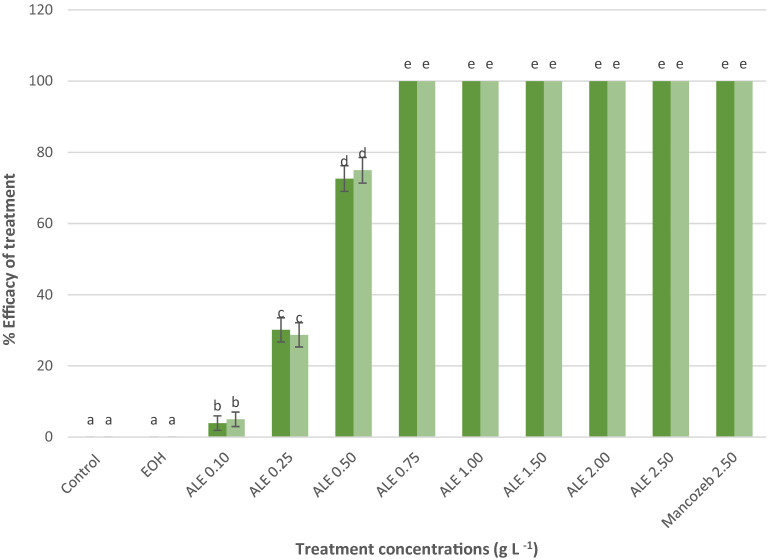
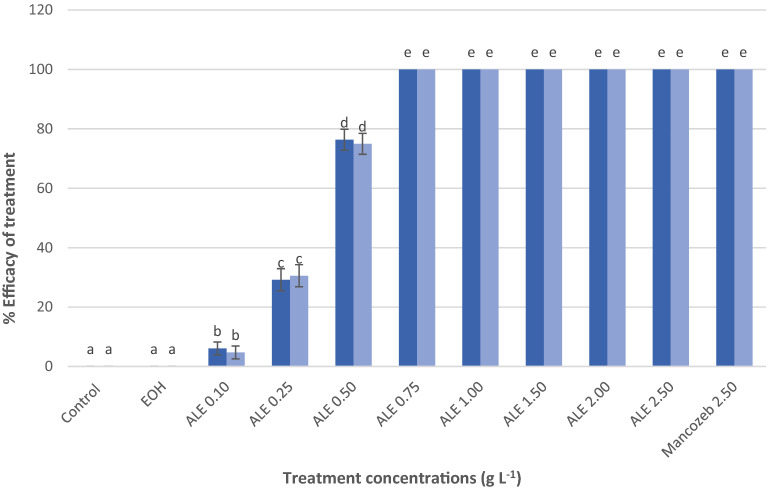
The present study focused on the effect of Allium longicuspis extracts (ALE) against anthracnose of mango fruit. In vitro tests (mycelial growth and conidial germination) showed that, ALE concentrated from 0.75 to 2.5 g L −1 completely inhibited the growth of Colletotrichum gloesporioides . Cytoplasmic discharge, mycelial and conidial blasts were clearly observed when applied with ALE. The minimum effective concentration (MEC) of ALE at 0.75 g L 1 can be applied as protective, curative and simultaneous treatment in mango fruit to inhibit the anthracnose infection. Efficacy of garlic extract was relatively superior to synthetic fungicide based on protective, curative and simultaneous treatments. Twenty chemical components were detected in ALE based on GCMS analysis (Table 1). The six major components were the following: oleyl alcohol, methyl ether (42.04%), γ-sitosterol (15.85%), , 24-norursa-3.12-diene (5.62%), 1-octadecanol methyl ether (4.23%), n -pentadecanol (3.95%) and 2-vinyl-4h-1 3-dithiine (3.76%). The findings support the potential use of ALE as an alternative to synthetic fungicide.
Overview
CoChat Summary
TL;DR
Allium longicuspis extract (ALE) strongly inhibited mango anthracnose pathogen growth in vitro and reduced disease on mango fruit, with 0.75 g L−1 identified as the minimum effective concentration. The paper argues ALE may be a practical alternative to synthetic fungicide, and GC–MS found 20 compounds in the extract.
Key findings
- ALE at 0.75 g L−1 completely inhibited mycelial growth of *Colletotrichum gloeosporioides* in vitro, and 0.75–2.5 g L−1 completely inhibited growth in the abstract’s summary.
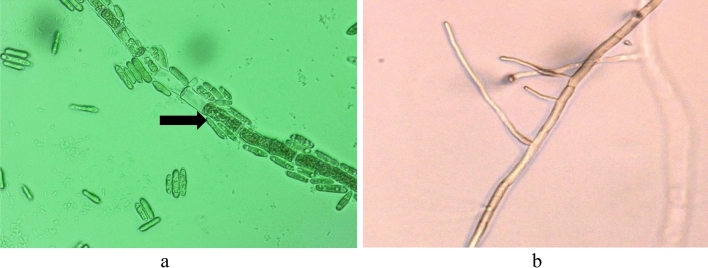
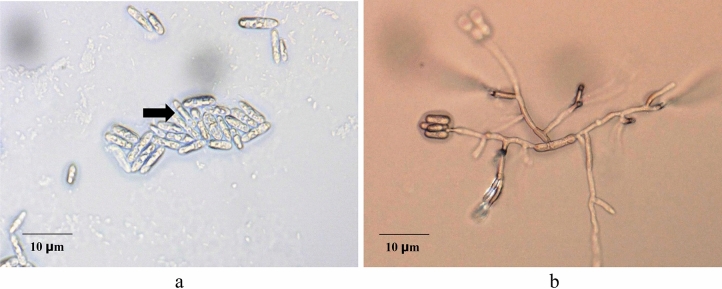
- ALE at 0.75 g L−1 completely inhibited conidial germination; treated conidia showed cytoplasmic discharge and conidial blast.
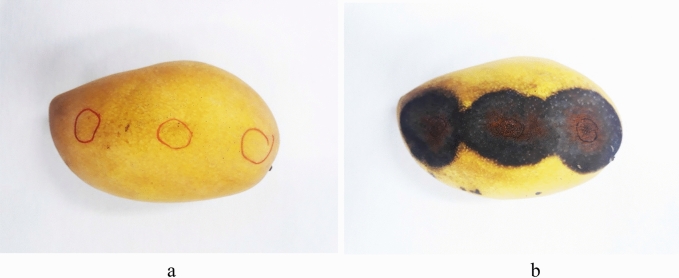
- In vivo, ALE 0.75 g L−1 caused no discoloration or detectable phytotoxicity on mango fruit even at the highest concentration tested (2.5 g L−1).
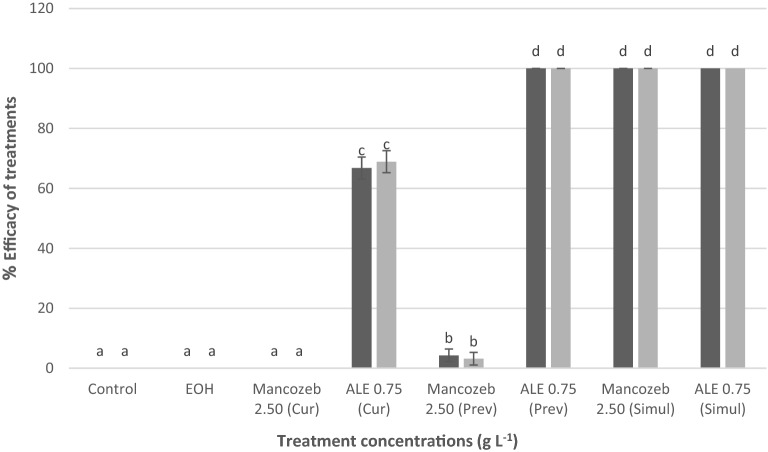
- For fruit treatment, ALE was reported as superior to Mancozeb: preventive application gave complete control, curative application gave 66.81–68.89% efficacy, and simultaneous application was 100% effective and statistically comparable to Mancozeb.
- GC–MS detected 20 chemical components; the six major ones were oleyl alcohol methyl ether (42.04%), γ-sitosterol (15.85%), 24-norursa-3,12-diene (5.62%), 1-octadecanol methyl ether (4.23%), n-pentadecanol (3.95%), and 2-vinyl-4h-1,3-dithiine (3.76%).
Methods
- Ethanol extracts of *Allium longicuspis* collected in Ilocos Sur, Philippines were prepared, vacuum filtered, evaporated, stored at −80 °C, and chemically profiled by GC/MS with NIST library matching.
- The fungal pathogen was isolated from anthracnose lesions on ripe mango cv. “Carabao” from a local market in Nueva Ecija, then cultured on PDA.
- In vitro assays tested ALE (0.1–2.5 g L−1) against mycelial growth and conidial germination, using water and ethanol controls plus Mancozeb as positive control; in vivo assays tested preventive, simultaneous, and curative treatments on wounded mango fruit with two trials, three replications, and ANOVA/Tukey’s HSD analysis.
Limitations
- The paper states that the effect of ALE was not fully explained mechanistically; it notes that “mode of action” and formulation should be investigated in future research.
- Evident from the text: the study uses one mango cultivar (“Carabao”) and a single pathogen isolate, so generalizability beyond this system is not established.
- Evident from the text: the in vivo work is limited to controlled storage conditions and short-term assessment over 7 days, not field or long-term postharvest performance.
Model-written summary. Check it against the paper before relying on it.
Integrity signals
Registry
Cites
Statistics
Figures
Verification
Claims the paper makes
1 Valid · 2 Not valid · 19 Not checked · 33 Own results and interpretations
A result the paper reports from its own data — it cites no other source for it, so there is none to check. The quote shows it is in the paper.
In the paper
“after 7 days, mango fruit treated with ALE resulted no discoloration nor detectable phytotoxicity was observed even at highest concentration of 2.5 g L−1 (Fig. 5a).”
§ Bioactivities of Allium longicuspis Regel against anthracnose of mango caused by Colletotrichum gloeosporioides (Penz.) > Results
plain- Asserted: passes — The authors put it forward as true.
- Checkable: passes — It can be checked against evidence.
- Load-bearing: passes — The paper’s conclusions depend on it.
- Based: passes — The paper gives a reason why it holds.
A result the paper states — it cites no source for it, so there is none to check. The quote shows it is in the paper.
In the paper
“On the other hand, higher efficacy of treatments (ALE and Mancozeb) was noticed in preventative over the curative test result.”
§ Bioactivities of Allium longicuspis Regel against anthracnose of mango caused by Colletotrichum gloeosporioides (Penz.) > Discussions
plainstates an association- Asserted: passes — The authors put it forward as true.
- Checkable: passes — It can be checked against evidence.
- Load-bearing: passes — The paper’s conclusions depend on it.
- Based: passes — The paper gives a reason why it holds.
A result the paper reports from its own data — it cites no other source for it, so there is none to check. The quote shows it is in the paper.
In the paper
“Complete inhibition of mycelial growth was observed starting from 0.75 g L−1 concentration of ALE and statistically comparable with the synthetic fungicides (Mancozeb) at 2.5 g L−1 concentration in terms of inhibitory effect on the mycelial growth.”
§ Bioactivities of Allium longicuspis Regel against anthracnose of mango caused by Colletotrichum gloeosporioides (Penz.) > Results
plain- Asserted: passes — The authors put it forward as true.
- Checkable: passes — It can be checked against evidence.
- Load-bearing: passes — The paper’s conclusions depend on it.
- Based: passes — The paper gives a reason why it holds.
A result the paper reports from its own data — it cites no other source for it, so there is none to check. The quote shows it is in the paper.
In the paper
“However, ALE was statistically comparable with the synthetic fungicide in terms of efficacy and inhibitory effect (100% effective) in simultaneous activities.”
§ Bioactivities of Allium longicuspis Regel against anthracnose of mango caused by Colletotrichum gloeosporioides (Penz.) > Results
plain- Asserted: passes — The authors put it forward as true.
- Checkable: passes — It can be checked against evidence.
- Load-bearing: passes — The paper’s conclusions depend on it.
- Based: passes — The paper gives a reason why it holds.
A result the paper reports from its own data — it cites no other source for it, so there is none to check. The quote shows it is in the paper.
In the paper
“Lower concentration (0.75 g L−1) of ALE was needed in vitro to achieve complete inhibition of mycelial growth as compared with the conventional synthetic fungicide (Mancozeb 2.5 g L−1).”
§ Bioactivities of Allium longicuspis Regel against anthracnose of mango caused by Colletotrichum gloeosporioides (Penz.) > Results
plainstates a cause- Asserted: passes — The authors put it forward as true.
- Checkable: passes — It can be checked against evidence.
- Load-bearing: passes — The paper’s conclusions depend on it.
- Based: passes — The paper gives a reason why it holds.
19 more claims
Create a free account to see all 55 claims and every source verdict.
- Probably not a substantial claim. 15
- It may state two separate claims as one. 21
- The quote only partly states this claim. 2
Claims other papers make about this one
Each is checked against this paper’s own text: does it say what the citing paper says it does?
The cited source says what the claim attributes to it.
In the citing paper
“in situ results showed a reduction in anthracnose incidence on mango fruit after extract application before, after, and simultaneously with C. gloeosporioides inoculation.”
From Green Management of Postharvest Anthracnose Caused by Colletotrichum gloeosporioides (2023) · cites this paper as [73]
The cited source says what the claim attributes to it.
In the citing paper
“Complete in vitro inhibition of C. gloeosporioides was found using the extract concentrated from 0.75 to 2.5 g/L.”
From Green Management of Postharvest Anthracnose Caused by Colletotrichum gloeosporioides (2023) · cites this paper as [73]
Citations
Cites
Biological properties of onions and garlic
CORZOMARTINEZ, M., CORZO, N., & VILLAMIEL, M. (2007) · Trends in Food Science & Technology · doi:10.1016/j.tifs.2007.07.011 · Cited by 810
The mode of action of allicin: trapping of radicals and interaction with thiol containing proteins
Rabinkov, A., Miron, T., Konstantinovski, L., Wilchek, M., Mirelman, D., & Weiner, L. (1998) · Biochimica et Biophysica Acta (BBA) - General Subjects · doi:10.1016/s0304-4165(97)00104-9 · Cited by 426
Miron, T., Rabinkov, A., Mirelman, D., Wilchek, M., & Weiner, L. (2000) · Biochimica et Biophysica Acta (BBA) - Biomembranes · doi:10.1016/s0005-2736(99)00174-1 · Cited by 353
Vogg, G., Fischer, S., Leide, J., Emmanuel, E., Jetter, R., Levy, A. A., & Riederer, M. (2004) · Journal of Experimental Botany · doi:10.1093/jxb/erh149 · Cited by 348
In Vitro Virucidal Effects of Allium sativum(Garlic) Extract and Compounds
Weber, N., Andersen, D., North, J., Murray, B., Lawson, L., & Hughes, B. (1992) · Planta Medica · doi:10.1055/s-2006-961504 · Cited by 327
Mango Anthracnose: Economic Impact and Current Options For Integrated Management
Arauz, L. F. (2000) · Plant Disease · doi:10.1094/pdis.2000.84.6.600 · Cited by 299
Kimbaris, A. C., Siatis, N. G., Daferera, D. J., Tarantilis, P. A., Pappas, C. S., & Polissiou, M. G. (2006) · Ultrasonics Sonochemistry · doi:10.1016/j.ultsonch.2004.12.003 · Cited by 281
Selection for resistance to azadirachtin in the green peach aphid,Myzus persicae
Feng, R., & Isman, M. B. (1995) · Experientia · doi:10.1007/bf01922438 · Cited by 249
Curtis, H., Noll, U., Störmann, J., & Slusarenko, A. J. (2004) · Physiological and Molecular Plant Pathology · doi:10.1016/j.pmpp.2004.11.006 · Cited by 229
Jetter, R., & Riederer, M. (2016) · Plant Physiology · doi:10.1104/pp.15.01699 · Cited by 206
Fungicide resistance action committee.
Highwood, D. P. (1990) · Pesticide Outlook · Cited by 187
The dose rate debate: does the risk of fungicide resistance increase or decrease with dose?
van den Bosch, F., Paveley, N., Shaw, M., Hobbelen, P., & Oliver, R. (2011) · Plant Pathology · doi:10.1111/j.1365-3059.2011.02439.x · Cited by 185
Sensitivity of food pathogens to garlic (Allium sativum)
Kumar, M., & Berwal, J. S. (1998) · Journal of Applied Microbiology · doi:10.1046/j.1365-2672.1998.00327.x · Cited by 176
Ankri, S., Miron, T., Rabinkov, A., Wilchek, M., & Mirelman, D. (1997) · Antimicrobial Agents and Chemotherapy · doi:10.1128/aac.41.10.2286 · Cited by 176
Balamurugan, R., Duraipandiyan, V., & Ignacimuthu, S. (2011) · European Journal of Pharmacology · doi:10.1016/j.ejphar.2011.05.025 · Cited by 173
A quantitative assessment of the antimicrobial activity of garlic (Allium sativum)
Rees, L. P., Minney, S. F., Plummer, N. T., Slater, J. H., & Skyrme, D. A. (1993) · World Journal of Microbiology & Biotechnology · doi:10.1007/bf00383068 · Cited by 168
Comparing impacts of plant extracts and pure allelochemicals and implications for pest control.
Opender Koul, O. K., & Suresh Walia, S. W. (2009) · CABI Reviews · doi:10.1079/pavsnnr20094049 · Cited by 151
Koul, O., Singh, G., Singh, R., Singh, J., Daniewski, W. M., & Berlozecki, S. (2004) · Journal of Biosciences · doi:10.1007/bf02712112 · Cited by 135
Shams-Ghahfarokhi, M., Shokoohamiri, M.-R., Amirrajab, N., Moghadasi, B., Ghajari, A., Zeini, F., Sadeghi, G., & Razzaghi-Abyaneh, M. (2006) · Fitoterapia · doi:10.1016/j.fitote.2006.03.014 · Cited by 134
Ploetz, R. C. (2003) · Diseases of tropical fruit crops · doi:10.1079/9780851993904.0327 · Cited by 105
Colletotrichum gloeosporioides (Anthracnose)
Siddiqui, Y., & Ali, A. (2014) · Elsevier eBooks · doi:10.1016/b978-0-12-411552-1.00011-9 · Cited by 99
Foliar, floral and soilborne diseases.
Ploetz, R. C., & Freeman, S. (2009) · The mango: botany, production and uses · doi:10.1079/9781845934897.0231 · Cited by 71
Activity of the novel fungicide SYP-Z048 against plant pathogens
Chen, F., Han, P., Liu, P., Nai-guo, S., Liu, J., & Liu, X. (2014) · Scientific Reports · doi:10.1038/srep06473 · Cited by 65
Portz, D., Koch, E., & Slusarenko, A. J. (2008) · European Journal of Plant Pathology · doi:10.1007/s10658-008-9334-x · Cited by 59
Kumar, A., Reddy, N. P. E., Reddy, K. H., & Devi, M. C. (2007) · Zhíwù bìnglǐxué huìkān · doi:10.6649/ppb.200709_16(3).0006 · Cited by 53
Alvindia, D. G., & Acda, M. A. (2015) · Crop Protection · doi:10.1016/j.cropro.2014.09.016 · Cited by 53
Self-citationDevelopment of Insect Resistance to Plant Biopesticides: An Overview
Tangtrakulwanich, K., & Reddy, G. V. P. (2014) · Advances in Plant Biopesticides · doi:10.1007/978-81-322-2006-0_4 · Cited by 44
Resistance of Mango Pathogens to Fungicides Used to Control Postharvest Diseases
Spalding, D. H. (1982) · Plant Disease · doi:10.1094/pd-66-1185 · Cited by 44
Endrini, S., Rahmat, A., Ismail, P., & Taufiq-Yap, Y. H. (2015) · Medical Journal of Indonesia · doi:10.13181/mji.v23i4.1085 · Cited by 43
(2001) · PubMed · Cited by 43
(2007) · Journal of agricultural and biological science · Cited by 40
Camacho-Vázquez, C., Ruiz-May, E., Guerrero-Analco, J. A., Elizalde-Contreras, J. M., Enciso-Ortiz, E. J., Rosas-Saito, G., López-Sánchez, L., Kiel-Martínez, A. L., Bonilla-Landa, I., Monribot-Villanueva, J. L., et al. (2019) · Postharvest Biology and Technology · doi:10.1016/j.postharvbio.2018.10.006 · Cited by 40
Ali, A., Mohamed, M. T. M., & Siddiqui, Y. (2012) · Journal of Biology and Life Science · doi:10.5296/jbls.v3i1.1306 · Cited by 34
Ji, S. H., Kim, T. K., Keum, Y. S., & Chun, S. (2018) · Mycobiology · doi:10.1080/12298093.2018.1505245 · Cited by 34
Clionasterol: A Potent Inhibitor of Complement Component C1
Cerqueira, F., Watanadilok, R., Sonchaeng, P., Kijjoa, A., Pinto, M., Quarles van Ufford, H., Kroes, B., Beukelman, C., & Nascimento, M. S. (2003) · Planta Medica · doi:10.1055/s-2003-37719 · Cited by 27
Figueiredo, K. V., Oliveira, M. T., Oliveira, A. F. M., Silva, G. C., & Santos, M. G. (2012) · Australian Journal of Botany · doi:10.1071/bt12168 · Cited by 27
Alvindia, D. G., & Acda, M. A. (2015) · Biocontrol Science and Technology · doi:10.1080/09583157.2014.996738 · Cited by 22
Self-citationHosseinzadeh, H., & Sadati, N. (2003) · Phytotherapy Research · doi:10.1002/ptr.1114 · Cited by 13
Mangoba, M. A. A., & Alvindia, D. D. G. (2019) · Journal of Biologically Active Products from Nature · doi:10.1080/22311866.2019.1702898 · Cited by 8
Self-citationAntibacterial Effects of Garlic Extract on Vibrio parahaemolyticus in Fish Meat
SATO, A., TERAO, M., & ISHIBASHI, M. (1993) · Food Hygiene and Safety Science (Shokuhin Eiseigaku Zasshi) · doi:10.3358/shokueishi.34.63 · Cited by 6
Research works printed but not linked: 3
- Nuevo, P. A. & Apaga, A. R. M. Technology reducing postharvest losses and maintain quality of fruits and vegetables (Philippines). In Technology Reducing Postharvest Losses and Maintain Quality of Fruits and Vegetables (Huang, C. C., Yang, C. M., Ou, S. K., Chen, J. J. eds.). Taiwan: Taiwan Agricultural Research Institute, Council of Agriculture Special Publication No. 147, 154–167 (2010).
- Donkin DJ Oosthuyse SA Quality evaluations of sea-exported South African mangoes in Europe during the 1995/96 season South Afr. Mango Growers Assoc. Yearb. 1996 16 1 5
- Waqar A Quaratulain S Altaf H Ahmad GM Asghar Z Evaluation of different garlic extracts for antibacterial activity Sci. Int. 1994 5 385 386
Cited by
Green Management of Postharvest Anthracnose Caused by Colletotrichum gloeosporioides
Peralta-Ruiz, Y., Rossi, C., Grande-Tovar, C. D., & Chaves-López, C. (2023) · Journal of Fungi · doi:10.3390/jof9060623 · Cited by 99
Teixeira, A., Sánchez‐Hernández, E., Noversa, J., da Cunha, A. C. G., Cortez, I., Marques, G., Martín‐Ramos, P., & de Oliveira, R. P. S. (2023) · Horticulturae · doi:10.3390/horticulturae9020136 · Cited by 44
Mangoba, M. A. A., & Alvindia, D. D. G. (2023) · Scientific Reports · doi:10.1038/s41598-023-33396-5 · Cited by 30
Self-citationFernandes, K. F. D., Queiroga, T. S., Lima, M. D. C., de Oliveira, K. Á. R., & de Souza, E. L. (2024) · Comprehensive Reviews in Food Science and Food Safety · doi:10.1111/1541-4337.13427 · Cited by 29
Choudhary, H., Dhar, V., Dave, P. P., & Pareek, S. (2025) · Crop Science · doi:10.1002/csc2.70064 · Cited by 19
Metadata
- Authors
- de Guzman Alvindia, D., & Mangoba, M. A. A.
- Affiliations
- Konkuk University (KR)
- Corresponding author
- Mangoba, Mark Anthony Angeles
- Venue
- Scientific Reports
- Published
- 2020-07-09
- Volume
- 10
- Issue
- 1
- Pages
- 11367-11367
- ISSN
- 2045-2322 (ISSN-L)
- PMC
- PMC7347625
- OpenAlex
- W3041785308
- Semantic Scholar
- cc2fd285a56d5269d20268bb34f4616d786f825d
- Cited by
- 18
- References
- 40
- Citations by year
- 2026: 2 · 2025: 7 · 2024: 2 · 2023: 4 · 2022: 2 · 2021: 1
- FWCI
- 1.31
- Type
- journal article
- Language
- en
- Update notices
- correction (2020-12-15)
- Open access
- gold
- doi.org
- Licence
- cc-by
- creativecommons.org/licenses/by/4.0 (tdm)
- creativecommons.org/licenses/by/4.0 (vor)
- Locations
- Scientific Reports (publishedVersion, cc-by)
- PubMed Central (publishedVersion, cc-by)
- PubMed (publishedVersion)
- Greater South Information System
- Funders
- Konkuk University
- Korea International Cooperation Agency
- Topics
- Life Sciences › Agricultural and Biological Sciences › Plant Science › Fungal Plant Pathogen Control
- Life Sciences › Agricultural and Biological Sciences › Food Science › Essential Oils and Antimicrobial Activity
- Life Sciences › Agricultural and Biological Sciences › Plant Science › Garlic and Onion Studies
- Keywords
- mango anthracnose, Colletotrichum gloeosporioides, mycelial growth inhibition, conidial germination, minimum effective concentration, plant chemical composition, oleyl alcohol, γ-sitosterol
- MeSH terms
- Fruit, Garlic, Philippines, Plant Diseases, Plant Extracts, Spores, Fungal, Crops, Agricultural, Colletotrichum, Mangifera
About these checks
Registry, retraction, Cites and statistics results are computed, not judged, with one exception: a printed reference that no index lists is read once by a model before it counts as a citation error. Claims are extracted by a model and kept only when their quote appears verbatim in the text; each cited source is then checked, with a model’s help, for whether it says what the claim relies on. Those verdicts can be wrong — read the claim’s quote and the cited source before relying on one.
The claim verdicts this report counts are experimental: their accuracy is not yet measured.
A language model drew the claims from the paper on 2026-10-10, under version 3 of the claim definition (model deepseek-v4.1-flash, prompt extract-v3).
A second model labelled each claim on 2026-10-10 (model jev-1.13-20260917, definition revision gold-guideline-v0.2).
Statistics and arithmetic are recomputed, not judged.
Confidence bands are shown only for fields calibrated on our annotated test set. None is calibrated yet, so no band is shown.
What counts as a claim ›How we measure confidence ›How we check this ›
Are you an author, or do you see a problem with this page? Request a review
Data sources
Bibliographic data: Semantic Scholar, OpenAlex, Crossref.
Contains information from the Semantic Scholar Academic Graph Datasets, made available under the ODC Attribution License (ODC-BY 1.0).
Semantic Scholar’s data is described in: Kinney, R., et al. (2023). The Semantic Scholar Open Data Platform. arXiv:2301.10140.
