

The COVID-19 social media infodemic
Open accessThe DOI matches its Crossref record; 57 of the 57 references it cites were found in a registry or an index.
Abstract
We address the diffusion of information about the COVID-19 with a massive data analysis on Twitter, Instagram, YouTube, Reddit and Gab. We analyze engagement and interest in the COVID-19 topic and provide a differential assessment on the evolution of the discourse on a global scale for each platform and their users. We fit information spreading with epidemic models characterizing the basic reproduction number $$R_0$$ R 0 for each social media platform. Moreover, we identify information spreading from questionable sources, finding different volumes of misinformation in each platform. However, information from both reliable and questionable sources do not present different spreading patterns. Finally, we provide platform-dependent numerical estimates of rumors’ amplification.
Overview
The claims and statistics of this paper haven’t been checked yet.
Free: it reads the open-access text and checks the first 5 claims that cite a source we can check. Create a free account to check every claim.
Integrity signals
Registry
Cites
Statistics
Figures
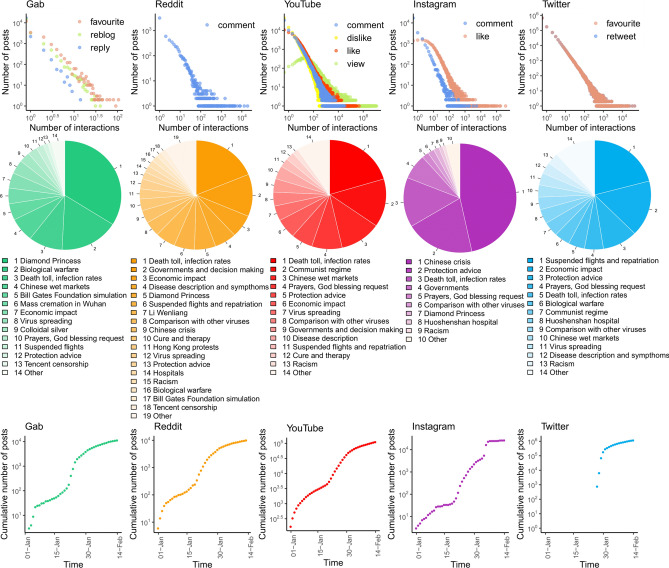
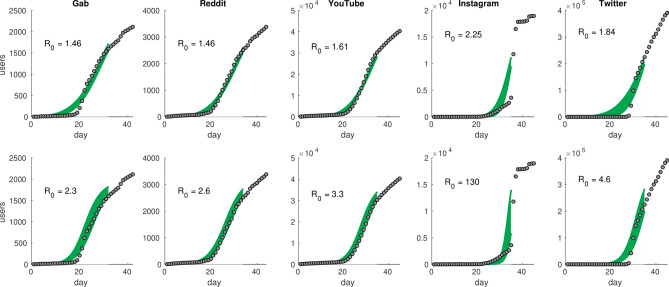
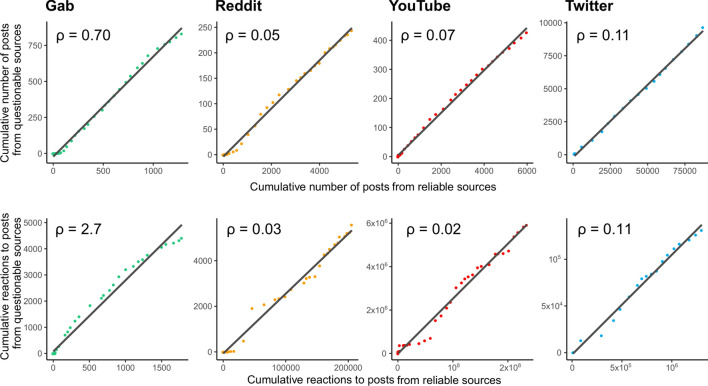
Verification
Claims the paper makes
The claims and statistics of this paper haven’t been checked yet.
Free: it reads the open-access text and checks the first 5 claims that cite a source we can check. Create a free account to check every claim.
Claims other papers make about this one
Each is checked against this paper’s own text: does it say what the citing paper says it does?
The source backs part of the claim, not all of it — or backs it for a different population, condition or comparison.
In the citing paper
“Our attention span remains limited (9, 10), and feed algorithms might limit our selection process by suggesting contents similar to the ones we are usually exposed to (11–13).”
From The echo chamber effect on social media (2021) · cites this paper as [12]
Experimental — accuracy not yet measuredThe cited source says what the claim attributes to it.
In the citing paper
“The uncontrolled dissemination of false or misleading health information via digital channels represents one of the most complex and urgent challenges currently facing Public Health (1, 2).”
From Health misinformation, digital health literacy, and attitudes toward science among university students: an exploratory cross-sectional survey (2026) · cites this paper as [2]
The cited source says what the claim attributes to it.
In the citing paper
“the amplification of questionable sources of COVID-19 misinformation is highly platform dependent, with some platforms amplifying questionable content less than reliable content 58 .”
From Measuring the impact of COVID-19 vaccine misinformation on vaccination intent in the UK and USA (2021) · cites this paper as [58]
The cited source says what the claim attributes to it.
In the citing paper
“The broad public reach of the Internet and social media favours the spread of rumours and dissemination of unreliable information [7].”
Self-check
Percentages, sums and reported differences re-computed from the paper’s own numbers.
The self-check needs the paper’s full text.
Citations
Cites
An Introduction to the Bootstrap
Efron, B., & Tibshirani, R. J. (1994) · doi:10.1201/9780429246593 · Cited by 40,500
Learning representations by back-propagating errors
Rumelhart, D. E., Hinton, G. E., & Williams, R. J. (1986) · Nature · doi:10.1038/323533a0 · Cited by 31,892 · cited 1×
“More formally, given a content represented by the sequence of words w 1 , w 2 , . . . , w T , we use stochastic gradient descent with gradient computed through backpropagation rule [39] for maximizing the average log probability where k is the size of the training window.”
MethodDistributed Representations of Words and Phrases and their Compositionality
Mikolov, T., Sutskever, I., Chen, K., Corrado, G., & Dean, J. (2013) · arXiv · doi:10.48550/arxiv.1310.4546 · Cited by 24,533
The spread of true and false news online
Vosoughi, S., Roy, D., & Aral, S. (2018) · Science · doi:10.1126/science.aap9559 · Cited by 8,847 · cited 2×
“Some studies pointed out that fake news and inaccurate information may spread faster and wider than fact-based news [22].”
BackgroundAn Introduction to the Bootstrap.
Buckland, S. T., Efron, B., & Tibshirani, R. J. (1994) · Biometrics · doi:10.2307/2532810 · Cited by 3,103
Linguistic Regularities in Continuous Space Word Representations
Mikolov, T., Yih, W.-T., & Zweig, G. (2013) · North American Chapter of the Association for Computational Linguistics · Cited by 2,912
The spread of behavior in an online social network experiment
Centola, D. (2010) · Science · doi:10.1126/science.1185231 · Cited by 2,692 · cited 1×
“While R0 is a good proxy for the engagement rate and a good predictor for epidemic-like information spreading, social contagion phenomena might be in general more complex [34, 35, 36].”
BackgroundThe spreading of misinformation online
Del Vicario, M., Bessi, A., Zollo, F., Petroni, F., Scala, A., Caldarelli, G., Stanley, H. E., & Quattrociocchi, W. (2016) · Proceedings of the National Academy of Sciences · doi:10.1073/pnas.1517441113 · Cited by 2,407 · cited 2×
“social perceptions [11] and the framing of narratives; it in uences policy-making, political communication, as well as the evolution of public debate [12, 13] especially when issues are controversial [14]. Indeed, users online tend to acquire information adhering to their worldviews [15], to ignore dissenting informat…”
BackgroundMethodSelf-citationZarocostas, J. (2020) · The Lancet · doi:10.1016/s0140-6736(20)30461-x · Cited by 2,344 · cited 1×
“The term infodemic [2, 3] has been coined to outline the perils of misinformation phenomena during the management of virus outbreaks [4, 5], since it could even speed up the epidemic process by influencing and fragmenting social response [6].”
BackgroundThe Mathematical Theory of Infectious Diseases and its applications
Ling, N. R. (1978) · Immunology · Cited by 1,934
Cited by
Items 601–700 of 1,008
Ebrahim, S. (2022) · Health SA Gesondheid · doi:10.4102/hsag.v27i0.1683 · Cited by 19
“Whilst the disease may have been first recorded in China, contagion to other regions because of international travel and subsequent local transmission have changed the virus’s foothold several times.”
BackgroundInfluentialArCovidVac: Analyzing Arabic Tweets About COVID-19 Vaccination
Mubarak, H., Hassan, S., Chowdhury, S. A., & Alam, F. (2022) · Language Resources and Evaluation Conference (LREC) · doi:10.63317/2zpc6rcxar5t · Cited by 19
Using Fuzzy Clustering with Deep Learning Models for Detection of COVID-19 Disinformation
Chen, M., & Lai, Y.-W. (2022) · ACM Transactions on Asian and Low-Resource Language Information Processing · doi:10.1145/3548458 · Cited by 22
“The World Health Organization calls this phenomenon as "infodemic" [3].”
BackgroundTrust in social media and COVID-19 beliefs and behaviours
Nicholls, N., & Yitbarek, E. A. (2022) · PLoS ONE · doi:10.1371/journal.pone.0275969 · Cited by 20
Harambam, J. (2024) · Journal of Digital Social Research · doi:10.33621/jdsr.v5i3.143 · Cited by 25
“Nor are they mere gullible citizens, all too easily manipulable by propaganda, roque actors and opaque algorithms (Benkler et al., 2018; Bennett & Livingston, 2018; Cinelli et al., 2020; Roozenbeek et al., 2020).”
BackgroundBroniatowski, D. A., Kerchner, D., Farooq, F., Huang, X., Jamison, A., Dredze, M. H., & Quinn, S. C. (2020) · arXiv (Cornell University) · doi:10.48550/arxiv.2007.09682 · Cited by 27
“se, COVID-19, vastly exceeded that pertaining to all other viral illnesses in the vaccine stream. 4.2 COVID-19Tweets Contain ProportionallyLess Non-Credible Content than OtherDatasets Like prior work [15,24,26,28], we find that the proportion of tweets from sources tagged as “not credible” is quite small, with the COV…”
BackgroundResultInfluentialMichelot, F., Béland, S., & Poëllhuber, B. (2022) · Higher Education Skills and Work-based Learning · doi:10.1108/heswbl-10-2021-0191 · Cited by 22
Herrero-Diz, P., & Pérez-Escolar, M. (2022) · Palabra Clave · doi:10.5294/pacla.2022.25.1.7 · Cited by 20
Network social capital and health information acquisition
Ahn, S., Lee, C., & Ko, Y. (2022) · Patient Education and Counseling · doi:10.1016/j.pec.2022.05.007 · Cited by 19
Investigation of COVID-19 Misinformation in Arabic on Twitter: Content Analysis
Al‐Rawi, A., Fakida, A., & Grounds, K. (2022) · JMIR Infodemiology · doi:10.2196/37007 · Cited by 22
“The COVID-19 pandemic has occurred in tandem with what is being called an infodemic, referring to the large amounts of false and misleading content about the virus being disseminated primarily over social media platforms [1].”
BackgroundFact-Checking Journalism: A Palliative Against the COVID-19 Infodemic in Ibero-America
Martínez-García, L., & Ferrer, I. (2023) · Journalism & Mass Communication Quarterly · doi:10.1177/10776990231164168 · Cited by 22
“This added to the constant erosion of trust in institutions, pointing to the observations of Papapicco (2020) and Cinelli et al. (2020), who warned that disinformation undermines the effectiveness of public health campaigns.”
BackgroundResultMensah, I. K., Khan, M. K., Liang, J., Zhu, N., Lin, L.-W., & Mwakapesa, D. S. (2023) · Frontiers in Psychology · doi:10.3389/fpsyg.2023.1172094 · Cited by 19
“This gap is vital since the nature of COVID-19 information shared on social media systems has the power to drive people’s behavioral response and may to some extent change the effectiveness of the counter mechanisms deployed by governments to fight the pandemic (Cinelli et al., 2020).”
BackgroundDeep learning for COVID-19 topic modelling via Twitter: Alpha, Delta and Omicron
Lande, J., Pillay, A. A., & Chandra, R. (2023) · PLoS ONE · doi:10.1371/journal.pone.0288681 · Cited by 20
“Although social media played a vital role in the pandemic, there was often alterations in dissemination of reports from the authorities, resulting to misinformation in social media [92] which had positive and negative impacts [17], which was not constrained to India.”
BackgroundHow does media coverage affect a COVID-19 pandemic model with direct and indirect transmission?
Thirthar, A. A., Jawad, S., Shah, K., & Abdeljawad, T. (2024) · Journal of Mathematics and Computer Science · doi:10.22436/jmcs.035.02.04 · Cited by 18
“The media exerts a substantial impact on disseminating valuable information through different channels, such as community radio, television, print media, and the internet (e.g., journals and newspapers), thereby influencing the behavior of a community [10].”
Understanding the complex links between social media and health behaviour
Zollo, F., Baronchelli, A., Betsch, C., Delmastro, M., & Quattrociocchi, W. (2024) · BMJ · doi:10.1136/bmj-2023-075645 · Cited by 20
“22 Despite earlier findings suggesting that false news might spread faster than trustworthy information, analysis of various platforms indicates no substantial difference in the spread of reliable versus questionable information.”
BackgroundSelf-citationInformation disorder’s impact on adolescents: publication trends and recommendations
Irwanto, I., Bahfiarti, T., Unde, A. A., & Sonni, A. F. (2025) · Frontiers in Communication · doi:10.3389/fcomm.2025.1495536 · Cited by 19
Zhao, B., Kong, F., & Nam, E. W. (2021) · Healthcare · doi:10.3390/healthcare9040433 · Cited by 21
“During this outbreak, the influence of rumors cannot be overlooked [63].”
Using infographics to improve trust in science: a randomized pilot test
Agley, J. D., Xiao, Y., Thompson, E. E., & Golzarri‐Arroyo, L. (2021) · BMC Research Notes · doi:10.1186/s13104-021-05626-4 · Cited by 20
“These narratives can spread very quickly [5] and have been associated, directly and indirectly, with harmful outcomes [6-8] as well as reduced personal wellness [9].”
BackgroundStigma Mutation: Tracking Lineage, Variation and Strength in Emerging COVID-19 Stigma
Farrimond, H. R. (2021) · Sociological Research Online · doi:10.1177/13607804211031580 · Cited by 22
“The ‘infodemic’ offers almost limitless informational content on COVID-19 from social media platforms (e.g. Weibo, Twitter, and Facebook), most unverified by public health sources, stemming from influencers or celebrities as well as political organizations (hidden and visible; Cinelli et al., 2020).”
BackgroundInformation Extraction and Sentiment Analysis to Gain Insight into the COVID-19 Crisis
Avasthi, S., Chauhan, R., & Acharjya, D. P. (2021) · Advances in intelligent systems and computing · doi:10.1007/978-981-16-2594-7_28 · Cited by 19
Mejía-Lancheros, C., Alfayumi‐Zeadna, S., Lachaud, J., O'Campo, P. J., Gogosis, E., Silva, G. D., Stergiopoulos, V., Hwang, S. W., & Thulien, N. S. (2022) · Health & Social Care in the Community · doi:10.1111/hsc.13826 · Cited by 19
“…disadvantaged people have access to internet and phone services and updated and reliable COVID- 19 related information also contribute to reducing their exposure risk and their role in spreading the SARS- CoV- 2 virus (Cinelli et al., 2020; Fakultaet & Sciences, 2020; Tsao et al., 2021).”
BackgroundDas, B., & Sudarshan, T. S. B. (2023) · Online Social Networks and Media · doi:10.1016/j.osnem.2023.100247 · Cited by 20
Lack of evidence for correlation between COVID-19 infodemic and vaccine acceptancePreprint
Valensise, C. M., Cinelli, M., Nadini, M., Galeazzi, A., Peruzzi, A., Etta, G., Zollo, F., Baronchelli, A., & Quattrociocchi, W. (2021) · arXiv (Cornell University) · doi:10.48550/arxiv.2107.07946 · Cited by 22
“However, the effect of the interplay between online information diffusion and offline user behaviour is still an open scientific question, with fundamental societal implications especially during a crisis like the ongoing pandemic [1, 18, 19, 20].”
BackgroundSelf-citationBouclaous, C., Kamand, A. A., Daher, R., Alrazim, A., & Kaedbey, H. D. (2023) · Nordic Journal of Digital Literacy · doi:10.18261/njdl.18.1.6 · Cited by 17
Gathering, processing, and interpreting information about COVID-19
Boot, A. B., Eerland, A., Jongerling, J., Verkoeijen, P. P. J. L., & Zwaan, R. A. (2021) · Scientific Reports · doi:10.1038/s41598-021-86088-3 · Cited by 18
Impacts of the COVID-19 Pandemic on the Bereaved: A Study of Bereaved Weibo Users
Han, N., Chen, G., Li, S., Huang, F., Wang, X., Ren, X., & Zhu, T. (2021) · Healthcare · doi:10.3390/healthcare9060724 · Cited by 19
Bok, S., Martin, D. E., Acosta, E., Lee, M., & Shum, J. (2021) · International Journal of Environmental Research and Public Health · doi:10.3390/ijerph182111319 · Cited by 14
“A greater number of infections utilized limited health care resources to treat cases [34].”
BackgroundEm Quem Confiam os Portugueses? A Gestão da Comunicação Governamental na Pandemia Covid-19
Gonçalves, G., Piñeiro-Naval, V., & Toniolo, B. P. (2021) · Comunicação e Sociedade · doi:10.17231/comsoc.40(2021).3251 · Cited by 35
Théories du complot et COVID-19 : comment naissent les croyances complotistes ?
Bottemanne, H. (2022) · L Encéphale · doi:10.1016/j.encep.2021.12.005 · Cited by 22
“Ce phénomène qualifié d’infodémie a évolué parallèlement à la dissémination du virus à travers le monde, particulièrement via les médias non traditionnels comme les réseaux sociaux [2,3].”
Meta-Reflexivity as a Way toward Responsible and Sustainable Behavior
Golob, T., & Makarovič, M. (2022) · Sustainability · doi:10.3390/su14095192 · Cited by 22
Uphold, H. S., Drahota, A., Bustos, T. E., Crawford, M. K., & Buchalski, Z. (2022) · Journal of Clinical and Translational Science · doi:10.1017/cts.2022.437 · Cited by 20
“RAP analyses identified three salient themes related to barriers, including subthemes [30].”
InfluentialVärttö, M. (2023) · European Policy Analysis · doi:10.1002/epa2.1190 · Cited by 22
News and misinformation consumption: A temporal comparison across European countries
Baqir, A., Galeazzi, A., & Zollo, F. (2024) · PLoS ONE · doi:10.1371/journal.pone.0302473 · Cited by 21
Self-citationSong, T., Yu, P., Yecies, B., Ke, J., & Yu, H. (2025) · Scientific Reports · doi:10.1038/s41598-025-90759-w · Cited by 24
Towards a psychosemiotics of journalism, mental distress and Covid-19
Niblock, S. (2020) · Social Semiotics · doi:10.1080/10350330.2020.1779456 · Cited by 17
“See, for examples, Pulido et al. 2020; Medford et al. 2020; Cinelli et al. 2020.”
BackgroundHelping Users Tackle Algorithmic Threats on Social Media: A Multimedia Research Agenda
von der Weth, C., Abdul, A., Fan, S., & Kankanhalli, M. (2020) · ACM International Conference on Multimedia (ACM MM) · doi:10.1145/3394171.3414692 · Cited by 26
“During the COVID-19 crisis, misleading claims about infection statistics have resulted in delayed or ignored counteractions (e.g., social distancing measures).”
ResultInfluentialGoing Viral: The 3 Rs of Social Media Messaging during Public Health Emergencies
Murthy, B. P., LeBlanc, T. T., Vagi, S. J., & Avchen, R. N. (2020) · Health Security · doi:10.1089/hs.2020.0157 · Cited by 17
“New research shows that the viral spread of information can be compared to an infectious pathogen’s R0, where information shared on social media platforms such as Twitter, Instagram and YouTube can have R0 > 1 indicating an infodemic, analogous to an epidemic.(10) Segmented media markets are creating opportunities for…”
BackgroundSentiment, Count and Cases: Analysis of Twitter discussions during COVID-19 Pandemic
Soomro, Z. T., Ilyas, S. H. W., & Yaqub, U. (2020) · International Conference on Behavioral, Economic, and Socio-Cultural Computing · doi:10.1109/besc51023.2020.9348291 · Cited by 17
“Cinelli et al. looked at the spread of COVID-19 related information diffusion across multiple social media platforms such as Twitter, Instagram, YouTube, Reddit, and Gab [11].”
BackgroundSchoultz, M., Leung, J., Bonsaksen, T., Ruffolo, M. C., Thygesen, H., Price, D., & Geirdal, A. Ø. (2021) · Healthcare · doi:10.3390/healthcare9060735 · Cited by 19
Gabrielli, F., & Irtelli, F. (2021) · IntechOpen eBooks · doi:10.5772/intechopen.95017 · Cited by 19
COVID-19 in Bulgarian Social Media: Factuality, Harmfulness, Propaganda, and Framing
Nakov, P., Alam, F., Shaar, S., Martino, G. D. S., & Zhang, Y. (2021) · International conference Recent advances in natural language processing · doi:10.26615/978-954-452-072-4_113 · Cited by 37
“Another less relevant research line is on the development of datasets of tweets about COVID-19 (Cinelli et al., 2020; Song et al., 2021; Zhou et al., 2020; Haouari et al., 2021)”
BackgroundGiatti, L. L. (2021) · Futures · doi:10.1016/j.futures.2021.102888 · Cited by 18
Lin, Y.-C. J. (2022) · Chinese Journal of Communication · doi:10.1080/17544750.2021.2011343 · Cited by 18
“Cinelli et al. (2020) analyzed the dynamics of how information on the same argument spreads in environments with different interaction settings and audiences on several digital platforms, such as Twitter, Instagram, YouTube, Reddit, and Gab.”
BackgroundSocial Media Driven Big Data Analysis for Disaster Situation Awareness: A Tutorial
Pal, A., Wang, J., Wu, Y., Kant, K., Liu, Z., & Sato, K. (2022) · IEEE Transactions on Big Data · doi:10.1109/tbdata.2022.3158431 · Cited by 17
“Reference [128] Discussed the diffusion of Covid related information with a”
BackgroundChopra, H., Vashishtha, A., Pal, R., Ashima, Tyagi, A., & Sethi, T. (2023) · JMIR Infodemiology · doi:10.2196/34315 · Cited by 18
“Social media plays a decisive role in propagating information, leading to the emergence of varying perceptions related to the pandemic [5].”
MM-Claims: A Dataset for Multimodal Claim Detection in Social Media
Cheema, G. S., Hakimov, S., Sittar, A., Müller-Budack, E., Otto, C., & Ewerth, R. (2022) · Findings of the Association for Computational Linguistics: NAACL · doi:10.18653/v1/2022.findings-naacl.72 · Cited by 38
Modeling algorithmic bias: simplicial complexes and evolving network topologies
Pansanella, V., Rossetti, G., & Milli, L. (2022) · Applied Network Science · doi:10.1007/s41109-022-00495-7 · Cited by 25
Exploring Pandemics Events on Twitter by Using Sentiment Analysis and Topic Modelling
Qin, Z., & Ronchieri, E. (2022) · Applied Sciences · doi:10.3390/app122311924 · Cited by 23
Gao, J., Raza, S. H., Yousaf, M., Shah, A. A., Hussain, I., & Malik, A. N. (2023) · Vaccines · doi:10.3390/vaccines11010114 · Cited by 21
Matthews, J., Zhao, X., Jackson, D., Thorsen, E., Mellado, C., Abuali, Y., & Glück, A. (2023) · Health Communication · doi:10.1080/10410236.2022.2162702 · Cited by 19
“…urgent examination during the COVID-19 pandemic given the central importance of quality information to health outcomes, the centrality of social media as an outlet for news audiences, and the concerns that some have raised about the circulation of misinformation online (Cinelli et al., 2020).”
BackgroundUnderstanding the dynamics emerging from infodemics: a call to action for interdisciplinary research
Leitner, S., Gula, B., Jannach, D., Krieg-Holz, U., & Wall, F. (2021) · SN Business & Economics · doi:10.1007/s43546-020-00027-4 · Cited by 19
“…spread of (mis)information related to the COVID-19 pandemic (Pulido et al. 2020; Rovetta and Bhagavathula 2020); it has led to significantly more worldwide fear, panic, and uncertainty as compared to infodemics that emerged from previous pandemics (Cinelli et al. 2020; Vaezi and Javan-mard 2020).”
BackgroundInfluentialHow can systems thinking help us in the COVID‐19 crisis?
Zięba, K. (2021) · Knowledge and Process Management · doi:10.1002/kpm.1680 · Cited by 21
Representing and utilizing clinical textual data for real world studies: An OHDSI approach
Keloth, V. K., Banda, J. M., Gurley, M., Heider, P. M., Kennedy, G., Liu, H., Liu, F., Miller, T., Natarajan, K., V Patterson, O., et al. (2023) · Journal of Biomedical Informatics · doi:10.1016/j.jbi.2023.104343 · Cited by 16
Tracking evolving communities in fake news cascades using temporal graphs
Ma, Y., Qu, D., & Wang, Y. (2026) · Scientific Reports · doi:10.1038/s41598-026-35175-4 · Cited by 47
Yuan, T., Li, X., Zhang, M., Tao, X. B., Xu, S. J., & Liu, H. (2022) · Frontiers in Public Health · doi:10.3389/fpubh.2022.1015803 · Cited by 18
Rubín, A., Brondi, S., & Pellegrini, G. (2022) · Quality & Quantity · doi:10.1007/s11135-022-01569-5 · Cited by 18
Quantifying investor narratives and their role during COVID‐19
Borup, D., Hansen, J. W., Liengaard, B. D., & Schütte, E. C. M. (2020) · Journal of Applied Econometrics · doi:10.1002/jae.2964 · Cited by 18
Tabak, B. M., Froner, M. B., Corrêa, R. S., & Silva, T. C. (2023) · International Journal of Environmental Research and Public Health · doi:10.3390/ijerph20206951 · Cited by 17
“Many people were overwhelmed by accurate and inaccurate information, which was difficult to distinguish, especially given the unfamiliarity of the situation [31–34].”
BackgroundHussna, A. U., Alam, M. G. R., Islam, R., Alkhamees, B. F., Hassan, M. M., & Uddin, M. Z. (2024) · Heliyon · doi:10.1016/j.heliyon.2024.e37760 · Cited by 22
“The authors of [77] have developed an intriguing approach to address the challenges related to the spread of misinformation during the COVID-19 pandemic.”
BackgroundCOVID-19 in Brazil: an analysis about the consumption of information on social networks
Massarani, L., Waltz, I., & Leal, T. (2020) · Journal of Science Communication · doi:10.22323/2.19070207 · Cited by 18
“The infodemic constitutes a source of concern because it can influence people’s behavior and jeopardise the efficiency of containment measures [Gallotti et al., 2020; Cinelli et al., 2020].”
BackgroundMurthy, D., & Dashtian, H. (2021) · Academia Letters · doi:10.20935/al314 · Cited by 18
“The coronavirus is a bioweapon”: classifying coronavirus stories on fact-checking sites
Ng, L. H. X., & Carley, K. M. (2021) · Computational and Mathematical Organization Theory · doi:10.1007/s10588-021-09329-w · Cited by 16
“Misinfor-mation diffusion has also been fittingly compared against a virus epidemic model (Cinelli et al. 2020).”
ResultBeall, J. M., Casola, W. R., Peterson, M. N., Larson, L. R., Carr, W., Seekamp, E., Stevenson, K. T., & Jackson, S. B. (2021) · Frontiers in Communication · doi:10.3389/fcomm.2021.645692 · Cited by 18
Women’s Use and Abuse of the News Media during the COVID-19 Pandemic on Mumsnet
Pedersen, S., & Burnett, S. (2021) · Digital Journalism · doi:10.1080/21670811.2021.1967768 · Cited by 16
National Leaders’ Usage of Twitter in Response to COVID-19: A Sentiment Analysis
Wang, Y., Croucher, S. M., & Pearson, E. (2021) · Frontiers in Communication · doi:10.3389/fcomm.2021.732399 · Cited by 16
Aggrawal, P., Jolly, B. L. K., Gulati, A., Sethi, A., Kumaraguru, P., & Sethi, T. (2021) · Frontiers in Communication · doi:10.3389/fcomm.2021.695913 · Cited by 17
“[3] provide insights into the evolution of the global COVID-19 discourse on Twitter, Instagram, Reddit, YouTube and Gab.”
BackgroundDaradkeh, M. K. (2021) · International Journal of Business Analytics · doi:10.4018/ijban.292056 · Cited by 21
“The influx of COVID-19 misinformation, such as fear-mongering, fake experts, and conspiracy theories, since the outbreak of the COVID-19 pandemic has piqued the interest of researchers to understand the impact on public attitudes and decision making regarding the COVID-19 vaccine, especially among a reluctant public (…”
BackgroundDong, X., Wei, X., Shu, F., Su, Q., Wang, J., Liu, N., & Qiu, J. (2022) · International Journal of Environmental Research and Public Health · doi:10.3390/ijerph19020879 · Cited by 16
Dębski, P. G., Boroń, A., Kapuśniak, N. E., Dębska, M., Piegza, M. J., & Gorczyca, P. W. (2022) · Frontiers in Psychiatry · doi:10.3389/fpsyt.2022.870128 · Cited by 17
“The COVID-19 pandemic has also become the subject of intense discussion on social media platforms, exposing the danger of the rapid virtual spread of not only reliable and verified information but also so-called “fake news” that may affect the behaviour of the recipients of this content and their compliance with sanit…”
BackgroundSentiment Analysis of Users’ Reactions on Social Media during the Pandemic
Abdukhamidov, E., Juraev, F., Abuhamad, M., El–Sappagh, S., & Abuhmed, T. (2022) · Electronics · doi:10.3390/electronics11101648 · Cited by 16
“[23] 1,187,482 January–February 2020 X X Kouzy et al.”
BackgroundPersonal Narrative under Nationalism: Chinese COVID-19 Vaccination Expressions on Douyin
Yang, Z., Luo, X., Jia, H., Xie, Y., & Zhang, R. (2022) · International Journal of Environmental Research and Public Health · doi:10.3390/ijerph191912553 · Cited by 21
“From 2020, the COVID-19 pandemic caused health conversations and health-related behaviour sharing to grow rapidly on social media platforms [30].”
BackgroundCommunicating a Pandemic: Crisis Management and Covid-19 in the Nordic Countries
Johansson, B., Ihlen, Ø., Lindholm, J., & Ørsten, M. (2023) · Åbo Akademi University Research Portal · doi:10.48335/9789188855688 · Cited by 54
Pattern of dental needs and advice on Twitter during the COVID-19 pandemic in Saudi Arabia
Al‐Khalifa, K. S., Bakhurji, E. A., Halawany, H. S., Alabdurubalnabi, E. M., Nasser, W. W., Shetty, A. C., & Sadaf, S. (2021) · BMC Oral Health · doi:10.1186/s12903-021-01825-4 · Cited by 16
“It has been used in delivering and obtaining health information among different populations such as special needs, HIV and diabetic patients [19, 20], and recently social media has been utilized to obtain information regarding COVID-19 as well [12, 21].”
MethodSilva, M., Ceschin, F., Shrestha, P. S., Brant, C., Gilda, S., Fernandes, J., Silva, C. S., Gregio, A. R. A., Oliveira, D. S., & Giovanini, L. (2020) · arXiv (Cornell University) · doi:10.48550/arxiv.2012.02164 · Cited by 28
“Research on COVID-19 misinformation is in its infancy as most relevant research papers on COVID-related misinformation are still pre-prints focused on the detection, prevalence and sentiments of COVID-19 misinformation in social media [13, 26, 34, 45, 50, 52, 61]), with many works focusing on Twitter users’ perception…”
BackgroundMakowsky, M. J., Davachi, S., & Jones, C. (2022) · JMIR Formative Research · doi:10.2196/29955 · Cited by 17
“Beyond assessing web-based health information about diabetes, cardiovascular disease, physical activity, and diet or nutrition, the COVID-19 infodemic is another example that illustrates the need for individuals to be better able to identify medical misinformation on the internet [21].”
Sundar, S. S., Jia, H., Bellur, S. S., Oh, J., & Kim, H. S. (2022) · CHI Conference on Human Factors in Computing Systems · doi:10.1145/3491102.3502207 · Cited by 17
“For instance, the burden of fact-checking and content moderation is adding a severe strain on limited resources available to combat the serious threats posed by COVID-19 misinformation online [2], echoing strategies proposed recently to combat the massive “infodemic” of misinformation [16, 78].”
BackgroundGlobal online public interest in monkeypox compared with COVID-19: Google trends in 2022
Martins‐Filho, P. R., Araújo, A. A. D. S., & Quintans‐Júnior, L. J. (2022) · Journal of Travel Medicine · doi:10.1093/jtm/taac104 · Cited by 16
Depression, reduced education, and bias perceptions as risk factors of beliefs in misinformation
Delmastro, M., & Paciello, M. (2022) · Scientific Reports · doi:10.1038/s41598-022-20640-7 · Cited by 17
Berger, C., Ben‐Shalom, U., Tarant, Z., Longo, J., & DeDonno, M. A. (2023) · INQUIRY The Journal of Health Care Organization Provision and Financing · doi:10.1177/00469580231164229 · Cited by 16
Mordeno, I. G., Luzano, J. G. C., Gallemit, I. M. J. S., & Gonzaga, E. Z. J. (2023) · Psychology in the Schools · doi:10.1002/pits.22939 · Cited by 15
Fake News, Real Emotions: Emotion Analysis of COVID-19 Infodemic in Weibo
Wan, M., Zhong, Y., Gao, X., Lee, S. Y. M., & Huang, C. (2023) · IEEE Transactions on Affective Computing · doi:10.1109/taffc.2023.3295806 · Cited by 16
“Therecentsurge of NLP research on fake news covers a wide range of topics, such as fake news detection [27], fact-checking [28], the spread of health-related fake news during the COVID-19 pandemic [29], factors that influence the dissemination of fake news [30], so on and so forth.”
BackgroundLee, S., Jones-Jang, S. M., Chung, M., Lee, E. W. J., & Diehl, T. (2023) · Mass Communication & Society · doi:10.1080/15205436.2023.2268053 · Cited by 17
“Given the all-time nadir of public trust in scientific institutions, as well as the prevalence of misinfor-mation circulating on social media during the height of the COVID-19 pandemic, scholars have been quick to implicate the affordances of social media (Cinelli et al., 2020).”
BackgroundMejia, C. R., Ruiz-Aquino, M., Garcia-Arteta, G., Ramos, G., Astete-Pérez, I., Pineda-Cáceres, M., Collahua-Briceño, M., Vargas-Patiño, K., Arias-Chávez, D., Franchi, T., et al. (2023) · Heliyon · doi:10.1016/j.heliyon.2023.e22299 · Cited by 19
“…of social media has been critically devastating with regards to causing confusion and fear, and propagating false information, which has certainly contributed to an increase in self-medication, including the use of home remedies, with unsubstantiated claims of reliability and efficacy [20,22].”
BackgroundThe social media discontinuance model: the trio of dark side, regret, and privacy control
Huang, Z., Palvia, P., & Mehta, N. (2024) · Behaviour and Information Technology · doi:10.1080/0144929x.2024.2326551 · Cited by 17
“The major outcomes of misinformation are to evoke fear and suspicion (Chen et al. 2015), to make it painful and time-consuming for users to learn facts, and to create danger (Cinelli et al. 2020).”
Lepird, C. S., Ng, L. H. X., Wu, A., & Carley, K. M. (2024) · Social Media + Society · doi:10.1177/20563051241245950 · Cited by 17
“…and Low Credibility News have been observed to exhibit similar spread patterns in a multi-plat-form dataset (across Twitter, Instagram, YouTube, Reddit, and Gab), potentially indicating that users are unable or unwilling to distinguish between credible and non-credible news (Cinelli et al., 2020b).”
Prevalence and intervention strategies of health misinformation among older adults: A meta-analysis
Hu, B., Liu, X., Lu, C. F., & Ju, X. (2024) · Journal of Health Psychology · doi:10.1177/13591053241298362 · Cited by 16
“Cinelli et al. (2020) compared strictly regulated social media platforms such as Twitter, Instagram, and YouTube with less regulated platforms such as Gab and Reddit, finding that while all of these platforms can promote the spread of misinformation, it is more likely on less regulated platforms.”
Earthquakes and Coronavirus: How to Survive an Infodemic
Peng, Z. (2020) · Seismological Research Letters · doi:10.1785/0220200125 · Cited by 15
Data trust and data privacy in the COVID-19 period
Biddle, N., Edwards, B., Gray, M., Hiscox, M., McEachern, S., & Sollis, K. (2022) · Data & Policy · doi:10.1017/dap.2021.36 · Cited by 15
“People are utilizing social media more often, partly because of an increase in demand for information about COVID-19, but also because of restrictions on other forms of social interaction (Cinelli et al., 2020).”
Three lessons conservation science can learn from the COVID‐19 pandemic
Buxton, R. T., Bergman, J. N., Lin, H., Binley, A. D., Avery‐Gomm, S., Schuster, R. H., Roche, D. G., & Bennett, J. (2020) · Conservation Biology · doi:10.1111/cobi.13652 · Cited by 15
Kaveh-Yazdy, F., & Zarifzadeh, S. (2020) · International Journal of Medical Informatics · doi:10.1016/j.ijmedinf.2020.104309 · Cited by 17
Argiñano, J.-L., & Bilbao, U. G. (2020) · Revista de Comunicación y Salud · doi:10.35669/rcys.2020.10(2).1-23 · Cited by 15
Social media for field epidemiologists (#SoMe4epi): How to use Twitter during the #COVID19 pandemic
Hammer, C. C., Boender, T. S., & Thomas, D. R. (2021) · International Journal of Infectious Diseases · doi:10.1016/j.ijid.2021.05.035 · Cited by 18
How Pandemic Spread in News: Text Analysis Using Topic Model
Wang, M., & Mengoni, P. (2020) · IEEE/WIC/ACM International Conference on Web Intelligence and Intelligent Agent Technology (WI-IAT) · doi:10.1109/wiiat50758.2020.00118 · Cited by 16
“These issues have been projected to the media atmosphere significantly as well, which can be regarded as a media infodemic [1].”
BackgroundLu, J., Zhang, M., Zheng, Y., & Li, Q. (2021) · International Journal of Environmental Research and Public Health · doi:10.3390/ijerph182211933 · Cited by 18
“Many mechanisms afforded by social media platforms have been argued to support such a misinformation pandemic [7,8].”
BackgroundSocial media and spreading panic among adults during the COVID-19 pandemic, Egypt
Shehata, W. M., & Abdeldaim, D. E. (2021) · Environmental Science and Pollution Research · doi:10.1007/s11356-021-17580-6 · Cited by 16
Brailovskaia, J., & Margraf, J. (2022) · Journal of Affective Disorders Reports · doi:10.1016/j.jadr.2022.100317 · Cited by 15
“COVID-19 and its consequences are a global topic that is omnipresent in different information sources (Cinelli et al., 2020), such as newspaper articles, television reports, official governmental sites, and SM (e.”
Alhayan, F., Pennington, D. R., & Ayouni, S. (2022) · Online Information Review · doi:10.1108/oir-04-2021-0208 · Cited by 15
COVID-19 infodemic on Facebook and containment measures in Italy, United Kingdom and New Zealand
Etta, G., Galeazzi, A., Hutchings, J. R., Smith, C. S. J., Conti, M., Quattrociocchi, W., & Riva, G. V. D. (2022) · PLoS ONE · doi:10.1371/journal.pone.0267022 · Cited by 17
“Further efforts aimed at quantifying the magnitude and the effects of infodemic on social media investigating a broader amount of platforms [5, 27, 28].”
BackgroundSelf-citationPolitical polarization on Twitter during the COVID-19 pandemic: a case study in Brazil
Brum, P. P. V., Teixeira, M. C., Vimieiro, R., Araújo, E. F. D. M., Meira, W., & Pappa, G. L. (2022) · Social Network Analysis and Mining · doi:10.1007/s13278-022-00949-x · Cited by 18
Utami, S. H., Purnama, A. A., & Hidayanto, A. N. (2022) · Zenodo (CERN European Organization for Nuclear Research) · doi:10.5281/zenodo.7266906 · Cited by 17
Metadata
- Authors
- Cinelli, M., Quattrociocchi, W., Galeazzi, A., Valensise, C. M., Brugnoli, E., Schmidt, A. L., Zola, P., Zollo, F., & Scala, A.
- Affiliations
- Ca' Foscari University of Venice (IT)
- University of Brescia (IT)
- Politecnico di Milano (IT)
- Institute of Informatics and Telematics (IT)
- Corresponding author
- Quattrociocchi, Walter
- Venue
- Scientific Reports
- Published
- 2020-10-06
- Volume
- 10
- Issue
- 1
- Pages
- 16598-16598
- ISSN
- 2045-2322 (ISSN-L)
- PMC
- PMC7538912
- OpenAlex
- W3011345566
- Cited by
- 2,313
- References
- 57
- Citations by year
- 2026: 201 · 2025: 251 · 2024: 246 · 2023: 349 · 2022: 451 · 2021: 557 · 2020: 257
- FWCI
- 541.32
- Type
- journal article
- Language
- en
- Open access
- gold
- doi.org
- Licence
- cc-by
- creativecommons.org/licenses/by/4.0 (tdm)
- creativecommons.org/licenses/by/4.0 (vor)
- Locations
- Scientific Reports (publishedVersion, cc-by)
- PubMed Central (publishedVersion, cc-by)
- PubMed (publishedVersion)
- arXiv (Cornell University) (submittedVersion)
- Informationszentrum Lebenswissenschaften (ZB MED) (submittedVersion, cc-by)
- IRIS Research product catalog (Sapienza University of Rome) (submittedVersion)
- ARCA (Università Ca' Foscari Venezia) (submittedVersion, cc-by-nc)
- Padua Research Archive (University of Padova) (submittedVersion, cc-by)
- arXiv (Cornell University)
- Topics
- Social Sciences › Sociology and Political Science › Misinformation and Its Impacts
- Physical Sciences › Physics and Astronomy › Statistical and Nonlinear Physics › Complex Network Analysis Techniques
- Social Sciences › Communication › Communication and COVID-19 Impact
- Keywords
- COVID-19 pandemic, infodemic, social media, misinformation, information dissemination, basic reproduction number, epidemic modeling, engagement, Twitter, Instagram, YouTube, Reddit, Gab
- MeSH terms
- Betacoronavirus, Data Analysis, COVID-19, SARS-CoV-2, Humans, Pneumonia, Viral, Social Behavior, Linear Models, Neural Networks, Computer, Coronavirus Infections, Information Dissemination, Basic Reproduction Number, Pandemics, Social Media
About these checks
Registry, retraction, Cites and statistics results are computed, not judged, with one exception: a printed reference that no index lists is read once by a model before it counts as a citation error. Claims are extracted by a model and kept only when their quote appears verbatim in the text; each cited source is then checked, with a model’s help, for whether it says what the claim relies on. Those verdicts can be wrong — read the claim’s quote and the cited source before relying on one.
Statistics and arithmetic are recomputed, not judged.
Confidence bands are shown only for fields calibrated on our annotated test set. None is calibrated yet, so no band is shown.
What counts as a claim ›How we measure confidence ›How we check this ›
Are you an author, or do you see a problem with this page? Request a review
Data sources
Bibliographic data: Semantic Scholar, OpenAlex, Crossref.
Contains information from the Semantic Scholar Academic Graph Datasets, made available under the ODC Attribution License (ODC-BY 1.0).
Semantic Scholar’s data is described in: Kinney, R., et al. (2023). The Semantic Scholar Open Data Platform. arXiv:2301.10140.
