

The COVID-19 social media infodemic
Open accessThe DOI matches its Crossref record; 57 of the 57 references it cites were found in a registry or an index.
Abstract
We address the diffusion of information about the COVID-19 with a massive data analysis on Twitter, Instagram, YouTube, Reddit and Gab. We analyze engagement and interest in the COVID-19 topic and provide a differential assessment on the evolution of the discourse on a global scale for each platform and their users. We fit information spreading with epidemic models characterizing the basic reproduction number $$R_0$$ R 0 for each social media platform. Moreover, we identify information spreading from questionable sources, finding different volumes of misinformation in each platform. However, information from both reliable and questionable sources do not present different spreading patterns. Finally, we provide platform-dependent numerical estimates of rumors’ amplification.
Overview
The claims and statistics of this paper haven’t been checked yet.
Free: it reads the open-access text and checks the first 5 claims that cite a source we can check. Create a free account to check every claim.
Integrity signals
Registry
Cites
Statistics
Figures
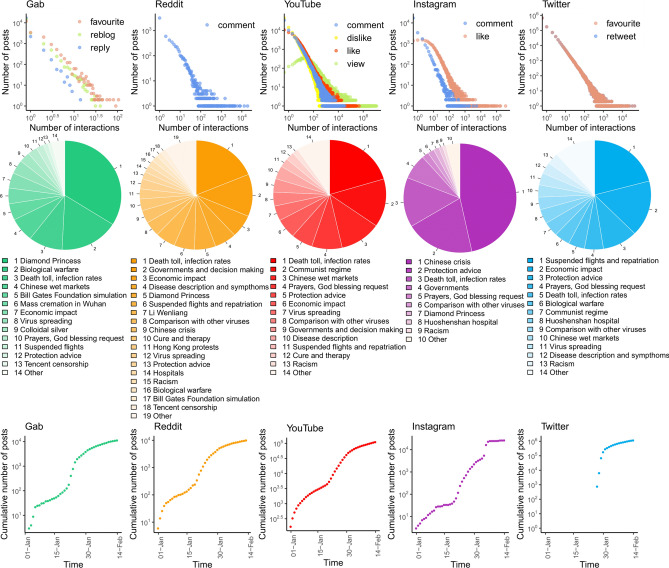
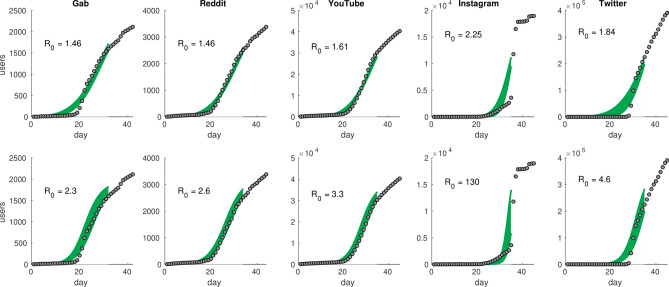
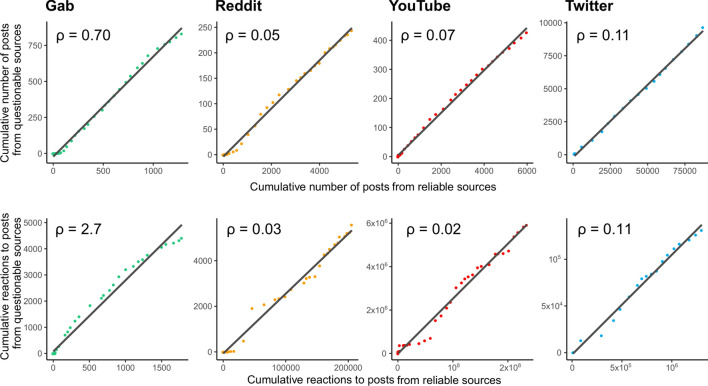
Verification
Claims the paper makes
The claims and statistics of this paper haven’t been checked yet.
Free: it reads the open-access text and checks the first 5 claims that cite a source we can check. Create a free account to check every claim.
Claims other papers make about this one
Each is checked against this paper’s own text: does it say what the citing paper says it does?
The source backs part of the claim, not all of it — or backs it for a different population, condition or comparison.
In the citing paper
“Our attention span remains limited (9, 10), and feed algorithms might limit our selection process by suggesting contents similar to the ones we are usually exposed to (11–13).”
From The echo chamber effect on social media (2021) · cites this paper as [12]
Experimental — accuracy not yet measuredThe cited source says what the claim attributes to it.
In the citing paper
“The uncontrolled dissemination of false or misleading health information via digital channels represents one of the most complex and urgent challenges currently facing Public Health (1, 2).”
From Health misinformation, digital health literacy, and attitudes toward science among university students: an exploratory cross-sectional survey (2026) · cites this paper as [2]
The cited source says what the claim attributes to it.
In the citing paper
“the amplification of questionable sources of COVID-19 misinformation is highly platform dependent, with some platforms amplifying questionable content less than reliable content 58 .”
From Measuring the impact of COVID-19 vaccine misinformation on vaccination intent in the UK and USA (2021) · cites this paper as [58]
The cited source says what the claim attributes to it.
In the citing paper
“The broad public reach of the Internet and social media favours the spread of rumours and dissemination of unreliable information [7].”
Self-check
Percentages, sums and reported differences re-computed from the paper’s own numbers.
The self-check needs the paper’s full text.
Citations
Cites
An Introduction to the Bootstrap
Efron, B., & Tibshirani, R. J. (1994) · doi:10.1201/9780429246593 · Cited by 40,500
Learning representations by back-propagating errors
Rumelhart, D. E., Hinton, G. E., & Williams, R. J. (1986) · Nature · doi:10.1038/323533a0 · Cited by 31,892 · cited 1×
“More formally, given a content represented by the sequence of words w 1 , w 2 , . . . , w T , we use stochastic gradient descent with gradient computed through backpropagation rule [39] for maximizing the average log probability where k is the size of the training window.”
MethodDistributed Representations of Words and Phrases and their Compositionality
Mikolov, T., Sutskever, I., Chen, K., Corrado, G., & Dean, J. (2013) · arXiv · doi:10.48550/arxiv.1310.4546 · Cited by 24,533
The spread of true and false news online
Vosoughi, S., Roy, D., & Aral, S. (2018) · Science · doi:10.1126/science.aap9559 · Cited by 8,847 · cited 2×
“Some studies pointed out that fake news and inaccurate information may spread faster and wider than fact-based news [22].”
BackgroundAn Introduction to the Bootstrap.
Buckland, S. T., Efron, B., & Tibshirani, R. J. (1994) · Biometrics · doi:10.2307/2532810 · Cited by 3,103
Linguistic Regularities in Continuous Space Word Representations
Mikolov, T., Yih, W.-T., & Zweig, G. (2013) · North American Chapter of the Association for Computational Linguistics · Cited by 2,912
The spread of behavior in an online social network experiment
Centola, D. (2010) · Science · doi:10.1126/science.1185231 · Cited by 2,692 · cited 1×
“While R0 is a good proxy for the engagement rate and a good predictor for epidemic-like information spreading, social contagion phenomena might be in general more complex [34, 35, 36].”
BackgroundThe spreading of misinformation online
Del Vicario, M., Bessi, A., Zollo, F., Petroni, F., Scala, A., Caldarelli, G., Stanley, H. E., & Quattrociocchi, W. (2016) · Proceedings of the National Academy of Sciences · doi:10.1073/pnas.1517441113 · Cited by 2,407 · cited 2×
“social perceptions [11] and the framing of narratives; it in uences policy-making, political communication, as well as the evolution of public debate [12, 13] especially when issues are controversial [14]. Indeed, users online tend to acquire information adhering to their worldviews [15], to ignore dissenting informat…”
BackgroundMethodSelf-citationZarocostas, J. (2020) · The Lancet · doi:10.1016/s0140-6736(20)30461-x · Cited by 2,344 · cited 1×
“The term infodemic [2, 3] has been coined to outline the perils of misinformation phenomena during the management of virus outbreaks [4, 5], since it could even speed up the epidemic process by influencing and fragmenting social response [6].”
BackgroundThe Mathematical Theory of Infectious Diseases and its applications
Ling, N. R. (1978) · Immunology · Cited by 1,934
Cited by
Items 301–400 of 1,008
Jain, P. (2021) · Journal of Health Communication · doi:10.1080/10810730.2021.1946219 · Cited by 46
Mäntymäki, M., Islam, A. K. M. N., Turel, O., & Dhir, A. (2022) · Technological Forecasting and Social Change · doi:10.1016/j.techfore.2022.121660 · Cited by 47
Public Health Communication and Engagement on Social Media during the COVID-19 PandemicPreprint
Teichmann, L., Nossek, S., Bridgman, A., Loewen, P. J., Owen, T., Ruths, D. A., & Zhilin, O. (2020) · OSF Preprints (OSF Preprints) · doi:10.31219/osf.io/7hypj · Cited by 48
Taboos in health communication: Stigma, silence and voice
Dimitrov, R., Jelen, A., & L’Etang, J. (2022) · Public Relations Inquiry · doi:10.1177/2046147x211067002 · Cited by 52
“Like in a neobaroque era, self-relearning co-generating bubbles and echo chambers of “believers” (Garcı́a, 2020) formed fierce opposition to official anti-virus measures – from playing down the risks and even questioning the very existence of the virus to attacking the official measures such as social distancing and l…”
BackgroundPrimary Health Care Nurses’ Perceptions of Risk During COVID‐19: A Qualitative Study
Ashley, C., James, S., Stephen, C. M., Mursa, R., McInnes, S., Williams, A., Calma, K. R. B., & Halcomb, E. (2021) · Journal of Nursing Scholarship · doi:10.1111/jnu.12698 · Cited by 46
“During COVID- 19, mass media and its spreading of misinformation about transmission and symptom management have contributed to what has been termed an “infodemic,” heightening risk perceptions (Cinelli et al., 2020; Pickles et al., 2021).”
BackgroundPolarised social media discourse during COVID-19 pandemic: evidence from YouTube
Gupta, S., Jain, G., & Tiwari, A. A. (2022) · Behaviour and Information Technology · doi:10.1080/0144929x.2022.2059397 · Cited by 49
Analysis of YouTube videos as a source of information for myocarditis during the COVID-19 pandemic
Memioğlu, T., & Özyaşar, M. (2022) · Clinical Research in Cardiology · doi:10.1007/s00392-022-02026-x · Cited by 47
“However, especially, speculative news on media, social platforms and the Internet pose a risk of misleading people who hesitate to being vaccinated and contribute to the infodemic, which is defined as “the dangers of misinformation phenomena during the management of an outbreak [21].”
BackgroundTechnical assistance in the field of risk communication
(EFSA), E. F. S. A., Maxim, L., Mazzocchi, M., den Broucke, S. V., Zollo, F., Robinson, T. P., Rogers, C., Vrbos, D., Zamariola, G., & Smith, A. (2021) · EFSA Journal · doi:10.2903/j.efsa.2021.6574 · Cited by 54
Self-citationJiang, Y., Huang, X., & Li, Z. (2021) · ISPRS International Journal of Geo-Information · doi:10.3390/ijgi10050344 · Cited by 47
Trying to make sense out of chaos: science, politics and the COVID-19 pandemic
de Camargo, K. R. (2020) · Cadernos de Saúde Pública · doi:10.1590/0102-311x00088120 · Cited by 44
Role of Social Media in the COVID-19 Pandemic: A Literature Review
Aggarwal, K., Singh, S., Chopra, M., & Kumar, S. (2021) · Advances in data mining and database management book series · doi:10.4018/978-1-7998-8413-2.ch004 · Cited by 60
Pierri, F., Luceri, L., Chen, E., & Ferrara, E. (2023) · EPJ Data Science · doi:10.1140/epjds/s13688-023-00420-7 · Cited by 57
The role of social media literacy in infodemic management: a systematic review
Ziapour, A., Malekzadeh, R., Darabı, F., Yıldırım, M., Montazeri, N., Kianipour, N., & NeJhaddadgar, N. (2024) · Frontiers in Digital Health · doi:10.3389/fdgth.2024.1277499 · Cited by 45
“The term “ infodemic ” (1, 2) indicates an extreme volume of information that is typically unreliable and spreads rapidly, especially during the management of a viral epidemic (3, 4).”
BackgroundThe Role of AI-Based Chatbots in Public Health Emergencies: A Narrative Review
Branda, F., Stella, M., Ceccarelli, C., Cabitza, F., Ceccarelli, G., Maruotti, A., Ciccozzi, M., & Scarpa, F. (2025) · Future Internet · doi:10.3390/fi17040145 · Cited by 51
“While LLMs offer scalable, immediate responses, their risks can undermine public trust and hinder effective health interventions [103].”
To shop or shelter? Issue framing effects and social-distancing preferences in the COVID-19 pandemic
Deslatte, A. (2020) · Journal of Behavioral Public Administration · doi:10.30636/jbpa.31.158 · Cited by 42
“The two major governmental frames surrounding COVID-19 have involved highlighting the potential public-health or economic consequences of specific courses of action (Cinelli et al. 2020).”
BackgroundIs COVID-19 Immune to Misinformation? A Brief Overview
Ali, S., Khalid, A., & Zahid, E. (2021) · Asian Bioethics Review · doi:10.1007/s41649-020-00155-x · Cited by 40
Andreadis, S. T., Antzoulatos, G. S., Mavropoulos, T., Giannakeris, P., Tzionis, G., Pantelidis, N., Ioannidis, K., Καρακώστας, Α., Gialampoukidis, I., Vrochidis, S., et al. (2021) · Online Social Networks and Media · doi:10.1016/j.osnem.2021.100134 · Cited by 47
“Considering that a large number of people rely on social media platforms for news and that information from both reliable and questionable sources present similar spreading patterns [9], the identification of misinformation has emerged as a critical task.”
Helm, P. J., Jimenez, T., Galgali, M. S., Edwards, M., Vail, K. E., & Arndt, J. (2022) · Journal of Social and Personal Relationships · doi:10.1177/02654075211066922 · Cited by 49
Understanding the phases of vaccine hesitancy during the COVID-19 pandemic
Kumar, D., Mathur, M., Kumar, N., Rana, R. K., Tiwary, R. C., Raghav, P. R., Kumar, A., Kapoor, N., Mathur, M., Tanu, T., et al. (2022) · Israel Journal of Health Policy Research · doi:10.1186/s13584-022-00527-8 · Cited by 40
“In relation to the COVID-19 pandemic, the world has also faced the unprecedented public health crisis of an infodemic, too much information including false information; and this has negatively impacted good decisions pertaining to health [5].”
BackgroundDataset on dynamics of Coronavirus on Twitter
Aguilar-Gallegos, N., Romero-García, L. E., Martínez-González, E. G., García-Sánchez, E. I., & Ávila, J. A. (2020) · Data in Brief · doi:10.1016/j.dib.2020.105684 · Cited by 42
Kiani, P., Merlo, A., Saeed, H. M., Benson, S., Bruce, G., Hoorn, R., Kraneveld, A. D., van de Loo, A. J. A. E., Severeijns, N. R., Sips, A. S. M., et al. (2021) · European Journal of Investigation in Health Psychology and Education · doi:10.3390/ejihpe11010016 · Cited by 41
“Finally, in addition to social isolation, the excess of (not always correct) information on the Internet and continuous media attention can fuel experiences of negative mood and stress [16].”
BackgroundHan, N., Ren, X., Wu, P., Liu, X., & Zhu, T. (2021) · Frontiers in Psychology · doi:10.3389/fpsyg.2021.632204 · Cited by 39
Investigating Public Discourses Around Gender and COVID-19: a Social Media Analysis of Twitter Data
Al‐Rawi, A., Grépin, K. A., Li, X., Morgan, R., Wenham, C., & Smith, J. (2021) · Journal of Healthcare Informatics Research · doi:10.1007/s41666-021-00102-x · Cited by 45
Röchert, D., Shahi, G. K., Neubaum, G., Roß, B., & Stieglitz, S. (2021) · Online Social Networks and Media · doi:10.1016/j.osnem.2021.100164 · Cited by 51
“3 spread of misinformation is related to the respective users of those platforms [43].”
Using AI–ML to Augment the Capabilities of Social Media for Telehealth and Remote Patient Monitoring
Leung, R. (2023) · Healthcare · doi:10.3390/healthcare11121704 · Cited by 45
“Firstly, patient users may share information about their health, such as symptoms, diagnoses, and treatment options, on social media platforms [40,41].”
BackgroundRojano, F. J. P., & Araújo, J. R. (2023) · Revista ICONO14 · doi:10.7195/ri14.v21i1.1987 · Cited by 44
Azhar, M., Nafees, S., Sujood, S., & Hamid, S. (2023) · Future Business Journal · doi:10.1186/s43093-023-00215-2 · Cited by 45
“The use of social media has made people technologically more aware of places and more equipped with information about their destinations [33].”
Exploring hate speech dynamics: The emotional, linguistic, and thematic impact on social media users
Ghenai, A., Noorian, Z., Moradisani, H., Abadeh, P., Erentzen, C. A., & Zarrinkalam, F. (2025) · Information Processing & Management · doi:10.1016/j.ipm.2025.104079 · Cited by 49
The COVID-19 fake news detection in Thai social texts
Mookdarsanit, P., & Mookdarsanit, L. (2021) · Bulletin of Electrical Engineering and Informatics · doi:10.11591/eei.v10i2.2745 · Cited by 45
Sommariva, S., Mote, J., Bon, H. B., Razafindraibe, H., Ratovozanany, D., Rasoamanana, V., Abeyesekera, S., Muhamedkhojaeva, P., Bashar, T., James, J., et al. (2021) · Health Security · doi:10.1089/hs.2020.0226 · Cited by 38
From Artificial Intelligence Bias to Inequality in the Time of COVID-19
Luengo-Oroz, M. A., Aylett-Bullock, J., Pham, K. H., Lam, C. S. N., & Luccioni, A. S. (2021) · IEEE Technology and Society Magazine · doi:10.1109/mts.2021.3056282 · Cited by 45
“Although the rate at which true versus false claims are amplified appears to vary across platforms [44], research on Twitter has found that social media users may be more likely to share false information because it is novel [45].”
BackgroundBella, E. L., Allen, C., & Lirussi, F. (2021) · Integrative Medicine Research · doi:10.1016/j.imr.2021.100731 · Cited by 43
“33 Although social media organizations have provided free campaigns to institutions, promoted independent fact-checking, and enhanced collaboration with the traditional media, they still struggle to counter misinformation.”
Criss, S., Nguyen, T. T. X., Norton, S., Virani, I., Titherington, E., Tillmanns, E. L., Kinnane, C., Maiolo, G., Kirby, A. B., & Gee, G. C. (2021) · International Journal of Environmental Research and Public Health · doi:10.3390/ijerph18115693 · Cited by 40
“Previous research has suggested that the age of social media as a primary form of news distribution has created a space in which individuals can selectively expose themselves to information, furthering the divide between political parties and crafting one-sided narratives based on a predetermined set of political view…”
BackgroundAsadi, S., Nilashi, M., Abumalloh, R. A., Samad, S., Ahani, A., Ghabban, F. M., Yusuf, S. Y. M., & Supriyanto, E. (2021) · International Journal of Fuzzy Systems · doi:10.1007/s40815-021-01119-5 · Cited by 39
“[41] performed the analysis of mainstream platforms, including Twitter, Instagram, and YouTube, along with less regulated social media platforms consisting of Reddit and Gab.”
BackgroundFirms’ challenges and social responsibilities during Covid-19: A Twitter analysis
Patuelli, A., Caldarelli, G., Lattanzi, N., & Saracco, F. (2021) · PLoS ONE · doi:10.1371/journal.pone.0254748 · Cited by 41
Caught in a networked collusion? Homogeneity in conspiracy-related discussion networks on YouTube
Röchert, D., Neubaum, G., Roß, B., & Stieglitz, S. (2021) · Information Systems · doi:10.1016/j.is.2021.101866 · Cited by 43
Consumer responses to brand communications involving COVID-19
Hesse, A., Niederle, F., Schön, L., & Stautz, D. (2021) · Journal of Marketing Management · doi:10.1080/0267257x.2021.2000008 · Cited by 44
“Cinelli et al. (2020) demonstrate how algorithms mediate and facilitate content promotion and information spreading on social media platforms and show that consumers online tend to seek out and acquire information ‘adhering to their worldviews’ (p. 2), especially ‘when issues are controversial’ (p.…”
BackgroundChen, E., Jiang, J., Chang, H.-C. H., Murić, G., & Ferrara, E. (2022) · JMIR Infodemiology · doi:10.2196/32378 · Cited by 44
“While the intensity of its effects varies based on country and culture, infodemics was and continues to be a salient issue in COVID-19 discourse [4,5].”
When Does an Individual Accept Misinformation? An Extended Investigation Through Cognitive Modeling
Borukhson, D., Lorenz-Spreen, P., & Ragni, M. (2022) · Computational Brain & Behavior · doi:10.1007/s42113-022-00136-3 · Cited by 34
“Especially in recent years, misinformation has returned to prominence in connection with political events such as the 2016 UK European Union membership referendum, the 2016 US presidential election (Allcott and Gentzkow, 2017), or during the ongoing COVID-19 pandemic (Cinelli et al., 2020).”
BackgroundDetecting fake news for the new coronavirus by reasoning on the Covid-19 ontologyPreprint
Groza, A. P. (2020) · arXiv (Cornell University) · doi:10.48550/arxiv.2004.12330 · Cited by 38
“Abstract In the context of the Covid-19 pandemic, many were quick to spread deceptive information [7].”
BackgroundGrusauskaite, K., Carbone, L., Harambam, J., & Aupers, S. (2024) · New Media & Society · doi:10.1177/14614448231162585 · Cited by 37
“Some scholars use the term to describe an online environment where people with similar beliefs, political leanings, or opinions share and reinforce each other’s points of view (Cinelli et al., 2020).”
Gbashi, S., Adebo, O. A., Doorsamy, W., & Njobeh, P. B. (2021) · JMIR Medical Informatics · doi:10.2196/22916 · Cited by 41
“infodemic and its impact on the fight against the COVID-19 pandemic [11-13].”
BackgroundSuomalaisten luottamus instituutioihin ja asiantuntijoihin COVID19-pandemiassa
Jallinoja, P. T., & Väliverronen, E. (2021) · Media & viestintä · doi:10.23983/mv.107298 · Cited by 57
Cyberchondria Amidst COVID-19 Pandemic: Challenges and Management Strategies
Varma, R., Das, S., & Singh, T. (2021) · Frontiers in Psychiatry · doi:10.3389/fpsyt.2021.618508 · Cited by 43
“In news and articles, most of the pieces of information were discovered to be incomplete and inaccurate (59).”
BackgroundMagee, L., Knights, F., McKechnie, D. G., Al‐bedaery, R., & Razai, M. S. (2022) · PLoS ONE · doi:10.1371/journal.pone.0270504 · Cited by 41
“The widespread, pervasive nature of misinformation during the pandemic has led to the recognition of an ‘infodemic’, undermining vaccination efforts [40,41].”
BackgroundSemeraro, A., Vilella, S., Ruffo, G., & Stella, M. (2022) · Scientific Reports · doi:10.1038/s41598-022-18472-6 · Cited by 43
Ioannidis, J. P. A. (2022) · BMJ Open · doi:10.1136/bmjopen-2021-052891 · Cited by 37
Adeyanju, G. C., Essoh, T.-A., Sidibé, A. R. O., Kyesi, F., & Aina, M. (2024) · Vaccines · doi:10.3390/vaccines12050489 · Cited by 38
Co-spread of Misinformation and Fact-Checking Content During the Covid-19 Pandemic
Burel, G., Farrell, T., Mensio, M., Khare, P., & Alani, H. (2020) · Lecture notes in computer science · doi:10.1007/978-3-030-60975-7_3 · Cited by 45
“In the context of the current crisis, Cinelli et al [6] analysed spread patterns of different Covid-19 related misinformation across several platforms.”
BackgroundDepolarization of echo chambers by random dynamical nudge
Currin, C. B., Vera, S. V., & Khaledi‐Nasab, A. (2022) · Scientific Reports · doi:10.1038/s41598-022-12494-w · Cited by 46
“(3) is modeled as a power-law decay of connection probabilities with only a small chance for agents with opposite opinions to interact.”
BackgroundYassin, A., Al-Omari, M., Al-Azzam, S. I., Karasneh, R. A., Abu‐Ismail, L., & Soudah, O. (2021) · International Journal of Environmental Health Research · doi:10.1080/09603123.2021.1935778 · Cited by 36
Ebeling, R., Sáenz, C. A. C., Nobre, J. C., & Becker, K. E. (2022) · Proceedings of the International AAAI Conference on Web and Social Media · doi:10.1609/icwsm.v16i1.19281 · Cited by 44
A retrospective analysis of social media posts pertaining to COVID-19 vaccination side effects
Lentzen, M.-P., Huebenthal, V., Kaiser, R., Kreppel, M., Zöeller, J. E., & Zirk, M. (2021) · Vaccine · doi:10.1016/j.vaccine.2021.11.052 · Cited by 39
“Irrespective of topics like vaccination, medical treatment or surgery, previous studies and our investigation could proof these results [16,17,20,24,37].”
BackgroundResultTahamtan, I., Potnis, D. D., Mohammadi, E., Singh, V., & Miller, L. E. (2022) · Journal of Medical Internet Research · doi:10.2196/34321 · Cited by 41
“The widespread distribution of information on social media resulted in the dissemination of low-quality and unverified stories and facts about COVID-19 [3,5,6], increasing public uncertainty about the situation and what will happen next [7].”
BackgroundReveilhac, M., & Blanchard, A. (2022) · International Journal of Information Management Data Insights · doi:10.1016/j.jjimei.2022.100068 · Cited by 46
Baghdadi, J. D., Coffey, K., Belcher, R., Frisbie, J., Hassan, N., Sim, D., & Malik, R. D. (2023) · JAMIA Open · doi:10.1093/jamiaopen/ooad013 · Cited by 44
Gómez, P. N., Vences, N. A., Sánchez, J. S., & Mañas-Viniegra, L. (2020) · Revista Latina de Comunicación Social · doi:10.4185/rlcs-2020-1468 · Cited by 43
Purnomo, E. P., Loilatu, M. J., Nurmandi, A., Qodir, Z., Sihidi, I. T., & Lutfi, M. K. (2020) · Webology · doi:10.14704/web/v18i1/web18001 · Cited by 35
“So, the information needs to be filtered and clearly conveyed through official institutional platforms (Cinelli et al., 2020).”
BackgroundZhang, X., Zhang, Z.-K., Wang, W., Hou, D., Xu, J., Ye, X., & Li, S. (2021) · International Journal of Digital Earth · doi:10.1080/17538947.2021.1888326 · Cited by 38
“Information spreading is often a self-exciting process (Cinelli et al. 2020), which can be captured by the within-layer feedback network E2,2 and E3,3.”
BackgroundInfluentialGlobal Trends in Plastic Surgery on Social Media: Analysis of 2 Million Posts
Braun, S. E., O’Connor, M. K., Hornick, M. M., Cullom, M. E., & Butterworth, J. A. (2021) · Aesthetic Surgery Journal · doi:10.1093/asj/sjab185 · Cited by 41
Emergence of knowledge communities and information centralization during the COVID-19 pandemic
Sacco, P. L., Gallotti, R., Pilati, F., Castaldo, N., & Domenico, M. D. (2021) · Social Science & Medicine · doi:10.1016/j.socscimed.2021.114215 · Cited by 44
“…to their questions, and may lead them to settle for the first inputs at hand, being thus guided by selection bias (Prior, 2005); on the other hand, a large volume of misleading content generates a pollution problem in the online environment in which they look for information (Cinelli et al., 2020).”
Durazzi, F., Müller, M., Salathé, M., & Remondini, D. (2021) · Scientific Reports · doi:10.1038/s41598-021-99301-0 · Cited by 41
Asghar, M. Z., Arif, S., Iqbal, J., & Seitamaa‐Hakkarainen, P. (2022) · International Journal of Environmental Research and Public Health · doi:10.3390/ijerph19010581 · Cited by 37
“Previous studies have mainly focused on the general public usage of social media [17,18] or general university students during the COVID-19 pandemic [19].”
BackgroundCasino, G. (2022) · Gaceta Sanitaria · doi:10.1016/j.gaceta.2022.01.003 · Cited by 35
Influence of Mass Media on Italian Web Users During the COVID-19 Pandemic: Infodemiological Analysis
Rovetta, A., & Castaldo, L. (2021) · JMIRx Med · doi:10.2196/32233 · Cited by 41
“The role of social and traditional media in spreading disinformation and misinformation has now been recognized in a substantial number of literature reports [5-10].”
BackgroundInformation theory for complex systems scientists: What, why, and how
Varley, T. F. (2025) · Physics Reports · doi:10.1016/j.physrep.2025.09.007 · Cited by 45
Risk Reduction of COVID-19 Pandemic in Pakistan
Shoaib, M., & Abdullah, F. (2020) · Social Work in Public Health · doi:10.1080/19371918.2020.1806172 · Cited by 38
Analysis and Insights for Myths Circulating on Twitter During the COVID-19 Pandemic
Yang, S., Jiang, J., Pal, A., Yu, K., Chen, F., & Yu, S. (2020) · IEEE Open Journal of the Computer Society · doi:10.1109/ojcs.2020.3028573 · Cited by 38
“Similar to [8], we interpret the number I + R as the number of distinct users that have posted a tweet on the myth.”
BackgroundInfluentialSocial media and the spread of COVID-19 infodemic
Adekoya, C. O., & Fasae, J. K. (2021) · Global Knowledge, Memory and Communication · doi:10.1108/gkmc-11-2020-0165 · Cited by 38
Community Mitigation of COVID-19 and Portrayal of Testing on TikTok: Descriptive Study
Basch, C. H., Mohlman, J., Fera, J., Tang, H., Pellicane, A., & Basch, C. E. (2021) · JMIR Public Health and Surveillance · doi:10.2196/29528 · Cited by 43
“Although there is an abundance of information on COVID-19 being distributed, social media has been particularly popular in this context [29-32].”
BackgroundSuárez-Lledó, V., & Álvarez‐Gálvez, J. (2022) · Journal of Medical Internet Research · doi:10.2196/36085 · Cited by 39
“Information consumption, opinion formation, and social contagion processes relating to COVID-19 across the social media ecosystem have become a major challenge for researchers [16], since these processes can strongly affect people’s behavior and reduce the effectiveness of the countermeasures implemented by government…”
BackgroundChakraborty, T., Gatta, V. L., Moscato, V., & Sperlí, G. (2023) · Neurocomputing · doi:10.1016/j.neucom.2023.126680 · Cited by 40
Resilience of Public Spheres in a Global Health Crisis
Trenz, H., Heft, A., Vaughan, M., & Pfetsch, B. (2021) · Javnost - The Public · doi:10.1080/13183222.2021.1919385 · Cited by 34
“5 Given the continued uncertainty, rumours and conspiracy theories are proliferating (Shahsavari et al. 2020; Cinelli et al. 2020) and pose significant thre - 5 https://acleddata.com/analysis/covid-19-disorder-tracker/#1585775314361-2ee40e97-5aec ats to democratic institutions such as a free press…”
BackgroundArCorona: Analyzing Arabic Tweets in the Early Days of Coronavirus (COVID-19) PandemicPreprint
Mubarak, H., & Hassan, S. (2020) · arXiv (Cornell University) · doi:10.48550/arxiv.2012.01462 · Cited by 34
“Other works include propagation of misinformation (Huang and Carley, 2020; Shahi et al., 2020), cultural, social and political impact of misinformation (Leng et al., 2020) and rumor amplification (Cinelli et al., 2020).”
BackgroundVelázquez, J. A. M., & Navazo-Ostúa, P. (2021) · CIC Cuadernos de Información y Comunicación · doi:10.5209/ciyc.75235 · Cited by 35
Guibarra, N. I. L., & Sánchez, J. C. A. (2020) · REVISTA ESPAÑOLA DE COMUNICACIÓN EN SALUD · doi:10.20318/recs.2020.5451 · Cited by 31
Public Information, Traditional Media and Social Networks during the COVID-19 Crisis in Spain
Fernández, A. B., Martín, S. A., & García, R. R. (2021) · Sustainability · doi:10.3390/su13126534 · Cited by 35
“For which it will reflect on the social relationships between them from the previously established monitoring connections [48], it will investigate the possibility of applying predictive models of the growth of the diffusion of certain arguments and the possibility of detecting environments with a higher probability o…”
Backgroundİnfodemide Dijital Ortamda Sağlık Bilgisi Edinme ve Teyit Davranışları
Çömlekçi, M. F., & BOZKANAT, E. (2021) · İstanbul Üniversitesi Sosyoloji Dergisi / İstanbul University Journal of Sociology · doi:10.26650/sj.2021.41.1.0024 · Cited by 45
Winds of Change: Impact of COVID-19 on Vaccine-Related Opinions of Twitter Users
Poddar, S., Mondal, M., Misra, J., Ganguly, N., & Ghosh, S. (2022) · Proceedings of the International AAAI Conference on Web and Social Media · doi:10.1609/icwsm.v16i1.19334 · Cited by 53
“These conspiracy theories are talked about a lot more after the onset of COVID Cinelli et al. (2020).”
BackgroundTrusting COVID-19 vaccines as individual and social goal
Falcone, R., Ansani, A., Colí, E., Marini, M., Sapienza, A., Castelfranchi, C., & Paglieri, F. (2022) · Scientific Reports · doi:10.1038/s41598-022-13675-3 · Cited by 37
Boucher, J.-C., Kim, S. Y., Jessiman‐Perreault, G., Edwards, J., Smith, H., Frenette, N., Badami, A., & Scott, L. A. (2023) · BMC Public Health · doi:10.1186/s12889-023-15615-w · Cited by 37
Cross-platform social dynamics: an analysis of ChatGPT and COVID-19 vaccine conversations
Alipour, S., Galeazzi, A., Sangiorgio, E., Avalle, M., Bojić, L., Cinelli, M., & Quattrociocchi, W. (2023) · Scientific Reports · doi:10.1038/s41598-024-53124-x · Cited by 36
“The findings from our study have implications for how we perceive the spread of information online, especially during critical global events.”
BackgroundSelf-citationAslan, I., & Çınar, O. (2023) · Frontiers in Psychology · doi:10.3389/fpsyg.2022.1087528 · Cited by 32
“However, alerting the public, increasing awareness, spreading knowledge and news, connecting people to get helps, and promoting certain preventive behaviors among the public were positive roles of social media (Chen et al., 2020; Cinelli et al., 2020; Kadam and Atre, 2020; Yassin et al., 2021).”
BackgroundNikolovska, M., Johnson, S. D., & Ekblom, P. (2020) · Crime Science · doi:10.1186/s40163-020-00129-2 · Cited by 34
Evaluating Pretrained Transformer-based Models for COVID-19 Fake News Detection
Hande, A., Puranik, K., Priyadharshini, R., Thavareesan, S., & Chakravarthi, B. R. (2021) · International Conference on Computing Methodologies and Communication (ICCMC) · doi:10.1109/iccmc51019.2021.9418446 · Cited by 39
“This results in a lot of engagement on the social media platforms for news and other developments [8].”
BackgroundNisbet, E. C., & Kamenchuk, O. (2021) · International Journal of Public Opinion Research · doi:10.1093/ijpor/edab011 · Cited by 37
Mining long-COVID symptoms from Reddit: characterizing post-COVID syndrome from patient reports
Sarker, A., & Ge, Y. (2021) · JAMIA Open · doi:10.1093/jamiaopen/ooab075 · Cited by 34
Exploring transformative policy imaginaries for a sustainable Post-COVID society
Giurca, A., Béfort, N., & Taylor, A. (2022) · Journal of Cleaner Production · doi:10.1016/j.jclepro.2022.131053 · Cited by 32
“Given the relatively few scientific investigations on COVID-19 in the media so far (see e.g., Cinelli et al., 2020; Metcalfe et al., 2020) it becomes interesting to explore what collective ways of thinking and seeing the pandemic are transmitted by the mass media and how these may or may not…”
Baharuddin, T., Qodir, Z., & Loilatu, M. J. (2022) · Journal of Governance and Public Policy · doi:10.18196/jgpp.v9i2.11474 · Cited by 39
Selective Feature Sets Based Fake News Detection for COVID-19 to Manage Infodemic
Narra, M., Umer, M., Sadiq, S., Eshmawi, A. A., Karamti, H., Mohamed, A., & Ashraf, I. (2022) · IEEE Access · doi:10.1109/access.2022.3206963 · Cited by 37
“Despite the instructions from governments and WHO alike about fake news, it is very difficult to check the validity, cor-65 rectness, and credibility of the news [10].”
BackgroundDahou, A., Ewees, A. A., Hashim, F. A., Al‐qaness, M. A. A., Orabi, D. A., Soliman, E. M., Eldin, S. M., Aseeri, A. O., & Elaziz, M. A. (2023) · Knowledge-Based Systems · doi:10.1016/j.knosys.2023.111023 · Cited by 32
van der Linden, S., Albarracín, D., Fazio, L. K., Freelon, D., Roozenbeek, J., Swire‐Thompson, B., & Bavel, J. J. V. (2023) · PsycEXTRA Dataset · doi:10.1037/e506432023-001 · Cited by 34
Tufi, S. (2022) · Linguistic Landscape An international journal · doi:10.1075/ll.21043.tuf · Cited by 31
Covid-19: análisis métrico de vídeos y canales de comunicación en YouTube
Orduña‐Malea, E., Font-Julián, C. I., & Ontalba-Ruipérez, J.-A. (2020) · El Profesional de la Informacion · doi:10.3145/epi.2020.jul.01 · Cited by 33
Large-Scale, Language-Agnostic Discourse Classification of Tweets During COVID-19
Gencoglu, O. (2020) · Machine Learning and Knowledge Extraction · doi:10.3390/make2040032 · Cited by 33
Lee, P. H., Marek, J., & Nálevka, P. (2020) · European Journal of Public Health · doi:10.1093/eurpub/ckaa208 · Cited by 32
Stawicki, S. P., Papadimos, T. J., Soghoian, S., Nanayakkara, P. W. B., Singh, S., Miller, A., Saddikuti, V., Jayatilleke, A. U., Dubhashi, S., Firstenberg, M., et al. (2020) · Journal of Global Infectious Diseases · doi:10.4103/jgid.jgid_397_20 · Cited by 37
“[26,27,141] To further exacerbate the matters, various political forces tend to latch onto pseudoscientific facts to support agendas that do not necessarily focus on societal health and well-being.”
BackgroundZhang, L., & Jung, E. H. (2021) · Universal Access in the Information Society · doi:10.1007/s10209-021-00795-2 · Cited by 36
“Such engagement with health information is even more common during times of health crises and pandemics, such as the epidemic of H1NI and Ebola, as well as the outbreak of COVID-19 recently [17, 67].”
BackgroundAhmed, A., Mohamed, N. S., El-Sadig, S., Fahal, L. A., Abelrahim, Z. B., Ahmed, E. S., & Siddig, E. E. (2021) · The Journal of Infection in Developing Countries · doi:10.3855/jidc.14520 · Cited by 31
Misinformation Adoption or Rejection in the Era of COVID-19
Weinzierl, M., Hopfer, S., & Harabagiu, S. (2021) · International Conference on Web and Social Media · doi:10.1609/icwsm.v15i1.18103 · Cited by 29
“Recently, epidemiological models originally designed for the study of the spread of biological viruses (Serrano, Iglesias, and Garijo 2015) have been used for in-depth analysis of the propagation of information about COVID-19 (Cinelli et al. 2020) on several social media platforms, such a Twitter, Instagram, Gab, Redd…”
BackgroundMethod
Metadata
- Authors
- Cinelli, M., Quattrociocchi, W., Galeazzi, A., Valensise, C. M., Brugnoli, E., Schmidt, A. L., Zola, P., Zollo, F., & Scala, A.
- Affiliations
- Ca' Foscari University of Venice (IT)
- University of Brescia (IT)
- Politecnico di Milano (IT)
- Institute of Informatics and Telematics (IT)
- Corresponding author
- Quattrociocchi, Walter
- Venue
- Scientific Reports
- Published
- 2020-10-06
- Volume
- 10
- Issue
- 1
- Pages
- 16598-16598
- ISSN
- 2045-2322 (ISSN-L)
- PMC
- PMC7538912
- OpenAlex
- W3011345566
- Cited by
- 2,313
- References
- 57
- Citations by year
- 2026: 201 · 2025: 251 · 2024: 246 · 2023: 349 · 2022: 451 · 2021: 557 · 2020: 257
- FWCI
- 541.32
- Type
- journal article
- Language
- en
- Open access
- gold
- doi.org
- Licence
- cc-by
- creativecommons.org/licenses/by/4.0 (tdm)
- creativecommons.org/licenses/by/4.0 (vor)
- Locations
- Scientific Reports (publishedVersion, cc-by)
- PubMed Central (publishedVersion, cc-by)
- PubMed (publishedVersion)
- arXiv (Cornell University) (submittedVersion)
- Informationszentrum Lebenswissenschaften (ZB MED) (submittedVersion, cc-by)
- IRIS Research product catalog (Sapienza University of Rome) (submittedVersion)
- ARCA (Università Ca' Foscari Venezia) (submittedVersion, cc-by-nc)
- Padua Research Archive (University of Padova) (submittedVersion, cc-by)
- arXiv (Cornell University)
- Topics
- Social Sciences › Sociology and Political Science › Misinformation and Its Impacts
- Physical Sciences › Physics and Astronomy › Statistical and Nonlinear Physics › Complex Network Analysis Techniques
- Social Sciences › Communication › Communication and COVID-19 Impact
- Keywords
- COVID-19 pandemic, infodemic, social media, misinformation, information dissemination, basic reproduction number, epidemic modeling, engagement, Twitter, Instagram, YouTube, Reddit, Gab
- MeSH terms
- Betacoronavirus, Data Analysis, COVID-19, SARS-CoV-2, Humans, Pneumonia, Viral, Social Behavior, Linear Models, Neural Networks, Computer, Coronavirus Infections, Information Dissemination, Basic Reproduction Number, Pandemics, Social Media
About these checks
Registry, retraction, Cites and statistics results are computed, not judged, with one exception: a printed reference that no index lists is read once by a model before it counts as a citation error. Claims are extracted by a model and kept only when their quote appears verbatim in the text; each cited source is then checked, with a model’s help, for whether it says what the claim relies on. Those verdicts can be wrong — read the claim’s quote and the cited source before relying on one.
Statistics and arithmetic are recomputed, not judged.
Confidence bands are shown only for fields calibrated on our annotated test set. None is calibrated yet, so no band is shown.
What counts as a claim ›How we measure confidence ›How we check this ›
Are you an author, or do you see a problem with this page? Request a review
Data sources
Bibliographic data: Semantic Scholar, OpenAlex, Crossref.
Contains information from the Semantic Scholar Academic Graph Datasets, made available under the ODC Attribution License (ODC-BY 1.0).
Semantic Scholar’s data is described in: Kinney, R., et al. (2023). The Semantic Scholar Open Data Platform. arXiv:2301.10140.
