

The COVID-19 social media infodemic
Open accessThe DOI matches its Crossref record; 57 of the 57 references it cites were found in a registry or an index.
Abstract
We address the diffusion of information about the COVID-19 with a massive data analysis on Twitter, Instagram, YouTube, Reddit and Gab. We analyze engagement and interest in the COVID-19 topic and provide a differential assessment on the evolution of the discourse on a global scale for each platform and their users. We fit information spreading with epidemic models characterizing the basic reproduction number $$R_0$$ R 0 for each social media platform. Moreover, we identify information spreading from questionable sources, finding different volumes of misinformation in each platform. However, information from both reliable and questionable sources do not present different spreading patterns. Finally, we provide platform-dependent numerical estimates of rumors’ amplification.
Overview
The claims and statistics of this paper haven’t been checked yet.
Free: it reads the open-access text and checks the first 5 claims that cite a source we can check. Create a free account to check every claim.
Integrity signals
Registry
Cites
Statistics
Figures
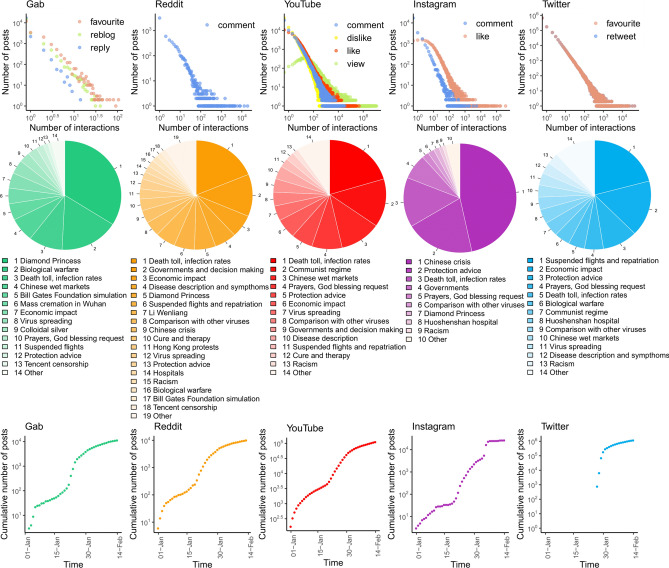
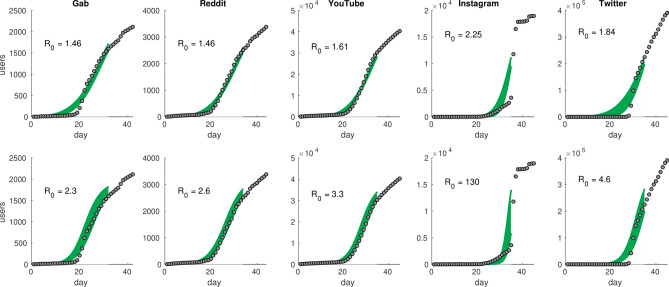
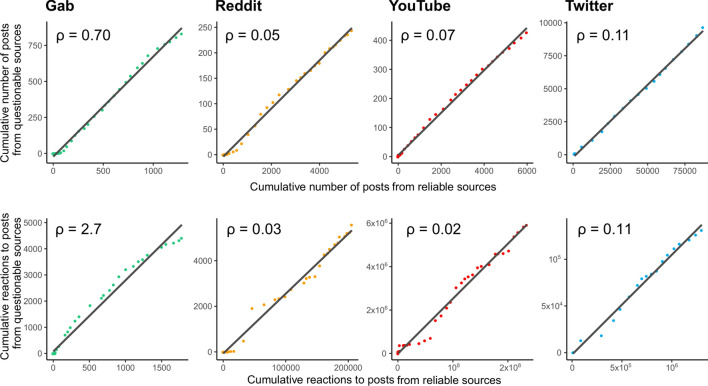
Verification
Claims the paper makes
The claims and statistics of this paper haven’t been checked yet.
Free: it reads the open-access text and checks the first 5 claims that cite a source we can check. Create a free account to check every claim.
Claims other papers make about this one
Each is checked against this paper’s own text: does it say what the citing paper says it does?
The source backs part of the claim, not all of it — or backs it for a different population, condition or comparison.
In the citing paper
“Our attention span remains limited (9, 10), and feed algorithms might limit our selection process by suggesting contents similar to the ones we are usually exposed to (11–13).”
From The echo chamber effect on social media (2021) · cites this paper as [12]
Experimental — accuracy not yet measuredThe cited source says what the claim attributes to it.
In the citing paper
“The uncontrolled dissemination of false or misleading health information via digital channels represents one of the most complex and urgent challenges currently facing Public Health (1, 2).”
From Health misinformation, digital health literacy, and attitudes toward science among university students: an exploratory cross-sectional survey (2026) · cites this paper as [2]
The cited source says what the claim attributes to it.
In the citing paper
“the amplification of questionable sources of COVID-19 misinformation is highly platform dependent, with some platforms amplifying questionable content less than reliable content 58 .”
From Measuring the impact of COVID-19 vaccine misinformation on vaccination intent in the UK and USA (2021) · cites this paper as [58]
The cited source says what the claim attributes to it.
In the citing paper
“The broad public reach of the Internet and social media favours the spread of rumours and dissemination of unreliable information [7].”
Self-check
Percentages, sums and reported differences re-computed from the paper’s own numbers.
The self-check needs the paper’s full text.
Citations
Cites
An Introduction to the Bootstrap
Efron, B., & Tibshirani, R. J. (1994) · doi:10.1201/9780429246593 · Cited by 40,500
Learning representations by back-propagating errors
Rumelhart, D. E., Hinton, G. E., & Williams, R. J. (1986) · Nature · doi:10.1038/323533a0 · Cited by 31,892 · cited 1×
“More formally, given a content represented by the sequence of words w 1 , w 2 , . . . , w T , we use stochastic gradient descent with gradient computed through backpropagation rule [39] for maximizing the average log probability where k is the size of the training window.”
MethodDistributed Representations of Words and Phrases and their Compositionality
Mikolov, T., Sutskever, I., Chen, K., Corrado, G., & Dean, J. (2013) · arXiv · doi:10.48550/arxiv.1310.4546 · Cited by 24,533
The spread of true and false news online
Vosoughi, S., Roy, D., & Aral, S. (2018) · Science · doi:10.1126/science.aap9559 · Cited by 8,847 · cited 2×
“Some studies pointed out that fake news and inaccurate information may spread faster and wider than fact-based news [22].”
BackgroundAn Introduction to the Bootstrap.
Buckland, S. T., Efron, B., & Tibshirani, R. J. (1994) · Biometrics · doi:10.2307/2532810 · Cited by 3,103
Linguistic Regularities in Continuous Space Word Representations
Mikolov, T., Yih, W.-T., & Zweig, G. (2013) · North American Chapter of the Association for Computational Linguistics · Cited by 2,912
The spread of behavior in an online social network experiment
Centola, D. (2010) · Science · doi:10.1126/science.1185231 · Cited by 2,692 · cited 1×
“While R0 is a good proxy for the engagement rate and a good predictor for epidemic-like information spreading, social contagion phenomena might be in general more complex [34, 35, 36].”
BackgroundThe spreading of misinformation online
Del Vicario, M., Bessi, A., Zollo, F., Petroni, F., Scala, A., Caldarelli, G., Stanley, H. E., & Quattrociocchi, W. (2016) · Proceedings of the National Academy of Sciences · doi:10.1073/pnas.1517441113 · Cited by 2,407 · cited 2×
“social perceptions [11] and the framing of narratives; it in uences policy-making, political communication, as well as the evolution of public debate [12, 13] especially when issues are controversial [14]. Indeed, users online tend to acquire information adhering to their worldviews [15], to ignore dissenting informat…”
BackgroundMethodSelf-citationZarocostas, J. (2020) · The Lancet · doi:10.1016/s0140-6736(20)30461-x · Cited by 2,344 · cited 1×
“The term infodemic [2, 3] has been coined to outline the perils of misinformation phenomena during the management of virus outbreaks [4, 5], since it could even speed up the epidemic process by influencing and fragmenting social response [6].”
BackgroundThe Mathematical Theory of Infectious Diseases and its applications
Ling, N. R. (1978) · Immunology · Cited by 1,934
Cited by
Items 101–200 of 1,008
Countering misinformation: A multidisciplinary approach
Gradoń, K., Hołyst, J. A., Moy, W. R., Sienkiewicz, J., & Suchecki, K. (2021) · Big Data & Society · doi:10.1177/20539517211013848 · Cited by 116
“The case of COVID-19 shows the critical impact of this new information environment: the erroneous information can negatively influence public behavior and degrade the effectiveness of public health measures (Cinelli et al., 2020).”
BackgroundThe Impacts of Covid-19 Pandemic on Socio-Economic Mobility in Indonesia
Prawoto, N., Eko, & Abitassha (2020) · International Journal of Economics and Business Administration · doi:10.35808/ijeba/486 · Cited by 101
“It is an important thing to remember at the peak of this panic produces egoism like capitalists, xenophobia and believe in every news item that was seen on social media (Cinelli et al., 2020).”
BackgroundSalvi, C., Iannello, P., Cancer, A., McClay, M., Rago, S., Dunsmoor, J. E., & Antonietti, A. (2021) · Frontiers in Communication · doi:10.3389/fcomm.2020.562588 · Cited by 117
Kochuvilayil, T., Fernandez, R. S., Moxham, L. J., Lord, H., Alomari, A. M. A., Hunt, L., Middleton, R., & Halcomb, E. (2021) · Journal of Clinical Nursing · doi:10.1111/jocn.15634 · Cited by 109
“To date, studies exploring anxiety and knowledge in nursing students have been predominately conducted in a single setting (Pan, 2020; Savitsky et al., 2020; Tang et al., 2020; de Tantillo & Christopher, 2020).”
BackgroundMultimodal approach to analysing big social and news media data
O’Halloran, K. L., Pal, G., & Jin, M. (2021) · Discourse Context & Media · doi:10.1016/j.dcm.2021.100467 · Cited by 110
The Impact of Social Media on Vaccination: A Narrative Review
Rodrigues, F., Ziadé, N., Jatuworapruk, K., Caballero-Uribe, C. V., Khursheed, T., & Gupta, L. (2023) · Journal of Korean Medical Science · doi:10.3346/jkms.2023.38.e326 · Cited by 108
“31 Popular subjects like vaccines, infectious diseases, cancer, and COVID-19 are particularly susceptible to disinformation campaigns.”
BackgroundJalil, Z., Abbasi, A., Javed, A. R., Khan, M. B., Hasanat, M. H. A., Malik, K. M., & Saudagar, A. K. J. (2022) · Frontiers in Public Health · doi:10.3389/fpubh.2021.812735 · Cited by 98
“The analysis shows flaws in the collected information (23).”
BackgroundFighting the COVID-19 Infodemic in Social Media: A Holistic Perspective and a Call to Arms
Alam, F., Dalvi, F., Shaar, S., Durrani, N., Mubarak, H., Nikolov, A., Da San Martino, G., Abdelali, A., Sajjad, H., Darwish, K., et al. (2021) · Proceedings of the International AAAI Conference on Web and Social Media · doi:10.1609/icwsm.v15i1.18114 · Cited by 92
COVID-19 Misinformation on Social Media: A Scoping Review
Joseph, A. M., Fernandez, V., Kritzman, S., Eaddy, I., Cook, O. M., Lambros, S., Jara Silva, C. E., Arguelles, D., Abraham, C., Dorgham, N., et al. (2022) · Cureus · doi:10.7759/cureus.24601 · Cited by 80
“These conspiracies can greatly impact an individual’s behavior and undermine the overall efficacy of a government’s implemented regulations regarding COVID-19 [12].”
BackgroundInformation on the COVID-19 Pandemic in Daily Newspapers’ Front Pages: Case Study of Spain and Italy
Tejedor, S., Cervi, L., Tusa, F., Oliva, M. P., & Zabotina, M. (2020) · International Journal of Environmental Research and Public Health · doi:10.3390/ijerph17176330 · Cited by 108
“Many studies have focused on and are still focusing on how the disintermediated role of social media may foster misinformation: Scholars studying Iran [5] and Spain [6], stress how social media spread rumors, others [7] try to analyze the structure of this infodemic, or concentrate on the effect of media exposure [8].”
Detecting East Asian Prejudice on Social Media
Vidgen, B., Hale, S. A., Guest, E., Margetts, H. Z., Broniatowski, D. A., Talat, Z., Botelho, A., Hall, M., & Tromble, R. (2020) · Workshop on Online Abuse and Harms (WOAH) · doi:10.18653/v1/2020.alw-1.19 · Cited by 128
Khan, J. I., Khan, J., Ali, F., Ullah, F., Bacha, J., & Lee, S. (2022) · IEEE Access · doi:10.1109/access.2022.3181605 · Cited by 118
Unleashing the power of disruptive and emerging technologies amid COVID-19: A detailed reviewPreprint
Agarwal, S., Punn, N. S., Sonbhadra, S. K., Tanveer, M., Nagabhushan, P., Pandian, K. K. S., & Saxena, P. (2020) · arXiv (Cornell University) · doi:10.48550/arxiv.2005.11507 · Cited by 106
“The infodemic prevention techniques include aggressively filtering out groundless medical advice, hoaxes and other incorrect information that are fatal to the public health [36].”
BackgroundThe sharing of disinformation in cross-national comparison: analyzing patterns of resilience
Humprecht, E., Esser, F., Aelst, P. V., Staender, A., & Morosoli, S. (2021) · Information Communication & Society · doi:10.1080/1369118x.2021.2006744 · Cited by 127
“Social media facilitates the spread of disinformation (Allcott et al., 2019; Cinelli et al., 2020; Tandoc et al., 2020; Zhao et al., 2020).”
BackgroundDeepfakes and scientific knowledge dissemination
Doss, C., Mondschein, J., Shu, D., Wolfson, T., Kopecky, D., Fitton-Kane, V. A., Bush, L., & Tucker, C. (2023) · Scientific Reports · doi:10.1038/s41598-023-39944-3 · Cited by 90
On a Networked SIS Epidemic Model With Cooperative and Antagonistic Opinion Dynamics
She, B., Liu, J., Sundaram, S., & Paré, P. E. (2022) · IEEE Transactions on Control of Network Systems · doi:10.1109/tcns.2022.3145748 · Cited by 90
“These reproduction numbers can be affected by a variety of factors, including biological properties of the epidemic, environmental conditions, and the opinions and behaviors of the population [6].”
BackgroundCOVID-19 infodemic and adult and elderly mental health: a scoping review
Delgado, C. E., Silva, E. A., de Castro, E. A. B., Carbogim, F. D. C., Püschel, V. A. D. A., & Cavalcante, R. B. (2021) · Revista da Escola de Enfermagem da USP · doi:10.1590/1980-220x-reeusp-2021-0170 · Cited by 100
Goldsmith, L. P., Rowland-Pomp, M., Hanson, K., Deal, A., Crawshaw, A. F., Hayward, S. E., Knights, F., Carter, J., Ahmad, A., Razai, M. S., et al. (2022) · BMJ Open · doi:10.1136/bmjopen-2022-061896 · Cited by 96
Schild, L., Ling, C., Blackburn, J., Stringhini, G., Zhang, Y., & Zannettou, S. (2020) · MPG.PuRe (Max Planck Society) · Cited by 89
Defining a ‘Risk Group’ and Ageism in the Era of COVID-19
Rahman, A., & Jahan, Y. (2020) · Journal of Loss and Trauma · doi:10.1080/15325024.2020.1757993 · Cited by 88
Social media mining under the COVID-19 context: Progress, challenges, and opportunities
Huang, X., Wang, S., Zhang, M., Hu, T., Hohl, A., She, B., Gong, X., Li, J., Liu, X., Gruebner, O., et al. (2022) · International Journal of Applied Earth Observation and Geoinformation · doi:10.1016/j.jag.2022.102967 · Cited by 98
“, 2020), misinformation modeling (Cinelli et al., 2020), and sentimental analysis (Nemes and Kiss, 2021).”
The role of race, religion, and partisanship in misperceptions about COVID-19
Druckman, J. N., Ognyanova, K., Baum, M., Lazer, D. M. J., Perlis, R. H., Volpe, J. D., Santillana, M., Chwe, H., Quintana, A., & Simonson, M. D. (2021) · Group Processes & Intergroup Relations · doi:10.1177/1368430220985912 · Cited by 94
“Not surprisingly, these concerns have led to a large number of explorations into COVID-19 misinformation and misperceptions (e.g., Cinelli et al., 2020; Krause et al., 2020; Li et al., 2020; Pennycook et al., 2020; Ricard & Medeiros, 2020; Singh et al., 2020); however, most of this work focuses on…”
BackgroundSocial Media News Use and COVID-19 Misinformation Engagement: Survey Study
Ahmed, S., & Rasul, M. E. (2022) · Journal of Medical Internet Research · doi:10.2196/38944 · Cited by 99
“Existing studies have found evidence of widespread misinformation related to COVID-19 on different social media platforms, such as YouTube, Twitter, Instagram, and Reddit [6].”
Papadopoulou, L., & Maniou, T. A. (2021) · Digital Journalism · doi:10.1080/21670811.2021.1945472 · Cited by 97
“Various studies were quick to acknowledge the pivotal role of digital and new media in this unprecedented crisis, especially stressing their role in information and misinformation spreading (Cinelli et al. 2020; Ferrara 2020; Gallotti 2020; Papa and Maniou 2020; Quandt et al. 2020).”
BackgroundCOVID-19 research in Wikipedia
Colavizza, G. (2020) · Quantitative Science Studies · doi:10.1162/qss_a_00080 · Cited by 90
CoVerifi: A COVID-19 news verification system
Kolluri, N. L., & Murthy, D. (2021) · Online Social Networks and Media · doi:10.1016/j.osnem.2021.100123 · Cited by 96
Combating Misinformation by Sharing the Truth: a Study on the Spread of Fact-Checks on Social Media
Li, J., & Chang, X. (2022) · Information Systems Frontiers · doi:10.1007/s10796-022-10296-z · Cited by 103
“…a network perspective, many researchers have adopted information propagation models and epidemic models to characterize the diffusion of misinformation (Allcott & Gentzkow, 2017; Cinelli et al., 2020; Garrett, 2019; Grinberg et al., 2019; Mosleh et al., 2020; Tambuscio et al., 2015; Wood, 2018).”
BackgroundThe COVID‐19 scamdemic: A survey of phishing attacks and their countermeasures during COVID‐19
Al-Qahtani, A. F., & Cresci, S. (2022) · IET Information Security · doi:10.1049/ise2.12073 · Cited by 98
“In retrospect, we clearly see that his warning call went unheeded [119].”
BackgroundFacilitators and barriers to vaccination uptake in pregnancy: A qualitative systematic review
Razai, M. S., Mansour, R., Ravindran, P., Freeman, S. K., Mason-Apps, C., Morris, J. K., Majeed, A., USSHER, M. H., Hargreaves, S., & Oakeshott, P. (2024) · PLoS ONE · doi:10.1371/journal.pone.0298407 · Cited by 85
Shahid, O., Nasajpour, M., Pouriyeh, S., Parizi, R. M., Han, M., Valero, M., Li, F., Aledhari, M., & Sheng, Q. Z. (2021) · Journal of Biomedical Informatics · doi:10.1016/j.jbi.2021.103751 · Cited by 84
“Over the course of the COVID-19 pandemic, people have engaged on twitter to share their experience with regards to testing or lack of testing, social-distancing, and other challenges that people are facing due to the pandemic [174].”
BackgroundCheng, M., Wang, S., Yan, X., Yang, T., Wang, W., Zehao, H., Xiao, X., Nazarian, S., & Bogdan, P. (2021) · Frontiers in Psychology · doi:10.3389/fpsyg.2021.644801 · Cited by 109
A First Instagram Dataset on COVID-19Preprint
Zarei, K., Farahbakhsh, R., Crespi, N., & Gareth Tyson, A. (2020) · arXiv (Cornell University) · doi:10.13140/rg.2.2.13968.15364 · Cited by 80
Sustained online amplification of COVID-19 elites in the United States
Gallagher, R. J., Doroshenko, L., Shugars, S., Lazer, D., & Foucault Welles, B. (2021) · Social Media + Society · doi:10.1177/20563051211024957 · Cited by 80
“For example, emerging evidence suggests that users of more niche social media platforms, such as Gab, are more susceptible to posts with questionable sources of information about COVID-19 than users of other mainstream platforms (Cinelli et al., 2020).”
BackgroundIshizumi, A., Kolis, J., Abad, N., Prybylski, D., Brookmeyer, K. A., Voegeli, C., Wardle, C., & Chiou, H. (2024) · The Lancet Public Health · doi:10.1016/s2468-2667(24)00031-8 · Cited by 79
Ferreira, G. B., & Borges, S. (2020) · Journalism and Media · doi:10.3390/journalmedia1010008 · Cited by 93
Crowdsourcing Geospatial Data for Earth and Human Observations: A Review
Huang, X., Wang, S., Yang, D., Hu, T., Chen, M., Zhang, M., Zhang, G., Biljecki, F., Lu, T., Zou, L., et al. (2024) · Journal of Remote Sensing · doi:10.34133/remotesensing.0105 · Cited by 86
“It serves as an invaluable tool in tracing the spread of information [187,188], monitoring societal attitudes [189,190], and understanding online communities [191].”
Wu, Y., & Shen, F. (2022) · Journal of Health Psychology · doi:10.1177/1359105321995964 · Cited by 78
“There is a considerable amount of research concerning media’s influence on people’s health behavior change (e.g. Cinelli et al., 2020; Kim et al., 2019).”
Htay, M. N. N., Parial, L. L., Tolabing, M. C., Dadaczynski, K., Okan, O., Leung, A. Y. M., & Su, T. T. (2022) · PLOS ONE · doi:10.1371/journal.pone.0266276 · Cited by 78
“The broad public reach of the Internet and social media favours the spread of rumours and dissemination of unreliable information [7].”
BackgroundKrishnan, N., Gu, J., Tromble, R., & Abroms, L. C. (2021) · Harvard Kennedy School Misinformation Review · doi:10.37016/mr-2020-85 · Cited by 96
One Year of COVID-19 Vaccine Misinformation on Twitter: Longitudinal Study
Pierri, F., DeVerna, M., Yang, K.-C., Axelrod, D., Bryden, J., & Menczer, F. (2023) · Journal of Medical Internet Research · doi:10.2196/42227 · Cited by 91
de Matos, D. G., Aidar, F. J., Almeida-Neto, P. F. D., Moreira, O. C., Souza, R. F. D., Marçal, A. C., Marcucci-Barbosa, L. S., Martins Júnior, F. D. A., Lobo, L. F., dos Santos, J. L., et al. (2020) · Sustainability · doi:10.3390/su12219072 · Cited by 72
“Nevertheless, access to mass media can lead to “infodemic,” which relates to too much confusing information that contributes to people’s difficulties in seeking credible sources of information, and can also harm people’s physical and mental health [41].”
BackgroundCOVID-19 on Instagram: A content analysis of selected accounts
Niknam, F., Samadbeik, M., Fatehi, F., Shirdel, M., Rezazadeh, M., & Bastani, P. (2020) · Health Policy and Technology · doi:10.1016/j.hlpt.2020.10.016 · Cited by 82
Agley, J., Xiao, Y., Thompson, E. E., Chen, X., & Golzarri-Arroyo, L. (2021) · Journal of Medical Internet Research · doi:10.2196/32425 · Cited by 60
“Four of these statements were used in our prior research [7] and were derived from an early list of COVID-19 misinformation [5]: The rollout of 5G cellphone networks caused the spread of COVID-19.”
Importance of oral health in mental health disorders: An updated review
Skallevold, H. E., Rokaya, N., Wongsirichat, N., & Rokaya, D. (2023) · Journal of Oral Biology and Craniofacial Research · doi:10.1016/j.jobcr.2023.06.003 · Cited by 85
Alwani, S. S., Majeed, M. M., Ramzan, Z., Rauf, S., Syed, M. S., Shah, S. H., Hirwani, M. Z., & Hamirani, F. (2021) · Pakistan Journal of Public Health · doi:10.32413/pjph.v10i2.601 · Cited by 87
“Previous studies in different parts of the world during the epidemic revealed that the rate of influx of information is much high during the current pandemic due to stress and depth of the situation (43, 44).”
BackgroundThe Surprising Performance of Simple Baselines for Misinformation Detection
Pelrine, K., Danovitch, J., & Rabbany, R. (2021) · International World Wide Web Conference (WWW) · doi:10.1145/3442381.3450111 · Cited by 98
“As real-world events such as the spread of COVID-19 misinformation show [18, 69], we are still far from addressing misinformation and more work is needed.”
BackgroundMahdikhani, M. (2021) · International Journal of Information Management Data Insights · doi:10.1016/j.jjimei.2021.100053 · Cited by 90
Moral Emotions Shape the Virality of COVID-19 Misinformation on Social Media
Solovev, K., & Pröllochs, N. (2022) · Proceedings of the ACM Web Conference 2022 · doi:10.1145/3485447.3512266 · Cited by 56
“For example, Cinelli et al. (2020) classify news sources into reliable and nonreliable sources in order to analyze the spread of COVID-19-related content.”
BackgroundHybrid ensemble framework with self-attention mechanism for social spam detection on imbalanced data
Rao, S., Verma, A. K., & Bhatia, T. (2023) · Expert Systems with Applications · doi:10.1016/j.eswa.2023.119594 · Cited by 84
Cognitive Biases in Fact-Checking and Their Countermeasures: A Review
Soprano, M., Roitero, K., Barbera, D. L., Ceolin, D., Spina, D., Demartini, G., & Mizzaro, S. (2024) · Information Processing & Management · doi:10.1016/j.ipm.2024.103672 · Cited by 87
Majeed, M., Irshad, M., Fatima, T., Khan, J., & Hassan, M. M. (2020) · Frontiers in Psychology · doi:10.3389/fpsyg.2020.557987 · Cited by 73
Stavropoulos, V., Motti-Stefanidi, F., & Griffiths, M. D. (2022) · European Psychologist · doi:10.1027/1016-9040/a000451 · Cited by 73
Rubinelli, S., Purnat, T. D., Wilhelm, E., Traicoff, D. A., Namageyo-Funa, A., Thomson, A., Wardle, C., Lamichhane, J., Briand, S. C., & Nguyen, T. (2022) · Human Resources for Health · doi:10.1186/s12960-022-00733-0 · Cited by 87
Defining Misinformation and Related Terms in Health-Related Literature: Scoping Review
Mikati, I. K. E., Hoteit, R., Harb, T., Zein, O. E., Piggott, T., Melki, J. P., Mustafa, R. A., & Akl, E. A. (2023) · Journal of Medical Internet Research · doi:10.2196/45731 · Cited by 77
Chin, H., Lima, G., Shin, M., Zhunis, A., Cha, C., Choi, J., & Cha, M. (2023) · Journal of Medical Internet Research · doi:10.2196/40922 · Cited by 49
“How users engage with health information may differ depending on the digital platform [12]; thus, studies have analyzed the idiosyncrasies of each platform.”
BackgroundThe Impact of Social Media on Health Behaviors, a Systematic Review
Paul, B. C., & Johnson, S.-A. H. (2025) · Healthcare · doi:10.3390/healthcare13212763 · Cited by 102
Loomba, S., de Figueiredo, A., Piatek, S. J., de Graaf, K., & Larson, H. J. (2020) · medRxiv · doi:10.1101/2020.10.22.20217513 · Cited by 75
Kim, S., & Kim, S. (2020) · Sustainability · doi:10.3390/su12239904 · Cited by 86
“[80] identify information spreading from questionable sources, finding different volumes of misinformation in each platform.”
BackgroundFactors affecting individual online rumor sharing behavior in the COVID-19 pandemic
Luo, P., Wang, C., Guo, F., & Luo, L. (2021) · Computers in Human Behavior · doi:10.1016/j.chb.2021.106968 · Cited by 75
Karidakis, M., Woodward‐Kron, R. E., Amorati, R., Hu, B., Pym, A., & Hajek, J. (2022) · Qualitative Health Communication · doi:10.7146/qhc.v1i1.127258 · Cited by 79
“The case of the COVID-19 pandemic highlights the impact of sourcing information from questionable sources as it may influence people’s behaviour and hamper the effectiveness of government responses and the countermeasures deployed (Cinelli et al., 2020).”
BackgroundZhang, Y., Chen, F., & Lukito, J. (2022) · Political Communication · doi:10.1080/10584609.2022.2113844 · Cited by 89
Multilingual topic modeling for tracking COVID-19 trends based on Facebook data analysis
Amara, A., Taieb, M. A. H., & Aouicha, M. B. (2021) · Applied Intelligence · doi:10.1007/s10489-020-02033-3 · Cited by 78
“Other works [34, 35] are focusing on related COVID-19 pandemic data shared on multiple social media platforms.”
BackgroundTopics and Sentiments of Public Concerns Regarding COVID-19 Vaccines: Social Media Trend Analysis
Monselise, M., Chang, C., Ferreira, G., Yang, R., & Yang, C. C. (2021) · Journal of Medical Internet Research · doi:10.2196/30765 · Cited by 73
“Cinelli et al [9] extracted topics using Partitioning Around Medoids algorithm on word vector representations and proposed a custom epidemic model for characterizing misinformation spreading speed in different social platforms.”
Maftei, A., Holman, A. C., & Merlici, I.-A. (2021) · Computers in Human Behavior · doi:10.1016/j.chb.2021.107032 · Cited by 82
Understanding and governing global systemic crises in the 21st century: A complexity perspective
Wernli, D., Böttcher, L., Vanackere, F., Kaspiarovich, Y., Masood, M., & Levrat, N. (2023) · Global Policy · doi:10.1111/1758-5899.13192 · Cited by 83
Alshaabi, T., Arnold, M., Minot, J. R., Adams, J. L., Dewhurst, D. R., Reagan, A. J., Muhamad, R., Danforth, C. M., & Dodds, P. S. (2021) · PLoS ONE · doi:10.1371/journal.pone.0244476 · Cited by 77
Stigma on first responders during COVID-19.
Zolnikov, T. R., & Furio, F. (2020) · Stigma and Health · doi:10.1037/sah0000270 · Cited by 63
ArCOV19-Rumors: Arabic COVID-19 Twitter Dataset for Misinformation DetectionPreprint
Haouari, F., Hasanain, M., Suwaileh, R., & Elsayed, T. (2020) · arXiv (Cornell University) · doi:10.48550/arxiv.2010.08768 · Cited by 103
“Many studies analyzed misinformation spreading in Twitter related to COVID-19 [6, 14, 20, 29, 30].”
BackgroundFung, X. C. C., Siu, A. M. H., Potenza, M. N., O'Brien, K. S., Latner, J. D., Chen, C.-Y., Chen, I.-H., & Lin, C.-Y. (2021) · Frontiers in Psychiatry · doi:10.3389/fpsyt.2021.675839 · Cited by 68
“The exacerbated associations between PSMU and depression/anxiety may be due to the rumors and frightening news or information on COVID-19 in the social media (54, 55).”
BackgroundClassification aware neural topic model for COVID-19 disinformation categorisation
Song, X., Petrak, J., Jiang, Y., Singh, I., Maynard, D., & Bontcheva, K. (2021) · PLoS ONE · doi:10.1371/journal.pone.0247086 · Cited by 94
“The most relevant research in this category includes: the creation of a COVID-19 relevant Twitter dataset based on a time period covering the pandemic [24] or based on certain manually selected COVID-related hashtags [25–29]; sentiment analysis of information spread on Twitter [28, 30, 30, 36–41]; analysis of the spre…”
BackgroundCypryańska, M., & Nezlek, J. B. (2020) · PLoS ONE · doi:10.1371/journal.pone.0241464 · Cited by 70
“In terms of cognitive considerations, there is also ample evidence that people are either intentionally misinformed about or misinterpret recommendations for how to cope with COVID [31,32].”
BackgroundRole of Drone Technology Helping in Alleviating the COVID-19 Pandemic
Mohsan, S. A. H., Zahra, Q. U. A., Khan, M. A., Alsharif, M. H., Elhaty, I. A., & Jahid, A. (2022) · Micromachines · doi:10.3390/mi13101593 · Cited by 87
“Additionally, social events such as marriages, vacations, weddings, and other leisure activities are postponed or canceled [26,27].”
BackgroundWang, X., Zhang, M., Fan, W., & Zhao, K. (2022) · Journal of the Association for Information Science and Technology · doi:10.1002/asi.24576 · Cited by 67
#COVID-19 on Twitter: Bots, Conspiracies, and Social Media Activism
Ferrara, E. (2020) · Europe PMC (PubMed Central) · Cited by 84
Halal Tourism to Promote Community’s Economic Growth: A Model for Aceh, Indonesia
Yusuf, M. Y., Djakfar, I., Isnaliana, I., & Maulana, H. (2021) · Pertanika journal of social science & humanities · doi:10.47836/pjssh.29.4.42 · Cited by 95
COVID-19 Conspiracy Theories Discussion on Twitter
Erokhin, D. V., Yosipof, A., & Komendantova, N. (2022) · Social Media + Society · doi:10.1177/20563051221126051 · Cited by 72
“The same could be seen with COVID-19 when, for example, rumors of lockdowns in the northern Italy caused people to want to leave to the southern Italy, resulting in crowds in railway stations and airports and a markedly increased risk of infection and contamination (Cinelli et al., 2020).”
BackgroundInformation disorders during the COVID-19 infodemic: The case of Italian Facebook
Guarino, S., Pierri, F., Giovanni, M. D., & Celestini, A. (2021) · Online Social Networks and Media · doi:10.1016/j.osnem.2021.100124 · Cited by 69
Wang, H., Li, Y., Hutch, M. R., Naidech, A. M., & Luo, Y. (2021) · Journal of Medical Internet Research · doi:10.2196/26302 · Cited by 72
“Previous studies and commentaries proposed several perspectives to detect and fight the COVID-19 infodemic [5,8-10].”
YouTube Recommendations and Effects on Sharing Across Online Social Platforms
Buntain, C., Bonneau, R., Nagler, J., & Tucker, J. A. (2021) · Proceedings of the ACM on Human-Computer Interaction · doi:10.1145/3449085 · Cited by 72
“Instead, links to YouTube content are routinely some of the most shared across Facebook, Twitter, and Reddit, with a recent study of COVID-19 discourse across five different online social platforms finding YouTube videos shared therein are significantly amplified [7].”
BackgroundCovid-19 tweeting in English: Gender differences
Thelwall, M. A., & Thelwall, S. (2020) · El Profesional de la Informacion · doi:10.3145/epi.2020.may.01 · Cited by 73
Toward COVID-19 Information: Infodemic or Fear of Missing Out?
Yu, S., Chen, H.-R., Liu, A.-C., & Lee, H.-Y. (2020) · Healthcare · doi:10.3390/healthcare8040550 · Cited by 67
Social Distance Into Factual Information Distance about COVID-19 in Indonesia Whatsapp Groups
Syam, M. T., Makmur, Z., & Nur, A. (2020) · Jurnal Ilmu Komunikasi · doi:10.31315/jik.v18i3.3684 · Cited by 72
“Previously, there had been research on Covid 19 news on social media, research entitled The Covid-19 Social Media Infodemic (Cinelli et al., 2020).”
BackgroundCharacterizing network dynamics of online hate communities around the COVID-19 pandemic
Uyheng, J., & Carley, K. M. (2021) · Applied Network Science · doi:10.1007/s41109-021-00362-x · Cited by 71
Multilingual deep learning framework for fake news detection using capsule neural network
Mohawesh, R., Maqsood, S., & Althebyan, Q. (2023) · Journal of Intelligent Information Systems · doi:10.1007/s10844-023-00788-y · Cited by 75
“Platforms for spreading such information, like mass media and social media, make it possible for the information to reach a large number of the audience (Cinelli et al., 2020).”
BackgroundHammad, M. A., & Alqarni, T. M. (2021) · PLOS ONE · doi:10.1371/journal.pone.0248811 · Cited by 58
“However, we need to consider the risks it presents through misleading facts and rumors, especially in times of crises such as the current pandemic, as it may hold dire psychological, social, and health consequences for the society [10, 15, 40, 44, 45].”
BackgroundA ciência entre a infodemia e outras narrativas da pós-verdade: desafios em tempos de pandemia
Giordani, R. C. F., Donasolo, J. P. G., Ames, V. D. B., & Giordani, R. L. (2021) · Ciência & Saúde Coletiva · doi:10.1590/1413-81232021267.05892021 · Cited by 86
Galletta, M. A. K., Oliveira, A. M. D. S. S., Albertini, J. G. L., Benute, G. R. G., Peres, S. V., Brizot, M. D. L., & Francisco, R. P. V. (2021) · Journal of Affective Disorders · doi:10.1016/j.jad.2021.09.091 · Cited by 94
“It seems to us that there is a relationship between these findings and Infodemic (Cinelli et al., 2020; Rathore and Farooq, 2020) with its inappropriate spread through countless social communication media, many of which are not backed up by a professional and ethical conduct.”
Using Deep Learning Models to Detect Fake News about COVID-19
Chen, M., Lai, Y.-W., & Lian, J.-W. (2023) · ACM Transactions on Internet Technology · doi:10.1145/3533431 · Cited by 92
Dynamic topic modeling of the COVID-19 Twitter narrative among U.S. governors and cabinet executivesPreprint
Sha, H., Hasan, M. A., Mohler, G., & Brantingham, P. J. (2020) · arXiv (Cornell University) · doi:10.48550/arxiv.2004.11692 · Cited by 63
“In (Cinelli et al.”
BackgroundBroniatowski, D. A., Simons, J. R., Gu, J., Jamison, A. M., & Abroms, L. C. (2023) · Science Advances · doi:10.1126/sciadv.adh2132 · Cited by 62
Misinformation on Misinformation: Conceptual and Methodological Challenges
Altay, S., Berriche, M., & Acerbi, A. (2021) · doi:10.31234/osf.io/edqc8 · Cited by 62
#lockdown: Network-Enhanced Emotional Profiling in the Time of COVID-19
Stella, M., Restocchi, V., & Deyne, S. D. (2020) · Big Data and Cognitive Computing · doi:10.3390/bdcc4020014 · Cited by 71
Enitan, S. S., Oyekale, A. O., Akele, R. Y., Olawuyi, K. A., Olabisi, E. O., Nwankiti, A. J., Adejumo, E., & Enitan, C. B. (2020) · International Journal of Vaccines and Immunization · doi:10.16966/2470-9948.123 · Cited by 73
Flow of online misinformation during the peak of the COVID-19 pandemic in Italy
Caldarelli, G., De Nicola, R., Petrocchi, M., Pratelli, M., & Saracco, F. (2021) · EPJ Data Science · doi:10.1140/epjds/s13688-021-00289-4 · Cited by 54
Oswald, S., Lewiński, M., Greco, S., & Villata, S. (2022) · Argumentation library · doi:10.1007/978-3-030-91017-4 · Cited by 64
Ecker, U. K. H., Butler, L. H., Cook, J., Hurlstone, M. J., Kurz, T., & Lewandowsky, S. (2020) · Journal of Environmental Psychology · doi:10.1016/j.jenvp.2020.101464 · Cited by 59
“The COVID-19 pandemic has recently dominated public discourse, crowding out other important topics, including climate change, from traditional and social media (Cinelli et al., 2020).”
BackgroundRethinking Fake News: Disinformation and Ideology during the time of COVID-19 Global Pandemic
Das, R., & Ahmed, W. (2021) · IIM Kozhikode Society & Management Review · doi:10.1177/22779752211027382 · Cited by 65
“…diffusion through social networks (Roozenbeek et al., 2020), comparative analysis of fake news dissemination across popular social media platforms (Cinelli et al., 2020), role of bots and automated accounts in creating organized disability (Al-Rawi & Shukla, 2020), people’s susceptibility to…”
BackgroundInfluentialTackling fake news in socially mediated public spheres: A comparison of Weibo and WeChat
Pang, H., Liu, J., & Lu, J. (2022) · Technology in Society · doi:10.1016/j.techsoc.2022.102004 · Cited by 64
Sentiment Analysis of Public Social Media as a Tool for Health-Related Topics
Arias, F. X., Zambrano, M., Guerra-Adames, A., Tejedor-Flores, N., & Vargas-Lombardo, M. (2022) · IEEE Access · doi:10.1109/access.2022.3187406 · Cited by 69
Creative Production of ‘COVID‐19 Social Distancing’ Narratives on Social Media
Mohamad, S. M. (2020) · Tijdschrift voor Economische en Sociale Geografie · doi:10.1111/tesg.12430 · Cited by 69
“…among the public from the misinformation, disinformation, and malinformation, apparent in the growing infodemic that accompanies a contemporary © 2020 Royal Dutch Geographical Society / Koninklijk Nederlands Aardrijkskundig epidemic or a pandemic (Cinelli et al. 2020; Zarocostas 2020).”
Background
Metadata
- Authors
- Cinelli, M., Quattrociocchi, W., Galeazzi, A., Valensise, C. M., Brugnoli, E., Schmidt, A. L., Zola, P., Zollo, F., & Scala, A.
- Affiliations
- Ca' Foscari University of Venice (IT)
- University of Brescia (IT)
- Politecnico di Milano (IT)
- Institute of Informatics and Telematics (IT)
- Corresponding author
- Quattrociocchi, Walter
- Venue
- Scientific Reports
- Published
- 2020-10-06
- Volume
- 10
- Issue
- 1
- Pages
- 16598-16598
- ISSN
- 2045-2322 (ISSN-L)
- PMC
- PMC7538912
- OpenAlex
- W3011345566
- Cited by
- 2,313
- References
- 57
- Citations by year
- 2026: 201 · 2025: 251 · 2024: 246 · 2023: 349 · 2022: 451 · 2021: 557 · 2020: 257
- FWCI
- 541.32
- Type
- journal article
- Language
- en
- Open access
- gold
- doi.org
- Licence
- cc-by
- creativecommons.org/licenses/by/4.0 (tdm)
- creativecommons.org/licenses/by/4.0 (vor)
- Locations
- Scientific Reports (publishedVersion, cc-by)
- PubMed Central (publishedVersion, cc-by)
- PubMed (publishedVersion)
- arXiv (Cornell University) (submittedVersion)
- Informationszentrum Lebenswissenschaften (ZB MED) (submittedVersion, cc-by)
- IRIS Research product catalog (Sapienza University of Rome) (submittedVersion)
- ARCA (Università Ca' Foscari Venezia) (submittedVersion, cc-by-nc)
- Padua Research Archive (University of Padova) (submittedVersion, cc-by)
- arXiv (Cornell University)
- Topics
- Social Sciences › Sociology and Political Science › Misinformation and Its Impacts
- Physical Sciences › Physics and Astronomy › Statistical and Nonlinear Physics › Complex Network Analysis Techniques
- Social Sciences › Communication › Communication and COVID-19 Impact
- Keywords
- COVID-19 pandemic, infodemic, social media, misinformation, information dissemination, basic reproduction number, epidemic modeling, engagement, Twitter, Instagram, YouTube, Reddit, Gab
- MeSH terms
- Betacoronavirus, Data Analysis, COVID-19, SARS-CoV-2, Humans, Pneumonia, Viral, Social Behavior, Linear Models, Neural Networks, Computer, Coronavirus Infections, Information Dissemination, Basic Reproduction Number, Pandemics, Social Media
About these checks
Registry, retraction, Cites and statistics results are computed, not judged, with one exception: a printed reference that no index lists is read once by a model before it counts as a citation error. Claims are extracted by a model and kept only when their quote appears verbatim in the text; each cited source is then checked, with a model’s help, for whether it says what the claim relies on. Those verdicts can be wrong — read the claim’s quote and the cited source before relying on one.
Statistics and arithmetic are recomputed, not judged.
Confidence bands are shown only for fields calibrated on our annotated test set. None is calibrated yet, so no band is shown.
What counts as a claim ›How we measure confidence ›How we check this ›
Are you an author, or do you see a problem with this page? Request a review
Data sources
Bibliographic data: Semantic Scholar, OpenAlex, Crossref.
Contains information from the Semantic Scholar Academic Graph Datasets, made available under the ODC Attribution License (ODC-BY 1.0).
Semantic Scholar’s data is described in: Kinney, R., et al. (2023). The Semantic Scholar Open Data Platform. arXiv:2301.10140.
