

The relationship between resting-state functional connectivity, antidepressant discontinuation and depression relapse
Open accessPublished version of a preprint
The DOI matches its Crossref record; 66 of the 66 references it cites were found in a registry or an index; 33 of the 50 sources its claims cite were checked for support.
Abstract
The risk of relapsing into depression after stopping antidepressants is high, but no established predictors exist. Resting-state functional magnetic resonance imaging (rsfMRI) measures may help predict relapse and identify the mechanisms by which relapses occur. rsfMRI data were acquired from healthy controls and from patients with remitted major depressive disorder on antidepressants. Patients were assessed a second time either before or after discontinuation of the antidepressant, and followed up for six months to assess relapse. A seed-based functional connectivity analysis was conducted focusing on the left subgenual anterior cingulate cortex and left posterior cingulate cortex. Seeds in the amygdala and dorsolateral prefrontal cortex were explored. 44 healthy controls (age: 33.8 (10.5), 73% female) and 84 patients (age: 34.23 (10.8), 80% female) were included in the analysis. 29 patients went on to relapse and 38 remained well. The seed-based analysis showed that discontinuation resulted in an increased functional connectivity between the right dorsolateral prefrontal cortex and the parietal cortex in non-relapsers. In an exploratory analysis, this functional connectivity predicted relapse risk with a balanced accuracy of 0.86. Further seed-based analyses, however, failed to reveal differences in functional connectivity between patients and controls, between relapsers and non-relapsers before discontinuation and changes due to discontinuation independent of relapse. In conclusion, changes in the connectivity between the dorsolateral prefrontal cortex and the posterior default mode network were associated with and predictive of relapse after open-label antidepressant discontinuation. This finding requires replication in a larger dataset.
Overview
CoChat Summary
TL;DR
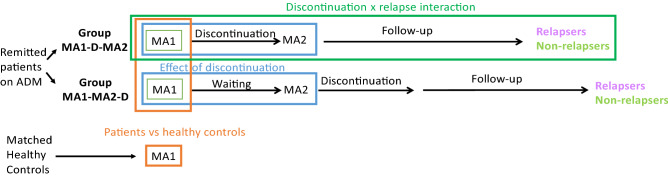
In remitted medicated patients with major depressive disorder, resting-state functional connectivity did not differ from healthy controls, did not differ before discontinuation between future relapsers and non-relapsers, and did not change with antidepressant discontinuation for the main seeds tested. An exploratory interaction showed that right dorsolateral prefrontal cortex connectivity with posterior default mode regions increased in non-relapsers after discontinuation and predicted relapse with balanced accuracy 0.86, requiring replication.
Key findings
- No resting-state functional connectivity differences were found between 84 remitted medicated patients and 44 healthy controls for the left subgenual anterior cingulate cortex main seed or any exploratory seeds.
- No pre-discontinuation connectivity differences were found between 29 patients who later relapsed and 38 who remained well, and no discontinuation effects were found for the left posterior cingulate cortex main seed or exploratory seeds.
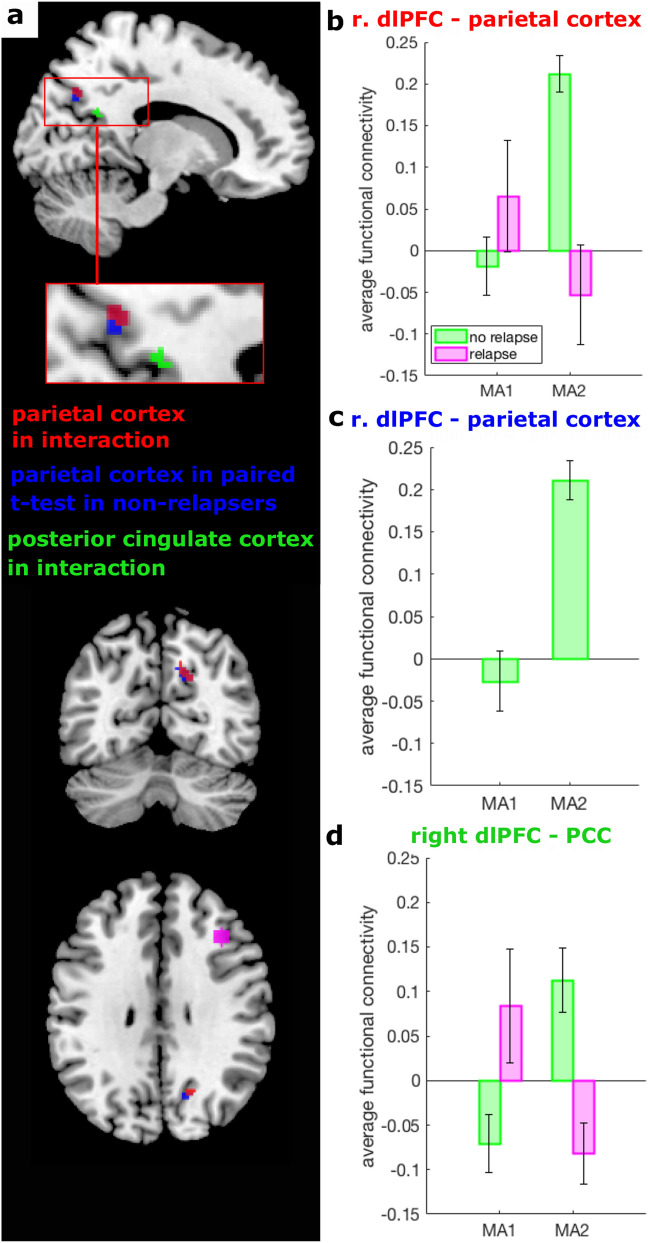
- A significant discontinuation-by-relapse interaction emerged for right dorsolateral prefrontal cortex connectivity with right parietal cortex (BA 7; peak MNI 14, −66, 38; p = 0.001) and posterior cingulate cortex (BA 23; peak MNI 12, −54, 14; p = 0.001); it was driven by increased right dlPFC–parietal connectivity in non-relapsers after discontinuation, while relapsers showed a numerical decrease that was not statistically significant.
- Post-hoc leave-one-out prediction using right dlPFC–parietal connectivity at MA2 or its change from MA1 to MA2 yielded a balanced accuracy of 0.86; the paper notes the change-based prediction is not independent evidence.
Methods
- The AIDA study was a two-centre observational randomized study of remitted patients on antidepressant medication who wanted to discontinue; patients were randomized to MA1-D-MA2 or MA1-MA2-D, assessed at main assessments MA1 and MA2, and followed for six months by telephone at weeks 1, 2, 4, 6, 8, 12, 16 and 21, with SCID-I if relapse signs appeared.
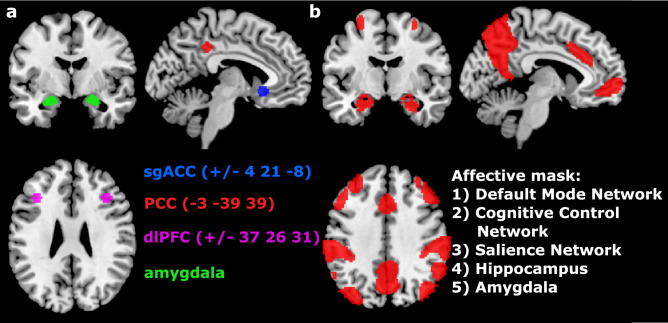
- Seed-based resting-state fMRI analysis used left sgACC as the main seed for patient-control and relapse comparisons and left PCC as the main seed for discontinuation analyses; exploratory seeds were right sgACC, left PCC, bilateral amygdala and bilateral dlPFC, with an affective mask including DMN, CEN, SN, amygdala and hippocampus; main results were FWE-corrected at p < 0.05 and exploratory results Bonferroni-corrected at p = 0.0083.
- The sample included 84 patients (mean age 34.23 [10.8], 80% female) and 44 controls (mean age 33.8 [10.5], 73% female); 29 patients relapsed and 38 remained well; post-hoc prediction used logistic regression nested in leave-one-out cross-validation.
Limitations
- The paper states the resting-state scan was only 5.5 min, the sgACC evidence base is heterogeneous and partly relies on overlapping samples, signal-to-noise ratio differed between sites, medication classes varied, motion-correction cut-offs are arbitrary, the naturalistic design cannot disentangle pharmacological from psychological effects of discontinuation, and the relapse sample was small.
- The paper states the prediction analysis was exploratory, focused on significant clusters, used a very small sample, and requires replication in an independent larger dataset; it also notes the change-based prediction is not orthogonal to the interaction effect.
- The text makes evident that the significant interaction did not remain significant when including participants with more than 1 mm framewise displacement and censoring scans with stick regressors, and that the study’s power was sufficient mainly for moderate-to-large effects, limiting interpretation of negative findings.
Model-written summary. Check it against the paper before relying on it.
Integrity signals
Registry
Cites
Statistics
Figures
Verification
Claims the paper makes
16 Valid · 2 Not valid · 7 Not checked · 55 Own results and interpretations
Every source the paper cites for this claim was checked and supports it.
In the paper
“but no established predictors exist”
§ The relationship between resting-state functional connectivity, antidepressant discontinuation and depression relapse > Abstract
What the sources say
- Supportedcites [5] Berwian IM Walter H Seifritz E Huys QJ Predicting relapse after antidepressant discontinuation a systematic review Psychol. Med. 2017 47 426 437 10.1017/S0033291716002580 27786144 PMC5244448 source
The Abstract states that although several predictors are promising, the evidence is weak and there are no established, validated markers of individual relapse risk after antidepressant cessation. This supports the claim in its stated context of relapse after discontinuation. (LLM, conf=0.94)
plain- Asserted: passes — The authors put it forward as true.
- Checkable: passes — It can be checked against evidence.
- Load-bearing: passes — The paper’s conclusions depend on it.
- Based: passes — The paper gives a reason why it holds.
- Supported
The cited sources support only part of this claim — read each source’s verdict below.
In the paper
“standard demographic and clinical variables appear to have very limited predictive power5”
§ The relationship between resting-state functional connectivity, antidepressant discontinuation and depression relapse > Introduction
What the sources say
- Partly supportedcites [5] Berwian IM Walter H Seifritz E Huys QJ Predicting relapse after antidepressant discontinuation a systematic review Psychol. Med. 2017 47 426 437 10.1017/S0033291716002580 27786144 PMC5244448 sourceExperimental — accuracy not yet measured
The Conclusion says few predictors of overall relapse risk appear to distinguish relapse risk after continuing versus discontinuing antidepressants. But the Discussion describes some clinical factors, including prior episodes and residual symptoms, as robust predictors of overall relapse risk. The claim omits that distinction and overstates the finding for relapse generally; page numbers are unavailable in our copy. (LLM, conf=0.85)
hedged- Asserted: passes — The authors put it forward as true.
- Checkable: passes — It can be checked against evidence.
- Load-bearing: passes — The paper’s conclusions depend on it.
- Based: passes — The paper gives a reason why it holds.
- Partly supported
The cited sources support only part of this claim — read each source’s verdict below.
In the paper
“the subgenual anterior cingulate cortex (sgACC) appears to have a particularly central role in relation to treatment response, remitted depression and relapse.”
§ The relationship between resting-state functional connectivity, antidepressant discontinuation and depression relapse > Introduction
What the sources say
- Not checked — no full text of the sourcecites [13] Mayberg HS Cingulate function in depression: a potential predictor of treatment response NeuroReport 1997 8 1057 1061 10.1097/00001756-199703030-00048 9141092 source
- Partly supportedcites [14] McGrath CL Pretreatment brain states identify likely nonresponse to standard treatments for depression Biol. Psychiatry 2014 76 527 535 10.1016/j.biopsych.2013.12.005 24462230 PMC4063885 sourceExperimental — accuracy not yet measured
The Results and Discussion (page not provided) link higher pretreatment subcallosal cingulate activity to treatment nonresponse and compare patients who did and did not remit. They do not establish a role in relapse or examine the brain state of people with remitted depression, so the broader claim is only partly supported. (LLM, conf=0.86)
- Supportedcites [26] Workman CI A novel resting-state functional magnetic resonance imaging signature of resilience to recurrent depression Psychol. Med. 2017 47 597 607 10.1017/S0033291716002567 27821193 PMC5426313 source
The Introduction describes the sgACC as central to depression and reports connectivity findings in remitted patients that differed according to subsequent recurrence. The Discussion reports that increased sgACC connectivity in current depression normalizes with treatment. Together, these passages support the claim's qualified description of its role. (LLM, conf=0.90)
- Partly supportedcites [27] Langenecker SA Cognitive control neuroimaging measures differentiate between those with and without future recurrence of depression Neuroimage Clin. 2018 20 1001 1009 10.1016/j.nicl.2018.10.004 30321791 PMC6197328 sourceExperimental — accuracy not yet measured
The Results (Left subgenual anterior cingulate connectivity; page unavailable) report greater sgACC connectivity in participants with a history of depression who later had a recurrence than in resilient participants and healthy controls. This supports a link to remission and relapse, but the paper does not establish a central role for sgACC in treatment response. (LLM, conf=0.86)
hedgedstates an association- Asserted: passes — The authors put it forward as true.
- Checkable: passes — It can be checked against evidence.
- Load-bearing: passes — The paper’s conclusions depend on it.
- Based: passes — The paper gives a reason why it holds.
The cited sources support only part of this claim — read each source’s verdict below.
In the paper
“One of the more replicated findings is a decrease in connectivity between PCC and various brain regions (including amygdala31, right inferior temporal gyrus36, right inferior frontal gyrus33)”
§ The relationship between resting-state functional connectivity, antidepressant discontinuation and depression relapse > Introduction
What the sources say
- Partly supportedcites [31] Cullen KR Neural correlates of antidepressant treatment response in adolescents with major depressive disorder J. Child Adolesc. Psychopharmacol. 2016 26 705 712 10.1089/cap.2015.0232 27159204 PMC5069704 sourceExperimental — accuracy not yet measured
The Results and Discussion report decreased amygdala–posterior cingulate resting-state connectivity associated with clinical improvement after SSRI treatment, supporting the amygdala example cited in the sentence. The Discussion also says the study found no overall pre–post connectivity change meeting its statistical criteria, so it does not establish a general effect of antidepressant initiation or that this finding is replicated. (LLM, conf=0.87)
- Not checked — no full text of the sourcecites [36] Qin J Predicting clinical responses in major depression using intrinsic functional connectivity NeuroReport 2015 26 675 680 10.1097/WNR.0000000000000407 26164454 source
- Supportedcites [33] Karim HT Intrinsic functional connectivity in late-life depression: trajectories over the course of pharmacotherapy in remitters and non-remitters Mol. Psychiatry 2017 22 450 457 10.1038/mp.2016.55 27090303 PMC5322273 source
The citation to this paper is attached to the right inferior frontal gyrus example, not the other regions listed. The Results (Default mode network; page unavailable) report decreased connectivity with that region over time in remitters, and the Discussion identifies the connection as PCC–IFG. The paper does not need to establish that the finding is replicated across studies to support this example. (LLM, conf=0.90)
plainstates a cause- Asserted: passes — The authors put it forward as true.
- Checkable: passes — It can be checked against evidence.
- Load-bearing: unclear — It is unclear whether the paper’s conclusions depend on it.
- Based: passes — The paper gives a reason why it holds.
- Partly supported
Every source the paper cites for this claim was checked and supports it.
In the paper
“increased connectivity between the sgACC and regions in the CEN differentiates patients who will experience a relapse and those who will not27”
§ The relationship between resting-state functional connectivity, antidepressant discontinuation and depression relapse > Introduction
What the sources say
- Supportedcites [27] Langenecker SA Cognitive control neuroimaging measures differentiate between those with and without future recurrence of depression Neuroimage Clin. 2018 20 1001 1009 10.1016/j.nicl.2018.10.004 30321791 PMC6197328 source
The Results section (Left subgenual anterior cingulate connectivity; page not provided) reports greater SGAC connectivity to cognitive-control network regions in the group with future MDD recurrence than in the resilient group. The Discussion likewise describes heightened SGAC-to-CCN connectivity in those with recurrence within one year. (LLM, conf=0.93)
plainstates an association- Asserted: passes — The authors put it forward as true.
- Checkable: passes — It can be checked against evidence.
- Load-bearing: passes — The paper’s conclusions depend on it.
- Based: passes — The paper gives a reason why it holds.
- Supported
32 more claims · 2 with their cited sources checked
Create a free account to see all 80 claims and to verify the 1 reference still open.
- Probably not a substantial claim. 27
- It may state two separate claims as one. 23
- The quote only partly states this claim. 2
Claims other papers make about this one
Each is checked against this paper’s own text: does it say what the citing paper says it does?
The cited source says what the claim attributes to it.
In the citing paper
“So far, findings of abnormal RSFC in remitted MDD (rMDD) have been inconsistent: both increased, decreased, or no abnormal connectivity have been found (Berwian et al., 2020; Bhaumik et al., 2017; Dong et al., 2019; Jenkins et al., 2017; Langenecker et al., 2018; Peters et al., 2016a; Vega et al., 2019).”
From Understanding and predicting future relapse in depression from resting state functional connectivity and self-referential processing (2023) · cites this paper as Berwian et al., 2020
The cited source says what the claim attributes to it.
In the citing paper
“This is in line with some of the scarce earlier studies in (young or medicated) rMDD patients (Berwian et al., 2020).”
From Understanding and predicting future relapse in depression from resting state functional connectivity and self-referential processing (2023) · cites this paper as Berwian et al., 2020
In the citing paper
“For example, res ng-state fMRI connec vity does change with discon nua on, and may be predic ve of relapse [16]”
From Amygdala Reactivity, Antidepressant Discontinuation, and Relapse (2024) · cites this paper as [16]
Statistics recomputed
Every reported test result, recomputed from its test statistic and degrees of freedom. A result shows as not adding up only once an independent check has confirmed it.
- Consistentt(126) = 7.76reported p < .001 · recomputed p < .001
“t(126) = 7.76, p < .001”
Self-check
Percentages, sums and reported differences re-computed from the paper’s own numbers.
Each contradiction between two passages listed here was confirmed by an independent check.
Rated minor: it would not touch a result — a value no result rests on, a p-value that stays on the same side of the significance level, or a conflict that is clerical, resolved elsewhere in the paper, or outside its own findings.
In the paper
§ The relationship between resting-state functional connectivity, antidepressant discontinuation and depression relapse > Discussion
“This interaction was driven by those who remained well during the follow-up period showing a significant increase in RSFC between the dlPFC and two areas in the posterior DMN, namely the parietal cortex and the PCC”
§ The relationship between resting-state functional connectivity, antidepressant discontinuation and depression relapse > Results > Interaction of discontinuation and relapse
“None of the post-hoc tests on the connectivity between right dlPFC and PCC reached significance, although a similar pattern of results is visible as for the connectivity of right dlPFC and parietal cortex”
Rated minor: it would not touch a result — a value no result rests on, a p-value that stays on the same side of the significance level, or a conflict that is clerical, resolved elsewhere in the paper, or outside its own findings.
In the paper
§ The relationship between resting-state functional connectivity, antidepressant discontinuation and depression relapse > Results > Interaction of discontinuation and relapse
“However, examining the exploratory seeds a significant interaction between discontinuation and relapse emerged for RSFC between the right dlPFC and two peaks in the right posterior DMN”
§ The relationship between resting-state functional connectivity, antidepressant discontinuation and depression relapse > Results > Exploratory analyses without correction for multiple comparisons
“No significant effects emerged for any of the exploratory seeds in any of the analyses when we dropped the correction for multiple comparison for number of seeds and set the required significance level to 0.05 FWE-corrected.”
Citations
Cites
Statistical power analyses using G∗Power 3.1: tests for correlation and regression analyses
Faul, F., Erdfelder, E., Buchner, A., & Lang, A.-G. (2009) · Behavior Research Methods · doi:10.3758/brm.41.4.1149 · Cited by 37,615
The human brain is intrinsically organized into dynamic, anticorrelated functional networks
Fox, M. D., Snyder, A. Z., Vincent, J. L., Corbetta, M., Van Essen, D. C., & Raichle, M. E. (2005) · Proceedings of the National Academy of Sciences · doi:10.1073/pnas.0504136102 · Cited by 8,553
Power, J. D., Barnes, K. A., Snyder, A. Z., Schlaggar, B. L., & Petersen, S. E. (2012) · NeuroImage · doi:10.1016/j.neuroimage.2011.10.018 · Cited by 7,429 · cited 1×
“The subgenual anterior cingulate cortex (sgACC) appears to have a particularly central role in the illness and treatment of depression(7; 8): neuroimaging measures of metabolic activity within this region have been shown to have predictive power for response to antidepressant and other treatments(9; 10) and RSFC of th…”
BackgroundEmotion-regulation strategies across psychopathology: A meta-analytic review
Aldao, A., Nolen-Hoeksema, S., & Schweizer, S. (2010) · Clinical Psychology Review · doi:10.1016/j.cpr.2009.11.004 · Cited by 6,686
Conn : A Functional Connectivity Toolbox for Correlated and Anticorrelated Brain Networks
Whitfield-Gabrieli, S., & Nieto-Castanon, A. (2012) · Brain Connectivity · doi:10.1089/brain.2012.0073 · Cited by 4,885
A reproducible evaluation of ANTs similarity metric performance in brain image registration
Avants, B. B., Tustison, N. J., Song, G., Cook, P. A., Klein, A., & Gee, J. C. (2011) · NeuroImage · doi:10.1016/j.neuroimage.2010.09.025 · Cited by 4,796 · cited 1×
“The subgenual anterior cingulate cortex (sgACC) appears to have a particularly central role in the illness and treatment of depression(7; 8): neuroimaging measures of metabolic activity within this region have been shown to have predictive power for response to antidepressant and other treatments(9; 10) and RSFC of th…”
BackgroundThe cognitive control of emotion
OCHSNER, K., & GROSS, J. (2005) · Trends in Cognitive Sciences · doi:10.1016/j.tics.2005.03.010 · Cited by 4,495
A new SPM toolbox for combining probabilistic cytoarchitectonic maps and functional imaging data
Eickhoff, S. B., Stephan, K. E., Mohlberg, H., Grefkes, C., Fink, G. R., Amunts, K., & Zilles, K. (2005) · NeuroImage · doi:10.1016/j.neuroimage.2004.12.034 · Cited by 4,033 · cited 1×
“In addition to abnormal RSFC in current depression(10; 11; 12), the subgenual anterior cingulate cortex (sgACC) appears to have a particularly central role in relation to treatment response, remitted depression and relapse.”
BackgroundSelf-citationRumination reconsidered: a psychometric analysis.
Treynor, W., Gonzalez, R., & Nolen-Hoeksema, S. (2003) · Cognitive Therapy and Research · doi:10.1023/a:1023910315561 · Cited by 3,808
SUSAN—a new approach to low level image processing
Smith, S. M., & Brady, J. M. (1997) · International Journal of Computer Vision · doi:10.1023/a:1007963824710 · Cited by 3,333 · cited 1×
“Here, we examined resting-state functional connectivity - a complex yet clinically feasible neuroimaging procedure(6).”
BackgroundKaiser, R. H., Andrews-Hanna, J. R., Wager, T. D., & Pizzagalli, D. A. (2015) · JAMA Psychiatry · doi:10.1001/jamapsychiatry.2015.0071 · Cited by 2,281
Greicius, M. D., Flores, B. H., Menon, V., Glover, G. H., Solvason, H. B., Kenna, H., Reiss, A. L., & Schatzberg, A. F. (2007) · Biological Psychiatry · doi:10.1016/j.biopsych.2006.09.020 · Cited by 2,214
The Inventory of Depressive Symptomatology (IDS): Psychometric properties
Rush, A. J., Gullion, C. M., Basco, M. R., Jarrett, R. B., & Trivedi, M. H. (1996) · Psychological Medicine · doi:10.1017/s0033291700035558 · Cited by 2,177 · cited 1×
“Indeed, the burden of depressive illnesses is in no small part due to their chronic nature with frequent relapses over the lifetime(3; 4).”
BackgroundWilamowska (2010) · doi:10.1001/archpsyc.1988.01800320058007 · Cited by 2,115 · cited 1×
“Indeed, the burden of depressive illnesses is in no small part due to their chronic nature with frequent relapses over the lifetime(3; 4).”
BackgroundICA-AROMA: A robust ICA-based strategy for removing motion artifacts from fMRI data
Pruim, R. H. R., Mennes, M., van Rooij, D., Llera, A., Buitelaar, J. K., & Beckmann, C. F. (2015) · NeuroImage · doi:10.1016/j.neuroimage.2015.02.064 · Cited by 1,684
The default mode network and self-referential processes in depression
Sheline, Y. I., Barch, D. M., Price, J. L., Rundle, M. M., Vaishnavi, S. N., Snyder, A. Z., Mintun, M. A., Wang, S., Coalson, R. S., & Raichle, M. E. (2009) · Proceedings of the National Academy of Sciences · doi:10.1073/pnas.0812686106 · Cited by 1,480
The increasing burden of depression
Briley, M., & Lépine (2011) · Neuropsychiatric Disease and Treatment · doi:10.2147/ndt.s19617 · Cited by 1,211
Sheline, Y. I., Price, J. L., Yan, Z., & Mintun, M. A. (2010) · Proceedings of the National Academy of Sciences · doi:10.1073/pnas.1000446107 · Cited by 1,196
Bupropion-SR, Sertraline, or Venlafaxine-XR after Failure of SSRIs for Depression
Rush, A. J., Trivedi, M. H., Wisniewski, S. R., Stewart, J. W., Nierenberg, A. A., Thase, M. E., Ritz, L., Biggs, M. M., Warden, D., Luther, J. F., et al. (2006) · New England Journal of Medicine · doi:10.1056/nejmoa052963 · Cited by 1,033 · cited 1×
“To this end, we examined (1) whether RSFC connectivity differs between remitted medicated patients and controls; (2) whether pre-discontinuation RSFC differs between patients who relapse after discontinuation and those who remain well; (3) the effects of discontinuation on RSFC; and (4) to what extent changes in RSFC…”
BackgroundCingulate function in depression: a potential predictor of treatment response
Mayberg, H. S., Brannan, S. K., Mahurin, R. K., Jerabek, P. A., Brickman, J. S., Tekell, J. L., Silva, J. A., McGinnis, S., Glass, T. G., Martin, C. C., et al. (1997) · NeuroReport · doi:10.1097/00001756-199703030-00048 · Cited by 1,029
Münster, R. D. (1999) · Zeitschrift für Klinische Psychologie und Psychotherapie · doi:10.1026//0084-5345.28.1.68 · Cited by 1,010
Relapse prevention with antidepressant drug treatment in depressive disorders: a systematic review
Geddes, J. R., Carney, S. M., Davies, C., Furukawa, T. A., Kupfer, D. J., Frank, E., & Goodwin, G. M. (2003) · The Lancet · doi:10.1016/s0140-6736(03)12599-8 · Cited by 945
Cross-validation failure: Small sample sizes lead to large error bars
Varoquaux, G. (2018) · NeuroImage · doi:10.1016/j.neuroimage.2017.06.061 · Cited by 897
Yan, C.-G., Chen, X., Li, L., Castellanos, F. X., Bai, T.-J., Bo, Q.-J., Cao, J., Chen, G.-M., Chen, N.-X., Chen, W., et al. (2019) · Proceedings of the National Academy of Sciences · doi:10.1073/pnas.1900390116 · Cited by 895
Resting-state functional connectivity in major depressive disorder: A review
Mulders, P. C., van Eijndhoven, P. F., Schene, A. H., Beckmann, C. F., & Tendolkar, I. (2015) · Neuroscience & Biobehavioral Reviews · doi:10.1016/j.neubiorev.2015.07.014 · Cited by 884
Methods for cleaning the BOLD fMRI signal
Caballero-Gaudes, C., & Reynolds, R. C. (2017) · NeuroImage · doi:10.1016/j.neuroimage.2016.12.018 · Cited by 542
Cognitive reactivity to sad mood provocation and the prediction of depressive relapse
Segal, Z. V., Kennedy, S., Gemar, M., Hood, K., Pedersen, R., & Buis, T. (2006) · Archives of General Psychiatry · doi:10.1001/archpsyc.63.7.749 · Cited by 470
Herringa, R. J., Birn, R. M., Ruttle, P. L., Burghy, C. A., Stodola, D. E., Davidson, R. J., & Essex, M. J. (2013) · Proceedings of the National Academy of Sciences · doi:10.1073/pnas.1310766110 · Cited by 426
Dichter, G. S., Gibbs, D., & Smoski, M. J. (2015) · Journal of Affective Disorders · doi:10.1016/j.jad.2014.09.028 · Cited by 375
A Treatment-Resistant Default Mode Subnetwork in Major Depression
Li, B., Liu, L., Friston, K. J., Shen, H., Wang, L., Zeng, L.-L., & Hu, D. (2013) · Biological Psychiatry · doi:10.1016/j.biopsych.2012.11.007 · Cited by 333
Antidepressant Effect on Connectivity of the Mood-Regulating Circuit: An fMRI Study
Anand, A., Li, Y., Wang, Y., Wu, J., Gao, S., Bukhari, L., Mathews, V. P., Kalnin, A., & Lowe, M. J. (2005) · Neuropsychopharmacology · doi:10.1038/sj.npp.1300725 · Cited by 324
Harnessing reliability for neuroscience research
Zuo, X.-N., Xu, T., & Milham, M. P. (2019) · Nature Human Behaviour · doi:10.1038/s41562-019-0655-x · Cited by 310
Antidepressants Normalize the Default Mode Network in Patients With Dysthymia
Posner, J., Hellerstein, D. J., Gat, I., Mechling, A., Klahr, K., Wang, Z., McGrath, P. J., Stewart, J. W., & Peterson, B. S. (2013) · JAMA Psychiatry · doi:10.1001/jamapsychiatry.2013.455 · Cited by 268
Lau, M. A., Segal, Z. V., & Williams, J. M. G. (2004) · Behaviour Research and Therapy · doi:10.1016/j.brat.2004.03.003 · Cited by 232
Recurrence of bipolar disorders and major depression: A life-long perspective
Angst, J., Gamma, A., Sellaro, R., Lavori, P. W., & Zhang, H. (2003) · European Archives of Psychiatry and Clinical Neuroscience · doi:10.1007/s00406-003-0437-2 · Cited by 189
Wang, L., Xia, M., Li, K., Zeng, Y., Su, Y., Dai, W., Zhang, Q., Jin, Z., Mitchell, P. B., Yu, X., et al. (2015) · Human Brain Mapping · doi:10.1002/hbm.22663 · Cited by 166
Resting state functional connectivity and treatment response in late-life depression
Andreescu, C., Tudorascu, D. L., Butters, M. A., Tamburo, E., Patel, M., Price, J., Karp, J. F., Reynolds, C. F., & Aizenstein, H. (2013) · Psychiatry Research: Neuroimaging · doi:10.1016/j.pscychresns.2013.08.007 · Cited by 153
Discontinuing antidepressant treatment in major depression.
Viguera, A. C., Baldessarini, R. J., & Friedberg, J. (1998) · Harvard Review of Psychiatry · doi:10.3109/10673229809003578 · Cited by 145
Pretreatment Brain States Identify Likely Nonresponse to Standard Treatments for Depression
McGrath, C. L., Kelley, M. E., Dunlop, B. W., Holtzheimer III, P. E., Craighead, W. E., & Mayberg, H. S. (2014) · Biological Psychiatry · doi:10.1016/j.biopsych.2013.12.005 · Cited by 139
Kaymaz, N., van Os, J., Loonen, A. J. M., & Nolan, W. A. (2008) · The Journal of Clinical Psychiatry · doi:10.4088/jcp.v69n0910 · Cited by 135
Wakefield, J. C., & Schmitz, M. F. (2013) · World Psychiatry · doi:10.1002/wps.20015 · Cited by 133
Neuroimaging-based biomarkers for treatment selection in major depressive disorder
Dunlop, B. W., & Mayberg, H. S. (2014) · Dialogues in Clinical Neuroscience · doi:10.31887/dcns.2014.16.4/bdunlop · Cited by 127
Altered amygdala connectivity in urban youth exposed to trauma
Thomason, M. E., Marusak, H. A., Tocco, M. A., Vila, A. M., McGarragle, O., & Rosenberg, D. R. (2015) · Social Cognitive and Affective Neuroscience · doi:10.1093/scan/nsv030 · Cited by 127
Windischberger, C., Lanzenberger, R., Holik, A., Spindelegger, C., Stein, P., Moser, U., Gerstl, F., Fink, M., Moser, E., & Kasper, S. (2010) · NeuroImage · doi:10.1016/j.neuroimage.2009.10.013 · Cited by 114
Jacobs, R. H., Jenkins, L. M., Gabriel, L. B., Barba, A., Ryan, K. A., Weisenbach, S. L., Verges, A., Baker, A. M., Peters, A. T., Crane, N. A., et al. (2014) · PLoS ONE · doi:10.1371/journal.pone.0104366 · Cited by 109
Goldstein-Piekarski, A. N., Staveland, B. R., Ball, T. M., Yesavage, J., Korgaonkar, M. S., & Williams, L. M. (2018) · Translational Psychiatry · doi:10.1038/s41398-018-0100-3 · Cited by 108
Jacobs, R. H., Barba, A., Gowins, J. R., Klumpp, H., Jenkins, L. M., Mickey, B. J., Ajilore, O., Peciña, M., Sikora, M., Ryan, K. A., et al. (2016) · Psychological Medicine · doi:10.1017/s0033291715002615 · Cited by 108
Karim, H. T., Andreescu, C., Tudorascu, D., Smagula, S. F., Butters, M. A., Karp, J. F., Reynolds, C., & Aizenstein, H. J. (2017) · Molecular Psychiatry · doi:10.1038/mp.2016.55 · Cited by 95
Predicting relapse after antidepressant withdrawal – a systematic review
Berwian, I. M., Walter, H., Seifritz, E., & Huys, Q. J. M. (2017) · Psychological Medicine · doi:10.1017/s0033291716002580 · Cited by 93
Self-citationPhilippi, C. L., Motzkin, J. C., Pujara, M. S., & Koenigs, M. (2015) · Journal of Psychiatric Research · doi:10.1016/j.jpsychires.2015.10.005 · Cited by 93
Salience Network Functional Connectivity Predicts Placebo Effects in Major Depression
Sikora, M., Heffernan, J., Avery, E. T., Mickey, B. J., Zubieta, J.-K., & Peciña, M. (2016) · Biological Psychiatry: Cognitive Neuroscience and Neuroimaging · doi:10.1016/j.bpsc.2015.10.002 · Cited by 85
Default mode network connectivity in children with a history of preschool onset depression
Gaffrey, M. S., Luby, J. L., Botteron, K., Repovš, G., & Barch, D. M. (2012) · Journal of Child Psychology and Psychiatry · doi:10.1111/j.1469-7610.2012.02552.x · Cited by 78
Why is Clinical fMRI in a Resting State?
O’Connor, E. E., & Zeffiro, T. A. (2019) · Frontiers in Neurology · doi:10.3389/fneur.2019.00420 · Cited by 77
Altered Intrinsic Functional Brain Architecture in Children at Familial Risk of Major Depression
Chai, X. J., Hirshfeld-Becker, D., Biederman, J., Uchida, M., Doehrmann, O., Leonard, J. A., Salvatore, J., Kenworthy, T., Brown, A., Kagan, E., et al. (2016) · Biological Psychiatry · doi:10.1016/j.biopsych.2015.12.003 · Cited by 75
Neural Correlates of Antidepressant Treatment Response in Adolescents with Major Depressive Disorder
Cullen, K. R., Klimes-Dougan, B., Vu, D. P., Westlund Schreiner, M., Mueller, B. A., Eberly, L. E., Camchong, J., Westervelt, A., & Lim, K. O. (2016) · Journal of Child and Adolescent Psychopharmacology · doi:10.1089/cap.2015.0232 · Cited by 75
Bhaumik, R., Jenkins, L. M., Gowins, J. R., Jacobs, R. H., Barba, A., Bhaumik, D. K., & Langenecker, S. A. (2017) · NeuroImage: Clinical · doi:10.1016/j.nicl.2016.02.018 · Cited by 72
Huffziger, S., & Kühner, C. (2012) · Zeitschrift für Klinische Psychologie und Psychotherapie · doi:10.1026/1616-3443/a000118 · Cited by 51
An, J., Wang, L., Li, K., Zeng, Y., Su, Y., Jin, Z., Yu, X., & Si, T. (2017) · Scientific Reports · doi:10.1038/s41598-017-10575-9 · Cited by 48
Langenecker, S. A., Jenkins, L. M., Stange, J. P., Chang, Y.-S., DelDonno, S. R., Bessette, K. L., Passarotti, A. M., Bhaumik, R., Ajilore, O., & Jacobs, R. H. (2018) · NeuroImage: Clinical · doi:10.1016/j.nicl.2018.10.004 · Cited by 47
Predicting clinical responses in major depression using intrinsic functional connectivity
Qin, J., Shen, H., Zeng, L.-L., Jiang, W., Liu, L., & Hu, D. (2015) · NeuroReport · doi:10.1097/wnr.0000000000000407 · Cited by 43
Bessette, K. L., Jenkins, L. M., Skerrett, K. A., Gowins, J. R., DelDonno, S. R., Zubieta, J., McInnis, M. G., Jacobs, R. H., Ajilore, O., & Langenecker, S. A. (2018) · Frontiers in Psychiatry · doi:10.3389/fpsyt.2018.00244 · Cited by 36
Jenkins, L. M., Stange, J. P., Barba, A., DelDonno, S. R., Kling, L. R., Briceño, E. M., Weisenbach, S. L., Phan, K. L., Shankman, S. A., Welsh, R. C., et al. (2017) · Cognitive, Affective, & Behavioral Neuroscience · doi:10.3758/s13415-017-0547-3 · Cited by 28
Subgenual Cingulate–Amygdala Functional Disconnection and Vulnerability to Melancholic Depression
Workman, C. I., Lythe, K. E., McKie, S., Moll, J., Gethin, J. A., Deakin, J. F., Elliott, R., & Zahn, R. (2016) · Neuropsychopharmacology · doi:10.1038/npp.2016.8 · Cited by 26
Workman, C. I., Lythe, K. E., McKie, S., Moll, J., Gethin, J. A., Deakin, J. F. W., Elliott, R., & Zahn, R. (2017) · Psychological Medicine · doi:10.1017/s0033291716002567 · Cited by 26
The neural basis of conceptual–emotional integration and its role in major depressive disorder
Green, S., Lambon Ralph, M. A., Moll, J., Zakrzewski, J., Deakin, J. F. W., Grafman, J., & Zahn, R. (2013) · Social Neuroscience · doi:10.1080/17470919.2013.810171 · Cited by 24
Effects of acute tryptophan depletion on raphé functional connectivity in depression
Weinstein, J. J., Rogers, B. P., Taylor, W. D., Boyd, B. D., Cowan, R. L., Shelton, K. M., & Salomon, R. M. (2015) · Psychiatry Research Neuroimaging · doi:10.1016/j.pscychresns.2015.08.015 · Cited by 19
Research works printed but not linked: 2
- Wittchen H-U Fydrich T Strukturiertes klinisches Interview für DSM-IV. Manual zum SKID-I und SKID-II 1997 Göttingen Hofgrefe
- Cohen J Statistical power analysis for the behavioural sciences 1969 San Diego Academic Press
Cited by
Gut microbiota-derived metabolites in CRC progression and causation
Dalal, N., Jalandra, R., Bayal, N., Yadav, A. K., Harshulika, Sharma, M., Makharia, G. K., Kumar, P., Singh, R. K., Solanki, P. R., et al. (2021) · Journal of Cancer Research and Clinical Oncology · doi:10.1007/s00432-021-03729-w · Cited by 114
Dunlop, K., Grosenick, L., Downar, J. H., Vila‐Rodriguez, F., Gunning, F. M., Daskalakis, Z. J., Blumberger, D. M., & Liston, C. M. (2024) · Biological Psychiatry · doi:10.1016/j.biopsych.2024.01.012 · Cited by 40
Sun, J., Chen, L., He, J., Wang, Z., Guo, C., Ma, Y., Luo, Y., Gao, D.-Q., Yang, H., Fang, J., et al. (2022) · Frontiers in Psychology · doi:10.3389/fpsyg.2022.849847 · Cited by 28
Amygdala Reactivity, Antidepressant Discontinuation, and Relapse
Erdmann, T., Berwian, I. M., Stephan, K. E., Seifritz, E., Walter, H., & Huys, Q. J. M. (2024) · JAMA Psychiatry · doi:10.1001/jamapsychiatry.2024.2136 · Cited by 18
Self-citationFarb, N. A. S., Desormeau, P., Anderson, A. K., & Segal, Z. V. (2022) · NeuroImage: Clinical · doi:10.1016/j.nicl.2022.102969 · Cited by 16
“Functional connectivity studies support this view, as cognitive control networks including the LPFC are observed less frequently in patients remitted from MDD (58), whereas non-relapsers tend to show increased connectivity of the LPFC with executive control regions following antidepressant discontinuation (59).”
Metadata
- Authors
- Berwian, I. M., Wenzel, J. G., Kuehn, L., Schnuerer, I., Kasper, L., Veer, I. M., Seifritz, E., Stephan, K. E., Walter, H., & Huys, Q. J. M.
- Affiliations
- Princeton University (US)
- Charité – Universitätsmedizin Berlin (DE)
- University of Zurich (CH)
- Wellcome Centre for Human Neuroimaging (GB)
- Corresponding author
- Berwian, Isabel M.
- ORCID
- Venue
- Scientific Reports
- Published
- 2020-12-18
- Volume
- 10
- Issue
- 1
- Pages
- 22346-22346
- ISSN
- 2045-2322 (ISSN-L)
- PMC
- PMC7749105
- OpenAlex
- W3114734180
- Cited by
- 29
- References
- 55
- Citations by year
- 2026: 3 · 2025: 3 · 2024: 11 · 2023: 6 · 2022: 4 · 2021: 2
- FWCI
- 1.61
- Type
- journal article
- Language
- en
- Open access
- gold
- doi.org
- Licence
- cc-by
- creativecommons.org/licenses/by/4.0 (tdm)
- creativecommons.org/licenses/by/4.0 (vor)
- Locations
- Scientific Reports (publishedVersion, cc-by)
- bioRxiv (Cold Spring Harbor Laboratory) (acceptedVersion, cc-by-nc-nd)
- PubMed Central (publishedVersion, cc-by)
- PubMed (publishedVersion)
- Zurich Open Repository and Archive (University of Zurich) (acceptedVersion, cc-by)
- DOAJ (DOAJ: Directory of Open Access Journals) (submittedVersion, cc-by-sa)
- UCL Discovery (University College London) (submittedVersion)
- MPG.PuRe (Max Planck Society) (submittedVersion)
- Repository for Publications and Research Data (ETH Zurich) (submittedVersion, cc-by)
- Zurich Open Repository and Archive (University of Zurich) (submittedVersion, cc-by)
- ETH Zürich Research Collection (cc-by)
- Zurich Open Repository and Archive (University of Zurich)
- Funders
- Clinical Research Priority Program "Molecular Imaging" at the University of Zurich
- René and Susanne Braginsky Foundation
- Deutsche Forschungsgemeinschaft (WA 1539/5-1)
- Schweizerischer Nationalfonds zur Förderung der Wissenschaftlichen Forschung (320030L_153449 / 1)
- Topics
- Life Sciences › Neuroscience › Cognitive Neuroscience › Functional Brain Connectivity Studies
- Health Sciences › Medicine › Pharmacology (medical) › Treatment of Major Depression
- Social Sciences › Psychology › Experimental and Cognitive Psychology › Mental Health Research Topics
- Keywords
- depression relapse, antidepressant discontinuation, resting-state functional connectivity, seed-based functional connectivity, dorsolateral prefrontal cortex, posterior default mode network, subgenual anterior cingulate cortex, posterior cingulate cortex, amygdala, remitted depression, recurrence prediction
- MeSH terms
- Adult, Amygdala, Antidepressive Agents, Brain Mapping, Depression, Female, Gyrus Cinguli, Humans, Magnetic Resonance Imaging, Male, Middle Aged, Neural Pathways, Recurrence, Prefrontal Cortex, Secondary Prevention
About these checks
Registry, retraction, Cites and statistics results are computed, not judged, with one exception: a printed reference that no index lists is read once by a model before it counts as a citation error. Claims are extracted by a model and kept only when their quote appears verbatim in the text; each cited source is then checked, with a model’s help, for whether it says what the claim relies on. Those verdicts can be wrong — read the claim’s quote and the cited source before relying on one.
The claim verdicts this report counts are experimental: their accuracy is not yet measured.
A language model drew the claims from the paper on 2026-10-10, under version 3 of the claim definition (model deepseek-v4.1-flash, prompt extract-v3).
A second model labelled each claim on 2026-10-10 (model jev-1.13-20260917, definition revision gold-guideline-v0.2).
Cited sources are checked with a language model’s help (gpt-6-sol).
Statistics and arithmetic are recomputed, not judged.
Confidence bands are shown only for fields calibrated on our annotated test set. None is calibrated yet, so no band is shown.
What counts as a claim ›How we measure confidence ›How we check this ›
Are you an author, or do you see a problem with this page? Request a review
Data sources
Bibliographic data: Semantic Scholar, OpenAlex, Crossref.
Contains information from the Semantic Scholar Academic Graph Datasets, made available under the ODC Attribution License (ODC-BY 1.0).
Semantic Scholar’s data is described in: Kinney, R., et al. (2023). The Semantic Scholar Open Data Platform. arXiv:2301.10140.
