

ChatGPT in education: global reactions to AI innovations
Open accessPublished version of a preprint
The DOI matches its Crossref record; 62 of the 62 references it cites were found in a registry or an index.
Abstract
The release and rapid diffusion of ChatGPT have caught the attention of educators worldwide. Some educators are enthusiastic about its potential to support learning. Others are concerned about how it might circumvent learning opportunities or contribute to misinformation. To better understand reactions about ChatGPT concerning education, we analyzed Twitter data (16,830,997 tweets from 5,541,457 users). Based on topic modeling and sentiment analysis, we provide an overview of global perceptions and reactions to ChatGPT regarding education. ChatGPT triggered a massive response on Twitter, with education being the most tweeted content topic. Topics ranged from specific (e.g., cheating) to broad (e.g., opportunities), which were discussed with mixed sentiment. We traced that authority decisions may influence public opinions. We discussed that the average reaction on Twitter (e.g., using ChatGPT to cheat in exams) differs from discussions in which education and teaching–learning researchers are likely to be more interested (e.g., ChatGPT as an intelligent learning partner). This study provides insights into people's reactions when new groundbreaking technology is released and implications for scientific and policy communication in rapidly changing circumstances.
Overview
The claims and statistics of this paper haven’t been checked yet.
Free: it reads the open-access text and checks the first 5 claims that cite a source we can check. Create a free account to check every claim.
Integrity signals
Registry
Cites
Statistics
Figures
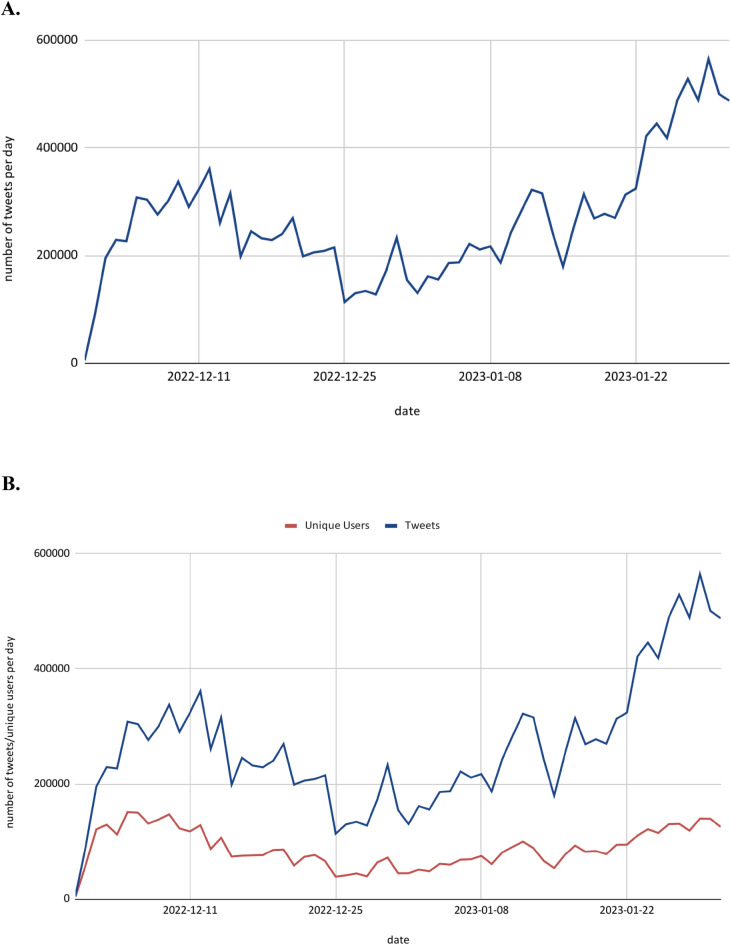
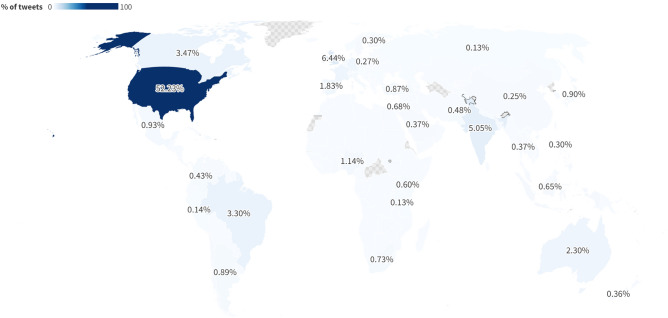
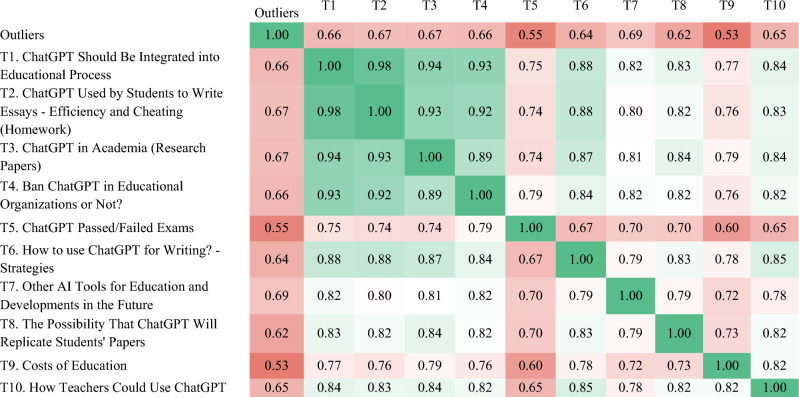
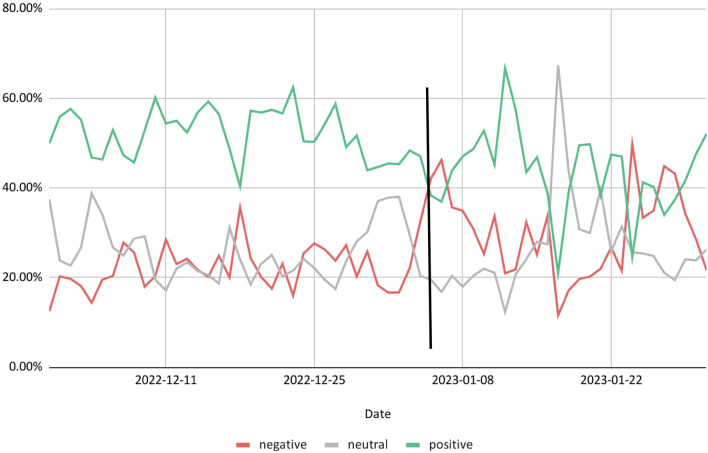
Verification
Claims the paper makes
The claims and statistics of this paper haven’t been checked yet.
Free: it reads the open-access text and checks the first 5 claims that cite a source we can check. Create a free account to check every claim.
Claims other papers make about this one
Each is checked against this paper’s own text: does it say what the citing paper says it does?
The source backs part of the claim, not all of it — or backs it for a different population, condition or comparison.
In the citing paper
“GenAI-driven tools may offer scalable and personalized support for reducing teachers' workloads (Fütterer et al., 2023; Kasneci et al., 2023; Steinert et al., 2024)”
From Enhancing School Students' Self-Regulated Learning through Generative AI Support: A Randomized Controlled Trial (2026) · cites this paper as Fütterer et al., 2023
Experimental — accuracy not yet measuredThe source backs part of the claim, not all of it — or backs it for a different population, condition or comparison.
In the citing paper
“By contrast, GenAI tools such as large language models (LLMs)-although likely less precise in instructional alignment and associated with challenges such as overreliance, reliability, and ethical concerns (Han et al. 2025a, b )-are more interactive and flexible in adapting to learners' needs through flexible dialogue without requiring extensive pre -modeling and could be used to support SRL by”
From Enhancing School Students' Self-Regulated Learning through Generative AI Support: A Randomized Controlled Trial (2026) · cites this paper as Fütterer et al., 2023
Experimental — accuracy not yet measuredThe source backs part of the claim, not all of it — or backs it for a different population, condition or comparison.
In the citing paper
“The results of questionnaire indicate ChatGPT can serve as an important educational tool, beneficial in a range of teaching contexts, including online classroom Q&A assistant, virtual tutor and facilitating language learning [24].”
From Exploring the potential of artificial intelligence to enhance the writing of english academic papers by non-native english-speaking medical students - the educational application of ChatGPT (2024) · cites this paper as [24]
Experimental — accuracy not yet measuredThe source backs part of the claim, not all of it — or backs it for a different population, condition or comparison.
In the citing paper
“Studies have suggested that the perceived usefulness of technology in the classroom is a strong predictor of intentions to participate in technology-related professional development (Fütterer et al., 2023a; Luckin et al., 2022).”
From Artificial intelligence in higher education: exploring faculty use, self-efficacy, distinct profiles, and professional development needs (2024) · cites this paper as Fütterer et al., 2023a
Experimental — accuracy not yet measuredIn the citing paper
“Fütterer et al. [68], in their article on global reactions to AI innovations, suggested that AI, such as ChatGPT, stressed the importance of AI literacy in shaping perceptions of the risks and opportunities associated with ChatGPT in education.”
From ChatGPT in Learning: Assessing Students’ Use Intentions through the Lens of Perceived Value and the Influence of AI Literacy (2024) · cites this paper as [68]
Self-check
Percentages, sums and reported differences re-computed from the paper’s own numbers.
The self-check needs the paper’s full text.
Citations
Cites
The theory of planned behavior
Ajzen, I. (1991) · Organizational Behavior and Human Decision Processes · doi:10.1016/0749-5978(91)90020-t · Cited by 134,657
(1975) · PhilPapers (PhilPapers Foundation) · Cited by 36,737
Language Models are Few-Shot Learners
Brown, T. B., Mann, B., Ryder, N., Subbiah, M., Kaplan, J., Dhariwal, P., Neelakantan, A., Shyam, P., Sastry, G., Askell, A., et al. (2020) · arXiv · doi:10.48550/arxiv.2005.14165 · Cited by 23,372
ChatGPT for good? On opportunities and challenges of large language models for education
Kasneci, E., Sessler, K., Küchemann, S., Bannert, M., Dementieva, D., Fischer, F., Gasser, U., Groh, G., Günnemann, S., Hüllermeier, E., et al. (2023) · Learning and Individual Differences · doi:10.1016/j.lindif.2023.102274 · Cited by 15,365
Kaugeranna, R., Kaugeranna, E., & Aion, (. S. 4. 6. (2023) · DROPS (Schloss Dagstuhl – Leibniz Center for Informatics) · doi:10.4230/lipics.giscience.2023.43 · Cited by 13,690
Hattie, J., & Timperley, H. (2007) · Review of Educational Research · doi:10.3102/003465430298487 · Cited by 12,905
ChatGPT for Good? On Opportunities and Challenges of Large Language Models for Education
Kasneci, E., Seßler, K., Küchemann, S., Bannert, M., Dementieva, D., Fischer, F., Gasser, U., Groh, G., Günnemann, S., Hüllermeier, E., et al. (2023) · doi:10.35542/osf.io/5er8f · Cited by 7,552
VADER: a parsimonious rule-based model for sentiment analysis of social media text
Hutto, C., & Gilbert, E. (2014) · Proceedings of the International AAAI Conference on Web and Social Media · doi:10.1609/icwsm.v8i1.14550 · Cited by 6,087
Training language models to follow instructions with human feedback
Ouyang, L., Wu, J., Jiang, X., Almeida, D., Wainwright, C. L., Mishkin, P., Zhang, C., Agarwal, S., Slama, K., Ray, A., et al. (2022) · arXiv · doi:10.48550/arxiv.2203.02155 · Cited by 4,208
BAİDOO-ANU, D., & OWUSU ANSAH, L. (2023) · Journal of AI · doi:10.61969/jai.1337500 · Cited by 3,939
Research works printed but not linked: 4
- Rogers, E. M. Diffusion of innovations (4th ed.). Free Press (2010).
- Trust T Whalen J Mouza C Editorial: ChatGPT: Challenges, opportunities, and implications for teacher education Contemp. Issues Technol. Teach. Educ. 2023 23 1 1 13
- Fishman, B. J. Possible futures for online teacher professional development. In C. Dede, A. Eisenkraft, K. Frumin, & A. Hartley (Eds.), Teacher learning in the digital age. Online professional development in STEM education (pp. 3–31). Harvard Education Press (2016).
- Borchers, C., Rosenberg, J. M., Gibbons, B., Burchfield, M. A., & Fischer, C. To scale or not to scale: Comparing popular sentiment analysis dictionaries on educational Twitter data. Fourteenth International Conference on Educational Data Mining (EDM 2021), Paris (2021).
Cited by
Items 201–242 of 242
Rossettini, G., Rodeghiero, L., Corradi, F., Cook, C., Pillastrini, P., Turolla, A., Castellini, G., Chiappinotto, S., Gianola, S., & Palese, A. (2024) · Figshare · doi:10.6084/m9.figshare.26739498
Rossettini, G., Rodeghiero, L., Corradi, F., Cook, C., Pillastrini, P., Turolla, A., Castellini, G., Chiappinotto, S., Gianola, S., & Palese, A. (2024) · Figshare · doi:10.6084/m9.figshare.26739489
Rossettini, G., Rodeghiero, L., Corradi, F., Cook, C., Pillastrini, P., Turolla, A., Castellini, G., Chiappinotto, S., Gianola, S., & Palese, A. (2024) · Figshare · doi:10.6084/m9.figshare.26739492
Rossettini, G., Rodeghiero, L., Corradi, F., Cook, C., Pillastrini, P., Turolla, A., Castellini, G., Chiappinotto, S., Gianola, S., & Palese, A. (2024) · Figshare · doi:10.6084/m9.figshare.26739495
Rossettini, G., Rodeghiero, L., Corradi, F., Cook, C., Pillastrini, P., Turolla, A., Castellini, G., Chiappinotto, S., Gianola, S., & Palese, A. (2024) · Figshare · doi:10.6084/m9.figshare.26739501
Baba, M. N. (2026) · International Journal of Education and Information Technologies · doi:10.46300/9109.2026.20.5
Sun, P., Haque, M. Z., Li, L., & Hossain, M. S. (2026) · Advances in Human-Computer Interaction · doi:10.1155/ahci/3363262
Kong, Y., Dong, T., Chen, R., Wu, Y., & Yang, Z. (2026) · PLoS ONE · doi:10.1371/journal.pone.0344849 · Cited by 2
“Recent survey data underscores this rapid adoption, with a significant portion of researchers already incorporating these tools into their workflows, albeit with notable disciplinary variations [20].”
BECKER, K. (2026) · AI & Society · doi:10.1007/s00146-026-02965-3
“…their access to vast knowledge repositories (Lin 2023, Chen (2024), LLMs can “extend our writing capacities” (Coeckelbergh and Gunkel 2024, p. 2223) while enabling personalized learning trajectories adapted to individual pace and needs (Karakose and Tülübaş 2023; Walter 2024; Fütterer et al. 2023).”
A Call for Action: The Eloquence of GenAI Numbs Students’ Critical Thinking
Jafari, E., & Vassileva, J. (2026) · Lecture notes on data engineering and communications technologies · doi:10.1007/978-981-95-4423-3_43 · Cited by 2
Lehren und Lernen mit künstlicher Intelligenz (KI)
Zinn, B. (2026) · Springer eBooks · doi:10.1007/978-3-662-72499-6_10
Digitalisierungs- und medienbezogenes Lehren und Lernen
Zinn, B. (2026) · Springer eBooks · doi:10.1007/978-3-662-72499-6_9
Ramya, M., V, & Prakash, K. R. (2025) · International Conference on Emerging Innovation and Digital Technology (ICEIDT) · doi:10.1109/iceidt66693.2025.11473470
“…learning outcomes, fosters student autonomy, and provides flexibility while maintaining the benefits of face-to-face interaction [27]. the potential of AI tools to assist students and educators while addressing concerns regarding academic integrity, ethical considerations, and AI literacy [28].”
Volodarskaya, E. B., & Tartoussi, A. A. (2026) · Вестник Тамбовского университета. Серия: Гуманитарные науки · doi:10.20310/1810-0201-2026-31-2-423-434
Design Thinking Meets AI: Leveraging ChatGPT for Innovative Pedagogy in Tourism Education
Al‐Romeedy, B. S., Hussein, H. S., & Emam, M. E. (2026) · IGI Global eBooks · doi:10.4018/979-8-3373-7102-3.ch001 · Cited by 1
Evaluating AI Detection Performance Across Writing Modalities in Engineering Interaction
Lestari, M. W., Ginting, A., Aminuddin, H., Cholish, C., & Hasnita, U. (2026) · Jurnal Penelitian Pendidikan IPA · doi:10.29303/jppipa.v12i4.9637
“Handwritten essays, which are later digitized through optical character recognition (OCR) or manual transcription, introduce additional variability due to recognition errors, formatting inconsistencies, and loss of original writing nuances (Montenegro-Rueda et al., 2023; Fütterer et al., 2023).”
Assessing ChatGPT for taxonomic and floristic studies
Peregrym, M., Козак, О., Yaprak, A. E., Elliott, A., Schwartsburd, P. B., Abidkulova, K. T., Voytsekhovich, A., & Danylevska, O. (2026) · Nordic Journal of Botany · doi:10.1002/njb.05206
“…has already demonstrated its utility in fields such as science (Cahyana et al. 2024, Garcia 2024, Nowogrodzki 2024, Malik et al. 2024), education (Fütterer et al. 2023, Kumar et al. 2024, Mai et al. 2024, Cotton and Cotton 2026), art (Guo et al. 2023, Zhu et al. 2024), medicine (Rao et al.…”
Challenges and Solutions in Implementation
Yeung, Y. Y. (2026) · Springer briefs in education · doi:10.1007/978-981-95-8259-4_5
Tsabedze, V. (2026) · Journal of Electronic Resources Librarianship · doi:10.1080/1941126x.2026.2669017
Junior high school student perspectives on the use of ChatGPT in music education
Weng, S. S., & Chiang, H.-C. (2026) · Computers and Education Open · doi:10.1016/j.caeo.2026.100387
Morina, F., Fütterer, T., Carpenter, J. P., Rosenberg, J. M., & Fischer, C. (2026) · Computers & Education · doi:10.1016/j.compedu.2026.105703
Self-citationA Bibliometric Study on the Use of ChatGPT in Education using Research Rabbit
Abu, M., & Moganathan, S. (2026) · ATTARBAWIY Malaysian Online Journal of Education · doi:10.53840/attarbawiy.v10i1.321
“Many facets of society were being profoundly altered by the quick development of artificial intelligence (AI) (Fütterer et al., 2023) technologies, with education being one of the areas most impacted.”
Зелевская, Н. А., & Ризина, Т. В. (2026) · Психолого-педагогический поиск · doi:10.37724/rsu.2026.78.2.011
Analyzing ChatGPT user experiences: a sentiment analysis and thematic cluster analytics approach
Teng, S., & HAMZAH, A. B. (2026) · Quality and User Experience · doi:10.1007/s41233-026-00079-8
“It is noted that users face technological innovations with varying expectations and emotions, ranging from absolute conviction of new technology’s usefulness and a positive attitude to a complete rejection of the new technology [69].”
da Silva, A. S., Alarcão, D. T. A., & Faria, S. P. (2026) · Revista de Geopolítica · doi:10.56238/revgeov17n7-086
Human–GenAI interaction across Bloom’s levels in university economics education
Макарова, В. В., & Ogloblina, E. V. (2026) · Discover Education · doi:10.1007/s44217-026-01896-x
“…about how learning outcomes are achieved and assessed, raising questions about productive and counterproductive forms of human-GenAI interaction, the trade-offs between cognitive, affective and behavioural outcomes, and the place of GenAI-based feedback in evidence-based interaction design [15].”
Giray, L., Nemeño, J., Jadulos, M. X., Abosejo, M. M., & Fabros, B. G. (2026) · Communications in computer and information science · doi:10.1007/978-3-032-33997-3_11
Wu, F., Xiao, H., & Lin, X. (2026) · SAGE Open · doi:10.1177/21582440261477182
Building Smart Classrooms Through AI and LLMs: A Case Study Using PISA Data
Jabiyev, T., Isaković, B., Mehanović, D., & Nazarli, N. (2026) · International Conference on Artificial Intelligence and Big Data (ICAIBD) · doi:10.1109/icaibd69640.2026.11637304
Kajembula, I. M., Matheo, K. I., Simchimba, P. D., Massawe, D. D., Usiri, A. I., & Ambikile, J. S. (2026) · Journal of Medical Education and Curricular Development · doi:10.1177/23821205261479986
Rogayan, D. V., & Yektie Nurprayoga, L. M. (2026) · International Journal of Education Reports · doi:10.62503/ijer.1.1.45-58
“…and more efficient lesson preparation, yet it has also raised new concerns about academic integrity and the quality of students' thinking processes (Cotton et al., 2024; Fütterer et al., 2023; García-López & Trujillo-Liñán, 2025; Klarin et al., 2024; Kofinas et al., 2025; Yusuf et al., 2024).”
Alan, B., Zengin, F. K., & Keçeci, G. (2026) · International Journal of Assessment Tools in Education · doi:10.21449/ijate.1671049
Petroccione, G., Drago, C., & Siggia, D. (2026) · Business Strategy and the Environment · doi:10.1002/bse.71546
Mesenhöller, J., & Böhme, K. (2026) · Frontiers in Education · doi:10.3389/feduc.2026.1875856
Corpus-level behavioral intensity in human–AI conversations
Mera-Navarrete, A., Revelo-Tapia, S., Beltrán-Morales, J., & Villegas-Ch, W. E. (2026) · Frontiers in Artificial Intelligence · doi:10.3389/frai.2026.1914081
“…as conspiracy theories (Costello et al., 2024), while education, health, and scientific writing document operational benefits together with risks of uncritical use, hallucinations, and displacement of expert judgment (Fütterer et al., 2023; Azamfirei et al., 2023; Haltaufderheide and Ranisch, 2024).”
Enhancing Children’s Artistic Skills through AI-Generated Visual Feedback: A Study Using SORA
ŞEN, Ş. N., & Şen, M. (2026) · The Elementary School Journal · doi:10.1086/743344
Meykola1, K. G., Taheri, R., Ellingsen, A., Dadgostari, F., Clark, J., & Nazemi, N. (2026) · Research Square · doi:10.21203/rs.3.rs-11013514/v1
Yu, M. (2026) · Advances in Education · doi:10.12677/ae.2026.16102156
Kollaborative Prozesse zur Einbindung von KI in der Primarstufe
Wichers, A., Hesse, F., & Helm, G. (2026) · MedienPädagogik Zeitschrift für Theorie und Praxis der Medienbildung · doi:10.21240/mpaed/73/2026.10.24.x
“5 durch OpenAI Ende 2022 werden Poten-ziale und Herausforderungen des Einsatzes generativer KI im Bildungswesen kontro-vers diskutiert (z. B. Fütterer et al. 2023).”
Metadata
- Authors
- Fütterer, T., Fischer, C., Alekseeva, A., Chen, X., Tate, T., Warschauer, M., & Gerjets, P.
- Affiliations
- University of Tübingen (DE)
- University of California, Irvine (US)
- Leibniz-Institut für Wissensmedien (DE)
- Corresponding author
- Fütterer, Tim
- ORCID
- Venue
- Scientific Reports
- Published
- 2023-09-15
- Volume
- 13
- Issue
- 1
- Pages
- 15310-15310
- ISSN
- 2045-2322 (ISSN-L)
- PMC
- PMC10504368
- OpenAlex
- W4386773699
- Semantic Scholar
- a45bde4fafe66475cd542477d6bb034e273aa8dc
- Cited by
- 242
- References
- 54
- Citations by year
- 2026: 45 · 2025: 93 · 2024: 95 · 2023: 9
- FWCI
- 56.69
- Type
- journal article
- Language
- en
- Open access
- gold
- doi.org
- Licence
- cc-by
- creativecommons.org/licenses/by/4.0 (tdm)
- creativecommons.org/licenses/by/4.0 (vor)
- Locations
- Scientific Reports (publishedVersion, cc-by)
- Research Square (acceptedVersion, cc-by)
- PubMed Central (publishedVersion, cc-by)
- PubMed (publishedVersion)
- eScholarship (California Digital Library) (submittedVersion, cc-by)
- DOAJ (DOAJ: Directory of Open Access Journals) (submittedVersion, cc-by-sa)
- Funders
- Eberhard Karls Universität Tübingen
- Topics
- Social Sciences › Education › Artificial Intelligence in Education
- Physical Sciences › Computer Science › Artificial Intelligence › Sentiment Analysis and Opinion Mining
- Social Sciences › Education › Educational Technology in Learning
- Keywords
- ChatGPT, generative AI in education, public perception of AI, academic dishonesty, misinformation, AI as learning partner, sentiment analysis, topic modeling, science communication, AI policy
About these checks
Registry, retraction, Cites and statistics results are computed, not judged, with one exception: a printed reference that no index lists is read once by a model before it counts as a citation error. Claims are extracted by a model and kept only when their quote appears verbatim in the text; each cited source is then checked, with a model’s help, for whether it says what the claim relies on. Those verdicts can be wrong — read the claim’s quote and the cited source before relying on one.
Statistics and arithmetic are recomputed, not judged.
Confidence bands are shown only for fields calibrated on our annotated test set. None is calibrated yet, so no band is shown.
What counts as a claim ›How we measure confidence ›How we check this ›
Are you an author, or do you see a problem with this page? Request a review
Data sources
Bibliographic data: Semantic Scholar, OpenAlex, Crossref.
Contains information from the Semantic Scholar Academic Graph Datasets, made available under the ODC Attribution License (ODC-BY 1.0).
Semantic Scholar’s data is described in: Kinney, R., et al. (2023). The Semantic Scholar Open Data Platform. arXiv:2301.10140.
