

ChatGPT in education: global reactions to AI innovations
Open accessPublished version of a preprint
The DOI matches its Crossref record; 62 of the 62 references it cites were found in a registry or an index.
Abstract
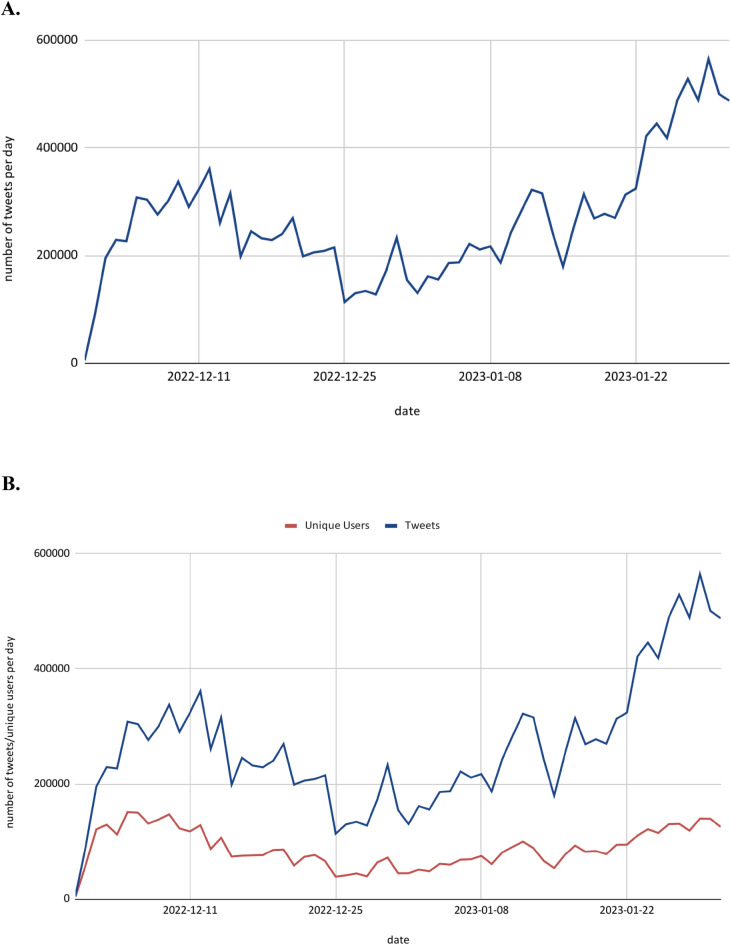
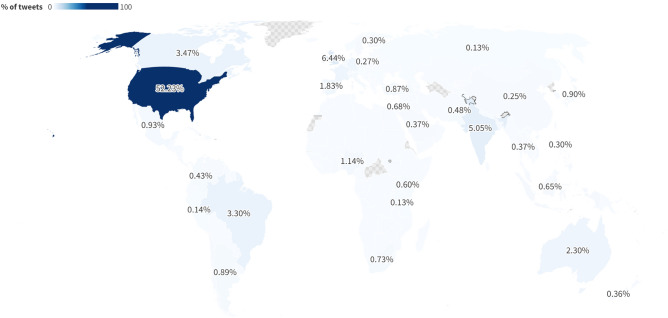
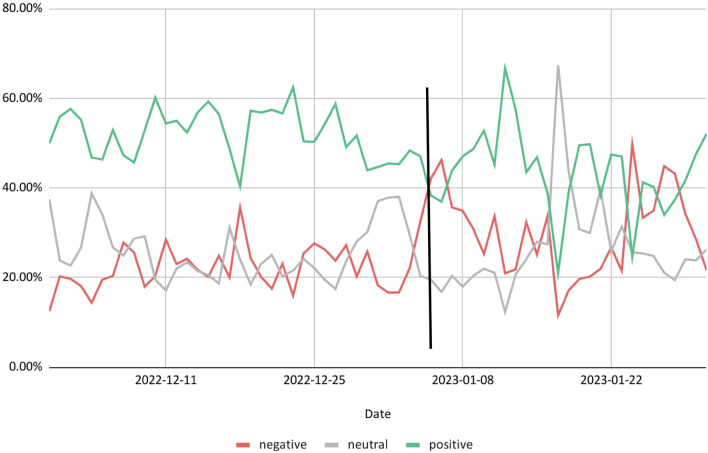
The release and rapid diffusion of ChatGPT have caught the attention of educators worldwide. Some educators are enthusiastic about its potential to support learning. Others are concerned about how it might circumvent learning opportunities or contribute to misinformation. To better understand reactions about ChatGPT concerning education, we analyzed Twitter data (16,830,997 tweets from 5,541,457 users). Based on topic modeling and sentiment analysis, we provide an overview of global perceptions and reactions to ChatGPT regarding education. ChatGPT triggered a massive response on Twitter, with education being the most tweeted content topic. Topics ranged from specific (e.g., cheating) to broad (e.g., opportunities), which were discussed with mixed sentiment. We traced that authority decisions may influence public opinions. We discussed that the average reaction on Twitter (e.g., using ChatGPT to cheat in exams) differs from discussions in which education and teaching–learning researchers are likely to be more interested (e.g., ChatGPT as an intelligent learning partner). This study provides insights into people's reactions when new groundbreaking technology is released and implications for scientific and policy communication in rapidly changing circumstances.
Overview
The claims and statistics of this paper haven’t been checked yet.
Free: it reads the open-access text and checks the first 5 claims that cite a source we can check. Create a free account to check every claim.
Integrity signals
Registry
Cites
Statistics
Figures
Verification
Claims the paper makes
The claims and statistics of this paper haven’t been checked yet.
Free: it reads the open-access text and checks the first 5 claims that cite a source we can check. Create a free account to check every claim.
Claims other papers make about this one
Each is checked against this paper’s own text: does it say what the citing paper says it does?
The source backs part of the claim, not all of it — or backs it for a different population, condition or comparison.
In the citing paper
“GenAI-driven tools may offer scalable and personalized support for reducing teachers' workloads (Fütterer et al., 2023; Kasneci et al., 2023; Steinert et al., 2024)”
From Enhancing School Students' Self-Regulated Learning through Generative AI Support: A Randomized Controlled Trial (2026) · cites this paper as Fütterer et al., 2023
Experimental — accuracy not yet measuredThe source backs part of the claim, not all of it — or backs it for a different population, condition or comparison.
In the citing paper
“By contrast, GenAI tools such as large language models (LLMs)-although likely less precise in instructional alignment and associated with challenges such as overreliance, reliability, and ethical concerns (Han et al. 2025a, b )-are more interactive and flexible in adapting to learners' needs through flexible dialogue without requiring extensive pre -modeling and could be used to support SRL by”
From Enhancing School Students' Self-Regulated Learning through Generative AI Support: A Randomized Controlled Trial (2026) · cites this paper as Fütterer et al., 2023
Experimental — accuracy not yet measuredThe source backs part of the claim, not all of it — or backs it for a different population, condition or comparison.
In the citing paper
“The results of questionnaire indicate ChatGPT can serve as an important educational tool, beneficial in a range of teaching contexts, including online classroom Q&A assistant, virtual tutor and facilitating language learning [24].”
From Exploring the potential of artificial intelligence to enhance the writing of english academic papers by non-native english-speaking medical students - the educational application of ChatGPT (2024) · cites this paper as [24]
Experimental — accuracy not yet measuredThe source backs part of the claim, not all of it — or backs it for a different population, condition or comparison.
In the citing paper
“Studies have suggested that the perceived usefulness of technology in the classroom is a strong predictor of intentions to participate in technology-related professional development (Fütterer et al., 2023a; Luckin et al., 2022).”
From Artificial intelligence in higher education: exploring faculty use, self-efficacy, distinct profiles, and professional development needs (2024) · cites this paper as Fütterer et al., 2023a
Experimental — accuracy not yet measuredIn the citing paper
“Fütterer et al. [68], in their article on global reactions to AI innovations, suggested that AI, such as ChatGPT, stressed the importance of AI literacy in shaping perceptions of the risks and opportunities associated with ChatGPT in education.”
From ChatGPT in Learning: Assessing Students’ Use Intentions through the Lens of Perceived Value and the Influence of AI Literacy (2024) · cites this paper as [68]
Self-check
Percentages, sums and reported differences re-computed from the paper’s own numbers.
The self-check needs the paper’s full text.
Citations
Cites
The theory of planned behavior
Ajzen, I. (1991) · Organizational Behavior and Human Decision Processes · doi:10.1016/0749-5978(91)90020-t · Cited by 134,657
(1975) · PhilPapers (PhilPapers Foundation) · Cited by 36,737
Language Models are Few-Shot Learners
Brown, T. B., Mann, B., Ryder, N., Subbiah, M., Kaplan, J., Dhariwal, P., Neelakantan, A., Shyam, P., Sastry, G., Askell, A., et al. (2020) · arXiv · doi:10.48550/arxiv.2005.14165 · Cited by 23,372
ChatGPT for good? On opportunities and challenges of large language models for education
Kasneci, E., Sessler, K., Küchemann, S., Bannert, M., Dementieva, D., Fischer, F., Gasser, U., Groh, G., Günnemann, S., Hüllermeier, E., et al. (2023) · Learning and Individual Differences · doi:10.1016/j.lindif.2023.102274 · Cited by 15,365
Kaugeranna, R., Kaugeranna, E., & Aion, (. S. 4. 6. (2023) · DROPS (Schloss Dagstuhl – Leibniz Center for Informatics) · doi:10.4230/lipics.giscience.2023.43 · Cited by 13,690
Hattie, J., & Timperley, H. (2007) · Review of Educational Research · doi:10.3102/003465430298487 · Cited by 12,905
ChatGPT for Good? On Opportunities and Challenges of Large Language Models for Education
Kasneci, E., Seßler, K., Küchemann, S., Bannert, M., Dementieva, D., Fischer, F., Gasser, U., Groh, G., Günnemann, S., Hüllermeier, E., et al. (2023) · doi:10.35542/osf.io/5er8f · Cited by 7,552
VADER: a parsimonious rule-based model for sentiment analysis of social media text
Hutto, C., & Gilbert, E. (2014) · Proceedings of the International AAAI Conference on Web and Social Media · doi:10.1609/icwsm.v8i1.14550 · Cited by 6,087
Training language models to follow instructions with human feedback
Ouyang, L., Wu, J., Jiang, X., Almeida, D., Wainwright, C. L., Mishkin, P., Zhang, C., Agarwal, S., Slama, K., Ray, A., et al. (2022) · arXiv · doi:10.48550/arxiv.2203.02155 · Cited by 4,208
BAİDOO-ANU, D., & OWUSU ANSAH, L. (2023) · Journal of AI · doi:10.61969/jai.1337500 · Cited by 3,939
The Role of Emotions in Marketing
Bagozzi, R. P., Gopinath, M., & Nyer, P. U. (1999) · Journal of the Academy of Marketing Science · doi:10.1177/0092070399272005 · Cited by 3,349 · cited 1×
“For instance, social science research has shown that emotions are a crucial factor for decision-making processes (e.g., functioning as helpful guides or as bias factors; Lerner et al. 29 ,) or consumer behavior 30 (for more studies, see Valor et al. 28”
BackgroundThe theory of planned behavior: Frequently asked questions
Ajzen, I. (2020) · Human Behavior and Emerging Technologies · doi:10.1002/hbe2.195 · Cited by 3,347 · cited 1×
“For instance, the Technology Acceptance Model (TAM; 22 , which is based on the Theory of Reasoned Action 23,24 and the Theory of Planned Behavior 25,26 , is a frequently used model to describe the actual use of technology 27 .”
BackgroundSallam, M. (2023) · Healthcare · doi:10.3390/healthcare11060887 · Cited by 3,126
Baidoo-Anu, D., & Owusu Ansah, L. (2023) · doi:10.2139/ssrn.4337484 · Cited by 3,004
Lerner, J. S., Li, Y., Valdesolo, P., & Kassam, K. S. (2015) · Annual Review of Psychology · doi:10.1146/annurev-psych-010213-115043 · Cited by 2,913 · cited 1×
“For instance, social science research has shown that emotions are a crucial factor for decision-making processes (e.g., functioning as helpful guides or as bias factors; Lerner et al. 29 ,) or consumer behavior 30 (for more studies, see Valor et al. 28”
BackgroundGPT-3: Its Nature, Scope, Limits, and Consequences
Floridi, L., & Chiriatti, M. (2020) · Minds and Machines · doi:10.1007/s11023-020-09548-1 · Cited by 2,519
Technology acceptance model: a literature review from 1986 to 2013
Marangunić, N., & Granić, A. (2015) · Universal Access in the Information Society · doi:10.1007/s10209-014-0348-1 · Cited by 2,458 · cited 1×
“For instance, the Technology Acceptance Model (TAM; 22 , which is based on the Theory of Reasoned Action 23,24 and the Theory of Planned Behavior 25,26 , is a frequently used model to describe the actual use of technology 27 .”
BackgroundWhat Is the Impact of ChatGPT on Education? A Rapid Review of the Literature
Lo, C. K. (2023) · Education Sciences · doi:10.3390/educsci13040410 · Cited by 2,024
Scherer, R., Siddiq, F., & Tondeur, J. (2019) · Computers & Education · doi:10.1016/j.compedu.2018.09.009 · Cited by 1,923
ChatGPT: Bullshit spewer or the end of traditional assessments in higher education?
(2023) · Journal of Applied Learning & Teaching · doi:10.37074/jalt.2023.6.1.9 · Cited by 1,806
BERTopic: Neural topic modeling with a class-based TF-IDF procedure
Grootendorst, M. (2022) · arXiv · doi:10.48550/arxiv.2203.05794 · Cited by 1,423
ChatGPT for Language Teaching and Learning
Kohnke, L., Moorhouse, B. L., & Zou, D. (2023) · RELC Journal · doi:10.1177/00336882231162868 · Cited by 1,371
A theory of reasoned action: some applications and implications.
Fishbein, M. (1980) · PubMed · Cited by 1,353
The Power of Feedback Revisited: A Meta-Analysis of Educational Feedback Research
Wisniewski, B., Zierer, K., & Hattie, J. (2020) · Frontiers in Psychology · doi:10.3389/fpsyg.2019.03087 · Cited by 1,199
Pavlik, J. V. (2023) · Journalism & Mass Communication Educator · doi:10.1177/10776958221149577 · Cited by 972
A Topic Modeling Comparison Between LDA, NMF, Top2Vec, and BERTopic to Demystify Twitter Posts
Egger, R., & Yu, J. (2022) · Frontiers in Sociology · doi:10.3389/fsoc.2022.886498 · Cited by 970
BotOrNot: A System to Evaluate Social Bots
Davis, C. A., Varol, O., Ferrara, E., Flammini, A., & Menczer, F. (2016) · Proceedings of the 25th International Conference Companion on World Wide Web - WWW 16 Companion · doi:10.1145/2872518.2889302 · Cited by 909
The benefits and challenges of chatgpt: An overview
Deng, J., & Lin, Y. (2023) · Frontiers in Computing and Intelligent Systems · doi:10.54097/fcis.v2i2.4465 · Cited by 611
AI bot ChatGPT writes smart essays — should professors worry?
Stokel-Walker, C. (2022) · Nature · doi:10.1038/d41586-022-04397-7 · Cited by 543
Exploring Students’ Perceptions of ChatGPT: Thematic Analysis and Follow-Up Survey
Shoufan, A. (2023) · IEEE Access · doi:10.1109/access.2023.3268224 · Cited by 499 · cited 1×
“For example, typical studies of this category analyzed the perceptions and expectations of 50 senior Computer Engineering students in Abu Dhabi 55 , 2100 students from a Ghanaian university 56 , or 288 participants from a convenience sample study at an Indian university 57 .”
BackgroundMining Big Data in Education: Affordances and Challenges
Fischer, C., Pardos, Z. A., Baker, R. S., Williams, J. J., Smyth, P., Yu, R., Slater, S., Baker, R., & Warschauer, M. (2020) · Review of Research in Education · doi:10.3102/0091732x20903304 · Cited by 412
Self-citationKöbis, N., & Mossink, L. D. (2021) · Computers in Human Behavior · doi:10.1016/j.chb.2020.106553 · Cited by 406
Bots, #Strongerin, and #Brexit: Computational Propaganda During the UK-EU Referendum
Howard, P. N., & Kollanyi, B. (2016) · doi:10.2139/ssrn.2798311 · Cited by 392
ChatGPT for Education and Research: A Review of Benefits and Risks
Sok, S., & Heng, K. (2023) · doi:10.2139/ssrn.4378735 · Cited by 386
ChatGPT for education and research: A review of benefits and risks
Sok, S., & Heng, K. (2023) · Cambodian Journal of Educational Research · doi:10.62037/cjer.2023.03.01.06 · Cited by 382
A decade of social bot detection
Cresci, S. (2020) · Communications of the ACM · doi:10.1145/3409116 · Cited by 323
Ince, J., Rojas, F., & Davis, C. A. (2017) · Ethnic and Racial Studies · doi:10.1080/01419870.2017.1334931 · Cited by 286
WebGPT: Browser-assisted question-answering with human feedback
Nakano, R., Hilton, J., Balaji, S., Wu, J., Ouyang, L., Kim, C., Hesse, C., Jain, S., Kosaraju, V., Saunders, W., et al. (2021) · arXiv · doi:10.48550/arxiv.2112.09332 · Cited by 272
Raman, R., Mandal, S., Das, P., Kaur, T., Sanjanasri, J. P., & Nedungadi, P. (2024) · Human Behavior and Emerging Technologies · doi:10.1155/2024/3085910 · Cited by 214
Haque, M. U., Dharmadasa, I., Sworna, Z. T., Rajapakse, R. N., & Ahmad, H. (2022) · arXiv · doi:10.48550/arxiv.2212.05856 · Cited by 203
Marčec, R., & Likić, R. (2021) · Postgraduate Medical Journal · doi:10.1136/postgradmedj-2021-140685 · Cited by 153
Technology and History: “Kranzberg’s Laws”
Kranzberg, M. (1986) · Technology and Culture · doi:10.1353/tech.2021.0008 · Cited by 144
Educational Research and AI-Generated Writing: Confronting the Coming Tsunami
Tate, T. P., Doroudi, S., Ritchie, D., Xu, Y., & uci, M. W. (2023) · doi:10.35542/osf.io/4mec3 · Cited by 137
Self-citationUnderstanding the Capabilities, Limitations, and Societal Impact of Large Language Models
Tamkin, A., Brundage, M., Clark, J., & Ganguli, D. (2021) · arXiv · doi:10.48550/arxiv.2102.02503 · Cited by 135
Emotions and consumers’ adoption of innovations: An integrative review and research agenda
Valor, C., Antonetti, P., & Crisafulli, B. (2022) · Technological Forecasting and Social Change · doi:10.1016/j.techfore.2022.121609 · Cited by 132
Social behavior and brand devotion among iPhone innovators
Filho, E. J. M. A., Cabusas, J. J., & Dholakia, N. (2010) · International Journal of Information Management · doi:10.1016/j.ijinfomgt.2010.03.003 · Cited by 126
Bonsu, E. M., & Baffour-Koduah, D. (2023) · Journal of Education, Society & Multiculturalism · doi:10.2478/jesm-2023-0001 · Cited by 123
Sentiment Analysis on Twitter with Python’s Natural Language Toolkit and VADER Sentiment Analyzer
Elbagir, S., & Yang, J. (2020) · doi:10.1142/9789811215094_0005 · Cited by 109
Beijing consensus on artificial intelligence and education
Krotz, F., & Schelhowe, H. (2020) · merz | medien + erziehung · doi:10.21240/merz/2020.5.11 · Cited by 100
University students as early adopters of ChatGPT: Innovation Diffusion StudyPreprint
Raghu Raman, R., Mandal, S., Das, P., et al. (2023) · Research Square · doi:10.21203/rs.3.rs-2734142/v1 · Cited by 95
Mahdikhani, M. (2021) · International Journal of Information Management Data Insights · doi:10.1016/j.jjimei.2021.100053 · Cited by 90
MaartenGr/BERTopic: Fix embedding parameter
Grootendorst, M. R., Das, A., Bailey, J. S., dschwalm, Elashry, A., Gamble, A., Simonoff, A., Aratako, Bob, Inskip, C., et al. (2020) · Zenodo (CERN European Organization for Nuclear Research) · doi:10.5281/zenodo.4381785 · Cited by 80
ChatGPT for Next Generation Science Learning
Zhai, X. (2023) · doi:10.2139/ssrn.4331313 · Cited by 58
The Uproar Over Gene-Edited Babies: A Semantic Network Analysis of CRISPR on Twitter
Calabrese, C., Ding, J., Millam, B. J., & Barnett, G. A. (2019) · Environmental Communication · doi:10.1080/17524032.2019.1699135 · Cited by 42
Anwar, A., Ilyas, H., Yaqub, U., & Zaman, S. (2021) · Annual International Conference on Digital Government Research · doi:10.1145/3463677.3463718 · Cited by 38
Fütterer, T., Hoch, E., Stürmer, K., Lachner, A., Fischer, C., & Scheiter, K. (2021) · Zeitschrift für Erziehungswissenschaft · doi:10.1007/s11618-021-01013-8 · Cited by 32
Self-citationRosenberg, J. M., Borchers, C., Dyer, E., Anderson, D., & Fischer, C. (2021) · AERA Open · doi:10.1177/23328584211024261 · Cited by 30
Self-citationWhy ChatGPT is such a big deal for education
Anders, B. A. (2023) · ScholarSpace - JCCC (Johnson County Community College) · Cited by 29
Gunser, V. E., Gottschling, S., Brucker, B., Richter, S., Çakir, D. C., & Gerjets, P. (2022) · Proceedings of the First Workshop on Intelligent and Interactive Writing Assistants (In2Writing 2022) · doi:10.18653/v1/2022.in2writing-1.8 · Cited by 23
Self-citationMaartenGr/BERTopic: Fix embedding parameter
Grootendorst, M. (2021) · Zenodo (CERN European Organization for Nuclear Research) · doi:10.5281/zenodo.4430182 · Cited by 15
Research works printed but not linked: 4
- Rogers, E. M. Diffusion of innovations (4th ed.). Free Press (2010).
- Trust T Whalen J Mouza C Editorial: ChatGPT: Challenges, opportunities, and implications for teacher education Contemp. Issues Technol. Teach. Educ. 2023 23 1 1 13
- Fishman, B. J. Possible futures for online teacher professional development. In C. Dede, A. Eisenkraft, K. Frumin, & A. Hartley (Eds.), Teacher learning in the digital age. Online professional development in STEM education (pp. 3–31). Harvard Education Press (2016).
- Borchers, C., Rosenberg, J. M., Gibbons, B., Burchfield, M. A., & Fischer, C. To scale or not to scale: Comparing popular sentiment analysis dictionaries on educational Twitter data. Fourteenth International Conference on Educational Data Mining (EDM 2021), Paris (2021).
Cited by
AI-generated feedback on writing: insights into efficacy and ENL student preference
Escalante, J., Pack, A., & Barrett, A. (2023) · International Journal of Educational Technology in Higher Education · doi:10.1186/s41239-023-00425-2 · Cited by 589
“The prevailing sentiment on GenAI seems to be that reforms are needed to adapt educational practices in accommodation of the technology (Fütterer et al., 2023; Tseng & Warschauer, 2023).”
BackgroundHigher education students’ perceptions of ChatGPT: A global study of early reactions
Ravšelj, D., Keržič, D., Tomaževič, N., Umek, L., Brezovar, N., A. Iahad, N., Abdulla, A. A., Akopyan, A., Aldana Segura, M. W., AlHumaid, J., et al. (2025) · PLOS ONE · doi:10.1371/journal.pone.0315011 · Cited by 376
Perkins, M., Furze, L., Roe, J., & MacVaugh, J. (2024) · Journal of University Teaching and Learning Practice · doi:10.53761/q3azde36 · Cited by 291
“While Tilli et al. (2023) note a cautious optimism and positive tone in social media discourse surrounding ChatGPT in HE, and Fütterer et al.’s (2023) findings from an analysis of posts on X (Twitter) are similarly positive, other research has been conflicting.”
ResultMah, D.-K., & Groß, N. (2024) · International Journal of Educational Technology in Higher Education · doi:10.1186/s41239-024-00490-1 · Cited by 218
“Studies have suggested that the perceived usefulness of technology in the classroom is a strong predictor of intentions to participate in technology-related professional development (Fütterer et al., 2023a; Luckin et al., 2022).”
Artificial Intelligence and the Transformation of Higher Education Institutions: A Systems Approach
Katsamakas, E., Pavlov, O. V., & Saklad, R. (2024) · Sustainability · doi:10.3390/su16146118 · Cited by 195
Metadata
- Authors
- Fütterer, T., Fischer, C., Alekseeva, A., Chen, X., Tate, T., Warschauer, M., & Gerjets, P.
- Affiliations
- University of Tübingen (DE)
- University of California, Irvine (US)
- Leibniz-Institut für Wissensmedien (DE)
- Corresponding author
- Fütterer, Tim
- ORCID
- Venue
- Scientific Reports
- Published
- 2023-09-15
- Volume
- 13
- Issue
- 1
- Pages
- 15310-15310
- ISSN
- 2045-2322 (ISSN-L)
- PMC
- PMC10504368
- OpenAlex
- W4386773699
- Semantic Scholar
- a45bde4fafe66475cd542477d6bb034e273aa8dc
- Cited by
- 242
- References
- 54
- Citations by year
- 2026: 45 · 2025: 93 · 2024: 95 · 2023: 9
- FWCI
- 56.69
- Type
- journal article
- Language
- en
- Open access
- gold
- doi.org
- Licence
- cc-by
- creativecommons.org/licenses/by/4.0 (tdm)
- creativecommons.org/licenses/by/4.0 (vor)
- Locations
- Scientific Reports (publishedVersion, cc-by)
- Research Square (acceptedVersion, cc-by)
- PubMed Central (publishedVersion, cc-by)
- PubMed (publishedVersion)
- eScholarship (California Digital Library) (submittedVersion, cc-by)
- DOAJ (DOAJ: Directory of Open Access Journals) (submittedVersion, cc-by-sa)
- Funders
- Eberhard Karls Universität Tübingen
- Topics
- Social Sciences › Education › Artificial Intelligence in Education
- Physical Sciences › Computer Science › Artificial Intelligence › Sentiment Analysis and Opinion Mining
- Social Sciences › Education › Educational Technology in Learning
- Keywords
- ChatGPT, generative AI in education, public perception of AI, academic dishonesty, misinformation, AI as learning partner, sentiment analysis, topic modeling, science communication, AI policy
About these checks
Registry, retraction, Cites and statistics results are computed, not judged, with one exception: a printed reference that no index lists is read once by a model before it counts as a citation error. Claims are extracted by a model and kept only when their quote appears verbatim in the text; each cited source is then checked, with a model’s help, for whether it says what the claim relies on. Those verdicts can be wrong — read the claim’s quote and the cited source before relying on one.
Statistics and arithmetic are recomputed, not judged.
Confidence bands are shown only for fields calibrated on our annotated test set. None is calibrated yet, so no band is shown.
What counts as a claim ›How we measure confidence ›How we check this ›
Are you an author, or do you see a problem with this page? Request a review
Data sources
Bibliographic data: Semantic Scholar, OpenAlex, Crossref.
Contains information from the Semantic Scholar Academic Graph Datasets, made available under the ODC Attribution License (ODC-BY 1.0).
Semantic Scholar’s data is described in: Kinney, R., et al. (2023). The Semantic Scholar Open Data Platform. arXiv:2301.10140.
