

Pivotal trial of an autonomous AI-based diagnostic system for detection of diabetic retinopathy in primary care offices
Open accessThe DOI matches its Crossref record; 62 of the 62 references it cites were found in a registry or an index.
Abstract
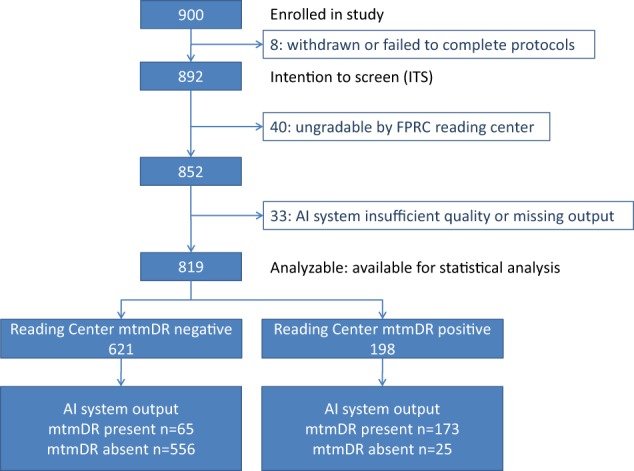
Artificial Intelligence (AI) has long promised to increase healthcare affordability, quality and accessibility but FDA, until recently, had never authorized an autonomous AI diagnostic system. This pivotal trial of an AI system to detect diabetic retinopathy (DR) in people with diabetes enrolled 900 subjects, with no history of DR at primary care clinics, by comparing to Wisconsin Fundus Photograph Reading Center (FPRC) widefield stereoscopic photography and macular Optical Coherence Tomography (OCT), by FPRC certified photographers, and FPRC grading of Early Treatment Diabetic Retinopathy Study Severity Scale (ETDRS) and Diabetic Macular Edema (DME). More than mild DR (mtmDR) was defined as ETDRS level 35 or higher, and/or DME, in at least one eye. AI system operators underwent a standardized training protocol before study start. Median age was 59 years (range, 22–84 years); among participants, 47.5% of participants were male; 16.1% were Hispanic, 83.3% not Hispanic; 28.6% African American and 63.4% were not; 198 (23.8%) had mtmDR. The AI system exceeded all pre-specified superiority endpoints at sensitivity of 87.2% (95% CI, 81.8–91.2%) (>85%), specificity of 90.7% (95% CI, 88.3–92.7%) (>82.5%), and imageability rate of 96.1% (95% CI, 94.6–97.3%), demonstrating AI’s ability to bring specialty-level diagnostics to primary care settings. Based on these results, FDA authorized the system for use by health care providers to detect more than mild DR and diabetic macular edema, making it, the first FDA authorized autonomous AI diagnostic system in any field of medicine, with the potential to help prevent vision loss in thousands of people with diabetes annually. ClinicalTrials.gov NCT02963441
Overview
The claims and statistics of this paper haven’t been checked yet.
Free: it reads the open-access text and checks the first 5 claims that cite a source we can check. Create a free account to check every claim.
Integrity signals
Registry
Cites
Statistics
Figures
Verification
Claims the paper makes
The claims and statistics of this paper haven’t been checked yet.
Free: it reads the open-access text and checks the first 5 claims that cite a source we can check. Create a free account to check every claim.
Claims other papers make about this one
Each is checked against this paper’s own text: does it say what the citing paper says it does?
The cited source doesn’t support the claim as written.
In the citing paper
“The regulatory approval of the first diagnostic autonomous AI system for diabetic eye exams was based on a pivotal trial against a prognostic standard, i.e., patient outcome24, showing its safety, efficacy, and lack of racial and ethnic bias for diagnosing DED in adults with diabetes with 87% sensitivity and 91% specificity24.”
From Autonomous artificial intelligence increases screening and follow-up for diabetic retinopathy in youth: the ACCESS randomized control trial (2024) · cites this paper as [24]
Checked by a reasoning model — may be wrong.
Experimental — accuracy not yet measuredThe source backs part of the claim, not all of it — or backs it for a different population, condition or comparison.
In the citing paper
“Only eight studies in ophthalmology imaging14,21,32,33,43,55,108,109, ten studies in respiratory imaging64,66,70,72,75,79,82,87,89,110 and six studies in breast imaging62,91,97,104,106,111 mentioned adherence to the STARD-2015 guidelines or had a STARD flow diagram in the manuscript.”
From Diagnostic accuracy of deep learning in medical imaging: a systematic review and meta-analysis (2021) · cites this paper as [14]
Experimental — accuracy not yet measuredThe source backs part of the claim, not all of it — or backs it for a different population, condition or comparison.
In the citing paper
“These systems use large annotated datasets to learn hierarchical features directly from images, improving reproducibility and reducing reliance on manual feature engineering [27,34].”
From Artificial Intelligence in Clinical Decision-Making: A Comprehensive Review of Diagnostic, Prognostic, and Therapeutic Applications, Validation Gaps, Bias, and Deployment Challenges (2026) · cites this paper as [27]
Experimental — accuracy not yet measuredThe source backs part of the claim, not all of it — or backs it for a different population, condition or comparison.
In the citing paper
“In clinical workflows, AI supports triage prioritisation, second-opinion review, and reduction of diagnostic variability in high-volume settings [15,27].”
From Artificial Intelligence in Clinical Decision-Making: A Comprehensive Review of Diagnostic, Prognostic, and Therapeutic Applications, Validation Gaps, Bias, and Deployment Challenges (2026) · cites this paper as [27]
Experimental — accuracy not yet measuredThe source backs part of the claim, not all of it — or backs it for a different population, condition or comparison.
In the citing paper
“Adoption in clinical practice is influenced by clinician interaction with AI systems, including trust and workflow compatibility [23,27].”
From Artificial Intelligence in Clinical Decision-Making: A Comprehensive Review of Diagnostic, Prognostic, and Therapeutic Applications, Validation Gaps, Bias, and Deployment Challenges (2026) · cites this paper as [27]
Experimental — accuracy not yet measured
18 more claims about this paper
Create a free account to see every claim other papers make about this one.
Self-check
Percentages, sums and reported differences re-computed from the paper’s own numbers.
The self-check needs the paper’s full text.
Citations
Cites
ImageNet classification with deep convolutional neural networks
Krizhevsky, A., Sutskever, I., & Hinton, G. E. (2017) · Communications of the ACM · doi:10.1145/3065386 · Cited by 112,155
Diagnosis and Classification of Diabetes Mellitus
American Diabetes Association (2011) · Diabetes Care · doi:10.2337/dc11-s062 · Cited by 13,988
Gulshan, V., Peng, L., Coram, M., Stumpe, M. C., Wu, D., Narayanaswamy, A., Venugopalan, S., Widner, K., Madams, T., Cuadros, J., et al. (2016) · JAMA · doi:10.1001/jama.2016.17216 · Cited by 7,697
Centers for Disease Control and Prevention
(2007) · Encyclopedia of Measurement and Statistics · doi:10.4135/9781412952644.n74 · Cited by 6,444
Diagnosis and classification of diabetes mellitus
American Diabetes Association (2014) · Diabetes Care · doi:10.2337/dc14-s081 · Cited by 5,974
(2007) · Developments in Ophthalmology · doi:10.1159/isbn.978-3-318-01439-6 · Cited by 5,583
Bias reduction of maximum likelihood estimates
FIRTH, D. (1993) · Biometrika · doi:10.1093/biomet/80.1.27 · Cited by 5,035
Wilkinson, C. P., Ferris, F. L., Klein, R. E., Lee, P. P., Agardh, C. D., Davis, M., Dills, D., Kampik, A., Pararajasegaram, R., & Verdaguer, J. T. (2003) · Ophthalmology · doi:10.1016/s0161-6420(03)00475-5 · Cited by 3,743
Classification and Diagnosis of Diabetes
Fajans, S. S. (1990) · Medical Entomology and Zoology · Cited by 2,359
Research works printed but not linked: 1
- Centers for Disease Control and Prevention. Diabetes Report Card 2012 2012 Atlanta, GA U.S. Department of Health and Human Services
Cited by
Items 901–1,000 of 1,004
Commentary: Artificial intelligence – A game changer
Ahuja, A. A., & Kewlani, D. (2020) · Indian Journal of Ophthalmology · doi:10.4103/ijo.ijo_1780_19 · Cited by 7
ChatGPT and beyond with artificial intelligence (AI) in health: Lessons to be learned
Thiébaut, R., Hejblum, B. P., Mougin, F., Tzourio, C., & Richert, L. E. (2023) · Joint Bone Spine · doi:10.1016/j.jbspin.2023.105607 · Cited by 7
Hou, Q., Wang, M., Cao, P., Zou, K., Liu, X., Fu, H., & Zai͏̈ane, O. R. (2025) · arXiv (Cornell University) · doi:10.48550/arxiv.2503.17831 · Cited by 8
“However, these advanced models face a critical challenge: they require massive amounts of high-quality annotated fundus images for effective pre-training [1, 13].”
Abramoff, M. D., Mortensen, Z., & Tava, C. (2021) · Frontiers in Medicine · doi:10.3389/fmed.2021.765936 · Cited by 6
“…design, including the use of priors such as biomarkers, instead of prior-less blank slate black box algorithms, the distribution of the training sets, rigorous validation for improved outcome metrics including equity, and the choice of where it is implemented after regulatory approval (2, 9).”
MethodHirota, M., Ueno, S., Inooka, T., Ito, Y., Takeyama, H., Inoue, Y., Watanabe, E., & Mizota, A. (2022) · Applied Sciences · doi:10.3390/app12146872 · Cited by 6
“A note of caution for developing ML models of medical images is that dataset shifting can occur: the accuracy of ML models is lower in the actual clinic than in the laboratory [21,22].”
BackgroundTransition from an in-person to a telemedicine diabetic retinopathy screening program
Barbieri, V. D. O. A., Nakayama, L. F., Barbieri, G. A., da Silva, S. E. R., Karmouche, D. C. J., Shinzato, M. N. O., Nakagawa, R. E., Regatieri, C. V., & Malerbi, F. K. (2024) · Arquivos Brasileiros de Oftalmologia · doi:10.5935/0004-2749.2023-0200 · Cited by 6
“Although no automated steps were employed during screening, AI-enabled systems allow improvement in the efficiency of DR screening (15,16) .”
MethodGlobal review of publicly available image datasets for the anterior segment of the eye
Niestrata-Ortiz, M., Radia, M., Jackson, J., & Allan, B. D. (2024) · Journal of Cataract & Refractive Surgery · doi:10.1097/j.jcrs.0000000000001538 · Cited by 6
Dong, J., Qian, T., Jiang, Y., Bi, L., Kim, J., Wang, L., & Xu, X. (2024) · Pattern Recognition Letters · doi:10.1016/j.patrec.2024.10.012 · Cited by 6
Cyber medicine in diagnosis - Need of the hour
Bisane, P., Makade, J. G., Bankar, N. J., Bandre, G. R., & Yenurkar, G. K. (2024) · AIP conference proceedings · doi:10.1063/5.0240484 · Cited by 6
Phatak, S. B., Saptarshi, R., Sharma, V., Shah, R., Zanwar, A. A., Hegde, P., Chakraborty, S., & Goel, P. (2024) · Rheumatology · doi:10.1093/rheumatology/keae678 · Cited by 6
Gu, B., Christopher, M. A., Lim, S., & Baxter, S. L. (2024) · Informatics · doi:10.3390/informatics12010002 · Cited by 7
Krogh, M., Hentze, M., Jensen, M. S. A., Jensen, M. B., Nielsen, M. G., Vorum, H., & Kristensen, J. K. (2025) · Frontiers in Medicine · doi:10.3389/fmed.2025.1565532 · Cited by 6
Validation of a Deep Learning Model for Diabetic Retinopathy on Patients with Young-Onset Diabetes
Tan-Torres, A., Praveen, P. A., Jeji, D., Brant, A. R., Yin, X., Yang, L., Singh, P., Ali, T. K., Traynis, I., Jadeja, D., et al. (2025) · Ophthalmology and Therapy · doi:10.1007/s40123-025-01116-z · Cited by 7
Artificial intelligence in the diagnosis and management of refractive errors
Nguyen, T. N., Ong, J., Jonnakuti, V. S., Masalkhi, M., Waisberg, E., Aman, S., Zaman, N., Sarker, P., Teo, Z. L., Ting, D. S. W., et al. (2025) · European Journal of Ophthalmology · doi:10.1177/11206721251318384 · Cited by 6
Li, L., Patkó, E., Szabo, E., Molitor, D., Meresz, B., Reglődi, D., Varga, A., Denes, D., Dai, L., Wang, H., et al. (2025) · International Journal of Molecular Sciences · doi:10.3390/ijms26083753 · Cited by 6
Negiloni, K., Baskaran, P., Rao, D. P., Maitray, A., Savoy, F. M., Suresh, S., Mahalingam, M., Vighnesh, M. J., & Rajendran, A. (2025) · Eye · doi:10.1038/s41433-025-03902-2 · Cited by 6
“This validation highlights the robust performance of Medios AI, with sensitivity and specificity comparable, if not exceeding the FDA-recommended diagnostic performance cut-off for such measures (example., >85% for DR screening) [23].”
Mamyrbayev, O. J., Pavlov, S. V., Poplavskyi, O., Momynzhanova, K., Saldan, Y. Y., Zhanegiz, A., Zhumagulova, S. R., & Zhumazhan, N. (2025) · Engineering Technology & Applied Science Research · doi:10.48084/etasr.11521 · Cited by 6
Bao, S., Yang, Z., Zhang, Z., Qu, J., & Sun, J. (2025) · Interdisciplinary Sciences Computational Life Sciences · doi:10.1007/s12539-025-00763-x · Cited by 6
“In ophthalmology, DL models have demonstrated remarkable accuracy in interpreting complex imaging data, enabling automated detection and classification of ocular diseases such as AMD, diabetic retinopathy, and glaucoma [25–29].”
Krogh, M., Nielsen, M. G., Petersen, G. B., Jensen, M. S. A., Jensen, M. B., Vorum, H., Bruun, N. H., & Kristensen, J. K. (2025) · Frontiers in Medicine · doi:10.3389/fmed.2025.1610114 · Cited by 6
“This AI-assisted approach has been tested internationally and has shown promising accuracy in prospective studies, achieving sensitivities of ≥ 87% and specificities of ≥ 84% (10–12).”
Multi-omics profiling and AI-driven clinically deployable risk models in MGUS and smoldering myeloma
Wu, Y., Zhang, D., Jiang, J., Zheng, L., Zhou, Z., Zhang, Z., & Nouri, S. (2025) · Clinical and Experimental Medicine · doi:10.1007/s10238-025-01987-3 · Cited by 6
“…highest when models provide concise explanations aligned with clinical reasoning and can be interrogated through simple “what-if” scenarios (for example, how the risk would change if M-protein or free light chain ratio improved), rather than functioning as opaque, non-interactive alerts [127, 128].”
Wei, Q., Xu, G., & Liu, Y. (2026) · AI & Society · doi:10.1007/s00146-026-02879-0 · Cited by 7
“The manufacturer submitted clinical trial data from more than 900 patients, and the device was required to be deployed only in qualified clinical settings (U.S. Food and Drug Administration (FDA) 2018a; Abràmoff et al. 2018).”
Zhao, M., Li, J., Li, S., Liu, J., Jiang, Y., Lai, X., Yang, J., Pang, L., Tang, L., Li, K. S., et al. (2026) · Frontiers in Medicine · doi:10.3389/fmed.2026.1781818 · Cited by 6
“During retinal membrane peeling surgery, AI can mark the boundary between the epiretinal membrane and normal retinal tissue, or highlight the location of fragile retinal blood vessels that are prone to bleeding during manipulation (29).”
Early retinal disease detection from fundus images using deep neural networks
Hailu, A. A., Desta, E. A., Mulugeta, A., Adugna, F. B., Salau, A. O., Almaw, L. A., & Fentahun, M. B. (2026) · Scientific Reports · doi:10.1038/s41598-026-42059-0 · Cited by 6
Medical Machines: The Expanding Role of Ethics in Technology-Driven Healthcare
Brenna, C. T. A. (2021) · Canadian Journal of Bioethics · doi:10.7202/1077638ar · Cited by 6
“A recent clinical trial organized in the United States demonstrated an AI system’s ability to detect diabetic retinopathy with specialty-level skill from ophthalmological images of real patients’ eyes (25).”
BackgroundHiguchi, M., Nagata, T., Iwabuchi, K., Sano, A., Maekawa, H., Idaka, T., Yamasaki, M., Seko, C., Satō, A., Suzuki, J., et al. (2023) · FUKUSHIMA JOURNAL OF MEDICAL SCIENCE · doi:10.5387/fms.2023-14 · Cited by 6
Diabetic Retinopathy Detection: EfficientNet with SAP BTP
Pawar, S., & Zope, H. (2024) · IEEE International Conference on Interdisciplinary Approaches in Technology and Management for Social Innovation (IATMSI) · doi:10.1109/iatmsi60426.2024.10502609 · Cited by 6
“Automated, artificial intelligence (AI)-based image analysis technologies have the potential to close this gap by enhancing the efficiency, accessibility, and cost-effectiveness of DR screening programs worldwide [9].”
BackgroundTelemedicine for Screening and Follow-Up of Glaucoma: A Descriptive Study
Lozano, A. R. C., Serrano, A., Salazar, D., Rincon, J., & Bayona, M. P. (2024) · Telemedicine Journal and e-Health · doi:10.1089/tmj.2023.0676 · Cited by 6
“7,9,11,14,15 The primary objective of this article is to provide a description of the telemedicine services offered by a Colombian center amid the COVID-19 pandemic.”
Using conversant artificial intelligence to improve diagnostic reasoning: ready for prime time?
Scott, I. A., Miller, T., & Crock, C. (2024) · The Medical Journal of Australia · doi:10.5694/mja2.52401 · Cited by 6
Wang, D., Sklar, B. A., Tian, J., Gabriel, R., Engelhard, M., McNabb, R. P., & Kuo, A. N. (2024) · Ophthalmology Science · doi:10.1016/j.xops.2024.100676 · Cited by 6
Yang, Z., Tian, D., Zhao, X., Zhang, L., Xu, Y., Lü, X., & Chen, Y. (2025) · Quantitative Imaging in Medicine and Surgery · doi:10.21037/qims-24-1406 · Cited by 7
González, R. A., Susanna-González, G., Blair, J., Vitar, R. M. L., Ciller, C., Apostolopoulos, S., Zanet, S. I. D., Martin, J., Bermúdez, C., Pascual, A. L. C., et al. (2025) · BMJ Open Ophthalmology · doi:10.1136/bmjophth-2024-002109 · Cited by 6
“20 Similar to our study, they validated their AI algorithm to screen DR in primary care clinics by using a Topcon non-mydriatic retinal camera (NW400).”
The Utility of Universal Newborn Eye Screening: A Review
Azad, A. D., Al‐Moujahed, A., Ludwig, C. A., Vail, D. G., Callaway, N. F., Rosenblatt, T. R., Kumm, J., & Moshfeghi, D. M. (2021) · Ophthalmic surgery, lasers & imaging retina · doi:10.3928/23258160-20211115-02 · Cited by 6
Digital Advancements in Retinal Models of Care in the Post–COVID-19 Lockdown Era
Ong, J., Tan, G. S. W., Ang, M., & Chhablani, J. K. (2022) · Asia-Pacific Journal of Ophthalmology · doi:10.1097/apo.0000000000000533 · Cited by 6
Transforming ophthalmology in the digital century—new care models with added value for patients
Faes, L., Maloca, P. M., Hatz, K. B., Wolfensberger, T. J., Munk, M. R., Sim, D. A., Bachmann, L. M., & Schmid, M. (2022) · Eye · doi:10.1038/s41433-022-02313-x · Cited by 6
Looking at the Safety of AI from a Systems Perspective: Two Healthcare Examples
Sujan, M. A. (2023) · SpringerBriefs in applied sciences and technology · doi:10.1007/978-3-031-32633-2_8 · Cited by 6
Screening for diabetic retinopathy with artificial intelligence: a real world evaluation
Burlina, S., Radin, S., Poggiato, M., Cioccoloni, D., Raimondo, D., Romanello, G., Tommasi, C., & Lombardi, S. (2024) · Acta Diabetologica · doi:10.1007/s00592-024-02333-x · Cited by 6
“Recently, the US Food and Drug Administration approved the IDx-DR Service as the first system based on AI that can automatically grade DR with a sensitivity of 87.2% and a specificity of 90.7% for the classification of more than mild DR [11].”
InfluentialWillis, J. R., Ali, F. S., Argente, B., Domalpally, A., Gannon, J. G., Gao, S. S., Grover, S., Kanodia, P., Russell-Puleri, S., Sun, D. K., et al. (2021) · Translational Vision Science & Technology · doi:10.1167/tvst.10.6.20 · Cited by 6
“31 We have not conducted a cost–benefit evaluation of the program in our study.”
AI for the Detection of the Diabetic Retinopathy
Vocaturo, E., & Zumpano, E. (2022) · Internet of things · doi:10.1007/978-3-030-91181-2_8 · Cited by 6
[Invited Paper] Near-infrared Colorized Imaging Technologies and Their Fundus Camera Applications
Takehara, H., Wang, Z., Tang, H., Kishida, N., Horiki, Y., Sobue, M., Haruta, M., Tashiro, H., Sasagawa, K., & Ohta, J. (2022) · ITE Transactions on Media Technology and Applications · doi:10.3169/mta.10.59 · Cited by 6
Point-of-Care Diabetic Retinopathy Diagnosis: A Standalone Mobile Application ApproachPreprint
Hagos, M. T. (2020) · arXiv (Cornell University) · doi:10.48550/arxiv.2002.04066 · Cited by 6
“[69] showed that a United States (US) Food and Drug Administration (FDA) approved Artificial Intelligence (AI) based DR detection device [70] scored 100% SN in detecting on 16 fundus images diagnosed with vision threatening DR (VTDR).”
BackgroundGould, D. S. W., Yang, J., & Clifton, D. A. (2024) · medRxiv · doi:10.1101/2024.02.12.24302676 · Cited by 6
“This promise is exemplified by the existence of FDA-approved devices designed for diabetic retinopathy screening [2, 3].”
BackgroundWhat Do We Do with Physicians When Autonomous AI-Enabled Workflow is Better for Patient Outcomes?
Abràmoff, M. D., & Char, D. S. (2024) · The American Journal of Bioethics · doi:10.1080/15265161.2024.2377111 · Cited by 6
“Under the total product lifecycle concept we developed with US FDA (Abramoff et al. 2023), such an AI (Abràmoff et al. 2018) can be iteratively introduced in specific invisible populations, potential bias in the real world assessed through continuous monitoring, and where necessary, the AI improved…”
Self-citationChetla, N., Samayamanthula, S., Chang, J., Leigh, A., Akosman, S., Tandon, M., Hage, T., & Cusick, M. (2025) · Clinical Ophthalmology · doi:10.2147/opth.s517238 · Cited by 5
Shou, B. L., Venkatesh, K., Chen, C., Ghidey, R., Lee, J. H., Wang, J., Channa, R., Wolf, R. M., Abramoff, M. D., & Liu, T. Y. A. (2024) · Journal of Diabetes Science and Technology · doi:10.1177/19322968231201654 · Cited by 5
“7 Although the pivotal clinical trial and other studies showedthat diagnostic rates can be increased by a reflexive dilation protocol, 6,8,9 such a protocol results in workflow inef-ficiencies and risks the potential of patients dropping out entirely, as multiple iterations of imaging are required…”
BackgroundSelf-citationRole of Artificial Intelligence in Nanomedicine and Organ-specific Therapy: An Updated Review
Rajpoot, K. (2025) · Current Drug Targets · doi:10.2174/0113894501394785250715165404 · Cited by 5
Ethical and Legal Aspects of Artificial Intelligence (AI) in Medical Service Contracts
Nogaroli, R. (2025) · Springer eBooks · doi:10.1007/978-3-031-94306-5_4 · Cited by 5
Lagisetty, S. K., Devarajulu, P., & Moka, A. K. (2025) · Intelligent Cybersecurity Conference (ICSC) · doi:10.1109/icsc65596.2025.11139916 · Cited by 5
Artificial intelligence in ophthalmology clinical trials: a narrative review
Rahmanipour, E., Afazel, S., Ashrafi, S., Sadeghi, E., Ghorbani, M. M., Zarranz‐Ventura, J., & Chhablani, J. K. (2025) · Graefe s Archive for Clinical and Experimental Ophthalmology · doi:10.1007/s00417-025-06997-1 · Cited by 5
Yudistira, Y., Hendrawan, K. A., Andayani, A., Suryathi, N. M. A., Ernawati, T., Gunawan, A. C. V., & Daradila, N. P. K. M. (2025) · Turkish Journal of Ophthalmology · doi:10.4274/tjo.galenos.2025.32916 · Cited by 5
Hunfeld, E., Tayar, A., Paúl, S., Poschkamp, B., Großjohann, R., Morawiec-Kisiel, E., Bohl, B., Pfeil, J. M., Busch, M., Dähmcke, M., et al. (2026) · Scientific Reports · doi:10.1038/s41598-026-36970-9 · Cited by 7
“This finding is consistent with other study results 7,14 .”
Impacts of artificial intelligence on healthcare business models and outcomes
Kakale, M. M., & Pinelli, N. (2026) · Journal of Health Organization and Management · doi:10.1108/jhom-06-2025-0356 · Cited by 5
“Ophthalmologists also use AI to grade and monitor diabetic retinopathy, glaucoma and age-related macular degeneration and analyze congenital cataracts (Abramoff et al ., 2018; Kumar et al ., 2023a, b; Long et al ., 2017).”
Tyagi, S., Verma, V., Vijarania, M., Gupta, S., Awotunde, J. B., Adeniyi, A. E., & Aroba, O. J. (2026) · Array · doi:10.1016/j.array.2026.100716 · Cited by 5
Deep Learning-Based Diagnostic Model for Ocular Surface Neoplastic Diseases
Sakata, R., Shijo, T., Ueno, Y., Oda, M., Kitaguchi, Y., Taki, Y., Maehara, H., Nejima, R., Miyata, K., Inomata, T., et al. (2026) · American Journal of Ophthalmology · doi:10.1016/j.ajo.2026.02.033 · Cited by 6
Artificial Intelligence in Ophthalmology: Current Status, Challenges, and Future Perspectives
She, C., & Yong, T. (2026) · Health care science · doi:10.1002/hcs2.70052 · Cited by 5
Vidal‐Alaball, J., Bonache, A. A., Solé‐Casals, J., Fibla, D. R., Marin-Gomez, F. X., Distéfano, L., Boixadera, A., Casado-García, Á., García-Domínguez, M., Inés, A., et al. (2026) · Frontiers in Artificial Intelligence · doi:10.3389/frai.2026.1754682 · Cited by 5
Ou, Y., Zhang, Q., Meng, C. K., Zhou, X., Na, M., Yu, Z., Ma, W., & Huang, C. (2026) · Therapeutics and Clinical Risk Management · doi:10.2147/tcrm.s596651 · Cited by 5
Zhao, R., & Gillani, S. (2026) · Photodiagnosis and Photodynamic Therapy · doi:10.1016/j.pdpdt.2026.105458 · Cited by 7
Chiang, M. F. (2021) · Optometry and Vision Science · doi:10.1097/opx.0000000000001821 · Cited by 5
Identifying Glaucoma in Primary Care Offices
Quigley, H. A. (2022) · JAMA Ophthalmology · doi:10.1001/jamaophthalmol.2022.1608 · Cited by 5
Automatic Classification of Slit-Lamp Photographs by Imaging Illumination
Lu, M.-C., Deng, C., Greenwald, M. F., Farsiu, S., Prajna, N. V., Nallasamy, N., Pawar, M. D., Hart, J. N., Sumithra, S. R., Kochar, P., et al. (2023) · Cornea · doi:10.1097/ico.0000000000003318 · Cited by 5
Macdonald, T., Dinnes, J., Maniatopoulos, G., Taylor‐Phillips, S., Shinkins, B., Hogg, H. D. J., Dunbar, J. K., Solebo, A. L., Sutton, H., Attwood, J., et al. (2024) · JMIR Research Protocols · doi:10.2196/50568 · Cited by 6
Vallée, R., Gomez, T., Bourreille, A., Normand, N., Mouchère, H., & Coutrot, A. (2024) · Journal of Vision · doi:10.1167/jov.24.4.6 · Cited by 5
“…Authors (Badia et al., 2020), various board games (Silver et al., 2018), the characterization of precise bacteria (Buetti-Dinh et al., 2019), and medical diagnosis (Abràmoff, Lavin, Birch, Shah, & Folk, 2018; Brinker et al., 2019; Brown et al., 2018; Esteva et al., 2017; Rajpurkar et al., 2018).”
Mossburg, S. E., Kilany, M., Jinnett, K., Nguyen, C., Soles, E., Wood-Palmer, D., & Aly, M. (2024) · International Journal of Environmental Research and Public Health · doi:10.3390/ijerph21050529 · Cited by 5
“Abramoff et al. [26] conducted a large ( n = 900) superiority trial comparing the diagnostic performance of an AI-based system with the gold standard for diagnosing diabetic retinopathy based on nonmydriatic retinal images.”
Melo, G. B., Nakayama, L. F., Cardoso, V. S., dos Santos, L. A., & Malerbi, F. K. (2024) · Ophthalmology Retina · doi:10.1016/j.oret.2024.05.009 · Cited by 5
Sankara Narayanan, S., Bag, S. K., & Singh, S. (2024) · IEEE International Conference on Intelligent Techniques in Control, Optimization and Signal Processing (INCOS) · doi:10.1109/incos59338.2024.10527466 · Cited by 5
Impact of Biosensors and Biomarkers in Diabetes Care: A Review
Balkrishna, A., Singh, S., Mishra, S., Rana, M., Mishra, R. K., Rajput, S. K., & Arya, V. (2024) · Biomedical Materials & Devices · doi:10.1007/s44174-024-00230-z · Cited by 5
Advancements in Diabetic Retinopathy and Cataract Identification Through Deep Learning
Raman, R., Kumar, V., Saini, D., Rabadiya, D., Patre, S., & Meenakshi, R. (2024) · International Conference on Data Science and Network Security (ICDSNS) · doi:10.1109/icdsns62112.2024.10691108 · Cited by 5
Alyami, M. S. M., Alyami, M. M. M., Khuraim, H. A. M. A., SALEM, A. M. S. A., Al, H. A. M., Albakri, K. A. M., ALsaqran, Q. N., Alyami, H. S., Alzamanan, A. S., Alharbi, F. M., et al. (2024) · Journal of Ecohumanism · doi:10.62754/joe.v3i7.4668 · Cited by 5
Screening for diabetic retinopathy at a health centre in South Africa: A cross-sectional study
Zulu, N., Piotie, P. N., Webb, E. M., Maphenduka, W. G., Cook, S., & Rheeder, P. (2025) · Journal of Public Health in Africa · doi:10.4102/jphia.v16i1.681 · Cited by 5
“32,33 Enhanced detection rates can lead to earlier intervention and better patient outcomes.”
Multimodal Approach for Diabetic Retinopathy Detection Using Deep Learning and Clinical Data Fusion
Karthikeyan, S., Selva Sangeeth, S., Sreeja, G. G., Sivasanjeev, R., & Srimathi, M. (2024) · International Conference on Communication and Electronics Systems (ICCES) · doi:10.1109/icces63552.2024.10859974 · Cited by 5
“Abramov et al. [5] conducted a clinical trial of a self-administered AI-based diagnostic system for DR detection in primary care settings.”
Mental Health Therapy: A Comparative Study of Generative AI and Deepfake Technology
Acim, B., Kharmoum, N., Ezziyyani, M., & Ziti, S. (2025) · Lecture notes in networks and systems · doi:10.1007/978-3-031-91337-2_33 · Cited by 5
Uses of Artificial Intelligence in Health
Godber, E. (2018) · International Conference on Artificial Intelligence: Applications and Innovations (IC-AIAI) · doi:10.1109/ic-aiai.2018.8674444 · Cited by 5
Vinny, P. W., Gupta, A., Modi, M., Srivastava, M. V. P., Lal, V., Sylaja, P. N., Narasimhan, L. S., Dwivedi, S. N., Nair, P. P., Iype, T., et al. (2019) · QJM · doi:10.1093/qjmed/hcz106 · Cited by 5
Role of Artificial Intelligence in Medicine and Clinical Research
Sarma, J. (2021) · International Journal for Research in Applied Science and Engineering Technology · doi:10.22214/ijraset.2021.37617 · Cited by 5
“A proprietary system IDx (Iowa City, IA) that uses ML technology to analyse retinal images with diabetic retinopathy had a sensitivity of 87% and specificity of 91% for autonomous detection of disease and received FDA approval in 2018 [29].”
BackgroundEra of Computational Cognitive Techniques in Healthcare Systems
Rastogi, D., Tiwari, V., Kumar, S., & Gupta, P. C. (2022) · Wiley eBooks · doi:10.1002/9781119771982.ch1 · Cited by 5
Application of artificial intelligence in medical care: review of current status
Pandya, H. B., & Pandya, T. (2023) · International Journal of Advances in Medicine · doi:10.18203/2349-3933.ijam20230073 · Cited by 5
Kale, A. U., Mills, A., Guggenheim, E. J., Gee, D. G., Bodza, S., Anumakonda, A., Doal, R., Williams, R. L., Gallier, S., Lee, W. H., et al. (2023) · Ophthalmology Science · doi:10.1016/j.xops.2023.100293 · Cited by 5
Data‐driven decisions about individual patients: The case of medical AI
Holm, S. (2023) · Journal of Evaluation in Clinical Practice · doi:10.1111/jep.13904 · Cited by 5
Krogh, M., Jensen, M. B., Jensen, M. S. A., Hentze, M., Nielsen, M. G., Vorum, H., & Kristensen, J. K. (2024) · Scandinavian Journal of Primary Health Care · doi:10.1080/02813432.2024.2396873 · Cited by 5
Automatic Screening for Ocular Anomalies Using Fundus Photographs
Matta, S. C., Lamard, M., Conze, P.-H., Guilcher, A. L., Ricquebourg, V., Benyoussef, A., Massin, P., Rottier, J.-B., Cochener, B., & Quellec, G. (2022) · Optometry and Vision Science · doi:10.1097/opx.0000000000001845 · Cited by 5
Artificial Intelligence in Diabetic Retinopathy
Grzybowski, A. E., & Brona, P. (2021) · Springer eBooks · doi:10.1007/978-3-030-78601-4_11 · Cited by 5
The autonomous point-of-care diabetic retinopathy examination
Abràmoff, M. D. (2020) · Elsevier eBooks · doi:10.1016/b978-0-12-817485-2.00012-2 · Cited by 5
Self-citationReply: Is automated screening for DR indeed not yet ready as stated by Grauslund et al?
Grauslund, J., Andersen, N., Andresen, J., Flesner, P., Haamann, P., Heegaard, S., Larsen, M., Laugesen, C. S., Schielke, K. C., Skov, J., et al. (2019) · Acta Ophthalmologica · doi:10.1111/aos.14251 · Cited by 5
Tan, T., Ting, D. S. W., Wong, T. Y., & Sim, D. A. (2020) · Annals of Translational Medicine · doi:10.21037/atm.2020.03.142 · Cited by 5
“One possible approach to tackling this problem is to first develop a DL algorithm for automated screening of image quality (22,23).”
BackgroundAutomatic Detection of Diabetic Retinopathy in Fundus Image: A SurveyPreprint
Kiresur, N., Rajesh, I. S., Bharathi, M. A., & Prathik, N. (2021) · SSRN Electronic Journal · doi:10.2139/ssrn.3851200 · Cited by 5
Pathology-Aware Generative Adversarial Networks for Medical Image AugmentationPreprint
Han, C. (2021) · arXiv (Cornell University) · doi:10.48550/arxiv.2106.01915 · Cited by 5
Artificial intelligence in ophthalmological practice: when ideal meets reality
Heindl, L. M., Li, S., Ting, D. S. W., & Keane, P. A. (2023) · BMJ Open Ophthalmology · doi:10.1136/bmjophth-2022-001129 · Cited by 5
What We Want to Publish at NEJM AI
Manrai, A. K., Beam, A. L., & Kohane, I. S. (2024) · NEJM AI · doi:10.1056/aie2300304 · Cited by 5
Bauer, F., Sauerbeck, A., Hitzl, W., Piravej, N. P., & Schmidbauer, J. M. (2025) · Klinische Monatsblätter für Augenheilkunde · doi:10.1055/a-2620-1956 · Cited by 4
“In the United States of America, the first automated screening system for DR was approved back in 2018 [7].”
The application of artificial intelligence-generated content in ophthalmology education
Wang, Y., Zhao, Y., & Li, J. (2025) · Frontiers in Medicine · doi:10.3389/fmed.2025.1617537 · Cited by 4
Customizing AI ‐based screening with real‐world data: Practical insights from diabetic retinopathy
Poschkamp, B., Kantz, L., Augstein, P., Tayar, A., Kaderali, L., Busch, M., Bohl, B., Paúl, S., Lüdtke, L., Bründer, M., et al. (2025) · Acta Ophthalmologica · doi:10.1111/aos.17591 · Cited by 4
“It was validated in a multi-centre clinical trial with 900 patients in a US population, comparing its performance to gold standard imaging and OCT grading (Abràmoff et al., 2018).”
Multimodal Deep Learning for Diabetic Retinopathy: A Survey
Qin, G.-Y., Peng, Q., Zhou, Y.-S., Peng, J., Liu, Q., & Xu, J. (2025) · Journal of Ophthalmology · doi:10.1109/mipr67560.2025.00032 · Cited by 4
Abraham, S. E., Kovoor, B. C., & Nidhi, S. (2025) · Neurocomputing · doi:10.1016/j.neucom.2025.132379 · Cited by 4
Presetya, F., & Edward (2025) · Jurnal Sains dan Kesehatan · doi:10.30872/jsk.v6i1.976 · Cited by 4
Nagai, T., Homma, K., Kawamata, Y., Yoshihara, M., Kawakami, E., & Baba, T. (2026) · npj Digital Medicine · doi:10.1038/s41746-025-02311-9 · Cited by 4
Regulatory Compliance and Data Governance in AI‐Driven Healthcare
Rahul, S. S., & Kakade, S. V. (2026) · Wiley eBooks · doi:10.1002/9781394389131.ch4 · Cited by 5
RSSDI guidelines for management of type 2 diabetes mellitus in older adults
Jagadeesha, A., Viswanathan, V., Agarwal, S., Maheshwari, A., Virmani, A. K., Nagendra, L., Amarnath, A., Chawla, M. S., Jethwani, P., Parikh, R. M., et al. (2026) · International Journal of Diabetes in Developing Countries · doi:10.1007/s13410-025-01613-8 · Cited by 4
Diabetes technology: an update
Prahalad, P., Zaharieva, D. P., & Maahs, D. M. (2026) · The Journal of Clinical Endocrinology & Metabolism · doi:10.1210/clinem/dgag164 · Cited by 4
Artificial Intelligence-Based Prognostic Models for Postoperative Outcomes in Vitreoretinal Surgery
Al-Ani, A., Connors, L., Mikhail, D., Alkhawaja, M., Yang, L., Ambikkumar, A., Punja, K. G., Costello, F., Gooi, P., & Munro, M. (2026) · Ophthalmology Retina · doi:10.1016/j.oret.2026.04.022 · Cited by 4
Validation is not enough: Longitudinal evidence of post-deployment fragility in clinical AI systems
Kopanitsa, G. (2026) · PLOS Digital Health · doi:10.1371/journal.pdig.0001534 · Cited by 9
“Pivotal prospective trial [39] Reference grading days-weeks, referral outcomes months .”
Metadata
- Authors
- Abràmoff, M. D., Lavin, P. T., Birch, M., Shah, N., & Folk, J. C.
- Affiliations
- University of Iowa (US)
- University of North Carolina at Charlotte (US)
- Emmes (United States) (US)
- Corresponding author
- Abràmoff, Michael D.
- Venue
- npj Digital Medicine
- Published
- 2018-08-28
- Volume
- 1
- Issue
- 1
- Pages
- 39-39
- ISSN
- 2398-6352 (ISSN-L)
- PMC
- PMC6550188
- OpenAlex
- W2888424632
- Cited by
- 1,638
- References
- 61
- Citations by year
- 2026: 332 · 2025: 276 · 2024: 226 · 2023: 193 · 2022: 172 · 2021: 183 · 2020: 173 · 2019: 73 · 2018: 10
- FWCI
- 75.83
- Type
- journal article
- Language
- en
- Open access
- gold
- doi.org
- Licence
- cc-by
- creativecommons.org/licenses/by/4.0 (tdm)
- creativecommons.org/licenses/by/4.0 (vor)
- Locations
- npj Digital Medicine (publishedVersion, cc-by)
- Europe PMC (PubMed Central) (publishedVersion, cc-by)
- PubMed Central (publishedVersion, cc-by)
- PubMed (publishedVersion)
- DOAJ (DOAJ: Directory of Open Access Journals) (submittedVersion)
- Funders
- IDx LLC, Coralville, IA
- Topics
- Health Sciences › Medicine › Radiology, Nuclear Medicine and Imaging › Retinal Imaging and Analysis
- Health Sciences › Medicine › Ophthalmology › Retinal Diseases and Treatments
- Health Sciences › Medicine › Health Informatics › Artificial Intelligence in Healthcare and Education
- Keywords
- diabetic retinopathy, diabetic macular edema, autonomous AI systems, FDA approval, primary care, fundus photography, optical coherence tomography, sensitivity and specificity, imageability, blindness prevention, diabetes mellitus
About these checks
Registry, retraction, Cites and statistics results are computed, not judged, with one exception: a printed reference that no index lists is read once by a model before it counts as a citation error. Claims are extracted by a model and kept only when their quote appears verbatim in the text; each cited source is then checked, with a model’s help, for whether it says what the claim relies on. Those verdicts can be wrong — read the claim’s quote and the cited source before relying on one.
Statistics and arithmetic are recomputed, not judged.
Confidence bands are shown only for fields calibrated on our annotated test set. None is calibrated yet, so no band is shown.
What counts as a claim ›How we measure confidence ›How we check this ›
Are you an author, or do you see a problem with this page? Request a review
Data sources
Bibliographic data: Semantic Scholar, OpenAlex, Crossref.
Contains information from the Semantic Scholar Academic Graph Datasets, made available under the ODC Attribution License (ODC-BY 1.0).
Semantic Scholar’s data is described in: Kinney, R., et al. (2023). The Semantic Scholar Open Data Platform. arXiv:2301.10140.
