

Pivotal trial of an autonomous AI-based diagnostic system for detection of diabetic retinopathy in primary care offices
Open accessThe DOI matches its Crossref record; 62 of the 62 references it cites were found in a registry or an index.
Abstract
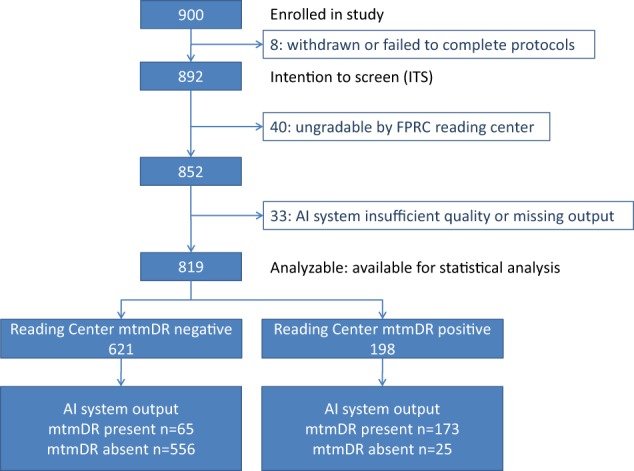
Artificial Intelligence (AI) has long promised to increase healthcare affordability, quality and accessibility but FDA, until recently, had never authorized an autonomous AI diagnostic system. This pivotal trial of an AI system to detect diabetic retinopathy (DR) in people with diabetes enrolled 900 subjects, with no history of DR at primary care clinics, by comparing to Wisconsin Fundus Photograph Reading Center (FPRC) widefield stereoscopic photography and macular Optical Coherence Tomography (OCT), by FPRC certified photographers, and FPRC grading of Early Treatment Diabetic Retinopathy Study Severity Scale (ETDRS) and Diabetic Macular Edema (DME). More than mild DR (mtmDR) was defined as ETDRS level 35 or higher, and/or DME, in at least one eye. AI system operators underwent a standardized training protocol before study start. Median age was 59 years (range, 22–84 years); among participants, 47.5% of participants were male; 16.1% were Hispanic, 83.3% not Hispanic; 28.6% African American and 63.4% were not; 198 (23.8%) had mtmDR. The AI system exceeded all pre-specified superiority endpoints at sensitivity of 87.2% (95% CI, 81.8–91.2%) (>85%), specificity of 90.7% (95% CI, 88.3–92.7%) (>82.5%), and imageability rate of 96.1% (95% CI, 94.6–97.3%), demonstrating AI’s ability to bring specialty-level diagnostics to primary care settings. Based on these results, FDA authorized the system for use by health care providers to detect more than mild DR and diabetic macular edema, making it, the first FDA authorized autonomous AI diagnostic system in any field of medicine, with the potential to help prevent vision loss in thousands of people with diabetes annually. ClinicalTrials.gov NCT02963441
Overview
The claims and statistics of this paper haven’t been checked yet.
Free: it reads the open-access text and checks the first 5 claims that cite a source we can check. Create a free account to check every claim.
Integrity signals
Registry
Cites
Statistics
Figures
Verification
Claims the paper makes
The claims and statistics of this paper haven’t been checked yet.
Free: it reads the open-access text and checks the first 5 claims that cite a source we can check. Create a free account to check every claim.
Claims other papers make about this one
Each is checked against this paper’s own text: does it say what the citing paper says it does?
The cited source doesn’t support the claim as written.
In the citing paper
“The regulatory approval of the first diagnostic autonomous AI system for diabetic eye exams was based on a pivotal trial against a prognostic standard, i.e., patient outcome24, showing its safety, efficacy, and lack of racial and ethnic bias for diagnosing DED in adults with diabetes with 87% sensitivity and 91% specificity24.”
From Autonomous artificial intelligence increases screening and follow-up for diabetic retinopathy in youth: the ACCESS randomized control trial (2024) · cites this paper as [24]
Checked by a reasoning model — may be wrong.
Experimental — accuracy not yet measuredThe source backs part of the claim, not all of it — or backs it for a different population, condition or comparison.
In the citing paper
“Only eight studies in ophthalmology imaging14,21,32,33,43,55,108,109, ten studies in respiratory imaging64,66,70,72,75,79,82,87,89,110 and six studies in breast imaging62,91,97,104,106,111 mentioned adherence to the STARD-2015 guidelines or had a STARD flow diagram in the manuscript.”
From Diagnostic accuracy of deep learning in medical imaging: a systematic review and meta-analysis (2021) · cites this paper as [14]
Experimental — accuracy not yet measuredThe source backs part of the claim, not all of it — or backs it for a different population, condition or comparison.
In the citing paper
“These systems use large annotated datasets to learn hierarchical features directly from images, improving reproducibility and reducing reliance on manual feature engineering [27,34].”
From Artificial Intelligence in Clinical Decision-Making: A Comprehensive Review of Diagnostic, Prognostic, and Therapeutic Applications, Validation Gaps, Bias, and Deployment Challenges (2026) · cites this paper as [27]
Experimental — accuracy not yet measuredThe source backs part of the claim, not all of it — or backs it for a different population, condition or comparison.
In the citing paper
“In clinical workflows, AI supports triage prioritisation, second-opinion review, and reduction of diagnostic variability in high-volume settings [15,27].”
From Artificial Intelligence in Clinical Decision-Making: A Comprehensive Review of Diagnostic, Prognostic, and Therapeutic Applications, Validation Gaps, Bias, and Deployment Challenges (2026) · cites this paper as [27]
Experimental — accuracy not yet measuredThe source backs part of the claim, not all of it — or backs it for a different population, condition or comparison.
In the citing paper
“Adoption in clinical practice is influenced by clinician interaction with AI systems, including trust and workflow compatibility [23,27].”
From Artificial Intelligence in Clinical Decision-Making: A Comprehensive Review of Diagnostic, Prognostic, and Therapeutic Applications, Validation Gaps, Bias, and Deployment Challenges (2026) · cites this paper as [27]
Experimental — accuracy not yet measured
18 more claims about this paper
Create a free account to see every claim other papers make about this one.
Self-check
Percentages, sums and reported differences re-computed from the paper’s own numbers.
The self-check needs the paper’s full text.
Citations
Cites
ImageNet classification with deep convolutional neural networks
Krizhevsky, A., Sutskever, I., & Hinton, G. E. (2017) · Communications of the ACM · doi:10.1145/3065386 · Cited by 112,155
Diagnosis and Classification of Diabetes Mellitus
American Diabetes Association (2011) · Diabetes Care · doi:10.2337/dc11-s062 · Cited by 13,988
Gulshan, V., Peng, L., Coram, M., Stumpe, M. C., Wu, D., Narayanaswamy, A., Venugopalan, S., Widner, K., Madams, T., Cuadros, J., et al. (2016) · JAMA · doi:10.1001/jama.2016.17216 · Cited by 7,697
Centers for Disease Control and Prevention
(2007) · Encyclopedia of Measurement and Statistics · doi:10.4135/9781412952644.n74 · Cited by 6,444
Diagnosis and classification of diabetes mellitus
American Diabetes Association (2014) · Diabetes Care · doi:10.2337/dc14-s081 · Cited by 5,974
(2007) · Developments in Ophthalmology · doi:10.1159/isbn.978-3-318-01439-6 · Cited by 5,583
Bias reduction of maximum likelihood estimates
FIRTH, D. (1993) · Biometrika · doi:10.1093/biomet/80.1.27 · Cited by 5,035
Wilkinson, C. P., Ferris, F. L., Klein, R. E., Lee, P. P., Agardh, C. D., Davis, M., Dills, D., Kampik, A., Pararajasegaram, R., & Verdaguer, J. T. (2003) · Ophthalmology · doi:10.1016/s0161-6420(03)00475-5 · Cited by 3,743
Classification and Diagnosis of Diabetes
Fajans, S. S. (1990) · Medical Entomology and Zoology · Cited by 2,359
Research works printed but not linked: 1
- Centers for Disease Control and Prevention. Diabetes Report Card 2012 2012 Atlanta, GA U.S. Department of Health and Human Services
Cited by
Items 601–700 of 1,004
Ding, X., Romano, F., Garg, I., Gan, J., Vingopoulos, F., Garcia, M., Overbey, K. M., Cui, Y., Zhu, Y., Bennett, C. F., et al. (2024) · American Journal of Ophthalmology · doi:10.1016/j.ajo.2024.10.016 · Cited by 21
Trabilsy, M., Genovese, A., Prabha, S., Borna, S., Gomez-Cabello, C. A., Haider, S. A., Tao, C., & Forte, A. J. (2025) · Aesthetic Surgery Journal · doi:10.1093/asj/sjaf084 · Cited by 20
Artificial intelligence for detection of optic disc abnormalities
Miléa, D., Singhal, S., & Najjar, R. P. (2019) · Current Opinion in Neurology · doi:10.1097/wco.0000000000000773 · Cited by 20
“Shortly after its release, the FDA-approved autonomous AI system became a highly effective system for DR detection, as recently demonstrated in a landmark, prospective study performed in primary care offices [22].”
BackgroundBlockchain Technology for Ophthalmology: Coming of Age?
Ng, W. Y., Tan, T.-E., Xiao, Z., Movva, P. V. H., Foo, F. S. S., Yun, D., Chen, W., Wong, T. Y., Lin, H. T., & Ting, D. S. W. (2021) · Asia-Pacific Journal of Ophthalmology · doi:10.1097/apo.0000000000000399 · Cited by 20
Reiter, G. S., & Schmidt-Erfurth, U. M. (2022) · Therapeutic Advances in Ophthalmology · doi:10.1177/25158414221083363 · Cited by 20
Decisions are not all equal—Introducing a utility metric based on case-wise raters’ perceptions
Campagner, A., Sternini, F., & Cabitza, F. (2022) · Computer Methods and Programs in Biomedicine · doi:10.1016/j.cmpb.2022.106930 · Cited by 20
Deep Learning System Outperforms Clinicians in Identifying Optic Disc Abnormalities
Vasseneix, C., Nusinovici, S., Xu, X., Hwang, J., Hamann, S., Chen, J. J.-W., Loo, J.-L., Milea, L., Tan, K. B. K., Ting, D. S. W., et al. (2023) · Journal of Neuro-Ophthalmology · doi:10.1097/wno.0000000000001800 · Cited by 21
Augmented intelligence: A synergy between man and the machine
Bhandari, M., & Reddiboina, M. (2019) · Indian Journal of Urology · doi:10.4103/iju.iju_74_19 · Cited by 20
Nakayama, L. F., Mitchell, W. G., Ribeiro, L. Z., Dychiao, R. G., Phanphruk, W., Celi, L. A., Kalua, K., Santiago, A. P. D., Regatieri, C. V., & de Moraes, N. S. B. (2023) · BMJ Open Ophthalmology · doi:10.1136/bmjophth-2022-001216 · Cited by 21
“13 The application of teleophthalmology in ROP diagnosis and management in particular (applied to address underserved remote areas) has created an opportunity to collect rich volumes of ophthalmic imaging data, which can be used secondarily to further AI development in this field.”
BackgroundBarakat, A., Mobarak, O., Javaid, H. A., Awad, M. R., Hamweyah, K., Ouban, A., & Al-Hazzaa, S. A. F. (2023) · Frontiers in Medicine · doi:10.3389/fmed.2023.1303300 · Cited by 19
Eckardt, F., Mittas, R., Horlava, N., Schiefelbein, J. B., Asani, B., Michalakis, S., Gerhardt, M. J., Priglinger, C., Keeser, D., Koutsouleris, N., et al. (2023) · Klinische Monatsblätter für Augenheilkunde · doi:10.1055/a-2227-3742 · Cited by 21
“However, compared to more common ophthalmological diseases like diabetic retinopathy (DR) [3], age related macular degeneration (AMD) [4] and glaucoma [5], AI studies specialized on IRDs are .”
Artificial intelligence in paediatric endocrinology: conflict or cooperation
Dimitri, P., & Savage, M. O. (2024) · Journal of Pediatric Endocrinology and Metabolism · doi:10.1515/jpem-2023-0554 · Cited by 19
Squirrell, D., Yang, S., Xie, L. Y., Ang, S., Moghadam, M., Vaghefi, E., & McConnell, M. V. (2024) · JACC Advances · doi:10.1016/j.jacadv.2024.101410 · Cited by 19
Fundamentals of artificial intelligence for ophthalmologists
Ahmad, B. U., Kim, J. E., & Rahimy, E. (2020) · Current Opinion in Ophthalmology · doi:10.1097/icu.0000000000000679 · Cited by 19
“retinopathy (defined as greater than mild nonproliferative diabetic retinopathy or the presence of macular edema) from fundus photographs in its pivotal trial of 900 participants [8,9].”
BackgroundControversies in artificial intelligence
Liu, T. Y. A., & Bressler, N. M. (2020) · Current Opinion in Ophthalmology · doi:10.1097/icu.0000000000000694 · Cited by 19
Artificial intelligence for improving sickle cell retinopathy diagnosis and management
Cai, S. C. S., Han, I. C., & Scott, A. W. (2021) · Eye · doi:10.1038/s41433-021-01556-4 · Cited by 20
“The recent FDA approval of the artificialintelligence-enabled IDx-DR [9] and EyeArt systems [10, 11] for screening for referrable diabetic retinopathy from fundus photographs has paved the way for application of similar systems to augment screening for other retinal diseases, such as SCR.”
BackgroundSheikh, A., Bhatti, A., Adeyemi, O. J., Raja, M., & Sheikh, I. (2021) · Journal of Current Ophthalmology · doi:10.4103/2452-2325.329064 · Cited by 19
“21 Moreover, the high DOR values, especially for RDR (286.1), show the effectiveness of using the Remidio FOP with an AI algorithm to screen for DR.”
MethodInfluentialCan deep learning revolutionize clinical understanding and diagnosis of optic neuropathy?
Subramaniam, M. D., Abishek Kumar, B., Chirayath, R. B., Nair, A. P., Iyer, M., & Vellingiri, B. (2021) · Artificial Intelligence in the Life Sciences · doi:10.1016/j.ailsci.2021.100018 · Cited by 19
Wang, R., Zuo, G., Li, K., Li, W., Xuan, Z., Han, Y., & Yang, W. (2022) · Frontiers in Endocrinology · doi:10.3389/fendo.2022.1036426 · Cited by 20
Tele-ophthalmology for age-related macular degeneration during the COVID-19 pandemic and beyond
Mintz, J. A., Labiste, C. C., Dicaro, M. V., McElroy, E., Alizadeh, R. F., & Xu, K. (2020) · Journal of Telemedicine and Telecare · doi:10.1177/1357633x20960636 · Cited by 19
“7% specificity, respectively, for detecting nAMD.(56) In fact, a machine-learning algorithm received FDA clearance for detection of diabetic oedema, the first machine-learning algorithm approved for any diagnostic use.”
MethodAI-enabled clinical decision support software: a “trust and value checklist” for clinicians
Silcox, C., Dentzer, S., & Bates, D. W. (2020) · NEJM Catalyst · doi:10.1056/cat.20.0212 · Cited by 18
Artemiou, E., Hooper, S. E., Dascanio, L., Schmidt, M., & Gilbert, G. (2025) · Frontiers in Veterinary Science · doi:10.3389/fvets.2024.1504598 · Cited by 18
[Current trends in the screening for diabetic retinopathy].
Pavlov, V., Sidamonidze, A., & Petrachkov, D. (2020) · Vestnik oftal mologii · doi:10.17116/oftalma2020136042300 · Cited by 6
Automated Detection of Vascular Leakage in Fluorescein Angiography – A Proof of Concept
Young, L. H., Kim, J., Yakın, M., Lin, H., Dao, D. T., Kodati, S., Sharma, S. K., Lee, A., Lee, C. S., & Sen, H. N. (2022) · Translational Vision Science & Technology · doi:10.1167/tvst.11.7.19 · Cited by 18
Meredith, S. P., van Grinsven, M. J. J. P., Engelberts, J., Clarke, D., Prior, V., Vodrey, J., Hammond, A., Muhammed, R., & Kirby, P. (2023) · Diabetic Medicine · doi:10.1111/dme.15055 · Cited by 18
Zhu, A., Tailor, P., Verma, R., Zhang, I., Schott, B., Ye, C., Szirth, B., Habiel, M. M., & Khouri, A. S. (2023) · Journal of Telemedicine and Telecare · doi:10.1177/1357633x231158832 · Cited by 18
“7 In addition, DLAI can be employed in more targeted screenings, such as in populations with genetic predispositions or comorbid risk factors.”
BackgroundDeepQuality improves infant retinopathy screening
Li, L., Lin, D., Lin, Z., Li, M., Lian, Z., Zhao, L., Wu, X., Liu, L., Liu, J., Wei, X., et al. (2023) · npj Digital Medicine · doi:10.1038/s41746-023-00943-3 · Cited by 18
Wang, Y., Han, X., Li, C., Luo, L., Yin, Q., Zhang, J., Peng, G., Shi, D., & He, M. (2024) · Journal of Medical Internet Research · doi:10.2196/52506 · Cited by 19
“Currently, there are 2 predominant approaches to generate a manually labeled gold standard in image-based real-world investigations [6-8 , 21-28 21-28 ].”
dos Reis, M. A., Künas, C. A., Araújo, T. D. S., Schneiders, J., de Azevedo, P. B., Nakayama, L. F., Rados, D. R. V., Umpierre, R. N., Berwanger, O. B., Lavinsky, D., et al. (2024) · Diabetology & Metabolic Syndrome · doi:10.1186/s13098-024-01447-0 · Cited by 18
“It was evaluated in a prospective, although observational setting, achieving 87.2% sensitivity and 90.7% specificity [23].”
BackgroundInfluentialLi, Z., Yin, S., Wang, S., Wang, Y., Qiang, W., & Jiang, J. (2024) · Journal of Advanced Research · doi:10.1016/j.jare.2024.11.018 · Cited by 18
“These systems, approved by regulatory authorities such as the U.S. Food and Drug Administration (FDA), employ non-mydriatic fundus cameras to capture retinal images and autonomously assess them without the need for human oversight [89,90].”
Wang, R., Hu, X., Sun, L., Zhang, S., & Yang, W. (2024) · International Journal of Ophthalmology · doi:10.18240/ijo.2024.12.19 · Cited by 18
Assessing the impact of AI on physician decision-making for mental health treatment in primary care
Ryan, K., Yang, H., Kim, B., & Kim, J. P. (2025) · npj Mental Health Research · doi:10.1038/s44184-025-00124-y · Cited by 19
Horsfall, L., Bondaronek, P., Ive, J., & Poduval, S. (2025) · Clinical Epidemiology · doi:10.2147/clep.s527000 · Cited by 18
“80 The equalized odds constraint method selects a model that minimizes group-level differences in the true positive/negative and false positive/negative rates.”
Finding Glaucoma in Color Fundus Photographs Using Deep Learning
Bojikian, K. D., Lee, C. S., & Lee, A. (2019) · JAMA Ophthalmology · doi:10.1001/jamaophthalmol.2019.3512 · Cited by 18
Howard, T., Ahluwalia, R. S., & Παπάνας, Ν. (2021) · The International Journal of Lower Extremity Wounds · doi:10.1177/15347346211041866 · Cited by 18
The impact of social class and service type on preference for AI service robots
Yao, Q., Wu, Z., & Zhou, W. (2022) · International Journal of Emerging Markets · doi:10.1108/ijoem-05-2021-0804 · Cited by 18
Artificial Intelligence Algorithms in Diabetic Retinopathy Screening
Zafar, S., Mahjoub, H., Mehta, N., Domalpally, A., & Channa, R. (2022) · Current Diabetes Reports · doi:10.1007/s11892-022-01467-y · Cited by 18
“At the time of writing this review, two systems have FDA approval for use in the USA, the IDx-DR (Digital Diagnostics) and EyeArt (Table 1) [38, 39].”
MethodResultSalongcay, R. P., Aquino, L. A. C., Alog, G. P., Locaylocay, K. B., Saunar, A. V., Pető, T., & Silva, P. S. (2023) · Ophthalmology Science · doi:10.1016/j.xops.2023.100457 · Cited by 18
“A study on an autonomous (i.e., does not require human review) AI-based grading of DR in primary care screening sites by Abram-off et al 12 exceeded the 85% SN and 82.5% SP end point targets set by the US FDA.”
BackgroundInfluentialAI-Driven Health Advice: Evaluating the Potential of Large Language Models as Health Assistants
Liu, Y., & Wang, J. (2023) · Journal of Computational Methods in Engineering Applications · doi:10.62836/jcmea.v3i1.030106 · Cited by 18
A scoping review of silent trials for medical artificial intelligence
Tikhomirov, L., Semmler, C., Prizant, N., Bhasin, S., Kenyon, G., van der Vegt, A., Erdman, L., Kurian, N. C., Thompson, H., Palmer, L. J., et al. (2026) · Nature Health · doi:10.1038/s44360-025-00048-z · Cited by 17
Development and Validation of a Diabetic Retinopathy Risk Stratification Algorithm
Tarasewicz, D., Karter, A. J., Pimentel, N., Moffet, H. H., Thai, K. K., Schlessinger, D., Sofrygin, O., & Melles, R. B. (2023) · Diabetes Care · doi:10.2337/dc22-1168 · Cited by 17
Johnson, P. M., Umapathy, L., Gigax, B., Rossi, J. A. K., Tong, A. Y., Bruno, M. T., Sodickson, D. K., Nayan, M., & Chandarana, H. (2025) · Journal of Magnetic Resonance Imaging · doi:10.1002/jmri.70189 · Cited by 17
Hamichi, S. E., Gold, A. S., Heier, J. S., Kiss, S., & Murray, T. G. (2020) · Clinical ophthalmology · doi:10.2147/opth.s267950 · Cited by 17
Bora, A., Tiwari, R., Bavishi, P., Virmani, S., Huang, R., Traynis, I., Corrado, G. S., Peng, L. H., Webster, D. R., Varadarajan, A. V., et al. (2023) · Translational Vision Science & Technology · doi:10.1167/tvst.12.12.11 · Cited by 17
Recent Advances in Medical Image Classification
Dao, L., & Ly, N. Q. (2024) · International Journal of Advanced Computer Science and Applications · doi:10.14569/ijacsa.2024.0150727 · Cited by 17
Pieper, M., & Gleasure, R. (2025) · Information Systems Journal · doi:10.1111/isj.12585 · Cited by 18
“…and advisory functions (Munoko, Brown-Liburd, and Vasarhelyi 2020), as AI for medical purposes, such as diagnosis recommendations or chatbots for medical advice (Abràmoff et al. 2018; Gulshan et al. 2016; Haenssle et al. 2018; Huston 2017; Longoni, Bonezzi, and Morewedge 2019; O'Hear 2017).”
Gong, D. A., Kras, A., & Miller, J. B. (2021) · Seminars in Ophthalmology · doi:10.1080/08820538.2021.1889617 · Cited by 17
“28–30 One of the most widely cited DL papers in ophthalmology by Gulshan et al. compared identifying diabetic retinopathy in fundus photographs by an automated DL algorithm versus ophthalmologist graders.”
BackgroundA Review of Ophthalmic Telemedicine for Emergency Department Settings
Arrigunaga, S. D., Aziz, K., Lorch, A., Friedman, D. S., & Armstrong, G. W. (2021) · Seminars in Ophthalmology · doi:10.1080/08820538.2021.1922712 · Cited by 17
“of autonomously detecting diabetic retinopathy, future advances could help with other ophthalmic diseases.(50,51) There should be appropriate expectations by ED and remote ophthalmic physicians.”
BackgroundClinically applicable deep learning-based decision aids for treatment of neovascular AMD
Gutfleisch, M., Ester, O., Aydin, S., Quassowski, M., Spital, G., Lommatzsch, A. P., Rothaus, K., Dubis, A. M., & Pauleikhoff, D. (2022) · Graefe s Archive for Clinical and Experimental Ophthalmology · doi:10.1007/s00417-022-05565-1 · Cited by 17
Nielsen, C., Tuladhar, A., & Forkert, N. D. (2022) · Lecture notes in computer science · doi:10.1007/978-3-031-16525-2_19 · Cited by 17
Artificial intelligence applied to ophthalmology and optometry: A citation network analysis
Martínez-Pérez, C., Alvarez-Peregrina, C. C., Villa-Collar, C. C., & Sánchez‐Tena, M. Á. (2022) · Journal of Optometry · doi:10.1016/j.optom.2022.06.005 · Cited by 18
“Up to now, only the system developed by Abramoff et al. 21 has been endorsed by the FDA.”
Vitreoretinal Surgical Instrument Tracking in Three Dimensions Using Deep Learning
Baldi, P., Abdelkarim, S., Liu, J., To, J. K., Ibarra, M. D., & Browne, A. (2023) · Translational Vision Science & Technology · doi:10.1167/tvst.12.1.20 · Cited by 17
Sarhan, M. H., Albarqouni, S., Yiğitsoy, M., Navab, N., & Eslami, A. (2020) · IET Image Processing · doi:10.1049/iet-ipr.2019.0804 · Cited by 18
“Abramoff et al. [6, 7] use deep learning for extracting the lesions and anatomy features then utilise random forests to fuse the results into a binary decision.”
MethodFont, O., Torrents‐Barrena, J., Fibla, D. R., García, S. B., Zarranz‐Ventura, J., Burés, A., Salinas, C., & Zapata, M. Á. (2022) · Graefe s Archive for Clinical and Experimental Ophthalmology · doi:10.1007/s00417-022-05653-2 · Cited by 16
Lin, S., Li, L., Zou, H., Xu, Y., & Lu, L. (2022) · Journal of Medical Internet Research · doi:10.2196/40249 · Cited by 16
“On the one hand, sensitivity is a patient safety criterion, because the primary goal of eye disease screening is to identify the people who are likely to have eye disease and require further evaluation by ophthalmologists [22].”
InfluentialIdentification of ocular refraction based on deep learning algorithm as a novel retinoscopy method
Zou, H., Shi, S., Yang, X., Ma, J., Fan, Q., Chen, X., Wang, Y., Zhang, M., Song, J., Jiang, Y., et al. (2022) · BioMedical Engineering OnLine · doi:10.1186/s12938-022-01057-9 · Cited by 16
Kawasaki, R. (2024) · Medicina · doi:10.3390/medicina60020243 · Cited by 16
Chang, C., Shi, W., Wang, Y., Zhang, Z., Huang, X., & Jiao, Y. (2024) · Computers in Biology and Medicine · doi:10.1016/j.compbiomed.2024.108258 · Cited by 16
Faroog, Z., Dirar, Q. S. E., Zaidi, A. R. Z., Khan, M. S., Mahamud, G., Ambia, S. R., & Al-Hazzaa, S. A. F. (2024) · Annals of Medicine and Surgery · doi:10.1097/ms9.0000000000002238 · Cited by 16
“For example, an AI software called IDX-DR, approved by the FDA in 2016, was used to classify patients according to the level of diabetic retinopathy [10] .”
BackgroundMethodArtificial intelligence applied to diabetes complications: a bibliometric analysis
Tao, Y.-H., Hou, J., Zhou, G., & Zhang, D. (2025) · Frontiers in Artificial Intelligence · doi:10.3389/frai.2025.1455341 · Cited by 17
Evidence Based Prediction and Progression Monitoring on Retinal Images from Three Nations
turk, L. I. A., Wang, S., Krause, P., Wawrzynski, J. R., Saleh, G. M., Alsawadi, H., Alshamrani, A. Z., Pető, T., Bastawrous, A., Li, J., et al. (2020) · Translational Vision Science & Technology · doi:10.1167/tvst.9.2.44 · Cited by 16
“This is in line with other studies 29 , 30 , where AI was evaluated in coordination with either assessing the quality and protocol adherence of images, or data imaged with mydriasis through a high quality imaging platform.”
ResultHeart, Eye, and Artificial Intelligence: A Review
Gupta, K., & Reddy, S. (2021) · Cardiology Research · doi:10.14740/cr1179 · Cited by 16
Assessing the Clinical Utility of Expanded Macular OCTs Using Machine Learning
Lin, A. C., Lee, C. S., Blazes, M. S., Lee, A., & Gorin, M. B. (2021) · Translational Vision Science & Technology · doi:10.1167/tvst.10.6.32 · Cited by 16
Vaghefi, E., Yang, S., Xie, L. Y., Han, D., Yap, A., Schmeidel, O., Marshall, J., & Squirrell, D. (2022) · Eye · doi:10.1038/s41433-022-02217-w · Cited by 17
Deep Learning System Boosts Radiologist Detection of Intracranial Hemorrhage
Warman, R., Warman, A., Warman, P. I., Degnan, A. J., Blickman, J. G., Chowdhary, V., Dash, D., Sangal, R. B., Vadhan, J. D., Bueso, T., et al. (2022) · Cureus · doi:10.7759/cureus.30264 · Cited by 16
“Artificial intelligence (AI) technologies, specifically computer vision (CV) algorithms, have continued to expand their applications to the interpretation of various medical imaging modalities, given their ability to rapidly interpret these scans in coordination with their demonstrated strong performance [9,10].”
BackgroundEllis, M., Bacorn, C., Luu, K.-Y., Lee, S. C., Tran, S., Lillis, C., Lim, M. C., & Yiu, G. C. (2020) · Ophthalmic surgery, lasers & imaging retina · doi:10.3928/23258160-20200108-04 · Cited by 16
Artificial Intelligence Approach in Melanoma
Curiel‐Lewandrowski, C. N., Novoa, R. A., Berry, E., Celebi, M. E., Codella, N., Giuste, F., Gutman, D. A., Halpern, A. C., Leachman, S. A., Liu, Y., et al. (2019) · Springer eBooks · doi:10.1007/978-1-4614-7147-9_43 · Cited by 16
Instant automatic diagnosis of diabetic retinopathyPreprint
Quellec, G., Lamard, M., Laÿ, B., Guilcher, A. L., Erginay, A., Cochener, B., & Massin, P. (2019) · arXiv (Cornell University) · doi:10.48550/arxiv.1906.11875 · Cited by 17
“980.(8) In parallel, we have developed OphtAI, a CE marked system for the automatic detection of referable DR.”
MethodThe AI Revolution and How to Prepare for It
Hallak, J., & Azar, D. T. (2020) · Translational Vision Science & Technology · doi:10.1167/tvst.9.2.16 · Cited by 16
Deep Learning Based Decision Support for Medicine -- A Case Study on Skin Cancer DiagnosisPreprint
Lucieri, A., Dengel, A. R., & Ahmed, S. (2021) · arXiv (Cornell University) · doi:10.48550/arxiv.2103.05112 · Cited by 17
“In the last decade, Deep Learning (DL) and particularly the Convolutional Neural Network (CNN) has demonstrated its exceptional ability to efficiently solve a variety of image-based tasks in medical diagnosis such as the detection of skin cancer [1], Alzheimer’s [2] and Diabetic Retinopathy (DR) [3].”
BackgroundMethodA CNN-Transformer fusion network for Diabetic retinopathy image classification
Huang, X., Ai, Z., She, C., Li, Q., Wei, Q., Xu, S., Lü, Y.-P., & Zeng, F. (2025) · Computerized Medical Imaging and Graphics · doi:10.1016/j.compmedimag.2025.102655 · Cited by 15
Imran, M., & Lee, Y. (2026) · IEEE Access · doi:10.1109/access.2026.3656368 · Cited by 15
Chen, K.-Y., Chan, H.-C., & Chan, C.-M. (2026) · npj Digital Medicine · doi:10.1038/s41746-026-02627-0 · Cited by 17
Paúl, S., Tayar, A., Morawiec‐Kisiel, E., Bohl, B., Großjohann, R., Hunfeld, E., Busch, M., Pfeil, J. M., Dähmcke, M., Brauckmann, T., et al. (2022) · Die Ophthalmologie · doi:10.1007/s00347-021-01556-5 · Cited by 15
Joseph, N. M., Benetz, B. A., Chirra, P. V., Menegay, H. J., Oellerich, S., Baydoun, L., Melles, G. R. J., Lass, J. H., & Wilson, D. L. (2023) · Translational Vision Science & Technology · doi:10.1167/tvst.12.2.22 · Cited by 15
Attention-based Deep Learning Approaches in Brain Tumor Image Analysis: A Mini Review
Saraei, M., & Liu, S. (2023) · Frontiers in Health Informatics · doi:10.30699/fhi.v12i0.493 · Cited by 16
Diabetes management in the era of artificial intelligence
Papazafiropoulou, A. K. (2024) · Archives of Medical Science - Atherosclerotic Diseases · doi:10.5114/amsad/183420 · Cited by 16
“A popular system that integrates data from several, partially dependent biomarker detectors – some of which make use of convolutional neural networks – is the IDx-DR system [34, 35].”
BackgroundLiu, Z., Han, X., Gao, L., Chen, S., Huang, W., Peng, L., Wu, Z., Wang, M., & Zheng, Y. (2024) · npj Digital Medicine · doi:10.1038/s41746-024-01222-5 · Cited by 15
Antaki, F., Hammana, I., Tessier, M.-C., Boucher, A., Jetté, M. L. D., Beauchemin, C., Hammamji, K., Ong, A. Y., Rhéaume, M., Gauthier, D., et al. (2024) · JMIR Diabetes · doi:10.2196/59867 · Cited by 15
“Alternatively, they can operate in a fully autonomous way, which would not require any human oversight [15].”
Discriminative, generative artificial intelligence, and foundation models in retina imaging
Ruamviboonsuk, P., Arjkongharn, N., Vongsa, N., Pakaymaskul, P., & Kaothanthong, N. (2024) · Taiwan Journal of Ophthalmology · doi:10.4103/tjo.tjo-d-24-00064 · Cited by 16
Artificial Intelligence in Medical Metaverse: Applications, Challenges, and Future Prospects
Yang, J., Chen, B., Li, R., Huang, B.-Q., Zhao, M.-H., Liu, P., Zhang, J., & Ye, Z. (2024) · Current Medical Science · doi:10.1007/s11596-024-2960-5 · Cited by 15
“In a study by Abramoff et al [55] , AI was able to detect the presence of diabetic retinopathy in fundus images and demonstrated extremely high diagnostic accuracy.”
Mitigation of AI adoption bias through an improved autonomous AI system for diabetic retinal disease
Abràmoff, M. D., Lavin, P. T., Jakubowski, J. R., Blodi, B. A., Keeys, M., Joyce, C., & Folk, J. C. (2024) · npj Digital Medicine · doi:10.1038/s41746-024-01389-x · Cited by 15
“Assistive AI for image quality: essentially the same image quality sys-tem as in the original system 16 , which is implemented as multiple independent detectors for retinal area validation as well as focus, color balanceandexposure,andhasbeenmodi fi edtosupportoneimageper eye and lower image…”
InfluentialSelf-citationKuo, D. C., Gao, Q., Patel, D., Pajić, M., & Hadziahmetovic, M. (2025) · Ophthalmology Science · doi:10.1016/j.xops.2025.100707 · Cited by 15
Moon, J., Jadhav, P., & Choi, S. T. (2025) · Journal of Rheumatic Diseases · doi:10.4078/jrd.2024.0128 · Cited by 15
“The IDx-DR system (Digital Diagnostics Inc., Coralville, IA, USA), which uses DL to analyze retinal images, was the first FDA-approved AI diagnostic tool for autonomous detection of diabetic retinopathy [27].”
The Use Of Fundus Photography In The Emergency Room—A Review
Browning, S. D., Costello, J. M., Dunn, H., & Fraser, C. L. (2025) · Current Neurology and Neuroscience Reports · doi:10.1007/s11910-025-01417-7 · Cited by 15
“The United States Food and Drug Administration recommended a threshold of 85% sensitivity, and 82.5% specificity for the approval of AI screening tools for DR [60].”
InfluentialPinto, I., Olazarán, Á., Jurío, D., de la Osa, B., Sainz, M., Oscoz, A., Ballaz, J., Gorricho, J., Galar, M., & Andonegui, J. (2025) · Frontiers in Digital Health · doi:10.3389/fdgth.2025.1547045 · Cited by 16
Artificial Intelligence: Help or Hindrance for Family Physicians?
Irfan, F. (2020) · Pakistan Journal of Medical Sciences · doi:10.12669/pjms.37.1.3351 · Cited by 15
Potapenko, I. O., Thiesson, B., Kristensen, M., Hajari, J. N., Ilginis, T., Fuchs, J., Hamann, S., & la Cour, M. (2022) · Acta Ophthalmologica · doi:10.1111/aos.15133 · Cited by 15
Ophthalmology and the emergence of artificial intelligence
Scheetz, J., He, M., & van Wijngaarden, P. (2021) · The Medical Journal of Australia · doi:10.5694/mja2.50932 · Cited by 15
AI Enables the Control of Public Finances: US Federal Government Initiatives
Skuza, S., & Lizak, R. (2023) · Białostockie Studia Prawnicze · doi:10.15290/bsp.2023.28.02.11 · Cited by 14
A Novel Dual Attention Approach for DNN Based Automated Diabetic Retinopathy Grading
Ovi, T. B., Bashree, N., Nyeem, H., Wahed, M. A., Rhythm, F. H., & Alam, A. S. (2024) · International Journal of Imaging Systems and Technology · doi:10.1002/ima.23175 · Cited by 14
Grzybowski, A. E., Peeters, F., Barão, R. C., Brona, P., Rommes, S., Krzywicki, T., Stalmans, I., & Jacob, J. A. (2024) · Acta Ophthalmologica · doi:10.1111/aos.17428 · Cited by 15
“IDx-DR is based on a multi-layered convolutional neural network (CNN) and was the first fully autonomous AI-based screening software to be approved by the FDA, thanks to its pivotal study showing a sensitivity of 87.2% and specificity of 90.7% for referable DR (Abràmoff et al., 2018).”
InfluentialAdaptive Fusion Attention for enhanced classification and interpretability in medical imaging
Shaik, N. S., Veeranjaneyulu, N., & Bodapati, J. D. (2025) · Machine Vision and Applications · doi:10.1007/s00138-025-01665-0 · Cited by 14
“Diabetes, for instance, disrupts insulin produc - tion and can affect organs like the kidneys, heart, and eyes, while brain tumors arise from abnormal cell growth, often due to carcinogens or radiation [2].”
Wang, T., Luo, W.-T., Tu, Y., Chou, Y.-B., & Wu, Y. (2025) · Survey of Ophthalmology · doi:10.1016/j.survophthal.2025.11.012 · Cited by 14
Grzybowski, A. E., & Jin, K. (2026) · Ophthalmology and Therapy · doi:10.1007/s40123-026-01322-3 · Cited by 14
Computer Vision for Brain Disorders Based Primarily on Ocular Responses
Li, X., Fan, F., Chen, X., Li, J., Li, N., Lin, K., Chen, Z., Qin, Z., Yeung, A., Li, X., et al. (2021) · Frontiers in Neurology · doi:10.3389/fneur.2021.584270 · Cited by 14
“Some case reports on AI practices engaged in medical diagnoses have involved image recognition via supervised learning using deep neural networks, which has helped in effectively interpreting cancer slides (72), retinal images (73), and brain scans as well (74); nevertheless, most of these applications have only been…”
BackgroundThe Challenge of Diabetic Retinopathy Standardization in an Ophthalmological Dataset
Nakayama, L. F., Gonçalves, M. B., Ferraz, D., dos Santos, H. N. V., Malerbi, F. K., Morales, P. H., Maia, M., Regatier, C. V. S., & Belfort, R. (2021) · Journal of Diabetes Science and Technology · doi:10.1177/19322968211029943 · Cited by 14
Nonproliferative and Proliferative Diabetic Retinopathy
Sun, J. K., & Aiello, L. P. (2022) · Springer eBooks · doi:10.1007/978-3-030-42634-7_24 · Cited by 14
Srinivasan, R., Surya, J., Ruamviboonsuk, P., Chotcomwongse, P., & Raman, R. (2022) · Life · doi:10.3390/life12101610 · Cited by 14
Artificial Intelligence and Machine Learning in Healthcare Sector
Chavda, V. P., Patel, K., Patel, S. H., & Apostolopoulos, V. (2023) · Wiley eBooks · doi:10.1002/9781119865728.ch13 · Cited by 15
Metadata
- Authors
- Abràmoff, M. D., Lavin, P. T., Birch, M., Shah, N., & Folk, J. C.
- Affiliations
- University of Iowa (US)
- University of North Carolina at Charlotte (US)
- Emmes (United States) (US)
- Corresponding author
- Abràmoff, Michael D.
- Venue
- npj Digital Medicine
- Published
- 2018-08-28
- Volume
- 1
- Issue
- 1
- Pages
- 39-39
- ISSN
- 2398-6352 (ISSN-L)
- PMC
- PMC6550188
- OpenAlex
- W2888424632
- Cited by
- 1,638
- References
- 61
- Citations by year
- 2026: 332 · 2025: 276 · 2024: 226 · 2023: 193 · 2022: 172 · 2021: 183 · 2020: 173 · 2019: 73 · 2018: 10
- FWCI
- 75.83
- Type
- journal article
- Language
- en
- Open access
- gold
- doi.org
- Licence
- cc-by
- creativecommons.org/licenses/by/4.0 (tdm)
- creativecommons.org/licenses/by/4.0 (vor)
- Locations
- npj Digital Medicine (publishedVersion, cc-by)
- Europe PMC (PubMed Central) (publishedVersion, cc-by)
- PubMed Central (publishedVersion, cc-by)
- PubMed (publishedVersion)
- DOAJ (DOAJ: Directory of Open Access Journals) (submittedVersion)
- Funders
- IDx LLC, Coralville, IA
- Topics
- Health Sciences › Medicine › Radiology, Nuclear Medicine and Imaging › Retinal Imaging and Analysis
- Health Sciences › Medicine › Ophthalmology › Retinal Diseases and Treatments
- Health Sciences › Medicine › Health Informatics › Artificial Intelligence in Healthcare and Education
- Keywords
- diabetic retinopathy, diabetic macular edema, autonomous AI systems, FDA approval, primary care, fundus photography, optical coherence tomography, sensitivity and specificity, imageability, blindness prevention, diabetes mellitus
About these checks
Registry, retraction, Cites and statistics results are computed, not judged, with one exception: a printed reference that no index lists is read once by a model before it counts as a citation error. Claims are extracted by a model and kept only when their quote appears verbatim in the text; each cited source is then checked, with a model’s help, for whether it says what the claim relies on. Those verdicts can be wrong — read the claim’s quote and the cited source before relying on one.
Statistics and arithmetic are recomputed, not judged.
Confidence bands are shown only for fields calibrated on our annotated test set. None is calibrated yet, so no band is shown.
What counts as a claim ›How we measure confidence ›How we check this ›
Are you an author, or do you see a problem with this page? Request a review
Data sources
Bibliographic data: Semantic Scholar, OpenAlex, Crossref.
Contains information from the Semantic Scholar Academic Graph Datasets, made available under the ODC Attribution License (ODC-BY 1.0).
Semantic Scholar’s data is described in: Kinney, R., et al. (2023). The Semantic Scholar Open Data Platform. arXiv:2301.10140.
