

Pivotal trial of an autonomous AI-based diagnostic system for detection of diabetic retinopathy in primary care offices
Open accessThe DOI matches its Crossref record; 62 of the 62 references it cites were found in a registry or an index.
Abstract
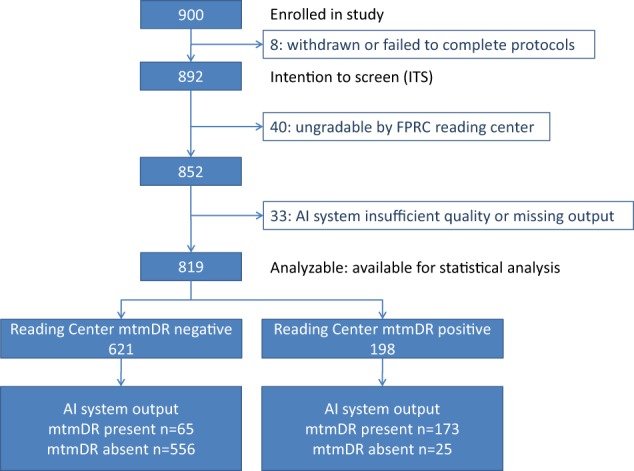
Artificial Intelligence (AI) has long promised to increase healthcare affordability, quality and accessibility but FDA, until recently, had never authorized an autonomous AI diagnostic system. This pivotal trial of an AI system to detect diabetic retinopathy (DR) in people with diabetes enrolled 900 subjects, with no history of DR at primary care clinics, by comparing to Wisconsin Fundus Photograph Reading Center (FPRC) widefield stereoscopic photography and macular Optical Coherence Tomography (OCT), by FPRC certified photographers, and FPRC grading of Early Treatment Diabetic Retinopathy Study Severity Scale (ETDRS) and Diabetic Macular Edema (DME). More than mild DR (mtmDR) was defined as ETDRS level 35 or higher, and/or DME, in at least one eye. AI system operators underwent a standardized training protocol before study start. Median age was 59 years (range, 22–84 years); among participants, 47.5% of participants were male; 16.1% were Hispanic, 83.3% not Hispanic; 28.6% African American and 63.4% were not; 198 (23.8%) had mtmDR. The AI system exceeded all pre-specified superiority endpoints at sensitivity of 87.2% (95% CI, 81.8–91.2%) (>85%), specificity of 90.7% (95% CI, 88.3–92.7%) (>82.5%), and imageability rate of 96.1% (95% CI, 94.6–97.3%), demonstrating AI’s ability to bring specialty-level diagnostics to primary care settings. Based on these results, FDA authorized the system for use by health care providers to detect more than mild DR and diabetic macular edema, making it, the first FDA authorized autonomous AI diagnostic system in any field of medicine, with the potential to help prevent vision loss in thousands of people with diabetes annually. ClinicalTrials.gov NCT02963441
Overview
The claims and statistics of this paper haven’t been checked yet.
Free: it reads the open-access text and checks the first 5 claims that cite a source we can check. Create a free account to check every claim.
Integrity signals
Registry
Cites
Statistics
Figures
Verification
Claims the paper makes
The claims and statistics of this paper haven’t been checked yet.
Free: it reads the open-access text and checks the first 5 claims that cite a source we can check. Create a free account to check every claim.
Claims other papers make about this one
Each is checked against this paper’s own text: does it say what the citing paper says it does?
The cited source doesn’t support the claim as written.
In the citing paper
“The regulatory approval of the first diagnostic autonomous AI system for diabetic eye exams was based on a pivotal trial against a prognostic standard, i.e., patient outcome24, showing its safety, efficacy, and lack of racial and ethnic bias for diagnosing DED in adults with diabetes with 87% sensitivity and 91% specificity24.”
From Autonomous artificial intelligence increases screening and follow-up for diabetic retinopathy in youth: the ACCESS randomized control trial (2024) · cites this paper as [24]
Checked by a reasoning model — may be wrong.
Experimental — accuracy not yet measuredThe source backs part of the claim, not all of it — or backs it for a different population, condition or comparison.
In the citing paper
“Only eight studies in ophthalmology imaging14,21,32,33,43,55,108,109, ten studies in respiratory imaging64,66,70,72,75,79,82,87,89,110 and six studies in breast imaging62,91,97,104,106,111 mentioned adherence to the STARD-2015 guidelines or had a STARD flow diagram in the manuscript.”
From Diagnostic accuracy of deep learning in medical imaging: a systematic review and meta-analysis (2021) · cites this paper as [14]
Experimental — accuracy not yet measuredThe source backs part of the claim, not all of it — or backs it for a different population, condition or comparison.
In the citing paper
“These systems use large annotated datasets to learn hierarchical features directly from images, improving reproducibility and reducing reliance on manual feature engineering [27,34].”
From Artificial Intelligence in Clinical Decision-Making: A Comprehensive Review of Diagnostic, Prognostic, and Therapeutic Applications, Validation Gaps, Bias, and Deployment Challenges (2026) · cites this paper as [27]
Experimental — accuracy not yet measuredThe source backs part of the claim, not all of it — or backs it for a different population, condition or comparison.
In the citing paper
“In clinical workflows, AI supports triage prioritisation, second-opinion review, and reduction of diagnostic variability in high-volume settings [15,27].”
From Artificial Intelligence in Clinical Decision-Making: A Comprehensive Review of Diagnostic, Prognostic, and Therapeutic Applications, Validation Gaps, Bias, and Deployment Challenges (2026) · cites this paper as [27]
Experimental — accuracy not yet measuredThe source backs part of the claim, not all of it — or backs it for a different population, condition or comparison.
In the citing paper
“Adoption in clinical practice is influenced by clinician interaction with AI systems, including trust and workflow compatibility [23,27].”
From Artificial Intelligence in Clinical Decision-Making: A Comprehensive Review of Diagnostic, Prognostic, and Therapeutic Applications, Validation Gaps, Bias, and Deployment Challenges (2026) · cites this paper as [27]
Experimental — accuracy not yet measured
18 more claims about this paper
Create a free account to see every claim other papers make about this one.
Self-check
Percentages, sums and reported differences re-computed from the paper’s own numbers.
The self-check needs the paper’s full text.
Citations
Cites
ImageNet classification with deep convolutional neural networks
Krizhevsky, A., Sutskever, I., & Hinton, G. E. (2017) · Communications of the ACM · doi:10.1145/3065386 · Cited by 112,155
Diagnosis and Classification of Diabetes Mellitus
American Diabetes Association (2011) · Diabetes Care · doi:10.2337/dc11-s062 · Cited by 13,988
Gulshan, V., Peng, L., Coram, M., Stumpe, M. C., Wu, D., Narayanaswamy, A., Venugopalan, S., Widner, K., Madams, T., Cuadros, J., et al. (2016) · JAMA · doi:10.1001/jama.2016.17216 · Cited by 7,697
Centers for Disease Control and Prevention
(2007) · Encyclopedia of Measurement and Statistics · doi:10.4135/9781412952644.n74 · Cited by 6,444
Diagnosis and classification of diabetes mellitus
American Diabetes Association (2014) · Diabetes Care · doi:10.2337/dc14-s081 · Cited by 5,974
(2007) · Developments in Ophthalmology · doi:10.1159/isbn.978-3-318-01439-6 · Cited by 5,583
Bias reduction of maximum likelihood estimates
FIRTH, D. (1993) · Biometrika · doi:10.1093/biomet/80.1.27 · Cited by 5,035
Wilkinson, C. P., Ferris, F. L., Klein, R. E., Lee, P. P., Agardh, C. D., Davis, M., Dills, D., Kampik, A., Pararajasegaram, R., & Verdaguer, J. T. (2003) · Ophthalmology · doi:10.1016/s0161-6420(03)00475-5 · Cited by 3,743
Classification and Diagnosis of Diabetes
Fajans, S. S. (1990) · Medical Entomology and Zoology · Cited by 2,359
Research works printed but not linked: 1
- Centers for Disease Control and Prevention. Diabetes Report Card 2012 2012 Atlanta, GA U.S. Department of Health and Human Services
Cited by
Items 501–600 of 1,004
Vasconcelos, F., He, B., Singh, N., & Teh, Y. W. (2023) · Transactions on machine learning research · doi:10.48550/arxiv.2202.10847 · Cited by 29
“Although uncertainty has been quantified in deep-learning based medical imaging [6, 71], medical datasets are often small and apparatus-specific, posing significant generalization challenges for large data-driven approaches [1, 25, 58, 125, 130].”
BackgroundWang, Z., Li, Z., Li, K., Mu, S., Zhou, X., & Di, Y. (2023) · Frontiers in Endocrinology · doi:10.3389/fendo.2023.1197783 · Cited by 27
“Since the researchers did not clarify the pre-training degree and learning amount of each model, we could not include these factors in the analysis; (7) there are problems with direct comparison of diagnostic accuracy.”
Diagnostic Accuracy of Automated Diabetic Retinopathy Image Assessment Software: IDx-DR and RetCAD
Grzybowski, A. E., Brona, P., Krzywicki, T., & Ruamviboonsuk, P. (2024) · Ophthalmology and Therapy · doi:10.1007/s40123-024-01049-z · Cited by 27
Jiao, C., Rosas, E., Asadigandomani, H., Delsoz, M., Madadi, Y., Raja, H., Munir, W. M., Tamm, B., Mehravaran, S., Djalilian, A. R., et al. (2025) · Diagnostics · doi:10.3390/diagnostics15101221 · Cited by 29
Duggal, M., Chauhan, A., Gupta, V., Kankaria, A., Budhija, D., Verma, P., Miglani, V., Syal, P., Kaur, G., Kumar, L., et al. (2025) · JMIR Medical Informatics · doi:10.2196/67529 · Cited by 27
“AI algorithms have demonstrated performance comparable to or exceeding human experts in DR classification [12,13].”
InfluentialEvaluation of a New Model of Care for People with Complications of Diabetic Retinopathy
Lois, N., Cook, J., Wang, A., Aldington, S. J., Mistry, H., Maredza, M., Mcauley, D., Aslam, T., Bailey, C., Chong, V., et al. (2020) · Ophthalmology (Rochester, Minn.) · doi:10.1016/j.ophtha.2020.10.030 · Cited by 24
Health Equity in Artificial Intelligence and Primary Care Research: Protocol for a Scoping Review
Wang, J. X., Somani, S. S., Chen, J. H., Murray, S. G., & Sarkar, U. (2021) · JMIR Research Protocols · doi:10.2196/27799 · Cited by 27
“This is particularly important in the fields of health equity, primary care, and AI, where much of the literature is currently focused on specific outcomes or aspects of care [18-21].”
BackgroundArtificial Intelligence in Ophthalmology – Status Quo and Future Perspectives
Matos, P. A. W., Reimer, R. P., Rokohl, A. C., Caldeira, L., Heindl, L. M., & Hokamp, N. G. (2022) · Seminars in Ophthalmology · doi:10.1080/08820538.2022.2139625 · Cited by 27
Chia, M. A., Hersch, F. B., Sayres, R., Bavishi, P., Tiwari, R., Keane, P. A., & Turner, A. W. (2023) · British Journal of Ophthalmology · doi:10.1136/bjo-2022-322237 · Cited by 28
Mixture of calibrated networks for domain generalization in brain tumor segmentation
Hu, J., Gu, X., Wang, Z., & Gu, X. (2023) · Knowledge-Based Systems · doi:10.1016/j.knosys.2023.110520 · Cited by 26
Examining the Role of Telemedicine in Diabetic Retinopathy
Land, M. R., Patel, P. A., Bui, T., Jiao, C., Ali, A. A., Ibnamasud, S., Patel, P. N., & Sheth, V. S. (2023) · Journal of Clinical Medicine · doi:10.3390/jcm12103537 · Cited by 27
Transparency in Artificial Intelligence Reporting in Ophthalmology-A Scoping Review
Chen, D. K., Geevarghese, A., Lee, S., Plovnick, C., Elgin, C. Y., Zhou, R. W., Oermann, E. K., Aphinyonaphongs, Y., & Al‐Aswad, L. A. (2024) · Ophthalmology Science · doi:10.1016/j.xops.2024.100471 · Cited by 27
Chuter, B., Huynh, J., Bowd, C., Walker, E., Rezapour, J., Brye, N., Belghith, A., Fazio, M. A., Girkin, C. A., Moraes, G. D., et al. (2024) · Translational Vision Science & Technology · doi:10.1167/tvst.13.1.23 · Cited by 27
Sassis, L., Kefala-Karli, P., Sassi, M., & Zervides, C. (2021) · Journal of Artificial Intelligence for Medical Sciences · doi:10.2991/jaims.d.210617.002 · Cited by 26
“AI has been introduced dynamically in various specialties of medicine such as radiology and neurology [3–6], pathology [7–9], dermatology [10,11], ophthalmology [12,13], gastroenterology [14], cardiology [15], surgery [16] and molecular medicine and genetics [17,18].”
BackgroundAwasthi, V., Awasthi, N., Kumar, H., Singh, S., Singh, P. P., Dixit, P., & Agarwal, R. (2024) · MethodsX · doi:10.1016/j.mex.2024.103018 · Cited by 26
Galanty, M., Luitse, D. M. R., Noteboom, S. H., Croon, P. M., Vlaar, A. P. J., Poell, T., Sánchez, C. I., Blanke, T., & Išgum, I. (2024) · Scientific Reports · doi:10.1038/s41598-024-83218-5 · Cited by 29
“The Grand Challenge platform 43 recommends that “the public training data should be uploaded to a public data host and the secret test data should be uploaded to a private archive on grand-challenge.org” .”
Artificial intelligence in bronchoscopy: a systematic review
Cold, K. M., Vamadevan, A., Laursen, C. B., Bjerrum, F., Singh, S., & Konge, L. (2025) · European Respiratory Review · doi:10.1183/16000617.0274-2024 · Cited by 29
“The first US Food and Drug Administration-approved AI in healthcare, IDx-DR (Digital Diagnostics, Coralville, IA, USA), detects diabetic retinopathy, and as an autonomous AI the company assumes liability [61, 62].”
Cao, J., You, K., Zhou, J., Xu, M., Xu, P., Wen, L., Wang, S., Jin, K., Lou, L., Wang, Y., et al. (2022) · EClinicalMedicine · doi:10.1016/j.eclinm.2022.101633 · Cited by 26
Application of Artificial Intelligence in Precision Medicine for Diabetic Macular Edema
Li, L., Zhang, W., Tu, X., Pang, J., Lai, I. F., Jin, C., Cheung, C. Y.-L., & Lin, H. (2023) · Asia-Pacific Journal of Ophthalmology · doi:10.1097/apo.0000000000000583 · Cited by 27
Artificial intelligence in uveitis: A comprehensive review
Nakayama, L. F., Ribeiro, L. Z., Dychiao, R. G., Zamora, Y. F., Regatieri, C. V., Celi, L. A., Silva, P., Sobrin, L., & Belfort, R. (2023) · Survey of Ophthalmology · doi:10.1016/j.survophthal.2023.02.007 · Cited by 26
Zhao, P. Y., Bommakanti, N. K., Yu, G., Aaberg, M. T., Patel, T. P., & Paulus, Y. M. (2023) · Scientific Reports · doi:10.1038/s41598-023-36327-6 · Cited by 26
“In diabetic retinopathy, deep learning has been used to screen patients with diabetes mellitus (DM) for referral-warranted diabetic retinopathy (DR) 11,23 , and to identify the severity of DR 24 .”
Rajalakshmi, R., Pramodkumar, T. A., Naziyagulnaaz, A. S., Anjana, R. M., Raman, R., Suchetha, M., & Mohan, V. (2024) · Seminars in Ophthalmology · doi:10.1080/08820538.2024.2432902 · Cited by 26
“31 EyeArt is an autonomous AI system that achieved 96% sensitivity and 88% specificity in detection of RDR in clinical validation studies and obtained USFDA approval for DR detection in primary care settings in August 2020.”
Artificial Intelligence in Uveitis: Innovations in Diagnosis and Therapeutic Strategies
Murugan, S., Sanjay, S., Somanath, A., Mahendradas, P., Patil, A., Kaur, K., & Gurnani, B. (2024) · Clinical ophthalmology · doi:10.2147/opth.s495307 · Cited by 26
“22,23 Abellanas et al, 21 in their review, included articles into 4 categories: diagnosis support algorithms, findings detection algorithms, screening algorithms, and Standardization of Uveitis Nomenclature (SUN) articles.”
Cost-effectiveness of AI for pediatric diabetic eye exams from a health system perspective
Ahmed, M., Dai, T., Channa, R., Abràmoff, M. D., Lehmann, H. P., & Wolf, R. M. (2025) · npj Digital Medicine · doi:10.1038/s41746-024-01382-4 · Cited by 26
Self-citationChen, E. M., Armstrong, G. W., Cox, J. T., Wu, D. M., Hoover, D. R., Priore, L. V. D., & Parikh, R. (2019) · Ophthalmology · doi:10.1016/j.ophtha.2019.09.010 · Cited by 26
Yuba, M., & Iwasaki, K. (2022) · Scientific Reports · doi:10.1038/s41598-022-21426-7 · Cited by 25
Automated strabismus detection and classification using deep learning analysis of facial images
Yarkheir, M., Sadeghi, M., Azarnoush, H., Akbari, M. R., & Pour, E. K. (2025) · Scientific Reports · doi:10.1038/s41598-025-88154-6 · Cited by 25
“Does Black Box AI In Medicine Compromise Informed Consent?”
Director, S. (2025) · Philosophy & Technology · doi:10.1007/s13347-025-00860-1 · Cited by 25
“This dramatically outperforms humans: “Previous studies have shown that board-certified ophthalmologists that perform indirect ophthalmoscopy achieve an average sensitivity of 33%, 34%, or 73%" (Abràmoff et al., 2018, 3).”
InfluentialArtificial intelligence in modern clinical practice (Review)
Thomas, K., Edpuganti, S., Puthooran, D. M., Thomas, A., Joy, A., & Latheef, S. (2025) · Medicine International · doi:10.3892/mi.2025.289 · Cited by 25
“In diabetic retinopathy, IDx‑DR is the approved tool for AI in screening with a sensitivity of 87.4% and specificity of 89.5% (30), which was tested on 900 patients across 10 primary care settings; it yielded a high accuracy and a 96.1% image ability (31).”
InfluentialWang, T.-W., Luo, W.-T., Tu, Y.-K., Chou, Y.-B., & Wu, Y.-T. (2025) · npj Digital Medicine · doi:10.1038/s41746-025-02223-8 · Cited by 26
Alali, N. M., Albazei, A. I., Alotaibi, H. M., Almohammadi, A. M., Alsirhani, E. K., Alanazi, T. S., Alshammri, B. J., Alqahtani, M. Q., Magliyah, M., Alreshidi, S. O., et al. (2022) · Journal of Clinical Medicine · doi:10.3390/jcm11216351 · Cited by 25
Penha, F. M., Priotto, B. M., Hennig, F., Przysiezny, B., Wiethorn, B. A., Orsi, J., Nagel, I. B. F., Wiggers, B., Stuchi, J. A., Lencione, D., et al. (2023) · International Journal of Retina and Vitreous · doi:10.1186/s40942-023-00477-6 · Cited by 25
“The high sensitivity of the embedded AI system in our real-world sample compares well with previous reports of other automated systems [5, 10, 11].”
BackgroundMethodResultInfluentialUrbano, F., Farella, I., Brunetti, G., & Faienza, M. F. (2023) · International Journal of Molecular Sciences · doi:10.3390/ijms241511980 · Cited by 26
Clinician-Driven AI: Code-Free Self-Training on Public Data for Diabetic Retinopathy Referral
Korot, E., Gonçalves, M. B., Huemer, J. C., Beqiri, S., Khalid, H., Kelly, M., Chia, M. A., Mathijs, E., Struyven, R., Moussa, M. S., et al. (2023) · JAMA Ophthalmology · doi:10.1001/jamaophthalmol.2023.4508 · Cited by 25
MSEF-Net: A multi-scale EfficientNet Fusion for Diabetic Retinopathy grading
Fu, Y., Ju, Y., & Zhang, D. (2024) · Biomedical Signal Processing and Control · doi:10.1016/j.bspc.2024.106714 · Cited by 25
Style-Invariant Cardiac Image Segmentation with Test-Time Augmentation
Huang, X., Chen, Z., Yang, X., Liu, Z., Zou, Y., Luo, M., Xue, W., & Ni, D. (2021) · Lecture notes in computer science · doi:10.1007/978-3-030-68107-4_31 · Cited by 25
Yu, M., & Wang, Y. (2022) · International Journal of Imaging Systems and Technology · doi:10.1002/ima.22734 · Cited by 25
“Abràmoffff et al.(22) CNN 900 subjects enrolled in primary care clinics SE 87.”
BackgroundMehra, A. A., Softing, A., Guner, M. K., Hodge, D. O., & Barkmeier, A. J. (2022) · American Journal of Ophthalmology · doi:10.1016/j.ajo.2022.08.008 · Cited by 24
Kalavar, M., Al-khersan, H., Sridhar, J. S., Gorniak, R., Lakhani, P. C., Flanders, A. E., & Kuriyan, A. E. (2020) · International Ophthalmology Clinics · doi:10.1097/iio.0000000000000333 · Cited by 24
Automatic fundus image quality assessment on a continuous scale
Karlsson, R. A., Jónsson, B. A., Hardarson, S. H., Ólafsdóttir, Ó. B., Halldorsson, G. H., & Stefánsson, E. (2020) · Computers in Biology and Medicine · doi:10.1016/j.compbiomed.2020.104114 · Cited by 24
Cagliero, D., Deuitch, N. T., Shah, N. H., Feudtner, C., & Char, D. S. (2023) · Journal of the American Medical Informatics Association · doi:10.1093/jamia/ocad022 · Cited by 24
Self-citationArtificial Intelligence: Singularity Approaches
TerKonda, S. P., TerKonda, A. A., Sacks, J. M., Kinney, B. M., Gurtner, G. C., Nachbar, J. M., Reddy, S., & Jeffers, L. L. C. (2023) · Plastic & Reconstructive Surgery · doi:10.1097/prs.0000000000010572 · Cited by 25
The Effect of Medical Artificial Intelligence Innovation Locus on Consumer Adoption of New Products
Huang, X., Wu, X., Cao, X., & Wu, J. (2021) · Technological Forecasting and Social Change · doi:10.1016/j.techfore.2023.122902 · Cited by 25
AI in the clinical management of GA: A novel therapeutic universe requires novel tools
Reiter, G. S., Mai, J., Riedl, S., Birner, K., Frank‐Publig, S., Bogunović, H., & Schmidt-Erfurth, U. M. (2024) · Progress in Retinal and Eye Research · doi:10.1016/j.preteyeres.2024.101305 · Cited by 24
Use of Artificial Intelligence–Based Detection of Diabetic Retinopathy in the US
Shah, S., Sokol, J. T., Wai, K. M., Rahimy, E., Myung, D. J., Mruthyunjaya, P., & Parikh, R. (2024) · JAMA Ophthalmology · doi:10.1001/jamaophthalmol.2024.4493 · Cited by 24
Current Application of Digital Diagnosing Systems for Retinopathy of Prematurity
Bao, Y., Ming, W., Mou, Z., Kong, Q., Li, A., Yuan, T., & Mi, X.-S. (2020) · Computer Methods and Programs in Biomedicine · doi:10.1016/j.cmpb.2020.105871 · Cited by 24
The contribution of AI in the detection of the Diabetic Retinopathy
Vocaturo, E., & Zumpano, E. (2020) · IEEE International Conference on Bioinformatics and Biomedicine (BIBM) · doi:10.1109/bibm49941.2020.9313541 · Cited by 24
Interpreting Deep Learning Studies in Glaucoma: Unresolved Challenges
Lee, E. B., Wang, S. Y., & Chang, R. T. (2021) · Asia-Pacific Journal of Ophthalmology · doi:10.1097/apo.0000000000000395 · Cited by 24
“16,17 Despite the success in diabetic retinopathy, similar results have yet to be published in glaucoma.”
BackgroundInfluentialGlobal disparity bias in ophthalmology artificial intelligence applications
Nakayama, L. F., Kras, A., Ribeiro, L. Z., Malerbi, F. K., Mendonça, L. S., Celi, L. A., Regatieri, C. V. S., & Waheed, N. K. (2022) · BMJ Health & Care Informatics · doi:10.1136/bmjhci-2021-100470 · Cited by 23
Yu, T., Shao, A., Wu, H., Su, Z., Shen, W., Zhou, J., Lin, X., Shi, D., Grzybowski, A., Wu, J., et al. (2025) · Ophthalmology and Therapy · doi:10.1007/s40123-025-01109-y · Cited by 23
“In conclusion, AI-assisted analysis of FFA images not only improves diagnostic speed and accuracy, reduces healthcare costs [1, 17], but also undertakes multiple tasks such as pathology segmentation, greatly easing the burden on ophthalmologists.”
Teng, C. W., Patel, S. D., Barkmeier, A. J., Liu, T. Y. A., Myung, D., Henderer, J., Liu, J., Hansen, E., & Al-Aswad, L. A. (2026) · Ophthalmology Science · doi:10.1016/j.xops.2025.100935 · Cited by 36
“15 In practice, the nonmydriatic gradability is found to range from 49% to 75% (Table 1).”
InfluentialUpadhyaya, S., Rao, D. P., Kavitha, S., Ganeshrao, S. B., Negiloni, K., Bhandary, S., Savoy, F. M., & Venkatesh, R. (2024) · Ophthalmology Glaucoma · doi:10.1016/j.ogla.2024.09.002 · Cited by 23
Khoury, N., Hadid, D., & El‐Outa, A. (2025) · Cureus · doi:10.7759/cureus.82667 · Cited by 23
“The first FDA-approved AI-based medical imaging application was introduced in 2017, with the first AI system for detecting diabetic retinopathy being approved in 2018 - without requiring any human assistance or interpretation [5-7].”
Djoumessi, K., Huang, Z., Kuehlewein, L., Rickmann, A., Simon, N., Koch, L. M., & Berens, P. (2025) · PLOS Digital Health · doi:10.1371/journal.pdig.0000831 · Cited by 25
“Despite the success of AI models in healthcare, comparatively few studies have evaluated their usefulness in collaboration with healthcare professionals in real or retrospective clinical settings [41, 44].”
BackgroundAlooghareh, M. M. A., Sheikhey, M. M., Sahafi, A., Pirnejad, H., & Naemi, A. (2025) · Bioengineering · doi:10.3390/bioengineering12080840 · Cited by 23
Sedeeq, F. S., & Arman, P. (2025) · The Journal of Law Medicine & Ethics · doi:10.1017/jme.2025.10175 · Cited by 24
Bajramagic, M., Battelino, T., Cos, X., Coté, M., Cui, N., Forbes, A., Galderisi, A., Heinemann, L., Hussain, S., Imbert, J., et al. (2025) · Diabetologia · doi:10.1007/s00125-025-06601-5 · Cited by 24
“…(FDA)-approved AI-driven diagnostic sys-tem in any field of medicine was an autonomous system for the detection of diabetic retinopathy in 2018 [43], and AI-based retinal screening using pattern recognition algorithms is now routinely used in diabetes care [5, 44], reducing the task load…”
Niazi, S. K. (2026) · Journal of Chemistry · doi:10.1155/joch/5202999 · Cited by 25
Artificial Intelligence Approach in Melanoma
Curiel‐Lewandrowski, C. N., Novoa, R. A., Berry, E., Celebi, M. E., Codella, N., Giuste, F., Gutman, D. A., Halpern, A. C., Leachman, S. A., Liu, Y., et al. (2019) · Springer eBooks · doi:10.1007/978-1-4614-7322-0_43-1 · Cited by 23
Clinical decision support in primary care for better diagnosis and management of retinal disease
Ho, S., Kalloniatis, M., & Ly, A. (2022) · Clinical and Experimental Optometry · doi:10.1080/08164622.2021.2008791 · Cited by 23
“However, novel AI CDSSs have been developed for the detection of retinal disease.(85,87) ● Objective assessment ● Source of second opinion to justify a diagnosis or list of differential options ● Potential screening tool ● Negative clinician perceptions and bias (threat to professional autonomy) ● Historically poor sy…”
MethodKaur, J., & Kaur, P. (2022) · Concurrency and Computation Practice and Experience · doi:10.1002/cpe.7138 · Cited by 23
Technology and Innovation in Global Ophthalmology: The Past, the Potential, and a Path Forward
Redd, T. K., Al-Khaled, T., Chan, R. V. P., & Campbell, J. P. (2022) · International Ophthalmology Clinics · doi:10.1097/iio.0000000000000450 · Cited by 23
Applications of Artificial Intelligence in Health Care Delivery
Spear, J., Ehrenfeld, J. M., & Miller, B. J. (2023) · Journal of Medical Systems · doi:10.1007/s10916-023-02018-y · Cited by 23
“Technology like IDx-DR [14] (Digital Diagnostics Inc, Iowa) can streamline screening for dia - betic retinopathy without physician interpretation and with such precision that the company holds liability insurance.”
Cleland, C. R., Bascarán, C., Makupa, W., Shilio, B. R., Sandi, F., Philippin, H., Marques, A. P., Egan, C. A., Tufail, A., Keane, P. A., et al. (2024) · BMJ Open · doi:10.1136/bmjopen-2023-075055 · Cited by 23
“11 There are several AI systems commercially available for DR grading that have shown promisingly high sensitivities and specificities.”
BackgroundMadadi, Y., Delsoz, M., Khouri, A. S., Boland, M. V., Grzybowski, A. E., & Yousefi, S. (2024) · Current Opinion in Ophthalmology · doi:10.1097/icu.0000000000001035 · Cited by 25
“In recent years, AI, particularly DL [28] has made considerable advancements in medicine [29], and the application of these technologies within the realm of ophthalmology [30] has opened up AI-based autonomic devices in medicine [31,32].”
Dubois, C., Eigen, D., Delmas, E., Einfalt, M., Lemaçon, C., Berteloot, L., Bossuyt, P. M., Drummond, D., Scherdel, P., Simon, F., et al. (2024) · BMJ · doi:10.1136/bmj-2023-076703 · Cited by 23
Schneider, E. W., Heier, J. S., Holekamp, N. M., Busquets, M. A., Wagner, A. L., Mukkamala, S. K., Riemann, C. D., Lee, S., Joondeph, B. C., Houston, S. S., et al. (2024) · Ophthalmology Science · doi:10.1016/j.xops.2024.100662 · Cited by 23
Ma, S., Zhang, M., Sun, W., Gao, Y., Jing, M., Gao, L., & Wu, Z. (2025) · Healthcare and Rehabilitation · doi:10.1016/j.hcr.2024.100006 · Cited by 23
“56 Two years later, an AI system named EyeArt also received FDA approval for autonomous DR diagnosis.”
Huang, P., Yang, J., Zhao, D., Ran, T., Luo, Y., Yang, D., Zheng, X., Zhou, S., & Chen, C. (2025) · Journal of Medical Internet Research · doi:10.2196/68354 · Cited by 23
“These factors make it popular in medicine, including anesthesiology [9], cardiology [10], ophthalmology [11], and so on.”
Xie, L. Y., Yang, S., Squirrell, D., & Vaghefi, E. (2020) · PLoS ONE · doi:10.1371/journal.pone.0225015 · Cited by 23
“…which features to extract from medical data (e.g. fundus photos) to achieve the best classification accuracy, when compared to human performance [15–20], with one study (De Fauw et al.) demonstrating that its AI was 2%-5% more accurate than 6 out of the 8 experienced clinicians in detecting…”
MethodThe Digital Reconstruction of Health Care
Halamka, J. D., & Cerrato, P. L. (2020) · NEJM Catalyst · doi:10.1056/cat.20.0082 · Cited by 23
Wang, Y., Shi, D., Tan, Z., Niu, Y. Y., Jiang, Y., Xiong, R., Peng, G., & He, M. (2021) · Frontiers in Medicine · doi:10.3389/fmed.2021.740987 · Cited by 23
“Researchers have made efforts to validate AI in clinical practice (15), revealing multiple socio-environmental factors that restrict the accuracy and adoption of this new technology (16).”
BackgroundJiang, X., Xie, M., Lan, M., Dong, L., & Li, D. (2023) · Annals of Translational Medicine · doi:10.21037/atm-22-3773 · Cited by 23
“The Food and Drug Administration (FDA, UAS) approved the use of AI algorithms in primary care settings to diagnose DR in 2018 (33).”
BackgroundFeng, H., Chen, J., Zhang, Z., Lou, Y., Zhang, S., & Yang, W. (2023) · Frontiers in Cell and Developmental Biology · doi:10.3389/fcell.2023.1174936 · Cited by 23
Chou, Y.-B., Kale, A. U., Lanzetta, P., Aslam, T. M., Barratt, J., Danese, C., Eldem, B. M., Eter, N., Gale, R. P., Korobelnik, J., et al. (2023) · Current Opinion in Ophthalmology · doi:10.1097/icu.0000000000000979 · Cited by 24
“It can analyze retinal images, detect vision-threatening DR, and provide referral recommendations [6,81].”
BackgroundArtificial intelligence assisted pterygium diagnosis: current status and perspectives
Chen, B., Wu, M., Zhu, S., Zheng, B. R., Liu, B.-Q., Wu, T., Hong, X., Wang, J., & Yang, W. (2023) · International Journal of Ophthalmology · doi:10.18240/ijo.2023.09.04 · Cited by 22
Deepa, R., & Sivasamy, A. (2023) · AIP Advances · doi:10.1063/5.0172226 · Cited by 22
Novel Technologies in Artificial Intelligence and Telemedicine for Glaucoma Screening
Christopher, M. A., Hallaj, S., Jiravarnsirikul, A., Baxter, S. L., & Zangwill, L. M. (2024) · Journal of Glaucoma · doi:10.1097/ijg.0000000000002367 · Cited by 22
Ali, S. G., Zhang, C., Guan, Z., Chen, T., Wu, Q., Li, P., Yang, P., Ghazanfar, Z., Jung, Y., Chen, Y., et al. (2024) · The Visual Computer · doi:10.1007/s00371-024-03391-6 · Cited by 22
“Within the field of ophthalmology, DL algorithms have been instrumental in the detection of various ocular diseases, including diabetic retinopathy and glaucoma [1, 12, 19].”
Real-world validation of artificial intelligence algorithms for ophthalmic imaging
Domalpally, A., & Channa, R. (2021) · The Lancet Digital Health · doi:10.1016/s2589-7500(21)00140-0 · Cited by 22
Choi, J. Y., & Yoo, T. K. (2023) · Annals of Translational Medicine · doi:10.21037/atm-23-1598 · Cited by 22
“Based on the advances of deep learning technology, AI-based systems such as IDx-DR (Digital Diagnostics, Coralville, IA, USA) and EyeArt (Eyenuk, Los Angeles, CA, USA) have been approved for diabetic retinopathy detection by the US Food and Drug Administration (5).”
Ho, S., Doig, G. S., & Ly, A. (2022) · Ophthalmic and Physiological Optics · doi:10.1111/opo.13034 · Cited by 21
“With high expectations for the future role of AI in optometric practice, the positive clinician attitudes demonstrated in this study are encouraging for its clinical adoption.”
Economic challenges of artificial intelligence adoption for diabetic retinopathy
Chen, E. M., Chen, D., Chilakamarri, P., Lopez, R., & Parikh, R. (2021) · Ophthalmology · doi:10.1016/j.ophtha.2020.07.043 · Cited by 21
Economic evaluation of AI-assisted technologies in healthcare: A systematic review
Wu, W.-T., Chao, Y.-W., Lin, T.-J., Huang, C.-K., & Hsieh, P.-H. (2025) · Journal of Food and Drug Analysis · doi:10.38212/2224-6614.3570 · Cited by 24
“AI is being applied to di-agnostics [1], treatment planning [2], predictive analytics [3], facilitate screening [4], among other uses.”
Artificial intelligence in eye care: a cautious welcome
Bastawrous, A., & Cleland, C. R. (2022) · Community Eye Health Journal · doi:10.56920/cehj.217 · Cited by 21
Diabetic Retinopathy and Cardiovascular Disease: A Literature Review
Yu, W., Yang, B., Xu, S., Gao, Y., Huang, Y., & Wang, Z. (2023) · Diabetes Metabolic Syndrome and Obesity · doi:10.2147/dmso.s438111 · Cited by 21
“…in clinical diagnosis and management and cannot completely replace ophthalmologists, recently, fully automated systems based on AI have been further developed and preliminarily approved for DR screening, 115 and it is believed that AI will play an important role in DR Screening in the near future.”
Artificial Intelligence‐Based Clinical Decision Support for COVID‐19–Where Art Thou?
Unberath, M., Ghobadi, K., Levin, S., Hinson, J. S., & Hager, G. D. (2020) · Advanced Intelligent Systems · doi:10.1002/aisy.202000104 · Cited by 21
Vaghefi, E., Yang, S., Xie, L. Y., Hill, S., Schmiedel, O., Murphy, R., & Squirrell, D. (2020) · Diabetic Medicine · doi:10.1111/dme.14386 · Cited by 21
“5 However, there are still many clinical and technical challenges with regard to clinical implementation.”
BackgroundFDA Regulation of Predictive Clinical Decision‐Support Tools: What Does It Mean for Hospitals?
Weissman, G. E. (2020) · Journal of Hospital Medicine · doi:10.12788/jhm.3450 · Cited by 21
The Role of Artificial Intelligence in the Diagnosis and Management of Glaucoma
Ittoop, S. M., Jaccard, N., Lanouette, G., & Kahook, M. Y. (2021) · Journal of Glaucoma · doi:10.1097/ijg.0000000000001972 · Cited by 23
Zhang, T., Chen, J., Lü, Y., Yang, X., & Ouyang, Z. (2022) · PLoS ONE · doi:10.1371/journal.pone.0273355 · Cited by 21
“Moreover, FDA had approved a DL-based autonomous AI diagnostic system to detect diabetic retinopathy on the images of retinal fundus [79].”
MethodHasan, S. U., & Siddiqui, M. A. R. (2023) · Diabetes Research and Clinical Practice · doi:10.1016/j.diabres.2023.110943 · Cited by 20
Miceli, G., Basso, M. G., Cocciola, E., & Tuttolomondo, A. (2025) · Bioengineering · doi:10.3390/bioengineering12070681 · Cited by 21
“The first AI-powered medical technology received approval from the United States Food and Drug Administration (FDA) in April 2018 [34], specifically for an ophthalmic system used to detect diabetic retinopathy.”
Artificial intelligence in clinical education in ophthalmology: a systematic review
Yuan, L., Kang, D., Dong, X., Liu, L., Grzybowski, A. E., & Jin, K. (2025) · Visual Neuroscience · doi:10.48130/vns-0025-0025 · Cited by 21
Deep-Learning–Based Pre-Diagnosis Assessment Module for Retinal Photographs: A Multicenter Study
Yuen, V. L., Ran, A. R., Shi, J., Sham, K., Yang, D., Chan, V. T. T., Chan, R. N. C., Yam, J. C. S., Tham, C. C. Y., McKay, G. J., et al. (2021) · Translational Vision Science & Technology · doi:10.1167/tvst.10.11.16 · Cited by 20
“For the fieldof-view assessment, all gradable retinal photographs were further classified as (1) macula-centered, a retinal photograph with the fovea in the center region; (2) optic-disc-centered, a retinal photographwith the optic disc in the center region; or (3) off-centered, a retinal photograph with neither the f…”
Yuan, A., & Lee, A. (2022) · The Lancet Digital Health · doi:10.1016/s2589-7500(22)00027-9 · Cited by 20
Etiology of Macular Edema Defined by Deep Learning in Optical Coherence Tomography Scans
Padilla-Pantoja, F. D., Sanchez, Y. D., Quijano-Nieto, B. A., Perdómo, O., & Gonzalez, F. A. (2022) · Translational Vision Science & Technology · doi:10.1167/tvst.11.9.29 · Cited by 20
Extracellular vesicles as a liquid biopsy for melanoma: Are we there yet?
Medhin, L. B., Beasley, A. B., Warburton, L., Amanuel, B., & Gray, E. S. (2023) · Seminars in Cancer Biology · doi:10.1016/j.semcancer.2023.01.008 · Cited by 20
Cao, S., Zhang, R., Jiang, A., Kuerban, M., Wumaier, A., Wu, J., Xie, K., Aizezi, M., Tuersun, A., Liang, X., et al. (2023) · BioMedical Engineering OnLine · doi:10.1186/s12938-023-01097-9 · Cited by 21
“Currently, only one CFP-based screening system for DR has been authorized by Food and Drug Administration (FDA), with the sensitivity and specificity surpassing 80%, which proved the feasibility of screening for DR in primary care settings [1].”
BackgroundVujosevic, S., Limoli, C., & Nucci, P. (2024) · Current Opinion in Ophthalmology · doi:10.1097/icu.0000000000001084 · Cited by 20
Metadata
- Authors
- Abràmoff, M. D., Lavin, P. T., Birch, M., Shah, N., & Folk, J. C.
- Affiliations
- University of Iowa (US)
- University of North Carolina at Charlotte (US)
- Emmes (United States) (US)
- Corresponding author
- Abràmoff, Michael D.
- Venue
- npj Digital Medicine
- Published
- 2018-08-28
- Volume
- 1
- Issue
- 1
- Pages
- 39-39
- ISSN
- 2398-6352 (ISSN-L)
- PMC
- PMC6550188
- OpenAlex
- W2888424632
- Cited by
- 1,638
- References
- 61
- Citations by year
- 2026: 332 · 2025: 276 · 2024: 226 · 2023: 193 · 2022: 172 · 2021: 183 · 2020: 173 · 2019: 73 · 2018: 10
- FWCI
- 75.83
- Type
- journal article
- Language
- en
- Open access
- gold
- doi.org
- Licence
- cc-by
- creativecommons.org/licenses/by/4.0 (tdm)
- creativecommons.org/licenses/by/4.0 (vor)
- Locations
- npj Digital Medicine (publishedVersion, cc-by)
- Europe PMC (PubMed Central) (publishedVersion, cc-by)
- PubMed Central (publishedVersion, cc-by)
- PubMed (publishedVersion)
- DOAJ (DOAJ: Directory of Open Access Journals) (submittedVersion)
- Funders
- IDx LLC, Coralville, IA
- Topics
- Health Sciences › Medicine › Radiology, Nuclear Medicine and Imaging › Retinal Imaging and Analysis
- Health Sciences › Medicine › Ophthalmology › Retinal Diseases and Treatments
- Health Sciences › Medicine › Health Informatics › Artificial Intelligence in Healthcare and Education
- Keywords
- diabetic retinopathy, diabetic macular edema, autonomous AI systems, FDA approval, primary care, fundus photography, optical coherence tomography, sensitivity and specificity, imageability, blindness prevention, diabetes mellitus
About these checks
Registry, retraction, Cites and statistics results are computed, not judged, with one exception: a printed reference that no index lists is read once by a model before it counts as a citation error. Claims are extracted by a model and kept only when their quote appears verbatim in the text; each cited source is then checked, with a model’s help, for whether it says what the claim relies on. Those verdicts can be wrong — read the claim’s quote and the cited source before relying on one.
Statistics and arithmetic are recomputed, not judged.
Confidence bands are shown only for fields calibrated on our annotated test set. None is calibrated yet, so no band is shown.
What counts as a claim ›How we measure confidence ›How we check this ›
Are you an author, or do you see a problem with this page? Request a review
Data sources
Bibliographic data: Semantic Scholar, OpenAlex, Crossref.
Contains information from the Semantic Scholar Academic Graph Datasets, made available under the ODC Attribution License (ODC-BY 1.0).
Semantic Scholar’s data is described in: Kinney, R., et al. (2023). The Semantic Scholar Open Data Platform. arXiv:2301.10140.
