

Pivotal trial of an autonomous AI-based diagnostic system for detection of diabetic retinopathy in primary care offices
Open accessThe DOI matches its Crossref record; 62 of the 62 references it cites were found in a registry or an index.
Abstract
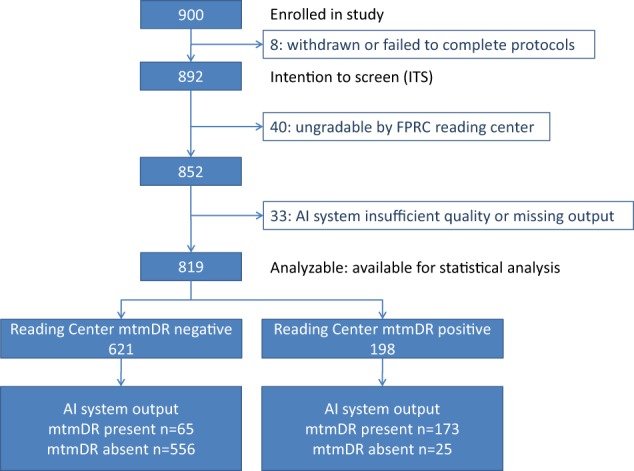
Artificial Intelligence (AI) has long promised to increase healthcare affordability, quality and accessibility but FDA, until recently, had never authorized an autonomous AI diagnostic system. This pivotal trial of an AI system to detect diabetic retinopathy (DR) in people with diabetes enrolled 900 subjects, with no history of DR at primary care clinics, by comparing to Wisconsin Fundus Photograph Reading Center (FPRC) widefield stereoscopic photography and macular Optical Coherence Tomography (OCT), by FPRC certified photographers, and FPRC grading of Early Treatment Diabetic Retinopathy Study Severity Scale (ETDRS) and Diabetic Macular Edema (DME). More than mild DR (mtmDR) was defined as ETDRS level 35 or higher, and/or DME, in at least one eye. AI system operators underwent a standardized training protocol before study start. Median age was 59 years (range, 22–84 years); among participants, 47.5% of participants were male; 16.1% were Hispanic, 83.3% not Hispanic; 28.6% African American and 63.4% were not; 198 (23.8%) had mtmDR. The AI system exceeded all pre-specified superiority endpoints at sensitivity of 87.2% (95% CI, 81.8–91.2%) (>85%), specificity of 90.7% (95% CI, 88.3–92.7%) (>82.5%), and imageability rate of 96.1% (95% CI, 94.6–97.3%), demonstrating AI’s ability to bring specialty-level diagnostics to primary care settings. Based on these results, FDA authorized the system for use by health care providers to detect more than mild DR and diabetic macular edema, making it, the first FDA authorized autonomous AI diagnostic system in any field of medicine, with the potential to help prevent vision loss in thousands of people with diabetes annually. ClinicalTrials.gov NCT02963441
Overview
The claims and statistics of this paper haven’t been checked yet.
Free: it reads the open-access text and checks the first 5 claims that cite a source we can check. Create a free account to check every claim.
Integrity signals
Registry
Cites
Statistics
Figures
Verification
Claims the paper makes
The claims and statistics of this paper haven’t been checked yet.
Free: it reads the open-access text and checks the first 5 claims that cite a source we can check. Create a free account to check every claim.
Claims other papers make about this one
Each is checked against this paper’s own text: does it say what the citing paper says it does?
The cited source doesn’t support the claim as written.
In the citing paper
“The regulatory approval of the first diagnostic autonomous AI system for diabetic eye exams was based on a pivotal trial against a prognostic standard, i.e., patient outcome24, showing its safety, efficacy, and lack of racial and ethnic bias for diagnosing DED in adults with diabetes with 87% sensitivity and 91% specificity24.”
From Autonomous artificial intelligence increases screening and follow-up for diabetic retinopathy in youth: the ACCESS randomized control trial (2024) · cites this paper as [24]
Checked by a reasoning model — may be wrong.
Experimental — accuracy not yet measuredThe source backs part of the claim, not all of it — or backs it for a different population, condition or comparison.
In the citing paper
“Only eight studies in ophthalmology imaging14,21,32,33,43,55,108,109, ten studies in respiratory imaging64,66,70,72,75,79,82,87,89,110 and six studies in breast imaging62,91,97,104,106,111 mentioned adherence to the STARD-2015 guidelines or had a STARD flow diagram in the manuscript.”
From Diagnostic accuracy of deep learning in medical imaging: a systematic review and meta-analysis (2021) · cites this paper as [14]
Experimental — accuracy not yet measuredThe source backs part of the claim, not all of it — or backs it for a different population, condition or comparison.
In the citing paper
“These systems use large annotated datasets to learn hierarchical features directly from images, improving reproducibility and reducing reliance on manual feature engineering [27,34].”
From Artificial Intelligence in Clinical Decision-Making: A Comprehensive Review of Diagnostic, Prognostic, and Therapeutic Applications, Validation Gaps, Bias, and Deployment Challenges (2026) · cites this paper as [27]
Experimental — accuracy not yet measuredThe source backs part of the claim, not all of it — or backs it for a different population, condition or comparison.
In the citing paper
“In clinical workflows, AI supports triage prioritisation, second-opinion review, and reduction of diagnostic variability in high-volume settings [15,27].”
From Artificial Intelligence in Clinical Decision-Making: A Comprehensive Review of Diagnostic, Prognostic, and Therapeutic Applications, Validation Gaps, Bias, and Deployment Challenges (2026) · cites this paper as [27]
Experimental — accuracy not yet measuredThe source backs part of the claim, not all of it — or backs it for a different population, condition or comparison.
In the citing paper
“Adoption in clinical practice is influenced by clinician interaction with AI systems, including trust and workflow compatibility [23,27].”
From Artificial Intelligence in Clinical Decision-Making: A Comprehensive Review of Diagnostic, Prognostic, and Therapeutic Applications, Validation Gaps, Bias, and Deployment Challenges (2026) · cites this paper as [27]
Experimental — accuracy not yet measured
18 more claims about this paper
Create a free account to see every claim other papers make about this one.
Self-check
Percentages, sums and reported differences re-computed from the paper’s own numbers.
The self-check needs the paper’s full text.
Citations
Cites
ImageNet classification with deep convolutional neural networks
Krizhevsky, A., Sutskever, I., & Hinton, G. E. (2017) · Communications of the ACM · doi:10.1145/3065386 · Cited by 112,155
Diagnosis and Classification of Diabetes Mellitus
American Diabetes Association (2011) · Diabetes Care · doi:10.2337/dc11-s062 · Cited by 13,988
Gulshan, V., Peng, L., Coram, M., Stumpe, M. C., Wu, D., Narayanaswamy, A., Venugopalan, S., Widner, K., Madams, T., Cuadros, J., et al. (2016) · JAMA · doi:10.1001/jama.2016.17216 · Cited by 7,697
Centers for Disease Control and Prevention
(2007) · Encyclopedia of Measurement and Statistics · doi:10.4135/9781412952644.n74 · Cited by 6,444
Diagnosis and classification of diabetes mellitus
American Diabetes Association (2014) · Diabetes Care · doi:10.2337/dc14-s081 · Cited by 5,974
(2007) · Developments in Ophthalmology · doi:10.1159/isbn.978-3-318-01439-6 · Cited by 5,583
Bias reduction of maximum likelihood estimates
FIRTH, D. (1993) · Biometrika · doi:10.1093/biomet/80.1.27 · Cited by 5,035
Wilkinson, C. P., Ferris, F. L., Klein, R. E., Lee, P. P., Agardh, C. D., Davis, M., Dills, D., Kampik, A., Pararajasegaram, R., & Verdaguer, J. T. (2003) · Ophthalmology · doi:10.1016/s0161-6420(03)00475-5 · Cited by 3,743
Classification and Diagnosis of Diabetes
Fajans, S. S. (1990) · Medical Entomology and Zoology · Cited by 2,359
Research works printed but not linked: 1
- Centers for Disease Control and Prevention. Diabetes Report Card 2012 2012 Atlanta, GA U.S. Department of Health and Human Services
Cited by
Items 101–200 of 1,004
Artificial Intelligence Detection of Diabetic Retinopathy
Lim, J. I., Regillo, C. D., Sadda, S. R., Ipp, E., Bhaskaranand, M., Ramachandra, C., Solanki, K., Dubiner, H., Levy-Clarke, G., Pesavento, R., et al. (2023) · Ophthalmology Science · doi:10.1016/j.xops.2022.100228 · Cited by 157
“…evaluation of fundus photographs for detection of mtmDR. Previous studies have compared dilated ophthalmoscopy with the ETDRS reference standard, 11 AI systems with the ETDRS reference standard, 7,8 AI systems with expert grading of nonstereo images, 9,12 and AI systems with dilated ophthalmoscopy.”
A Review of Algorithm & Hardware Design for AI-Based Biomedical Applications
Wei, Y., Zhou, J., Wang, Y., Liu, Y., Liu, Q., Luo, J., Wang, C., Ren, F., & Huang, L. (2020) · IEEE Transactions on Biomedical Circuits and Systems · doi:10.1109/tbcas.2020.2974154 · Cited by 161
“Recent work includes detecting diabetic retinopathy [78], Laparoscopy [79], grading OCT”
BackgroundEnsemble deep learning and EfficientNet for accurate diagnosis of diabetic retinopathy
Arora, L., Singh, S. K., Kumar, S., Gupta, H., Alhalabi, W., Arya, V., Bansal, S., Chui, K. T., & Gupta, B. B. (2024) · Scientific Reports · doi:10.1038/s41598-024-81132-4 · Cited by 163
Governance of automated image analysis and artificial intelligence analytics in healthcare
Ho, C. W. L., Soon, D., Caals, K., & Kapur, J. (2019) · Clinical Radiology · doi:10.1016/j.crad.2019.02.005 · Cited by 132
Diabetic Retinopathy Preferred Practice Pattern®
Lim, J. I., Kim, S. J., Bailey, S. T., Kovach, J. L., Vemulakonda, G. A., Ying, G., & Flaxel, C. J. (2025) · Ophthalmology · doi:10.1016/j.ophtha.2024.12.020 · Cited by 164
Brajer, N., Cozzi, B., Gao, M., Nichols, M., Revoir, M., Balu, S., Futoma, J., Bae, J., Setji, N., Hernandez, A., et al. (2020) · JAMA Network Open · doi:10.1001/jamanetworkopen.2019.20733 · Cited by 138
Promises and perils of artificial intelligence in dentistry
Pethani, F. (2021) · Australian Dental Journal · doi:10.1111/adj.12812 · Cited by 112
Flores, A. M., Demsas, F., Leeper, N. J., & Ross, E. (2021) · Circulation Research · doi:10.1161/circresaha.121.318224 · Cited by 151
Diabetic retinopathy screening in the emerging era of artificial intelligence
Grauslund, J. (2022) · Diabetologia · doi:10.1007/s00125-022-05727-0 · Cited by 146
Machine learning in haematological malignancies
Radakovich, N., Nagy, M. R., & Nazha, A. (2020) · The Lancet Haematology · doi:10.1016/s2352-3026(20)30121-6 · Cited by 145
Henry, K. E., Adams, R., Parent, C., Soleimani, H., Sridharan, A., Johnson, L., Hager, D. N., Cosgrove, S. E., Markowski, A., Klein, E. Y., et al. (2022) · Nature Medicine · doi:10.1038/s41591-022-01895-z · Cited by 144
“The high overall rate of provider response to the TREWS alert observed in this study (a provider entered an evaluation in response to 89% of alerts) is promising given the documented challenges to gaining adoption of such systems 21,22,52–55 .”
BackgroundReporting and Implementing Interventions Involving Machine Learning and Artificial Intelligence
Bates, D. W., Auerbach, A., Schulam, P., Wright, A., & Saria, S. (2020) · Annals of Internal Medicine · doi:10.7326/m19-0872 · Cited by 114
“The images were then interpreted by an AI system (22).”
MethodAnti-senescent drug screening by deep learning-based morphology senescence scoring
Kusumoto, D., Seki, T., Sawada, H., Kunitomi, A., Katsuki, T., Kimura, M., Ito, S., Komuro, J., Hashimoto, H., Fukuda, K., et al. (2021) · Nature Communications · doi:10.1038/s41467-020-20213-0 · Cited by 143
Holzinger, A., Weippl, E., Tjoa, A. M., & Kieseberg, P. (2021) · Lecture Notes in Computer Science · doi:10.1007/978-3-030-84060-0_1 · Cited by 100
Collin, C. B., Gebhardt, T., Golebiewski, M., Karaderi, T., Hillemanns, M., Khan, F. M., Salehzadeh‐Yazdi, A., Kirschner, M. W., Krobitsch, S., & Kuepfer, L. (2022) · Journal of Personalized Medicine · doi:10.3390/jpm12020166 · Cited by 147
An overview of artificial intelligence in diabetic retinopathy and other ocular diseases
Sheng, B., Chen, X., Li, T., Ma, T., Yang, Y., Bi, L., & Zhang, X. (2022) · Frontiers in Public Health · doi:10.3389/fpubh.2022.971943 · Cited by 123
“Recently, DL systems for detecting DR have developed rapidly, with remarkable results (12, 13, 26, 34), greatly improving the diagnostic performance of non-proliferative DR (NPDR) and middle-and late-stage PDR (Table 1).”
BackgroundInfluentialTsopra, R., Fernandez, X., Luchinat, C., Alberghina, L., Lehrach, H., Vanoni, M., Dreher, F., Sezerman, O. U., Cuggia, M., de Tayrac, M., et al. (2021) · BMC Medical Informatics and Decision Making · doi:10.1186/s12911-021-01634-3 · Cited by 116
Gomez Rossi, J., Rojas-Perilla, N., Krois, J., & Schwendicke, F. (2022) · JAMA Network Open · doi:10.1001/jamanetworkopen.2022.0269 · Cited by 141
Imaging and Biomarkers in Diabetic Macular Edema and Diabetic Retinopathy
Kwan, C. C., & Fawzi, A. A. (2019) · Current Diabetes Reports · doi:10.1007/s11892-019-1226-2 · Cited by 144
Artificial Intelligence in Medicine: Chances and Challenges for Wide Clinical Adoption
Varghese, J. (2020) · Visceral Medicine · doi:10.1159/000511930 · Cited by 113
Abràmoff, M. D., Tobey, D., & Char, D. S. (2020) · American Journal of Ophthalmology · doi:10.1016/j.ajo.2020.02.022 · Cited by 140
“In our example, safety, efficacy, and equity principles were implemented as 3 study endpoints of sensitivity, specificity, and diagnosability, with subgroup validity analysis, all of which had to be met to satisfy hypothesis testing.(43) As we saw, the autonomous AI evaluation rules require comparing the autonomous AI…”
BackgroundMethodSelf-citationArtificial intelligence in medicine: what is it doing for us today?
Becker, A. (2019) · Health Policy and Technology · doi:10.1016/j.hlpt.2019.03.004 · Cited by 137
Welcoming new guidelines for AI clinical research
Topol, E. J. (2020) · Nature Medicine · doi:10.1038/s41591-020-1042-x · Cited by 136
Javaid, A., Zghyer, F., Kim, C., Spaulding, E. M., Isakadze, N., Ding, J., Kargilis, D., Gao, Y., Rahman, F., Brown, D. E., et al. (2022) · American Journal of Preventive Cardiology · doi:10.1016/j.ajpc.2022.100379 · Cited by 133
Applications of deep learning in dentistry
Corbella, S., Srinivas, S., & Cabitza, F. (2020) · Oral Surgery Oral Medicine Oral Pathology and Oral Radiology · doi:10.1016/j.oooo.2020.11.003 · Cited by 133
Paying for artificial intelligence in medicine
Parikh, R. B., & Helmchen, L. A. (2022) · npj Digital Medicine · doi:10.1038/s41746-022-00609-6 · Cited by 132
“IDX-DR, another AI device based on fundoscopic images, identi fi es diabetic retinopathy — the leading cause of vision loss in adults globally — with sensitivity and speci fi city greater than 90% 4 .”
BackgroundUsing digital technologies in clinical trials: Current and future applications
Rosa, C., Marsch, L. A., Winstanley, E. L., Brunner, M., & Campbell, A. N. C. (2020) · Contemporary Clinical Trials · doi:10.1016/j.cct.2020.106219 · Cited by 131
“The integration of digital technologies into clinical trials ranges from the incorporation of artificial intelligence in diagnostic devices (Abramoff et al., 2018) to the use of real-world data (e.g., electronic health records (EHR)) to trial outcomes (Ma, et al 2019).”
MethodFormosa, P., Rogers, W., Griep, Y., Bankins, S., & Richards, D. (2022) · Computers in Human Behavior · doi:10.1016/j.chb.2022.107296 · Cited by 129
Mackenzie, S. C., Sainsbury, C. A. R., & Wake, D. J. (2023) · Diabetologia · doi:10.1007/s00125-023-06038-8 · Cited by 132
Malerbi, F. K., Andrade, R. E., Morales, P. H., Stuchi, J. A., Lencione, D., de Paulo, J. V., Carvalho, M. P., Nunes, F. S., Rocha, R. M., Ferraz, D. A., et al. (2022) · Journal of Diabetes Science and Technology · doi:10.1177/1932296820985567 · Cited by 98
“4,13,14 Implementation and maintenance of DR screening programs worldwide are challenged by financial and workforce constraints; 6 under-resourced health systems, particularly in low-to middle-income countries that face severe worker and infrastructure shortages, 15,16 need rational and…”
BackgroundResultThe role of agentic artificial intelligence in healthcare: a scoping review
Collaço, B. G., Haider, S. A., Prabha, S., Gomez-Cabello, C. A., Genovese, A., Wood, N. G., Bagaria, S. P., Gopala, N., Tao, C., & Forte, A. J. (2026) · npj Digital Medicine · doi:10.1038/s41746-026-02517-5 · Cited by 130
Sanchez-Martinez, S., Camara, O., Piella, G., Cikes, M., González-Ballester, M. Á., Miron, M., Vellido, A., Gómez, E., Fraser, A. G., & Bijnens, B. (2022) · Frontiers in Cardiovascular Medicine · doi:10.3389/fcvm.2021.765693 · Cited by 85
Artificial Intelligence (AI) in Drugs and Pharmaceuticals
Sahu, A., Mishra, J., & Kushwaha, N. (2021) · Combinatorial Chemistry & High Throughput Screening · doi:10.2174/1386207325666211207153943 · Cited by 130
Zhang, Y., Shi, J., Peng, Y., Zhao, Z., Zheng, Q., Wang, Z., Liu, K., Jiao, S., Qiu, K., Zhou, Z., et al. (2020) · BMJ Open Diabetes Research & Care · doi:10.1136/bmjdrc-2020-001596 · Cited by 109
Wang, J., Bai, Y., & Xia, B. (2020) · IEEE Journal of Biomedical and Health Informatics · doi:10.1109/jbhi.2020.3012547 · Cited by 124
“FDA approved the first autonomous DR detection system, IDx-DR, in 2017 for use with fundus camera Topcon NW400 [37].”
Ianni, J. D., Soans, R. E., Sankarapandian, S., Chamarthi, R. V., Ayyagari, D., Olsen, T. G., Bonham, M. J., Stavish, C. C., Motaparthi, K., Cockerell, C. J., et al. (2020) · Scientific Reports · doi:10.1038/s41598-020-59985-2 · Cited by 112
Yanagihara, R. T., Lee, C. S., Ting, D. S. W., & Lee, A. (2020) · Translational Vision Science & Technology · doi:10.1167/tvst.9.2.11 · Cited by 122
The application of convolutional neural network to stem cell biology
Kusumoto, D., & Yuasa, S. (2019) · Inflammation and Regeneration · doi:10.1186/s41232-019-0103-3 · Cited by 119
“In April 2018, the US Food and Drug Administration granted marketing authorization for a test device that enables diagnosis of diabetic retinopathy without a clinical physician [35].”
BackgroundGonzález-Gonzalo, C., Sánchez-Gutiérrez, V., Hernández-Martínez, P., Contreras, I., Lechanteur, Y. T. E., Domanian, A., van Ginneken, B., & Sánchez, C. I. (2019) · Acta Ophthalmologica · doi:10.1111/aos.14306 · Cited by 120
“Several DL systems for the automatic detection of DR (Abr amoff et al. 2016, 2018; Gulshan et al. 2016; Gargeya & Leng 2017) and AMD (Burlina et al. 2017; Grassmann et al. 2018; Peng et al. 2018) have showed performance close or even superior to that achieved by human graders.”
MethodResultInfluentialA reimbursement framework for artificial intelligence in healthcare
Abràmoff, M. D., Roehrenbeck, C., Trujillo, S., Goldstein, J., Graves, A. S., Repka, M. X., & Silva III, E. “. (2022) · npj Digital Medicine · doi:10.1038/s41746-022-00621-w · Cited by 117
Self-citationArtificial Intelligence (AI) for Early Diagnosis of Retinal Diseases
Parmar, U. P. S., Surico, P. L., Singh, R. B., Romano, F., Salati, C., Spadea, L., Musa, M., Gagliano, C., Mori, T., & Zeppieri, M. (2024) · Medicina · doi:10.3390/medicina60040527 · Cited by 119
Alami, H., Lehoux, P., Papoutsi, C., Shaw, S. E., Fleet, R. P., & Fortin, J. (2024) · BMC Health Services Research · doi:10.1186/s12913-024-11112-x · Cited by 122
Oculomics: Current concepts and evidence
Zhu, Z., Wang, Y., Qi, Z., Hu, W., Zhang, X., Wagner, S. K., Wang, Y., Ran, A. R., Ong, J., Waisberg, E., et al. (2025) · Progress in Retinal and Eye Research · doi:10.1016/j.preteyeres.2025.101350 · Cited by 120
Wolf, R. M., Channa, R., Liu, T. Y. A., Zehra, A., Bromberger, L., Patel, D., Ananthakrishnan, A., Brown, E. A., Prichett, L., Lehmann, H. P., et al. (2024) · Nature Communications · doi:10.1038/s41467-023-44676-z · Cited by 159
Self-citationVerbraak, F. D., Abramoff, M. D., Bausch, G. C. F., Klaver, C., Nijpels, G., Schlingemann, R. O., & van der Heijden, A. A. (2019) · Diabetes Care · doi:10.2337/dc18-0148 · Cited by 115
“image or results, making it usable by health care providers who may not normally be involved in eye care (40).”
BackgroundSelf-citationArtificial intelligence promotes the diagnosis and screening of diabetic retinopathy
Huang, X., Wang, H., She, C., Feng, J., Liu, X., Hu, X., Chen, L., & Tao, Y. (2022) · Frontiers in Endocrinology · doi:10.3389/fendo.2022.946915 · Cited by 115
“Although AI-based retinal analysis methods widely differ in their applicability, reliability, and interpretability in different diseases and datasets, recently, fully automated AI-based systems have been further developed and initially approved for DR screening (11, 12).”
MethodArtificial Intelligence and Ophthalmology
Keskinbora, K. H., & Güven, F. (2020) · Turkish Journal of Ophthalmology · doi:10.4274/tjo.galenos.2020.78989 · Cited by 115
Tavakkoli, A., Kamran, S. A., Hossain, K. F., & Zuckerbrod, S. L. (2020) · Scientific Reports · doi:10.1038/s41598-020-78696-2 · Cited by 113
“These advances resulted in the first automatic AI-enabled Diabetic Retinopathy (DR) system, called IDx-DR 37 , to be approved by the FDA in 2018 38 .”
Harvey, H. B., & Gowda, V. (2020) · Academic Radiology · doi:10.1016/j.acra.2019.09.017 · Cited by 112
Randomized clinical trials of artificial intelligence
Angus, D. C. (2020) · JAMA · doi:10.1001/jama.2020.1039 · Cited by 112
Supervised Machine Learning Based Multi-Task Artificial Intelligence Classification of Retinopathies
Alam, M. N., Le, D., Lim, J. I., Chan, R. V. P., & Yao, X. (2019) · Journal of Clinical Medicine · doi:10.3390/jcm8060872 · Cited by 112
Ting, D. S. W., Lin, H., Ruamviboonsuk, P., Wong, T. Y., & Sim, D. A. (2019) · The Lancet Digital Health · doi:10.1016/s2589-7500(19)30217-1 · Cited by 112
Steps to avoid overuse and misuse of machine learning in clinical research
Volovici, V., Syn, N. L., Ercole, A., Zhao, J. J., & Liu, N. (2022) · Nature Medicine · doi:10.1038/s41591-022-01961-6 · Cited by 110
Designing AI‐augmented healthcare delivery systems for physician buy‐in and patient acceptance
Dai, T., & TAYUR, S. R. (2022) · Production and Operations Management · doi:10.1111/poms.13850 · Cited by 112
“The AI system has been demonstrated to be able to achieve high accuracy, with an 87% sensitivity and 91% specificity in detecting DR, compared to a 35% sensitivity and a 95% specificity for clinical experts (Abràmoff et al., 2018; Wolf et al., 2020).”
ResultHood, D. C., Bruna, S. L., Tsamis, E., Thakoor, K. A., Rai, A., Leshno, A., Moraes, C. G. V. D., Cioffi, G. A., & Liebmann, J. M. (2022) · Progress in Retinal and Eye Research · doi:10.1016/j.preteyeres.2022.101052 · Cited by 110
Mitigating the impact of biased artificial intelligence in emergency decision-making
Adam, H., Balagopalan, A., Alsentzer, E., Christia, F., & Ghassemi, M. (2022) · Communications Medicine · doi:10.1038/s43856-022-00214-4 · Cited by 81
Wu, J.-H., Liu, T. Y. A., Hsu, W.-T., Ho, J. H.-C., & Lee, C.-C. (2021) · Journal of Medical Internet Research · doi:10.2196/23863 · Cited by 108
“…significant attention with the recent US Food and Drug Administration (FDA) approval of the first ML-based, fully automatic DR screening machine in April 2018 [15], skepticism within the medical community remains regarding the robustness of ML techniques in real-world clinical applications.”
BackgroundMethodResultInfluentialPersonalized medicine for patients with COPD: where are we?
Franssen, F. M. E., Alter, P. J., Bar, N., Benedikter, B. J., Iurato, S., Maier, D., Maxheim, M., Roessler, F. K., Spruit, M. A., Vogelmeier, C. F., et al. (2019) · International Journal of COPD · doi:10.2147/copd.s175706 · Cited by 109
“are well known in medical research, while supervised ML algorithms became popular in the last two decades and achieved promising results, for example in skin cancer classification(143) and diabetic retinopathy detection.(144)”
BackgroundJadhav, A. S., Patil, P. B., & Biradar, S. (2020) · Evolutionary Intelligence · doi:10.1007/s12065-020-00400-0 · Cited by 108
“Moreover, the computer vision-based techniques are classified into end-to-end learning [9, 10], and hand-on engineering [11–13].”
MethodAyhan, M. S., Kuehlewein, L., Aliyeva, G., INHOFFEN, W., Ziemssen, F., & Berens, P. (2020) · Medical Image Analysis · doi:10.1016/j.media.2020.101724 · Cited by 110
Artificial intelligence in healthcare (Review)
Alhejaily, A. (2024) · Biomedical Reports · doi:10.3892/br.2024.1889 · Cited by 110
“Another study by Abràmoff et al (21) conducted a pivotal study to evaluate the effectiveness of an autonomous AI system in detecting diabetic retinopathy (DR) from retinal images.”
InfluentialExplAIn: Explanatory artificial intelligence for diabetic retinopathy diagnosis
Quellec, G., Hajj, H. A., Lamard, M., Conze, P.-H., Massin, P., & Cochener, B. (2021) · Medical Image Analysis · doi:10.1016/j.media.2021.102118 · Cited by 110
Artificial intelligence: the unstoppable revolution in ophthalmology
Benet, D., & Pellicer-Valero, Ó. J. (2021) · Survey of Ophthalmology · doi:10.1016/j.survophthal.2021.03.003 · Cited by 112
Artificial intelligence for diabetes care: current and future prospects
Sheng, B., Pushpanathan, K., Guan, Z., Lim, Q. H., Lim, Z. W., Yew, S. M. E., Goh, J. H. L., Bee, Y. M., Sabanayagam, C., Sevdalis, N., et al. (2024) · The Lancet Diabetes & Endocrinology · doi:10.1016/s2213-8587(24)00154-2 · Cited by 106
Senthil, R., Anand, T., Somala, C. S., & Saravanan, K. M. (2024) · Future Healthcare Journal · doi:10.1016/j.fhj.2024.100182 · Cited by 113
González-Gonzalo, C., Thee, E. F., Klaver, C. C. W., Lee, A. Y., Schlingemann, R. O., Tufail, A., Verbraak, F., & Sánchez, C. I. (2022) · Progress in Retinal and Eye Research · doi:10.1016/j.preteyeres.2021.101034 · Cited by 103
“Such patients might not be referred if there is no DR present (Abr ` amoff et al., 2018).”
InfluentialSchreuder, A., Scholten, E. T., van Ginneken, B., & Jacobs, C. (2021) · Translational Lung Cancer Research · doi:10.21037/tlcr-2020-lcs-06 · Cited by 85
“The first fully autonomous AI algorithm that is able to perform diagnostic assessment without supervision of an expert clinician—an AI system called IDx-DR which analyzes fundus photographs in a primary care setting to detect diabetic retinopathy—has recently been approved by the FDA (70).”
BackgroundHong, J. C., Eclov, N. C. W., Dalal, N. H., Thomas, S. M., Stephens, S. J., Malicki, M., Shields, S., Cobb, A., Mowery, Y. M., Niedzwiecki, D., et al. (2020) · Journal of Clinical Oncology · doi:10.1200/jco.20.01688 · Cited by 93
“Days on treatment 14 (6-35) 32 (14-42) 9 (4-23)”
Updating the Staging System for Diabetic Retinal Disease
Sun, J. K., Aiello, L. P., Abràmoff, M. D., Antonetti, D. A., Dutta, S., Pragnell, M., Levine, S. R., & Gardner, T. W. (2021) · Ophthalmology · doi:10.1016/j.ophtha.2020.10.008 · Cited by 94
Self-citationMüller, H., Holzinger, A., Plass, M., Brcic, L., Stumptner, C., & Zatloukal, K. (2022) · New Biotechnology · doi:10.1016/j.nbt.2022.05.002 · Cited by 87
Sosale, B., Aravind, S. R., Murthy, H., Narayana, S., Sharma, U., Gowda, S. G. V., & Naveenam, M. (2020) · BMJ Open Diabetes Research & Care · doi:10.1136/bmjdrc-2019-000892 · Cited by 85
Zhang, Z., Deng, C., & Paulus, Y. M. (2024) · Biomedicines · doi:10.3390/biomedicines12071405 · Cited by 100
“Another study achieved robust model performance by not only including the raw OCTA images but also extracting a binary map of the segmented retinal vascular network from OCTA images and calculating a distance map of blood vessels as additional processed inputs for the CNN model [148].”
MethodGrzybowski, A. E., Singhanetr, P., Nanegrungsunk, O., & Ruamviboonsuk, P. (2023) · Ophthalmology and Therapy · doi:10.1007/s40123-023-00691-3 · Cited by 98
“…Study (ETDRS) were used as standards, IDx-DR was prospectively validated in primary care units in the USA and found to have a sensitivity of 87.2% and specificity of 90.7%, both of which were higher than the pre-speci-fied superiority endpoints of a sensitivity of 85% and specificity of 82.5% [38].”
MethodInfluentialArtificial Intelligence in Retinopathy of Prematurity Diagnosis
Scruggs, B. A., Chan, R. V. P., Kalpathy–Cramer, J., Chiang, M. F., & Campbell, J. P. (2020) · Translational Vision Science & Technology · doi:10.1167/tvst.9.2.5 · Cited by 97
Bakshi, S. K., Lin, S. R., Ting, D. S. W., Chiang, M. F., & Chodosh, J. (2021) · British Journal of Ophthalmology · doi:10.1136/bjophthalmol-2020-316845 · Cited by 81
Artificial intelligence in retinal disease: clinical application, challenges, and future directions
Varela, M. D., Sen, S., de Guimarães, T. A. C., Kabiri, N., Pontikos, N., Balaskas, K., & Michaelides, M. (2023) · Graefe s Archive for Clinical and Experimental Ophthalmology · doi:10.1007/s00417-023-06052-x · Cited by 100
“The United States Food and Drug Administration (US FDA) has recently approved IDx-DR, a CNN for screening DR stages in adults aged 22 years or older [49, 120].”
Foundational Considerations for Artificial Intelligence Using Ophthalmic Images
Abràmoff, M. D., Cunningham, B., Patel, B., Eydelman, M. B., Leng, T., Sakamoto, T., Blodi, B., Grenon, S. M., Wolf, R. M., Manrai, A. K., et al. (2022) · Ophthalmology · doi:10.1016/j.ophtha.2021.08.023 · Cited by 96
Self-citationLim, G., Bellemo, V., Xie, Y., Lee, X. Q., Yip, M. Y. T., & Ting, D. S. W. (2020) · Eye and Vision · doi:10.1186/s40662-020-00182-7 · Cited by 96
“In 2018, IDX-DR software utilizing Alex/VGGNet features was validated with an external dataset [69] that was also approved for use by the US FDA, [34] having reported a sensitivity of 91% and specificity of 87% in a real-world clinical setting.”
BackgroundMethodComputer-Aided Diagnosis in Ophthalmology: A Technical Review of Deep Learning Applications
Kazi, K. S. L. (2024) · Advances in healthcare information systems and administration book series · doi:10.4018/979-8-3693-3661-8.ch006 · Cited by 96
Lyell, D., Coiera, E., Chen, J., Shah, P., & Magrabi, F. (2021) · BMJ Health & Care Informatics · doi:10.1136/bmjhci-2020-100301 · Cited by 95
“71 The De Novo describes risks that false-negatives may delay detection of retinopathy requiring treatment, while false-positives may subject patients to additional and unnecessary follow-up.”
Armstrong, G. W., & Lorch, A. (2019) · International Ophthalmology Clinics · doi:10.1097/iio.0000000000000298 · Cited by 96
Deployment of Artificial Intelligence in Real-World Practice: Opportunity and Challenge
He, M., Li, Z., Liu, C., Shi, D., & Tan, Z. (2020) · Asia-Pacific Journal of Ophthalmology · doi:10.1097/apo.0000000000000301 · Cited by 75
Artificial Intelligence and Machine Learning Applied at the Point of Care
Angehrn, Z., Haldna, L., Zandvliet, A. S., Gil Berglund, E., Zeeuw, J., Amzal, B., Cheung, S. Y. A., Polasek, T. M., Pfister, M., Kerbusch, T., et al. (2020) · Frontiers in Pharmacology · doi:10.3389/fphar.2020.00759 · Cited by 93
Practice Guidelines for Ocular Telehealth-Diabetic Retinopathy, Third Edition
Horton, M. B., Brady, C. J., Cavallerano, J., Abramoff, M., Barker, G., Chiang, M. F., Crockett, C. H., Garg, S., Karth, P., Liu, Y., et al. (2020) · Telemedicine and e-Health · doi:10.1089/tmj.2020.0006 · Cited by 82
“The grading system affects the estimated diagnostic accuracy and performance of the DR AI system, even within the same reading center.(122,133)”
MethodSelf-citationProtecting Data Privacy in the Age of AI-Enabled Ophthalmology
Tom, E., Keane, P. A., Blazes, M., Pasquale, L. R., Chiang, M. F., Lee, A. Y., Lee, C. S., & and AAO Artificial Intelligence Task Force (2020) · Translational Vision Science & Technology · doi:10.1167/tvst.9.2.36 · Cited by 92
Cioana, M., Deng, J., Nadarajah, A., Hou, M., Qiu, Y., Chen, S. S. J., Rivas, A., Toor, P. P., Banfield, L. E., Thabane, L., et al. (2023) · JAMA Network Open · doi:10.1001/jamanetworkopen.2023.1887 · Cited by 94
Ting, D. S. W., Cheung, C. Y., Nguyen, Q., Sabanayagam, C., Lim, G., Lim, Z. W., Tan, G. S. W., Soh, Y. Q., Schmetterer, L., Wang, Y. X., et al. (2019) · npj Digital Medicine · doi:10.1038/s41746-019-0097-x · Cited by 82
Artificial intelligence in food science and nutrition: A narrative review
Miyazawa, T., Hiratsuka, Y., Toda, M., Hatakeyama, N., Ozawa, H., Abe, C., Cheng, T.-Y., Matsushima, Y., Miyawaki, Y., Ashida, K., et al. (2022) · Nutrition Reviews · doi:10.1093/nutrit/nuac033 · Cited by 91
Mayya, V., Kamath, S. S., & Kulkarni, U. (2021) · Computer Methods and Programs in Biomedicine Update · doi:10.1016/j.cmpbup.2021.100013 · Cited by 89
Scheetz, J., Koca, D., McGuinness, M., Holloway, E., Tan, Z., Zhu, Z., O’Day, R., Sandhu, S., MacIsaac, R. J., Gilfillan, C., et al. (2021) · Scientific Reports · doi:10.1038/s41598-021-94178-5 · Cited by 88
“We note however that these endpoints were previously set for AI based on 7-field ETDRS photography, compared to the single field approach adopted in this study 12 .”
BackgroundMethodResultInfluentialWolf, R. M., Channa, R., Abramoff, M. D., & Lehmann, H. P. (2020) · JAMA Ophthalmology · doi:10.1001/jamaophthalmol.2020.3190 · Cited by 87
Self-citationGrzybowski, A., & Brona, P. (2021) · Journal of Clinical Medicine · doi:10.3390/jcm10112352 · Cited by 66
FairLens: Auditing black-box clinical decision support systems
Panigutti, C., Perotti, A., Panisson, A., Bajardi, P., & Pedreschi, D. (2021) · Information Processing & Management · doi:10.1016/j.ipm.2021.102657 · Cited by 86
Predicting risk of late age-related macular degeneration using deep learning
Peng, Y., Keenan, T. D. L., Chen, Q., Agrón, E., Allot, A., Wong, W. T., Chew, E. Y., & Lu, Z. (2020) · npj Digital Medicine · doi:10.1038/s41746-020-00317-z · Cited by 87
“Recent work applying deep learning (DL) 14 has shown promise in the automated diagnosis and triage of conditions including cardiac, pediatric, dermatological, and retinal diseases, 13,15–26 but not in predicting the risk of AMD progression on a large scale or at the patient level.”
Convolution neural networks for optical coherence tomography (OCT) image classification
Karthik, K., & Mahadevappa, M. (2022) · Biomedical Signal Processing and Control · doi:10.1016/j.bspc.2022.104176 · Cited by 87
BRSET: A Brazilian Multilabel Ophthalmological Dataset of Retina Fundus Photos
Nakayama, L. F., Restrepo, D. S., de Matos, J. C. R. G., Ribeiro, L. Z., Malerbi, F. K., Celi, L. A., & Regatieri, C. V. (2024) · PLOS Digital Health · doi:10.1371/journal.pdig.0000454 · Cited by 88
“In ophthalmology, AI holds promise for ocular diseases such as diabetic retinopathy, age-related macular degeneration, glaucoma, and retinopathy of prematurity [1,2,4–8].”
BackgroundHadweh, P., Niset, A., Salvagno, M., Barajraji, M. A., Hadwe, S. E., Taccone, F. S., & Barrit, S. (2025) · Journal of Clinical Medicine · doi:10.3390/jcm14124026 · Cited by 86
AIBx, Artificial Intelligence Model to Risk Stratify Thyroid Nodules
Thomas, J., & Haertling, T. (2020) · Thyroid · doi:10.1089/thy.2019.0752 · Cited by 84
Autonomous AI systems in the face of liability, regulations and costs.
Saenz, A. D., Harned, Z., Banerjee, O., Abràmoff, M. D., & Rajpurkar, P. (2023) · npj Digital Medicine · doi:10.1038/s41746-023-00929-1 · Cited by 83
Self-citationSosale, B., Sosale, A., Murthy, H., Sengupta, S., & Naveenam, M. (2020) · Indian Journal of Ophthalmology · doi:10.4103/ijo.ijo_1203_19 · Cited by 69
“This study made IDx-DR the first FDA approved AI algorithm for the diagnosis of RDR [Table 1].[14]”
Method
Metadata
- Authors
- Abràmoff, M. D., Lavin, P. T., Birch, M., Shah, N., & Folk, J. C.
- Affiliations
- University of Iowa (US)
- University of North Carolina at Charlotte (US)
- Emmes (United States) (US)
- Corresponding author
- Abràmoff, Michael D.
- Venue
- npj Digital Medicine
- Published
- 2018-08-28
- Volume
- 1
- Issue
- 1
- Pages
- 39-39
- ISSN
- 2398-6352 (ISSN-L)
- PMC
- PMC6550188
- OpenAlex
- W2888424632
- Cited by
- 1,638
- References
- 61
- Citations by year
- 2026: 332 · 2025: 276 · 2024: 226 · 2023: 193 · 2022: 172 · 2021: 183 · 2020: 173 · 2019: 73 · 2018: 10
- FWCI
- 75.83
- Type
- journal article
- Language
- en
- Open access
- gold
- doi.org
- Licence
- cc-by
- creativecommons.org/licenses/by/4.0 (tdm)
- creativecommons.org/licenses/by/4.0 (vor)
- Locations
- npj Digital Medicine (publishedVersion, cc-by)
- Europe PMC (PubMed Central) (publishedVersion, cc-by)
- PubMed Central (publishedVersion, cc-by)
- PubMed (publishedVersion)
- DOAJ (DOAJ: Directory of Open Access Journals) (submittedVersion)
- Funders
- IDx LLC, Coralville, IA
- Topics
- Health Sciences › Medicine › Radiology, Nuclear Medicine and Imaging › Retinal Imaging and Analysis
- Health Sciences › Medicine › Ophthalmology › Retinal Diseases and Treatments
- Health Sciences › Medicine › Health Informatics › Artificial Intelligence in Healthcare and Education
- Keywords
- diabetic retinopathy, diabetic macular edema, autonomous AI systems, FDA approval, primary care, fundus photography, optical coherence tomography, sensitivity and specificity, imageability, blindness prevention, diabetes mellitus
About these checks
Registry, retraction, Cites and statistics results are computed, not judged, with one exception: a printed reference that no index lists is read once by a model before it counts as a citation error. Claims are extracted by a model and kept only when their quote appears verbatim in the text; each cited source is then checked, with a model’s help, for whether it says what the claim relies on. Those verdicts can be wrong — read the claim’s quote and the cited source before relying on one.
Statistics and arithmetic are recomputed, not judged.
Confidence bands are shown only for fields calibrated on our annotated test set. None is calibrated yet, so no band is shown.
What counts as a claim ›How we measure confidence ›How we check this ›
Are you an author, or do you see a problem with this page? Request a review
Data sources
Bibliographic data: Semantic Scholar, OpenAlex, Crossref.
Contains information from the Semantic Scholar Academic Graph Datasets, made available under the ODC Attribution License (ODC-BY 1.0).
Semantic Scholar’s data is described in: Kinney, R., et al. (2023). The Semantic Scholar Open Data Platform. arXiv:2301.10140.
