

Pivotal trial of an autonomous AI-based diagnostic system for detection of diabetic retinopathy in primary care offices
Open accessThe DOI matches its Crossref record; 62 of the 62 references it cites were found in a registry or an index.
Abstract
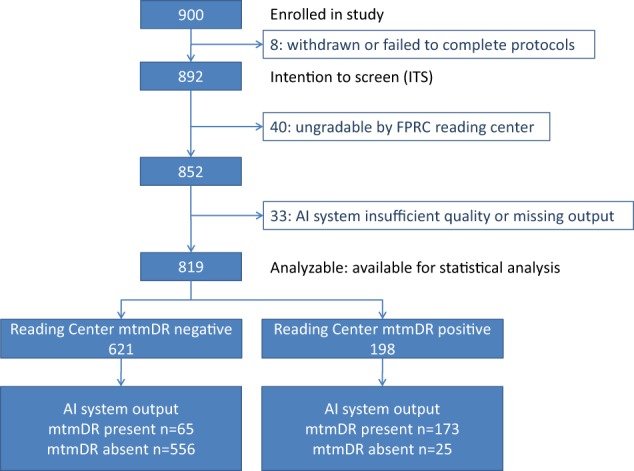
Artificial Intelligence (AI) has long promised to increase healthcare affordability, quality and accessibility but FDA, until recently, had never authorized an autonomous AI diagnostic system. This pivotal trial of an AI system to detect diabetic retinopathy (DR) in people with diabetes enrolled 900 subjects, with no history of DR at primary care clinics, by comparing to Wisconsin Fundus Photograph Reading Center (FPRC) widefield stereoscopic photography and macular Optical Coherence Tomography (OCT), by FPRC certified photographers, and FPRC grading of Early Treatment Diabetic Retinopathy Study Severity Scale (ETDRS) and Diabetic Macular Edema (DME). More than mild DR (mtmDR) was defined as ETDRS level 35 or higher, and/or DME, in at least one eye. AI system operators underwent a standardized training protocol before study start. Median age was 59 years (range, 22–84 years); among participants, 47.5% of participants were male; 16.1% were Hispanic, 83.3% not Hispanic; 28.6% African American and 63.4% were not; 198 (23.8%) had mtmDR. The AI system exceeded all pre-specified superiority endpoints at sensitivity of 87.2% (95% CI, 81.8–91.2%) (>85%), specificity of 90.7% (95% CI, 88.3–92.7%) (>82.5%), and imageability rate of 96.1% (95% CI, 94.6–97.3%), demonstrating AI’s ability to bring specialty-level diagnostics to primary care settings. Based on these results, FDA authorized the system for use by health care providers to detect more than mild DR and diabetic macular edema, making it, the first FDA authorized autonomous AI diagnostic system in any field of medicine, with the potential to help prevent vision loss in thousands of people with diabetes annually. ClinicalTrials.gov NCT02963441
Overview
The claims and statistics of this paper haven’t been checked yet.
Free: it reads the open-access text and checks the first 5 claims that cite a source we can check. Create a free account to check every claim.
Integrity signals
Registry
Cites
Statistics
Figures
Verification
Claims the paper makes
The claims and statistics of this paper haven’t been checked yet.
Free: it reads the open-access text and checks the first 5 claims that cite a source we can check. Create a free account to check every claim.
Claims other papers make about this one
Each is checked against this paper’s own text: does it say what the citing paper says it does?
The cited source doesn’t support the claim as written.
In the citing paper
“The regulatory approval of the first diagnostic autonomous AI system for diabetic eye exams was based on a pivotal trial against a prognostic standard, i.e., patient outcome24, showing its safety, efficacy, and lack of racial and ethnic bias for diagnosing DED in adults with diabetes with 87% sensitivity and 91% specificity24.”
From Autonomous artificial intelligence increases screening and follow-up for diabetic retinopathy in youth: the ACCESS randomized control trial (2024) · cites this paper as [24]
Checked by a reasoning model — may be wrong.
Experimental — accuracy not yet measuredThe source backs part of the claim, not all of it — or backs it for a different population, condition or comparison.
In the citing paper
“Only eight studies in ophthalmology imaging14,21,32,33,43,55,108,109, ten studies in respiratory imaging64,66,70,72,75,79,82,87,89,110 and six studies in breast imaging62,91,97,104,106,111 mentioned adherence to the STARD-2015 guidelines or had a STARD flow diagram in the manuscript.”
From Diagnostic accuracy of deep learning in medical imaging: a systematic review and meta-analysis (2021) · cites this paper as [14]
Experimental — accuracy not yet measuredThe source backs part of the claim, not all of it — or backs it for a different population, condition or comparison.
In the citing paper
“These systems use large annotated datasets to learn hierarchical features directly from images, improving reproducibility and reducing reliance on manual feature engineering [27,34].”
From Artificial Intelligence in Clinical Decision-Making: A Comprehensive Review of Diagnostic, Prognostic, and Therapeutic Applications, Validation Gaps, Bias, and Deployment Challenges (2026) · cites this paper as [27]
Experimental — accuracy not yet measuredThe source backs part of the claim, not all of it — or backs it for a different population, condition or comparison.
In the citing paper
“In clinical workflows, AI supports triage prioritisation, second-opinion review, and reduction of diagnostic variability in high-volume settings [15,27].”
From Artificial Intelligence in Clinical Decision-Making: A Comprehensive Review of Diagnostic, Prognostic, and Therapeutic Applications, Validation Gaps, Bias, and Deployment Challenges (2026) · cites this paper as [27]
Experimental — accuracy not yet measuredThe source backs part of the claim, not all of it — or backs it for a different population, condition or comparison.
In the citing paper
“Adoption in clinical practice is influenced by clinician interaction with AI systems, including trust and workflow compatibility [23,27].”
From Artificial Intelligence in Clinical Decision-Making: A Comprehensive Review of Diagnostic, Prognostic, and Therapeutic Applications, Validation Gaps, Bias, and Deployment Challenges (2026) · cites this paper as [27]
Experimental — accuracy not yet measured
18 more claims about this paper
Create a free account to see every claim other papers make about this one.
Self-check
Percentages, sums and reported differences re-computed from the paper’s own numbers.
The self-check needs the paper’s full text.
Citations
Cites
ImageNet classification with deep convolutional neural networks
Krizhevsky, A., Sutskever, I., & Hinton, G. E. (2017) · Communications of the ACM · doi:10.1145/3065386 · Cited by 112,155
Diagnosis and Classification of Diabetes Mellitus
American Diabetes Association (2011) · Diabetes Care · doi:10.2337/dc11-s062 · Cited by 13,988
Gulshan, V., Peng, L., Coram, M., Stumpe, M. C., Wu, D., Narayanaswamy, A., Venugopalan, S., Widner, K., Madams, T., Cuadros, J., et al. (2016) · JAMA · doi:10.1001/jama.2016.17216 · Cited by 7,697
Centers for Disease Control and Prevention
(2007) · Encyclopedia of Measurement and Statistics · doi:10.4135/9781412952644.n74 · Cited by 6,444
Diagnosis and classification of diabetes mellitus
American Diabetes Association (2014) · Diabetes Care · doi:10.2337/dc14-s081 · Cited by 5,974
(2007) · Developments in Ophthalmology · doi:10.1159/isbn.978-3-318-01439-6 · Cited by 5,583
Bias reduction of maximum likelihood estimates
FIRTH, D. (1993) · Biometrika · doi:10.1093/biomet/80.1.27 · Cited by 5,035
Wilkinson, C. P., Ferris, F. L., Klein, R. E., Lee, P. P., Agardh, C. D., Davis, M., Dills, D., Kampik, A., Pararajasegaram, R., & Verdaguer, J. T. (2003) · Ophthalmology · doi:10.1016/s0161-6420(03)00475-5 · Cited by 3,743
Classification and Diagnosis of Diabetes
Fajans, S. S. (1990) · Medical Entomology and Zoology · Cited by 2,359
Research works printed but not linked: 1
- Centers for Disease Control and Prevention. Diabetes Report Card 2012 2012 Atlanta, GA U.S. Department of Health and Human Services
Cited by
Items 401–500 of 1,004
Retinal imaging and Alzheimer’s disease: a future powered by Artificial Intelligence
Ashayeri, H., Jafarizadeh, A., Yousefi, M., Farhadi, F., & Javadzadeh, A. (2024) · Graefe s Archive for Clinical and Experimental Ophthalmology · doi:10.1007/s00417-024-06394-0 · Cited by 39
“Food and Drug Administration (FDA) has recently approved use of an AI-based technology called IDx-DR to detect diabetic retinopathy [9].”
Artificial Intelligence in Ophthalmology: Advantages and Limits
Costin, H. N., Fira, M., & Goraş, L. (2025) · Applied Sciences · doi:10.3390/app15041913 · Cited by 40
Diabetic retinopathy: a comprehensive review of pathophysiology and emerging treatments
Shyam, M., Sidharth, S., Veronica, A., Jagannathan, L., Srirangan, P., Vidya, R., & Prince, S. E. (2025) · Molecular Biology Reports · doi:10.1007/s11033-025-10490-7 · Cited by 39
“Among these innovations, IDx-DR is distinguished as the inaugural FDA-sanctioned autonomous AI system, proficient in identifying more-than-mild DR without necessitating specialist interpretation, thereby presenting an efficient alternative for primary care environments [116].”
Artificial intelligence in ophthalmology: opportunities, challenges, and ethical considerations
Kazemzadeh, K. (2025) · Medical Hypothesis Discovery & Innovation in Ophthalmology · doi:10.51329/mehdiophthal1517 · Cited by 40
“Similarly, IDx-DR (now LumineticsCore) has pioneered FDA-approved autonomous DR detection, although the current literature emphasizes the EyeArt system’s validation and superior performance across diverse populations and camera models [20, 22, 23].”
DeepUWF: An Automated Ultra-Wide-Field Fundus Screening System via Deep Learning
Zhang, W., Zhao, X., Chen, Y., Zhong, J., & Zhang, Y. (2020) · IEEE Journal of Biomedical and Health Informatics · doi:10.1109/jbhi.2020.3046771 · Cited by 39
H-ProSeg: Hybrid ultrasound prostate segmentation based on explainability-guided mathematical model
Peng, T., Wu, Y., Qin, J., Wu, Q. J., & Cai, J. (2022) · Computer Methods and Programs in Biomedicine · doi:10.1016/j.cmpb.2022.106752 · Cited by 39
Q-Pain: A Question Answering Dataset to Measure Social Bias in Pain ManagementPreprint
Logé, C., Ross, E., Dadey, D. Y. A., Jain, S., Saporta, A., Ng, A. Y., & Rajpurkar, P. (2021) · arXiv (Cornell University) · doi:10.13026/2tdv-hj07 · Cited by 39
Li, B., Chen, H., Yu, W., Zhang, M., Lü, F., Ma, J., Hao, Y., Li, X., Hu, B., Shen, L., et al. (2024) · npj Digital Medicine · doi:10.1038/s41746-023-00991-9 · Cited by 38
Sükei, E., Rumetshofer, E., Schmidinger, N., Mayr, A., Schmidt-Erfurth, U. M., Klambauer, G., & Bogunović, H. (2024) · Scientific Reports · doi:10.1038/s41598-024-78515-y · Cited by 38
Future and Development Direction of Digital Healthcare
Kim, H., Kwon, I. H., & Cha, W. C. (2021) · Healthcare Informatics Research · doi:10.4258/hir.2021.27.2.95 · Cited by 38
“In addition, significant results from several large-scale clinical studies (with more than 1,000 patients) conducted in many countries have shown that the device has a bright future [6,7].”
BackgroundPerformance of ChatGPT on the Chinese postgraduate examination for clinical medicine: survey study
Yu, P., Fang, C., Liu, X., Fu, W., Ling, J., Yan, Z., Jiang, Y., Cao, Z., Wu, M., Chen, Z., et al. (2024) · JMIR Medical Education · doi:10.2196/48514 · Cited by 37
Kamalipour, A., Moghimi, S., Khosravi, P., Mohammadzadeh, V., Nishida, T., Micheletti, E., Wu, J., Mahmoudinezhad, G., Li, E. H. F., Christopher, M. A., et al. (2022) · American Journal of Ophthalmology · doi:10.1016/j.ajo.2022.10.016 · Cited by 38
Rodríguez-Pérez, J., Andreu-Martínez, R., Daza, R., Fernández-Arroyo, L., Hernández-García, A., Díaz‐García, E., Cubillos‐Zapata, C., Lozano-Díez, A., Morales, A., Ramos, D., et al. (2025) · Antioxidants · doi:10.3390/antiox14070839 · Cited by 38
“Recent DL advances have enabled models like CNNs, RNNs, and transformers to achieve expert-level performance in clinical tasks [296–301], with some gaining regulatory approval [296].”
Tseng, R. M. W. W., Gunasekeran, D. V., Tan, S. S. H., Rim, T. H., Lum, E., Tan, G. S. W., Wong, T. Y., & Tham, Y. C. (2021) · Asia-Pacific Journal of Ophthalmology · doi:10.1097/apo.0000000000000400 · Cited by 37
Automated diabetic retinopathy screening for primary care settings using deep learning
Bhuiyan, A., Govindaiah, A., Deobhakta, A. A., Hossain, M., Rosen, R. B., & Smith, T. (2021) · Intelligence-Based Medicine · doi:10.1016/j.ibmed.2021.100045 · Cited by 37
Challenges for ocular disease identification in the era of artificial intelligence
Gour, N., Tanveer, M., & Khanna, P. (2022) · Neural Computing and Applications · doi:10.1007/s00521-021-06770-5 · Cited by 37
“Healthvisors made available a diagnostic support algorithm for automated early diagnosis of diabetic retinopathy in early stages of pathology [134].”
MethodMüller, S., Wintergerst, M. W. M., Falahat, P., Holz, F. G., Schaefer, C. A., Schahab, N., Finger, R. P., & Schultz, T. (2022) · Scientific Reports · doi:10.1038/s41598-022-05169-z · Cited by 37
Zhelev, Z., Peters, J., Rogers, M., Allen, M. J., Kijauskaite, G., Seedat, F., Wilkinson, E. C., & Hyde, C. (2023) · Journal of Medical Screening · doi:10.1177/09691413221144382 · Cited by 39
Muntean, G. A., Marginean, A. N., Groza, A. P., Damian, I., Roman, S. A., Hapca, M. C., Muntean, M. V., & Nicoară, S. (2023) · Diagnostics · doi:10.3390/diagnostics13142464 · Cited by 37
Machine learning predictive outcomes modeling in inflammatory bowel diseases
Javaid, A., Shahab, O., Adorno, W., Fernandes, P., May, E., & Syed, S. (2022) · Inflammatory Bowel Diseases · doi:10.1093/ibd/izab187 · Cited by 36
(2022) · doi:10.1145/3491102.3501868 · Cited by 36
“AI systems are helping with early detection and diagnosis [1, 9, 101], drug discovery [16], as well as outcome prediction and prognosis evaluation [38, 94].”
BackgroundSkevas, C., de Olaguer, N. P., Lleó, A., Thiwa, D., Schroeter, U., Lopes, I. V., Mautone, L., Linke, S. J., Spitzer, M. S., Yap, D., et al. (2024) · BMC Ophthalmology · doi:10.1186/s12886-024-03306-y · Cited by 36
“Subsequent studies by Abràmoff et al. (2018), Ting et al. (2017), and Gargeya and Leng (2017) demonstrated similar performance [1–4].”
ResultDoğan, M. E., Bilgin, A. B., Sarı, R., Akar, Y., Bulut, M., Aydemir, M., & Karaçorlu, M. (2024) · Eye · doi:10.1038/s41433-024-03000-9 · Cited by 37
“[6]).”
InfluentialSubbaswamy, A., Sahiner, B., Petrick, N., Pai, V. M., Adams, R., Diamond, M. C., & Saria, S. (2024) · npj Digital Medicine · doi:10.1038/s41746-024-01275-6 · Cited by 36
Evaluation and Regulation of Artificial Intelligence Medical Devices for Clinical Decision Support
Weissman, G. E. (2025) · Annual Review of Biomedical Data Science · doi:10.1146/annurev-biodatasci-103123-095824 · Cited by 38
Transforming Speech-Language Pathology with AI: Opportunities, Challenges, and Ethical Guidelines
Georgiou, G. P. (2025) · Healthcare · doi:10.3390/healthcare13192460 · Cited by 38
“A concrete validation precedent comes from ophthalmology: a pivotal, prospective trial of an autonomous diagnostic system met pre-specified endpoints in primary care, illustrating the level of evidence appropriate for high-impact AI [57].”
Nesper, P. L., Ong, J. X., & Fawzi, A. A. (2022) · Ophthalmology Retina · doi:10.1016/j.oret.2022.05.028 · Cited by 36
Diabetic retinopathy detection by optimized deep learning model
Rachapudi, V., Rao, K. S., Rao, T. S. M., Dileep, P., & Roy, T. L. D. (2023) · Multimedia Tools and Applications · doi:10.1007/s11042-023-14606-8 · Cited by 36
“Further, the computer visionbased models are categorized into end-to-end learning [15, 30] and hand-on engineering [1, 33, 41].”
MethodLiu, C., Amodio, M., Shen, L. L., Gao, F., Avesta, A., Aneja, S., Wang, J. C., Priore, L. V. D., & Krishnaswamy, S. (2024) · Lecture notes in computer science · doi:10.1007/978-3-031-72111-3_15 · Cited by 36
“Second, supervised networks trained on one set of annotated images can fail to generalize to similar images collected in very slightly different contexts, such as in different patient populations or on different devices [15].”
BackgroundLoo, J., Clemons, T. E., Chew, E. Y., Friedlander, M., Jaffe, G. J., & Farsiu, S. (2019) · Ophthalmology · doi:10.1016/j.ophtha.2019.12.015 · Cited by 36
Accelerating ophthalmic artificial intelligence research: the role of an open access data repository
Kras, A., Celi, L. A., & Miller, J. B. (2020) · Current Opinion in Ophthalmology · doi:10.1097/icu.0000000000000678 · Cited by 35
“j Coralville, IA, USA, which pioneered the first-ever algorithmic FDA-approved software in 2018 [14].”
BackgroundShould AI allocate livers for transplant? Public attitudes and ethical considerations
Drezga‐Kleiminger, M., Demaree‐Cotton, J., Koplin, J. J., Savulescu, J., & Wilkinson, D. J. C. (2023) · BMC Medical Ethics · doi:10.1186/s12910-023-00983-0 · Cited by 36
“AI can now diagnose certain medical conditions equally (or more) accurately than specialist doctors [9–11].”
BackgroundHeld, L. A., Wewetzer, L., & Steinhäuser, J. (2022) · Health Informatics Journal · doi:10.1177/14604582221112816 · Cited by 34
Application of artificial intelligence in laryngeal lesions: a systematic review and meta-analysis
Marrero‐Gonzalez, A. R., Diemer, T. J., Nguyen, S. A., Camilon, T. J. M., Meenan, K. D., & O’Rourke, A. K. (2024) · European Archives of Oto-Rhino-Laryngology · doi:10.1007/s00405-024-09075-0 · Cited by 34
“Additionally, AI systems for diabetic retinopathy have demonstrated high sensitivity and specificity, making them effective in primary care settings, leading to the authorization of such a system for widespread use [15].”
Lee, A., Lee, C. S., Blazes, M. S., Owen, J. P., Bagdasarova, Y., Wu, Y., Spaide, T. C., Yanagihara, R. T., Kihara, Y., Clark, M. E., et al. (2020) · Translational Vision Science & Technology · doi:10.1167/tvst.9.2.62 · Cited by 34
“Unlike automated diagnostic machine learning models, 24–28 which are trained using hand-labeled data to detect known findings, supervised deep learning models can also be trained to identify image characteristics that correspond to a known measurement in a previously unrecognized way.”
Tang, J. N., Yuan, M., Tian, K., Wang, Y., Wang, D., Yang, J., Yang, Z., He, X., Luo, Y., Li, Y., et al. (2022) · Translational Vision Science & Technology · doi:10.1167/tvst.11.6.16 · Cited by 34
Artificial intelligence in ophthalmology: A multidisciplinary approach
Ahuja, A. S., Wagner, I. V., Dorairaj, S. K., Checo, L. A., & Hulzen, R. D. T. (2022) · Integrative Medicine Research · doi:10.1016/j.imr.2022.100888 · Cited by 35
Non-Melanoma Skin Cancer Detection in the Age of Advanced Technology: A Review
Stafford, H. D., Buell, J. B., Chiang, E., Ramesh, U. R., Migden, M. R., Nagarajan, P., Amit, M., & Yaniv, D. (2023) · Cancers · doi:10.3390/cancers15123094 · Cited by 35
Autonomous artificial intelligence in diabetic retinopathy: From algorithm to clinical application
Channa, R., Wolf, R., & Abramoff, M. D. (2021) · Journal of Diabetes Science and Technology · doi:10.1177/1932296820909900 · Cited by 33
“8 For diagnostic imaging, an important variable to assess is “diag-nosability” or “imageability.””
BackgroundResultSelf-citationGrzybowski, A., Rao, D. P., Brona, P., Negiloni, K., Krzywicki, T., & Savoy, F. M. (2023) · Ophthalmic Research · doi:10.1159/000534098 · Cited by 33
“Previous studies have shown that inter-grader kappa scores typically range from 0.40 to 0.65 in DR grading [13 – 19].”
BackgroundResultInfluentialRevolutionizing Diabetic Retinopathy Screening: Integrating AI-Based Retinal Imaging in Primary Care
Beals, D., Simon, L., Rogers, F., & Pogroszewski, S. (2025) · Journal of CME · doi:10.1080/28338073.2024.2437294 · Cited by 33
Will AI Replace Physicians in the Near Future? AI Adoption Barriers in Medicine
Obuchowicz, R., Piórkowski, A., Nurzynska, K., Obuchowicz, B., Strzelecki, M., & Bielecka, M. (2026) · Diagnostics · doi:10.3390/diagnostics16030396 · Cited by 28
“Autonomous systems, such as the FDA-cleared IDx-DR for diabetic retinopathy screening, have also improved screening rates in primary care, suggesting that AI can enhance access and satisfaction when applied within appropriate regulatory frameworks [126].”
Progress of artificial intelligence in diabetic retinopathy screening
Wang, Y., Yang, J., Yang, J., Zhao, X., Chen, Y., & Yu, W. (2020) · Diabetes/Metabolism Research and Reviews · doi:10.1002/dmrr.3414 · Cited by 34
“In 2018, Abramoff et al.(67) tested their AI systems in a group of 900 patients at 10 study sites for the automated detection of DR and diabetic macular edema, termed mtmDR.”
BackgroundInfluentialChiara, F. D., Ferret-Miñana, A., & Ramón‐Azcón, J. (2021) · Biomedicines · doi:10.3390/biomedicines9030248 · Cited by 33
“The three most common approaches used are unsupervised, supervised, and reinforced learning [92].”
BackgroundDeep Learning Based Analysis of Ophthalmology: A Systematic Review
Kumar, P., Kumar, R., & Gupta, M. (2021) · EAI Endorsed Transactions on Pervasive Health and Technology · doi:10.4108/eai.10-9-2021.170950 · Cited by 34
“[56] 2018 DR Alex Net / VGG Net USA x 87.”
BackgroundTelemedicine in diabetic retinopathy screening in India
Ramasamy, K., Mishra, C., Kannan, N. B., Namperumalsamy, P., & Sen, S. (2021) · Indian Journal of Ophthalmology · doi:10.4103/ijo.ijo_1442_21 · Cited by 33
“Although the modified Airlie house 30° seven-field CFP, encompassing a 75° fundus viewing angle is the gold standard of fundus imaging for the detection of DR, it is practically not possible for screening purposes, because it is laborious, time consuming, and needs a trained photographer.”
MethodInfluentialPalermo, B. J., D'Amico, S., Kim, B. Y., & Brady, C. J. (2021) · Survey of Ophthalmology · doi:10.1016/j.survophthal.2021.11.006 · Cited by 33
Novel technical and privacy-preserving technology for artificial intelligence in ophthalmology
Lim, J. S., Hong, M., Lam, W. S. T., Zhang, Z., Teo, Z. L., Liu, Y., Ng, W. Y., Foo, L. L., & Ting, D. S. W. (2022) · Current Opinion in Ophthalmology · doi:10.1097/icu.0000000000000846 · Cited by 33
Deep learning-based smart speaker to confirm surgical sites for cataract surgeries: A pilot study
Yoo, T. K., Oh, E., Kim, H. K., Ryu, I. H., Lee, I. S., Kim, J. S., & Kim, J. K. (2020) · PLoS ONE · doi:10.1371/journal.pone.0231322 · Cited by 33
“These contributions are not limited to research as deep learning techniques and highly efficient hardware are being introduced in clinics as well [9].”
BackgroundUrsin, F., Timmermann, C., Orzechowski, M., & Steger, F. (2021) · Frontiers in Medicine · doi:10.3389/fmed.2021.695217 · Cited by 32
“The system, called IDx-DR, runs on a retinal camera (Topcon NW400) and analyzes images of the eye utilizing an AI algorithm (6).”
BackgroundMethodInfluentialAbramoff, M. D., Dai, T., & Zou, J. (2024) · NEJM AI · doi:10.1056/aipc2400083 · Cited by 32
Self-citationRao, D. P., Shroff, S., Savoy, F. M., Shruthi, S., Hsu, C., Negiloni, K., Pradhan, Z. S., Jayasree, P. V., Sivaraman, A., & Rao, H. L. (2023) · Eye · doi:10.1038/s41433-023-02826-z · Cited by 32
“Additionally, the AI image quality algorithm was evaluated by image-ability, defined as the percentage of images determined as sufficient quality by the AI within the subset of images deemed sufficient by the graders [18].”
BackgroundMethodRiotto, E., Gasser, S., Potić, J., Sherif, M. M., Stappler, T., Schlingemann, R. O., Wolfensberger, T. J., & Konstantinidis, L. (2024) · Journal of Clinical Medicine · doi:10.3390/jcm13164776 · Cited by 32
Chitoran, E., Rotaru, V., Gelal, A., Ionescu, S. O., Gullo, G., Stefan, D. C., & Simion, L. (2025) · Diagnostics · doi:10.3390/diagnostics15182391 · Cited by 34
The Validation of Deep Learning-Based Grading Model for Diabetic Retinopathy
Zhang, W.-F., Li, D., Wei, Q., Ding, D., Meng, L., Wang, Y., Zhao, X., & Chen, Y. (2022) · Frontiers in Medicine · doi:10.3389/fmed.2022.839088 · Cited by 33
“(10) AlexNet/VGGNet Messidor-2 10 primary care practice sites from the United States NA 87 91 mtmDR”
BackgroundMethodPornvoraphat, P., Tiankanon, K., Pittayanon, R., Sunthornwetchapong, P., Vateekul, P., & Rerknimitr, R. (2023) · Computers in Biology and Medicine · doi:10.1016/j.compbiomed.2023.106582 · Cited by 32
The future application of artificial intelligence and telemedicine in the retina: A perspective
Wu, C.-T., Lin, T., Lin, C.-J., & Hwang, D. (2023) · Taiwan Journal of Ophthalmology · doi:10.4103/tjo.tjo-d-23-00028 · Cited by 32
“[33] In addition to the screening of DR, AI can be trained to grade DR, having the potential to offer the prognosis and treatment recommendations.”
BackgroundThe Role of Artificial Intelligence in Endoscopic Ultrasound for Pancreatic Disorders
Tonozuka, R., Mukai, S., & Itoi, T. (2020) · Diagnostics · doi:10.3390/diagnostics11010018 · Cited by 32
“The implementation of artificial intelligence (AI) for image analysis has been studied in various disorders, some of which have already been used in clinical practice [5,6].”
BackgroundAbdalla, M. M. I., & Mohanraj, J. (2024) · World Journal of Clinical Cases · doi:10.12998/wjcc.v13.i5.101306 · Cited by 32
Martelli, E., Capoccia, L., Francesco, M. D., Cavallo, E., Pezzulla, M. G., Giudice, G., Bauleo, A., Coppola, G., & Panagrosso, M. (2024) · Biomimetics · doi:10.3390/biomimetics9080465 · Cited by 31
An, S., Teo, K. Y. C., McConnell, M. V., Marshall, J., Galloway, C., & Squirrell, D. (2025) · Progress in Retinal and Eye Research · doi:10.1016/j.preteyeres.2025.101352 · Cited by 32
Embodied artificial intelligence in ophthalmology
Qiu, Y., Chen, X., Wu, X., Li, Y., Xu, P., Jin, K., Shang, X., Chotcomwongse, P., He, M., & Shi, D. (2025) · npj Digital Medicine · doi:10.1038/s41746-025-01754-4 · Cited by 31
Software as Medical Devices: requirements and regulatory landscape in the United States
Shah, S. A., Thakor, P., Shah, A., & Singh, O. V. (2025) · Expert Review of Medical Devices · doi:10.1080/17434440.2025.2561918 · Cited by 32
“This clearance illustrated how the principles of bias auditing and dataset diversity can be operationalized to support equitable clinical performance of SaMD [29].”
Jacoba, C. M. P., Celi, L. A., & Silva, P. S. (2021) · Seminars in Ophthalmology · doi:10.1080/08820538.2021.1893351 · Cited by 31
Yin, H., Yang, X., Sun, L., Pan, P., Peng, L., Li, K., Zhang, D., Cui, F., Xia, C., Huang, H., et al. (2022) · Endoscopic Ultrasound · doi:10.4103/eus-d-21-00131 · Cited by 31
“[12,13] More advanced AI is already being used in the field of gastrointestinal endoscopy, including the detection of colon polyps.”
BackgroundDong, X., Du, S., Zheng, W., Cai, C., Liu, H., & Zou, J. (2022) · Frontiers in Medicine · doi:10.3389/fmed.2022.883462 · Cited by 31
“Moreover, these results can only be obtained from fundus photographs (13).”
Digital innovations for retinal care in diabetic retinopathy
Vujosevic, S., Limoli, C., Luzi, L., & Nucci, P. (2022) · Acta Diabetologica · doi:10.1007/s00592-022-01941-9 · Cited by 32
“The recent introduction of DL-based AI to this process has undeniable potential in staging/classifying DR on retinal images, as recognized by the international regulatory agencies [25] and is expected to improve the current disease management process.”
BackgroundInfluentialSmartphone Eye Examination: Artificial Intelligence and Telemedicine
Vilela, M. A. P., Arrigo, A., Parodi, M. B., & Mengue, C. D. S. (2024) · Telemedicine Journal and e-Health · doi:10.1089/tmj.2023.0041 · Cited by 32
“109 Ting et al 70 Refractive errors.”
Achievements and Challenges in Explaining Deep Learning based Computer-Aided Diagnosis SystemsPreprint
Lucieri, A., Bajwa, M. N., Dengel, A. R., & Ahmed, S. (2020) · arXiv (Cornell University) · doi:10.48550/arxiv.2011.13169 · Cited by 31
“Shortly afterwards, early comparative studies reported the superiority of such self-learning algorithms over human experts in fields such as dermatology [7, 8], ophthalmology [9, 10] and radiology [11].”
BackgroundAutomated and computer-assisted detection, classification, and diagnosis of diabetic retinopathy
Abràmoff, M. D., Leng, T., Ting, D. S. W., Rhee, K., Horton, M. B., Brady, C. J., & Chiang, M. F. (2020) · Telemedicine and e-Health · doi:10.1089/tmj.2020.0008 · Cited by 30
“15,26 DR AI SYSTEM DESIGN DR AI system design has changed considerably over the past 10 years, and significant continued evolution is expected; therefore, any characterization of design must be descriptive to avoid rapid obsolescence.”
BackgroundSelf-citation(2022) · doi:10.1186/s12909-022-03272-3 · Cited by 30
Implementation of Machine Learning Pipelines for Clinical Practice: Development and Validation Study
Kanbar, L. J., Wissel, B., Ni, Y., Pajor, N., Glauser, T., Pestian, J., & Dexheimer, J. W. (2022) · JMIR Medical Informatics · doi:10.2196/37833 · Cited by 30
“CDS tools using AI and NLP technologies remain less implementable directly into real-time clinical care with long-term success [31-34].”
MethodRao, D. P., Savoy, F. M., Tan, J. Z. E., Fung, B., Bopitiya, C. M., Sivaraman, A., & Vinekar, A. S. (2023) · Frontiers in Pediatrics · doi:10.3389/fped.2023.1197237 · Cited by 32
AI-assisted ophthalmic imaging for early detection of neurodegenerative diseases
Tukur, H. N., Uwishema, O., Akbay, H., Sheikhah, D., & Correia, I. F. S. (2025) · International Journal of Emergency Medicine · doi:10.1186/s12245-025-00870-y · Cited by 30
“AI algorithms trained on non-diverse datasets may not generalize well to under-represented populations, potentially overlooking disease variations linked to ethnicity, age, or coexisting ocular conditions such as glaucoma or diabetic retinopathy [35].”
Brigell, M., Chiang, B., Maa, A. Y., & Davis, C. Q. (2020) · Translational Vision Science & Technology · doi:10.1167/tvst.9.9.40 · Cited by 30
Li, H., Wang, D.-X., Dong, L., & Wei, W. (2022) · European Journal of Ophthalmology · doi:10.1177/11206721221094786 · Cited by 30
Artificial Intelligence and Deep Learning in Ophthalmology
Wang, Z., Keane, P. A., Chiang, M. F., Cheung, C. Y.-L., Wong, T. Y., & Ting, D. S. W. (2021) · Springer eBooks · doi:10.1007/978-3-030-58080-3_200-1 · Cited by 32
Liu, L., Wu, X., Lin, D., Zhao, L., Li, M., Yun, D., Lin, Z., Pang, J., Li, L., Wu, Y., et al. (2023) · Cell Reports Medicine · doi:10.1016/j.xcrm.2022.100912 · Cited by 31
Alam, M. N., Yamashita, R., Ramesh, V., Prabhune, T., Lim, J. I., Chan, R. V. P., Hallak, J., Leng, T., & Rubin, D. L. (2023) · Scientific Reports · doi:10.1038/s41598-023-33365-y · Cited by 30
Diabetes more than retinopathy, it’s effect on the anterior segment of eye
Morya, A. K., Ramesh, P. V., Kaur, K., Gurnani, B., Heda, A., Bhatia, K., & Sinha, A. (2023) · World Journal of Clinical Cases · doi:10.12998/wjcc.v11.i16.3736 · Cited by 30
Detection of central serous retinopathy using deep learning through retinal images
Hassan, S. A., Akbar, S., & Khan, H. U. (2023) · Multimedia Tools and Applications · doi:10.1007/s11042-023-16206-y · Cited by 30
Artificial intelligence in the management of metabolic disorders: a comprehensive review
Anwar, A., Rana, S., & Pathak, P. (2025) · Journal of Endocrinological Investigation · doi:10.1007/s40618-025-02548-x · Cited by 30
“These AI tools enhance screening efficiency and reduce the workload for ophthalmologists [54, 55].”
Artificial Intelligence to Diagnose Complications of Diabetes
Ayers, A. T., Ho, C., Kerr, D. E., Cichosz, S. L., Mathioudakis, N. N., Wang, M., Najafi, B., Moon, S. J., Pandey, A., & Klonoff, D. C. (2024) · Journal of Diabetes Science and Technology · doi:10.1177/19322968241287773 · Cited by 30
Artificial Intelligence Improves Patient Follow-Up in a Diabetic Retinopathy Screening Program
Dow, E. R., Chen, K. M., Zhao, C., Knapp, A., Phadke, A., Weng, K., Do, D. V., Mahajan, V. B., Mruthyunjaya, P., Leng, T., et al. (2023) · Clinical Ophthalmology · doi:10.2147/opth.s422513 · Cited by 29
Incorporating Artificial Intelligence into Healthcare Workflows: Models and Insights
Dai, T., & Abràmoff, M. D. (2023) · Tutorials in Operations Research: Advancing the Frontiers of OR/MS: From Methodologies to Applications · doi:10.1287/educ.2023.0257 · Cited by 29
Self-citationRodríguez, A., Arruabarrena, C., Allendes, G., Olivera, M., Zarranz‐Ventura, J., & Teus, M. A. (2024) · Scientific Reports · doi:10.1038/s41598-024-68489-2 · Cited by 29
“Otherwise, when transported to real-world datasets, much more realistic results have been reported 13,14,24–26 .”
BackgroundChu, A., Squirrell, D., Phillips, A. M., & Vaghefi, E. (2020) · Journal of Ophthalmology · doi:10.1155/2020/8841927 · Cited by 30
The Fairness in Algorithmic Fairness
Holm, S. (2022) · Res Publica · doi:10.1007/s11158-022-09546-3 · Cited by 29
“For full details of the pivotal trial see Abràmoff et al. (2018).”
BackgroundRuan, S., Hu, W., Jia, H., Wang, S., Song, M.-L., Shen, M.-X., Luo, D., Ye, T., & Wang, F. (2022) · International Journal of Ophthalmology · doi:10.18240/ijo.2022.04.16 · Cited by 29
Zhao, J., Lu, Y., Zhu, S., Li, K., Jiang, Q., & Yang, W. (2022) · Frontiers in Pharmacology · doi:10.3389/fphar.2022.930520 · Cited by 31
Yang, Y., Pan, J., Yuan, M., Lai, K., Xie, H., Ma, L., Xu, S., Deng, R., Zhao, M., Luo, Y., et al. (2022) · Annals of Translational Medicine · doi:10.21037/atm-22-350 · Cited by 29
“The AI-based IDx-DR was first approved for automated DR screening by the US Food and Drug Administration (FDA); however, it could only be applied to fundus photographs captured using the Topcon NW400 camera at that time (24).”
Can Artificial Intelligence Make Screening Faster, More Accurate, and More Accessible?
Li, Z., Keel, S. P., & He, M. (2019) · Asia-Pacific Journal of Ophthalmology · doi:10.22608/apo.2018438 · Cited by 29
Hainsworth, D. P., Gangula, A., Ghoshdastidar, S., Kannan, R., & Upendran, A. (2020) · American Journal of Ophthalmology · doi:10.1016/j.ajo.2020.01.032 · Cited by 29
Application of telemedicine in COVID-19: a bibliometric analysis
Lan, X., Yu, H., & Cui, L. (2022) · Frontiers in Public Health · doi:10.3389/fpubh.2022.908756 · Cited by 28
Wroblewski, J. J., Sánchez-Buenfil, E., Inciarte, M., Berdia, J., Blake, L. R., Wroblewski, S., Patti, A., Suter, G., & Sanborn, G. E. (2023) · Journal of Diabetes Science and Technology · doi:10.1177/19322968231194644 · Cited by 28
The evolution of diabetic retinopathy screening
Irodi, A., Zhu, Z., Grzybowski, A. E., Wu, Y.-L., Cheung, C. Y.-L., Li, H., Tan, G. S. W., & Wong, T. Y. (2025) · Eye · doi:10.1038/s41433-025-03633-4 · Cited by 28
“The system, IDx-DR, has been validated on data collected prospectively from primary care clinics within the US and abroad [44–46] and is the first autonomous AI to receive regulatory approval from the US Food and Drug Administration (FDA) for detecting severe DR in adults with diabetes [47].”
Tseng, V. S. M., Chen, C., Liang, C.-M., Tai, M., Liu, J.-T., Wu, P.-Y., Deng, M.-S., Lee, Y.-W., Huang, T., & Chen, Y.-H. (2020) · Translational Vision Science & Technology · doi:10.1167/tvst.9.2.41 · Cited by 29
Analysis of international publication trends in artificial intelligence in ophthalmology
Boudry, C., Hajj, H. A., Arnould, L., & Mouriaux, F. (2022) · Graefe s Archive for Clinical and Experimental Ophthalmology · doi:10.1007/s00417-021-05511-7 · Cited by 28
“Ultimately, some systems are approved by medical institutions, such as IDx [33], approved by the United States Food and Drug Administration and OphtAI, which is European Conform-ity marked.”
BackgroundShi, Y., Lu, W., & Zhou, Y. (2023) · Journal of Consumer Behaviour · doi:10.1002/cb.2283 · Cited by 29
Malerbi, F. K., Nakayama, L. F., Melo, G. B., Stuchi, J. A., Lencione, D., Prado, P. V. D. S., Ribeiro, L. Z., Dib, S. A., & Regatieri, C. V. (2024) · Ophthalmology Science · doi:10.1016/j.xops.2024.100481 · Cited by 28
“10 In our study, a good performance was achieved not only for mtmDR but also for the detection of any DR.”
Influential
Metadata
- Authors
- Abràmoff, M. D., Lavin, P. T., Birch, M., Shah, N., & Folk, J. C.
- Affiliations
- University of Iowa (US)
- University of North Carolina at Charlotte (US)
- Emmes (United States) (US)
- Corresponding author
- Abràmoff, Michael D.
- Venue
- npj Digital Medicine
- Published
- 2018-08-28
- Volume
- 1
- Issue
- 1
- Pages
- 39-39
- ISSN
- 2398-6352 (ISSN-L)
- PMC
- PMC6550188
- OpenAlex
- W2888424632
- Cited by
- 1,638
- References
- 61
- Citations by year
- 2026: 332 · 2025: 276 · 2024: 226 · 2023: 193 · 2022: 172 · 2021: 183 · 2020: 173 · 2019: 73 · 2018: 10
- FWCI
- 75.83
- Type
- journal article
- Language
- en
- Open access
- gold
- doi.org
- Licence
- cc-by
- creativecommons.org/licenses/by/4.0 (tdm)
- creativecommons.org/licenses/by/4.0 (vor)
- Locations
- npj Digital Medicine (publishedVersion, cc-by)
- Europe PMC (PubMed Central) (publishedVersion, cc-by)
- PubMed Central (publishedVersion, cc-by)
- PubMed (publishedVersion)
- DOAJ (DOAJ: Directory of Open Access Journals) (submittedVersion)
- Funders
- IDx LLC, Coralville, IA
- Topics
- Health Sciences › Medicine › Radiology, Nuclear Medicine and Imaging › Retinal Imaging and Analysis
- Health Sciences › Medicine › Ophthalmology › Retinal Diseases and Treatments
- Health Sciences › Medicine › Health Informatics › Artificial Intelligence in Healthcare and Education
- Keywords
- diabetic retinopathy, diabetic macular edema, autonomous AI systems, FDA approval, primary care, fundus photography, optical coherence tomography, sensitivity and specificity, imageability, blindness prevention, diabetes mellitus
About these checks
Registry, retraction, Cites and statistics results are computed, not judged, with one exception: a printed reference that no index lists is read once by a model before it counts as a citation error. Claims are extracted by a model and kept only when their quote appears verbatim in the text; each cited source is then checked, with a model’s help, for whether it says what the claim relies on. Those verdicts can be wrong — read the claim’s quote and the cited source before relying on one.
Statistics and arithmetic are recomputed, not judged.
Confidence bands are shown only for fields calibrated on our annotated test set. None is calibrated yet, so no band is shown.
What counts as a claim ›How we measure confidence ›How we check this ›
Are you an author, or do you see a problem with this page? Request a review
Data sources
Bibliographic data: Semantic Scholar, OpenAlex, Crossref.
Contains information from the Semantic Scholar Academic Graph Datasets, made available under the ODC Attribution License (ODC-BY 1.0).
Semantic Scholar’s data is described in: Kinney, R., et al. (2023). The Semantic Scholar Open Data Platform. arXiv:2301.10140.
