

Pivotal trial of an autonomous AI-based diagnostic system for detection of diabetic retinopathy in primary care offices
Open accessThe DOI matches its Crossref record; 62 of the 62 references it cites were found in a registry or an index.
Abstract
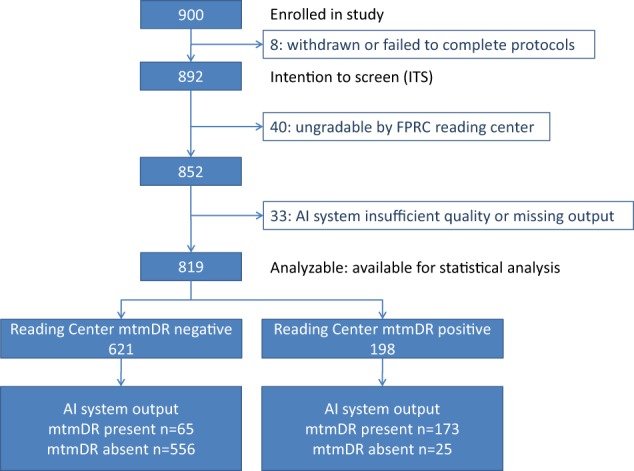
Artificial Intelligence (AI) has long promised to increase healthcare affordability, quality and accessibility but FDA, until recently, had never authorized an autonomous AI diagnostic system. This pivotal trial of an AI system to detect diabetic retinopathy (DR) in people with diabetes enrolled 900 subjects, with no history of DR at primary care clinics, by comparing to Wisconsin Fundus Photograph Reading Center (FPRC) widefield stereoscopic photography and macular Optical Coherence Tomography (OCT), by FPRC certified photographers, and FPRC grading of Early Treatment Diabetic Retinopathy Study Severity Scale (ETDRS) and Diabetic Macular Edema (DME). More than mild DR (mtmDR) was defined as ETDRS level 35 or higher, and/or DME, in at least one eye. AI system operators underwent a standardized training protocol before study start. Median age was 59 years (range, 22–84 years); among participants, 47.5% of participants were male; 16.1% were Hispanic, 83.3% not Hispanic; 28.6% African American and 63.4% were not; 198 (23.8%) had mtmDR. The AI system exceeded all pre-specified superiority endpoints at sensitivity of 87.2% (95% CI, 81.8–91.2%) (>85%), specificity of 90.7% (95% CI, 88.3–92.7%) (>82.5%), and imageability rate of 96.1% (95% CI, 94.6–97.3%), demonstrating AI’s ability to bring specialty-level diagnostics to primary care settings. Based on these results, FDA authorized the system for use by health care providers to detect more than mild DR and diabetic macular edema, making it, the first FDA authorized autonomous AI diagnostic system in any field of medicine, with the potential to help prevent vision loss in thousands of people with diabetes annually. ClinicalTrials.gov NCT02963441
Overview
The claims and statistics of this paper haven’t been checked yet.
Free: it reads the open-access text and checks the first 5 claims that cite a source we can check. Create a free account to check every claim.
Integrity signals
Registry
Cites
Statistics
Figures
Verification
Claims the paper makes
The claims and statistics of this paper haven’t been checked yet.
Free: it reads the open-access text and checks the first 5 claims that cite a source we can check. Create a free account to check every claim.
Claims other papers make about this one
Each is checked against this paper’s own text: does it say what the citing paper says it does?
The cited source doesn’t support the claim as written.
In the citing paper
“The regulatory approval of the first diagnostic autonomous AI system for diabetic eye exams was based on a pivotal trial against a prognostic standard, i.e., patient outcome24, showing its safety, efficacy, and lack of racial and ethnic bias for diagnosing DED in adults with diabetes with 87% sensitivity and 91% specificity24.”
From Autonomous artificial intelligence increases screening and follow-up for diabetic retinopathy in youth: the ACCESS randomized control trial (2024) · cites this paper as [24]
Checked by a reasoning model — may be wrong.
Experimental — accuracy not yet measuredThe source backs part of the claim, not all of it — or backs it for a different population, condition or comparison.
In the citing paper
“Only eight studies in ophthalmology imaging14,21,32,33,43,55,108,109, ten studies in respiratory imaging64,66,70,72,75,79,82,87,89,110 and six studies in breast imaging62,91,97,104,106,111 mentioned adherence to the STARD-2015 guidelines or had a STARD flow diagram in the manuscript.”
From Diagnostic accuracy of deep learning in medical imaging: a systematic review and meta-analysis (2021) · cites this paper as [14]
Experimental — accuracy not yet measuredThe source backs part of the claim, not all of it — or backs it for a different population, condition or comparison.
In the citing paper
“These systems use large annotated datasets to learn hierarchical features directly from images, improving reproducibility and reducing reliance on manual feature engineering [27,34].”
From Artificial Intelligence in Clinical Decision-Making: A Comprehensive Review of Diagnostic, Prognostic, and Therapeutic Applications, Validation Gaps, Bias, and Deployment Challenges (2026) · cites this paper as [27]
Experimental — accuracy not yet measuredThe source backs part of the claim, not all of it — or backs it for a different population, condition or comparison.
In the citing paper
“In clinical workflows, AI supports triage prioritisation, second-opinion review, and reduction of diagnostic variability in high-volume settings [15,27].”
From Artificial Intelligence in Clinical Decision-Making: A Comprehensive Review of Diagnostic, Prognostic, and Therapeutic Applications, Validation Gaps, Bias, and Deployment Challenges (2026) · cites this paper as [27]
Experimental — accuracy not yet measuredThe source backs part of the claim, not all of it — or backs it for a different population, condition or comparison.
In the citing paper
“Adoption in clinical practice is influenced by clinician interaction with AI systems, including trust and workflow compatibility [23,27].”
From Artificial Intelligence in Clinical Decision-Making: A Comprehensive Review of Diagnostic, Prognostic, and Therapeutic Applications, Validation Gaps, Bias, and Deployment Challenges (2026) · cites this paper as [27]
Experimental — accuracy not yet measured
18 more claims about this paper
Create a free account to see every claim other papers make about this one.
Self-check
Percentages, sums and reported differences re-computed from the paper’s own numbers.
The self-check needs the paper’s full text.
Citations
Cites
ImageNet classification with deep convolutional neural networks
Krizhevsky, A., Sutskever, I., & Hinton, G. E. (2017) · Communications of the ACM · doi:10.1145/3065386 · Cited by 112,155
Diagnosis and Classification of Diabetes Mellitus
American Diabetes Association (2011) · Diabetes Care · doi:10.2337/dc11-s062 · Cited by 13,988
Gulshan, V., Peng, L., Coram, M., Stumpe, M. C., Wu, D., Narayanaswamy, A., Venugopalan, S., Widner, K., Madams, T., Cuadros, J., et al. (2016) · JAMA · doi:10.1001/jama.2016.17216 · Cited by 7,697
Centers for Disease Control and Prevention
(2007) · Encyclopedia of Measurement and Statistics · doi:10.4135/9781412952644.n74 · Cited by 6,444
Diagnosis and classification of diabetes mellitus
American Diabetes Association (2014) · Diabetes Care · doi:10.2337/dc14-s081 · Cited by 5,974
(2007) · Developments in Ophthalmology · doi:10.1159/isbn.978-3-318-01439-6 · Cited by 5,583
Bias reduction of maximum likelihood estimates
FIRTH, D. (1993) · Biometrika · doi:10.1093/biomet/80.1.27 · Cited by 5,035
Wilkinson, C. P., Ferris, F. L., Klein, R. E., Lee, P. P., Agardh, C. D., Davis, M., Dills, D., Kampik, A., Pararajasegaram, R., & Verdaguer, J. T. (2003) · Ophthalmology · doi:10.1016/s0161-6420(03)00475-5 · Cited by 3,743
Classification and Diagnosis of Diabetes
Fajans, S. S. (1990) · Medical Entomology and Zoology · Cited by 2,359
Research works printed but not linked: 1
- Centers for Disease Control and Prevention. Diabetes Report Card 2012 2012 Atlanta, GA U.S. Department of Health and Human Services
Cited by
Items 301–400 of 1,004
Artificial Intelligence and Machine Learning in Endocrinology and Metabolism: The Dawn of a New Era
Gubbi, S., Hamet, P., Tremblay, J., Koch, C. A., & Hannah‐Shmouni, F. (2019) · Frontiers in Endocrinology · doi:10.3389/fendo.2019.00185 · Cited by 57
“A proprietary system IDx (Iowa City, IA) that uses ML technology to analyze retinal images in diabetic retinopathy had a sensitivity of 87% and specificity of 91% for autonomous detection of disease and received FDA approval in 2018 (12).”
Machine-Learning Implementation in Clinical Anesthesia: Opportunities and Challenges
Char, D. S., & Burgart, A. (2020) · Anesthesia & Analgesia · doi:10.1213/ane.0000000000004656 · Cited by 45
Wu, J., & Liu, T. Y. A. (2022) · Journal of Clinical Medicine · doi:10.3390/jcm12010152 · Cited by 57
Ethical Considerations in the Design and Conduct of Clinical Trials of Artificial Intelligence
Youssef, A., Nichol, A. A., Martinez‐Martin, N., Larson, D. B., Abràmoff, M. D., Wolf, R. M., & Char, D. S. (2024) · JAMA Network Open · doi:10.1001/jamanetworkopen.2024.32482 · Cited by 57
Self-citationGeneralization Performance of Deep Learning Models in Neurodegenerative Disease Classification
Yağış, E., de Herrera, A. G. S., & Citi, L. (2019) · IEEE International Conference on Bioinformatics and Biomedicine (BIBM) · doi:10.1109/bibm47256.2019.8983088 · Cited by 56
“lized machine learning (ML) algorithms for detection and diagnosis of PD [33]–[35].”
BackgroundZheng, B., Wu, M.-N., Zhu, S.-J., Zhou, H.-X., Hao, X.-L., Fei, F.-Q., Jia, Y., Wu, J., Yang, W.-H., & Pan, X.-P. (2021) · BMC Health Services Research · doi:10.1186/s12913-021-07044-5 · Cited by 54
Automated detection of severe diabetic retinopathy using deep learning method
Zhang, X., Li, F., Li, D., Wei, Q., Han, X., Zhang, B., Chen, H., Zhang, Y., Mo, B., Hu, B., et al. (2021) · Graefe s Archive for Clinical and Experimental Ophthalmology · doi:10.1007/s00417-021-05402-x · Cited by 55
Application of artificial intelligence in modern medicine
Xu, N., Yang, D., Arikawa, K., & Bai, C. (2023) · Clinical eHealth · doi:10.1016/j.ceh.2023.09.001 · Cited by 55
Artificial intelligence in ophthalmology
Patoni, S. I. P., Muşat, A. A. M., Patoni, C., Popescu, M.-N., Munteanu, M., Costache, I. B., Pîrvulescu, R. A., & Mușat, O. (2023) · Romanian Journal of Ophthalmology · doi:10.22336/rjo.2023.37 · Cited by 55
“This system uses one image centered on the optical disc and one on the macula for each eye for analysis and needs all four images to display a result [ 60,61 ].”
MethodAutomated OCT angiography image quality assessment using a deep learning algorithm
Lauermann, J. L., Treder, M., Alnawaiseh, M., Clemens, C. R., Eter, N., & Alten, F. (2019) · Graefe s Archive for Clinical and Experimental Ophthalmology · doi:10.1007/s00417-019-04338-7 · Cited by 55
Yip, M. Y. T., Lim, G., Lim, Z. W., Nguyen, Q. D., Chong, C. C. Y., Yu, M., Bellemo, V., Xie, Y., Lee, X. Q., Hamzah, H., et al. (2020) · npj Digital Medicine · doi:10.1038/s41746-020-0247-1 · Cited by 56
Multimodal foundation models exploit text to make medical image predictions
Buckley, T. A., Diao, J. A., Srivastava, C. N., Brodeur, P. G., Rajpurkar, P., Rodman, A. M., & Manrai, A. K. (2026) · Nature Communications · doi:10.1038/s41467-026-74207-5 · Cited by 17
Artificial Intelligence Algorithms for Analysis of Geographic Atrophy: A Review and Evaluation
Arslan, J., Samarasinghe, G., Benke, K. K., Sowmya, A., Wu, Z., Guymer, R. H., & Baird, P. N. (2020) · Translational Vision Science & Technology · doi:10.1167/tvst.9.2.57 · Cited by 55
Updates in deep learning research in ophthalmology
Ng, W. Y., Zhang, S., Wang, Z., Ong, C., Gunasekeran, D. V., Lim, G. Y. S., Zheng, F., Tan, S. C. Y., Tan, G. S. W., Rim, T. H., et al. (2021) · Clinical Science · doi:10.1042/cs20210207 · Cited by 56
Racial disparities in the screening and treatment of diabetic retinopathy
Coney, J. M., & Scott, A. W. (2022) · Journal of the National Medical Association · doi:10.1016/j.jnma.2021.12.011 · Cited by 53
Machine Learning Algorithms to Detect Subclinical Keratoconus: Systematic Review
Maile, H. P., Li, J.-P. O., Gore, D. M., Leucci, M. T., Mulholland, P. J., Hau, S., Szabó, A., Moghul, I., Balaskas, K., Fujinami, K., et al. (2021) · JMIR Medical Informatics · doi:10.2196/27363 · Cited by 53
The upcoming role of Artificial Intelligence (AI) for retinal and glaucomatous diseases
Desideri, L. F., Rutigliani, C., Corazza, P., Nastasi, A., Roda, M., Nicolò, M., Traverso, C. E., & Vagge, A. (2022) · Journal of Optometry · doi:10.1016/j.optom.2022.08.001 · Cited by 54
“18 Afterwards, Eye Art became the second AI-based DR in-clinic screening platform to receive FDA approval in 2020.”
BackgroundArtificial Intelligence in a Structurally Unjust Society
Lin, T.-A., & Chen, P.-H. C. (2022) · Feminist Philosophy Quarterly · doi:10.5206/fpq/2022.3/4.14191 · Cited by 53
“For example, after a successful prospective pivotal trial (Abràmoff et al. 2018), the U.S. Food and Drug Administration authorized an automated tool for diabetic retinopathy screening without the need for a clinician to interpret the results (Office of the Commissioner 2018).”
Artificial intelligence in retinal image analysis: Development, advances, and challenges
Oganov, A. C., Seddon, I. A., Jabbehdari, S., Uner, O. E., Fonoudi, H., Yazdanpanah, G., Outani, O., & Arévalo, J. F. (2023) · Survey of Ophthalmology · doi:10.1016/j.survophthal.2023.04.001 · Cited by 56
Lepcha, D. C., Goyal, B., Dogra, A., Alkhayyat, A. H., Sahu, P. K., Ali, A., & Kukreja, V. (2025) · Computer Modeling in Engineering & Sciences · doi:10.32604/cmes.2025.070964 · Cited by 56
Liu, Y., Diaz, A. T., & Benkert, R. (2019) · Current Diabetes Reports · doi:10.1007/s11892-019-1187-5 · Cited by 53
Wewetzer, L., Held, L. A., & Steinhäuser, J. (2021) · PLoS ONE · doi:10.1371/journal.pone.0255034 · Cited by 52
“Of the studies shown here, several authors conclude that adherence to regular screenings may be enhanced if the PC physician is able to conduct them [18].”
BackgroundMethodKong, M., & Song, S. J. (2024) · Endocrinology and Metabolism · doi:10.3803/enm.2023.1913 · Cited by 52
“In addition to its accuracy, this algorithm is highly efficient and capable of analyzing data from 100,000 individuals in just 45 hours [27,28].”
MethodChen, Q., Keenan, T. D. L., Allot, A., Peng, Y., Agrón, E., Domalpally, A., Klaver, C. C. W., Luttikhuizen, D. T., Colyer, M. H., Cukras, C. A., et al. (2020) · Journal of the American Medical Informatics Association · doi:10.1093/jamia/ocaa302 · Cited by 52
“This approach was the basis for the first Food and Drug Administration approval of an autonomous artificial intelligence system in clinical care, for the detection of diabetic retinopathy.(62) CONCLUSION”
Fujinami‐Yokokawa, Y., Ninomiya, H., Liu, X., Yang, L., Pontikos, N., Yoshitake, K., Iwata, T., Sato, Y., Hashimoto, T., Tsunoda, K., et al. (2021) · British Journal of Ophthalmology · doi:10.1136/bjophthalmol-2020-318544 · Cited by 52
Resilience to diabetic retinopathy
Serikbaeva, A., Li, Y., Ma, S., Yi, D., & Kazlauskas, A. (2024) · Progress in Retinal and Eye Research · doi:10.1016/j.preteyeres.2024.101271 · Cited by 51
“Detectors of diagnostic features (e.g., hemorrhages, exudates) were developed with deep learning, except the microaneurysm detector which was from the featurebank (Abramoff et al., 2018).”
InfluentialJain, A., Krishnan, R., Rogye, A., & Natarajan, S. (2021) · Indian Journal of Ophthalmology · doi:10.4103/ijo.ijo_3808_20 · Cited by 39
“,[2] there were 900 patients with no prior history of DR, where the autonomous AI detected RDR for patients with a sensitivity of 87.”
BackgroundHo, C. W.-L. (2023) · Journal of Law and the Biosciences · doi:10.1093/jlb/lsad026 · Cited by 50
“63 Hence FDA approval has only been based on IDx-DR functioning like a standard non-AI medical device since the autodidactic functionality has been locked, which in turn renderedthevariabilityoftherangeofoutputsmanageable.”
MethodEconomic Evaluations of Artificial Intelligence in Ophthalmology
Ruamviboonsuk, P., Chantra, S., Seresirikachorn, K., Ruamviboonsuk, V., & Sangroongruangsri, S. (2021) · Asia-Pacific Journal of Ophthalmology · doi:10.1097/apo.0000000000000403 · Cited by 50
“25 The clearance of IDx-DR was not usual since it had been approved in the de novo pathway.”
BackgroundEDR-Net: Lightweight Deep Neural Network Architecture for Detecting Referable Diabetic Retinopathy
Aujih, A. B., Shapiai, M. I., Mériaudeau, F., & Tang, T. B. (2022) · IEEE Transactions on Biomedical Circuits and Systems · doi:10.1109/tbcas.2022.3182907 · Cited by 51
Applications of natural language processing in ophthalmology: present and future
Chen, J., & Baxter, S. L. (2022) · Frontiers in Medicine · doi:10.3389/fmed.2022.906554 · Cited by 50
“The majority of these applications within ophthalmology have focused on imagebased AI including diagnosis of diabetic retinopathy (15, 16), age-related macular degeneration (17, 18), retinopathy of prematurity (19, 20), and glaucoma (21–23), among others.”
BackgroundBig Data in Laboratory Medicine—FAIR Quality for AI?
Blatter, T. U., Witte, H., Nakas, C. T., & Leichtle, A. B. (2022) · Diagnostics · doi:10.3390/diagnostics12081923 · Cited by 50
“[80,81] Data from a multi-centre study with 900 patients enrolled at 10 different sites were a cornerstone for the approval of the “IDx-DR” algorithm—a masterpiece, unthinkable without proper “Big Data” management [79].”
BackgroundMethodKHAN, Z., GAIDHANE, A. M., SINGH, M., GANESAN, S., KAUR, M., SHARMA, G. C., RANI, P., SHARMA, R., THAPLIYAL, S., KUSHWAHA, M., et al. (2025) · American Journal of Ophthalmology · doi:10.1016/j.ajo.2025.02.022 · Cited by 49
Leveraging physiology and artificial intelligence to deliver advancements in health care
Zhang, A., Wu, Z., Wu, E., Wu, M. A., Snyder, M. P., Zou, J., & Wu, J. C. (2023) · Physiological Reviews · doi:10.1152/physrev.00033.2022 · Cited by 51
Keenan, T. D. L., Chen, Q., Peng, Y., Domalpally, A., Agrón, E., Hwang, C. K., Thavikulwat, A. T., Lee, D. H., Li, D., Wong, W. T., et al. (2020) · Ophthalmology · doi:10.1016/j.ophtha.2020.05.036 · Cited by 49
Artificial Intelligence (AI) in medicine as a strategic valuable tool
Larentzakis, A., & Lygeros, N. (2021) · Pan African Medical Journal · doi:10.11604/pamj.2021.38.184.28197 · Cited by 40
“ophthalmology, AI-based algorithms have been utilized for fundus screening in diabetic patients, age-related macular degeneration, and congenital cataract diagnosis [22-27].”
MethodUzir, M. U. H., Bukari, Z., Halbusi, H. A., Lim, R., Wahab, S. N., Rasul, T., Ramayah, T., Jerin, I., Chowdhury, M. R. K., Tarofder, A. K., et al. (2023) · Heliyon · doi:10.1016/j.heliyon.2023.e18666 · Cited by 50
Novel Approaches for Early Detection of Retinal Diseases Using Artificial Intelligence
Sorrentino, F. S., Gardini, L., Fontana, L., Musa, M., Gabai, A., Maniaci, A., Lavalle, S., D’Esposito, F., Russo, A., Longo, A., et al. (2024) · Journal of Personalized Medicine · doi:10.3390/jpm14070690 · Cited by 48
“Generically, AI software work like-wise combining results from multiple, partially dependent biomarker detectors, analyzing exudates, hemorrhages, neovascularization, cotton wool spots, and abnormal/irregular lesions [97].”
MethodShah, M., Ledo, A. R., & Rittscher, J. (2020) · Acta Ophthalmologica · doi:10.1111/aos.14353 · Cited by 48
“78 79 Automated image analysis approaches have been successfully demonstrated using colour and 80 OCT images for a number of ophthalmic diseases including diabetes and age related macular 81 degeneration (Abràmoff et al. 2018, De Fauw et al. 2018, Lee, Baughman & Lee 2017, Li et 82 al.”
MethodBach, A. K. P., Nørgaard, T. M., Brok, J. C., & van Berkel, N. (2023) · Proceedings of the 2023 CHI Conference on Human Factors in Computing Systems · doi:10.1145/3544548.3581513 · Cited by 47
“settings (as studied here) by opticians, and in primary care [1].”
BackgroundHu, W., Joseph, S., Li, R., Woods, E., Sun, J., Shen, M., Jan, C. L., Zhu, Z., He, M., & Zhang, L. (2024) · eClinicalMedicine · doi:10.1016/j.eclinm.2023.102387 · Cited by 47
Vargas-Santiago, M., León-Velasco, D. A., Maldonado-Sifuentes, C. E., & Chanona-Hernández, L. (2025) · Computers · doi:10.3390/computers14040143 · Cited by 47
Alqahtani, A. S., Alshareef, W. M., Aljadani, H. T., Hawsawi, W. O., & Shaheen, M. H. (2025) · International Journal of Retina and Vitreous · doi:10.1186/s40942-025-00670-9 · Cited by 47
Bias and Non-Diversity of Big Data in Artificial Intelligence: Focus on Retinal Diseases
Jacoba, C. M. P., Celi, L. A., Lorch, A., Fickweiler, W., Sobrin, L., Gichoya, J. W., Aiello, L. P., & Silva, P. S. (2023) · Seminars in Ophthalmology · doi:10.1080/08820538.2023.2168486 · Cited by 49
“In the field of retinal disease, there are two Food and Drug Administration (FDA) approved algorithms for screening diabetic retinopathy (DR), with a growing list of other disease indications.(2,3) Specifically, these are the IDx-DR 2.”
BackgroundDen, H., Ito, J., & Kokaze, A. (2023) · Scientific Reports · doi:10.1038/s41598-023-33860-2 · Cited by 47
“An autonomous artificial intelligence-based diagnosis system has already been applied in the field of medicine 39 .”
MethodHu, W., Yii, F. S. L., Chen, R., Zhang, X., Shang, X., Kiburg, K., Woods, E., Vingrys, A. J., Zhang, L., Zhu, Z., et al. (2023) · Translational Vision Science & Technology · doi:10.1167/tvst.12.7.14 · Cited by 47
“58,59 Taken together, the evidence from DR has shed light on the feasibility and the impact of applying automated AI systems can have on retinal image analysis and disease diagnosis.”
Abdulazeem, H. M., Whitelaw, S., Schauberger, G., & Klug, S. J. (2023) · PLoS ONE · doi:10.1371/journal.pone.0274276 · Cited by 47
“cohort Incident diagnostic United Kingdom Exclusive 604,135 01/200112/2016 Atrial fibrillation Endocrine, Metabolic, and Nutritional Diseases Abramoff et al (2019) [129] Pros.”
BackgroundMultinational External Validation of Autonomous Retinopathy of Prematurity Screening
Coyner, A. S., Murickan, T., Oh, M. A., Young, B. K., Ostmo, S. R., Singh, P., Chan, R. V. P., Moshfeghi, D. M., Shah, P. K., Narendran, V., et al. (2024) · JAMA Ophthalmology · doi:10.1001/jamaophthalmol.2024.0045 · Cited by 46
The AI revolution in glaucoma: Bridging challenges with opportunities
Li, F., Wang, D., Yang, Z., Zhang, Y., Jiang, J., Liu, X., Kong, K., Zhou, F., Tham, C. C. Y., Medeiros, F. A., et al. (2024) · Progress in Retinal and Eye Research · doi:10.1016/j.preteyeres.2024.101291 · Cited by 49
Yang, W.-H., Zheng, B., Wu, M.-N., Zhu, S.-J., Fei, F.-Q., Weng, M., Zhang, X., & Lu, P.-R. (2019) · Diabetes Therapy · doi:10.1007/s13300-019-0652-0 · Cited by 40
Arenas-Cavalli, J. T., Abarca, I., Rojas-Contreras, M., Bernuy, F., & Donoso, R. (2021) · Eye · doi:10.1038/s41433-020-01366-0 · Cited by 47
Artificial intelligence in oncology: From bench to clinic
Elkhader, J. A., & Elemento, O. (2021) · Seminars in Cancer Biology · doi:10.1016/j.semcancer.2021.04.013 · Cited by 47
Machine learning models for decision support in epilepsy management: A critical review
Smolyansky, E. D., Hakeem, H., Ge, Z., Chen, Z. Z., & Kwan, P. (2021) · Epilepsy & Behavior · doi:10.1016/j.yebeh.2021.108273 · Cited by 49
Opportunities for machine learning to accelerate halide-perovskite commercialization and scale-up
Kumar, R. E., Tiihonen, A., Sun, S., Fenning, D. P., Liu, Z., & Buonassisi, T. (2022) · Matter · doi:10.1016/j.matt.2022.04.016 · Cited by 46
Using artificial intelligence for diabetic retinopathy screening: Policy implications
Raman, R., Dasgupta, D., Ramasamy, K., George, R. J., Mohan, V., & Ting, D. S. W. (2021) · Indian Journal of Ophthalmology · doi:10.4103/ijo.ijo_1420_21 · Cited by 46
“[5] Fundus [28] Fundus photos 900 participants for validation Sensitivity: 87.2% Specificity: 90.7% 33% 99.2% 2019 Bhaskaranand et al .”
BackgroundInfluentialDecision-support systems for managing polypharmacy in the elderly: A scoping review
Mouazer, A., Tsopra, R., Sedki, K., Catherine Letord, A., & Lamy, J.-B. (2022) · Journal of Biomedical Informatics · doi:10.1016/j.jbi.2022.104074 · Cited by 46
Lyu, X., Jajal, P., Tahir, M. Z., & Zhang, S. (2022) · Scientific Reports · doi:10.1038/s41598-022-16089-3 · Cited by 46
Matthiesen, S., Diederichsen, S. Z., Hansen, M. K. H., Villumsen, C., Lassen, M. C. H., Jacobsen, P. K., Risum, N., Winkel, B. G., Philbert, B. T., Svendsen, J. H., et al. (2021) · JMIR Human Factors · doi:10.2196/26964 · Cited by 45
“While studies of medical AI-based tools that undergo prospective clinical validation are emerging [24-27], there is a general lack of understanding of how AI may support achieving clinical effectiveness and improve patient care in real-life settings [28,29].”
BackgroundDeep Learning-Based Classification of Diabetic Retinopathy: Leveraging the Power of VGG-19
Malik, T., Nandal, V., & Garg, P. (2024) · International Conference on Emerging Innovations and Advanced Computing (INNOCOMP) · doi:10.1109/innocomp63224.2024.00111 · Cited by 45
“Abràmoff et al. [4] proposed an ensemble of deep learning models for DR classification.”
BackgroundVidal-Alaball, J., Royo Fibla, D., Zapata, M. A., Marin-Gomez, F. X., & Solans Fernandez, O. (2019) · JMIR Research Protocols · doi:10.2196/12539 · Cited by 37
“These CNNs have also been used for the detection of DR, obtaining high sensitivities and specificities [13,14] with accuracies of up to 97.”
Sohn, J. H., Chillakuru, Y. R., Lee, S. C.-W., Lee, A. Y., Kelil, T., Hess, C. P., Seo, Y., Vu, T.-K. H., & Joe, B. N. (2020) · Journal of Imaging Informatics in Medicine · doi:10.1007/s10278-020-00348-8 · Cited by 45
Barrero‐Castillero, A., Corwin, B. K., VanderVeen, D. K., & Wang, J. C. (2020) · Pediatric Clinics of North America · doi:10.1016/j.pcl.2020.04.012 · Cited by 45
Carlile, M., Hurt, B., Hsiao, A., Hogarth, M., Longhurst, C. A., & Dameff, C. (2020) · JACEP Open · doi:10.1002/emp2.12297 · Cited by 38
Ming, S., Xie, K., Lei, X., Yang, Y., Zhao, Z., Li, S., Jin, X., & Lei, B. (2021) · International Ophthalmology · doi:10.1007/s10792-020-01685-x · Cited by 45
Liu, Z., Wang, C., Cai, X., Jiang, H., & Wang, J. (2021) · IEEE Access · doi:10.1109/access.2021.3056430 · Cited by 45
“5%, and the accuracy is comparable [7], [12], [19], [20], [39], [40].”
BackgroundEmerging Ethical Considerations for the Use of Artificial Intelligence in Ophthalmology
Evans, N. G., Wenner, D. M., Cohen, I. G., Purves, D., Chiang, M. F., Ting, D. S. W., & Lee, A. (2022) · Ophthalmology Science · doi:10.1016/j.xops.2022.100141 · Cited by 45
“In the same year, IDx reported that their autonomous AI-based diagnostic platform exceeds human reference standards.(13) Last year, 2 AI-assisted ROP diagnosis packages were approved for use(21) as part of China’s developing medical AI landscape.”
BackgroundASHP Statement on the Use of Artificial Intelligence in Pharmacy
Schutz, N., Olsen, C. A., McLaughlin, A. J., Yi, W. M., Nelson, S. D., Kalichira, A. L., Smith, A. H., Miller, K. A., Le, T., Chaffee, B. W., et al. (2020) · American Journal of Health-System Pharmacy · doi:10.1093/ajhp/zxaa249 · Cited by 44
“As AI capacity develops further into the diagnostic space, it has the potential to shift healthcare paradigms, with some diagnoses being confirmed independently through AI-enabled devices and applications.(8,9) Eventually, patients may receive continuous diagnostic surveillance.”
BackgroundGomez-Rossi, J., Feldberg, B., Krois, J., & Schwendicke, F. (2022) · JMIR Medical Informatics · doi:10.2196/33703 · Cited by 44
“In the field of health care, AI is frequently referenced [2,3] as a tool [4] to improve diagnostics [5], facilitate screening [6], and optimize appointments for surgeries [7], among other use cases.”
MethodHuman-AI governance (HAIG): A trust-utility approach
Engin, Z. (2026) · Journal of Responsible Technology · doi:10.1016/j.jrt.2026.100167 · Cited by 46
“…models (Fleuren et al., 2020) illustrate effective management through outcome validation frameworks, while the Information-to-Authority threshold is demonstrated by automated retinopathy screening systems (Grauslund, 2022; Abràmoff et al., 2018) through graduated authority implementation.”
Ramessur, R., Raja, L., Kilduff, C. L. S., Kang, S., Li, J.-P. O., Thomas, P. B. M., & Sim, D. A. (2021) · Asia-Pacific Journal of Ophthalmology · doi:10.1097/apo.0000000000000406 · Cited by 45
“IDx, the first FDA-approved screening algorithm designed to detect adult diabetic retinopathy and macular oedema, demonstrated 87% sensitivity and 90% specificity in detecting more than mild DR. 33 Many other algorithms are being investigated and validated.”
BackgroundInfluentialPatel, D., Ananthakrishnan, A., Lin, T., Channa, R., Liu, T. Y. A., & Wolf, R. M. (2022) · Journal of Clinical Medicine · doi:10.3390/jcm11237120 · Cited by 43
Artificial intelligence in ophthalmology - Machines think!
Honavar, S. G. (2022) · Indian Journal of Ophthalmology · doi:10.4103/ijo.ijo_644_22 · Cited by 43
“In a prospective study, Abràmoff et al. [17] achieved 87.2% sensitivity and 90.7% specificity.”
BackgroundInfluentialEmbedded deep learning in ophthalmology: making ophthalmic imaging smarter
Teikari, P., Najjar, R. P., Schmetterer, L. F., & Miléa, D. (2019) · Therapeutic Advances in Ophthalmology · doi:10.1177/2515841419827172 · Cited by 43
Baget‐Bernaldiz, M., Romero‐Aroca, P., Santos-Blanco, E., Navarro-Gil, R., Valls, A., Moreno, A., Rashwan, H. A., & Puig, D. (2021) · Diagnostics · doi:10.3390/diagnostics11081385 · Cited by 43
“Currently available deep learning algorithms (DLA) have performed well in various DR classification tasks [11,12].”
BackgroundArntfield, R. T., Wu, D., Tschirhart, J. N., VanBerlo, B., Ford, A., Ho, J., McCauley, J., Wu, B., Deglint, J., Chaudhary, R., et al. (2021) · Diagnostics · doi:10.3390/diagnostics11112049 · Cited by 43
“Deep learning solutions for dermatology [36] and for ocular health [37], however, have shown tolerance exists for non-expert and/or patient-directed assessments of common medical concerns [38].”
BackgroundPediatric Diabetic Retinopathy: Updates in Prevalence, Risk Factors, Screening, and Management
Lin, T., Gubitosi‐Klug, R., Channa, R., & Wolf, R. M. (2021) · Current Diabetes Reports · doi:10.1007/s11892-021-01436-x · Cited by 45
Liu, R., Li, Q., Xu, F., Wang, S., He, J., Cao, Y., Shi, F., Chen, X., & Chen, J. (2022) · BioMedical Engineering OnLine · doi:10.1186/s12938-022-01018-2 · Cited by 43
Mind the Performance Gap: Examining Dataset Shift During Prospective Validation
Ötleş, E., Oh, J., Li, B. C., Bochinski, M., Joo, H., Ortwine, J., Shenoy, E. S., Washer, L., Young, V. B., Rao, K., et al. (2021) · PubMed · doi:10.48550/arxiv.2107.13964 · Cited by 44
“The need for prospective validation has been previously recognized in the context of screening for diabetic retinopathy (Bellemo et al., 2019; Keel et al., 2018; Abràmoff et al., 2018).”
BackgroundChanna, R., Wolf, R. M., Abràmoff, M. D., & Lehmann, H. P. (2023) · npj Digital Medicine · doi:10.1038/s41746-023-00785-z · Cited by 29
“…cases is small: the pivotal trial that led to FDA approval of autonomous AI estimated that 0.2% of participants with glaucoma and 1.6% with non-exudative age-related macular degeneration may be missed by AI-based screening, no cases of neovascular age-related macular degeneration were noted 11 .”
InfluentialSelf-citationRêgo, S., Dutra-Medeiros, M., Soares, F., & Monteiro‐Soares, M. (2020) · Ophthalmologica · doi:10.1159/000512638 · Cited by 42
“…validated in the same population, had similar values of both sensitivity and specificity to the CNN model with Inception-V3, with a sensitivity of 87% and a specificity of 90%, therefore both higher than the minimum set by the FDA: 85 and 82.5% for sensitivity and specificity, respectively [27].”
BackgroundInfluentialSedova, A., Hajdu, D., Datlinger, F., Steiner, I., Neschi, M., Aschauer, J., Gerendas, B. S., Schmidt-Erfurth, U., & Pollreisz, A. (2022) · Eye · doi:10.1038/s41433-021-01912-4 · Cited by 35
“Furthermore, training of staff for handling the fundus camera requires a minimal expenditure of time with no more than 4 h instruction needed for the personnel on-site [13].”
BackgroundMethodInfluentialLoo, J., Kriegel, M. F., Tuohy, M. M., Kim, K. H., Prajna, V., Woodward, M. A., & Farsiu, S. (2020) · IEEE Journal of Biomedical and Health Informatics · doi:10.1109/jbhi.2020.2983549 · Cited by 41
Hopkins, J. J., Keane, P. A., & Balaskas, K. (2020) · Current Opinion in Ophthalmology · doi:10.1097/icu.0000000000000677 · Cited by 42
Artificial intelligence for solid tumour diagnosis in digital pathology
Klein, C., Zeng, Q., Arbaretaz, F., Devêvre, E., Caldéraro, J., Loménie, N., & Maiuri, M. C. (2021) · British Journal of Pharmacology · doi:10.1111/bph.15633 · Cited by 41
“One of the first examples of approved algorithm was a development from the IDx Company for the detection of diabetic retinopathy on eye fundus images (Abràmoff et al., 2018).”
MethodOphthalmology Going Greener: A Narrative Review
Wong, Y. L., Noor, M., James, K. L., & Aslam, T. M. (2021) · Ophthalmology and Therapy · doi:10.1007/s40123-021-00404-8 · Cited by 41
Liu, X., Zhao, C., Wang, L., Wang, G., Lv, B., Lv, C., Xie, G., & Wang, F. (2022) · Translational Vision Science & Technology · doi:10.1167/tvst.11.3.4 · Cited by 41
Dow, E. R., Khan, N. C., Chen, K. M., Mishra, K., Perera, C., Narala, R., Basina, M., Dang, J., Kim, M., Levine, M., et al. (2023) · Ophthalmology Science · doi:10.1016/j.xops.2023.100330 · Cited by 40
Pandey, P. U., Ballios, B. G., Christakis, P. G., Kaplan, A., Mathew, D. J., Tone, S. O., Wan, M. J., Micieli, J. A., & Wong, J. C. Y. (2023) · British Journal of Ophthalmology · doi:10.1136/bjo-2022-322183 · Cited by 40
“…two such learning algorithms were granted clearance by the US Food and Drug Administration (FDA) for DR screening 5 and DR and diabetic macular oedema screening, 6 making them among the first diagnostic machine learning methods to be authorised by the FDA without the need for human oversight.”
BackgroundIntegrating artificial intelligence into an ophthalmologist’s workflow: obstacles and opportunities
Taribagil, P., Hogg, H. D. J., Balaskas, K., & Keane, P. A. (2023) · Expert Review of Ophthalmology · doi:10.1080/17469899.2023.2175672 · Cited by 40
“The system had a 97.6% sensitivity for identifying individuals requiring urgent assessment according to American Academy of Ophthalmology Preferred Practice Pattern (PPP) [39].”
BackgroundInfluentialArtificial Intelligence-Based Digital Biomarkers for Type 2 Diabetes: A Review
Jabara, M., Köse, O., Perlman, G., Corcos, S., Pelletier, M.-A., Possik, E., Tsoukas, M. A., & Sharma, A. (2024) · Canadian Journal of Cardiology · doi:10.1016/j.cjca.2024.07.028 · Cited by 40
“34 The results demonstrated a sensitivity of 87.2% and a speci fi city of 90.7% for detecting mild-to-moderate diabetic retinopathy.”
InfluentialApplications of interpretability in deep learning models for ophthalmology
Hanif, A. M., Beqiri, S., Keane, P. A., & Campbell, J. P. (2021) · Current Opinion in Ophthalmology · doi:10.1097/icu.0000000000000780 · Cited by 40
Mamun, S. A., Kaiser, M. S., & Mahmud, M. (2021) · Lecture notes in computer science · doi:10.1007/978-3-030-86993-9_15 · Cited by 41
Diabetic retinopathy classification for supervised machine learning algorithms
Nakayama, L. F., Ribeiro, L. Z., Gonçalves, M. B., Ferraz, D., dos Santos, H. N. V., Malerbi, F. K., Morales, P. H., Maia, M., Regatieri, C. V., & Belfort, R. (2022) · International Journal of Retina and Vitreous · doi:10.1186/s40942-021-00352-2 · Cited by 40
“Automated technology provides unprecedented diagnostic accuracy, screening capacity, risk stratification, and workflow optimization with accuracy equivalent to healthcare professionals [3] and more cost-effective diseases screening [4].”
BackgroundStern, A. D., Goldfarb, A., Minssen, T., & Price, W. N. (2022) · NEJM Catalyst · doi:10.1056/cat.21.0242 · Cited by 40
Harnessing the Power of Artificial Intelligence in Otolaryngology and the Communication Sciences
Wilson, B. S., Tucci, D. L., Moses, D. A., Chang, E. F., Young, N. M., Zeng, F., Lesica, N. A., Bur, A. M., Kavookjian, H. L., Mussatto, C. C., et al. (2022) · Journal of the Association for Research in Otolaryngology · doi:10.1007/s10162-022-00846-2 · Cited by 40
“This technology analyses retinal images unsupervised by a human being with a sensitivity of 87% and a specificity of 91% in identifying pathology requiring referral to a specialist (Abràmoff et al. 2018).”
BackgroundKhan, N. C., Perera, C. M., Dow, E. R., Chen, K., Mahajan, V. B., Mruthyunjaya, P., Diana, V., Leng, T., & Myung, D. J. (2022) · Diagnostics · doi:10.3390/diagnostics12071714 · Cited by 40
Xie, Z., & Xiao, X. (2022) · Frontiers in Endocrinology · doi:10.3389/fendo.2022.1065856 · Cited by 40
“Similarly, other AI systems like IDx-DR (62), RetmarkerDR (63), Singapore SERI-NUS (64) and so on, also obtain good results in DR screening in different populations.”
ResultRom, Y., Aviv, R., Ianchulev, T., & Dvey-Aharon, Z. (2022) · BMJ Open Ophthalmology · doi:10.1136/bmjophth-2022-001140 · Cited by 34
Diabetic retinopathy in China: Epidemiology, screening and treatment trends—A review
Li, X., Tan, T., Wong, T. Y., & Sun, X. (2023) · Clinical and Experimental Ophthalmology · doi:10.1111/ceo.14269 · Cited by 40
“The prevalence of diabetes has increased worldwide from 4.3% to 9.0% in men and from 5.0% to 7.9% in women between 1980 and 2014, with a similar trend in Chinese adults, increasing from 0.67% in 1980 to 10.9% in 2013, with 10.2% in women and 11.7% in men.5,10 China has been holding the largest global share of the adul…”
BackgroundInfluentialHuang, J. J., Channa, R., Wolf, R. M., Dong, Y., Liang, M., Wang, J., Abramoff, M. D., & Liu, T. Y. A. (2024) · npj Digital Medicine · doi:10.1038/s41746-024-01197-3 · Cited by 51
Self-citation
Metadata
- Authors
- Abràmoff, M. D., Lavin, P. T., Birch, M., Shah, N., & Folk, J. C.
- Affiliations
- University of Iowa (US)
- University of North Carolina at Charlotte (US)
- Emmes (United States) (US)
- Corresponding author
- Abràmoff, Michael D.
- Venue
- npj Digital Medicine
- Published
- 2018-08-28
- Volume
- 1
- Issue
- 1
- Pages
- 39-39
- ISSN
- 2398-6352 (ISSN-L)
- PMC
- PMC6550188
- OpenAlex
- W2888424632
- Cited by
- 1,638
- References
- 61
- Citations by year
- 2026: 332 · 2025: 276 · 2024: 226 · 2023: 193 · 2022: 172 · 2021: 183 · 2020: 173 · 2019: 73 · 2018: 10
- FWCI
- 75.83
- Type
- journal article
- Language
- en
- Open access
- gold
- doi.org
- Licence
- cc-by
- creativecommons.org/licenses/by/4.0 (tdm)
- creativecommons.org/licenses/by/4.0 (vor)
- Locations
- npj Digital Medicine (publishedVersion, cc-by)
- Europe PMC (PubMed Central) (publishedVersion, cc-by)
- PubMed Central (publishedVersion, cc-by)
- PubMed (publishedVersion)
- DOAJ (DOAJ: Directory of Open Access Journals) (submittedVersion)
- Funders
- IDx LLC, Coralville, IA
- Topics
- Health Sciences › Medicine › Radiology, Nuclear Medicine and Imaging › Retinal Imaging and Analysis
- Health Sciences › Medicine › Ophthalmology › Retinal Diseases and Treatments
- Health Sciences › Medicine › Health Informatics › Artificial Intelligence in Healthcare and Education
- Keywords
- diabetic retinopathy, diabetic macular edema, autonomous AI systems, FDA approval, primary care, fundus photography, optical coherence tomography, sensitivity and specificity, imageability, blindness prevention, diabetes mellitus
About these checks
Registry, retraction, Cites and statistics results are computed, not judged, with one exception: a printed reference that no index lists is read once by a model before it counts as a citation error. Claims are extracted by a model and kept only when their quote appears verbatim in the text; each cited source is then checked, with a model’s help, for whether it says what the claim relies on. Those verdicts can be wrong — read the claim’s quote and the cited source before relying on one.
Statistics and arithmetic are recomputed, not judged.
Confidence bands are shown only for fields calibrated on our annotated test set. None is calibrated yet, so no band is shown.
What counts as a claim ›How we measure confidence ›How we check this ›
Are you an author, or do you see a problem with this page? Request a review
Data sources
Bibliographic data: Semantic Scholar, OpenAlex, Crossref.
Contains information from the Semantic Scholar Academic Graph Datasets, made available under the ODC Attribution License (ODC-BY 1.0).
Semantic Scholar’s data is described in: Kinney, R., et al. (2023). The Semantic Scholar Open Data Platform. arXiv:2301.10140.
