

Pivotal trial of an autonomous AI-based diagnostic system for detection of diabetic retinopathy in primary care offices
Open accessThe DOI matches its Crossref record; 62 of the 62 references it cites were found in a registry or an index.
Abstract
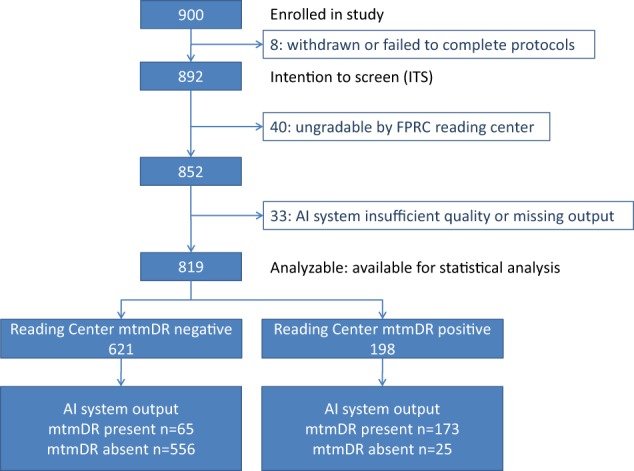
Artificial Intelligence (AI) has long promised to increase healthcare affordability, quality and accessibility but FDA, until recently, had never authorized an autonomous AI diagnostic system. This pivotal trial of an AI system to detect diabetic retinopathy (DR) in people with diabetes enrolled 900 subjects, with no history of DR at primary care clinics, by comparing to Wisconsin Fundus Photograph Reading Center (FPRC) widefield stereoscopic photography and macular Optical Coherence Tomography (OCT), by FPRC certified photographers, and FPRC grading of Early Treatment Diabetic Retinopathy Study Severity Scale (ETDRS) and Diabetic Macular Edema (DME). More than mild DR (mtmDR) was defined as ETDRS level 35 or higher, and/or DME, in at least one eye. AI system operators underwent a standardized training protocol before study start. Median age was 59 years (range, 22–84 years); among participants, 47.5% of participants were male; 16.1% were Hispanic, 83.3% not Hispanic; 28.6% African American and 63.4% were not; 198 (23.8%) had mtmDR. The AI system exceeded all pre-specified superiority endpoints at sensitivity of 87.2% (95% CI, 81.8–91.2%) (>85%), specificity of 90.7% (95% CI, 88.3–92.7%) (>82.5%), and imageability rate of 96.1% (95% CI, 94.6–97.3%), demonstrating AI’s ability to bring specialty-level diagnostics to primary care settings. Based on these results, FDA authorized the system for use by health care providers to detect more than mild DR and diabetic macular edema, making it, the first FDA authorized autonomous AI diagnostic system in any field of medicine, with the potential to help prevent vision loss in thousands of people with diabetes annually. ClinicalTrials.gov NCT02963441
Overview
The claims and statistics of this paper haven’t been checked yet.
Free: it reads the open-access text and checks the first 5 claims that cite a source we can check. Create a free account to check every claim.
Integrity signals
Registry
Cites
Statistics
Figures
Verification
Claims the paper makes
The claims and statistics of this paper haven’t been checked yet.
Free: it reads the open-access text and checks the first 5 claims that cite a source we can check. Create a free account to check every claim.
Claims other papers make about this one
Each is checked against this paper’s own text: does it say what the citing paper says it does?
The cited source doesn’t support the claim as written.
In the citing paper
“The regulatory approval of the first diagnostic autonomous AI system for diabetic eye exams was based on a pivotal trial against a prognostic standard, i.e., patient outcome24, showing its safety, efficacy, and lack of racial and ethnic bias for diagnosing DED in adults with diabetes with 87% sensitivity and 91% specificity24.”
From Autonomous artificial intelligence increases screening and follow-up for diabetic retinopathy in youth: the ACCESS randomized control trial (2024) · cites this paper as [24]
Checked by a reasoning model — may be wrong.
Experimental — accuracy not yet measuredThe source backs part of the claim, not all of it — or backs it for a different population, condition or comparison.
In the citing paper
“Only eight studies in ophthalmology imaging14,21,32,33,43,55,108,109, ten studies in respiratory imaging64,66,70,72,75,79,82,87,89,110 and six studies in breast imaging62,91,97,104,106,111 mentioned adherence to the STARD-2015 guidelines or had a STARD flow diagram in the manuscript.”
From Diagnostic accuracy of deep learning in medical imaging: a systematic review and meta-analysis (2021) · cites this paper as [14]
Experimental — accuracy not yet measuredThe source backs part of the claim, not all of it — or backs it for a different population, condition or comparison.
In the citing paper
“These systems use large annotated datasets to learn hierarchical features directly from images, improving reproducibility and reducing reliance on manual feature engineering [27,34].”
From Artificial Intelligence in Clinical Decision-Making: A Comprehensive Review of Diagnostic, Prognostic, and Therapeutic Applications, Validation Gaps, Bias, and Deployment Challenges (2026) · cites this paper as [27]
Experimental — accuracy not yet measuredThe source backs part of the claim, not all of it — or backs it for a different population, condition or comparison.
In the citing paper
“In clinical workflows, AI supports triage prioritisation, second-opinion review, and reduction of diagnostic variability in high-volume settings [15,27].”
From Artificial Intelligence in Clinical Decision-Making: A Comprehensive Review of Diagnostic, Prognostic, and Therapeutic Applications, Validation Gaps, Bias, and Deployment Challenges (2026) · cites this paper as [27]
Experimental — accuracy not yet measuredThe source backs part of the claim, not all of it — or backs it for a different population, condition or comparison.
In the citing paper
“Adoption in clinical practice is influenced by clinician interaction with AI systems, including trust and workflow compatibility [23,27].”
From Artificial Intelligence in Clinical Decision-Making: A Comprehensive Review of Diagnostic, Prognostic, and Therapeutic Applications, Validation Gaps, Bias, and Deployment Challenges (2026) · cites this paper as [27]
Experimental — accuracy not yet measured
18 more claims about this paper
Create a free account to see every claim other papers make about this one.
Self-check
Percentages, sums and reported differences re-computed from the paper’s own numbers.
The self-check needs the paper’s full text.
Citations
Cites
ImageNet classification with deep convolutional neural networks
Krizhevsky, A., Sutskever, I., & Hinton, G. E. (2017) · Communications of the ACM · doi:10.1145/3065386 · Cited by 112,155
Diagnosis and Classification of Diabetes Mellitus
American Diabetes Association (2011) · Diabetes Care · doi:10.2337/dc11-s062 · Cited by 13,988
Gulshan, V., Peng, L., Coram, M., Stumpe, M. C., Wu, D., Narayanaswamy, A., Venugopalan, S., Widner, K., Madams, T., Cuadros, J., et al. (2016) · JAMA · doi:10.1001/jama.2016.17216 · Cited by 7,697
Centers for Disease Control and Prevention
(2007) · Encyclopedia of Measurement and Statistics · doi:10.4135/9781412952644.n74 · Cited by 6,444
Diagnosis and classification of diabetes mellitus
American Diabetes Association (2014) · Diabetes Care · doi:10.2337/dc14-s081 · Cited by 5,974
(2007) · Developments in Ophthalmology · doi:10.1159/isbn.978-3-318-01439-6 · Cited by 5,583
Bias reduction of maximum likelihood estimates
FIRTH, D. (1993) · Biometrika · doi:10.1093/biomet/80.1.27 · Cited by 5,035
Wilkinson, C. P., Ferris, F. L., Klein, R. E., Lee, P. P., Agardh, C. D., Davis, M., Dills, D., Kampik, A., Pararajasegaram, R., & Verdaguer, J. T. (2003) · Ophthalmology · doi:10.1016/s0161-6420(03)00475-5 · Cited by 3,743
Classification and Diagnosis of Diabetes
Fajans, S. S. (1990) · Medical Entomology and Zoology · Cited by 2,359
Research works printed but not linked: 1
- Centers for Disease Control and Prevention. Diabetes Report Card 2012 2012 Atlanta, GA U.S. Department of Health and Human Services
Cited by
High-performance medicine: the convergence of human and artificial intelligence
Topol, E. J. (2019) · Nature Medicine · doi:10.1038/s41591-018-0300-7 · Cited by 10,450
“…review (many of which are summarized in Table 1), the only prospective validation studies in a real-world setting have been for diabetic retinopathy 31,32 , detection of wrist fractures in the emergy room setting 33 , histologic breast cancer metastases 34,35 , very small colonic polyps 36,37 ,…”
BackgroundMethodKey challenges for delivering clinical impact with artificial intelligence
Kelly, C. J., Karthikesalingam, A., Suleyman, M., Corrado, G., & King, D. (2019) · BMC Medicine · doi:10.1186/s12916-019-1426-2 · Cited by 3,136
“The limited number of prospective studies to date include diabetic retinopathy grading [48 – 50], detection of breast cancer metastases in sentinel lymph node biopsies [51, 52], wrist fracture detection [53], colonic polyp detection [28, 54], and detection of congenital cataracts [55].”
BackgroundArtificial intelligence in healthcare
Yu, K.-H., Beam, A. L., & Kohane, I. S. (2018) · Nature Biomedical Engineering · doi:10.1038/s41551-018-0305-z · Cited by 2,817
Resistance to Medical Artificial Intelligence
Longoni, C., Bonezzi, A., & Morewedge, C. K. (2019) · Journal of Consumer Research · doi:10.1093/jcr/ucz013 · Cited by 2,015
Precision medicine, AI, and the future of personalized health care
Johnson, K. B., Wei, W., Weeraratne, D., Frisse, M. E., Misulis, K., Rhee, K., Zhao, J., & Snowdon, J. L. (2021) · Clinical and Translational Science · doi:10.1111/cts.12884 · Cited by 1,854
“Such prospective studies highlighted the importance of validating the AI models in the clinical environment and considering an iteration loop—that collects users’ feedback as new input for learning and system improvement 96 before applying the AI system widely.”
BackgroundThe Lancet Global Health Commission on Global Eye Health: vision beyond 2020
Burton, M. J., Ramke, J., Marques, A. P., Bourne, R. R. A., Congdon, N., Jones, I., Ah Tong, B. A. M., Arunga, S., Bachani, D., Bascaran, C., et al. (2021) · The Lancet Global Health · doi:10.1016/s2214-109x(20)30488-5 · Cited by 1,624
Artificial intelligence and deep learning in ophthalmology
Ting, D. S. W., Pasquale, L. R., Peng, L., Campbell, J. P., Lee, A. Y., Raman, R., Tan, G. S. W., Schmetterer, L., Keane, P. A., & Wong, T. Y. (2019) · British Journal of Ophthalmology · doi:10.1136/bjophthalmol-2018-313173 · Cited by 1,554
Artificial Intelligence and Deep Learning in Ophthalmology
Wang, Z., Keane, P. A., Chiang, M., Cheung, C. Y., Wong, T. Y., & Ting, D. S. W. (2022) · Artificial Intelligence in Medicine · doi:10.1007/978-3-030-64573-1_200 · Cited by 1,524
Big data and machine learning algorithms for health-care delivery
Ngiam, K. Y., & Khor, I. W. (2019) · The Lancet Oncology · doi:10.1016/s1470-2045(19)30149-4 · Cited by 1,424
Deep learning-enabled medical computer vision
Esteva, A., Chou, K., Yeung, S., Naik, N., Madani, A., Mottaghi, A., Liu, Y., Topol, E., Dean, J., & Socher, R. (2021) · npj Digital Medicine · doi:10.1038/s41746-020-00376-2 · Cited by 1,406
Diagnostic accuracy of deep learning in medical imaging: a systematic review and meta-analysis
Aggarwal, R., Sounderajah, V., Martin, G., Ting, D. S. W., Karthikesalingam, A., King, D., Ashrafian, H., & Darzi, A. (2021) · npj Digital Medicine · doi:10.1038/s41746-021-00438-z · Cited by 946
Orlando, J. I., Fu, H., Barbosa Breda, J., van Keer, K., Bathula, D. R., Diaz-Pinto, A., Fang, R., Heng, P.-A., Kim, J., Lee, J., et al. (2020) · Medical Image Analysis · doi:10.1016/j.media.2019.101570 · Cited by 855
Artificial Intelligence and Black‐Box Medical Decisions: Accuracy versus Explainability
London, A. J. (2019) · Hastings Center Report · doi:10.1002/hast.973 · Cited by 801
AI in Medical Imaging Informatics: Current Challenges and Future Directions
Panayides, A. S., Amini, A., Filipovic, N. D., Sharma, A., Tsaftaris, S. A., Young, A., Foran, D., Do, N., Golemati, S., Kurc, T., et al. (2020) · IEEE Journal of Biomedical and Health Informatics · doi:10.1109/jbhi.2020.2991043 · Cited by 713
“Applications include screening for acute neurologic events [114], diabetic retinopathy [115], and melanoma [116].”
Artificial intelligence for clinical trial design
Harrer, S., Shah, P., Antony, B., & Hu, J. (2019) · Trends in Pharmacological Sciences · doi:10.1016/j.tips.2019.05.005 · Cited by 672
Introducing artificial intelligence training in medical education
Paranjape, K., Schinkel, M., Nannan Panday, R., Car, J., & Nanayakkara, P. (2019) · JMIR Medical Education · doi:10.2196/16048 · Cited by 634
“A recently launched AI system for autonomous detection of diabetic retinopathy carries medical malpractice and liability insurance [40,41].”
Digital technology, tele-medicine and artificial intelligence in ophthalmology: A global perspective
Li, J.-P. O., Liu, H., Ting, D. S. J., Jeon, S., Chan, R. V. P., Kim, J. E., Sim, D. A., Thomas, P. B. M., Lin, H., Chen, Y., et al. (2021) · Progress in Retinal and Eye Research · doi:10.1016/j.preteyeres.2020.100900 · Cited by 626
“Abramoff et al., (2018) reported the first DL-enhanced algorithm for referable DR and VTDR, with a sensitivity of 87.2% and a specificity of 90.7% in detection of referable DR (worse than mild DR) with a gradability rate of 96.1%.”
BackgroundInfluentialA Deep Learning Ensemble Approach for Diabetic Retinopathy Detection
Qummar, S., Khan, F. G., Shah, S., Khan, A., Shamshirband, S., Rehman, Z. U., Ahmed Khan, I., & Jadoon, W. (2019) · IEEE Access · doi:10.1109/access.2019.2947484 · Cited by 622
A deep learning system for detecting diabetic retinopathy across the disease spectrum
Dai, L., Wu, L., Li, H., Cai, C., Wu, Q., Kong, H., Liu, R., Wang, X., Hou, X., Liu, Y., et al. (2021) · Nature Communications · doi:10.1038/s41467-021-23458-5 · Cited by 620
Beede, E., Baylor, E., Hersch, F., Iurchenko, A., Wilcox, L., Ruamviboonsuk, P., & Vardoulakis, L. M. (2020) · Proceedings of the 2020 CHI Conference on Human Factors in Computing Systems · doi:10.1145/3313831.3376718 · Cited by 614
“Prospective studies that involve evaluations of deep learning models within a clinical environment are beginning to emerge [1].”
BackgroundTowards transparency by design for artificial intelligence
Felzmann, H., Fosch-Villaronga, E., Lutz, C., & Tamò-Larrieux, A. (2020) · Science and Engineering Ethics · doi:10.1007/s11948-020-00276-4 · Cited by 588
“…that can reach largely autonomous decisions, such as AI-based diagnostic tools for health applications (e.g., detection of diabetic retinopathy, cf. Abràmoff et al. 2018), recommender systems (e.g., YouTube recommender algorithms, cf. Bishop 2018), or predictive policing and criminal sentencing…”
BackgroundPeiffer-Smadja, N., Rawson, T. M., Ahmad, R., Buchard, A., Georgiou, P., Lescure, F.-X., Birgand, G., & Holmes, A. H. (2020) · Clinical Microbiology and Infection · doi:10.1016/j.cmi.2019.09.009 · Cited by 561
Zhang, L., Wang, X., Yang, D., Sanford, T., Harmon, S., Turkbey, B., Wood, B. J., Roth, H., Myronenko, A., Xu, D., et al. (2020) · IEEE Transactions on Medical Imaging · doi:10.1109/tmi.2020.2973595 · Cited by 542
“) [1], as illustrated in Fig.”
MethodInfluentialDeep learning in ophthalmology: The technical and clinical considerations
Ting, D. S. W., Peng, L., Varadarajan, A. V., Keane, P. A., Burlina, P. M., Chiang, M. F., Schmetterer, L., Pasquale, L. R., Bressler, N. M., Webster, D. R., et al. (2019) · Progress in Retinal and Eye Research · doi:10.1016/j.preteyeres.2019.04.003 · Cited by 534
Self-citationDiabetic retinopathy: Looking forward to 2030
Tan, T.-E., & Wong, T. Y. (2023) · Frontiers in Endocrinology · doi:10.3389/fendo.2022.1077669 · Cited by 511
“, Woodlands Hills, CA, USA) have both received approval by the USA Food and Drug Administration (FDA), and are already in clinical use (63, 64).”
BackgroundSurgical data science – from concepts toward clinical translation
Maier‐Hein, L., Eisenmann, M., Sarıkaya, D., März, K., Collins, T., Malpani, A., Fallert, J., Feußner, H., Giannarou, S., Mascagni, P., et al. (2021) · Medical Image Analysis · doi:10.1016/j.media.2021.102306 · Cited by 515
Artificial Intelligence and Personalized Medicine
Schork, N. J. (2019) · Cancer Treatment and Research · doi:10.1007/978-3-030-16391-4_11 · Cited by 488
11. Microvascular Complications and Foot Care: Standards of Medical Care in Diabetes−2020
American Diabetes Association (2020) · Diabetes Care · doi:10.2337/dc20-s011 · Cited by 460
“an alternative to traditional screening approaches (115).”
Artificial intelligence as the next step towards precision pathology
Acs, B., Rantalainen, M., & Hartman, J. (2020) · Journal of Internal Medicine · doi:10.1111/joim.13030 · Cited by 450
“Moreover, the US Drug and Food Administration (FDA) has approved a deep learning-based autonomous AI diagnostic system to detect diabetic retinopathy on the images of retinal fundus [18].”
BackgroundShifting machine learning for healthcare from development to deployment and from models to data
Zhang, A., Xing, L., Zou, J., & Wu, J. C. (2022) · Nature Biomedical Engineering · doi:10.1038/s41551-022-00898-y · Cited by 420
Role of Artificial Intelligence Applications in Real-Life Clinical Practice: Systematic Review
Yin, J., Ngiam, K. Y., & Teo, H. H. (2021) · Journal of Medical Internet Research · doi:10.2196/25759 · Cited by 419
“…year APa (sensitivity, specificity, imageability rate) 10 primary care clinics (United States) 819 patientsObservational study (prospective) Abràmoff et al, 2018 [25] COb (reading time, mucosal break detection rate) The University of Tokyo Hospital (Japan) 6 physiciansExperimental study…”
BackgroundInfluentialBellemo, V., Lim, Z. W., Lim, G., Nguyen, Q. D., Xie, Y., Yip, M. Y. T., Hamzah, H., Ho, J., Lee, X. Q., Hsu, W., et al. (2019) · The Lancet Digital Health · doi:10.1016/s2589-7500(19)30004-4 · Cited by 419
Andaur Navarro, C. L., Damen, J. A. A., Takada, T., Nijman, S. W. J., Dhiman, P., Ma, J., Collins, G. S., Bajpai, R., Riley, R. D., Moons, K. G. M., et al. (2021) · BMJ · doi:10.1136/bmj.n2281 · Cited by 415
“13-16 Although several publications have raised concern about the methodological quality of prediction models developed with conventional statistical techniques, 6 17 18 a formal methodological and risk of bias assessment of supervised machine learning based prediction model studies across all…”
BackgroundIdentifying Ethical Considerations for Machine Learning Healthcare Applications
Char, D. S., Abràmoff, M. D., & Feudtner, C. (2020) · The American Journal of Bioethics · doi:10.1080/15265161.2020.1819469 · Cited by 415
“…error, data inputs of lower quality and nearly infinite variance, and additional potentially relevant data captured in a modality not accessible to the ML-HCA — the true accuracy is typically lower, even when the underlying ML-HCA has been locked and unchanged (Abr (cid:1) amoff et al. 2018).”
BackgroundSelf-citation11. Microvascular Complications and Foot Care: Standards of Medical Care in Diabetes—2021
American Diabetes Association (2021) · Diabetes Care · doi:10.2337/dc21-s011 · Cited by 395
“mild diabetic retinopathy and diabetic macular edema authorized for use by the FDA represent an alternative to traditional screening approaches (122).”
BackgroundArtificial intelligence for diabetic retinopathy screening: a review
Grzybowski, A., Brona, P., Lim, G., Ruamviboonsuk, P., Tan, G. S. W., Abramoff, M., & Ting, D. S. W. (2020) · Eye · doi:10.1038/s41433-019-0566-0 · Cited by 376
Self-citationGerke, S., Babic, B., Evgeniou, T., & Cohen, I. G. (2020) · npj Digital Medicine · doi:10.1038/s41746-020-0262-2 · Cited by 359
Considerations for addressing bias in artificial intelligence for health equity
Abràmoff, M. D., Tarver, M. E., Loyo-Berrios, N., Trujillo, S., Char, D., Obermeyer, Z., Eydelman, M. B., Foundational Principles of Ophthalmic Imaging and Algorithmic Interpretation Working Group of the Collaborative Community for Ophthalmic Imaging Foundation, W., & Maisel, W. H. (2023) · npj Digital Medicine · doi:10.1038/s41746-023-00913-9 · Cited by 349
Self-citationArtificial Intelligence to Detect Papilledema from Ocular Fundus Photographs
Milea, D., Najjar, R. P., Jiang, Z., Ting, D., Vasseneix, C., Xu, X., Aghsaei Fard, M., Fonseca, P., Vanikieti, K., Lagrèze, W. A., et al. (2020) · New England Journal of Medicine · doi:10.1056/nejmoa1917130 · Cited by 348
Khan, S. M., Liu, X., Nath, S., Korot, E., Faes, L., Wagner, S. K., Keane, P. A., Sebire, N. J., Burton, M. J., & Denniston, A. K. (2021) · The Lancet Digital Health · doi:10.1016/s2589-7500(20)30240-5 · Cited by 334
Deep learning for diabetic retinopathy detection and classification based on fundus images: A review
Tsiknakis, N., Theodoropoulos, D., Manikis, G., Ktistakis, E., Boutsora, O., Berto, A., Scarpa, F., Scarpa, A., Fotiadis, D. I., & Marias, K. (2021) · Computers in Biology and Medicine · doi:10.1016/j.compbiomed.2021.104599 · Cited by 328
Laíns, I., Wang, J. C., Cui, Y., Katz, R., Vingopoulos, F., Staurenghi, G., Vavvas, D. G., Miller, J. W., & Miller, J. B. (2021) · Progress in Retinal and Eye Research · doi:10.1016/j.preteyeres.2021.100951 · Cited by 324
With an eye to AI and autonomous diagnosis
Keane, P. A., & Topol, E. J. (2018) · npj Digital Medicine · doi:10.1038/s41746-018-0048-y · Cited by 304
“In this issue of npj Digital Medicine, Abramoff and colleagues report the findings from a prospective study that evaluates the performance of a diabetic retinopathy diagnostic system (IDx-DR) in a primary care setting.(1) This represents an important clinical milestone as, in April 2018, these results were used to for…”
Qiao, L., Zhu, Y., & Zhou, H. (2020) · IEEE Access · doi:10.1109/access.2020.2993937 · Cited by 304
Gulshan, V., Rajan, R. P., Widner, K., Wu, D., Wubbels, P., Rhodes, T., Whitehouse, K., Coram, M., Corrado, G., Ramasamy, K., et al. (2019) · JAMA Ophthalmology · doi:10.1001/jamaophthalmol.2019.2004 · Cited by 303
Palaniappan, K., Lin, E. Y. T., & Vogel, S. (2024) · Healthcare · doi:10.3390/healthcare12050562 · Cited by 301
“Some of the apps have already been authorised by the United States (US) Food and Drug Administration (FDA) to provide a screening decision independent of a healthcare professional [15].”
BackgroundAI-based computer-aided diagnosis (AI-CAD): the latest review to read first
Fujita, H. (2020) · Radiological Physics and Technology · doi:10.1007/s12194-019-00552-4 · Cited by 300
Deep learning predicts hip fracture using confounding patient and healthcare variables
Badgeley, M. A., Zech, J. R., Oakden-Rayner, L., Glicksberg, B. S., Liu, M., Gale, W., McConnell, M. V., Percha, B., Snyder, T. M., & Dudley, J. T. (2019) · npj Digital Medicine · doi:10.1038/s41746-019-0105-1 · Cited by 290
Sendak, M. P., Ratliff, W., Sarro, D., Alderton, E., Futoma, J., Gao, M., Nichols, M., Revoir, M., Yashar, F., Miller, C., et al. (2020) · JMIR Medical Informatics · doi:10.2196/15182 · Cited by 287
“Isolated efforts demonstrating the clinical impact of previously validated technologies show the potential of machine learning in health care [3,4].”
BackgroundArtificial intelligence in diabetes management: Advancements, opportunities, and challenges
Guan, Z., Li, H., Liu, R., Cai, C., Liu, Y., Li, J., Wang, X., Huang, S., Wu, L., Liu, D., et al. (2023) · Cell Reports Medicine · doi:10.1016/j.xcrm.2023.101213 · Cited by 412
“104,142 This device facilitates DR screening, especially in rural communities where patients have difficulty accessing an ophthalmologist.”
BackgroundArtificial Intelligence in Medicine: Where Are We Now?
Kulkarni, S., Seneviratne, N., Baig, M. S., & Khan, A. H. A. (2020) · Academic Radiology · doi:10.1016/j.acra.2019.10.001 · Cited by 282
Machine learning in clinical decision making
Adlung, L., Cohen, Y., Mor, U., & Elinav, E. (2021) · Med · doi:10.1016/j.medj.2021.04.006 · Cited by 282
How to develop machine learning models for healthcare
Chen, P.-H. C., Liu, Y., & Peng, L. (2019) · Nature Materials · doi:10.1038/s41563-019-0345-0 · Cited by 274
Scheetz, J., Rothschild, P., McGuinness, M., Hadoux, X., Soyer, H. P., Janda, M., Condon, J. J. J., Oakden-Rayner, L., Palmer, L. J., Keel, S., et al. (2021) · Scientific Reports · doi:10.1038/s41598-021-84698-5 · Cited by 273
“The top three ranked potential advantages of AI were (1) improved patient access to disease screening, (2) improved diagnostic confidence, and (3) reduced time spent by specialists on monotonous tasks.”
BackgroundPredicting the risk of developing diabetic retinopathy using deep learning
Bora, A., Balasubramanian, S., Babenko, B., Virmani, S., Venugopalan, S., Mitani, A., de Oliveira Marinho, G., Cuadros, J., Ruamviboonsuk, P., Corrado, G. S., et al. (2021) · The Lancet Digital Health · doi:10.1016/s2589-7500(20)30250-8 · Cited by 270
Machine Learning in Dermatology: Current Applications, Opportunities, and Limitations
Chan, S., Reddy, V., Myers, B., Thibodeaux, Q., Brownstone, N., & Liao, W. (2020) · Dermatology and Therapy · doi:10.1007/s13555-020-00372-0 · Cited by 267
Singh, R. P., Hom, G. L., Abramoff, M. D., Campbell, J. P., Chiang, M. F., & on behalf of the AAO Task Force on Artificial Intelligence (2020) · Translational Vision Science & Technology · doi:10.1167/tvst.9.2.45 · Cited by 259
Self-citationIpp, E., Liljenquist, D., Bode, B., Shah, V. N., Silverstein, S., Regillo, C. D., Lim, J. I., Sadda, S., Domalpally, A., Gray, G., et al. (2021) · JAMA Network Open · doi:10.1001/jamanetworkopen.2021.34254 · Cited by 256
Clinical applications of continual learning machine learning
Lee, C. S., & Lee, A. Y. (2020) · The Lancet Digital Health · doi:10.1016/s2589-7500(20)30102-3 · Cited by 254
Aminizadeh, S., Heidari, A., Dehghan, M., Toumaj, S., Rezaei, M., Jafari Navimipour, N., Stroppa, F., & Unal, M. (2024) · Artificial Intelligence in Medicine · doi:10.1016/j.artmed.2024.102779 · Cited by 252
Ruamviboonsuk, P., Tiwari, R., Sayres, R., Nganthavee, V., Hemarat, K., Kongprayoon, A., Raman, R., Levinstein, B., Liu, Y., Schaekermann, M., et al. (2022) · The Lancet Digital Health · doi:10.1016/s2589-7500(22)00017-6 · Cited by 250
Introduction to artificial intelligence in ultrasound imaging in obstetrics and gynecology
Drukker, L., Noble, J. A., & Papageorghiou, A. T. (2020) · Ultrasound in Obstetrics & Gynecology · doi:10.1002/uog.22122 · Cited by 240
“Promising medical AI applications are emerging in the areas of screening 5,6 , prediction 7–9 , triage 10,11 , diagnosis 12,13 , drug development 14,15 , treatment 16,17 , monitoring 18 and imaging interpretation 19,20 .”
BackgroundTime to reality check the promises of machine learning-powered precision medicine.
Wilkinson, J., Arnold, K. F., Murray, E. J., van Smeden, M., Carr, K., Sippy, R., de Kamps, M., Beam, A., Konigorski, S., Lippert, C., et al. (2020) · The Lancet Digital Health · doi:10.1016/s2589-7500(20)30200-4 · Cited by 233
Detection of anaemia from retinal fundus images via deep learning
Mitani, A., Huang, A., Venugopalan, S., Corrado, G. S., Peng, L., Webster, D. R., Hammel, N., Liu, Y., & Varadarajan, A. V. (2019) · Nature Biomedical Engineering · doi:10.1038/s41551-019-0487-z · Cited by 230
“Together with the development of fully automated diabetic retinopathy screening tools based on artificial intelligence 52 and low-cost mobile devices with image qualities approaching that of standard ‘table-top’ fundus cameras 53 , the prevalence of fundus photographs is likely to increase in the…”
BackgroundDigital health technologies: opportunities and challenges in rheumatology
Solomon, D. H., & Rudin, R. S. (2020) · Nature Reviews Rheumatology · doi:10.1038/s41584-020-0461-x · Cited by 228
Natarajan, S., Jain, A., Krishnan, R., Rogye, A., & Sivaprasad, S. (2019) · JAMA Ophthalmology · doi:10.1001/jamaophthalmol.2019.2923 · Cited by 228
Online misinformation and vaccine hesitancy
Garett, R., & Young, S. D. (2021) · Translational Behavioral Medicine · doi:10.1093/tbm/ibab128 · Cited by 221
“and approved by the Federal Drug Administration of USA [43].”
BackgroundInfluentialArtificial Intelligence in Healthcare: Review, Ethics, Trust Challenges & Future Research Directions
Kumar, P., Chauhan, S., & Awasthi, L. K. (2023) · Engineering Applications of Artificial Intelligence · doi:10.1016/j.engappai.2023.105894 · Cited by 218
Bhaskaranand, M., Ramachandra, C., Bhat, S., Cuadros, J., Nittala, M. G., Sadda, S. R., & Solanki, K. (2019) · Diabetes Technology & Therapeutics · doi:10.1089/dia.2019.0164 · Cited by 211
Artificial Intelligence and Liability in Medicine: Balancing Safety and Innovation
MALIHA, G., GERKE, S., COHEN, I. G., & PARIKH, R. B. (2021) · The Milbank Quarterly · doi:10.1111/1468-0009.12504 · Cited by 211
12. Retinopathy, Neuropathy, and Foot Care: Standards of Care in Diabetes—2024
American Diabetes Association Professional Practice Committee, ElSayed, N. A., Aleppo, G., Bannuru, R. R., Bruemmer, D., Collins, B. S., Ekhlaspour, L., Gibbons, C. H., Giurini, J. M., Hilliard, M. E., et al. (2024) · Diabetes Care · doi:10.2337/dc24-s012 · Cited by 207
Artificial Intelligence in Biological Sciences
Bhardwaj, A., Kishore, S., & Pandey, D. K. (2022) · Life · doi:10.3390/life12091430 · Cited by 210
“The model was trained with a diversified sample dataset consisting of individuals of different ages, races and sex, thus minimizing the chances of errors in different groups [78].”
MethodClassification of diabetic retinopathy: Past, present and future
Yang, Z., Tan, T.-E., Shao, Y., Wong, T. Y., & Li, X. (2022) · Frontiers in Endocrinology · doi:10.3389/fendo.2022.1079217 · Cited by 201
Liyanage, H., Liaw, S.-T., Jonnagaddala, J., Schreiber, R., Kuziemsky, C., Terry, A. L., & de Lusignan, S. (2019) · Yearbook of Medical Informatics · doi:10.1055/s-0039-1677901 · Cited by 200
“developed an AI system, approved by the Federal Drug Administration of USA, to detect diabetic retinopathy in PHC centres [8].”
BackgroundLee, A. Y., Yanagihara, R. T., Lee, C. S., Blazes, M., Jung, H. C., Chee, Y. E., Gencarella, M. D., Gee, H., Maa, A. Y., Cockerham, G. C., et al. (2021) · Diabetes Care · doi:10.2337/dc20-1877 · Cited by 194
Abbasgholizadeh Rahimi, S., Légaré, F., Sharma, G., Archambault, P., Zomahoun, H. T. V., Chandavong, S., Rheault, N., T Wong, S., Langlois, L., Couturier, Y., et al. (2021) · Journal of Medical Internet Research · doi:10.2196/29839 · Cited by 146
“[85-87]; suicidal ideations (2/90, 2”
Rajesh, A. E., Davidson, O. Q., Lee, C. S., & Lee, A. Y. (2023) · Diabetes Care · doi:10.2337/dci23-0032 · Cited by 150
Artificial Intelligence in Current Diabetes Management and Prediction
Nomura, A., Noguchi, M., Kometani, M., Furukawa, K., & Yoneda, T. (2021) · Current Diabetes Reports · doi:10.1007/s11892-021-01423-2 · Cited by 183
Heydon, P., Egan, C., Bolter, L., Chambers, R., Anderson, J., Aldington, S., Stratton, I. M., Scanlon, P. H., Webster, L., Mann, S., et al. (2021) · British Journal of Ophthalmology · doi:10.1136/bjophthalmol-2020-316594 · Cited by 183
Adversarial attacks and defenses on AI in medical imaging informatics: A survey
Kaviani, S., Han, K. J., & Sohn, I. (2022) · Expert Systems with Applications · doi:10.1016/j.eswa.2022.116815 · Cited by 184
Redd, T. K., Campbell, J. P., Brown, J. M., Kim, S. J., Ostmo, S., Chan, R. V. P., Dy, J., Erdogmus, D., Ioannidis, S., Kalpathy-Cramer, J., et al. (2019) · British Journal of Ophthalmology · doi:10.1136/bjophthalmol-2018-313156 · Cited by 178
12. Retinopathy, Neuropathy, and Foot Care: Standards of Medical Care in Diabetes—2022
American Diabetes Association Professional Practice Committee (2022) · Diabetes Care · doi:10.2337/dc22-s012 · Cited by 177
12. Retinopathy, Neuropathy, and Foot Care: Standards of Care in Diabetes—2025
American Diabetes Association Professional Practice Committee, ElSayed, N. A., McCoy, R. G., Aleppo, G., Balapattabi, K., Beverly, E. A., Briggs Early, K., Bruemmer, D., Callaghan, B. C., Echouffo-Tcheugui, J. B., et al. (2025) · Diabetes Care · doi:10.2337/dc25-s012 · Cited by 176
Artificial Intelligence Screening for Diabetic Retinopathy: the Real-World Emerging Application
Bellemo, V., Lim, G., Rim, T. H., Tan, G. S. W., Cheung, C. Y., Sadda, S., He, M.-G., Tufail, A., Lee, M. L., Hsu, W., et al. (2019) · Current Diabetes Reports · doi:10.1007/s11892-019-1189-3 · Cited by 176
Artificial intelligence and deep learning in ophthalmology: Current status and future perspectives
Jin, K., & Ye, J. (2022) · Advances in Ophthalmology Practice and Research · doi:10.1016/j.aopr.2022.100078 · Cited by 132
A Path for Translation of Machine Learning Products into Healthcare Delivery
(2020) · EMJ Innovations · doi:10.33590/emjinnov/19-00172 · Cited by 172
AI-driven healthcare: A review on ensuring fairness and mitigating bias
Chinta, S. V., Wang, Z., Palikhe, A., Zhang, X., Kashif, A., Smith, M. A., Liu, J., & Zhang, W. (2025) · PLOS Digital Health · doi:10.1371/journal.pdig.0000864 · Cited by 171
“However, ongoing research and collaboration between AI technologists and ophthalmic experts are likely to overcome these obstacles, solidifying AI’s role in modern ophthalmology [34].”
Code-free deep learning for multi-modality medical image classification
Korot, E., Guan, Z., Ferraz, D., Wagner, S. K., Zhang, G., Liu, X., Faes, L., Pontikos, N., Finlayson, S. G., Khalid, H., et al. (2021) · Nature Machine Intelligence · doi:10.1038/s42256-021-00305-2 · Cited by 171
Application of machine learning in ophthalmic imaging modalities
Tong, Y., Lü, W., Yu, Y., & Shen, Y. (2020) · Eye and Vision · doi:10.1186/s40662-020-00183-6 · Cited by 171
“In 2018, IDx-DR was approved as the first fully autonomous AI-based DR diagnostic system by the United States Food and Drug Administration (FDA) [62]; this study is a milestone as the first prospective assessment of AI in the real-world.”
Background12. Retinopathy, Neuropathy, and Foot Care: Standards of Care in Diabetes—2023
ElSayed, N. A., Aleppo, G., Aroda, V. R., Bannuru, R. R., Brown, F. M., Bruemmer, D., Collins, B. S., Gibbons, C. H., Giurini, J. M., Hilliard, M. E., et al. (2023) · Diabetes Care · doi:10.2337/dc23-s012 · Cited by 169
Machine learning in the clinical microbiology laboratory: has the time come for routine practice?
Peiffer-Smadja, N., Dellière, S., Rodriguez, C., Birgand, G., Lescure, F.-X., Fourati, S., & Ruppé, E. (2020) · Clinical Microbiology and Infection · doi:10.1016/j.cmi.2020.02.006 · Cited by 131
Lin, D., Xiong, J., Liu, C., Zhao, L., Li, Z., Yu, S., Wu, X., Ge, Z., Hu, X., Wang, B., et al. (2021) · The Lancet Digital Health · doi:10.1016/s2589-7500(21)00086-8 · Cited by 144
Adversarial attack vulnerability of medical image analysis systems: Unexplored factors
Bortsova, G., González-Gonzalo, C., Wetstein, S. C., Dubost, F., Katramados, I., Hogeweg, L., Liefers, B., van Ginneken, B., Pluim, J. P. W., Veta, M., et al. (2021) · Medical Image Analysis · doi:10.1016/j.media.2021.102141 · Cited by 126
“This has created an opportunity to automate certain medical tasks and integrate DL systems in clinical settings (Abr`amo ff et al., 2018; Murphy et al., 2020; GE Reports, 2019).”
Diabetic retinopathy: Screening, prevention, and treatment
Chong, D. D., Das, N., & Singh, R. P. (2024) · Cleveland Clinic Journal of Medicine · doi:10.3949/ccjm.91a.24028 · Cited by 174
“17,18 Consequently, if the screening is positive, an in-person eye examination by an ophthalmologist is required.”
Wang, W., Chen, L., Xiong, M., & Wang, Y. (2023) · Information Systems Frontiers · doi:10.1007/s10796-021-10154-4 · Cited by 164
Singh, M., Kumar, A., Khanna, N. N., Laird, J. R., Nicolaides, A., Faa, G., Johri, A. M., Mantella, L. E., Fernandes, J. F. E., Teji, J. S., et al. (2024) · eClinicalMedicine · doi:10.1016/j.eclinm.2024.102660 · Cited by 163
Tan, T.-E., Anees, A., Chen, C., Li, S., Xu, X., Li, Z., Xiao, Z., Yang, Y., Lei, X., Ang, M., et al. (2021) · The Lancet Digital Health · doi:10.1016/s2589-7500(21)00055-8 · Cited by 163
A Clinician's Guide to Artificial Intelligence: How to Critically Appraise Machine Learning Studies
Faes, L., Liu, X., Wagner, S. K., Fu, D. J., Balaskas, K., Sim, D. A., Bachmann, L. M., Keane, P. A., & Denniston, A. K. (2020) · Translational Vision Science & Technology · doi:10.1167/tvst.9.2.7 · Cited by 162
Fundus photograph-based deep learning algorithms in detecting diabetic retinopathy
Raman, R., Srinivasan, S., Virmani, S., Sivaprasad, S., Rao, C., & Rajalakshmi, R. (2019) · Eye · doi:10.1038/s41433-018-0269-y · Cited by 159
“The IDx-DR is able to detect RDR (more than mild [mtm] DR) with a sensitivity of 87.4% and a specificity of 89.5%.”
MethodInfluentialArtificial intelligence for diabetic retinopathy screening, prediction and management
Gunasekeran, D. V., Ting, D. S. W., Tan, G. S. W., & Wong, T. Y. (2020) · Current Opinion in Ophthalmology · doi:10.1097/icu.0000000000000693 · Cited by 133
“have also secured regulatory approval for diabetic retinopathy detection in the United States, Europe and in Singapore [21,45].”
Background
Metadata
- Authors
- Abràmoff, M. D., Lavin, P. T., Birch, M., Shah, N., & Folk, J. C.
- Affiliations
- University of Iowa (US)
- University of North Carolina at Charlotte (US)
- Emmes (United States) (US)
- Corresponding author
- Abràmoff, Michael D.
- Venue
- npj Digital Medicine
- Published
- 2018-08-28
- Volume
- 1
- Issue
- 1
- Pages
- 39-39
- ISSN
- 2398-6352 (ISSN-L)
- PMC
- PMC6550188
- OpenAlex
- W2888424632
- Cited by
- 1,638
- References
- 61
- Citations by year
- 2026: 332 · 2025: 276 · 2024: 226 · 2023: 193 · 2022: 172 · 2021: 183 · 2020: 173 · 2019: 73 · 2018: 10
- FWCI
- 75.83
- Type
- journal article
- Language
- en
- Open access
- gold
- doi.org
- Licence
- cc-by
- creativecommons.org/licenses/by/4.0 (tdm)
- creativecommons.org/licenses/by/4.0 (vor)
- Locations
- npj Digital Medicine (publishedVersion, cc-by)
- Europe PMC (PubMed Central) (publishedVersion, cc-by)
- PubMed Central (publishedVersion, cc-by)
- PubMed (publishedVersion)
- DOAJ (DOAJ: Directory of Open Access Journals) (submittedVersion)
- Funders
- IDx LLC, Coralville, IA
- Topics
- Health Sciences › Medicine › Radiology, Nuclear Medicine and Imaging › Retinal Imaging and Analysis
- Health Sciences › Medicine › Ophthalmology › Retinal Diseases and Treatments
- Health Sciences › Medicine › Health Informatics › Artificial Intelligence in Healthcare and Education
- Keywords
- diabetic retinopathy, diabetic macular edema, autonomous AI systems, FDA approval, primary care, fundus photography, optical coherence tomography, sensitivity and specificity, imageability, blindness prevention, diabetes mellitus
About these checks
Registry, retraction, Cites and statistics results are computed, not judged, with one exception: a printed reference that no index lists is read once by a model before it counts as a citation error. Claims are extracted by a model and kept only when their quote appears verbatim in the text; each cited source is then checked, with a model’s help, for whether it says what the claim relies on. Those verdicts can be wrong — read the claim’s quote and the cited source before relying on one.
Statistics and arithmetic are recomputed, not judged.
Confidence bands are shown only for fields calibrated on our annotated test set. None is calibrated yet, so no band is shown.
What counts as a claim ›How we measure confidence ›How we check this ›
Are you an author, or do you see a problem with this page? Request a review
Data sources
Bibliographic data: Semantic Scholar, OpenAlex, Crossref.
Contains information from the Semantic Scholar Academic Graph Datasets, made available under the ODC Attribution License (ODC-BY 1.0).
Semantic Scholar’s data is described in: Kinney, R., et al. (2023). The Semantic Scholar Open Data Platform. arXiv:2301.10140.
