

Pivotal trial of an autonomous AI-based diagnostic system for detection of diabetic retinopathy in primary care offices
Open accessThe DOI matches its Crossref record; 62 of the 62 references it cites were found in a registry or an index.
Abstract
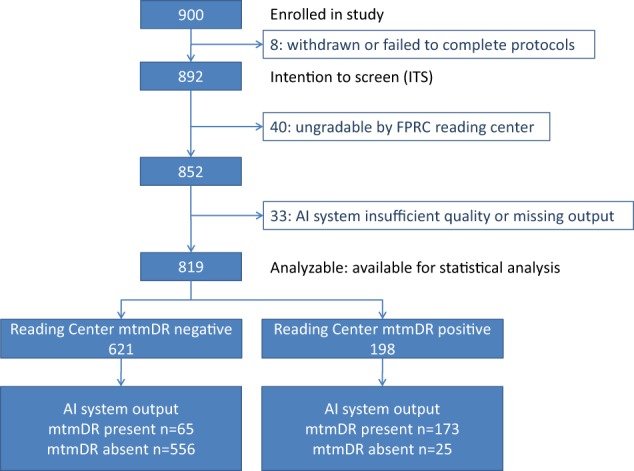
Artificial Intelligence (AI) has long promised to increase healthcare affordability, quality and accessibility but FDA, until recently, had never authorized an autonomous AI diagnostic system. This pivotal trial of an AI system to detect diabetic retinopathy (DR) in people with diabetes enrolled 900 subjects, with no history of DR at primary care clinics, by comparing to Wisconsin Fundus Photograph Reading Center (FPRC) widefield stereoscopic photography and macular Optical Coherence Tomography (OCT), by FPRC certified photographers, and FPRC grading of Early Treatment Diabetic Retinopathy Study Severity Scale (ETDRS) and Diabetic Macular Edema (DME). More than mild DR (mtmDR) was defined as ETDRS level 35 or higher, and/or DME, in at least one eye. AI system operators underwent a standardized training protocol before study start. Median age was 59 years (range, 22–84 years); among participants, 47.5% of participants were male; 16.1% were Hispanic, 83.3% not Hispanic; 28.6% African American and 63.4% were not; 198 (23.8%) had mtmDR. The AI system exceeded all pre-specified superiority endpoints at sensitivity of 87.2% (95% CI, 81.8–91.2%) (>85%), specificity of 90.7% (95% CI, 88.3–92.7%) (>82.5%), and imageability rate of 96.1% (95% CI, 94.6–97.3%), demonstrating AI’s ability to bring specialty-level diagnostics to primary care settings. Based on these results, FDA authorized the system for use by health care providers to detect more than mild DR and diabetic macular edema, making it, the first FDA authorized autonomous AI diagnostic system in any field of medicine, with the potential to help prevent vision loss in thousands of people with diabetes annually. ClinicalTrials.gov NCT02963441
Overview
The claims and statistics of this paper haven’t been checked yet.
Free: it reads the open-access text and checks the first 5 claims that cite a source we can check. Create a free account to check every claim.
Integrity signals
Registry
Cites
Statistics
Figures
Verification
Claims the paper makes
The claims and statistics of this paper haven’t been checked yet.
Free: it reads the open-access text and checks the first 5 claims that cite a source we can check. Create a free account to check every claim.
Claims other papers make about this one
Each is checked against this paper’s own text: does it say what the citing paper says it does?
The cited source doesn’t support the claim as written.
In the citing paper
“The regulatory approval of the first diagnostic autonomous AI system for diabetic eye exams was based on a pivotal trial against a prognostic standard, i.e., patient outcome24, showing its safety, efficacy, and lack of racial and ethnic bias for diagnosing DED in adults with diabetes with 87% sensitivity and 91% specificity24.”
From Autonomous artificial intelligence increases screening and follow-up for diabetic retinopathy in youth: the ACCESS randomized control trial (2024) · cites this paper as [24]
Checked by a reasoning model — may be wrong.
Experimental — accuracy not yet measuredThe source backs part of the claim, not all of it — or backs it for a different population, condition or comparison.
In the citing paper
“Only eight studies in ophthalmology imaging14,21,32,33,43,55,108,109, ten studies in respiratory imaging64,66,70,72,75,79,82,87,89,110 and six studies in breast imaging62,91,97,104,106,111 mentioned adherence to the STARD-2015 guidelines or had a STARD flow diagram in the manuscript.”
From Diagnostic accuracy of deep learning in medical imaging: a systematic review and meta-analysis (2021) · cites this paper as [14]
Experimental — accuracy not yet measuredThe source backs part of the claim, not all of it — or backs it for a different population, condition or comparison.
In the citing paper
“These systems use large annotated datasets to learn hierarchical features directly from images, improving reproducibility and reducing reliance on manual feature engineering [27,34].”
From Artificial Intelligence in Clinical Decision-Making: A Comprehensive Review of Diagnostic, Prognostic, and Therapeutic Applications, Validation Gaps, Bias, and Deployment Challenges (2026) · cites this paper as [27]
Experimental — accuracy not yet measuredThe source backs part of the claim, not all of it — or backs it for a different population, condition or comparison.
In the citing paper
“In clinical workflows, AI supports triage prioritisation, second-opinion review, and reduction of diagnostic variability in high-volume settings [15,27].”
From Artificial Intelligence in Clinical Decision-Making: A Comprehensive Review of Diagnostic, Prognostic, and Therapeutic Applications, Validation Gaps, Bias, and Deployment Challenges (2026) · cites this paper as [27]
Experimental — accuracy not yet measuredThe source backs part of the claim, not all of it — or backs it for a different population, condition or comparison.
In the citing paper
“Adoption in clinical practice is influenced by clinician interaction with AI systems, including trust and workflow compatibility [23,27].”
From Artificial Intelligence in Clinical Decision-Making: A Comprehensive Review of Diagnostic, Prognostic, and Therapeutic Applications, Validation Gaps, Bias, and Deployment Challenges (2026) · cites this paper as [27]
Experimental — accuracy not yet measured
18 more claims about this paper
Create a free account to see every claim other papers make about this one.
Self-check
Percentages, sums and reported differences re-computed from the paper’s own numbers.
The self-check needs the paper’s full text.
Citations
Cites
ImageNet classification with deep convolutional neural networks
Krizhevsky, A., Sutskever, I., & Hinton, G. E. (2017) · Communications of the ACM · doi:10.1145/3065386 · Cited by 112,155
Diagnosis and Classification of Diabetes Mellitus
American Diabetes Association (2011) · Diabetes Care · doi:10.2337/dc11-s062 · Cited by 13,988
Gulshan, V., Peng, L., Coram, M., Stumpe, M. C., Wu, D., Narayanaswamy, A., Venugopalan, S., Widner, K., Madams, T., Cuadros, J., et al. (2016) · JAMA · doi:10.1001/jama.2016.17216 · Cited by 7,697
Centers for Disease Control and Prevention
(2007) · Encyclopedia of Measurement and Statistics · doi:10.4135/9781412952644.n74 · Cited by 6,444
Diagnosis and classification of diabetes mellitus
American Diabetes Association (2014) · Diabetes Care · doi:10.2337/dc14-s081 · Cited by 5,974
(2007) · Developments in Ophthalmology · doi:10.1159/isbn.978-3-318-01439-6 · Cited by 5,583
Bias reduction of maximum likelihood estimates
FIRTH, D. (1993) · Biometrika · doi:10.1093/biomet/80.1.27 · Cited by 5,035
Wilkinson, C. P., Ferris, F. L., Klein, R. E., Lee, P. P., Agardh, C. D., Davis, M., Dills, D., Kampik, A., Pararajasegaram, R., & Verdaguer, J. T. (2003) · Ophthalmology · doi:10.1016/s0161-6420(03)00475-5 · Cited by 3,743
Classification and Diagnosis of Diabetes
Fajans, S. S. (1990) · Medical Entomology and Zoology · Cited by 2,359
Research works printed but not linked: 1
- Centers for Disease Control and Prevention. Diabetes Report Card 2012 2012 Atlanta, GA U.S. Department of Health and Human Services
Cited by
Items 201–300 of 1,004
Tan, C. H., Kyaw, B. M., Smith, H. E., Tan, C. S., & Car, L. T. (2020) · Journal of Medical Internet Research · doi:10.2196/16658 · Cited by 84
“%) and 90.7% (95% CI 88.3%-92.7%), respectively, in detecting more than mild DR [43].”
InfluentialHan, X., Steven, K., Qassim, A., Marshall, H. N., Bean, C., Tremeer, M., An, J., Siggs, O. M., Gharahkhani, P., Craig, J. E., et al. (2021) · The American Journal of Human Genetics · doi:10.1016/j.ajhg.2021.05.005 · Cited by 84
“14,15 The probabilistic nature and non-linear capabilities, as well as analytical capabilities to deal with single and multimodal high-dimensional data, has seen the application of AI experience lower resistance to adoption in the medical field when applied to computer vision applications.”
BackgroundZhu, Y., Salowe, R., Chow, C., Li, S., Bastani, O., & O’Brien, J. M. (2024) · Bioengineering · doi:10.3390/bioengineering11020122 · Cited by 83
Artificial Intelligence in Diabetic Eye Disease Screening
(2019) · Asia-Pacific Journal of Ophthalmology · doi:10.22608/apo.201976 · Cited by 82
“6,48,61 Fourth, a continuous data supply is necessary for ongoing improvement and refinement of the DL algorithms and data may need to be shared across multiple centers for widespread implementation.”
BackgroundNatural Language Processing in medicine and ophthalmology: A review for the 21st-century clinician
Rojas-Carabali, W. A., Agrawal, R., Gutiérrez-Sinisterra, L., Baxter, S. L., Cifuentes‐González, C., Wei, Y. C., Abisheganaden, J. A., Kannapiran, P., Wong, S., Lee, B. T. K., et al. (2024) · Asia-Pacific Journal of Ophthalmology · doi:10.1016/j.apjo.2024.100084 · Cited by 82
“For instance, it has been demonstrated how AI algorithms can be deployed to automate the detection of skin cancer from lesions’ pictures 4 or diabetic retinopathy from retinal fundus images 5 .”
Abramoff, M. D., Whitestone, N., Patnaik, J. L., Rich, E., Ahmed, M., Husain, L., Hassan, M. Y., Tanjil, M. S. H., Weitzman, D., Dai, T., et al. (2023) · npj Digital Medicine · doi:10.1038/s41746-023-00931-7 · Cited by 81
Self-citationAdvancing Artificial Intelligence in Health Settings Outside the Hospital and Clinic
Aggarwal, N., Ahmed, M., Basu, S., Curtin, J. J., Evans, B. J., Matheny, M. E., Nundy, S., Sendak, M. P., Shachar, C., Shah, R. U., et al. (2020) · NAM Perspectives · doi:10.31478/202011f · Cited by 59
Quantitative approaches in multimodal fundus imaging: State of the art and future perspectives
Arrigo, A., Aragona, E., Parodi, M. B., & Bandello, F. M. (2022) · Progress in Retinal and Eye Research · doi:10.1016/j.preteyeres.2022.101111 · Cited by 82
Machine Learning as a Support for the Diagnosis of Type 2 Diabetes
Agliata, A., Giordano, D., Bardozzo, F., Bottiglieri, S., Facchiano, A. M., & Tagliaferri, R. (2023) · International Journal of Molecular Sciences · doi:10.3390/ijms24076775 · Cited by 82
Artificial intelligence in glaucoma: opportunities, challenges, and future directions
Huang, X., Islam, M. R., Prome, S. A., Ahmed, F., Kazami, E., Serhan, H. A. A., Abd-Alrazaq, A. A., & Yousefi, S. (2023) · BioMedical Engineering OnLine · doi:10.1186/s12938-023-01187-8 · Cited by 83
“Two autonomous AI models have been approved by the FDA to detect more than mild diabetic retinopathy and diabetic macular edema [302]; however, there is no FDA-approved autonomous AI instrument for detecting glaucoma.”
BackgroundArtificial intelligence for retinopathy of prematurity
Gensure, R. H., Chiang, M. F., & Campbell, J. P. (2020) · Current Opinion in Ophthalmology · doi:10.1097/icu.0000000000000680 · Cited by 81
Thakoor, K. A., Koorathota, S., Hood, D. C., & Sajda, P. (2020) · IEEE Transactions on Biomedical Engineering · doi:10.1109/tbme.2020.3043215 · Cited by 82
Jain, A., Brooks, J. R., Alford, C. C., Chang, C. S., Mueller, N. M., Umscheid, C. A., & Bierman, A. S. (2023) · JAMA Health Forum · doi:10.1001/jamahealthforum.2023.1197 · Cited by 79
Advances in Telemedicine in Ophthalmology
Parikh, D., Armstrong, G. W., Liou, V. D., & Husain, D. (2020) · Seminars in Ophthalmology · doi:10.1080/08820538.2020.1789675 · Cited by 79
Adler‐Milstein, J., Chen, J. H., & Dhaliwal, G. (2021) · JAMA · doi:10.1001/jama.2021.22396 · Cited by 79
Current status and future directions of explainable artificial intelligence in medical imaging
Saw, S. N., Yan, Y. Y., & Ng, K. H. (2024) · European Journal of Radiology · doi:10.1016/j.ejrad.2024.111884 · Cited by 81
The Diabetic Retinopathy “Pandemic” and Evolving Global Strategies: The 2023 Friedenwald Lecture
Wong, T. Y., & Tan, T. (2023) · Investigative Ophthalmology & Visual Science · doi:10.1167/iovs.64.15.47 · Cited by 82
Tang, F., Luenam, P., Ran, A. R., Quadeer, A. A., Raman, R., Sen, P., Khan, R., Anantharaman, G., Haridas, S., Iglicki, M., et al. (2021) · Ophthalmology Retina · doi:10.1016/j.oret.2021.01.013 · Cited by 78
Artificial intelligence for retinal diseases
Lim, J. I., Rachitskaya, A. V., Hallak, J., Gholami, S., & Alam, M. N. (2024) · Asia-Pacific Journal of Ophthalmology · doi:10.1016/j.apjo.2024.100096 · Cited by 79
Sivaprasad, S., Wong, T. Y., Gardner, T. W., Sun, J. K., & Bressler, N. M. (2025) · Nature Reviews Disease Primers · doi:10.1038/s41572-025-00646-x · Cited by 77
“The type and severity of microvascular lesions in patients also inform the indications for referral and treatment 75–77 .”
London, A. J. (2022) · Cell Reports Medicine · doi:10.1016/j.xcrm.2022.100622 · Cited by 76
“34 These systems seek to improve patient outcomes by eliminating delays in screening while maintaining uniformly high degrees of sensitivity and spec-ificity to better optimize the rate at which high-risk patients are referred to specialists.”
Wang, Y., Liu, C., Hu, W., Luo, L., Shi, D., Zhang, J., Yin, Q., Zhang, L., Han, X., & He, M. (2024) · npj Digital Medicine · doi:10.1038/s41746-024-01032-9 · Cited by 76
Deep Learning for the Diagnosis of Stage in Retinopathy of Prematurity
Chen, J., Coyner, A. S., Ostmo, S. R., Sönmez, K., Bajimaya, S., Pradhan, E., Valikodath, N. G., Cole, E. D., Al-Khaled, T., Chan, R. V. P., et al. (2021) · Ophthalmology Retina · doi:10.1016/j.oret.2020.12.013 · Cited by 79
Shah, P., Mishra, D., Shanmugam, M., Doshi, B., Jayaraj, H., & Ramanjulu, R. (2020) · Indian Journal of Ophthalmology · doi:10.4103/ijo.ijo_966_19 · Cited by 64
“[14-17, 20, 21 ] In the present scenario, every diabetic patient”
BackgroundAGE challenge: Angle Closure Glaucoma Evaluation in Anterior Segment Optical Coherence Tomography
Fu, H., Li, F., Sun, X., Cao, X., Liao, J., Orlando, J. I., Xing, T., Li, Y., Zhang, S., Tan, M., et al. (2020) · Medical Image Analysis · doi:10.1016/j.media.2020.101798 · Cited by 76
AI in Global Health: The View from the Front Lines
Ismail, A., & Kumar, N. (2021) · Proceedings of the 2021 CHI Conference on Human Factors in Computing Systems · doi:10.1145/3411764.3445130 · Cited by 59
“AI systems have been developed to help with early detection and diagnosis [5, 27], drug discovery [47], and outcome prediction and prognosis evaluation [107, 226].”
BackgroundKeratoconus detection of changes using deep learning of colour-coded maps
Chen, X., Zhao, J., Iselin, K. C., Borroni, D., Romano, D., Gokul, A., McGhee, C. N. J., Zhao, Y., Sedaghat, M.-R., Momeni‐Moghaddam, H., et al. (2021) · BMJ Open Ophthalmology · doi:10.1136/bmjophth-2021-000824 · Cited by 74
Bajgain, B., Lorenzetti, D., Lee, J., & Sauro, K. (2023) · BMJ Open · doi:10.1136/bmjopen-2022-068373 · Cited by 57
Ilan, Y. (2020) · Frontiers in Digital Health · doi:10.3389/fdgth.2020.569178 · Cited by 77
“Prospective studies have shown limited benefit in diabetic retinopathy grading (82–84), detection of breast cancer metastases in lymph node biopsies (85), wrist fracture detection (86), colonic polyp detection (87), and detection of atrial fibrillation in Apple watch users (10, 88).”
BackgroundLessons learned from translating AI from development to deployment in healthcare
Widner, K., Virmani, S., Krause, J., Nayar, J., Tiwari, R., Pedersen, E. R., Jeji, D., Hammel, N., Matias, Y., Corrado, G. S., et al. (2023) · Nature Medicine · doi:10.1038/s41591-023-02293-9 · Cited by 75
Cleland, C. R., Rwiza, J., Evans, J. R., Gordon, I., Macleod, D., Burton, M. J., & Bascarán, C. (2023) · BMJ Open Diabetes Research & Care · doi:10.1136/bmjdrc-2023-003424 · Cited by 75
A normative framework for artificial intelligence as a sociotechnical system in healthcare
McCradden, M. D., Joshi, S. D., Anderson, J. A., & London, A. J. (2023) · Patterns · doi:10.1016/j.patter.2023.100864 · Cited by 74
“36 Table 1”
BackgroundMethodInfluentialEnhancing Ophthalmic Diagnosis and Treatment with Artificial Intelligence
Olawade, D. B., Weerasinghe, K., Mathugamage, M. D. D. E., Odetayo, A., Aderinto, N., Teke, J., & Boussios, S. (2025) · Medicina · doi:10.3390/medicina61030433 · Cited by 76
“In clinical settings, AI can streamline workflows by automating routine tasks, such as image analysis and patient triage [9,22].”
InfluentialCabitza, F., & Zeitoun, J.-D. (2019) · Annals of Translational Medicine · doi:10.21037/atm.2019.04.07 · Cited by 72
“Several studies and clinical trials have been conducted in virtually all medical specialties, including oncology (3), cardiology (4) and ophthalmology (5), often reporting machine performance on par with or even superior to human performance in both diagnostic and prognostic tasks (2).”
BackgroundKhoury, P., Srinivasan, R., Kakumanu, S., Ochoa, S., Keswani, A., Sparks, R., & Rider, N. L. (2022) · The Journal of Allergy and Clinical Immunology: In Practice · doi:10.1016/j.jaip.2022.01.047 · Cited by 60
“This device, called IDx-DR, is capable of rapid autonomous retinal examination, can be used in areas of specialty shortages, and could be scalable and cost-effective.(79,80) Tools such as IDx-DR fall under the FDA category of breakthrough device designation (BDD) as novel technology, which have their own criteria and…”
BackgroundApplication of artificial intelligence to the public health education
Wang, X., He, X., Wei, J., Liu, J., Li, Y., & Liu, X. (2023) · Frontiers in Public Health · doi:10.3389/fpubh.2022.1087174 · Cited by 73
Deep Learning-Based Classification of Inherited Retinal Diseases Using Fundus Autofluorescence
Mière, A., Meur, T. L., Bitton, K., Pallone, C., Semoun, O., Capuano, V., Colantuono, D., Taibouni, K., Chenoune, Y., Astroz, P., et al. (2020) · Journal of Clinical Medicine · doi:10.3390/jcm9103303 · Cited by 71
“Over the past years, machine learning and more recently deep learning have been increasingly applied to a vast array of ophthalmological diseases from diabetic retinopathy (DR) [19] to age-related macular degeneration (AMD) [20,21] and glaucoma [22], with sensitivities and specificities above 90% [19–24].”
BackgroundVasseneix, C., Najjar, R. P., Xu, X., Tang, Z., Loo, J.-L., Singhal, S., Tow, S., Milea, L., Ting, D. S. W., Liu, Y., et al. (2021) · Neurology · doi:10.1212/wnl.0000000000012226 · Cited by 71
“Fundus photography is now increasingly used in various clinical settings for screening purposes,(18,19) and may be augmented with artificial intelligence deep learning techniques for automated image interpretation.(20,21) Recently, the Brain andOptic Nerve Study with Artificial Intelligence (BONSAI) deep learning syst…”
Development of a Fundus Image-Based Deep Learning Diagnostic Tool for Various Retinal Diseases
Kim, K. M., Heo, T., Kim, A., Kim, J., Han, K. J., Yun, J., & Min, J. K. (2021) · Journal of Personalized Medicine · doi:10.3390/jpm11050321 · Cited by 70
The application of artificial intelligence in glaucoma diagnosis and prediction
Zhang, L., Tang, L., Xia, M., & Cao, G. (2023) · Frontiers in Cell and Developmental Biology · doi:10.3389/fcell.2023.1173094 · Cited by 70
“Thus its mode of combining with AI for diagnosis has received attention from the initial detection of diabetic retinopathy (Gulshan et al., 2016; Abràmoff et al., 2018), and gradually applied to the diagnosis of glaucoma.”
Artificial intelligence in health care
Chu, A., Mathews, L. R., & Yu, K. (2023) · Elsevier eBooks · doi:10.1016/b978-0-323-99136-0.00001-5 · Cited by 70
Uyanık, H., Şengür, A., Salvi, M., Tan, R., Tan, J. H., & Acharya, U. R. (2025) · Wiley Interdisciplinary Reviews Data Mining and Knowledge Discovery · doi:10.1002/widm.70002 · Cited by 71
“ML methods excel at analyzing and interpreting this data, providing clinicians with valuable patient-specific evaluations or recommendations (Abràmoff et al. 2018).”
Diabetic eye disease: A review of screening and management recommendations
Gale, M. J., Scruggs, B. A., & Flaxel, C. J. (2021) · Clinical and Experimental Ophthalmology · doi:10.1111/ceo.13894 · Cited by 70
“The 2018 FDA approval of IDX for DR screening in primary care setting set the stage for clinical use of artificial intelligence(38,39); this technology, which assesses image quality and detects DR based on biomarkers (eg, haemorrhages, exudates, etc), is the first automated screening in all medical specialties with no…”
BackgroundJOSEPH, S., SELVARAJ, J., MANI, I., KUMARAGURUPARI, T., SHANG, X., MUDGIL, P., RAVILLA, T., & HE, M. (2024) · American Journal of Ophthalmology · doi:10.1016/j.ajo.2024.02.012 · Cited by 69
Impact of Artificial Intelligence on Medical Education in Ophthalmology
Valikodath, N. G., Cole, E., Ting, D. S. W., Campbell, J. P., Pasquale, L. R., Chiang, M. F., Chan, R. V. P., & on behalf of the American Academy of Ophthalmology Task Force on Artificial Intelligence (2021) · Translational Vision Science & Technology · doi:10.1167/tvst.10.7.14 · Cited by 59
General deep learning model for detecting diabetic retinopathy
Chen, P.-N., Lee, C.-C., Liang, C., Pao, S., Huang, K.-H., & Lin, K.-F. (2021) · BMC Bioinformatics · doi:10.1186/s12859-021-04005-x · Cited by 69
“diagnostic efficiency by using deep learning techniques to select treatments and support personnel workflow [1].”
MethodDeep Learning to Detect OCT-derived Diabetic Macular Edema from Color Retinal Photographs
Liu, X., Ali, T. K., Singh, P., Shah, A., McKinney, S. M., Ruamviboonsuk, P., Turner, A. W., Keane, P. A., Chotcomwongse, P., Nganthavee, V., et al. (2022) · Ophthalmology Retina · doi:10.1016/j.oret.2021.12.021 · Cited by 72
Foundation models in ophthalmology
Chia, M. A., Antaki, F., Zhou, Y., Turner, A. W., Lee, A., & Keane, P. A. (2024) · British Journal of Ophthalmology · doi:10.1136/bjo-2024-325459 · Cited by 71
The Role of Agentic Artificial Intelligence in Healthcare: A Systematic Review
Collaco, B. G., Haider, S. A., Prabha, S., Gomez-Cabello, C. A., Genovese, A., Wood, N. G., Bagaria, S. P., Gopala, N., Tao, C., & Forte, A. J. (2025) · doi:10.21203/rs.3.rs-7234499/v1 · Cited by 68
Shah, A., Clarida, W., Amelon, R., Hernaez-Ortega, M. C., Navea, A., Morales-Olivas, J., Dolz-Marco, R., Verbraak, F., Jorda, P. P., van der Heijden, A. A., et al. (2021) · Journal of Diabetes Science and Technology · doi:10.1177/1932296820906212 · Cited by 68
“21 This study on a Spanish population should be considered confirmatory in the context of prospective demonstration of the system’s performance, reflecting the performance of the AI system in a Spanish population with a reference standard established by four ophthalmologists.”
BackgroundMethodInfluentialShinde, R. K., Alam, M. S., Hossain, M. B., Imtiaz, S. M., Kim, J., Padwal, A. A., & Kim, N. (2022) · Cancers · doi:10.3390/cancers15010012 · Cited by 69
Huemer, J. C., Wagner, S. K., & Sim, D. A. (2020) · Clinical ophthalmology · doi:10.2147/opth.s261629 · Cited by 68
Saleh, G. A., Batouty, N. M., Haggag, S., Elnakib, A. A., Khalifa, F., Taher, F., Mohamed, M. A., Farag, R. K., Sandhu, H. S., Sewelam, A., et al. (2022) · Bioengineering · doi:10.3390/bioengineering9080366 · Cited by 69
Role of artificial intelligence and machine learning in ophthalmology
Akkara, J., & Kuriakose, A. (2019) · Kerala Journal of Ophthalmology · doi:10.4103/kjo.kjo_54_19 · Cited by 68
“[37] Typically, ML systems run on a powerful server computer.”
BackgroundDigital health in the era of personalized healthcare
Cancela, J., Charlafti, I., Colloud, S., & Wu, C. (2020) · Elsevier eBooks · doi:10.1016/b978-0-12-820077-3.00002-x · Cited by 68
Domain adaptation based self-correction model for COVID-19 infection segmentation in CT images
Jin, Q., Cui, H., Sun, C., Meng, Z., Wei, L., & Su, R. (2021) · Expert Systems with Applications · doi:10.1016/j.eswa.2021.114848 · Cited by 66
“field is the usage of various image datasets, which can differ significantly in data distribution due to different hospitals, scanner vendors, imaging protocols, patient populations, etc (Abràmoff et al., 2018; Dou et al., 2018).”
Bernstam, E. V., Shireman, P. K., Meric‐Bernstam, F., Zozus, M. N., Jiang, X., Brimhall, B. B., Windham, A. K., Schmidt, S., Visweswaran, S., Ye, Y., et al. (2021) · Clinical and Translational Science · doi:10.1111/cts.13175 · Cited by 67
Chat Generative Pre-Trained Transformer (ChatGPT) usage in healthcare
Zhang, Y., Pei, H., Zhen, S., Li, Q., & Liang, F. (2023) · Gastroenterology & Endoscopy · doi:10.1016/j.gande.2023.07.002 · Cited by 46
Artificial intelligence for diabetic retinopathy
Li, S., Zhao, R., & Zou, H. (2021) · Chinese Medical Journal · doi:10.1097/cm9.0000000000001816 · Cited by 68
“[43] EyeArt was the fi rst AI system to detect DR on smartphones.”
MethodPatients Perceptions of Artificial Intelligence in Diabetic Eye Screening
Yap, A., Wilkinson, B., Chen, E., Han, L., Vaghefi, E., Galloway, C., & Squirrell, D. (2022) · Asia-Pacific Journal of Ophthalmology · doi:10.1097/apo.0000000000000525 · Cited by 56
Upshaw, T. L., Craig-Neil, A., Macklin, J. A., Gray, C. S., Chan, T. C. Y., Gibson, J., & Pinto, A. D. (2023) · The Journal of the American Board of Family Medicine · doi:10.3122/jabfm.2022.220171r1 · Cited by 66
Pieczynski, J., Kuklo, P., & Grzybowski, A. (2021) · Ophthalmology and Therapy · doi:10.1007/s40123-021-00353-2 · Cited by 54
Clinical Applications of Artificial Intelligence in Glaucoma
Yousefi, S. (2023) · Journal of Ophthalmic and Vision Research · doi:10.18502/jovr.v18i1.12730 · Cited by 64
“While two autonomous AI-enabled models have received US FDA approvals for screening diabetic retinopathy and macular edema,[98, 99] no autonomous AI models have yet received FDA approval in glaucoma screening, diagnosis, or prognosis.”
Glaucoma screening: where are we and where do we need to go?
Tan, N. Y. Q., Friedman, D. S., Stalmans, I., Ahmed, I. I. K., & Sng, C. C. A. (2020) · Current Opinion in Ophthalmology · doi:10.1097/icu.0000000000000649 · Cited by 64
“In the United States, the Food and Drug Administration has approved an artificial intelligence diagnostic system for autonomous diabetic retinopathy and diabetic macular edema detection without assisted interpretation by a clinician [89].”
BackgroundHan, C., Rundo, L., Murao, K., Nemoto, T., & Nakayama, H. (2020) · IFIP Advances in Information and Communication Technology · doi:10.1007/978-3-030-49186-4_27 · Cited by 45
Cheng, C.-Y., Soh, Z. D., Majithia, S., Thakur, S., Rim, T. H., Tham, Y. C., & Wong, T. Y. (2020) · Asia-Pacific Journal of Ophthalmology · doi:10.1097/apo.0000000000000304 · Cited by 64
“This includes the development of management systems that efficiently handle its complexity,(39,45) and predictive algorithms that translate its potentials into clinical solutions.(89,90) Big data is poised to grow at an exponential rate in the years to come.”
BackgroundPotential reduction in healthcare carbon footprint by autonomous artificial intelligence
Wolf, R. M., Abramoff, M. D., Channa, R., Tava, C., Clarida, W., & Lehmann, H. P. (2022) · npj Digital Medicine · doi:10.1038/s41746-022-00605-w · Cited by 63
“…when calculating the marginal contribution of the autonomous AI we account for the fact that a ‘ disease present ’ output will lead to an in-person referral with an eye care provider — in our example about 20% of all cases will lead to a referral, with a concomitant increase in GHG emissions 34 .”
BackgroundInfluentialSelf-citationCoiera, E., & Liu, S. (2022) · Cell Reports Medicine · doi:10.1016/j.xcrm.2022.100860 · Cited by 48
A Systematic Literature Review on Diabetic Retinopathy Using an Artificial Intelligence Approach
Bidwai, P., Gite, S., Pahuja, K., & Kotecha, K. V. (2022) · Big Data and Cognitive Computing · doi:10.3390/bdcc6040152 · Cited by 64
Artificial intelligence-aided optical imaging for cancer theranostics
Xu, M., Chen, Z., Zheng, J., Zhao, Q., & Yuan, Z. (2023) · Seminars in Cancer Biology · doi:10.1016/j.semcancer.2023.06.003 · Cited by 63
Multimodal imaging in diabetic retinopathy and macular edema: An update about biomarkers
Parravano, M., Cennamo, G., Antonio, L. D., Grassi, M. O., Lupidi, M., Rispoli, M., Savastano, M. C., Veritti, D., & Vujosevic, S. (2024) · Survey of Ophthalmology · doi:10.1016/j.survophthal.2024.06.006 · Cited by 63
Wolf, R. M., Liu, T. Y. A., Thomas, C., Prichett, L., Zimmer-Galler, I., Smith, K., Abramoff, M. D., & Channa, R. (2021) · Diabetes Care · doi:10.2337/dc20-1671 · Cited by 62
Self-citationOng, J. X., Konopek, N., Fukuyama, H., & Fawzi, A. A. (2022) · Ophthalmology Retina · doi:10.1016/j.oret.2022.06.018 · Cited by 62
AI and Primary Care: Scoping Review
Katonai, G., Árvai, N., & Meskó, B. (2025) · Journal of Medical Internet Research · doi:10.2196/65950 · Cited by 46
“These systems achieved sensitivities of 87%-100% and specificities of 89%-98% [47-52].”
Heo, T., Kim, K. M., Min, H. K., Gu, S. M., Kim, J. H., Yun, J., & Min, J. K. (2020) · Diagnostics · doi:10.3390/diagnostics10050261 · Cited by 62
Deep Transfer Learning for Improved Detection of Keratoconus using Corneal Topographic Maps
Al-Timemy, A. H., Ghaeb, N. H., Mosa, Z. M., & Escudero, J. (2021) · Cognitive Computation · doi:10.1007/s12559-021-09880-3 · Cited by 61
“Despite the fact that the general clinical acceptance of the ‘black-box’ model is still an existing challenge [19], FDA approval has recently been given to an ophthalmic device, 1 the IDx-DR [21], that integrates a DL model for detection of diabetic retinopathy.”
BackgroundSoellner, M., & Koenigstorfer, J. (2021) · BMC Medical Informatics and Decision Making · doi:10.1186/s12911-021-01596-6 · Cited by 53
“Examples of recent uses of AI in this context include the detection of skin and breast cancer as well as of cardiac arrest [6, 12, 13].”
BackgroundApplications of Artificial Intelligence in Drug Design: Opportunities and Challenges
Thomas, M. C., Boardman, A., García-Ortegón, M., Yang, H., de Graaf, C., & Bender, A. (2021) · Methods in molecular biology · doi:10.1007/978-1-0716-1787-8_1 · Cited by 63
Application of Artificial Intelligence in Ophthalmology: An Updated Comprehensive Review
Hashemian, H., Pető, T., Ambrósio, R., Lengyel, I., Kafieh, R., Noori, A. M., & Khorrami‐Nejad, M. (2024) · Journal of Ophthalmic and Vision Research · doi:10.18502/jovr.v19i3.15893 · Cited by 64
“[10, 81] Accordingly, the first autonomous AI diagnostic system, IDx-DR (IDx Technologies Inc, USA), received FDA approval in 2018 for DR screening.”
BackgroundMethodInfluentialFerryman, K. (2020) · Journal of the American Medical Informatics Association · doi:10.1093/jamia/ocaa133 · Cited by 55
McNamara, S. L., Yi, P. H., & Lotter, W. (2024) · npj Digital Medicine · doi:10.1038/s41746-024-01080-1 · Cited by 60
“The clinician-AI interface: intended use and explainability in FDA-cleared AI devices for medical image interpretation”
Wu, J., Nishida, T., Weinreb, R. N., & Lin, J. (2021) · American Journal of Ophthalmology · doi:10.1016/j.ajo.2021.12.008 · Cited by 60
Automation Opportunities in Pharmacovigilance: An Industry Survey
Ghosh, R., Kempf, D., Pufko, A., Martinez, L. F. B., Davis, C. M., & Sethi, S. (2020) · Pharmaceutical Medicine · doi:10.1007/s40290-019-00320-0 · Cited by 62
“, the use of AI in medical imaging, including radiology and diagnosing eye disease) [11, 15].”
Artificial Intelligence in Hematology: Current Challenges and Opportunities
Radakovich, N., Nagy, M. R., & Nazha, A. (2020) · Current Hematologic Malignancy Reports · doi:10.1007/s11899-020-00575-4 · Cited by 60
Predicting the clinical management of skin lesions using deep learning
Abhishek, K., Kawahara, J., & Hamarneh, G. (2021) · Scientific Reports · doi:10.1038/s41598-021-87064-7 · Cited by 60
Integrative multiomics-histopathology analysis for breast cancer classification
Ektefaie, Y., Yuan, W., Dillon, D. A., Lin, N. U., Golden, J. A., Kohane, I. S., & Yu, K.-H. (2021) · npj Breast Cancer · doi:10.1038/s41523-021-00357-y · Cited by 49
Xie, Y., Gunasekeran, D. V., Balaskas, K., Keane, P. A., Sim, D. A., Bachmann, L. M., Macrae, C., & Ting, D. S. W. (2020) · Translational Vision Science & Technology · doi:10.1167/tvst.9.2.22 · Cited by 59
Chia, M. A., & Turner, A. W. (2022) · Frontiers in Medicine · doi:10.3389/fmed.2022.835804 · Cited by 59
“Currently, two autonomous DR screening systems have been approved for use by Food and Drug Administration, following pivotal trials showing strong performance in real-world settings (15, 16).”
BackgroundCurrent research and future strategies for the management of vision-threatening diabetic retinopathy
Li, H., Jia, W., Vujosevic, S., Sabanayagam, C., Grauslund, J., Sivaprasad, S., & Wong, T. Y. (2024) · Asia-Pacific Journal of Ophthalmology · doi:10.1016/j.apjo.2024.100109 · Cited by 60
An Ophthalmologist's Guide to Deciphering Studies in Artificial Intelligence
Ting, D. S. W., Lee, A. Y., & Wong, T. Y. (2019) · Ophthalmology · doi:10.1016/j.ophtha.2019.09.014 · Cited by 53
Artificial intelligence in the neonatal intensive care unit: the time is now
Beam, K., Sharma, P., Levy, P. T., & Beam, A. L. (2023) · Journal of Perinatology · doi:10.1038/s41372-023-01719-z · Cited by 61
Oualikene-Gonin, W., Jaulent, M., Thierry, J.-P., Oliveira‐Martins, S., Belgodère, L., Maison, P., Ankri, J., & The Scientific Advisory Board of ANSM (2024) · Frontiers in Pharmacology · doi:10.3389/fphar.2024.1437167 · Cited by 58
Machine learning in clinical practice: prospects and pitfalls
Scott, I. A., Cook, D., Coiera, E. W., & Richards, B. (2019) · Medical Journal of Australia · doi:10.5694/mja2.50294 · Cited by 50
AI in the treatment of fertility: key considerations
Swain, J. E., VerMilyea, M. T., Meseguer, M., Ezcurra, D., Fertility AI Forum Group, Ezcurra, D., Letterie, G. S., Sánchez, P., Trew, G. H., Swain, J., et al. (2020) · Journal of Assisted Reproduction and Genetics · doi:10.1007/s10815-020-01950-z · Cited by 58
Deep Learning Applications in Medical Image Analysis
Singha, A., Thakur, R. S., & Patel, T. (2021) · Wiley eBooks · doi:10.1002/9781119711278.ch11 · Cited by 58
Bowd, C., Belghith, A., Zangwill, L. M., Christopher, M. A., Goldbaum, M. H., Fan, R., Rezapour, J., Moghimi, S., Kamalipour, A., Hou, H., et al. (2021) · American Journal of Ophthalmology · doi:10.1016/j.ajo.2021.11.008 · Cited by 58
When Algorithms Err : Differential Impact of Early vs. Late Errors on Users’ Reliance on Algorithms
Kim, A., Yang, M., & Zhang, J. (2020) · ACM Transactions on Computer-Human Interaction · doi:10.1145/3557889 · Cited by 57
“, tools ofered by Google Photo) to automatically sort and manage their photos, very few people would choose to fully delegate a tumor detection task to Google’s algorithm even though it is reported to be more accurate than experienced physicians [2, 41].”
BackgroundMethodArtificial intelligence for telemedicine diabetic retinopathy screening: a review
Nakayama, L. F., Ribeiro, L. Z., Novaes, F. D. C., Miyawaki, I. A., Miyawaki, A. E., de Oliveira, J. A. E., de Oliveira, T. V. F., Malerbi, F. K., Regatieri, C. V., Celi, L. A., et al. (2023) · Annals of Medicine · doi:10.1080/07853890.2023.2258149 · Cited by 57
Automated Ensemble Multimodal Machine Learning for Healthcare
Imrie, F., Denner, S., Brunschwig, L. S., Maier-Hein, K. H., & van der Schaar, M. (2025) · IEEE Journal of Biomedical and Health Informatics · doi:10.1109/jbhi.2025.3530156 · Cited by 57
“As a result, ML is increasingly being proposed in medicine and healthcare, particularly for diagnostic and prognostic modeling [1, 2].”
BackgroundA hybrid multi model artificial intelligence approach for glaucoma screening using fundus images
Sharma, P., Takahashi, N., Ninomiya, T., Sato, M., Miya, T., Tsuda, S., & Nakazawa, T. (2025) · npj Digital Medicine · doi:10.1038/s41746-025-01473-w · Cited by 58
Metadata
- Authors
- Abràmoff, M. D., Lavin, P. T., Birch, M., Shah, N., & Folk, J. C.
- Affiliations
- University of Iowa (US)
- University of North Carolina at Charlotte (US)
- Emmes (United States) (US)
- Corresponding author
- Abràmoff, Michael D.
- Venue
- npj Digital Medicine
- Published
- 2018-08-28
- Volume
- 1
- Issue
- 1
- Pages
- 39-39
- ISSN
- 2398-6352 (ISSN-L)
- PMC
- PMC6550188
- OpenAlex
- W2888424632
- Cited by
- 1,638
- References
- 61
- Citations by year
- 2026: 332 · 2025: 276 · 2024: 226 · 2023: 193 · 2022: 172 · 2021: 183 · 2020: 173 · 2019: 73 · 2018: 10
- FWCI
- 75.83
- Type
- journal article
- Language
- en
- Open access
- gold
- doi.org
- Licence
- cc-by
- creativecommons.org/licenses/by/4.0 (tdm)
- creativecommons.org/licenses/by/4.0 (vor)
- Locations
- npj Digital Medicine (publishedVersion, cc-by)
- Europe PMC (PubMed Central) (publishedVersion, cc-by)
- PubMed Central (publishedVersion, cc-by)
- PubMed (publishedVersion)
- DOAJ (DOAJ: Directory of Open Access Journals) (submittedVersion)
- Funders
- IDx LLC, Coralville, IA
- Topics
- Health Sciences › Medicine › Radiology, Nuclear Medicine and Imaging › Retinal Imaging and Analysis
- Health Sciences › Medicine › Ophthalmology › Retinal Diseases and Treatments
- Health Sciences › Medicine › Health Informatics › Artificial Intelligence in Healthcare and Education
- Keywords
- diabetic retinopathy, diabetic macular edema, autonomous AI systems, FDA approval, primary care, fundus photography, optical coherence tomography, sensitivity and specificity, imageability, blindness prevention, diabetes mellitus
About these checks
Registry, retraction, Cites and statistics results are computed, not judged, with one exception: a printed reference that no index lists is read once by a model before it counts as a citation error. Claims are extracted by a model and kept only when their quote appears verbatim in the text; each cited source is then checked, with a model’s help, for whether it says what the claim relies on. Those verdicts can be wrong — read the claim’s quote and the cited source before relying on one.
Statistics and arithmetic are recomputed, not judged.
Confidence bands are shown only for fields calibrated on our annotated test set. None is calibrated yet, so no band is shown.
What counts as a claim ›How we measure confidence ›How we check this ›
Are you an author, or do you see a problem with this page? Request a review
Data sources
Bibliographic data: Semantic Scholar, OpenAlex, Crossref.
Contains information from the Semantic Scholar Academic Graph Datasets, made available under the ODC Attribution License (ODC-BY 1.0).
Semantic Scholar’s data is described in: Kinney, R., et al. (2023). The Semantic Scholar Open Data Platform. arXiv:2301.10140.
