

Pivotal trial of an autonomous AI-based diagnostic system for detection of diabetic retinopathy in primary care offices
Open accessThe DOI matches its Crossref record; 62 of the 62 references it cites were found in a registry or an index.
Abstract
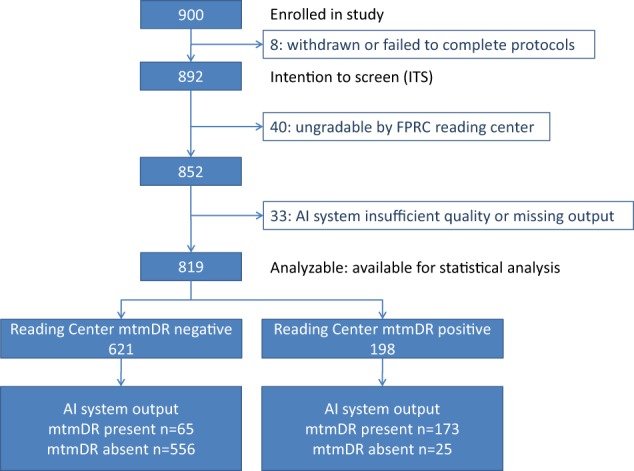
Artificial Intelligence (AI) has long promised to increase healthcare affordability, quality and accessibility but FDA, until recently, had never authorized an autonomous AI diagnostic system. This pivotal trial of an AI system to detect diabetic retinopathy (DR) in people with diabetes enrolled 900 subjects, with no history of DR at primary care clinics, by comparing to Wisconsin Fundus Photograph Reading Center (FPRC) widefield stereoscopic photography and macular Optical Coherence Tomography (OCT), by FPRC certified photographers, and FPRC grading of Early Treatment Diabetic Retinopathy Study Severity Scale (ETDRS) and Diabetic Macular Edema (DME). More than mild DR (mtmDR) was defined as ETDRS level 35 or higher, and/or DME, in at least one eye. AI system operators underwent a standardized training protocol before study start. Median age was 59 years (range, 22–84 years); among participants, 47.5% of participants were male; 16.1% were Hispanic, 83.3% not Hispanic; 28.6% African American and 63.4% were not; 198 (23.8%) had mtmDR. The AI system exceeded all pre-specified superiority endpoints at sensitivity of 87.2% (95% CI, 81.8–91.2%) (>85%), specificity of 90.7% (95% CI, 88.3–92.7%) (>82.5%), and imageability rate of 96.1% (95% CI, 94.6–97.3%), demonstrating AI’s ability to bring specialty-level diagnostics to primary care settings. Based on these results, FDA authorized the system for use by health care providers to detect more than mild DR and diabetic macular edema, making it, the first FDA authorized autonomous AI diagnostic system in any field of medicine, with the potential to help prevent vision loss in thousands of people with diabetes annually. ClinicalTrials.gov NCT02963441
Overview
The claims and statistics of this paper haven’t been checked yet.
Free: it reads the open-access text and checks the first 5 claims that cite a source we can check. Create a free account to check every claim.
Integrity signals
Registry
Cites
Statistics
Figures
Verification
Claims the paper makes
The claims and statistics of this paper haven’t been checked yet.
Free: it reads the open-access text and checks the first 5 claims that cite a source we can check. Create a free account to check every claim.
Claims other papers make about this one
Each is checked against this paper’s own text: does it say what the citing paper says it does?
The cited source doesn’t support the claim as written.
In the citing paper
“The regulatory approval of the first diagnostic autonomous AI system for diabetic eye exams was based on a pivotal trial against a prognostic standard, i.e., patient outcome24, showing its safety, efficacy, and lack of racial and ethnic bias for diagnosing DED in adults with diabetes with 87% sensitivity and 91% specificity24.”
From Autonomous artificial intelligence increases screening and follow-up for diabetic retinopathy in youth: the ACCESS randomized control trial (2024) · cites this paper as [24]
Checked by a reasoning model — may be wrong.
Experimental — accuracy not yet measuredThe source backs part of the claim, not all of it — or backs it for a different population, condition or comparison.
In the citing paper
“Only eight studies in ophthalmology imaging14,21,32,33,43,55,108,109, ten studies in respiratory imaging64,66,70,72,75,79,82,87,89,110 and six studies in breast imaging62,91,97,104,106,111 mentioned adherence to the STARD-2015 guidelines or had a STARD flow diagram in the manuscript.”
From Diagnostic accuracy of deep learning in medical imaging: a systematic review and meta-analysis (2021) · cites this paper as [14]
Experimental — accuracy not yet measuredThe source backs part of the claim, not all of it — or backs it for a different population, condition or comparison.
In the citing paper
“These systems use large annotated datasets to learn hierarchical features directly from images, improving reproducibility and reducing reliance on manual feature engineering [27,34].”
From Artificial Intelligence in Clinical Decision-Making: A Comprehensive Review of Diagnostic, Prognostic, and Therapeutic Applications, Validation Gaps, Bias, and Deployment Challenges (2026) · cites this paper as [27]
Experimental — accuracy not yet measuredThe source backs part of the claim, not all of it — or backs it for a different population, condition or comparison.
In the citing paper
“In clinical workflows, AI supports triage prioritisation, second-opinion review, and reduction of diagnostic variability in high-volume settings [15,27].”
From Artificial Intelligence in Clinical Decision-Making: A Comprehensive Review of Diagnostic, Prognostic, and Therapeutic Applications, Validation Gaps, Bias, and Deployment Challenges (2026) · cites this paper as [27]
Experimental — accuracy not yet measuredThe source backs part of the claim, not all of it — or backs it for a different population, condition or comparison.
In the citing paper
“Adoption in clinical practice is influenced by clinician interaction with AI systems, including trust and workflow compatibility [23,27].”
From Artificial Intelligence in Clinical Decision-Making: A Comprehensive Review of Diagnostic, Prognostic, and Therapeutic Applications, Validation Gaps, Bias, and Deployment Challenges (2026) · cites this paper as [27]
Experimental — accuracy not yet measured
18 more claims about this paper
Create a free account to see every claim other papers make about this one.
Self-check
Percentages, sums and reported differences re-computed from the paper’s own numbers.
The self-check needs the paper’s full text.
Citations
Cites
ImageNet classification with deep convolutional neural networks
Krizhevsky, A., Sutskever, I., & Hinton, G. E. (2017) · Communications of the ACM · doi:10.1145/3065386 · Cited by 112,155
Diagnosis and Classification of Diabetes Mellitus
American Diabetes Association (2011) · Diabetes Care · doi:10.2337/dc11-s062 · Cited by 13,988
Gulshan, V., Peng, L., Coram, M., Stumpe, M. C., Wu, D., Narayanaswamy, A., Venugopalan, S., Widner, K., Madams, T., Cuadros, J., et al. (2016) · JAMA · doi:10.1001/jama.2016.17216 · Cited by 7,697
Centers for Disease Control and Prevention
(2007) · Encyclopedia of Measurement and Statistics · doi:10.4135/9781412952644.n74 · Cited by 6,444
Diagnosis and classification of diabetes mellitus
American Diabetes Association (2014) · Diabetes Care · doi:10.2337/dc14-s081 · Cited by 5,974
(2007) · Developments in Ophthalmology · doi:10.1159/isbn.978-3-318-01439-6 · Cited by 5,583
Bias reduction of maximum likelihood estimates
FIRTH, D. (1993) · Biometrika · doi:10.1093/biomet/80.1.27 · Cited by 5,035
Wilkinson, C. P., Ferris, F. L., Klein, R. E., Lee, P. P., Agardh, C. D., Davis, M., Dills, D., Kampik, A., Pararajasegaram, R., & Verdaguer, J. T. (2003) · Ophthalmology · doi:10.1016/s0161-6420(03)00475-5 · Cited by 3,743
Classification and Diagnosis of Diabetes
Fajans, S. S. (1990) · Medical Entomology and Zoology · Cited by 2,359
Research works printed but not linked: 1
- Centers for Disease Control and Prevention. Diabetes Report Card 2012 2012 Atlanta, GA U.S. Department of Health and Human Services
Cited by
Items 701–800 of 1,004
Kikukawa, Y., Tanaka, S., Kosugi, T., & Pflugfelder, S. C. (2023) · PLoS ONE · doi:10.1371/journal.pone.0282973 · Cited by 15
“In recent years, there has been a lot of research on the use of artificial intelligence (AI) in the medical field, and an automated AI diagnostic system for diabetic retinopathy was approved by the United States Food and Drug Administration (USFDA) in 2018 [10].”
BackgroundTowards population-independent, multi-disease detection in fundus photographs
Matta, S. C., Lamard, M., Conze, P.-H., Guilcher, A. L., Lecat, C., Carette, R., Basset, F., Massin, P., Rottier, J.-B., Cochener, B., et al. (2023) · Scientific Reports · doi:10.1038/s41598-023-38610-y · Cited by 14
Phatak, S. B., Chakraborty, S., & Goel, P. (2023) · Frontiers in Medicine · doi:10.3389/fmed.2023.1280462 · Cited by 14
Healthcare Artificial Intelligence in India and Ethical Aspects
Sarkar, A., Singh, P., & Varkey, M. (2024) · Springer eBooks · doi:10.1007/978-981-97-0503-0_7 · Cited by 14
Smartphone-basierte Fundusfotografie: Anwendungen und Adapter
Jansen, L. G., Schultz, T., Holz, F. G., Finger, R. P., & Wintergerst, M. W. M. (2021) · Der Ophthalmologe · doi:10.1007/s00347-021-01536-9 · Cited by 15
Chiang, M. F., & Tumminia, S. J. (2021) · Ophthalmology · doi:10.1016/j.ophtha.2021.09.012 · Cited by 14
AI and Liability in Medicine: The Case of Assistive-Diagnostic AI
Rimkutė, D. (2024) · Baltic Journal of Law & Politics · doi:10.2478/bjlp-2023-0013 · Cited by 13
Integrating AI with tele-ophthalmology in Canada: a review
Balas, M., Micieli, J. A., & Wong, J. C. Y. (2024) · Canadian Journal of Ophthalmology · doi:10.1016/j.jcjo.2024.08.013 · Cited by 13
Similié, D. E., Andersen, J., Dinesen, S., Savarimuthu, T. R., & Grauslund, J. (2024) · Acta Ophthalmologica · doi:10.1111/aos.16781 · Cited by 13
Hosu, M. C., Faye, L. M., & Apalata, T. R. (2024) · Pathogens · doi:10.3390/pathogens13110923 · Cited by 14
“A first-of-its-kind independent approval was issued by the FDA in 2018 to IDx, an ML system, for detecting diabetic retinopathy [35].”
Huang, Y., Gong, D., Dang, K., Zhu, L., Guo, J., Yang, W., & Wang, J. (2024) · PeerJ · doi:10.7717/peerj.18611 · Cited by 13
Chen, Y., Song, F., Zhao, Z., Wang, Y., To, E., Liu, Y., Shi, D., Chen, X., Xu, L., Shang, X., et al. (2025) · Diabetes Research and Clinical Practice · doi:10.1016/j.diabres.2025.112161 · Cited by 13
Zhang, J., Tian, B., Tian, M., Si, X., Li, J., & Fan, T. (2025) · Frontiers in Medicine · doi:10.3389/fmed.2025.1573329 · Cited by 13
Real-world performance of an AI system for diabetic retinopathy screening
Berrada, L., Crenier, L., Lytrivi, M., Burniat, A., Motulsky, E. H., & Cnop, M. (2026) · Scientific Reports · doi:10.1038/s41598-026-37292-6 · Cited by 13
“First, the sample size is modest compared with larger multicenter studies 12,22,25 , which may limit the precision of subgroup analyses and the generalizability of some secondary findings.”
Li, H. H., Abraham, J. R., Sevgi, D. D., Srivastava, S. K., Hach, J. M., Whitney, J., Vasanji, A., Reese, J. L., & Ehlers, J. P. (2020) · Translational Vision Science & Technology · doi:10.1167/tvst.9.2.52 · Cited by 13
Fulbright, R., & Walters, G. (2020) · Lecture notes in computer science · doi:10.1007/978-3-030-50439-7_3 · Cited by 13
“In the field of diabetic retinopathy, a study evaluated the diagnostic performance of an autonomous artificial intelligence system, a cog, for the automated detection of diabetic retinopathy (DR) and Diabetic Macular Edema (DME) [48].”
BackgroundPeeters, F., Rommes, S., Elen, B., Gerrits, N., Stalmans, I., Jacob, J. A., & Boever, P. D. (2023) · Journal of Clinical Medicine · doi:10.3390/jcm12041408 · Cited by 13
Mayya, A. S. (2023) · International Conference on Neural Networks and Neurotechnologies (NeuroNT) · doi:10.1109/neuront58640.2023.10175853 · Cited by 14
“However, recent developments in deep learning and convolutional neural networks (CNNs) have shown promising results in the automatic detection of diabetic retinopathy from retinal images [2, 3].”
BackgroundAssessment of angle closure disease in the age of artificial intelligence: A review
Soh, Z. D., Tan, M., Nongpiur, M. E., Xu, B. Y., Friedman, D. S., Zhang, X., Leung, C. K.-S., Liu, Y., Koh, V., Aung, T., et al. (2023) · Progress in Retinal and Eye Research · doi:10.1016/j.preteyeres.2023.101227 · Cited by 13
Yao, H., Wu, Z., Gao, S. S., Guymer, R. H., Steffen, V., Chen, H., Hejrati, M., & Zhang, M. (2023) · Ophthalmology Science · doi:10.1016/j.xops.2023.100428 · Cited by 13
Blair, J., Rodriguez, J. N., Vitar, R. M. L., Stadelmann, M. A., González, R. A., Donate-López, J., Ciller, C., Apostolopoulos, S., Bermudez, C., & Zanet, S. I. D. (2023) · Translational Vision Science & Technology · doi:10.1167/tvst.12.11.38 · Cited by 13
“25,28 This approach offers a simpler and shorter screening process compared with the traditional two-image protocol but with equivalent performance.”
ResultNeri, G., Sharma, S., Ghezzo, B., Novarese, C., Olivieri, C., Tibaldi, D., Marolo, P., Russakoff, D. B., Oakley, J. D., Reibaldi, M., et al. (2025) · Eye · doi:10.1038/s41433-024-03585-1 · Cited by 13
“These efforts primarily focus on the automatic detection of microaneurysms in en face retinal images, such as fundus color photography and FA [30–33].”
How artificial intelligence is helping to prevent blindness
Ravindran, S. (2019) · Nature · doi:10.1038/d41586-019-01111-y · Cited by 13
Residual-CycleGAN Based Camera Adaptation for Robust Diabetic Retinopathy Screening
Yang, D., Yang, Y., Huang, T., Wu, B., Wang, L., & Xu, Y. (2020) · Lecture notes in computer science · doi:10.1007/978-3-030-59713-9_45 · Cited by 13
Artificial Intelligence in the assessment of diabetic retinopathy from fundus photographs
Gilbert, M. J., & Sun, J. K. (2020) · Seminars in Ophthalmology · doi:10.1080/08820538.2020.1855358 · Cited by 13
“5% specificity.(40) This device will be discussed further later in this review.”
BackgroundMorya, A. K., Gowdar, J., Kaushal, A., Makwana, N., Biswas, S., Raj, P., Hegde, S., Velis, G., Padua, W., Nazm, N., et al. (2021) · Clinical ophthalmology · doi:10.2147/opth.s289425 · Cited by 13
Deep learning: applications in retinal and optic nerve diseases
Charng, J., Alam, K., Swartz, G., Kugelman, J., Alonso‐Caneiro, D., Mackey, D. A., & Chen, F. K. (2022) · Clinical and Experimental Optometry · doi:10.1080/08164622.2022.2111201 · Cited by 13
“Moving past DR detection, DL has been utilised to identify DR lesions for disease severity grading, 37,38 which has implications in assisting clinical decision-making.”
Who wants accurate models? Arguing for a different metrics to take classification models seriouslyPreprint
Cabitza, F., & Campagner, A. (2019) · arXiv (Cornell University) · doi:10.48550/arxiv.1910.09246 · Cited by 14
Sen, C. K., & DeMazumder, D. (2025) · Advances in Wound Care · doi:10.1177/21621918251380217 · Cited by 14
Wolf, R. M., Channa, R., Lehmann, H. P., Abramoff, M. D., & Liu, T. Y. A. (2024) · Clinical Diabetes · doi:10.2337/cd23-0019 · Cited by 12
“The AI system of LumineticsCore (formerly IDx-DR) has an image quality algorithm that determines whether the images are of suf fi - cient quality for the diagnostic algorithm to process and provide a result (10).”
MethodInfluentialSelf-citationAbini, M. A., & Priya, S. S. S. (2025) · AIUB Journal of Science and Engineering (AJSE) · doi:10.53799/ajse.v23i3.1361 · Cited by 12
“An automatic AI-based diagnostic system that identified DR in a crucial analysis by Abramoff et al. [40] has now been approved by the Food and Drug Administration for use by healthcare professionals to identify mild DR and DMO.”
Transforming Preventive Healthcare with Machine Learning Technologies
Karataş, M., Zare, Z., & Zheng, Y. (2025) · Journal of Operations Intelligence · doi:10.31181/jopi31202538 · Cited by 12
RiskPath: Explainable deep learning for multistep biomedical prediction in longitudinal data
de Lacy, N., Ramshaw, M. J., & Lam, W. Y. (2025) · Patterns · doi:10.1016/j.patter.2025.101240 · Cited by 12
The Role of Artificial Intelligence in the Diagnosis and Management of Diabetic Retinopathy
Ansari, A., Ansari, N. M., Khalid, U., Markov, D., Bechev, K. I., Aleksiev, V., Markov, G., & Poryazova, E. G. (2025) · Journal of Clinical Medicine · doi:10.3390/jcm14145150 · Cited by 12
Shen, S., Qi, W., Li, S., Zeng, J., Liu, X., Zhu, X., Dong, C., Wang, B., Xu, Q., & Cao, S. (2025) · Digital Health · doi:10.1177/20552076251361614 · Cited by 12
Hu, F., Shao, Y., Liu, J., Liu, J., Xiao, X., Shi, K., Zheng, Y., Zhang, J., & Wang, X. (2025) · Frontiers in Medicine · doi:10.3389/fmed.2025.1667087 · Cited by 12
Precision Medicine for Diabetic Retinopathy: Integrating Genetics, Biomarkers, Lifestyle, and AI
Kaurich, C., Mahajan, N. S., & Bhatwadekar, A. D. (2025) · Genes · doi:10.3390/genes16091096 · Cited by 12
Khan, A. Y. R., & Malik, M. B. (2025) · Cureus · doi:10.7759/cureus.96121 · Cited by 13
“The pivotal autonomous system used a single desktop non-mydriatic camera with a 45° field of view and specified capture criteria [2].”
Murray, N. M., Phan, P., Hager, G., Menard, A., Chin, D., Liu, A., & Hui, F. K. (2022) · The Neuroradiology Journal · doi:10.1177/19714009211067408 · Cited by 12
“27 Likewise, there is currently no NTAP counterpart for outpatient based services to encourage adoption of innovative technologies.”
BackgroundGobbi, J. D., Braga, J. P. R., de Lucena, M. M., Bellanda, V. C. F., Frasson, M. V. S., Ferraz, D., Koh, V., & Jorge, R. (2022) · International Journal of Retina and Vitreous · doi:10.1186/s40942-022-00388-y · Cited by 12
Atalay, S., & SÖNMEZ, U. (2023) · Springer eBooks · doi:10.1007/978-981-99-0252-1_10 · Cited by 12
Multitask Learning for Activity Detection in Neovascular Age-Related Macular Degeneration
Ayhan, M. S., Faber, H., Kuehlewein, L., INHOFFEN, W., Aliyeva, G., Ziemssen, F., & Berens, P. (2023) · Translational Vision Science & Technology · doi:10.1167/tvst.12.4.12 · Cited by 13
Centroid Distance Distillation for Effective Rehearsal in Continual Learning
Liu, D., Lyu, F., Li, L., Xia, Z., & Hu, F. (2023) · IEEE International Conference on Acoustics Speech and Signal Processing · doi:10.1109/icassp49357.2023.10094837 · Cited by 13
“Continual Learning (CL) is used to enable a machine learning system to learn from a sequence of tasks like humans [1], which has been applied to many applications, such as the recommender systems [2], medical research [3, 4] and clinical management decisions [5].”
MethodLi, W., Bian, L., Ma, B., Sun, T., Liu, Y., Sun, Z., Zhao, L., Feng, K., Yang, F., Wang, X., et al. (2024) · Diagnostics · doi:10.3390/diagnostics14020121 · Cited by 12
“Deep learning techniques, especially convolutional neural networks (CNNs), have exhibited remarkable success in various image recognition tasks, including the analysis of fundus images for DR [15,16,18–25], RVO [26–29], and AMD [30–36].”
BackgroundPiatti, A., Rui, C., Gazzina, S., Tartaglino, B., Romeo, F., Manti, R., Doglio, M., Nada, E., & Giorda, C. B. (2024) · European Journal of Ophthalmology · doi:10.1177/11206721241272229 · Cited by 12
Choubey, U., Upadrasta, V. A., Kaur, I. P., Banker, H., Kanagala, S. G., Anamika, F., Virmani, M., & Jain, R. (2024) · The Egyptian Journal of Internal Medicine · doi:10.1186/s43162-024-00373-x · Cited by 12
Learning to Address Health Inequality in the United States with a Bayesian Decision Network
Sethi, T., Mittal, A., Maheshwari, S., & Chugh, S. (2019) · Proceedings of the AAAI Conference on Artificial Intelligence · doi:10.1609/aaai.v33i01.3301710 · Cited by 12
Artificial Intelligence in Hematology
Luchinin, A. S. (2022) · Clinical oncohematology · doi:10.21320/2500-2139-2022-15-1-16-27 · Cited by 12
Soh, Z. D., Jiang, Y., Ganesan, S. S. S. O., Zhou, M., Nongiur, M., Majithia, S., Tham, Y. C., Rim, T. H., Qian, C., Koh, V., et al. (2023) · PLOS Digital Health · doi:10.1371/journal.pdig.0000193 · Cited by 12
Diving Deep into Deep Learning: an Update on Artificial Intelligence in Retina
Goldhagen, B. E., & Al-khersan, H. (2020) · Current Ophthalmology Reports · doi:10.1007/s40135-020-00240-2 · Cited by 12
“5%, respectively, for the detection of “more thanmild diabetic retinopathy” [15].”
BackgroundMethodThe eye in AI: artificial intelligence in ophthalmology
Keel, S., & van Wijngaarden, P. (2018) · Clinical and Experimental Ophthalmology · doi:10.1111/ceo.13435 · Cited by 12
“Another recent publication with profound implications for the implementation of AI systems in the clinic describes the evaluation of a deep learning system for the detection of referable diabetic retinopathy (>mild NPDR and/or DME).(4) The trial included 900 participants with diabetes who were recruited from 10 primar…”
BackgroundEvaluation and Care of Patients with Diabetic Retinopathy
Folk, J. C., & Abràmoff, M. D. (2020) · New England Journal of Medicine · doi:10.1056/nejmc2018871 · Cited by 12
Self-citationPerformance of ChatGPT on Clinical Medicine Entrance Examination for Chinese Postgraduate in ChinesePreprint
Liu, X., Fang, C., Yan, Z., Liu, X., Jiang, Y., Cao, Z., Wu, M., Chen, Z., Ma, J., Yu, P., et al. (2023) · medRxiv · doi:10.1101/2023.04.12.23288452 · Cited by 12
Readiness for Artificial Intelligence in Biobanking
Grossman, G., & Henderson, M. K. (2023) · Biopreservation and Biobanking · doi:10.1089/bio.2023.29121.editorial · Cited by 13
Eli, A. A., & Ali, A. (2024) · arXiv (Cornell University) · doi:10.48550/arxiv.2410.14131 · Cited by 12
“Convolutional neural networks (CNNs) have demonstrated excellent accuracy in detecting diabetic retinopathy in retinal fundus pictures, which, if caught in its early stages, can avoid blindness [11].”
BackgroundDiabetic retinopathy screening model in low and middle-income countries: a scoping review
Lestari, Y. D., Sitompul, R., Widyahening, I. S., Tahapary, D. L., Yusuf, P. A., Sasongko, M. B., Riono, P., Nursakina, Y., & Alexandra, G. (2025) · BMC Public Health · doi:10.1186/s12889-025-25543-6 · Cited by 11
“To achieve effective workflow in the screening process, training programs are essential to reduce ungradable rates further and maintain image quality [46].”
Artificial Intelligence in Medicine
Malik, M., Tariq, M. I., Kamran, M., & Naqvi, M. R. (2021) · Smart Innovation, Systems and Technologies · doi:10.1007/978-981-16-1209-1_15 · Cited by 11
Rahmati, M., Smith, L., Piyasena, M. P., Bowen, M., Boyer, L., Fond, G., Kazemi, A., Yon, D. K., Lee, H., Sehmbi, T., et al. (2025) · Eye · doi:10.1038/s41433-025-03849-4 · Cited by 11
“Moreover A1 systems have been shown to have 87% sensitivity and 91% specificity [34], providing rapid results, has the potential of offering immediate patient counselling and eye health education in needed, is devoid of human error and has the potential to reduce workload and improve efficiency,…”
Bhambhwani, V., Whitestone, N., Patnaik, J. L., Ojeda, A., Scali, J., & Cherwek, D. H. (2025) · Ophthalmic Epidemiology · doi:10.1080/09286586.2024.2434738 · Cited by 11
Cao, J., Sun, X., Sun, L. Z., Song, H., Niu, K., & He, Z. (2023) · Eye & Contact Lens Science & Clinical Practice · doi:10.1097/icl.0000000000001054 · Cited by 11
Li, X., & Abangbila, L. (2024) · Journal of Infrastructure Policy and Development · doi:10.24294/jipd.v8i11.7923 · Cited by 11
“For instance, algorithms are able to diagnose diabetic retinopathy disorders related to the eye just as well as trained doctors (Abràmoff et al., 2018; Gulshan et al., 2016) with expert precision (Haenssle et al., 2018), skin cancer can be detected by apps like Skin Vision.”
BackgroundDiabetic retinopathy—recommendations for screening and treatment
Pedrini, A., Nowosielski, Y., & Rehák, M. (2025) · Wiener Medizinische Wochenschrift · doi:10.1007/s10354-025-01088-6 · Cited by 11
“This was further supported by Abràmoff et al. (2018), whose deep learning algorithm for DR detection showed high quality in a multicenter study, with a sensitivity of 87% and specificity of 91%, thus providing a reliable tool for early diagnosis [43].”
The march to harmonized imaging standards for retinal imaging
Gim, N., Ferguson, A. N., Blazes, M. S., Lee, C. S., & Lee, A. (2025) · Progress in Retinal and Eye Research · doi:10.1016/j.preteyeres.2025.101363 · Cited by 13
“Since its implementation, the usage of LumineticsCore ™ in primary care settings has been shown to yield high diagnostic accuracy (Abr ` amoff et al., 2018; Savoy, 2020; Verbraak et al., 2019).”
Hu, L., Wang, J., Zhang, H., & Huang, H.-Y. (2025) · Frontiers in Cell and Developmental Biology · doi:10.3389/fcell.2025.1608580 · Cited by 10
Federated multimodal AI for precision-equitable diabetes care
Bai, B., Liu, X., & Li, H. Q. (2026) · Frontiers in Digital Health · doi:10.3389/fdgth.2025.1678047 · Cited by 12
Agrawal, L., Agrawal, P. K., Agrawal, S. S., Sonune, M. S., Kadu, R. K., Kulkarni, M. B., & Bhaiyya, M. L. (2026) · Graefe s Archive for Clinical and Experimental Ophthalmology · doi:10.1007/s00417-026-07273-6 · Cited by 12
COVID-19 Launches Retinal Telemedicine into the Next Frontier
Raparia, E., & Husain, D. (2021) · Seminars in Ophthalmology · doi:10.1080/08820538.2021.1893352 · Cited by 11
“speed of processing retinal images, several companies have developed automated diabetic retinopathy screening solutions.(30,31) While encouraging, these automated image algorithms still require refinement to improve clinical validity.”
BackgroundThrough the eyes into the brain, using artificial intelligence
Sathianvichitr, K., Lamoureux, O., Nakada, S., Tang, Z., Schmetterer, L. F., Chen, C., Cheung, C. Y.-L., Najjar, R. P., & Miléa, D. (2023) · Annals of the Academy of Medicine Singapore · doi:10.47102/annals-acadmedsg.2022369 · Cited by 11
Artificial Intelligence (AI) in pediatric endocrinology
Winkelman, J., Nguyen, D., vanSonnenberg, E., Kirk, A. F., & Lieberman, S. A. (2023) · Journal of Pediatric Endocrinology and Metabolism · doi:10.1515/jpem-2023-0287 · Cited by 12
The use of artificial intelligence to assess diabetic eye disease among the Greenlandic population
Larsen, T. J., Pettersen, M. B., Jensen, H. N., Pedersen, M. L., Lund‐Andersen, H., Jørgensen, M. E., & Byberg, S. (2024) · International Journal of Circumpolar Health · doi:10.1080/22423982.2024.2314802 · Cited by 11
“The approach should have a high sensitivity and specificity as there is no human check involved, in order to be applied in a clinical setting [30].”
BackgroundInfluentialLee, D., Choi, Y. J., Lee, S. J., Kang, H. G., & Park, Y. R. (2024) · Scientific Reports · doi:10.1038/s41598-024-55054-0 · Cited by 11
", S., Невська, А. О., Pohosian, O. A., Goncharuk, K. O., Sofyna, D. F., Chernenko, O. O., Enterprise, M. P., Tronko, К. M., Kozhan, N. I., & Korol, A. R. (2024) · Oftalmologicheskii Zhurnal · doi:10.31288/oftalmolzh202412731 · Cited by 11
Diagnostic decisions of specialist optometrists exposed to ambiguous deep-learning outputs
Carmichael, J., Costanza, E., BLANDFORD, A. E., Struyven, R., Keane, P. A., & Balaskas, K. (2024) · Scientific Reports · doi:10.1038/s41598-024-55410-0 · Cited by 11
Autonomous artificial intelligence versus teleophthalmology for diabetic retinopathy
Musetti, D., Cutolo, C. A., Bonetto, M., Giacomini, M. L., Maggi, D. C., Viviani, G. L., Gandin, I., Traverso, C. E., & Nicolò, M. (2024) · European Journal of Ophthalmology · doi:10.1177/11206721241248856 · Cited by 11
Ong, J., Jang, K. J., Baek, S. J., Hu, D., Lin, V., Jang, S., Thaler, A., Sabbagh, N., Saeed, A., Kwon, M., et al. (2024) · Asia-Pacific Journal of Ophthalmology · doi:10.1016/j.apjo.2024.100095 · Cited by 12
“15,16 In 2018, Abramoff et al. 17 demonstrated the ability to autonomously detect DR in a primary care setting using fundus photography and OCT. 17 This model, IDx-DR, became the first FDA cleared AI diagnostic tool in any field of medicine.”
Nguyen, V., Iyengar, S., Rasheed, H., Apolo, G., Li, Z., Kumar, A., Nguyen, H., Bohner, A. D., Bolo, K. A., Dhodapkar, R. M., et al. (2025) · Ophthalmology Science · doi:10.1016/j.xops.2025.100751 · Cited by 11
Tewari, Y., Parihar, N. S., Rautela, K., Kaundal, N., Diwakar, M., & Pandey, N. K. (2025) · Biomedical Informatics and Smart Healthcare · doi:10.62762/bish.2025.724307 · Cited by 11
“In the area of Healthcare, Abramoff et al. [1] explored a key trail on Autonomous AI-Based Diagnostic System for Diabetic Retinopathy.”
Accountability, secrecy, and innovation in AI-enabled clinical decision software
Rai, A. K., Sharma, I., & Silcox, C. (2020) · Journal of Law and the Biosciences · doi:10.1093/jlb/lsaa077 · Cited by 11
Deep Learning for Diabetic Retinopathy Prediction
Rodriguez-León, C., William, A., Baños, O., & Villalonga, C. (2021) · Lecture notes in computer science · doi:10.1007/978-3-030-85030-2_44 · Cited by 11
“DenseNet121, a variant of DenseNet, are architectures inspired by ResNet, but instead of residual connections, dense blocks are used, consisting of convolution layers placed sequentially, similar to VGG, but each layer is connected to all subsequent layers.”
ResultInfluentialSegmenting The Kidney On CT Scans Via Crowdsourcing
Mehta, P. P., Sandfort, V., Gheysens, D., Braeckevelt, G.-J., Berte, J., & Summers, R. M. (2019) · IEEE International Symposium on Biomedical Imaging (ISBI) · doi:10.1109/isbi.2019.8759240 · Cited by 11
Quinn, N. B., Brazionis, L., Zhu, B., Ryan, C. D., D’Aloisio, R., Tang, L. H. Y., Pető, T., & Jenkins, A. J. (2021) · Diabetic Medicine · doi:10.1111/dme.14582 · Cited by 11
Najeeb, B. H., Deák, G. G., Schmidt-Erfurth, U. M., & Gerendas, B. S. (2021) · Acta Ophthalmologica · doi:10.1111/aos.14866 · Cited by 11
“In time, retina specialists could differentiate MNV types using artificial intelligenceassisted cameras as currently in diabetic retinopathy (Abr amoff et al. 2018).”
BackgroundThe 2021 National Eye Institute Strategic Plan—Relating Vision to Health and Quality of Life
Chiang, M. F. (2021) · JAMA Ophthalmology · doi:10.1001/jamaophthalmol.2021.4774 · Cited by 11
Application of deep learning algorithms for diabetic retinopathy screening
Poschkamp, B., & Stahl, A. (2022) · Annals of Translational Medicine · doi:10.21037/atm-2022-73 · Cited by 11
“This is also possible with the IDx-DR system (8,11).”
Low responsiveness of machine learning models to critical or deteriorating health conditions
Pias, T. S., Afrose, S., Tuli, M. D., Trisha, I. H., Deng, X., Nemeroff, C. B., & Yao, D. D. (2025) · Communications Medicine · doi:10.1038/s43856-025-00775-0 · Cited by 10
Hunt, V. M., Sprehe, L. K., de Lomba, W. C., Gameiro, R. R., Woite, N. L., Wade, C. G., Chen, J. H., Rougas, S. C., Fraser, H. S. F., Sullivan, A. M., et al. (2026) · npj Digital Medicine · doi:10.1038/s41746-026-02761-9 · Cited by 10
Realistic fundus photograph generation for improving automated disease classification
Pandey, P. U., Micieli, J. A., Tone, S. O., Eng, K. T., Kertes, P. J., & Wong, J. C. Y. (2025) · British Journal of Ophthalmology · doi:10.1136/bjo-2024-326122 · Cited by 10
“9 10 Given the recent United States Food and Drug Administration approval of autonomous single-disease screening algorithms for diabetic retinopathy (DR), 11 12 the next step will be to develop accurate classifiers for multidisease screening.”
A Deep Learning Segmentation Model for Detection of Active Proliferative Diabetic Retinopathy
Dinesen, S., Schou, M. G., Hedegaard, C. V., Subhi, Y., Savarimuthu, T. R., Pető, T., Andersen, J., & Grauslund, J. (2025) · Ophthalmology and Therapy · doi:10.1007/s40123-025-01127-w · Cited by 10
“However, given the inclusion of a very limited number of 16–70 images with PDR [11, 27], these have not been developed to detect PDR nor distinguish between active and inactive disease.”
InfluentialLin, A. L., Parrish, A. B., Cary, M. P., Silcox, C., Balu, S., Jelovsek, J. E., O’Brien, C. L., Pencina, M. J., Poon, E. G., & Economou-Zavlanos, N. (2025) · Annual Review of Biomedical Data Science · doi:10.1146/annurev-biodatasci-103123-094601 · Cited by 10
Baskar, V., Vignesh, M. A., Raman, S. C., Jijo, A., Bhavadharini, B., Steckhan, N., Roth, L. M. K., Siddiqui, M. K., Jebarani, S., Unnikrishnan, R., et al. (2025) · PLOS Digital Health · doi:10.1371/journal.pdig.0000702 · Cited by 11
“%) in DR detection [26].”
Artificial Intelligence in Personalized Medicine for Diabetes Mellitus: A Narrative Review
Ghosh, K., Chandra, S., Ghosh, S., & Ghosh, U. S. (2025) · Cureus · doi:10.7759/cureus.91520 · Cited by 10
“The utility and impact of lipid and HbA1c variability for risk assessment and survival analysis in diabetes were examined using regularized and weighted Random Survival Forest (RSF) models [52].”
Machine Learning to Diagnose Complications of Diabetes
Scheideman, A. F., Shao, M. M., Zelada, H., Cuadros, J. A., Foreman, J., Sarder, P., Ho, C., Ejskjær, N., Fleischer, J., Cichosz, S. L., et al. (2025) · Journal of Diabetes Science and Technology · doi:10.1177/19322968251365245 · Cited by 11
“29 Recent systematic reviews support the broader accuracy of ML screeners.”
Selvaraj, C., Cho, W. C. S., Kulanthaivel, L., Alothaim, A. S., Vijayakumar, R., Jayaprakashvel, M., & Desai, D. (2025) · 3 Biotech · doi:10.1007/s13205-025-04518-9 · Cited by 12
“The AI Workflow returned results within 48 h, while other workflows took 7 days (Abràmoff et al. 2018).”
Current status and solutions for AI ethics in ophthalmology: a bibliometric analysis
Chen, X., Yang, Y., Yun, D., Wang, R., Lin, Y., Luo, M., Zhang, W., Yu‐Wai‐Man, P., Burton, M. J., Liang, L., et al. (2025) · npj Digital Medicine · doi:10.1038/s41746-025-01976-6 · Cited by 11
Wang, T.-W., Luo, W.-T., Tu, Y., Chou, Y.-B., & Wu, Y.-T. (2025) · American Journal of Ophthalmology · doi:10.1016/j.ajo.2025.09.045 · Cited by 10
The role of deep learning-based algorithms in retinal image processing: a review
Celik, C., & Yücedağ, İ. (2026) · Multimedia Tools and Applications · doi:10.1007/s11042-026-21181-1 · Cited by 10
Aldosari, H. (2026) · Healthcare · doi:10.3390/healthcare14111497 · Cited by 10
“The clinical validation of IDx-DR, an autonomous AI-based diagnostic system for detecting more-than-mild diabetic retinopathy, represented an important milestone in the translation of AI from research to regulated clinical use [8].”
Ilodigwe, L. (2026) · INTERNATIONAL JOURNAL OF MEDICAL EVALUATION AND PHYSICAL REPORT · doi:10.56201/ijmepr.v9.no7.2025.pg165.185 · Cited by 10
Artificial intelligence in preventive and managed healthcare
Shenoy, S., Sanap, G., Paul, D., Desai, N., Tambe, V., Kalyane, D., & Tekade, R. K. (2021) · Elsevier eBooks · doi:10.1016/b978-0-12-814425-1.00003-6 · Cited by 10
Telehealth Screening for Diabetic Retinopathy: Economic Modeling Reveals Cost Savings
Curran, D., Kim, B. Y., Withers, N., Shepard, D. S., & Brady, C. J. (2022) · Telemedicine Journal and e-Health · doi:10.1089/tmj.2021.0352 · Cited by 10
Metadata
- Authors
- Abràmoff, M. D., Lavin, P. T., Birch, M., Shah, N., & Folk, J. C.
- Affiliations
- University of Iowa (US)
- University of North Carolina at Charlotte (US)
- Emmes (United States) (US)
- Corresponding author
- Abràmoff, Michael D.
- Venue
- npj Digital Medicine
- Published
- 2018-08-28
- Volume
- 1
- Issue
- 1
- Pages
- 39-39
- ISSN
- 2398-6352 (ISSN-L)
- PMC
- PMC6550188
- OpenAlex
- W2888424632
- Cited by
- 1,638
- References
- 61
- Citations by year
- 2026: 332 · 2025: 276 · 2024: 226 · 2023: 193 · 2022: 172 · 2021: 183 · 2020: 173 · 2019: 73 · 2018: 10
- FWCI
- 75.83
- Type
- journal article
- Language
- en
- Open access
- gold
- doi.org
- Licence
- cc-by
- creativecommons.org/licenses/by/4.0 (tdm)
- creativecommons.org/licenses/by/4.0 (vor)
- Locations
- npj Digital Medicine (publishedVersion, cc-by)
- Europe PMC (PubMed Central) (publishedVersion, cc-by)
- PubMed Central (publishedVersion, cc-by)
- PubMed (publishedVersion)
- DOAJ (DOAJ: Directory of Open Access Journals) (submittedVersion)
- Funders
- IDx LLC, Coralville, IA
- Topics
- Health Sciences › Medicine › Radiology, Nuclear Medicine and Imaging › Retinal Imaging and Analysis
- Health Sciences › Medicine › Ophthalmology › Retinal Diseases and Treatments
- Health Sciences › Medicine › Health Informatics › Artificial Intelligence in Healthcare and Education
- Keywords
- diabetic retinopathy, diabetic macular edema, autonomous AI systems, FDA approval, primary care, fundus photography, optical coherence tomography, sensitivity and specificity, imageability, blindness prevention, diabetes mellitus
About these checks
Registry, retraction, Cites and statistics results are computed, not judged, with one exception: a printed reference that no index lists is read once by a model before it counts as a citation error. Claims are extracted by a model and kept only when their quote appears verbatim in the text; each cited source is then checked, with a model’s help, for whether it says what the claim relies on. Those verdicts can be wrong — read the claim’s quote and the cited source before relying on one.
Statistics and arithmetic are recomputed, not judged.
Confidence bands are shown only for fields calibrated on our annotated test set. None is calibrated yet, so no band is shown.
What counts as a claim ›How we measure confidence ›How we check this ›
Are you an author, or do you see a problem with this page? Request a review
Data sources
Bibliographic data: Semantic Scholar, OpenAlex, Crossref.
Contains information from the Semantic Scholar Academic Graph Datasets, made available under the ODC Attribution License (ODC-BY 1.0).
Semantic Scholar’s data is described in: Kinney, R., et al. (2023). The Semantic Scholar Open Data Platform. arXiv:2301.10140.
