

The state of artificial intelligence-based FDA-approved medical devices and algorithms: an online database
Open accessThe DOI matches its Crossref record; 24 of the 24 references it cites were found in a registry or an index.
Abstract
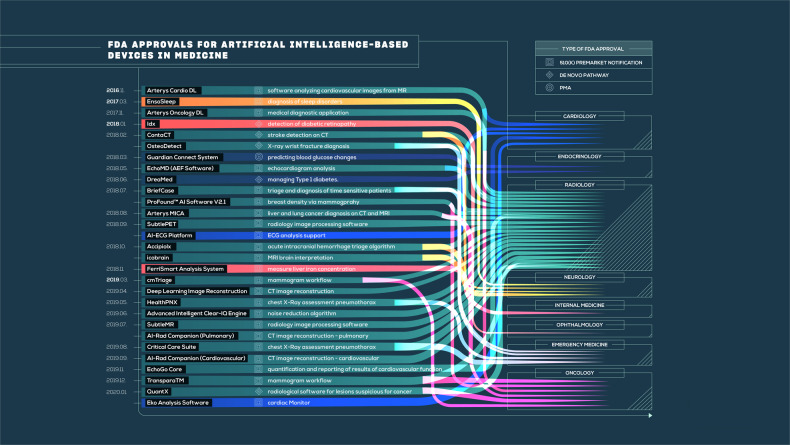
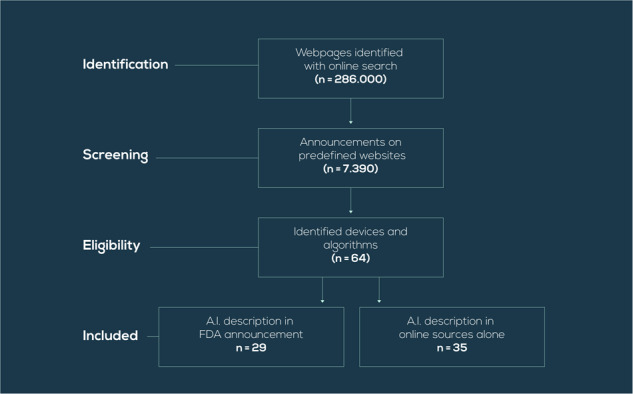
At the beginning of the artificial intelligence (AI)/machine learning (ML) era, the expectations are high, and experts foresee that AI/ML shows potential for diagnosing, managing and treating a wide variety of medical conditions. However, the obstacles for implementation of AI/ML in daily clinical practice are numerous, especially regarding the regulation of these technologies. Therefore, we provide an insight into the currently available AI/ML-based medical devices and algorithms that have been approved by the US Food & Drugs Administration (FDA). We aimed to raise awareness of the importance of regulatory bodies, clearly stating whether a medical device is AI/ML based or not. Cross-checking and validating all approvals, we identified 64 AI/ML based, FDA approved medical devices and algorithms. Out of those, only 29 (45%) mentioned any AI/ML-related expressions in the official FDA announcement. The majority (85.9%) was approved by the FDA with a 510(k) clearance, while 8 (12.5%) received de novo pathway clearance and one (1.6%) premarket approval (PMA) clearance. Most of these technologies, notably 30 (46.9%), 16 (25.0%), and 10 (15.6%) were developed for the fields of Radiology, Cardiology and Internal Medicine/General Practice respectively. We have launched the first comprehensive and open access database of strictly AI/ML-based medical technologies that have been approved by the FDA. The database will be constantly updated.
Overview
The claims and statistics of this paper haven’t been checked yet.
Free: it reads the open-access text and checks the first 5 claims that cite a source we can check. Create a free account to check every claim.
Integrity signals
Registry
Cites
Statistics
Figures
Verification
Claims the paper makes
The claims and statistics of this paper haven’t been checked yet.
Free: it reads the open-access text and checks the first 5 claims that cite a source we can check. Create a free account to check every claim.
Claims other papers make about this one
Each is checked against this paper’s own text: does it say what the citing paper says it does?
The source backs part of the claim, not all of it — or backs it for a different population, condition or comparison.
In the citing paper
“Dozens of companies have obtained US FDA and European CE approval for medical imaging AI 37 , and commercial markets have begun to form as sustainable business models are created.”
From Deep learning-enabled medical computer vision (2021) · cites this paper as [37]
Experimental — accuracy not yet measuredThe source backs part of the claim, not all of it — or backs it for a different population, condition or comparison.
In the citing paper
“The majority of AI interventions that are close to translation are in the field of medical diagnostics.3”
From Developing a reporting guideline for artificial intelligence-centred diagnostic test accuracy studies: the STARD-AI protocol (2021) · cites this paper as [3]
Experimental — accuracy not yet measuredThe source backs part of the claim, not all of it — or backs it for a different population, condition or comparison.
In the citing paper
“Moreover, diagnostics constitutes a substantial proportion of clinical AI focus, with most AI devices achieving regulatory approval thus far belonging to the diagnostic field 26 .”
From The STARD-AI reporting guideline for diagnostic accuracy studies using artificial intelligence (2025) · cites this paper as [26]
Experimental — accuracy not yet measuredThe cited source says what the claim attributes to it.
In the citing paper
“To date, 64 AI-powered medical devices and algorithms have been approved by the Food and Drug Administration in the United States [8].”
From Randomized Controlled Trials of Artificial Intelligence in Clinical Practice: Systematic Review (2022) · cites this paper as [8]
The cited source says what the claim attributes to it.
In the citing paper
“Another obstacle to the implementation of AI or ML in daily clinical practice is the regulation of these technologies [8].”
From Randomized Controlled Trials of Artificial Intelligence in Clinical Practice: Systematic Review (2022) · cites this paper as [8]
7 more claims about this paper
Create a free account to see every claim other papers make about this one.
Self-check
Percentages, sums and reported differences re-computed from the paper’s own numbers.
The self-check needs the paper’s full text.
Citations
Cites
High-performance medicine: the convergence of human and artificial intelligence
Topol, E. J. (2019) · Nature Medicine · doi:10.1038/s41591-018-0300-7 · Cited by 10,450 · cited 1×
“Despite its promise, the obstacles for implementation of AI/ML in daily clinical practice are numerous 10 .”
BackgroundWang, X., Peng, Y., Lu, L., Lu, Z., Bagheri, M., & Summers, R. M. (2017) · 2017 IEEE Conference on Computer Vision and Pattern Recognition (CVPR) · doi:10.1109/cvpr.2017.369 · Cited by 4,616
Deep Learning—A Technology With the Potential to Transform Health Care
Hinton, G. (2018) · JAMA · doi:10.1001/jama.2018.11100 · Cited by 667
Brown, J. M., Campbell, J. P., Beers, A., Chang, K., Ostmo, S., Chan, R. V. P., Dy, J., Erdogmus, D., Ioannidis, S., Kalpathy-Cramer, J., et al. (2018) · JAMA Ophthalmology · doi:10.1001/jamaophthalmol.2018.1934 · Cited by 657 · cited 1×
“Indeed, AI/ML-based technologies have been shown to support several medical specialties from radiology 2 and oncology 3 to ophthalmology 4 and general medical decision-making 5 .”
BackgroundArtificial Intelligence in Health Care: A Report From the National Academy of Medicine
Matheny, M. E., Whicher, D., & Thadaney Israni, S. (2020) · JAMA · doi:10.1001/jama.2019.21579 · Cited by 628
Wang, X., Peng, Y., Lu, L., Lu, Z., Bagheri, M., & Summers, R. M. (2019) · Advances in Computer Vision and Pattern Recognition · doi:10.1007/978-3-030-13969-8_18 · Cited by 371 · cited 1×
“Indeed, AI/ML-based technologies have been shown to support several medical specialties from radiology 2 and oncology 3 to ophthalmology 4 and general medical decision-making 5 .”
BackgroundLabovitz, D. L., Shafner, L., Reyes Gil, M., Virmani, D., & Hanina, A. (2017) · Stroke · doi:10.1161/strokeaha.116.016281 · Cited by 311
Horng, S., Sontag, D. A., Halpern, Y., Jernite, Y., Shapiro, N. I., & Nathanson, L. A. (2017) · PLOS ONE · doi:10.1371/journal.pone.0174708 · Cited by 310
van der Heijden, A. A., Abramoff, M. D., Verbraak, F., van Hecke, M. V., Liem, A., & Nijpels, G. (2018) · Acta Ophthalmologica · doi:10.1111/aos.13613 · Cited by 296
Artificial intelligence and the future of psychiatry: Insights from a global physician survey
Doraiswamy, P. M., Blease, C., & Bodner, K. (2020) · Artificial Intelligence in Medicine · doi:10.1016/j.artmed.2019.101753 · Cited by 253
Research works printed but not linked: 1
- Wang T Outpatient clinic process enhancement at children’s hospital: empoweredby information technology Chin. J. Hosp. Adm. 2018 34 753 755
Cited by
Items 901–1,000 of 1,000
Venture Capital Investments in Radiology From 2000 to 2023
Bikmal, A., Dhawan, R., Boyle, A. B., & Shay, D. (2025) · Journal of the American College of Radiology · doi:10.1016/j.jacr.2025.12.016 · Cited by 2
Doktorova, V., Goranov, G., & Nikolov, P. (2025) · Medicina · doi:10.3390/medicina61122229 · Cited by 1
“Robotic-assisted PCI has already demonstrated benefits in reducing operator radiation exposure, improving precision in stent deployment, and enabling remote interventions [49,50].”
Sobia Yasmin, S. A. (2025) · Review journal of neurological & medical sciences review. · doi:10.5281/zenodo.18161542 · Cited by 1
Yar, M. A. E., Ahmad, H. I., Ali, M., Hashir, Q., & Ahmad, A. (2026) · Journal of Saidu Medical College · doi:10.52206/jsmc.2026.16.1.1318 · Cited by 1
AI-Enabled Precision Echocardiography: Toward Personalized Cardiovascular Care
Saikhan, L. A. (2026) · Diagnostics · doi:10.3390/diagnostics16050694 · Cited by 1
“Collectively, these platforms have analyzed millions of echocardiograms, supporting feasibility and clinical utility in practice [66,67].”
InfluentialBold, B., Tokuda, B., Kashif, M. S., Fadzli, F., Wee, N. K., Kanwal, U., Nguyen, T. N., & Wah, N. P. S. (2026) · Japanese Journal of Radiology · doi:10.1007/s11604-026-01971-1 · Cited by 2
“Radiology now represents the largest clinical application area for AI-enabled software as a medical device, account - ing for the majority of regulatory-approved AI tools glob - ally [ 4 ].”
Phillips, V. (2026) · Journal of the American College of Radiology · doi:10.1016/j.jacr.2026.04.001 · Cited by 1
Modern Advancements in AI for Healthcare Diagnostics: Transforming Medical Care
Khan, N. A. (2026) · Advances in computational intelligence and robotics book series · doi:10.4018/407372 · Cited by 1
A narrative review on the use of artificial intelligence in cardiovascular medicine
Serour, M. H., Houri, H. A., Egaimi, M., Alshazly, A., Khan, A., & Khan, Z. U. (2026) · Cardiovascular Diagnosis and Therapy · doi:10.21037/cdt-2025-aw-595 · Cited by 2
“This approach holds the promise of constructing a comprehensive ‘digital twin’ for each patient, enabling highly accurate, dynamic risk assessment and therapy selection (60).”
InfluentialEvaluation of large language models for nursing support in maternal venous thromboembolism care
Li, C., Lin, Y., Chen, D.-P., & Huang, Y. (2026) · Frontiers in Public Health · doi:10.3389/fpubh.2026.1740254 · Cited by 1
Qualitative Framework for Evaluating Clinical Data Science Systems: Beyond Technical Validation
Heslin, S. M. (2026) · Healthcare Informatics Research · doi:10.4258/hir.2026.32.2.196 · Cited by 1
“The CARES framework for evaluating clinical data science systems Healthcare data are inherently heterogeneous, incomplete, and shaped by documentation practices within healthcare organizations.”
Empowering healthcare 5.0 with deep learning: techniques, trends, and future directions
Maji, P. K., Chakraborty, S., Sadiq, A., Basu, S., & Ghosh, K. (2026) · Artificial Intelligence Review · doi:10.1007/s10462-026-11593-8 · Cited by 2
Nosa-Ihaza, E. A., Edeh, E. C., Wol, W. B. G., & Okenwa, E. (2026) · Journal of the Egyptian National Cancer Institute · doi:10.1186/s43046-026-00371-w · Cited by 2
Bertók, T., Ivana, P., Jáné, E., Zuzana, B., & Jan, T. (2026) · Clinica Chimica Acta · doi:10.1016/j.cca.2026.121209 · Cited by 1
Rutka, B., Danieluk, A., Krata, N., & Mucha, K. (2026) · Journal of Clinical Medicine · doi:10.3390/jcm15135213 · Cited by 1
Warankar, S. A., & Kale, M. (2026) · Nigerian Journal of Technology · doi:10.67358/njt.2026.5970si · Cited by 1
“– [10], [11], [12] Fraudulent use of AI Jurisdictional policies differ in enactment and implementation [19], [20], Therefore, it is imperative to investigate how AI, which can be misused as a device of exploitation, can instead be leveraged to protect the well-being of the older generation[7], [8],…”
Vallée, A. (2026) · PLOS Digital Health · doi:10.1371/journal.pdig.0001610 · Cited by 1
Validating medical digital twins for clinical decision support: beyond predictive accuracy
Vallée, A. (2026) · JAMIA Open · doi:10.1093/jamiaopen/ooag160 · Cited by 2
“139 An instrumented digital twin is a knowledge-producing system, and its regulation must therefore address not only what it predicts, but also how it generates and updates its claims.”
Boughida, A., Kouahla, M. N., Benoughidene, A., Kouadria, A., & Kurulay, M. (2026) · The Journal of Supercomputing · doi:10.1007/s11227-026-08750-9 · Cited by 1
Valavarasu, S., Marathe, S. A., Kochar, S. K., & Mahapatra, T. (2026) · JAC-Antimicrobial Resistance · doi:10.1093/jacamr/dlag144 · Cited by 2
Apostol, L. L. A., Ștefan, C. S., Grecu, M., Moldovanu, S., Verga, G. I., Lungu, M., Prada, G. I., & Romila, A. (2026) · Life · doi:10.3390/life16081324 · Cited by 1
“Accuracy must be closely examined under strict clinical validation frameworks, continuous real-world performance monitoring, and thorough safety testing in order to protect patient safety and avoid potentially fatal diagnostic errors [36].”
Echo Chambers: Bias and Representation in Cardiac Imaging Datasets for Artificial Intelligence
Gorijavolu, R., Jaiswal, N., Pratap, J. S., Madapati, K., López, M. D. P. A., Leite, M., Muwanguzi, D. P., Izath, N., Samsel, K., Shoyombo, I., et al. (2026) · Current Cardiology Reports · doi:10.1007/s11886-026-02406-z · Cited by 1
“Developing and validating AI models often demands specialized expertise often concentrated in well-funded research environments [101–104].”
Danishuddin, Haque, M. A., Madhukar, G., Khan, S., Khan, S. N., & Kim, J.-J. (2026) · Biotechnology Advances · doi:10.1016/j.biotechadv.2026.109040 · Cited by 1
Beyond Regulatory Approval: Lifecycle Assurance for Clinical Artificial Intelligence
Shujaat, S. (2026) · Journal of Medical Systems · doi:10.1007/s10916-026-02466-2 · Cited by 1
“The increasing use of AI across clinical domains [ 10 – 13 ], alongside growing regulatory clearance of AI-enabled devices [13 –15], therefore expands the need for longitudinal governance.”
Leveraging artificial intelligence and machine learning in assisted reproductive technology
Jamil, K., & Rozati, R. (2025) · Journal of Reproductive Healthcare and Medicine · doi:10.25259/jrhm_21_2025 · Cited by 1
Carter, A. M., Dai, H., Phuyal, S., Lucke-Wold, B. P., Pierre, K., & Karsy, M. J. (2025) · Elsevier eBooks · doi:10.1016/b978-0-323-87760-2.00012-8 · Cited by 1
Artificial intelligence in endodontics: Current applications, challenges, and future directions
Ghivari Sheetal, B., & Kubasad, G. (2025) · IP Indian Journal of Conservative and Endodontics · doi:10.18231/j.ijce.13489.1763961046 · Cited by 1
Shafi, O., Mirzarakhimov, M., Martin, S., Gabriel, D. M., Chan, U. H., Phadnis, S., Asif, H., & Camacho, M. H. B. (2026) · Surgical Oncology · doi:10.1016/j.suronc.2026.102364 · Cited by 1
Adrejiya, P., Neshat, N., Patel, A. H., Shah, V., Patel, N. H., Frishman, W. H., & Aronow, W. S. (2026) · Cardiology in Review · doi:10.1097/crd.0000000000001268 · Cited by 1
Mahmoud, R., soliman, S. H., Tahir, F., & Elmageed, N. E. A. (2026) · The Egyptian Journal of Radiology and Nuclear Medicine · doi:10.1186/s43055-026-01728-w · Cited by 1
AI Applications Integrating Legal and Regulatory Perspectives in Mental Health: Systematic Review
Kandeel, M. E., Hamza, E. A., Abouahmed, A., Abdelaziz, G. M., Hashish, A., El-Wafa, T. A., Khalil, A., & Eldakak, A. (2026) · JMIR AI · doi:10.2196/84305 · Cited by 1
“However, there are, however, concerns regarding compliance and accountability, where around 45% of mental health applications do not have HIPAA-compliant encryption [33].”
InfluentialImage-Based Deep Learning for Cataract Diagnosis: Systematic Review and Meta-Analysis
Li, R., Li, H., Li, C., Li, S., Lei, L., & Tao, D. (2026) · Journal of Medical Internet Research · doi:10.2196/78869 · Cited by 1
“Many DL-based diagnostic tools have been approved by the US Food and Drug Administration (FDA), but they require further evaluation and independent quality review [15].”
Yue, S., Ginting, C. N., & ., L. (2026) · International Journal of Drug Delivery Technology · doi:10.25258/ijddt.16.47s.61 · Cited by 1
Cheng, Y., Zhou, C., Wang, P., Liu, H., & Han, Y. (2026) · Global Health & Medicine · doi:10.35772/ghm.2026.01058 · Cited by 1
Walston, S. L., Takita, H., Mitsuyama, Y., Sato, J., & Ueda, D. (2026) · European Radiology · doi:10.1007/s00330-026-12652-y · Cited by 1
Clinical applications of digital twin technology in In Vitro Fertilisation
Olawade, D. B., Abe, O. R., Nwazuo, K. E., Apena, T., Olawuyi, O. F., & Egbon, E. (2026) · Journal of Gynecology Obstetrics and Human Reproduction · doi:10.1016/j.jogoh.2026.103235 · Cited by 1
Artificial intelligence in drug development: From molecular discovery to precision medicine
Xie, T., Zhang, Z.-H., Wang, Y.-S., Wang, H., Chen, X., Han, F., & Shao, F. (2026) · Genes & Diseases · doi:10.1016/j.gendis.2026.102402 · Cited by 1
Dzokoto, S. K., Marrah, S. A., Computer, S. T. R., Arhin, K. M., Dzokoto, F. K., Nawaz, S., & Arisiya, E. (2026) · Journal of Scientific Reports · doi:10.58970/jsr.1238 · Cited by 1
Artificial intelligence in biomarker discovery for diseases: diagnostic and therapeutic prospects
Dinç, R., & Ardıç, N. (2026) · Signal Transduction and Targeted Therapy · doi:10.1038/s41392-026-02946-4 · Cited by 1
The Next Frontier of Healthcare: AI, Predictive Modeling, and Value-Based Care
Arshad, W., Arshad, M., Arshad, M., Muhammad Asjad, K. H. A. N., Khan, M., Shahid, F., Aslam, S., & Arooba (2026) · Medical and Life Sciences · doi:10.69565/mls.v5i1.463 · Cited by 1
A glimpse into the future of cardiology: how can advanced technologies lead to compassionate care?
Meskó, B. (2021) · European Heart Journal · doi:10.1093/eurheartj/ehab167 · Cited by 1
Self-citationГеннадьевич, М. П., Khidirova, L. D., & Kovalev, E. A. (2021) · JOURNAL of SIBERIAN MEDICAL SCIENCES · doi:10.31549/2542-1174-2021-2-127-135 · Cited by 1
KI-Systeme für die nächste Medizintechnikgeneration
Stallkamp, J. L., Horsch, J., & Karstensen, L. (2022) · Springer eBooks · doi:10.1007/978-3-658-33597-7_7 · Cited by 1
Risk Stratification of Thyroid Nodule: From Ultrasound Features to TIRADS
Trimboli, P. (2022) · MDPI eBooks · doi:10.3390/books978-3-0365-3759-7 · Cited by 1
Machine Learning, Deep Learning and Neural Networks
Shellshear, E., Tremeer, M., & Bean, C. (2022) · Springer eBooks · doi:10.1007/978-981-19-1223-8_3 · Cited by 3
Barber, R. D., & Kroeger, K. (2022) · Healthcare delivery in the information age · doi:10.1007/978-3-030-95675-2_3 · Cited by 1
Petty, H. R. (2022) · Springer eBooks · doi:10.1007/978-3-030-80962-1_318-1 · Cited by 1
Artificial Intelligence: A Legal Landscape
Giovannini, A., & Pasha, A. S. (2022) · Springer eBooks · doi:10.1007/978-3-031-08162-0_25 · Cited by 2
Artificial intelligence and computational modeling
Khemasuwan, D., & Colt, H. G. (2022) · Elsevier eBooks · doi:10.1016/b978-0-323-90871-9.00010-3 · Cited by 1
Integrated Health Care Delivery and Telemedicine: Existing Legal Impediments in India
Mathew, M. (2022) · Lecture notes in networks and systems · doi:10.1007/978-981-19-4052-1_52 · Cited by 1
Better prognostic markers for nonmuscle invasive papillary urothelial carcinomas
Kvikstad, V. (2022) · doi:10.31265/usps.161 · Cited by 1
AI, Epidemiology and Public Health in the Covid Pandemic
Lefèvre, T., Colineaux, H., Morgand, C., Tournois, L., & Delpierre, C. (2022) · Springer eBooks · doi:10.1007/978-3-031-08506-2_13 · Cited by 5
Ho, A. (2023) · Oxford University Press eBooks · doi:10.1093/med/9780197556269.003.0001 · Cited by 1
Designing Deep Learning Architectures with Neuroevolution. Study Case: Fetal Morphology Scan
Belciug, S., Nagy, R. D., Popa, S.-D., Nascu, A. G., & Iliescu, D. G. (2023) · Smart innovation, systems and technologies · doi:10.1007/978-981-99-3311-2_23 · Cited by 1
Probabilistic Framework Based on Deep Learning for Differentiating Ultrasound Movie View Planes
Nascu, A. G., Belciug, S., Istrate-Ofiţeru, A.-M., & Iliescu, D. G. (2023) · Lecture notes in computer science · doi:10.1007/978-3-031-40837-3_14 · Cited by 1
Su, T., & Kao, J. (2023) · Elsevier eBooks · doi:10.1016/b978-0-323-99136-0.00008-8 · Cited by 1
Looking to the future: Artificial intelligence in enhancing patient care
Yeats, A. (2023) · Elsevier eBooks · doi:10.1016/b978-0-323-99138-4.00007-2 · Cited by 1
Artificial intelligence in the current management and prediction of diabetes mellites
Singh, I., & Garg, V. K. (2023) · International Conference on Contemporary Computing · doi:10.1145/3607947.3608025 · Cited by 1
“We have a numerous AI-based medical gadgets that have received FDA approval nowadays although the majority of these approvals are for carcinoma, cardiovascular disease, and radiography, three medical gadgets with AI are useful to the treatment of diabetes [5].”
BackgroundLamrani, M., Moghadas, M., Kalia, Y. N., & Santer, V. (2024) · Springer eBooks · doi:10.1007/978-981-99-8122-9_19 · Cited by 3
Artificial Intelligence Effectiveness for Conversational Agents in Healthcare Security
Buttar, A. M., & Hyee, A. (2024) · Wiley eBooks · doi:10.1002/9781394200801.ch2 · Cited by 1
Artificial Intelligence in Cutaneous Lesions: Where do we Stand and What is Next?
(2024) · Frontiers research topics · doi:10.3389/978-2-8325-4911-7 · Cited by 2
Artificial intelligence in dermatology: opportunities and prospects
Khryanin, А. А., & Bocharova, V. K. (2024) · Russian Journal of Clinical Dermatology and Venereology · doi:10.17116/klinderma202423031246 · Cited by 3
Chang, K.-J., Lin, T., Hsu, C., Hwang, D., Chen, S., Chiou, S., Li, C.-Y., Chen, L., Hsu, C.-R., & Chang, W.-H. (2024) · IEEE Computational Intelligence Magazine · doi:10.1109/mci.2024.3401348 · Cited by 2
“…Union (EU) General Data Protection Regulation (GDPR, Article No. 13-15; 21-22), which the article stated that all automated products were responsible for providing clear explanation on how the decision process was formed, namely, the clinical relevance in regard to the medical realm [7], [8], [9].”
BackgroundAbbasi, M. H., Somai, M. M., & Saber, H. (2024) · Intelligence-Based Medicine · doi:10.1016/j.ibmed.2024.100179 · Cited by 1
Application of knowledge graphs for clinical monitoring of the treatment process
Gribova, V. V., Okun, D. B., & Шалфеева, Е. А. (2024) · Ontology of Designing · doi:10.18287/2223-9537-2024-14-3-504-517 · Cited by 1
Mitigating Algorithmic Bias in Healthcare AI for Equitable Care
Yang, Y. T. (2024) · Wiley eBooks · doi:10.1002/9781394263752.ch6 · Cited by 1
Transformative potential of artificial intelligence in medical microbiology education
Rathod, S. S., Bankar, N. J., Tiwade, Y. R., Bandre, G. R., Mishra, V. H., & Badge, A. K. (2024) · Journal of Education and Health Promotion · doi:10.4103/jehp.jehp_2112_23 · Cited by 1
A Review of Research Progress and Applications of ChatGPT in Orthopedics
陈, 志. (2025) · Advances in Clinical Medicine · doi:10.12677/acm.2025.151203 · Cited by 1
AI-Assisted Immunology for Precision Cancer Medicine
Sah, A. K., Verma, M., Mishra, P. S., Rahaman, S. A., Gupta, T., & Mishra, R. (2025) · Advances in computational intelligence and robotics book series · doi:10.4018/979-8-3693-9725-1.ch010 · Cited by 1
Artificial Intelligence in Ophthalmology: Promises, Hazards and Challenges
Grzybowski, A. E. (2025) · Springer eBooks · doi:10.1007/978-3-031-83756-2_1 · Cited by 1
The State of Artificial Intelligence in Medical Imaging
Veghes, C. (2021) · Clark Digital Commons (Clark University) · Cited by 1
AI agents in drug discovery: A review of evolution, applications, and future directions
Das, S., Ferdaus, M. M., & Dam, T. (2026) · Computer Methods and Programs in Biomedicine · doi:10.1016/j.cmpb.2026.109539 · Cited by 2
Cohen, T., Patel, V. L., & Shortliffe, E. H. (2022) · Cognitive informatics in biomedicine and healthcare · doi:10.1007/978-3-031-09108-7_1 · Cited by 1
Caprara, S. (2021) · Repository for Publications and Research Data (ETH Zurich) · doi:10.3929/ethz-b-000475269 · Cited by 4
Topology-Aware Focal Loss for 3D Image SegmentationPreprint
Demir, A., Massaad, E., & Kızıltan, B. (2023) · bioRxiv (Cold Spring Harbor Laboratory) · doi:10.1101/2023.04.21.537860 · Cited by 7
“[6] Existing methods provide limited capabilities to harness the variability in tumor shape and texture that characterize different types of diffuse gliomas.”
BackgroundHigham, A. (2023) · medRxiv · doi:10.1101/2023.06.14.23291399 · Cited by 1
Wang, K., Qi, L., Zhang, T., Li, J., Zhang, M., & Du, H. (2024) · Research Square · doi:10.21203/rs.3.rs-4479368/v1 · Cited by 1
Artificial Intelligence and Machine Learning in Bioinformatics
O’Brien, M. J., Sng, L. M. F., Ramarao-Milne, P., Didi, K., & Bauer, D. C. (2024) · Elsevier eBooks · doi:10.1016/b978-0-323-95502-7.00108-1 · Cited by 1
The balancing act: Adopting AI and robotics in medicine with cautious optimism
Bagaria, V. B., & Chhabra, H. S. (2024) · Journal of Clinical Orthopaedics and Trauma · doi:10.1016/j.jcot.2024.102550 · Cited by 1
AUGMENT: a framework for robust assessment of the clinical utility of segmentation algorithmsPreprint
McCague, C., Buddenkotte, T., Sánchez, L. E., Hulse, D., Pintican, R. M., Rundo, L., AUGMENT study team, Brenton, J. D., Couturier, D., Öktem, O., et al. (2024) · medRxiv · doi:10.1101/2024.09.20.24313970 · Cited by 1
Kauro, a graph-based chatbot for high-fidelity information transmission conversationsPreprint
King, C. H., Barrick, R., Almalvez, M., Blanco, K., Dios, I. D., Fusaro, V. A., Délot, E. C., Donohue, C., Berger, S. I., Xiao, C., et al. (2026) · medRxiv · doi:10.64898/2026.01.30.25342358 · Cited by 1
Rao, A., Jensen, M., Fisher, A. T., Blankemeier, L., Berens, P. M., Fereydooni, A., Lirette, S. T., Alkan, E., Kitamura, F. C., Chaves, J. M. Z., et al. (2026) · arXiv (Cornell University) · doi:10.48550/arxiv.2602.10364 · Cited by 4
Satisfying Model Validity for Robust Clinical Machine Learning for Time-Series
Nestor, B. (2023) · TSpace (University of Toronto) · Cited by 1
Adversarial Robustness of Capsule Networks for Medical Image ClassificationPreprint
Srinivasan, A., Sritharan, D. V., Chadha, S., Fu, D., Hossain, J. O., Breuer, G. A., & Aneja, S. (2026) · medRxiv · doi:10.64898/2026.03.09.26347900 · Cited by 1
Schirmer, J. (2024) · theses.fr (ABES) · doi:10.70675/20965babzc3f2z4442z9ea4z445f7ba4f5e3 · Cited by 1
Happonen, A. P. (2026) · Osuva (University of Vaasa) · Cited by 1
Automatic Generation of Interpretable Lung Cancer Scoring Models from Chest X-Ray Images.Preprint
Horry, M. J., Chakraborty, S., Pradhan, B., Paul, M., Gomes, D. P. S., & Ulhaq, A. (2020) · arXiv (Cornell University)
A Clinician’s Introduction to Artificial Intelligence
Thakur, S., & Cheng, C. (2021) · Current practices in ophthalmology · doi:10.1007/978-981-16-0634-2_1
Sounderajah, V., Normahani, P., Aggarwal, R., Jayakumar, S., Markar, S. R., Ashrafian, H., & Darzi, A. W. (2021) · Springer eBooks · doi:10.1007/978-3-030-58080-3_34-1
Predicting Melanoma Staging using Targeted RNA Sequencing data using Machine LearningPreprint
Ahmed, F. S., & Irfan, F. B. (2021) · medRxiv · doi:10.1101/2021.11.03.21265077
Lukács, G., & Steyrl, D. (2022) · PsyArXiv (OSF Preprints) · doi:10.31234/osf.io/mfjx8
How Artificial Intelligence will Reshape the Field of Cardiothoracic Imaging: A Global Perspective
Cecco, C. N. D., Zhang, J., van Assen, M., Wessell, J., Leiner, T., & Lü, B. (2022) · Contemporary medical imaging · doi:10.1007/978-3-030-92087-6_55 · Cited by 1
Ichikawa, H., & Goto, M. (2021) · International Conference on Biomedical and Bioinformatics Engineering (ICBBE) · doi:10.1145/3502871.3502883
“According to [1], the number of Artificial Intelligence (AI)/Machine Learning (ML)-based medical devices (including AICAD) approved by the US Food and Drug Administration (FDA) is 64.”
BackgroundSystematic overview of challenges and opportunities of computational data-driven research in biologyPreprint
Ramesh, T., Chhugani, K., Jönsson, V. D., & Mangul, S. (2020) · OSF Preprints (OSF Preprints) · doi:10.31219/osf.io/v5kr4
(2021) · Rigakuryoho Kagaku · doi:10.1589/rika.36.s2_1
Robustness assessment and improvement of a neural network for blood oxygen pressure estimation
Arcaini, P., Bombarda, A., Bonfanti, S., Gargantini, A., Gamba, D., & Pedercini, R. (2022) · IEEE International Conference on Software Testing, Verification and Validation (ICST) · doi:10.1109/icst53961.2022.00040 · Cited by 4
“Note that, nowadays, many medical devices based on AI algorithms are certified by competent authorities [6], but a lack of clarity on the approval of AI/ML-based medical devices and algorithms characterizes the certification process.”
BackgroundAnalysis of data based on clinical aspects implementing meta-heuristic approach: A case study
Mishra, J. P., Mishra, S. K., Pólkowski, Z., & Samarjeet, B. (2021) · Informatyka Ekonomiczna · doi:10.15611/ie.2021.4.03
“S. Benjamens et al. (2020) discussed different machine learning and artificial intelligence applications linked to internal medicines as well as clinical pathology.”
BackgroundCombatting COVID-19: Artificial Intelligence Technologies & ChallengesPreprint
Patel, N., Trivedi, S., & Chatterjee, J. M. (2022) · doi:10.14293/s2199-1006.1.sor-.ppvk63o.v2
Inteligencia artificial y radiología: la disrupción tecnológica en la transformación de un paradigma
Puentes, G., Salinas-Miranda, E., & Triana, G. A. (2022) · Medicina · doi:10.56050/01205498.1648
Metadata
- Authors
- Benjamens, S., Dhunnoo, P., & Meskó, B.
- Affiliations
- University Medical Center Groningen (NL)
- Semmelweis University (HU)
- Corresponding author
- Meskó, Bertalan
- Venue
- npj Digital Medicine
- Published
- 2020-09-11
- Volume
- 3
- Issue
- 1
- Pages
- 118-118
- ISSN
- 2398-6352 (ISSN-L)
- PMC
- PMC7486909
- OpenAlex
- W3086667591
- Semantic Scholar
- 0623ccb3694aae29857890809afe5868931a98ec
- Cited by
- 1,215
- References
- 24
- Citations by year
- 2026: 219 · 2025: 208 · 2024: 212 · 2023: 227 · 2022: 188 · 2021: 153 · 2020: 7
- FWCI
- 42.33
- Type
- journal article
- Language
- en
- Open access
- gold
- doi.org
- Licence
- cc-by
- creativecommons.org/licenses/by/4.0 (tdm)
- creativecommons.org/licenses/by/4.0 (vor)
- Locations
- npj Digital Medicine (publishedVersion, cc-by)
- PubMed Central (publishedVersion, cc-by)
- PubMed (publishedVersion)
- University of Groningen research database (University of Groningen / Centre for Information Technology) (publishedVersion, cc-by)
- DOAJ (DOAJ: Directory of Open Access Journals) (submittedVersion, cc-by-sa)
- University of Groningen research database (University of Groningen / Centre for Information Technology) (submittedVersion, cc-by)
- Topics
- Health Sciences › Medicine › Health Informatics › Artificial Intelligence in Healthcare and Education
- Health Sciences › Medicine › Public Health, Environmental and Occupational Health › Healthcare Regulation
- Physical Sciences › Computer Science › Information Systems › Internet of Things and AI
- Keywords
- artificial intelligence, machine learning, medical device regulation, 510(k) clearance, de novo pathway, premarket approval, clinical implementation of AI, radiology, online databases
About these checks
Registry, retraction, Cites and statistics results are computed, not judged, with one exception: a printed reference that no index lists is read once by a model before it counts as a citation error. Claims are extracted by a model and kept only when their quote appears verbatim in the text; each cited source is then checked, with a model’s help, for whether it says what the claim relies on. Those verdicts can be wrong — read the claim’s quote and the cited source before relying on one.
Statistics and arithmetic are recomputed, not judged.
Confidence bands are shown only for fields calibrated on our annotated test set. None is calibrated yet, so no band is shown.
What counts as a claim ›How we measure confidence ›How we check this ›
Are you an author, or do you see a problem with this page? Request a review
Data sources
Bibliographic data: Semantic Scholar, OpenAlex, Crossref.
Contains information from the Semantic Scholar Academic Graph Datasets, made available under the ODC Attribution License (ODC-BY 1.0).
Semantic Scholar’s data is described in: Kinney, R., et al. (2023). The Semantic Scholar Open Data Platform. arXiv:2301.10140.
