

The state of artificial intelligence-based FDA-approved medical devices and algorithms: an online database
Open accessThe DOI matches its Crossref record; 24 of the 24 references it cites were found in a registry or an index.
Abstract
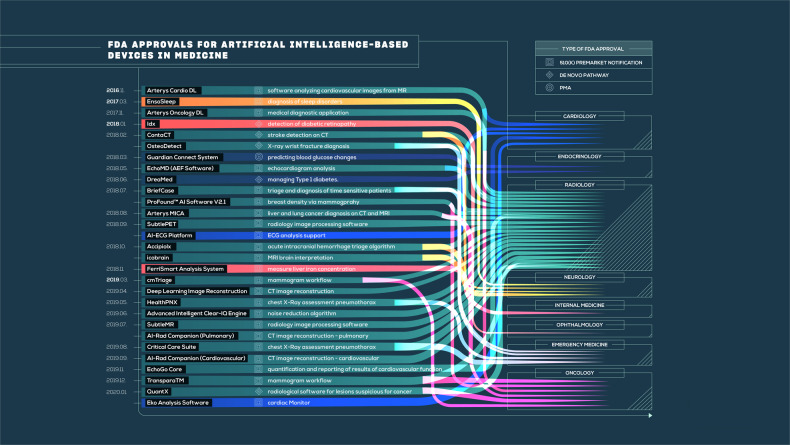
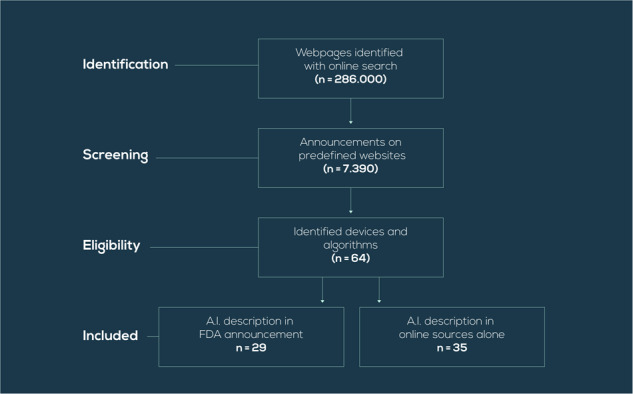
At the beginning of the artificial intelligence (AI)/machine learning (ML) era, the expectations are high, and experts foresee that AI/ML shows potential for diagnosing, managing and treating a wide variety of medical conditions. However, the obstacles for implementation of AI/ML in daily clinical practice are numerous, especially regarding the regulation of these technologies. Therefore, we provide an insight into the currently available AI/ML-based medical devices and algorithms that have been approved by the US Food & Drugs Administration (FDA). We aimed to raise awareness of the importance of regulatory bodies, clearly stating whether a medical device is AI/ML based or not. Cross-checking and validating all approvals, we identified 64 AI/ML based, FDA approved medical devices and algorithms. Out of those, only 29 (45%) mentioned any AI/ML-related expressions in the official FDA announcement. The majority (85.9%) was approved by the FDA with a 510(k) clearance, while 8 (12.5%) received de novo pathway clearance and one (1.6%) premarket approval (PMA) clearance. Most of these technologies, notably 30 (46.9%), 16 (25.0%), and 10 (15.6%) were developed for the fields of Radiology, Cardiology and Internal Medicine/General Practice respectively. We have launched the first comprehensive and open access database of strictly AI/ML-based medical technologies that have been approved by the FDA. The database will be constantly updated.
Overview
The claims and statistics of this paper haven’t been checked yet.
Free: it reads the open-access text and checks the first 5 claims that cite a source we can check. Create a free account to check every claim.
Integrity signals
Registry
Cites
Statistics
Figures
Verification
Claims the paper makes
The claims and statistics of this paper haven’t been checked yet.
Free: it reads the open-access text and checks the first 5 claims that cite a source we can check. Create a free account to check every claim.
Claims other papers make about this one
Each is checked against this paper’s own text: does it say what the citing paper says it does?
The source backs part of the claim, not all of it — or backs it for a different population, condition or comparison.
In the citing paper
“Dozens of companies have obtained US FDA and European CE approval for medical imaging AI 37 , and commercial markets have begun to form as sustainable business models are created.”
From Deep learning-enabled medical computer vision (2021) · cites this paper as [37]
Experimental — accuracy not yet measuredThe source backs part of the claim, not all of it — or backs it for a different population, condition or comparison.
In the citing paper
“The majority of AI interventions that are close to translation are in the field of medical diagnostics.3”
From Developing a reporting guideline for artificial intelligence-centred diagnostic test accuracy studies: the STARD-AI protocol (2021) · cites this paper as [3]
Experimental — accuracy not yet measuredThe source backs part of the claim, not all of it — or backs it for a different population, condition or comparison.
In the citing paper
“Moreover, diagnostics constitutes a substantial proportion of clinical AI focus, with most AI devices achieving regulatory approval thus far belonging to the diagnostic field 26 .”
From The STARD-AI reporting guideline for diagnostic accuracy studies using artificial intelligence (2025) · cites this paper as [26]
Experimental — accuracy not yet measuredThe cited source says what the claim attributes to it.
In the citing paper
“To date, 64 AI-powered medical devices and algorithms have been approved by the Food and Drug Administration in the United States [8].”
From Randomized Controlled Trials of Artificial Intelligence in Clinical Practice: Systematic Review (2022) · cites this paper as [8]
The cited source says what the claim attributes to it.
In the citing paper
“Another obstacle to the implementation of AI or ML in daily clinical practice is the regulation of these technologies [8].”
From Randomized Controlled Trials of Artificial Intelligence in Clinical Practice: Systematic Review (2022) · cites this paper as [8]
7 more claims about this paper
Create a free account to see every claim other papers make about this one.
Self-check
Percentages, sums and reported differences re-computed from the paper’s own numbers.
The self-check needs the paper’s full text.
Citations
Cites
High-performance medicine: the convergence of human and artificial intelligence
Topol, E. J. (2019) · Nature Medicine · doi:10.1038/s41591-018-0300-7 · Cited by 10,450 · cited 1×
“Despite its promise, the obstacles for implementation of AI/ML in daily clinical practice are numerous 10 .”
BackgroundWang, X., Peng, Y., Lu, L., Lu, Z., Bagheri, M., & Summers, R. M. (2017) · 2017 IEEE Conference on Computer Vision and Pattern Recognition (CVPR) · doi:10.1109/cvpr.2017.369 · Cited by 4,616
Deep Learning—A Technology With the Potential to Transform Health Care
Hinton, G. (2018) · JAMA · doi:10.1001/jama.2018.11100 · Cited by 667
Brown, J. M., Campbell, J. P., Beers, A., Chang, K., Ostmo, S., Chan, R. V. P., Dy, J., Erdogmus, D., Ioannidis, S., Kalpathy-Cramer, J., et al. (2018) · JAMA Ophthalmology · doi:10.1001/jamaophthalmol.2018.1934 · Cited by 657 · cited 1×
“Indeed, AI/ML-based technologies have been shown to support several medical specialties from radiology 2 and oncology 3 to ophthalmology 4 and general medical decision-making 5 .”
BackgroundArtificial Intelligence in Health Care: A Report From the National Academy of Medicine
Matheny, M. E., Whicher, D., & Thadaney Israni, S. (2020) · JAMA · doi:10.1001/jama.2019.21579 · Cited by 628
Wang, X., Peng, Y., Lu, L., Lu, Z., Bagheri, M., & Summers, R. M. (2019) · Advances in Computer Vision and Pattern Recognition · doi:10.1007/978-3-030-13969-8_18 · Cited by 371 · cited 1×
“Indeed, AI/ML-based technologies have been shown to support several medical specialties from radiology 2 and oncology 3 to ophthalmology 4 and general medical decision-making 5 .”
BackgroundLabovitz, D. L., Shafner, L., Reyes Gil, M., Virmani, D., & Hanina, A. (2017) · Stroke · doi:10.1161/strokeaha.116.016281 · Cited by 311
Horng, S., Sontag, D. A., Halpern, Y., Jernite, Y., Shapiro, N. I., & Nathanson, L. A. (2017) · PLOS ONE · doi:10.1371/journal.pone.0174708 · Cited by 310
van der Heijden, A. A., Abramoff, M. D., Verbraak, F., van Hecke, M. V., Liem, A., & Nijpels, G. (2018) · Acta Ophthalmologica · doi:10.1111/aos.13613 · Cited by 296
Artificial intelligence and the future of psychiatry: Insights from a global physician survey
Doraiswamy, P. M., Blease, C., & Bodner, K. (2020) · Artificial Intelligence in Medicine · doi:10.1016/j.artmed.2019.101753 · Cited by 253
Research works printed but not linked: 1
- Wang T Outpatient clinic process enhancement at children’s hospital: empoweredby information technology Chin. J. Hosp. Adm. 2018 34 753 755
Cited by
Items 801–900 of 1,000
Lachapelle, A. S. (2021) · bioRxiv (Cold Spring Harbor Laboratory) · doi:10.1101/2021.09.14.458035 · Cited by 3
Diagnostische Radiologie: Update 2022
Lennartz, S., Schlemmer, H., & Persigehl, T. (2022) · Die Onkologie · doi:10.1007/s00761-022-01209-5 · Cited by 5
Harikrishnan, K., Botelho, N., Rebelo, P., Kenkre, A., & Tarcar, A. K. (2023) · medRxiv · doi:10.1101/2023.07.07.23292356 · Cited by 3
“Artificial Intelligence has transformed the field of imaging based modalities at an unprecedented speed with more than 80 FDA filings for diagnostic use(Software as a Medical Device – SaMD) in 2021 [4].”
BackgroundMethodPacheco‐Barrios, K., Gianlorenço, A. C., Camargo, L., Dodurgali, M. R., Tangjade, A., & Fregni, F. (2023) · Expert Review of Neurotherapeutics · doi:10.1080/14737175.2023.2292733 · Cited by 3
“Therefore, constant conversations between representatives from academia, industry and regulatory agencies are recommended even before the piloting of the technology and clinical trial designs, as is being promoted with AI-based medical devices [20].”
BackgroundDREAM: A framework for discovering mechanisms underlying AI prediction of protected attributesPreprint
Gadgil, S. U., DeGrave, A. J., Janizek, J. D., Xu, S. H., Nwandu, L., Fonjungo, F., Lee, S., & Daneshjou, R. (2024) · medRxiv · doi:10.1101/2024.04.09.24305289 · Cited by 6
“Machine learning (ML) technologies have been widely applied to image classification problems in medicine, and this has led to the approval of hundreds of ML-based devices by the United States Food and Drug Administration (FDA) [1, 4, 34].”
BackgroundEvaluation of large language models for the classification of medical device software
Han, Y., Ceross, A., Bourgeois, F. T., Savaget, P., & Bergmann, J. (2024) · Bio-Design and Manufacturing · doi:10.1007/s42242-024-00307-0 · Cited by 5
“The dataset consisted of 130 distinct medical software products: 66 devices from the National Medical Products Administration (NMPA) of China, 29 devices from the U.S. Food and Drug Administration (FDA) [13], as well as 35 devices from EU database guided by the listings in Ref.”
Guarnier, G., Reinelt, J. D., Molloy, E. N., Mihai, P. G., Einaliyan, P., Valk, S. L., Modestino, A. E., Ugolini, M., Mueller, K., Wu, Q., et al. (2024) · medRxiv · doi:10.1101/2024.09.23.24314186 · Cited by 4
Artificial Intelligence in Medicine: Revolutionizing Healthcare Practices and Patient OutcomesPreprint
Susilo, Y. K. B., Rahman, S. A., Yuliana, D., & Rasyid, F. A. (2025) · SSRN Electronic Journal · doi:10.2139/ssrn.5178173 · Cited by 5
Dighe, M. (2026) · WFUMB Ultrasound Open · doi:10.1016/j.wfumbo.2026.100115 · Cited by 3
The Dawn of AI in Pharmaceutical Research: AI Transforming Pharma - Ethics, Trials, and Beyond
Saeed, A., & Alajlan, S. A. (2025) · Advances in computational intelligence and robotics book series · doi:10.4018/979-8-3693-6270-9.ch001 · Cited by 2
Chandra, J., Short, S., Rodríguez, F., Maron, D. J., Pagidipati, N. J., Hernandez, A. F., Mahaffey, K. W., Shah, S. H., Kiel, D. P., Lu, M. T., et al. (2025) · The Journals of Gerontology Series A · doi:10.1093/gerona/glaf173 · Cited by 2
Wan, B. (2025) · Advances in Economics Management and Political Sciences · doi:10.54254/2754-1169/2025.lh26978 · Cited by 2
Gökseven, Y., & Öztürk, G. Z. (2025) · Healthcare · doi:10.3390/healthcare13182283 · Cited by 2
Assessing the Economic Viability of AI in Environmental Management
Haseeb, M., Rahman, M. M., Kamal, M., Ghai, S., & Sidana, N. (2025) · Springer eBooks · doi:10.1007/978-3-031-96243-1_12 · Cited by 2
Turangan, R., Tambun, J. G., & Suswantoro, T. A. (2025) · JIIP - Jurnal Ilmiah Ilmu Pendidikan · doi:10.54371/jiip.v8i10.9330 · Cited by 2
Fatima, S., Faisal, S., Batool, S. V., Faisal, M., Aamir, T., Shahid, Z. U. A., & Mahato, R. K. (2025) · Frontiers in Oncology · doi:10.3389/fonc.2025.1673586 · Cited by 2
Artificial Intelligence and Machine Learning for Osteoarthritis and Cartilage Assessment
Jo, S. Y., & Sebro, R. (2025) · Radiologic Clinics of North America · doi:10.1016/j.rcl.2025.09.001 · Cited by 2
AI and telemedicine in management of diabetes
Petrov, S. V., Donkov, D., & Orbetzova, M. M. (2025) · Folia Medica · doi:10.3897/folmed.67.e153728 · Cited by 2
Anber, A., Mohamed, Y., Maleki, A., Atiq, S., Radu, L., Omar, I., & Sayed, A. (2025) · Cureus · doi:10.7759/cureus.100134 · Cited by 2
Carou‐Senra, P., Rodríguez‐Pombo, L., Alvarez‐Lorenzo, C., & Goyanes, Á. (2026) · International Journal of Pharmaceutics · doi:10.1016/j.ijpharm.2026.126587 · Cited by 3
Kavandi, H., Costenbader, K., Yazbek, S., Kamel, P. I., Yahyavi‐Firouz‐Abadi, N., & Jeudy, J. J. (2026) · Journal of Imaging Informatics in Medicine · doi:10.1007/s10278-026-01857-8 · Cited by 2
Dhunnoo, P., McGuigan, K., O’Rourke, V., Meskó, B., & McCann, M. (2026) · Future Internet · doi:10.3390/fi18020084 · Cited by 3
“The technology has already been successfully employed across medical specialties [9]; and it would be interesting to investigate its potential support during virtual consultations from the users’ point of view in order to gather insights around the corresponding human factors.”
Self-citationToward integrated sleep health: multimodal AI in Hang Hao Meng agent
Cai, M., Liang, S., Zhen, S., Wei, S., Sun, T., Liu, J., Mao, H., & Zhang, J. (2026) · npj Digital Medicine · doi:10.1038/s41746-026-02432-9 · Cited by 2
Borges, J. Y. V. (2026) · American Journal of Biomedical Science & Research · doi:10.34297/ajbsr.2026.30.003888 · Cited by 3
Greß, J., Otto, G., Sommer, S., Schuler, M. K., Khan, S., Schröder, F., & Seidel, C. A. (2026) · European Urology Open Science · doi:10.1016/j.euros.2026.02.006 · Cited by 2
“Particularly for the automated extraction of information from clinical text, critical questions concerning workflow integration, generalizability across different institutions, and real-world application remain largely unanswered [14–16].”
Xu, W., Cao, L., Shen, Q., Shan, Y., Pan, S., & Ruan, M. (2026) · Frontiers in Digital Health · doi:10.3389/fdgth.2026.1741973 · Cited by 2
“Lymph node involvement is often described with variability and uncertainty, such as “borderline enlarged” or “suspicious for metastasis,” making consistent interpretation more difficult (18).”
Muthukrishnan, V., & Bastani, M. (2026) · Journal of Medical Devices · doi:10.1115/1.4071334 · Cited by 2
Artificial Intelligence in Pulmonary Endoscopy: Current Evidence, Limitations, and Future Directions
Lopes, S., Mascarenhas, M., Fonseca, J., & Leite-Moreira, A. F. (2026) · Journal of Imaging · doi:10.3390/jimaging12040167 · Cited by 2
AI‐Driven Cancer Multi‐Omics: A Review From the Data Pipeline Perspective
Liu, S., Li, S. X., & Qian, K. (2026) · Advanced Intelligent Discovery · doi:10.1002/aidi.202500249 · Cited by 2
A data-centric perspective on designing AI foundation models for healthcare
Jorf, B. A., Piechowski‐Jóźwiak, B., & Shamout, F. E. (2026) · Frontiers in Digital Health · doi:10.3389/fdgth.2026.1738523 · Cited by 2
“Such practices are aligned with recommendations to ensure high clinical utility of AI models and regulatory approval [33, 34].”
Understanding AI risks from its characteristics and NMPA regulation perspectives
Liu, Y., & Yu, W. (2026) · Insights into Imaging · doi:10.1186/s13244-026-02283-8 · Cited by 3
Ashraf, D., Sanker, V., Liverani, L., Park, C.-G., Medikonda, R. T., Cavagnaro, M. J., Jeon, I., Ratliff, J. K., & Desai, A. M. (2026) · Neurospine · doi:10.14245/ns.2551862.931 · Cited by 2
“80 With clinical concerns such as hallucinated or nonexistent structures, especially in diagnostic or preoperative contexts, posing significant medicolegal risks, as shown in studies of synthetic spine CTs and MRIs where phantom artifacts occasionally appeared, it is clear this needs to be quickly…”
Gherghe, M. E., Grigore, A.-G., Timofticiuc, I.-A., Moise, A.-E., Andrei, C. A., Dragosloveanu, Ş., Nedelea, D.-G., Pulik, Ł., Anghel, C., Scheau, C., et al. (2026) · Bioengineering · doi:10.3390/bioengineering13060610 · Cited by 2
“Although there is an increase in the number of FDA clearances in recent years, the majority of approvals concern radiology and cardiology, with few orthopaedic-specific tools currently accepted for clinical use [113,114].”
Research integrity and data ethics in AI-driven integrated healthcare: a critical appraisal
Zeng, W., Wei, H., Chen, Y., Tang, J., Ge, J., & Chen, H. (2026) · Frontiers in Public Health · doi:10.3389/fpubh.2026.1838551 · Cited by 2
“Risk-based frameworks calibrate oversight intensity to potential harms, applying greater scrutiny to high-stakes diagnostic applications than low-risk administrative tools (87, 88).”
Liu, J., & Zhang, X. (2026) · Breast Cancer Targets and Therapy · doi:10.2147/bctt.s605985 · Cited by 2
“45”
Lucki, M., Lucka, E., Żak, J., Mitkowski, P. P., & Lesiak, M. (2026) · Journal of Clinical Medicine · doi:10.3390/jcm15134885 · Cited by 2
“In the United States, the FDA’s Action Plan for AI/ML-based Software as a Medical Device (SaMD) emphasizes adaptive learning oversight and the need for post-market surveillance [84,85].”
Golshani, P., & Joseph, M. S. (2026) · Cureus · doi:10.7759/cureus.112583 · Cited by 2
1,357 AI medical devices cleared, 3 actually tested on patient outcomes
Abulibdeh, R., Cajas, S. A., Celi, L. A., Gorijavolu, R., Izath, N., & Lunde, T. M. (2026) · PLOS Digital Health · doi:10.1371/journal.pdig.0001597 · Cited by 3
“By contrast, the majority of AI/ML-enabled devices reach the market through the 510(k) pathway, which does not require independent prospective clinical trial data if substantial equivalence to a predicate device can be demonstrated [8].”
InfluentialYong, Q., Chen, C., Zhang, X., Sun, K., He, Y., Pan, R., Meng, Y., Wang, Q., Chai, D., Shao, D., et al. (2026) · International Journal of Pharmaceutics · doi:10.1016/j.ijpharm.2026.127339 · Cited by 2
Lee, Y.-S., & Youn, B.-Y. (2026) · Journal of Medical Internet Research · doi:10.2196/103040 · Cited by 2
“Benjamens et al [4] reported radiology’s dominance through 2020, and an analysis of 2024 authorizations reported continued dominance at approximately 75% to 80%, with growth in pathology and cardiovascular devices [6].”
InfluentialAgentic systems in computational pathology: architectures, evidence, and translational challenges
Lu, X., Li, Q., Gao, Y., Wei, D., Lyu, M., Ma, S., Li, J., Wu, Y., Cai, L., Zhang, T., et al. (2026) · Journal of Translational Medicine · doi:10.1186/s12967-026-08829-0 · Cited by 2
“Key barriers include trial design [166], regulatory-pathway selection [209], and uncertain payer value [210].”
A Review of Current Applications of Artificial Intelligence and Machine Learning in Medical Science
Rathod, J. K. A., Bhavani, N., Saldanha, P. P., Rao, P. M., & Patil, P. (2021) · International Journal of Advanced Research in Science Communication and Technology · doi:10.48175/ijarsct-2125 · Cited by 2
Review of Machine Learning Applications and Datasets in Classification of Acute Leukemia
Ranganathan, J. (2021) · International Journal of Data Mining & Knowledge Management Process · doi:10.5121/ijdkp2021.11601 · Cited by 2
“Many AI-based medical devices and algorithms are being approved by the United States Food and Drug Administration (FDA) [9].”
BackgroundInvestigation on continual training of computer-aided diagnosis systems by semi-supervised learning
Muramamatsu, C., Nishio, M., Oiwa, M., Yakami, M., Kubo, T., & Fujita, H. (2022) · International Conference on Intelligent Medicine and Image Processing (IMIP) · doi:10.1145/3524086.3524095 · Cited by 2
“3524095 are FDA-approved [2] and already implemented or close to implementation in clinical practice.”
BackgroundInfluentialSupervision System of AI-based Software as a Medical Device
Zhang, J., Li, Y., Zhou, J., Zhu, Y., & Li, L. (2022) · Strategic Study of CAE · doi:10.15302/j-sscae-2022.01.021 · Cited by 2
Artificial Intelligence and Teledermatology
Fernandez, K., Young, A. T., Bhattarcharya, A., Kusari, A., & Wei, M. L. (2023) · Updates in clinical dermatology · doi:10.1007/978-3-031-27276-9_18 · Cited by 3
Knowledge-based statistical data analysis for deep learning and voting classifiers merger
Belciug, S., Ivănescu, R. C., Nascu, A. G., Şerbănescu, M.-S., Comănescu, C. M., & Iliescu, D. G. (2023) · Procedia Computer Science · doi:10.1016/j.procs.2023.10.417 · Cited by 2
Artificial intelligence in peri‐operative prediction model research: are we there yet?
Shah, A., & Dhiman, P. (2024) · Anaesthesia · doi:10.1111/anae.16315 · Cited by 2
Artificial Intelligence and Oocyte/Embryo Assessment in Cryopreservation Cycles
Janmohamed, A., Nayot, D., Miller, R., & Zaninović, N. (2024) · Springer eBooks · doi:10.1007/978-3-031-58214-1_23 · Cited by 2
A gépi tanulás szerepe a szívelégtelenség modern kezelési stratégiájában
Gáspár, D., Komlósi, F., Bohus, G. Y., Tóth, P., Sax, B., Heltai, K., Vándor, L., Becker, D., Merkely, B. P., & Nagy, K. V. (2024) · Cardiologia Hungarica · doi:10.26430/chungarica.2024.54.3.234 · Cited by 2
Low-cost and convenient screening of disease using analysis of physical measurements and recordings
Chandra, J., Lin, R., Kancherla, D., Scott, S. C., Sul, D., Andrade, D., Marzouk, S., Iyer, J. M., Wasswa, W., Villanueva, C., et al. (2024) · PLOS Digital Health · doi:10.1371/journal.pdig.0000574 · Cited by 2
A beginner's guide to supervised analysis for mass cytometry data in cancer biology
Wlosik, J., Granjeaud, S., Gorvel, L., Olive, D., & Chrétien, A.-S. (2024) · Cytometry Part A · doi:10.1002/cyto.a.24901 · Cited by 2
“For now, six supervised algorithms are FDA-approved in the field of oncology for image processing [11].”
Introduction to the Future of Medicine
Hemati, H., Patrinos, G. P., Meybodi, H. R. A., Sarhangi, N., Larijani, B. A., Khodayari, N., & Hasanzad, M. (2024) · Springer eBooks · doi:10.1007/978-981-97-4974-4_1 · Cited by 3
Progress on the development of prediction tools for detecting disease causing mutations in proteins
Gromiha, M. M., Pandey, M., Kulandaisamy, A., Sharma, D., & Ridha, F. (2024) · Computers in Biology and Medicine · doi:10.1016/j.compbiomed.2024.109510 · Cited by 3
Miranda, I., Agrotis, G., Beets‐Tan, R. G. H., Teixeira, L. F., & Silva, W. (2024) · Annual International Conference of the IEEE Engineering in Medicine and Biology Society (EMBC) · doi:10.1109/embc53108.2024.10781895 · Cited by 2
“These AI models not only contribute to speeding up the diagnostic process but have also demonstrated effectiveness in personalizing medication dosages and aiding in image interpretation [3].”
Radiómica: ¿Qué es y en dónde estamos?
Upegui, D., Cruz, M. Á. E., Milanés, S. G., & Martínez, M. F. A. (2024) · Medicina · doi:10.56050/01205498.2379 · Cited by 2
Ethical, Regulatory, and Practical Challenges in Artificial Intelligence-Driven Chest Imaging
de Lima, J. B. C., Griffin, I., Gemmell, J. S., Davis, K., Amanamba, U., Zanjani, N. A., Siyanaki, M. R. H., Mohammed, T.-L. H., Benos, T., Rodrigues, R. S., et al. (2025) · Seminars in Roentgenology · doi:10.1053/j.ro.2025.06.003 · Cited by 2
Oncology: Way Forward from Clinical and Molecular Diagnosis to Treatment
Srivastava, S., & Pandey, A. (2023) · Springer eBooks · doi:10.1007/978-981-99-1529-3_1 · Cited by 2
3D MRI Brain Tumor Diagnosis with Topological Descriptors
Daruger, H., Brodsky, D. J., & Coşkunuzer, B. (2024) · Lecture notes in computer science · doi:10.1007/978-3-031-76160-7_8 · Cited by 2
Research and Application of Artificial Intelligence Algorithm in Network Search System
Jun, M. (2021) · IEEE International Conference on Data Science and Computer Application (ICDSCA) · doi:10.1109/icdsca53499.2021.9650115 · Cited by 2
Medical Image Labeling via Active Learning is 90% Effective
Bangert, P. D., Moon, H., Woo, J. O., Didari, S., & Hao, H. (2022) · Lecture notes in networks and systems · doi:10.1007/978-3-030-98012-2_23 · Cited by 3
Price, J. B. (2022) · Wiley eBooks · doi:10.1002/9781119800613.ch1 · Cited by 2
Bhayat, A., Hull, R., Chauke-Malinga, N., & Dlamini, Z. (2023) · Springer eBooks · doi:10.1007/978-3-031-21506-3_10 · Cited by 2
Artificial Intelligence in Body Imaging: An Overview of Commercially Available Tools
Perchik, J. D., Rothenberg, S., Tridandapani, S., Perchik, L. M., & Smith, A. D. (2023) · Seminars in Roentgenology · doi:10.1053/j.ro.2023.02.007 · Cited by 2
Artificial Intelligence in Ovarian Digital Pathology
Allen, K. E., Adusumilli, P., Breen, J., Hall, G., & Orsi, N. M. (2023) · Essentials of Diagnostic Gynecological Pathology. · doi:10.1007/978-3-031-39659-5_29 · Cited by 2
Role of artificial intelligence in neuromuscular and electrodiagnostic medicine
AANEM Professional Practice Committee (2024) · Muscle & Nerve · doi:10.1002/mus.28074 · Cited by 2
Assessing Artificial Intelligence Models to Diagnose and Differentiate Common Liver CarcinomasPreprint
Thomas, M., Mastorides, S., Borkowski, S., Reed, J., Deland, L., Thomas, L., & Borkowski, A. (2022) · medRxiv · doi:10.1101/2022.08.30.22279347 · Cited by 3
Dreizin, D. (2023) · Emergency Radiology · doi:10.1007/s10140-023-02135-8 · Cited by 3
“Nearly one-half of FDA-approved AI CAD tools were in the radiology domain as of 2020 [6], with 118 FDA-approved AI CAD tools as of 2021 [7].”
BackgroundRegulação da inteligência artificial na saúde
Dourado, D. D. A. (2024) · Digital Library of Theses and Dissertations (Universidade de São Paulo) · doi:10.11606/t.5.2024.tde-23042024-111255 · Cited by 11
Andreoletti, M., Senkalfa, B., & Blasimme, A. (2024) · medRxiv · doi:10.1101/2024.07.09.24310133 · Cited by 5
AI for Spirometry Interpretation in Primary Care
Witonsky, J. I., & Bhakta, N. R. (2025) · NEJM AI · doi:10.1056/aie2500586 · Cited by 2
Requirements for Quality Assurance of AI Models for Early Detection of Lung CancerPreprint
Hahn, H. K., May, M. S., Dicken, V., Walz, M., Eßeling, R., Lassen-Schmidt, B. C., Rischen, R., Vogel‐Claussen, J., Nikolaou, K., & Barkhausen, J. (2025) · arXiv (Cornell University) · doi:10.48550/arxiv.2502.17639 · Cited by 3
“…besteht darin, Verfahren und Kriterien der Qualitätssicherung auf weitere bildgebungsbasierte KI-Anwendungen zu übertragen, etwa in der Mammadiagnostik, in der Prostata-krebsfrüherkennung, in der Neuroradiologie oder bei muskuloskelettalen Fragestellungen (vgl. Benjamens et al., 2020).”
Ogbuefi, C., Ezika, O., Egbunike, J., & Ogbuefi, K. (2026) · Cureus · doi:10.7759/cureus.103995 · Cited by 2
“Many clinicians and public health professionals lack formal training in AI literacy, bias evaluation, and interpretation of algorithmic outputs [11].”
Evolution of AI-based software as a medical device: from static tools to adaptive clinical partners
Mofrad, F. B. (2026) · Expert Review of Medical Devices · doi:10.1080/17434440.2026.2638365 · Cited by 2
Kulkarni Kale, U., & Vemulapalli, G. (2025) · The Cancer Journal · doi:10.1097/ppo.0000000000000799 · Cited by 1
[Artificial intelligence in oncological radiology : A (p)review].
Bucher, A. M., & Kleesiek, J. (2021) · PubMed · doi:10.1007/s00117-020-00787-y · Cited by 1
Course Corrections for Clinical AI
DeGrave, A. J., Janizek, J. D., & Lee, S. (2021) · Kidney360 · doi:10.34067/kid.0004152021 · Cited by 1
Ho, A. (2023) · Oxford University Press eBooks · doi:10.1093/med/9780197556269.003.0005 · Cited by 1
Klinische Entscheidungsfindung mit Künstlicher Intelligenz
Samhammer, D., Beck, S., Budde, K., Burchardt, A., Faber, M., Gerndt, S., Möller, S., Osmanodja, B., Roller, R., & Dabrock, P. (2023) · Essentials · doi:10.1007/978-3-662-67008-8_1 · Cited by 3
Ndacayisaba, L. J., Mason, J. M., & Kühn, P. (2023) · Current cancer research · doi:10.1007/978-3-031-22903-9_7 · Cited by 1
Industry perspective of artificial intelligence in medicine and surgery
Flores, M. G. (2023) · Elsevier eBooks · doi:10.1016/b978-0-323-90534-3.00031-7 · Cited by 1
AI in Dermatology: Bridging the Gap Between Potential and Practice
Klarycki, J., Tomczyk, K., Podgórska, D., Sanecki, M., Jurasz, K., Chojnacka, N., Rzeska, E., & Cymer, R. (2024) · Journal of Education Health and Sport · doi:10.12775/jehs.2024.52.004 · Cited by 1
Target-Free Domain Adaptation through Cross-Adaptation (Student Abstract)
Obuchowski, A., Klaudel, B., Frąckowski, P., Krajna, S., Badyra, W., Czubenko, M., & Kowalczuk, Z. (2024) · Proceedings of the AAAI Conference on Artificial Intelligence · doi:10.1609/aaai.v38i21.30490 · Cited by 1
From Pixels to Predictions: Exploring the Role of Artificial Intelligence in Radiology
Aiyappa, M. J. A., & Shetty, B. S. K. (2024) · Biological and medical physics, biomedical engineering · doi:10.1007/978-981-97-5345-1_2 · Cited by 3
Ammar, A. S. (2024) · Springer eBooks · doi:10.1007/978-3-031-71477-1_28 · Cited by 1
Sneha, Mohanta, A., Chatterjee, S., & Rout, P. C. (2024) · Advances in finance, accounting, and economics book series · doi:10.4018/979-8-3693-7580-8.ch017 · Cited by 1
Sanyasi, R. D. L. R. (2025) · Journal of Preventive Diagnostic and Treatment Strategies in Medicine · doi:10.4103/jpdtsm.jpdtsm_41_25 · Cited by 1
Artificial intelligence in spine surgery
Zhang, C., Liu, S., Shi, J., Zhou, X., Passias, P. G., Xu, N., & Li, W. (2025) · Spine Research · doi:10.1097/br9.0000000000000005 · Cited by 2
Caturla, S. I., Mestre, J. D. D. B., & Mozos, Ó. M. (2025) · Future Internet · doi:10.3390/fi17070292 · Cited by 2
Artificial intelligence in assisted reproduction: the future for reproductive medicine
Hynniewta, B. C., Navas, F., & Marbaniang, K. (2025) · International Journal of Reproduction Contraception Obstetrics and Gynecology · doi:10.18203/2320-1770.ijrcog20252767 · Cited by 2
Machine Learning in Mental Health: Predictive Insights from Exploratory Data Analysis
Singh, V., Singh, T. K., & Singh, A. (2025) · International Conference on Emerging Trends in Engineering and Technology (ICETET) · doi:10.1109/icetetsip64213.2025.11156226 · Cited by 1
Servicios de salud basados en inteligencia artificial: propuestas para entornos de bajo presupuesto
Betancourt, D. S. G., Varela, P. M. R., Varela, D. I. R., & Proaño, R. F. A. (2025) · Revista Ingeniería e Innovación del Futuro. · doi:10.62465/riif.v4n2.2025.189 · Cited by 1
Regulação da Inteligência Artificial em saúde: desafios para o SUS e o papel da ANVISA
Pallaoro, Y. L. D. R., Soncini, L. C., Rossi, L. D. R., Raitez, S. R., Cardinal, M. D. S., Ritterbusch, A. A. C., Raitez, S. R. R., Patricio, P. H. D. B., Pontes, M. E. S., & Lauxen, D. D. F. (2025) · STUDIES IN HEALTH SCIENCES · doi:10.54022/shsv6n3-069 · Cited by 1
D-A GAN: A novel Dual-Attention GAN for efficient and explainable medical anomaly detection
Ounasser, N., Rhanoui, M., Mikram, M., & Asri, B. E. (2025) · Informatics in Medicine Unlocked · doi:10.1016/j.imu.2025.101695 · Cited by 1
Ethical Implications of Artificial Intelligence in Healthcare Decision-Making
Singh, J., & Dadhich, A. (2025) · Lecture notes in networks and systems · doi:10.1007/978-981-96-7289-9_9 · Cited by 1
AI in Facial Cosmetic Surgery: Surgeon’s Perspective Summary
Hamrah, D., Eidson, B. K., & Vargas, N. (2025) · The American Journal of Cosmetic Surgery · doi:10.1177/07488068251343281 · Cited by 1
“5,6 While AI-driven advancements hold immense promise, challenges related to bias, ethics, cyberse-curity, and depersonalization must be addressed to ensure responsible implementation (Figure 1).”
New Genomic Technologies and Bioinformatics Resources for Precision Medicine
Fakim, Y. J., Ghoorah, A. W., Othman, H., & Ghedira, K. (2025) · Springer eBooks · doi:10.1007/978-981-96-8959-0_13 · Cited by 1
Pollák, P., Barótfi, S., Csóka, I., & Budai-Szűcs, M. (2025) · Orvosi Hetilap · doi:10.1556/650.2025.33420 · Cited by 1
Umar, M., Ali, V., Shamim, L., Musharaf, I., Hafsa, R., Ahsan, M. U., Ahmad, O., Sabhan, L. B., Saeed, M., Ahmed, S., et al. (2025) · Journal of intelligent medicine. · doi:10.1002/jim4.70015 · Cited by 2
Metadata
- Authors
- Benjamens, S., Dhunnoo, P., & Meskó, B.
- Affiliations
- University Medical Center Groningen (NL)
- Semmelweis University (HU)
- Corresponding author
- Meskó, Bertalan
- Venue
- npj Digital Medicine
- Published
- 2020-09-11
- Volume
- 3
- Issue
- 1
- Pages
- 118-118
- ISSN
- 2398-6352 (ISSN-L)
- PMC
- PMC7486909
- OpenAlex
- W3086667591
- Semantic Scholar
- 0623ccb3694aae29857890809afe5868931a98ec
- Cited by
- 1,215
- References
- 24
- Citations by year
- 2026: 219 · 2025: 208 · 2024: 212 · 2023: 227 · 2022: 188 · 2021: 153 · 2020: 7
- FWCI
- 42.33
- Type
- journal article
- Language
- en
- Open access
- gold
- doi.org
- Licence
- cc-by
- creativecommons.org/licenses/by/4.0 (tdm)
- creativecommons.org/licenses/by/4.0 (vor)
- Locations
- npj Digital Medicine (publishedVersion, cc-by)
- PubMed Central (publishedVersion, cc-by)
- PubMed (publishedVersion)
- University of Groningen research database (University of Groningen / Centre for Information Technology) (publishedVersion, cc-by)
- DOAJ (DOAJ: Directory of Open Access Journals) (submittedVersion, cc-by-sa)
- University of Groningen research database (University of Groningen / Centre for Information Technology) (submittedVersion, cc-by)
- Topics
- Health Sciences › Medicine › Health Informatics › Artificial Intelligence in Healthcare and Education
- Health Sciences › Medicine › Public Health, Environmental and Occupational Health › Healthcare Regulation
- Physical Sciences › Computer Science › Information Systems › Internet of Things and AI
- Keywords
- artificial intelligence, machine learning, medical device regulation, 510(k) clearance, de novo pathway, premarket approval, clinical implementation of AI, radiology, online databases
About these checks
Registry, retraction, Cites and statistics results are computed, not judged, with one exception: a printed reference that no index lists is read once by a model before it counts as a citation error. Claims are extracted by a model and kept only when their quote appears verbatim in the text; each cited source is then checked, with a model’s help, for whether it says what the claim relies on. Those verdicts can be wrong — read the claim’s quote and the cited source before relying on one.
Statistics and arithmetic are recomputed, not judged.
Confidence bands are shown only for fields calibrated on our annotated test set. None is calibrated yet, so no band is shown.
What counts as a claim ›How we measure confidence ›How we check this ›
Are you an author, or do you see a problem with this page? Request a review
Data sources
Bibliographic data: Semantic Scholar, OpenAlex, Crossref.
Contains information from the Semantic Scholar Academic Graph Datasets, made available under the ODC Attribution License (ODC-BY 1.0).
Semantic Scholar’s data is described in: Kinney, R., et al. (2023). The Semantic Scholar Open Data Platform. arXiv:2301.10140.
