

A mixed culture of bacterial cells enables an economic DNA storage on a large scale
Open accessThe DOI matches its Crossref record; 41 of the 43 references it cites were found in a registry or an index.
Abstract
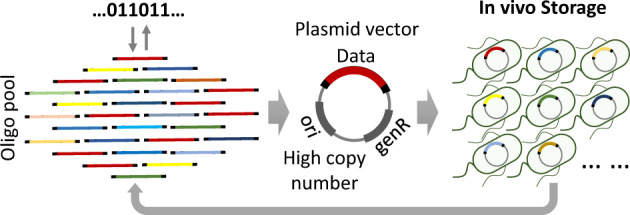
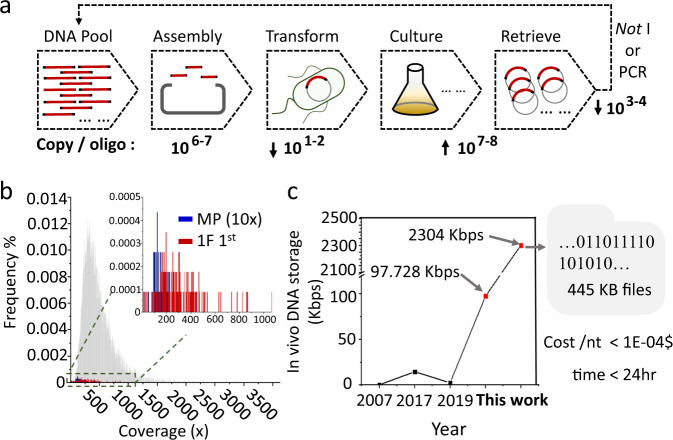
DNA emerged as a novel potential material for mass data storage, offering the possibility to cheaply solve a great data storage problem. Large oligonucleotide pools demonstrated high potential of large-scale data storage in test tube, meanwhile, living cell with high fidelity in information replication. Here we show a mixed culture of bacterial cells carrying a large oligo pool that was assembled in a high-copy-number plasmid was presented as a stable material for large-scale data storage. The underlying principle was explored by deep bioinformatic analysis. Although homology assembly showed sequence context dependent bias, the large oligonucleotide pools in the mixed culture were constant over multiple successive passages. Finally, over ten thousand distinct oligos encompassing 2304 Kbps encoding 445 KB digital data, were stored in cells, the largest storage in living cells reported so far and present a previously unreported approach for bridging the gap between in vitro and in vivo systems.
Overview
The claims and statistics of this paper haven’t been checked yet.
Free: it reads the open-access text and checks the first 5 claims that cite a source we can check. Create a free account to check every claim.
Integrity signals
Registry
Cites
Statistics
Figures
Verification
Claims the paper makes
The claims and statistics of this paper haven’t been checked yet.
Free: it reads the open-access text and checks the first 5 claims that cite a source we can check. Create a free account to check every claim.
Claims other papers make about this one
Each is checked against this paper’s own text: does it say what the citing paper says it does?
The cited source says what the claim attributes to it.
In the citing paper
“Preservation within a living cell allows the DNA to be replicated with a few orders of magnitude, much faster than by PCR, during the cell’s proliferation processes [67].”
From DNA Data Storage. (2023) · cites this paper as [67]
The cited source says what the claim attributes to it.
In the citing paper
“Hao et al. (2020) assembled a large oligo pool into vector plasmids based on homology and introduced them into bacterial cells for mixed culture, then combining the advantages of in vivo cell systems and in vitro data storage mediated by oligo pools to achieve high-fidelity replication of DNA molecules at low cost.”
From Large-Scale de Novo Oligonucleotide Synthesis for Whole-Genome Synthesis and Data Storage: Challenges and Opportunities (2021) · cites this paper as Hao et al., 2020
Self-check
Percentages, sums and reported differences re-computed from the paper’s own numbers.
The self-check needs the paper’s full text.
Citations
Cites
Double-slit photoelectron interference in strong-field ionization of the neon dimer
Kunitski, M., Eicke, N., Huber, P., Köhler, J., Zeller, S., Voigtsberger, J., Schlott, N., Henrichs, K., Sann, H., Trinter, F., et al. (2019) · Nature Communications · doi:10.1038/s41467-018-07882-8 · Cited by 8,162
Double-slit photoelectron interference in strong-field ionization of the neon dimer
Kunitski, M., Eicke, N., Huber, P., Köhler, J., Zeller, S., Voigtsberger, J., Schlott, N., Henrichs, K., Sann, H., Trinter, F., et al. (2019) · Institutional Repository of Leibniz Universität Hannover (Leibniz Universität Hannover) · doi:10.15488/5174 · Cited by 8,161
Kozich, J. J., Westcott, S. L., Baxter, N. T., Highlander, S. K., & Schloss, P. D. (2013) · Applied and Environmental Microbiology · doi:10.1128/aem.01043-13 · Cited by 7,112
Creation of a Bacterial Cell Controlled by a Chemically Synthesized Genome
Gibson, D. G., Glass, J. I., Lartigue, C., Noskov, V. N., Chuang, R.-Y., Algire, M. A., Benders, G. A., Montague, M. G., Ma, L., Moodie, M. M., et al. (2010) · Science · doi:10.1126/science.1190719 · Cited by 2,638
Efficient generation of mouse models of human diseases via ABE- and BE-mediated base editing
Liu, Z., Lu, Z., Yang, G., Huang, S., Li, G., Feng, S., Liu, Y., Li, J., Yu, W., Zhang, Y., et al. (2018) · Nature Communications · doi:10.1038/s41467-018-04768-7 · Cited by 2,074
NUPACK: Analysis and design of nucleic acid systems
Zadeh, J. N., Steenberg, C. D., Bois, J. S., Wolfe, B. R., Pierce, M. B., Khan, A. R., Dirks, R. M., & Pierce, N. A. (2011) · Journal of Computational Chemistry · doi:10.1002/jcc.21596 · Cited by 1,670
The CRISPR tool kit for genome editing and beyond
Adli, M. (2018) · Nature Communications · doi:10.1038/s41467-018-04252-2 · Cited by 1,545
Design and synthesis of a minimal bacterial genome
Hutchison, C. A., Chuang, R.-Y., Noskov, V. N., Assad-Garcia, N., Deerinck, T. J., Ellisman, M. H., Gill, J., Kannan, K., Karas, B. J., Ma, L., et al. (2016) · Science · doi:10.1126/science.aad6253 · Cited by 1,500
Towards Practical, High-Capacity, Low-Maintenance Information Storage in Synthesized DNA
Goldman, N., Bertone, P., Chen, S., Dessimoz, C., LeProust, E. M., Sipos, B., & Birney, E. (2013) · Nature · doi:10.1038/nature11875 · Cited by 1,220 · cited 2×
“The thermocycling protocol was: (1) 98 °C for 5 min, (2) 98 °C for 30 s, (3)54 °C for 30 s, (4) 72 °C for 10 s, then repeat steps 2–4 five times, followed by a final elongation at 72 °C for 5 min.”
MethodA rapid and robust method for single cell chromatin accessibility profiling
Chen, X., Miragaia, R. J., Natarajan, K. N., & Teichmann, S. A. (2018) · Nature Communications · doi:10.1038/s41467-018-07771-0 · Cited by 1,147
Self-citationRichardson, C. D., Ray, G. J., DeWitt, M. A., Curie, G. L., & Corn, J. E. (2016) · Nature Biotechnology · doi:10.1038/nbt.3481 · Cited by 1,098
DNA Fountain enables a robust and efficient storage architecture
Erlich, Y., & Zielinski, D. (2017) · Science · doi:10.1126/science.aaj2038 · Cited by 898 · cited 2×
“The thermocycling protocol was: (1) 98 °C for 5 min, (2) 98 °C for 30 s, (3)54 °C for 30 s, (4) 72 °C for 10 s, then repeat steps 2–4 five times, followed by a final elongation at 72 °C for 5 min.”
MethodLarge-scale de novo DNA synthesis: technologies and applications
Kosuri, S., & Church, G. M. (2014) · Nature Methods · doi:10.1038/nmeth.2918 · Cited by 869
Random access in large-scale DNA data storage
Organick, L., Ang, S. D., Chen, Y.-J., Lopez, R., Yekhanin, S., Makarychev, K., Racz, M. Z., Kamath, G., Gopalan, P., Nguyen, B., et al. (2018) · Nature Biotechnology · doi:10.1038/nbt.4079 · Cited by 775 · cited 1×
“The thermocycling protocol was: (1) 98 °C for 5 min, (2) 98 °C for 30 s, (3)54 °C for 30 s, (4) 72 °C for 10 s, then repeat steps 2–4 five times, followed by a final elongation at 72 °C for 5 min.”
MethodMolecular Digital Data Storage Using DNA
Ceze, L., Nivala, J., & Strauss, K. (2019) · Nature Reviews Genetics · doi:10.1038/s41576-019-0125-3 · Cited by 551 · cited 2×
“The thermocycling protocol was: (1) 98 °C for 5 min, (2) 98 °C for 30 s, (3)54 °C for 30 s, (4) 72 °C for 10 s, then repeat steps 2–4 five times, followed by a final elongation at 72 °C for 5 min.”
MethodTotal synthesis of Escherichia coli with a recoded genome
Fredens, J., Wang, K., de la Torre, D., Funke, L. F. H., Robertson, W. E., Christova, Y., Chia, T., Schmied, W. H., Dunkelmann, D. L., Beránek, V., et al. (2019) · Nature · doi:10.1038/s41586-019-1192-5 · Cited by 526
Updating benchtop sequencing performance comparison
Jünemann, S., Sedlazeck, F. J., Prior, K., Albersmeier, A., John, U., Kalinowski, J., Mellmann, A., Goesmann, A., von Haeseler, A., Stoye, J., et al. (2013) · Nature Biotechnology · doi:10.1038/nbt.2522 · Cited by 505
Synthetic DNA Synthesis and Assembly: Putting the Synthetic in Synthetic Biology
Hughes, R. A., & Ellington, A. D. (2017) · Cold Spring Harbor Perspectives in Biology · doi:10.1101/cshperspect.a023812 · Cited by 411
The ecological role of bacteriocins in bacterial competition
Riley, M. A., & Gordon, D. M. (1999) · Trends in Microbiology · doi:10.1016/s0966-842x(99)01459-6 · Cited by 385
CRISPR-Cas Encoding of a Digital Movie into the Genomes of a Population of Living Bacteria
Shipman, S. L., Nivala, J., Macklis, J. D., & Church, G. M. (2017) · Nature · doi:10.1038/nature23017 · Cited by 361
Chemical synthesis of the mouse mitochondrial genome
Gibson, D. G., Smith, H. O., Hutchison, C. A., Venter, J. C., & Merryman, C. (2010) · Nature Methods · doi:10.1038/nmeth.1515 · Cited by 347
TALEN-mediated precise genome modification by homologous recombination in zebrafish
Zu, Y., Tong, X., Wang, Z., Liu, D., Pan, R., Li, Z., Hu, Y., Luo, Z., Huang, P., Wu, Q., et al. (2013) · Nature Methods · doi:10.1038/nmeth.2374 · Cited by 328
Self-citationHuman Whole-Genome Shotgun Sequencing
Weber, J. L., & Myers, E. W. (1997) · Genome Research · doi:10.1101/gr.7.5.401 · Cited by 311
Genomically encoded analog memory with precise in vivo DNA writing in living cell populations
Farzadfard, F., & Lu, T. K. (2014) · Science · doi:10.1126/science.1256272 · Cited by 298
Scalable gene synthesis by selective amplification of DNA pools from high-fidelity microchips
Kosuri, S., Eroshenko, N., LeProust, E. M., Super, M., Way, J., Li, J. B., & Church, G. M. (2010) · Nature Biotechnology · doi:10.1038/nbt.1716 · Cited by 272
Hadzhiev, Y., Qureshi, H. K., Wheatley, L., Cooper, L., Jasiulewicz, A., Van Nguyen, H., Wragg, J. W., Poovathumkadavil, D., Conic, S., Bajan, S., et al. (2019) · Nature Communications · doi:10.1038/s41467-019-08487-5 · Cited by 256
COMPETITION BETWEEN HIGH AND LOW MUTATING STRAINS OF ESCHERICHIA COLI
Chao, L., & Cox, E. C. (1983) · Evolution · doi:10.1111/j.1558-5646.1983.tb05521.x · Cited by 255
PCR-based accurate synthesis of long DNA sequences
Xiong, A.-S., Yao, Q.-H., Peng, R.-H., Duan, H., Li, X., Fan, H.-Q., Cheng, Z.-M., & Li, Y. (2006) · Nature Protocols · doi:10.1038/nprot.2006.103 · Cited by 195
Chen, Y. (2011) · Journal of Industrial Microbiology & Biotechnology · doi:10.1007/s10295-010-0894-3 · Cited by 189
Function-based isolation of novel enzymes from a large library
Olsen, M. J., Stephens, D., Griffiths, D., Daugherty, P., Georgiou, G., & Iverson, B. L. (2000) · Nature Biotechnology · doi:10.1038/80267 · Cited by 175
Next-Generation Sequencing: The Race Is On
von Bubnoff, A. (2008) · Cell · doi:10.1016/j.cell.2008.02.028 · Cited by 168
Quantifying Molecular Bias in DNA Data Storage
Chen, Y.-J., Takahashi, C. N., Organick, L., Stewart, K., Ang, S. D., Weiss, P., Peck, B., Seelig, G., Ceze, L., & Strauss, K. (2019) · doi:10.1101/566554 · Cited by 116
Retrons and their applications in genome engineering
Simon, A. J., Ellington, A. D., & Finkelstein, I. J. (2019) · Nucleic Acids Research · doi:10.1093/nar/gkz865 · Cited by 103
Alignment‐Based Approach for Durable Data Storage into Living Organisms
Yachie, N., Sekiyama, K., Sugahara, J., Ohashi, Y., & Tomita, M. (2007) · Biotechnology Progress · doi:10.1021/bp060261y · Cited by 83
High-resolution specificity profiling and off-target prediction for site-specific DNA recombinases
Bessen, J. L., Afeyan, L. K., Dančík, V., Koblan, L. W., Thompson, D. B., Leichner, C., Clemons, P. A., & Liu, D. R. (2019) · Nature Communications · doi:10.1038/s41467-019-09987-0 · Cited by 41
Prime Editing: Precision Genome Editing by Reverse Transcription
Yan, J., Cirincione, A., & Adamson, B. (2020) · Molecular Cell · doi:10.1016/j.molcel.2019.12.016 · Cited by 39
Simultaneous and stoichiometric purification of hundreds of oligonucleotides
Pinto, A., Chen, S. X., & Zhang, D. Y. (2018) · Nature Communications · doi:10.1038/s41467-018-04870-w · Cited by 28
Sadler, J. C., Currin, A., & Kell, D. B. (2018) · The Analyst · doi:10.1039/c8an00851e · Cited by 24
Pang, J., Hao, M., Li, Y., Liu, J., Lan, H., Zhang, Y., Zhang, Q., & Liu, Z. (2018) · BioResources · doi:10.15376/biores.13.4.8209-8221 · Cited by 19
Self-citationOrthogonal Information Encoding in Living Cells with High Error-Tolerance, Safety, and Fidelity
Song, L., & Zeng, A. (2018) · ACS Synthetic Biology · doi:10.1021/acssynbio.7b00382 · Cited by 18
Pang, J., Hao, M., Shi, Y., Li, Y., Zhu, M., Hu, J., Liu, J., Zhang, Q., & Liu, Z. (2018) · BioResources · doi:10.15376/biores.13.3.5377-5393 · Cited by 16
Self-citationDigital information storage on DNA in living organisms
Sun, J. L., Wang, Q., Diao, W., Zhou, C., Wang, B., Rao, L., & Yang, P. (2019) · Medical Research Archives · doi:10.18103/mra.v7i6.1930 · Cited by 8
Low-Bias Amplification for Robust DNA Data ReadoutPreprint
Gao, Y., Chen, X., Hao, J., Zhang, C., Qiao, H., Ke, Y., & Qi, H. (2020) · bioRxiv (Cold Spring Harbor Laboratory) · doi:10.1101/2020.02.09.940411 · Cited by 2
Self-citation
Research works printed but not linked: 2
- Shipman SL Nivala J Macklis JD Church GM CRISPR-Cas encoding of a digital movie into the genomes of a population of living bacteria Nature 2017 547 345 349 10.1038/nature23017 28700573 PMC5842791 · DOI · Paper page
- Yachie N Sekiyama K Sugahara J Ohashi Y Masaru T Alignment-based approach for durable data storage into living organisms Biotechnol. Prog. 2007 23 501 505 10.1021/bp060261y 17253725 · DOI · Paper page
Cited by
An Artificial Chromosome for Data Storage
Chen, W., Han, M., Zhou, J., Ge, Q., Wang, P., Zhang, X., Zhu, S., Song, L., & Yuan, Y. (2021) · National Science Review · doi:10.1093/nsr/nwab028 · Cited by 136
Robust data storage in DNA by de Bruijn graph-based de novo strand assembly
Song, L., Geng, F., Gong, Z.-Y., Chen, X., Tang, J., Gong, C., Zhou, L., Xia, R., Han, M., Xu, J.-Y., et al. (2022) · Nature Communications · doi:10.1038/s41467-022-33046-w · Cited by 115
Self-citationWang, S., Mao, X., Wang, F., Zuo, X., & Fan, C. (2023) · Advanced Materials · doi:10.1002/adma.202307499 · Cited by 103
High-throughput DNA synthesis for data storage
Yu, M., Tang, X., Li, Z., Wang, W., Wang, S., Li, M., Yu, Q., Xie, S., Zuo, X., & Chen, C. Q. (2024) · Chemical Society Reviews · doi:10.1039/d3cs00469d · Cited by 102
Song, L.-F., Deng, Z.-H., Gong, Z.-Y., Li, L.-L., & Li, B.-Z. (2021) · Frontiers in Bioengineering and Biotechnology · doi:10.3389/fbioe.2021.689797 · Cited by 74
Metadata
- Authors
- Hao, M., Qiao, H., Gao, Y., Wang, Z., Qiao, X., Chen, X., & Qi, H.
- Affiliations
- Tianjin University (CN)
- Corresponding author
- Qi, Hao
- Venue
- Communications Biology
- Published
- 2020-07-31
- Volume
- 3
- Issue
- 1
- Pages
- 416-416
- ISSN
- 2399-3642 (ISSN-L)
- PMC
- PMC7395121
- OpenAlex
- W3046652474
- Semantic Scholar
- eaa0bf2305052049d2374a6030d2854bbd9987f3
- Cited by
- 41
- References
- 42
- Citations by year
- 2026: 7 · 2025: 7 · 2024: 8 · 2023: 7 · 2022: 7 · 2021: 4 · 2020: 1
- FWCI
- 1.54
- Type
- journal article
- Language
- en
- Open access
- gold
- doi.org
- Licence
- cc-by
- creativecommons.org/licenses/by/4.0 (tdm)
- creativecommons.org/licenses/by/4.0 (vor)
- Locations
- Communications Biology (publishedVersion, cc-by)
- PubMed Central (publishedVersion, cc-by)
- PubMed (publishedVersion)
- Funders
- National Natural Science Foundation of China (.21778039, , 21621004, 21476167)
- Topics
- Physical Sciences › Mathematics › Theoretical Computer Science › DNA and Biological Computing
- Physical Sciences › Engineering › Biomedical Engineering › Molecular Communication and Nanonetworks
- Life Sciences › Biochemistry, Genetics and Molecular Biology › Molecular Biology › Advanced biosensing and bioanalysis techniques
- Keywords
- DNA data storage, high-copy-number plasmid, big data storage, synthetic biology
- MeSH terms
- Bacteria, DNA, Bacterial, Humans, Plasmids, Information Storage and Retrieval, Sequence Analysis, DNA, Computers, Molecular
About these checks
Registry, retraction, Cites and statistics results are computed, not judged, with one exception: a printed reference that no index lists is read once by a model before it counts as a citation error. Claims are extracted by a model and kept only when their quote appears verbatim in the text; each cited source is then checked, with a model’s help, for whether it says what the claim relies on. Those verdicts can be wrong — read the claim’s quote and the cited source before relying on one.
Statistics and arithmetic are recomputed, not judged.
Confidence bands are shown only for fields calibrated on our annotated test set. None is calibrated yet, so no band is shown.
What counts as a claim ›How we measure confidence ›How we check this ›
Are you an author, or do you see a problem with this page? Request a review
Data sources
Bibliographic data: Semantic Scholar, OpenAlex, Crossref.
Contains information from the Semantic Scholar Academic Graph Datasets, made available under the ODC Attribution License (ODC-BY 1.0).
Semantic Scholar’s data is described in: Kinney, R., et al. (2023). The Semantic Scholar Open Data Platform. arXiv:2301.10140.
