

Time-dependent consolidation mechanisms of durable memory in spaced learning
Open accessThe DOI matches its Crossref record; 95 of the 95 references it cites were found in a registry or an index.
Abstract
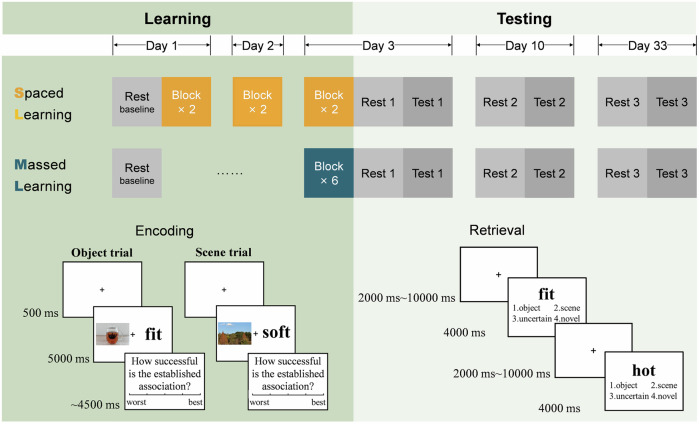
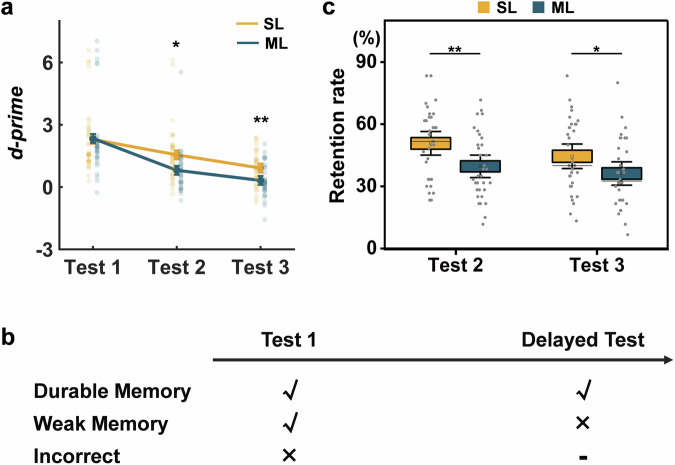
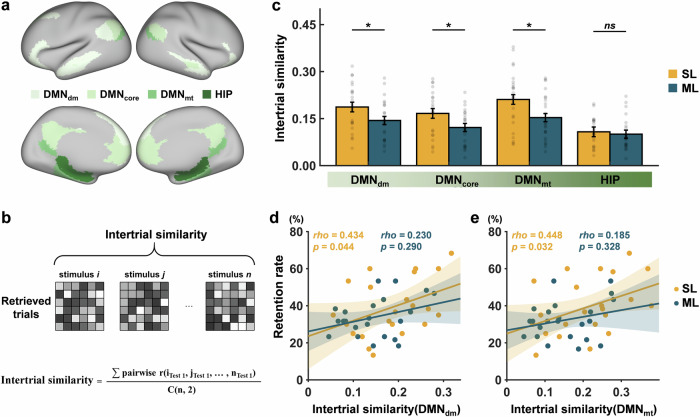
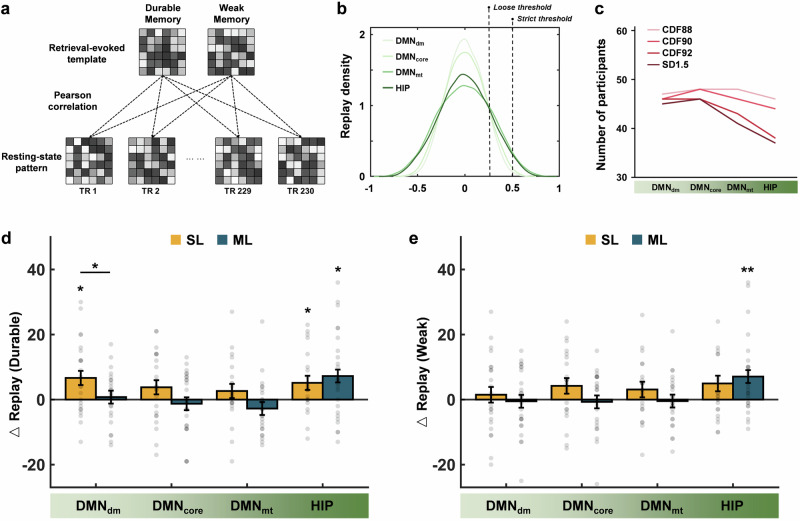
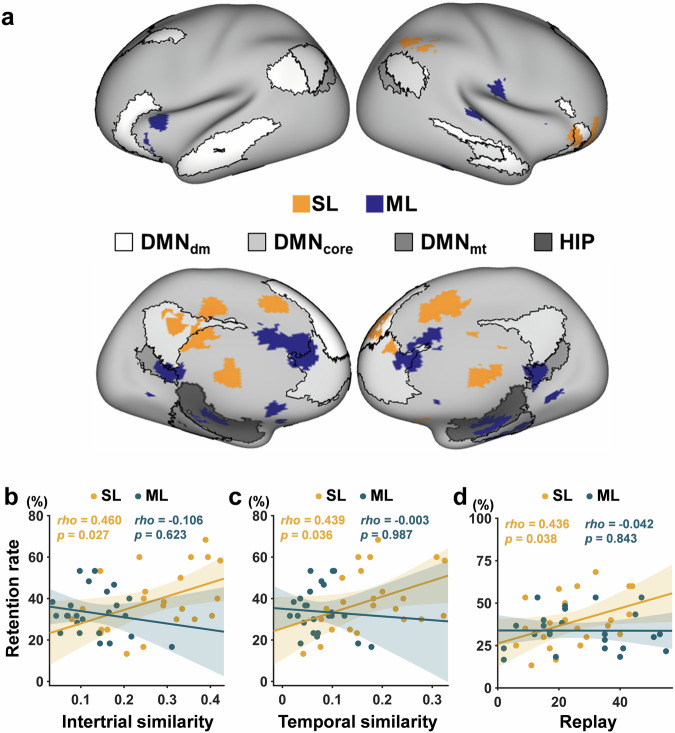
Emerging studies suggest that time-dependent consolidation enables memory stabilization by promoting memory integration and hippocampal-cortical transfer. Compared to massed learning, how time-dependent consolidation contributes to forming durable memory and what neural signatures predict durable memory in spaced learning remain unclear. We recruited 48 participants who underwent either 3-day spaced learning or 1-day massed learning, and both resting-state and task-based fMRI data were collected in multiple delayed tests (i.e., immediate, 1-week, and 1-month). We use representational similarity analysis to assess neural integration and replay in the hippocampus and default mode network (DMN) subsystems. In contrast with massed learning, spaced learning induces higher neural pattern similarity during immediate retrieval only in DMN subsystems. Particularly, the neural pattern similarity in the dorsal-medial DMN (DMNdm) and medial-temporal DMN subsystems predicts the durable memory defined by 1-month delay. Moreover, we find increased neural replay of durable memory in the DMNdm for spaced learning and in the hippocampus for both spaced and massed learning. Our findings suggest that time-dependent consolidation promotes neural integration and replay in the cortex rather than in the hippocampus, which may underlie the formation of durable memory after spaced learning. Time-dependent consolidation promoting neural integration and spontaneous replay in the cortex rather than in the hippocampus may underlie the formation of durable memories after spaced learning.
Overview
The claims and statistics of this paper haven’t been checked yet.
Free: it reads the open-access text and checks the first 5 claims that cite a source we can check. Create a free account to check every claim.
Integrity signals
Registry
Cites
Statistics
Figures
Verification
Claims the paper makes
The claims and statistics of this paper haven’t been checked yet.
Free: it reads the open-access text and checks the first 5 claims that cite a source we can check. Create a free account to check every claim.
Claims other papers make about this one
Each is checked against this paper’s own text: does it say what the citing paper says it does?
The cited source says what the claim attributes to it.
In the citing paper
“Yang et al. (2025) explain that prolonged intervals between learning sessions allow for spontaneous neuronal reproduction and integration processes, facilitating hippocampal-cortical transfer and the stabilization of memory traces.”
From Systematic Review of the Effectiveness of Neurodidactic Spaced Learning Strategies in Long-Term Memory (2026) · cites this paper as Yang et al. (2025)
Self-check
Percentages, sums and reported differences re-computed from the paper’s own numbers.
The self-check needs the paper’s full text.
Citations
Cites
Tzourio-Mazoyer, N., Landeau, B., Papathanassiou, D., Crivello, F., Etard, O., Delcroix, N., Mazoyer, B., & Joliot, M. (2002) · NeuroImage · doi:10.1006/nimg.2001.0978 · Cited by 16,319 · cited 2×
“A spherical ROI (radius = 3 voxels) was moved voxel-by-voxel through the brain 62 .”
Functional connectivity in the motor cortex of resting human brain using echo‐planar mri
Biswal, B., Zerrin Yetkin, F., Haughton, V. M., & Hyde, J. S. (1995) · Magnetic Resonance in Medicine · doi:10.1002/mrm.1910340409 · Cited by 9,812 · cited 1×
“…nuisance regression to remove confounding factors, including six head motion parameters, cerebrospinal signals, and white matter signals 84,85 ; and (3) A linear drift and bandpass fi lter (0.01 ~ 0.08 Hz) was taken to reduce low-frequency drift and high-frequency physiological noises 86 .”
InfluentialThe organization of the human cerebral cortex estimated by intrinsic functional connectivity
Thomas Yeo, B. T., Krienen, F. M., Sepulcre, J., Sabuncu, M. R., Lashkari, D., Hollinshead, M., Roffman, J. L., Smoller, J. W., Zöllei, L., Polimeni, J. R., et al. (2011) · Journal of Neurophysiology · doi:10.1152/jn.00338.2011 · Cited by 9,182
The organization of the human cerebellum estimated by intrinsic functional connectivity
Buckner, R. L., Krienen, F. M., Castellanos, A., Diaz, J. C., & Yeo, B. T. T. (2011) · Journal of Neurophysiology · doi:10.1152/jn.00339.2011 · Cited by 7,304
McClelland, J. L., McNaughton, B. L., & O'Reilly, R. C. (1995) · Psychological Review · doi:10.1037/0033-295x.102.3.419 · Cited by 5,256 · cited 2×
“Ontheotherhand,convergentstudieshavesuggestedthatmemories (especially episodic memories) are initially encoded in the hippocampus and then transferred to distributed cortical networks for stabilization through hippocampal-cortical interactions during consolidation 19,24 – 28 .”
DPABI: Data Processing & Analysis for (Resting-State) Brain Imaging
Yan, C.-G., Wang, X.-D., Zuo, X.-N., & Zang, Y.-F. (2016) · Neuroinformatics · doi:10.1007/s12021-016-9299-4 · Cited by 3,853
Representational similarity analysis-connecting the branches of systems neuroscience
Kriegeskorte, N. (2008) · Frontiers in Systems Neuroscience · doi:10.3389/neuro.06.004.2008 · Cited by 3,355
The organization of recent and remote memories
Frankland, P. W., & Bontempi, B. (2005) · Nature Reviews Neuroscience · doi:10.1038/nrn1607 · Cited by 2,138 · cited 2×
“Ontheotherhand,convergentstudieshavesuggestedthatmemories (especially episodic memories) are initially encoded in the hippocampus and then transferred to distributed cortical networks for stabilization through hippocampal-cortical interactions during consolidation 19,24 – 28 .”
Information-based functional brain mapping
Kriegeskorte, N., Goebel, R., & Bandettini, P. (2006) · Proceedings of the National Academy of Sciences · doi:10.1073/pnas.0600244103 · Cited by 2,113
Andrews‐Hanna, J. R., Smallwood, J., & Spreng, R. N. (2014) · Annals of the New York Academy of Sciences · doi:10.1111/nyas.12360 · Cited by 2,102
Distributed practice in verbal recall tasks: A review and quantitative synthesis.
Cepeda, N. J., Pashler, H., Vul, E., Wixted, J. T., & Rohrer, D. (2006) · Psychological Bulletin · doi:10.1037/0033-2909.132.3.354 · Cited by 1,888 · cited 1×
“Based on the spacing effect, a well-known phenomenon in learning and memory, spaced learning can enhance memory performance, especially for memory durability, compared to massed learning 1 – 5 .”
The Neurobiology of Consolidations, Or, How Stable is the Engram?
Dudai, Y. (2004) · Annual Review of Psychology · doi:10.1146/annurev.psych.55.090902.142050 · Cited by 1,671
Retrograde amnesia and memory consolidation: a neurobiological perspective
Squire, L. R., & Alvarez, P. (1995) · Current Opinion in Neurobiology · doi:10.1016/0959-4388(95)80023-9 · Cited by 1,416 · cited 1×
“Theconsolidationtheorypositsthatconsolidationfosterstheformation of long-term memory traces through effective stabilization and reinforcement 12 – 16 .”
Memory consolidation and the medial temporal lobe: a simple network model.
Alvarez, P., & Squire, L. R. (1994) · Proceedings of the National Academy of Sciences · doi:10.1073/pnas.91.15.7041 · Cited by 1,072 · cited 1×
“During post-encoding consolidation, spontaneous activities within hippocampal and across hippocampal-cortical networks are the leading mechanism underlying memory stabilization and transformation 20,29 – 33 .”
The effect of testing versus restudy on retention: A meta-analytic review of the testing effect.
Rowland, C. A. (2014) · Psychological Bulletin · doi:10.1037/a0037559 · Cited by 1,066 · cited 1×
“Third, in order to estimate the memory retention for each object-word pair, we repeatedly tested the same pairs in different tests, which may affect the memory durability 76 and the systems consolidation 77,78 .”
Episodic memory and beyond: the hippocampus and neocortex in transformation
Moscovitch, M., Cabeza, R., Winocur, G., & Nadel, L. (2016) · Annual Review of Psychology · doi:10.1146/annurev-psych-113011-143733 · Cited by 1,062
Hippocampal replay in the awake state: a potential substrate for memory consolidation and retrieval
Carr, M. F., Jadhav, S. P., & Frank, L. M. (2011) · Nature Neuroscience · doi:10.1038/nn.2732 · Cited by 958 · cited 2×
“Consolidation relies on the spontaneous memory-related replay after learning 31,32,34,35 .”
The default mode network in cognition: a topographical perspective
Smallwood, J., Bernhardt, B. C., Leech, R., Bzdok, D., Jefferies, E., & Margulies, D. S. (2021) · Nature Reviews Neuroscience · doi:10.1038/s41583-021-00474-4 · Cited by 935 · cited 1×
“Due to its complex cognitive engagement, the DMN has been divided into distinct subsystems: the dorsal-medial DMN (DMN dm ), core DMN (DMN core ), and medial-temporal DMN (DMN mt ) 48 .”
20 years of the default mode network: A review and synthesis.
Menon, V. (2023) · Neuron · doi:10.1016/j.neuron.2023.04.023 · Cited by 934 · cited 2×
“Moreover, the emerging model emphasizes that the default mode network (DMN), which has frequently been linked to episodic memory, may serve as a hub for igniting replay cascades and support the reactivation of older memories 42 – 47 .”
Prefrontal–hippocampal interactions in episodic memory
Eichenbaum, H. (2017) · Nature Reviews Neuroscience · doi:10.1038/nrn.2017.74 · Cited by 870
The Consolidation and Transformation of Memory
Dudai, Y., Karni, A., & Born, J. (2015) · Neuron · doi:10.1016/j.neuron.2015.09.004 · Cited by 741
Dan-Glauser, E. S., & Scherer, K. R. (2011) · Behavior Research Methods · doi:10.3758/s13428-011-0064-1 · Cited by 736
Deconvolving BOLD activation in event-related designs for multivoxel pattern classification analyses
Mumford, J. A., Turner, B. O., Ashby, F. G., & Poldrack, R. A. (2012) · NeuroImage · doi:10.1016/j.neuroimage.2011.08.076 · Cited by 726
How does nature program neuron types?
Borst, A. (2008) · Frontiers in Neuroscience · doi:10.3389/neuro.01.016.2008 · Cited by 705
A meta-analytic review of the distribution of practice effect: Now you see it, now you don’t
Donovan, J. J., & Radosevich, D. J. (1999) · Journal of Applied Psychology · doi:10.1037/0021-9010.84.5.795 · Cited by 696
Time-dependent reorganization of brain circuitry underlying long-term memory storage
Bontempi, B., Laurent-Demir, C., Destrade, C., & Jaffard, R. (1999) · Nature · doi:10.1038/23270 · Cited by 673 · cited 2×
“Ontheotherhand,convergentstudieshavesuggestedthatmemories (especially episodic memories) are initially encoded in the hippocampus and then transferred to distributed cortical networks for stabilization through hippocampal-cortical interactions during consolidation 19,24 – 28 .”
Spacing Effects in Learning: A Temporal Ridgeline of Optimal Retention
Cepeda, N. J., Vul, E., Rohrer, D., Wixted, J. T., & Pashler, H. (2008) · Psychological Science · doi:10.1111/j.1467-9280.2008.02209.x · Cited by 631
Enhanced Brain Correlations during Rest Are Related to Memory for Recent Experiences
Tambini, A., Ketz, N., & Davachi, L. (2010) · Neuron · doi:10.1016/j.neuron.2010.01.001 · Cited by 583 · cited 2×
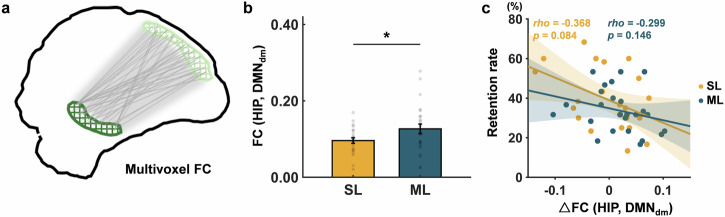
“Weaker hippocampus-DMN dm functional connectivity after spaced learning than after massed learning Besides the increased replay of local neural activity, previous studies con-sideredthatthechangesinhippocampus-cortexFCafterlearningre fl ectthe transfer of memory storage 10,40,41 .”
Winocur, G., Moscovitch, M., & Bontempi, B. (2010) · Neuropsychologia · doi:10.1016/j.neuropsychologia.2010.04.016 · Cited by 486 · cited 2×
“Theconsolidationtheorypositsthatconsolidationfosterstheformation of long-term memory traces through effective stabilization and reinforcement 12 – 16 .”
Hebart, M. N., Görgen, K., & Haynes, J.-D. (2015) · Frontiers in Neuroinformatics · doi:10.3389/fninf.2014.00088 · Cited by 437 · cited 1×
“The Decoding Toolbox (TDT) 92 was used for this searchlight analysis based on beta images obtained from the trial-by-trial GLM.”
Ellenbogen, J. M., Hulbert, J. C., Stickgold, R., Dinges, D. F., & Thompson-Schill, S. L. (2006) · Current Biology · doi:10.1016/j.cub.2006.05.024 · Cited by 377 · cited 1×
“This is because the persistence of the spacing effect may rely on learning intervals, especially sleep 66,67 .”
Foster, D. J. (2017) · Annual Review of Neuroscience · doi:10.1146/annurev-neuro-072116-031538 · Cited by 375
Biasing the content of hippocampal replay during sleep
Bendor, D., & Wilson, M. A. (2012) · Nature Neuroscience · doi:10.1038/nn.3203 · Cited by 359 · cited 1×
“First,althoughsleepisthoughttoplaya crucialroleinmemoryconsolidation 72,73 , we did not directly explore the neural mechanism of consolidation during sleep.”
Hippocampal ripples and memory consolidation
Girardeau, G., & Zugaro, M. (2011) · Current Opinion in Neurobiology · doi:10.1016/j.conb.2011.02.005 · Cited by 330 · cited 1×
“Consolidation relies on the spontaneous memory-related replay after learning 31,32,34,35 .”
Zhang, J., Cheng, W., Liu, Z., Zhang, K., Lei, X., Yao, Y., Becker, B., Liu, Y., Kendrick, K. M., Lu, G., et al. (2016) · Brain · doi:10.1093/brain/aww143 · Cited by 329 · cited 1×
“…nuisance regression to remove confounding factors, including six head motion parameters, cerebrospinal signals, and white matter signals 84,85 ; and (3) A linear drift and bandpass fi lter (0.01 ~ 0.08 Hz) was taken to reduce low-frequency drift and high-frequency physiological noises 86 .”
Influentialvan de Ven, G. M., Trouche, S., McNamara, C. G., Allen, K., & Dupret, D. (2016) · Neuron · doi:10.1016/j.neuron.2016.10.020 · Cited by 320 · cited 1×
“Consolidation relies on the spontaneous memory-related replay after learning 31,32,34,35 .”
Sequential replay of nonspatial task states in the human hippocampus
Schuck, N. W., & Niv, Y. (2019) · Science · doi:10.1126/science.aaw5181 · Cited by 304
Shift from hippocampal to neocortical centered retrieval network with consolidation
Takashima, A., Nieuwenhuis, I. L. C., Jensen, O., Talamini, L. M., Rijpkema, M., & Fernández, G. (2009) · The Journal of Neuroscience · doi:10.1523/jneurosci.0799-09.2009 · Cited by 276
100 Years of Consolidation— Remembering Müller and Pilzecker
Lechner, H. A., Squire, L. R., & Byrne, J. H. (1999) · Learning & Memory · doi:10.1101/lm.6.2.77 · Cited by 272 · cited 1×
“According to the consolidation theory, the formation of long-term memory traces is attributed to effective stabilization and reinforcement 14 .”
Robin, J., & Moscovitch, M. (2017) · Current Opinion in Behavioral Sciences · doi:10.1016/j.cobeha.2017.07.016 · Cited by 266
Memory Consolidation by Replay of Stimulus-Specific Neural Activity
Deuker, L., Olligs, J., Fell, J., Kranz, T. A., Mormann, F., Montag, C., Reuter, M., Elger, C. E., & Axmacher, N. (2013) · The Journal of Neuroscience · doi:10.1523/jneurosci.0414-13.2013 · Cited by 263 · cited 1×
“Consolidation relies on the spontaneous memory-related replay after learning 31,32,34,35 .”
Schapiro, A. C., McDevitt, E. A., Rogers, T. T., Mednick, S. C., & Norman, K. A. (2018) · Nature Communications · doi:10.1038/s41467-018-06213-1 · Cited by 263 · cited 6×
“For instance,thepriorstudyindicatedthataftera1-daydelay,theitemsreplayed moreduringpost-encodingconsolidationshowedbettersubsequent memory 36 .”
InfluentialLeft prefrontal activation during episodic remembering: an event-related fMRI study
Nolde, S. F., Johnson, M. K., & DʼEsposito, M. (1998) · NeuroReport · doi:10.1097/00001756-199810260-00032 · Cited by 257
Retrieval as a fast route to memory consolidation
Antony, J. W., Ferreira, C. S., Norman, K. A., & Wimber, M. (2017) · Trends in Cognitive Sciences · doi:10.1016/j.tics.2017.05.001 · Cited by 242 · cited 1×
“Third, in order to estimate the memory retention for each object-word pair, we repeatedly tested the same pairs in different tests, which may affect the memory durability 76 and the systems consolidation 77,78 .”
Maintaining memories by reactivation
Rasch, B., & Born, J. (2007) · Current Opinion in Neurobiology · doi:10.1016/j.conb.2007.11.007 · Cited by 240
Persistence of hippocampal multivoxel patterns into postencoding rest is related to memory
Tambini, A., & Davachi, L. (2013) · Proceedings of the National Academy of Sciences · doi:10.1073/pnas.1308499110 · Cited by 230
Spacing practice sessions across days benefits the learning of motor skills
Shea, C. H., Lai, Q., Black, C., & Park, J.-H. (2000) · Human Movement Science · doi:10.1016/s0167-9457(00)00021-x · Cited by 224
Tompary, A., & Davachi, L. (2017) · Neuron · doi:10.1016/j.neuron.2017.09.005 · Cited by 224 · cited 3×
“This suggests that time-dependent consolidation in spaced learning facilitates the neural integration of memories 17,22,23,69 .”
Awake reactivation predicts memory in humans
Staresina, B. P., Alink, A., Kriegeskorte, N., & Henson, R. N. (2013) · Proceedings of the National Academy of Sciences · doi:10.1073/pnas.1311989110 · Cited by 219 · cited 2×
“Several fMRI studies evaluated the appearance of task-evoked memory pattern, as well as increased hippocampal-cortical functional connectivity (FC) in post-encoding rest, and revealed a positive relationship between spontaneous replay and subsequent memory 36 – 39 .”
Boredom, sustained attention and the default mode network
Danckert, J., & Merrifield, C. (2018) · Experimental Brain Research · doi:10.1007/s00221-016-4617-5 · Cited by 198 · cited 1×
“In addition, DMN is particularly associated with boredom or fatigue 79,80 .”
Awake Reactivation of Prior Experiences Consolidates Memories and Biases Cognition
Tambini, A., & Davachi, L. (2019) · Trends in Cognitive Sciences · doi:10.1016/j.tics.2019.07.008 · Cited by 188 · cited 2×
“With time, memories are strengthened and integrated across hippocampal-cortical networks through spontaneous replay, which is considered to be the leading mechanism of system consolidation 32,33 .”
Patterns across multiple memories are identified over time
Richards, B. A., Xia, F., Santoro, A., Husse, J., Woodin, M. A., Josselyn, S. A., & Frankland, P. W. (2014) · Nature Neuroscience · doi:10.1038/nn.3736 · Cited by 150 · cited 1×
“Prior work has shown that cortical neural representations of memories become more integrated with time 23,71 .”
Replay bursts in humans coincide with activation of the default mode and parietal alpha networks
Higgins, C., Liu, Y., Vidaurre, D., Kurth-Nelson, Z., Dolan, R., Behrens, T., & Woolrich, M. (2021) · Neuron · doi:10.1016/j.neuron.2020.12.007 · Cited by 149 · cited 1×
“In particular, the DMN plays a vital role in the hippocampal-cortical transfer, which supports memory formation 45 .”
Replay, the default mode network and the cascaded memory systems model
Kaefer, K., Stella, F., McNaughton, B. L., & Battaglia, F. P. (2022) · Nature reviews. Neuroscience · doi:10.1038/s41583-022-00620-6 · Cited by 143 · cited 1×
“Previous studies demonstrated the crucial role of the hippocampus in the spacingeffect,andtheDMNisincreasinglyrecognizedtobeassociatedwith humancognition,especiallyepisodicmemory 42,43 .”
Toppino, T. C., & Gerbier, É. (2013) · The Psychology of learning and motivation/The psychology of learning and motivation · doi:10.1016/b978-0-12-800090-8.00004-4 · Cited by 138 · cited 1×
“Previous studies with multi-day learning designs demonstrated that the spacing effect can persist for one year 9,68 .”
Kim, H. (2015) · Neuropsychologia · doi:10.1016/j.neuropsychologia.2015.11.006 · Cited by 119 · cited 1×
“Speci fi cally, the DMN dm is closely linked to the integration and storage of memory 49 – 52 .”
Hippocampal Sharp-Wave Ripples Influence Selective Activation of the Default Mode Network
Kaplan, R., Adhikari, M. H., Hindriks, R., Mantini, D., Murayama, Y., Logothetis, N. K., & Deco, G. (2016) · Current Biology · doi:10.1016/j.cub.2016.01.017 · Cited by 116
Individual differences and time-varying features of modular brain architecture
Liao, X., Cao, M., Xia, M., & He, Y. (2017) · NeuroImage · doi:10.1016/j.neuroimage.2017.02.066 · Cited by 116
Reagh, Z. M., & Ranganath, C. (2023) · Nature Communications · doi:10.1038/s41467-023-36805-5 · Cited by 115
Spaced Learning Enhances Subsequent Recognition Memory by Reducing Neural Repetition Suppression
Xue, G., Mei, L., Chen, C., Lu, Z.-L., Poldrack, R., & Dong, Q. (2011) · Journal of Cognitive Neuroscience · doi:10.1162/jocn.2010.21532 · Cited by 114 · cited 3×
“Second, the neural activity during encoding, which was usually examinedintrial-baseddesign 2,8,74,75 ,wasnotrecordedduringourmulti-day learning.”
Kaboodvand, N., Bäckman, L., Nyberg, L., & Salami, A. (2018) · Human Brain Mapping · doi:10.1002/hbm.23983 · Cited by 111
Rapid Cortical Plasticity Supports Long-Term Memory Formation
Hebscher, M., Wing, E., Ryan, J., & Gilboa, A. (2019) · Trends in Cognitive Sciences · doi:10.1016/j.tics.2019.09.009 · Cited by 107 · cited 1×
“Third, in order to estimate the memory retention for each object-word pair, we repeatedly tested the same pairs in different tests, which may affect the memory durability 76 and the systems consolidation 77,78 .”
Awake reactivation of emotional memory traces through hippocampal–neocortical interactions
de Voogd, L. D., Fernández, G., & Hermans, E. J. (2016) · NeuroImage · doi:10.1016/j.neuroimage.2016.04.026 · Cited by 97 · cited 1×
“Although differences exist, all the preprocessing steps and parameters for both resting-state and task fMRI data were standard and were used following previous studies 36,87 .”
Cowan, E., Liu, A., Henin, S., Kothare, S., Devinsky, O., & Davachi, L. (2020) · The Journal of Neuroscience · doi:10.1523/jneurosci.1946-19.2020 · Cited by 97 · cited 3×
“Consistently, previous studies have indicated the higher retrieval-related neural pattern similarity after consolidation, which is related to the fast spindle density that is thought to play an important role in systems memory consolidation 21 .”
Time-dependent memory transformation along the hippocampal anterior–posterior axis
Dandolo, L. C., & Schwabe, L. (2018) · Nature Communications · doi:10.1038/s41467-018-03661-7 · Cited by 96 · cited 2×
“This suggests that time-dependent consolidation in spaced learning facilitates the neural integration of memories 17,22,23,69 .”
The Spacing Effect Depends on an Encoding Deficit, Retrieval, and Time in Working Memory: Evidence
Rubin, K. B. D. C. (1998) · Memory · doi:10.1080/741941599 · Cited by 92 · cited 1×
“Previous studies suggest that spaced learning leads to robust memory by eliciting retrieval effort and the reactivation of a preceding memory trace 6 , manifests as stronger brain activation 2,7 and enhanced item-speci fi c spatiotemporal pattern similarity 8 during the encoding phase.”
Xue, C., Yuan, B., Yue, Y., Xu, J., Wang, S., Wu, M., Ji, N., Zhou, X., Zhao, Y., Rao, J., et al. (2019) · Frontiers in Aging Neuroscience · doi:10.3389/fnagi.2019.00307 · Cited by 89 · cited 1×
“The DMN core , involved in self-referential and long-term memoryprocessing 53,54 ,servesasafunctionalhubandmediatesinformation transfer between DMN dm and the DMN mt subsystems 55 – 58 .”
Distributed learning enhances relational memory consolidation
Litman, L., & Davachi, L. (2008) · Learning & Memory · doi:10.1101/lm.1132008 · Cited by 81 · cited 2×
“To con fi rm that no between-group difference in memory performance in immediate memory test but do in delayed tests revealed by previous studies 10,61 , we conducted independent sample t -test for each test.”
Spaced learning enhances episodic memory by increasing neural pattern similarity across repetitions
Feng, K., Zhao, X., Liu, J., Cai, Y., Ye, Z., Chen, C., & Xue, G. (2019) · The Journal of Neuroscience · doi:10.1523/jneurosci.2741-18.2019 · Cited by 78 · cited 3×
“Second, the neural activity during encoding, which was usually examinedintrial-baseddesign 2,8,74,75 ,wasnotrecordedduringourmulti-day learning.”
Causal Role of Prefrontal Cortex in Strengthening of Episodic Memories through Reconsolidation
Sandrini, M., Censor, N., Mishoe, J., & Cohen, L. G. (2013) · Current Biology · doi:10.1016/j.cub.2013.08.045 · Cited by 77
Takashima, A., Nieuwenhuis, I. L. C., Rijpkema, M., Petersson, K. M., Jensen, O., & Fernández, G. (2007) · Learning & Memory · doi:10.1101/lm.605607 · Cited by 75 · cited 1×
“Previous studies on multi-day learning have consistently reported no signi fi cantdifferencesinmemoryperformancebetweentwolearninggroupsat immediate test 10,61,64,65 .”
Gui, D.-Y., Xu, S., Zhu, S., Fang, Z., Spaeth, A. M., Xin, Y., Feng, T., & Rao, H. (2015) · NeuroImage · doi:10.1016/j.neuroimage.2015.07.030 · Cited by 74 · cited 1×
“In addition, DMN is particularly associated with boredom or fatigue 79,80 .”
Memory consolidation reconfigures neural pathways involved in the suppression of emotional memories
Liu, Y., Lin, W., Liu, C., Luo, Y., Wu, J., Bayley, P. J., & Qin, S. (2016) · Nature Communications · doi:10.1038/ncomms13375 · Cited by 73 · cited 2×
“This suggests that time-dependent consolidation in spaced learning facilitates the neural integration of memories 17,22,23,69 .”
Vilberg, K. L., & Davachi, L. (2013) · Neuron · doi:10.1016/j.neuron.2013.07.013 · Cited by 67 · cited 5×
“To con fi rm that no between-group difference in memory performance in immediate memory test but do in delayed tests revealed by previous studies 10,61 , we conducted independent sample t -test for each test.”
InfluentialTerry, D. P., Sabatinelli, D., Puente, A. N., Lazar, N. A., & Miller, L. S. (2015) · Journal of Neuroimaging · doi:10.1111/jon.12266 · Cited by 62 · cited 1×
“The DMN mt , most close to the hippocampus spatially and functionally, is associated with the encoding and retrieval of episodic memory, particularly in gathering cognitive, emotional, environmental, and other information 54,59,60 .”
The role of experience in prioritizing hippocampal replay
Gorriz, M. H., Takigawa, M., & Bendor, D. (2023) · Nature Communications · doi:10.1038/s41467-023-43939-z · Cited by 62 · cited 1×
“First,althoughsleepisthoughttoplaya crucialroleinmemoryconsolidation 72,73 , we did not directly explore the neural mechanism of consolidation during sleep.”
Imaging distributed and massed repetitions of natural scenes: Spontaneous retrieval and maintenance
Bradley, M. M., Costa, V. D., Ferrari, V., Codispoti, M., Fitzsimmons, J. R., & Lang, P. J. (2014) · Human Brain Mapping · doi:10.1002/hbm.22708 · Cited by 59 · cited 1×
“Previous studies suggest that spaced learning leads to robust memory by eliciting retrieval effort and the reactivation of a preceding memory trace 6 , manifests as stronger brain activation 2,7 and enhanced item-speci fi c spatiotemporal pattern similarity 8 during the encoding phase.”
Callan, D. E., & Schweighofer, N. (2010) · Human Brain Mapping · doi:10.1002/hbm.20894 · Cited by 55 · cited 1×
“Second, the neural activity during encoding, which was usually examinedintrial-baseddesign 2,8,74,75 ,wasnotrecordedduringourmulti-day learning.”
Replay-triggered brain-wide activation in humans
Huang, Q., Xiao, Z., Yu, Q., Luo, Y., Xu, J., Qu, Y., Dolan, R. J., Behrens, T. E. J., & Liu, Y. (2024) · Nature Communications · doi:10.1038/s41467-024-51582-5 · Cited by 55
Parallel Engagement of Regions Associated with Encoding and Later Retrieval Forms Durable Memories
Wagner, I. C., van Buuren, M., Bovy, L., & Fernández, G. (2016) · Journal of Neuroscience · doi:10.1523/jneurosci.0830-16.2016 · Cited by 51
Time-dependent memory transformation in hippocampus and neocortex is semantic in nature
Krenz, V., Alink, A., Sommer, T., Roozendaal, B., & Schwabe, L. (2023) · Nature Communications · doi:10.1038/s41467-023-41648-1 · Cited by 44
Thalamo-cortical coupling during encoding and consolidation is linked to durable memory formation
Wagner, I. C., van Buuren, M., & Fernández, G. (2019) · NeuroImage · doi:10.1016/j.neuroimage.2019.04.055 · Cited by 36 · cited 2×
“Weaker hippocampus-DMN dm functional connectivity after spaced learning than after massed learning Besides the increased replay of local neural activity, previous studies con-sideredthatthechangesinhippocampus-cortexFCafterlearningre fl ectthe transfer of memory storage 10,40,41 .”
Pattern and predictability in memory formation: From molecular mechanisms to clinical relevance
Philips, G. T., Kopec, A. M., & Carew, T. J. (2013) · Neurobiology of Learning and Memory · doi:10.1016/j.nlm.2013.05.003 · Cited by 33 · cited 1×
“Based on the spacing effect, a well-known phenomenon in learning and memory, spaced learning can enhance memory performance, especially for memory durability, compared to massed learning 1 – 5 .”
Ezzyat, Y., Inhoff, M. C., & Davachi, L. (2018) · The Journal of Neuroscience · doi:10.1523/jneurosci.2290-17.2018 · Cited by 33 · cited 2×
“Nevertheless,neuroimagingstudies withday-basedspacedlearningtypicallyassessmemoryretentionfollowing relativelyshortdelays,suchasseveraldays 10,11 , and they rarely explored the time-dependent consolidation mechanisms underlying the formation of durable memory in spaced learning.”
Zou, F., Guo, W., Allen, E., Wu, Y., Charest, I., Naselaris, T., Kay, K., Kuhl, B. A., Hutchinson, J. B., & DuBrow, S. (2023) · Nature Communications · doi:10.1038/s41467-023-40100-8 · Cited by 31 · cited 1×
“Second, the neural activity during encoding, which was usually examinedintrial-baseddesign 2,8,74,75 ,wasnotrecordedduringourmulti-day learning.”
Role of the hippocampus in the spacing effect during memory retrieval
Li, C., & Yang, J. (2020) · Hippocampus · doi:10.1002/hipo.23193 · Cited by 30 · cited 1×
“Previous studies on multi-day learning have consistently reported no signi fi cantdifferencesinmemoryperformancebetweentwolearninggroupsat immediate test 10,61,64,65 .”
Relationship between brain AD biomarkers and episodic memory performance in healthy aging
Rizzolo, L., Narbutas, J., Egroo, M. V., Chylinski, D., Besson, G., Baillet, M., Bahri, M. A., Salmon, É., Maquet, P., Vandewalle, G., et al. (2021) · Brain and Cognition · doi:10.1016/j.bandc.2020.105680 · Cited by 30 · cited 1×
“The DMN mt , most close to the hippocampus spatially and functionally, is associated with the encoding and retrieval of episodic memory, particularly in gathering cognitive, emotional, environmental, and other information 54,59,60 .”
Livne, T., Kim, D., Metcalf, N. V., Zhang, L., Pini, L., Shulman, G. L., & Corbetta, M. (2022) · Scientific Reports · doi:10.1038/s41598-022-20866-5 · Cited by 28
Tompary, A., & Davachi, L. (2024) · eLife · doi:10.7554/elife.84359 · Cited by 24 · cited 1×
“This suggests that time-dependent consolidation in spaced learning facilitates the neural integration of memories 17,22,23,69 .”
Hou, Y., Yuan, X., Wei, Q., Ou, R., Yang, J., Gong, Q., & Shang, H. (2020) · Neuroradiology · doi:10.1007/s00234-020-02378-z · Cited by 22
Awake Hippocampal–Cortical Co-reactivation Is Associated with Forgetting
Tanrıverdi, B., Cowan, E. T., Metoki, A., Jobson, K. R., Murty, V. P., Chein, J. M., & Olson, I. R. (2023) · Journal of Cognitive Neuroscience · doi:10.1162/jocn_a_02021 · Cited by 22 · cited 3×
“5 obtained by the pooled correlation coef fi cients from pre-encoding and post-encoding rest sessions of all participants is likely stricter than that obtained for a single participant in previous studies 36,63 .”
InfluentialSleep shapes the associative structure underlying pattern completion in multielement event memory
Lutz, N. D., Martínez-Albert, E., Friedrich, H., Born, J., & Besedovsky, L. (2024) · Proceedings of the National Academy of Sciences · doi:10.1073/pnas.2314423121 · Cited by 20 · cited 1×
“This is because the persistence of the spacing effect may rely on learning intervals, especially sleep 66,67 .”
Chen, Q., Turnbull, A. G., Baran, T. M., & Lin, F. V. (2020) · eLife · doi:10.7554/elife.62114 · Cited by 15 · cited 1×
“The DMN core , involved in self-referential and long-term memoryprocessing 53,54 ,servesasafunctionalhubandmediatesinformation transfer between DMN dm and the DMN mt subsystems 55 – 58 .”
Failure in Cognitive Suppression of Negative Affect in Adolescents with Generalized Anxiety Disorder
Yin, D., Liu, W., Zeljic, K., Lv, Q., Wang, Z., You, M., Men, W., Fan, M., Cheng, W., & Wang, Z. (2017) · Scientific Reports · doi:10.1038/s41598-017-07063-5 · Cited by 14 · cited 1×
“After converting the raw DICOM data to the NIFTI format, the following preprocessing steps were conducted 82 .”
Self-citationYao, W., Initiative, A. D. N., Chen, H., Sheng, X., Zhao, H., Xu, Y., & Bai, F. (2021) · Journal of Alzheimer s Disease · doi:10.3233/jad-210481 · Cited by 5 · cited 1×
“The DMN core , involved in self-referential and long-term memoryprocessing 53,54 ,servesasafunctionalhubandmediatesinformation transfer between DMN dm and the DMN mt subsystems 55 – 58 .”
Cited by
The Memory Paradox: Why Our Brains Need Knowledge in an Age of AI
Oakley, B., Johnston, M., Chen, K., Jung, E., & Sejnowski, T. (2025) · doi:10.2139/ssrn.5250447 · Cited by 31
Avendaño, O. F. R. (2026) · Educación Médica · doi:10.1016/j.edumed.2025.101148 · Cited by 3
Markiel, A., Skalski, D., Markowski, J., Pilch, J., Maszczyk, A., & Zając, A. (2025) · Applied Sciences · doi:10.3390/app16010142 · Cited by 2
Miao, Z., Liu, Y., Zhang, W., Jing, P., & Huang, Z. (2025) · IEEE Internet of Things Journal · doi:10.1109/jiot.2025.3644386 · Cited by 1
“Yang et al. [14] employed the EEG-functional magnetic resonance imaging (fMRI) multimodal data to confirm that hippocampal theta power during the awake resting period is correlated with functional connectivity.”
Self-citationSilva Sánchez, M., Lainez Quinde, G. A., & Zambrano Vélez, W. A. (2026) · Education Sciences · doi:10.3390/educsci16060962
“…of the included literature indicates that distributed practice protocols are associated with positive trends in long-term memory retention across several university contexts (Li & Yang, 2025; Yang et al., 2025), offering a valuable interpretive lens for neurodidactic framework development.”
Metadata
- Authors
- Yang, Y., Huang, Z., Yang, Y., Fan, M., & Yin, D.
- Affiliations
- East China Normal University (CN)
- Shanghai Changning Mental Health Center (CN)
- Corresponding author
- Yin, Dazhi
- Venue
- Communications Biology
- Published
- 2025-04-01
- Volume
- 8
- Issue
- 1
- Pages
- 535-535
- ISSN
- 2399-3642 (ISSN-L)
- PMC
- PMC11962080
- OpenAlex
- W4409080337
- Cited by
- 10
- References
- 95
- Citations by year
- 2026: 6 · 2025: 4
- FWCI
- 5.67
- Type
- journal article
- Language
- en
- Open access
- gold
- doi.org
- Licence
- cc-by-nc-nd
- creativecommons.org/licenses/by-nc-nd/4.0 (tdm)
- creativecommons.org/licenses/by-nc-nd/4.0 (vor)
- Locations
- Communications Biology (publishedVersion, cc-by-nc-nd)
- PubMed Central (publishedVersion, cc-by-nc-nd)
- PubMed (publishedVersion)
- DOAJ (DOAJ: Directory of Open Access Journals) (submittedVersion, cc-by-sa)
- Funders
- National Natural Science Foundation of China (2021ZD0200500, STI2030, 32271096)
- Fundamental Research Funds for the Central Universities (2021ZD0200500)
- Topics
- Life Sciences › Neuroscience › Cognitive Neuroscience › Memory and Neural Mechanisms
- Life Sciences › Neuroscience › Cognitive Neuroscience › Memory Processes and Influences
- Life Sciences › Neuroscience › Cognitive Neuroscience › Sleep and Wakefulness Research
- Keywords
- time-dependent consolidation, spaced learning, memory consolidation, hippocampus, default mode network, neural replay, neural integration, massed learning, memory stability, representational similarity analysis
- MeSH terms
- Memory Consolidation, Adult, Female, Hippocampus, Humans, Learning, Magnetic Resonance Imaging, Male, Memory, Time Factors, Young Adult
About these checks
Registry, retraction, Cites and statistics results are computed, not judged, with one exception: a printed reference that no index lists is read once by a model before it counts as a citation error. Claims are extracted by a model and kept only when their quote appears verbatim in the text; each cited source is then checked, with a model’s help, for whether it says what the claim relies on. Those verdicts can be wrong — read the claim’s quote and the cited source before relying on one.
Statistics and arithmetic are recomputed, not judged.
Confidence bands are shown only for fields calibrated on our annotated test set. None is calibrated yet, so no band is shown.
What counts as a claim ›How we measure confidence ›How we check this ›
Are you an author, or do you see a problem with this page? Request a review
Data sources
Bibliographic data: Semantic Scholar, OpenAlex, Crossref.
Contains information from the Semantic Scholar Academic Graph Datasets, made available under the ODC Attribution License (ODC-BY 1.0).
Semantic Scholar’s data is described in: Kinney, R., et al. (2023). The Semantic Scholar Open Data Platform. arXiv:2301.10140.
