

Multi-shape active composites by 3D printing of digital shape memory polymers
Open accessThe DOI matches its Crossref record; 30 of the 31 references it cites were found in a registry or an index.
Abstract
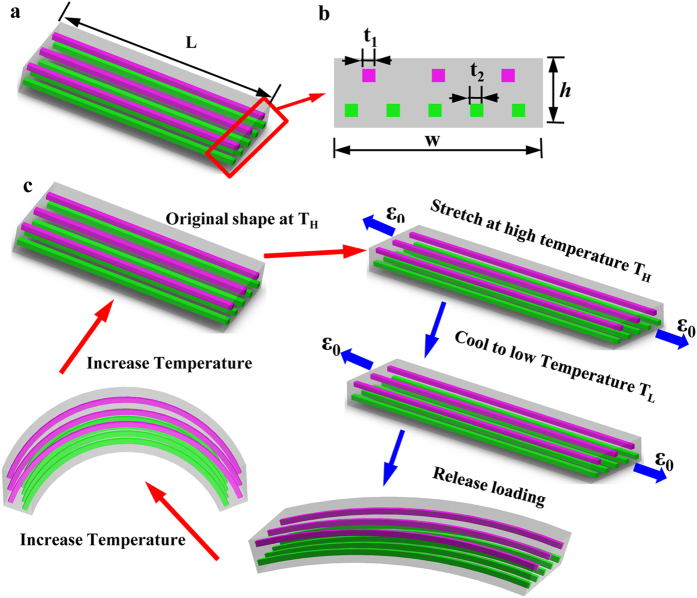
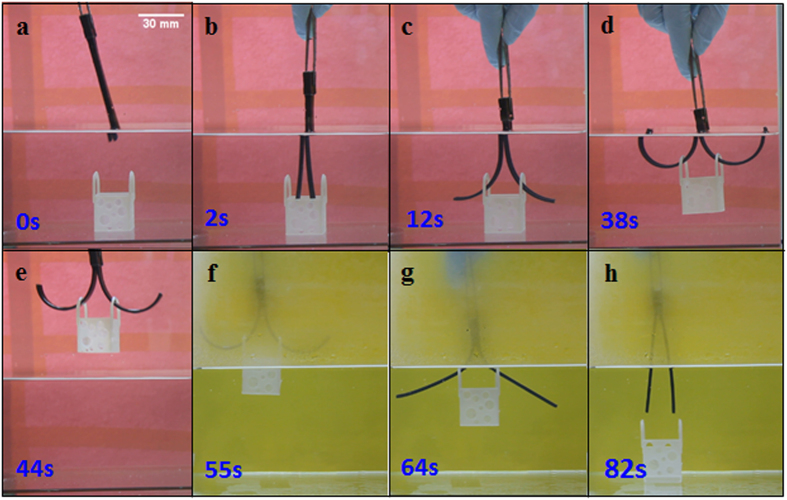
Recent research using 3D printing to create active structures has added an exciting new dimension to 3D printing technology. After being printed, these active, often composite, materials can change their shape over time; this has been termed as 4D printing. In this paper, we demonstrate the design and manufacture of active composites that can take multiple shapes, depending on the environmental temperature. This is achieved by 3D printing layered composite structures with multiple families of shape memory polymer (SMP) fibers – digital SMPs - with different glass transition temperatures (Tg) to control the transformation of the structure. After a simple single-step thermomechanical programming process, the fiber families can be sequentially activated to bend when the temperature is increased. By tuning the volume fraction of the fibers, bending deformation can be controlled. We develop a theoretical model to predict the deformation behavior for better understanding the phenomena and aiding the design. We also design and print several flat 2D structures that can be programmed to fold and open themselves when subjected to heat. With the advantages of an easy fabrication process and the controllable multi-shape memory effect, the printed SMP composites have a great potential in 4D printing applications.
Overview
The claims and statistics of this paper haven’t been checked yet.
Free: it reads the open-access text and checks the first 5 claims that cite a source we can check. Create a free account to check every claim.
Integrity signals
Registry
Cites
Statistics
Figures



Verification
Claims the paper makes
The claims and statistics of this paper haven’t been checked yet.
Free: it reads the open-access text and checks the first 5 claims that cite a source we can check. Create a free account to check every claim.
Claims other papers make about this one
Each is checked against this paper’s own text: does it say what the citing paper says it does?
The source backs part of the claim, not all of it — or backs it for a different population, condition or comparison.
In the citing paper
“the first example of 3D printed multiple-way SMPs was provided by Wu et al. [206], who fabricated layered composite structures with SMPs having different glass transition temperatures, by using a multi-material Polyjet 3D printer.”
From Two-Way and Multiple-Way Shape Memory Polymers for Soft Robotics: An Overview (2020) · cites this paper as [206]
Experimental — accuracy not yet measured
Self-check
Percentages, sums and reported differences re-computed from the paper’s own numbers.
The self-check needs the paper’s full text.
Citations
Cites
3D bioprinting of tissues and organs
Murphy, S. V., & Atala, A. (2014) · Nature Biotechnology · doi:10.1038/nbt.2958 · Cited by 7,034
Inkjet Printing—Process and Its Applications
Singh, M., Haverinen, H. M., Dhagat, P., & Jabbour, G. E. (2010) · Advanced Materials · doi:10.1002/adma.200901141 · Cited by 2,375 · cited 1×
“Active materials and structures that can change their properties and shape have great technological potential, e.g., in sensors, robotics, self-packaging devices, aerospace exploring and bio-medical applications 15–18 .”
Light-induced shape-memory polymers
Lendlein, A., Jiang, H., Jünger, O., & Langer, R. (2005) · Nature · doi:10.1038/nature03496 · Cited by 2,006 · cited 1×
“Among active materials, shape memory polymers (SMPs) have been intensively studied because of their ability to generate a large shape change under an external stimuli us, such as temperature 19–21 , light 22 , electric 23,24 and magnetic fields 25,26 .”
Review of progress in shape-memory polymers
Liu, C., Qin, H., & Mather, P. T. (2007) · Journal of Materials Chemistry · doi:10.1039/b615954k · Cited by 1,942
Evaluation of 3D Printing and Its Potential Impact on Biotechnology and the Chemical Sciences
Gross, B. C., Erkal, J. L., Lockwood, S. Y., Chen, C., & Spence, D. M. (2014) · Analytical Chemistry · doi:10.1021/ac403397r · Cited by 1,746 · cited 1×
“1038/srep24224 λ α = + − < < t T t T t t ( ) 1 [ ( ) ], 0 , (2) Thermal H 1”
Shape-memory polymers and their composites: stimulus methods and applications
Leng, J., Lan, X., Liu, Y., & Du, S. (2011) · Progress in Materials Science · doi:10.1016/j.pmatsci.2011.03.001 · Cited by 1,495 · cited 1×
“Active materials and structures that can change their properties and shape have great technological potential, e.g., in sensors, robotics, self-packaging devices, aerospace exploring and bio-medical applications 15–18 .”
A review on 3D micro-additive manufacturing technologies
Vaezi, M., Seitz, H., & Yang, S. (2013) · The International Journal of Advanced Manufacturing Technology · doi:10.1007/s00170-012-4605-2 · Cited by 1,293 · cited 1×
“e y t t t t y t t t ( , ) ln ( ) ( ) ( ) , (6) Thermal b 0 2 3”
Recent advances in polymer shape memory
Xie, T. (2011) · Polymer · doi:10.1016/j.polymer.2011.08.003 · Cited by 870
3D printing of composite calcium phosphate and collagen scaffolds for bone regeneration
Inzana, J. A., Olvera, D., Fuller, S. M., Kelly, J. P., Graeve, O. A., Schwarz, E. M., Kates, S. L., & Awad, H. A. (2014) · Biomaterials · doi:10.1016/j.biomaterials.2014.01.064 · Cited by 840 · cited 1×
“λ λ = ∆ y t y t y t ( , ) ( , ) ( , ), (7) Mech Thermal 0”
Mohr, R., Kratz, K., Weigel, T., Lucka-Gabor, M., Moneke, M., & Lendlein, A. (2006) · Proceedings of the National Academy of Sciences · doi:10.1073/pnas.0600079103 · Cited by 819 · cited 1×
“Among active materials, shape memory polymers (SMPs) have been intensively studied because of their ability to generate a large shape change under an external stimuli us, such as temperature 19–21 , light 22 , electric 23,24 and magnetic fields 25,26 .”
Research works printed but not linked: 1
- Tibbits, S. The emergence of “4D printing”. TED conference. (2013) Available at: http://www.ted.com/talks/skylar_tibbits_the_emergence_of_4d_printing?language=en (Accessed: 25th July 2013).
Cited by
Printing ferromagnetic domains for untethered fast-transforming soft materials
Kim, Y., Yuk, H., Zhao, R., Chester, S. A., & Zhao, X. (2018) · Nature · doi:10.1038/s41586-018-0185-0 · Cited by 2,183
Momeni, F., M.Mehdi Hassani.N, S., Liu, X., & Ni, J. (2017) · Materials & Design · doi:10.1016/j.matdes.2017.02.068 · Cited by 1,165
Multimaterial 4D Printing with Tailorable Shape Memory Polymers
Ge, Q., Sakhaei, A. H., Lee, H., Dunn, C. K., Fang, N. X., & Dunn, M. L. (2016) · Scientific Reports · doi:10.1038/srep31110 · Cited by 1,160
Self-citationAdvances in 4D Printing: Materials and Applications
Kuang, X., Roach, D. J., Wu, J., Hamel, C. M., Ding, Z., Wang, T., Dunn, M. L., & Qi, H. J. (2019) · Advanced Functional Materials · doi:10.1002/adfm.201805290 · Cited by 1,095
Self-citation3D printing of soft robotic systems
Wallin, T. J., Pikul, J., & Shepherd, R. F. (2018) · Nature Reviews Materials · doi:10.1038/s41578-018-0002-2 · Cited by 942
Metadata
- Authors
- Wu, J., Yuan, C., Ding, Z., Isakov, M., Mao, Y., Wang, T., Dunn, M. L., & Qi, H. J.
- Affiliations
- Georgia Institute of Technology (US)
- Xi'an Jiaotong University (CN)
- Singapore University of Technology and Design (SG)
- Corresponding author
- Dunn, Martin L.
- Qi, H. Jerry
- Venue
- Scientific Reports
- Published
- 2016-04-13
- Volume
- 6
- Issue
- 1
- Pages
- 24224-24224
- ISSN
- 2045-2322 (ISSN-L)
- PMC
- PMC4829848
- OpenAlex
- W2336992486
- Cited by
- 399
- References
- 31
- Citations by year
- 2026: 12 · 2025: 23 · 2024: 39 · 2023: 37 · 2022: 43 · 2021: 55 · 2020: 57 · 2019: 49 · 2018: 39 · 2017: 36 · 2016: 8
- FWCI
- 39.13
- Type
- journal article
- Language
- en
- Open access
- gold
- doi.org
- Licence
- cc-by
- creativecommons.org/licenses/by/4.0 (tdm)
- creativecommons.org/licenses/by/4.0 (vor)
- Locations
- Scientific Reports (publishedVersion, cc-by)
- Europe PMC (PubMed Central) (publishedVersion, cc-by)
- PubMed Central (publishedVersion, cc-by)
- PubMed (publishedVersion)
- Funders
- National Science Foundation (1462895, 1462894, 1404621)
- National Research Foundation
- National Research Foundation Singapore
- Singapore University of Technology and Design
- Digital Manufacturing and Design Centre, Singapore University of Technology and Design
- Division of Civil, Mechanical and Manufacturing Innovation (CMMI-1462895, CMMI-1462894, 1462894, 1462895)
- Air Force Office of Scientific Research (FA9550-13-1-0088, FA9550-)
- Topics
- Physical Sciences › Engineering › Mechanical Engineering › Advanced Materials and Mechanics
- Physical Sciences › Materials Science › Polymers and Plastics › Polymer composites and self-healing
- Physical Sciences › Engineering › Industrial and Manufacturing Engineering › Additive Manufacturing and 3D Printing Technologies
- Keywords
- shape memory polymers, 4D printing, active composites, glass transition temperature, fiber volume fraction, bending deformation, folding and unfolding, deformation modeling, composite laminates
About these checks
Registry, retraction, Cites and statistics results are computed, not judged, with one exception: a printed reference that no index lists is read once by a model before it counts as a citation error. Claims are extracted by a model and kept only when their quote appears verbatim in the text; each cited source is then checked, with a model’s help, for whether it says what the claim relies on. Those verdicts can be wrong — read the claim’s quote and the cited source before relying on one.
Statistics and arithmetic are recomputed, not judged.
Confidence bands are shown only for fields calibrated on our annotated test set. None is calibrated yet, so no band is shown.
What counts as a claim ›How we measure confidence ›How we check this ›
Are you an author, or do you see a problem with this page? Request a review
Data sources
Bibliographic data: Semantic Scholar, OpenAlex, Crossref.
Contains information from the Semantic Scholar Academic Graph Datasets, made available under the ODC Attribution License (ODC-BY 1.0).
Semantic Scholar’s data is described in: Kinney, R., et al. (2023). The Semantic Scholar Open Data Platform. arXiv:2301.10140.
