

The DOI matches its Crossref record; 18 of the 18 references it cites were found in a registry or an index.
The genetics of an early Neolithic pastoralist from the Zagros, Iran
Published version of a preprint
Abstract
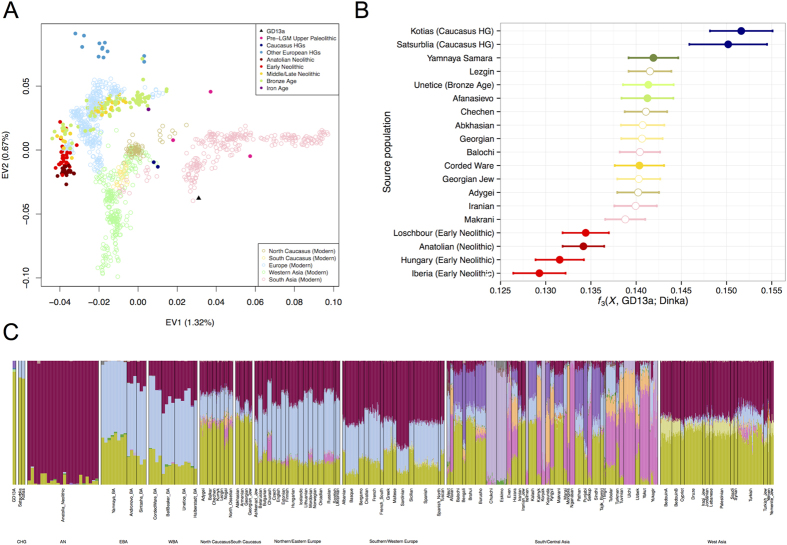
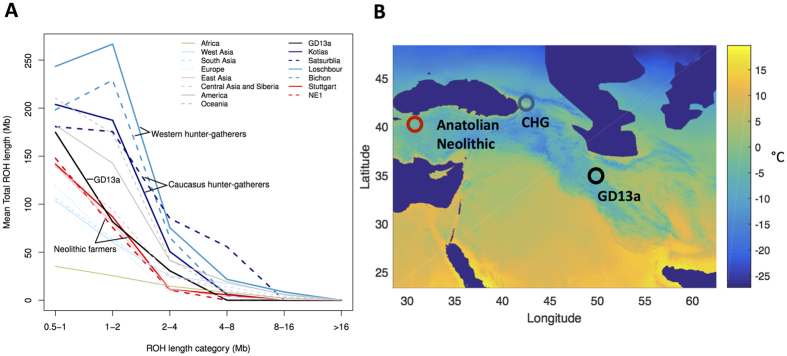
The agricultural transition profoundly changed human societies. We sequenced and analysed the first genome (1.39x) of an early Neolithic woman from Ganj Dareh, in the Zagros Mountains of Iran, a site with early evidence for an economy based on goat herding, ca. 10,000 BP. We show that Western Iran was inhabited by a population genetically most similar to hunter-gatherers from the Caucasus, but distinct from the Neolithic Anatolian people who later brought food production into Europe. The inhabitants of Ganj Dareh made little direct genetic contribution to modern European populations, suggesting those of the Central Zagros were somewhat isolated from other populations of the Fertile Crescent. Runs of homozygosity are of a similar length to those from Neolithic farmers, and shorter than those of Caucasus and Western Hunter-Gatherers, suggesting that the inhabitants of Ganj Dareh did not undergo the large population bottleneck suffered by their northern neighbours. While some degree of cultural diffusion between Anatolia, Western Iran and other neighbouring regions is possible, the genetic dissimilarity between early Anatolian farmers and the inhabitants of Ganj Dareh supports a model in which Neolithic societies in these areas were distinct.
Overview
The claims and statistics of this paper haven’t been checked yet.
Run the check — free, no account needed. It reads the open-access text and checks the sources it cites.
Integrity signals
Registry
Cites
Statistics
Figures
Verification
Claims the paper makes
The claims and statistics of this paper haven’t been checked yet.
Run the check — free, no account needed. It reads the open-access text and checks the sources it cites.
Claims other papers make about this one
Each is checked against this paper’s own text: does it say what the citing paper says it does?
In the citing paper
“Genomes from ancient hunter gatherers in East Asia25, Neolithic farmers in Iran16,17, and ancient African hunter gatherers26,27, allow us to infer, through ancient–modern comparisons, that the genetic contribution from Neolithic populations to present-day farming or pastoralist Africans and South and East Asians is greater than that from hunter gatherers.”
From Cultural hitchhiking and competition between patrilineal kin groups explain the post-Neolithic Y-chromosome bottleneck (2018) · cites this paper as [16]
In the citing paper
“In West Eurasia, the precursors of the first Neolithic farming populations already had larger population sizes16,17 than hunter gatherers from areas that received agriculturalist migration”
From Cultural hitchhiking and competition between patrilineal kin groups explain the post-Neolithic Y-chromosome bottleneck (2018) · cites this paper as [16]
Self-check
Percentages, sums and reported differences re-computed from the paper’s own numbers.
The self-check needs the paper’s full text.
Citations
Cites
Population Structure and Eigenanalysis
Patterson, N., Price, A. L., & Reich, D. (2006) · PLoS Genetics · doi:10.1371/journal.pgen.0020190 · Cited by 5,280
ANGSD: Analysis of Next Generation Sequencing Data
Korneliussen, T. S., Albrechtsen, A., & Nielsen, R. (2014) · BMC Bioinformatics · doi:10.1186/s12859-014-0356-4 · Cited by 2,982
Ancient Admixture in Human History
Patterson, N., Moorjani, P., Luo, Y., Mallick, S., Rohland, N., Zhan, Y., Genschoreck, T., Webster, T., & Reich, D. (2012) · Genetics · doi:10.1534/genetics.112.145037 · Cited by 2,848
Massive migration from the steppe was a source for Indo-European languages in Europe
Haak, W., Lazaridis, I., Patterson, N., Rohland, N., Mallick, S., Llamas, B., Brandt, G., Nordenfelt, S., Harney, E., Stewardson, K., et al. (2015) · Nature · doi:10.1038/nature14317 · Cited by 1,940
mapDamage2.0: fast approximate Bayesian estimates of ancient DNA damage parameters
Jónsson, H., Ginolhac, A., Schubert, M., Johnson, P. L. F., & Orlando, L. (2013) · Bioinformatics · doi:10.1093/bioinformatics/btt193 · Cited by 1,669
Population genomics of Bronze Age Eurasia
Allentoft, M. E., Sikora, M., Sjögren, K.-G., Rasmussen, S., Rasmussen, M., Stenderup, J., Damgaard, P. B., Schroeder, H., Ahlström, T., Vinner, L., et al. (2015) · Nature · doi:10.1038/nature14507 · Cited by 1,550
Genome-wide patterns of selection in 230 ancient Eurasians
Mathieson, I., Lazaridis, I., Rohland, N., Mallick, S., Patterson, N., Roodenberg, S. A., Harney, E., Stewardson, K., Fernandes, D., Novak, M., et al. (2015) · Nature · doi:10.1038/nature16152 · Cited by 1,515
Self-citationAncient human genomes suggest three ancestral populations for present-day Europeans
Lazaridis, I., Patterson, N., Mittnik, A., Renaud, G., Mallick, S., Kirsanow, K., Sudmant, P. H., Schraiber, J. G., Castellano, S., Lipson, M., et al. (2014) · Nature · doi:10.1038/nature13673 · Cited by 1,357
Upper Palaeolithic Siberian genome reveals dual ancestry of Native Americans
Raghavan, M., Skoglund, P., Graf, K. E., Metspalu, M., Albrechtsen, A., Moltke, I., Rasmussen, S., Stafford Jr, T. W., Orlando, L., Metspalu, E., et al. (2014) · Nature · doi:10.1038/nature12736 · Cited by 963
An early modern human from Romania with a recent Neanderthal ancestor
Fu, Q., Hajdinjak, M., Moldovan, O. T., Constantin, S., Mallick, S., Skoglund, P., Patterson, N., Rohland, N., Lazaridis, I., Nickel, B., et al. (2015) · Nature · doi:10.1038/nature14558 · Cited by 802
Genome flux and stasis in a five millennium transect of European prehistory
Gamba, C., Jones, E. R., Teasdale, M. D., McLaughlin, R. L., Gonzalez-Fortes, G., Mattiangeli, V., Domboróczki, L., Kővári, I., Pap, I., Anders, A., et al. (2014) · Nature Communications · doi:10.1038/ncomms6257 · Cited by 667
Self-citationNew insights into the Tyrolean Iceman's origin and phenotype as inferred by whole-genome sequencing
Keller, A., Graefen, A., Ball, M., Matzas, M., Boisguerin, V., Maixner, F., Leidinger, P., Backes, C., Khairat, R., Forster, M., et al. (2012) · Nature Communications · doi:10.1038/ncomms1701 · Cited by 437
The HIrisPlex system for simultaneous prediction of hair and eye colour from DNA
Walsh, S., Liu, F., Wollstein, A., Kovatsi, L., Ralf, A., Kosiniak-Kamysz, A., Branicki, W., & Kayser, M. (2013) · Forensic Science International Genetics · doi:10.1016/j.fsigen.2012.07.005 · Cited by 428
Upper Palaeolithic genomes reveal deep roots of modern Eurasians
Jones, E. R., Gonzalez-Fortes, G., Connell, S., Siska, V., Eriksson, A., Martiniano, R., McLaughlin, R. L., Gallego Llorente, M., Cassidy, L. M., Gamba, C., et al. (2015) · Nature Communications · doi:10.1038/ncomms9912 · Cited by 417
Self-citationDerived immune and ancestral pigmentation alleles in a 7,000-year-old Mesolithic European
Olalde, I., Allentoft, M. E., Sánchez-Quinto, F., Santpere, G., Chiang, C. W. K., DeGiorgio, M., Prado-Martinez, J., Rodríguez, J. A., Rasmussen, S., Quilez, J., et al. (2014) · Nature · doi:10.1038/nature12960 · Cited by 360
Genomic structure in Europeans dating back at least 36,200 years
Seguin-Orlando, A., Korneliussen, T. S., Sikora, M., Malaspinas, A.-S., Manica, A., Moltke, I., Albrechtsen, A., Ko, A., Margaryan, A., Moiseyev, V., et al. (2014) · Science · doi:10.1126/science.aaa0114 · Cited by 315
Self-citationAncient genomes link early farmers from Atapuerca in Spain to modern-day Basques
Günther, T., Valdiosera, C., Malmström, H., Ureña, I., Rodriguez-Varela, R., Sverrisdóttir, Ó. O., Daskalaki, E. A., Skoglund, P., Naidoo, T., Svensson, E. M., et al. (2015) · Proceedings of the National Academy of Sciences · doi:10.1073/pnas.1509851112 · Cited by 278
Emergence of Agriculture in the Foothills of the Zagros Mountains of Iran
Riehl, S., Zeidi, M., & Conard, N. J. (2013) · Science · doi:10.1126/science.1236743 · Cited by 257
Research works printed but not linked: 38
- Blockley, S. P. E. & Pinhasi, R. A revised chronology for the adoption of agriculture in the Southern Levant and the role of Lateglacial climatic change. Quaternary Science Reviews 30, 98–108 (2011). · DOI
- Goring-Morris, A. N. & Belfer-Cohen, A. Neolithization Processes in the Levant: The Outer Envelope. Current Anthropology 52, S195–S208 (2011). · DOI · Paper page
- Omrak, A. et al. Genomic Evidence Establishes Anatolia as the Source of the European Neolithic Gene Pool. Current Biology 26, 270–275 (2016). · DOI
- Zeder, M. A. & Hesse, B. The Initial Domestication of Goats (Capra hircus) in the Zagros Mountains 10,000 Years Ago. Science 287, 2254–2257 (2000). · DOI
- Zeder, M. A. Domestication and early agriculture in the Mediterranean Basin: Origins, diffusion, and impact. PNAS, doi: 10.1073/pnas.0801317105 (2008). · DOI
- Zeder, M. A. The Origins of Agriculture in the Near East. Curr Anthrop 52, 221–235 (2011). · DOI
- Smith, P. E. L. Architectural Innovation and Experimentation at Ganj Dareh, Iran. World Archaeology 21, 323–335 (1990). · DOI
- Merrett, D. C. Bioarchaeology in Early Neolithic Iran: assessment of health status and subsistence strategy. Unpublished Ph.D. Dissertation. (University of Manitoba, 2004).
- van Zeist, W., Smith, P. E. L., Palfenier-Vegter, R. M., Suwijn, M. & Casparie, W. A. An archaeobotanical study of Ganj Dareh Tepe, Iran. Palaeohistoria 26, 201–224 (1984).
- Reidla, M. et al. Origin and Diffusion of mtDNA Haplogroup X. Am J Hum Genet 73, 1178–1190 (2003). · DOI
- Richards, M. et al. Tracing European founder lineages in the Near Eastern mtDNA pool. Am. J. Hum. Genet. 67, 1251–1276 (2000). · DOI
- Cassidy, L. M. et al. Neolithic and Bronze Age migration to Ireland and establishment of the insular Atlantic genome. PNAS 113, 368–373 (2016). · DOI
- Olalde, I. et al. A common genetic origin for early farmers from Mediterranean Cardial and Central European LBK cultures. Mol Biol Evol msv181, doi: 10.1093/molbev/msv181 (2015). · DOI · Paper page
- Alexander, D. H., Novembre, J. & Lange, K. Fast model-based estimation of ancestry in unrelated individuals. Genome Res. 19, 1655–1664 (2009). · DOI · Paper page
- Green, R. E. et al. A Draft Sequence of the Neandertal Genome. Science 328, 710–722 (2010). · DOI · Paper page
- Harris, D. R. et al. Origins of Agriculture in Western Central Asia: An Environmental-Archaeological Study. (University of Pennsylvania Press, 2010). · DOI
- Gangal, K., Sarson, G. R. & Shukurov, A. The Near-Eastern Roots of the Neolithic in South Asia. PLoS ONE 9, e95714 (2014). · DOI
- Kirin, M. et al. Genomic Runs of Homozygosity Record Population History and Consanguinity. PLOS ONE 5, e13996 (2010). · DOI
- Matthews, R. & Nashli, H. F. The Neolithisation of Iran. 3, (Oxbow Books, 2013). · DOI
- Weeks, L. et al. The Neolithic Settlement of Highland SW Iran: New Evidence from the Mamasani District. Iran 44, 1–31 (2006). · DOI
- Whitlam, J., Ilkhani, H., Bogaard, A. & Charles, C. In The Earliest Neolithic of Iran: 2008 Excavations at Sheikh-e Abad and Jani (eds Matthews, R., Matthews, W. & Mohammadifar, Y. ) Ch. 15, 175–184 (2013). · DOI
- Gamba, C. et al. Comparing the performance of three ancient DNA extraction methods for high-throughput sequencing. Mol Ecol Resour 16, 459–469 (2016). · DOI
- Meyer, M. & Kircher, M. Illumina Sequencing Library Preparation for Highly Multiplexed Target Capture and Sequencing. Cold Spring Harb. Protoc. 2010, pdb.prot5448 (2010). · DOI
- Martin, M. Cutadapt removes adapter sequences from high-throughput sequencing reads. EMBnet. journal 17, pp. 10–12 (2011). · DOI · Paper page
- Li, H. & Durbin, R. Fast and accurate short read alignment with Burrows-Wheeler transform. Bioinformatics 25, 1754–1760 (2009). · DOI · Paper page
- Li, H. et al. The Sequence Alignment/Map format and SAMtools. Bioinformatics 25, 2078–2079 (2009). · DOI · Paper page
- McKenna, A. et al. The Genome Analysis Toolkit: a MapReduce framework for analyzing next-generation DNA sequencing data. Genome Res. 20, 1297–1303 (2010). · DOI · Paper page
- Quinlan, A. R. & Hall, I. M. BEDTools: a flexible suite of utilities for comparing genomic features. Bioinformatics 26, 841–842 (2010). · DOI · Paper page
- Briggs, A. W. et al. Patterns of damage in genomic DNA sequences from a Neandertal. Proc. Natl. Acad. Sci. USA 104, 14616–14621 (2007). · DOI · Paper page
- Brotherton, P. et al. Novel high-resolution characterization of ancient DNA reveals C > U-type base modification events as the sole cause of post mortem miscoding lesions. Nucleic Acids Res. 35, 5717–5728 (2007). · DOI
- Gallego Llorente, M. et al. Ancient Ethiopian genome reveals extensive Eurasian admixture in Eastern Africa. Science 350, 820–822 (2015). · DOI · Paper page
- Sánchez-Quinto, F. et al. Genomic Affinities of Two 7,000-Year-Old Iberian Hunter-Gatherers. Curr. Biol. 22, 1494–1499 (2012). · DOI · Paper page
- Skoglund, P., Storå, J., Götherström, A. & Jakobsson, M. Accurate sex identification of ancient human remains using DNA shotgun sequencing. J. Archaeol. Sci. 40, 4477–4482 (2013). · DOI · Paper page
- Vianello, D. et al. HAPLOFIND: a new method for high-throughput mtDNA haplogroup assignment. Hum. Mutat. 34, 1189–1194 (2013). · DOI
- Purcell, S. et al. PLINK: a tool set for whole-genome association and population-based linkage analyses. Am. J. Hum. Genet. 81, 559–575 (2007). · DOI · Paper page
- Browning, S. R. & Browning, B. L. Rapid and accurate haplotype phasing and missing-data inference for whole-genome association studies by use of localized haplotype clustering. Am. J. Hum. Genet. 81, 1084–1097 (2007). · DOI
- Consortium, T. 1000 G. P. An integrated map of genetic variation from 1,092 human genomes. Nature 491, 56–65 (2012). · DOI · Paper page
- Hijmans, R. J., Cameron, S. E., Parra, J. L., Jones, P. G. & Jarvis, A. Very high resolution interpolated climate surfaces for global land areas. International Journal of Climatology 25, 1965–1978 (2005). · DOI
Cited by
Zeng, T. C., Aw, A. J., & Feldman, M. W. (2018) · Nature Communications · doi:10.1038/s41467-018-04375-6 · Cited by 121
Metadata
- Authors
- Gallego-Llorente, M., Connell, S., Jones, E. R., Merrett, D. C., Jeon, Y., Eriksson, A., Siska, V., Gamba, C., Meiklejohn, C., Beyer, R., Jeon, S., Cho, Y. S., Hofreiter, M., Bhak, J., Manica, A., & Pinhasi, R.
- Venue
- Scientific Reports
- Published
- 2016-08-09
- Volume
- 6
- Issue
- 1
- ISSN
- 2045-2322
- PMC
- PMC4977546
- Cited by
- 73
- References
- 18
- Language
- en
About these checks
Registry, retraction, Cites and statistics results are computed, not judged, with one exception: a printed reference that no index lists is read once by a model before it counts as a citation error. Claims are extracted by a model and kept only when their quote appears verbatim in the text; each cited source is then checked, with a model’s help, for whether it says what the claim relies on. Those verdicts can be wrong — read the claim’s quote and the cited source before relying on one.
Statistics and arithmetic are recomputed, not judged.
Confidence bands are shown only for fields calibrated on our annotated test set. None is calibrated yet, so no band is shown.
What counts as a claim ›How we measure confidence ›How we check this ›
Are you an author, or do you see a problem with this page? Request a review
