

Global value chains: A review of the multi-disciplinary literature
Open accessThe DOI matches its Crossref record; 48 of the 217 references it cites were found in a registry or an index; 21 of the 270 sources its claims cite were checked for support.
Abstract
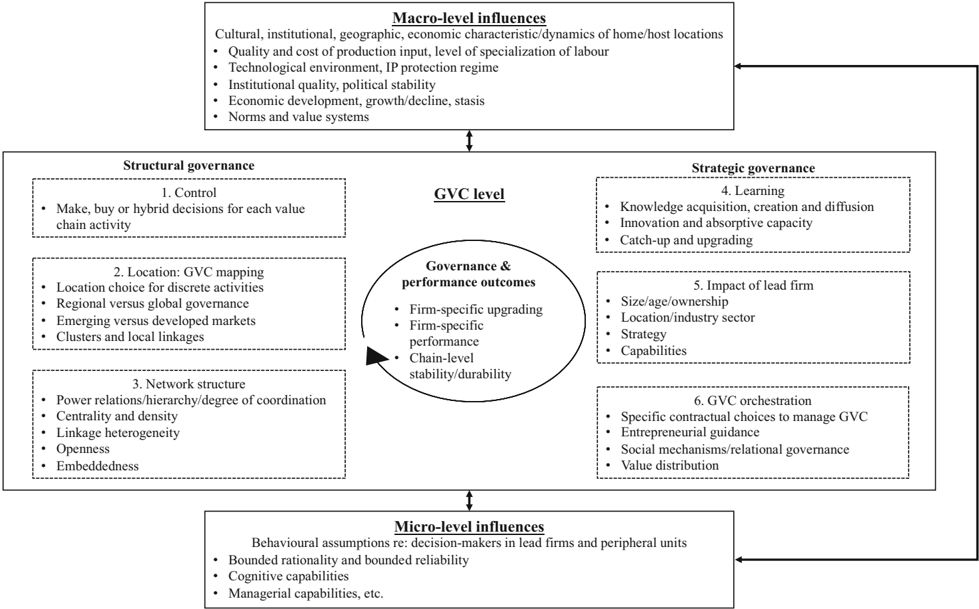
This article reviews the rapidly growing domain of global value chain (GVC) research by analyzing several highly cited conceptual frameworks and then appraising GVC studies published in such disciplines as international business, general management, supply chain management, operations management, economic geography, regional and development studies, and international political economy. Building on GVC conceptual frameworks, we conducted the review based on a comparative institutional perspective that encompasses critical governance issues at the micro-, GVC, and macro-levels. Our results indicate that some of these issues have garnered significantly more scholarly attention than others. We suggest several future research topics such as microfoundations of GVC governance, GVC mapping, learning, impact of lead firm ownership and strategy, dynamics of GVC arrangements, value creation and distribution, financialization, digitization, the impact of renewed protectionism, the impact of GVCs on their macro-environment, and chain-level performance management.
Overview
CoChat Summary
TL;DR
This review synthesizes multidisciplinary global value chain (GVC) research using an IB-centric comparative institutional framework, covering 87 conceptual and empirical studies. It finds uneven scholarly attention across micro-, GVC-, and macro-level governance issues and identifies gaps in microfoundations, GVC mapping, learning, lead-firm ownership/strategy, temporal dynamics, value distribution, financialization, digitization, protectionism, macro-environment impact, and chain-level performance measurement.
Key findings
- The review covers 87 studies: 22 theory papers (including nine foundational pieces) and 65 empirical articles across 21 journals; 33 shortlisted articles are in mainstream IB journals, constituting about 58% of the group of non-social science journals.
- Microfoundations are underrepresented: only seven studies directly address the impact of microfoundations on GVC configurations, knowledge acquisition/dissemination, and network functioning; behavioral assumptions are often implicit and rarely tested.
- Geographic and temporal gaps are evident: only two studies directly address the regional effect in GVCs, only two examine temporal factors in a targeted manner, and few empirical studies measure geographic dispersion or directly address GVCs’ impact on their macro-environment.
- There is no dominant theory of GVC; existing frameworks and typologies are useful organizing frames rather than predictive theory, and GPN 2.0 still lacks empirical studies testing its generality, validity, and robustness.
Methods
- Systematic review of published journal articles, excluding books and book chapters; searched the past 20 years using four terms: global value chain, global commodity chain, global production network, and global factory.
- Included conceptual articles with GVCs as a major focus and empirical articles with at least one search term as a major variable; sample comprises 21 journals, 22 theory papers (including nine foundational pieces), and 65 empirical articles, spanning 1999 to end of July 2019.
- Extracted two to three key GVC-related findings per article and organized them using a comparative institutional framework with micro-, GVC-, and macro-level dimensions; methods were roughly equally split between qualitative case studies and quantitative archival/survey studies, with manufacturing contexts and automotive as the most popular industry.
Limitations
- Paper-stated: books and book chapters were excluded; social science journals were narrowed to a small selection of 30 articles; some impactful cited studies did not meet the sample criteria.
- Paper-stated: GVC/GPN frameworks are primarily explanatory rather than predictive, and predictive power is curtailed by ceteris paribus conditions in open systems; there is no dominant GVC theory, and GPN 2.0 lacks empirical testing.
- Evident from the text: the review is explicitly IB-centric and uses “GVC” inclusively, which may shape which literatures and findings are foregrounded; the additional screening criteria for social science articles were judgment-based.
Model-written summary. Check it against the paper before relying on it.
Integrity signals
Registry
Cites
Statistics
Figures
Verification
Claims the paper makes
16 Valid · 7 Not valid · 191 Not checked · 128 Own results and interpretations
The cited sources support only part of this claim — read each source’s verdict below.
In the paper
“For example, Asian tier 1 suppliers to MNEs and OEMs become GVC lead firms in their own right by shifting production to lower cost locations in the region (Azmeh & Nadvi, 2014;Chen, Wei, Hu, & Muralidharan, 2016).”
§ Global value chains: A review of the multidisciplinary literature > Location
What the sources say
- Partly supportedcites Azmeh & Nadvi, 2014 matched to “Asian firms and the restructuring of global value chains” (2014) sourceExperimental — accuracy not yet measured
The Introduction describes former first-tier Asian garment suppliers taking on chain-coordination functions and shifting manufacturing to lower-cost locations. But it calls them “co-leads” that often work with Western buyers, not independent lead firms; it also says their production networks extend beyond Asia. The claim overstates both their autonomy and the regional scope. (LLM, conf=0.86)
- Not checked yetcites Chen, Wei, Hu, & Muralidharan, 2016 matched to “Survival strategy of OEM companies: a case study of the Chinese toy industry” (2016) source
plainstates a cause- Asserted: passes — The authors put it forward as true.
- Checkable: passes — It can be checked against evidence.
- Load-bearing: unclear — It is unclear whether the paper’s conclusions depend on it.
- Based: passes — The paper gives a reason why it holds.
- Partly supported
The cited sources support only part of this claim — read each source’s verdict below.
In the paper
“Among these factors, favorable business regulations, IP protection, and significant education spending typically attract technologically and functionally sophisticated activities (Amendolagine et al., 2019;Ascani et al., 2016;Pipkin & Fuentes, 2017).”
§ Global value chains: A review of the multidisciplinary literature > Location
What the sources say
- Partly supportedcites Amendolagine et al., 2019 matched to “Local sourcing in developing countries: The role of foreign direct investments and global value chains” (2019) sourceExperimental — accuracy not yet measured
Section 2.1 says cumbersome regulations can discourage foreign investors from buying local inputs, while §4.3 finds that higher education spending strengthens the relationship between GVC involvement and local sourcing (page numbers unavailable). These passages support a role for regulations and education, but they do not establish that those factors attract technologically and functionally sophisticated activities; the cited passages also do not address IP protection. (LLM, conf=0.86)
- Partly supportedcites Ascani et al., 2016 matched to “Economic Institutions and the Location Strategies of European Multinationals in their Geographic Neighborhood” (2016) sourceExperimental — accuracy not yet measured
The Conclusions (page unavailable) link favorable business regulation to MNE location choices, including sophisticated sectors and functions. But they describe preferences for property-rights protection as divided, particularly for sophisticated activities, and say public expenditure matters chiefly for production. The paper does not establish that IP protection or education spending typically attracts sophisticated activities. (LLM, conf=0.89)
- Not checked yetcites Pipkin & Fuentes, 2017 matched to “Spurred to Upgrade: A Review of Triggers and Consequences of Industrial Upgrading in the Global Value Chain Literature” (2017) source
plainstates a cause- Asserted: passes — The authors put it forward as true.
- Checkable: passes — It can be checked against evidence.
- Load-bearing: unclear — It is unclear whether the paper’s conclusions depend on it.
- Based: passes — The paper gives a reason why it holds.
- Partly supported
The cited sources support only part of this claim — read each source’s verdict below.
In the paper
“Sturgeon et al. (2008) followed up with this line of research by examining major American and Japanese automotive lead firms and over 150 suppliers in North America.They found that upgrading of local suppliers was more likely if the GVC network structure moved towards a relational form of power dynamics.”
§ Global value chains: A review of the multidisciplinary literature > Network structure
What the sources say
- Partly supportedcites Sturgeon et al., 2008 matched to “Value chains, networks and clusters: reframing the global automotive industry” (2008) sourceExperimental — accuracy not yet measured
The Local clusters section discusses relational linkages and reports better working relationships between Japanese automakers and locally based North American suppliers. It does not find that a shift toward relational governance made local-supplier upgrading more likely; its account of Japanese suppliers says their relationships became more relational as supplier competence increased. The copy also identifies a figure of the top 150 suppliers, not an examination of over 150 suppliers establishing the claimed result. (LLM, conf=0.83)
hedgedstates a possible cause- Asserted: passes — The authors put it forward as true.
- Checkable: passes — It can be checked against evidence.
- Load-bearing: passes — The paper’s conclusions depend on it.
- Based: passes — The paper gives a reason why it holds.
- Partly supported
The cited sources support only part of this claim — read each source’s verdict below.
In the paper
“This is particularly pronounced in knowledge-intensive industries, where lead firms often locate operations in innovation hubs and global cities (Taylor, Derudder, Faulconbridge, Hoyler, & Ni, 2014).”
§ Global value chains: A review of the multidisciplinary literature > Location
What the sources say
- Partly supportedcites Taylor, Derudder, Faulconbridge, Hoyler, & Ni, 2014 matched to “Advanced Producer Service Firms as Strategic Networks, Global Cities as Strategic Places” (2014) sourceExperimental — accuracy not yet measured
In “APS Internationalization through Strategic Cities” (page unavailable), the paper says some advanced producer service firms locate offices in strategically important cities, including places associated with cutting-edge innovation. Its evidence concerns particular service-firm location strategies; it does not establish the broader claim about lead firms across knowledge-intensive industries or innovation hubs generally. (LLM, conf=0.83)
plainstates an association- Asserted: passes — The authors put it forward as true.
- Checkable: passes — It can be checked against evidence.
- Load-bearing: unclear — It is unclear whether the paper’s conclusions depend on it.
- Based: passes — The paper gives a reason why it holds.
- Partly supported
The cited sources support only part of this claim — read each source’s verdict below.
In the paper
“Such a relational form of network structure tends to favor inter-firm cooperation and credible commitment (e.g., IKEA and its suppliers in Ivarsson & Alvstam, 2011 and tuna canning firms in Havice & Campling, 2017).”
§ Global value chains: A review of the multidisciplinary literature > Network structure
What the sources say
- Not checked yetcites Ivarsson & Alvstam, 2011 matched to “Upgrading in global value-chains: a case study of technology-learning among IKEA-suppliers in China and Southeast Asia” (2011) source
- Partly supportedcites Havice & Campling, 2017 matched to “Where Chain Governance and Environmental Governance Meet: Interfirm Strategies in the Canned Tuna Global Value Chain” (2017) sourceExperimental — accuracy not yet measured
The Processing/Trading section describes tuna processors forming an association and acting collectively, supporting the example of inter-firm cooperation. The Vessel ownership, financing and contracts section also describes long-term supply relationships. Neither passage establishes that a relational network structure generally favors credible commitment; the paper instead emphasizes that inter-firm strategies depend on context. Page numbers are unavailable in our copy. (LLM, conf=0.84)
plainstates a possible cause- Asserted: passes — The authors put it forward as true.
- Checkable: passes — It can be checked against evidence.
- Load-bearing: unclear — It is unclear whether the paper’s conclusions depend on it.
- Based: passes — The paper gives a reason why it holds.
159 more claims · 8 with their cited sources checked
Create a free account to see all 342 claims and to verify the 249 references still open.
- It may state two separate claims as one. 101
- Probably not a substantial claim. 116
Claims other papers make about this one
Each is checked against this paper’s own text: does it say what the citing paper says it does?
The source backs part of the claim, not all of it — or backs it for a different population, condition or comparison.
In the citing paper
“Research reveals that MNEs can build competitive advantages through collaboration with global competitors (horizontal cooperation) or with suppliers and distributors (vertical cooperation) (Kano et al., 2020).”
From Illusions of techno-nationalism. (2022) · cites this paper as Kano et al., 2020
Experimental — accuracy not yet measured
Self-check
Percentages, sums and reported differences re-computed from the paper’s own numbers.
Each contradiction between two passages listed here was confirmed by an independent check.
Rated minor: it would not touch a result — a value no result rests on, a p-value that stays on the same side of the significance level, or a conflict that is clerical, resolved elsewhere in the paper, or outside its own findings.
In the paper
§ Global value chains: A review of the multidisciplinary literature > Micro-level: Microfoundational Assumptions and Their Impact on GVC
“Seppa ¨la ¨, Kenney and Ali-Yrkko ¨(2018) focus on boundedly rational accounting decisions in lead MNEs”
§ Global value chains: A review of the multidisciplinary literature > References
“Seppa ¨la ¨, T., Kenney, M., & Ali-Yrkko ¨, J. 2014. Global supply chains and transfer pricing: Insights from a case study.”
Rated minor: it would not touch a result — a value no result rests on, a p-value that stays on the same side of the significance level, or a conflict that is clerical, resolved elsewhere in the paper, or outside its own findings.
In the paper
§ Global value chains: A review of the multidisciplinary literature > Impact of lead firm ownership and strategy on GVC governance
“However, few studies (with the exception of, e.g., Morris & Staritz, 2014) examined the impact of ownership, meaning potential differences among GVCs led by private, public, state-owned, and family-owned MNEs.”
§ Global value chains: A review of the multidisciplinary literature > Micro-level: Microfoundational Assumptions and Their Impact on GVC
“Ownership characteristics of supplier firms shape the ability to shift between different end markets, respond to lead firm requirements, and pursue upgrading in GVCs.”
Citations
Cites
(1994) · Journal of the American Dietetic Association · doi:10.1016/0002-8223(94)92216-0 · Cited by 45,910
Journal of Economic Literature
(2019) · AEA Papers and Proceedings · doi:10.1257/pandp.109.633 · Cited by 7,468
The governance of global value chains
Gereffi, G., Humphrey, J., & Sturgeon, T. (2005) · Review of International Political Economy · doi:10.1080/09692290500049805 · Cited by 7,233
The Future of the Multinational Enterprise
Buckley, P. J., & Casson, M. (1976) · doi:10.1007/978-1-349-02899-3 · Cited by 4,478
The Eclectic Paradigm of International Production: A Restatement and Some Possible Extensions
Dunning, J. H. (1988) · Journal of International Business Studies · doi:10.1057/palgrave.jibs.8490372 · Cited by 4,315 · cited 1×
“…tariff regimes (Curran, Nadvi, & Campling, 2019; Kim, Milner, Bernauer, Osgood, Spilker, & Tingley, 2019), regulatory environments and government policy interventions, labor costs, level of technological sophistication, and societal Journal of International Business Studies norms (Dunning, 1988).”
BackgroundManaging Across Borders: The Transnational Solution
Bartlett, C. A., & Ghoshal, S. (2009) · Rugman Reviews · doi:10.1007/978-1-137-28787-8_25 · Cited by 4,101
Social Capital, Networks, and Knowledge Transfer
Inkpen, A. C., & Tsang, E. W. K. (2005) · Academy of Management Review · doi:10.5465/amr.2005.15281445 · Cited by 3,864
Self-citationInternational trade and industrial upgrading in the apparel commodity chain
Gereffi, G. (1999) · Journal of International Economics · doi:10.1016/s0022-1996(98)00075-0 · Cited by 3,197 · cited 2×
“In economic sociology and development studies, the earliest work was concerned with global commodity trade and the governance structure of such commodity chains in labor-intensive and high-tech industries (Bair, 2009; Gereffi, 1999, 2018; Gereffi & Korzeniewicz, 1994).”
BackgroundWilliamson, O. E. (1996) · doi:10.1093/oso/9780195078244.001.0001 · Cited by 3,041
Simon, H. A. (1950) · AJN, American Journal of Nursing · doi:10.1097/00000446-195002000-00071 · Cited by 3,004
Research works printed but not linked: 7
- (Papers included in the review are marked with an asterisk.)
- Washington, D. C.: World Bank.
- Kinkel, S., Rieder, B., Horvath, D., & Ja ¨ger, A. 2016. Productivity and flexibility advantages of in-house manufacturing and local sourcing -The limits of global value chains? Paper presented at the 42nd Annual Conference of the European International Business Academy, Vienna, Austria.
- UNCTAD. 2013. Global value chains and development: Investment and value added trade in the global economy. New York: United Nations.
- UNCTAD. 2019. Digital economy report. New York: United Nations.
- World Bank. 2019. Global value chain development report 2019. Washington, DC: World Bank.
- Eric W. K. Tsang is the Dallas World Salute Distinguished Professor of Global Strategy at the Naveen Jindal School of Management, University of Texas at Dallas. He received his PhD from the University of Cambridge. His main research inter- ests include organizational learning, strategic alli- ances, entrepreneurship, and philosophical analysis of methodological issues.
Cited by
Items 201–300 of 996
Rescaling: Change agency and the emerging geography of economic relationships
Grillitsch, M., Asheim, B., Lowe, N., Kelmenson, S., Fünfschilling, L., Lundquist, K.-J., Mahmoud, Y., Martynovich, M., Mattsson, P., Nilsson, M., et al. (2024) · Progress in Human Geography · doi:10.1177/03091325241288337 · Cited by 21
“Furthermore, historically developed economic relationships during the era of globalisation distribute the possibilities to shape rescaling processes differently between actors and across space, thus creating inequality and uneven power relations (Kano et al., 2020).”
Islam, M. T., Chadee, D. D., & Polonsky, M. J. (2021) · Supply Chain Management An International Journal · doi:10.1108/scm-05-2021-0255 · Cited by 22
Qin, L., & Sun, S. L. (2022) · Asia Pacific Journal of Management · doi:10.1007/s10490-022-09823-y · Cited by 21
“Although prior studies have emphasized products, services, risk factors, or environment protection criteria on supplier selection, scant research explores GVC supplier selection from knowledge embeddedness view (Kano et al., 2020; Nielsen, 2005; Ware et al., 2012).”
The influence of global value chain governance on supply network resilience
Statsenko, L., Scholten, K., & Stevenson, M. (2025) · Supply Chain Management An International Journal · doi:10.1108/scm-05-2024-0328 · Cited by 20
Soliman, S., Papanastassiou, M., & Saka‐Helmhout, A. (2023) · Journal of International Management · doi:10.1016/j.intman.2022.101003 · Cited by 21
Sustainability in the global value chain—a scientometric analysis
Jacob, N. R., Aggarwal, S., Saini, N., Wahid, R., & Sarwar, S. (2023) · Environmental Science and Pollution Research · doi:10.1007/s11356-023-29381-0 · Cited by 21
“Major contributions to this cluster are from McWilliam et al. (2020), Kano et al. (2020), Liu and Mei (2016), Bush et al. (2015), Ponte and Sturgeon (2014), Fold (2014), and Neilson (2014).”
BackgroundQin, L., Xie, W., & Jia, P. (2024) · Sustainability · doi:10.3390/su16072845 · Cited by 22
“On the other hand, within product diversification contexts, there is a need to acquire new and complementary knowledge for technological innovation [4].”
Functional specialisation and income distribution along global value chains
Riccio, F., Dosi, G., & Virgillito, M. E. (2024) · Economic Systems Research · doi:10.1080/09535314.2024.2406877 · Cited by 20
“…make of GVC participation: similar productivity growth across inputs, ensured by strict control of the production process and digital monitoring (Foster et al., 2018; Kano et al., 2020), is matched by asymmetric inputs remuneration according to the country of location of a particular activity.”
Foreign Investment and Upgrading in the Garment Sector in Africa and Asia
Calabrese, L., & Balchin, N. (2022) · Global Policy · doi:10.1111/1758-5899.13059 · Cited by 20
Uner, M. M., Çiğdemoğlu, C., Wang, Y., YALÇIN, A., & Cavusgil, S. T. (2022) · Review of International Business and Strategy · doi:10.1108/ribs-05-2022-0053 · Cited by 20
Li, Y., Xia, X., Wang, C., & Huang, Q. (2025) · Systems · doi:10.3390/systems13100873 · Cited by 20
Future-oriented green and just regional industrial path development: Towards a critical examination
Jolly, S., Asheim, B., Benner, M., Calignano, G., Eadson, W., Gong, H., & Nilsen, T. (2025) · Progress in Economic Geography · doi:10.1016/j.peg.2025.100049 · Cited by 19
Nachum, L. (2021) · Journal of International Business Policy · doi:10.1057/s42214-021-00105-w · Cited by 19
COVID-19 pandemic: advancing international marketing theory and guiding practice
Christofi, M., Kvasova, O., & Hadjielias, Ε. (2024) · International Marketing Review · doi:10.1108/imr-03-2024-0074 · Cited by 19
Kang, Z., Kou, H., Zhou, D., Shi, X., Parente, R., & Rong, K. (2025) · International Business Review · doi:10.1016/j.ibusrev.2024.102386 · Cited by 19
Relocation Strategy of Global Supply Chain and Value Chain Under Deglobalization
Vargas-Hernández, J. G. (2022) · Advances in logistics, operations, and management science book series · doi:10.4018/978-1-6684-5876-1.ch005 · Cited by 19
Antalóczy, K., Birizdó, I., & Sass, M. (2022) · Regional Statistics · doi:10.15196/rs120104 · Cited by 19
Aggarwal, S. (2023) · International Journal of Science and Research (IJSR) · doi:10.21275/sr23305084601 · Cited by 19
“…emerging economies, due to splitting of production processes into several stages carried out in varied geographical locations (Athukorala and Yamashita, 2006; Cingolani et al., 2018; Kano et al., 2020; Aggarwal et al., 2021), is one such positive outcome among numerous prevailing opportunities.”
BackgroundProcesses Underlying Interfirm Cooperation
Lahiri, S., Kundu, S. K., & Munjal, S. (2021) · British Journal of Management · doi:10.1111/1467-8551.12476 · Cited by 19
Global value chains and development: Redefining the contours of 21st century capitalism
McWilliam, S. E., & Nielsen, B. B. (2020) · Journal of International Business Studies · doi:10.1057/s41267-020-00303-3 · Cited by 19
Fusillo, F., Montresor, S., Burlina, C., & Palma, A. (2023) · Regional Studies · doi:10.1080/00343404.2023.2269205 · Cited by 18
“In the literature, these networks are represented by GVCs and other global networks, such as global production networks and GINs, into which the analysis of the former has evolved (Cooke, 2017).”
BackgroundInfluentialCalignano, G., & Nilsen, T. (2024) · GeoJournal · doi:10.1007/s10708-024-11075-w · Cited by 18
“In addition, scholars in the field of global production networks are particularly interested in asymmetrical power relations and their consequences (Coe & Yeung, 2015; Kano et al., 2020).”
Shirkoohi, S. M., & Mohiuddin, M. (2025) · Journal of theoretical and applied electronic commerce research · doi:10.3390/jtaer20020126 · Cited by 18
The European value chain network: key regions and Brexit implications
Tsekeris, T. (2020) · European Planning Studies · doi:10.1080/09654313.2020.1850646 · Cited by 18
Zhang, J. (2022) · Sustainability · doi:10.3390/su14095354 · Cited by 18
How do strategic networks help SMEs upgrade in global value chains? A cross-national analysis
Kang, S., & Kim, C. (2023) · Cogent Business & Management · doi:10.1080/23311975.2023.2202833 · Cited by 18
“Third, previous studies have shown that lead firms and orchestrating companies, along with MNCs, demonstrate innovative value creation functions and promote excellent performance within GVCs (Humphrey & Schmitz, 2002; Kano et al., 2020; Kano, 2018; Saliola & Zanfei, 2009).”
BackgroundInfluentialGao, Y., Meng, B., Suder, G., Ye, J., & Sun, Y. (2023) · Transnational corporations · doi:10.18356/2076099x-30-1-1 · Cited by 18
Tracing carbon emissions and intensity in relational global value chain activities
Sun, K., Ye, J., Yue, Y., & Xiao, N. (2023) · Journal of Cleaner Production · doi:10.1016/j.jclepro.2023.139579 · Cited by 18
Fedyunina, A. A., Gorodnyi, N. A., & Simachev, Y. V. (2024) · International Journal of Innovation Studies · doi:10.1016/j.ijis.2024.01.002 · Cited by 18
Impact of Burnout on Anaesthesiologists
Berger‐Estilita, J., Salvisberg, D., Köselerli, E., Haupt, S., & Meço, B. C. (2024) · Türk anesteziyoloji ve reanimasyon derneği dergisi · doi:10.4274/tjar.2024.241565 · Cited by 17
Wu, X., Wang, M., & Cui, V. (2024) · Journal of International Management · doi:10.1016/j.intman.2024.101155 · Cited by 17
Navigating the Complexity: The Sustainability Challenges in Global Value Chains
Berthet, E., & Fusacchia, I. (2024) · Annual Review of Resource Economics · doi:10.1146/annurev-resource-101623-102101 · Cited by 17
Hernández-Rodríguez, E., Boschma, R. A., Morrison, A., & Ye, X. (2025) · Industry and Innovation · doi:10.1080/13662716.2025.2480624 · Cited by 18
“…and to retain them over time (Blažek 2016; Giuliani, Pietrobelli, and Rabellotti 2005; Humphrey and Schmitz 2002; Iammarino and McCann 2013; Kano, Tsang, and Yeung 2020; Morrison, Pietrobelli, and Rabellotti 2008; Pietrobelli and Rabellotti 2007, 2011; Pipkin and Fuentes 2017; Plank and…”
Consequences of legislation-based reshoring for EU carbon emissions in global value chains
López, L.-A., Ortiz, M., García‐Alaminos, Á., & Cadarso, M. (2025) · Journal of International Business Policy · doi:10.1057/s42214-025-00216-8 · Cited by 17
“…United Nations Conference on Trade and Development (UNCTAD) (2020) points to the regionalisation and reshoring of GVCs as suitable trajectories to gain resilience in the post-pandemic era, which requires the restructuring of current GVCs’ governance and production patterns (Kano et al., 2020).”
Additive Manufacturing and Production Internationalization: An Internalization Perspective
Beule, F. D., Assche, A. V., & Joren, N. (2022) · Journal of International Management · doi:10.1016/j.intman.2022.100952 · Cited by 18
Senior Executive, C. &. C., Imam, H., Biswas, S., & Cybersecurity Analyst, D. (2021) · American Journal of Scholarly Research and Innovation · doi:10.63125/78jcs795 · Cited by 17
Magnani, G., Sanguineti, F., Cavusgil, S. T., Rašković, M. M., & Jean, R. “. (2024) · Journal of Business Research · doi:10.1016/j.jbusres.2024.114549 · Cited by 18
Liang, S., Zhong, Q., Zhou, H., Liao, Y., You, J., Meng, J., Feng, C., & Lin, C. (2023) · PNAS Nexus · doi:10.1093/pnasnexus/pgad288 · Cited by 16
“In particular, TP in this sector contributes 40, 32, and 13 MtCO 2 -eq of GHG emission increments in the chemical products, mineral products, and electricity sectors of China.”
Medina, G., Rotondo, R., & Rodríguez, G. R. (2023) · World · doi:10.3390/world4040045 · Cited by 16
“A crucial challenge in developing countries is to build agro-industrial capabilities and resilience that go beyond the farming sector based on domestic investments in the industrial segments of the supply chains [15,28].”
BackgroundShadow of the giant: How global value chain participation influences the knowledge structure of SMEs
Wang, Y., & Li, X. (2024) · International Business Review · doi:10.1016/j.ibusrev.2024.102270 · Cited by 16
Preuss, L., Barkemeyer, R., Arora, B., & Banerjee, S. (2024) · Journal of International Business Studies · doi:10.1057/s41267-024-00708-4 · Cited by 16
“Yet doing so has remained a vexing problem, given that sustainability issues in MNE supply chains are notoriously difficult to monitor, let alone con-trol (Kano et al., 2020).”
Alford, M., Pasquali, G., Barrientos, S., & Opondo, M. (2024) · Journal of Economic Geography · doi:10.1093/jeg/lbae018 · Cited by 16
Rašković, M. M., Hurd, F., & Onaji-Benson, T. (2024) · Critical Perspectives on International Business · doi:10.1108/cpoib-09-2024-0110 · Cited by 16
Yeung, H. W. (2025) · Asian Geographer · doi:10.1080/10225706.2025.2475624 · Cited by 17
“For the past ten years since the birth of GPN 2.0 as a theory rather than a short-hand conceptual framework (GPN 1.0), much of its research impact has been made both within economic geography and across the social sciences (see reviews in Boschma 2022, 2024; Kano, Tsang, and Yeung, 2020; Lee 2024).”
InfluentialSelf-citationUnconnected to global network: Infrastructural deficit in Africa
Ifere, S. E., Nyuur, R. B.-B.-I., Amankwah‐Amoah, J., & Ochie, C. (2022) · Strategic Change · doi:10.1002/jsc.2482 · Cited by 16
The determinants of FDI: a new network-based approach
Bettarelli, L., & Resmini, L. (2022) · Applied Economics · doi:10.1080/00036846.2022.2041184 · Cited by 16
“…– but as a network of strongly interrelated firms, ultimately connecting different locations across space (Baldwin and Venables 2013; Baldwin and Okubo 2019; Kano, Tsang, and Yeung 2020; Turkina, Van Assche, and Kali 2016; Bathelt and Buchhoz 2019; Cortinovis and Van Oort 2019; Ascani et al. 2020).”
BackgroundMaking the invisible visible: stakeholder capitalism and powerless stakeholders
Buren, H. J. V., & Schrempf‐Stirling, J. (2023) · Corporate Governance · doi:10.1108/cg-03-2023-0114 · Cited by 17
Narula, R. (2024) · Journal of International Business Policy · doi:10.1057/s42214-024-00191-6 · Cited by 16
“Examples include Kano et al. (2020), and Kostova et al. (2020).”
Mora, C. J., Malik, A., Shanmuga, S., & Sidhu, B. K. (2024) · Journal of Accounting Literature · doi:10.1108/jal-06-2023-0105 · Cited by 15
International Trade Law in the Modern World: A Review of Evolving Practices and Agreements
Eyo-Udo, N. L., Apeh, C. E., Bristol-Alagbariya, B., Udeh, C. A., & Ewim, C. P.-M. (2025) · International Journal of Multidisciplinary Research and Growth Evaluation · doi:10.54660/.ijmrge.2025.6.1.840-847 · Cited by 17
Shao, Y., & Li, J. (2025) · Energy Economics · doi:10.1016/j.eneco.2025.108498 · Cited by 15
Chae, S., Filatotchev, I. V., Kim, S., & Son, B. (2025) · Journal of International Business Studies · doi:10.1057/s41267-025-00796-w · Cited by 15
“…dispersed business activities involving multiple suppliers and subcontractors, with offshore production sites in low-cost countries linked to MNEs from the U.S., Europe, and other developed regions (Fortanier et al., 2020; Kano et al., 2020; Sharma et al., 2022; Strange & Humphrey, 2019).”
E-Finance Transformation: A Study of M-Wallet Adoption in Indonesia
Putri, E., Praswati, A. N., Muna, N., & Sari, N. P. (2022) · Jurnal Ekonomi Pembangunan Kajian Masalah Ekonomi dan Pembangunan · doi:10.23917/jep.v23i1.15469 · Cited by 15
“Technology adoption in a country is impacted by many factors including its economic development and growth (Kano et al., 2020).”
Resource Dependencies and the Legitimatization of Grocery Retailer’s Social Evaluations of Suppliers
Gorton, M., Kastenhofer, K., Lemke, F., Esquivel, L., & Nicolau, M. (2023) · Journal of Business Ethics · doi:10.1007/s10551-023-05509-7 · Cited by 15
“…for greater attention to be paid to MNC’s implementation and enforcement of social evaluations for their supply chains (Aragòn-Correa et al., 2020; Bowen, 2019; Kano et al., 2020), recognizing “business and human rights (BHR) as a research area with great poten-tial” (Wettstein et al., 2019, p.54).”
Paiva, E. L., & Miguel, P. L. D. S. (2021) · Organization · doi:10.1177/13505084211057259 · Cited by 15
“Or will powerful focal companies from the South impose actions and norms on less powerful suppliers, dictating the specifications for inclusion or exclusion, as well as for value creation and capture (Dallas et al., 2019; Kano et al., 2020)?”
BackgroundThe global network of product-embodied R&D flows: Have national boundaries really faded away?
Fusillo, F., Montresor, S., & Marzetti, G. V. (2023) · Structural Change and Economic Dynamics · doi:10.1016/j.strueco.2023.10.001 · Cited by 14
Integrating behavioral science into operational risk management: A new paradigm for the FMCG sector
Asuzu, O. F. (2024) · World Journal of Advanced Research and Reviews · doi:10.30574/wjarr.2024.21.3.0698 · Cited by 14
Sacco, F., Magnani, G., & Previtali, P. (2025) · International Business Review · doi:10.1016/j.ibusrev.2025.102460 · Cited by 15
Schrage, S., Berti, M., & Grimm, J. (2025) · Organization Studies · doi:10.1177/01708406251370500 · Cited by 15
“This observation applies to the context of GVCs, where power relations are particularly complex (Kano et al., 2020).”
InfluentialInterfirm Transformative Capacity Within Global Value Chains
Qin, L., & Sun, S. L. (2020) · IEEE Transactions on Engineering Management · doi:10.1109/tem.2020.3037870 · Cited by 14
The impact of e‐commerce on Chinese suppliers' upgrading in global value chains in a digitalized era
Yan, J., Qin, X. H., Virtanen, Y., & You, W. (2022) · Strategic Change · doi:10.1002/jsc.2480 · Cited by 14
Global value chains and liability of international connectivity: MNE strategy post COVID-19
Kottaridi, C., McWilliam, S. E., & Nielsen, B. B. (2021) · European J of International Management · doi:10.1504/ejim.2021.10036502 · Cited by 14
Beyond structural injustice: Pursuing justice for workers in post‐pandemic global value chains
Buren, H. J. V., & Schrempf‐Stirling, J. (2022) · Business Ethics the Environment & Responsibility · doi:10.1111/beer.12466 · Cited by 14
How does global trade in environmental goods contribute to the SDGs in developing countries?
Wang, P.-Y., Mao, X., & Huang, X. (2023) · Sustainable Development · doi:10.1002/sd.2673 · Cited by 14
40th anniversary editorial: Looking backwards to move forward in management research
Robinson, S., Muratbekova‐Touron, M., Linder, C., Bouncken, R. B., Findikoglu, M. N., Garbuio, M., Hartner‐Tiefenthaler, M., Thanos, I. C., Aharonson, B. S., Ströbl, A., et al. (2022) · European Management Journal · doi:10.1016/j.emj.2022.07.002 · Cited by 14
Dynamics and Model Predictive Control of Current-Fed Dickson Voltage Multiplier: TS Fuzzy Approach
Niazi, Y., Rajaei, A., Farbood, M., Tehrani, V. M., Shasadeghi, M., & Shahparasti, M. (2022) · IEEE Access · doi:10.1109/access.2022.3186370 · Cited by 13
Baruch, Y., Guttormsen, D. S. A., Gyoshev, S. B., Pavkov, T., & Plesca, M. (2023) · Human Resource Management Journal · doi:10.1111/1748-8583.12535 · Cited by 13
How do global value chains respond to climate change? A case study of Chinese manufacturing firms
Guo, J., Jie, X., Liu, X., & Yang, T. (2024) · Journal of Environmental Management · doi:10.1016/j.jenvman.2024.122083 · Cited by 13
Benussi, C., & Samoggia, A. (2025) · Foods · doi:10.3390/foods14050885 · Cited by 14
“The seminal GVC studies distinguished between two types of chain governance based on the concentration of power in the relationship between producers and distributors: producer-driven and buyer-driven value chains [24].”
InfluentialYingfei, Y., Pang, Q., Yao, J., Zhang, M., & Arzo, S. (2025) · Clean Technologies and Environmental Policy · doi:10.1007/s10098-025-03146-4 · Cited by 13
“This dual benefit attracts businesses and policymakers by promoting innovation, economic resilience, and equitable and sustainable development (Kano et al. 2020).”
Can multinational subsidiaries withstand growing trade barriers?
Ghodsi, M., Landesmann, M. A., & Vujanović, N. (2025) · Review of World Economics · doi:10.1007/s10290-025-00585-5 · Cited by 13
Lampón, J. F., Carballo‐Cruz, F., Velando-Rodríguez, M.-E., & Cabanelas, P. (2025) · Kybernetes · doi:10.1108/k-12-2024-3383 · Cited by 13
Jeon, G. (2025) · Business Strategy & Development · doi:10.1002/bsd2.70162 · Cited by 13
Mendoza, A. R. (2023) · Journal of International Trade & Economic Development · doi:10.1080/09638199.2023.2235620 · Cited by 14
“The micro-level mechanisms behind this governance-upgrading nexus are also not yet fully understood (Kano, Tsang, and Yeung 2020), while the available evidence is mixed.”
Martins, R., Farinha, L. M. D. C., & Ferreira, J. J. (2023) · Management Research The Journal of the Iberoamerican Academy of Management · doi:10.1108/mrjiam-09-2022-1344 · Cited by 13
Does the sticky relationships of global value chains help stabilize employment? Evidence from China
Yue, Y., Hou, J., Zhang, M., & Ye, J. (2024) · Structural Change and Economic Dynamics · doi:10.1016/j.strueco.2024.04.006 · Cited by 13
Nabi, M. N. U., Misbauddin, S. M., & Dornberger, U. (2022) · Transnational Corporation Review · doi:10.1080/19186444.2021.2009299 · Cited by 13
Tallman, S., & Cuervo-Cazurra, Á. (2021) · Oxford University Press eBooks · doi:10.1093/oso/9780190090883.003.0016 · Cited by 13
Global value chain repositioning: Insights from the 2023-24 TiVA nowcasting exercise
OECD (2026) · doi:10.1787/8c97068d-en · Cited by 13
The regional dimension in GPN – Mapping value creation and governance of the Bavarian beer sector
Sommer, C., & Chilla, T. (2023) · Geoforum · doi:10.1016/j.geoforum.2023.103828 · Cited by 12
Klarin, A., Ray, P. K., Ray, S., & Xiao, Q. (2024) · Journal of Business and Industrial Marketing · doi:10.1108/jbim-04-2023-0195 · Cited by 12
Muis, A., Pholboon, M., & Kamali, A. N. (2024) · Journal of Educational Technology and Learning Creativity · doi:10.37251/jetlc.v2i2.1089 · Cited by 12
“The further impact is that students become lazy to follow geography learning so that students' geography learning utcomes are less than satisfactory [20], [21].”
Pegoraro, D., Chidlow, A., & Propris, L. D. (2025) · Journal of International Business Policy · doi:10.1057/s42214-024-00207-1 · Cited by 12
“…we offer empirical evidence supporting the adoption of the MHS strategy by firms as strategic production location decisions, which can be contextualised within the framework of the international business discipline and linked to a trend towards more continentalised value chains (Kano et al., 2020).”
Networks for scaling businesses: Accessing international support webs for critical support resources
Bretas, V. P. G., Tippmann, E., & Levie, J. (2025) · Journal of World Business · doi:10.1016/j.jwb.2025.101645 · Cited by 12
Global value chains and environment performance: Insights from global database
Hoa, T. T. M., Hà, L. T., Huyền, N. T. T., Ha, N. T. T., & Ngoc, T. A. (2023) · Energy & Environment · doi:10.1177/0958305x221146952 · Cited by 12
“Kano et al. 20 offer the conceptual and innovative notion of GVCs, which describe GVCs as a factor to bridge functions and operations through which the actions of creating, consuming, and distributing products and services are performed with the collaboration of numerous actors from different…”
Guan, X., Wang, Q., Mansoor, H., & Nadeem, M. (2024) · Natural Resources Forum · doi:10.1111/1477-8947.12413 · Cited by 12
Kansheba, J. M., Fubah, C. N., & Marobhe, M. I. (2024) · International Journal of Entrepreneurial Behaviour & Research · doi:10.1108/ijebr-07-2023-0738 · Cited by 12
Jithin, P., Arayankalam, J., Rajesh, S. P., & Tiwari, A. K. (2024) · Journal of Cleaner Production · doi:10.1016/j.jclepro.2024.142208 · Cited by 12
Yu, Z., & Choi, Y. (2024) · Energy Strategy Reviews · doi:10.1016/j.esr.2024.101385 · Cited by 12
Bonding and bridging social capital in family firm internationalization
Rondi, E., Debellis, F., Massis, A. D., & Garzoni, A. (2020) · Sinergie Italian Journal of Management · doi:10.7433/s112.2020.06 · Cited by 12
Global value chains in a digitalized era
You, W., Sarpong, D., & O’Regan, N. (2022) · Strategic Change · doi:10.1002/jsc.2476 · Cited by 12
Leymann, G., & Lundan, S. M. (2022) · International Business Review · doi:10.1016/j.ibusrev.2022.102070 · Cited by 12
Tomova, B., Andreeva, D., Andreeva, T., Kolokytha, O., Gmeiner, R., Ognyanova, N., Antonova, V., & Kirilova, E. (2023) · Zenodo (CERN European Organization for Nuclear Research) · doi:10.5281/zenodo.8016832 · Cited by 13
Local value creation for developing business relationships: An SME case study in the pasta industry
Runfola, A., Monteverde, G., & Picciotti, A. (2024) · Italian Journal of Marketing · doi:10.1007/s43039-024-00094-7 · Cited by 11
“Research has also highlighted the importance of understanding the interplay between local and global supply processes, particularly how companies can manage supply networks across different geographical levels (Kano et al., 2020).”
(2025) · Journal of Logistics Informatics and Service Science · doi:10.33168/jliss.2025.0113 · Cited by 11
“Namely, these technologies affecting companies entail building complex arrays, which are their geographically distributed strategic partners, specialized customers and consumers, and international value systems (Kano et al., 2020).”
Nagdev, K., Ahtesham, S., Paliwal, S., Smith, S., & Rajesh, A. (2025) · International journal of organizational analysis · doi:10.1108/ijoa-08-2024-4783 · Cited by 11
Yang, C.-S. (2026) · Transportation Research Part E Logistics and Transportation Review · doi:10.1016/j.tre.2026.104733 · Cited by 11
Schirmer, J.-E. (2022) · Mohr Siebeck eBooks · doi:10.1628/978-3-16-161865-9 · Cited by 11
The Emerging “Metaverse” and Its Implications for International Business
Balakrishnan, M. S., Mathana, Morrow, M. J., McBride, K., Mangina, E., Havens, J. C., Vashishtha, H., & Hajeri, S. A. (2024) · AIB Insights · doi:10.46697/001c.118572 · Cited by 11
Wang, P.-Y., Mao, X., & Huang, X. (2024) · Environmental Impact Assessment Review · doi:10.1016/j.eiar.2024.107621 · Cited by 11
Metadata
- Authors
- Kano, L., Tsang, E. W. K., & Yeung, H. W.-C.
- Affiliations
- University of Calgary (CA)
- The University of Texas at Dallas (US)
- National University of Singapore (SG)
- Corresponding author
- Kano, Liena
- Venue
- Journal of International Business Studies
- Published
- 2020-02-25
- Volume
- 51
- Issue
- 4
- Pages
- 577-622
- ISSN
- 0047-2506 (ISSN-L)
- 1478-6990
- OpenAlex
- W3008345757
- Cited by
- 767
- References
- 217
- Citations by year
- 2026: 160 · 2025: 140 · 2024: 140 · 2023: 117 · 2022: 108 · 2021: 72 · 2020: 29
- FWCI
- 86.86
- Type
- journal article
- Language
- en
- Update notices
- correction (2020-03-30)
- Open access
- hybrid
- doi.org
- Licence
- cc-by
- creativecommons.org/licenses/by/4.0/ (tdm)
- creativecommons.org/licenses/by/4.0/ (vor)
- Locations
- Journal of International Business Studies (publishedVersion, cc-by)
- RePEc: Research Papers in Economics (submittedVersion)
- Funders
- University of Calgary
- National University of Singapore (R109000183646)
- Topics
- Social Sciences › Business, Management and Accounting › Strategy and Management › Global trade, sustainability, and social impact
- Social Sciences › Business, Management and Accounting › Strategy and Management › International Business and FDI
- Social Sciences › Business, Management and Accounting › Management Information Systems › Outsourcing and Supply Chain Management
- Keywords
- global value chains, GVC governance, conceptual framework, financialization, digitization, protectionism, supply chain management, international political economy
About these checks
Registry, retraction, Cites and statistics results are computed, not judged, with one exception: a printed reference that no index lists is read once by a model before it counts as a citation error. Claims are extracted by a model and kept only when their quote appears verbatim in the text; each cited source is then checked, with a model’s help, for whether it says what the claim relies on. Those verdicts can be wrong — read the claim’s quote and the cited source before relying on one.
The claim verdicts this report counts are experimental: their accuracy is not yet measured.
A language model drew the claims from the paper on 2026-10-06, under version 3 of the claim definition (model deepseek-v4.1-flash, prompt extract-v3).
A second model labelled each claim on 2026-10-06 (model jev-1.13-20260917, definition revision gold-guideline-v0.2).
Cited sources are checked with a language model’s help (gpt-6-sol).
Statistics and arithmetic are recomputed, not judged.
Confidence bands are shown only for fields calibrated on our annotated test set. None is calibrated yet, so no band is shown.
What counts as a claim ›How we measure confidence ›How we check this ›
Are you an author, or do you see a problem with this page? Request a review
Data sources
Bibliographic data: Semantic Scholar, OpenAlex, Crossref.
Contains information from the Semantic Scholar Academic Graph Datasets, made available under the ODC Attribution License (ODC-BY 1.0).
Semantic Scholar’s data is described in: Kinney, R., et al. (2023). The Semantic Scholar Open Data Platform. arXiv:2301.10140.
