

Global value chains: A review of the multi-disciplinary literature
Open accessThe DOI matches its Crossref record; 48 of the 217 references it cites were found in a registry or an index; 21 of the 270 sources its claims cite were checked for support.
Abstract
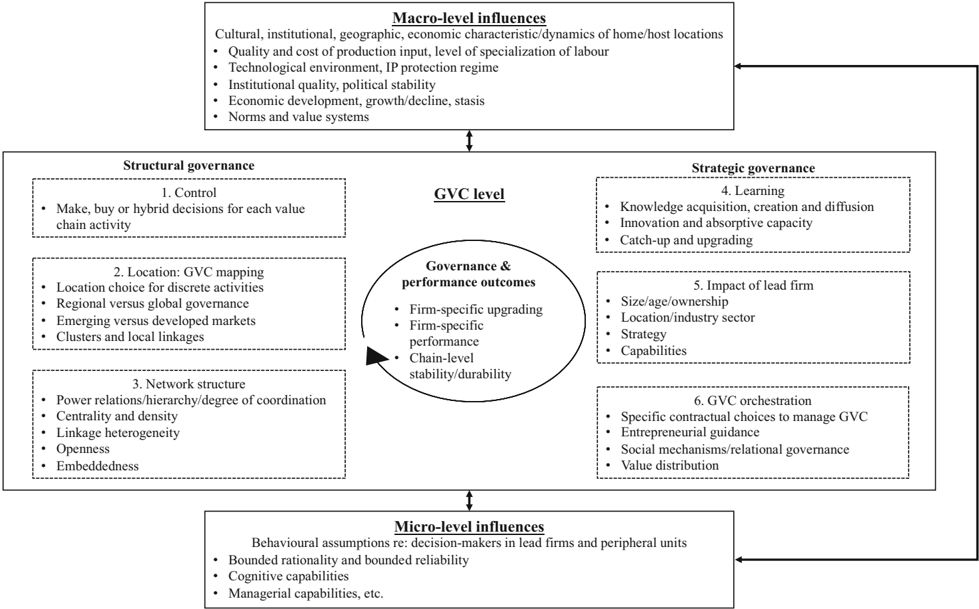
This article reviews the rapidly growing domain of global value chain (GVC) research by analyzing several highly cited conceptual frameworks and then appraising GVC studies published in such disciplines as international business, general management, supply chain management, operations management, economic geography, regional and development studies, and international political economy. Building on GVC conceptual frameworks, we conducted the review based on a comparative institutional perspective that encompasses critical governance issues at the micro-, GVC, and macro-levels. Our results indicate that some of these issues have garnered significantly more scholarly attention than others. We suggest several future research topics such as microfoundations of GVC governance, GVC mapping, learning, impact of lead firm ownership and strategy, dynamics of GVC arrangements, value creation and distribution, financialization, digitization, the impact of renewed protectionism, the impact of GVCs on their macro-environment, and chain-level performance management.
Overview
CoChat Summary
TL;DR
This review synthesizes multidisciplinary global value chain (GVC) research using an IB-centric comparative institutional framework, covering 87 conceptual and empirical studies. It finds uneven scholarly attention across micro-, GVC-, and macro-level governance issues and identifies gaps in microfoundations, GVC mapping, learning, lead-firm ownership/strategy, temporal dynamics, value distribution, financialization, digitization, protectionism, macro-environment impact, and chain-level performance measurement.
Key findings
- The review covers 87 studies: 22 theory papers (including nine foundational pieces) and 65 empirical articles across 21 journals; 33 shortlisted articles are in mainstream IB journals, constituting about 58% of the group of non-social science journals.
- Microfoundations are underrepresented: only seven studies directly address the impact of microfoundations on GVC configurations, knowledge acquisition/dissemination, and network functioning; behavioral assumptions are often implicit and rarely tested.
- Geographic and temporal gaps are evident: only two studies directly address the regional effect in GVCs, only two examine temporal factors in a targeted manner, and few empirical studies measure geographic dispersion or directly address GVCs’ impact on their macro-environment.
- There is no dominant theory of GVC; existing frameworks and typologies are useful organizing frames rather than predictive theory, and GPN 2.0 still lacks empirical studies testing its generality, validity, and robustness.
Methods
- Systematic review of published journal articles, excluding books and book chapters; searched the past 20 years using four terms: global value chain, global commodity chain, global production network, and global factory.
- Included conceptual articles with GVCs as a major focus and empirical articles with at least one search term as a major variable; sample comprises 21 journals, 22 theory papers (including nine foundational pieces), and 65 empirical articles, spanning 1999 to end of July 2019.
- Extracted two to three key GVC-related findings per article and organized them using a comparative institutional framework with micro-, GVC-, and macro-level dimensions; methods were roughly equally split between qualitative case studies and quantitative archival/survey studies, with manufacturing contexts and automotive as the most popular industry.
Limitations
- Paper-stated: books and book chapters were excluded; social science journals were narrowed to a small selection of 30 articles; some impactful cited studies did not meet the sample criteria.
- Paper-stated: GVC/GPN frameworks are primarily explanatory rather than predictive, and predictive power is curtailed by ceteris paribus conditions in open systems; there is no dominant GVC theory, and GPN 2.0 lacks empirical testing.
- Evident from the text: the review is explicitly IB-centric and uses “GVC” inclusively, which may shape which literatures and findings are foregrounded; the additional screening criteria for social science articles were judgment-based.
Model-written summary. Check it against the paper before relying on it.
Integrity signals
Registry
Cites
Statistics
Figures
Verification
Claims the paper makes
16 Valid · 7 Not valid · 191 Not checked · 128 Own results and interpretations
The cited sources support only part of this claim — read each source’s verdict below.
In the paper
“For example, Asian tier 1 suppliers to MNEs and OEMs become GVC lead firms in their own right by shifting production to lower cost locations in the region (Azmeh & Nadvi, 2014;Chen, Wei, Hu, & Muralidharan, 2016).”
§ Global value chains: A review of the multidisciplinary literature > Location
What the sources say
- Partly supportedcites Azmeh & Nadvi, 2014 matched to “Asian firms and the restructuring of global value chains” (2014) sourceExperimental — accuracy not yet measured
The Introduction describes former first-tier Asian garment suppliers taking on chain-coordination functions and shifting manufacturing to lower-cost locations. But it calls them “co-leads” that often work with Western buyers, not independent lead firms; it also says their production networks extend beyond Asia. The claim overstates both their autonomy and the regional scope. (LLM, conf=0.86)
- Not checked yetcites Chen, Wei, Hu, & Muralidharan, 2016 matched to “Survival strategy of OEM companies: a case study of the Chinese toy industry” (2016) source
plainstates a cause- Asserted: passes — The authors put it forward as true.
- Checkable: passes — It can be checked against evidence.
- Load-bearing: unclear — It is unclear whether the paper’s conclusions depend on it.
- Based: passes — The paper gives a reason why it holds.
- Partly supported
The cited sources support only part of this claim — read each source’s verdict below.
In the paper
“Among these factors, favorable business regulations, IP protection, and significant education spending typically attract technologically and functionally sophisticated activities (Amendolagine et al., 2019;Ascani et al., 2016;Pipkin & Fuentes, 2017).”
§ Global value chains: A review of the multidisciplinary literature > Location
What the sources say
- Partly supportedcites Amendolagine et al., 2019 matched to “Local sourcing in developing countries: The role of foreign direct investments and global value chains” (2019) sourceExperimental — accuracy not yet measured
Section 2.1 says cumbersome regulations can discourage foreign investors from buying local inputs, while §4.3 finds that higher education spending strengthens the relationship between GVC involvement and local sourcing (page numbers unavailable). These passages support a role for regulations and education, but they do not establish that those factors attract technologically and functionally sophisticated activities; the cited passages also do not address IP protection. (LLM, conf=0.86)
- Partly supportedcites Ascani et al., 2016 matched to “Economic Institutions and the Location Strategies of European Multinationals in their Geographic Neighborhood” (2016) sourceExperimental — accuracy not yet measured
The Conclusions (page unavailable) link favorable business regulation to MNE location choices, including sophisticated sectors and functions. But they describe preferences for property-rights protection as divided, particularly for sophisticated activities, and say public expenditure matters chiefly for production. The paper does not establish that IP protection or education spending typically attracts sophisticated activities. (LLM, conf=0.89)
- Not checked yetcites Pipkin & Fuentes, 2017 matched to “Spurred to Upgrade: A Review of Triggers and Consequences of Industrial Upgrading in the Global Value Chain Literature” (2017) source
plainstates a cause- Asserted: passes — The authors put it forward as true.
- Checkable: passes — It can be checked against evidence.
- Load-bearing: unclear — It is unclear whether the paper’s conclusions depend on it.
- Based: passes — The paper gives a reason why it holds.
- Partly supported
The cited sources support only part of this claim — read each source’s verdict below.
In the paper
“Sturgeon et al. (2008) followed up with this line of research by examining major American and Japanese automotive lead firms and over 150 suppliers in North America.They found that upgrading of local suppliers was more likely if the GVC network structure moved towards a relational form of power dynamics.”
§ Global value chains: A review of the multidisciplinary literature > Network structure
What the sources say
- Partly supportedcites Sturgeon et al., 2008 matched to “Value chains, networks and clusters: reframing the global automotive industry” (2008) sourceExperimental — accuracy not yet measured
The Local clusters section discusses relational linkages and reports better working relationships between Japanese automakers and locally based North American suppliers. It does not find that a shift toward relational governance made local-supplier upgrading more likely; its account of Japanese suppliers says their relationships became more relational as supplier competence increased. The copy also identifies a figure of the top 150 suppliers, not an examination of over 150 suppliers establishing the claimed result. (LLM, conf=0.83)
hedgedstates a possible cause- Asserted: passes — The authors put it forward as true.
- Checkable: passes — It can be checked against evidence.
- Load-bearing: passes — The paper’s conclusions depend on it.
- Based: passes — The paper gives a reason why it holds.
- Partly supported
The cited sources support only part of this claim — read each source’s verdict below.
In the paper
“This is particularly pronounced in knowledge-intensive industries, where lead firms often locate operations in innovation hubs and global cities (Taylor, Derudder, Faulconbridge, Hoyler, & Ni, 2014).”
§ Global value chains: A review of the multidisciplinary literature > Location
What the sources say
- Partly supportedcites Taylor, Derudder, Faulconbridge, Hoyler, & Ni, 2014 matched to “Advanced Producer Service Firms as Strategic Networks, Global Cities as Strategic Places” (2014) sourceExperimental — accuracy not yet measured
In “APS Internationalization through Strategic Cities” (page unavailable), the paper says some advanced producer service firms locate offices in strategically important cities, including places associated with cutting-edge innovation. Its evidence concerns particular service-firm location strategies; it does not establish the broader claim about lead firms across knowledge-intensive industries or innovation hubs generally. (LLM, conf=0.83)
plainstates an association- Asserted: passes — The authors put it forward as true.
- Checkable: passes — It can be checked against evidence.
- Load-bearing: unclear — It is unclear whether the paper’s conclusions depend on it.
- Based: passes — The paper gives a reason why it holds.
- Partly supported
The cited sources support only part of this claim — read each source’s verdict below.
In the paper
“Such a relational form of network structure tends to favor inter-firm cooperation and credible commitment (e.g., IKEA and its suppliers in Ivarsson & Alvstam, 2011 and tuna canning firms in Havice & Campling, 2017).”
§ Global value chains: A review of the multidisciplinary literature > Network structure
What the sources say
- Not checked yetcites Ivarsson & Alvstam, 2011 matched to “Upgrading in global value-chains: a case study of technology-learning among IKEA-suppliers in China and Southeast Asia” (2011) source
- Partly supportedcites Havice & Campling, 2017 matched to “Where Chain Governance and Environmental Governance Meet: Interfirm Strategies in the Canned Tuna Global Value Chain” (2017) sourceExperimental — accuracy not yet measured
The Processing/Trading section describes tuna processors forming an association and acting collectively, supporting the example of inter-firm cooperation. The Vessel ownership, financing and contracts section also describes long-term supply relationships. Neither passage establishes that a relational network structure generally favors credible commitment; the paper instead emphasizes that inter-firm strategies depend on context. Page numbers are unavailable in our copy. (LLM, conf=0.84)
plainstates a possible cause- Asserted: passes — The authors put it forward as true.
- Checkable: passes — It can be checked against evidence.
- Load-bearing: unclear — It is unclear whether the paper’s conclusions depend on it.
- Based: passes — The paper gives a reason why it holds.
159 more claims · 8 with their cited sources checked
Create a free account to see all 342 claims and to verify the 249 references still open.
- It may state two separate claims as one. 101
- Probably not a substantial claim. 116
Claims other papers make about this one
Each is checked against this paper’s own text: does it say what the citing paper says it does?
The source backs part of the claim, not all of it — or backs it for a different population, condition or comparison.
In the citing paper
“Research reveals that MNEs can build competitive advantages through collaboration with global competitors (horizontal cooperation) or with suppliers and distributors (vertical cooperation) (Kano et al., 2020).”
From Illusions of techno-nationalism. (2022) · cites this paper as Kano et al., 2020
Experimental — accuracy not yet measured
Self-check
Percentages, sums and reported differences re-computed from the paper’s own numbers.
Each contradiction between two passages listed here was confirmed by an independent check.
Rated minor: it would not touch a result — a value no result rests on, a p-value that stays on the same side of the significance level, or a conflict that is clerical, resolved elsewhere in the paper, or outside its own findings.
In the paper
§ Global value chains: A review of the multidisciplinary literature > Micro-level: Microfoundational Assumptions and Their Impact on GVC
“Seppa ¨la ¨, Kenney and Ali-Yrkko ¨(2018) focus on boundedly rational accounting decisions in lead MNEs”
§ Global value chains: A review of the multidisciplinary literature > References
“Seppa ¨la ¨, T., Kenney, M., & Ali-Yrkko ¨, J. 2014. Global supply chains and transfer pricing: Insights from a case study.”
Rated minor: it would not touch a result — a value no result rests on, a p-value that stays on the same side of the significance level, or a conflict that is clerical, resolved elsewhere in the paper, or outside its own findings.
In the paper
§ Global value chains: A review of the multidisciplinary literature > Impact of lead firm ownership and strategy on GVC governance
“However, few studies (with the exception of, e.g., Morris & Staritz, 2014) examined the impact of ownership, meaning potential differences among GVCs led by private, public, state-owned, and family-owned MNEs.”
§ Global value chains: A review of the multidisciplinary literature > Micro-level: Microfoundational Assumptions and Their Impact on GVC
“Ownership characteristics of supplier firms shape the ability to shift between different end markets, respond to lead firm requirements, and pursue upgrading in GVCs.”
Citations
Cites
(1994) · Journal of the American Dietetic Association · doi:10.1016/0002-8223(94)92216-0 · Cited by 45,910
Journal of Economic Literature
(2019) · AEA Papers and Proceedings · doi:10.1257/pandp.109.633 · Cited by 7,468
The governance of global value chains
Gereffi, G., Humphrey, J., & Sturgeon, T. (2005) · Review of International Political Economy · doi:10.1080/09692290500049805 · Cited by 7,233
The Future of the Multinational Enterprise
Buckley, P. J., & Casson, M. (1976) · doi:10.1007/978-1-349-02899-3 · Cited by 4,478
The Eclectic Paradigm of International Production: A Restatement and Some Possible Extensions
Dunning, J. H. (1988) · Journal of International Business Studies · doi:10.1057/palgrave.jibs.8490372 · Cited by 4,315 · cited 1×
“…tariff regimes (Curran, Nadvi, & Campling, 2019; Kim, Milner, Bernauer, Osgood, Spilker, & Tingley, 2019), regulatory environments and government policy interventions, labor costs, level of technological sophistication, and societal Journal of International Business Studies norms (Dunning, 1988).”
BackgroundManaging Across Borders: The Transnational Solution
Bartlett, C. A., & Ghoshal, S. (2009) · Rugman Reviews · doi:10.1007/978-1-137-28787-8_25 · Cited by 4,101
Social Capital, Networks, and Knowledge Transfer
Inkpen, A. C., & Tsang, E. W. K. (2005) · Academy of Management Review · doi:10.5465/amr.2005.15281445 · Cited by 3,864
Self-citationInternational trade and industrial upgrading in the apparel commodity chain
Gereffi, G. (1999) · Journal of International Economics · doi:10.1016/s0022-1996(98)00075-0 · Cited by 3,197 · cited 2×
“In economic sociology and development studies, the earliest work was concerned with global commodity trade and the governance structure of such commodity chains in labor-intensive and high-tech industries (Bair, 2009; Gereffi, 1999, 2018; Gereffi & Korzeniewicz, 1994).”
BackgroundWilliamson, O. E. (1996) · doi:10.1093/oso/9780195078244.001.0001 · Cited by 3,041
Simon, H. A. (1950) · AJN, American Journal of Nursing · doi:10.1097/00000446-195002000-00071 · Cited by 3,004
Research works printed but not linked: 7
- (Papers included in the review are marked with an asterisk.)
- Washington, D. C.: World Bank.
- Kinkel, S., Rieder, B., Horvath, D., & Ja ¨ger, A. 2016. Productivity and flexibility advantages of in-house manufacturing and local sourcing -The limits of global value chains? Paper presented at the 42nd Annual Conference of the European International Business Academy, Vienna, Austria.
- UNCTAD. 2013. Global value chains and development: Investment and value added trade in the global economy. New York: United Nations.
- UNCTAD. 2019. Digital economy report. New York: United Nations.
- World Bank. 2019. Global value chain development report 2019. Washington, DC: World Bank.
- Eric W. K. Tsang is the Dallas World Salute Distinguished Professor of Global Strategy at the Naveen Jindal School of Management, University of Texas at Dallas. He received his PhD from the University of Cambridge. His main research inter- ests include organizational learning, strategic alli- ances, entrepreneurship, and philosophical analysis of methodological issues.
Cited by
Items 801–900 of 996
宋, 成. (2025) · E-Commerce Letters · doi:10.12677/ecl.2025.14124337
Junior, A. P. P., Rossetto, C. R., Serra, F. A. R., Carneiro, J., & Martignago, G. (2025) · Management Research The Journal of the Iberoamerican Academy of Management · doi:10.1108/mrjiam-01-2025-1671
Tran, T. V. T., Tran, C. D., & Mai, N. K. (2025) · International Journal of Business and Society · doi:10.33736/ijbs.8230.2025
Technology Adoption Within Global Value Chains: Upgrading Was (and Remains) a Demanding Stairway
Anzolin, G. (2026) · Palgrave studies of internationalization in emerging markets · doi:10.1007/978-3-031-76410-3_6
CASA Trade: Identifying Regional Value Chain Recital and Dynamics
Wani, N. U. H. (2025) · Springer eBooks · doi:10.1007/978-981-95-2728-1_9
Indian Organizations: Moving up the Innovation Curve
Goparaju, R. (2026) · Springer eBooks · doi:10.1007/978-981-95-1033-7_7
STRUCTURAL EVOLUTION OF GLOBAL VALUE CHAINS IN THE ERA OF INTELLIGENT TRANSFORMATION
Ting, L. (2025) · Tikintinin iqtisadiyyatı və menecment · doi:10.58225/tim.2025-4-132-143
Lupton, N. C., & No, Y. (2026) · SSRN Electronic Journal · doi:10.2139/ssrn.6052254
Huang, F., Peng, K., Wang, S., & Chen, W. (2026) · Sustainability · doi:10.3390/su18021082
Beyond Physical Connectivity: High-Speed Rail and Cross-Regional Innovation within Business GroupsPreprint
Gao, H., Wang, Z., Zhang, B., & Li, M. (2026) · SSRN Electronic Journal · doi:10.2139/ssrn.5940094
256Chapter 8 Cooperative Strategy: Social Value Creation
Bloom, P., & Kranjc, R. (2025) · De Gruyter eBooks · doi:10.1515/9783111080147-008
Blockchain applications in sustainable supply chains
Sarkis, J. (2026) · Elsevier eBooks · doi:10.1016/b978-0-443-32880-0.00023-1
Supply chains as battlefields: Resilience, nearshoring, and strategic sourcing
Kumar, G. V. S., & Saluja, (. R. (2026) · International Journal of Foreign Trade and International Business · doi:10.33545/26633140.2026.v8.i1b.214
Roh, T., Byungjun, Y., Islam, N., Lee, K., & Kim, J. (2026) · SSRN Electronic Journal · doi:10.2139/ssrn.6184699
Lin, Y. (2026) · SSRN Electronic Journal · doi:10.2139/ssrn.6260386
Robotics and labor costs: Not a duel, but a dual advantage
Kulkarni, P., Awate, S. S., & Chauradia, A. J. (2026) · Journal of International Management · doi:10.1016/j.intman.2026.101347
Fundamentals of Supply Chain Literature
Caccialanza, A. (2026) · SIDREA series in accounting and business administration · doi:10.1007/978-3-032-16879-5_1
Asa, S. (2025) · Tuwhera (Auckland University of Technology)
DIMENSIONS OF INTERNATIONAL PRODUCTION
Съботинова, Д. (2022) · Bulgarian Portal for Open Science
The Impacts and Governance of Artificial Intelligence: A Transfeminist Perspective
Attard-Frost, B. (2025) · TSpace (University of Toronto)
Thakur, R., & Sharma, S. (2026) · Management International Review · doi:10.1007/s11575-025-00609-0
Empirical studies on innovation, automation and changing economic dynamics in global value chains
Mohamed, H. (2025) · Common Library Network (Der Gemeinsame Bibliotheksverbund) · doi:10.22032/dbt.69552
Can digital technology affect global value chain position?—cross-country evidence
Zhang, Y. (2026) · Applied Economics · doi:10.1080/00036846.2026.2634816
Bezpośrednie inwestycje zagraniczne we Wspólnocie Gospodarczej ASEAN (AEC)
Drelich-Skulska, B., & Bobowski, S. (2025) · Wroclaw University of Economics and Business eBooks · doi:10.15611/2025.49.8.05
Transformacja handlu zagranicznego. Księga jubileuszowa Małgorzaty Domiter
(2025) · Wroclaw University of Economics and Business eBooks · doi:10.15611/2025.49.8
Heatwaves and Systemic Vulnerability: An Empirical Assessment of Global Supply Chains Resilience
Song, C., Zhao, Q., Liu, M., & Ma, J. (2026) · Sustainable Development · doi:10.1002/sd.70869
Investigating Value Addition Activities in the Palm Oil Supply Chain in Kigoma Region, Tanzania.
Merengo, C. (2026) · International Journal For Multidisciplinary Research · doi:10.36948/ijfmr.2026.v08i02.70161
Zhang, J., & Pang, Q. (2026) · Global Academic Frontiers · doi:10.5281/zenodo.18936927
Yang, J., Xu, S., Shen, Q., & Mukhopadhaya, P. (2026) · SSRN Electronic Journal · doi:10.2139/ssrn.6390922
Vriesema, M. A. (2025) · UvA-DARE (University of Amsterdam)
Liang, L., Bo, L., & Yan, A. (2026) · Applied Economics · doi:10.1080/00036846.2026.2644560
Dobos, E. (2026) · CUB Ph.D. Dissertations (Corvinus University of Budapest) · doi:10.14267/phd.2026020
Akinwalere, S. N., & Chang, K. (2026) · Journal of Industry Competition and Trade · doi:10.1007/s10842-026-00463-2
Clustered SMEs’ resilience against global disruptions: Lessons from the COVID-19 pandemic
Pallás-Rocafull, A., Barber, J. P., Villar, C., & Hervás-Oliver, J.-L. (2026) · Emprendimiento y Negocios Internacionales · doi:10.20420/eni.2025.837
Friendshoring as a Strategic Response: Location Decisions for MNEs in a Fractured Global Economy
Virani, S. S. (2026) · Emerald Group Publishing Limited eBooks · doi:10.1108/s1745-88622026000020a003
Gao, H., Yang, Y., & Yang, W. (2026) · Systems · doi:10.3390/systems14040345
Teissandier, M. S., & Boutary, M. (2026) · Emerald Group Publishing Limited eBooks · doi:10.1108/s1745-88622026000020b003
Hoang, V. N., & Tsholofelo, E. (2026) · Journal of Health Innovation and Environmental Education. · doi:10.37251/jhiee.v3i1.2875
“Schools, as high-density social environments, represent critical micro-settings where children are simultaneously exposed to indoor air pollutants, inadequate ventilation, poor sanitation, and overcrowding factors known to increase respiratory vulnerability [7], [8].”
Li, T., Lian, Y., Hou, C., Huang, X., & Zhang, Q. (2026) · Sustainable Development · doi:10.1002/sd.70987
Chapter 6: Digital Platforms and Global Value Chains
Lundquist, K., & Jong, W. K. (2021) · Institutional Repositories DataBase (IRDB) · doi:10.20561/00052863
The roles of multinational enterprises in governing the sustainability of global supply chains
Leone, C., Picone, P. M., & Destri, A. M. L. (2026) · International Journal of Management Reviews · doi:10.1111/ijmr.70023
Internationalization through Entering Social Networks
Han, X. (2024) · theses.fr (ABES) · doi:10.70675/8d74af47z983fz424bzbdeaz64d22108b451
Towards Responsible Global Value Chain : Bridging Global and Local Dimensions of CSR
Mineeva, A. (2024) · theses.fr (ABES) · doi:10.70675/928439f5z65b9z48e5z81d9z6b50092b8e97
Global Value Chains Analysis in the Agri-food Industry
Agbekponou, K. M. (2024) · theses.fr (ABES) · doi:10.70675/ae1d2ba2z13e2z4fa0z9da5ze8b099ec7a1a
Research on the Construction of Enterprise Ecological Strategy in the Context of Platform Economy
Li, Z. (2026) · Journal of innovation and development · doi:10.54097/rgmffh23
“Once the platform adjusts the cooperation rules, suppliers will face huge operational risks, and the ecological stability is challenged [12, 14, 15].”
Analysis of Lead (PB) Levels in Snack Foods at Joyoboyo Terminal, Surabaya as a Public Health Risk
Maryati, A., Chhea, S., & Bunleang, K. (2026) · Journal of Health Innovation and Environmental Education. · doi:10.37251/jhiee.v3i1.3000
“Such micro-level analysis is important for identifying specific risk zones and understanding how environmental factors influence contamination levels [27], [28].”
Sanchez, K. M. S. R. (2025) · LA Referencia (Red Federada de Repositorios Institucionales de Publicaciones Científicas)
Jing, Y., He, Y., & Qian, H. (2026) · Structural Change and Economic Dynamics · doi:10.1016/j.strueco.2026.04.013
Governance of the Volkswagen Group's Global Value Chain in Europe from 2019 to 2025
Ramadhan, M. N. R., Calista, S. A., Bilqis, T. N., & Purbantina, A. P. (2026) · MEC-J (Management and Economics Journal) · doi:10.18860/mec-j.v10i1.40373
Spatiotemporal evolution and structural resilience of the global value chain network
Chen, W., Xiquan, Z. H. A. O., & Liu, W. (2026) · Journal of Geographical Sciences · doi:10.1007/s11442-026-2478-9
Nachhaltigkeitsstandards und Vertragsrecht
Gebauer), L. K. E. (. (2026) · Mohr Siebeck eBooks · doi:10.1628/978-3-16-200115-3
Tang, S., & Malaluan, L. A. (2025) · Journal of Chemical Learning Innovation. · doi:10.37251/jocli.v2i2.2966
“However, mastering this topic requires learners to integrate symbolic, macroscopic, and submicroscopic representations, a process that is often cognitively demanding [7]-[9].”
Cost and risk allocation in the green hydrogen value chain for hard-to-abate sectors
Repo, A. (2026) · LUTPub (LUT University)
The Cultural Convergence Debate
Anguelov, N. (2026) · Springer eBooks · doi:10.1007/978-3-032-22302-9_5
Location-specific wage effects from offshoring and backshoring
Schmidt, T. D., & Mitze, T. (2026) · Global challenges & regional science. · doi:10.1016/j.gcrs.2026.100030
Jegede, O. O., SEGUN-OLASANMI, A. O., & Odeniran, A. A. (2026) · Studies in systems, decision and control · doi:10.1007/978-3-032-13119-5_37
Bogala, M. R., Uppu, V. A. R., Kotni, V. V. D. P., Babu, T. V. R., Varalakshmi, S., & Vemula, R. (2026) · Journal of Applied Science Engineering Technology and Education · doi:10.35877/454ri.asci4447
Karwowski, E., & Castillo, J. (2026) · New Political Economy · doi:10.1080/13563467.2026.2666791 · Cited by 2
Ali, M. U., Bechchar, M., & Ali, Q. (2026) · Environmental Sciences Europe · doi:10.1186/s12302-026-01418-4
Wang, Y. (2026) · Exploring Science Academic Conference Series · doi:10.70267/icbms.2601.320327
“Marketing adaptation contributes to upgrading primarily through its interaction with firms’ network positions and resource orchestration [21].”
Sustainability strategies of small luxury brands – Insights from ScotlandPreprint
Bai, H., Gao, B., & Blanes, R. (2026) · Research Square · doi:10.21203/rs.3.rs-8261266/v1
Wu, Y., & Perez-Aleman, P. (2026) · Global Strategy Journal · doi:10.1002/gsj.70016
Rethinking the Theory of the Multinational Enterprise: Structural Dynamics and the Future of Work
Schotter, A. P. J. (2026) · Management International Review · doi:10.1007/s11575-026-00615-w
“Structural responses depend on task characteristics (e.g., modularity, codifiability, and asset specificity) and on institutional constraints that are increasingly shaped by geopolitics (Cuypers et al., 2021; Kano et al., 2020; Laplume et al., 2016).”
Integration into global value chains: A management framework for Ukrainian enterprises
Voronets, D. (2026) · Economics Entrepreneurship Management · doi:10.56318/eem2026.01.094
“L. Kano et al .”
Mohiuddin, M., Ourhalouch, M., Ed‐Dafali, S., & Al-Azad, M. S. (2026) · Journal of theoretical and applied electronic commerce research · doi:10.3390/jtaer21060177
van Oorschot, K. E., Boffelli, A., Elia, S., & von Dzengelevski, O. (2026) · Edward Elgar Publishing eBooks · doi:10.4337/9781035348206.00007
Cities bound, bounded, boundless: urban metabolic entanglements and planetary boundaries
Marom, N. (2026) · Territory Politics Governance · doi:10.1080/21622671.2026.2672449
(13969), J. Y., Xu, S., Shen, Q., & Mukhopadhaya, P. (2026) · SSRN Electronic Journal · doi:10.2139/ssrn.6886873
Hot Assets: A Value Network Analysis of User Exploitation in Mobile Dating Applications
Voll, M., & Attard-Frost, B. (2026) · Canadian Journal of Communication · doi:10.3138/cjc-2023-0056
International Business Environment: Diagnosis, Risk and Strategic Judgement
Rideg, A. (2026) · Pécsi Egyetemi Archívum (University of Pécs) · doi:10.15170/ibe-drsj-ktk-2026
Sun, M., & Yao, Y. (2026) · International Journal of Intercultural Relations · doi:10.1016/j.ijintrel.2026.102462
Yu, S., & Othman, Z. B. (2026) · Multidisciplinary International Research Journal · doi:10.67373/mirj.2026.001.1.003
СПЕЦИФИКА ФОРМИРОВАНИЯ СТРАТЕГИИ СИСТЕМНОЙ ИНТЕГРАЦИИ ПРЕДПРИЯТИЙ ВЬЕТНАМА В МЕЖДУНАРОДНОМ БИЗНЕСЕ
Туен, Н. Ф. (2026) · Теория и практика современной науки
Enterprise reputation as an important factor of economic success in international markets
Євгенович, К. О., & Koshovyi, B.-P. (2026) · Scientific Notes of Lviv University of Business and Law · doi:10.66556/2663-0117.48.kuzmin-o
GLOBAL VALUE CHAIN GOVERNANCE OF INDONESIAN PEPPER: A CASE STUDY IN BANGKA BELITUNG
Darhyati, A. T., Nurmalina, R., Novianti, T., & Suharno, S. (2026) · Jurnal Agribisnis Indonesia · doi:10.29244/jai.2026.14.01.16-28
Cui, W., Li, Z., & Chen, Z. (2026) · Emerging Markets Finance and Trade · doi:10.1080/1540496x.2026.2695864
SEARCH SPACE FOR THE OPTIMAL PRODUCTION PLACEMENT
Stadnicki, J., & Nagaitseva, O. (2026) · Scientific Papers of Silesian University of Technology Organization and Management Series · doi:10.29119/1641-3466.2026.249.27
Vairamuthu, R. T. B. (2026) · International Journal of Economic Practices and Theories · doi:10.52783/ijept.236
Industrial Policies and MNEs Investment Decisions in the Lithium Battery Value Chain
Ponti, P. D., Elia, S., Marra, M., & Piscitello, L. (2026) · The Academy of International Business · doi:10.1007/978-3-032-21419-5_13
Gao, J. (2026) · SSRN Electronic Journal · doi:10.2139/ssrn.7038297
Διερεύνηση της Συμμετοχής των Ασιατικών Χωρών στις Παγκόσμιες Αλυσίδες Αξίας
Dimopoulos, S. (2026) · DSpace - NTUA (National Technical University of Athens) · doi:10.26240/heal.ntua.32926
Song, K., & Zhao, J. (2026) · Systems · doi:10.3390/systems14070765
“A global value chain is a transnational production network in which multinational firms collaborate across borders with partners, suppliers, and customers, encompassing value-creating activities from design and R&D through production, marketing, and services [4,5].”
Industrial SMEs’ Experiences of Network Agency
Nieminen, S., Pyykko, S. J., Kemell, K., Seppälä, M., & Honkanen, S. (2026) · AHFE international · doi:10.54941/ahfe1007617
KÜRESEL TİCARETTE ÇOK KUTUPLULUK TARTIŞMALARI: LİTERATÜR TEMELLİ BİR DEĞERLENDİRME
Kaygusız, E., & Söylemez, C. (2026) · International Review of Economics and Management · doi:10.18825/iremjournal.1963817
The Impact of Education and Human Capital on High-Tech Business Upgrading: Macro-level Evidence
Nguyen, N. D. (2026) · European Journal of Business and Management · doi:10.7176/ejbm/18-6-04
Wang, K. (2026) · International Journal of World Economic Research · doi:10.54097/bq77ea45
Singh, S., Gaur, A. S., & Mudambi, R. (2026) · Journal of International Business Studies · doi:10.1057/s41267-026-00888-1
Cao, L., Lau, W., & Shaharuddin, S. S. (2026) · International Review of Economics & Finance · doi:10.1016/j.iref.2026.105647
Asnordin, N. A. (2026) · UiTM Institutional Repositories (Universiti Teknologi MARA)
Strategic considerations for green relocation in energy-intensive global value chains
Colen, S., & Mohnen, A. (2026) · Journal of Industrial Ecology · doi:10.1007/s44498-026-00133-w
“The renewables pull effect has emerged as a theoretical angle within the production location theory, which has long been a central topic across various academic disciplines (Buckley & Casson, 2016; Farrell et al., 2006; Kano et al., 2020; Ravi-chandran & Ahmed, 1993; Tsai & Urmetzer, 2024).”
Leite, E. R. (2026) · Critical Perspectives on International Business · doi:10.1108/cpoib-01-2026-0015
Xiong, S., & He, J. (2026) · Eurasian Geography and Economics · doi:10.1080/15387216.2026.2706662
Economic implications of EVs in Europe: A scenario analysis of value added
Hoefer, T. (2026) · Transportation Research Part D Transport and Environment · doi:10.1016/j.trd.2026.105524
Gjeloshi, A., Dafa, J., & Boshnjaku, A. (2026) · Interdisciplinary Journal of Research and Development · doi:10.56345/ijrdv13n245
“Global value chain (GVC) analysis has provided a foundational framework for understanding how economic activities are coordinated across production networks (Kano et al., 2020).”
Moradi, L. (2026) · Radiant Journal of Business & Sustainability · doi:10.51594/rjbs.v1i2.20
“Energy strategy and global supply chain configuration are increasingly shaped by policy and governance arrangements operating across national, regional, and global levels (Boström et al., 2015; Goldthau, 2014; Kano et al., 2020).”
Redefining Business: Integrating Human Rights, Sustainability, and Corporate Accountability
Talukdar, S. (2026) · Springer eBooks · doi:10.1007/978-3-032-28714-4_1
Batagoda, V., & Weerasekera, S. (2026) · Journal of Business and Technology · doi:10.4038/jbt.v10i2.181
“But managing sustainability beyond organisation borders has become difficult for most MNEs owing to sustainability issues that arise in the supply chain (Kano et al., 2020; Preuss et al., 2024), especially with outsourced partners.”
Adriaens, P., & Mattila, J. (2026) · Frontiers in Built Environment · doi:10.3389/fbuil.2026.1812897
Metadata
- Authors
- Kano, L., Tsang, E. W. K., & Yeung, H. W.-C.
- Affiliations
- University of Calgary (CA)
- The University of Texas at Dallas (US)
- National University of Singapore (SG)
- Corresponding author
- Kano, Liena
- Venue
- Journal of International Business Studies
- Published
- 2020-02-25
- Volume
- 51
- Issue
- 4
- Pages
- 577-622
- ISSN
- 0047-2506 (ISSN-L)
- 1478-6990
- OpenAlex
- W3008345757
- Cited by
- 767
- References
- 217
- Citations by year
- 2026: 160 · 2025: 140 · 2024: 140 · 2023: 117 · 2022: 108 · 2021: 72 · 2020: 29
- FWCI
- 86.86
- Type
- journal article
- Language
- en
- Update notices
- correction (2020-03-30)
- Open access
- hybrid
- doi.org
- Licence
- cc-by
- creativecommons.org/licenses/by/4.0/ (tdm)
- creativecommons.org/licenses/by/4.0/ (vor)
- Locations
- Journal of International Business Studies (publishedVersion, cc-by)
- RePEc: Research Papers in Economics (submittedVersion)
- Funders
- University of Calgary
- National University of Singapore (R109000183646)
- Topics
- Social Sciences › Business, Management and Accounting › Strategy and Management › Global trade, sustainability, and social impact
- Social Sciences › Business, Management and Accounting › Strategy and Management › International Business and FDI
- Social Sciences › Business, Management and Accounting › Management Information Systems › Outsourcing and Supply Chain Management
- Keywords
- global value chains, GVC governance, conceptual framework, financialization, digitization, protectionism, supply chain management, international political economy
About these checks
Registry, retraction, Cites and statistics results are computed, not judged, with one exception: a printed reference that no index lists is read once by a model before it counts as a citation error. Claims are extracted by a model and kept only when their quote appears verbatim in the text; each cited source is then checked, with a model’s help, for whether it says what the claim relies on. Those verdicts can be wrong — read the claim’s quote and the cited source before relying on one.
The claim verdicts this report counts are experimental: their accuracy is not yet measured.
A language model drew the claims from the paper on 2026-10-06, under version 3 of the claim definition (model deepseek-v4.1-flash, prompt extract-v3).
A second model labelled each claim on 2026-10-06 (model jev-1.13-20260917, definition revision gold-guideline-v0.2).
Cited sources are checked with a language model’s help (gpt-6-sol).
Statistics and arithmetic are recomputed, not judged.
Confidence bands are shown only for fields calibrated on our annotated test set. None is calibrated yet, so no band is shown.
What counts as a claim ›How we measure confidence ›How we check this ›
Are you an author, or do you see a problem with this page? Request a review
Data sources
Bibliographic data: Semantic Scholar, OpenAlex, Crossref.
Contains information from the Semantic Scholar Academic Graph Datasets, made available under the ODC Attribution License (ODC-BY 1.0).
Semantic Scholar’s data is described in: Kinney, R., et al. (2023). The Semantic Scholar Open Data Platform. arXiv:2301.10140.
