

Global value chains: A review of the multi-disciplinary literature
Open accessThe DOI matches its Crossref record; 48 of the 217 references it cites were found in a registry or an index; 21 of the 270 sources its claims cite were checked for support.
Abstract
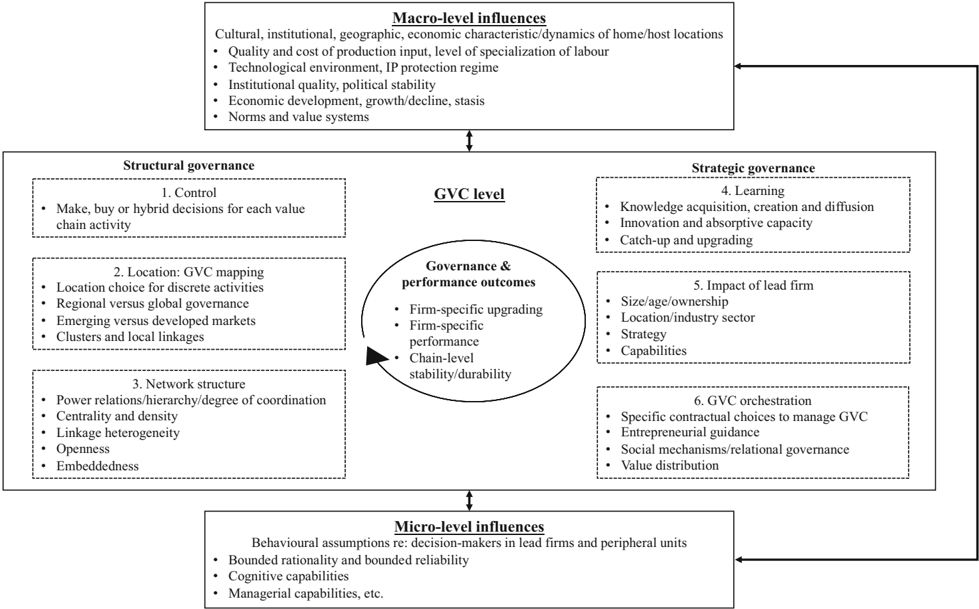
This article reviews the rapidly growing domain of global value chain (GVC) research by analyzing several highly cited conceptual frameworks and then appraising GVC studies published in such disciplines as international business, general management, supply chain management, operations management, economic geography, regional and development studies, and international political economy. Building on GVC conceptual frameworks, we conducted the review based on a comparative institutional perspective that encompasses critical governance issues at the micro-, GVC, and macro-levels. Our results indicate that some of these issues have garnered significantly more scholarly attention than others. We suggest several future research topics such as microfoundations of GVC governance, GVC mapping, learning, impact of lead firm ownership and strategy, dynamics of GVC arrangements, value creation and distribution, financialization, digitization, the impact of renewed protectionism, the impact of GVCs on their macro-environment, and chain-level performance management.
Overview
CoChat Summary
TL;DR
This review synthesizes multidisciplinary global value chain (GVC) research using an IB-centric comparative institutional framework, covering 87 conceptual and empirical studies. It finds uneven scholarly attention across micro-, GVC-, and macro-level governance issues and identifies gaps in microfoundations, GVC mapping, learning, lead-firm ownership/strategy, temporal dynamics, value distribution, financialization, digitization, protectionism, macro-environment impact, and chain-level performance measurement.
Key findings
- The review covers 87 studies: 22 theory papers (including nine foundational pieces) and 65 empirical articles across 21 journals; 33 shortlisted articles are in mainstream IB journals, constituting about 58% of the group of non-social science journals.
- Microfoundations are underrepresented: only seven studies directly address the impact of microfoundations on GVC configurations, knowledge acquisition/dissemination, and network functioning; behavioral assumptions are often implicit and rarely tested.
- Geographic and temporal gaps are evident: only two studies directly address the regional effect in GVCs, only two examine temporal factors in a targeted manner, and few empirical studies measure geographic dispersion or directly address GVCs’ impact on their macro-environment.
- There is no dominant theory of GVC; existing frameworks and typologies are useful organizing frames rather than predictive theory, and GPN 2.0 still lacks empirical studies testing its generality, validity, and robustness.
Methods
- Systematic review of published journal articles, excluding books and book chapters; searched the past 20 years using four terms: global value chain, global commodity chain, global production network, and global factory.
- Included conceptual articles with GVCs as a major focus and empirical articles with at least one search term as a major variable; sample comprises 21 journals, 22 theory papers (including nine foundational pieces), and 65 empirical articles, spanning 1999 to end of July 2019.
- Extracted two to three key GVC-related findings per article and organized them using a comparative institutional framework with micro-, GVC-, and macro-level dimensions; methods were roughly equally split between qualitative case studies and quantitative archival/survey studies, with manufacturing contexts and automotive as the most popular industry.
Limitations
- Paper-stated: books and book chapters were excluded; social science journals were narrowed to a small selection of 30 articles; some impactful cited studies did not meet the sample criteria.
- Paper-stated: GVC/GPN frameworks are primarily explanatory rather than predictive, and predictive power is curtailed by ceteris paribus conditions in open systems; there is no dominant GVC theory, and GPN 2.0 lacks empirical testing.
- Evident from the text: the review is explicitly IB-centric and uses “GVC” inclusively, which may shape which literatures and findings are foregrounded; the additional screening criteria for social science articles were judgment-based.
Model-written summary. Check it against the paper before relying on it.
Integrity signals
Registry
Cites
Statistics
Figures
Verification
Claims the paper makes
16 Valid · 7 Not valid · 191 Not checked · 128 Own results and interpretations
The cited sources support only part of this claim — read each source’s verdict below.
In the paper
“For example, Asian tier 1 suppliers to MNEs and OEMs become GVC lead firms in their own right by shifting production to lower cost locations in the region (Azmeh & Nadvi, 2014;Chen, Wei, Hu, & Muralidharan, 2016).”
§ Global value chains: A review of the multidisciplinary literature > Location
What the sources say
- Partly supportedcites Azmeh & Nadvi, 2014 matched to “Asian firms and the restructuring of global value chains” (2014) sourceExperimental — accuracy not yet measured
The Introduction describes former first-tier Asian garment suppliers taking on chain-coordination functions and shifting manufacturing to lower-cost locations. But it calls them “co-leads” that often work with Western buyers, not independent lead firms; it also says their production networks extend beyond Asia. The claim overstates both their autonomy and the regional scope. (LLM, conf=0.86)
- Not checked yetcites Chen, Wei, Hu, & Muralidharan, 2016 matched to “Survival strategy of OEM companies: a case study of the Chinese toy industry” (2016) source
plainstates a cause- Asserted: passes — The authors put it forward as true.
- Checkable: passes — It can be checked against evidence.
- Load-bearing: unclear — It is unclear whether the paper’s conclusions depend on it.
- Based: passes — The paper gives a reason why it holds.
- Partly supported
The cited sources support only part of this claim — read each source’s verdict below.
In the paper
“Among these factors, favorable business regulations, IP protection, and significant education spending typically attract technologically and functionally sophisticated activities (Amendolagine et al., 2019;Ascani et al., 2016;Pipkin & Fuentes, 2017).”
§ Global value chains: A review of the multidisciplinary literature > Location
What the sources say
- Partly supportedcites Amendolagine et al., 2019 matched to “Local sourcing in developing countries: The role of foreign direct investments and global value chains” (2019) sourceExperimental — accuracy not yet measured
Section 2.1 says cumbersome regulations can discourage foreign investors from buying local inputs, while §4.3 finds that higher education spending strengthens the relationship between GVC involvement and local sourcing (page numbers unavailable). These passages support a role for regulations and education, but they do not establish that those factors attract technologically and functionally sophisticated activities; the cited passages also do not address IP protection. (LLM, conf=0.86)
- Partly supportedcites Ascani et al., 2016 matched to “Economic Institutions and the Location Strategies of European Multinationals in their Geographic Neighborhood” (2016) sourceExperimental — accuracy not yet measured
The Conclusions (page unavailable) link favorable business regulation to MNE location choices, including sophisticated sectors and functions. But they describe preferences for property-rights protection as divided, particularly for sophisticated activities, and say public expenditure matters chiefly for production. The paper does not establish that IP protection or education spending typically attracts sophisticated activities. (LLM, conf=0.89)
- Not checked yetcites Pipkin & Fuentes, 2017 matched to “Spurred to Upgrade: A Review of Triggers and Consequences of Industrial Upgrading in the Global Value Chain Literature” (2017) source
plainstates a cause- Asserted: passes — The authors put it forward as true.
- Checkable: passes — It can be checked against evidence.
- Load-bearing: unclear — It is unclear whether the paper’s conclusions depend on it.
- Based: passes — The paper gives a reason why it holds.
- Partly supported
The cited sources support only part of this claim — read each source’s verdict below.
In the paper
“Sturgeon et al. (2008) followed up with this line of research by examining major American and Japanese automotive lead firms and over 150 suppliers in North America.They found that upgrading of local suppliers was more likely if the GVC network structure moved towards a relational form of power dynamics.”
§ Global value chains: A review of the multidisciplinary literature > Network structure
What the sources say
- Partly supportedcites Sturgeon et al., 2008 matched to “Value chains, networks and clusters: reframing the global automotive industry” (2008) sourceExperimental — accuracy not yet measured
The Local clusters section discusses relational linkages and reports better working relationships between Japanese automakers and locally based North American suppliers. It does not find that a shift toward relational governance made local-supplier upgrading more likely; its account of Japanese suppliers says their relationships became more relational as supplier competence increased. The copy also identifies a figure of the top 150 suppliers, not an examination of over 150 suppliers establishing the claimed result. (LLM, conf=0.83)
hedgedstates a possible cause- Asserted: passes — The authors put it forward as true.
- Checkable: passes — It can be checked against evidence.
- Load-bearing: passes — The paper’s conclusions depend on it.
- Based: passes — The paper gives a reason why it holds.
- Partly supported
The cited sources support only part of this claim — read each source’s verdict below.
In the paper
“This is particularly pronounced in knowledge-intensive industries, where lead firms often locate operations in innovation hubs and global cities (Taylor, Derudder, Faulconbridge, Hoyler, & Ni, 2014).”
§ Global value chains: A review of the multidisciplinary literature > Location
What the sources say
- Partly supportedcites Taylor, Derudder, Faulconbridge, Hoyler, & Ni, 2014 matched to “Advanced Producer Service Firms as Strategic Networks, Global Cities as Strategic Places” (2014) sourceExperimental — accuracy not yet measured
In “APS Internationalization through Strategic Cities” (page unavailable), the paper says some advanced producer service firms locate offices in strategically important cities, including places associated with cutting-edge innovation. Its evidence concerns particular service-firm location strategies; it does not establish the broader claim about lead firms across knowledge-intensive industries or innovation hubs generally. (LLM, conf=0.83)
plainstates an association- Asserted: passes — The authors put it forward as true.
- Checkable: passes — It can be checked against evidence.
- Load-bearing: unclear — It is unclear whether the paper’s conclusions depend on it.
- Based: passes — The paper gives a reason why it holds.
- Partly supported
The cited sources support only part of this claim — read each source’s verdict below.
In the paper
“Such a relational form of network structure tends to favor inter-firm cooperation and credible commitment (e.g., IKEA and its suppliers in Ivarsson & Alvstam, 2011 and tuna canning firms in Havice & Campling, 2017).”
§ Global value chains: A review of the multidisciplinary literature > Network structure
What the sources say
- Not checked yetcites Ivarsson & Alvstam, 2011 matched to “Upgrading in global value-chains: a case study of technology-learning among IKEA-suppliers in China and Southeast Asia” (2011) source
- Partly supportedcites Havice & Campling, 2017 matched to “Where Chain Governance and Environmental Governance Meet: Interfirm Strategies in the Canned Tuna Global Value Chain” (2017) sourceExperimental — accuracy not yet measured
The Processing/Trading section describes tuna processors forming an association and acting collectively, supporting the example of inter-firm cooperation. The Vessel ownership, financing and contracts section also describes long-term supply relationships. Neither passage establishes that a relational network structure generally favors credible commitment; the paper instead emphasizes that inter-firm strategies depend on context. Page numbers are unavailable in our copy. (LLM, conf=0.84)
plainstates a possible cause- Asserted: passes — The authors put it forward as true.
- Checkable: passes — It can be checked against evidence.
- Load-bearing: unclear — It is unclear whether the paper’s conclusions depend on it.
- Based: passes — The paper gives a reason why it holds.
159 more claims · 8 with their cited sources checked
Create a free account to see all 342 claims and to verify the 249 references still open.
- It may state two separate claims as one. 101
- Probably not a substantial claim. 116
Claims other papers make about this one
Each is checked against this paper’s own text: does it say what the citing paper says it does?
The source backs part of the claim, not all of it — or backs it for a different population, condition or comparison.
In the citing paper
“Research reveals that MNEs can build competitive advantages through collaboration with global competitors (horizontal cooperation) or with suppliers and distributors (vertical cooperation) (Kano et al., 2020).”
From Illusions of techno-nationalism. (2022) · cites this paper as Kano et al., 2020
Experimental — accuracy not yet measured
Self-check
Percentages, sums and reported differences re-computed from the paper’s own numbers.
Each contradiction between two passages listed here was confirmed by an independent check.
Rated minor: it would not touch a result — a value no result rests on, a p-value that stays on the same side of the significance level, or a conflict that is clerical, resolved elsewhere in the paper, or outside its own findings.
In the paper
§ Global value chains: A review of the multidisciplinary literature > Micro-level: Microfoundational Assumptions and Their Impact on GVC
“Seppa ¨la ¨, Kenney and Ali-Yrkko ¨(2018) focus on boundedly rational accounting decisions in lead MNEs”
§ Global value chains: A review of the multidisciplinary literature > References
“Seppa ¨la ¨, T., Kenney, M., & Ali-Yrkko ¨, J. 2014. Global supply chains and transfer pricing: Insights from a case study.”
Rated minor: it would not touch a result — a value no result rests on, a p-value that stays on the same side of the significance level, or a conflict that is clerical, resolved elsewhere in the paper, or outside its own findings.
In the paper
§ Global value chains: A review of the multidisciplinary literature > Impact of lead firm ownership and strategy on GVC governance
“However, few studies (with the exception of, e.g., Morris & Staritz, 2014) examined the impact of ownership, meaning potential differences among GVCs led by private, public, state-owned, and family-owned MNEs.”
§ Global value chains: A review of the multidisciplinary literature > Micro-level: Microfoundational Assumptions and Their Impact on GVC
“Ownership characteristics of supplier firms shape the ability to shift between different end markets, respond to lead firm requirements, and pursue upgrading in GVCs.”
Citations
Cites
(1994) · Journal of the American Dietetic Association · doi:10.1016/0002-8223(94)92216-0 · Cited by 45,910
Journal of Economic Literature
(2019) · AEA Papers and Proceedings · doi:10.1257/pandp.109.633 · Cited by 7,468
The governance of global value chains
Gereffi, G., Humphrey, J., & Sturgeon, T. (2005) · Review of International Political Economy · doi:10.1080/09692290500049805 · Cited by 7,233
The Future of the Multinational Enterprise
Buckley, P. J., & Casson, M. (1976) · doi:10.1007/978-1-349-02899-3 · Cited by 4,478
The Eclectic Paradigm of International Production: A Restatement and Some Possible Extensions
Dunning, J. H. (1988) · Journal of International Business Studies · doi:10.1057/palgrave.jibs.8490372 · Cited by 4,315 · cited 1×
“…tariff regimes (Curran, Nadvi, & Campling, 2019; Kim, Milner, Bernauer, Osgood, Spilker, & Tingley, 2019), regulatory environments and government policy interventions, labor costs, level of technological sophistication, and societal Journal of International Business Studies norms (Dunning, 1988).”
BackgroundManaging Across Borders: The Transnational Solution
Bartlett, C. A., & Ghoshal, S. (2009) · Rugman Reviews · doi:10.1007/978-1-137-28787-8_25 · Cited by 4,101
Social Capital, Networks, and Knowledge Transfer
Inkpen, A. C., & Tsang, E. W. K. (2005) · Academy of Management Review · doi:10.5465/amr.2005.15281445 · Cited by 3,864
Self-citationInternational trade and industrial upgrading in the apparel commodity chain
Gereffi, G. (1999) · Journal of International Economics · doi:10.1016/s0022-1996(98)00075-0 · Cited by 3,197 · cited 2×
“In economic sociology and development studies, the earliest work was concerned with global commodity trade and the governance structure of such commodity chains in labor-intensive and high-tech industries (Bair, 2009; Gereffi, 1999, 2018; Gereffi & Korzeniewicz, 1994).”
BackgroundWilliamson, O. E. (1996) · doi:10.1093/oso/9780195078244.001.0001 · Cited by 3,041
Simon, H. A. (1950) · AJN, American Journal of Nursing · doi:10.1097/00000446-195002000-00071 · Cited by 3,004
Research works printed but not linked: 7
- (Papers included in the review are marked with an asterisk.)
- Washington, D. C.: World Bank.
- Kinkel, S., Rieder, B., Horvath, D., & Ja ¨ger, A. 2016. Productivity and flexibility advantages of in-house manufacturing and local sourcing -The limits of global value chains? Paper presented at the 42nd Annual Conference of the European International Business Academy, Vienna, Austria.
- UNCTAD. 2013. Global value chains and development: Investment and value added trade in the global economy. New York: United Nations.
- UNCTAD. 2019. Digital economy report. New York: United Nations.
- World Bank. 2019. Global value chain development report 2019. Washington, DC: World Bank.
- Eric W. K. Tsang is the Dallas World Salute Distinguished Professor of Global Strategy at the Naveen Jindal School of Management, University of Texas at Dallas. He received his PhD from the University of Cambridge. His main research inter- ests include organizational learning, strategic alli- ances, entrepreneurship, and philosophical analysis of methodological issues.
Cited by
Items 501–600 of 996
Brownfields in China: The Case of Liaocheng Chemical Plant
Mehdipour, A., & Kellett, J. (2024) · Urban sustainability · doi:10.1007/978-981-97-8776-0_8 · Cited by 2
Towards Solid-Based B2B Data Value Chains
Both, A., Yeboah, D., Kastner, T., Schraudner, D., Schmid, S., Braun, C. H.-J., Harth, A., & Käfer, T. (2025) · Lecture notes in computer science · doi:10.1007/978-3-031-78952-6_14 · Cited by 2
“In this section, we will describe the use case of data-based ecosystems (data value chain, cf. [2]), Solid technologies [4], and the challenges in such ecosystems (in particular, regarding GDPR [7] and zero-trust architectures [6,5]) that are unique regarding the strong need for a technological…”
The Effect of Global Value Chain Governance on Organizational Resilience: A Configurational Approach
Song, Y., Sun, H., & Zhang, R. (2025) · Thunderbird International Business Review · doi:10.1002/tie.22439 · Cited by 2
Universiti Malaysia Sarawak, M., Sun, T., bin Abdullah, M. A., & Universiti Malaysia Sarawak, M. (2025) · Asian Journal of Business Research · doi:10.14707/ajbr.240196 · Cited by 2
A Configurational Framework for Supplier Upgrading in Global Value Chains
Ma, H., Zhang, N., & Zhang, S. (2025) · Strategic Change · doi:10.1002/jsc.2693 · Cited by 2
Pequeñas y medianas empresas, cadenas globales de valor y economía circular
Santos, A. A. A., Calderón, G. T., López, A. E., Galván, M. F. B., Martínez, A. M. C., & Cardozo, M. L. (2025) · 360 Revista de Ciencias de la Gestión · doi:10.18800/360gestion.202510.008 · Cited by 2
Stefanov, A., & Schwabe, J. (2025) · Geographica Helvetica · doi:10.5194/gh-80-289-2025 · Cited by 2
Gedefie, G. D., & Wu, S. (2025) · Journal of Economic Surveys · doi:10.1111/joes.70013 · Cited by 2
Rahman, N., & Sharma, K. (2025) · Journal of Regulatory Economics · doi:10.1007/s11149-025-09500-0 · Cited by 2
“In trade, institutional quality influences which goods and tasks a country can profitably specialise in, how firms organise production across borders, and whether upgrading into more sophisticated activities is feasible (Liu et al., 2020; Abreo et al., 2021; Kano et al., 2020).”
How Digital Technology Shapes the Spatial Evolution of Global Value Chains in Financial Services
Yu, X., & Zeng, S. (2025) · Sustainability · doi:10.3390/su172411229 · Cited by 2
A System-Based Framework for Reducing the Digital Divide in Critical Mineral Supply Chains
Xu, S., Bai, N., Park, K.-S., & Su, M. (2026) · Systems · doi:10.3390/systems14010053 · Cited by 3
“Existing studies primarily analyze collaborative mechanisms from the view-points of governance structures [71], organizational trust [72], and knowledge transfer [73], focusing on power dynamics and institutional arrangements between lead firms and subor-dinate partners [74].”
Ahmed, S. S., Bhatti, M. I., Jawad, M., & Ahmad, Z. (2026) · Quality & Quantity · doi:10.1007/s11135-025-02533-9 · Cited by 2
Basharat, S., Jaffar, H. M., Rahim, M. A., Al‐Asmari, F., Ramadan, M. F., & Zongo, E. (2026) · Journal of Food Quality · doi:10.1155/jfq/8881863 · Cited by 2
Xu, L., Du, X., & Tang, Q. (2026) · Review of Development Economics · doi:10.1111/rode.70123 · Cited by 2
Su, Y., Yang, Z., Bai, Q., Shu, S., & Li, H. (2026) · Sustainable Development · doi:10.1002/sd.70636 · Cited by 2
Khan, N. T., Tahir, H., Mohammed, A., Ghaithan, A. M., Tayyab, M., & Ferik, S. E. (2026) · Results in Engineering · doi:10.1016/j.rineng.2026.109542 · Cited by 2
Valle, C. D., Viana, J. G. A., & Dörr, A. C. (2026) · Administrative Sciences · doi:10.3390/admsci16030138 · Cited by 2
“As with any systematic review, this study is subject to methodological constraints.”
Gupta, S., Abdollahi, S., Melewar, T. C., Shin, M. M., Theodorakopoulos, N., & Monder, R. (2026) · Industrial Marketing Management · doi:10.1016/j.indmarman.2026.02.010 · Cited by 2
Wang, Y., Lu, Y., & Yang, Q. (2026) · Frontiers in Environmental Science · doi:10.3389/fenvs.2026.1830040 · Cited by 2
Decarbonization in Financial Turbulent Times: Global Value Chains and Regulatory Framework
Xu, X., Zhang, L., Imandojemu, K., Orole, F. A., & Osabohien, R. A. (2026) · Business Strategy and the Environment · doi:10.1002/bse.71099 · Cited by 2
Upgrading and industrial policy in global value chains: A bibliometric perspective
Mohammadi, M. (2026) · Sustainable Futures · doi:10.1016/j.sftr.2026.101990 · Cited by 2
Yaseen, I., Ahraf, S., Siddiqui, A. A., & Mangla, S. K. (2026) · Global Networks · doi:10.1111/glob.70061 · Cited by 2
Global value chain partnerships for sustainable aviation fuel: Implications for Australia–China
Xu, Y., Zhang, Y., Deng, X., Li, Y., Lee, S.-Y., & Jiang, H. (2026) · Research in Transportation Business & Management · doi:10.1016/j.rtbm.2026.101819 · Cited by 2
Tanzania’s Green Gold: Export Potential, Competitiveness and Strategic Pathways for Avocado Products
Magai, P. S. (2025) · Business Management Review · doi:10.65085/2546-213x.1070 · Cited by 2
Konara, P., Mohr, A., Shirodkar, V., & Kiefner, V. (2026) · Journal of International Business Studies · doi:10.1057/s41267-026-00899-y · Cited by 2
What drives global product integration? An empirical update
Berry, H., & Kaul, A. (2023) · Journal of International Business Studies · doi:10.1057/s41267-023-00640-z · Cited by 2
“…tap into location-specific advantages in host countries, including low-cost production (Caves, 1996; Yeaple, 2003), knowledge resources (Berry, 2006; Kuemmerle, 1999; Penner-Hahn & Shaver, 2006), and the flexibility of global production networks (Kano, Tsang, & Yeung, 2020; Kogut & Kulatilaka, 1994).”
Arellano, J. D. J. E., Ramos, L. A. G., & Zamarripa, J. L. G. (2024) · Vertice Universitario/Vértice universitario · doi:10.36792/rvu.v26i95.87 · Cited by 2
Sun, L., Wang, T., Liqing, T., & Fan, Q. (2024) · Journal of the Knowledge Economy · doi:10.1007/s13132-024-02211-5 · Cited by 2
“…environment, institutional quality, political stability, and economic development and micro factors such as cognitive capabilities, and managerial capabilities influence in firm’s upgrading and performance (Abbass et al., 2022; Fortanier et al., 2019; Kano et al., 2020; Lee et al., 2020).”
Mytsenko, V., Babets, I. H., Mytsenko, I., Fleychuk, M., & Dorosh-Kizym, M. (2024) · Management and Production Engineering Review · doi:10.24425/mper.2024.151134 · Cited by 2
“Kano et al. (2020) highlighted the potential of the country’s involvement in GVCs.”
BackgroundAvotra, A. A. R. N., & Nawaz, A. (2024) · Journal of Environmental Management · doi:10.1016/j.jenvman.2024.122202 · Cited by 2
Enterprise ownership patterns in the least developed districts of Slovakia
Csabay, M., Vincúrová, Z., Stoch, M., & Stehlíková, B. (2021) · Equilibrium Quarterly Journal of Economics and Economic Policy · doi:10.24136/eq.2021.030 · Cited by 2
“…regional development theories emphasising the importance of trans-local and global ties and relationships — theory of global production networks (GPNs) (Coe et al., 2008; Coe & Yeung, 2015), the theory of global value chains (Kano et al., 2020), the theory of global commodity chains (Argent, 2017).”
BackgroundThe value of publishing in JIBS
Li, C., Ahn, J., Bu, J., & Meyer, K. E. (2023) · Journal of International Business Studies · doi:10.1057/s41267-023-00630-1 · Cited by 2
“These journals have been considered as leading IB journals by several authors (e.g., Aguilera, Marano, & Haxhi, 2019; Kano, Tsang, & Yeung, 2020; Luo, Zhang, & Bu, 2019; Meyer, Li, & Schotter, 2020; Tan, Su, Mahoney, & Kor, 2020).”
Complementary approach to the analysis of countries’ participation in global production networks
Osaulenko, O. H., Krysovatyy, A., Zvarych, I., Reznikova, N. V., Brodovska, O., & Krysovatyy, I. A. (2023) · Statistical Journal of the IAOS · doi:10.3233/sji-220094 · Cited by 2
“The trade complementarity index (TCI) is an indicator that allows you to determine how likely bilateral trade is, reflecting the degree of correspondence between the export positions of one country and the structure of imports of a specific trading partner [20,21, pp. 80–81].”
MSMEs and SDGs—Narratives from India
Adapa, S., & Yarram, S. R. (2023) · Springer eBooks · doi:10.1007/978-981-99-4844-4_1 · Cited by 2
Boosting Upcycled Value: Evidence from an Emerging Economy
Durmuşoğlu, S. S., & Gokkut, B. S. (2024) · Journal of International Consumer Marketing · doi:10.1080/08961530.2024.2383910 · Cited by 2
“In global value chains, renewed protectionism is on the rise and its impact is in flux (Kano et al. 2020).”
Applying FIS models for lean waste management: a case study in Bangladesh’s textile industry
Tahsin, R., Shahrier, M. F., Aziz, R. A., & Ahmad, N. (2024) · Journal of the Textile Institute · doi:10.1080/00405000.2024.2431763 · Cited by 2
“Value Stream Mapping (VSM) is a widely utilized technique for visualizing and analyzing the flow of materials and information within various processes and value chains (Kano et al., 2020).”
Li, H., Jiang, D., Fang, D., & Xing, Z. (2025) · Renewable Energy · doi:10.1016/j.renene.2025.122599 · Cited by 2
How do Chinese marine firms embed in global value chains? Peer effects perspective
Tian, W., & Zhao, Y. (2025) · Frontiers in Marine Science · doi:10.3389/fmars.2025.1568042 · Cited by 2
Assessing innovation in the nascent value chains of climate-mitigating technologies
Thomas, Z. H., Williams, E. D., Surana, K., & Edwards, M. R. (2025) · Environmental Research Letters · doi:10.1088/1748-9326/adf763 · Cited by 2
“Encouraging innovation across the nascent value chain during the formative phase can facilitate widespread deployment of climate-tech, form strong climate-tech industries, deliver environmental benefits, and provide economic benefits at global and local scales [1].”
Sustainable ecosystems : Findings from the NaWerSys workshop series
Schoormann, T., Kammler, F., Gembarski, P. C., Hagen, S., Brinker, J., Bollenbach, J., Jussen-Lengersdorf, I., Keller, R., Kortum-Landwehr, H., Möller, F., et al. (2024) · Institutional Repository of Leibniz Universität Hannover (Leibniz Universität Hannover) · doi:10.15488/21899 · Cited by 2
Methodology Of Quality Economy In The Knowledge Space
Львовна, Г. Н. (2021) · The European Proceedings of Social & Behavioural Sciences · doi:10.15405/epsbs.2021.04.29 · Cited by 2
Alliance models among value chain participants in foreign markets: A focus on Korean LSPs
Lee, H. (2021) · The Asian Journal of Shipping and Logistics · doi:10.1016/j.ajsl.2021.07.001 · Cited by 2
Cross-Border Cooperation in Spatial Planning: Facts and Future Lessons From European Borderlands
Behradfar, A., & Castanho, R. A. (2023) · Advances in electronic government, digital divide, and regional development book series · doi:10.4018/978-1-6684-7020-6.ch002 · Cited by 2
Schubert, T. (2023) · Journal of the Knowledge Economy · doi:10.1007/s13132-023-01329-2 · Cited by 2
“In this paper, we provided empirical evidence that the increasing integration into global value chains (Kano et al., 2020) can provide important benefits to businesses, not only in terms of cost reductions or increased productivity but also in terms of innovation for home-based operations.”
Yücesan, E. (2023) · Springer eBooks · doi:10.1007/978-3-031-19975-2_9 · Cited by 2
Trang, T. T. V., & Khương, M. N. (2023) · Zbornik radova Ekonomskog fakulteta u Rijeci · doi:10.18045/zbefri.2023.2.449 · Cited by 2
“Businesses must use data analytics to stay ahead or risk falling behind. must invest in efficient partnership processes to boost creativity, value co-creation, and performance and gain a competitive edge (Kano et al., 2020).”
BackgroundCho, S. H., & Cantwell, J. (2024) · Review of International Business and Strategy · doi:10.1108/ribs-07-2023-0080 · Cited by 2
St‐Hilaire, W. A. (2024) · SEDME (Small Enterprises Development Management & Extension Journal) A worldwide window on MSME Studies · doi:10.1177/09708464231223485 · Cited by 2
“These platforms as a value base can have complex implications for government start-ups, their resource optimisation activities, relationships and participation or orchestration (Kano et al., 2020).”
BackgroundRetractedCieślik, E. (2024) · Journal of Current Chinese Affairs · doi:10.1177/18681026241246011 · Cited by 2
“China ’ s ambition to dominate technological global value chains (GVCs) (Geref fi and Fernandez-Stark, 2011; Kano et al., 2020) became more apparent with the launch of the Belt and Road Initiative in 2013 and the Digital Silk Road (DSR) two years later (Hillman, 2021; Mochinaga, 2021).”
Orchestrating Knowledge Integration in Global Value ChainsPreprint
Turkina, E., Assche, A. V., & Mudambi, R. (2023) · SSRN Electronic Journal · doi:10.2139/ssrn.4579226 · Cited by 2
Business History in International Business
Lopes, T. D. S. (2023) · Oxford University Press eBooks · doi:10.1093/acrefore/9780190224851.013.394 · Cited by 2
Bioeconomia do cacau no estado do Amazonas
Trindade, L. X. (2023) · Digital Library of Theses and Dissertations (Universidade de São Paulo) · doi:10.11606/t.12.2023.tde-23012024-213537 · Cited by 2
Catch-up Industrialization in the Era of GVCs: A case study of the automotive global value chain
Wuttke, T. (2023) · RUCforsk (Roskilde University) · doi:10.13140/rg.2.2.26668.44163 · Cited by 2
Tsambou, A. D., & Diallo, T. M. (2025) · SSRN Electronic Journal · doi:10.2139/ssrn.5389864 · Cited by 2
O impacto da pandemia COVID-19 nas empresas inseridas em Cadeias de Valor Globais
Cunha, A. S. S. (2021) · Portuguese National Funding Agency for Science, Research and Technology (RCAAP Project by FCT) · doi:10.34626/7bxt-7x29 · Cited by 2
Vega-Barbero, J. M. (2024) · White Rose eTheses Online (University of Leeds, The University of Sheffield, University of York) · Cited by 2
Georgieva, D. V. (2024) · Munich Personal RePEc Archive (Ludwig Maximilian University of Munich) · Cited by 2
Developing Sustainability Conscientious African Producers: Insights from Nigeria
Owie, E., & Ogbuehi, A. O. (2022) · Greening of industry networks studies · doi:10.1007/978-3-030-78791-2_5 · Cited by 1
Gospodarka światowa w XXI wieku – niestabilność i adaptacja
Katedra Międzynarodowych Sosunków Ekonomicznych, W. E., Kos-Łabędowicz, J., Czech, K., & Akademia Górnośląska, P. (2023) · doi:10.22367/uekat.9788378758488 · Cited by 1
Digital Risk in International Business Management and Allied Areas in India, the UAE, and Austria
Braendle, U., Almuraqab, N. A. S., Manoj Kumar, M., V, & Rao, A. (2023) · Internet of things · doi:10.1007/978-3-031-35525-7_17 · Cited by 1
Zhao, Y. (2024) · Journal of the Knowledge Economy · doi:10.1007/s13132-024-01880-6 · Cited by 1
“Transitioning to the need for a comprehensive analysis, Kano et al. (2020) advocate for a holistic approach encompassing social, institutional, and sector-specific dynamics to understand the impact of technology on economic growth.”
RetractedAnálisis estadístico de los ingresos de Andalucía durante el año 2021
Ceballos, M., & Belzunegui, J. M. D. L. P. (2023) · Inquietud Empresarial · doi:10.19053/01211048.16495 · Cited by 1
Putri, I. N., Wijati, M. P. W., & Batu, K. L. (2024) · International Journal of Scientific Research and Management (IJSRM) · doi:10.18535/ijsrm/v12i07.em18 · Cited by 1
Георгиевич, К. М., & Ruzhanskaya, L. (2024) · Journal of Applied Economic Research · doi:10.15826/vestnik.2024.23.3.026 · Cited by 2
XIA, W., Alwie, A., Taasim, S. I., Jin, W. T., & Naning, F. H. (2024) · Journal of Ecohumanism · doi:10.62754/joe.v3i6.4118 · Cited by 1
“…years, scholars have begun to pay attention to cutting-edge topics such as corporate strategic adjustment in the context of GVC reconstruction (Kano et al., 2020), the profound impact of digital technology on GVC (Strange & Zucchella, 2017), and the dynamic process of role transformation of…”
BackgroundArma, N. A. (2025) · Pakistan Journal of Life and Social Sciences (PJLSS) · doi:10.57239/pjlss-2025-23.1.00139 · Cited by 1
Nugraha, U., Budiarti, R. S., & Yuliawan, E. (2024) · Journal Evaluation in Education (JEE) · doi:10.37251/jee.v6i1.1264 · Cited by 1
“Conversely, negative or apathetic perspectives toward sports can hinder students' maximum achievement in this area [47]-[49].”
Mahomva, B., & Barnard, H. C. (2025) · Critical Perspectives on International Business · doi:10.1108/cpoib-08-2024-0087 · Cited by 1
Regionalization of Global Value Chains in Manufacturing Industries: Governance and Upgrading
Barber, J. P., Pallás-Rocafull, A., Andreu, A. B., & Villar, C. (2025) · Springer eBooks · doi:10.1007/978-3-031-78308-1_2 · Cited by 1
Biznes międzynarodowy we Wspólnocie Gospodarczej ASEAN. Wybrane aspekty
(2025) · Wroclaw University of Economics and Business eBooks · doi:10.15611/2025.20.7 · Cited by 1
Darmaji, D., Astalini, A., Kurniawan, D. A., & Triani, E. (2025) · Journal of Education Research and Evaluation · doi:10.23887/jere.v9i1.81139 · Cited by 1
“This research offers a significant contribution in understanding the interaction between digital literacy and students' disciplinary character in the context of dynamic electrical science learning at the junior high school level (Anisimova, 2020; Kano et al., 2020; Lee & Fanguy, 2022).”
Chakumba, J. A., Jin, J., & Kisanga, S. E. (2025) · Systems · doi:10.3390/systems13050384 · Cited by 1
Paz, M. J., & Rísquez, M. (2025) · ICE Revista de Economía · doi:10.32796/ice.2025.939.7910 · Cited by 1
Khan, H., Khan, I., Li, M., Bibi, R., & Sumaira, S. (2025) · Environment Innovation and Management · doi:10.1142/s3060901125300020 · Cited by 1
He, X., & Zhou, J. (2025) · SAGE Open · doi:10.1177/21582440251361672 · Cited by 1
“However, existing literature lacks comprehensive research on GGVCs and their influencing factors (Kano et al., 2020).”
Exploring Firm Performance in Global Value Chains—A Sustainability‐Oriented Study
Jacob, N. R., & Ritika (2025) · Business Strategy & Development · doi:10.1002/bsd2.70210 · Cited by 1
Context-Specific Professional Development for Business Studies Educators
Motseta, L. L., Mdodana-Zide, L., Mahome, M. M., & van Wyk, M. M. (2025) · International Journal of Learning Teaching and Educational Research · doi:10.26803/ijlter.24.8.23 · Cited by 1
Stemberger, J., & Kejžar, K. Z. (2025) · Economic and business review · doi:10.15458/2335-4216.1358 · Cited by 1
Human Supply Chain as Global Value Chain: Employer Control in Nepal–GCC Low-wage Labour Recruitment
Gill, S. (2025) · Cambridge University Press eBooks · doi:10.1017/9781009591102.009 · Cited by 1
Gobernanza de la cadena de valor en el sector del aceite de palma colombiano
Naranjo, J. I. C., & Forero-Cantor, G. A. (2025) · ENTRAMADO · doi:10.18041/1900-3803/entramado.2.12086 · Cited by 1
A review of the international business policy-turn studies: a societal perspective
Zheng, F., & Alon, I. (2025) · Competitiveness Review An International Business Journal incorporating Journal of Global Competitiveness · doi:10.1108/cr-09-2024-0169 · Cited by 1
Digital Pathways to Global Markets: The Influence of ICTs on Value Chain Participation
Djoumessi, Y. F. (2025) · Journal of Global Information Technology Management · doi:10.1080/1097198x.2026.2690891 · Cited by 1
“Third, we control for foreign direct investment (FDI) inflows, as FDI often facilitates GVC integration by embedding domestic firms into multinational production networks and transferring knowledge and technology (Jean et al., 2010; Kano et al., 2020).”
Neoindustrialization—Towards a New Geometry of Economic Spatial Interactions
Kryukov, V. A., & Kryukov, Y. V. (2025) · Regional Research of Russia · doi:10.1134/s2079970525600301 · Cited by 1
Navigating power dynamics in the space global value chain: the Suppliers’ Perspective
Teissandier, M. S., & Boutary, M. (2025) · Critical Perspectives on International Business · doi:10.1108/cpoib-05-2024-0051 · Cited by 1
Can data factor penetration enhance global value chain resilience
Benye, S. H. I., & ZHANG, Y. (2025) · Zhongguo ruankexue · doi:10.3724/1005-0566.20251015 · Cited by 1
Sorokina, O., & Schwabe, J. (2025) · Progress in Economic Geography · doi:10.1016/j.peg.2025.100059 · Cited by 1
The Changing Position of Poland’s Automotive Industry in the European Division of Labour
Domański, B., Guzik, R., & Gwosdz, K. (2026) · Palgrave studies of internationalization in emerging markets · doi:10.1007/978-3-031-76410-3_9 · Cited by 1
Production perspectives of indigenous goats in sub-Saharan Africa: a review
Washaya, S., Bvirwa, W., & Washaya, D. D. (2026) · Spanish Journal of Agricultural Research · doi:10.5424/sjar/2025233-21448 · Cited by 1
“In SSA meat imports are common due to low meat supplies vis avis demand (Wang et al., 2019; Kano et al., 2020; Woodhill et al., 2022) further complicating the current production challenges and governments’ efforts to eradicate poverty.”
Liu, Y., Wang, L., Chen, B., & Shan, H. (2026) · Scientific Reports · doi:10.1038/s41598-026-36247-1 · Cited by 1
“Rational financial allocation provides essential material foundation for NQPF, facilitating capital-intensive technological upgrading and R&D activities 27,28 .”
International production in the age of platform multinationals
Bereznoy, A. V. (2026) · Long Range Planning · doi:10.1016/j.lrp.2026.102607 · Cited by 1
丁, 雨. (2025) · E-Commerce Letters · doi:10.12677/ecl.2025.14124625 · Cited by 1
Belabbas, I., & Su, Z. (2026) · Sustainability · doi:10.3390/su18031609 · Cited by 1
Dörrenbächer, C., & Geppert, M. (2026) · Emerald Group Publishing Limited eBooks · doi:10.1108/s0733-558x20260000101011 · Cited by 1
Rana, M. B., Allen, M. M. C., & Tajuddin, S. A. (2026) · Emerald Group Publishing Limited eBooks · doi:10.1108/s0733-558x20260000101006 · Cited by 1
Connectivity before scale: Governance depth and ESG risk in multinational enterprises
Popa, M. (2026) · Strategic Business Research · doi:10.1016/j.sbr.2026.100088 · Cited by 1
How Will Geopolitical Risk Play Its Role in the Global Value Chain?
Tsiong, S. (., & Sun, L. (2026) · World Economy · doi:10.1111/twec.70077 · Cited by 1
Multinationals and the Environment
Bergquist, A.-K., & Jones, G. (2026) · Cambridge University Press eBooks · doi:10.1017/9781009679558.003 · Cited by 1
Patti, D. M. A., Mudambi, R., & Navarra, P. M. (2026) · Journal of International Business Studies · doi:10.1057/s41267-026-00849-8 · Cited by 1
“Inflows of FDI and the associated spillovers, such as technology transfer and knowledge diffusion, have been shown to have a significant positive impact on economic growth, productivity, and overall national development (Awate & Mudambi, 2018; Jha et al., 2024; Kano et al., 2020).”
Batinoluho, L. F. (2026) · African Quarterly Social Science Review · doi:10.51867/aqssr.3.1.31 · Cited by 1
FDI, Informational Globalisation and Global Value Chain: Lessons from G20 Economies
Sinha, M., Roy, S., Dominic Savio, S. J., & Sarkar, S. (2026) · The Indian Economic Journal · doi:10.1177/00194662261425165 · Cited by 1
Metadata
- Authors
- Kano, L., Tsang, E. W. K., & Yeung, H. W.-C.
- Affiliations
- University of Calgary (CA)
- The University of Texas at Dallas (US)
- National University of Singapore (SG)
- Corresponding author
- Kano, Liena
- Venue
- Journal of International Business Studies
- Published
- 2020-02-25
- Volume
- 51
- Issue
- 4
- Pages
- 577-622
- ISSN
- 0047-2506 (ISSN-L)
- 1478-6990
- OpenAlex
- W3008345757
- Cited by
- 767
- References
- 217
- Citations by year
- 2026: 160 · 2025: 140 · 2024: 140 · 2023: 117 · 2022: 108 · 2021: 72 · 2020: 29
- FWCI
- 86.86
- Type
- journal article
- Language
- en
- Update notices
- correction (2020-03-30)
- Open access
- hybrid
- doi.org
- Licence
- cc-by
- creativecommons.org/licenses/by/4.0/ (tdm)
- creativecommons.org/licenses/by/4.0/ (vor)
- Locations
- Journal of International Business Studies (publishedVersion, cc-by)
- RePEc: Research Papers in Economics (submittedVersion)
- Funders
- University of Calgary
- National University of Singapore (R109000183646)
- Topics
- Social Sciences › Business, Management and Accounting › Strategy and Management › Global trade, sustainability, and social impact
- Social Sciences › Business, Management and Accounting › Strategy and Management › International Business and FDI
- Social Sciences › Business, Management and Accounting › Management Information Systems › Outsourcing and Supply Chain Management
- Keywords
- global value chains, GVC governance, conceptual framework, financialization, digitization, protectionism, supply chain management, international political economy
About these checks
Registry, retraction, Cites and statistics results are computed, not judged, with one exception: a printed reference that no index lists is read once by a model before it counts as a citation error. Claims are extracted by a model and kept only when their quote appears verbatim in the text; each cited source is then checked, with a model’s help, for whether it says what the claim relies on. Those verdicts can be wrong — read the claim’s quote and the cited source before relying on one.
The claim verdicts this report counts are experimental: their accuracy is not yet measured.
A language model drew the claims from the paper on 2026-10-06, under version 3 of the claim definition (model deepseek-v4.1-flash, prompt extract-v3).
A second model labelled each claim on 2026-10-06 (model jev-1.13-20260917, definition revision gold-guideline-v0.2).
Cited sources are checked with a language model’s help (gpt-6-sol).
Statistics and arithmetic are recomputed, not judged.
Confidence bands are shown only for fields calibrated on our annotated test set. None is calibrated yet, so no band is shown.
What counts as a claim ›How we measure confidence ›How we check this ›
Are you an author, or do you see a problem with this page? Request a review
Data sources
Bibliographic data: Semantic Scholar, OpenAlex, Crossref.
Contains information from the Semantic Scholar Academic Graph Datasets, made available under the ODC Attribution License (ODC-BY 1.0).
Semantic Scholar’s data is described in: Kinney, R., et al. (2023). The Semantic Scholar Open Data Platform. arXiv:2301.10140.
