

Global value chains: A review of the multi-disciplinary literature
Open accessThe DOI matches its Crossref record; 48 of the 217 references it cites were found in a registry or an index; 21 of the 270 sources its claims cite were checked for support.
Abstract
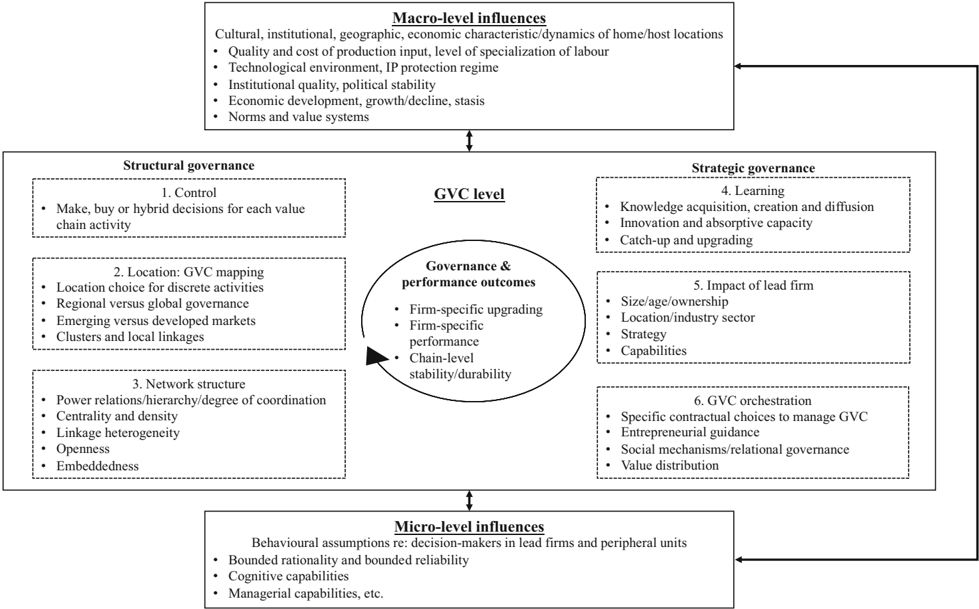
This article reviews the rapidly growing domain of global value chain (GVC) research by analyzing several highly cited conceptual frameworks and then appraising GVC studies published in such disciplines as international business, general management, supply chain management, operations management, economic geography, regional and development studies, and international political economy. Building on GVC conceptual frameworks, we conducted the review based on a comparative institutional perspective that encompasses critical governance issues at the micro-, GVC, and macro-levels. Our results indicate that some of these issues have garnered significantly more scholarly attention than others. We suggest several future research topics such as microfoundations of GVC governance, GVC mapping, learning, impact of lead firm ownership and strategy, dynamics of GVC arrangements, value creation and distribution, financialization, digitization, the impact of renewed protectionism, the impact of GVCs on their macro-environment, and chain-level performance management.
Overview
CoChat Summary
TL;DR
This review synthesizes multidisciplinary global value chain (GVC) research using an IB-centric comparative institutional framework, covering 87 conceptual and empirical studies. It finds uneven scholarly attention across micro-, GVC-, and macro-level governance issues and identifies gaps in microfoundations, GVC mapping, learning, lead-firm ownership/strategy, temporal dynamics, value distribution, financialization, digitization, protectionism, macro-environment impact, and chain-level performance measurement.
Key findings
- The review covers 87 studies: 22 theory papers (including nine foundational pieces) and 65 empirical articles across 21 journals; 33 shortlisted articles are in mainstream IB journals, constituting about 58% of the group of non-social science journals.
- Microfoundations are underrepresented: only seven studies directly address the impact of microfoundations on GVC configurations, knowledge acquisition/dissemination, and network functioning; behavioral assumptions are often implicit and rarely tested.
- Geographic and temporal gaps are evident: only two studies directly address the regional effect in GVCs, only two examine temporal factors in a targeted manner, and few empirical studies measure geographic dispersion or directly address GVCs’ impact on their macro-environment.
- There is no dominant theory of GVC; existing frameworks and typologies are useful organizing frames rather than predictive theory, and GPN 2.0 still lacks empirical studies testing its generality, validity, and robustness.
Methods
- Systematic review of published journal articles, excluding books and book chapters; searched the past 20 years using four terms: global value chain, global commodity chain, global production network, and global factory.
- Included conceptual articles with GVCs as a major focus and empirical articles with at least one search term as a major variable; sample comprises 21 journals, 22 theory papers (including nine foundational pieces), and 65 empirical articles, spanning 1999 to end of July 2019.
- Extracted two to three key GVC-related findings per article and organized them using a comparative institutional framework with micro-, GVC-, and macro-level dimensions; methods were roughly equally split between qualitative case studies and quantitative archival/survey studies, with manufacturing contexts and automotive as the most popular industry.
Limitations
- Paper-stated: books and book chapters were excluded; social science journals were narrowed to a small selection of 30 articles; some impactful cited studies did not meet the sample criteria.
- Paper-stated: GVC/GPN frameworks are primarily explanatory rather than predictive, and predictive power is curtailed by ceteris paribus conditions in open systems; there is no dominant GVC theory, and GPN 2.0 lacks empirical testing.
- Evident from the text: the review is explicitly IB-centric and uses “GVC” inclusively, which may shape which literatures and findings are foregrounded; the additional screening criteria for social science articles were judgment-based.
Model-written summary. Check it against the paper before relying on it.
Integrity signals
Registry
Cites
Statistics
Figures
Verification
Claims the paper makes
16 Valid · 7 Not valid · 191 Not checked · 128 Own results and interpretations
The cited sources support only part of this claim — read each source’s verdict below.
In the paper
“For example, Asian tier 1 suppliers to MNEs and OEMs become GVC lead firms in their own right by shifting production to lower cost locations in the region (Azmeh & Nadvi, 2014;Chen, Wei, Hu, & Muralidharan, 2016).”
§ Global value chains: A review of the multidisciplinary literature > Location
What the sources say
- Partly supportedcites Azmeh & Nadvi, 2014 matched to “Asian firms and the restructuring of global value chains” (2014) sourceExperimental — accuracy not yet measured
The Introduction describes former first-tier Asian garment suppliers taking on chain-coordination functions and shifting manufacturing to lower-cost locations. But it calls them “co-leads” that often work with Western buyers, not independent lead firms; it also says their production networks extend beyond Asia. The claim overstates both their autonomy and the regional scope. (LLM, conf=0.86)
- Not checked yetcites Chen, Wei, Hu, & Muralidharan, 2016 matched to “Survival strategy of OEM companies: a case study of the Chinese toy industry” (2016) source
plainstates a cause- Asserted: passes — The authors put it forward as true.
- Checkable: passes — It can be checked against evidence.
- Load-bearing: unclear — It is unclear whether the paper’s conclusions depend on it.
- Based: passes — The paper gives a reason why it holds.
- Partly supported
The cited sources support only part of this claim — read each source’s verdict below.
In the paper
“Among these factors, favorable business regulations, IP protection, and significant education spending typically attract technologically and functionally sophisticated activities (Amendolagine et al., 2019;Ascani et al., 2016;Pipkin & Fuentes, 2017).”
§ Global value chains: A review of the multidisciplinary literature > Location
What the sources say
- Partly supportedcites Amendolagine et al., 2019 matched to “Local sourcing in developing countries: The role of foreign direct investments and global value chains” (2019) sourceExperimental — accuracy not yet measured
Section 2.1 says cumbersome regulations can discourage foreign investors from buying local inputs, while §4.3 finds that higher education spending strengthens the relationship between GVC involvement and local sourcing (page numbers unavailable). These passages support a role for regulations and education, but they do not establish that those factors attract technologically and functionally sophisticated activities; the cited passages also do not address IP protection. (LLM, conf=0.86)
- Partly supportedcites Ascani et al., 2016 matched to “Economic Institutions and the Location Strategies of European Multinationals in their Geographic Neighborhood” (2016) sourceExperimental — accuracy not yet measured
The Conclusions (page unavailable) link favorable business regulation to MNE location choices, including sophisticated sectors and functions. But they describe preferences for property-rights protection as divided, particularly for sophisticated activities, and say public expenditure matters chiefly for production. The paper does not establish that IP protection or education spending typically attracts sophisticated activities. (LLM, conf=0.89)
- Not checked yetcites Pipkin & Fuentes, 2017 matched to “Spurred to Upgrade: A Review of Triggers and Consequences of Industrial Upgrading in the Global Value Chain Literature” (2017) source
plainstates a cause- Asserted: passes — The authors put it forward as true.
- Checkable: passes — It can be checked against evidence.
- Load-bearing: unclear — It is unclear whether the paper’s conclusions depend on it.
- Based: passes — The paper gives a reason why it holds.
- Partly supported
The cited sources support only part of this claim — read each source’s verdict below.
In the paper
“Sturgeon et al. (2008) followed up with this line of research by examining major American and Japanese automotive lead firms and over 150 suppliers in North America.They found that upgrading of local suppliers was more likely if the GVC network structure moved towards a relational form of power dynamics.”
§ Global value chains: A review of the multidisciplinary literature > Network structure
What the sources say
- Partly supportedcites Sturgeon et al., 2008 matched to “Value chains, networks and clusters: reframing the global automotive industry” (2008) sourceExperimental — accuracy not yet measured
The Local clusters section discusses relational linkages and reports better working relationships between Japanese automakers and locally based North American suppliers. It does not find that a shift toward relational governance made local-supplier upgrading more likely; its account of Japanese suppliers says their relationships became more relational as supplier competence increased. The copy also identifies a figure of the top 150 suppliers, not an examination of over 150 suppliers establishing the claimed result. (LLM, conf=0.83)
hedgedstates a possible cause- Asserted: passes — The authors put it forward as true.
- Checkable: passes — It can be checked against evidence.
- Load-bearing: passes — The paper’s conclusions depend on it.
- Based: passes — The paper gives a reason why it holds.
- Partly supported
The cited sources support only part of this claim — read each source’s verdict below.
In the paper
“This is particularly pronounced in knowledge-intensive industries, where lead firms often locate operations in innovation hubs and global cities (Taylor, Derudder, Faulconbridge, Hoyler, & Ni, 2014).”
§ Global value chains: A review of the multidisciplinary literature > Location
What the sources say
- Partly supportedcites Taylor, Derudder, Faulconbridge, Hoyler, & Ni, 2014 matched to “Advanced Producer Service Firms as Strategic Networks, Global Cities as Strategic Places” (2014) sourceExperimental — accuracy not yet measured
In “APS Internationalization through Strategic Cities” (page unavailable), the paper says some advanced producer service firms locate offices in strategically important cities, including places associated with cutting-edge innovation. Its evidence concerns particular service-firm location strategies; it does not establish the broader claim about lead firms across knowledge-intensive industries or innovation hubs generally. (LLM, conf=0.83)
plainstates an association- Asserted: passes — The authors put it forward as true.
- Checkable: passes — It can be checked against evidence.
- Load-bearing: unclear — It is unclear whether the paper’s conclusions depend on it.
- Based: passes — The paper gives a reason why it holds.
- Partly supported
The cited sources support only part of this claim — read each source’s verdict below.
In the paper
“Such a relational form of network structure tends to favor inter-firm cooperation and credible commitment (e.g., IKEA and its suppliers in Ivarsson & Alvstam, 2011 and tuna canning firms in Havice & Campling, 2017).”
§ Global value chains: A review of the multidisciplinary literature > Network structure
What the sources say
- Not checked yetcites Ivarsson & Alvstam, 2011 matched to “Upgrading in global value-chains: a case study of technology-learning among IKEA-suppliers in China and Southeast Asia” (2011) source
- Partly supportedcites Havice & Campling, 2017 matched to “Where Chain Governance and Environmental Governance Meet: Interfirm Strategies in the Canned Tuna Global Value Chain” (2017) sourceExperimental — accuracy not yet measured
The Processing/Trading section describes tuna processors forming an association and acting collectively, supporting the example of inter-firm cooperation. The Vessel ownership, financing and contracts section also describes long-term supply relationships. Neither passage establishes that a relational network structure generally favors credible commitment; the paper instead emphasizes that inter-firm strategies depend on context. Page numbers are unavailable in our copy. (LLM, conf=0.84)
plainstates a possible cause- Asserted: passes — The authors put it forward as true.
- Checkable: passes — It can be checked against evidence.
- Load-bearing: unclear — It is unclear whether the paper’s conclusions depend on it.
- Based: passes — The paper gives a reason why it holds.
159 more claims · 8 with their cited sources checked
Create a free account to see all 342 claims and to verify the 249 references still open.
- It may state two separate claims as one. 101
- Probably not a substantial claim. 116
Claims other papers make about this one
Each is checked against this paper’s own text: does it say what the citing paper says it does?
The source backs part of the claim, not all of it — or backs it for a different population, condition or comparison.
In the citing paper
“Research reveals that MNEs can build competitive advantages through collaboration with global competitors (horizontal cooperation) or with suppliers and distributors (vertical cooperation) (Kano et al., 2020).”
From Illusions of techno-nationalism. (2022) · cites this paper as Kano et al., 2020
Experimental — accuracy not yet measured
Self-check
Percentages, sums and reported differences re-computed from the paper’s own numbers.
Each contradiction between two passages listed here was confirmed by an independent check.
Rated minor: it would not touch a result — a value no result rests on, a p-value that stays on the same side of the significance level, or a conflict that is clerical, resolved elsewhere in the paper, or outside its own findings.
In the paper
§ Global value chains: A review of the multidisciplinary literature > Micro-level: Microfoundational Assumptions and Their Impact on GVC
“Seppa ¨la ¨, Kenney and Ali-Yrkko ¨(2018) focus on boundedly rational accounting decisions in lead MNEs”
§ Global value chains: A review of the multidisciplinary literature > References
“Seppa ¨la ¨, T., Kenney, M., & Ali-Yrkko ¨, J. 2014. Global supply chains and transfer pricing: Insights from a case study.”
Rated minor: it would not touch a result — a value no result rests on, a p-value that stays on the same side of the significance level, or a conflict that is clerical, resolved elsewhere in the paper, or outside its own findings.
In the paper
§ Global value chains: A review of the multidisciplinary literature > Impact of lead firm ownership and strategy on GVC governance
“However, few studies (with the exception of, e.g., Morris & Staritz, 2014) examined the impact of ownership, meaning potential differences among GVCs led by private, public, state-owned, and family-owned MNEs.”
§ Global value chains: A review of the multidisciplinary literature > Micro-level: Microfoundational Assumptions and Their Impact on GVC
“Ownership characteristics of supplier firms shape the ability to shift between different end markets, respond to lead firm requirements, and pursue upgrading in GVCs.”
Citations
Cites
(1994) · Journal of the American Dietetic Association · doi:10.1016/0002-8223(94)92216-0 · Cited by 45,910
Journal of Economic Literature
(2019) · AEA Papers and Proceedings · doi:10.1257/pandp.109.633 · Cited by 7,468
The governance of global value chains
Gereffi, G., Humphrey, J., & Sturgeon, T. (2005) · Review of International Political Economy · doi:10.1080/09692290500049805 · Cited by 7,233
The Future of the Multinational Enterprise
Buckley, P. J., & Casson, M. (1976) · doi:10.1007/978-1-349-02899-3 · Cited by 4,478
The Eclectic Paradigm of International Production: A Restatement and Some Possible Extensions
Dunning, J. H. (1988) · Journal of International Business Studies · doi:10.1057/palgrave.jibs.8490372 · Cited by 4,315 · cited 1×
“…tariff regimes (Curran, Nadvi, & Campling, 2019; Kim, Milner, Bernauer, Osgood, Spilker, & Tingley, 2019), regulatory environments and government policy interventions, labor costs, level of technological sophistication, and societal Journal of International Business Studies norms (Dunning, 1988).”
BackgroundManaging Across Borders: The Transnational Solution
Bartlett, C. A., & Ghoshal, S. (2009) · Rugman Reviews · doi:10.1007/978-1-137-28787-8_25 · Cited by 4,101
Social Capital, Networks, and Knowledge Transfer
Inkpen, A. C., & Tsang, E. W. K. (2005) · Academy of Management Review · doi:10.5465/amr.2005.15281445 · Cited by 3,864
Self-citationInternational trade and industrial upgrading in the apparel commodity chain
Gereffi, G. (1999) · Journal of International Economics · doi:10.1016/s0022-1996(98)00075-0 · Cited by 3,197 · cited 2×
“In economic sociology and development studies, the earliest work was concerned with global commodity trade and the governance structure of such commodity chains in labor-intensive and high-tech industries (Bair, 2009; Gereffi, 1999, 2018; Gereffi & Korzeniewicz, 1994).”
BackgroundWilliamson, O. E. (1996) · doi:10.1093/oso/9780195078244.001.0001 · Cited by 3,041
Simon, H. A. (1950) · AJN, American Journal of Nursing · doi:10.1097/00000446-195002000-00071 · Cited by 3,004
Research works printed but not linked: 7
- (Papers included in the review are marked with an asterisk.)
- Washington, D. C.: World Bank.
- Kinkel, S., Rieder, B., Horvath, D., & Ja ¨ger, A. 2016. Productivity and flexibility advantages of in-house manufacturing and local sourcing -The limits of global value chains? Paper presented at the 42nd Annual Conference of the European International Business Academy, Vienna, Austria.
- UNCTAD. 2013. Global value chains and development: Investment and value added trade in the global economy. New York: United Nations.
- UNCTAD. 2019. Digital economy report. New York: United Nations.
- World Bank. 2019. Global value chain development report 2019. Washington, DC: World Bank.
- Eric W. K. Tsang is the Dallas World Salute Distinguished Professor of Global Strategy at the Naveen Jindal School of Management, University of Texas at Dallas. He received his PhD from the University of Cambridge. His main research inter- ests include organizational learning, strategic alli- ances, entrepreneurship, and philosophical analysis of methodological issues.
Cited by
Items 101–200 of 996
Barbieri, P., Boffelli, A., Elia, S., Fratocchi, L., & Kalchschmidt, M. G. M. (2022) · International Business Review · doi:10.1016/j.ibusrev.2022.101992 · Cited by 51
The European deforestation-free trade regulation: collateral damage to agroforesters?
van Noordwijk, M., Leimona, B., & Minang, P. A. (2025) · Current Opinion in Environmental Sustainability · doi:10.1016/j.cosust.2024.101505 · Cited by 48
Value chain analysis of banana in Bench Maji and Sheka Zones of Southern Ethiopia
Tarekegn, K., Asado, A., Gafaro, T., & Shitaye, Y. (2020) · Cogent Food & Agriculture · doi:10.1080/23311932.2020.1785103 · Cited by 48
“Value chain analysis can be done at a product level, measuring input-output flows based on a defined functional unit of a commodity without being site specific, or at a spatial level, describing input-output flows within a defined economy (Faße et al., 2009; Gabriel et al., 2019; Kano et al., 2020).”
BackgroundOFDI performance of EMNEs: A review and recommendations for future research
Cui, L., Gao, Q., Guo, J., & Ma, P. (2022) · Journal of International Management · doi:10.1016/j.intman.2022.100967 · Cited by 49
Reshoring: A Road to Industry 4.0 Transformation
Gupta, S., Wang, Y., & Czinkota, M. (2023) · British Journal of Management · doi:10.1111/1467-8551.12731 · Cited by 47
Shi, J. (2024) · Technovation · doi:10.1016/j.technovation.2024.102998 · Cited by 46
Morgan, T. R., Roath, A. S., & Richey, R. G., Jr. (2023) · Journal of Business Research · doi:10.1016/j.jbusres.2022.113641 · Cited by 45
Bair, J., & Mahutga, M. C. (2023) · Global Networks · doi:10.1111/glob.12441 · Cited by 46
Does deglobalization imply the end of global supply chains?
Yücesan, E., & Witt, M. (2025) · International Business Review · doi:10.1016/j.ibusrev.2025.102398 · Cited by 45
Technology adoption, global value chains and sustainability: The case of additive manufacturing
Sanguineti, F., Magnani, G., & Zucchella, A. (2023) · Journal of Cleaner Production · doi:10.1016/j.jclepro.2023.137095 · Cited by 45
Digitalization and global value chain participation: firm-level evidence from Indian manufacturing
Reddy, K., & Sasidharan, S. (2023) · Journal of Industrial and Business Economics · doi:10.1007/s40812-023-00270-4 · Cited by 45
“Kano et al. (2020) also posit that availability of viable digital architecture enables sharing of firms’ knowledge and expertise to its foreign subsidiaries, which further advances the GVC nature of production.”
BackgroundVerbeke, A. C., Hutzschenreuter, T., & Pyasi, N. (2021) · Journal of Business Research · doi:10.1016/j.jbusres.2021.07.006 · Cited by 44
“The micro-foundational challenges arise from human frailty, that is, the limits of our intellect, i.e. bounded rationality, and imperfect efforts to fulfil commitments, i.e. bounded reliability 3 (Kano & Verbeke, 2015; Kano et al., 2020; Kano & Oh, 2020; Verbeke & Greidanus, 2009).”
InfluentialJohns, J. (2021) · Global Networks · doi:10.1111/glob.12349 · Cited by 43
Park, Y. W., Hong, P. C., & Shin, G. (2022) · Asia Pacific Business Review · doi:10.1080/13602381.2022.2059955 · Cited by 43
Women on board and firm export attitudes: Evidence from Italy
Carbonero, F., Devicienti, F., Manello, A., & Vannoni, D. (2021) · Journal of Economic Behavior & Organization · doi:10.1016/j.jebo.2021.10.011 · Cited by 43
Rengarajan, S., Narayanamurthy, G., Moser, R., & Pereira, V. E. (2022) · Journal of Business Research · doi:10.1016/j.jbusres.2022.02.042 · Cited by 43
Belderbos, R., Castellani, D., Du, H. S., & Lee, G. H. (2024) · Journal of International Business Studies · doi:10.1057/s41267-024-00686-7 · Cited by 44
“…corporations (MNCs) have been “fine slicing” the location of specific activities in places where they can enjoy the external agglomeration benefits of locating in industry clusters with other firms conducting similar activities (Kano, Tsang, & Yeung, 2020; Lorenzen, Mudambi, & Schotter, 2020).”
FDI and human capital development: a tale of two Southeast Asian economies
Ibarra‐Olivo, J. E., Neise, T., Breul, M., & Wrana, J. (2024) · Journal of International Business Policy · doi:10.1057/s42214-024-00186-3 · Cited by 42
“A discussion on the nuances of these associated but distinct frameworks is beyond the scope of this paper (see Kano et al., 2020 for a multidisciplinary literature review).”
Entangled chains of global value and wealth
Bair, J., Ponte, S., Seabrooke, L., & Wigan, D. (2023) · Review of International Political Economy · doi:10.1080/09692290.2023.2220268 · Cited by 45
“GVC research details both the inter-firm relationships that enable value creation within GVCs (Kano, 2018; Kano et al., 2020), and the disparities that exist between parties contributing to value creation and those engaged in value capture (Nachum & Uramoto, 2021).”
BackgroundAdjusting supply chain involvement in countries with politician turnover: A contingency framework
Dong, M. C., Huang, Q., & Liu, Z. (2022) · Journal of Operations Management · doi:10.1002/joom.1213 · Cited by 40
Islam, M. T., & Chadee, D. D. (2021) · International Business Review · doi:10.1016/j.ibusrev.2021.101898 · Cited by 40
Clark, D. R., & Pidduck, R. J. (2023) · Journal of Small Business Management · doi:10.1080/00472778.2022.2149761 · Cited by 40
“…all business is international business—meaning that international products are ubiquitous and supply chains, inherently global (Johnson, 2018; Kano et al., 2020)—and what characterizes (emerging) multinational corporations is the degree they commit resources (e.g., human, financial,…”
BackgroundHernández-Rodríguez, E., Boschma, R. A., Morrison, A., & Ye, X. (2025) · Papers of the Regional Science Association · doi:10.1016/j.pirs.2024.100072 · Cited by 39
Mujuru, N. M., Obi, A., Mishi, S., & Mdoda, L. (2022) · Agriculture & Food Security · doi:10.1186/s40066-021-00345-2 · Cited by 39
Innovation and international business: A systematic literature review
Fernández, I. A. (2023) · Heliyon · doi:10.1016/j.heliyon.2023.e12956 · Cited by 40
“The second theme reveals a new conceptual approach, the global value chains as referred in the relationship between multinational corporations and global innovation systems [64] in view of the fact that nowadays international lead firms integrate their geographically dispersed partners, specialized suppliers, and cust…”
BackgroundVeiga, P. M., Marnoto, S., Guerra-Mota, M., & Rexhepi, G. (2024) · Journal of Small Business and Enterprise Development · doi:10.1108/jsbed-10-2023-0501 · Cited by 39
Soundararajan, V., Wilhelm, M. M., Crane, A., Agarwal, P., & Shetty, H. (2024) · Academy of Management Annals · doi:10.5465/annals.2023.0071 · Cited by 38
Zahoor, N., Khan, Z., & Shenkar, O. (2022) · Journal of World Business · doi:10.1016/j.jwb.2022.101385 · Cited by 38
Islam, M. T., & Chadee, D. (2024) · International Business Review · doi:10.1016/j.ibusrev.2023.102248 · Cited by 37
Global Value Chains, Digital Economy, and Upgrading of China’s Manufacturing Industry
Li, W., Li, Q., Chen, M., Su, Y., & Zhu, J. (2023) · Sustainability · doi:10.3390/su15108003 · Cited by 37
“Studies on global value chains in manufacturing upgrading have mainly focused on the knowledge spillover e ff ect [9], technological innovation e ff ect [10], and foreign investment spillover e ff ect [11].”
BackgroundCompetitive dynamics of lead firms and their systems suppliers in the automotive industry
Yeung, G. K.-Y. (2023) · Environment and Planning A Economy and Space · doi:10.1177/0308518x231202390 · Cited by 39
“Although technology, especially the degree of codification, has long been a crucial factor in the determination of specific modes of governance (Gereffi et al., 2005), new technology as a strategic driver of GPNs has, arguably, not been thoughtfully examined in the literature (Kano et al., 2020).”
BackgroundFrom carbon-neutral to climate-neutral supply chains: a multidisciplinary review and research agenda
Guntuka, L., Mukandwal, P. S., Aktaş, E., & Paluvadi, V. S. K. (2024) · The International Journal of Logistics Management · doi:10.1108/ijlm-03-2023-0116 · Cited by 37
Reilly, M., Tippmann, E., & Scott, P. S. (2023) · Journal of International Business Studies · doi:10.1057/s41267-022-00592-w · Cited by 39
Corcioli, G., Medina, G., & Arrais, C. A. (2022) · Frontiers in Sustainable Food Systems · doi:10.3389/fsufs.2021.796845 · Cited by 36
The impact of European Cohesion Policy: a spatial perspective
Amendolagine, V., Prota, F., & Serlenga, L. (2024) · Journal of Economic Geography · doi:10.1093/jeg/lbae006 · Cited by 35
Regional resilience during a trade war: The role of global connections and local networks
He, C., Li, J., Wang, W., & Zhang, P. (2024) · Journal of World Business · doi:10.1016/j.jwb.2024.101567 · Cited by 35
Challenging the orthodoxy in international business research: Directions for “new” research areas
Delios, A., Li, J., Schotter, A. P. J., & Vrontis, D. (2024) · Journal of World Business · doi:10.1016/j.jwb.2024.101552 · Cited by 34
Szymczak, S. (2024) · Journal for Labour Market Research · doi:10.1186/s12651-024-00367-w · Cited by 35
Anzolin, G., Andreoni, A., & Zanfei, A. (2022) · Technovation · doi:10.1016/j.technovation.2022.102476 · Cited by 34
Family firms and the governance of global value chains
Debellis, F., Rondi, E., Buckley, P. J., & Massis, A. D. (2024) · Journal of International Business Studies · doi:10.1057/s41267-024-00716-4 · Cited by 34
“Although the governance of global value chains (GVCs) has attracted increasing research interest (e.g., Kano et al., 2020), most studies adopt only the perspective of the lead multinational enterprise (MNE) to depict how value chain activities can be structured and managed across the globe.”
Attah‐Boakye, R., Adams, K., Yu, H., & Koukpaki, S. (2022) · Strategic Change · doi:10.1002/jsc.2479 · Cited by 34
Global Value Chain Resilience and Reshoring During Covid-19: Challenges in a Post-Covid World
Marvasi, E. (2023) · The Academy of International Business · doi:10.1007/978-3-031-24090-4_10 · Cited by 33
Robotization and employment dynamics in German manufacturing value chains
Graf, H., & Mohamed, H. (2023) · Structural Change and Economic Dynamics · doi:10.1016/j.strueco.2023.10.014 · Cited by 33
de Oliveira, R. T., Indulska, M., & Zalan, T. (2020) · Review of International Business and Strategy · doi:10.1108/ribs-06-2020-153 · Cited by 35
Neo-Industrialization – Towards a ‘New Geometry’ of Economic Spatial Interactions
Kryukov, V. А., & Валерьевич, К. Я. (2024) · Spatial Economics · doi:10.14530/se.2024.3.007-038 · Cited by 32
Juergensen, J. J., Narula, R., & Surdu, I. M. (2021) · International Business Review · doi:10.1016/j.ibusrev.2021.101955 · Cited by 32
“Indeed, while some reviews rely on keyword searches to identify studies (Jormanainen & Koveshnikov, 2012; Kano et al., 2020), we deemed a manual issue-by-issue search more appropriate, given the varying terminologies and the multifaceted nature of both of our main constructs.”
Revisiting economic geography and foreign direct investment in less developed regions
Pavlínek, P. (2022) · Geography Compass · doi:10.1111/gec3.12617 · Cited by 32
Taking two to tango: A comparative nationalism view of cross-border acquisitions
Wu, S., & Fan, D. (2022) · International Business Review · doi:10.1016/j.ibusrev.2022.102069 · Cited by 32
Wu, J., Zahoor, N., Khan, Z., & Meyer, M. S. (2022) · Journal of Business Research · doi:10.1016/j.jbusres.2022.113487 · Cited by 32
Grillitsch, M., & Asheim, B. (2023) · European Planning Studies · doi:10.1080/09654313.2023.2205890 · Cited by 32
“A GVC ‘ is the nexus of interconnected functions and operations through which goods and services are produced, distributed, and consumed on a global basis ’ (Kano, Tsang, and Yeung 2020, 579).”
Capello, R., Dellisanti, R., & Perucca, G. (2023) · Environment and Planning A Economy and Space · doi:10.1177/0308518x231211788 · Cited by 32
“…GVCs participation in the functional structure of GVCs, and their environmental and socio-economic impacts, with contributions from several disciplines, from international business to sociology, to environmental studies and international economics (see Kano et al., 2020, for an extensive review).”
BackgroundVrontis, D., Shams, S. M. R., Thrassou, A., & Kafouros, M. I. (2024) · Journal of International Management · doi:10.1016/j.intman.2024.101188 · Cited by 32
Mostafiz, M. I., Ahmed, F. U., Ibrahim, F., & Tarba, S. Y. (2023) · International Marketing Review · doi:10.1108/imr-10-2022-0241 · Cited by 33
DeBerge, T. (2023) · Global Strategy Journal · doi:10.1002/gsj.1498 · Cited by 31
“…relatively higher costs associated with hierarchical governance compared to market-or network-based governance modes (e.g., Hennart, 1993), which can function more efficiently through institutional and relational mechanisms external to the firm (Gereffi et al., 2005; Kano, 2018; Kano et al., 2020).”
BackgroundDigital and Green Transitions and Automotive Industry Reconfiguration: Evidence from Japan and China
Dzienis, A. M., & McCaleb, A. (2024) · Journal of Contemporary Asia · doi:10.1080/00472336.2024.2384704 · Cited by 30
“…focuses on the geography of international trade and value creation, or the international business perspective, which examines how multinational companies leverage their firm-specific advantages and create value by organising production with partners across borders (see Kano, Tsang, and Yeung 2020).”
InfluentialThe Impact of Digitalization on the Upgrading of China’s Manufacturing Sector’s Global Value Chains
Zhang, Q. (2024) · Journal of the Knowledge Economy · doi:10.1007/s13132-023-01698-8 · Cited by 30
“In the specific division of labor in GVCs, a country often concentrates on a specific link in the chain for production (Kano et al., 2020).”
Knowledge synthesis on the mine life cycle and the mining value chain to address climate change
Gholami, A., Tokac, B., & Zhang, Q. (2024) · Resources Policy · doi:10.1016/j.resourpol.2024.105183 · Cited by 32
Forsgren, M., & Holm, U. (2021) · Journal of International Business Studies · doi:10.1057/s41267-021-00416-3 · Cited by 30
Kanungo, R. P., Liu, R., & Gupta, S. (2024) · Journal of Business Research · doi:10.1016/j.jbusres.2024.114788 · Cited by 30
Cruz, J. E., Medina, G., & Júnior, J. R. D. O. (2022) · Logistics · doi:10.3390/logistics6010023 · Cited by 29
“A crucial challenge is the consolidation of companies with domestic capital throughout the supply chain of agribusiness in developing countries [17].”
BackgroundLate industrialisation and global value chains under platform capitalism
Naudé, W. A. (2022) · Journal of Industrial and Business Economics · doi:10.1007/s40812-022-00240-2 · Cited by 29
“For a review of the GCV literature, see Kano et al. (2020).”
BackgroundDonbesuur, F., Zahoor, N., Al‐Tabbaa, O., Adomako, S., & Tarba, S. Y. (2022) · Journal of International Management · doi:10.1016/j.intman.2022.101002 · Cited by 29
Digital Transformation and Resilience: Dimensions and Interactions
Abidi, O., Richet, J., & Vitari, C. (2025) · Journal of Global Information Management · doi:10.4018/jgim.367873 · Cited by 28
Supplier response to Apple’s friendshoring
Deng, Z., Wang, Y., & Xu, H. (2025) · Journal of Business Research · doi:10.1016/j.jbusres.2025.115614 · Cited by 29
The wind energy global value chain localisation and industrial policy failure in South Africa
Morris, M., Robbins, G., Hansen, U. E., & Nygaard, I. (2021) · Journal of International Business Policy · doi:10.1057/s42214-021-00123-8 · Cited by 28
Wang, S. L. (2023) · Journal of Industrial and Business Economics · doi:10.1007/s40812-022-00249-7 · Cited by 29
Dsouza, A., & Panakaje, N. (2023) · International Journal of Case Studies in Business IT and Education · doi:10.47992/ijcsbe.2581.6942.0260 · Cited by 28
Coral, C., & Mithöfer, D. (2022) · Agriculture and Human Values · doi:10.1007/s10460-022-10405-3 · Cited by 28
Global value chains and export growth in South Africa: evidence from dynamic ARDL simulations
Olasehinde‐Williams, G., & Oshodi, A. F. (2021) · Transnational Corporation Review · doi:10.1080/19186444.2021.1959833 · Cited by 27
Pillich, S. M. (2024) · Management Review Quarterly · doi:10.1007/s11301-024-00414-3 · Cited by 28
What is the future of regional multinational enterprises?
Verbeke, A. C., Oh, C. H., & Jain, R. (2025) · International Business Review · doi:10.1016/j.ibusrev.2025.102442 · Cited by 26
Could Chinese enterprises real benefit from embedding in global value chains?
Wang, S., & Chen, H. (2022) · Environment Development and Sustainability · doi:10.1007/s10668-022-02348-w · Cited by 27
“Notwithstanding the high cost of social responsibility, established enterprises can obtain high returns (Kano et al., 2020) because CSR can attract potential customers (Kaul & Luo, 2017; Servaes & Tamayo, 2013), raise net stock returns (Eccles et al., 2014), and improve innovative ability (Vakili &…”
Reis, G. G., Villar, E. G., Gimenez, F. A. P., Molento, C. F. M., & Ferri, P. (2022) · Technology in Society · doi:10.1016/j.techsoc.2022.102116 · Cited by 27
Post-offshoring manufacturing strategies: decision-making and implementation
Bettiol, M., Chiarvesio, M., Maria, E. D., Stefano, C. D., & Fratocchi, L. (2023) · Management Decision · doi:10.1108/md-12-2022-1764 · Cited by 26
Digital sustainability assurance governing global value chains: The case of aquaculture
Kruk, S. R. L., Toonen, H., & Bush, S. R. (2023) · Regulation & Governance · doi:10.1111/rego.12571 · Cited by 26
Siaw, C. A., & Okorie, C. (2022) · Strategic Change · doi:10.1002/jsc.2475 · Cited by 27
“, 2014) to explicate the structural organization and strategic management of GVC activities (Fernandez-Stark & Gereffi, 2019; Kano et al., 2020).”
BackgroundInfluentialZahoor, N., Donbesuur, F., Nwoba, A. C., & Khan, H. (2021) · Asia Pacific Journal of Management · doi:10.1007/s10490-021-09799-1 · Cited by 25
“International suppliers provide access to knowledge about the production process and input characteristics that could reduce the cost of the final product/ service and thus promote regional expansion (Bhatti et al., 2020; Kano et al., 2020; Turkina & Van Assche, 2018).”
BackgroundFrom mainstream to niche: How value regimes shift in emerging economy upgrading
Manning, S. D. (2022) · Research Policy · doi:10.1016/j.respol.2022.104532 · Cited by 25
Global value chain: An empirical investigation of Bangladesh’s garments and textile industry
Hossain, M. S., & Baars, J. V. (2022) · International Journal of Research in Business and Social Science (2147-4478) · doi:10.20525/ijrbs.v11i3.1726 · Cited by 25
“(Kano et al., 2020).”
On GVC and innovation: the moderating role of policy
Eissa, Y., & Zaki, C. R. (2023) · Journal of Industrial and Business Economics · doi:10.1007/s40812-022-00255-9 · Cited by 25
Zhang, M., Song, G., & Ma, N. (2024) · Journal of Cleaner Production · doi:10.1016/j.jclepro.2024.141717 · Cited by 25
D’Amato, D., Notte, A. L., Damiani, M., & Sala, S. (2024) · Journal of Industrial Ecology · doi:10.1111/jiec.13521 · Cited by 26
Liu, W., Cao, M., Zheng, J., & Zhang, Z. (2024) · Journal of Innovation & Knowledge · doi:10.1016/j.jik.2024.100518 · Cited by 25
Agro-industrial development: Lessons from Brazil
Medina, G., & Pokorny, B. (2022) · Land Use Policy · doi:10.1016/j.landusepol.2022.106266 · Cited by 25
Navigating geopolitical risks: How U.S. firms adjust supply chains amid U.S.–China rivalry
Yang, B., Song, J., Wei, Y., & Li, J. (2025) · Journal of International Business Studies · doi:10.1057/s41267-025-00800-3 · Cited by 24
Nenci, S., Fusacchia, I., Giunta, A., Montalbano, P., & Pietrobelli, C. (2022) · Bio-based and Applied Economics · doi:10.36253/bae-12558 · Cited by 24
Effects of Sociodemographic Variables on Electronic Word of Mouth: Evidence from Emerging Economies
Mladenović, D., Rrustemi, V., Martin, S., Kalia, P., & Chawdhary, R. (2022) · MUNI ECON Working Papers · doi:10.5817/wp_muni_econ_2022-02 · Cited by 24
Deciphering relocation paths: A systematic literature review of near-shoring and friend-shoring
da Rocha, A., da Fonseca, L., & Kogut, C. (2025) · Journal of International Management · doi:10.1016/j.intman.2025.101282 · Cited by 14
Technology strategy and MNE subsidiary upgrading in emerging markets
Lopez‐Vega, H., & Tell, F. (2021) · Technological Forecasting and Social Change · doi:10.1016/j.techfore.2021.120709 · Cited by 23
Geographical reconfiguration in global value chains: Search within limited space?
Rodríguez, C., Ciravegna, L., & Petersen, B. (2022) · Global Strategy Journal · doi:10.1002/gsj.1441 · Cited by 23
“Keywords: Global value chains, Performance Feedback theory, Problemistic search, Geographical reconfiguration INTRODUCTION Different streams of literature converge in arguing that multinational enterprises (MNEs) continuously change their global value chains (GVCs) (Strange & Humphrey, 2019; Buckley & Casson, 2019; Ka…”
BackgroundInfluentialPeng, Y., Zhu, H., & Cui, J. (2023) · Journal of Environmental Management · doi:10.1016/j.jenvman.2023.117712 · Cited by 23
Obrenovic, B., Godinić, D., & Njavro, M. (2023) · Environment Development and Sustainability · doi:10.1007/s10668-023-03892-9 · Cited by 23
“On the other hand, the demand for products and services remains strong even amidst hardship (Kano et al., 2020).”
A multilateral network perspective on inward FDI
Jha, S., Awate, S. S., & Mudambi, R. (2023) · Journal of International Business Studies · doi:10.1057/s41267-023-00650-x · Cited by 23
“Prior literature on international trade, industrial upgrading, and catch-up processes prove that FDI spillovers lead to higher resource efficiency and knowledge-generation capabilities in host economies (Gereffi, 1999; Kano et al., 2020).”
Digital divide and environmental pressure: A countermeasure on the embodied carbon emissions in FDI
Wang, L., & Ramsey, T. S. (2024) · Technological Forecasting and Social Change · doi:10.1016/j.techfore.2024.123398 · Cited by 23
Hendrayati, H., Marimón, F., Hwang, W., Yuliawati, T., Susanto, P., & Rahmiati, R. (2025) · Journal of Innovation and Entrepreneurship · doi:10.1186/s13731-025-00520-w · Cited by 24
“Managers need to be able to see businesses as socially integrated and actively seek out opportunities to create value for all parties (Kano et al., 2020).”
Chen, Q., & Shen, Y. (2021) · Structural Change and Economic Dynamics · doi:10.1016/j.strueco.2021.08.014 · Cited by 23
VP & Unit Head, I. (., & Kamal, M. (2025) · doi:10.63125/42rd4x66 · Cited by 22
Vargas‐Carpintero, R., Romero-Perdomo, F., Martínez, J. F., & Lewandowski, I. M. (2023) · Discover Sustainability · doi:10.1007/s43621-023-00150-w · Cited by 22
“NIs are also particularly interesting as a valorization strategy for biomass from novel plants, established crops, and residues by taking advantage of natural properties and extracting targeted constituents to produce specialty products [14].”
BackgroundHow Does Protectionism Impact Multinational Firm Reshoring? Evidence from the UK
Temouri, Y., Pereira, V. E., Delis, A., & Wood, G. (2023) · Management International Review · doi:10.1007/s11575-023-00521-5 · Cited by 21
“However, as Kano et al. (2020) noted, much more research has been conducted on the scale and scope of protectionism than reshoring (cf. Delis et al., 2019; Pereira et al., 2019).”
Critical perspectives on GVC theory: uncovering GVC resilience through non-lead power
Suder, G. G. S., Meng, B., & Gao, Y. (2024) · Critical Perspectives on International Business · doi:10.1108/cpoib-04-2022-0025 · Cited by 21
Metadata
- Authors
- Kano, L., Tsang, E. W. K., & Yeung, H. W.-C.
- Affiliations
- University of Calgary (CA)
- The University of Texas at Dallas (US)
- National University of Singapore (SG)
- Corresponding author
- Kano, Liena
- Venue
- Journal of International Business Studies
- Published
- 2020-02-25
- Volume
- 51
- Issue
- 4
- Pages
- 577-622
- ISSN
- 0047-2506 (ISSN-L)
- 1478-6990
- OpenAlex
- W3008345757
- Cited by
- 767
- References
- 217
- Citations by year
- 2026: 160 · 2025: 140 · 2024: 140 · 2023: 117 · 2022: 108 · 2021: 72 · 2020: 29
- FWCI
- 86.86
- Type
- journal article
- Language
- en
- Update notices
- correction (2020-03-30)
- Open access
- hybrid
- doi.org
- Licence
- cc-by
- creativecommons.org/licenses/by/4.0/ (tdm)
- creativecommons.org/licenses/by/4.0/ (vor)
- Locations
- Journal of International Business Studies (publishedVersion, cc-by)
- RePEc: Research Papers in Economics (submittedVersion)
- Funders
- University of Calgary
- National University of Singapore (R109000183646)
- Topics
- Social Sciences › Business, Management and Accounting › Strategy and Management › Global trade, sustainability, and social impact
- Social Sciences › Business, Management and Accounting › Strategy and Management › International Business and FDI
- Social Sciences › Business, Management and Accounting › Management Information Systems › Outsourcing and Supply Chain Management
- Keywords
- global value chains, GVC governance, conceptual framework, financialization, digitization, protectionism, supply chain management, international political economy
About these checks
Registry, retraction, Cites and statistics results are computed, not judged, with one exception: a printed reference that no index lists is read once by a model before it counts as a citation error. Claims are extracted by a model and kept only when their quote appears verbatim in the text; each cited source is then checked, with a model’s help, for whether it says what the claim relies on. Those verdicts can be wrong — read the claim’s quote and the cited source before relying on one.
The claim verdicts this report counts are experimental: their accuracy is not yet measured.
A language model drew the claims from the paper on 2026-10-06, under version 3 of the claim definition (model deepseek-v4.1-flash, prompt extract-v3).
A second model labelled each claim on 2026-10-06 (model jev-1.13-20260917, definition revision gold-guideline-v0.2).
Cited sources are checked with a language model’s help (gpt-6-sol).
Statistics and arithmetic are recomputed, not judged.
Confidence bands are shown only for fields calibrated on our annotated test set. None is calibrated yet, so no band is shown.
What counts as a claim ›How we measure confidence ›How we check this ›
Are you an author, or do you see a problem with this page? Request a review
Data sources
Bibliographic data: Semantic Scholar, OpenAlex, Crossref.
Contains information from the Semantic Scholar Academic Graph Datasets, made available under the ODC Attribution License (ODC-BY 1.0).
Semantic Scholar’s data is described in: Kinney, R., et al. (2023). The Semantic Scholar Open Data Platform. arXiv:2301.10140.
