

Global value chains: A review of the multi-disciplinary literature
Open accessThe DOI matches its Crossref record; 48 of the 217 references it cites were found in a registry or an index; 21 of the 270 sources its claims cite were checked for support.
Abstract
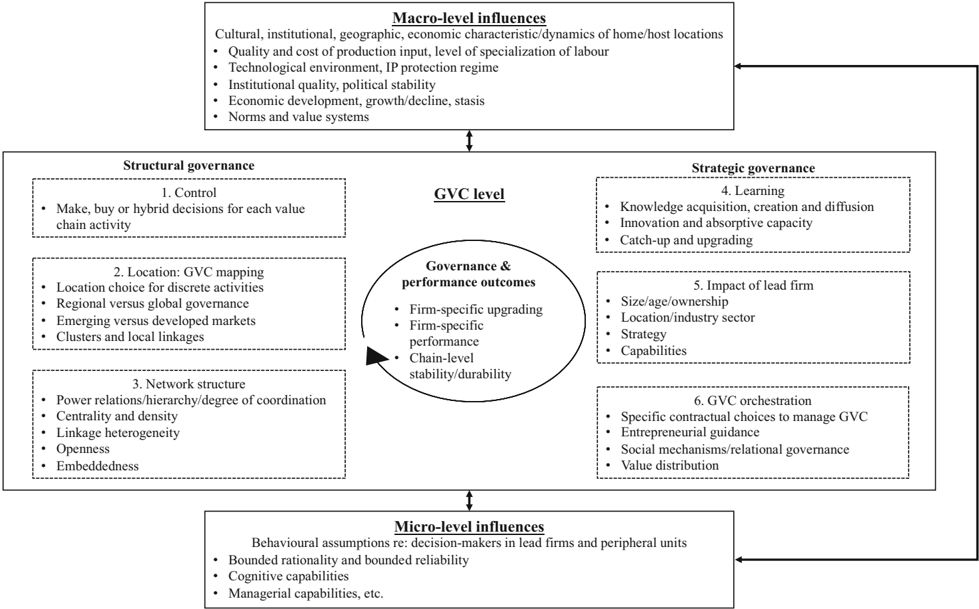
This article reviews the rapidly growing domain of global value chain (GVC) research by analyzing several highly cited conceptual frameworks and then appraising GVC studies published in such disciplines as international business, general management, supply chain management, operations management, economic geography, regional and development studies, and international political economy. Building on GVC conceptual frameworks, we conducted the review based on a comparative institutional perspective that encompasses critical governance issues at the micro-, GVC, and macro-levels. Our results indicate that some of these issues have garnered significantly more scholarly attention than others. We suggest several future research topics such as microfoundations of GVC governance, GVC mapping, learning, impact of lead firm ownership and strategy, dynamics of GVC arrangements, value creation and distribution, financialization, digitization, the impact of renewed protectionism, the impact of GVCs on their macro-environment, and chain-level performance management.
Overview
CoChat Summary
TL;DR
This review synthesizes multidisciplinary global value chain (GVC) research using an IB-centric comparative institutional framework, covering 87 conceptual and empirical studies. It finds uneven scholarly attention across micro-, GVC-, and macro-level governance issues and identifies gaps in microfoundations, GVC mapping, learning, lead-firm ownership/strategy, temporal dynamics, value distribution, financialization, digitization, protectionism, macro-environment impact, and chain-level performance measurement.
Key findings
- The review covers 87 studies: 22 theory papers (including nine foundational pieces) and 65 empirical articles across 21 journals; 33 shortlisted articles are in mainstream IB journals, constituting about 58% of the group of non-social science journals.
- Microfoundations are underrepresented: only seven studies directly address the impact of microfoundations on GVC configurations, knowledge acquisition/dissemination, and network functioning; behavioral assumptions are often implicit and rarely tested.
- Geographic and temporal gaps are evident: only two studies directly address the regional effect in GVCs, only two examine temporal factors in a targeted manner, and few empirical studies measure geographic dispersion or directly address GVCs’ impact on their macro-environment.
- There is no dominant theory of GVC; existing frameworks and typologies are useful organizing frames rather than predictive theory, and GPN 2.0 still lacks empirical studies testing its generality, validity, and robustness.
Methods
- Systematic review of published journal articles, excluding books and book chapters; searched the past 20 years using four terms: global value chain, global commodity chain, global production network, and global factory.
- Included conceptual articles with GVCs as a major focus and empirical articles with at least one search term as a major variable; sample comprises 21 journals, 22 theory papers (including nine foundational pieces), and 65 empirical articles, spanning 1999 to end of July 2019.
- Extracted two to three key GVC-related findings per article and organized them using a comparative institutional framework with micro-, GVC-, and macro-level dimensions; methods were roughly equally split between qualitative case studies and quantitative archival/survey studies, with manufacturing contexts and automotive as the most popular industry.
Limitations
- Paper-stated: books and book chapters were excluded; social science journals were narrowed to a small selection of 30 articles; some impactful cited studies did not meet the sample criteria.
- Paper-stated: GVC/GPN frameworks are primarily explanatory rather than predictive, and predictive power is curtailed by ceteris paribus conditions in open systems; there is no dominant GVC theory, and GPN 2.0 lacks empirical testing.
- Evident from the text: the review is explicitly IB-centric and uses “GVC” inclusively, which may shape which literatures and findings are foregrounded; the additional screening criteria for social science articles were judgment-based.
Model-written summary. Check it against the paper before relying on it.
Integrity signals
Registry
Cites
Statistics
Figures
Verification
Claims the paper makes
16 Valid · 7 Not valid · 191 Not checked · 128 Own results and interpretations
The cited sources support only part of this claim — read each source’s verdict below.
In the paper
“For example, Asian tier 1 suppliers to MNEs and OEMs become GVC lead firms in their own right by shifting production to lower cost locations in the region (Azmeh & Nadvi, 2014;Chen, Wei, Hu, & Muralidharan, 2016).”
§ Global value chains: A review of the multidisciplinary literature > Location
What the sources say
- Partly supportedcites Azmeh & Nadvi, 2014 matched to “Asian firms and the restructuring of global value chains” (2014) sourceExperimental — accuracy not yet measured
The Introduction describes former first-tier Asian garment suppliers taking on chain-coordination functions and shifting manufacturing to lower-cost locations. But it calls them “co-leads” that often work with Western buyers, not independent lead firms; it also says their production networks extend beyond Asia. The claim overstates both their autonomy and the regional scope. (LLM, conf=0.86)
- Not checked yetcites Chen, Wei, Hu, & Muralidharan, 2016 matched to “Survival strategy of OEM companies: a case study of the Chinese toy industry” (2016) source
plainstates a cause- Asserted: passes — The authors put it forward as true.
- Checkable: passes — It can be checked against evidence.
- Load-bearing: unclear — It is unclear whether the paper’s conclusions depend on it.
- Based: passes — The paper gives a reason why it holds.
- Partly supported
The cited sources support only part of this claim — read each source’s verdict below.
In the paper
“Among these factors, favorable business regulations, IP protection, and significant education spending typically attract technologically and functionally sophisticated activities (Amendolagine et al., 2019;Ascani et al., 2016;Pipkin & Fuentes, 2017).”
§ Global value chains: A review of the multidisciplinary literature > Location
What the sources say
- Partly supportedcites Amendolagine et al., 2019 matched to “Local sourcing in developing countries: The role of foreign direct investments and global value chains” (2019) sourceExperimental — accuracy not yet measured
Section 2.1 says cumbersome regulations can discourage foreign investors from buying local inputs, while §4.3 finds that higher education spending strengthens the relationship between GVC involvement and local sourcing (page numbers unavailable). These passages support a role for regulations and education, but they do not establish that those factors attract technologically and functionally sophisticated activities; the cited passages also do not address IP protection. (LLM, conf=0.86)
- Partly supportedcites Ascani et al., 2016 matched to “Economic Institutions and the Location Strategies of European Multinationals in their Geographic Neighborhood” (2016) sourceExperimental — accuracy not yet measured
The Conclusions (page unavailable) link favorable business regulation to MNE location choices, including sophisticated sectors and functions. But they describe preferences for property-rights protection as divided, particularly for sophisticated activities, and say public expenditure matters chiefly for production. The paper does not establish that IP protection or education spending typically attracts sophisticated activities. (LLM, conf=0.89)
- Not checked yetcites Pipkin & Fuentes, 2017 matched to “Spurred to Upgrade: A Review of Triggers and Consequences of Industrial Upgrading in the Global Value Chain Literature” (2017) source
plainstates a cause- Asserted: passes — The authors put it forward as true.
- Checkable: passes — It can be checked against evidence.
- Load-bearing: unclear — It is unclear whether the paper’s conclusions depend on it.
- Based: passes — The paper gives a reason why it holds.
- Partly supported
The cited sources support only part of this claim — read each source’s verdict below.
In the paper
“Sturgeon et al. (2008) followed up with this line of research by examining major American and Japanese automotive lead firms and over 150 suppliers in North America.They found that upgrading of local suppliers was more likely if the GVC network structure moved towards a relational form of power dynamics.”
§ Global value chains: A review of the multidisciplinary literature > Network structure
What the sources say
- Partly supportedcites Sturgeon et al., 2008 matched to “Value chains, networks and clusters: reframing the global automotive industry” (2008) sourceExperimental — accuracy not yet measured
The Local clusters section discusses relational linkages and reports better working relationships between Japanese automakers and locally based North American suppliers. It does not find that a shift toward relational governance made local-supplier upgrading more likely; its account of Japanese suppliers says their relationships became more relational as supplier competence increased. The copy also identifies a figure of the top 150 suppliers, not an examination of over 150 suppliers establishing the claimed result. (LLM, conf=0.83)
hedgedstates a possible cause- Asserted: passes — The authors put it forward as true.
- Checkable: passes — It can be checked against evidence.
- Load-bearing: passes — The paper’s conclusions depend on it.
- Based: passes — The paper gives a reason why it holds.
- Partly supported
The cited sources support only part of this claim — read each source’s verdict below.
In the paper
“This is particularly pronounced in knowledge-intensive industries, where lead firms often locate operations in innovation hubs and global cities (Taylor, Derudder, Faulconbridge, Hoyler, & Ni, 2014).”
§ Global value chains: A review of the multidisciplinary literature > Location
What the sources say
- Partly supportedcites Taylor, Derudder, Faulconbridge, Hoyler, & Ni, 2014 matched to “Advanced Producer Service Firms as Strategic Networks, Global Cities as Strategic Places” (2014) sourceExperimental — accuracy not yet measured
In “APS Internationalization through Strategic Cities” (page unavailable), the paper says some advanced producer service firms locate offices in strategically important cities, including places associated with cutting-edge innovation. Its evidence concerns particular service-firm location strategies; it does not establish the broader claim about lead firms across knowledge-intensive industries or innovation hubs generally. (LLM, conf=0.83)
plainstates an association- Asserted: passes — The authors put it forward as true.
- Checkable: passes — It can be checked against evidence.
- Load-bearing: unclear — It is unclear whether the paper’s conclusions depend on it.
- Based: passes — The paper gives a reason why it holds.
- Partly supported
The cited sources support only part of this claim — read each source’s verdict below.
In the paper
“Such a relational form of network structure tends to favor inter-firm cooperation and credible commitment (e.g., IKEA and its suppliers in Ivarsson & Alvstam, 2011 and tuna canning firms in Havice & Campling, 2017).”
§ Global value chains: A review of the multidisciplinary literature > Network structure
What the sources say
- Not checked yetcites Ivarsson & Alvstam, 2011 matched to “Upgrading in global value-chains: a case study of technology-learning among IKEA-suppliers in China and Southeast Asia” (2011) source
- Partly supportedcites Havice & Campling, 2017 matched to “Where Chain Governance and Environmental Governance Meet: Interfirm Strategies in the Canned Tuna Global Value Chain” (2017) sourceExperimental — accuracy not yet measured
The Processing/Trading section describes tuna processors forming an association and acting collectively, supporting the example of inter-firm cooperation. The Vessel ownership, financing and contracts section also describes long-term supply relationships. Neither passage establishes that a relational network structure generally favors credible commitment; the paper instead emphasizes that inter-firm strategies depend on context. Page numbers are unavailable in our copy. (LLM, conf=0.84)
plainstates a possible cause- Asserted: passes — The authors put it forward as true.
- Checkable: passes — It can be checked against evidence.
- Load-bearing: unclear — It is unclear whether the paper’s conclusions depend on it.
- Based: passes — The paper gives a reason why it holds.
159 more claims · 8 with their cited sources checked
Create a free account to see all 342 claims and to verify the 249 references still open.
- It may state two separate claims as one. 101
- Probably not a substantial claim. 116
Claims other papers make about this one
Each is checked against this paper’s own text: does it say what the citing paper says it does?
The source backs part of the claim, not all of it — or backs it for a different population, condition or comparison.
In the citing paper
“Research reveals that MNEs can build competitive advantages through collaboration with global competitors (horizontal cooperation) or with suppliers and distributors (vertical cooperation) (Kano et al., 2020).”
From Illusions of techno-nationalism. (2022) · cites this paper as Kano et al., 2020
Experimental — accuracy not yet measured
Self-check
Percentages, sums and reported differences re-computed from the paper’s own numbers.
Each contradiction between two passages listed here was confirmed by an independent check.
Rated minor: it would not touch a result — a value no result rests on, a p-value that stays on the same side of the significance level, or a conflict that is clerical, resolved elsewhere in the paper, or outside its own findings.
In the paper
§ Global value chains: A review of the multidisciplinary literature > Micro-level: Microfoundational Assumptions and Their Impact on GVC
“Seppa ¨la ¨, Kenney and Ali-Yrkko ¨(2018) focus on boundedly rational accounting decisions in lead MNEs”
§ Global value chains: A review of the multidisciplinary literature > References
“Seppa ¨la ¨, T., Kenney, M., & Ali-Yrkko ¨, J. 2014. Global supply chains and transfer pricing: Insights from a case study.”
Rated minor: it would not touch a result — a value no result rests on, a p-value that stays on the same side of the significance level, or a conflict that is clerical, resolved elsewhere in the paper, or outside its own findings.
In the paper
§ Global value chains: A review of the multidisciplinary literature > Impact of lead firm ownership and strategy on GVC governance
“However, few studies (with the exception of, e.g., Morris & Staritz, 2014) examined the impact of ownership, meaning potential differences among GVCs led by private, public, state-owned, and family-owned MNEs.”
§ Global value chains: A review of the multidisciplinary literature > Micro-level: Microfoundational Assumptions and Their Impact on GVC
“Ownership characteristics of supplier firms shape the ability to shift between different end markets, respond to lead firm requirements, and pursue upgrading in GVCs.”
Citations
Cites
(1994) · Journal of the American Dietetic Association · doi:10.1016/0002-8223(94)92216-0 · Cited by 45,910
Journal of Economic Literature
(2019) · AEA Papers and Proceedings · doi:10.1257/pandp.109.633 · Cited by 7,468
The governance of global value chains
Gereffi, G., Humphrey, J., & Sturgeon, T. (2005) · Review of International Political Economy · doi:10.1080/09692290500049805 · Cited by 7,233
The Future of the Multinational Enterprise
Buckley, P. J., & Casson, M. (1976) · doi:10.1007/978-1-349-02899-3 · Cited by 4,478
The Eclectic Paradigm of International Production: A Restatement and Some Possible Extensions
Dunning, J. H. (1988) · Journal of International Business Studies · doi:10.1057/palgrave.jibs.8490372 · Cited by 4,315 · cited 1×
“…tariff regimes (Curran, Nadvi, & Campling, 2019; Kim, Milner, Bernauer, Osgood, Spilker, & Tingley, 2019), regulatory environments and government policy interventions, labor costs, level of technological sophistication, and societal Journal of International Business Studies norms (Dunning, 1988).”
BackgroundManaging Across Borders: The Transnational Solution
Bartlett, C. A., & Ghoshal, S. (2009) · Rugman Reviews · doi:10.1007/978-1-137-28787-8_25 · Cited by 4,101
Social Capital, Networks, and Knowledge Transfer
Inkpen, A. C., & Tsang, E. W. K. (2005) · Academy of Management Review · doi:10.5465/amr.2005.15281445 · Cited by 3,864
Self-citationInternational trade and industrial upgrading in the apparel commodity chain
Gereffi, G. (1999) · Journal of International Economics · doi:10.1016/s0022-1996(98)00075-0 · Cited by 3,197 · cited 2×
“In economic sociology and development studies, the earliest work was concerned with global commodity trade and the governance structure of such commodity chains in labor-intensive and high-tech industries (Bair, 2009; Gereffi, 1999, 2018; Gereffi & Korzeniewicz, 1994).”
BackgroundWilliamson, O. E. (1996) · doi:10.1093/oso/9780195078244.001.0001 · Cited by 3,041
Simon, H. A. (1950) · AJN, American Journal of Nursing · doi:10.1097/00000446-195002000-00071 · Cited by 3,004
Research works printed but not linked: 7
- (Papers included in the review are marked with an asterisk.)
- Washington, D. C.: World Bank.
- Kinkel, S., Rieder, B., Horvath, D., & Ja ¨ger, A. 2016. Productivity and flexibility advantages of in-house manufacturing and local sourcing -The limits of global value chains? Paper presented at the 42nd Annual Conference of the European International Business Academy, Vienna, Austria.
- UNCTAD. 2013. Global value chains and development: Investment and value added trade in the global economy. New York: United Nations.
- UNCTAD. 2019. Digital economy report. New York: United Nations.
- World Bank. 2019. Global value chain development report 2019. Washington, DC: World Bank.
- Eric W. K. Tsang is the Dallas World Salute Distinguished Professor of Global Strategy at the Naveen Jindal School of Management, University of Texas at Dallas. He received his PhD from the University of Cambridge. His main research inter- ests include organizational learning, strategic alli- ances, entrepreneurship, and philosophical analysis of methodological issues.
Cited by
Items 301–400 of 996
Lee, H., & Baek, S. (2025) · Asia Pacific Business Review · doi:10.1080/13602381.2025.2458649 · Cited by 11
Jegede, O. O., & Muchie, M. (2024) · African Journal of Science Technology Innovation and Development · doi:10.1080/20421338.2024.2361952 · Cited by 12
“Global Value Chain practices encompass a spectrum of strategies, procedures, and actions aimed at optimizing production, enhancing efficiency, and maximizing value creation within the global production landscape (Kano, Tsang, and Yeung 2020).”
Local roots, global reach? A framework for managing place-based identity in new cultural industries
Wang, S. L., Lyles, M. A., Bird, A. W., & Lampel, J. (2025) · Journal of International Business Studies · doi:10.1057/s41267-025-00807-w · Cited by 11
“As Kano, Tsang, and Yeung (2020) argue, addressing these complexities requires a multidisciplinary approach to GVC governance.”
From Niches to Global Value Chains: The Role of Firms' Collaborative Strategies in the Bioeconomy
Ayoub, M., Béfort, N., & Matt, M. (2024) · Business Strategy and the Environment · doi:10.1002/bse.4107 · Cited by 10
Zhang, L., Zhang, X., Yao, Y., Sun, P., & Liu, Z. (2025) · China Economic Review · doi:10.1016/j.chieco.2025.102485 · Cited by 11
A social influence view of the internationalization of cultural products
Huang, X., Fan, D., & Soo, C. W. (2025) · Journal of International Business Studies · doi:10.1057/s41267-025-00797-9 · Cited by 10
“This GVC-based approach offers a more holistic understanding of the mechanisms driving global success in cultural industries (Kano et al., , 2020; Wang, 2023).”
Digital trade rules and division of labour in global value chains
Luo, X., & Xiao, Y. (2025) · Finance research letters · doi:10.1016/j.frl.2025.108164 · Cited by 10
How do emerging market suppliers reshape the governance of global value chains? Evidence from China
Ma, H., Su, J., Gao, X. Q., & Wang, N. (2022) · Global Networks · doi:10.1111/glob.12374 · Cited by 10
The impact of commodified non-timber forest products on the livelihoods of San in Northern Namibia
Nakanyete, N. F., Matengu, K. K., & Diez, J. R. (2023) · Development Southern Africa · doi:10.1080/0376835x.2022.2162855 · Cited by 10
Ferretti, T. (2023) · AIB Insights · doi:10.46697/001c.88529 · Cited by 10
Kirste, L., Oberhauser, M., & Holtbrügge, D. (2023) · International Business Review · doi:10.1016/j.ibusrev.2023.102218 · Cited by 10
Hosanoo, Z. A., Patel, P., Prikshat, V., Kanungo, R. P., & Gupta, S. (2024) · Journal of International Management · doi:10.1016/j.intman.2024.101135 · Cited by 10
Bawa, S., & Yongping, X. (2024) · South African Journal of Economic and Management Sciences · doi:10.4102/sajems.v27i1.5442 · Cited by 10
“Transboundary investment serves as a proactive strategy for multinational firms to contrivance knowledge management, enabling access to valuable insights and resources from the knowledge systems of the regions where these corporations operate (Kano, Tsang & Yeung 2020).”
BackgroundExamining Value Generation activities in agro-industrial Chains: a Systematic literature Review
Gutiérrez, N. A., Avella, A. C. P., & López-Giraldo, L. J. (2024) · Ingeniería y Competitividad · doi:10.25100/iyc.v26i2.14077 · Cited by 10
“For example, relational governance can facilitate improvement through knowledge sharing and joint problem solving (20), resulting in skill development and product differentiation.”
BackgroundFernández, Z., & Rodríguez, A. (2022) · FGF studies in small business and entrepreneurship · doi:10.1007/978-3-031-11371-0_4 · Cited by 10
Atiase, V. Y., Agbanyo, S., Ameh, J. K., Sambian, R. M., & Ganza, P. (2022) · Strategic Change · doi:10.1002/jsc.2478 · Cited by 10
Remaking the Multinational Corporation: Geographically Dispersed Unbundling and Intangible Assets
Mohr, A. T., Hashai, N., Puck, J. F., Konara, P., & Reinprecht, H. (2024) · Management International Review · doi:10.1007/s11575-024-00558-0 · Cited by 9
“Research has suggested that in response to deglobalization pressures, MNCs have begun to move away from a global factory model to regional or even national factories and national firm value chains (Buckley & Hashai, 2004; Kano et al., 2020).”
Shaqiri, G., Kacani, J., & Qorraj, G. (2024) · European Journal of Government and Economics · doi:10.17979/ejge.2024.13.2.10173 · Cited by 9
Techno-nationalism and capability development in the global pharmaceuticals industry, 1918–1970
Godley, A., Buckley, T., & Joseph, M. (2025) · Journal of International Business Policy · doi:10.1057/s42214-025-00210-0 · Cited by 9
“The dominant theme in the literature is the importance to MNCs of regionalising global value chains in order to mitigate the risks to proprietary intellectual property within one bloc or another (Dachs et al., 2024; Kano et al., 2020).”
Climbing the Coffee Global Value Chain—Three Decades of Trade and Upgrading
Hanley, A., Liu, W., Semrau, F. O., & Görlich, D. (2025) · Journal of International Development · doi:10.1002/jid.70033 · Cited by 9
Rašković, M. M. (2024) · Critical Perspectives on International Business · doi:10.1108/cpoib-03-2024-0025 · Cited by 9
Unlocking the Potential of Metaverse Integration in Supply Chains: A Literature Review
Zheng, X., Keoy, K. H., & Lim, A. (2024) · PaperAsia · doi:10.59953/paperasia.v40i4b.157 · Cited by 10
“…the pursuit of zero carbon emissions, the SC has undergone significant redefinition and restructuring, comprising changes in information sharing, objectives, business models, customer needs, and the operating cycle (Kano et al., 2020; Jain et al., 2021; Ivanov et al., 2022; Qrunfleh et al., 2022).”
BackgroundLoomis, J. J., & de Oliveira, J. A. P. (2024) · The International Journal of Logistics Management · doi:10.1108/ijlm-03-2024-0139 · Cited by 9
Value chain disruptions: policy responses to antibiotic shortages in global value chains
Baraldi, E., Ciabuschi, F., & Fratocchi, L. (2025) · Journal of International Business Policy · doi:10.1057/s42214-025-00214-w · Cited by 9
“The organizational dimension of GVCs regards “linkage heterogeneity” (Kano et al., 2020) of both vertical and horizontal links.”
Wu, S., Huang, X., Fan, D., Li, Y., & Su, Y. (2023) · Transportation Research Part E Logistics and Transportation Review · doi:10.1016/j.tre.2023.103039 · Cited by 9
Li, C., He, Q., Ji, H., Yu, S., & Wang, J. (2023) · Sustainability · doi:10.3390/su151813835 · Cited by 9
Huang, Q., Xia, X., Zhang, X., & Li, Y. (2022) · Environment Development and Sustainability · doi:10.1007/s10668-022-02795-5 · Cited by 9
“In the context of participating in GVC, firms coordinate the rational use of resources through management to ensure the smooth operation of social production networks and maintain the interests in environmental protection (Kano et al., 2020).”
Oke, A., & Maltz, A. (2020) · Oxford University Press eBooks · doi:10.1093/oxfordhb/9780190066727.013.22 · Cited by 9
The Covid-19 Pandemic and the Future of Global Value Chains (GVCs)
Quak, E.-J. (2020) · Figshare · Cited by 9
Buckley, P. J., & Enderwick, P. (2025) · Management International Review · doi:10.1007/s11575-025-00585-5 · Cited by 8
“In its earlier applications (Grunwald & Flamm, 1985; Mascarenhas, 1984), global factory analysis emphasised either control (Mascarenhas, 1984), or location (Grunwald & Flamm, 1985), but failed to integrate the two, or to recognise interdependencies between them (Buckley, 2011; Kano et al., 2020).”
InfluentialForeign Direct Investment and Global Value Chains in Sub-Saharan African Firms
Fambeu, A. H., & Tsambou, A. D. (2025) · International Journal of the Economics of Business · doi:10.1080/13571516.2025.2541114 · Cited by 8
“For more than two decades, developing countries have seen an increase in foreign direct investment (FDI), accompanied by growing participation in the rapid and ongoing development of value chains (Antr � as 2020; Kano, Tsang, and Yeung 2020).”
Ladeira, C. S. B., & Ferreira, J. J. (2025) · International Marketing Review · doi:10.1108/imr-03-2025-0104 · Cited by 8
Giotopoulos, I., Gkypali, A., & Τσακανίκας, Ά. (2026) · Journal of Business Research · doi:10.1016/j.jbusres.2026.116031 · Cited by 9
Resilience and innovation: SME responses in global value chains under uncertainty
Hortoványi, L., & Szepesi, B. (2026) · Journal of Business Research · doi:10.1016/j.jbusres.2026.116120 · Cited by 8
How Can Tariff Elimination and Trade Facilitation Affect East African Economies?
Bakouan, P., Diarra, M., & OUEDRAOGO, I. M. (2023) · Foreign Trade Review · doi:10.1177/00157325231165643 · Cited by 8
“This model has the advantage of capturing the interactions between economic agents, sectors of activity and trade policies (Bakouan et al., 2022; Fusacchia et al., 2022; Kano et al., 2020).”
BackgroundMethodA topic modeling and scientometric analysis of microfoundations of strategy research
Venugopal, A., Gopinathan, S., Alshammari, M. A., & Shah, T. R. (2023) · Management Review Quarterly · doi:10.1007/s11301-023-00379-9 · Cited by 8
“The representative words under topic 8 are more aligned with organizational context and discuss how organizational context interacts with microfoundational capabilities to influence organizational growth strategies (Con-tractor et al. 2019; Kano et al. 2020).”
Horizontal subcontracting and the global factory
Buckley, P. J., Murphree, M., & Anderson, J. R. (2024) · Journal of International Business Studies · doi:10.1057/s41267-024-00711-9 · Cited by 8
“The global factory is an important concept as both the means of organizing global production and academically understanding how global production takes place (Buckley & Ghauri, 2004; Buckley et al., 2020; Kano et al., 2020).”
GVC embeddedness and innovation performance – an analysis across 28 European countries
van Zijl, A. L., & Koster, F. (2024) · European Journal of Management Studies · doi:10.1108/ejms-12-2023-0091 · Cited by 8
Wang, M., Wei, Y., Wang, C. L., & Azumah, G. (2025) · International Journal of Management Reviews · doi:10.1111/ijmr.12400 · Cited by 8
Sydow, J., Schüßler, E., & Helfen, M. (2022) · Relational economics and organization governance · doi:10.1007/978-3-030-86526-9_8 · Cited by 8
Segaro, E. L., & Haag, K. (2022) · Journal of Business Ethics · doi:10.1007/s10551-022-05197-9 · Cited by 8
“The issue of power and dependence and how to harness them for better firm performance has also been examined in global value chains (GVCs) (Gereffi & Lee, 2015; Grereffi, 1999; Johnsen & Ford, 2008; Kano et al., 2020; Lee & Gereffi, 2015).”
BackgroundIndustry globalization: construct, measurement and variation across industries
Sambharya, R. B., Contractor, F. J., & Rasheed, A. A. (2022) · Multinational Business Review · doi:10.1108/mbr-04-2022-0053 · Cited by 8
Sun, L., Tienan, W., Guan, F., & Liqing, T. (2022) · Journal of International Trade & Economic Development · doi:10.1080/09638199.2022.2124438 · Cited by 8
“…that GVCs marketing activities participation can help firms focus on marketing innovation, understand the marketing strategies of leading companies, and learn how to develop new marketing programs to increase product competitiveness (Buckley, Craig, andMudambi 2019; Kano, Tsang, and Yeung 2020).”
BackgroundEicke, L., Apergi, M., Goldthau, A. C., Kurniawan, J. H., Schuch, E., & Weko, S. (2023) · Energy Sustainable Development/Energy for sustainable development · doi:10.1016/j.esd.2023.101257 · Cited by 8
Tecnologias digitais e reorganização da produção internacional: notas sobre o caso brasileiro
Introini, M. P., Marcato, M. B., & Sarti, F. (2023) · Revista Brasileira de Inovação · doi:10.20396/rbi.v22i00.8668477 · Cited by 8
“À exemplo do ocorrido nas décadas de 1970 e 1980, o aumento da conectividade digital torna possível o controle sem propriedade, o que permite que as empresas líderes influenciem diversas unidades da CGVs sem gerenciá-las diretamente (KANO; TSANG; YEUNG, 2020).”
BackgroundYuslaini, N., Andriyus, A., Febriyanti, D., & Wicaksono, A. (2024) · Journal of Contemporary Governance and Public Policy · doi:10.46507/jcgpp.v5i1.266 · Cited by 10
“Global conditions and technological sophistication have had a considerable impact on today’s business environment (Kano et al., 2020; Litvinenko, 2020; Shahzad et al., 2022).”
BackgroundFaroque, A. R., Hoque, I., & Gani, M. O. (2024) · Critical Perspectives on International Business · doi:10.1108/cpoib-04-2022-0037 · Cited by 8
Penerapan Rantai Nilai Global Sebagai Strategi Peningkatan Ekspor Produk Kopi
Darmawan, A., Wibowo, L. A., & Surachman, A. (2021) · Coopetition Jurnal Ilmiah Manajemen · doi:10.32670/coopetition.v12i1.277 · Cited by 8
Alsolamy, M. Q. (2022) · Technology Analysis and Strategic Management · doi:10.1080/09537325.2022.2110057 · Cited by 8
“This is achieved through all the processes and activities provided by digital entrepre-neurship, including the primary activities of the value chain and the activities supporting it (Kano, Tsang, and Yeung 2020).”
BackgroundFerreira, L. B. G. R., Rizzi, D. I., da Silva, C. T., & Hoffmann, V. E. (2023) · Review of Business Management · doi:10.7819/rbgn.v25i1.4211 · Cited by 8
Wang, M., & Xiao, S. S. (2024) · International Journal of Development Issues · doi:10.1108/ijdi-03-2023-0081 · Cited by 8
Yeung, H. W. (2026) · Regional Studies Regional Science · doi:10.1080/21681376.2025.2600174 · Cited by 7
Self-citationTransition to electric vehicles and the location of key battery-related activities
Lampón, J. F., Crespo-Velando, M. Á., Rodríguez-Domínguez, M. D. M., & Pérez-Moure, H. (2026) · Journal of Innovation & Knowledge · doi:10.1016/j.jik.2026.100951 · Cited by 7
Fostering Resilient Global Supply Chains Amid Risk and Uncertainty
Ashok, M. (2023) · Asian Development Bank Institute eBooks · doi:10.56506/atqy8548 · Cited by 7
Evolution of Poland's Participation in Global Value Chains Since the Mid-1990s
Pasierbiak, P., & Bobowski, S. (2023) · Emerald Group Publishing Limited eBooks · doi:10.1108/978-1-83753-654-220231019 · Cited by 7
Additive manufacturing in international business: Bridging academic and practitioners' perspectives
Giacosa, E., Crocco, E., Kubálek, J., & Culasso, F. (2024) · Journal of International Management · doi:10.1016/j.intman.2024.101151 · Cited by 8
Ma, S., Ding, J., Huang, Z., & Guo, R. (2024) · PLoS ONE · doi:10.1371/journal.pone.0300588 · Cited by 8
“From the EGG perspective innovation and knowledge are drivers of regional revolution and path development, leading to industrial upgrading and value capture trajectories [37, 52].”
Jankowska, B., Götz, M. A., Mińska‐Struzik, E., & Bartosik‐Purgat, M. (2024) · Entrepreneurial Business and Economics Review · doi:10.15678/eber.2024.120108 · Cited by 8
Ong, J. W., Goh, G. G. G., Lim, W., & Yong, S. H. S. (2024) · SAGE Open · doi:10.1177/21582440241291264 · Cited by 7
“Ricciotti (2020) further identified literature to converge on themes such as virtual value chain (Corejova´ et al., 2020), global value chain (Kano et al., 2020), added value chain (McPhee & Wheeler, 2006), reverse value chain (Jayaraman & Luo, 2007); sustainable value chain (Fearne et al., 2012);…”
Paulraj, A., Datar, A., Nakamura, A., & Seepana, C. (2024) · International Journal of Operations & Production Management · doi:10.1108/ijopm-03-2024-0260 · Cited by 7
Global Value Chains Participation and Air Pollution: Does Digital Economy Matter?
Zheng, L., Zhu, J., Zhao, Y., Qian, Z., Zhao, Z., Fan, S., & Zuo, S. (2025) · Business Strategy and the Environment · doi:10.1002/bse.4065 · Cited by 7
Gorodnyi, N. A., Fedyunina, A. A., & Simachev, Y. V. (2025) · Russian Journal of Economics · doi:10.32609/j.ruje.11.144072 · Cited by 7
“This includes adapting the configuration of GVC activities, particularly with respect to their spatial distribution and strategic management (Ali et al., 2022; Altay et al., 2018; Kano et al., 2020).”
Pillich, S. M. (2025) · Journal of International Management · doi:10.1016/j.intman.2025.101253 · Cited by 8
Chang, W., Liao, K., Zou, B., Ren, R., & Dong, Q. (2025) · Chinese Management Studies · doi:10.1108/cms-11-2024-0921 · Cited by 7
Yang, F., Li, T., & Qi, Y. (2025) · Finance research letters · doi:10.1016/j.frl.2025.107763 · Cited by 7
Yu, Y., Du, D., & Li, Q. (2025) · Technological Forecasting and Social Change · doi:10.1016/j.techfore.2025.124258 · Cited by 8
Neirotti, P., Ricci, A., & Tubiana, M. (2025) · International Journal of Production Economics · doi:10.1016/j.ijpe.2025.109765 · Cited by 8
The Hidden Cost of Supply Chain Disruptions: Case Study of the UK’s Automotive Sector
Escaith, H., Khorana, S., & Kerr, W. A. (2020) · SocioEconomic Challenges · doi:10.21272/sec.4(3).5-19.2020 · Cited by 7
“Kano et al. (2020) conduct an exhaustive review based on a comparative institutional perspective that encompasses critical governance issues at the micro- and macro-levels.”
BackgroundPark, S. A. (2023) · Asian Journal of Political Science · doi:10.1080/02185377.2023.2231916 · Cited by 7
“State power is derived from legitimacy over business actors and domestic firms’ leverage on the GVC (Kano et al., 2020).”
BackgroundShaping the Future: Navigating New Horizons in Supply Chain Management
Havale, D. S., Chavan, P., Kokate, H. G., & Dutta, P. K. (2024) · Information systems engineering and management · doi:10.1007/978-3-031-71052-0_5 · Cited by 7
Oliver, J. L. H., Maria, E. D., & Bettiol, M. (2021) · RiuNet (Universitat Politècnica de València) · doi:10.1108/cr-01-2021-164 · Cited by 7
Toxic Illusio in the Global Value Chain: The Case of Amazon
Mergen, A., & Özbilgin, M. F. (2021) · Emerald Group Publishing Limited eBooks · doi:10.1108/978-1-80043-180-520211011 · Cited by 7
Seow, R. Y. C. (2022) · ADVANCES IN BUSINESS RESEARCH INTERNATIONAL JOURNAL · doi:10.24191/abrij.v8i2.18412 · Cited by 7
Do global value chains and local capabilities matter for economic complexity in EU regions?
Boschma, R. A., Rodríguez, E. H., Morrison, A., & Pietrobelli, C. (2025) · doi:10.53330/bagr7168 · Cited by 7
“This is in line with Kano et al. (2020) – and with the earlier contributions of Pietrobelli and Rabellotti (2007) – who highlighted that the GVC literature should investigate more thoroughly the interplay between local capabilities and inter-regional linkages.”
Kroll, H. (2024) · RePEc: Research Papers in Economics · doi:10.24406/w-34872 · Cited by 7
Ludec, C. L. (2024) · theses.fr (ABES) · doi:10.70675/a41aafbdzc381z4669z83f3z4f55465ac987 · Cited by 7
Cross-border innovation for global value chain orchestration
Turkina, E., Assche, A. V., & Mudambi, R. (2025) · International Business Review · doi:10.1016/j.ibusrev.2025.102450 · Cited by 7
Lu, X., Xiao, J., Peng, J., Jiang, S., & Wang, L. (2026) · Humanities and Social Sciences Communications · doi:10.1057/s41599-025-06191-y · Cited by 6
“Therefore, we analyze the theoretical mechanism and research hypotheses of the bidirectional transformation of the energy intensive industry based on Global Value Chain (GVC) theory (Gibbon et al., 2008; Kano et al., 2020).”
Liu, Z., Meng, F.-L., Li, B.-J., & Li, Y. (2026) · Sustainability · doi:10.3390/su18031293 · Cited by 2
Widening the web. Applying a production network approach to the cultural and creative sectors
Kloosterman, R. C., Pratt, A. C., d’Ovidio, M., & Greco, L. (2026) · City Culture and Society · doi:10.1016/j.ccs.2026.100694 · Cited by 7
When governments act as strategists: Geopolitical turmoil and global strategy theory
Assche, A. V., & Lindner, T. (2026) · Global Strategy Journal · doi:10.1002/gsj.70026 · Cited by 6
Le, T. T., Battisti, E., & Lan, T. (2024) · European Management Journal · doi:10.1016/j.emj.2024.04.002 · Cited by 6
Gopalan, S., Reddy, K., & Sasidharan, S. (2024) · Review of World Economics · doi:10.1007/s10290-024-00572-2 · Cited by 6
Global supply chain resilience with the flexible partnership
Pratono, A. H., Han, L., & Maharani, A. (2023) · Modern Supply Chain Research and Applications · doi:10.1108/mscra-05-2022-0014 · Cited by 6
Wan, F., Williamson, P. J., & Pandit, N. R. (2024) · Multinational Business Review · doi:10.1108/mbr-06-2023-0107 · Cited by 6
Regional Cooperation and Resilience in East Asia
Bobowski, S. (2024) · Routledge eBooks · doi:10.4324/9781003458357 · Cited by 6
Global Value Chain Strategies Before and After the Pandemic Crisis: The Case of Volvo Cars
Alvstam, C. G., & Fang, T. (2021) · Emerald Group Publishing Limited eBooks · doi:10.1108/s1876-066x20220000036012 · Cited by 6
Les filières de production. Nouvelles analyses au prisme de la bioéconomie
Laperche, B., de Rouffignac, A., & Jullian, N. (2024) · Technologie et innovation · doi:10.21494/iste.op.2024.1057 · Cited by 5
Global value chains before and in times of the COVID-19 pandemic
Folfas, P. (2024) · International Journal of Management and Economics · doi:10.2478/ijme-2024-0021 · Cited by 5
Zhang, B., Zhang, J., & Feng, T. (2024) · Journal of Environmental Management · doi:10.1016/j.jenvman.2024.121851 · Cited by 5
Technological spillovers from imported intermediate goods on heterogeneous innovation
Dong, N., Chen, X., & Zhong, C. (2025) · Journal of Innovation & Knowledge · doi:10.1016/j.jik.2025.100766 · Cited by 5
How data barriers shape international strategy
Kolbjørnsrud, V., & Rademaker, L. (2025) · Global Strategy Journal · doi:10.1002/gsj.70004 · Cited by 5
Wuri, J., Purwoto, L., Hardanti, Y. R., Harnoto, L. B., & Papur, M. G. D. (2025) · Sustainability · doi:10.3390/su172310629 · Cited by 5
Kavak, S., Işlar, M., & Olsson, L. (2026) · World Development · doi:10.1016/j.worlddev.2026.107329 · Cited by 5
Revisiting Globalization: Southeast Asia in the Global Factory
Athukorala, P., & Hill, H. (2026) · Cambridge University Press eBooks · doi:10.1017/9781009738460 · Cited by 6
Bianchini, V., & Appolloni, A. (2026) · Journal of Cleaner Production · doi:10.1016/j.jclepro.2026.148380 · Cited by 5
Agnihotri, A., Bhattacharya, S., & Jafari‐Sadeghi, V. (2023) · Journal of International Management · doi:10.1016/j.intman.2023.101060 · Cited by 5
Bobowski, S. (2023) · Wroclaw University of Economics and Business eBooks · doi:10.15611/2023.18.5 · Cited by 5
Negotiating (under)development? Expanding bargaining power within globalised production networks
Arias‐Loyola, M. (2024) · Political Geography · doi:10.1016/j.polgeo.2024.103233 · Cited by 5
Services Liberalization and Global Value Chains Participation: Evidence from Egypt
Aboushady, N. (2023) · International Journal of Euro-Mediterranean Studies · Cited by 5
Metadata
- Authors
- Kano, L., Tsang, E. W. K., & Yeung, H. W.-C.
- Affiliations
- University of Calgary (CA)
- The University of Texas at Dallas (US)
- National University of Singapore (SG)
- Corresponding author
- Kano, Liena
- Venue
- Journal of International Business Studies
- Published
- 2020-02-25
- Volume
- 51
- Issue
- 4
- Pages
- 577-622
- ISSN
- 0047-2506 (ISSN-L)
- 1478-6990
- OpenAlex
- W3008345757
- Cited by
- 767
- References
- 217
- Citations by year
- 2026: 160 · 2025: 140 · 2024: 140 · 2023: 117 · 2022: 108 · 2021: 72 · 2020: 29
- FWCI
- 86.86
- Type
- journal article
- Language
- en
- Update notices
- correction (2020-03-30)
- Open access
- hybrid
- doi.org
- Licence
- cc-by
- creativecommons.org/licenses/by/4.0/ (tdm)
- creativecommons.org/licenses/by/4.0/ (vor)
- Locations
- Journal of International Business Studies (publishedVersion, cc-by)
- RePEc: Research Papers in Economics (submittedVersion)
- Funders
- University of Calgary
- National University of Singapore (R109000183646)
- Topics
- Social Sciences › Business, Management and Accounting › Strategy and Management › Global trade, sustainability, and social impact
- Social Sciences › Business, Management and Accounting › Strategy and Management › International Business and FDI
- Social Sciences › Business, Management and Accounting › Management Information Systems › Outsourcing and Supply Chain Management
- Keywords
- global value chains, GVC governance, conceptual framework, financialization, digitization, protectionism, supply chain management, international political economy
About these checks
Registry, retraction, Cites and statistics results are computed, not judged, with one exception: a printed reference that no index lists is read once by a model before it counts as a citation error. Claims are extracted by a model and kept only when their quote appears verbatim in the text; each cited source is then checked, with a model’s help, for whether it says what the claim relies on. Those verdicts can be wrong — read the claim’s quote and the cited source before relying on one.
The claim verdicts this report counts are experimental: their accuracy is not yet measured.
A language model drew the claims from the paper on 2026-10-06, under version 3 of the claim definition (model deepseek-v4.1-flash, prompt extract-v3).
A second model labelled each claim on 2026-10-06 (model jev-1.13-20260917, definition revision gold-guideline-v0.2).
Cited sources are checked with a language model’s help (gpt-6-sol).
Statistics and arithmetic are recomputed, not judged.
Confidence bands are shown only for fields calibrated on our annotated test set. None is calibrated yet, so no band is shown.
What counts as a claim ›How we measure confidence ›How we check this ›
Are you an author, or do you see a problem with this page? Request a review
Data sources
Bibliographic data: Semantic Scholar, OpenAlex, Crossref.
Contains information from the Semantic Scholar Academic Graph Datasets, made available under the ODC Attribution License (ODC-BY 1.0).
Semantic Scholar’s data is described in: Kinney, R., et al. (2023). The Semantic Scholar Open Data Platform. arXiv:2301.10140.
