

The biomass distribution on Earth
Open accessThe DOI matches its Crossref record; 263 of the 263 references it cites were found in a registry or an index; 11 of the 41 sources its claims cite were checked for support.
Abstract
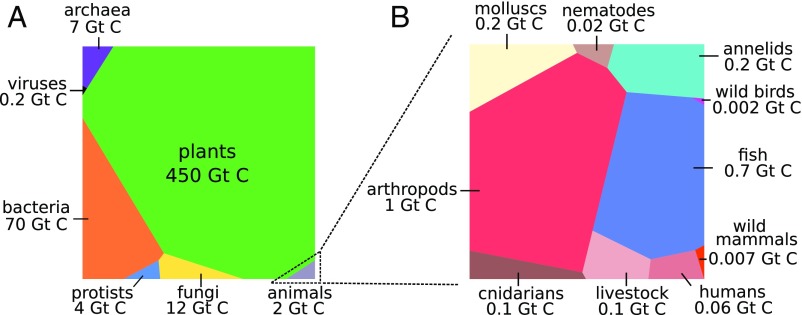
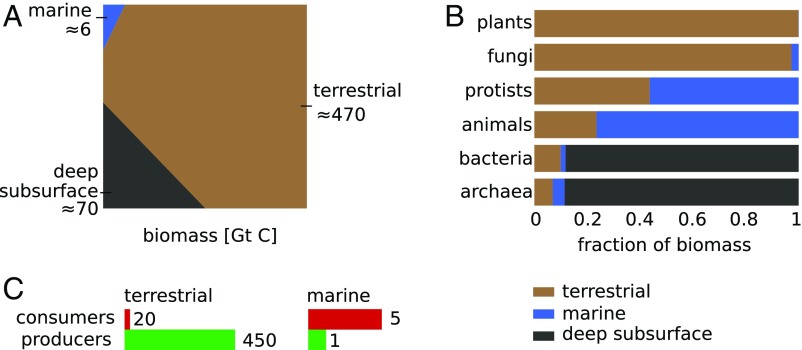
A census of the biomass on Earth is key for understanding the structure and dynamics of the biosphere. However, a global, quantitative view of how the biomass of different taxa compare with one another is still lacking. Here, we assemble the overall biomass composition of the biosphere, establishing a census of the ≈550 gigatons of carbon (Gt C) of biomass distributed among all of the kingdoms of life. We find that the kingdoms of life concentrate at different locations on the planet; plants (≈450 Gt C, the dominant kingdom) are primarily terrestrial, whereas animals (≈2 Gt C) are mainly marine, and bacteria (≈70 Gt C) and archaea (≈7 Gt C) are predominantly located in deep subsurface environments. We show that terrestrial biomass is about two orders of magnitude higher than marine biomass and estimate a total of ≈6 Gt C of marine biota, doubling the previous estimated quantity. Our analysis reveals that the global marine biomass pyramid contains more consumers than producers, thus increasing the scope of previous observations on inverse food pyramids. Finally, we highlight that the mass of humans is an order of magnitude higher than that of all wild mammals combined and report the historical impact of humanity on the global biomass of prominent taxa, including mammals, fish, and plants.
Overview
CoChat Summary
TL;DR
The paper assembles a global census of biomass across all kingdoms of life, estimating Earth’s total biomass at ≈550 Gt C, dominated by plants. It also compares biomass across environments and trophic modes, highlighting large uncertainties and human impacts on the biosphere.
Key findings
- Total global biomass is ≈550 Gt C, with plants ≈450 Gt C (≈80%), bacteria ≈70 Gt C (≈15%), fungi ≈12 Gt C, archaea ≈7 Gt C, protists ≈4 Gt C, animals ≈2 Gt C, and viruses ≈0.2 Gt C.
- Land biomass (≈470 Gt C) is about two orders of magnitude higher than marine biomass (≈6 Gt C); the deep subsurface holds ≈15% of total biomass, chiefly bacteria and archaea.
- In the ocean, ≈1 Gt C of primary producers supports ≈5 Gt C of consumer biomass, an inverted standing biomass distribution; marine biomass is ≈70% microbes, mainly bacteria and protists.
- Human-associated biomass is large relative to wild vertebrates: humans ≈0.06 Gt C, livestock ≈0.1 Gt C, wild mammals ≈0.007 Gt C, domesticated poultry ≈0.005 Gt C versus wild birds ≈0.002 Gt C; total plant biomass has declined approximately twofold relative to pre-human civilization.
Methods
- The authors synthesize hundreds of studies and generate estimates for major taxonomic groups, reporting biomass as gigatons of carbon (Gt C) and using a kingdom-level framework plus viruses.
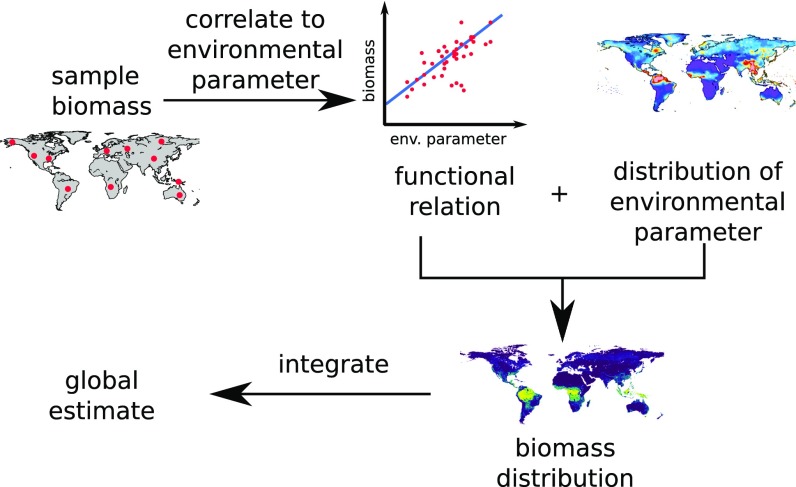
- For many taxa, local biomass samples are extrapolated globally by correlating biomass density with environmental parameters known at global scale; best estimates often use a geometric mean of independent estimates.
- Uncertainty is reported as multiplicative fold-change projections akin to 95% confidence intervals, incorporating intrastudy, interstudy, and intermethod variation; data and code are open-sourced.
Limitations
- The paper states that most datasets rely on fragmentary sampling, causing large uncertainties; sampling is scarce in the deep ocean (usually deeper than 200 m) and deep soil (usually deeper than 1 m), and some estimates may be biased by sampling toward high-abundance areas.
- The paper states that deep subsurface environments have particularly high uncertainty and unknown systematic biases, including unresolved distribution of biomass between aquifer fluids and rocks and among microbial taxa.
- The paper states that current and prehuman vertebrate biomass estimates are only a crude first step, amphibians remain poorly characterized, and parasite biomass is not resolved from hosts; evident from the text, kingdom-level grouping was chosen because much data lack finer taxonomic detail, and some uncertainty projections rely on analogous taxa or expert consultation.
Model-written summary. Check it against the paper before relying on it.
Integrity signals
Registry
Cites
Statistics
Figures
Verification
Claims the paper makes
9 Valid · 7 Not valid · 16 Not checked · 53 Own results and interpretations
Every source the paper cites for this claim was checked and supports it.
In the paper
“The biomass of amphibians, which are experiencing a dramatic population decline (42), remains poorly characterized.”
§ The biomass distribution on Earth > Discussion
What the sources say
- Supportedcites [42] Wake DB Vredenburg VT 2008 Colloquium paper: Are we in the midst of the sixth mass extinction? A view from the world of amphibians Proc Natl Acad Sci USA 105 11466 11473 18695221 PMC2556420 source
The citation is attached to the clause about amphibian population decline, not the separate statement that their biomass is poorly characterized. The passage reporting the Global Amphibian Assessment (labeled Abstract in our copy) says that 43% of amphibian species have declining populations. (LLM, conf=0.92)
plain- Asserted: passes — The authors put it forward as true.
- Checkable: passes — It can be checked against evidence.
- Load-bearing: unclear — It is unclear whether the paper’s conclusions depend on it.
- Based: passes — The paper gives a reason why it holds.
- Supported
Every source the paper cites for this claim was checked and supports it.
In the paper
“In the case of prokaryotes, some major improvements were recently realized, with global estimates of marine deep subsurface prokaryote biomass reduced by about two orders of magnitude due to an increased diversity of sampling locations (7).”
§ The biomass distribution on Earth > Discussion
What the sources say
- Supportedcites [7] Kallmeyer J Pockalny R Adhikari RR Smith DC D’Hondt S 2012 Global distribution of microbial abundance and biomass in subseafloor sediment Proc Natl Acad Sci USA 109 16213 16216 22927371 PMC3479597 source
The Discussion reports a revised subseafloor microbial biomass estimate of 4.1 Pg C versus a previous estimate of 303 Pg C—about a 74-fold reduction. It also identifies a more geographically diverse sampling database, including low-abundance ocean gyres, as a reason the new estimate is lower. The paper identifies other contributing factors as well. (LLM, conf=0.88)
plainstates a cause- Asserted: passes — The authors put it forward as true.
- Checkable: passes — It can be checked against evidence.
- Load-bearing: unclear — It is unclear whether the paper’s conclusions depend on it.
- Based: passes — The paper gives a reason why it holds.
- Supported
The sources with a verdict support this claim; the rest weren’t checked yet, have no full text we could read, or their verdicts aren’t rated yet.
In the paper
“Such inverted biomass distributions can occur when primary producers have a rapid turnover of biomass [on the order of days (34)], while consumer biomass turns over much more slowly [a few years in the case of mesopelagic fish (35)].”
§ The biomass distribution on Earth > Results > The Distribution of Biomass Across Environments and Trophic Modes.
What the sources say
- Supportedcites [34] Zubkov MV 2014 Faster growth of the major prokaryotic versus eukaryotic CO2 fixers in the oligotrophic ocean Nat Commun 5 3776 24777140 PMC4015317 source
The Results (Comparison of the growth rates of the CO2 fixers; page unavailable) report growth rates of 0.1–0.6 per day for the studied oceanic primary producers, consistent with biomass turnover on the order of days. The few-years estimate for mesopelagic fish is assigned to a different citation, not this source. (LLM, conf=0.91)
- Not checked — no full text of the sourcecites [35] Catul V Gauns M Karuppasamy PK 2011 A review on mesopelagic fishes belonging to family Myctophidae Rev Fish Biol Fish 21 339 354 source
plainstates a possible cause- Asserted: passes — The authors put it forward as true.
- Checkable: passes — It can be checked against evidence.
- Load-bearing: passes — The paper’s conclusions depend on it.
- Based: passes — The paper gives a reason why it holds.
- Supported
The cited sources support only part of this claim — read each source’s verdict below.
In the paper
“Combining data from independent sources such as these enables a robust assessment of the total plant biomass (17).”
§ The biomass distribution on Earth > Results > The Uncertainty Associated with Global Biomass Estimates.
What the sources say
- Partly supportedcites [17] Erb K-H 2017 Unexpectedly large impact of forest management and grazing on global vegetation biomass Nature 553 73 76 29258288 PMC5756473 sourceExperimental — accuracy not yet measured
The Methods describe combining multiple datasets and types of evidence to estimate global vegetation biomass stocks. But the paper also says global stocks remain uncertain, reports uncertainty ranges around 35% of the median estimate, and describes more robust estimates as a future prospect. It therefore supports the use of independent sources for an assessment, but not the unqualified characterization of that assessment as robust. (LLM, conf=0.84)
plainstates a cause- Asserted: passes — The authors put it forward as true.
- Checkable: passes — It can be checked against evidence.
- Load-bearing: passes — The paper’s conclusions depend on it.
- Based: passes — The paper gives a reason why it holds.
- Partly supported
A result the paper states — it cites no source for it, so there is none to check. The quote shows it is in the paper.
In the paper
“Plant biomass includes ≈70% stems and tree trunks, which are mostly woody, and thus relatively metabolically inert.”
§ The biomass distribution on Earth > Results > The Biomass Distribution of the Biosphere by Kingdom.
plain- Asserted: passes — The authors put it forward as true.
- Checkable: passes — It can be checked against evidence.
- Load-bearing: unclear — It is unclear whether the paper’s conclusions depend on it.
- Based: passes — The paper gives a reason why it holds.
27 more claims
Create a free account to see all 85 claims and to verify the 2 references still open.
- It may state two separate claims as one. 32
- Probably not a substantial claim. 28
Claims other papers make about this one
Each is checked against this paper’s own text: does it say what the citing paper says it does?
The cited source doesn’t support the claim as written.
In the citing paper
“and less than 10% that of the world ' s current human population ( 52 ).”
From Pervasive human-driven decline of life on Earth points to the need for transformative change (2019) · cites this paper as [52]
Checked by a reasoning model — may be wrong.
Experimental — accuracy not yet measuredThe cited source says what the claim attributes to it.
In the citing paper
“Approximately 450 Gt of C is bound up in terrestrial biota, primarily in plants (86), while only ~6 Gt of C is found in ocean biota (87).”
From Earth beyond six of nine planetary boundaries (2023) · cites this paper as [87]
The cited source says what the claim attributes to it.
In the citing paper
“The amount of metabolic energy available to a biosphere powered by O 2 is vast, such that the O 2 -rich ocean-atmosphere system of the modern Earth supports staggering levels of standing biomass (Bar-On et al. 2018), energy flow (Falkowski et al. 2008), and ecological complexity (Steele 1974).”
From The History of Ocean Oxygenation (2022) · cites this paper as Bar-On et al. 2018
In the citing paper
“Global populations of domestic ruminants (cattle, sheep, and goats) (Ripple et al. 2013) poultry, and pigs (Bennett et al. 2018) used to feed the growing human population now exceed 100 million tons of carbon (Bar-On et al. 2018), and livestock populations are growing rapidly.”
From Scientists’ warning to humanity on the freshwater biodiversity crisis (2021) · cites this paper as Bar-On et al. 2018
Citations
Cites
The worldwide leaf economics spectrum
Wright, I. J., Reich, P. B., Westoby, M., Ackerly, D. D., Baruch, Z., Bongers, F., Cavender-Bares, J., Chapin, T., Cornelissen, J. H. C., Diemer, M., et al. (2004) · Nature · doi:10.1038/nature02403 · Cited by 9,021 · cited 1×
“We then convert the total area of leaves to an estimate of the total dry mass of leaves by using the Glopnet database (24), which measured leaf mass per area (LMA) for ≈2500 plant species.”
MethodA large and persistent carbon sink in the world’s forests
Pan, Y., Birdsey, R. A., Fang, J., Houghton, R., Kauppi, P. E., Kurz, W. A., Phillips, O. L., Shvidenko, A., Lewis, S. L., Canadell, J. G., et al. (2011) · Science · doi:10.1126/science.1201609 · Cited by 8,458
Soil Sampling and Methods of Analysis
(2007) · CRC Press eBooks · doi:10.1201/9781420005271 · Cited by 6,469
Primary production of the biosphere: Integrating terrestrial and oceanic components
Field, C. B., Behrenfeld, M. J., Randerson, J. T., & Falkowski, P. (1998) · Science · doi:10.1126/science.281.5374.237 · Cited by 6,371
Prokaryotes: The unseen majority
Whitman, W. B., Coleman, D. C., & Wiebe, W. J. (1998) · Proceedings of the National Academy of Sciences · doi:10.1073/pnas.95.12.6578 · Cited by 4,871
Global effects of land use on local terrestrial biodiversity
Newbold, T., Hudson, L. N., Hill, S. L. L., Contu, S., Lysenko, I., Senior, R. A., Börger, L., Bennett, D. J., Choimes, A., Collen, B., et al. (2015) · Nature · doi:10.1038/nature14324 · Cited by 4,352
Belowground biodiversity and ecosystem functioning
Bardgett, R. D., & van der Putten, W. H. (2014) · Nature · doi:10.1038/nature13855 · Cited by 3,990 · cited 4×
“This was recommended by experts in the field for estimation of arbuscular mycorrhizal fungi abundance (117).”
BackgroundInfluentialMangroves among the most carbon-rich forests in the tropics
Donato, D. C., Kauffman, J. B., Murdiyarso, D., Kurnianto, S., Stidham, M., & Kanninen, M. (2011) · Nature Geoscience · doi:10.1038/ngeo1123 · Cited by 3,374
Poorter, H., Niklas, K. J., Reich, P. B., Oleksyn, J., Poot, P., & Mommer, L. (2012) · New Phytologist · doi:10.1111/j.1469-8137.2011.03952.x · Cited by 3,163 · cited 1×
“The first relies on a meta-analysis of the biomass allocation to different plant compartments across biomes (19).”
BackgroundA global analysis of root distributions for terrestrial biomes
Jackson, R. B., Canadell, J., Ehleringer, J. R., Mooney, H. A., Sala, O. E., & Schulze, E. D. (1996) · Oecologia · doi:10.1007/bf00333714 · Cited by 3,071 · cited 4×
“assumed the distribution of microbial biomass with depth follows the biomass density versus depth profile of root biomass (21).”
BackgroundMethodInfluential
Research works printed but not linked: 1
- Chapman AD 2009 Numbers of Living Species in Australia and the World Australian Biological Resources Study Canberra, Australia
Cited by
Items 2,701–2,800 of 3,743
Global Environment in the Anthropocene
Dodds, W. K. (2019) · Springer eBooks · doi:10.1007/978-3-030-30410-2_7
Being “Rich towards God” in the Capitalocene: An Ecological/Economic Reading of Luke 12.13-34
Shepherd, A. (2019) · The Bible Translator · doi:10.1177/2051677019882979 · Cited by 2
Sumner, S. (2020) · Frontiers for Young Minds · doi:10.3389/frym.2019.00149
“In fact, 75% of all described organisms are insects [1].”
BackgroundMANAGING THE DEVIATIONS OF THE RESULTS OF THE ECONOMY HAS MADE AS A VARIETY OF ECONOMIC SCIENCES
Yevchuk, K.-I. (2019) · PROBLEMS OF SYSTEMIC APPROACH IN THE ECONOMY · doi:10.32782/2520-2200/2019-6-51
Sea Level Rise, 1970-2070: A View from the Future
Kopp, R. E. (2020) · Open Book Publishers · doi:10.11647/obp.0193.16
May, E. (2020) · Open Book Publishers · doi:10.11647/obp.0193.05
Tortell, P. D., Chafe, C., & Niemeyer, G. O. (2020) · doi:10.11647/obp.0193.29
Craig-Sparrow, Z., & Nosek, G. (2020) · Open Book Publishers · doi:10.11647/obp.0193.28
Puttick, M. N., Morris, J. L., Williams, T. A., Edwards, D., Kenrick, P., Pressel, S., Wellman, C. H., Schneider, H., Pisani, D., & Donoghue, P. C. J. (2020) · Wiley eBooks · doi:10.1002/9780470015902.a0003361.pub2 · Cited by 2
Empowering Living Matter and the Fever Effect of Global Warming
Berkovich, S. (2020) · Journal of Neurology and Neurobiology · doi:10.16966/2379-7150.157
Lampert, E. C. (2020) · The American Biology Teacher · doi:10.1525/abt.2020.82.4.241
“The biomass distribution of Earth.”
Background“Desperation for Life”: Writing Death in the Anthropocene
White, J., & Whitlock, G. (2020) · a/b Auto/Biography Studies · doi:10.1080/08989575.2020.1722377
Delmas, E., Stouffer, D. B., & Poisot, T. (2020) · bioRxiv (Cold Spring Harbor Laboratory) · doi:10.1101/2020.06.10.144949
“When we look at natural ecosystems, we realize that in the same way, they are dominated in most cases by the biomass of heterotrophs (Bar-On et al. 2018).”
BackgroundMathis, C. (2020) · Oxford University Press eBooks · doi:10.1093/oso/9780190915650.003.0006
Segura, A., Ramírez, S. I., & Lozada-Chávez, I. (2020) · Cuatro ciénegas basin: an endangered hyperdiverse oasis · doi:10.1007/978-3-030-46087-7_1
Reduce, Reuse, Recycle in the Arctic Ocean With the Power of Microbes
Zäncker, B., Stern, R., Price, E. L., et al. (2020) · Frontiers for Young Minds · doi:10.3389/frym.2020.00090
“In fact, marine microbes make up 70% of the total living mass of all oceans [1]!”
BackgroundChen, J. P. L. (2020) · Otago University Research Archive (University of Otago) · Cited by 1
Reflexões sobre o Antropoceno, o paradigma da espécie humana e seu domínio ilusório sobre a Terra
Nascimento, A. (2020) · Anthropocenica Revista de Estudos do Antropoceno e Ecocrítica · doi:10.21814/anthropocenica.3093 · Cited by 3
Empirical evidence for a global atmospheric temperature control system: physical structurePreprint
Leggett, M., & Ball, D. A. (2020) · arXiv (Cornell University) · doi:10.48550/arxiv.2011.06708
Una competencia de pesos pesados por el dominio del mundo
Tortarolo, G. N. M., & Murguía‐Flores, F. (2020) · Revista Digital Universitaria · doi:10.22201/cuaieed.16076079e.2020.21.6.15
Feature selection and intelligent livestock management
Alsahaf, A. M. J. (2020) · University of Groningen research database (University of Groningen / Centre for Information Technology) · doi:10.33612/diss.145238079
GM Animals: Biodiversity and Bioethical Concerns and Analysis
Caballero-Hernández, D. E., Arreola-Triana, A. E., & Rodríguez-Padilla, C. (2020) · Topics in biodiversity and conservation · doi:10.1007/978-3-030-53183-6_13
Dennis, M. (2020) · Invertebrate Biology · doi:10.1111/ivb.12310
Sosiologinen tutkimus suomalaisten suhtautumisesta tuotantoeläimiin ja eläinten käyttöön ruokana
Kupsala, S. (2020) · TRACE ∴ Journal for Human-Animal Studies · doi:10.23984/fjhas.89229
Advances in Omics and Bioinformatics Tools for Phyllosphere Studies
Bansal, H. (2021) · Wiley eBooks · doi:10.1002/9781119644798.ch13 · Cited by 1
The Anthropocene by the Numbers: A Quantitative Snapshot of Humanity's Influence on the PlanetPreprint
Chure, G., Banks, R. A., Flamholz, A. I., Sarai, N. S., Kamb, M., Lopez‐Gomez, I., Bar‐On, Y. M., Milo, R., & Phillips, R. (2021) · CaltechAUTHORS (California Institute of Technology) · doi:10.48550/arxiv.2101.09620 · Cited by 7
Self-citationHobohm, C., & Vanderplank, S. E. (2021) · Environmental challenges and solutions · doi:10.1007/978-3-030-57710-0_4 · Cited by 2
Climate Change: A Forced Choice Ethical Paradigm
Menkes, D. L. (2021) · IntechOpen eBooks · doi:10.5772/intechopen.95486 · Cited by 1
Greguš, J. (2020) · Journal of Gynecology and Womens Health · doi:10.19080/jgwh.2020.19.556040
Multi-omics approaches for biosynthetic pathway prediction in plants
Duran, H. G. S. (2021) · doi:10.18174/538330 · Cited by 2
Greguš, J. (2021) · The European Journal of Contraception & Reproductive Health Care · doi:10.1080/13625187.2020.1870952
Smil, V. (2021) · Oxford University Press eBooks · doi:10.1093/oso/9780190060664.003.0003
Smil, V. (2021) · Oxford University Press eBooks · doi:10.1093/oso/9780190060664.003.0007
A sala de emergência ambiental: a proteção dos direitos da natureza na América Latina
Rocha, L. R. L. (2021) · Revista Brasileira de Políticas Públicas · doi:10.5102/rbpp.v10i3.7107
Trajnostni razvoj in trajnostno kmetijstvo
Borec, A. (2021) · doi:10.18690/978-961-286-433-0.2
Taking Care of Essential Well-being in the “Century of the Environment”
Laurent, É. (2021) · Springer eBooks · doi:10.1007/978-3-030-67860-9_15
García, F. C., Clegg, T., O’Neill, D. B., Warfield, R., Pawar, S. S., & Yvon‐Durocher, G. (2021) · bioRxiv (Cold Spring Harbor Laboratory) · doi:10.1101/2021.04.15.439947
“perature-dependent changes in average population growth rate 8 ), 2%(*) = )!-!(9) ∑!"# $ )!-!(9) is the 112”
BackgroundLessons learned and best practice from the case studies
Wyatt, T. (2021) · Routledge eBooks · doi:10.4324/9781003007838-6
Lithotrophic (“Stone-Eating”) Microbes Provide the Foundation for Deep Subsurface Ecosystems
Kieft, T. L. (2021) · Advances in environmental microbiology · doi:10.1007/978-3-030-63512-1_7 · Cited by 3
Vio, S. A. (2023) · El Servicio de Difusión de la Creación Intelectual (National University of La Plata) · doi:10.35537/10915/150979 · Cited by 1
Research Progress on the Effects of Nitrogen Deposition on Soil Nematodes
逄, 佳. (2021) · Sustainable Development · doi:10.12677/sd.2021.113032
Mutational mechanisms and evolvability
Stoltzfus, A. (2021) · Oxford University Press eBooks · doi:10.1093/oso/9780198844457.003.0005 · Cited by 1
Stoltzfus, A. (2021) · Oxford University Press eBooks · doi:10.1093/oso/9780198844457.003.0009
Stoltzfus, A. (2021) · Oxford University Press eBooks · doi:10.1093/oso/9780198844457.003.0006
Plant Experience Questionnaire (Rioux & Wertz 2021)Preprint
Rioux, C., & Wertz, A. E. (2021) · PsyArXiv (OSF Preprints) · doi:10.31234/osf.io/k8dhu
Introduction: a curious disconnect
Stoltzfus, A. (2021) · Oxford University Press eBooks · doi:10.1093/oso/9780198844457.003.0001
Stoltzfus, A. (2021) · Oxford University Press eBooks · doi:10.1093/oso/9780198844457.003.0007
Shapovalov, A. B. (2021) · Earth and environmental sciences library · doi:10.1007/978-3-030-73110-6_2
Discovering circadian clocks in microbes
Bosman, J. (2021) · University of Groningen research database (University of Groningen / Centre for Information Technology) · doi:10.33612/diss.170828314
Epochs of Ecology: The Transition from Feudalism to Capitalism
Tucker, J. A. (2020) · Digital Commons - DU (University of Denver)
Bacterial Predation on T4 PhagesPreprint
Godon, J., Bize, A., Ngo, V. Q. H., Cauquil, L., Almeida, M., Petit, M., & Zemb, O. (2021) · bioRxiv (Cold Spring Harbor Laboratory) · doi:10.21203/rs.3.rs-580088/v1
“2 gigatons of carbon on Earth(Bar-On et al., 2018).”
BackgroundInfluentialChristensen, A., Piggott, M. D., van Sebille, E., et al. (2021) · Research Square · doi:10.21203/rs.3.rs-152503/v2
“Life on Earth is predominantly microbial [1], with microbes responsible for the majority 2 of the metabolic activity that maintains the basic habitability of the planet [2, 3].”
BackgroundCombating the climate crisis with cognitive science
Dubey, R., & Peterson, J. C. (2021) · eScholarship (California Digital Library)
Garcia, E. J., Vale, B., & Vale, R. (2021) · Springer eBooks · doi:10.1007/978-3-030-77783-8_1
Myers, K. (2021) · Digital Archive @ GSU · doi:10.57709/23984774 · Cited by 1
From Precariousness to Prudence: Eco-Cosmopolitanism as the Fabric for Weaving the Post-COVID World
Samanta, N. (2021) · Kathmandu School of Law Review · doi:10.46985/kslr.v8i1.2127
Evolution beyond nature's lawsPreprint
Xu, K. (2021) · arXiv (Cornell University)
Small-scale convective turbulence constrains microbial patchinessPreprint
Christensen, A., Piggott, M. D., van Sebille, E., et al. (2021) · Research Square · doi:10.21203/rs.3.rs-152503/v1
“This implies (1) that a 294 highly accurate code for direct numerical simulation needs to be employed; and (2) that 295 the problem should be scaled down to a lab-scale, since it is impossible to resolve all the 296 turbulence at real-world oceanic or lacustrine scales.”
BackgroundLa crisis ecológica desde una perspectiva socio-metabólica poscapitalista
Seminario, B. R. P. (2019) · Sílex · doi:10.53870/silex.20199252
Jong, F. P. C. M. D. (2021) · Aeres Hogeschool eBooks · doi:10.46884/2021.2
Élevage, biodiversité et émergences de pandémies
Morand, S. (2021) · Bulletin de l Académie vétérinaire de France · doi:10.3406/bavf.2021.70951 · Cited by 4
The resilience of tropical forest invertebrates to microclimate change
Boyle, M. J. W. (2019) · National University of Singapore · doi:10.25560/83404 · Cited by 1
Natural Selection Reconsidered
Shiels, R. (2021) · Apollo (University of Cambridge) · doi:10.17863/cam.76473
Toorians, M. E. M., MacPherson, A., & Davies, T. J. (2021) · Preprints.org · doi:10.20944/preprints202110.0295.v1 · Cited by 2
“Worldwide, many natural populations are declining rapidly due to anthropogenic influences (IPBES, 2020), resulting 22 in a shift in the abundance of humans and livestock relative to wildlife species (Bar-On et al., 2018).”
BackgroundEarly evolution of beetles regulated by the end-Permian deforestationPreprint
Zhao, X., Yu, Y., Clapham, M. E., Yan, E. V., Chen, J., Jarzembowski, E. A., Zhao, X., & Wáng, B. (2021) · bioRxiv (Cold Spring Harbor Laboratory) · doi:10.1101/2021.10.12.464043
“The majority of terrestrial plant biomass is stored in forest woody tissue consisting of decay-resistant lignin (Hibbett et al., 2016; Bar-on et al., 2018).”
Haines, A., & Frumkin, H. (2021) · Cambridge University Press eBooks · doi:10.1017/9781108698054.001
The Volumetric Properties of the Transition State Ensemble for Protein FoldingPreprint
Avagyan, S., & Makhatadze, G. I. (2021) · doi:10.33774/chemrxiv-2021-svw4f
Super-Small Predators in Soils: Who Are They and What Do They Do?
Geisen, S. (2021) · Frontiers for Young Minds · doi:10.3389/frym.2021.597620
“Not only do soils have more biodiversity than any other ecosystem on Earth, but the weight of all soil organisms (including plants whose roots make them about half soil organisms) is far greater than the weight of all other organisms combined [1].”
BackgroundGarcía, M. B., la Cruz, O. A.-D., & Marco, M. (1999) · Dialnet (Universidad de la Rioja)
Introductory Chapter: Managing Wildlife in a Changing World - Trends, Drivers and the Way Forward
Kideghesho, J. R. (2021) · IntechOpen eBooks · doi:10.5772/intechopen.98851
World Scientists' Warnings Into Action, Local to GlobalPreprint
Barnard, P., Moomaw, W. R., Fioramonti, L., Laurance, W. F., Mahmoud, M. I., O’Sullivan, J., Rapley, C. G., Rees, W., Ripple, W. J., Rhodes, C. J., et al. (2021) · OSF Preprints (OSF Preprints) · doi:10.31219/osf.io/s93ve
El Antropoceno como proceso, no como estado
Lanata, J. L., Tanos, N., & Monjeau, A. J. (2021) · Relaciones · doi:10.24215/18521479e024 · Cited by 1
“En un estudio reciente, Bar-On et al. (2018) señalan que, actualmente, la masa de todos los humanos combinada es más alta que la de todos los mamíferos terrestres juntos, y que esto tiene un impacto sin precedentes sobre la biomasa global no sólo de los mamíferos, sino también de peces, plantas y…”
Background(2021) · Methods in molecular biology · doi:10.1007/978-1-0716-1653-6
Stoltzfus, A. (2021) · Oxford University Press eBooks · doi:10.1093/oso/9780198844457.003.0010
Introduction to the Research Handbook of Innovation for a Circular Economy
Jakobsen, S., Lauvås, T., Quatraro, F., Rasmussen, E., & Steinmo, M. T. (2021) · Edward Elgar Publishing eBooks · doi:10.4337/9781800373099.00007 · Cited by 3
Stoltzfus, A. (2021) · Oxford University Press eBooks · doi:10.1093/oso/9780198844457.003.0004
Smirnov, B. M. (2021) · Springer atmospheric sciences · doi:10.1007/978-3-030-90008-3_5
Stoltzfus, A. (2021) · Oxford University Press eBooks · doi:10.1093/oso/9780198844457.003.0003
The 24-chain core-shell nanostructure of wood cellulose microfibrils in seed plantsPreprint
Chang, C., Cai, W., Lin, J.-H., Huang, S., Lin, Y. J., Tsao, C.-S., & Tai, H. (2022) · bioRxiv (Cold Spring Harbor Laboratory) · doi:10.1101/2021.12.31.474620
Design for New Materials and New Manufacturing Technologies
Oliveira, P., Rognoli, V., & Holzbach, M. (2022) · Springer series in design and innovation · doi:10.1007/978-3-030-86596-2_5
Visualising Anthropocene Extinctions: Mapping affect in the works of Naeemah Naeemaei
Williams, L. (2021) · Animal studies journal · doi:10.14453/asj.v10i2.4
Stoltzfus, A. (2021) · Oxford University Press eBooks · doi:10.1093/oso/9780198844457.003.0002
Exploring the role of soil microbiome in global climatic changes
Muhilan, B. M., & Chattopadhyay, I. (2022) · Elsevier eBooks · doi:10.1016/b978-0-323-90571-8.00016-x · Cited by 2
Richter, E. (2019) · SN Applied Sciences · doi:10.1007/s42452-019-0811-y
“Most biomass on earth consists of symbiotic systems of pro- and eukaryotes [43].”
BackgroundCombating Pasture Degradation in Central Asia and the Caucasus — A Review of Approaches
Neudert, R. (2016) · MDPI eBooks · doi:10.3390/books978-3-03897-879-4-10 · Cited by 1
(2020) · Presses Universitaires de France eBooks · doi:10.3917/puf.calam.2020.01.0337
La représentation des extraterrestres
Lehoucq, R. (2022) · Arts et sciences · doi:10.21494/iste.op.2022.0793
Collard, R.-C. (2020) · Duke University Press eBooks · doi:10.1215/9781478012467-005
Crafting the Unencounterable Animal
Collard, R.-C. (2020) · Duke University Press eBooks · doi:10.1215/9781478012467-004
Schlesinger, W. H., & Bernhardt, E. S. (2020) · Elsevier eBooks · doi:10.1016/b978-0-12-814608-8.00002-5
Schaer, É., & André, J. (2020) · Wiley eBooks · doi:10.1002/9781119751229.refs
Noah’s Ark on the Auction Block
Collard, R.-C. (2020) · Duke University Press eBooks · doi:10.1215/9781478012467-003
(2020) · Elsevier eBooks · doi:10.1016/b978-0-12-814608-8.09992-8
Collard, R.-C. (2020) · Duke University Press eBooks · doi:10.1215/9781478012467-002
Collard, R.-C. (2020) · Duke University Press eBooks · doi:10.1215/9781478012467-001
Collard, R.-C. (2020) · Duke University Press eBooks · doi:10.1215/9781478012467-007
Metadata
- Authors
- Bar-On, Y. M., Phillips, R., & Milo, R.
- Affiliations
- Department of Plant and Environmental Sciences, Weizmann Institute of Science, 76100 Rehovot, Israel;
- California Institute of Technology (US)
- Weizmann Institute of Science (IL)
- Corresponding author
- Milo, Ron
- Venue
- Proceedings of the National Academy of Sciences
- Publisher
- National Academy of Sciences
- Published
- 2018-05-21
- Volume
- 115
- Issue
- 25
- Pages
- 6506-6511
- ISSN
- 0027-8424 (ISSN-L)
- 1091-6490
- PMC
- PMC6016768
- OpenAlex
- W2804910112
- Cited by
- 3,723
- References
- 263
- Citations by year
- 2026: 349 · 2025: 450 · 2024: 589 · 2023: 617 · 2022: 498 · 2021: 498 · 2020: 419 · 2019: 246 · 2018: 49
- FWCI
- 239.98
- Type
- journal article
- Language
- en
- Open access
- hybrid
- doi.org
- Licence
- Locations
- Proceedings of the National Academy of Sciences (publishedVersion, cc-by-nc-nd)
- Europe PMC (PubMed Central) (publishedVersion, cc-by-nc-nd)
- PubMed Central (publishedVersion, cc-by-nc-nd)
- PubMed (publishedVersion)
- CaltechAUTHORS (California Institute of Technology) (submittedVersion, cc-by-nc-nd)
- Funders
- National Institutes of Health (5r35gm118043-07)
- National Institute of General Medical Sciences (R35 GM118043)
- Topics
- Physical Sciences › Environmental Science › Nature and Landscape Conservation › Ecology and Vegetation Dynamics Studies
- Physical Sciences › Environmental Science › Global and Planetary Change › Earth Systems and Cosmic Evolution
- Life Sciences › Agricultural and Biological Sciences › Soil Science › Soil Carbon and Nitrogen Dynamics
- Keywords
- biomass allocation, biomass carbon, terrestrial biomass, marine biomass, bacteria, archaea, food pyramid, wild mammals, fish biomass, plant biomass
- MeSH terms
- Animals, Archaea, Bacteria, Carbon, Humans, Plants, Ecosystem, Biomass, Earth, Planet, Biota
About these checks
Registry, retraction, Cites and statistics results are computed, not judged, with one exception: a printed reference that no index lists is read once by a model before it counts as a citation error. Claims are extracted by a model and kept only when their quote appears verbatim in the text; each cited source is then checked, with a model’s help, for whether it says what the claim relies on. Those verdicts can be wrong — read the claim’s quote and the cited source before relying on one.
The claim verdicts this report counts are experimental: their accuracy is not yet measured.
A language model drew the claims from the paper on 2026-10-10, under version 3 of the claim definition (model deepseek-v4.1-flash, prompt extract-v3).
A second model labelled each claim on 2026-10-10 (model jev-1.13-20260917, definition revision gold-guideline-v0.2).
Cited sources are checked with a language model’s help (gpt-6-sol).
Statistics and arithmetic are recomputed, not judged.
Confidence bands are shown only for fields calibrated on our annotated test set. None is calibrated yet, so no band is shown.
What counts as a claim ›How we measure confidence ›How we check this ›
Are you an author, or do you see a problem with this page? Request a review
Data sources
Bibliographic data: Semantic Scholar, OpenAlex, Crossref.
Contains information from the Semantic Scholar Academic Graph Datasets, made available under the ODC Attribution License (ODC-BY 1.0).
Semantic Scholar’s data is described in: Kinney, R., et al. (2023). The Semantic Scholar Open Data Platform. arXiv:2301.10140.
