

The biomass distribution on Earth
Open accessThe DOI matches its Crossref record; 263 of the 263 references it cites were found in a registry or an index; 11 of the 41 sources its claims cite were checked for support.
Abstract
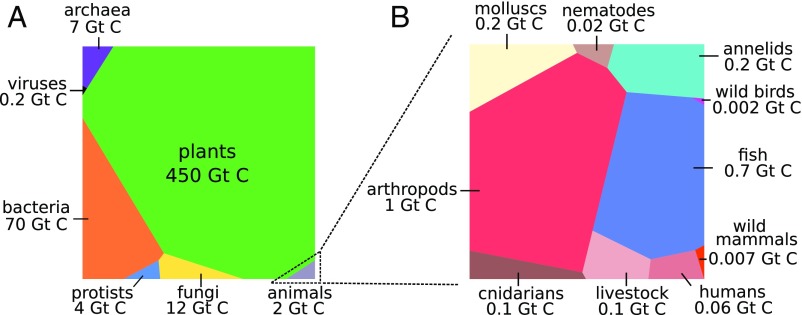
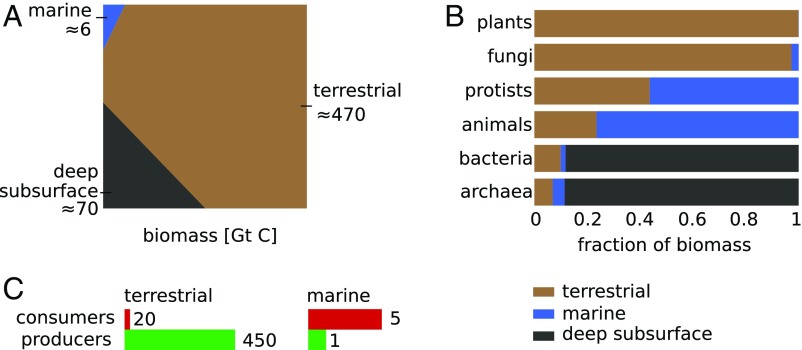
A census of the biomass on Earth is key for understanding the structure and dynamics of the biosphere. However, a global, quantitative view of how the biomass of different taxa compare with one another is still lacking. Here, we assemble the overall biomass composition of the biosphere, establishing a census of the ≈550 gigatons of carbon (Gt C) of biomass distributed among all of the kingdoms of life. We find that the kingdoms of life concentrate at different locations on the planet; plants (≈450 Gt C, the dominant kingdom) are primarily terrestrial, whereas animals (≈2 Gt C) are mainly marine, and bacteria (≈70 Gt C) and archaea (≈7 Gt C) are predominantly located in deep subsurface environments. We show that terrestrial biomass is about two orders of magnitude higher than marine biomass and estimate a total of ≈6 Gt C of marine biota, doubling the previous estimated quantity. Our analysis reveals that the global marine biomass pyramid contains more consumers than producers, thus increasing the scope of previous observations on inverse food pyramids. Finally, we highlight that the mass of humans is an order of magnitude higher than that of all wild mammals combined and report the historical impact of humanity on the global biomass of prominent taxa, including mammals, fish, and plants.
Overview
CoChat Summary
TL;DR
The paper assembles a global census of biomass across all kingdoms of life, estimating Earth’s total biomass at ≈550 Gt C, dominated by plants. It also compares biomass across environments and trophic modes, highlighting large uncertainties and human impacts on the biosphere.
Key findings
- Total global biomass is ≈550 Gt C, with plants ≈450 Gt C (≈80%), bacteria ≈70 Gt C (≈15%), fungi ≈12 Gt C, archaea ≈7 Gt C, protists ≈4 Gt C, animals ≈2 Gt C, and viruses ≈0.2 Gt C.
- Land biomass (≈470 Gt C) is about two orders of magnitude higher than marine biomass (≈6 Gt C); the deep subsurface holds ≈15% of total biomass, chiefly bacteria and archaea.
- In the ocean, ≈1 Gt C of primary producers supports ≈5 Gt C of consumer biomass, an inverted standing biomass distribution; marine biomass is ≈70% microbes, mainly bacteria and protists.
- Human-associated biomass is large relative to wild vertebrates: humans ≈0.06 Gt C, livestock ≈0.1 Gt C, wild mammals ≈0.007 Gt C, domesticated poultry ≈0.005 Gt C versus wild birds ≈0.002 Gt C; total plant biomass has declined approximately twofold relative to pre-human civilization.
Methods
- The authors synthesize hundreds of studies and generate estimates for major taxonomic groups, reporting biomass as gigatons of carbon (Gt C) and using a kingdom-level framework plus viruses.
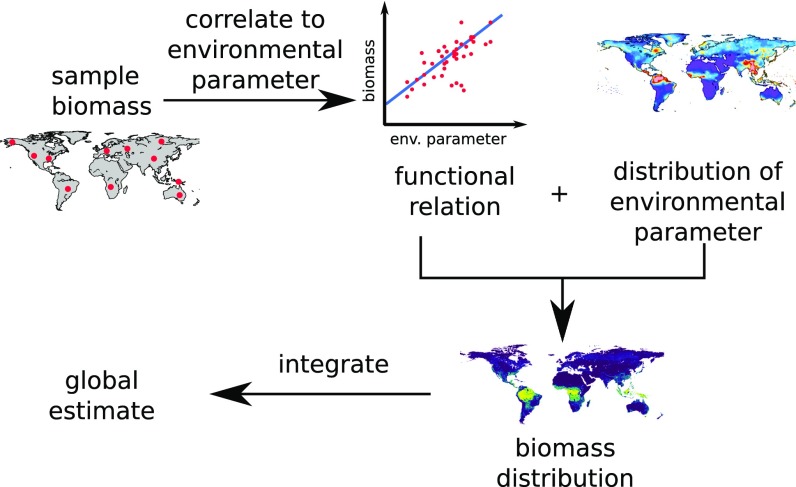
- For many taxa, local biomass samples are extrapolated globally by correlating biomass density with environmental parameters known at global scale; best estimates often use a geometric mean of independent estimates.
- Uncertainty is reported as multiplicative fold-change projections akin to 95% confidence intervals, incorporating intrastudy, interstudy, and intermethod variation; data and code are open-sourced.
Limitations
- The paper states that most datasets rely on fragmentary sampling, causing large uncertainties; sampling is scarce in the deep ocean (usually deeper than 200 m) and deep soil (usually deeper than 1 m), and some estimates may be biased by sampling toward high-abundance areas.
- The paper states that deep subsurface environments have particularly high uncertainty and unknown systematic biases, including unresolved distribution of biomass between aquifer fluids and rocks and among microbial taxa.
- The paper states that current and prehuman vertebrate biomass estimates are only a crude first step, amphibians remain poorly characterized, and parasite biomass is not resolved from hosts; evident from the text, kingdom-level grouping was chosen because much data lack finer taxonomic detail, and some uncertainty projections rely on analogous taxa or expert consultation.
Model-written summary. Check it against the paper before relying on it.
Integrity signals
Registry
Cites
Statistics
Figures
Verification
Claims the paper makes
9 Valid · 7 Not valid · 16 Not checked · 53 Own results and interpretations
Every source the paper cites for this claim was checked and supports it.
In the paper
“The biomass of amphibians, which are experiencing a dramatic population decline (42), remains poorly characterized.”
§ The biomass distribution on Earth > Discussion
What the sources say
- Supportedcites [42] Wake DB Vredenburg VT 2008 Colloquium paper: Are we in the midst of the sixth mass extinction? A view from the world of amphibians Proc Natl Acad Sci USA 105 11466 11473 18695221 PMC2556420 source
The citation is attached to the clause about amphibian population decline, not the separate statement that their biomass is poorly characterized. The passage reporting the Global Amphibian Assessment (labeled Abstract in our copy) says that 43% of amphibian species have declining populations. (LLM, conf=0.92)
plain- Asserted: passes — The authors put it forward as true.
- Checkable: passes — It can be checked against evidence.
- Load-bearing: unclear — It is unclear whether the paper’s conclusions depend on it.
- Based: passes — The paper gives a reason why it holds.
- Supported
Every source the paper cites for this claim was checked and supports it.
In the paper
“In the case of prokaryotes, some major improvements were recently realized, with global estimates of marine deep subsurface prokaryote biomass reduced by about two orders of magnitude due to an increased diversity of sampling locations (7).”
§ The biomass distribution on Earth > Discussion
What the sources say
- Supportedcites [7] Kallmeyer J Pockalny R Adhikari RR Smith DC D’Hondt S 2012 Global distribution of microbial abundance and biomass in subseafloor sediment Proc Natl Acad Sci USA 109 16213 16216 22927371 PMC3479597 source
The Discussion reports a revised subseafloor microbial biomass estimate of 4.1 Pg C versus a previous estimate of 303 Pg C—about a 74-fold reduction. It also identifies a more geographically diverse sampling database, including low-abundance ocean gyres, as a reason the new estimate is lower. The paper identifies other contributing factors as well. (LLM, conf=0.88)
plainstates a cause- Asserted: passes — The authors put it forward as true.
- Checkable: passes — It can be checked against evidence.
- Load-bearing: unclear — It is unclear whether the paper’s conclusions depend on it.
- Based: passes — The paper gives a reason why it holds.
- Supported
The sources with a verdict support this claim; the rest weren’t checked yet, have no full text we could read, or their verdicts aren’t rated yet.
In the paper
“Such inverted biomass distributions can occur when primary producers have a rapid turnover of biomass [on the order of days (34)], while consumer biomass turns over much more slowly [a few years in the case of mesopelagic fish (35)].”
§ The biomass distribution on Earth > Results > The Distribution of Biomass Across Environments and Trophic Modes.
What the sources say
- Supportedcites [34] Zubkov MV 2014 Faster growth of the major prokaryotic versus eukaryotic CO2 fixers in the oligotrophic ocean Nat Commun 5 3776 24777140 PMC4015317 source
The Results (Comparison of the growth rates of the CO2 fixers; page unavailable) report growth rates of 0.1–0.6 per day for the studied oceanic primary producers, consistent with biomass turnover on the order of days. The few-years estimate for mesopelagic fish is assigned to a different citation, not this source. (LLM, conf=0.91)
- Not checked — no full text of the sourcecites [35] Catul V Gauns M Karuppasamy PK 2011 A review on mesopelagic fishes belonging to family Myctophidae Rev Fish Biol Fish 21 339 354 source
plainstates a possible cause- Asserted: passes — The authors put it forward as true.
- Checkable: passes — It can be checked against evidence.
- Load-bearing: passes — The paper’s conclusions depend on it.
- Based: passes — The paper gives a reason why it holds.
- Supported
The cited sources support only part of this claim — read each source’s verdict below.
In the paper
“Combining data from independent sources such as these enables a robust assessment of the total plant biomass (17).”
§ The biomass distribution on Earth > Results > The Uncertainty Associated with Global Biomass Estimates.
What the sources say
- Partly supportedcites [17] Erb K-H 2017 Unexpectedly large impact of forest management and grazing on global vegetation biomass Nature 553 73 76 29258288 PMC5756473 sourceExperimental — accuracy not yet measured
The Methods describe combining multiple datasets and types of evidence to estimate global vegetation biomass stocks. But the paper also says global stocks remain uncertain, reports uncertainty ranges around 35% of the median estimate, and describes more robust estimates as a future prospect. It therefore supports the use of independent sources for an assessment, but not the unqualified characterization of that assessment as robust. (LLM, conf=0.84)
plainstates a cause- Asserted: passes — The authors put it forward as true.
- Checkable: passes — It can be checked against evidence.
- Load-bearing: passes — The paper’s conclusions depend on it.
- Based: passes — The paper gives a reason why it holds.
- Partly supported
A result the paper states — it cites no source for it, so there is none to check. The quote shows it is in the paper.
In the paper
“Plant biomass includes ≈70% stems and tree trunks, which are mostly woody, and thus relatively metabolically inert.”
§ The biomass distribution on Earth > Results > The Biomass Distribution of the Biosphere by Kingdom.
plain- Asserted: passes — The authors put it forward as true.
- Checkable: passes — It can be checked against evidence.
- Load-bearing: unclear — It is unclear whether the paper’s conclusions depend on it.
- Based: passes — The paper gives a reason why it holds.
27 more claims
Create a free account to see all 85 claims and to verify the 2 references still open.
- It may state two separate claims as one. 32
- Probably not a substantial claim. 28
Claims other papers make about this one
Each is checked against this paper’s own text: does it say what the citing paper says it does?
The cited source doesn’t support the claim as written.
In the citing paper
“and less than 10% that of the world ' s current human population ( 52 ).”
From Pervasive human-driven decline of life on Earth points to the need for transformative change (2019) · cites this paper as [52]
Checked by a reasoning model — may be wrong.
Experimental — accuracy not yet measuredThe cited source says what the claim attributes to it.
In the citing paper
“Approximately 450 Gt of C is bound up in terrestrial biota, primarily in plants (86), while only ~6 Gt of C is found in ocean biota (87).”
From Earth beyond six of nine planetary boundaries (2023) · cites this paper as [87]
The cited source says what the claim attributes to it.
In the citing paper
“The amount of metabolic energy available to a biosphere powered by O 2 is vast, such that the O 2 -rich ocean-atmosphere system of the modern Earth supports staggering levels of standing biomass (Bar-On et al. 2018), energy flow (Falkowski et al. 2008), and ecological complexity (Steele 1974).”
From The History of Ocean Oxygenation (2022) · cites this paper as Bar-On et al. 2018
In the citing paper
“Global populations of domestic ruminants (cattle, sheep, and goats) (Ripple et al. 2013) poultry, and pigs (Bennett et al. 2018) used to feed the growing human population now exceed 100 million tons of carbon (Bar-On et al. 2018), and livestock populations are growing rapidly.”
From Scientists’ warning to humanity on the freshwater biodiversity crisis (2021) · cites this paper as Bar-On et al. 2018
Citations
Cites
The worldwide leaf economics spectrum
Wright, I. J., Reich, P. B., Westoby, M., Ackerly, D. D., Baruch, Z., Bongers, F., Cavender-Bares, J., Chapin, T., Cornelissen, J. H. C., Diemer, M., et al. (2004) · Nature · doi:10.1038/nature02403 · Cited by 9,021 · cited 1×
“We then convert the total area of leaves to an estimate of the total dry mass of leaves by using the Glopnet database (24), which measured leaf mass per area (LMA) for ≈2500 plant species.”
MethodA large and persistent carbon sink in the world’s forests
Pan, Y., Birdsey, R. A., Fang, J., Houghton, R., Kauppi, P. E., Kurz, W. A., Phillips, O. L., Shvidenko, A., Lewis, S. L., Canadell, J. G., et al. (2011) · Science · doi:10.1126/science.1201609 · Cited by 8,458
Soil Sampling and Methods of Analysis
(2007) · CRC Press eBooks · doi:10.1201/9781420005271 · Cited by 6,469
Primary production of the biosphere: Integrating terrestrial and oceanic components
Field, C. B., Behrenfeld, M. J., Randerson, J. T., & Falkowski, P. (1998) · Science · doi:10.1126/science.281.5374.237 · Cited by 6,371
Prokaryotes: The unseen majority
Whitman, W. B., Coleman, D. C., & Wiebe, W. J. (1998) · Proceedings of the National Academy of Sciences · doi:10.1073/pnas.95.12.6578 · Cited by 4,871
Global effects of land use on local terrestrial biodiversity
Newbold, T., Hudson, L. N., Hill, S. L. L., Contu, S., Lysenko, I., Senior, R. A., Börger, L., Bennett, D. J., Choimes, A., Collen, B., et al. (2015) · Nature · doi:10.1038/nature14324 · Cited by 4,352
Belowground biodiversity and ecosystem functioning
Bardgett, R. D., & van der Putten, W. H. (2014) · Nature · doi:10.1038/nature13855 · Cited by 3,990 · cited 4×
“This was recommended by experts in the field for estimation of arbuscular mycorrhizal fungi abundance (117).”
BackgroundInfluentialMangroves among the most carbon-rich forests in the tropics
Donato, D. C., Kauffman, J. B., Murdiyarso, D., Kurnianto, S., Stidham, M., & Kanninen, M. (2011) · Nature Geoscience · doi:10.1038/ngeo1123 · Cited by 3,374
Poorter, H., Niklas, K. J., Reich, P. B., Oleksyn, J., Poot, P., & Mommer, L. (2012) · New Phytologist · doi:10.1111/j.1469-8137.2011.03952.x · Cited by 3,163 · cited 1×
“The first relies on a meta-analysis of the biomass allocation to different plant compartments across biomes (19).”
BackgroundA global analysis of root distributions for terrestrial biomes
Jackson, R. B., Canadell, J., Ehleringer, J. R., Mooney, H. A., Sala, O. E., & Schulze, E. D. (1996) · Oecologia · doi:10.1007/bf00333714 · Cited by 3,071 · cited 4×
“assumed the distribution of microbial biomass with depth follows the biomass density versus depth profile of root biomass (21).”
BackgroundMethodInfluential
Research works printed but not linked: 1
- Chapman AD 2009 Numbers of Living Species in Australia and the World Australian Biological Resources Study Canberra, Australia
Cited by
Items 2,501–2,600 of 3,743
On the Separate Metabolisms of UDP-Sugars and GDP-Sugars in Plants
Kotake, T., & Takahashi, D. (2024) · Trends in Glycoscience and Glycotechnology · doi:10.4052/tigg.2303.1e · Cited by 1
Signals and Host Cell Remodeling in Arbuscular Mycorrhizal Symbiosis
Genre, A., Capitanio, S., & Bonfante, P. (2024) · The mycota · doi:10.1007/978-3-031-41648-4_9 · Cited by 1
Yoon, N.-Y., Uh, S.-W., nam, S.-K., & Lee, J.-H. (2024) · Annals of Applied Sport Science · doi:10.61186/aassjournal.1224 · Cited by 2
Lynch, M. (2024) · Oxford University Press eBooks · doi:10.1093/oso/9780192847287.003.0001 · Cited by 1
Chapter two The Food of Our Food medicated feed and the industrialization of metabolism
Landecker, H. L. (2023) · Duke University Press eBooks · doi:10.1515/9781478093114-005 · Cited by 1
Dairov, A., Муканов, К. К., Khapilina, O. N., Manabayeva, S. A., Kakimzhanova, A., Khassenova, A., Kubentayev, S. A., Zholdybayeva, E. V., Khassenov, B., Shevtsov, A., et al. (2024) · Eurasian journal of applied biotechnology · doi:10.11134/btp.1.2024.1 · Cited by 2
How to achieve a planetary health diet through system and paradigm change?
(2024) · Frontiers research topics · doi:10.3389/978-2-8325-4826-4 · Cited by 1
Santos, A. A., Diez, J. B., & Nel, A. (2024) · Historical Biology · doi:10.1080/08912963.2024.2344799 · Cited by 1
“Fossils of insects are relatively scarce in the Carboniferous of the Iberian Peninsula, despite the fact that insects are one of the most diverse and abundant organisms of terrestrial ecosystems (Bar-On et al. 2018; Forister et al. 2019).”
A Biosemiotic Perspective on the Human Condition and the Environmental Crisis
Tønnessen, M. (2024) · Sophia studies in cross-cultural philosophy of traditions and cultures · doi:10.1007/978-3-031-42119-8_7 · Cited by 1
Impacts of Climate Change on the Ascension Island Marine Protected Area and Its Ecosystem Services
de Mora, L., Galli, G., Artioli, Y., Broszeit, S., Garrard, S. L., Baum, D., Weber, S. B., & Blackford, J. C. (2024) · Journal of Geophysical Research Biogeosciences · doi:10.1029/2023jg007395 · Cited by 5
“However, the estimated global carbon stock of marine vertebrates is only 0.7 Pg (Bar‐”
BackgroundInfluentialPlant Tendrils in Children's and Young Adult Literature. An Introduction
Duckworth, M., Guanio-Uluru, L., & Szabari, A. (2024) · Ecozon European Journal of Literature Culture and Environment · doi:10.37536/ecozona.2024.15.1.5433 · Cited by 1
Biogenic Synthesis of Inorganic Materials
Slocik, J. M., Knecht, M. R., & Naik, R. R. (2024) · Royal Society of Chemistry eBooks · doi:10.1039/9781839165757-00029 · Cited by 1
“A Great Responsibility”: Biodiversity Crisis in the Royal Botanic Gardens, Kew
Akerman, I. (2024) · Environmental History · doi:10.1086/730559 · Cited by 1
Marine nematodes of Costa Rica: state of the art
Sánchez-Monge, A., & Cortés, J. (2024) · Neotropical Biology and Conservation · doi:10.3897/neotropical.19.e115345 · Cited by 1
“Nematodes are the most abundant animal phylum in terms of the number of individuals, accounting for around 1% of the total animal biomass (Bar-On et al. 2018), and the fourth most speciose phylum with 25,043 described species (Zhang 2013).”
BackgroundGalv´an, H. E. D., López, H. M., Ramos, E. M., Yepes-Blandón, J. A., Campo, O., Torres, K. N. Q., Tirado, L. C. E., & Julio, R. G. V. (2023) · Revista Colombiana de Biotecnología · doi:10.15446/rev.colomb.biote.v25n2.110727 · Cited by 2
“It has been calculated that there are over 26 billion chickens worldwide, with poultry constituting around 70% of all bird biomass on earth (Bar-On et al ., 2018; Mageiros et al ., 2021).”
BackgroundSantos, A. A., McLoughlin, S., Rubalcava-Knoth, M. A., Hernández-Damián, A. L., Villanueva‐Amadoz, U., & Cevallos-Ferriz, S. R. S. (2024) · Frontiers in Ecology and Evolution · doi:10.3389/fevo.2024.1381539 · Cited by 1
Geoethics and the Anthropocene
Leinfelder, R., Thomas, J. A., Vidas, D., Williams, M., & Zalasiewicz, J. (2024) · Elsevier eBooks · doi:10.1016/b978-0-443-15654-0.00005-0 · Cited by 2
New Workflow Enabling Cryo-EM Analyses of Viruses Natively Isolated from Soil
Parvate, A. D., Alfaro, T., McDearis, R., et al. (2024) · Microscopy and Microanalysis · doi:10.1093/mam/ozae044.351 · Cited by 1
The Lab Grown Plate: A Deep Dive Into Cellular Agriculture
ayakannu, R., Vijayan, H., & Elengoe, A. (2024) · Advances in environmental engineering and green technologies book series · doi:10.4018/979-8-3693-4115-5.ch005 · Cited by 2
Competition and perspectives of protein-carbon and specific inorganic ecosystems on Earth
Voloshyn, V. S., & Azarkhov, O. Y. (2024) · Reporter of the Priazovskyi State Technical University Section Technical sciences · doi:10.31498/2225-6733.48.2024.310695 · Cited by 1
Rawat, M., & Parihar, D. S. (2024) · Current World Environment · doi:10.12944/cwe.19.2.35 · Cited by 4
Pathway to independence: perspectives on the future
Birtele, M., Cerise, M., Djenoune, L., Kale, G., Maniou, E., Prahl, L. S., Schuster, K., & Villeneuve, C. (2024) · Development · doi:10.1242/dev.204366 · Cited by 1
A “Scientific Fairy Tale” of Origin of Mammals
Navare, C. (2024) · Science & Education · doi:10.1007/s11191-024-00569-1 · Cited by 1
“According to their share in the global biomass (Bar-On et al., 2018), plants, bacteria, archaea, fungi, protists each would be placed “higher” than animals.”
Creating with more-than-humans
Li, J. (2024) · Halfway to the Future Symposium · doi:10.1145/3686169.3686191 · Cited by 1
Lignin Degradation and Valorization by Filamentous Fungi
Mäkelä, M., Böke, H., Nyhamar, E., & Wan, X. (2024) · Springer eBooks · doi:10.1007/978-94-007-6308-1_31 · Cited by 1
The Appearance of Eukaryotic Microalgae
Sánchez‐Baracaldo, P., & Raven, J. A. (2024) · Cambridge University Press eBooks · doi:10.1017/9781139049979.006 · Cited by 1
Davies, M. A., Bollmann, J., Amesbury, M. J., Piilo, S., Zhang, H., Garneau, M., Swindles, G. T., Mclaughlin, J. W., & Finkelstein, S. A. (2024) · Canadian Journal of Earth Sciences · doi:10.1139/cjes-2024-0039 · Cited by 1
Kim, H. S., Ahn, J. W., Damodar, K., et al. (2024) · Biochemical and Biophysical Research Communications · doi:10.1016/j.bbrc.2024.150989 · Cited by 1
Amazonia in symbiosis: traces of humankinds facing the Anthropocene
Aparício, M., Moraes, C. D. P., Py-Daniel, A. R., & Neves, E. G. (2024) · Estudos Avançados · doi:10.1590/s0103-4014.202438112.002 · Cited by 7
Preparation an Ecological Map Using Data from the Third Survey on National Environment
Ko, E.-J., Kang, T., & Yoon, H.-Y. (2024) · GEO DATA · doi:10.22761/gd.2024.0130 · Cited by 1
Ramsar wetlands: Critical zones for maintenance for ecological equilibrium
Dubey, S. (2025) · Journal of Pharmaceutical and Biological Sciences · doi:10.18231/j.jpbs.2024.019 · Cited by 1
Supporting Wildlife Restoration in Eastern States via State Wildlife Action Plans
Elbroch, L. M., Vucetich, J. A., Rose, C., & Bruskotter, J. T. (2025) · Diversity and Distributions · doi:10.1111/ddi.13971 · Cited by 1
“Human domination of terrestrial ecosystems is so complete that only an estimated 4% of the Earth's mammalian biomass is wild animals (Bar-On, Phillips, and Milo 2018).”
Brains and where else? Mapping theories of consciousness to unconventional embodiments
Rouleau, N., & Levin, M. G. (2026) · Philosophical Transactions of the Royal Society A Mathematical Physical and Engineering Sciences · doi:10.1098/rsta.2025.0082 · Cited by 8
The role of fish in marine food webs
Travers‐Trolet, M., van Denderen, P. D., Deniau, C., Gascuel, D., Lobry, J., & Trueman, C. N. (2025) · Elsevier eBooks · doi:10.1016/b978-0-323-99036-3.00013-1 · Cited by 4
Fungal biotechnology: An overview
Bhari, R., Singh, D., & Singh, R. S. (2025) · Elsevier eBooks · doi:10.1016/b978-0-443-13263-6.00001-8 · Cited by 1
Key questions for future research in Physiological Entomology
Büscher, T. H., Appel, A. G., Lüddecke, T., et al. (2025) · Physiological Entomology · doi:10.1111/phen.12481 · Cited by 1
“It is estimated that there are 5.5 million species of insect (Stork, 2018) and 1 gigaton of carbon biomass globally (Bar-On et al., 2018).”
InfluentialUm naturalista no Antropoceno: Um biólogo em busca do selvagem
Galetti, M. (2023) · Editora UNESP eBooks · doi:10.7476/9786557144541 · Cited by 14
Popp, T. M. O., Karthikeyan, M., Herman, E. M., Dufur, A. C., Vetriani, C., & Nieuwkoop, A. J. (2025) · Communications Chemistry · doi:10.1038/s42004-025-01449-7 · Cited by 2
The need for uprooting offensive plant eponyms
Jose, J. K. (2025) · Botanical Journal of the Linnean Society · doi:10.1093/botlinnean/boaf008 · Cited by 1
Baquero, F. (2025) · Microbial Biotechnology · doi:10.1111/1751-7915.70097 · Cited by 1
“The microbiosphere, because of its huge total biomass with more than 80 gigatons of carbon (Bar-On, Phillips, and Milo 2018) full ubiquity, and astronomic diversity, constitutes an exqui-sitely sensible skin wrapping and sustaining health in all living organisms.”
Tonelli, B. A., Wu, J. X., & Montgomery, G. A. (2025) · Oikos · doi:10.1002/oik.11480 · Cited by 1
“As such, biomass is widely studied across plants, marine invertebrates, insects, fish, and mammals (Hatton et al. 2015, Bar-On et al. 2018, Bianchi et al. 2021, Maschler et al. 2022, Greenspoon et al. 2023, Müller et al. 2024).”
Zhang, H., Ishioka, S., Isobe, N., et al. (2025) · Chemical Engineering Journal · doi:10.1016/j.cej.2025.166482 · Cited by 1
Purohit, S., Aggarwal, S. P., & Patel, N. R. (2018) · The international archives of the photogrammetry, remote sensing and spatial information sciences/International archives of the photogrammetry, remote sensing and spatial information sciences · doi:10.5194/isprs-archives-xlii-5-877-2018 · Cited by 1
“(Bar-on et al. 2018).”
Vigilance Behaviour of Wild Herbivores when Foraging With or Without Livestock
Baltazary, A., Røskaft, E., & Treydte, A. C. (2019) · Environment and Natural Resources Research · doi:10.5539/enrr.v9n1p64 · Cited by 1
Geyer, R. (2020) · Open Book Publishers · doi:10.11647/obp.0193.24 · Cited by 2
Schneider, T. (2020) · Open Book Publishers · doi:10.11647/obp.0193.04 · Cited by 1
On Mitigating the Cruelty of Natural Selection Through Humane Genome Editing
Edison, R., & Esvelt, K. M. (2020) · Advances in neuroethics · doi:10.1007/978-3-030-31011-0_7 · Cited by 2
Spineless and sentient: a challenge for moral comparison
Forber, P., & Jones, R. C. (2020) · Animal Sentience · doi:10.51291/2377-7478.1606 · Cited by 1
The (Un)Natural History of the “Plastisphere,” A New Marine Ecosystem
Zettler, E., & Amaral‐Zettler, L. (2020) · Springer eBooks · doi:10.1007/978-3-030-38945-1_4 · Cited by 1
Genesis of the Idea of the Anthropocene and the New Man–Nature Relationship
Marques, L. (2020) · Springer eBooks · doi:10.1007/978-3-030-47527-7_12 · Cited by 1
On the issue of the distribution of living organisms in the biosphere
Frumin, G. T., & Bolotova, N. L. (2020) · Amurian Zoological Journal · doi:10.33910/2686-9519-2020-12-3-339-344 · Cited by 1
“XII, No 3 343 отмечен в использованном нами первоисточнике (Bar-On et al. 2018).”
InfluentialMiki, T. (2020) · Theoretical biology · doi:10.1007/978-981-15-7953-0_6 · Cited by 1
“The Path of Most Resistance”: Surgeon X and the Graphic Estrangement of Antibiosis
Servitje, L. (2020) · Springer eBooks · doi:10.1007/978-3-030-48244-2_34 · Cited by 1
Thinking longer, looking deeper
Hawkins, R. Z. (2020) · Animal Sentience · doi:10.51291/2377-7478.1657 · Cited by 1
Obodovych, O. (2020) · Biotechnologia Acta · doi:10.15407/biotech13.06.013 · Cited by 1
Gap Analysis of Threatened, Rare, and Under-Represented Species in Bhutan
Tshewang, U., Tobias, M. C., & Morrison, J. G. (2021) · Springer eBooks · doi:10.1007/978-3-030-57824-4_5 · Cited by 1
Groundwater and ecosystems: Previous research trend and future perspective
Saito, M., Yasumoto, J., & Sugiyama, A. (2020) · Journal of Groundwater Hydrology · doi:10.5917/jagh.62.525 · Cited by 2
Cendoya, M. A., Micca, M., & Bogino, S. M. (2021) · Bosque (Valdivia) · doi:10.4067/s0717-92002021000100141 · Cited by 1
“Furthermore, in this context of global change, the value of forests as providers of ecosystem services has been reconsidered and the quantification of biomass for estimating the capacity to fix carbon is one of the most interesting variables in the world (Bar-on et al. 2018).”
BackgroundArtificial Moral Patients: Mentality, Intentionality, and Systematicity
Nye, H., & Yoldas, T. (2021) · The International Review of Information Ethics · doi:10.29173/irie418 · Cited by 2
High Pressure and High-Pressure Environments
Macdonald, A. (2021) · Springer eBooks · doi:10.1007/978-3-030-67587-5_1 · Cited by 2
The role of ecosystem and landscape in terms of the COVID-19 pandemic
Nakashizuka, T. (2021) · Journal of The Japanese Institute of Landscape Architecture · doi:10.5632/jila.85.230 · Cited by 1
Sharov, A. A., & Tønnessen, M. (2021) · Biosemiotics/Biosemiotics. Bookseries · doi:10.1007/978-3-030-89484-9_3 · Cited by 1
Körner, C. (2021) · Springer eBooks · doi:10.1007/978-3-662-61943-8_22 · Cited by 1
Energy Resources and Pollution
Krozer, Y. (2022) · Springer eBooks · doi:10.1007/978-3-030-90804-1_2 · Cited by 1
Case, N. T., Song, M. J., Fulford, A. H., Graham, H. V., Orphan, V. J., Stajich, J., Casadevall, A., Mustard, J. F., Heitman, J., Lollar, B. S., et al. (2022) · Astrobiology · doi:10.1089/ast.2021.0186 · Cited by 1
“The continental and oceanic subsurface are estimated to contain up to 19% and 30% of Earth’s total biomass, respectively, yet they remain relatively unexplored (Kallmeyer et al., 2012; Colwell and D’Hondt, 2013; McMahon and Parnell, 2014; Bar-On et al., 2018; Magnabosco et al., 2018).”
Valdez, C., Grados, D., Cruz, L. L., et al. (2022) · Marine and Fishery Sciences (MAFIS) · doi:10.47193/mafis.3532022010903 · Cited by 1
Production of solid and liquid fuels for energy applications via pyrolysis of biomass
Osman, A. I. (2022) · Elsevier eBooks · doi:10.1016/b978-0-323-85586-0.00001-9 · Cited by 4
Tortell, P. D. (2020) · Open Book Publishers · doi:10.11647/obp.0193.01 · Cited by 1
Adams, J. C., & Engel, J. (2021) · Springer eBooks · doi:10.1007/978-3-030-59075-8_4 · Cited by 1
The Bottom of the Arctic’s Food Web Is of Top Importance
Hayward, A., & Grigor, J. (2020) · Frontiers for Young Minds · doi:10.3389/frym.2020.00122 · Cited by 1
“[1]! In comparison, large plants like trees make up around 70% of global plant biomass yet produce about the same amount of oxygen as microscopic phytoplankton1 .”
BackgroundPerceptions of Human-Animal Relationships and their Impacts on Animal Ethics, Law and Research
Sueur, C., Pelé, M., Matsuzawa, T., & Georges, J. (2021) · Frontiers research topics · doi:10.3389/978-2-88966-470-2 · Cited by 1
Food and Environmental Emergency
Marinova, D. V., & Bogueva, D. (2022) · Springer eBooks · doi:10.1007/978-981-16-7707-6_3 · Cited by 1
Sustainable future in the next decade, based on soil science
Швець, О. (2022) · Interagency thematic scientific collection «Irrigated agriculture» · doi:10.32848/0135-2369.2022.77.18 · Cited by 1
Biomass Based Materials for Green Route Production of Energy
Tiwari, A. K., Nirupama, Mishra, A. N., Pal, S. L., & Pal, D. B. (2022) · Clean Energy Production Technologies · doi:10.1007/978-981-16-9356-4_1 · Cited by 1
Role of microorganisms in climate-smart agriculture
Sinha, A., Reddy, S., & Osborne, W. J. (2022) · Elsevier eBooks · doi:10.1016/b978-0-323-89938-3.00002-5 · Cited by 3
Innovative Foods with Transparent Labels That Will Have the Next Pandemic for Breakfast
Friedmann, D. (2022) · Economic analysis of law in European legal scholarship · doi:10.1007/978-3-030-95876-3_12 · Cited by 1
Proske, D. (2022) · Springer eBooks · doi:10.1007/978-3-658-37083-1_2 · Cited by 1
Volumetric Properties of the Transition State Ensemble for Protein Folding
Avagyan, S., & Makhatadze, G. I. (2022) · The Journal of Physical Chemistry B · doi:10.1021/acs.jpcb.2c05437 · Cited by 1
Tides: Lifting life in the ocean
Poulton, A. J. (2022) · Elsevier eBooks · doi:10.1016/b978-0-323-90851-1.00012-1 · Cited by 1
RESPONSE TO THE COMPATIBILITY OF EVOLUTION AND DESIGN
Sollereder, B. (2022) · Zygon® · doi:10.1111/zygo.12846 · Cited by 1
The Social Conundrum of Eco-Centric Activism Against Oceanic Minerals
Ali, S. H. (2023) · Archimedes · doi:10.1007/978-3-031-25577-9_9 · Cited by 1
Meat and the Environment: How Livestock Are Taking a Big Bite Out of Our Planet
McClements, D. J. (2023) · Copernicus books · doi:10.1007/978-3-031-23961-8_2 · Cited by 1
Regionally rare animal species of Lviv region
Shydlovskyy, I., Reshetylo, O., Hirna, A., et al. (2023) · Visnyk of Lviv University Biological series · doi:10.30970/vlubs.2023.89.06 · Cited by 1
Decididamente, sí: Gaia forma parte del cosmograma que necesitamos.
Riechmann, J. (2023) · Hábitat y Sociedad · doi:10.12795/habitatysociedad.2023.i16.08 · Cited by 1
Naive Boars and Dummy Sows: Porcine Sex and the Politics of Purity
Szczygielska, M., & Kowalewska, A. (2023) · BRILL eBooks · doi:10.1163/9789004679375_003 · Cited by 1
Report of the IWC Climate Change Workshop
(2024) · The journal of cetacean research and management. Special issue · doi:10.47536/jcrm.v24i2.930 · Cited by 1
“This is in the same range of carbon in global livestock (0.1 Gt C) and human biomass (0.06 Gt C) (Bar-On et al. , 2018).”
BackgroundInfluentialInstitutional governance of biomass in relation to global health among farmers in Madagascar
Mention AT2D-ESSA, U. D., Razanakoto, O. R., Temple, L., et al. (2023) · Proceedings of the International Scientific Conference "Economic Science for Rural Development"/Economic Science for Rural Development · doi:10.22616/esrd.2023.57.048 · Cited by 1
“While farmed animals account for 96% of the mammals in the animal kingdom and cultivated plants account for only 2% of the biomass in the plant kingdom, these two forms of biomass have declined by seven times less and by half, respectively, since the human era (Bar-on et al., 2018).”
BackgroundThe Uncanny Poetics of Capitalocene Meat: Carnologistics and Octavia Butler’s ‘Bloodchild’
Ryle, S. (2023) · doi:10.26493/2630-4082.55.215-236 · Cited by 2
Fiat secundum artem: Botany, Experimental Photography and Visual Ecocriticism
Stübing, G. (2023) · Anales de la Real Academia Nacional de Farmacia · doi:10.53519/analesranf.2023.89.04.05 · Cited by 1
One Health and Sustainable Development Goals
Tvarijonaviciute, A., Inácio, P., Muñoz-Prieto, A., Nakae, D., & Franco‐Martínez, L. (2024) · CABI eBooks · doi:10.1079/9781800623002.0016 · Cited by 1
de Souza, R. O. C. (2019) · Digital Library of Theses and Dissertations (Universidade de São Paulo) · doi:10.11606/d.106.2019.tde-31072019-153158 · Cited by 6
Sustainability assessment of chicken meat production
Tallentire, C. W. (2018) · Cited by 1
Starr, E. (2019) · eScholarship (California Digital Library) · Cited by 1
The Plankton Food‐Web Role in the Oceans
D’Alelio, D. (2019) · Wiley eBooks · doi:10.1002/9781119300762.wsts0106 · Cited by 3
Constrained proteome allocation affects coexistence in models of competitive microbial communitiesPreprint
Pacciani-Mori, L., Suweis, S., Maritan, A., & Giometto, A. (2020) · bioRxiv (Cold Spring Harbor Laboratory) · doi:10.1101/2020.01.27.921478 · Cited by 3
“For example, microbial communities have been found in the deep terrestrial subsurface [2, 3], and it has been estimated that the first five kilometers beneath the Earth’s surface could be habitable for them [4].”
BackgroundEditorial overview: Plant biotechnology
Reski, R., Rybicki, E. P., & Foster, G. D. (2020) · Current Opinion in Biotechnology · doi:10.1016/j.copbio.2020.02.012 · Cited by 1
“With an estimated 450 gigatons of carbon (Gt C), plants represent by far the most important kingdom of life on Earth, followed by bacteria (70 Gt C), whereas animals contribute only 2 Gt C to the approximately 550 Gt C of total life biomass [1].”
BackgroundÉditorial. La sociologie d’un effondrement à l’autre
Cary, P. L., Garnoussi, N., & Rodriguez, J. (2020) · Revue Française de Socio-Économie · doi:10.3917/rfse.024.0005 · Cited by 1
The Global Body Size Biomass Spectrum is MultimodalPreprint
Tekwa, E. W., Catalano, K. A., Bazzicalupo, A., & Pinsky, M. L. (2021) · Research Square · doi:10.21203/rs.3.rs-144241/v1 · Cited by 1
Editorial overview: Energy biotechnology
Zhao, H., & Yoshikuni, Y. (2021) · Current Opinion in Biotechnology · doi:10.1016/j.copbio.2021.01.018 · Cited by 1
Alberro, H. (2020) · Nottingham Trent University's Institutional Repository (Nottingham Trent Repository) · Cited by 2
Metadata
- Authors
- Bar-On, Y. M., Phillips, R., & Milo, R.
- Affiliations
- Department of Plant and Environmental Sciences, Weizmann Institute of Science, 76100 Rehovot, Israel;
- California Institute of Technology (US)
- Weizmann Institute of Science (IL)
- Corresponding author
- Milo, Ron
- Venue
- Proceedings of the National Academy of Sciences
- Publisher
- National Academy of Sciences
- Published
- 2018-05-21
- Volume
- 115
- Issue
- 25
- Pages
- 6506-6511
- ISSN
- 0027-8424 (ISSN-L)
- 1091-6490
- PMC
- PMC6016768
- OpenAlex
- W2804910112
- Cited by
- 3,723
- References
- 263
- Citations by year
- 2026: 349 · 2025: 450 · 2024: 589 · 2023: 617 · 2022: 498 · 2021: 498 · 2020: 419 · 2019: 246 · 2018: 49
- FWCI
- 239.98
- Type
- journal article
- Language
- en
- Open access
- hybrid
- doi.org
- Licence
- Locations
- Proceedings of the National Academy of Sciences (publishedVersion, cc-by-nc-nd)
- Europe PMC (PubMed Central) (publishedVersion, cc-by-nc-nd)
- PubMed Central (publishedVersion, cc-by-nc-nd)
- PubMed (publishedVersion)
- CaltechAUTHORS (California Institute of Technology) (submittedVersion, cc-by-nc-nd)
- Funders
- National Institutes of Health (5r35gm118043-07)
- National Institute of General Medical Sciences (R35 GM118043)
- Topics
- Physical Sciences › Environmental Science › Nature and Landscape Conservation › Ecology and Vegetation Dynamics Studies
- Physical Sciences › Environmental Science › Global and Planetary Change › Earth Systems and Cosmic Evolution
- Life Sciences › Agricultural and Biological Sciences › Soil Science › Soil Carbon and Nitrogen Dynamics
- Keywords
- biomass allocation, biomass carbon, terrestrial biomass, marine biomass, bacteria, archaea, food pyramid, wild mammals, fish biomass, plant biomass
- MeSH terms
- Animals, Archaea, Bacteria, Carbon, Humans, Plants, Ecosystem, Biomass, Earth, Planet, Biota
About these checks
Registry, retraction, Cites and statistics results are computed, not judged, with one exception: a printed reference that no index lists is read once by a model before it counts as a citation error. Claims are extracted by a model and kept only when their quote appears verbatim in the text; each cited source is then checked, with a model’s help, for whether it says what the claim relies on. Those verdicts can be wrong — read the claim’s quote and the cited source before relying on one.
The claim verdicts this report counts are experimental: their accuracy is not yet measured.
A language model drew the claims from the paper on 2026-10-10, under version 3 of the claim definition (model deepseek-v4.1-flash, prompt extract-v3).
A second model labelled each claim on 2026-10-10 (model jev-1.13-20260917, definition revision gold-guideline-v0.2).
Cited sources are checked with a language model’s help (gpt-6-sol).
Statistics and arithmetic are recomputed, not judged.
Confidence bands are shown only for fields calibrated on our annotated test set. None is calibrated yet, so no band is shown.
What counts as a claim ›How we measure confidence ›How we check this ›
Are you an author, or do you see a problem with this page? Request a review
Data sources
Bibliographic data: Semantic Scholar, OpenAlex, Crossref.
Contains information from the Semantic Scholar Academic Graph Datasets, made available under the ODC Attribution License (ODC-BY 1.0).
Semantic Scholar’s data is described in: Kinney, R., et al. (2023). The Semantic Scholar Open Data Platform. arXiv:2301.10140.
