

The biomass distribution on Earth
Open accessThe DOI matches its Crossref record; 263 of the 263 references it cites were found in a registry or an index; 11 of the 41 sources its claims cite were checked for support.
Abstract
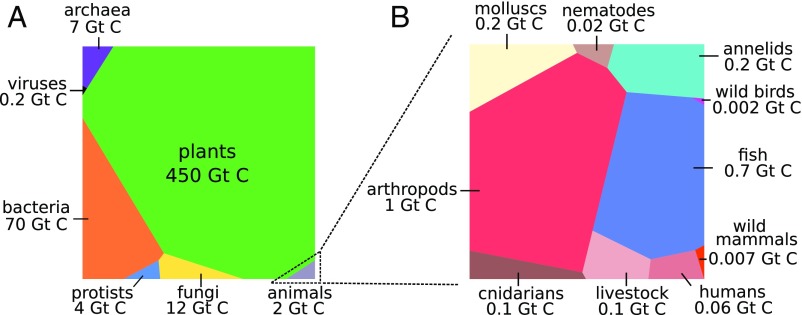
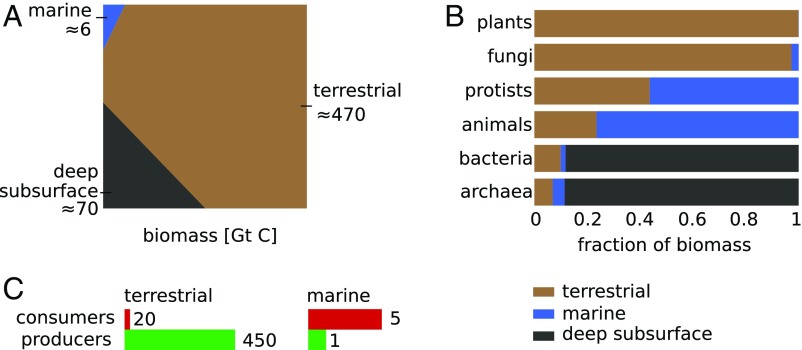
A census of the biomass on Earth is key for understanding the structure and dynamics of the biosphere. However, a global, quantitative view of how the biomass of different taxa compare with one another is still lacking. Here, we assemble the overall biomass composition of the biosphere, establishing a census of the ≈550 gigatons of carbon (Gt C) of biomass distributed among all of the kingdoms of life. We find that the kingdoms of life concentrate at different locations on the planet; plants (≈450 Gt C, the dominant kingdom) are primarily terrestrial, whereas animals (≈2 Gt C) are mainly marine, and bacteria (≈70 Gt C) and archaea (≈7 Gt C) are predominantly located in deep subsurface environments. We show that terrestrial biomass is about two orders of magnitude higher than marine biomass and estimate a total of ≈6 Gt C of marine biota, doubling the previous estimated quantity. Our analysis reveals that the global marine biomass pyramid contains more consumers than producers, thus increasing the scope of previous observations on inverse food pyramids. Finally, we highlight that the mass of humans is an order of magnitude higher than that of all wild mammals combined and report the historical impact of humanity on the global biomass of prominent taxa, including mammals, fish, and plants.
Overview
CoChat Summary
TL;DR
The paper assembles a global census of biomass across all kingdoms of life, estimating Earth’s total biomass at ≈550 Gt C, dominated by plants. It also compares biomass across environments and trophic modes, highlighting large uncertainties and human impacts on the biosphere.
Key findings
- Total global biomass is ≈550 Gt C, with plants ≈450 Gt C (≈80%), bacteria ≈70 Gt C (≈15%), fungi ≈12 Gt C, archaea ≈7 Gt C, protists ≈4 Gt C, animals ≈2 Gt C, and viruses ≈0.2 Gt C.
- Land biomass (≈470 Gt C) is about two orders of magnitude higher than marine biomass (≈6 Gt C); the deep subsurface holds ≈15% of total biomass, chiefly bacteria and archaea.
- In the ocean, ≈1 Gt C of primary producers supports ≈5 Gt C of consumer biomass, an inverted standing biomass distribution; marine biomass is ≈70% microbes, mainly bacteria and protists.
- Human-associated biomass is large relative to wild vertebrates: humans ≈0.06 Gt C, livestock ≈0.1 Gt C, wild mammals ≈0.007 Gt C, domesticated poultry ≈0.005 Gt C versus wild birds ≈0.002 Gt C; total plant biomass has declined approximately twofold relative to pre-human civilization.
Methods
- The authors synthesize hundreds of studies and generate estimates for major taxonomic groups, reporting biomass as gigatons of carbon (Gt C) and using a kingdom-level framework plus viruses.
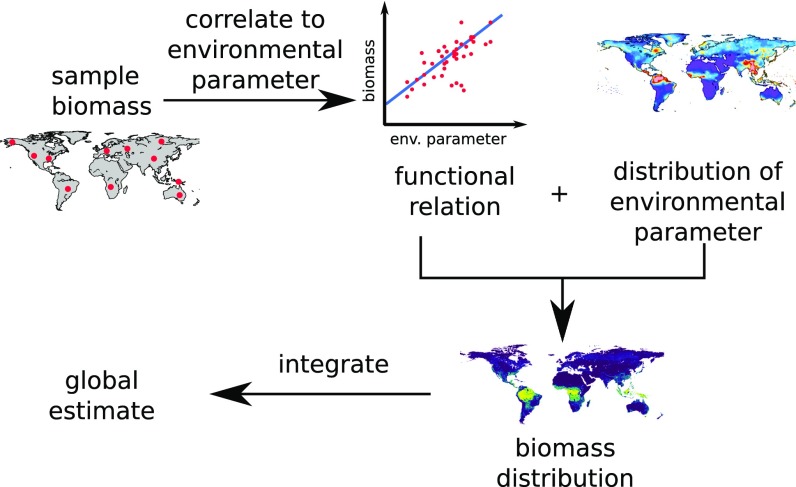
- For many taxa, local biomass samples are extrapolated globally by correlating biomass density with environmental parameters known at global scale; best estimates often use a geometric mean of independent estimates.
- Uncertainty is reported as multiplicative fold-change projections akin to 95% confidence intervals, incorporating intrastudy, interstudy, and intermethod variation; data and code are open-sourced.
Limitations
- The paper states that most datasets rely on fragmentary sampling, causing large uncertainties; sampling is scarce in the deep ocean (usually deeper than 200 m) and deep soil (usually deeper than 1 m), and some estimates may be biased by sampling toward high-abundance areas.
- The paper states that deep subsurface environments have particularly high uncertainty and unknown systematic biases, including unresolved distribution of biomass between aquifer fluids and rocks and among microbial taxa.
- The paper states that current and prehuman vertebrate biomass estimates are only a crude first step, amphibians remain poorly characterized, and parasite biomass is not resolved from hosts; evident from the text, kingdom-level grouping was chosen because much data lack finer taxonomic detail, and some uncertainty projections rely on analogous taxa or expert consultation.
Model-written summary. Check it against the paper before relying on it.
Integrity signals
Registry
Cites
Statistics
Figures
Verification
Claims the paper makes
9 Valid · 7 Not valid · 16 Not checked · 53 Own results and interpretations
Every source the paper cites for this claim was checked and supports it.
In the paper
“The biomass of amphibians, which are experiencing a dramatic population decline (42), remains poorly characterized.”
§ The biomass distribution on Earth > Discussion
What the sources say
- Supportedcites [42] Wake DB Vredenburg VT 2008 Colloquium paper: Are we in the midst of the sixth mass extinction? A view from the world of amphibians Proc Natl Acad Sci USA 105 11466 11473 18695221 PMC2556420 source
The citation is attached to the clause about amphibian population decline, not the separate statement that their biomass is poorly characterized. The passage reporting the Global Amphibian Assessment (labeled Abstract in our copy) says that 43% of amphibian species have declining populations. (LLM, conf=0.92)
plain- Asserted: passes — The authors put it forward as true.
- Checkable: passes — It can be checked against evidence.
- Load-bearing: unclear — It is unclear whether the paper’s conclusions depend on it.
- Based: passes — The paper gives a reason why it holds.
- Supported
Every source the paper cites for this claim was checked and supports it.
In the paper
“In the case of prokaryotes, some major improvements were recently realized, with global estimates of marine deep subsurface prokaryote biomass reduced by about two orders of magnitude due to an increased diversity of sampling locations (7).”
§ The biomass distribution on Earth > Discussion
What the sources say
- Supportedcites [7] Kallmeyer J Pockalny R Adhikari RR Smith DC D’Hondt S 2012 Global distribution of microbial abundance and biomass in subseafloor sediment Proc Natl Acad Sci USA 109 16213 16216 22927371 PMC3479597 source
The Discussion reports a revised subseafloor microbial biomass estimate of 4.1 Pg C versus a previous estimate of 303 Pg C—about a 74-fold reduction. It also identifies a more geographically diverse sampling database, including low-abundance ocean gyres, as a reason the new estimate is lower. The paper identifies other contributing factors as well. (LLM, conf=0.88)
plainstates a cause- Asserted: passes — The authors put it forward as true.
- Checkable: passes — It can be checked against evidence.
- Load-bearing: unclear — It is unclear whether the paper’s conclusions depend on it.
- Based: passes — The paper gives a reason why it holds.
- Supported
The sources with a verdict support this claim; the rest weren’t checked yet, have no full text we could read, or their verdicts aren’t rated yet.
In the paper
“Such inverted biomass distributions can occur when primary producers have a rapid turnover of biomass [on the order of days (34)], while consumer biomass turns over much more slowly [a few years in the case of mesopelagic fish (35)].”
§ The biomass distribution on Earth > Results > The Distribution of Biomass Across Environments and Trophic Modes.
What the sources say
- Supportedcites [34] Zubkov MV 2014 Faster growth of the major prokaryotic versus eukaryotic CO2 fixers in the oligotrophic ocean Nat Commun 5 3776 24777140 PMC4015317 source
The Results (Comparison of the growth rates of the CO2 fixers; page unavailable) report growth rates of 0.1–0.6 per day for the studied oceanic primary producers, consistent with biomass turnover on the order of days. The few-years estimate for mesopelagic fish is assigned to a different citation, not this source. (LLM, conf=0.91)
- Not checked — no full text of the sourcecites [35] Catul V Gauns M Karuppasamy PK 2011 A review on mesopelagic fishes belonging to family Myctophidae Rev Fish Biol Fish 21 339 354 source
plainstates a possible cause- Asserted: passes — The authors put it forward as true.
- Checkable: passes — It can be checked against evidence.
- Load-bearing: passes — The paper’s conclusions depend on it.
- Based: passes — The paper gives a reason why it holds.
- Supported
The cited sources support only part of this claim — read each source’s verdict below.
In the paper
“Combining data from independent sources such as these enables a robust assessment of the total plant biomass (17).”
§ The biomass distribution on Earth > Results > The Uncertainty Associated with Global Biomass Estimates.
What the sources say
- Partly supportedcites [17] Erb K-H 2017 Unexpectedly large impact of forest management and grazing on global vegetation biomass Nature 553 73 76 29258288 PMC5756473 sourceExperimental — accuracy not yet measured
The Methods describe combining multiple datasets and types of evidence to estimate global vegetation biomass stocks. But the paper also says global stocks remain uncertain, reports uncertainty ranges around 35% of the median estimate, and describes more robust estimates as a future prospect. It therefore supports the use of independent sources for an assessment, but not the unqualified characterization of that assessment as robust. (LLM, conf=0.84)
plainstates a cause- Asserted: passes — The authors put it forward as true.
- Checkable: passes — It can be checked against evidence.
- Load-bearing: passes — The paper’s conclusions depend on it.
- Based: passes — The paper gives a reason why it holds.
- Partly supported
A result the paper states — it cites no source for it, so there is none to check. The quote shows it is in the paper.
In the paper
“Plant biomass includes ≈70% stems and tree trunks, which are mostly woody, and thus relatively metabolically inert.”
§ The biomass distribution on Earth > Results > The Biomass Distribution of the Biosphere by Kingdom.
plain- Asserted: passes — The authors put it forward as true.
- Checkable: passes — It can be checked against evidence.
- Load-bearing: unclear — It is unclear whether the paper’s conclusions depend on it.
- Based: passes — The paper gives a reason why it holds.
27 more claims
Create a free account to see all 85 claims and to verify the 2 references still open.
- It may state two separate claims as one. 32
- Probably not a substantial claim. 28
Claims other papers make about this one
Each is checked against this paper’s own text: does it say what the citing paper says it does?
The cited source doesn’t support the claim as written.
In the citing paper
“and less than 10% that of the world ' s current human population ( 52 ).”
From Pervasive human-driven decline of life on Earth points to the need for transformative change (2019) · cites this paper as [52]
Checked by a reasoning model — may be wrong.
Experimental — accuracy not yet measuredThe cited source says what the claim attributes to it.
In the citing paper
“Approximately 450 Gt of C is bound up in terrestrial biota, primarily in plants (86), while only ~6 Gt of C is found in ocean biota (87).”
From Earth beyond six of nine planetary boundaries (2023) · cites this paper as [87]
The cited source says what the claim attributes to it.
In the citing paper
“The amount of metabolic energy available to a biosphere powered by O 2 is vast, such that the O 2 -rich ocean-atmosphere system of the modern Earth supports staggering levels of standing biomass (Bar-On et al. 2018), energy flow (Falkowski et al. 2008), and ecological complexity (Steele 1974).”
From The History of Ocean Oxygenation (2022) · cites this paper as Bar-On et al. 2018
In the citing paper
“Global populations of domestic ruminants (cattle, sheep, and goats) (Ripple et al. 2013) poultry, and pigs (Bennett et al. 2018) used to feed the growing human population now exceed 100 million tons of carbon (Bar-On et al. 2018), and livestock populations are growing rapidly.”
From Scientists’ warning to humanity on the freshwater biodiversity crisis (2021) · cites this paper as Bar-On et al. 2018
Citations
Cites
The worldwide leaf economics spectrum
Wright, I. J., Reich, P. B., Westoby, M., Ackerly, D. D., Baruch, Z., Bongers, F., Cavender-Bares, J., Chapin, T., Cornelissen, J. H. C., Diemer, M., et al. (2004) · Nature · doi:10.1038/nature02403 · Cited by 9,021 · cited 1×
“We then convert the total area of leaves to an estimate of the total dry mass of leaves by using the Glopnet database (24), which measured leaf mass per area (LMA) for ≈2500 plant species.”
MethodA large and persistent carbon sink in the world’s forests
Pan, Y., Birdsey, R. A., Fang, J., Houghton, R., Kauppi, P. E., Kurz, W. A., Phillips, O. L., Shvidenko, A., Lewis, S. L., Canadell, J. G., et al. (2011) · Science · doi:10.1126/science.1201609 · Cited by 8,458
Soil Sampling and Methods of Analysis
(2007) · CRC Press eBooks · doi:10.1201/9781420005271 · Cited by 6,469
Primary production of the biosphere: Integrating terrestrial and oceanic components
Field, C. B., Behrenfeld, M. J., Randerson, J. T., & Falkowski, P. (1998) · Science · doi:10.1126/science.281.5374.237 · Cited by 6,371
Prokaryotes: The unseen majority
Whitman, W. B., Coleman, D. C., & Wiebe, W. J. (1998) · Proceedings of the National Academy of Sciences · doi:10.1073/pnas.95.12.6578 · Cited by 4,871
Global effects of land use on local terrestrial biodiversity
Newbold, T., Hudson, L. N., Hill, S. L. L., Contu, S., Lysenko, I., Senior, R. A., Börger, L., Bennett, D. J., Choimes, A., Collen, B., et al. (2015) · Nature · doi:10.1038/nature14324 · Cited by 4,352
Belowground biodiversity and ecosystem functioning
Bardgett, R. D., & van der Putten, W. H. (2014) · Nature · doi:10.1038/nature13855 · Cited by 3,990 · cited 4×
“This was recommended by experts in the field for estimation of arbuscular mycorrhizal fungi abundance (117).”
BackgroundInfluentialMangroves among the most carbon-rich forests in the tropics
Donato, D. C., Kauffman, J. B., Murdiyarso, D., Kurnianto, S., Stidham, M., & Kanninen, M. (2011) · Nature Geoscience · doi:10.1038/ngeo1123 · Cited by 3,374
Poorter, H., Niklas, K. J., Reich, P. B., Oleksyn, J., Poot, P., & Mommer, L. (2012) · New Phytologist · doi:10.1111/j.1469-8137.2011.03952.x · Cited by 3,163 · cited 1×
“The first relies on a meta-analysis of the biomass allocation to different plant compartments across biomes (19).”
BackgroundA global analysis of root distributions for terrestrial biomes
Jackson, R. B., Canadell, J., Ehleringer, J. R., Mooney, H. A., Sala, O. E., & Schulze, E. D. (1996) · Oecologia · doi:10.1007/bf00333714 · Cited by 3,071 · cited 4×
“assumed the distribution of microbial biomass with depth follows the biomass density versus depth profile of root biomass (21).”
BackgroundMethodInfluential
Research works printed but not linked: 1
- Chapman AD 2009 Numbers of Living Species in Australia and the World Australian Biological Resources Study Canberra, Australia
Cited by
Items 2,401–2,500 of 3,743
Ji, D., Zhou, J., Xie, D., Zhang, X., Wu, F., Yang, J., Gao, J., Deng, J., Wang, Q.-W., Xu, X., et al. (2025) · Plant and Soil · doi:10.1007/s11104-025-08099-7 · Cited by 2
“Plant litter serves as a significant source of biogenic organic carbon in aquatic ecosystems, with its decomposition process playing a crucial role in regulating nutrient supply and biogeochemical cycle (Bar-On et al. 2018; Marks 2019; Stoler and Relyea 2020).”
Camacho, L. F., & Araújo, M. B. (2025) · Proceedings of the Royal Society B Biological Sciences · doi:10.1098/rspb.2025.2335 · Cited by 3
Bacillus megaterium controls melon Fusarium wilt disease through its effects on keystone soil taxa
Lu, X., Li, Q., Li, B., Fang, L., Wang, Y., Wenshuo, N., Liu, Y., & Zhao, H. (2025) · Plant and Soil · doi:10.1007/s11104-025-07914-5 · Cited by 4
“Soil microorganisms are an important component of soil ecosystems, as they play a key role in enhancing ecosystem multifunctionally (Bar-On et al. 2018; Yang et al. 2023).”
What drives bacterial extinction? The role of bacteriophages
Tanaka, M. M., & Wahl, L. M. (2025) · Theoretical Population Biology · doi:10.1016/j.tpb.2025.12.001 · Cited by 1
OAKS: Kingpins in Northern Hemisphere Food Webs
Tallamy, D. W., Wagner, D. L., Matson, T. A., et al. (2025) · American Entomologist · doi:10.1093/ae/tmaf066 · Cited by 1
The future extent of the Anthropocene epoch: A synthesis
Summerhayes, C. P., Zalasiewicz, J., Head, M. J., Syvitski, J., Barnosky, A. D., Cearreta, A., Fiałkiewicz-Kozieł, B., Grinevald, J., Leinfelder, R., McCarthy, F. M. G., et al. (2024) · Global and Planetary Change · doi:10.1016/j.gloplacha.2024.104568 · Cited by 72
Neundorf, A. C. A., Mikich, A., Feitosa, R. M., et al. (2025) · Neotropical Entomology · doi:10.1007/s13744-025-01340-z · Cited by 1
“Plants represent the dominant form of life on Earth, comprising approximately 80% of the planet’s biomass (Bar-On et al. 2018).”
Microbial Diversity and Metabolic Adaptations in Mars‐Analog Lava Tubes
Cheng, X., Li, M., She, X., Zhao, R., Long, X. I. A. O., & Wang, H. (2025) · Journal of Geophysical Research Planets · doi:10.1029/2025je009246 · Cited by 1
“These microorganisms are predominantly found in deep subsurface environments (Bar‐”
Molina‐Solís, A., Cleal, C. J., Santos, A. A., McLoughlin, S., Diez, J. B., & Cascales‐Miñana, B. (2025) · Palaeogeography Palaeoclimatology Palaeoecology · doi:10.1016/j.palaeo.2025.113517 · Cited by 3
Miller, B. (2025) · PLoS ONE · doi:10.1371/journal.pone.0339572 · Cited by 3
“Yet, the number of bacteria that have existed on Earth is many orders of magnitude larger than complex animals, plants, and fungi [61].”
Justicia social y explotación animal: reflexiones sobre una alianza imposible
Bohórquez, P. C. M. (2026) · (Des)troços revista de pensamento radical · doi:10.53981/destrocos.v6i2.60783 · Cited by 1
Facing the pain: ethical considerations of AI-based pain detection of farmed animals
Ryan, M., & Bossert, L. N. (2026) · AI and Ethics · doi:10.1007/s43681-025-00905-3 · Cited by 4
Friedrich, A., & Ekardt, F. (2026) · Environmental Sciences Europe · doi:10.1186/s12302-025-01315-2 · Cited by 2
“…[13], on wetland loss [45], on land change [46], on ocean habitats [47], most serious wetland loss in Europe [48]) and global biomass dominated by livestock followed by humans (on insect biomass [49, 50] on the total shares of humans, livestock and wild mammals to total mammal biomass [51]).”
Lee, G.-E., Kim, M.-J., & Jeong, R. (2026) · Water Air & Soil Pollution · doi:10.1007/s11270-026-09126-8 · Cited by 1
“Plants are the most concentrated biomass kingdoms of life globally, accounting for 450 gigatons of the overall 550 gigatons of carbon (GtC) in the biomass composition of the biosphere (Bar-On et al., 2018).”
Urban Liquefaction: Rethinking the Relationship between Land and Sea
Simonetti, C., Lussault, M., & Ingold, T. (2026) · Punctum Books · doi:10.53288/0532.1.00 · Cited by 2
Keystone management species under the Endangered Species Act can promote ecosystem-based management
Hayes, S. A., & Roman, J. (2026) · Frontiers in Conservation Science · doi:10.3389/fcosc.2025.1645471 · Cited by 2
Trigo, C. B., VILLAGRA, P. E., Coles, P. C., et al. (2026) · Applied Vegetation Science · doi:10.1111/avsc.70053 · Cited by 1
Polyphosphate as an Integral Component of Global Phosphorus Cycling through Earth’s History
Wang, Z., He, P., Baldwin, M. A., & Gu, A. Z. (2026) · Environmental Science & Technology · doi:10.1021/acs.est.5c08597 · Cited by 4
Animal emergency management: the future is unwritten – how will we shape it?
Squance, H. (2026) · New Zealand Veterinary Journal · doi:10.1080/00480169.2026.2632160 · Cited by 1
Wendt, O., Palasz, J. M., Rodriguez, A., Nimavat, M., Baidoo, E. E. K., Gladden, J. M., Singh, S., Simmons, B. A., & Choudhary, H. (2026) · Cell Reports Sustainability · doi:10.1016/j.crsus.2026.100638 · Cited by 2
Diversity and ecological roles of endophytic fungi in desert phreatophytes
Zhang, Y., Du, Y., Alwutayd, K. M., Islam, W., & Zeng, F. (2026) · 3 Biotech · doi:10.1007/s13205-026-04743-w · Cited by 2
Zhan, H., Li, F., Zhang, J., Tang, R., & Zang, L. (2026) · Insect Science · doi:10.1111/1744-7917.70268 · Cited by 3
The Tooth of Time: Charles Darwin’s Prophecy Regarding Selective Survival on Snowball Earth
Hoffman, P. F. (2026) · Geoscience Canada · doi:10.12789/geocanj.2026.53.227 · Cited by 1
Shane, T., Waaswa, A., Williams, P. J., Reeves, M. C., Washington‐Allen, R. A., & Perryman, B. L. (2026) · Remote Sensing · doi:10.3390/rs18060942 · Cited by 2
Enquist, B. J., Boyle, B. L., Maitner, B., Merow, C., Carlson, B., Feng, X., MOULATLET, G. M., Newman, E. A., Park, D., Pillet, M., et al. (2026) · Methods in Ecology and Evolution · doi:10.1111/2041-210x.70274 · Cited by 12
“Plants are the foundation of terrestrial ecosystem productivity, contributing the vast majority of Earth's biomass and playing cen - tral roles in global carbon cycling, climate regulation and ecosys - tem services (Bar-On et al., 2018 ).”
Biodiversity loss: global drivers, trade impacts, and conservation strategies
Wang, S., & Zhu, H. (2026) · Environmental Reviews · doi:10.1139/er-2025-0223 · Cited by 2
Unveiling the patterns and drivers of scientific and societal interest in Brazilian lepidopterans
Guedes, J. J. M., dos Santos, J. P., & Freitas, A. V. L. (2026) · Royal Society Open Science · doi:10.1098/rsos.251797 · Cited by 1
Parker, J., Williams, C. L., Deel, H. L., Letitiya, D., Goldenberg, S. Z., Sukuna, D. A., D’Ammando, G., Daballen, D., Owen, M. A., Tubbs, C. W., et al. (2026) · Royal Society Open Science · doi:10.1098/rsos.251569 · Cited by 1
Microbial rights for a planetary age
Rizk, A., Jones, E., Saab, A., Strobeyko, A., Soininen, N., Burci, G. L., Höll, D., Bossert, L. N., Larose, C., Brown, K., et al. (2026) · Earth System Governance · doi:10.1016/j.esg.2026.100331 · Cited by 4
Li, Y., Zhang, C., Xue, Y., Ji, Y., Ren, Y., & Xu, B. (2026) · Journal of Environmental Management · doi:10.1016/j.jenvman.2026.129632 · Cited by 1
Young, J., Nelson, D., Gu, L., & Zhou, R. (2026) · AI Chemistry · doi:10.3390/aichem1020007 · Cited by 1
“Rubisco is abundant, which creates additional constraints because improving catalytic rates requires trade-offs with cellular resource allocation and stress tolerance [1,5].”
Standardized Protocols for Soil Fauna Extraction and a Call for Cross‐Lab Implementation
Tůmová, M., Lu, J., Briones, M. J., Cesarz, S., Eisenhauer, N., Fujii, S., Gongalsky, K. B., Haimi, J., Hohberg, K., Jänsch, S., et al. (2026) · Ecology and Evolution · doi:10.1002/ece3.73407 · Cited by 2
“…soil fauna (Mathieu et al. 2022), assess changes of soil communities along wide climatic and disturbance gradients, correctly estimate contribution of soil animals in the global biomass stocks (Bar-On et al. 2018), and understand global trends of soil biodiversity (Guerra, Bardgett, et al. 2021).”
John, M. E. S., & Stein, L. R. (2026) · Journal of Fish Biology · doi:10.1111/jfb.70440 · Cited by 1
Tian, Z., Feng, X., Wu, N., Liu, H., Dong, X., Zhang, Y., Yang, Y., Nan, Z., & Chen, T. (2026) · Journal of Applied Ecology · doi:10.1111/1365-2664.70405 · Cited by 2
Jia, J., Dietrich, D., Pidatala, V. R., et al. (2026) · Green Chemistry · doi:10.1039/d5gc06335c · Cited by 1
Ji, L., Tanunchai, B., Schroeter, S. A., Wahdan, S. F. M., Hossen, S., Noll, M., & Purahong, W. (2026) · BMC Plant Biology · doi:10.1186/s12870-026-08931-x · Cited by 1
“Terrestrial plants are among the most significant contributors to biomass globally, accounting for approximately 450 Gt carbon (C) [1].”
Genome engineering of plant photosynthesis for carbon sequestration
Groover, E. D., Wang, F. Z., John, A., Shen, J., Lemaux, P. G., Savage, D. F., & Niyogi, K. (2026) · Nature Reviews Bioengineering · doi:10.1038/s44222-026-00453-3 · Cited by 3
Due, B. L. (2026) · Human Studies · doi:10.1007/s10746-026-09843-3 · Cited by 1
Pérez-Álvarez, R., Chará, J., Snyder, L. D., Bonatti, M., Sieber, S., & Martin, E. A. (2026) · Ecological Applications · doi:10.1002/eap.70255 · Cited by 11
Phylogenomic frameworks from deep archaeplastid evolution to embryophyte diversification
Baştürk, M. N., Kunz, C. F., Darienko, T., Pröschold, T., de Vries, J., & Chen, H. (2026) · Current Biology · doi:10.1016/j.cub.2026.03.019 · Cited by 11
Barber, R. A., Underwood, B., Clarkson, J. J., Brekke, T. D., Weeks, T. L., Wilkinson, T., Wilkes, P., Egan, G., Lee, M. A., Openshaw, I., et al. (2026) · Functional Ecology · doi:10.1111/1365-2435.70369 · Cited by 5
Lorimer, J. (2026) · Progress in Environmental Geography · doi:10.1177/27539687261457154 · Cited by 1
“Bar-On et al. (2018) calculate that this is now exceeded by the biomass of livestock ( ≈ 0.1 GtC, dominated by cattle and pigs), which have displaced wild mammals ( ≈ 0.007 GtC), while the biomass of domesticated poultry ( ≈ 0.005 GtC, dominated by chickens) exceeds that of wild birds ( ≈ 0.002…”
InfluentialVegMRFP: Mixed radiance field primitives for vegetation rendering and reconstruction
Liu, L., Liu, N., Xie, H., & Hu, S. (2026) · Computers & Graphics · doi:10.1016/j.cag.2026.104650 · Cited by 2
Unveiling Shortfalls in Biodiversity Knowledge of Brazilian Butterflies
Guedes, J. J. M., dos Santos, J. P., & Freitas, A. V. L. (2026) · Diversity · doi:10.3390/d18060373 · Cited by 4
Upcycling lignocellulosic biomass using a radial-axial fixed-bed ex-situ catalytic pyrolysis reactor
Li, F., Guo, J., Shi, X., Piao, W., Franch, C., Chen, Y., Seshan, K., & He, S. (2026) · Bioresource Technology · doi:10.1016/j.biortech.2026.135218 · Cited by 1
Accelerating Campylobacter zoonosis in the Anthropocene
Kyne, O., Penman, B. S., Kelly, D. J., & Sheppard, S. K. (2026) · Proceedings of the National Academy of Sciences · doi:10.1073/pnas.2609969123 · Cited by 1
“Chickens now comprise 70% of all bird biomass on earth (2).”
Carbon-to-ATP ratios across the kingdoms of life
Fahimi, P., Amirian, M. M., Irwin, A. J., & Finkel, Z. V. (2026) · iScience · doi:10.1016/j.isci.2026.116849 · Cited by 4
“57,58 The carbon-to-ATP (C:ATP) ratio has long been used as a proxy for marine microbial biomass based on the assumption of a universal value of ∼ 250.”
Dopant‐Assisted APCI for Enhanced Sugar Analysis: Overcoming Ionization Bottlenecks
Traullé, N., Voellinger, T., Hertzog, J., et al. (2026) · Rapid Communications in Mass Spectrometry · doi:10.1002/rcm.70152 · Cited by 1
Applied vegetation science addresses emerging global issues
Chiarucci, A., Pärtel, M., Pillar, V. D., & Chytrý, M. (2019) · Applied Vegetation Science · doi:10.1111/avsc.12421 · Cited by 2
Nitrogen cycling from the perspective of boreal Scots pine trees
Korhonen, J. (2020) · Dissertationes Forestales · doi:10.14214/df.293 · Cited by 1
“Based on the studies of Bar-On et al. (2018) and Elser et al. (2000), the estimated N level in biomass is very roughly 20 Pg N, roughly 80% of which is in terrestrial plants, ca. 20% in microbes and 2% in animals.”
BackgroundInto the Anthropocene: Environmental history and the morality of climate change
Pawson, E. (2020) · International Review of Environmental History · doi:10.22459/ireh.06.02.2020.04 · Cited by 1
The Earth’s Microbiome: Significance in Sustainable Development and Impact of Climate Changes
Goyal, D., Vaijanapurkar, M., Jacques, E., Pandey, J., & Prakash, O. (2020) · Springer eBooks · doi:10.1007/978-981-15-8562-3_6 · Cited by 1
Tsuchida, T., Watanabe, T., & Mikame, K. (2021) · Transactions of the Materials Research Society of Japan · doi:10.14723/tmrsj.46.25 · Cited by 1
Special Issue–Causes and consequences of microbiome changes
Geisen, S., & Thakur, M. P. (2021) · Basic and Applied Ecology · doi:10.1016/j.baae.2021.03.010 · Cited by 1
Overview Regarding Synthetic Gas Production by Biomass Gasification
Corbu, A., Raboacă, M. S., & Tanwar, S. (2021) · Advances in computer and electrical engineering book series · doi:10.4018/978-1-7998-4945-2.ch004 · Cited by 1
Stoltzfus, A. (2021) · Oxford University Press eBooks · doi:10.1093/oso/9780198844457.003.0008 · Cited by 1
Zoonotic disease in the face of rapidly changing human–nature interactions in the Anthropocene
Chakraborty, S., Kumar, P., & Mishra, B. K. (2021) · Elsevier eBooks · doi:10.1016/b978-0-323-85512-9.00008-5 · Cited by 2
Tritiation of the botanically derived toxin dihydrorotenone
Filer, C. N., & Egan, J. A. (2021) · Journal of Radioanalytical and Nuclear Chemistry · doi:10.1007/s10967-021-07852-3 · Cited by 1
“Plants collectively constitute the largest single biomass on Earth [3] and besides supplying food, fiber and fuel, they have been a cornucopia of valuable natural product chemicals for mankind’s many needs [4].”
BackgroundTöbb őszinteséget, új közgazdaságtant! : A gazdasági növekedés meghaladásának stratégiái
Antal, M. (2021) · Replika · doi:10.32564/121-122.12 · Cited by 2
Ksepka, D. T. (2021) · Elsevier eBooks · doi:10.1016/b978-0-12-819770-7.00009-8 · Cited by 3
Suppiah, S., Chattopadhyay, S., Nardin, A. C. F. D., et al. (2022) · Springer eBooks · doi:10.1007/978-3-030-93254-1_4 · Cited by 1
Changing Epidemiology of Infections in Pregnancy: A Global Perspective
Jain, J. J. (2022) · Springer eBooks · doi:10.1007/978-981-16-7865-3_1 · Cited by 1
Bezgraniczny wzrost. Ramując na nowo relacje między ludźmi i roślinami
Modrzyk, A. (2022) · Ruch Prawniczy Ekonomiczny i Socjologiczny · doi:10.14746/rpeis.2022.84.1.16 · Cited by 1
Stubbins, A., Ryan, K. A., & Stan, J. T. V. (2022) · Frontiers for Young Minds · doi:10.3389/frym.2022.703704 · Cited by 1
Molecular Mechanisms of Leaf Morphogenesis
Koyama, T. (2022) · MDPI eBooks · doi:10.3390/books978-3-0365-3162-5 · Cited by 2
Fellows, A. (2019) · Routledge eBooks · doi:10.4324/9780203733394-2 · Cited by 1
Fullerton, D. (2020) · Open Book Publishers · doi:10.11647/obp.0193.10 · Cited by 1
Karl, D. M. (2020) · Open Book Publishers · doi:10.11647/obp.0193.23 · Cited by 1
McGregor, D. (2020) · Open Book Publishers · doi:10.11647/obp.0193.15 · Cited by 4
Ernährung neu denken – die Planetary Health Diet im Gesundheitswesen
Hünninghaus, K., & Dobos, G. (2022) · Zeitschrift für Komplementärmedizin · doi:10.1055/a-1897-1615 · Cited by 1
Patsyuk, M. (2022) · Biosystems Diversity · doi:10.15421/012216 · Cited by 1
Fellows, A. (2022) · Journal of Analytical Psychology · doi:10.1111/1468-5922.12858 · Cited by 3
Perte de biodiversité, prélude aux émergences virales
Roche, B., & Morand, S. (2022) · médecine/sciences · doi:10.1051/medsci/2022160 · Cited by 4
Diversité et importance écologique des virus dans le milieu marin
Bachy, C., & Baudoux, A. (2022) · médecine/sciences · doi:10.1051/medsci/2022165 · Cited by 1
Native microbiomes in danger: Could One Health help to cope with this threat to global health?
Zunino, P. (2022) · International Journal of One Health · doi:10.14202/ijoh.2022.178-184 · Cited by 3
Warmer temperatures result in maladaptive learning of sexual preferences
Holveck, M., Muller, D., Visser, B., Timmermans, A., Colonval, L., Jan, F., Crucifix, M. C., & Nieberding, C. M. (2023) · Functional Ecology · doi:10.1111/1365-2435.14242 · Cited by 1
Wenn es Menschenbilder gibt, muss es auch Tierbilder geben. Menschenbild und Beziehung zum Tier
Wild, M. (2023) · Springer eBooks · doi:10.1007/978-3-658-32138-3_51-1 · Cited by 1
Georges, A., Barbier, T., Delorme, M., et al. (2022) · Projets de paysage · doi:10.4000/paysage.31650 · Cited by 1
Rhizosphere Mycobiome: Roles, Diversity, and Dynamics
Moussa, T. A. A., Mohamed, A. H., & Zaky, M. S. (2023) · Springer eBooks · doi:10.1007/978-3-031-28307-9_3 · Cited by 1
Role and diversity of microbes in agriculture
Raja, N., Sajitha, T. P., Khan, M. L., & Ravikanth, G. (2023) · Elsevier eBooks · doi:10.1016/b978-0-323-90500-8.00022-1 · Cited by 1
Kuo, J., Chen, K., Lu, M., Sung, P.-J., Lin, C.-H., & Huang, Y.-S. (2023) · Biologia · doi:10.1007/s11756-023-01397-4 · Cited by 2
Dwiantara, W. S., & Rahmawati, W. (2023) · Jurnal Pengembangan Potensi Laboratorium · doi:10.25047/plp.v2i1.3693 · Cited by 1
Single-cell transcriptomics and data analyses for prokaryotes—Past, present and future concepts
Münch, J., Sobol, M. S., Brors, B., & Kaster, A. (2023) · Advances in applied microbiology · doi:10.1016/bs.aambs.2023.04.002 · Cited by 3
Romanticism’s Fellow Creatures
Hunt, A., Broglio, R., Castellano, K., et al. (2023) · European Romantic Review · doi:10.1080/10509585.2023.2205082 · Cited by 1
Rights of Nature Include Rights of Domesticated Animals
Peters, A. M. (2023) · Springer eBooks · doi:10.1007/978-3-662-66978-5_2 · Cited by 1
常, 乐., Yu, G., & Liu, C. (2023) · SCIENTIA SINICA Terrae · doi:10.1360/sste-2023-0058 · Cited by 2
Endosymbionts: Bacterial hijacking of fungi?
Dijksterhuis, J. (2023) · Current Biology · doi:10.1016/j.cub.2023.06.028 · Cited by 1
New insights into the synergistic degradation of organic pollutants by white rot fungi and minerals
Dong, H. (2023) · Science China Earth Sciences · doi:10.1007/s11430-023-1157-0 · Cited by 1
Flourishing bodies: spiritual entanglements and psychobiological imperatives
Pribac, T. B. (2023) · Religion · doi:10.1080/0048721x.2023.2258706 · Cited by 1
“Measured in biomass, Bar-On, Phillips, and Milo (2018) report, of all mammals currently living, only 5% are wild, free-living mammals, the rest are humans (36”
Antony, S., & John, S. (2023) · Springer eBooks · doi:10.1007/978-981-19-6772-6_4-1 · Cited by 1
Illner, D., Lingam, M., & Peverati, R. (2023) · Molecular Physics · doi:10.1080/00268976.2023.2261563 · Cited by 4
Conversion factors for dry weight for the lion paw scallop (Nodipected subnodosus Sowerby, 1835)
Carreño-León, D. P., Vázquez-Sánchez, R. I., Ramírez-Arce, J. L., et al. (2023) · CICIMAR Oceánides · doi:10.37543/oceanides.v38i1.283 · Cited by 1
“Following that, these estimates are becoming increasingly important in informing modeling initiatives to investigate the global distribution of biomass (Bar-On et al., 2018) and the global ocean effects of climate change (Lotze et al.”
BackgroundInfluentialOne Health: potential synergy between infectious and toxic agents. The case of COVID-19
Herkovits, J. (2023) · Academia Medicine · doi:10.20935/acadmed6106 · Cited by 1
How Artificial Intellegence Can Support Veganism: An Exploratory Analysis
Hagendorff, T. (2023) · Journal of Animal Ethics · doi:10.5406/21601267.13.2.05 · Cited by 1
“…could also avoid the expense of billions of dollars for combatting the effects of currently established diets (Stehfest et al., 2009) and, what is most important, could save millions of human, as well as billions of animal, lives (Bar-On et al., 2018; Cassidy et al., 2013; Springmann et al., 2018).”
BackgroundElectronic Trap for Field Detection of Fall Armyworm (Spodoptera Frugiperda) in Corn
López, A.-F. J., López, F. R. J., & Alvarez, C. S. L. (2023) · IEEE Colombian Conference on Automatic Control (CCAC) · doi:10.1109/ccac58200.2023.10333801 · Cited by 4
“Insects are the most diverse group of animals and represent one of the largest biomasses of terrestrial animals [3].”
BackgroundMicrobes in the Recycling of Carbon in the Arctic Regions: A Short Review
Ushasri, R., Charumathi, G., & Saseendran, S. (2023) · Springer eBooks · doi:10.1007/978-981-99-5022-5_2 · Cited by 1
Agile teaching methodology - Manual
Gorczyca, A., Klimek‐Kopyra, A., Kiełbasa, B., Redlichová, R., Wieczorek-Przybyło, M., Piecuch, K., Pereira, F., Raposo, A., Saúde, S., Durão, A., et al. (2023) · Universidad de La Laguna (España) eBooks · doi:10.25145/b.2023.13 · Cited by 5
Molecular Characterisation of Faecal Bacterial Assemblages Among Four Species of Syntopic Odonates
Morrill, A., Forbes, M. R., Vesterinen, E. J., Tamminen, M. V., Sääksjärvi, I. E., & Kaunisto, K. (2023) · Microbial Ecology · doi:10.1007/s00248-023-02328-1 · Cited by 4
Wenn es Menschenbilder gibt, muss es auch Tierbilder geben. Menschenbild und Beziehung zum Tier
Wild, M. (2023) · Springer eBooks · doi:10.1007/978-3-658-32128-4_51 · Cited by 1
Modelling role of jellyfish in plankton marine/coastal ecosystems
Wright, R. M. (2024) · Elsevier eBooks · doi:10.1016/b978-0-323-90798-9.00030-5 · Cited by 1
Metadata
- Authors
- Bar-On, Y. M., Phillips, R., & Milo, R.
- Affiliations
- Department of Plant and Environmental Sciences, Weizmann Institute of Science, 76100 Rehovot, Israel;
- California Institute of Technology (US)
- Weizmann Institute of Science (IL)
- Corresponding author
- Milo, Ron
- Venue
- Proceedings of the National Academy of Sciences
- Publisher
- National Academy of Sciences
- Published
- 2018-05-21
- Volume
- 115
- Issue
- 25
- Pages
- 6506-6511
- ISSN
- 0027-8424 (ISSN-L)
- 1091-6490
- PMC
- PMC6016768
- OpenAlex
- W2804910112
- Cited by
- 3,723
- References
- 263
- Citations by year
- 2026: 349 · 2025: 450 · 2024: 589 · 2023: 617 · 2022: 498 · 2021: 498 · 2020: 419 · 2019: 246 · 2018: 49
- FWCI
- 239.98
- Type
- journal article
- Language
- en
- Open access
- hybrid
- doi.org
- Licence
- Locations
- Proceedings of the National Academy of Sciences (publishedVersion, cc-by-nc-nd)
- Europe PMC (PubMed Central) (publishedVersion, cc-by-nc-nd)
- PubMed Central (publishedVersion, cc-by-nc-nd)
- PubMed (publishedVersion)
- CaltechAUTHORS (California Institute of Technology) (submittedVersion, cc-by-nc-nd)
- Funders
- National Institutes of Health (5r35gm118043-07)
- National Institute of General Medical Sciences (R35 GM118043)
- Topics
- Physical Sciences › Environmental Science › Nature and Landscape Conservation › Ecology and Vegetation Dynamics Studies
- Physical Sciences › Environmental Science › Global and Planetary Change › Earth Systems and Cosmic Evolution
- Life Sciences › Agricultural and Biological Sciences › Soil Science › Soil Carbon and Nitrogen Dynamics
- Keywords
- biomass allocation, biomass carbon, terrestrial biomass, marine biomass, bacteria, archaea, food pyramid, wild mammals, fish biomass, plant biomass
- MeSH terms
- Animals, Archaea, Bacteria, Carbon, Humans, Plants, Ecosystem, Biomass, Earth, Planet, Biota
About these checks
Registry, retraction, Cites and statistics results are computed, not judged, with one exception: a printed reference that no index lists is read once by a model before it counts as a citation error. Claims are extracted by a model and kept only when their quote appears verbatim in the text; each cited source is then checked, with a model’s help, for whether it says what the claim relies on. Those verdicts can be wrong — read the claim’s quote and the cited source before relying on one.
The claim verdicts this report counts are experimental: their accuracy is not yet measured.
A language model drew the claims from the paper on 2026-10-10, under version 3 of the claim definition (model deepseek-v4.1-flash, prompt extract-v3).
A second model labelled each claim on 2026-10-10 (model jev-1.13-20260917, definition revision gold-guideline-v0.2).
Cited sources are checked with a language model’s help (gpt-6-sol).
Statistics and arithmetic are recomputed, not judged.
Confidence bands are shown only for fields calibrated on our annotated test set. None is calibrated yet, so no band is shown.
What counts as a claim ›How we measure confidence ›How we check this ›
Are you an author, or do you see a problem with this page? Request a review
Data sources
Bibliographic data: Semantic Scholar, OpenAlex, Crossref.
Contains information from the Semantic Scholar Academic Graph Datasets, made available under the ODC Attribution License (ODC-BY 1.0).
Semantic Scholar’s data is described in: Kinney, R., et al. (2023). The Semantic Scholar Open Data Platform. arXiv:2301.10140.
