

The biomass distribution on Earth
Open accessThe DOI matches its Crossref record; 263 of the 263 references it cites were found in a registry or an index; 11 of the 41 sources its claims cite were checked for support.
Abstract
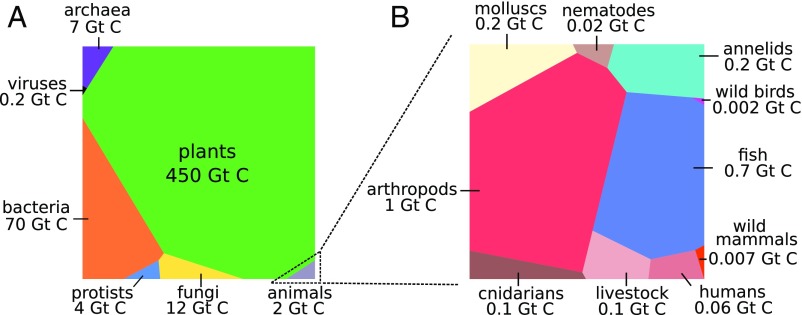
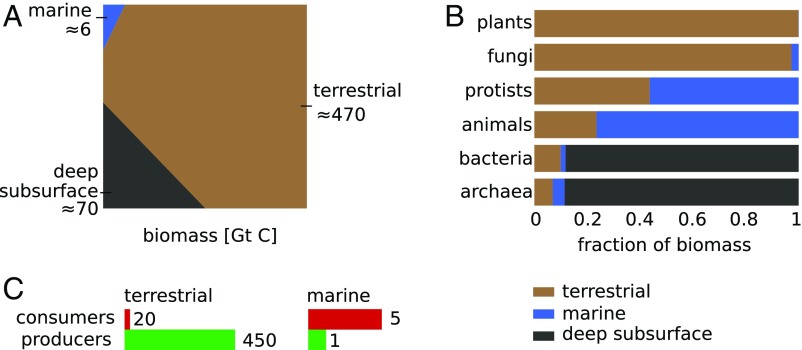
A census of the biomass on Earth is key for understanding the structure and dynamics of the biosphere. However, a global, quantitative view of how the biomass of different taxa compare with one another is still lacking. Here, we assemble the overall biomass composition of the biosphere, establishing a census of the ≈550 gigatons of carbon (Gt C) of biomass distributed among all of the kingdoms of life. We find that the kingdoms of life concentrate at different locations on the planet; plants (≈450 Gt C, the dominant kingdom) are primarily terrestrial, whereas animals (≈2 Gt C) are mainly marine, and bacteria (≈70 Gt C) and archaea (≈7 Gt C) are predominantly located in deep subsurface environments. We show that terrestrial biomass is about two orders of magnitude higher than marine biomass and estimate a total of ≈6 Gt C of marine biota, doubling the previous estimated quantity. Our analysis reveals that the global marine biomass pyramid contains more consumers than producers, thus increasing the scope of previous observations on inverse food pyramids. Finally, we highlight that the mass of humans is an order of magnitude higher than that of all wild mammals combined and report the historical impact of humanity on the global biomass of prominent taxa, including mammals, fish, and plants.
Overview
CoChat Summary
TL;DR
The paper assembles a global census of biomass across all kingdoms of life, estimating Earth’s total biomass at ≈550 Gt C, dominated by plants. It also compares biomass across environments and trophic modes, highlighting large uncertainties and human impacts on the biosphere.
Key findings
- Total global biomass is ≈550 Gt C, with plants ≈450 Gt C (≈80%), bacteria ≈70 Gt C (≈15%), fungi ≈12 Gt C, archaea ≈7 Gt C, protists ≈4 Gt C, animals ≈2 Gt C, and viruses ≈0.2 Gt C.
- Land biomass (≈470 Gt C) is about two orders of magnitude higher than marine biomass (≈6 Gt C); the deep subsurface holds ≈15% of total biomass, chiefly bacteria and archaea.
- In the ocean, ≈1 Gt C of primary producers supports ≈5 Gt C of consumer biomass, an inverted standing biomass distribution; marine biomass is ≈70% microbes, mainly bacteria and protists.
- Human-associated biomass is large relative to wild vertebrates: humans ≈0.06 Gt C, livestock ≈0.1 Gt C, wild mammals ≈0.007 Gt C, domesticated poultry ≈0.005 Gt C versus wild birds ≈0.002 Gt C; total plant biomass has declined approximately twofold relative to pre-human civilization.
Methods
- The authors synthesize hundreds of studies and generate estimates for major taxonomic groups, reporting biomass as gigatons of carbon (Gt C) and using a kingdom-level framework plus viruses.
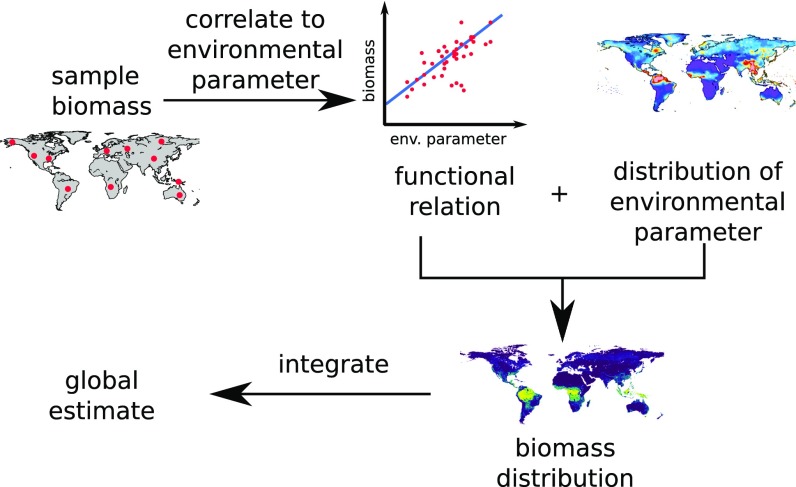
- For many taxa, local biomass samples are extrapolated globally by correlating biomass density with environmental parameters known at global scale; best estimates often use a geometric mean of independent estimates.
- Uncertainty is reported as multiplicative fold-change projections akin to 95% confidence intervals, incorporating intrastudy, interstudy, and intermethod variation; data and code are open-sourced.
Limitations
- The paper states that most datasets rely on fragmentary sampling, causing large uncertainties; sampling is scarce in the deep ocean (usually deeper than 200 m) and deep soil (usually deeper than 1 m), and some estimates may be biased by sampling toward high-abundance areas.
- The paper states that deep subsurface environments have particularly high uncertainty and unknown systematic biases, including unresolved distribution of biomass between aquifer fluids and rocks and among microbial taxa.
- The paper states that current and prehuman vertebrate biomass estimates are only a crude first step, amphibians remain poorly characterized, and parasite biomass is not resolved from hosts; evident from the text, kingdom-level grouping was chosen because much data lack finer taxonomic detail, and some uncertainty projections rely on analogous taxa or expert consultation.
Model-written summary. Check it against the paper before relying on it.
Integrity signals
Registry
Cites
Statistics
Figures
Verification
Claims the paper makes
9 Valid · 7 Not valid · 16 Not checked · 53 Own results and interpretations
Every source the paper cites for this claim was checked and supports it.
In the paper
“The biomass of amphibians, which are experiencing a dramatic population decline (42), remains poorly characterized.”
§ The biomass distribution on Earth > Discussion
What the sources say
- Supportedcites [42] Wake DB Vredenburg VT 2008 Colloquium paper: Are we in the midst of the sixth mass extinction? A view from the world of amphibians Proc Natl Acad Sci USA 105 11466 11473 18695221 PMC2556420 source
The citation is attached to the clause about amphibian population decline, not the separate statement that their biomass is poorly characterized. The passage reporting the Global Amphibian Assessment (labeled Abstract in our copy) says that 43% of amphibian species have declining populations. (LLM, conf=0.92)
plain- Asserted: passes — The authors put it forward as true.
- Checkable: passes — It can be checked against evidence.
- Load-bearing: unclear — It is unclear whether the paper’s conclusions depend on it.
- Based: passes — The paper gives a reason why it holds.
- Supported
Every source the paper cites for this claim was checked and supports it.
In the paper
“In the case of prokaryotes, some major improvements were recently realized, with global estimates of marine deep subsurface prokaryote biomass reduced by about two orders of magnitude due to an increased diversity of sampling locations (7).”
§ The biomass distribution on Earth > Discussion
What the sources say
- Supportedcites [7] Kallmeyer J Pockalny R Adhikari RR Smith DC D’Hondt S 2012 Global distribution of microbial abundance and biomass in subseafloor sediment Proc Natl Acad Sci USA 109 16213 16216 22927371 PMC3479597 source
The Discussion reports a revised subseafloor microbial biomass estimate of 4.1 Pg C versus a previous estimate of 303 Pg C—about a 74-fold reduction. It also identifies a more geographically diverse sampling database, including low-abundance ocean gyres, as a reason the new estimate is lower. The paper identifies other contributing factors as well. (LLM, conf=0.88)
plainstates a cause- Asserted: passes — The authors put it forward as true.
- Checkable: passes — It can be checked against evidence.
- Load-bearing: unclear — It is unclear whether the paper’s conclusions depend on it.
- Based: passes — The paper gives a reason why it holds.
- Supported
The sources with a verdict support this claim; the rest weren’t checked yet, have no full text we could read, or their verdicts aren’t rated yet.
In the paper
“Such inverted biomass distributions can occur when primary producers have a rapid turnover of biomass [on the order of days (34)], while consumer biomass turns over much more slowly [a few years in the case of mesopelagic fish (35)].”
§ The biomass distribution on Earth > Results > The Distribution of Biomass Across Environments and Trophic Modes.
What the sources say
- Supportedcites [34] Zubkov MV 2014 Faster growth of the major prokaryotic versus eukaryotic CO2 fixers in the oligotrophic ocean Nat Commun 5 3776 24777140 PMC4015317 source
The Results (Comparison of the growth rates of the CO2 fixers; page unavailable) report growth rates of 0.1–0.6 per day for the studied oceanic primary producers, consistent with biomass turnover on the order of days. The few-years estimate for mesopelagic fish is assigned to a different citation, not this source. (LLM, conf=0.91)
- Not checked — no full text of the sourcecites [35] Catul V Gauns M Karuppasamy PK 2011 A review on mesopelagic fishes belonging to family Myctophidae Rev Fish Biol Fish 21 339 354 source
plainstates a possible cause- Asserted: passes — The authors put it forward as true.
- Checkable: passes — It can be checked against evidence.
- Load-bearing: passes — The paper’s conclusions depend on it.
- Based: passes — The paper gives a reason why it holds.
- Supported
The cited sources support only part of this claim — read each source’s verdict below.
In the paper
“Combining data from independent sources such as these enables a robust assessment of the total plant biomass (17).”
§ The biomass distribution on Earth > Results > The Uncertainty Associated with Global Biomass Estimates.
What the sources say
- Partly supportedcites [17] Erb K-H 2017 Unexpectedly large impact of forest management and grazing on global vegetation biomass Nature 553 73 76 29258288 PMC5756473 sourceExperimental — accuracy not yet measured
The Methods describe combining multiple datasets and types of evidence to estimate global vegetation biomass stocks. But the paper also says global stocks remain uncertain, reports uncertainty ranges around 35% of the median estimate, and describes more robust estimates as a future prospect. It therefore supports the use of independent sources for an assessment, but not the unqualified characterization of that assessment as robust. (LLM, conf=0.84)
plainstates a cause- Asserted: passes — The authors put it forward as true.
- Checkable: passes — It can be checked against evidence.
- Load-bearing: passes — The paper’s conclusions depend on it.
- Based: passes — The paper gives a reason why it holds.
- Partly supported
A result the paper states — it cites no source for it, so there is none to check. The quote shows it is in the paper.
In the paper
“Plant biomass includes ≈70% stems and tree trunks, which are mostly woody, and thus relatively metabolically inert.”
§ The biomass distribution on Earth > Results > The Biomass Distribution of the Biosphere by Kingdom.
plain- Asserted: passes — The authors put it forward as true.
- Checkable: passes — It can be checked against evidence.
- Load-bearing: unclear — It is unclear whether the paper’s conclusions depend on it.
- Based: passes — The paper gives a reason why it holds.
27 more claims
Create a free account to see all 85 claims and to verify the 2 references still open.
- It may state two separate claims as one. 32
- Probably not a substantial claim. 28
Claims other papers make about this one
Each is checked against this paper’s own text: does it say what the citing paper says it does?
The cited source doesn’t support the claim as written.
In the citing paper
“and less than 10% that of the world ' s current human population ( 52 ).”
From Pervasive human-driven decline of life on Earth points to the need for transformative change (2019) · cites this paper as [52]
Checked by a reasoning model — may be wrong.
Experimental — accuracy not yet measuredThe cited source says what the claim attributes to it.
In the citing paper
“Approximately 450 Gt of C is bound up in terrestrial biota, primarily in plants (86), while only ~6 Gt of C is found in ocean biota (87).”
From Earth beyond six of nine planetary boundaries (2023) · cites this paper as [87]
The cited source says what the claim attributes to it.
In the citing paper
“The amount of metabolic energy available to a biosphere powered by O 2 is vast, such that the O 2 -rich ocean-atmosphere system of the modern Earth supports staggering levels of standing biomass (Bar-On et al. 2018), energy flow (Falkowski et al. 2008), and ecological complexity (Steele 1974).”
From The History of Ocean Oxygenation (2022) · cites this paper as Bar-On et al. 2018
In the citing paper
“Global populations of domestic ruminants (cattle, sheep, and goats) (Ripple et al. 2013) poultry, and pigs (Bennett et al. 2018) used to feed the growing human population now exceed 100 million tons of carbon (Bar-On et al. 2018), and livestock populations are growing rapidly.”
From Scientists’ warning to humanity on the freshwater biodiversity crisis (2021) · cites this paper as Bar-On et al. 2018
Citations
Cites
The worldwide leaf economics spectrum
Wright, I. J., Reich, P. B., Westoby, M., Ackerly, D. D., Baruch, Z., Bongers, F., Cavender-Bares, J., Chapin, T., Cornelissen, J. H. C., Diemer, M., et al. (2004) · Nature · doi:10.1038/nature02403 · Cited by 9,021 · cited 1×
“We then convert the total area of leaves to an estimate of the total dry mass of leaves by using the Glopnet database (24), which measured leaf mass per area (LMA) for ≈2500 plant species.”
MethodA large and persistent carbon sink in the world’s forests
Pan, Y., Birdsey, R. A., Fang, J., Houghton, R., Kauppi, P. E., Kurz, W. A., Phillips, O. L., Shvidenko, A., Lewis, S. L., Canadell, J. G., et al. (2011) · Science · doi:10.1126/science.1201609 · Cited by 8,458
Soil Sampling and Methods of Analysis
(2007) · CRC Press eBooks · doi:10.1201/9781420005271 · Cited by 6,469
Primary production of the biosphere: Integrating terrestrial and oceanic components
Field, C. B., Behrenfeld, M. J., Randerson, J. T., & Falkowski, P. (1998) · Science · doi:10.1126/science.281.5374.237 · Cited by 6,371
Prokaryotes: The unseen majority
Whitman, W. B., Coleman, D. C., & Wiebe, W. J. (1998) · Proceedings of the National Academy of Sciences · doi:10.1073/pnas.95.12.6578 · Cited by 4,871
Global effects of land use on local terrestrial biodiversity
Newbold, T., Hudson, L. N., Hill, S. L. L., Contu, S., Lysenko, I., Senior, R. A., Börger, L., Bennett, D. J., Choimes, A., Collen, B., et al. (2015) · Nature · doi:10.1038/nature14324 · Cited by 4,352
Belowground biodiversity and ecosystem functioning
Bardgett, R. D., & van der Putten, W. H. (2014) · Nature · doi:10.1038/nature13855 · Cited by 3,990 · cited 4×
“This was recommended by experts in the field for estimation of arbuscular mycorrhizal fungi abundance (117).”
BackgroundInfluentialMangroves among the most carbon-rich forests in the tropics
Donato, D. C., Kauffman, J. B., Murdiyarso, D., Kurnianto, S., Stidham, M., & Kanninen, M. (2011) · Nature Geoscience · doi:10.1038/ngeo1123 · Cited by 3,374
Poorter, H., Niklas, K. J., Reich, P. B., Oleksyn, J., Poot, P., & Mommer, L. (2012) · New Phytologist · doi:10.1111/j.1469-8137.2011.03952.x · Cited by 3,163 · cited 1×
“The first relies on a meta-analysis of the biomass allocation to different plant compartments across biomes (19).”
BackgroundA global analysis of root distributions for terrestrial biomes
Jackson, R. B., Canadell, J., Ehleringer, J. R., Mooney, H. A., Sala, O. E., & Schulze, E. D. (1996) · Oecologia · doi:10.1007/bf00333714 · Cited by 3,071 · cited 4×
“assumed the distribution of microbial biomass with depth follows the biomass density versus depth profile of root biomass (21).”
BackgroundMethodInfluential
Research works printed but not linked: 1
- Chapman AD 2009 Numbers of Living Species in Australia and the World Australian Biological Resources Study Canberra, Australia
Cited by
Items 2,301–2,400 of 3,743
Institut de Ciència i Tecnologia Ambientals (ICTA), U. A. D. B., Hatton, I. A., Galbraith, E. D., & Institut de Ciència i Tecnologia Ambientals (ICTA), U. A. D. B. (2020) · Russian Journal of Ecosystem Ecology · doi:10.21685/2500-0578-2020-2-5 · Cited by 2
“The estimate of 13 Gt of phytoplankton reported in the author’s Table 1 [25], extended over the 360 million km(2) of the ocean’s surface amounts to an autotroph layer only ~0.”
BackgroundA Study on the Future of World Leader’s Behaviour Towards Global Health after COVID-19Preprint
Itagi, G., & Aithal, P. S. (2020) · SSRN Electronic Journal · doi:10.2139/ssrn.3612021 · Cited by 2
“01 per cent of the biomass on the earth and 95 per cent of these population on the earth lives on just 10 per cent of the land [1] [2].”
BackgroundAggarwal, A., Rai, R., Joshi, G., & Gahtori, P. (2021) · medRxiv · doi:10.1101/2021.09.09.21263347 · Cited by 2
Durango, H., Morales, H., Ramos, E. M., et al. (2021) · Research Square · doi:10.21203/rs.3.rs-1184472/v1 · Cited by 2
Roy, S., Naidu, D., & Bagchi, S. (2022) · bioRxiv · doi:10.1101/2022.02.07.479355 · Cited by 2
“Smith, 2014) across a 107 large fraction of the earth’s terrestrial surface (Asner et al., 2004; Bar-On et al., 2018).”
BackgroundInfluentialLu, J. (2021) · eDiss (Georg-August-Universität Göttingen) · doi:10.53846/goediss-8908 · Cited by 3
From Groundwater to Drinking Water—Microbiology of Karstic Water Resources
Savio, D., Derx, J., Lang, R., Kirschner, A. K. T., Sommer, R., Blaschke, A. P., Küsel, K., & Farnleitner, A. H. (2022) · Elsevier eBooks · doi:10.1016/b978-0-12-819166-8.00181-x · Cited by 6
COSMOPOLÍTICAS DA TERRA: MODOS DE EXISTÊNCIA E RESISTÊNCIA NO ANTROPOCENO
COSTA, A. D. C. (2019) · doi:10.17771/pucrio.acad.46900 · Cited by 24
A metagenomic view on fungal diversity in freshwater lakesPreprint
Sanyal, A., Kluge, M., Redondo, M. Á., et al. (2022) · bioRxiv (Cold Spring Harbor Laboratory) · doi:10.1101/2022.06.20.496890 · Cited by 2
“Earth has been estimated to be of fungi (Bar-On et al. 2018).”
BackgroundMaitner, B., Gallagher, R. V., Svenning, J., et al. (2022) · bioRxiv (Cold Spring Harbor Laboratory) · doi:10.1101/2022.09.26.509556 · Cited by 2
Semenov, M. V. (2022) · Elsevier eBooks · doi:10.1016/b978-0-12-822974-3.00095-1 · Cited by 2
Geisen, S., Amacker, N., & Jousset, A. (2022) · Elsevier eBooks · doi:10.1016/b978-0-12-822974-3.00075-6 · Cited by 2
ГЛУБИННАЯ БИОСФЕРА ЗЕМЛИ, СОВРЕМЕННАЯ И ДРЕВНЯЯPreprint
Беляев, А., & Юхалин, П. (2022) · doi:10.24108/preprints-3112589 · Cited by 2
Suzuki, Y., Trembath‐Reichert, E., & Drake, H. (2022) · Frontiers in Microbiology · doi:10.3389/fmicb.2022.1102710 · Cited by 2
“geobiology, geomicrobiology, astrobiology, subsurfacemicrobiology, deepbiosphere Editorial on the Research Topic The rocky biosphere: New insights from microbiomes at rock-water interfaces and their interactions with minerals The deep subsurface hosts one of the largest, yet least explored ecosystems on Earth.”
BackgroundInfluentialResistance, recovery, and resilience: rethinking the three Rs of survival in the AnthropocenePreprint
Abbott, B. W., Underwood, K. L., Seybold, E. C., Kincaid, D. W., Hamshaw, S. D., Lee, R. M., Rizzo, D. M., Brown, B., Toolin, R. E., Chorover, J., et al. (2023) · doi:10.22541/essoar.167390526.69780816/v1 · Cited by 4
Toorians, M. E. M., MacPherson, A., & Davies, T. J. (2023) · Preprints.org · doi:10.20944/preprints202110.0295.v4 · Cited by 1
Olanrewaju, O. S., & Lazzaro, U. (2023) · Preprints.org · doi:10.20944/preprints202305.0812.v2 · Cited by 1
Dynamic and Optimal Ash-to-Gas Responses of Oxy-Fuel and Air Combustions of Soil Remediation BiomassPreprint
Chen, Z., Li, W., Dai, W., et al. (2023) · SSRN Electronic Journal · doi:10.2139/ssrn.4479470 · Cited by 2
Kumar, N. (2023) · bioRxiv (Cold Spring Harbor Laboratory) · doi:10.1101/2023.07.13.546415 · Cited by 6
“Over the last six decades, the production and consumption of poultry have dramatically increased, leading to the current situation where the overall biomass of poultry-fowl now exceeds the combined value of all wild birds on Earth by more than 300% (Bar-On et al., 2018; Bennett et al., 2018).”
BackgroundInfluentialEditorial: Coexistence between conservation and food security in social-ecological systems
Crespín, S. J., Bhatia, S., & Jiren, T. S. (2023) · Frontiers in Conservation Science · doi:10.3389/fcosc.2023.1225841 · Cited by 2
Biodegradation of polycyclic aromatic hydrocarbons in the surface ocean
Martinez‐Varela, A. (2022) · UPCommons institutional repository (Universitat Politècnica de Catalunya) · doi:10.5821/dissertation-2117-367550 · Cited by 2
A molecular atlas of plastid and mitochondrial evolution from algae to angiospermsPreprint
Raval, P. K., MacLeod, A. I., & Gould, S. B. (2023) · bioRxiv (Cold Spring Harbor Laboratory) · doi:10.1101/2023.09.01.555919 · Cited by 2
Physical modeling of gelatinous zooplankton sinking in the deep global oceanPreprint
Ličer, M., Vodopıvec, M., Herndl, G. J., & Tinta, T. (2023) · doi:10.22541/essoar.169754927.71150576/v1 · Cited by 2
Grace, J. (2023) · Elsevier eBooks · doi:10.1016/b978-0-12-822562-2.00366-2 · Cited by 4
SPECTRE: standardized global spatial data on terrestrial SPECies ThREatsPreprint
Branco, V. V., Correia, L. M. P., & Cardoso, P. (2023) · bioRxiv (Cold Spring Harbor Laboratory) · doi:10.1101/2023.11.26.568516 · Cited by 2
“LIVESTOCK_MASS was created using a similar methodology to that described in Bar-On, Phillips & Milo (2018).”
MethodCamenzind, T., Haslwimmer, H., Rillig, M., Ruess, L., Finn, D., Tebbe, C., Hempel, S., & Marhan, S. (2024) · bioRxiv (Cold Spring Harbor Laboratory) · doi:10.1101/2024.01.04.574151 · Cited by 2
Garber, P. A., Dolins, F. L., & Lappan, S. (2024) · American Journal of Primatology · doi:10.1002/ajp.23601 · Cited by 2
The Overlooked Contribution of Pelagic Fungi to Ocean BiomassPreprint
Breyer, E., Stix, C., Kilker, S., et al. (2024) · SSRN Electronic Journal · doi:10.2139/ssrn.4790633 · Cited by 2
Olanrewaju, O. S., & Lazzaro, U. (2024) · Preprints.org · doi:10.20944/preprints202308.1017.v2 · Cited by 1
Ecological not social factors explain brain size in cephalopodsPreprint
Basava, K., Bendixen, T., Leonhard, A., et al. (2024) · bioRxiv (Cold Spring Harbor Laboratory) · doi:10.1101/2024.05.01.592020 · Cited by 2
Rapid adaptive evolution of microbial thermal performance curvesPreprint
Liu, M. H., Han, Z., Yuan, Y., et al. (2024) · bioRxiv (Cold Spring Harbor Laboratory) · doi:10.1101/2024.04.30.590804 · Cited by 2
“We address these questions in a globally important ciliate protist species—i.e., unicellular Eukaryotes that dominate oceanic biomass (Bar-On & Milo, 2019), hold twice the biomass of the entire Animal Kingdom (Bar-On et al., 2018), rank third in terrestrial biomass (Bar-On et al., 2018), and underpin global ecosystem…”
BackgroundModification of xylan in secondary walls alters cell wall biosynthesis and wood formation programsPreprint
Sivan, P., Urbancsok, J., Donev, E. N., et al. (2024) · bioRxiv (Cold Spring Harbor Laboratory) · doi:10.1101/2024.05.02.592170 · Cited by 2
Li, J. (2024) · doi:10.33774/coe-2024-5lnw2 · Cited by 2
Tiawoun, M. A. P., Phogole, B., Kandolo, B. S., & Yessoufou, K. (2025) · bioRxiv (Cold Spring Harbor Laboratory) · doi:10.1101/2025.02.12.637779 · Cited by 3
Rights to Microbes (RtM) and Rights of Microbes (RoM): Microbial Rights for a Planetary AgePreprint
Rizk, A., Jones, E., Saab, A., et al. (2025) · SSRN Electronic Journal · doi:10.2139/ssrn.5361866 · Cited by 2
Environment and disease have tissue-specific effects on the tree microbiomePreprint
Downie, J., Ordonez, A., Cambon, M. C., Hussain, U., Brown, N., Beckmann, M., Finch, J. P., Draper, J., Denman, S., & McDonald, J. E. (2025) · bioRxiv (Cold Spring Harbor Laboratory) · doi:10.1101/2025.08.15.670310 · Cited by 3
“Trees represent the largest component of living biomass on Earth 1 and provide essential ecosystem, societal and economic services that sustain planetary health and shape the terrestrial biosphere 2 , including CO 2 assimilation 3 and atmospheric methane uptake 4 .”
Origin of chaperone dependence and assembly complexity in Rubisco’s biogenesisPreprint
Ng, J. Z. Y., Wiens, D., Schulz, L., Hergenröder, A., Küffner, A. M., Geil, C., Erb, T. J., & Hochberg, G. K. A. (2025) · bioRxiv (Cold Spring Harbor Laboratory) · doi:10.1101/2025.09.22.677769 · Cited by 4
“1A) ( 12 – 14 ), the enzyme responsible for CO 2 fixation in oxygenic photosynthesis and probably the most abundant protein on Earth ( 15 – 17 ).”
The Global Chemical Experiment
Sunderland, E. M., & Wagner, C. C. (2020) · Open Book Publishers · doi:10.11647/obp.0193.21 · Cited by 1
Utilizing Bacteria to Mitigate Global Climate Change: A Review
Dumka, S., Gupta, C., & Kamboj, A. (2020) · International Journal of Current Microbiology and Applied Sciences · doi:10.20546/ijcmas.2020.905.157 · Cited by 2
“Generally autotrophs dominate over the heterotrophs on the earth in terms of utilization and sequestration of atmospheric CO2 and supply of biomass (Bar-On et al., 2018).”
BackgroundA new high: Cannabis as a budding source of carbon-based materials for electrochemical power sources
Rana, Z., Shah, A. R., Llewellyn, A. V., Mazloomian, K., McAlernon, P., Miller, T. S., Cullen, P. L., Shearing, P. R., & Brett, D. J. L. (2021) · Current Opinion in Electrochemistry · doi:10.1016/j.coelec.2021.100860 · Cited by 2
“It is considering a sustainable and renewable source of carbon, with plant biomass accounting for an overall reserve of 450 gigtatons of carbon [60].”
BackgroundLoredo, E. G. L., & Mendoza, M. E. (2021) · Ecosistemas · doi:10.7818/ecos.2235 · Cited by 3
Beneath shaky ground: deep life at Koyna, India
Kieft, T. L. (2021) · Environmental Microbiology · doi:10.1111/1462-2920.15866 · Cited by 1
The New Meatways and Sustainability: Discourses and Social Practices
Kanerva, M. (2021) · Edition Politik · doi:10.14361/9783839454336 · Cited by 23
SAKATA, S. (2021) · Synthesiology · doi:10.5571/synth.2021.3_1 · Cited by 1
Mechanosensory Behaviour and Biotremology in Nematodes
Sugi, T. (2022) · Animal signals and communication · doi:10.1007/978-3-030-97419-0_12 · Cited by 2
Spontaneous plant species responses to engineered nanoparticles
Marchiol, L., Pilotto, L., Lizzi, D., & Fellet, G. (2022) · Elsevier eBooks · doi:10.1016/b978-0-323-85032-2.00006-3 · Cited by 1
Honeybee Bias and Bee-washing: Effects of Vertebrate-centric Care?
Davies, O., & Sayers, T. D. J. (2022) · Oxford University Press eBooks · doi:10.1093/oxfordhb/9780192848185.013.21 · Cited by 3
Violent elements: the impossible document of ‘1984’
Baer, B. C. (2022) · Sikh Formations · doi:10.1080/17448727.2022.2139904 · Cited by 1
“…it can neither know nor master (for instance, the bacterial biomass on earth – excluding viruses, protists, archaeae and fungi, some of which do also live in paper archives – is currently estimated to exceed that of human life by a factor of over one thousand [Bar-On, Phillips, and Milo 2018]).”
BackgroundHuman and domesticated animal environmental DNA as bioassays of the Anthropocene
Thaler, D. S., Ausubel, J. H., & Stoeckle, M. Y. (2022) · The Innovation · doi:10.1016/j.xinn.2022.100356 · Cited by 1
“Humans are now the dominant terrestrial vertebrate, composing about 1/3 of land vertebrate biomass, which translates to 1/10 of total vertebrate biomass.(2) The other terrestrial 2/3 consists nearly entirely of livestock kept by humans for food.”
BackgroundLv, C., Saba, T., Wang, J., Hui, W., & Gong, W. (2023) · Plant and Soil · doi:10.1007/s11104-023-06268-0 · Cited by 1
“Afforestation is widely considered to be an effective way to increase the C stock of terrestrial ecosystems and mitigate global climate change because plants can absorb and store CO 2 from the atmosphere through photosynthesis (Bar-On et al. 2018; Street et al. 2020).”
Aguirre-Medina, J. F., Aguirre-Cadena, J. F., Escobar-España, J. C., et al. (2023) · Revista Fitotecnia Mexicana · doi:10.35196/rfm.2023.3.273 · Cited by 1
Wilkinson, D. M. (2023) · Oxford University Press eBooks · doi:10.1093/oso/9780192884640.003.0004 · Cited by 1
Climate Change and Animal Ethics
Pollo, S. (2023) · Handbooks in philosophy · doi:10.1007/978-3-031-07002-0_72 · Cited by 1
Mechanistic Explanation, Interdisciplinary Integration and Interpersonal Social Coordination
Sarkia, M. (2024) · Social Epistemology · doi:10.1080/02691728.2023.2294841 · Cited by 1
CFD analysis of existing Mobile Disinfecting Units (MDUs)
Constantino, I. J., & Serrano, N. L. (2024) · E3S Web of Conferences · doi:10.1051/e3sconf/202448803016 · Cited by 1
“Despite its size depending on what variant is between 50 and 150 nanometers across [1] , the SARS-Cov-2 virus caused at least 234 million cases worldwide in the span of 20 months and is continuously increasing up to this time.”
Karak, S., Garima, Berry, E., & Choudhary, A. K. (2024) · Springer eBooks · doi:10.1007/978-981-97-0823-9_9 · Cited by 1
Perspective Chapter: Caste, Class, Race and Poverty – A Perspective from the Case of Pellagra
Williams, A. C., Badenoch, E. G., & Hill, L. J. (2024) · Sustainable development · doi:10.5772/intechopen.1005314 · Cited by 1
Vilar, A., Vicente, T. M., Martins, M. V. A., et al. (2024) · Marine Micropaleontology · doi:10.1016/j.marmicro.2024.102396 · Cited by 1
Plant-Based v. Omnivorous Diets: Comparative Environmental Impacts
Cleveland, D. A., & Jay, J. A. (2024) · Springer eBooks · doi:10.1007/978-3-031-63083-5_30 · Cited by 2
Study of microplastic accumulation in halophyte plants and macroalgae: A critical review
Fara, M. E., Muslim, M., & Munir, M. (2025) · Environmental Research and Technology · doi:10.35208/ert.1499952 · Cited by 2
Habitat fragmentation drives pest termite risk in humid, but not arid, biomes
Wu, D., Liu, C., Caron, F. S., Luo, Y., Pie, M. R., Yu, M., Eggleton, P., & Chu, C. (2024) · One Earth · doi:10.1016/j.oneear.2024.10.003 · Cited by 3
Optimism about Wild Fish Welfare
York, K. (2024) · Journal of Agricultural and Environmental Ethics · doi:10.1007/s10806-024-09937-x · Cited by 3
“In any case, the only methodology of fish-to-biomass ratio estimates in MacAskill’s sources seem to be based upon the average numbers and weights of fish caught by commercial fisheries (Bar-On et al., 2018).”
Patil, S. P., Chaudhari, T. B., Dalal, K. S., Phirke, N. V., & Chaudhari, B. L. (2024) · Springer eBooks · doi:10.1007/978-981-97-6270-5_21 · Cited by 5
Amazonia in symbiosis: traces of humankinds facing the Anthropocene
Aparício, M., Moraes, C. D. P., Py-Daniel, A. R., & Neves, E. G. (2024) · Estudos Avançados · doi:10.1590/s0103-4014.202438112.002-en · Cited by 1
Planter i skandinavisk barne- og ungdomslitteratur – en introduksjon
Guanio-Uluru, L., & Reed, B. G. (2024) · Universitetsforlaget eBooks · doi:10.18261/9788215069883-24-00 · Cited by 1
Sonnenberg, A. S. M., Nayan, N., Cone, J. W., et al. (2024) · Journal of Fungi · doi:10.3390/jof10120858 · Cited by 1
Sheremetev, I. S., Demchenko, V. I., Шереметьева, И. Н., et al. (2024) · Contemporary Problems of Ecology · doi:10.1134/s1995425524700562 · Cited by 1
“Plants represent the main trophic resource in terrestrial ecosystems (Bar-On et al., 2018).”
Biomasa aérea y radicular en etapa de brinzal de Abies religiosa (Kunth) Schltdl. & Cham. en Hidalgo
Chávez, N. M., Rodríguez-Laguna, R., Razo-Zárate, R., et al. (2024) · Revista mexicana de ciencias forestales · doi:10.29298/rmcf.v16i87.1503 · Cited by 1
Honda, M. C. (2025) · Oceanography in Japan · doi:10.5928/kaiyou.34.1_1 · Cited by 1
Domestic Dogs Exposed to Orthopoxvirus in Urban Areas of Brazil
de Meneses, D., Stoffella-Dutra, A. G., Blaso, V. S., de Almeida, I. M., Dias, K. L., Domingos, I. J. D. S., Ribeiro, G. P., Coura-Vital, W., Reis, A. B., Vieira, T. M., et al. (2025) · Viruses · doi:10.3390/v17010131 · Cited by 1
“These characteristics of domestic animals increase the sharing of pathogens [8,9].”
Screening Adaptive Microbial Hydrolytic Enzymes for Cleaner Production in Resource-Limited Settings
Mahatmanto, T. (2025) · Industrial Biotechnology · doi:10.1089/ind.2024.0032 · Cited by 1
“48,49 With 10 30 prokaryotic cells 50 and other eukaryotic microorganisms to screen from, nature provides an immense resource for microbial enzyme discovery.”
Mathematical forms of Planck’s thermal radiation law and photobiological biomass adaptations
Sendova, M., & Moncada-Almendarez, I. (2025) · Academia Biology · doi:10.20935/acadbiol7513 · Cited by 1
Nanomaterials in the pretreatment of biomass
Mallick, S., Chakraborty, A., & Ray, R. R. (2025) · Elsevier eBooks · doi:10.1016/b978-0-443-24748-4.00013-1 · Cited by 2
Bioeconomic Construction: Technical, Economic, and Cultural Challenges
Grossarth, J. (2025) · Springer eBooks · doi:10.1007/978-3-031-84014-2_2 · Cited by 1
Habitat affinities of European temperate forest plants
Chiarucci, A. (2025) · Nature Plants · doi:10.1038/s41477-025-01997-9 · Cited by 1
Muñoz-Rivera, M.-P., Martínez‐Morales, F., Morales-Guzmán, D., Rivera-Ramírez, A., Sánchez‐Reyes, A., & Trejo‐Hernández, M. R. (2025) · International Microbiology · doi:10.1007/s10123-025-00659-2 · Cited by 1
“Marine sediment covers 70% of Earth’s surface and represents one of the more biodiverse assets of the ecosphere just compared to soil and water environments which remains largely unexplored (Bar-On et al. 2018; Hoshino et al. 2020).”
Ethics of Plants: Interconnections between Biosemiotics and Critical Plant Studies
Comollo, F. (2025) · Biosemiotics · doi:10.1007/s12304-025-09611-3 · Cited by 1
“…of human beings, even to discuss the normative implications for human-plant relationships – considering that plants represent the eighty per cent of the biomass on this planet (Bar-On et al., 2018 , P. 6507), we are excluding from our moral consideration the majority of life on this planet.”
Mastery, Equality, or Reciprocity? Ambiguities of Human–Animal Relationships
Cobb, C. W. (2025) · American Journal of Economics and Sociology · doi:10.1111/ajes.12638 · Cited by 1
Pan, Y., Tao, Y., Yang, X., et al. (2025) · Microbiology Spectrum · doi:10.1128/spectrum.00517-25 · Cited by 1
“ocean health and climate resilience (1).”
A haplotype-resolved reference genome for Eucalyptus grandis
Lötter, A., Brůna, T., Duong, T. A., Barry, K., Lipzen, A., Daum, C. G., Yoshinaga, Y., Grimwood, J., Jenkins, J. W., Talag, J., et al. (2025) · G3 Genes Genomes Genetics · doi:10.1093/g3journal/jkaf112 · Cited by 3
Growth potential of Ulva prolifera in the South Yellow Sea and effectiveness of countermeasures
Wang, C., Tang, Y., Xu, Y., et al. (2025) · Journal of Marine Systems · doi:10.1016/j.jmarsys.2025.104094 · Cited by 1
Response of soil viruses to multiple crop types and environmental changes
Xie, G., Zhou, H., Zhou, R., et al. (2025) · Plant and Soil · doi:10.1007/s11104-025-07692-0 · Cited by 1
“While phage-induced bacterial lysis in soil has been studied to some extent, even less is known about viral-induced mortality of fungi and other eukaryotes (Bar-On et al. 2018).”
Measures of prehistoric terrestrial net ecosystem productivity and carbon sink function
Mays, C., Tyson, R. V., & Hren, M. T. (2025) · Earth-Science Reviews · doi:10.1016/j.earscirev.2025.105222 · Cited by 2
Environmental effects of land plants evolution in the phanerozoic
Cai, J., Ju, P., Liu, M., Xue, J., & Zhao, M. (2025) · Chinese Science Bulletin (Chinese Version) · doi:10.1360/tb-2025-0173 · Cited by 4
Mizumoto, N., Chambliss, W., Carroll, E. P., et al. (2025) · Journal of Ethology · doi:10.1007/s10164-025-00857-5 · Cited by 1
“Social insects play a dominant role in ecosystems, either as predators, pollinators, or decomposers, contributing to global biomass (Bar-On et al. 2018; Eggleton 2020; Tuma et al. 2020).”
Maracle, S., Garvie, M., Taylor, C. J. L., Fisher, M., Cumming, B. F., & Lougheed, S. C. (2025) · Ecology and Evolution · doi:10.1002/ece3.71948 · Cited by 1
Vitale, L. A., Tedesco, P., Galasso, C., et al. (2025) · Journal of environmental chemical engineering · doi:10.1016/j.jece.2025.118729 · Cited by 1
Cen, C., Wang, W., Jian, M., Wang, Z., & Yang, J. (2025) · Ecology and Evolution · doi:10.1002/ece3.72021 · Cited by 2
“Microbial diversity is crucial for biodiversity, particularly within soil-based bacteria and fungi which underpin biogeochemical cycles (Bar-On et al. 2018).”
The big picture: Wildlife population ecology at the interface of humans and biodiversity
Mills, L. S., Whiteley, A. R., & Tourani, M. (2025) · Oxford University Press eBooks · doi:10.1093/oso/9780192898166.003.0001 · Cited by 1
Population responses to human-caused stressors: Move, adjust, or die
Mills, L. S., Whiteley, A. R., & Tourani, M. (2025) · Oxford University Press eBooks · doi:10.1093/oso/9780192898166.003.0011 · Cited by 1
Apex Scavenger Declines Have Cascading Effects on Soil Biogeochemistry and Ecosystem Processes
Stephenson, T., Crowder, D. W., Osburn, E. D., Strickland, M. S., Jones, M. E., Bartel, S. L., Kittipalawattanapol, K., Cunningham, C. X., Hudiburg, T. W., Storfer, A. T., et al. (2025) · Global Change Biology · doi:10.1111/gcb.70520 · Cited by 4
“As this is far less than the ~320 billion metric tons provided by plants (Bar-On et al. 2018), animal inputs are often disregarded in the context of soil biogeochemistry.”
Outbreaks of SARS-CoV-2 in minks: public health, environmental and bioethical perspectives
Halabowski, D., Gwenzi, W., Skubała, P., Fal, A., Szuster‐Ciesielska, A., & Rzymski, P. (2025) · Environmental Sciences Europe · doi:10.1186/s12302-025-01202-w · Cited by 2
“Since the appearance of humans, the biomass of wild land mammals has decreased sixfold, comprising only 4% of the mammalian biomass [26].”
Characteristics of global datasets used to support biodiversity conservation action and policy
Copperthwaite, G., O’Connell, M. J., Berry, R., Lynch, K. D., & Bennett, R. (2025) · Journal for Nature Conservation · doi:10.1016/j.jnc.2025.127111 · Cited by 4
Chen, F., Lian, Y., & Wang, Y. (2025) · Diversity · doi:10.3390/d17100719 · Cited by 1
Current understanding of electroautotrophy and its relevance in astrobiology‐related research
Wang, Q., & Lau, M. C. Y. (2025) · mLife · doi:10.1002/mlf2.70032 · Cited by 1
“These reports of microbial electroactivity may have only scratched a tiny bit of the deep biosphere that hosts a vast reservoir of microbial biomass 141 .”
Ahmed, M., Arshad, A., Raza, M. Y., & Malik, A. (2025) · Advances in global change research · doi:10.1007/978-3-032-00190-0_5 · Cited by 2
Nenning, T., Todt, J., Kečkéš, J., Konnerth, J., Gindl‐Altmutter, W., Grabner, M., Tockner, A., Hansmann, C., & Pramreiter, M. (2025) · Next Materials · doi:10.1016/j.nxmate.2025.101347 · Cited by 1
Boyle, M. J. W., Williamson, J., Rossiter, S. J., Pfeifer, M., Drinkwater, R., Woon, J. S., Ashton, L. A., van Breugel, M., Eggleton, P., Evans, T. A., et al. (2025) · iScience · doi:10.1016/j.isci.2025.113936 · Cited by 2
“7,20 Most animal species are ectotherms 21 including in the tropics, where invertebrates are numerically and functionally dominant.”
de Assis, D. A., & Ayub, M. A. Z. (2025) · Applied Biochemistry and Biotechnology · doi:10.1007/s12010-025-05402-1 · Cited by 2
“…sector occupies 75% of Earth’s arable land, and it is the major driver for deforestation and biodiversity loss, while being the source of massive greenhouse gas emissions (> 9.7 billion t CO 2 -eq • year −1 ) and is responsible for 78% of the eutrophication of superficial waters worldwide [6–11].”
InfluentialSheers, H., Stanfield, M. K., Smith, J. A., & Thickett, S. C. (2025) · Polymer Chemistry · doi:10.1039/d5py00509d · Cited by 2
Metadata
- Authors
- Bar-On, Y. M., Phillips, R., & Milo, R.
- Affiliations
- Department of Plant and Environmental Sciences, Weizmann Institute of Science, 76100 Rehovot, Israel;
- California Institute of Technology (US)
- Weizmann Institute of Science (IL)
- Corresponding author
- Milo, Ron
- Venue
- Proceedings of the National Academy of Sciences
- Publisher
- National Academy of Sciences
- Published
- 2018-05-21
- Volume
- 115
- Issue
- 25
- Pages
- 6506-6511
- ISSN
- 0027-8424 (ISSN-L)
- 1091-6490
- PMC
- PMC6016768
- OpenAlex
- W2804910112
- Cited by
- 3,723
- References
- 263
- Citations by year
- 2026: 349 · 2025: 450 · 2024: 589 · 2023: 617 · 2022: 498 · 2021: 498 · 2020: 419 · 2019: 246 · 2018: 49
- FWCI
- 239.98
- Type
- journal article
- Language
- en
- Open access
- hybrid
- doi.org
- Licence
- Locations
- Proceedings of the National Academy of Sciences (publishedVersion, cc-by-nc-nd)
- Europe PMC (PubMed Central) (publishedVersion, cc-by-nc-nd)
- PubMed Central (publishedVersion, cc-by-nc-nd)
- PubMed (publishedVersion)
- CaltechAUTHORS (California Institute of Technology) (submittedVersion, cc-by-nc-nd)
- Funders
- National Institutes of Health (5r35gm118043-07)
- National Institute of General Medical Sciences (R35 GM118043)
- Topics
- Physical Sciences › Environmental Science › Nature and Landscape Conservation › Ecology and Vegetation Dynamics Studies
- Physical Sciences › Environmental Science › Global and Planetary Change › Earth Systems and Cosmic Evolution
- Life Sciences › Agricultural and Biological Sciences › Soil Science › Soil Carbon and Nitrogen Dynamics
- Keywords
- biomass allocation, biomass carbon, terrestrial biomass, marine biomass, bacteria, archaea, food pyramid, wild mammals, fish biomass, plant biomass
- MeSH terms
- Animals, Archaea, Bacteria, Carbon, Humans, Plants, Ecosystem, Biomass, Earth, Planet, Biota
About these checks
Registry, retraction, Cites and statistics results are computed, not judged, with one exception: a printed reference that no index lists is read once by a model before it counts as a citation error. Claims are extracted by a model and kept only when their quote appears verbatim in the text; each cited source is then checked, with a model’s help, for whether it says what the claim relies on. Those verdicts can be wrong — read the claim’s quote and the cited source before relying on one.
The claim verdicts this report counts are experimental: their accuracy is not yet measured.
A language model drew the claims from the paper on 2026-10-10, under version 3 of the claim definition (model deepseek-v4.1-flash, prompt extract-v3).
A second model labelled each claim on 2026-10-10 (model jev-1.13-20260917, definition revision gold-guideline-v0.2).
Cited sources are checked with a language model’s help (gpt-6-sol).
Statistics and arithmetic are recomputed, not judged.
Confidence bands are shown only for fields calibrated on our annotated test set. None is calibrated yet, so no band is shown.
What counts as a claim ›How we measure confidence ›How we check this ›
Are you an author, or do you see a problem with this page? Request a review
Data sources
Bibliographic data: Semantic Scholar, OpenAlex, Crossref.
Contains information from the Semantic Scholar Academic Graph Datasets, made available under the ODC Attribution License (ODC-BY 1.0).
Semantic Scholar’s data is described in: Kinney, R., et al. (2023). The Semantic Scholar Open Data Platform. arXiv:2301.10140.
