

The biomass distribution on Earth
Open accessThe DOI matches its Crossref record; 263 of the 263 references it cites were found in a registry or an index; 11 of the 41 sources its claims cite were checked for support.
Abstract
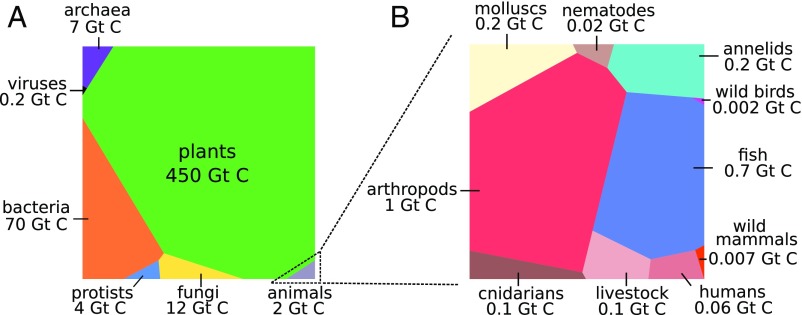
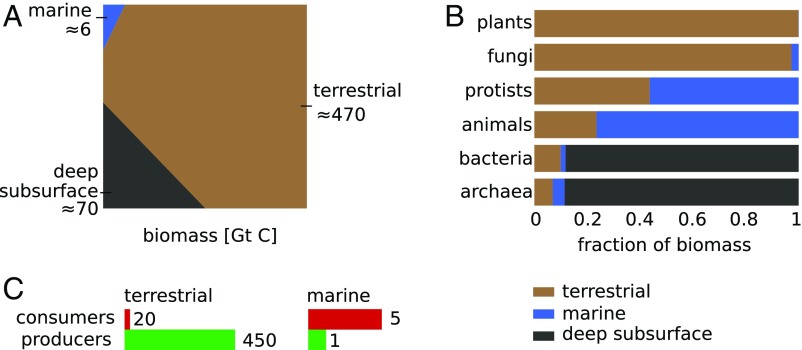
A census of the biomass on Earth is key for understanding the structure and dynamics of the biosphere. However, a global, quantitative view of how the biomass of different taxa compare with one another is still lacking. Here, we assemble the overall biomass composition of the biosphere, establishing a census of the ≈550 gigatons of carbon (Gt C) of biomass distributed among all of the kingdoms of life. We find that the kingdoms of life concentrate at different locations on the planet; plants (≈450 Gt C, the dominant kingdom) are primarily terrestrial, whereas animals (≈2 Gt C) are mainly marine, and bacteria (≈70 Gt C) and archaea (≈7 Gt C) are predominantly located in deep subsurface environments. We show that terrestrial biomass is about two orders of magnitude higher than marine biomass and estimate a total of ≈6 Gt C of marine biota, doubling the previous estimated quantity. Our analysis reveals that the global marine biomass pyramid contains more consumers than producers, thus increasing the scope of previous observations on inverse food pyramids. Finally, we highlight that the mass of humans is an order of magnitude higher than that of all wild mammals combined and report the historical impact of humanity on the global biomass of prominent taxa, including mammals, fish, and plants.
Overview
CoChat Summary
TL;DR
The paper assembles a global census of biomass across all kingdoms of life, estimating Earth’s total biomass at ≈550 Gt C, dominated by plants. It also compares biomass across environments and trophic modes, highlighting large uncertainties and human impacts on the biosphere.
Key findings
- Total global biomass is ≈550 Gt C, with plants ≈450 Gt C (≈80%), bacteria ≈70 Gt C (≈15%), fungi ≈12 Gt C, archaea ≈7 Gt C, protists ≈4 Gt C, animals ≈2 Gt C, and viruses ≈0.2 Gt C.
- Land biomass (≈470 Gt C) is about two orders of magnitude higher than marine biomass (≈6 Gt C); the deep subsurface holds ≈15% of total biomass, chiefly bacteria and archaea.
- In the ocean, ≈1 Gt C of primary producers supports ≈5 Gt C of consumer biomass, an inverted standing biomass distribution; marine biomass is ≈70% microbes, mainly bacteria and protists.
- Human-associated biomass is large relative to wild vertebrates: humans ≈0.06 Gt C, livestock ≈0.1 Gt C, wild mammals ≈0.007 Gt C, domesticated poultry ≈0.005 Gt C versus wild birds ≈0.002 Gt C; total plant biomass has declined approximately twofold relative to pre-human civilization.
Methods
- The authors synthesize hundreds of studies and generate estimates for major taxonomic groups, reporting biomass as gigatons of carbon (Gt C) and using a kingdom-level framework plus viruses.
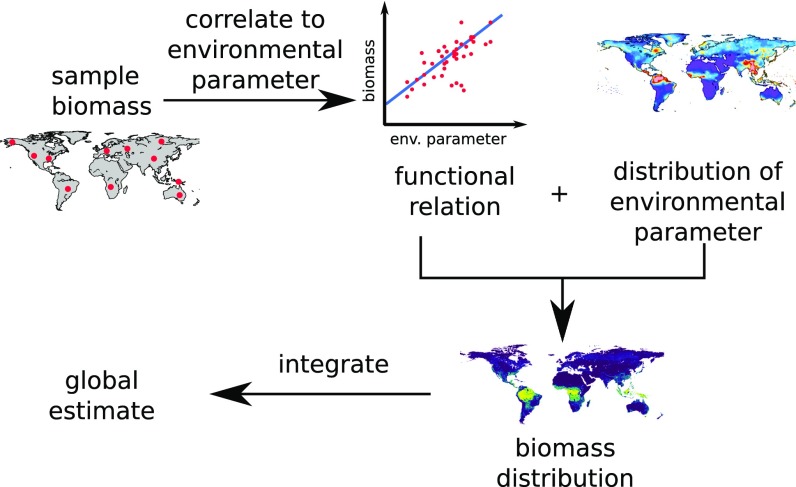
- For many taxa, local biomass samples are extrapolated globally by correlating biomass density with environmental parameters known at global scale; best estimates often use a geometric mean of independent estimates.
- Uncertainty is reported as multiplicative fold-change projections akin to 95% confidence intervals, incorporating intrastudy, interstudy, and intermethod variation; data and code are open-sourced.
Limitations
- The paper states that most datasets rely on fragmentary sampling, causing large uncertainties; sampling is scarce in the deep ocean (usually deeper than 200 m) and deep soil (usually deeper than 1 m), and some estimates may be biased by sampling toward high-abundance areas.
- The paper states that deep subsurface environments have particularly high uncertainty and unknown systematic biases, including unresolved distribution of biomass between aquifer fluids and rocks and among microbial taxa.
- The paper states that current and prehuman vertebrate biomass estimates are only a crude first step, amphibians remain poorly characterized, and parasite biomass is not resolved from hosts; evident from the text, kingdom-level grouping was chosen because much data lack finer taxonomic detail, and some uncertainty projections rely on analogous taxa or expert consultation.
Model-written summary. Check it against the paper before relying on it.
Integrity signals
Registry
Cites
Statistics
Figures
Verification
Claims the paper makes
9 Valid · 7 Not valid · 16 Not checked · 53 Own results and interpretations
Every source the paper cites for this claim was checked and supports it.
In the paper
“The biomass of amphibians, which are experiencing a dramatic population decline (42), remains poorly characterized.”
§ The biomass distribution on Earth > Discussion
What the sources say
- Supportedcites [42] Wake DB Vredenburg VT 2008 Colloquium paper: Are we in the midst of the sixth mass extinction? A view from the world of amphibians Proc Natl Acad Sci USA 105 11466 11473 18695221 PMC2556420 source
The citation is attached to the clause about amphibian population decline, not the separate statement that their biomass is poorly characterized. The passage reporting the Global Amphibian Assessment (labeled Abstract in our copy) says that 43% of amphibian species have declining populations. (LLM, conf=0.92)
plain- Asserted: passes — The authors put it forward as true.
- Checkable: passes — It can be checked against evidence.
- Load-bearing: unclear — It is unclear whether the paper’s conclusions depend on it.
- Based: passes — The paper gives a reason why it holds.
- Supported
Every source the paper cites for this claim was checked and supports it.
In the paper
“In the case of prokaryotes, some major improvements were recently realized, with global estimates of marine deep subsurface prokaryote biomass reduced by about two orders of magnitude due to an increased diversity of sampling locations (7).”
§ The biomass distribution on Earth > Discussion
What the sources say
- Supportedcites [7] Kallmeyer J Pockalny R Adhikari RR Smith DC D’Hondt S 2012 Global distribution of microbial abundance and biomass in subseafloor sediment Proc Natl Acad Sci USA 109 16213 16216 22927371 PMC3479597 source
The Discussion reports a revised subseafloor microbial biomass estimate of 4.1 Pg C versus a previous estimate of 303 Pg C—about a 74-fold reduction. It also identifies a more geographically diverse sampling database, including low-abundance ocean gyres, as a reason the new estimate is lower. The paper identifies other contributing factors as well. (LLM, conf=0.88)
plainstates a cause- Asserted: passes — The authors put it forward as true.
- Checkable: passes — It can be checked against evidence.
- Load-bearing: unclear — It is unclear whether the paper’s conclusions depend on it.
- Based: passes — The paper gives a reason why it holds.
- Supported
The sources with a verdict support this claim; the rest weren’t checked yet, have no full text we could read, or their verdicts aren’t rated yet.
In the paper
“Such inverted biomass distributions can occur when primary producers have a rapid turnover of biomass [on the order of days (34)], while consumer biomass turns over much more slowly [a few years in the case of mesopelagic fish (35)].”
§ The biomass distribution on Earth > Results > The Distribution of Biomass Across Environments and Trophic Modes.
What the sources say
- Supportedcites [34] Zubkov MV 2014 Faster growth of the major prokaryotic versus eukaryotic CO2 fixers in the oligotrophic ocean Nat Commun 5 3776 24777140 PMC4015317 source
The Results (Comparison of the growth rates of the CO2 fixers; page unavailable) report growth rates of 0.1–0.6 per day for the studied oceanic primary producers, consistent with biomass turnover on the order of days. The few-years estimate for mesopelagic fish is assigned to a different citation, not this source. (LLM, conf=0.91)
- Not checked — no full text of the sourcecites [35] Catul V Gauns M Karuppasamy PK 2011 A review on mesopelagic fishes belonging to family Myctophidae Rev Fish Biol Fish 21 339 354 source
plainstates a possible cause- Asserted: passes — The authors put it forward as true.
- Checkable: passes — It can be checked against evidence.
- Load-bearing: passes — The paper’s conclusions depend on it.
- Based: passes — The paper gives a reason why it holds.
- Supported
The cited sources support only part of this claim — read each source’s verdict below.
In the paper
“Combining data from independent sources such as these enables a robust assessment of the total plant biomass (17).”
§ The biomass distribution on Earth > Results > The Uncertainty Associated with Global Biomass Estimates.
What the sources say
- Partly supportedcites [17] Erb K-H 2017 Unexpectedly large impact of forest management and grazing on global vegetation biomass Nature 553 73 76 29258288 PMC5756473 sourceExperimental — accuracy not yet measured
The Methods describe combining multiple datasets and types of evidence to estimate global vegetation biomass stocks. But the paper also says global stocks remain uncertain, reports uncertainty ranges around 35% of the median estimate, and describes more robust estimates as a future prospect. It therefore supports the use of independent sources for an assessment, but not the unqualified characterization of that assessment as robust. (LLM, conf=0.84)
plainstates a cause- Asserted: passes — The authors put it forward as true.
- Checkable: passes — It can be checked against evidence.
- Load-bearing: passes — The paper’s conclusions depend on it.
- Based: passes — The paper gives a reason why it holds.
- Partly supported
A result the paper states — it cites no source for it, so there is none to check. The quote shows it is in the paper.
In the paper
“Plant biomass includes ≈70% stems and tree trunks, which are mostly woody, and thus relatively metabolically inert.”
§ The biomass distribution on Earth > Results > The Biomass Distribution of the Biosphere by Kingdom.
plain- Asserted: passes — The authors put it forward as true.
- Checkable: passes — It can be checked against evidence.
- Load-bearing: unclear — It is unclear whether the paper’s conclusions depend on it.
- Based: passes — The paper gives a reason why it holds.
27 more claims
Create a free account to see all 85 claims and to verify the 2 references still open.
- It may state two separate claims as one. 32
- Probably not a substantial claim. 28
Claims other papers make about this one
Each is checked against this paper’s own text: does it say what the citing paper says it does?
The cited source doesn’t support the claim as written.
In the citing paper
“and less than 10% that of the world ' s current human population ( 52 ).”
From Pervasive human-driven decline of life on Earth points to the need for transformative change (2019) · cites this paper as [52]
Checked by a reasoning model — may be wrong.
Experimental — accuracy not yet measuredThe cited source says what the claim attributes to it.
In the citing paper
“Approximately 450 Gt of C is bound up in terrestrial biota, primarily in plants (86), while only ~6 Gt of C is found in ocean biota (87).”
From Earth beyond six of nine planetary boundaries (2023) · cites this paper as [87]
The cited source says what the claim attributes to it.
In the citing paper
“The amount of metabolic energy available to a biosphere powered by O 2 is vast, such that the O 2 -rich ocean-atmosphere system of the modern Earth supports staggering levels of standing biomass (Bar-On et al. 2018), energy flow (Falkowski et al. 2008), and ecological complexity (Steele 1974).”
From The History of Ocean Oxygenation (2022) · cites this paper as Bar-On et al. 2018
In the citing paper
“Global populations of domestic ruminants (cattle, sheep, and goats) (Ripple et al. 2013) poultry, and pigs (Bennett et al. 2018) used to feed the growing human population now exceed 100 million tons of carbon (Bar-On et al. 2018), and livestock populations are growing rapidly.”
From Scientists’ warning to humanity on the freshwater biodiversity crisis (2021) · cites this paper as Bar-On et al. 2018
Citations
Cites
The worldwide leaf economics spectrum
Wright, I. J., Reich, P. B., Westoby, M., Ackerly, D. D., Baruch, Z., Bongers, F., Cavender-Bares, J., Chapin, T., Cornelissen, J. H. C., Diemer, M., et al. (2004) · Nature · doi:10.1038/nature02403 · Cited by 9,021 · cited 1×
“We then convert the total area of leaves to an estimate of the total dry mass of leaves by using the Glopnet database (24), which measured leaf mass per area (LMA) for ≈2500 plant species.”
MethodA large and persistent carbon sink in the world’s forests
Pan, Y., Birdsey, R. A., Fang, J., Houghton, R., Kauppi, P. E., Kurz, W. A., Phillips, O. L., Shvidenko, A., Lewis, S. L., Canadell, J. G., et al. (2011) · Science · doi:10.1126/science.1201609 · Cited by 8,458
Soil Sampling and Methods of Analysis
(2007) · CRC Press eBooks · doi:10.1201/9781420005271 · Cited by 6,469
Primary production of the biosphere: Integrating terrestrial and oceanic components
Field, C. B., Behrenfeld, M. J., Randerson, J. T., & Falkowski, P. (1998) · Science · doi:10.1126/science.281.5374.237 · Cited by 6,371
Prokaryotes: The unseen majority
Whitman, W. B., Coleman, D. C., & Wiebe, W. J. (1998) · Proceedings of the National Academy of Sciences · doi:10.1073/pnas.95.12.6578 · Cited by 4,871
Global effects of land use on local terrestrial biodiversity
Newbold, T., Hudson, L. N., Hill, S. L. L., Contu, S., Lysenko, I., Senior, R. A., Börger, L., Bennett, D. J., Choimes, A., Collen, B., et al. (2015) · Nature · doi:10.1038/nature14324 · Cited by 4,352
Belowground biodiversity and ecosystem functioning
Bardgett, R. D., & van der Putten, W. H. (2014) · Nature · doi:10.1038/nature13855 · Cited by 3,990 · cited 4×
“This was recommended by experts in the field for estimation of arbuscular mycorrhizal fungi abundance (117).”
BackgroundInfluentialMangroves among the most carbon-rich forests in the tropics
Donato, D. C., Kauffman, J. B., Murdiyarso, D., Kurnianto, S., Stidham, M., & Kanninen, M. (2011) · Nature Geoscience · doi:10.1038/ngeo1123 · Cited by 3,374
Poorter, H., Niklas, K. J., Reich, P. B., Oleksyn, J., Poot, P., & Mommer, L. (2012) · New Phytologist · doi:10.1111/j.1469-8137.2011.03952.x · Cited by 3,163 · cited 1×
“The first relies on a meta-analysis of the biomass allocation to different plant compartments across biomes (19).”
BackgroundA global analysis of root distributions for terrestrial biomes
Jackson, R. B., Canadell, J., Ehleringer, J. R., Mooney, H. A., Sala, O. E., & Schulze, E. D. (1996) · Oecologia · doi:10.1007/bf00333714 · Cited by 3,071 · cited 4×
“assumed the distribution of microbial biomass with depth follows the biomass density versus depth profile of root biomass (21).”
BackgroundMethodInfluential
Research works printed but not linked: 1
- Chapman AD 2009 Numbers of Living Species in Australia and the World Australian Biological Resources Study Canberra, Australia
Cited by
Items 2,201–2,300 of 3,743
Kelly, K. J., Kast, D. J., Schiksnis, C., et al. (2023) · Current The Journal of Marine Education · doi:10.5334/cjme.86 · Cited by 2
DataPLAN: A Web-Based Data Management Plan Generator for the Plant Sciences
Zhou, X., Beier, S., Brilhaus, D., Rodrigues, C. M., Mühlhaus, T., von Suchodoletz, D., Twyman, R. M., Usadel, B., & Kranz, A. (2023) · Data · doi:10.3390/data8110159 · Cited by 4
Ulrich, K.-U., Hiester, U., & Poetke, D. (2023) · Grundwasser · doi:10.1007/s00767-023-00557-2 · Cited by 2
“Diese Biomasse besteht hauptsächlich aus Bakterien (~ 63Gt C) und Archaeen (~ 7Gt C), was jeweils rund 90% ihrer globalen Biomasse ausmacht (Bar-On et al. 2018).”
BackgroundSandu, M., Străteanu, A. G., & Udrea, L. (2023) · Annals of "Valahia" University of Târgovişte. Agriculture · doi:10.2478/agr-2023-0006 · Cited by 2
Kaur, A., & Brown, A. M. V. (2023) · Methods in molecular biology · doi:10.1007/978-1-0716-3553-7_7 · Cited by 2
Using picosecond fluorescence lifetime analysis to determine photosynthesis in the world’s oceans
Gorbunov, M. Y., & Falkowski, P. G. (2023) · Photosynthesis Research · doi:10.1007/s11120-023-01060-8 · Cited by 2
“In striking contrast to aquatic photosynthetic organisms, terrestrial plant biomass includes, by far, tree trunks, stems, and roots, which are mostly woody and thus photo-synthetically inert (Bar-On et al. 2018).”
Soil saprophages as an emerging global source of micronutrients
Gongalsky, K. B., Korobushkin, D. I., Baratova, L. A., Bastrakov, A. I., Degtyarev, M. I., Gorbunova, A. Y., Ksenofontov, A. L., Lapa, S. A., Lebedev, I. M., & Zaitsev, A. S. (2023) · Journal of Insects as Food and Feed · doi:10.1163/23524588-20230001 · Cited by 2
Land use change and emerging infectious diseases
Salkeld, D., Hopkins, S. R., & Hayman, D. (2023) · Oxford University Press eBooks · doi:10.1093/oso/9780198825920.003.0011 · Cited by 2
Fabricius, M., Tarp, D. Ø., Kristensen, R. W., et al. (2023) · IFAC-PapersOnLine · doi:10.1016/j.ifacol.2023.12.059 · Cited by 2
Camenzind, T., Haslwimmer, H., Rillig, M. C., Rueß, L., Finn, D., Tebbe, C. C., Hempel, S., & Marhan, S. (2024) · Refubium (Universitätsbibliothek der Freien Universität Berlin) · doi:10.17169/refubium-42938 · Cited by 2
Vielfalt achten: Eine Ethik der Biodiversität
Hetzel, A. (2024) · Edition transcript · doi:10.14361/9783839429853 · Cited by 12
Decomposer communities are universal in death
Strickland, M. S., & Lynch, L. (2024) · Nature Microbiology · doi:10.1038/s41564-023-01576-8 · Cited by 2
Ecocentrism. Hopes and concerns
(2023) · Scientific Papers of Silesian University of Technology Organization and Management Series · doi:10.29119/1641-3466.2023.183.10 · Cited by 2
Progress in the valorization of biomass: a statistical perspective
Barabás, B., Fülöp, O., Nagy, M., & Pályi, G. (2024) · Journal of Mathematical Chemistry · doi:10.1007/s10910-024-01575-y · Cited by 2
Algae from Primary Endosymbioses
Büdel, B., & Friedl, T. (2024) · Springer eBooks · doi:10.1007/978-3-662-65712-6_4 · Cited by 4
Foundational guiding principles for a flourishing Earth system
Hejnowicz, A. P., & Ritchie‐Dunham, J. L. (2024) · Business and Society Review · doi:10.1111/basr.12349 · Cited by 4
BIODIVERSITY AND BIORESOURCES OF DEEP-SEA ECOSYSTEMS OF THE NORTHWESTERN PACIFIC
Владимирович, А. А., & Mordukhovich, V. V. (2023) · Вестник Российской академии наук · doi:10.31857/s0869587323090025 · Cited by 3
Stop Rainforest Deforestation: The Most Urgent Way of Combining Climate and Species Protection
Winter, S. (2024) · Springer eBooks · doi:10.1007/978-3-031-58144-1_6 · Cited by 4
Moeller, C., Schmidt, C., Testemale, D., Guyot, F., Kokh, M., & Wilke, M. (2024) · Geochimica et Cosmochimica Acta · doi:10.1016/j.gca.2024.06.017 · Cited by 2
Sensing electrical environments: mechanical object reconstruction via electrosensors
Palmer, R. A., Chenchiah, I. V., & Robert, D. (2024) · Journal of Physics A Mathematical and Theoretical · doi:10.1088/1751-8121/ad6f80 · Cited by 3
“Terrestrial arthropods are present throughout the majority of the world’s ecosystems with current estimates suggesting that their global biomass is an order of magnitude higher than wild mammals and of similar magnitude to all humans and livestock [3, 37].”
Tian, Y. Y., Gao, H., Hong, L., Li, C., & Li, B. (2024) · Comparative Biochemistry and Physiology Part D Genomics and Proteomics · doi:10.1016/j.cbd.2024.101318 · Cited by 2
Koh, S., Saito, Y., Kudo, H., Taguchi, S., Kumagai, A., Mizuno, M., SAMEJIMA, M., & Amano, Y. (2024) · Biochemical and Biophysical Research Communications · doi:10.1016/j.bbrc.2024.150642 · Cited by 2
More-than-human urban food growing imaginaries: engaging with the senses
Gladkova, E. (2024) · Social & Cultural Geography · doi:10.1080/14649365.2024.2397999 · Cited by 2
“It is resource-and capital-intensive (Ritchie et al., 2022), contributing to different types of pollution (Woodhouse, 2010), biodiversity collapse (Bar-On et al., 2018) and climate change, emitting ∼ 30% of the global total of greenhouse gas emissions (Clark et al., 2020).”
Jones, R. C., & Sanbonmatsu, J. (2024) · Springer eBooks · doi:10.1007/978-3-031-63083-5_7 · Cited by 2
Katayama, T., Nobu, M. K., Kamagata, Y., & Tamaki, H. (2024) · INTERNATIONAL JOURNAL OF SYSTEMATIC AND EVOLUTIONARY MICROBIOLOGY · doi:10.1099/ijsem.0.006558 · Cited by 2
Biomass Derived Bio-chars: Unlocking the Potential for Advanced Energy Storage
Rathee, J., Sharma, A., Kaur, M., & Nandal, K. (2024) · ACS symposium series · doi:10.1021/bk-2024-1484.ch007 · Cited by 4
Carbon—Classification, Sources, and Potentials
Zitscher, T., Bullerdiek, N., & Kaltschmitt, M. (2024) · Green energy and technology · doi:10.1007/978-3-031-62411-7_14 · Cited by 2
Persisting plant blindness in conservation efforts
Jose, J. K. (2024) · Integrative Conservation · doi:10.1002/inc3.73 · Cited by 6
“Plants are fascinating and fundamental organisms that comprise about 80% of all biomass on Earth (Bar ‐”
Qiao, J., Zuo, X., Chen, M., Yue, P., Wang, S., Wang, H., & Zhang, X. (2024) · The Science of The Total Environment · doi:10.1016/j.scitotenv.2024.178122 · Cited by 2
The trophic distribution of biomass in ecosystems with co-occurring wildlife and livestock
Speed, J. D. M., Sobocinski, A., Kolstad, A. L., Linnell, J. D. C., Solberg, E. J., Mattisson, J., & Austrheim, G. (2025) · Scientific Reports · doi:10.1038/s41598-025-85469-2 · Cited by 3
“The co-occurrence of livestock and wildlife is not specific to Norway, but is common throughout the world, and not surprising given the predominance of livestock in animal biomass 17 .”
Almeida, S. M., Gonsioroski, G., Marques, N., et al. (2025) · Ornithology Research · doi:10.1007/s43388-025-00224-5 · Cited by 2
“Omnivores are well adapted to human-modified habitats due to their ability to exploit a variety of resources (Fagan 1997), while arthropods, as one of the main components of the global biomass (Bar-On et al. 2018), are also not a limiting resource for invertivores (Nyffeler et al. 2018).”
Baidya, P., Roy, S., Karapurkar, J., & Bagchi, S. (2025) · Ecological Applications · doi:10.1002/eap.3091 · Cited by 4
Isaji, Y., Sugie, K., Ishikawa, N. F., Ogawa, N. O., Matsumoto, K., Yoshikawa, C., Obata, H., Honda, M. C., & Ohkouchi, N. (2025) · Progress in Earth and Planetary Science · doi:10.1186/s40645-025-00689-4 · Cited by 3
Not seeing the tree for the Forest: Scattered trees can be unexpected hotspots of fungal diversity
Scali, E., Johnson, M., Emiliani, G., Schmidt, D. J., Popenuck, T., & Garbelotto, M. M. (2025) · Biological Conservation · doi:10.1016/j.biocon.2025.111020 · Cited by 3
Zhang, X., Zhou, H., Ye, L., Shi, J., Zhang, H., & Zhang, T. (2025) · Veterinary Sciences · doi:10.3390/vetsci12020182 · Cited by 2
Copeland, S., Sambado, S., Orr, D. A., Bui, A. Q. T., Swei, A., & Young, H. S. (2025) · Ecosphere · doi:10.1002/ecs2.70190 · Cited by 2
Environmental sustainability in basic research. A perspective from HECAP+
Banerjee, S., Chen, T. Y., David, C., Düren, M., Erbin, H., Ghiglieri, J., Gill, M. S. S., Glaser, L., Gutschow, C., Hall, J. J., et al. (2025) · Journal of Instrumentation · doi:10.1088/1748-0221/20/03/p03012 · Cited by 8
Martins, D. T., Alegria, O. V. C., Dantas, C. W. D., Franco, E. F., Pontes, P. R. M., Cavalcante, R. B. L., & Ramos, R. T. J. (2025) · Applied and Environmental Microbiology · doi:10.1128/aem.01470-24 · Cited by 2
“Viruses are ubiquitous organisms that are distributed throughout all ecosystems around the globe, with their abundance estimated to be nearly 10 31 virus-like particles (11–13).”
Baranowska, W., Bartoszewicz, M., Nowak, S., Stępniak, K. M., Kwiatkowska, I., & Mysłajek, R. W. (2025) · European Journal of Wildlife Research · doi:10.1007/s10344-025-01926-3 · Cited by 5
“Furthermore, the biomass of live-stock and humans far exceeds that of all wild mammals (Bar-On et al. 2018).”
Complete mitogenomes reveal high diversity and recent population dynamics in Antarctic krill
Sun, S., Li, S., Seim, I., Du, X., Yang, X., Liu, K., Wei, Z., Shao, C., Fan, G., & Liu, X. (2025) · BMC Genomics · doi:10.1186/s12864-025-11579-w · Cited by 6
The FUTURE of the US Marine Seafloor and Subseafloor Sampling Capabilities
FUTURE 2024 PI‐team, Appelgate, B., Dugan, B., et al. (2025) · AGU Advances · doi:10.1029/2024av001560 · Cited by 2
Nava-Nolazco, R. M., Ríos-Meléndez, S., Galván-Gordillo, S. V., Martínez-Navarro, A. C., Sánchez-Pérez, M., Chávez-Santoscoy, R. A., Bibbins-Martínez, M., Maldonado‐Mendoza, I. E., Arroyo-Becerra, A., & Villalobos-López, M. Á. (2025) · Plants · doi:10.3390/plants14121752 · Cited by 5
Gupta, K., Sekulić, N., Allu, P. K., Sapp, N., Huang, Q., Sarachan, K. L., Christensen, M. K., Lund, R., Krueger, S., Curtis, J. E., et al. (2025) · Chromosome Research · doi:10.1007/s10577-025-09769-z · Cited by 2
“Deep-sea life comprises a major percentage of the planet’s total biomass (Bar-On et al. 2018), and includes species of prokaryotes and archaea with chromatin-like assemblies (Henneman et al. 2018; Takai and Horikoshi 1999; Yamaguchi et al. 2012) and eukaryotes that have adapted their chromatin to…”
Shi, D., Zu, K., Nong, J., Yang, W., Zhang, Y., Liao, S., Zhu, G., & Sun, J. (2025) · Frontiers in Plant Science · doi:10.3389/fpls.2025.1605431 · Cited by 6
Xu, C., Wu, J., Liang, Y., Zhu, P., Wang, S., Wu, F., Liu, W., Mei, X., Zheng, Z., Zeng, Y., et al. (2025) · Remote Sensing · doi:10.3390/rs17173038 · Cited by 2
Overshoot and procreative ethics: at an ecological crossroads
Rees, W. E., & Szocik, K. (2026) · Sustainability Science · doi:10.1007/s11625-026-01810-2 · Cited by 2
“Similarly, domestic poultry now comprise 70% of Earth’s remaining avian biomass (Bar-On et al. 2018).”
Empowering Living Matter and the Fever Effect of Global Warming
Berkovich, S. (2019) · Novel Research in Sciences · doi:10.31031/nrs.2019.01.000525 · Cited by 2
Lifestyle of bacteria in deep sea
Su, H., & Zhang, Y. (2020) · Environmental Microbiology Reports · doi:10.1111/1758-2229.12891 · Cited by 2
Natural reward drives the advancement of life
Gilbert, O. M. (2020) · Rethinking Ecology · doi:10.3897/rethinkingecology.5.58518 · Cited by 3
“2 Gt Carbon), but less successful than arthropods (1 Gt carbon; Bar-On et al. 2018).”
BackgroundMethodInfluentialNaggs, F. (2019) · The Journal of Population and Sustainability · doi:10.3197/jps.2019.4.1.15 · Cited by 2
“Introduction From a negligible figure just a few thousand years ago humans and their livestock now constitute over 95% of mammalian biomass (Bar-On et al., 2018).”
BackgroundInfluentialNatural Ecosystems and Earth’s Habitability: Attempting a Cross-Disciplinary Synthesis
Makarieva, A. M. (2021) · Strategies for sustainability · doi:10.1007/978-3-030-74458-8_9 · Cited by 2
Imaging of Bacterial Infections
Ordoñez, A. A., & Jain, S. K. (2021) · Molecular Imaging · doi:10.1016/b978-0-12-816386-3.00089-2 · Cited by 2
Rook, G. A. W. (2022) · Progress in inflammation research · doi:10.1007/978-3-030-91051-8_2 · Cited by 4
Weinberger, V. P., Zalaquett, N., & Abades, S. R. (2023) · Philosophical Transactions of the Royal Society B Biological Sciences · doi:10.1098/rstb.2022.0260 · Cited by 3
“For instance, modern human societies have greatly increased the energy that flows towards livestock production, with current biomasses surpassing those achieved by wild mammals and even humans [52].”
BackgroundViruses in the deep biosphere: A review
Chen, H., Cai, L., Jiao, N., & Zhang, R. (2018) · Chinese Science Bulletin (Chinese Version) · doi:10.1360/n972018-00612 · Cited by 1
Leblanc, V., Hellal, J., Fardeau, M., Khelaifia, S., Sergeant, C., Garrido, F., Ollivier, B., & Joulian, C. (2018) · Geosciences · doi:10.3390/geosciences9010003 · Cited by 2
“The subsurface, including the continental one, represents one of the most important microbial habitats on Earth and stores an important part of the world’s prokaryotic community [6,7].”
BackgroundIntroduction: Embracing Non-Human Nature in World Politics
Pereira, J. C., & Saramago, A. (2020) · Frontiers in international relations · doi:10.1007/978-3-030-49496-4_1 · Cited by 2
The Hidden Danger in Digital Children Games: Gambling
Erdal, K., & ERDAL, G. (2020) · Journal of History Culture and Art Research · doi:10.7596/taksad.v9i3.2709 · Cited by 2
Science, society and a sustainable future
Rockström, J., & Stern, N. H. (2020) · Edward Elgar Publishing eBooks · doi:10.4337/9781800371781.00009 · Cited by 2
Physical Constraints on Motility with Applications to Possible Life on Mars and Enceladus
Lingam, M., & Loeb, A. (2021) · The Planetary Science Journal · doi:10.3847/psj/abfe06 · Cited by 3
“As a consequence, it is evident from Figure 1 σmax > σ⊕ for R > 1 µm, although it is a few times smaller than Earth’s surface biomass density of ∼ 3.2 kg m−2, the latter of which is derived after invoking the biomass estimates from Bar-On et al. (2018).”
BackgroundInfluentialUltrasocial: The Evolution of Human Nature and the Quest for a Sustainable Future
Gowdy, J. M. (2021) · Cited by 2
Rashid, M. M., Akhtar, N., Teli, B., Bajpai, R., & Vaishnav, A. (2021) · Springer eBooks · doi:10.1007/978-981-15-9758-9_19 · Cited by 4
Empirical evidence for a global atmospheric temperature control system: physical structure
Leggett, L. M. W., & Ball, D. A. (2021) · Tellus A Dynamic Meteorology and Oceanography · doi:10.1080/16000870.2021.1926123 · Cited by 2
Goyes, D. R. (2021) · Revista Catalana de Dret Ambiental · doi:10.17345/rcda3051 · Cited by 2
Animal Representation on UK Children’s Television
Korimboccus, L. M. (2021) · Networking Knowledge Journal of the MeCCSA Postgraduate Network · doi:10.31165/nk.2021.142.651 · Cited by 2
Rate, A. W. (2022) · Progress in soil science · doi:10.1007/978-3-030-87316-5_4 · Cited by 2
Risks for the Environment, Biodiversity, Humankind, and the Planet
Swing, K. (2022) · Springer eBooks · doi:10.1007/978-3-030-85829-2_8 · Cited by 2
Can Justice Respect Needs and Nature? The Idea of a Nature-Respecting Sufficiency
Ziegler, R. (2016) · MDPI eBooks · doi:10.3390/books978-3-03897-879-4-4 · Cited by 3
The Pelagic Light-Dependent Microbiome
LaRoche, J., & Robicheau, B. M. (2022) · The microbiomes of humans, animals, plants, and the environment · doi:10.1007/978-3-030-90383-1_9 · Cited by 2
Sheshe, S. M., Yunusa, A., Mikail, T. A., Abdullahi, A. N., Muazu, S. A., Ismail, S. Y., Khalid, G. M., & Muhammad, M. I. (2022) · EAS Journal of Nutrition and Food Sciences · doi:10.36349/easjnfs.2022.v04i02.002 · Cited by 2
“Vegtables are important food components particularly in African countries (Bar-On et al., 2018).”
BackgroundCorlett, R. T. (2019) · Oxford University Press eBooks · doi:10.1093/oso/9780198817017.003.0001 · Cited by 2
Gaia and the Anthropocene: The Ultimate Determinant of Health
Hancock, T. (2022) · Springer eBooks · doi:10.1007/978-3-030-95856-5_14 · Cited by 3
Standard Candles for Dating Microbial Lineages
Fournier, G. P., Parsons, C., Cutts, E. M., & Tamre, E. (2022) · Methods in molecular biology · doi:10.1007/978-1-0716-2691-7_3 · Cited by 5
Infectious diseases: overview, challenges, and perspectives
Vázquez-Muñoz, R. (2023) · Elsevier eBooks · doi:10.1016/b978-0-323-99148-3.00010-8 · Cited by 4
Dehghani, R., Varzaneh, A. A., Varzaneh, Z. B., & Akbari, M. (2022) · Journal of Entomological Research · doi:10.5958/0974-4576.2022.00206.7 · Cited by 2
NandaKafle, G., Blasius, L. A., Seale, T., & Brözel, V. S. (2023) · Microorganisms · doi:10.3390/microorganisms11061457 · Cited by 3
Kumar, R., Kumar, A., Dhaka, R. K., Chahar, M., Malyan, S. K., Singh, A. P., & Rana, A. (2023) · Springer eBooks · doi:10.1007/978-981-99-2973-3_4 · Cited by 3
Deciphering the Role and Diversity of Microbes Present in Millet Rhizosphere
Kotra, V., Singh, M., Kumar, C., & Pandey, S. (2023) · Rhizosphere biology · doi:10.1007/978-981-99-2166-9_8 · Cited by 2
Business Innovation Towards a Circular Economy
Konietzko, J. (2020) · Architecture and the Built Environment · doi:10.59490/abe.2020.22.5470 · Cited by 12
Афанасьева, Ф. Н. П. З. И. К. И. В. А., & ГЛАЗКО, В. И. (2023) · Sel skokhozyaistvennaya Biologiya · doi:10.15389/agrobiology.2023.5.821eng · Cited by 4
Rixen, T., Lahajnar, N., Lamont, T., Koppelmann, R., Martin, B., Meiritz, L., Siddiqui, C., & van der Plas, A. K. (2024) · Ecological studies · doi:10.1007/978-3-031-10948-5_25 · Cited by 3
The Paleo-Anthropocene and the Genesis of the Current Landscape of Israel
Ackermann, O., & Horwitz, L. K. (2024) · World geomorphological landscapes · doi:10.1007/978-3-031-44764-8_5 · Cited by 2
Welche Rechte braucht die Natur? Wege aus dem Artensterben
Adloff, F., & Busse, T. (2023) · Campus Verlag eBooks · doi:10.12907/978-3-593-44851-0 · Cited by 18
Fundamentals and potentials of biomass-derived materials for sustainable issues
Sahoo, G., Dash, A. C., Roul, P. K., & Handa, A. K. (2024) · Elsevier eBooks · doi:10.1016/b978-0-443-15465-2.00003-3 · Cited by 2
Hides and Skins: Unravelling Nature’s Marvel
Ramshaw, J. A. M., & Madhan, B. (2024) · Springer eBooks · doi:10.1007/978-981-99-9754-1_1 · Cited by 4
Take to the high seas: microbiology labs below the ocean surface
Huber, J. A., & Preston, C. M. (2018) · Environmental Microbiology Reports · doi:10.1111/1758-2229.12714 · Cited by 2
Slime mould foraging: an inspiration for algorithmic design
McGarraghy, S., & Brabazon, A. (2020) · International Journal of Innovative Computing and Applications · doi:10.1504/ijica.2020.10027032 · Cited by 9
“Recent work by Bar-on et al. (2018) estimates that the vast majority of the earth’s biomass is found in nonneuronal organisms such as plants (accounting for 82% of total biomass) and bacteria (13%), with less than 0.45% of total biomass being comprised of animals with neuronal tissue.”
BackgroundInfluentialPolyethylene Identification in Ocean Water Samples by Means of 50 keV Energy Electron Beam
Adlish, J. I., Costa, D., Mainardi, E., Neuhold, P., Surrente, R., & Tagliapietra, L. J. (2020) · Instruments · doi:10.3390/instruments4040032 · Cited by 2
Shedding light on the bacterial resistance to toxic UV filters: a comparative genomic study
Lozano, C., Lebaron, P., & Matallana-Surget, S. (2020) · PeerJ · doi:10.7717/peerj.12278
Harvey, J. A. (2021) · The Central European Review of Economics and Management · doi:10.29015/cerem.912 · Cited by 2
Come ricorderemo il 2020? Et voilà: PUF!
Lombardi, M. (2021) · Giornale di Clinica Nefrologica e Dialisi · doi:10.33393/gcnd.2021.2259 · Cited by 2
Zamora-Espinoza, M. E., López‐Acosta, J. C., & Mendoza, E. (2021) · Animal Biology · doi:10.1163/15707563-bja10056 · Cited by 2
Sharov, A. A., & Tønnessen, M. (2021) · Biosemiotics/Biosemiotics. Bookseries · doi:10.1007/978-3-030-89484-9_11 · Cited by 6
High Abundance of Thaumarchaeota Found in Deep Metamorphic Subsurface in Eastern China
Zhang, W., Hou, W., Zeng, X., Wang, S., & Dong, H. (2022) · Microorganisms · doi:10.3390/microorganisms10030542 · Cited by 2
Keystone mutualists can facilitate transition between alternative ecosystem states in the soilPreprint
Duhamel, M., Wan, J., Bogar, L., Segnitz, R. M., Duncritts, N. C., & Peay, K. (2018) · bioRxiv (Cold Spring Harbor Laboratory) · doi:10.1101/392993 · Cited by 3
“Total fungal biomass in soils is also ~40 times lower than that of plants (Bar-On et al. 2018).”
BackgroundPredator-prey nutrient competition undermines predator coexistencePreprint
Klauschies, T., & Gaedke, U. (2019) · bioRxiv (Cold Spring Harbor Laboratory) · doi:10.1101/535195 · Cited by 4
Fossil amber reveals springtails’ longstanding dispersal by social insectsPreprint
Robin, N., D’Haese, C. A., & Barden, P. (2019) · bioRxiv (Cold Spring Harbor Laboratory) · doi:10.1101/699611 · Cited by 2
Editorial: Root Branching: From Lateral Root Primordium Initiation and Morphogenesis to Function
DUBROVSKY, J. G., Fukaki, H., Laplaze, L., et al. (2019) · Frontiers in Plant Science · doi:10.3389/fpls.2019.01462 · Cited by 2
“Out of the total biomass of all life kingdoms on our planet (550 Gigatons of C; 1Gt C = 1015 g of carbon), belowground biomass, most of which is composed by plant roots, is estimated to be 130 Gt of C (Bar-On et al., 2018).”
BackgroundA leap towards unravelling the soil microbiome
Harkes, P. (2020) · doi:10.18174/501980 · Cited by 2
Heterotrophic Thaumarchaeota with ultrasmall genomes are widespread in the oceanPreprint
Aylward, F. O., & Santoro, A. E. (2020) · bioRxiv (Cold Spring Harbor Laboratory) · doi:10.1101/2020.03.17.996280 · Cited by 2
“Archaea represent a major fraction of the microbial biomass on Earth and play key roles in global 44 biogeochemical cycles (1, 2).”
Background
Metadata
- Authors
- Bar-On, Y. M., Phillips, R., & Milo, R.
- Affiliations
- Department of Plant and Environmental Sciences, Weizmann Institute of Science, 76100 Rehovot, Israel;
- California Institute of Technology (US)
- Weizmann Institute of Science (IL)
- Corresponding author
- Milo, Ron
- Venue
- Proceedings of the National Academy of Sciences
- Publisher
- National Academy of Sciences
- Published
- 2018-05-21
- Volume
- 115
- Issue
- 25
- Pages
- 6506-6511
- ISSN
- 0027-8424 (ISSN-L)
- 1091-6490
- PMC
- PMC6016768
- OpenAlex
- W2804910112
- Cited by
- 3,723
- References
- 263
- Citations by year
- 2026: 349 · 2025: 450 · 2024: 589 · 2023: 617 · 2022: 498 · 2021: 498 · 2020: 419 · 2019: 246 · 2018: 49
- FWCI
- 239.98
- Type
- journal article
- Language
- en
- Open access
- hybrid
- doi.org
- Licence
- Locations
- Proceedings of the National Academy of Sciences (publishedVersion, cc-by-nc-nd)
- Europe PMC (PubMed Central) (publishedVersion, cc-by-nc-nd)
- PubMed Central (publishedVersion, cc-by-nc-nd)
- PubMed (publishedVersion)
- CaltechAUTHORS (California Institute of Technology) (submittedVersion, cc-by-nc-nd)
- Funders
- National Institutes of Health (5r35gm118043-07)
- National Institute of General Medical Sciences (R35 GM118043)
- Topics
- Physical Sciences › Environmental Science › Nature and Landscape Conservation › Ecology and Vegetation Dynamics Studies
- Physical Sciences › Environmental Science › Global and Planetary Change › Earth Systems and Cosmic Evolution
- Life Sciences › Agricultural and Biological Sciences › Soil Science › Soil Carbon and Nitrogen Dynamics
- Keywords
- biomass allocation, biomass carbon, terrestrial biomass, marine biomass, bacteria, archaea, food pyramid, wild mammals, fish biomass, plant biomass
- MeSH terms
- Animals, Archaea, Bacteria, Carbon, Humans, Plants, Ecosystem, Biomass, Earth, Planet, Biota
About these checks
Registry, retraction, Cites and statistics results are computed, not judged, with one exception: a printed reference that no index lists is read once by a model before it counts as a citation error. Claims are extracted by a model and kept only when their quote appears verbatim in the text; each cited source is then checked, with a model’s help, for whether it says what the claim relies on. Those verdicts can be wrong — read the claim’s quote and the cited source before relying on one.
The claim verdicts this report counts are experimental: their accuracy is not yet measured.
A language model drew the claims from the paper on 2026-10-10, under version 3 of the claim definition (model deepseek-v4.1-flash, prompt extract-v3).
A second model labelled each claim on 2026-10-10 (model jev-1.13-20260917, definition revision gold-guideline-v0.2).
Cited sources are checked with a language model’s help (gpt-6-sol).
Statistics and arithmetic are recomputed, not judged.
Confidence bands are shown only for fields calibrated on our annotated test set. None is calibrated yet, so no band is shown.
What counts as a claim ›How we measure confidence ›How we check this ›
Are you an author, or do you see a problem with this page? Request a review
Data sources
Bibliographic data: Semantic Scholar, OpenAlex, Crossref.
Contains information from the Semantic Scholar Academic Graph Datasets, made available under the ODC Attribution License (ODC-BY 1.0).
Semantic Scholar’s data is described in: Kinney, R., et al. (2023). The Semantic Scholar Open Data Platform. arXiv:2301.10140.
