

The biomass distribution on Earth
Open accessThe DOI matches its Crossref record; 263 of the 263 references it cites were found in a registry or an index; 11 of the 41 sources its claims cite were checked for support.
Abstract
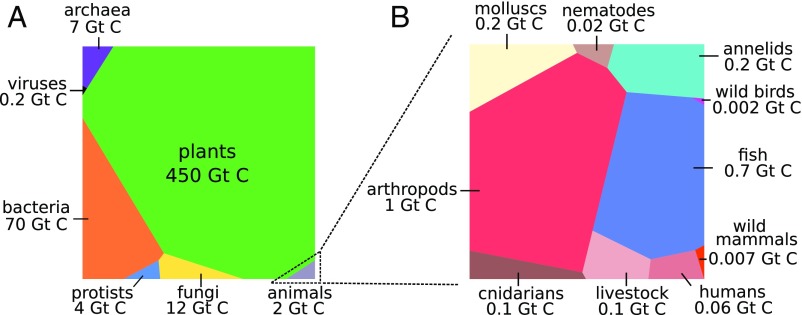
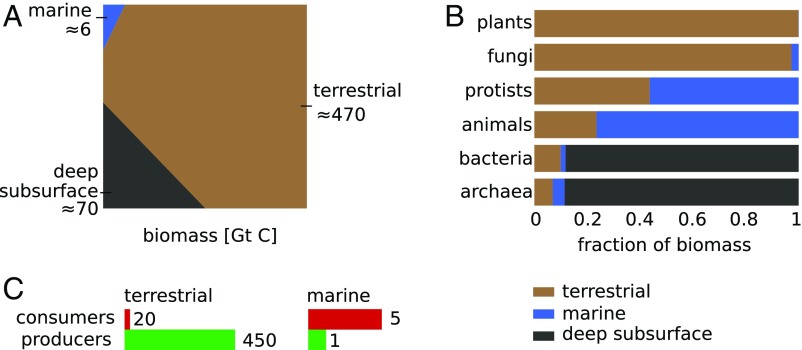
A census of the biomass on Earth is key for understanding the structure and dynamics of the biosphere. However, a global, quantitative view of how the biomass of different taxa compare with one another is still lacking. Here, we assemble the overall biomass composition of the biosphere, establishing a census of the ≈550 gigatons of carbon (Gt C) of biomass distributed among all of the kingdoms of life. We find that the kingdoms of life concentrate at different locations on the planet; plants (≈450 Gt C, the dominant kingdom) are primarily terrestrial, whereas animals (≈2 Gt C) are mainly marine, and bacteria (≈70 Gt C) and archaea (≈7 Gt C) are predominantly located in deep subsurface environments. We show that terrestrial biomass is about two orders of magnitude higher than marine biomass and estimate a total of ≈6 Gt C of marine biota, doubling the previous estimated quantity. Our analysis reveals that the global marine biomass pyramid contains more consumers than producers, thus increasing the scope of previous observations on inverse food pyramids. Finally, we highlight that the mass of humans is an order of magnitude higher than that of all wild mammals combined and report the historical impact of humanity on the global biomass of prominent taxa, including mammals, fish, and plants.
Overview
CoChat Summary
TL;DR
The paper assembles a global census of biomass across all kingdoms of life, estimating Earth’s total biomass at ≈550 Gt C, dominated by plants. It also compares biomass across environments and trophic modes, highlighting large uncertainties and human impacts on the biosphere.
Key findings
- Total global biomass is ≈550 Gt C, with plants ≈450 Gt C (≈80%), bacteria ≈70 Gt C (≈15%), fungi ≈12 Gt C, archaea ≈7 Gt C, protists ≈4 Gt C, animals ≈2 Gt C, and viruses ≈0.2 Gt C.
- Land biomass (≈470 Gt C) is about two orders of magnitude higher than marine biomass (≈6 Gt C); the deep subsurface holds ≈15% of total biomass, chiefly bacteria and archaea.
- In the ocean, ≈1 Gt C of primary producers supports ≈5 Gt C of consumer biomass, an inverted standing biomass distribution; marine biomass is ≈70% microbes, mainly bacteria and protists.
- Human-associated biomass is large relative to wild vertebrates: humans ≈0.06 Gt C, livestock ≈0.1 Gt C, wild mammals ≈0.007 Gt C, domesticated poultry ≈0.005 Gt C versus wild birds ≈0.002 Gt C; total plant biomass has declined approximately twofold relative to pre-human civilization.
Methods
- The authors synthesize hundreds of studies and generate estimates for major taxonomic groups, reporting biomass as gigatons of carbon (Gt C) and using a kingdom-level framework plus viruses.
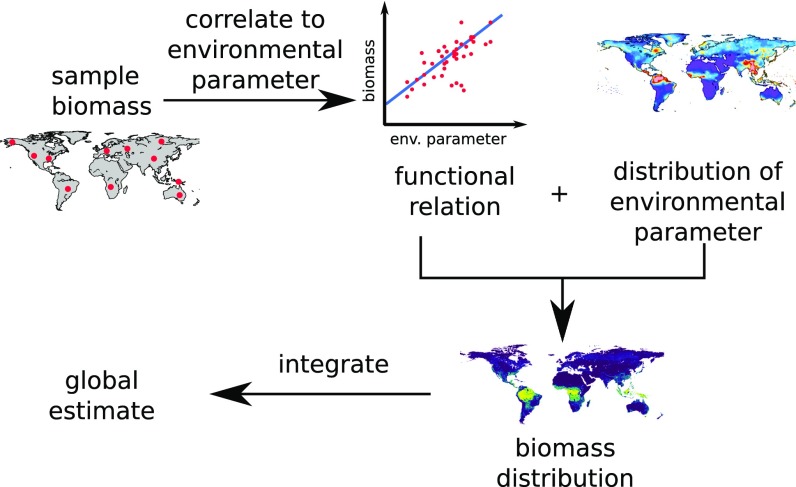
- For many taxa, local biomass samples are extrapolated globally by correlating biomass density with environmental parameters known at global scale; best estimates often use a geometric mean of independent estimates.
- Uncertainty is reported as multiplicative fold-change projections akin to 95% confidence intervals, incorporating intrastudy, interstudy, and intermethod variation; data and code are open-sourced.
Limitations
- The paper states that most datasets rely on fragmentary sampling, causing large uncertainties; sampling is scarce in the deep ocean (usually deeper than 200 m) and deep soil (usually deeper than 1 m), and some estimates may be biased by sampling toward high-abundance areas.
- The paper states that deep subsurface environments have particularly high uncertainty and unknown systematic biases, including unresolved distribution of biomass between aquifer fluids and rocks and among microbial taxa.
- The paper states that current and prehuman vertebrate biomass estimates are only a crude first step, amphibians remain poorly characterized, and parasite biomass is not resolved from hosts; evident from the text, kingdom-level grouping was chosen because much data lack finer taxonomic detail, and some uncertainty projections rely on analogous taxa or expert consultation.
Model-written summary. Check it against the paper before relying on it.
Integrity signals
Registry
Cites
Statistics
Figures
Verification
Claims the paper makes
9 Valid · 7 Not valid · 16 Not checked · 53 Own results and interpretations
Every source the paper cites for this claim was checked and supports it.
In the paper
“The biomass of amphibians, which are experiencing a dramatic population decline (42), remains poorly characterized.”
§ The biomass distribution on Earth > Discussion
What the sources say
- Supportedcites [42] Wake DB Vredenburg VT 2008 Colloquium paper: Are we in the midst of the sixth mass extinction? A view from the world of amphibians Proc Natl Acad Sci USA 105 11466 11473 18695221 PMC2556420 source
The citation is attached to the clause about amphibian population decline, not the separate statement that their biomass is poorly characterized. The passage reporting the Global Amphibian Assessment (labeled Abstract in our copy) says that 43% of amphibian species have declining populations. (LLM, conf=0.92)
plain- Asserted: passes — The authors put it forward as true.
- Checkable: passes — It can be checked against evidence.
- Load-bearing: unclear — It is unclear whether the paper’s conclusions depend on it.
- Based: passes — The paper gives a reason why it holds.
- Supported
Every source the paper cites for this claim was checked and supports it.
In the paper
“In the case of prokaryotes, some major improvements were recently realized, with global estimates of marine deep subsurface prokaryote biomass reduced by about two orders of magnitude due to an increased diversity of sampling locations (7).”
§ The biomass distribution on Earth > Discussion
What the sources say
- Supportedcites [7] Kallmeyer J Pockalny R Adhikari RR Smith DC D’Hondt S 2012 Global distribution of microbial abundance and biomass in subseafloor sediment Proc Natl Acad Sci USA 109 16213 16216 22927371 PMC3479597 source
The Discussion reports a revised subseafloor microbial biomass estimate of 4.1 Pg C versus a previous estimate of 303 Pg C—about a 74-fold reduction. It also identifies a more geographically diverse sampling database, including low-abundance ocean gyres, as a reason the new estimate is lower. The paper identifies other contributing factors as well. (LLM, conf=0.88)
plainstates a cause- Asserted: passes — The authors put it forward as true.
- Checkable: passes — It can be checked against evidence.
- Load-bearing: unclear — It is unclear whether the paper’s conclusions depend on it.
- Based: passes — The paper gives a reason why it holds.
- Supported
The sources with a verdict support this claim; the rest weren’t checked yet, have no full text we could read, or their verdicts aren’t rated yet.
In the paper
“Such inverted biomass distributions can occur when primary producers have a rapid turnover of biomass [on the order of days (34)], while consumer biomass turns over much more slowly [a few years in the case of mesopelagic fish (35)].”
§ The biomass distribution on Earth > Results > The Distribution of Biomass Across Environments and Trophic Modes.
What the sources say
- Supportedcites [34] Zubkov MV 2014 Faster growth of the major prokaryotic versus eukaryotic CO2 fixers in the oligotrophic ocean Nat Commun 5 3776 24777140 PMC4015317 source
The Results (Comparison of the growth rates of the CO2 fixers; page unavailable) report growth rates of 0.1–0.6 per day for the studied oceanic primary producers, consistent with biomass turnover on the order of days. The few-years estimate for mesopelagic fish is assigned to a different citation, not this source. (LLM, conf=0.91)
- Not checked — no full text of the sourcecites [35] Catul V Gauns M Karuppasamy PK 2011 A review on mesopelagic fishes belonging to family Myctophidae Rev Fish Biol Fish 21 339 354 source
plainstates a possible cause- Asserted: passes — The authors put it forward as true.
- Checkable: passes — It can be checked against evidence.
- Load-bearing: passes — The paper’s conclusions depend on it.
- Based: passes — The paper gives a reason why it holds.
- Supported
The cited sources support only part of this claim — read each source’s verdict below.
In the paper
“Combining data from independent sources such as these enables a robust assessment of the total plant biomass (17).”
§ The biomass distribution on Earth > Results > The Uncertainty Associated with Global Biomass Estimates.
What the sources say
- Partly supportedcites [17] Erb K-H 2017 Unexpectedly large impact of forest management and grazing on global vegetation biomass Nature 553 73 76 29258288 PMC5756473 sourceExperimental — accuracy not yet measured
The Methods describe combining multiple datasets and types of evidence to estimate global vegetation biomass stocks. But the paper also says global stocks remain uncertain, reports uncertainty ranges around 35% of the median estimate, and describes more robust estimates as a future prospect. It therefore supports the use of independent sources for an assessment, but not the unqualified characterization of that assessment as robust. (LLM, conf=0.84)
plainstates a cause- Asserted: passes — The authors put it forward as true.
- Checkable: passes — It can be checked against evidence.
- Load-bearing: passes — The paper’s conclusions depend on it.
- Based: passes — The paper gives a reason why it holds.
- Partly supported
A result the paper states — it cites no source for it, so there is none to check. The quote shows it is in the paper.
In the paper
“Plant biomass includes ≈70% stems and tree trunks, which are mostly woody, and thus relatively metabolically inert.”
§ The biomass distribution on Earth > Results > The Biomass Distribution of the Biosphere by Kingdom.
plain- Asserted: passes — The authors put it forward as true.
- Checkable: passes — It can be checked against evidence.
- Load-bearing: unclear — It is unclear whether the paper’s conclusions depend on it.
- Based: passes — The paper gives a reason why it holds.
27 more claims
Create a free account to see all 85 claims and to verify the 2 references still open.
- It may state two separate claims as one. 32
- Probably not a substantial claim. 28
Claims other papers make about this one
Each is checked against this paper’s own text: does it say what the citing paper says it does?
The cited source doesn’t support the claim as written.
In the citing paper
“and less than 10% that of the world ' s current human population ( 52 ).”
From Pervasive human-driven decline of life on Earth points to the need for transformative change (2019) · cites this paper as [52]
Checked by a reasoning model — may be wrong.
Experimental — accuracy not yet measuredThe cited source says what the claim attributes to it.
In the citing paper
“Approximately 450 Gt of C is bound up in terrestrial biota, primarily in plants (86), while only ~6 Gt of C is found in ocean biota (87).”
From Earth beyond six of nine planetary boundaries (2023) · cites this paper as [87]
The cited source says what the claim attributes to it.
In the citing paper
“The amount of metabolic energy available to a biosphere powered by O 2 is vast, such that the O 2 -rich ocean-atmosphere system of the modern Earth supports staggering levels of standing biomass (Bar-On et al. 2018), energy flow (Falkowski et al. 2008), and ecological complexity (Steele 1974).”
From The History of Ocean Oxygenation (2022) · cites this paper as Bar-On et al. 2018
In the citing paper
“Global populations of domestic ruminants (cattle, sheep, and goats) (Ripple et al. 2013) poultry, and pigs (Bennett et al. 2018) used to feed the growing human population now exceed 100 million tons of carbon (Bar-On et al. 2018), and livestock populations are growing rapidly.”
From Scientists’ warning to humanity on the freshwater biodiversity crisis (2021) · cites this paper as Bar-On et al. 2018
Citations
Cites
The worldwide leaf economics spectrum
Wright, I. J., Reich, P. B., Westoby, M., Ackerly, D. D., Baruch, Z., Bongers, F., Cavender-Bares, J., Chapin, T., Cornelissen, J. H. C., Diemer, M., et al. (2004) · Nature · doi:10.1038/nature02403 · Cited by 9,021 · cited 1×
“We then convert the total area of leaves to an estimate of the total dry mass of leaves by using the Glopnet database (24), which measured leaf mass per area (LMA) for ≈2500 plant species.”
MethodA large and persistent carbon sink in the world’s forests
Pan, Y., Birdsey, R. A., Fang, J., Houghton, R., Kauppi, P. E., Kurz, W. A., Phillips, O. L., Shvidenko, A., Lewis, S. L., Canadell, J. G., et al. (2011) · Science · doi:10.1126/science.1201609 · Cited by 8,458
Soil Sampling and Methods of Analysis
(2007) · CRC Press eBooks · doi:10.1201/9781420005271 · Cited by 6,469
Primary production of the biosphere: Integrating terrestrial and oceanic components
Field, C. B., Behrenfeld, M. J., Randerson, J. T., & Falkowski, P. (1998) · Science · doi:10.1126/science.281.5374.237 · Cited by 6,371
Prokaryotes: The unseen majority
Whitman, W. B., Coleman, D. C., & Wiebe, W. J. (1998) · Proceedings of the National Academy of Sciences · doi:10.1073/pnas.95.12.6578 · Cited by 4,871
Global effects of land use on local terrestrial biodiversity
Newbold, T., Hudson, L. N., Hill, S. L. L., Contu, S., Lysenko, I., Senior, R. A., Börger, L., Bennett, D. J., Choimes, A., Collen, B., et al. (2015) · Nature · doi:10.1038/nature14324 · Cited by 4,352
Belowground biodiversity and ecosystem functioning
Bardgett, R. D., & van der Putten, W. H. (2014) · Nature · doi:10.1038/nature13855 · Cited by 3,990 · cited 4×
“This was recommended by experts in the field for estimation of arbuscular mycorrhizal fungi abundance (117).”
BackgroundInfluentialMangroves among the most carbon-rich forests in the tropics
Donato, D. C., Kauffman, J. B., Murdiyarso, D., Kurnianto, S., Stidham, M., & Kanninen, M. (2011) · Nature Geoscience · doi:10.1038/ngeo1123 · Cited by 3,374
Poorter, H., Niklas, K. J., Reich, P. B., Oleksyn, J., Poot, P., & Mommer, L. (2012) · New Phytologist · doi:10.1111/j.1469-8137.2011.03952.x · Cited by 3,163 · cited 1×
“The first relies on a meta-analysis of the biomass allocation to different plant compartments across biomes (19).”
BackgroundA global analysis of root distributions for terrestrial biomes
Jackson, R. B., Canadell, J., Ehleringer, J. R., Mooney, H. A., Sala, O. E., & Schulze, E. D. (1996) · Oecologia · doi:10.1007/bf00333714 · Cited by 3,071 · cited 4×
“assumed the distribution of microbial biomass with depth follows the biomass density versus depth profile of root biomass (21).”
BackgroundMethodInfluential
Research works printed but not linked: 1
- Chapman AD 2009 Numbers of Living Species in Australia and the World Australian Biological Resources Study Canberra, Australia
Cited by
Items 2,901–3,000 of 3,743
Bickel, S., & Or, D. (2022) · Research Square · doi:10.21203/rs.3.rs-2000986/v1
Velasco, J. (2022) · Digital Library of Theses and Dissertations (Universidade de São Paulo) · doi:10.11606/t.97.2022.tde-05102022-152812
Osorio‐Leon, I., Bouchez, C., Chatton, E., et al. (2022) · doi:10.1002/essoar.10512568.1
Santoro, F., Pastore, G., Fox, V., et al. (2022) · bioRxiv (Cold Spring Harbor Laboratory) · doi:10.1101/2022.10.13.512196
“Bacteriophages are the most 60 abundant entities on the biosphere, with an estimated total number of virus-like particles on Earth 61 close to 10(31) (Hendrix et al. 1999; Clokie et al. 2011; Bar-On et al. 2018; Mushegian 2020).”
BackgroundThe Sizes of LifePreprint
Tekwa, E. W., Catalano, K. A., Bazzicalupo, A., O’Connor, M. I., & Pinsky, M. L. (2022) · Research Square · doi:10.21203/rs.3.rs-144241/v2
Monteiro, E. S. (2022) · Gredos (University of Salamanca) · doi:10.14201/gredos.150835
Diversidade e distribuição de procariotos na zona mesopelágica da Bacia de Santos - Brasil
Lizarraga, R. G. M. (2022) · Digital Library of Theses and Dissertations (Universidade de São Paulo) · doi:10.11606/d.42.2022.tde-14102022-121941
Biotic Soil Organic Carbon (SOC) Stock: What We Had & What We LostPreprint
Blakemore, R. J. (2022) · Preprints.org · doi:10.20944/preprints202212.0258.v1
The Low Permeability of the Earth’s Precambrian CrustPreprint
Ferguson, G., McIntosh, J. C., Warr, O., et al. (2022) · doi:10.31223/x5zp9d
Ecodemocracy in Practice: Examples of Forestry and Food Production
Kopnina, H., Spannring, R., Morini, M., Lynn, W., & Santiago‐Ávila, F. J. (2022) · Integrated science · doi:10.1007/978-3-030-94651-7_23
Progress and Civilization in Whitehead
Schulz, D. (2020) · Process Studies · doi:10.5406/processstudies.49.2.0188
Gasification of Biomass: An Overview
Chauhan, G., Sánchez, N. M., Halmenschlager, C. M., & Link, F. (2022) · Royal Society of Chemistry eBooks · doi:10.1039/9781839167829-00080
Harrison, S. J., Baker, M., Benschop, J., et al. (2022) · New Zealand Science Review · doi:10.26686/nzsr.v76i4.7805
Biodiversity, the most fundamental secret of biosphere sustainability: A review
Dehghani, R., Varzaneh, A. A., Akbari, M., & Varzaneh, Z. B. (2022) · Journal of Entomological Research · doi:10.5958/0974-4576.2022.00147.5
Assessment of groundwater quality in the different zones of Punjab, north-western India
Bharti, S., Kaur, N., & Saini, S. P. (2022) · Journal of Soil and Water Conservation · doi:10.5958/2455-7145.2022.00024.8
Pre-assessments of plant conservation status in islands: the case of French Overseas Territories
Véron, S., Bernard, A., Lebreton, É., Rodrigues‐Vaz, C., Durand, M., Procopio, L., Hélion, M., Gayot, M., Viscardi, G., Krupnick, G. A., et al. (2023) · Biodiversity and Conservation · doi:10.1007/s10531-023-02544-8 · Cited by 1
“Plants are the dominant kingdom in terms of Earth biomass, representing around 82% (c.a. 450Gt), and represent around 370 000 species (Bar-On et al. 2018; Roskov et al. 2019, Freiberg et al. 2020).”
BackgroundMexican Insects in the Anthropocene
Gómez, B., de Gortari, E. D. D. V., & Jones, R. W. (2023) · Springer eBooks · doi:10.1007/978-3-031-17277-9_3
Transformation als Systemwechsel
Brocchi, D. (2022) · Springer eBooks · doi:10.1007/978-3-658-38965-9_5
Distributions and perturbations of the marine dissolved cobalt cycle in a changing ocean
Chmiel, R. J. (2023) · Woods Hole Open Access Server (WHOAS) · doi:10.1575/1912/29645
Introduction: Men, Masculinities, and the Consumption of Nonhuman Animals in the Anthropocene
Aavik, K. (2023) · Springer eBooks · doi:10.1007/978-3-031-19507-5_1
Commonly found bacteria and drug-resistant gene in wastewater
Dewangan, N. (2023) · Elsevier eBooks · doi:10.1016/b978-0-323-96124-0.00010-6 · Cited by 1
Feral Kinetics and Cattle Research Within Planetary Boundaries
Brichet, N., Brieghel, S., & Hastrup, F. (2023) · Animals · doi:10.3390/ani13050802 · Cited by 2
“Industrial livestock requires enormous amounts of feed, the production of which takes up more than three quarters of all agricultural land on the planet [5].”
BackgroundGutierrez, D. E. R. (2023) · eDiss (Georg-August-Universität Göttingen) · doi:10.53846/goediss-9761
Zmiany różnorodności biosfery: dawniej, dziś, jutro
Weiner, J. (2023) · Nauka · doi:10.24425/nauka.2023.144945 · Cited by 1
González, J. D. C. (2022) · Eötvös Loránd Tudományegyetem · doi:10.15476/elte.2021.165 · Cited by 1
Cruickshank, M. G. (2023) · Canadian Journal of Plant Pathology · doi:10.1080/07060661.2023.2190165
“The largest global terrestrial biomass compartment consists of plants (trees), with 29% of Earth’s belowground biomass, followed by fungi, then bacteria (Bar-On et al. 2018).”
Background(2023) · Elsevier eBooks · doi:10.1016/b978-0-443-18775-9.16001-2
Primary production in subsidized green-brown food webs
Zelnik, Y. R., Manzoni, S., & Bommarco, R. (2023) · Frontiers in Ecology and Evolution · doi:10.3389/fevo.2023.1106461 · Cited by 1
“The use of a geometric average is appropriate due to the wide range of values for various ecosystems (Bar-On et al., 2018).”
BackgroundAnthropocene Patterns in Stratigraphy as a Perspective on Human Success
Zalasiewicz, J., Williams, A. M., & Waters, C. N. (2023) · Oxford University Press eBooks · doi:10.1093/oso/9780190096168.003.0009 · Cited by 1
Türkiye’de Çocuk Evliliklerinin Siyaseti: Çocuğun Yaralanabilirliğinin İnşası
Sözer, H. (2023) · Özgür Yayınları eBooks · doi:10.58830/ozgur.pub97.c467
Sosyal Bilimler Üzerine Araştırmalar- III
APALI, A., Ercan, T., Murat, S. A. R. I., Keskin, A., Beşoluk, E., Demirel, M., Ömür, Ö. M., Türe, A. A., Dural, B. Y., Çetin, C., et al. (2023) · Özgür Yayınları eBooks · doi:10.58830/ozgur.pub97
Identification, Characterization and Use of Microorganisms
Smith, D., Ryan, M. J., & Buddie, A. G. (2023) · CABI eBooks · doi:10.1079/9781800622135.0003
Post-partum Dönemdeki Kadınlarda Sosyo-Ekonomik Durumun Depresyonla Olan İlişkisi
Çuvadar, T. M. (2023) · Özgür Yayınları eBooks · doi:10.58830/ozgur.pub97.c501
Global Biodiversity: Trends and Regulation
Nagtzaam, G., & Brady, U. (2023) · Springer eBooks · doi:10.1007/978-3-031-01949-4_39
Preparation and Characterization of Graphene Oxide from Rice Husk
Nisa, A. K., Supriyanto, G., & Ibrahim, W. A. W. (2023) · ALCHEMY Journal of Chemistry · doi:10.18860/al.v11i1.16006
Lignin Degradation and Valorization by Filamentous Fungi
Mäkelä, M., Böke, H., Nyhamar, E., & Wan, X. (2023) · Springer eBooks · doi:10.1007/978-94-007-6724-9_31-1 · Cited by 1
Resurrecting Gaia: Harnessing the Free Energy Principle to Preserve Life as We Know ItPreprint
Montgomery, C., & Hipólito, I. (2023) · doi:10.31234/osf.io/5tm9w
Annexe C : Rendement théorique d'une éolienne
Blanc, G., & Noûs, C. (2023) · Université Paris Cité eBooks · doi:10.53480/physique-societe.7715e2
Chapitre 3 : Le réchauffement climatique
Blanc, G., & Noûs, C. (2023) · Université Paris Cité eBooks · doi:10.53480/physique-societe.ac4025
Chapitre 4 : L’énergie et le CO2
Blanc, G., & Noûs, C. (2023) · Université Paris Cité eBooks · doi:10.53480/physique-societe.8a7076
Chapitre 1 : La méthode scientifique
Blanc, G., & Noûs, C. (2023) · Université Paris Cité eBooks · doi:10.53480/physique-societe.3224b0
Blanc, G., & Noûs, C. (2023) · Université Paris Cité eBooks · doi:10.53480/physique-societe.b046
Annexe A : Quelques organismes internationaux pour le climat
Blanc, G., & Noûs, C. (2023) · Université Paris Cité eBooks · doi:10.53480/physique-societe.b236d0
Chapitre 5 : Ondes électromagnétiques et santé
Blanc, G., & Noûs, C. (2023) · Université Paris Cité eBooks · doi:10.53480/physique-societe.d2f159
Chapitre 2 : Nucléaire et radioactivité
Blanc, G., & Noûs, C. (2023) · Université Paris Cité eBooks · doi:10.53480/physique-societe.d8819d
Annexe D : Puissance géothermique
Blanc, G., & Noûs, C. (2023) · Université Paris Cité eBooks · doi:10.53480/physique-societe.077f16
Blanc, G., & Noûs, C. (2023) · Université Paris Cité eBooks · doi:10.53480/physique-societe.eab7ff
Bakterielle Cellulose — ein Netzwerk gestaltet von drei Cellulosesynthasen
Bimmer, M., Liebl, W., & Ehrenreich, A. (2023) · BIOspektrum · doi:10.1007/s12268-023-1908-9
“Als Hauptbestandteil pfl anzlicher Zellwände stellt sie rund 40 Prozent der weltweiten Gesamtbiomasse [1].”
BackgroundEcological genomics in the Northern krill uncovers loci for local adaptation across ocean basinsPreprint
Unneberg, P., Larsson, M., Olsson, A., et al. (2023) · bioRxiv (Cold Spring Harbor Laboratory) · doi:10.1101/2023.04.15.537050
The trail-following communication in Stylotermes spp. (Blattodea, Isoptera, Stylotermitidae)Preprint
Thakur, H., Agarwal, S., Hradecký, J., et al. (2023) · Research Square · doi:10.21203/rs.3.rs-2770501/v1
Ottinger, M. A., & Geiselman, C. (2023) · Elsevier eBooks · doi:10.1016/b978-0-323-89873-7.00006-5
Ottinger, M. A., & Geiselman, C. (2023) · Elsevier eBooks · doi:10.1016/b978-0-323-89873-7.00005-3 · Cited by 1
How Birds Reveal the Scale of the Biodiversity Crisis
Allinson, T. (2023) · Cambridge University Press eBooks · doi:10.1017/9781108758826.007 · Cited by 3
Qiu, D., Riemer, E., Haas, T., Prucker, I., Masuda, S., Wang, Y. L., Felix, G., Schaaf, G., & Jessen, H. J. (2023) · bioRxiv (Cold Spring Harbor Laboratory) · doi:10.1101/2023.04.26.538375
Biomanufactured High-Performance Triboelectric Fibers for RespiratorsPreprint
Demirel, M. C., Boy, R., Singhal, K., Mazeed, T. E.-S., & Abdullah, A. (2023) · Research Square · doi:10.21203/rs.3.rs-2782940/v1
Structure and function studies of GH45 glycoside hydrolases
Okmane, L. (2023) · Acta universitatis agriculturae Sueciae · doi:10.54612/a.3f14k593rr · Cited by 1
Plant-rich diets: Healthier for people and the planet
King, D. B., Schien, M., & Stanton, R. A. (2023) · Australian Journal of General Practice · doi:10.31128/ajgp-09-22-6558
Buskirk, S. W. (2023) · Oxford University Press eBooks · doi:10.1093/oso/9780192863249.003.0008
Buskirk, S. W. (2023) · Oxford University Press eBooks · doi:10.1093/oso/9780192863249.003.0012
Lebert, S., Marteinsson, V., & Vannier, P. (2023) · doi:10.1002/9781119814085.ch17
Enabling robotic manipulation in remote environments with shared autonomy
Phung, A. (2023) · Woods Hole Open Access Server (WHOAS) · doi:10.1575/1912/66365
Atencio, B., Geisler, E., Rubin‐Blum, M., et al. (2023) · bioRxiv (Cold Spring Harbor Laboratory) · doi:10.1101/2023.06.25.546375
“Deep terrestrial subsurface habitats, including groundwater ecosystems, host ~15% of the total 37 biomass in the biosphere [1].”
BackgroundVegansexuality: Troubling Gender and Sexuality Norms to Combat Climate Change
Todd, M. (2023) · Sustainable development goals series · doi:10.1007/978-3-031-31046-1_4
Coulter, B., West, R. S., Kingsford, R. T., et al. (2023) · Austral Ecology · doi:10.1111/aec.13348
Soentgen, J. (2023) · Zeitschrift für Ethik und Moralphilosophie · doi:10.1007/s42048-023-00147-0
Protein from microscopic sources—a realistic scalable solution?
Matassa, S., Papirio, S., Esposito, G., & Pirozzi, F. (2023) · Elsevier eBooks · doi:10.1016/b978-0-323-91739-1.00010-6 · Cited by 2
Fernández‐Remolar, D. C. (2023) · Encyclopedia of Astrobiology · doi:10.1007/978-3-662-65093-6_191
Österblom, H. (2023) · Elsevier eBooks · doi:10.1016/b978-0-443-15267-2.00009-6
Regmi, P. (2023) · Publication Server of Goethe University Frankfurt am Main (Goethe University Frankfurt) · doi:10.21248/gups.74819
Harris, R. L., & Schuerger, A. C. (2023) · Research Square · doi:10.21203/rs.3.rs-3221337/v1 · Cited by 1
董, 海. (2023) · SCIENTIA SINICA Terrae · doi:10.1360/sste-2023-0158
Métagénomique et métatranscriptomique
Guyomar, C., & Lemaitre, C. (2023) · doi:10.51926/iste.9066.ch5 · Cited by 1
Is it what’s inside that matters? A conserved microbiome in woody tissues of Pinus radiataPreprint
Daley, K. J., Eslami, Y., Armstrong, C., et al. (2023) · bioRxiv (Cold Spring Harbor Laboratory) · doi:10.1101/2023.08.10.552887
“Of this, an estimated ~450 Gt is held in plants, with ~300 Gt of this estimated to be held in tree stems (Bar-On et al. 2018).”
BackgroundClimate Change and Animal Ethics
Pollo, S. (2023) · Handbooks in philosophy · doi:10.1007/978-3-030-16960-2_72-1
Stoltzfus, A. (2021) · Oxford University Press eBooks · doi:10.1093/oso/9780198844457.005.0003
(2021) · Oxford University Press eBooks · doi:10.1093/oso/9780198844457.002.0007
Stoltzfus, A. (2021) · Oxford University Press eBooks · doi:10.1093/oso/9780198844457.005.0004
Counting the universe of mutations
Stoltzfus, A. (2021) · Oxford University Press eBooks · doi:10.1093/oso/9780198844457.005.0002
Stoltzfus, A. (2021) · Oxford University Press eBooks · doi:10.1093/oso/9780198844457.005.0001
(2021) · Oxford University Press eBooks · doi:10.1093/oso/9780198844457.002.0008
(2021) · Oxford University Press eBooks · doi:10.1093/oso/9780198844457.002.0004
(2019) · Oxford University Press eBooks · doi:10.1093/oso/9780198817017.002.0003
(2019) · Oxford University Press eBooks · doi:10.1093/oso/9780198817017.002.0004
Human Reconfiguration of the Biosphere
Williams, M., Zalasiewicz, J., & Thomas, J. A. (2023) · Springer eBooks · doi:10.1007/978-3-031-25910-4_187 · Cited by 1
Weber, A. P. M. (2023) · Springer eBooks · doi:10.1007/978-3-031-25910-4_27
Phenotypic Plasticity of Plants in Formal and Non-formal Education: Genetics in Everyday Life
Lima, N. R. W., Roland, H., Sodré, G. A., Campos, L. V., Ferah, P. C., Mancebo, S. S. D. S., Soares, A. P. D. S. A., Cabral, L. M., & Ratcliffe, N. A. (2023) · Springer eBooks · doi:10.1007/978-3-031-34854-9_23
Review: Past changes in and present status of the coastal carbon cycle — R1/PR7
Rixen, T. (2023) · Cambridge Prisms Coastal Futures · doi:10.1017/cft.2023.20.pr7
Decision: Past changes in and present status of the coastal carbon cycle — R1/PR9
Rixen, T. (2023) · Cambridge Prisms Coastal Futures · doi:10.1017/cft.2023.20.pr9
Decision: Past changes in and present status of the coastal carbon cycle — R0/PR5
Rixen, T. (2023) · Cambridge Prisms Coastal Futures · doi:10.1017/cft.2023.20.pr5
Recommendation: Past changes in and present status of the coastal carbon cycle — R0/PR4
Rixen, T. (2023) · Cambridge Prisms Coastal Futures · doi:10.1017/cft.2023.20.pr4
Recommendation: Past changes in and present status of the coastal carbon cycle — R1/PR8
Rixen, T. (2023) · Cambridge Prisms Coastal Futures · doi:10.1017/cft.2023.20.pr8
Author comment: Past changes in and present status of the coastal carbon cycle — R1/PR6
Rixen, T. (2023) · Cambridge Prisms Coastal Futures · doi:10.1017/cft.2023.20.pr6
Review: Past changes in and present status of the coastal carbon cycle — R0/PR3
Rixen, T. (2023) · Cambridge Prisms Coastal Futures · doi:10.1017/cft.2023.20.pr3
Review: Past changes in and present status of the coastal carbon cycle — R0/PR2
Rixen, T. (2023) · Cambridge Prisms Coastal Futures · doi:10.1017/cft.2023.20.pr2
Author comment: Past changes in and present status of the coastal carbon cycle — R0/PR1
Rixen, T. (2022) · Cambridge Prisms Coastal Futures · doi:10.1017/cft.2023.20.pr1
Murphy, T. W. (2023) · The Physics Teacher · doi:10.1119/5.0134159
“At this point, 96% of mammal mass on the planet is in the form of humans (36%) and our livestock (60%), leaving a tiny toe-hold of ∼ 2% for land mammals and ∼ 2% for marine mammals [6].”
BackgroundComment on egusphere-2023-1552
Djemiel, C., Dequiedt, S. S., Horrigue, W., et al. (2023) · doi:10.5194/egusphere-2023-1552-rc1
Djemiel, C. (2023) · doi:10.5194/egusphere-2023-1552-ac1
Metadata
- Authors
- Bar-On, Y. M., Phillips, R., & Milo, R.
- Affiliations
- Department of Plant and Environmental Sciences, Weizmann Institute of Science, 76100 Rehovot, Israel;
- California Institute of Technology (US)
- Weizmann Institute of Science (IL)
- Corresponding author
- Milo, Ron
- Venue
- Proceedings of the National Academy of Sciences
- Publisher
- National Academy of Sciences
- Published
- 2018-05-21
- Volume
- 115
- Issue
- 25
- Pages
- 6506-6511
- ISSN
- 0027-8424 (ISSN-L)
- 1091-6490
- PMC
- PMC6016768
- OpenAlex
- W2804910112
- Cited by
- 3,723
- References
- 263
- Citations by year
- 2026: 349 · 2025: 450 · 2024: 589 · 2023: 617 · 2022: 498 · 2021: 498 · 2020: 419 · 2019: 246 · 2018: 49
- FWCI
- 239.98
- Type
- journal article
- Language
- en
- Open access
- hybrid
- doi.org
- Licence
- Locations
- Proceedings of the National Academy of Sciences (publishedVersion, cc-by-nc-nd)
- Europe PMC (PubMed Central) (publishedVersion, cc-by-nc-nd)
- PubMed Central (publishedVersion, cc-by-nc-nd)
- PubMed (publishedVersion)
- CaltechAUTHORS (California Institute of Technology) (submittedVersion, cc-by-nc-nd)
- Funders
- National Institutes of Health (5r35gm118043-07)
- National Institute of General Medical Sciences (R35 GM118043)
- Topics
- Physical Sciences › Environmental Science › Nature and Landscape Conservation › Ecology and Vegetation Dynamics Studies
- Physical Sciences › Environmental Science › Global and Planetary Change › Earth Systems and Cosmic Evolution
- Life Sciences › Agricultural and Biological Sciences › Soil Science › Soil Carbon and Nitrogen Dynamics
- Keywords
- biomass allocation, biomass carbon, terrestrial biomass, marine biomass, bacteria, archaea, food pyramid, wild mammals, fish biomass, plant biomass
- MeSH terms
- Animals, Archaea, Bacteria, Carbon, Humans, Plants, Ecosystem, Biomass, Earth, Planet, Biota
About these checks
Registry, retraction, Cites and statistics results are computed, not judged, with one exception: a printed reference that no index lists is read once by a model before it counts as a citation error. Claims are extracted by a model and kept only when their quote appears verbatim in the text; each cited source is then checked, with a model’s help, for whether it says what the claim relies on. Those verdicts can be wrong — read the claim’s quote and the cited source before relying on one.
The claim verdicts this report counts are experimental: their accuracy is not yet measured.
A language model drew the claims from the paper on 2026-10-10, under version 3 of the claim definition (model deepseek-v4.1-flash, prompt extract-v3).
A second model labelled each claim on 2026-10-10 (model jev-1.13-20260917, definition revision gold-guideline-v0.2).
Cited sources are checked with a language model’s help (gpt-6-sol).
Statistics and arithmetic are recomputed, not judged.
Confidence bands are shown only for fields calibrated on our annotated test set. None is calibrated yet, so no band is shown.
What counts as a claim ›How we measure confidence ›How we check this ›
Are you an author, or do you see a problem with this page? Request a review
Data sources
Bibliographic data: Semantic Scholar, OpenAlex, Crossref.
Contains information from the Semantic Scholar Academic Graph Datasets, made available under the ODC Attribution License (ODC-BY 1.0).
Semantic Scholar’s data is described in: Kinney, R., et al. (2023). The Semantic Scholar Open Data Platform. arXiv:2301.10140.
