

The biomass distribution on Earth
Open accessThe DOI matches its Crossref record; 263 of the 263 references it cites were found in a registry or an index; 11 of the 41 sources its claims cite were checked for support.
Abstract
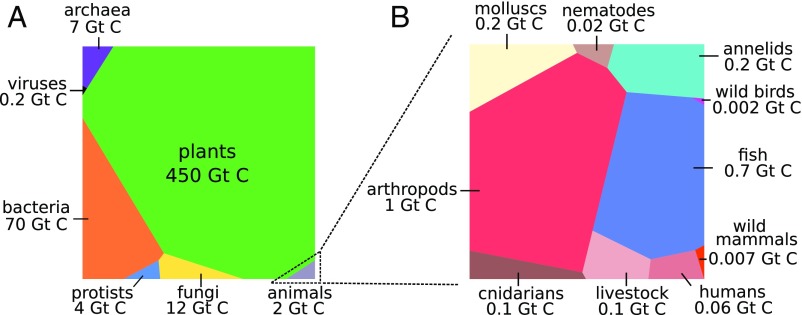
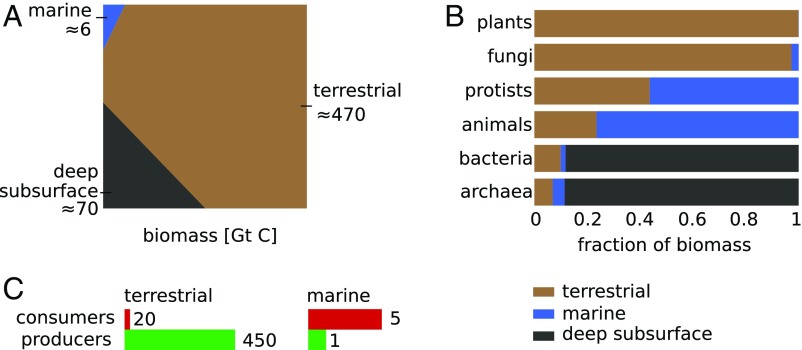
A census of the biomass on Earth is key for understanding the structure and dynamics of the biosphere. However, a global, quantitative view of how the biomass of different taxa compare with one another is still lacking. Here, we assemble the overall biomass composition of the biosphere, establishing a census of the ≈550 gigatons of carbon (Gt C) of biomass distributed among all of the kingdoms of life. We find that the kingdoms of life concentrate at different locations on the planet; plants (≈450 Gt C, the dominant kingdom) are primarily terrestrial, whereas animals (≈2 Gt C) are mainly marine, and bacteria (≈70 Gt C) and archaea (≈7 Gt C) are predominantly located in deep subsurface environments. We show that terrestrial biomass is about two orders of magnitude higher than marine biomass and estimate a total of ≈6 Gt C of marine biota, doubling the previous estimated quantity. Our analysis reveals that the global marine biomass pyramid contains more consumers than producers, thus increasing the scope of previous observations on inverse food pyramids. Finally, we highlight that the mass of humans is an order of magnitude higher than that of all wild mammals combined and report the historical impact of humanity on the global biomass of prominent taxa, including mammals, fish, and plants.
Overview
CoChat Summary
TL;DR
The paper assembles a global census of biomass across all kingdoms of life, estimating Earth’s total biomass at ≈550 Gt C, dominated by plants. It also compares biomass across environments and trophic modes, highlighting large uncertainties and human impacts on the biosphere.
Key findings
- Total global biomass is ≈550 Gt C, with plants ≈450 Gt C (≈80%), bacteria ≈70 Gt C (≈15%), fungi ≈12 Gt C, archaea ≈7 Gt C, protists ≈4 Gt C, animals ≈2 Gt C, and viruses ≈0.2 Gt C.
- Land biomass (≈470 Gt C) is about two orders of magnitude higher than marine biomass (≈6 Gt C); the deep subsurface holds ≈15% of total biomass, chiefly bacteria and archaea.
- In the ocean, ≈1 Gt C of primary producers supports ≈5 Gt C of consumer biomass, an inverted standing biomass distribution; marine biomass is ≈70% microbes, mainly bacteria and protists.
- Human-associated biomass is large relative to wild vertebrates: humans ≈0.06 Gt C, livestock ≈0.1 Gt C, wild mammals ≈0.007 Gt C, domesticated poultry ≈0.005 Gt C versus wild birds ≈0.002 Gt C; total plant biomass has declined approximately twofold relative to pre-human civilization.
Methods
- The authors synthesize hundreds of studies and generate estimates for major taxonomic groups, reporting biomass as gigatons of carbon (Gt C) and using a kingdom-level framework plus viruses.
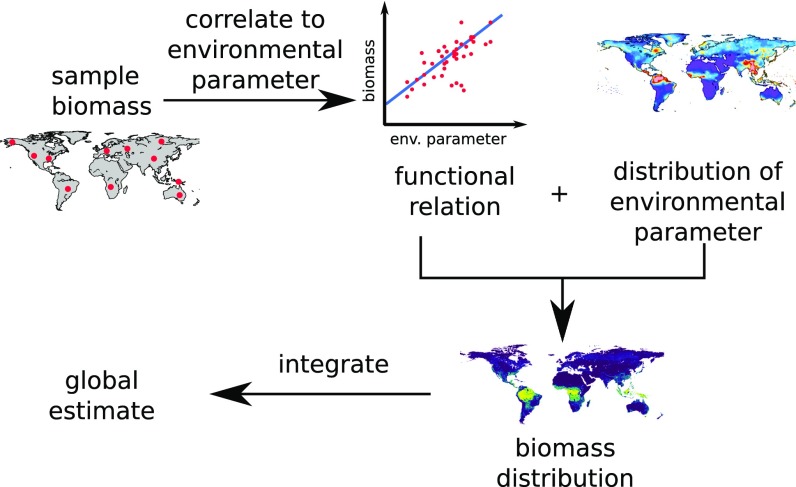
- For many taxa, local biomass samples are extrapolated globally by correlating biomass density with environmental parameters known at global scale; best estimates often use a geometric mean of independent estimates.
- Uncertainty is reported as multiplicative fold-change projections akin to 95% confidence intervals, incorporating intrastudy, interstudy, and intermethod variation; data and code are open-sourced.
Limitations
- The paper states that most datasets rely on fragmentary sampling, causing large uncertainties; sampling is scarce in the deep ocean (usually deeper than 200 m) and deep soil (usually deeper than 1 m), and some estimates may be biased by sampling toward high-abundance areas.
- The paper states that deep subsurface environments have particularly high uncertainty and unknown systematic biases, including unresolved distribution of biomass between aquifer fluids and rocks and among microbial taxa.
- The paper states that current and prehuman vertebrate biomass estimates are only a crude first step, amphibians remain poorly characterized, and parasite biomass is not resolved from hosts; evident from the text, kingdom-level grouping was chosen because much data lack finer taxonomic detail, and some uncertainty projections rely on analogous taxa or expert consultation.
Model-written summary. Check it against the paper before relying on it.
Integrity signals
Registry
Cites
Statistics
Figures
Verification
Claims the paper makes
9 Valid · 7 Not valid · 16 Not checked · 53 Own results and interpretations
Every source the paper cites for this claim was checked and supports it.
In the paper
“The biomass of amphibians, which are experiencing a dramatic population decline (42), remains poorly characterized.”
§ The biomass distribution on Earth > Discussion
What the sources say
- Supportedcites [42] Wake DB Vredenburg VT 2008 Colloquium paper: Are we in the midst of the sixth mass extinction? A view from the world of amphibians Proc Natl Acad Sci USA 105 11466 11473 18695221 PMC2556420 source
The citation is attached to the clause about amphibian population decline, not the separate statement that their biomass is poorly characterized. The passage reporting the Global Amphibian Assessment (labeled Abstract in our copy) says that 43% of amphibian species have declining populations. (LLM, conf=0.92)
plain- Asserted: passes — The authors put it forward as true.
- Checkable: passes — It can be checked against evidence.
- Load-bearing: unclear — It is unclear whether the paper’s conclusions depend on it.
- Based: passes — The paper gives a reason why it holds.
- Supported
Every source the paper cites for this claim was checked and supports it.
In the paper
“In the case of prokaryotes, some major improvements were recently realized, with global estimates of marine deep subsurface prokaryote biomass reduced by about two orders of magnitude due to an increased diversity of sampling locations (7).”
§ The biomass distribution on Earth > Discussion
What the sources say
- Supportedcites [7] Kallmeyer J Pockalny R Adhikari RR Smith DC D’Hondt S 2012 Global distribution of microbial abundance and biomass in subseafloor sediment Proc Natl Acad Sci USA 109 16213 16216 22927371 PMC3479597 source
The Discussion reports a revised subseafloor microbial biomass estimate of 4.1 Pg C versus a previous estimate of 303 Pg C—about a 74-fold reduction. It also identifies a more geographically diverse sampling database, including low-abundance ocean gyres, as a reason the new estimate is lower. The paper identifies other contributing factors as well. (LLM, conf=0.88)
plainstates a cause- Asserted: passes — The authors put it forward as true.
- Checkable: passes — It can be checked against evidence.
- Load-bearing: unclear — It is unclear whether the paper’s conclusions depend on it.
- Based: passes — The paper gives a reason why it holds.
- Supported
The sources with a verdict support this claim; the rest weren’t checked yet, have no full text we could read, or their verdicts aren’t rated yet.
In the paper
“Such inverted biomass distributions can occur when primary producers have a rapid turnover of biomass [on the order of days (34)], while consumer biomass turns over much more slowly [a few years in the case of mesopelagic fish (35)].”
§ The biomass distribution on Earth > Results > The Distribution of Biomass Across Environments and Trophic Modes.
What the sources say
- Supportedcites [34] Zubkov MV 2014 Faster growth of the major prokaryotic versus eukaryotic CO2 fixers in the oligotrophic ocean Nat Commun 5 3776 24777140 PMC4015317 source
The Results (Comparison of the growth rates of the CO2 fixers; page unavailable) report growth rates of 0.1–0.6 per day for the studied oceanic primary producers, consistent with biomass turnover on the order of days. The few-years estimate for mesopelagic fish is assigned to a different citation, not this source. (LLM, conf=0.91)
- Not checked — no full text of the sourcecites [35] Catul V Gauns M Karuppasamy PK 2011 A review on mesopelagic fishes belonging to family Myctophidae Rev Fish Biol Fish 21 339 354 source
plainstates a possible cause- Asserted: passes — The authors put it forward as true.
- Checkable: passes — It can be checked against evidence.
- Load-bearing: passes — The paper’s conclusions depend on it.
- Based: passes — The paper gives a reason why it holds.
- Supported
The cited sources support only part of this claim — read each source’s verdict below.
In the paper
“Combining data from independent sources such as these enables a robust assessment of the total plant biomass (17).”
§ The biomass distribution on Earth > Results > The Uncertainty Associated with Global Biomass Estimates.
What the sources say
- Partly supportedcites [17] Erb K-H 2017 Unexpectedly large impact of forest management and grazing on global vegetation biomass Nature 553 73 76 29258288 PMC5756473 sourceExperimental — accuracy not yet measured
The Methods describe combining multiple datasets and types of evidence to estimate global vegetation biomass stocks. But the paper also says global stocks remain uncertain, reports uncertainty ranges around 35% of the median estimate, and describes more robust estimates as a future prospect. It therefore supports the use of independent sources for an assessment, but not the unqualified characterization of that assessment as robust. (LLM, conf=0.84)
plainstates a cause- Asserted: passes — The authors put it forward as true.
- Checkable: passes — It can be checked against evidence.
- Load-bearing: passes — The paper’s conclusions depend on it.
- Based: passes — The paper gives a reason why it holds.
- Partly supported
A result the paper states — it cites no source for it, so there is none to check. The quote shows it is in the paper.
In the paper
“Plant biomass includes ≈70% stems and tree trunks, which are mostly woody, and thus relatively metabolically inert.”
§ The biomass distribution on Earth > Results > The Biomass Distribution of the Biosphere by Kingdom.
plain- Asserted: passes — The authors put it forward as true.
- Checkable: passes — It can be checked against evidence.
- Load-bearing: unclear — It is unclear whether the paper’s conclusions depend on it.
- Based: passes — The paper gives a reason why it holds.
27 more claims
Create a free account to see all 85 claims and to verify the 2 references still open.
- It may state two separate claims as one. 32
- Probably not a substantial claim. 28
Claims other papers make about this one
Each is checked against this paper’s own text: does it say what the citing paper says it does?
The cited source doesn’t support the claim as written.
In the citing paper
“and less than 10% that of the world ' s current human population ( 52 ).”
From Pervasive human-driven decline of life on Earth points to the need for transformative change (2019) · cites this paper as [52]
Checked by a reasoning model — may be wrong.
Experimental — accuracy not yet measuredThe cited source says what the claim attributes to it.
In the citing paper
“Approximately 450 Gt of C is bound up in terrestrial biota, primarily in plants (86), while only ~6 Gt of C is found in ocean biota (87).”
From Earth beyond six of nine planetary boundaries (2023) · cites this paper as [87]
The cited source says what the claim attributes to it.
In the citing paper
“The amount of metabolic energy available to a biosphere powered by O 2 is vast, such that the O 2 -rich ocean-atmosphere system of the modern Earth supports staggering levels of standing biomass (Bar-On et al. 2018), energy flow (Falkowski et al. 2008), and ecological complexity (Steele 1974).”
From The History of Ocean Oxygenation (2022) · cites this paper as Bar-On et al. 2018
In the citing paper
“Global populations of domestic ruminants (cattle, sheep, and goats) (Ripple et al. 2013) poultry, and pigs (Bennett et al. 2018) used to feed the growing human population now exceed 100 million tons of carbon (Bar-On et al. 2018), and livestock populations are growing rapidly.”
From Scientists’ warning to humanity on the freshwater biodiversity crisis (2021) · cites this paper as Bar-On et al. 2018
Citations
Cites
The worldwide leaf economics spectrum
Wright, I. J., Reich, P. B., Westoby, M., Ackerly, D. D., Baruch, Z., Bongers, F., Cavender-Bares, J., Chapin, T., Cornelissen, J. H. C., Diemer, M., et al. (2004) · Nature · doi:10.1038/nature02403 · Cited by 9,021 · cited 1×
“We then convert the total area of leaves to an estimate of the total dry mass of leaves by using the Glopnet database (24), which measured leaf mass per area (LMA) for ≈2500 plant species.”
MethodA large and persistent carbon sink in the world’s forests
Pan, Y., Birdsey, R. A., Fang, J., Houghton, R., Kauppi, P. E., Kurz, W. A., Phillips, O. L., Shvidenko, A., Lewis, S. L., Canadell, J. G., et al. (2011) · Science · doi:10.1126/science.1201609 · Cited by 8,458
Soil Sampling and Methods of Analysis
(2007) · CRC Press eBooks · doi:10.1201/9781420005271 · Cited by 6,469
Primary production of the biosphere: Integrating terrestrial and oceanic components
Field, C. B., Behrenfeld, M. J., Randerson, J. T., & Falkowski, P. (1998) · Science · doi:10.1126/science.281.5374.237 · Cited by 6,371
Prokaryotes: The unseen majority
Whitman, W. B., Coleman, D. C., & Wiebe, W. J. (1998) · Proceedings of the National Academy of Sciences · doi:10.1073/pnas.95.12.6578 · Cited by 4,871
Global effects of land use on local terrestrial biodiversity
Newbold, T., Hudson, L. N., Hill, S. L. L., Contu, S., Lysenko, I., Senior, R. A., Börger, L., Bennett, D. J., Choimes, A., Collen, B., et al. (2015) · Nature · doi:10.1038/nature14324 · Cited by 4,352
Belowground biodiversity and ecosystem functioning
Bardgett, R. D., & van der Putten, W. H. (2014) · Nature · doi:10.1038/nature13855 · Cited by 3,990 · cited 4×
“This was recommended by experts in the field for estimation of arbuscular mycorrhizal fungi abundance (117).”
BackgroundInfluentialMangroves among the most carbon-rich forests in the tropics
Donato, D. C., Kauffman, J. B., Murdiyarso, D., Kurnianto, S., Stidham, M., & Kanninen, M. (2011) · Nature Geoscience · doi:10.1038/ngeo1123 · Cited by 3,374
Poorter, H., Niklas, K. J., Reich, P. B., Oleksyn, J., Poot, P., & Mommer, L. (2012) · New Phytologist · doi:10.1111/j.1469-8137.2011.03952.x · Cited by 3,163 · cited 1×
“The first relies on a meta-analysis of the biomass allocation to different plant compartments across biomes (19).”
BackgroundA global analysis of root distributions for terrestrial biomes
Jackson, R. B., Canadell, J., Ehleringer, J. R., Mooney, H. A., Sala, O. E., & Schulze, E. D. (1996) · Oecologia · doi:10.1007/bf00333714 · Cited by 3,071 · cited 4×
“assumed the distribution of microbial biomass with depth follows the biomass density versus depth profile of root biomass (21).”
BackgroundMethodInfluential
Research works printed but not linked: 1
- Chapman AD 2009 Numbers of Living Species in Australia and the World Australian Biological Resources Study Canberra, Australia
Cited by
Items 2,801–2,900 of 3,743
Germany’s Agriculture and UN’s Sustainable Development Goal 15
Hampicke, U. (2016) · MDPI eBooks · doi:10.3390/books978-3-03897-879-4-5
Fossil amber reveals springtails’ longstanding dispersal by social insectsPreprint
Robin, N., D’Haese, C. A., & Barden, P. (2019) · Research Square · doi:10.21203/rs.2.11847/v3
Fossil amber reveals springtails’ longstanding dispersal by social insectsPreprint
Robin, N., D’Haese, C. A., & Barden, P. (2019) · Research Square · doi:10.21203/rs.2.11847/v2
Fossil amber reveals springtails’ longstanding dispersal by social insectsPreprint
Robin, N., D’Haese, C. A., & Barden, P. (2019) · Research Square · doi:10.21203/rs.2.11847/v1
The Time of Man and the Time of the Earth
Grassi, W. (2022) · Springer eBooks · doi:10.1007/978-3-030-94372-1_6
Possible Tectonic Impact of BiospherePreprint
Bagashov, E. (2019) · EarthArXiv (California Digital Library) · doi:10.31223/osf.io/bae7t
Karamanev, D. G. (2022) · doi:10.5194/egusphere-2022-5-cc1
Schowalter, T. D. (2022) · Elsevier eBooks · doi:10.1016/b978-0-323-85673-7.00016-2
(2022) · Elsevier eBooks · doi:10.1016/b978-0-08-102826-1.00012-0
Karamanev, D. G. (2022) · doi:10.5194/egusphere-2022-5-ac1
Karamanev, D. G. (2022) · doi:10.5194/egusphere-2022-5-ac2
Karamanev, D. (2022) · doi:10.5194/egusphere-2022-5-cc2
(2022) · Presses universitaires du Septentrion eBooks · doi:10.4000/books.septentrion.129665
Aquatic organisms as models in biomedical space researchPreprint
Kuznetsov, N. V. (2022) · doi:10.1002/essoar.10510313.1
Global Biodiversity: Trends and Regulation
Nagtzaam, G., & Brady, U. (2022) · Springer eBooks · doi:10.1007/978-3-030-38948-2_39-1
Sierra-Porta, D. (2022) · SSRN Electronic Journal · doi:10.2139/ssrn.4057197
Antwerp, J. V., & Heun, M. K. (2022) · Synthesis lectures on sustainable development · doi:10.2200/s01168ed1v01y202202sde004 · Cited by 2
Space Travel and Early Childhood Gut Microbiome: Is Space Dirty Enough to Raise a Child?
Loh, T. P., Henriques, A., & Tang, J. W.-T. (2022) · Future Microbiology · doi:10.2217/fmb-2022-0036
Smith, J. R., & Daily, G. C. (2020) · Open Book Publishers · doi:10.11647/obp.0193.07
Burtynsky, E. (2020) · Open Book Publishers · doi:10.11647/obp.0193.14
Macdonald, D. W. (2019) · Encyclopedia of the UN sustainable development goals · doi:10.1007/978-3-319-71065-5_45-1
Smil, V. (2021) · Oxford University Press eBooks · doi:10.1093/oso/9780190060664.003.0006
Macdonald, D. W. (2020) · Encyclopedia of the UN sustainable development goals · doi:10.1007/978-3-319-95981-8_45
Nicholls, N. (2020) · Open Book Publishers · doi:10.11647/obp.0193.18
Aitken, S. N. (2020) · Open Book Publishers · doi:10.11647/obp.0193.09
The ecology of plants: from seed to seed
Corlett, R. T. (2019) · Oxford University Press eBooks · doi:10.1093/oso/9780198817017.003.0004
“Desperation for Life”: Writing Death in the Anthropocene
White, J., & Whitlock, G. (2021) · Routledge eBooks · doi:10.4324/9781003146315-12
Shedding Light on the Bacterial Resistance to Toxic UV Filters: A Comparative Genomic StudyPreprint
Lozano, C., Lebaron, P., & Matallana‐Surget, S. (2020) · Research Square · doi:10.21203/rs.3.rs-120851/v1
Microbial redox interplay enhances biodiversity and ecosystem productivityPreprint
Seto, M., & Kondoh, M. (2021) · Research Square · doi:10.21203/rs.3.rs-959776/v1
Smil, V. (2021) · Oxford University Press eBooks · doi:10.1093/oso/9780190060664.003.0002
The role of trematode parasites as a nutritional food source for higher trophic level consumers
McKee, K. M. (2021) · doi:10.32920/ryerson.14648400.v1 · Cited by 1
Smil, V. (2021) · Oxford University Press eBooks · doi:10.1093/oso/9780190060664.003.0004
MacMartin, D. G., & Ricke, K. (2020) · Open Book Publishers · doi:10.11647/obp.0193.12 · Cited by 1
Wilson, E. J., & Nielsen, E. G. (2020) · Open Book Publishers · doi:10.11647/obp.0193.08
Heat production from biological wood oxidation
Fan, S. (2021) · doi:10.18174/546129
Chafe, C., Tortell, P. D., & Girard, J. (2020) · doi:10.11647/obp.0193.30
Jasanoff, S. (2020) · Open Book Publishers · doi:10.11647/obp.0193.19
Abbatt, J. (2020) · Open Book Publishers · doi:10.11647/obp.0193.11
The ecology of animals: Foods and feeding
Corlett, R. T. (2019) · Oxford University Press eBooks · doi:10.1093/oso/9780198817017.003.0005
Corlett, R. T. (2019) · Oxford University Press eBooks · doi:10.1093/oso/9780198817017.003.0003
Lyster, R. (2020) · Open Book Publishers · doi:10.11647/obp.0193.17
Corlett, R. T. (2019) · Oxford University Press eBooks · doi:10.1093/oso/9780198817017.003.0002
Harte, J., & Socolow, R. H. (2020) · Open Book Publishers · doi:10.11647/obp.0193.03
Bucaille, F. (2020) · Dunod eBooks · doi:10.3917/dunod.bucai.2020.01.0209
Dowdeswell, J. A. (2020) · Open Book Publishers · doi:10.11647/obp.0193.13
Callison, C. (2020) · Open Book Publishers · doi:10.11647/obp.0193.26
Ramankutty, N., & Wittman, H. K. (2020) · Open Book Publishers · doi:10.11647/obp.0193.22
Tortell, P. D. (2020) · Open Book Publishers · doi:10.11647/obp.0193.02
Hering, J. G. (2020) · Open Book Publishers · doi:10.11647/obp.0193.25
crisis ecológica desde una perspectiva socio-metabólica poscapitalista
Seminario, B. R. P. (2019) · Sílex · doi:10.53870/uarm2019.n252
Welford, M. R., & Yarbrough, R. A. (2020) · Springer eBooks · doi:10.1007/978-3-030-56032-4_5
“In addition, locals excluded from lands they traditionally had access to either in the form of out-right exclusion from National Parks (e.g., in India, Bosak 2004; in Tanzania, Kamuaro, 1996; in Sri Lanka, Tisdell 2003) or, as Pratt found, that where multi-use common lands that are “purchased” and set aside as private…”
BackgroundFinding fungal ecological strategies: Is recycling an option?Preprint
Zanne, A. E., Powell, J. R., Moreno, H. F., et al. (2019) · doi:10.32942/osf.io/tkxj2
“There are ~12 gigatons of fungal carbon in the world, containing ~200 times as much biomass as humans (Bar-On et al., 2018).”
BackgroundScholtz, G., Beltz, B. S., & Steinbrecht, A. (2020) · Arthropod Structure & Development · doi:10.1016/j.asd.2020.100917
Collard, R.-C. (2020) · Duke University Press eBooks · doi:10.1215/9781478012467-006
Smil, V. (2021) · Oxford University Press eBooks · doi:10.1093/oso/9780190060664.003.0005
Corlett, R. T. (2019) · Oxford University Press eBooks · doi:10.1093/oso/9780198817017.003.0006
Archer, D. E. (2020) · Open Book Publishers · doi:10.11647/obp.0193.06
Ramesh, S. (2018) · Springer eBooks · doi:10.1007/978-3-030-01608-1_1
Science in support of a nonlinear non-equilibrium world: all articles
(2020) · ICES Journal of Marine Science · doi:10.1093/icesjms/fsaa144
Bissell, H. A. (2019) · Springer eBooks · doi:10.1007/978-3-319-47829-6_1140-1 · Cited by 1
Chandelier, M., Yann, N., Oliver, Z., et al. (2022) · Géo-Regards · doi:10.33055/georegards
Characterizing Microbial Community Composition and Function by Sequencing
Michaelsen, T. Y. (2021) · VBN Forskningsportal (Aalborg Universitet) · doi:10.54337/aau456474762
“Microorganisms and viruses are everywhere, making up thirty-five times the biomass of all animal life (1).”
BackgroundEditorial: Plant Microbiome: Interactions, Mechanisms of Action, and Applications, Volume II
Srivastava, A. K., Kashyap, P. L., Santoyo, G., et al. (2022) · Frontiers in Microbiology · doi:10.3389/fmicb.2022.915684
“Since plants comprise 82% of all living biomass on Earth (Bar-On et al., 2018), their microbiome-enabled network has global reach ecologically.”
BackgroundKirui, A. (2021) · Louisiana State University · doi:10.31390/gradschool_dissertations.5732
Reviewer comments on egusphere-2022-5
Karamanev, D. G. (2022) · doi:10.5194/egusphere-2022-5-rc2
Karamanev, D. (2022) · doi:10.5194/egusphere-2022-5-rc1
Gómez‐Letona, M., Arı́stegui, J., Hernández‐Hernández, N., et al. (2022) · bioRxiv (Cold Spring Harbor Laboratory) · doi:10.1101/2022.06.20.496789
“At abundances typically 46 ranging from thousands to millions of cells per millilitre, they conform a major fraction 47 of the biomass of marine organisms (Whitman et al. 1998; Bar-On et al. 2018) and make 48 use of a wide variety of energy and carbon sources (Moran 2015).”
BackgroundBelow ZeroPreprint
Desing, H. (2022) · doi:10.31219/osf.io/fj7ag
Karamanev, D. G. (2022) · doi:10.5194/egusphere-2022-5-ac3
Sustainable Technologies for Recycling Organic Solid Wastes
Xu, L., Zhou, X., Dong, C., Fang, Z. Y., & Smith, R. L. (2022) · Biofuels and biorefineries · doi:10.1007/978-981-16-6162-4_1 · Cited by 1
Bissell, H. A. (2022) · Springer eBooks · doi:10.1007/978-3-319-55065-7_1140
Aarssen, L. W. (2022) · Springer eBooks · doi:10.1007/978-3-031-05879-0_5
Antwerp, J. V., & Heun, M. K. (2022) · Synthesis lectures on sustainable development · doi:10.1007/978-3-031-79179-6_3
Living with biodiversity: the butterfly dimension
de Vries, M. F. W. (2022) · doi:10.18174/567388
“As humans we have a significant share in the biomass of mammals on Earth and together with our livestock, we dwarf the share of wild mammals (Bar-On et al., 2018).”
BackgroundShortle, J. S., Ollikainen, M., & Iho, A. (2021) · Palgrave studies in agricultural economics and food policy · doi:10.1007/978-3-030-47087-6_1
A Study on the Future of World Leader’s Behaviour towards Global Health after COVID-19
Itagi, G., & Aithal, P. S. (2020) · International Journal of Case Studies in Business IT and Education · doi:10.47992/ijcsbe.2581.6942.0068 · Cited by 2
Buller, A. (2022) · Manchester University Press eBooks · doi:10.7765/9781526166036.00013
Christensen, A., Piggott, M. D., van Sebille, E., et al. (2022) · PLoS Computational Biology · doi:10.1371/journal.pcbi.1010291
“Life on Earth is predominantly microbial [1], with microbes responsible for the majority of the metabolic activity that maintains the basic habitability of the planet [2, 3].”
BackgroundThe Genetic Changes Induced by Engineered Manufactured Nanomaterials (EMNs)
Marmiroli, M. (2022) · MDPI eBooks · doi:10.3390/books978-3-0365-4810-4
The Importance of Collecting and Archiving Data on Domestic and Cultivated Organisms
Groom, Q., Adriaens, T., Bertolino, S., et al. (2022) · Biodiversity Information Science and Standards · doi:10.3897/biss.6.90864
“Total livestock biomass is 15 times greater than that of wild mammals (Bar-On et al. 2018).”
BackgroundLiu, T., Wang, P., Tian, J., et al. (2022) · SSRN Electronic Journal · doi:10.2139/ssrn.4184423
A Hundred Years of the “Living Matter” Concept: Its Amount, Quality, and Distribution in the Ocean
Vereshchaka, A. L. (2022) · Doklady Earth Sciences · doi:10.1134/s1028334x22070182
Karamanev, D. G. (2022) · doi:10.5194/egusphere-2022-5-ac4
Immune Response duringSaccharopolyspora rectivirgulaInduced Farmer’s Lung Disease
Elmore, J. P., & August, A. (2022) · IntechOpen eBooks · doi:10.5772/intechopen.104577
Forero, O. A., Caícedo, C. P. V., Buendía, C., et al. (2022) · Corporación Colombiana de Investigación Agropecuaria (Agrosavia) eBooks · doi:10.21930/agrosavia.analisis.7405200
Partnerships promote innovation in food supply chains
(2022) · Food Science and Technology · doi:10.1002/fsat.3603_7.x
Consequences of life-cycle complexity to the potential for evolutionary branchingPreprint
Vasconcelos, P. T. F. D. G., Saltini, M., & Rueffler, C. (2022) · bioRxiv (Cold Spring Harbor Laboratory) · doi:10.1101/2022.08.31.506002 · Cited by 1
“For instance, arthropods and fish – two of the groups that include most organisms with this form of complex lifecycle – account for more than 85% of all animal biomass (Bar-On et al., 2018).”
(2022) · Royal Society of Chemistry eBooks · doi:10.1039/9781839161162-fp005
The trophic pyramid revisited: most animal classes have more predator than herbivore speciesPreprint
Klein, T., Livne‐Luzon, S., & Moran, U. (2022) · bioRxiv (Cold Spring Harbor Laboratory) · doi:10.1101/2022.09.14.507913
Environmental selection influences the microbiome of subsurface petroleum reservoirsPreprint
Gittins, D. A., Bhatnagar, S., & Hubert, C. R. J. (2022) · bioRxiv (Cold Spring Harbor Laboratory) · doi:10.1101/2022.09.08.507151
“The subsurface biosphere is the largest microbial habitat on Earth (Bar-On et al. 2018).”
BackgroundSilva, G. N. (2022) · Digital Library of Theses and Dissertations (Universidade de São Paulo) · doi:10.11606/d.41.2022.tde-12092022-103808
Metagenomics and Metatranscriptomics
Guyomar, C., & Lemaitre, C. (2022) · Wiley eBooks · doi:10.1002/9781394169641.ch5 · Cited by 2
limites para a vida na biosfera terrestre
Horvath, J. E. (2022) · Cadernos de Astronomia · doi:10.47456/cad.astro.v3n2.38512
E(gg)xit strategy of plant defense : Evolution and genetics of a butterfly egg-triggered cell death
Bassetti, N. (2022) · doi:10.18174/575127 · Cited by 1
Metadata
- Authors
- Bar-On, Y. M., Phillips, R., & Milo, R.
- Affiliations
- Department of Plant and Environmental Sciences, Weizmann Institute of Science, 76100 Rehovot, Israel;
- California Institute of Technology (US)
- Weizmann Institute of Science (IL)
- Corresponding author
- Milo, Ron
- Venue
- Proceedings of the National Academy of Sciences
- Publisher
- National Academy of Sciences
- Published
- 2018-05-21
- Volume
- 115
- Issue
- 25
- Pages
- 6506-6511
- ISSN
- 0027-8424 (ISSN-L)
- 1091-6490
- PMC
- PMC6016768
- OpenAlex
- W2804910112
- Cited by
- 3,723
- References
- 263
- Citations by year
- 2026: 349 · 2025: 450 · 2024: 589 · 2023: 617 · 2022: 498 · 2021: 498 · 2020: 419 · 2019: 246 · 2018: 49
- FWCI
- 239.98
- Type
- journal article
- Language
- en
- Open access
- hybrid
- doi.org
- Licence
- Locations
- Proceedings of the National Academy of Sciences (publishedVersion, cc-by-nc-nd)
- Europe PMC (PubMed Central) (publishedVersion, cc-by-nc-nd)
- PubMed Central (publishedVersion, cc-by-nc-nd)
- PubMed (publishedVersion)
- CaltechAUTHORS (California Institute of Technology) (submittedVersion, cc-by-nc-nd)
- Funders
- National Institutes of Health (5r35gm118043-07)
- National Institute of General Medical Sciences (R35 GM118043)
- Topics
- Physical Sciences › Environmental Science › Nature and Landscape Conservation › Ecology and Vegetation Dynamics Studies
- Physical Sciences › Environmental Science › Global and Planetary Change › Earth Systems and Cosmic Evolution
- Life Sciences › Agricultural and Biological Sciences › Soil Science › Soil Carbon and Nitrogen Dynamics
- Keywords
- biomass allocation, biomass carbon, terrestrial biomass, marine biomass, bacteria, archaea, food pyramid, wild mammals, fish biomass, plant biomass
- MeSH terms
- Animals, Archaea, Bacteria, Carbon, Humans, Plants, Ecosystem, Biomass, Earth, Planet, Biota
About these checks
Registry, retraction, Cites and statistics results are computed, not judged, with one exception: a printed reference that no index lists is read once by a model before it counts as a citation error. Claims are extracted by a model and kept only when their quote appears verbatim in the text; each cited source is then checked, with a model’s help, for whether it says what the claim relies on. Those verdicts can be wrong — read the claim’s quote and the cited source before relying on one.
The claim verdicts this report counts are experimental: their accuracy is not yet measured.
A language model drew the claims from the paper on 2026-10-10, under version 3 of the claim definition (model deepseek-v4.1-flash, prompt extract-v3).
A second model labelled each claim on 2026-10-10 (model jev-1.13-20260917, definition revision gold-guideline-v0.2).
Cited sources are checked with a language model’s help (gpt-6-sol).
Statistics and arithmetic are recomputed, not judged.
Confidence bands are shown only for fields calibrated on our annotated test set. None is calibrated yet, so no band is shown.
What counts as a claim ›How we measure confidence ›How we check this ›
Are you an author, or do you see a problem with this page? Request a review
Data sources
Bibliographic data: Semantic Scholar, OpenAlex, Crossref.
Contains information from the Semantic Scholar Academic Graph Datasets, made available under the ODC Attribution License (ODC-BY 1.0).
Semantic Scholar’s data is described in: Kinney, R., et al. (2023). The Semantic Scholar Open Data Platform. arXiv:2301.10140.
