

The biomass distribution on Earth
Open accessThe DOI matches its Crossref record; 263 of the 263 references it cites were found in a registry or an index; 11 of the 41 sources its claims cite were checked for support.
Abstract
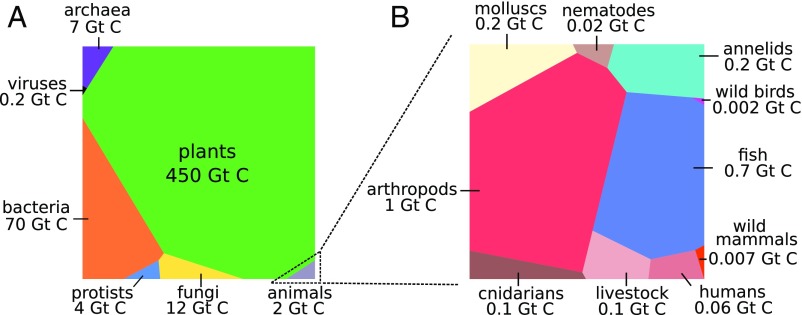
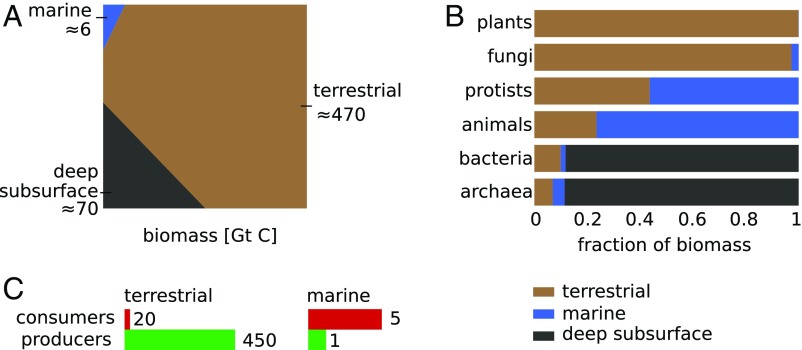
A census of the biomass on Earth is key for understanding the structure and dynamics of the biosphere. However, a global, quantitative view of how the biomass of different taxa compare with one another is still lacking. Here, we assemble the overall biomass composition of the biosphere, establishing a census of the ≈550 gigatons of carbon (Gt C) of biomass distributed among all of the kingdoms of life. We find that the kingdoms of life concentrate at different locations on the planet; plants (≈450 Gt C, the dominant kingdom) are primarily terrestrial, whereas animals (≈2 Gt C) are mainly marine, and bacteria (≈70 Gt C) and archaea (≈7 Gt C) are predominantly located in deep subsurface environments. We show that terrestrial biomass is about two orders of magnitude higher than marine biomass and estimate a total of ≈6 Gt C of marine biota, doubling the previous estimated quantity. Our analysis reveals that the global marine biomass pyramid contains more consumers than producers, thus increasing the scope of previous observations on inverse food pyramids. Finally, we highlight that the mass of humans is an order of magnitude higher than that of all wild mammals combined and report the historical impact of humanity on the global biomass of prominent taxa, including mammals, fish, and plants.
Overview
CoChat Summary
TL;DR
The paper assembles a global census of biomass across all kingdoms of life, estimating Earth’s total biomass at ≈550 Gt C, dominated by plants. It also compares biomass across environments and trophic modes, highlighting large uncertainties and human impacts on the biosphere.
Key findings
- Total global biomass is ≈550 Gt C, with plants ≈450 Gt C (≈80%), bacteria ≈70 Gt C (≈15%), fungi ≈12 Gt C, archaea ≈7 Gt C, protists ≈4 Gt C, animals ≈2 Gt C, and viruses ≈0.2 Gt C.
- Land biomass (≈470 Gt C) is about two orders of magnitude higher than marine biomass (≈6 Gt C); the deep subsurface holds ≈15% of total biomass, chiefly bacteria and archaea.
- In the ocean, ≈1 Gt C of primary producers supports ≈5 Gt C of consumer biomass, an inverted standing biomass distribution; marine biomass is ≈70% microbes, mainly bacteria and protists.
- Human-associated biomass is large relative to wild vertebrates: humans ≈0.06 Gt C, livestock ≈0.1 Gt C, wild mammals ≈0.007 Gt C, domesticated poultry ≈0.005 Gt C versus wild birds ≈0.002 Gt C; total plant biomass has declined approximately twofold relative to pre-human civilization.
Methods
- The authors synthesize hundreds of studies and generate estimates for major taxonomic groups, reporting biomass as gigatons of carbon (Gt C) and using a kingdom-level framework plus viruses.
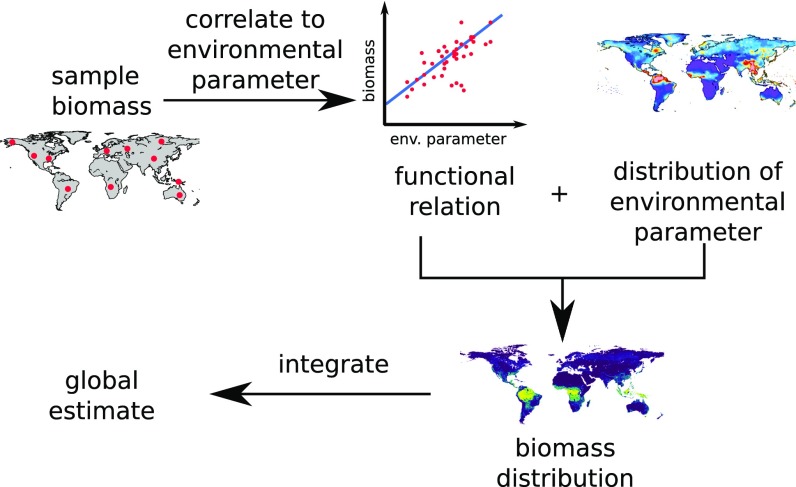
- For many taxa, local biomass samples are extrapolated globally by correlating biomass density with environmental parameters known at global scale; best estimates often use a geometric mean of independent estimates.
- Uncertainty is reported as multiplicative fold-change projections akin to 95% confidence intervals, incorporating intrastudy, interstudy, and intermethod variation; data and code are open-sourced.
Limitations
- The paper states that most datasets rely on fragmentary sampling, causing large uncertainties; sampling is scarce in the deep ocean (usually deeper than 200 m) and deep soil (usually deeper than 1 m), and some estimates may be biased by sampling toward high-abundance areas.
- The paper states that deep subsurface environments have particularly high uncertainty and unknown systematic biases, including unresolved distribution of biomass between aquifer fluids and rocks and among microbial taxa.
- The paper states that current and prehuman vertebrate biomass estimates are only a crude first step, amphibians remain poorly characterized, and parasite biomass is not resolved from hosts; evident from the text, kingdom-level grouping was chosen because much data lack finer taxonomic detail, and some uncertainty projections rely on analogous taxa or expert consultation.
Model-written summary. Check it against the paper before relying on it.
Integrity signals
Registry
Cites
Statistics
Figures
Verification
Claims the paper makes
9 Valid · 7 Not valid · 16 Not checked · 53 Own results and interpretations
Every source the paper cites for this claim was checked and supports it.
In the paper
“The biomass of amphibians, which are experiencing a dramatic population decline (42), remains poorly characterized.”
§ The biomass distribution on Earth > Discussion
What the sources say
- Supportedcites [42] Wake DB Vredenburg VT 2008 Colloquium paper: Are we in the midst of the sixth mass extinction? A view from the world of amphibians Proc Natl Acad Sci USA 105 11466 11473 18695221 PMC2556420 source
The citation is attached to the clause about amphibian population decline, not the separate statement that their biomass is poorly characterized. The passage reporting the Global Amphibian Assessment (labeled Abstract in our copy) says that 43% of amphibian species have declining populations. (LLM, conf=0.92)
plain- Asserted: passes — The authors put it forward as true.
- Checkable: passes — It can be checked against evidence.
- Load-bearing: unclear — It is unclear whether the paper’s conclusions depend on it.
- Based: passes — The paper gives a reason why it holds.
- Supported
Every source the paper cites for this claim was checked and supports it.
In the paper
“In the case of prokaryotes, some major improvements were recently realized, with global estimates of marine deep subsurface prokaryote biomass reduced by about two orders of magnitude due to an increased diversity of sampling locations (7).”
§ The biomass distribution on Earth > Discussion
What the sources say
- Supportedcites [7] Kallmeyer J Pockalny R Adhikari RR Smith DC D’Hondt S 2012 Global distribution of microbial abundance and biomass in subseafloor sediment Proc Natl Acad Sci USA 109 16213 16216 22927371 PMC3479597 source
The Discussion reports a revised subseafloor microbial biomass estimate of 4.1 Pg C versus a previous estimate of 303 Pg C—about a 74-fold reduction. It also identifies a more geographically diverse sampling database, including low-abundance ocean gyres, as a reason the new estimate is lower. The paper identifies other contributing factors as well. (LLM, conf=0.88)
plainstates a cause- Asserted: passes — The authors put it forward as true.
- Checkable: passes — It can be checked against evidence.
- Load-bearing: unclear — It is unclear whether the paper’s conclusions depend on it.
- Based: passes — The paper gives a reason why it holds.
- Supported
The sources with a verdict support this claim; the rest weren’t checked yet, have no full text we could read, or their verdicts aren’t rated yet.
In the paper
“Such inverted biomass distributions can occur when primary producers have a rapid turnover of biomass [on the order of days (34)], while consumer biomass turns over much more slowly [a few years in the case of mesopelagic fish (35)].”
§ The biomass distribution on Earth > Results > The Distribution of Biomass Across Environments and Trophic Modes.
What the sources say
- Supportedcites [34] Zubkov MV 2014 Faster growth of the major prokaryotic versus eukaryotic CO2 fixers in the oligotrophic ocean Nat Commun 5 3776 24777140 PMC4015317 source
The Results (Comparison of the growth rates of the CO2 fixers; page unavailable) report growth rates of 0.1–0.6 per day for the studied oceanic primary producers, consistent with biomass turnover on the order of days. The few-years estimate for mesopelagic fish is assigned to a different citation, not this source. (LLM, conf=0.91)
- Not checked — no full text of the sourcecites [35] Catul V Gauns M Karuppasamy PK 2011 A review on mesopelagic fishes belonging to family Myctophidae Rev Fish Biol Fish 21 339 354 source
plainstates a possible cause- Asserted: passes — The authors put it forward as true.
- Checkable: passes — It can be checked against evidence.
- Load-bearing: passes — The paper’s conclusions depend on it.
- Based: passes — The paper gives a reason why it holds.
- Supported
The cited sources support only part of this claim — read each source’s verdict below.
In the paper
“Combining data from independent sources such as these enables a robust assessment of the total plant biomass (17).”
§ The biomass distribution on Earth > Results > The Uncertainty Associated with Global Biomass Estimates.
What the sources say
- Partly supportedcites [17] Erb K-H 2017 Unexpectedly large impact of forest management and grazing on global vegetation biomass Nature 553 73 76 29258288 PMC5756473 sourceExperimental — accuracy not yet measured
The Methods describe combining multiple datasets and types of evidence to estimate global vegetation biomass stocks. But the paper also says global stocks remain uncertain, reports uncertainty ranges around 35% of the median estimate, and describes more robust estimates as a future prospect. It therefore supports the use of independent sources for an assessment, but not the unqualified characterization of that assessment as robust. (LLM, conf=0.84)
plainstates a cause- Asserted: passes — The authors put it forward as true.
- Checkable: passes — It can be checked against evidence.
- Load-bearing: passes — The paper’s conclusions depend on it.
- Based: passes — The paper gives a reason why it holds.
- Partly supported
A result the paper states — it cites no source for it, so there is none to check. The quote shows it is in the paper.
In the paper
“Plant biomass includes ≈70% stems and tree trunks, which are mostly woody, and thus relatively metabolically inert.”
§ The biomass distribution on Earth > Results > The Biomass Distribution of the Biosphere by Kingdom.
plain- Asserted: passes — The authors put it forward as true.
- Checkable: passes — It can be checked against evidence.
- Load-bearing: unclear — It is unclear whether the paper’s conclusions depend on it.
- Based: passes — The paper gives a reason why it holds.
27 more claims
Create a free account to see all 85 claims and to verify the 2 references still open.
- It may state two separate claims as one. 32
- Probably not a substantial claim. 28
Claims other papers make about this one
Each is checked against this paper’s own text: does it say what the citing paper says it does?
The cited source doesn’t support the claim as written.
In the citing paper
“and less than 10% that of the world ' s current human population ( 52 ).”
From Pervasive human-driven decline of life on Earth points to the need for transformative change (2019) · cites this paper as [52]
Checked by a reasoning model — may be wrong.
Experimental — accuracy not yet measuredThe cited source says what the claim attributes to it.
In the citing paper
“Approximately 450 Gt of C is bound up in terrestrial biota, primarily in plants (86), while only ~6 Gt of C is found in ocean biota (87).”
From Earth beyond six of nine planetary boundaries (2023) · cites this paper as [87]
The cited source says what the claim attributes to it.
In the citing paper
“The amount of metabolic energy available to a biosphere powered by O 2 is vast, such that the O 2 -rich ocean-atmosphere system of the modern Earth supports staggering levels of standing biomass (Bar-On et al. 2018), energy flow (Falkowski et al. 2008), and ecological complexity (Steele 1974).”
From The History of Ocean Oxygenation (2022) · cites this paper as Bar-On et al. 2018
In the citing paper
“Global populations of domestic ruminants (cattle, sheep, and goats) (Ripple et al. 2013) poultry, and pigs (Bennett et al. 2018) used to feed the growing human population now exceed 100 million tons of carbon (Bar-On et al. 2018), and livestock populations are growing rapidly.”
From Scientists’ warning to humanity on the freshwater biodiversity crisis (2021) · cites this paper as Bar-On et al. 2018
Citations
Cites
The worldwide leaf economics spectrum
Wright, I. J., Reich, P. B., Westoby, M., Ackerly, D. D., Baruch, Z., Bongers, F., Cavender-Bares, J., Chapin, T., Cornelissen, J. H. C., Diemer, M., et al. (2004) · Nature · doi:10.1038/nature02403 · Cited by 9,021 · cited 1×
“We then convert the total area of leaves to an estimate of the total dry mass of leaves by using the Glopnet database (24), which measured leaf mass per area (LMA) for ≈2500 plant species.”
MethodA large and persistent carbon sink in the world’s forests
Pan, Y., Birdsey, R. A., Fang, J., Houghton, R., Kauppi, P. E., Kurz, W. A., Phillips, O. L., Shvidenko, A., Lewis, S. L., Canadell, J. G., et al. (2011) · Science · doi:10.1126/science.1201609 · Cited by 8,458
Soil Sampling and Methods of Analysis
(2007) · CRC Press eBooks · doi:10.1201/9781420005271 · Cited by 6,469
Primary production of the biosphere: Integrating terrestrial and oceanic components
Field, C. B., Behrenfeld, M. J., Randerson, J. T., & Falkowski, P. (1998) · Science · doi:10.1126/science.281.5374.237 · Cited by 6,371
Prokaryotes: The unseen majority
Whitman, W. B., Coleman, D. C., & Wiebe, W. J. (1998) · Proceedings of the National Academy of Sciences · doi:10.1073/pnas.95.12.6578 · Cited by 4,871
Global effects of land use on local terrestrial biodiversity
Newbold, T., Hudson, L. N., Hill, S. L. L., Contu, S., Lysenko, I., Senior, R. A., Börger, L., Bennett, D. J., Choimes, A., Collen, B., et al. (2015) · Nature · doi:10.1038/nature14324 · Cited by 4,352
Belowground biodiversity and ecosystem functioning
Bardgett, R. D., & van der Putten, W. H. (2014) · Nature · doi:10.1038/nature13855 · Cited by 3,990 · cited 4×
“This was recommended by experts in the field for estimation of arbuscular mycorrhizal fungi abundance (117).”
BackgroundInfluentialMangroves among the most carbon-rich forests in the tropics
Donato, D. C., Kauffman, J. B., Murdiyarso, D., Kurnianto, S., Stidham, M., & Kanninen, M. (2011) · Nature Geoscience · doi:10.1038/ngeo1123 · Cited by 3,374
Poorter, H., Niklas, K. J., Reich, P. B., Oleksyn, J., Poot, P., & Mommer, L. (2012) · New Phytologist · doi:10.1111/j.1469-8137.2011.03952.x · Cited by 3,163 · cited 1×
“The first relies on a meta-analysis of the biomass allocation to different plant compartments across biomes (19).”
BackgroundA global analysis of root distributions for terrestrial biomes
Jackson, R. B., Canadell, J., Ehleringer, J. R., Mooney, H. A., Sala, O. E., & Schulze, E. D. (1996) · Oecologia · doi:10.1007/bf00333714 · Cited by 3,071 · cited 4×
“assumed the distribution of microbial biomass with depth follows the biomass density versus depth profile of root biomass (21).”
BackgroundMethodInfluential
Research works printed but not linked: 1
- Chapman AD 2009 Numbers of Living Species in Australia and the World Australian Biological Resources Study Canberra, Australia
Cited by
Items 3,201–3,300 of 3,743
Katayama, T. (2024) · doi:10.5194/egusphere-2024-842-ac4
Size spectra in freshwater streams are consistent across temperature and resource supplyPreprint
Gjoni, V., Pomeranz, J. P. F., Junker, J. R., et al. (2024) · Research Square · doi:10.21203/rs.3.rs-4369259/v1
Pedroso-Roussado, C., Pestana, M., Dias, R., et al. (2024) · Open Research Europe · doi:10.12688/openreseurope.18072.1
Soil-Microbe Assessment in Borgu LGA, Nigeria for Sustainable Soil Health and Fertility ManagementPreprint
Oyedele, A. O., Ezaka, E., Uthman, A. C. O., Odunjo, T. E., Ogunweide, T. A., Abigail Oluremi, O. J. O., & Adediran, J. A. (2024) · Research Square · doi:10.21203/rs.3.rs-4605100/v1
Biological Evolutionary Lineages in Marine Habitats of the Phanerozoic
Knoflacher, M. (2024) · Springer eBooks · doi:10.1007/978-3-662-69423-7_9
Characterization of bio-derived carbon nanostructures
Zingare, P. A., & Deshmukh, A. D. (2024) · Elsevier eBooks · doi:10.1016/b978-0-443-13579-8.00007-3
Huxley, P. J., Johnson, L. R., Cator, L. J., et al. (2024) · bioRxiv (Cold Spring Harbor Laboratory) · doi:10.1101/2024.08.09.607340
Exploration of non-coding RNA in complex microbial communities with machine learning
Avila-Santos, A. P. (2024) · Digital Library of Theses and Dissertations (Universidade de São Paulo) · doi:10.11606/t.55.2024.tde-19082024-091042
Multi-Host Pathogen Transmission and the Disease-Diversity RelationshipPreprint
Toorians, M. E. M., MacPherson, A., & Davies, T. J. (2024) · Preprints.org · doi:10.20944/preprints202110.0295.v5
Grundlagen und Ressourcen der Welternährung
Fischer, C. (2024) · Springer eBooks · doi:10.1007/978-3-658-44709-0_2
Dharma ‘धरम’ Framework for Decision-Making and Governance to Implement SDGs: Bhārat’s Imprint
Mishra, S. N. (2024) · Implementing the UN sustainable development goals - regional perspectives · doi:10.1007/978-3-031-17463-6_66
Unbalanced leaf microbiota can cause autoimmunity in plants
(2024) · Nature Plants · doi:10.1038/s41477-024-01782-0
Chapter 2: How to Approach the Materiality of the Ecosocial Transition in Social Work Education
Ranta‐Tyrkkö, S. (2024) · Springer eBooks · doi:10.1007/978-3-031-58708-5_3
Insect Diversity, Distribution, and Abundance
New, T. R. (2024) · Springer eBooks · doi:10.1007/978-3-031-66631-5_1
Plant growth: The heavy matter of weight-induced plant stem thickening
Ji, H., & Ragni, L. (2024) · Current Biology · doi:10.1016/j.cub.2024.08.023
Improving the visualization of viruses in soilPreprint
Parvate, A. D., Alfaro, T., McDearis, R., et al. (2024) · bioRxiv (Cold Spring Harbor Laboratory) · doi:10.1101/2024.09.30.615710
Hüppe, L., Bahlburg, D., Driscoll, R., et al. (2024) · bioRxiv (Cold Spring Harbor Laboratory) · doi:10.1101/2024.10.02.616219
Duan, Q., Clegg, T., Smith, T., Bell, T., & Pawar, S. S. (2024) · Qeios · doi:10.32388/m1xfxl · Cited by 3
“Among these, bacteria dominate, making up approximately 13% of global biomass (Bar-On et al. 2018), accounting for a variety of ecosystem functions by metabolising substrates in their environment (Handley 2019), and ultimately driving all major global biogeochemical cycles, including carbon…”
BackgroundHigh-throughput viral enumeration of aquatic ecosystems via flow cytometry
Bellanger, M., Visscher, P. T., & White, R. A., III (2026) · Applied and Environmental Microbiology · doi:10.1128/aem.01926-25
“Viruses have been estimated to be 10 30 within the global oceans alone and with global biomass estimates, suggesting an underestimation, with further methods needed to enumerate viruses on a global scale (20, 21).”
Origins and Consequences of Early Photosynthetic Organisms
Giordano, M., Beardall, J., Raven, J. A., & Maberly, S. C. (2024) · Cambridge University Press eBooks · doi:10.1017/9781139049979.003
Freedom of speech predicts animal welfare protection across the globePreprint
Montalcini, C. M., & Crowther, T. W. (2024) · bioRxiv (Cold Spring Harbor Laboratory) · doi:10.1101/2024.11.01.621535
Bodawatta, K. H., Maccario, L., Peereboom, N., Conlon, B. H., Li, G., Plaszkó, T., Vinagre‐Izquierdo, C., Jønsson, K. A., Vesala, R., de Beer, Z. W., et al. (2024) · The Science of The Total Environment · doi:10.1016/j.scitotenv.2024.177015
Probiotics in Wild Animal Nutrition and Health
Singh, B., Mal, G., Kalra, R. S., & Marotta, F. (2024) · Springer eBooks · doi:10.1007/978-3-031-65455-8_15
Kaolinite bioformation at surface conditions: The role of fungi and bacteria
Pasquale, V., Cuadros, J., Dumontet, S., Huertas, F. J., Lettino, A., & Fiore, S. (2024) · The Science of The Total Environment · doi:10.1016/j.scitotenv.2024.177513 · Cited by 2
Bouncing photons, underwater robots, and the ocean’s green film
Barone, B. (2024) · Proceedings of the National Academy of Sciences · doi:10.1073/pnas.2420619121
Concept and Dynamics on Earth Mycobiome AMF Networks and Processes
Lalfakwami, C., Yenda, D., Chandrapati, A., Meshram, S., & Srivastava, S. (2024) · Progress in soil science · doi:10.1007/978-3-031-71487-0_6
Humans Make Earth History—New Earth and New Anthropology
Antweiler, C. (2024) · Anthropocene - humanities and social sciences · doi:10.1007/978-3-031-74591-1_1
Comparative analysis of microbial communities of soils under contrasting microclimatesPreprint
Pall, T., Zagal, E., V, Pavlı́ček, T., et al. (2024) · bioRxiv (Cold Spring Harbor Laboratory) · doi:10.1101/2024.11.27.625671
Maia, F. G. M., Freitas, M. D. P., Maia, J. B., et al. (2024) · REVISTA DE AGRICULTURA NEOTROPICAL · doi:10.32404/rean.v11i4.8365
Our Ancient History with Microbes
Ramanathan, J. (2024) · Springer eBooks · doi:10.1007/978-3-031-70088-0_14
Pedroso-Roussado, C., Pestana, M., Dias, R., et al. (2024) · Open Research Europe · doi:10.12688/openreseurope.18072.2
吉田, 光., 吉見, 圭., 高橋, 大., et al. (2024) · Bulletin of Applied Glycoscience · doi:10.5458/bag.14.3_233
植物バイオマスを構成するヘミセルロースの修飾パターンと立体構造
吉見圭永, Tryfona, T., 小竹, 敬., & Dupree, P. (2024) · Bulletin of Applied Glycoscience · doi:10.5458/bag.14.3_187
Local Scale Biogeographic Variation in the Magnolia (Magnolia grandiflora) Phyllosphere
Vaughn, S. N., Eckard, E. M., Kota, V. K., et al. (2024) · Microorganisms · doi:10.3390/microorganisms12122546
Oliveira, L. Z., Vibrans, A. C., Nicoletti, A. L., et al. (2024) · Anais da Academia Brasileira de Ciências · doi:10.1590/0001-3765202420230176
Foliar Microbes as Drivers of Plant Performance and Trophic Dynamics
Griffin, E. A., English, A. R., Jeffrey, C. S., et al. (2024) · Smithsonian Institution Scholarly Press eBooks · doi:10.5479/si.26882395
Genome Annotation: Perspective From Bacterial Genomes
Lim, S. J., & Young, M. (2024) · Elsevier eBooks · doi:10.1016/b978-0-323-95502-7.00256-6
TACKLING THE SOIL MICROBIOME – CHALLENGES AND OPORTUNITIES
Mlesnita, A.-M. (2024) · Journal of Experimental and Molecular Biology · doi:10.47743/jemb-2025-209
Abbas, S., Tabassum, S., Kalsoom, H., Bibi, N., Sohail, K., Zubair, M., & Noreen, M. (2024) · European journal of ecology, biology and agriculture. · doi:10.59324/ejeba.2024.1(5).06
Mitsuguchi, T., Okabe, N., Saito‐Kokubu, Y., et al. (2024) · Genshiryoku bakkuendo kenkyu/Hōshasei haikibutsu kenkyū/Genshiryoku bakku endo kenkyū/Genshiryoku bakkuendo kenkyuu · doi:10.3327/jnuce.31.2_96
王, 翔., Yu, G., Kuzyakov, Y. V., 殷, 博., Kappler, A. A., & Liu, C. (2025) · SCIENTIA SINICA Terrae · doi:10.1360/n072024-0088
ТРАНСФОРМАЦІЯ ЕКОНОМІЧНИХ, ФІНАНСОВИХ ТА ПРОДУКТИВНИХ СИСТЕМ ПРИШВИДШУЄ ПЕРЕХІД ДО СТАЛОГО РОЗВИТКУ
Драпак, Т., Баб’яр, В., & Корнієнко, Д. І. (2025) · Сталий розвиток економіки · doi:10.32782/2308-1988/2024-51-29 · Cited by 1
Adroit, B., Kozlov, M. V., Robledo, J. M., & Schachat, S. R. (2025) · Frontiers in Ecology and Evolution · doi:10.3389/fevo.2024.1539173
Growth in Low Carbon Conditions Reveals Amino-Acid-Coupled Iron UptakePreprint
Lara‐Gutiérrez, J., Nguyen, J., McIlvin, M. R., Sugiyama, I., Landry, Z., Alcolombri, U., Keegstra, J. M., Pontrelli, S., Jiménez‐Martínez, J., Sauer, U., et al. (2025) · bioRxiv (Cold Spring Harbor Laboratory) · doi:10.1101/2025.01.15.633289 · Cited by 1
LYGIA CLARK, HÉLIO OITICICA E MÁRIO PEDROSA: EMBREANTES DA ARTE CONTEMPORÂNEA BRASILEIRA
Gontijo, B. H. F. (2020) · DOAJ (DOAJ: Directory of Open Access Journals)
Sommer, S. G., Bruhn, A., Thomsen, S. T., Jensen, P. D., & Fretté, X. C. (2025) · Cambridge University Press eBooks · doi:10.1017/9781108950831.003
Hüppe, L., Bahlburg, D., Driscoll, R., Helfrich‐Förster, C., & Meyer, B. (2025) · eLife · doi:10.7554/elife.103096.1
Mamawal, D. R. D., & Rivera, W. L. (2025) · Environmental Monitoring and Assessment · doi:10.1007/s10661-025-13630-5
“Eukaryotic microbes also play a large part in microbial diversity, specifically protists and fungi, accounting for 17% of the global microbial biomass, and protists comprise 25% of microbial eukaryotic biomass (Bar-On et al., 2018).”
Interactions of morphology and leg-driven locomotor behaviour in insects
Weihmann, T. (2025) · Elsevier eBooks · doi:10.1016/b978-0-443-18544-1.00017-x · Cited by 1
Behold the scale of global zoogeomorphic activity
Francis, R. A. (2025) · Proceedings of the National Academy of Sciences · doi:10.1073/pnas.2501894122
Dasgupta, P. S. (2024) · Cambridge University Press eBooks · doi:10.1017/9781009494359.029
Волошин, В. С. (2024) · Reporter of the Priazovskyi State Technical University Section Technical sciences · doi:10.31498/2225-6733.49.2.2024.321363
A correction is due—the current population boom will end
Rees, W. E. (2025) · Elsevier eBooks · doi:10.1016/b978-0-443-14082-2.00085-5 · Cited by 1
Yu, Y., Shangguan, M., Sun, P., et al. (2025) · Microorganisms · doi:10.3390/microorganisms13040727
“Marine planktonic microorganisms constitute approximately 60% of the total ocean biomass [1].”
The nutritional value of invertebrate aquatic foods
Zamborain‐Mason, J., Marwaha, N., Yoo, S., Hicks, C. C., Robinson, J. P. W., Abucay, L. R., Elsler, L. G., Eurich, J. G., Friedman, W. R., Gephart, J. A., et al. (2026) · Nature · doi:10.1038/s41586-026-10908-7 · Cited by 2
“7 and 8), indicating, for example, that a country or EEZ with high nutrient yields does not necessarily target the species with most nutrient concentrations.”
The evolution and domestication of the ruminants
Tizard, I. R. (2025) · Elsevier eBooks · doi:10.1016/b978-0-443-33572-3.00001-1
Hüppe, L., Bahlburg, D., Driscoll, R., Helfrich‐Förster, C., & Meyer, B. (2025) · eLife · doi:10.7554/elife.103096.2
Spotlight on “A map of the rubisco biochemical landscape” by Prywes et al. (2025)
Lo, W. T., & Leister, D. (2025) · Journal of Mitochondria Plastids and Endosymbiosis · doi:10.1080/28347056.2025.2492069
Pedroso-Roussado, C., Pestana, M., Dias, R., et al. (2025) · Open Research Europe · doi:10.12688/openreseurope.18072.3
Long-Term Storage of Seeds from Plant Gene Pool Samples in the National Depository
Chernobai, Y., Рябчун, В. К., Kuzmyshyna, N., et al. (2024) · Problems of Cryobiology and Cryomedicine · doi:10.15407/cryo34.04.296a
Pathways and Policies of Blue Economy in Supporting Carbon-Neutrality Target
China Council for International Cooperation on Environment and Development (CCICED) Secretariat (2025) · Springer eBooks · doi:10.1007/978-981-96-4218-2_2
Kwidzińska, K., Hryniewicka, M., & Caban, M. (2025) · Atmospheric Environment · doi:10.1016/j.atmosenv.2025.121252
Let the BOOSTER boost photosynthesis and plant productivity
Ahmad, N., Awan, M. J. A., Amin, I. U., et al. (2025) · Trends in Plant Science · doi:10.1016/j.tplants.2025.04.005
General Patterns in the Temperature-Dependence of Heterotrophic Microbial InteractionsPreprint
Duan, Q., Harcombe, W. R., Savage, V. M., Mustri, M., Smith, T., & Pawar, S. S. (2025) · bioRxiv (Cold Spring Harbor Laboratory) · doi:10.1101/2025.04.18.649480 · Cited by 1
“In all of this, prokaryotes, and in particular bacteria, play a pivotal role due to their high biomass abundance relative to other microbial groups (Bar-On et al. 2018, Rivett & Bell 2018).”
Frediani, P., & Frediani, M. (2025) · Biofuels and biorefineries · doi:10.1007/978-981-96-1222-2_5
What makes a society dead: accumulation of uric acid increases infectious disease risk in termitesPreprint
Konishi, T., Nakashima, M., Nozaki, T., et al. (2025) · bioRxiv (Cold Spring Harbor Laboratory) · doi:10.1101/2025.04.23.650172
“Social insects, such as termites, ants, bees and wasps, are the most abundant animals on earth [1–3].”
Unsustainability and Ecolinguistics
Krizsán, A. (2025) · Springer eBooks · doi:10.1007/978-3-031-85493-4_4
Zai, X., Zhu, F., Zhao, M., et al. (2025) · ISME Communications · doi:10.1093/ismeco/ycaf066
“The phyllosphere (i.e. the aerial parts of plants, including leaves, flowers, stems, fruits, and pollen [9, 10]) constitutes one of the largest surface habitats supporting microbial life [11].”
Systemic bio‐inequity links poverty to biodiversity and induces a conservation paradox
Waldock, C. A., Nguyen, V. T. H., Owuor, M. A., Manyanza, A. S., & D, O. S. C. (2026) · People and Nature · doi:10.1002/pan3.70349 · Cited by 3
“Development and environmental policy programmes have responded to the contemporaneous decline in biodiversity (IPBES, 2019 ) and rise in absolute poverty and inequality (Hickel, 2018a ) by addressing both these global challenges together (Carmenta et al., 2025; Fisher et al., 2020 ; UN, 2015 ).”
Eläinten rooli suomalaisessa koulutusjärjestelmässä
Koivunen, T., & Konst, T. (2025) · Ennen ja nyt Historian tietosanomat · doi:10.37449/ennenjanyt.148659
Letico, V. (2025) · Palgrave Studies in Sustainable Futures. · doi:10.1007/978-3-031-30231-2_1-1
Pantoja, D. E. A., & Ruaro, R. (2025) · Revista de Gestão Social e Ambiental · doi:10.24857/rgsa.v19n5-112
piRNAs are abundant in the early embryo of the crustacean Parhyale hawaiensisPreprint
Calvo, L., Pettini, T., Ylla, G., Ronshaugen, M., & Griffiths‐Jones, S. (2025) · bioRxiv (Cold Spring Harbor Laboratory) · doi:10.1101/2025.05.30.656998
“Crustacea is a predominantly aquatic and highly abundant subphylum of the Arthropoda, comprising an estimated 67,000 species 27 and accounting for around 0.94Gt of the earth biomass 28 .”
Fonaments filosòfics per al reconeixement de drets als altres animals
Tafalla, M. (2025) · Revista Catalana de Dret Públic · doi:10.58992/rcdp.i70.2025.4418
Lippeveld, M., Peralta, D., Vardi, A., Vincent, F., & Saeys, Y. (2025) · Cytometry Part A · doi:10.1002/cyto.a.24944
Organomineralization in the deep seabed polymetallic nodules: a matter of cell surface
Montoya, L., & Escobar-Briones, E. G. (2025) · Geomicrobiology Journal · doi:10.1080/01490451.2025.2519782
Petruch, M., & Walcher, D. (2025) · Springer eBooks · doi:10.1007/978-3-031-95925-7_5
Petruch, M., & Walcher, D. (2025) · Springer eBooks · doi:10.1007/978-3-031-95925-7_6
Gustafsson, J., & Drake, H. (2025) · Discover Geoscience · doi:10.1007/s44288-025-00176-9 · Cited by 1
Serrano, A. G. (2025) · Tabula rasa · doi:10.25058/20112742.n54.06 · Cited by 1
Feltrin, A. N. (2025) · University of North Texas Digital Library (University of North Texas) · doi:10.12794/metadc2443353
Rewilding Animal Studies: Biodiversity Bias in Modernist Fiction and Criticism
Warodell, J. A. (2025) · Anthropocenes – Human Inhuman Posthuman · doi:10.16997/ahip.1771
Searching for evolutionary perspectives of human sociality through the eyes of gorillas
Yamagiwa, J. (2025) · Primates · doi:10.1007/s10329-025-01198-0
Ethical Implications of Being a Holobiont
Gilbert, S. F. (2025) · Integrative and Comparative Biology · doi:10.1093/icb/icaf124 · Cited by 1
Letico, V. (2025) · Palgrave Studies in Sustainable Futures. · doi:10.1007/978-3-031-55387-5_1
Biomass distribution of sympatric mammals in a European temperate forest
Pleskalt, A., Farias, S., Vicedo, T., Álvarez‐Martínez, J. M., Roces-Díaz, J. V., Meloro, C., Pereira, S., Cruz, A., García, J. T., Gómez, P., et al. (2025) · Royal Society Open Science · doi:10.1098/rsos.250472
“[1] highlighted that the expected ratio of primary producers (plants) to consumers (herbivores) is approximately 12 : 1.”
InfluentialMetabolic potentials of the gut microbes in Antarctic krill ( Euphausia superba )
Wei, Z., Meng, L., Du, S., Wang, F., Jiang, A., Lu, R., Liu, K., Wang, X., Xu, Q., Mu, X., et al. (2025) · mSystems · doi:10.1128/msystems.00377-25 · Cited by 1
Favourite animals, plant awareness, and the forgotten kingdom: addressing low fungal awareness
Torres‐Porras, J., Ramos-Miras, J. J., Castro, F., et al. (2025) · Journal of Biological Education · doi:10.1080/00219266.2025.2523349
“If we analyse the total biomass on the planet, of these three groups, plants predominate, followed by fungi and animals in third place (Bar-On, Phillips, and Milo 2018).”
Pilát, A., Tomasko, R. E., Gibson, A., Barich, D., Slimak, Z. C., Fennessy, M. S., & Slonczewski, J. L. (2025) · bioRxiv (Cold Spring Harbor Laboratory) · doi:10.1101/2025.08.10.669474
Mehtta, M. (2025) · Current Anthropology · doi:10.1086/736420
Bärlocher, F. (2025) · Springer eBooks · doi:10.1007/978-3-662-70586-5_12
Bornschlögl, T., & Dietz, H. (2025) · Springer eBooks · doi:10.1007/978-3-662-65805-5_6
Dynamics of small and declining populations: Viability and extinction
Mills, L. S., Whiteley, A. R., & Tourani, M. (2025) · Oxford University Press eBooks · doi:10.1093/oso/9780192898166.003.0012
Mills, L. S., Whiteley, A. R., & Tourani, M. (2025) · Oxford University Press eBooks · doi:10.1093/oso/9780192898166.002.0007
Mills, L. S., Whiteley, A. R., & Tourani, M. (2025) · Oxford University Press eBooks · doi:10.1093/oso/9780192898166.003.0006
Mills, L. S. (2025) · Oxford University Press eBooks · doi:10.1093/oso/9780192898166.002.0011
Mills, L. S., Whiteley, A. R., & Tourani, M. (2025) · Oxford University Press eBooks · doi:10.1093/oso/9780192898166.002.0013
Predation and wildlife populations
Mills, L. S., Whiteley, A. R., & Tourani, M. (2025) · Oxford University Press eBooks · doi:10.1093/oso/9780192898166.003.0008
Metadata
- Authors
- Bar-On, Y. M., Phillips, R., & Milo, R.
- Affiliations
- Department of Plant and Environmental Sciences, Weizmann Institute of Science, 76100 Rehovot, Israel;
- California Institute of Technology (US)
- Weizmann Institute of Science (IL)
- Corresponding author
- Milo, Ron
- Venue
- Proceedings of the National Academy of Sciences
- Publisher
- National Academy of Sciences
- Published
- 2018-05-21
- Volume
- 115
- Issue
- 25
- Pages
- 6506-6511
- ISSN
- 0027-8424 (ISSN-L)
- 1091-6490
- PMC
- PMC6016768
- OpenAlex
- W2804910112
- Cited by
- 3,723
- References
- 263
- Citations by year
- 2026: 349 · 2025: 450 · 2024: 589 · 2023: 617 · 2022: 498 · 2021: 498 · 2020: 419 · 2019: 246 · 2018: 49
- FWCI
- 239.98
- Type
- journal article
- Language
- en
- Open access
- hybrid
- doi.org
- Licence
- Locations
- Proceedings of the National Academy of Sciences (publishedVersion, cc-by-nc-nd)
- Europe PMC (PubMed Central) (publishedVersion, cc-by-nc-nd)
- PubMed Central (publishedVersion, cc-by-nc-nd)
- PubMed (publishedVersion)
- CaltechAUTHORS (California Institute of Technology) (submittedVersion, cc-by-nc-nd)
- Funders
- National Institutes of Health (5r35gm118043-07)
- National Institute of General Medical Sciences (R35 GM118043)
- Topics
- Physical Sciences › Environmental Science › Nature and Landscape Conservation › Ecology and Vegetation Dynamics Studies
- Physical Sciences › Environmental Science › Global and Planetary Change › Earth Systems and Cosmic Evolution
- Life Sciences › Agricultural and Biological Sciences › Soil Science › Soil Carbon and Nitrogen Dynamics
- Keywords
- biomass allocation, biomass carbon, terrestrial biomass, marine biomass, bacteria, archaea, food pyramid, wild mammals, fish biomass, plant biomass
- MeSH terms
- Animals, Archaea, Bacteria, Carbon, Humans, Plants, Ecosystem, Biomass, Earth, Planet, Biota
About these checks
Registry, retraction, Cites and statistics results are computed, not judged, with one exception: a printed reference that no index lists is read once by a model before it counts as a citation error. Claims are extracted by a model and kept only when their quote appears verbatim in the text; each cited source is then checked, with a model’s help, for whether it says what the claim relies on. Those verdicts can be wrong — read the claim’s quote and the cited source before relying on one.
The claim verdicts this report counts are experimental: their accuracy is not yet measured.
A language model drew the claims from the paper on 2026-10-10, under version 3 of the claim definition (model deepseek-v4.1-flash, prompt extract-v3).
A second model labelled each claim on 2026-10-10 (model jev-1.13-20260917, definition revision gold-guideline-v0.2).
Cited sources are checked with a language model’s help (gpt-6-sol).
Statistics and arithmetic are recomputed, not judged.
Confidence bands are shown only for fields calibrated on our annotated test set. None is calibrated yet, so no band is shown.
What counts as a claim ›How we measure confidence ›How we check this ›
Are you an author, or do you see a problem with this page? Request a review
Data sources
Bibliographic data: Semantic Scholar, OpenAlex, Crossref.
Contains information from the Semantic Scholar Academic Graph Datasets, made available under the ODC Attribution License (ODC-BY 1.0).
Semantic Scholar’s data is described in: Kinney, R., et al. (2023). The Semantic Scholar Open Data Platform. arXiv:2301.10140.
