

The biomass distribution on Earth
Open accessThe DOI matches its Crossref record; 263 of the 263 references it cites were found in a registry or an index; 11 of the 41 sources its claims cite were checked for support.
Abstract
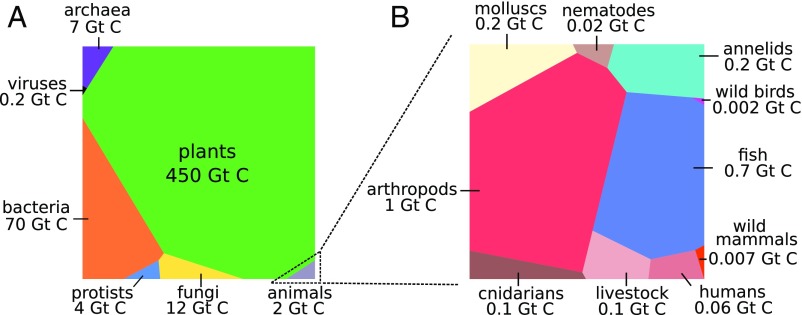
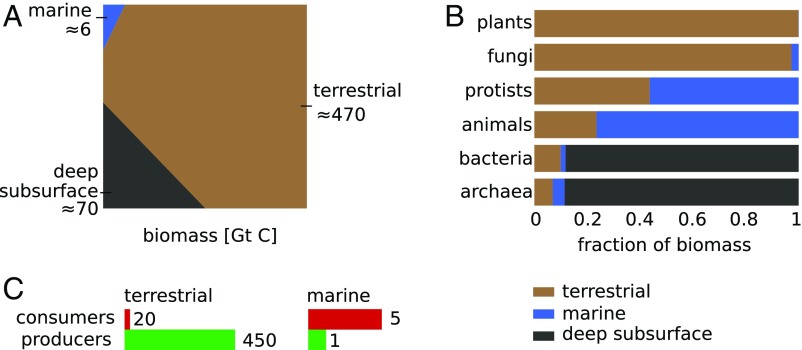
A census of the biomass on Earth is key for understanding the structure and dynamics of the biosphere. However, a global, quantitative view of how the biomass of different taxa compare with one another is still lacking. Here, we assemble the overall biomass composition of the biosphere, establishing a census of the ≈550 gigatons of carbon (Gt C) of biomass distributed among all of the kingdoms of life. We find that the kingdoms of life concentrate at different locations on the planet; plants (≈450 Gt C, the dominant kingdom) are primarily terrestrial, whereas animals (≈2 Gt C) are mainly marine, and bacteria (≈70 Gt C) and archaea (≈7 Gt C) are predominantly located in deep subsurface environments. We show that terrestrial biomass is about two orders of magnitude higher than marine biomass and estimate a total of ≈6 Gt C of marine biota, doubling the previous estimated quantity. Our analysis reveals that the global marine biomass pyramid contains more consumers than producers, thus increasing the scope of previous observations on inverse food pyramids. Finally, we highlight that the mass of humans is an order of magnitude higher than that of all wild mammals combined and report the historical impact of humanity on the global biomass of prominent taxa, including mammals, fish, and plants.
Overview
CoChat Summary
TL;DR
The paper assembles a global census of biomass across all kingdoms of life, estimating Earth’s total biomass at ≈550 Gt C, dominated by plants. It also compares biomass across environments and trophic modes, highlighting large uncertainties and human impacts on the biosphere.
Key findings
- Total global biomass is ≈550 Gt C, with plants ≈450 Gt C (≈80%), bacteria ≈70 Gt C (≈15%), fungi ≈12 Gt C, archaea ≈7 Gt C, protists ≈4 Gt C, animals ≈2 Gt C, and viruses ≈0.2 Gt C.
- Land biomass (≈470 Gt C) is about two orders of magnitude higher than marine biomass (≈6 Gt C); the deep subsurface holds ≈15% of total biomass, chiefly bacteria and archaea.
- In the ocean, ≈1 Gt C of primary producers supports ≈5 Gt C of consumer biomass, an inverted standing biomass distribution; marine biomass is ≈70% microbes, mainly bacteria and protists.
- Human-associated biomass is large relative to wild vertebrates: humans ≈0.06 Gt C, livestock ≈0.1 Gt C, wild mammals ≈0.007 Gt C, domesticated poultry ≈0.005 Gt C versus wild birds ≈0.002 Gt C; total plant biomass has declined approximately twofold relative to pre-human civilization.
Methods
- The authors synthesize hundreds of studies and generate estimates for major taxonomic groups, reporting biomass as gigatons of carbon (Gt C) and using a kingdom-level framework plus viruses.
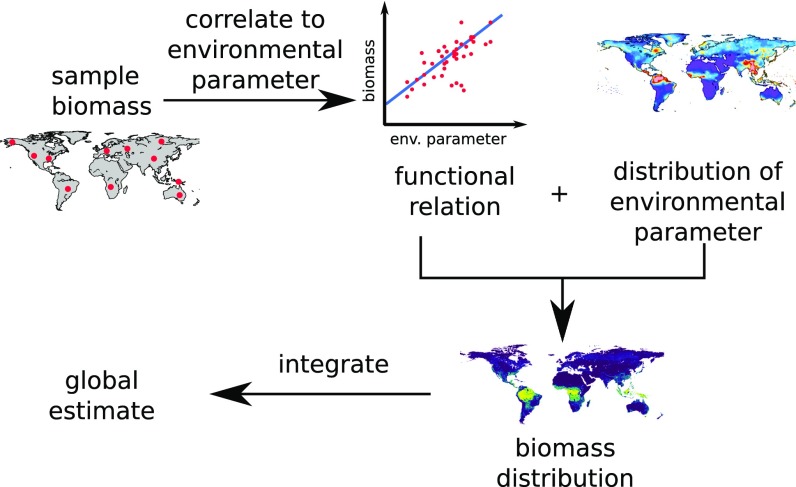
- For many taxa, local biomass samples are extrapolated globally by correlating biomass density with environmental parameters known at global scale; best estimates often use a geometric mean of independent estimates.
- Uncertainty is reported as multiplicative fold-change projections akin to 95% confidence intervals, incorporating intrastudy, interstudy, and intermethod variation; data and code are open-sourced.
Limitations
- The paper states that most datasets rely on fragmentary sampling, causing large uncertainties; sampling is scarce in the deep ocean (usually deeper than 200 m) and deep soil (usually deeper than 1 m), and some estimates may be biased by sampling toward high-abundance areas.
- The paper states that deep subsurface environments have particularly high uncertainty and unknown systematic biases, including unresolved distribution of biomass between aquifer fluids and rocks and among microbial taxa.
- The paper states that current and prehuman vertebrate biomass estimates are only a crude first step, amphibians remain poorly characterized, and parasite biomass is not resolved from hosts; evident from the text, kingdom-level grouping was chosen because much data lack finer taxonomic detail, and some uncertainty projections rely on analogous taxa or expert consultation.
Model-written summary. Check it against the paper before relying on it.
Integrity signals
Registry
Cites
Statistics
Figures
Verification
Claims the paper makes
9 Valid · 7 Not valid · 16 Not checked · 53 Own results and interpretations
Every source the paper cites for this claim was checked and supports it.
In the paper
“The biomass of amphibians, which are experiencing a dramatic population decline (42), remains poorly characterized.”
§ The biomass distribution on Earth > Discussion
What the sources say
- Supportedcites [42] Wake DB Vredenburg VT 2008 Colloquium paper: Are we in the midst of the sixth mass extinction? A view from the world of amphibians Proc Natl Acad Sci USA 105 11466 11473 18695221 PMC2556420 source
The citation is attached to the clause about amphibian population decline, not the separate statement that their biomass is poorly characterized. The passage reporting the Global Amphibian Assessment (labeled Abstract in our copy) says that 43% of amphibian species have declining populations. (LLM, conf=0.92)
plain- Asserted: passes — The authors put it forward as true.
- Checkable: passes — It can be checked against evidence.
- Load-bearing: unclear — It is unclear whether the paper’s conclusions depend on it.
- Based: passes — The paper gives a reason why it holds.
- Supported
Every source the paper cites for this claim was checked and supports it.
In the paper
“In the case of prokaryotes, some major improvements were recently realized, with global estimates of marine deep subsurface prokaryote biomass reduced by about two orders of magnitude due to an increased diversity of sampling locations (7).”
§ The biomass distribution on Earth > Discussion
What the sources say
- Supportedcites [7] Kallmeyer J Pockalny R Adhikari RR Smith DC D’Hondt S 2012 Global distribution of microbial abundance and biomass in subseafloor sediment Proc Natl Acad Sci USA 109 16213 16216 22927371 PMC3479597 source
The Discussion reports a revised subseafloor microbial biomass estimate of 4.1 Pg C versus a previous estimate of 303 Pg C—about a 74-fold reduction. It also identifies a more geographically diverse sampling database, including low-abundance ocean gyres, as a reason the new estimate is lower. The paper identifies other contributing factors as well. (LLM, conf=0.88)
plainstates a cause- Asserted: passes — The authors put it forward as true.
- Checkable: passes — It can be checked against evidence.
- Load-bearing: unclear — It is unclear whether the paper’s conclusions depend on it.
- Based: passes — The paper gives a reason why it holds.
- Supported
The sources with a verdict support this claim; the rest weren’t checked yet, have no full text we could read, or their verdicts aren’t rated yet.
In the paper
“Such inverted biomass distributions can occur when primary producers have a rapid turnover of biomass [on the order of days (34)], while consumer biomass turns over much more slowly [a few years in the case of mesopelagic fish (35)].”
§ The biomass distribution on Earth > Results > The Distribution of Biomass Across Environments and Trophic Modes.
What the sources say
- Supportedcites [34] Zubkov MV 2014 Faster growth of the major prokaryotic versus eukaryotic CO2 fixers in the oligotrophic ocean Nat Commun 5 3776 24777140 PMC4015317 source
The Results (Comparison of the growth rates of the CO2 fixers; page unavailable) report growth rates of 0.1–0.6 per day for the studied oceanic primary producers, consistent with biomass turnover on the order of days. The few-years estimate for mesopelagic fish is assigned to a different citation, not this source. (LLM, conf=0.91)
- Not checked — no full text of the sourcecites [35] Catul V Gauns M Karuppasamy PK 2011 A review on mesopelagic fishes belonging to family Myctophidae Rev Fish Biol Fish 21 339 354 source
plainstates a possible cause- Asserted: passes — The authors put it forward as true.
- Checkable: passes — It can be checked against evidence.
- Load-bearing: passes — The paper’s conclusions depend on it.
- Based: passes — The paper gives a reason why it holds.
- Supported
The cited sources support only part of this claim — read each source’s verdict below.
In the paper
“Combining data from independent sources such as these enables a robust assessment of the total plant biomass (17).”
§ The biomass distribution on Earth > Results > The Uncertainty Associated with Global Biomass Estimates.
What the sources say
- Partly supportedcites [17] Erb K-H 2017 Unexpectedly large impact of forest management and grazing on global vegetation biomass Nature 553 73 76 29258288 PMC5756473 sourceExperimental — accuracy not yet measured
The Methods describe combining multiple datasets and types of evidence to estimate global vegetation biomass stocks. But the paper also says global stocks remain uncertain, reports uncertainty ranges around 35% of the median estimate, and describes more robust estimates as a future prospect. It therefore supports the use of independent sources for an assessment, but not the unqualified characterization of that assessment as robust. (LLM, conf=0.84)
plainstates a cause- Asserted: passes — The authors put it forward as true.
- Checkable: passes — It can be checked against evidence.
- Load-bearing: passes — The paper’s conclusions depend on it.
- Based: passes — The paper gives a reason why it holds.
- Partly supported
A result the paper states — it cites no source for it, so there is none to check. The quote shows it is in the paper.
In the paper
“Plant biomass includes ≈70% stems and tree trunks, which are mostly woody, and thus relatively metabolically inert.”
§ The biomass distribution on Earth > Results > The Biomass Distribution of the Biosphere by Kingdom.
plain- Asserted: passes — The authors put it forward as true.
- Checkable: passes — It can be checked against evidence.
- Load-bearing: unclear — It is unclear whether the paper’s conclusions depend on it.
- Based: passes — The paper gives a reason why it holds.
27 more claims
Create a free account to see all 85 claims and to verify the 2 references still open.
- It may state two separate claims as one. 32
- Probably not a substantial claim. 28
Claims other papers make about this one
Each is checked against this paper’s own text: does it say what the citing paper says it does?
The cited source doesn’t support the claim as written.
In the citing paper
“and less than 10% that of the world ' s current human population ( 52 ).”
From Pervasive human-driven decline of life on Earth points to the need for transformative change (2019) · cites this paper as [52]
Checked by a reasoning model — may be wrong.
Experimental — accuracy not yet measuredThe cited source says what the claim attributes to it.
In the citing paper
“Approximately 450 Gt of C is bound up in terrestrial biota, primarily in plants (86), while only ~6 Gt of C is found in ocean biota (87).”
From Earth beyond six of nine planetary boundaries (2023) · cites this paper as [87]
The cited source says what the claim attributes to it.
In the citing paper
“The amount of metabolic energy available to a biosphere powered by O 2 is vast, such that the O 2 -rich ocean-atmosphere system of the modern Earth supports staggering levels of standing biomass (Bar-On et al. 2018), energy flow (Falkowski et al. 2008), and ecological complexity (Steele 1974).”
From The History of Ocean Oxygenation (2022) · cites this paper as Bar-On et al. 2018
In the citing paper
“Global populations of domestic ruminants (cattle, sheep, and goats) (Ripple et al. 2013) poultry, and pigs (Bennett et al. 2018) used to feed the growing human population now exceed 100 million tons of carbon (Bar-On et al. 2018), and livestock populations are growing rapidly.”
From Scientists’ warning to humanity on the freshwater biodiversity crisis (2021) · cites this paper as Bar-On et al. 2018
Citations
Cites
The worldwide leaf economics spectrum
Wright, I. J., Reich, P. B., Westoby, M., Ackerly, D. D., Baruch, Z., Bongers, F., Cavender-Bares, J., Chapin, T., Cornelissen, J. H. C., Diemer, M., et al. (2004) · Nature · doi:10.1038/nature02403 · Cited by 9,021 · cited 1×
“We then convert the total area of leaves to an estimate of the total dry mass of leaves by using the Glopnet database (24), which measured leaf mass per area (LMA) for ≈2500 plant species.”
MethodA large and persistent carbon sink in the world’s forests
Pan, Y., Birdsey, R. A., Fang, J., Houghton, R., Kauppi, P. E., Kurz, W. A., Phillips, O. L., Shvidenko, A., Lewis, S. L., Canadell, J. G., et al. (2011) · Science · doi:10.1126/science.1201609 · Cited by 8,458
Soil Sampling and Methods of Analysis
(2007) · CRC Press eBooks · doi:10.1201/9781420005271 · Cited by 6,469
Primary production of the biosphere: Integrating terrestrial and oceanic components
Field, C. B., Behrenfeld, M. J., Randerson, J. T., & Falkowski, P. (1998) · Science · doi:10.1126/science.281.5374.237 · Cited by 6,371
Prokaryotes: The unseen majority
Whitman, W. B., Coleman, D. C., & Wiebe, W. J. (1998) · Proceedings of the National Academy of Sciences · doi:10.1073/pnas.95.12.6578 · Cited by 4,871
Global effects of land use on local terrestrial biodiversity
Newbold, T., Hudson, L. N., Hill, S. L. L., Contu, S., Lysenko, I., Senior, R. A., Börger, L., Bennett, D. J., Choimes, A., Collen, B., et al. (2015) · Nature · doi:10.1038/nature14324 · Cited by 4,352
Belowground biodiversity and ecosystem functioning
Bardgett, R. D., & van der Putten, W. H. (2014) · Nature · doi:10.1038/nature13855 · Cited by 3,990 · cited 4×
“This was recommended by experts in the field for estimation of arbuscular mycorrhizal fungi abundance (117).”
BackgroundInfluentialMangroves among the most carbon-rich forests in the tropics
Donato, D. C., Kauffman, J. B., Murdiyarso, D., Kurnianto, S., Stidham, M., & Kanninen, M. (2011) · Nature Geoscience · doi:10.1038/ngeo1123 · Cited by 3,374
Poorter, H., Niklas, K. J., Reich, P. B., Oleksyn, J., Poot, P., & Mommer, L. (2012) · New Phytologist · doi:10.1111/j.1469-8137.2011.03952.x · Cited by 3,163 · cited 1×
“The first relies on a meta-analysis of the biomass allocation to different plant compartments across biomes (19).”
BackgroundA global analysis of root distributions for terrestrial biomes
Jackson, R. B., Canadell, J., Ehleringer, J. R., Mooney, H. A., Sala, O. E., & Schulze, E. D. (1996) · Oecologia · doi:10.1007/bf00333714 · Cited by 3,071 · cited 4×
“assumed the distribution of microbial biomass with depth follows the biomass density versus depth profile of root biomass (21).”
BackgroundMethodInfluential
Research works printed but not linked: 1
- Chapman AD 2009 Numbers of Living Species in Australia and the World Australian Biological Resources Study Canberra, Australia
Cited by
Items 3,301–3,400 of 3,743
Density-dependent population change
Mills, L. S., Whiteley, A. R., & Tourani, M. (2025) · Oxford University Press eBooks · doi:10.1093/oso/9780192898166.003.0007
Genetic concepts and tools to support wildlife population ecology
Mills, L. S., Whiteley, A. R., & Tourani, M. (2025) · Oxford University Press eBooks · doi:10.1093/oso/9780192898166.003.0003
Exponential (or geometric) change: The simplest way to describe and project population dynamics
Mills, L. S., Whiteley, A. R., & Tourani, M. (2025) · Oxford University Press eBooks · doi:10.1093/oso/9780192898166.003.0005
Mills, L. S. (2025) · Oxford University Press eBooks · doi:10.1093/oso/9780192898166.002.0012
Dynamics of multiple populations
Mills, L. S., Whiteley, A. R., & Tourani, M. (2025) · Oxford University Press eBooks · doi:10.1093/oso/9780192898166.003.0010
Sustainable harvest principles, models, and best practices
Mills, L. S., Whiteley, A. R., & Tourani, M. (2025) · Oxford University Press eBooks · doi:10.1093/oso/9780192898166.003.0013
Mills, L. S., Whiteley, A. R., & Tourani, M. (2025) · Oxford University Press eBooks · doi:10.1093/oso/9780192898166.002.0014
Genetic variation and fitness of wildlife populations
Mills, L. S., Whiteley, A. R., & Tourani, M. (2025) · Oxford University Press eBooks · doi:10.1093/oso/9780192898166.003.0009
Gaining reliable knowledge: How do we know what we know?
Mills, L. S., Whiteley, A. R., & Tourani, M. (2025) · Oxford University Press eBooks · doi:10.1093/oso/9780192898166.003.0002
Mills, L. S., Whiteley, A. R., & Tourani, M. (2025) · Oxford University Press eBooks · doi:10.1093/oso/9780192898166.002.0003
Estimating population size and vital rates
Mills, L. S., Whiteley, A. R., & Tourani, M. (2025) · Oxford University Press eBooks · doi:10.1093/oso/9780192898166.003.0004 · Cited by 1
Mills, L. S., Whiteley, A. R., & Tourani, M. (2025) · Oxford University Press eBooks · doi:10.1093/oso/9780192898166.002.0004
Mills, L. S., Whiteley, A. R., & Tourani, M. (2025) · Oxford University Press eBooks · doi:10.1093/oso/9780192898166.002.0009
Mills, L. S., Whiteley, A. R., & Tourani, M. (2025) · Oxford University Press eBooks · doi:10.1093/oso/9780192898166.002.0008
Turismo verde y alimentación animal: ¿cuáles son los riesgos para nuestra salud y la suya?
Giraudoux, P., Afonso, E., & Li, L. (2022) · doi:10.64628/aak.3cehnchh5
Weis, T. (2025) · The Conversation · doi:10.64628/aam.ecf3u37et
Suissa, J. S., & Goulet‐Scott, B. E. (2023) · The Conversation · doi:10.64628/aai.6wgskthqn
¿Qué nos enseñan los herbívoros silvestres sobre el impacto climático de la ganadería?
Manzano, P., Santeodoro, A. D. P., Pardo, G. O., & Zulueta, R. (2024) · The Conversation · doi:10.64628/aao.tcfdpgs9r
Research progress on nitrogen balance potentials in terrestrial ecosystems
Zhang, Y., Chen, X., Duan, X., Xia, L., Liu, J., Yan, X., & Cheng, X. (2025) · Chinese Science Bulletin (Chinese Version) · doi:10.1360/csb-2025-0586
Faire du tourisme vert et nourrir les animaux : quels risques pour notre santé… et la leur ?
Giraudoux, P., Afonso, E., & Li, L. (2022) · doi:10.64628/aak.hksxphxta
Challenges in soil ecotoxicology in climate change scenarios
Reis, F. O., Volcão, L. M., Zebral, Y. D., & Júnior, F. M. R. D. S. (2025) · Integrated Environmental Assessment and Management · doi:10.1093/inteam/vjaf069
On the importance of agriculture for wildlife conservation
Johnson, M. D. (2025) · California Fish and Wildlife Journal · doi:10.51492/cfwj.111.12
Unveiling the Dynamic Role of Microbes in Soil Management for Sustainable Agriculture
Khan, N., Tabassum, B., Hashim, M., & Hasan, A. (2025) · Sustainable landscape planning and natural resources management · doi:10.1007/978-3-031-93075-1_10
WBSCR Locus: At the Crossroads of Human Behavioral Disorders and Domestication of Animals
Shepelev, M. V., Skobel, O. I., Glazko, T. T., Popov, D. V., Vysotskii, D. E., Georgiev, P. G., Maksimenko, O. G., Kosovsky, G. Y., & Silaeva, Y. Y. (2025) · International Journal of Molecular Sciences · doi:10.3390/ijms26178549
“Meanwhile, the study of the genetic basis of domestication has recently acquired particular importance in connection with the pace and biospheric consequences of the development of agrarian civilization, the rapid reduction in biodiversity and growth of biomass of domesticated animals [13].”
Qu, Y., Zhao, W., Chen, Y., et al. (2025) · The Science of The Total Environment · doi:10.1016/j.scitotenv.2025.180303
A systematic review of carbon sink pathways and deployment strategies
Ma, J., Zhou, Y., He, L., Liu, X., & Wang, H. (2026) · Earth-Science Reviews · doi:10.1016/j.earscirev.2026.105517 · Cited by 2
Ferreti, J. D., Ribeiro, B., Bonetti, J. D. A., Camargo, L. E. A., Creste, S., Kuramae, E. E., & Monteiro-Vitorello, C. B. (2025) · bioRxiv (Cold Spring Harbor Laboratory) · doi:10.1101/2025.08.30.672968 · Cited by 1
“…are the main source of microbiomes which represent the largest microorganism’s biomass fraction on the planet, with emphasis on bacteria that account for almost 15% of the total living biomass, followed by the fungi community representing 2% (Bar-On et al., 2018; Banerjee; van der Heijden, 2022).”
The First Globalization: Foraging Bands on the Global Human Frontier, 100,000–12,000 BP
Burr, T. C. (2025) · Emerging globalities and civilizational perspectives · doi:10.1007/978-3-031-91532-1_3
Biogeochemistry of phytoplankton RuBisCO in the ocean
Thornton, D. C. O. (2025) · Frontiers in Marine Science · doi:10.3389/fmars.2025.1653421
The Human Environment: The “Anthroposphere”
Wolfson, A. (2025) · Springer briefs in molecular science · doi:10.1007/978-3-032-07363-1_5
Callieri, C., Eckert, E. M., Cesare, A. D., & Bertoni, F. (2025) · Elsevier eBooks · doi:10.1016/b978-0-443-21964-1.00096-3 · Cited by 1
Groundwater Tracers 7. Microbial DNA
Sugiyama, A. (2025) · Journal of Groundwater Hydrology · doi:10.5917/jagh.67.373 · Cited by 1
Nishimura, H., Urai, A., Matsui, Y., Yoshimura, T., Ogawara, M., Imachi, H., Miyairi, Y., Yokoyama, Y., Miyabara, Y., Takahashi, Y., et al. (2025) · Progress in Earth and Planetary Science · doi:10.1186/s40645-025-00740-4
“A significant proportion of prokaryotes resides deep within Earth’s terrestrial and oceanic crust, so-called deep biosphere (Whitman et al. 1998; Bar-On et al. 2018; Ruff et al. 2024).”
Genetic diversity of phyllosphere microbiome as a bioindicator of urban air pollution
Kazmi, M. B., & Naqqash, T. (2025) · Atmospheric Environment · doi:10.1016/j.atmosenv.2025.121555
Within-reef biomass partitioning in a Mediterranean vermetid reef: a baseline for future monitoring
Mancuso, F. P., Bisanti, L., Picone, F., & Chemello, R. (2025) · Frontiers in Marine Science · doi:10.3389/fmars.2025.1656826 · Cited by 1
Zrównoważone rolnictwo: jak wyżywić ludzkość i nie zniszczyć Ziemi?
Zych, M. (2025) · Wydawnictwa Uniwersytetu Warszawskiego eBooks · doi:10.31338/uw.9788323568001.pp.27-42
Assessing Links Between Climate Change Indicators and Algal Occurrence in Current Times
Otim, F. N., & Otim, O. (2025) · Springer eBooks · doi:10.1007/978-3-032-05809-6_8
Olaleye, A. C., Oyewusi, H. A., Akinyede, K. A., Oladipo, O. O., & Oyeyemi, B. F. (2025) · Archives of Microbiology · doi:10.1007/s00203-025-04503-z
“The marine microbes that remain unexplored are potential armoury of secondary metabolites (Nigam et al. 2019) in the approximately 10 million species of marine organisms on the Earth’s biomass (Bar-On et al. 2018).”
Bowen, M. R., Agblemanyo, F. E., Persad, P. M., Wozniak, A. S., & Biddle, J. F. (2025) · Environmental Microbiology · doi:10.1111/1462-2920.70194
Soil carbon sequestration and carbon flux under warming climate
Carrenho, R., Krzyzanski, H. D. C., & Morisco, J. V. D. S. (2025) · Elsevier eBooks · doi:10.1016/b978-0-443-40292-0.00018-2
Qiu, J., Xie, J., Feng, L., et al. (2025) · SSRN Electronic Journal · doi:10.2139/ssrn.5622664
Temporal and spatial heterogeneity of antarctic krill abundance in relation to seawater temperature
Cui, X., Li, J., Tang, F., Zhao, G., Wu, Y., & Zhang, H. (2025) · Regional Studies in Marine Science · doi:10.1016/j.rsma.2025.104559 · Cited by 3
Les mythes sur l’eau dans les récits de l’histoire du vivant
Lecointre, G. (2025) · Raison présente · doi:10.3917/rpre.235.0018
The need and opportunity to change
Butterworth, B. (2025) · Developments in environmental science · doi:10.1016/b978-0-443-26775-8.00002-6
Impacts of Contaminants on Crustaceans in the Field
Ford, A. T., & Knigge, T. (2025) · Oxford University Press eBooks · doi:10.1093/oso/9780197768242.003.0011
Genomics-based quantitative biogeography of marine planktonPreprint
Crédeville, M., Hourany, R. E., Sow, S. L. S., Poulain, J., Depaty, M., Pelletier, É., Mériguet, Z., Racault, M., Genoscope Sequencing Team, Perdereau, A., et al. (2025) · bioRxiv (Cold Spring Harbor Laboratory) · doi:10.1101/2025.10.25.684415 · Cited by 1
Toulabi, S. B., Buiten, C. B. V., Carolan, M., Kantar, M. B., Gore, M. A., Khoury, C. K., Gallo‐Franco, J. J., Brinkley, S., McAlvay, A. C., de Haan, S., et al. (2026) · Journal of Agriculture and Food Research · doi:10.1016/j.jafr.2026.103252 · Cited by 1
Palmer, S. J. (2025) · Theoretical Economics Letters · doi:10.4236/tel.2025.155074
Jobe, N. E., Jones, D. S., Castillo, J., Gómez-Arias, A., Nisson, D. M., Skaar, C. H., Onstott, T. C., & Kieft, T. L. (2026) · ISME Communications · doi:10.1093/ismeco/ycag207
Abu-Ashour, J., Qdais, H. A., & Qamar, R. A. (2025) · Journal of Environmental Engineering · doi:10.1061/joeedu.eeeng-8278
Zur Historie: Wie konnte es so weit kommen? Treiber der nicht nachhaltigen Veränderungen
Müller, M. H.-P., & Meyer, A. K. (2025) · Ökonomien und Gesellschaften im Wandel · doi:10.1007/978-3-658-49415-5_1
George-Ambrocio, R., Jusino, M. A., & Skelton, J. (2026) · Fungal ecology · doi:10.1016/j.funeco.2026.101517
Cho, K., & Kim, S. (2025) · Marine Environmental Research · doi:10.1016/j.marenvres.2025.107654 · Cited by 1
Scatterometers for leaf area index estimation: A review
Murmu, D., Sharma, B., Gwal, S., et al. (2025) · Elsevier eBooks · doi:10.1016/b978-0-443-31380-6.00021-0
Treich, N. (2025) · Cambridge University Press eBooks · doi:10.1017/9781009699334.004
Treich, N. (2025) · Cambridge University Press eBooks · doi:10.1017/9781009699334.002
Cattle, Disease, and the Stories We Tell
Cole, L. (2025) · Palgrave studies in animals and literature · doi:10.1007/978-3-031-92793-5_1
A Dichotomous Approach to Extensive and Intensive Animal Farming
Frölich, K. (2025) · Springer eBooks · doi:10.1007/978-3-031-97872-2_18
A formal approach to the hierarchical structures of microbial communities with negative interactions
Ruth, B., Ibrahim, B., & Dittrich, P. (2025) · Computational and Structural Biotechnology Journal · doi:10.1016/j.csbj.2025.11.036
Stoffwechselregulation auf subzellulärer Ebene
Nägele, T. (2025) · BIOspektrum · doi:10.1007/s12268-025-2612-8
Kopnina, H., Dommange, X., & Schnitzler, C. (2025) · Springer eBooks · doi:10.1007/978-3-030-68127-2_728-1
Rath, S., Panda, S. K., & Das, S. (2025) · Critical Reviews in Microbiology · doi:10.1080/1040841x.2025.2591753
Avelino, D. F. G., da Silva, M. C., Norões, M., et al. (2025) · Discover Oceans · doi:10.1007/s44289-025-00104-2
“Nematodes have been considered a potentially hyper-diverse phylum [43], with estimates suggesting that 90% of all metazoans are nematodes [73], which account for approximately 1% of the total animal biomass [74].”
Body plan organization and the evolution of conscious agency
Moreno, Á., & Gambarotto, A. (2025) · Biology & Philosophy · doi:10.1007/s10539-025-10004-6 · Cited by 2
“Thus, despite invertebrates constituting 99% of all animal species (Bar-On et al. 2018), the focus should primarily be on vertebrate brains—with cephalopods stand - ing as the only invertebrate group to have evolved large brains.”
Protecting Biodiversity: Why it is Critical to Our Well-Being
Abate, M. E., Magurran, A. E., Burke, H., & Fraser, D. F. (2022) · Emerald Group Publishing Limited eBooks · doi:10.1108/978-1-64802-956-120251008 · Cited by 1
Olanrewaju, O. S., & Lazzaro, U. (2025) · Palgrave Studies in Sustainable Futures. · doi:10.1007/978-3-031-24952-5_27-1
Host Co‐Occurrence and Population Size Explain Genetic Differentiation and Diversity in Seal Lice
Sromek, L., Johnson, K. P., Kunnasranta, M., Rosing‐Asvid, A., Bäcklin, B., Tasmagambetova, A., Tovassarov, A., Русинек, О. Т., Ziel, H. L., Rubio‐García, A., et al. (2025) · Molecular Ecology · doi:10.1111/mec.70198
“Due to anthropogenic over-exploitation and habitat destruction, many previously abundant wildlife species have experienced drastic population collapses across the globe during the last few hundred years (Bar-On et al. 2018; Greenspoon et al. 2023).”
Yan, H., Zhang, Y., Zhang, Z., Zhao, Z., Zhang, L., & Ju, F. (2025) · Applied and Environmental Microbiology · doi:10.1128/aem.02067-25
“biogeochemical cycles of earth’s elements (e.g., nitrogen, carbon, and phosphorus), support plant-associated microbial communities, shape the herbivore microbiome, and interact with many eukaryotes (1–4).”
Refining Viral Production Estimation
Shaikh, H. M., den Bremt, J. V., Schellenberg, L., Bejarano, S. J. F., Rijcke, M. D., & Brussaard, C. P. D. (2025) · Environmental Microbiology Reports · doi:10.1111/1758-2229.70258
“Constituting the largest share of the living biomass in the world's oceans, marine microorganisms drive critical biogeochemical cycles through diverse and interdependent metabolic roles (Suttle 2007; Falkowski et al. 2008; Bar-On et al. 2018).”
Biomass-derivates and their applications in renewable energy conversion and storage
Huang, Z., Yu, J., Peng, Y., Wang, H., & Du, L. (2025) · Discover Electrochemistry. · doi:10.1007/s44373-025-00083-1 · Cited by 1
“First of all, the biomass is one of the most abundant renewable energy resources [8].”
Barrajon-Santos, V., Nepel, M., Hausmann, B., Voglmayr, H., Woebken, D., & Mayer, V. E. (2024) · Figshare · doi:10.6084/m9.figshare.26720562
Escamez, S., Robinson, K. M., Luomaranta, M., Gandla, M. L., Mähler, N., Yassin, Z., Grahn, T., Scheepers, G., Stener, L.-G., Jansson, S., et al. (2024) · Figshare · doi:10.6084/m9.figshare.26581451
Zhang, G., Shi, L., Liu, C., Mao, R., Xia, B., Huang, Z., Wei, X., Wu, L., Zheng, Y., Wei, G., et al. (2024) · Figshare · doi:10.6084/m9.figshare.26603770
Avila-Santos, A. P., Kabiru Nata’ala, M., Kasmanas, J. C., Bartholomäus, A., Keller‐Costa, T., Jurburg, S. D., Tal, T., Camarinha-Silva, A., Saraiva, J. P., Ponce de Leon Ferreira de Carvalho, A. C., et al. (2024) · Figshare · doi:10.6084/m9.figshare.26623408
Douchet, P., Haegeman, B., Allienne, J., Boissier, J., Senghor, B., & Rey, O. (2024) · Figshare · doi:10.6084/m9.figshare.26982138
Douchet, P., Haegeman, B., Allienne, J., Boissier, J., Senghor, B., & Rey, O. (2024) · Figshare · doi:10.6084/m9.figshare.26982135
Douchet, P., Haegeman, B., Allienne, J., Boissier, J., Senghor, B., & Rey, O. (2024) · Figshare · doi:10.6084/m9.figshare.26982147
Douchet, P., Haegeman, B., Allienne, J., Boissier, J., Senghor, B., & Rey, O. (2024) · Figshare · doi:10.6084/m9.figshare.26982132
Kimsey, L. S. (2006) · INFM-OAR (INFN Catania) · doi:10.5281/zenodo.172482
Escamez, S., Robinson, K. M., Luomaranta, M., Gandla, M. L., Mähler, N., Yassin, Z., Grahn, T., Scheepers, G., Stener, L.-G., Jansson, S., et al. (2024) · Figshare · doi:10.6084/m9.figshare.26581442
Douchet, P., Haegeman, B., Allienne, J., Boissier, J., Senghor, B., & Rey, O. (2024) · Figshare · doi:10.6084/m9.figshare.26982144
Avila-Santos, A. P., Kabiru Nata’ala, M., Kasmanas, J. C., Bartholomäus, A., Keller‐Costa, T., Jurburg, S. D., Tal, T., Camarinha-Silva, A., Saraiva, J. P., Ponce de Leon Ferreira de Carvalho, A. C., et al. (2024) · Figshare · doi:10.6084/m9.figshare.26623402
Douchet, P., Haegeman, B., Allienne, J., Boissier, J., Senghor, B., & Rey, O. (2024) · Figshare · doi:10.6084/m9.figshare.26982150
Barrajon-Santos, V., Nepel, M., Hausmann, B., Voglmayr, H., Woebken, D., & Mayer, V. E. (2024) · Figshare · doi:10.6084/m9.figshare.26720556
Barrajon-Santos, V., Nepel, M., Hausmann, B., Voglmayr, H., Woebken, D., & Mayer, V. E. (2024) · Figshare · doi:10.6084/m9.figshare.26720547
Cao, J., Li, Z., He, F., Tong, Z., Wang, Y., Wang, L., Zheng, G., & Zhang, Y. (2024) · Figshare · doi:10.6084/m9.figshare.26632798
Barrajon-Santos, V., Nepel, M., Hausmann, B., Voglmayr, H., Woebken, D., & Mayer, V. E. (2024) · Figshare · doi:10.6084/m9.figshare.26720565
Barrajon-Santos, V., Nepel, M., Hausmann, B., Voglmayr, H., Woebken, D., & Mayer, V. E. (2024) · Figshare · doi:10.6084/m9.figshare.26720559
Saary, P., Mitchell, A., & Finn, R. D. (2020) · Figshare · doi:10.6084/m9.figshare.12940813
Yeo, D., Srivathsan, A., Puniamoorthy, J., Foo, M., Grootaert, P., Chan, L., Guénard, B., Damken, C., Wahab, R. A., Yuchen, A., et al. (2021) · Figshare · doi:10.6084/m9.figshare.16620763
Sánchez-Ruiz, M. I., Santillana, E., Linde, D., Romero, A., Martínez, Á. T., & Ruiz-Dueñas, F. J. (2024) · Figshare · doi:10.6084/m9.figshare.26728684
Douchet, P., Haegeman, B., Allienne, J., Boissier, J., Senghor, B., & Rey, O. (2024) · Figshare · doi:10.6084/m9.figshare.26982120
Barrajon-Santos, V., Nepel, M., Hausmann, B., Voglmayr, H., Woebken, D., & Mayer, V. E. (2024) · Figshare · doi:10.6084/m9.figshare.25824753
Additional file 1 of A glimpse of the paleome in endolithic microbial communities
Wegner, C.-E., Stahl, R., Velsko, I. M., Hübner, A., Fagernäs, Z., Warinner, C., Lehmann, R. G., Ritschel, T., Totsche, K. U., & Küsel, K. (2023) · Figshare · doi:10.6084/m9.figshare.24196826
Avila-Santos, A. P., Kabiru Nata’ala, M., Kasmanas, J. C., Bartholomäus, A., Keller‐Costa, T., Jurburg, S. D., Tal, T., Camarinha-Silva, A., Saraiva, J. P., Ponce de Leon Ferreira de Carvalho, A. C., et al. (2024) · Figshare · doi:10.6084/m9.figshare.26623399
Cao, J., Li, Z., He, F., Tong, Z., Wang, Y., Wang, L., Zheng, G., & Zhang, Y. (2024) · Figshare · doi:10.6084/m9.figshare.26632801
Avila-Santos, A. P., Kabiru Nata’ala, M., Kasmanas, J. C., Bartholomäus, A., Keller‐Costa, T., Jurburg, S. D., Tal, T., Camarinha-Silva, A., Saraiva, J. P., Ponce de Leon Ferreira de Carvalho, A. C., et al. (2024) · Figshare · doi:10.6084/m9.figshare.24257616
Barrajon-Santos, V., Nepel, M., Hausmann, B., Voglmayr, H., Woebken, D., & Mayer, V. E. (2024) · Figshare · doi:10.6084/m9.figshare.26720544
Metadata
- Authors
- Bar-On, Y. M., Phillips, R., & Milo, R.
- Affiliations
- Department of Plant and Environmental Sciences, Weizmann Institute of Science, 76100 Rehovot, Israel;
- California Institute of Technology (US)
- Weizmann Institute of Science (IL)
- Corresponding author
- Milo, Ron
- Venue
- Proceedings of the National Academy of Sciences
- Publisher
- National Academy of Sciences
- Published
- 2018-05-21
- Volume
- 115
- Issue
- 25
- Pages
- 6506-6511
- ISSN
- 0027-8424 (ISSN-L)
- 1091-6490
- PMC
- PMC6016768
- OpenAlex
- W2804910112
- Cited by
- 3,723
- References
- 263
- Citations by year
- 2026: 349 · 2025: 450 · 2024: 589 · 2023: 617 · 2022: 498 · 2021: 498 · 2020: 419 · 2019: 246 · 2018: 49
- FWCI
- 239.98
- Type
- journal article
- Language
- en
- Open access
- hybrid
- doi.org
- Licence
- Locations
- Proceedings of the National Academy of Sciences (publishedVersion, cc-by-nc-nd)
- Europe PMC (PubMed Central) (publishedVersion, cc-by-nc-nd)
- PubMed Central (publishedVersion, cc-by-nc-nd)
- PubMed (publishedVersion)
- CaltechAUTHORS (California Institute of Technology) (submittedVersion, cc-by-nc-nd)
- Funders
- National Institutes of Health (5r35gm118043-07)
- National Institute of General Medical Sciences (R35 GM118043)
- Topics
- Physical Sciences › Environmental Science › Nature and Landscape Conservation › Ecology and Vegetation Dynamics Studies
- Physical Sciences › Environmental Science › Global and Planetary Change › Earth Systems and Cosmic Evolution
- Life Sciences › Agricultural and Biological Sciences › Soil Science › Soil Carbon and Nitrogen Dynamics
- Keywords
- biomass allocation, biomass carbon, terrestrial biomass, marine biomass, bacteria, archaea, food pyramid, wild mammals, fish biomass, plant biomass
- MeSH terms
- Animals, Archaea, Bacteria, Carbon, Humans, Plants, Ecosystem, Biomass, Earth, Planet, Biota
About these checks
Registry, retraction, Cites and statistics results are computed, not judged, with one exception: a printed reference that no index lists is read once by a model before it counts as a citation error. Claims are extracted by a model and kept only when their quote appears verbatim in the text; each cited source is then checked, with a model’s help, for whether it says what the claim relies on. Those verdicts can be wrong — read the claim’s quote and the cited source before relying on one.
The claim verdicts this report counts are experimental: their accuracy is not yet measured.
A language model drew the claims from the paper on 2026-10-10, under version 3 of the claim definition (model deepseek-v4.1-flash, prompt extract-v3).
A second model labelled each claim on 2026-10-10 (model jev-1.13-20260917, definition revision gold-guideline-v0.2).
Cited sources are checked with a language model’s help (gpt-6-sol).
Statistics and arithmetic are recomputed, not judged.
Confidence bands are shown only for fields calibrated on our annotated test set. None is calibrated yet, so no band is shown.
What counts as a claim ›How we measure confidence ›How we check this ›
Are you an author, or do you see a problem with this page? Request a review
Data sources
Bibliographic data: Semantic Scholar, OpenAlex, Crossref.
Contains information from the Semantic Scholar Academic Graph Datasets, made available under the ODC Attribution License (ODC-BY 1.0).
Semantic Scholar’s data is described in: Kinney, R., et al. (2023). The Semantic Scholar Open Data Platform. arXiv:2301.10140.
