

The biomass distribution on Earth
Open accessThe DOI matches its Crossref record; 263 of the 263 references it cites were found in a registry or an index; 11 of the 41 sources its claims cite were checked for support.
Abstract
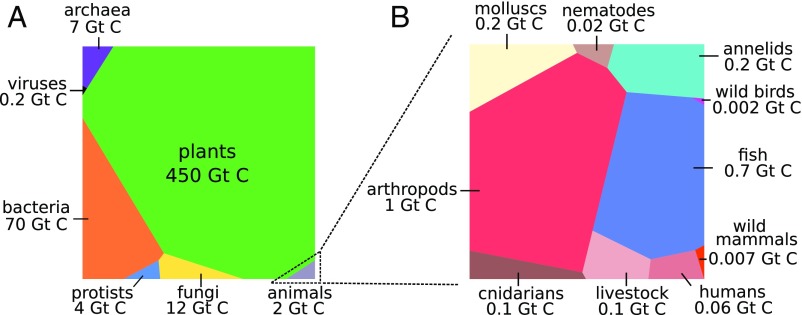
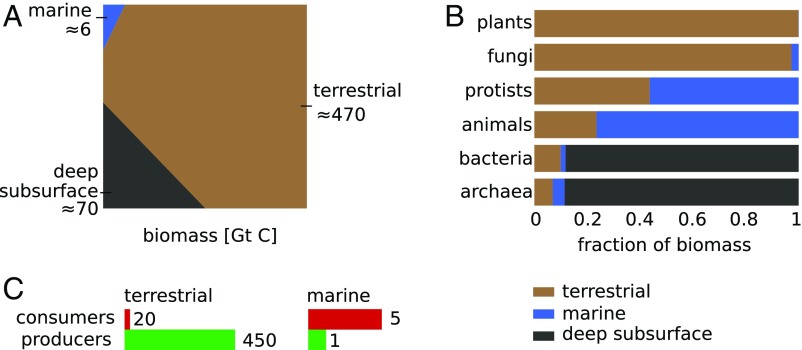
A census of the biomass on Earth is key for understanding the structure and dynamics of the biosphere. However, a global, quantitative view of how the biomass of different taxa compare with one another is still lacking. Here, we assemble the overall biomass composition of the biosphere, establishing a census of the ≈550 gigatons of carbon (Gt C) of biomass distributed among all of the kingdoms of life. We find that the kingdoms of life concentrate at different locations on the planet; plants (≈450 Gt C, the dominant kingdom) are primarily terrestrial, whereas animals (≈2 Gt C) are mainly marine, and bacteria (≈70 Gt C) and archaea (≈7 Gt C) are predominantly located in deep subsurface environments. We show that terrestrial biomass is about two orders of magnitude higher than marine biomass and estimate a total of ≈6 Gt C of marine biota, doubling the previous estimated quantity. Our analysis reveals that the global marine biomass pyramid contains more consumers than producers, thus increasing the scope of previous observations on inverse food pyramids. Finally, we highlight that the mass of humans is an order of magnitude higher than that of all wild mammals combined and report the historical impact of humanity on the global biomass of prominent taxa, including mammals, fish, and plants.
Overview
CoChat Summary
TL;DR
The paper assembles a global census of biomass across all kingdoms of life, estimating Earth’s total biomass at ≈550 Gt C, dominated by plants. It also compares biomass across environments and trophic modes, highlighting large uncertainties and human impacts on the biosphere.
Key findings
- Total global biomass is ≈550 Gt C, with plants ≈450 Gt C (≈80%), bacteria ≈70 Gt C (≈15%), fungi ≈12 Gt C, archaea ≈7 Gt C, protists ≈4 Gt C, animals ≈2 Gt C, and viruses ≈0.2 Gt C.
- Land biomass (≈470 Gt C) is about two orders of magnitude higher than marine biomass (≈6 Gt C); the deep subsurface holds ≈15% of total biomass, chiefly bacteria and archaea.
- In the ocean, ≈1 Gt C of primary producers supports ≈5 Gt C of consumer biomass, an inverted standing biomass distribution; marine biomass is ≈70% microbes, mainly bacteria and protists.
- Human-associated biomass is large relative to wild vertebrates: humans ≈0.06 Gt C, livestock ≈0.1 Gt C, wild mammals ≈0.007 Gt C, domesticated poultry ≈0.005 Gt C versus wild birds ≈0.002 Gt C; total plant biomass has declined approximately twofold relative to pre-human civilization.
Methods
- The authors synthesize hundreds of studies and generate estimates for major taxonomic groups, reporting biomass as gigatons of carbon (Gt C) and using a kingdom-level framework plus viruses.
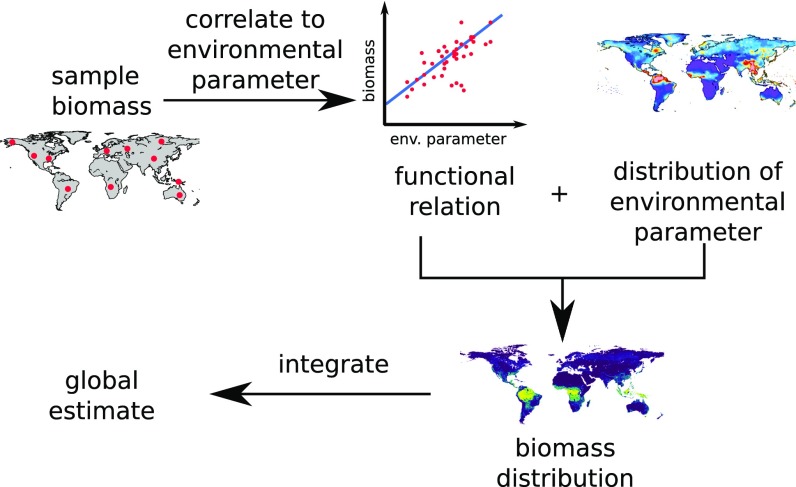
- For many taxa, local biomass samples are extrapolated globally by correlating biomass density with environmental parameters known at global scale; best estimates often use a geometric mean of independent estimates.
- Uncertainty is reported as multiplicative fold-change projections akin to 95% confidence intervals, incorporating intrastudy, interstudy, and intermethod variation; data and code are open-sourced.
Limitations
- The paper states that most datasets rely on fragmentary sampling, causing large uncertainties; sampling is scarce in the deep ocean (usually deeper than 200 m) and deep soil (usually deeper than 1 m), and some estimates may be biased by sampling toward high-abundance areas.
- The paper states that deep subsurface environments have particularly high uncertainty and unknown systematic biases, including unresolved distribution of biomass between aquifer fluids and rocks and among microbial taxa.
- The paper states that current and prehuman vertebrate biomass estimates are only a crude first step, amphibians remain poorly characterized, and parasite biomass is not resolved from hosts; evident from the text, kingdom-level grouping was chosen because much data lack finer taxonomic detail, and some uncertainty projections rely on analogous taxa or expert consultation.
Model-written summary. Check it against the paper before relying on it.
Integrity signals
Registry
Cites
Statistics
Figures
Verification
Claims the paper makes
9 Valid · 7 Not valid · 16 Not checked · 53 Own results and interpretations
Every source the paper cites for this claim was checked and supports it.
In the paper
“The biomass of amphibians, which are experiencing a dramatic population decline (42), remains poorly characterized.”
§ The biomass distribution on Earth > Discussion
What the sources say
- Supportedcites [42] Wake DB Vredenburg VT 2008 Colloquium paper: Are we in the midst of the sixth mass extinction? A view from the world of amphibians Proc Natl Acad Sci USA 105 11466 11473 18695221 PMC2556420 source
The citation is attached to the clause about amphibian population decline, not the separate statement that their biomass is poorly characterized. The passage reporting the Global Amphibian Assessment (labeled Abstract in our copy) says that 43% of amphibian species have declining populations. (LLM, conf=0.92)
plain- Asserted: passes — The authors put it forward as true.
- Checkable: passes — It can be checked against evidence.
- Load-bearing: unclear — It is unclear whether the paper’s conclusions depend on it.
- Based: passes — The paper gives a reason why it holds.
- Supported
Every source the paper cites for this claim was checked and supports it.
In the paper
“In the case of prokaryotes, some major improvements were recently realized, with global estimates of marine deep subsurface prokaryote biomass reduced by about two orders of magnitude due to an increased diversity of sampling locations (7).”
§ The biomass distribution on Earth > Discussion
What the sources say
- Supportedcites [7] Kallmeyer J Pockalny R Adhikari RR Smith DC D’Hondt S 2012 Global distribution of microbial abundance and biomass in subseafloor sediment Proc Natl Acad Sci USA 109 16213 16216 22927371 PMC3479597 source
The Discussion reports a revised subseafloor microbial biomass estimate of 4.1 Pg C versus a previous estimate of 303 Pg C—about a 74-fold reduction. It also identifies a more geographically diverse sampling database, including low-abundance ocean gyres, as a reason the new estimate is lower. The paper identifies other contributing factors as well. (LLM, conf=0.88)
plainstates a cause- Asserted: passes — The authors put it forward as true.
- Checkable: passes — It can be checked against evidence.
- Load-bearing: unclear — It is unclear whether the paper’s conclusions depend on it.
- Based: passes — The paper gives a reason why it holds.
- Supported
The sources with a verdict support this claim; the rest weren’t checked yet, have no full text we could read, or their verdicts aren’t rated yet.
In the paper
“Such inverted biomass distributions can occur when primary producers have a rapid turnover of biomass [on the order of days (34)], while consumer biomass turns over much more slowly [a few years in the case of mesopelagic fish (35)].”
§ The biomass distribution on Earth > Results > The Distribution of Biomass Across Environments and Trophic Modes.
What the sources say
- Supportedcites [34] Zubkov MV 2014 Faster growth of the major prokaryotic versus eukaryotic CO2 fixers in the oligotrophic ocean Nat Commun 5 3776 24777140 PMC4015317 source
The Results (Comparison of the growth rates of the CO2 fixers; page unavailable) report growth rates of 0.1–0.6 per day for the studied oceanic primary producers, consistent with biomass turnover on the order of days. The few-years estimate for mesopelagic fish is assigned to a different citation, not this source. (LLM, conf=0.91)
- Not checked — no full text of the sourcecites [35] Catul V Gauns M Karuppasamy PK 2011 A review on mesopelagic fishes belonging to family Myctophidae Rev Fish Biol Fish 21 339 354 source
plainstates a possible cause- Asserted: passes — The authors put it forward as true.
- Checkable: passes — It can be checked against evidence.
- Load-bearing: passes — The paper’s conclusions depend on it.
- Based: passes — The paper gives a reason why it holds.
- Supported
The cited sources support only part of this claim — read each source’s verdict below.
In the paper
“Combining data from independent sources such as these enables a robust assessment of the total plant biomass (17).”
§ The biomass distribution on Earth > Results > The Uncertainty Associated with Global Biomass Estimates.
What the sources say
- Partly supportedcites [17] Erb K-H 2017 Unexpectedly large impact of forest management and grazing on global vegetation biomass Nature 553 73 76 29258288 PMC5756473 sourceExperimental — accuracy not yet measured
The Methods describe combining multiple datasets and types of evidence to estimate global vegetation biomass stocks. But the paper also says global stocks remain uncertain, reports uncertainty ranges around 35% of the median estimate, and describes more robust estimates as a future prospect. It therefore supports the use of independent sources for an assessment, but not the unqualified characterization of that assessment as robust. (LLM, conf=0.84)
plainstates a cause- Asserted: passes — The authors put it forward as true.
- Checkable: passes — It can be checked against evidence.
- Load-bearing: passes — The paper’s conclusions depend on it.
- Based: passes — The paper gives a reason why it holds.
- Partly supported
A result the paper states — it cites no source for it, so there is none to check. The quote shows it is in the paper.
In the paper
“Plant biomass includes ≈70% stems and tree trunks, which are mostly woody, and thus relatively metabolically inert.”
§ The biomass distribution on Earth > Results > The Biomass Distribution of the Biosphere by Kingdom.
plain- Asserted: passes — The authors put it forward as true.
- Checkable: passes — It can be checked against evidence.
- Load-bearing: unclear — It is unclear whether the paper’s conclusions depend on it.
- Based: passes — The paper gives a reason why it holds.
27 more claims
Create a free account to see all 85 claims and to verify the 2 references still open.
- It may state two separate claims as one. 32
- Probably not a substantial claim. 28
Claims other papers make about this one
Each is checked against this paper’s own text: does it say what the citing paper says it does?
The cited source doesn’t support the claim as written.
In the citing paper
“and less than 10% that of the world ' s current human population ( 52 ).”
From Pervasive human-driven decline of life on Earth points to the need for transformative change (2019) · cites this paper as [52]
Checked by a reasoning model — may be wrong.
Experimental — accuracy not yet measuredThe cited source says what the claim attributes to it.
In the citing paper
“Approximately 450 Gt of C is bound up in terrestrial biota, primarily in plants (86), while only ~6 Gt of C is found in ocean biota (87).”
From Earth beyond six of nine planetary boundaries (2023) · cites this paper as [87]
The cited source says what the claim attributes to it.
In the citing paper
“The amount of metabolic energy available to a biosphere powered by O 2 is vast, such that the O 2 -rich ocean-atmosphere system of the modern Earth supports staggering levels of standing biomass (Bar-On et al. 2018), energy flow (Falkowski et al. 2008), and ecological complexity (Steele 1974).”
From The History of Ocean Oxygenation (2022) · cites this paper as Bar-On et al. 2018
In the citing paper
“Global populations of domestic ruminants (cattle, sheep, and goats) (Ripple et al. 2013) poultry, and pigs (Bennett et al. 2018) used to feed the growing human population now exceed 100 million tons of carbon (Bar-On et al. 2018), and livestock populations are growing rapidly.”
From Scientists’ warning to humanity on the freshwater biodiversity crisis (2021) · cites this paper as Bar-On et al. 2018
Citations
Cites
The worldwide leaf economics spectrum
Wright, I. J., Reich, P. B., Westoby, M., Ackerly, D. D., Baruch, Z., Bongers, F., Cavender-Bares, J., Chapin, T., Cornelissen, J. H. C., Diemer, M., et al. (2004) · Nature · doi:10.1038/nature02403 · Cited by 9,021 · cited 1×
“We then convert the total area of leaves to an estimate of the total dry mass of leaves by using the Glopnet database (24), which measured leaf mass per area (LMA) for ≈2500 plant species.”
MethodA large and persistent carbon sink in the world’s forests
Pan, Y., Birdsey, R. A., Fang, J., Houghton, R., Kauppi, P. E., Kurz, W. A., Phillips, O. L., Shvidenko, A., Lewis, S. L., Canadell, J. G., et al. (2011) · Science · doi:10.1126/science.1201609 · Cited by 8,458
Soil Sampling and Methods of Analysis
(2007) · CRC Press eBooks · doi:10.1201/9781420005271 · Cited by 6,469
Primary production of the biosphere: Integrating terrestrial and oceanic components
Field, C. B., Behrenfeld, M. J., Randerson, J. T., & Falkowski, P. (1998) · Science · doi:10.1126/science.281.5374.237 · Cited by 6,371
Prokaryotes: The unseen majority
Whitman, W. B., Coleman, D. C., & Wiebe, W. J. (1998) · Proceedings of the National Academy of Sciences · doi:10.1073/pnas.95.12.6578 · Cited by 4,871
Global effects of land use on local terrestrial biodiversity
Newbold, T., Hudson, L. N., Hill, S. L. L., Contu, S., Lysenko, I., Senior, R. A., Börger, L., Bennett, D. J., Choimes, A., Collen, B., et al. (2015) · Nature · doi:10.1038/nature14324 · Cited by 4,352
Belowground biodiversity and ecosystem functioning
Bardgett, R. D., & van der Putten, W. H. (2014) · Nature · doi:10.1038/nature13855 · Cited by 3,990 · cited 4×
“This was recommended by experts in the field for estimation of arbuscular mycorrhizal fungi abundance (117).”
BackgroundInfluentialMangroves among the most carbon-rich forests in the tropics
Donato, D. C., Kauffman, J. B., Murdiyarso, D., Kurnianto, S., Stidham, M., & Kanninen, M. (2011) · Nature Geoscience · doi:10.1038/ngeo1123 · Cited by 3,374
Poorter, H., Niklas, K. J., Reich, P. B., Oleksyn, J., Poot, P., & Mommer, L. (2012) · New Phytologist · doi:10.1111/j.1469-8137.2011.03952.x · Cited by 3,163 · cited 1×
“The first relies on a meta-analysis of the biomass allocation to different plant compartments across biomes (19).”
BackgroundA global analysis of root distributions for terrestrial biomes
Jackson, R. B., Canadell, J., Ehleringer, J. R., Mooney, H. A., Sala, O. E., & Schulze, E. D. (1996) · Oecologia · doi:10.1007/bf00333714 · Cited by 3,071 · cited 4×
“assumed the distribution of microbial biomass with depth follows the biomass density versus depth profile of root biomass (21).”
BackgroundMethodInfluential
Research works printed but not linked: 1
- Chapman AD 2009 Numbers of Living Species in Australia and the World Australian Biological Resources Study Canberra, Australia
Cited by
Items 3,401–3,500 of 3,743
Chen, Y., Tong, S., Jiang, Y., Ai, F., Feng, Y., Zhang, J., Gong, J., Qin, J., Zhang, Y., Zhu, Y., et al. (2021) · Figshare · doi:10.6084/m9.figshare.17065966
Barrajon-Santos, V., Nepel, M., Hausmann, B., Voglmayr, H., Woebken, D., & Mayer, V. E. (2024) · Figshare · doi:10.6084/m9.figshare.26720553
Burton, V. J., Contu, S., Palma, A. D., Hill, S. L. L., Albrecht, H., Bone, J. S., Carpenter, D., Corstanje, R., SMEDT, P. D., Farrell, M., et al. (2022) · Figshare · doi:10.6084/m9.figshare.21582635
Douchet, P., Haegeman, B., Allienne, J., Boissier, J., Senghor, B., & Rey, O. (2024) · Figshare · doi:10.6084/m9.figshare.26982114
Avila-Santos, A. P., Kabiru Nata’ala, M., Kasmanas, J. C., Bartholomäus, A., Keller‐Costa, T., Jurburg, S. D., Tal, T., Camarinha-Silva, A., Saraiva, J. P., Ponce de Leon Ferreira de Carvalho, A. C., et al. (2024) · Figshare · doi:10.6084/m9.figshare.26623405
Chen, Y., Tong, S., Jiang, Y., Ai, F., Feng, Y., Zhang, J., Gong, J., Qin, J., Zhang, Y., Zhu, Y., et al. (2021) · Figshare · doi:10.6084/m9.figshare.17065969
Barrajon-Santos, V., Nepel, M., Hausmann, B., Voglmayr, H., Woebken, D., & Mayer, V. E. (2024) · Figshare · doi:10.6084/m9.figshare.26720550
Additional file 1 of Growing a circular economy with fungal biotechnology: a white paper
Meyer, V., Basenko, E. Y., Benz, J. P., Braus, G. H., Caddick, M. X., Csukai, M., de Vries, R. P., Endy, D., Frisvad, J. C., Gunde‐Cimerman, N., et al. (2020) · Figshare · doi:10.6084/m9.figshare.12096300
Barrajon-Santos, V., Nepel, M., Hausmann, B., Voglmayr, H., Woebken, D., & Mayer, V. E. (2024) · Figshare · doi:10.6084/m9.figshare.25824872
Douchet, P., Haegeman, B., Allienne, J., Boissier, J., Senghor, B., & Rey, O. (2024) · Figshare · doi:10.6084/m9.figshare.26982117
Additional file 1 of Global contribution of pelagic fungi to protein degradation in the ocean
Breyer, E., Zhao, Z., Herndl, G. J., & Baltar, F. (2022) · Figshare · doi:10.6084/m9.figshare.20786846
Escamez, S., Robinson, K. M., Luomaranta, M., Gandla, M. L., Mähler, N., Yassin, Z., Grahn, T., Scheepers, G., Stener, L.-G., Jansson, S., et al. (2024) · Figshare · doi:10.6084/m9.figshare.26581448
Yeo, D., Srivathsan, A., Puniamoorthy, J., Foo, M., Grootaert, P., Chan, L., Guénard, B., Damken, C., Wahab, R. A., Yuchen, A., et al. (2021) · Figshare · doi:10.6084/m9.figshare.16620766
Saary, P., Mitchell, A., & Finn, R. D. (2020) · Figshare · doi:10.6084/m9.figshare.12940795
Escamez, S., Robinson, K. M., Luomaranta, M., Gandla, M. L., Mähler, N., Yassin, Z., Grahn, T., Scheepers, G., Stener, L.-G., Jansson, S., et al. (2024) · Figshare · doi:10.6084/m9.figshare.26581445
Douchet, P., Haegeman, B., Allienne, J., Boissier, J., Senghor, B., & Rey, O. (2024) · Figshare · doi:10.6084/m9.figshare.26982126
Douchet, P., Haegeman, B., Allienne, J., Boissier, J., Senghor, B., & Rey, O. (2024) · Figshare · doi:10.6084/m9.figshare.26982141
Douchet, P., Haegeman, B., Allienne, J., Boissier, J., Senghor, B., & Rey, O. (2024) · Figshare · doi:10.6084/m9.figshare.26982123
Adaptation of Folding and Function of a Nuclease from the Cold Deep SeaPreprint
Koduru, T., Barthe, P., Hantman, N., et al. (2025) · SSRN Electronic Journal · doi:10.2139/ssrn.5482417
Hernández-Ramos, A., Valdez‐Lazalde, J. R., Reyes-Hernández, V. J., Santos-Posadas, H. M. D. L., López-Serrano, P. M., & Pineda, A. C. (2025) · International Journal of Remote Sensing · doi:10.1080/01431161.2025.2559421
Harnessing aquatic plants: From ecological functions to bioeconomy contributions
Jerome, R. E., Stramarkou, M., & Tan, X. (2025) · Elsevier eBooks · doi:10.1016/b978-0-443-28810-4.00016-5
Biological processes for biorefinery
Ladero, M., Bolivar, J. M., González, E., Ripoll, V., Acedos, M. G., de la Torre, I., Escanciano, I. A., Martin-Dominguez, V., García-Martín, A., Carballares, D., et al. (2025) · Elsevier eBooks · doi:10.1016/b978-0-443-28810-4.00011-6
Así se ha convertido la trashumancia en una pieza fundamental de los ecosistemas
Manzano, P., Azcárate, F., Alegría, J., et al. (2019) · doi:10.64628/aao.5rvqtyp5y
Wolfson, A. (2025) · Springer briefs in molecular science · doi:10.1007/978-3-032-07363-1_4
Waters, K. A., & Benbow, M. E. (2025) · Elsevier eBooks · doi:10.1016/b978-0-443-13961-1.00004-6
Di Musciano, M., Zannini, P., Testolin, R., et al. (2025) · Zürcher Hochschule für Angewandte Wissenschaften digital collection (Zurich University of Applied Sciences) · doi:10.21256/zhaw-34412
Liu, E., Xie, J., Banerjee, S., Goberna, M., Jiang, L., Ichihashia, Y., Yang, H., Jiang, C., Jia, Z., Liu, S., et al. (2025) · Agrobiodiversity · doi:10.48130/abd-0025-0012
The enactive continuity between life, language and symbol: working within a paradox
Figueiredo, N. M., & Cuffari, E. C. (2025) · Phenomenology and the Cognitive Sciences · doi:10.1007/s11097-025-10116-0 · Cited by 2
Adaptation of Folding and Function of a Nuclease from the Cold Deep Sea
Koduru, T. N., Barthe, P., Hantman, N., de Guillen, K. M., McCallum, S. A., Morgan, J. E., Yee, E. F., Leonardi, P., Foland, J., Roumestand, C., et al. (2025) · Journal of Molecular Biology · doi:10.1016/j.jmb.2025.169602 · Cited by 2
Valenzuela, L., Reyes, C., Martí, L., & Sánchez-Pi, N. (2025) · International Conference on Pattern Recognition Systems (ICPRS) · doi:10.1109/icprs66293.2025.11302855 · Cited by 1
“The pivotal role of microbial communities in the carbon cycle is further emphasized by global biomass estimates: the biosphere contains approximately gigatons of carbon (GtC), with plants accounting for the majority (450 GtC), followed by bacteria (70 GtC) and archaea (7 GtC) [15].”
Invasive Lonicera maackii (Dipscales: Caprifoliaceae) supports a depauperate arthropod community
Zakroff, A. R. A., & Stireman, J. O. (2025) · Environmental Entomology · doi:10.1093/ee/nvaf130
Lechner, T., & Višak, T. (2025) · Springer eBooks · doi:10.1007/978-3-662-71326-6_50
Vitale, L., Fuentes‐Lema, A., Sepe, R. M., Zoysa, H. K. S. D., Righelli, D., Sobrino, C., Romano, G., & Dato, V. D. (2026) · Algal Research · doi:10.1016/j.algal.2026.104521
Microbial biogeochemistry in the Anthropocene
King, G. M., & Fenchel, T. (2026) · Elsevier eBooks · doi:10.1016/b978-0-443-15883-4.00016-5
Vlasblom, A. A., Patel, S., Lawlor, P. G., Claesson, M. J., Crespo‐Piazuelo, D., Eckenberger, J., Huseyin, C. E., Elend, C., Wagenaar, J. A., Zomer, A., et al. (2026) · BMC Microbiology · doi:10.1186/s12866-025-04613-0 · Cited by 1
“Livestock makes up 62% of the global mammal biomass (1, 2).”
Shapira, O., Izhaki, I., Zemah-Shamir, S., & Malkinson, D. (2026) · Ecology and Evolution · doi:10.1002/ece3.72839
“The global livestock biomass, estimated at 0.1 gigatons of carbon (Bar-On et al. 2018), has far-reaching ecological consequences, including the replacement of native ungulate populations and their ecological roles across continents (2017; Herrik et al. 2023; Pringle et al. 2023).”
InfluentialCosta, H. C. M., Peres, C. A., Heming, N. M., da Silva, D. J., Filho, M. D. S., Campos‐Silva, J. V., & Storck‐Tonon, D. (2026) · Journal of Applied Ecology · doi:10.1111/1365-2664.70274 · Cited by 2
Multidecadal increase in microbial biomass and production along the western Antarctic Peninsula
Ducklow, H. W., Schofield, O., Stammerjohn, S. E., et al. (2026) · Deep Sea Research Part I Oceanographic Research Papers · doi:10.1016/j.dsr.2026.104653
Global Atmospheric Release of Methoxyphenols From Wildfires
Shen, Y., Zheng, M., & Liu, G. (2026) · Journal of Geophysical Research Atmospheres · doi:10.1029/2025jd045402
Mantzari, E. D., Eleftheriadou, N., Xanthopoulos, G., Gkouvas, A., Sazeides, C., Kiorapostolou, N., Bintsi-Frantzi, E., Markos, N., Spyroglou, G., Vanguelova, E., et al. (2026) · Research Square · doi:10.21203/rs.3.rs-8310680/v1
Braden, P. (2026) · Journal of Chinese History · doi:10.1017/jch.2025.10088
Waste derived catalysts for energy storage systems
Salora, S., Sharma, A., Grewal, A., & Singh, S. (2026) · Elsevier eBooks · doi:10.1016/b978-0-443-32958-6.00011-x
Sequential cultivation of oyster and shiitake mushrooms on willow enhances biomass degradability
Siva, N., Klatte, H., Mather, T., Kothattil, S., Pecchia, J. A., & Anderson, C. T. (2026) · Biomass Conversion and Biorefinery · doi:10.1007/s13399-025-06955-1
“While plant biomass, primarily lignocellulose, offers substantial potential for energy production due to its abundance [ 11 , 12], the complex structure of lignocellulose hinders its efficient breakdown into simple sugars [ 13 ].”
Reclamation from Below: Urban Undergrounds as Geosocial Formations
Meulemans, G. (2026) · Punctum Books · doi:10.53288/0532.1.07
Introduction to Part 4: Rivers and Floods
(2026) · Punctum Books · doi:10.53288/0532.1.18
Washed-In and Washed-Out Livelihoods: Shifting Grounds in a Former Fishing Colony
Lang, L. (2026) · Punctum Books · doi:10.53288/0532.1.08
The Shape of Fluid Cities: An Archaeologist’s Guide to Amphibious Living
Leadbetter, M. P. (2026) · Punctum Books · doi:10.53288/0532.1.17
(2026) · Punctum Books · doi:10.53288/0532.1.01
Introduction to Part 3: Emerging Lands
(2026) · Punctum Books · doi:10.53288/0532.1.14
Introducing More-Than-Solid Urbanity
Simonetti, C., Lussault, M., & Ingold, T. (2026) · Punctum Books · doi:10.53288/0532.1.03
Ley, L. (2026) · Punctum Books · doi:10.53288/0532.1.12
Simonetti, C., Lussault, M., & Ingold, T. (2026) · Punctum Books · doi:10.53288/0532.1.02
Introduction to Part 1: Shifting Grounds
(2026) · Punctum Books · doi:10.53288/0532.1.04
Material Flows and the Strata-Producing City
Edgeworth, M. (2026) · Punctum Books · doi:10.53288/0532.1.19
Anastassakis, Z., Calafate, C., & Camargo, P. D. O. (2026) · Punctum Books · doi:10.53288/0532.1.21
City Wetlands: Unsettling Topography of Urban Liquefaction
Gruppuso, P. (2026) · Punctum Books · doi:10.53288/0532.1.05
Ocean Urbanization and the Dissolution of the Polis
Simpson, I. (2026) · Punctum Books · doi:10.53288/0532.1.15
Bremner, L. (2026) · Punctum Books · doi:10.53288/0532.1.10
Building on Shifting Ground: Liquescence in an Arctic River Delta
Krause, F. (2026) · Punctum Books · doi:10.53288/0532.1.06
From Ownership of Land to Care for Water: Some Lessons from a Flooded Costa Blanca
Alemany, E. G. (2026) · Punctum Books · doi:10.53288/0532.1.20
Solidification and Liquefaction: Accounts from the Bengal Delta
Hříbek, M. (2026) · Punctum Books · doi:10.53288/0532.1.16
(2026) · Punctum Books · doi:10.53288/0532.1.22
Introduction to Part 2: Life at the Shoreline
(2026) · Punctum Books · doi:10.53288/0532.1.09
Liquefying Concrete: Building, Dwelling, and Thinking at the Shoreline
Simonetti, C. (2026) · Punctum Books · doi:10.53288/0532.1.13
Between Anchorage and Collapse: Knots, Traces, and Surfaces in a Lacustrian Village in Benin
Ciavolella, R., & Choplin, A. (2026) · Punctum Books · doi:10.53288/0532.1.11 · Cited by 1
Otomo, Y., Kimbara, R., Oguchi, K., et al. (2026) · Die Naturwissenschaften · doi:10.1007/s00114-026-02072-9
“Among these groups, arthropods are the most successful animals on Earth, displaying remarkable diversity in both species number and morphological complexity (Akam 2000; Bar-On et al. 2018).”
The boundary problem in the origins of the universe, life, and consciousnessPreprint
Yurchenko, S. B. (2026) · SSRN Electronic Journal · doi:10.2139/ssrn.6149628
Nondecomposer-mediated nutrient transfer in soils: experimental evidence from Drosophila
Luo, Y., Liu, R., Cao, T., Zhang, J., Zhao, M., Li, K., Ran, Z., Wang, L., & Tian, X. (2026) · Applied Soil Ecology · doi:10.1016/j.apsoil.2026.106830
Plue, J., & Töpel, M. (2026) · bioRxiv (Cold Spring Harbor Laboratory) · doi:10.64898/2026.01.27.702028
“Vascular plants are a major component of terrestrial biomass and diversity (Bar-On et al. 2018; Kier et al. 2005), being crucial for biodiversity at higher and lower trophic levels (Wan et al. 2020), ecosystem processes (e.g. carbon sequestration, Chen et al. 2020), ecosystem stability (Haddad et…”
Macroecology of microbial performance across Earth’s biomesPreprint
Rain‐Franco, A., Andrei, A., & Pernthaler, J. (2026) · bioRxiv (Cold Spring Harbor Laboratory) · doi:10.64898/2026.01.30.702831
Novel repressors of cambium activity in ArabidopsisPreprint
Wang, X., Han, J., Turley, E. K., Mäkilä, R., Bågman, A.-M., Kraus, J. M., He, Q., Alhowty, H., Edwards, J., Li, Y., et al. (2026) · bioRxiv (Cold Spring Harbor Laboratory) · doi:10.64898/2026.01.28.702292
“As such the cambium is the stem cell population responsible for the generation of the majority of terrestrial biomass (Bar-On et al. 2018).”
What Goes First? Effects of Starvation on the Body Condition of a Neotropical Dung Beetle
de Cerqueira, L. V. M. P., Salomão, R. P., Villaseñor‐Amador, D., Cotta, A. F., de Oliveira, P. L. M., & Correa, C. M. A. (2026) · Entomologia Experimentalis et Applicata · doi:10.1111/eea.70061 · Cited by 1
“Insects represent over a third of all terrestrial animal biomass (Bar-On et al. 2018; Rosenberg et al. 2023) and play crucial roles in ecosystem functioning.”
Traits retained in arthropod corpses influence the scavenging behavior of invertebrate scavengers
He, S., Sun, S., & Wu, X. (2026) · Insect Science · doi:10.1111/1744-7917.70252
Rajotia, M., Kumar, S., Saroj, V. K., & Panda, S. (2026) · ACS Sustainable Resource Management · doi:10.1021/acssusresmgt.5c00423
Newton, R., Friedman, K. J., Himes‐Cornell, A., & Green, D. M. (2026) · Biodiversity and Conservation · doi:10.1007/s10531-026-03251-w · Cited by 1
“The ocean is crucial to regulating the Earth’s climate and is home to a diverse range of interconnected ecosystems that support almost every animal phylum, as well as the largest vertebrate biomass on Earth: fish (May 1994; Bar-On et al. 2018; Dobush et al. 2022).”
Fady, B., Farsakoglou, A., Caron, M., et al. (2025) · HAL AMU
Lindenmayer, D. B., Florance, D., Scheele, B. C., Bowd, E., Strong, C., Macintosh, A., & Evans, M. J. (2026) · PLoS ONE · doi:10.1371/journal.pone.0342006 · Cited by 1
“Many agricultural landscapes are characterised by altered vegetation communities that support limited biodiversity, degraded soils, and impaired carbon stores [3–5].”
Environmental and Ecological Impacts of Livestock Farming
Simm, G. (2026) · Springer eBooks · doi:10.1007/978-3-032-11407-5_4
Barrett, M. (2026) · Springer eBooks · doi:10.1007/978-3-032-11407-5_23
Dutton, T. (2026) · Springer eBooks · doi:10.1007/978-3-032-11407-5_19
Pinheiro, Â., Martins, T. M., Varela, A., et al. (2026) · Research Square · doi:10.21203/rs.3.rs-8530099/v1
Seeing the forest: Microbiome resilience in mature trees
Rojer, Z., & Hendry, T. A. (2026) · Cell Host & Microbe · doi:10.1016/j.chom.2026.01.014
Zuo, Q., Liang, G., Jiao, Z., Ma, L., Ji, X., He, X., Xu, Z., & Hu, Z. (2026) · Journal of Plant Ecology · doi:10.1093/jpe/rtag019
Preventing the next invasion: Lessons from aquaculture for the safe expansion of insect farming
Manfrini, E., Courchamp, F., Leroy, B., & Berggren, Å. (2026) · Journal of Applied Ecology · doi:10.1111/1365-2664.70311 · Cited by 4
Roxi Thoren et la pratique de la coconception spatiale avec les animaux
Rollot, M. A. D. T., & Voisin, L. (2025) · Projets de paysage · doi:10.4000/15pes
Jiang, S., & Yamada, T. (2026) · Review of Palaeobotany and Palynology · doi:10.1016/j.revpalbo.2026.105543
BOUDJELLAL, A. A., Berkouk, E. M., & Achour, Y. (2026) · Engineering Research Express · doi:10.1088/2631-8695/ae4a6c
Evolutionary and Economic Foundations for an Ecological Civilization
Liam, G., & Farley, J. (2026) · Ecological civilization · doi:10.70322/ecolciviliz.2026.10006
Collings, D. (2026) · Emerald Group Publishing Limited eBooks · doi:10.1108/978-1-83708-420-320261012
Localization of candidate clock neurons in Antarctic krill ( Euphausia superba )Preprint
Hüppe, L., Reinhard, N., Karl, A., Kirsch, V., Wollny, L., Palmer, A., Rieger, D., Senthilan, P. R., & Helfrich‐Förster, C. (2026) · bioRxiv (Cold Spring Harbor Laboratory) · doi:10.64898/2026.02.26.708226
Sonophore enables autonomous observation of micronekton communities in the ocean twilight zone
Downie, R. A., Jansen, P. W., Macaulay, G. J., Ladroit, Y., Pethybridge, H., Nicol, S., & Davies, C. R. (2026) · Scientific Reports · doi:10.1038/s41598-026-41581-5
What kills a society: accumulation of uric acid increases infectious disease risk in termites
Konishi, T., Nakashima, M., Nozaki, T., et al. (2026) · Proceedings of the Royal Society B Biological Sciences · doi:10.1098/rspb.2025.2438
Gounand, I., Loeuille, N., Charberet, S., Fronhofer, E. A., Harvey, É., Kéfi, S., Leroux, S., Little, C. J., McLeod, A. M., Saade, C., et al. (2026) · bioRxiv (Cold Spring Harbor Laboratory) · doi:10.64898/2026.03.03.709064
“This should be especially important in terrestrial systems, where low-quality food maintain herbivores at low biomass compared to plants (Bar-On et al., 2018).”
Cryo-EM visualization of viruses from partially irrigated soils
Parvate, A. D., Alfaro, T., McDearis, R., et al. (2026) · Frontiers in Agronomy · doi:10.3389/fagro.2025.1711814
Soil and Genotype Shape the Sugarcane Phytobiome for Enhanced Environmental Adaptation
Ferreti, J. D., Ribeiro, B., Bonetti, J. D. A., Camargo, L. E. A., Creste, S., Kuramae, E. E., & Monteiro-Vitorello, C. B. (2026) · Environmental Microbiology Reports · doi:10.1111/1758-2229.70314 · Cited by 2
A Reappraisal of the Principle of Maximum Power
Gianinetti, A. (2026) · Ecologies · doi:10.3390/ecologies7010029 · Cited by 1
Ободович, О. М., Sydorenko, V., & Шейко, Т. (2025) · Food Resources · doi:10.31073/foodresources2025-25-03
Kashyap, S., Caro, T. A., & Templeton, A. S. (2026) · Nature Communications · doi:10.1038/s41467-026-70622-w · Cited by 1
“For sub-surface biomes, which are known to host a signi fi cant fraction of Earth ’ s total biomass 2,3 , few studies have addressed microbial growth rates as such rates areassumed to be slow and challenging to measure.”
Metadata
- Authors
- Bar-On, Y. M., Phillips, R., & Milo, R.
- Affiliations
- Department of Plant and Environmental Sciences, Weizmann Institute of Science, 76100 Rehovot, Israel;
- California Institute of Technology (US)
- Weizmann Institute of Science (IL)
- Corresponding author
- Milo, Ron
- Venue
- Proceedings of the National Academy of Sciences
- Publisher
- National Academy of Sciences
- Published
- 2018-05-21
- Volume
- 115
- Issue
- 25
- Pages
- 6506-6511
- ISSN
- 0027-8424 (ISSN-L)
- 1091-6490
- PMC
- PMC6016768
- OpenAlex
- W2804910112
- Cited by
- 3,723
- References
- 263
- Citations by year
- 2026: 349 · 2025: 450 · 2024: 589 · 2023: 617 · 2022: 498 · 2021: 498 · 2020: 419 · 2019: 246 · 2018: 49
- FWCI
- 239.98
- Type
- journal article
- Language
- en
- Open access
- hybrid
- doi.org
- Licence
- Locations
- Proceedings of the National Academy of Sciences (publishedVersion, cc-by-nc-nd)
- Europe PMC (PubMed Central) (publishedVersion, cc-by-nc-nd)
- PubMed Central (publishedVersion, cc-by-nc-nd)
- PubMed (publishedVersion)
- CaltechAUTHORS (California Institute of Technology) (submittedVersion, cc-by-nc-nd)
- Funders
- National Institutes of Health (5r35gm118043-07)
- National Institute of General Medical Sciences (R35 GM118043)
- Topics
- Physical Sciences › Environmental Science › Nature and Landscape Conservation › Ecology and Vegetation Dynamics Studies
- Physical Sciences › Environmental Science › Global and Planetary Change › Earth Systems and Cosmic Evolution
- Life Sciences › Agricultural and Biological Sciences › Soil Science › Soil Carbon and Nitrogen Dynamics
- Keywords
- biomass allocation, biomass carbon, terrestrial biomass, marine biomass, bacteria, archaea, food pyramid, wild mammals, fish biomass, plant biomass
- MeSH terms
- Animals, Archaea, Bacteria, Carbon, Humans, Plants, Ecosystem, Biomass, Earth, Planet, Biota
About these checks
Registry, retraction, Cites and statistics results are computed, not judged, with one exception: a printed reference that no index lists is read once by a model before it counts as a citation error. Claims are extracted by a model and kept only when their quote appears verbatim in the text; each cited source is then checked, with a model’s help, for whether it says what the claim relies on. Those verdicts can be wrong — read the claim’s quote and the cited source before relying on one.
The claim verdicts this report counts are experimental: their accuracy is not yet measured.
A language model drew the claims from the paper on 2026-10-10, under version 3 of the claim definition (model deepseek-v4.1-flash, prompt extract-v3).
A second model labelled each claim on 2026-10-10 (model jev-1.13-20260917, definition revision gold-guideline-v0.2).
Cited sources are checked with a language model’s help (gpt-6-sol).
Statistics and arithmetic are recomputed, not judged.
Confidence bands are shown only for fields calibrated on our annotated test set. None is calibrated yet, so no band is shown.
What counts as a claim ›How we measure confidence ›How we check this ›
Are you an author, or do you see a problem with this page? Request a review
Data sources
Bibliographic data: Semantic Scholar, OpenAlex, Crossref.
Contains information from the Semantic Scholar Academic Graph Datasets, made available under the ODC Attribution License (ODC-BY 1.0).
Semantic Scholar’s data is described in: Kinney, R., et al. (2023). The Semantic Scholar Open Data Platform. arXiv:2301.10140.
