

The biomass distribution on Earth
Open accessThe DOI matches its Crossref record; 263 of the 263 references it cites were found in a registry or an index; 11 of the 41 sources its claims cite were checked for support.
Abstract
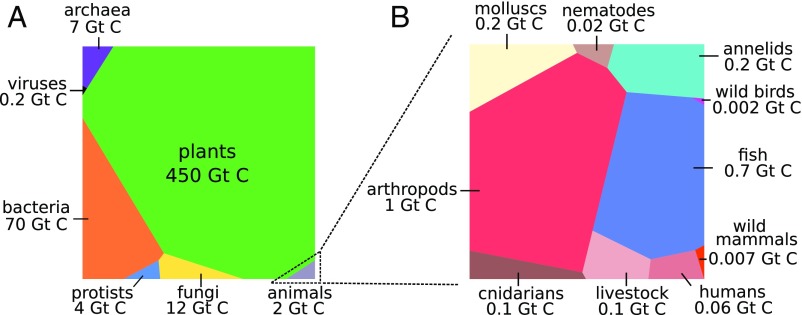
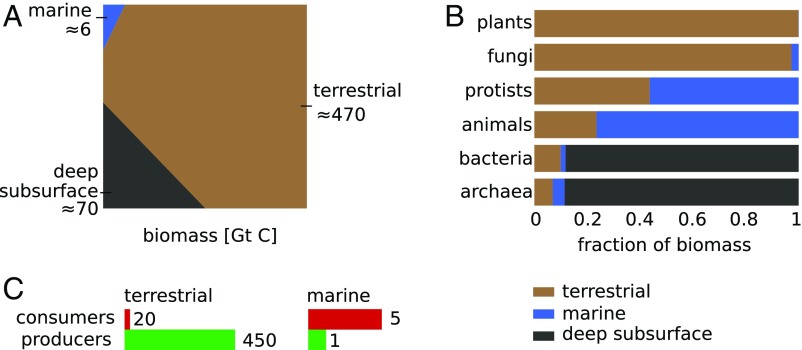
A census of the biomass on Earth is key for understanding the structure and dynamics of the biosphere. However, a global, quantitative view of how the biomass of different taxa compare with one another is still lacking. Here, we assemble the overall biomass composition of the biosphere, establishing a census of the ≈550 gigatons of carbon (Gt C) of biomass distributed among all of the kingdoms of life. We find that the kingdoms of life concentrate at different locations on the planet; plants (≈450 Gt C, the dominant kingdom) are primarily terrestrial, whereas animals (≈2 Gt C) are mainly marine, and bacteria (≈70 Gt C) and archaea (≈7 Gt C) are predominantly located in deep subsurface environments. We show that terrestrial biomass is about two orders of magnitude higher than marine biomass and estimate a total of ≈6 Gt C of marine biota, doubling the previous estimated quantity. Our analysis reveals that the global marine biomass pyramid contains more consumers than producers, thus increasing the scope of previous observations on inverse food pyramids. Finally, we highlight that the mass of humans is an order of magnitude higher than that of all wild mammals combined and report the historical impact of humanity on the global biomass of prominent taxa, including mammals, fish, and plants.
Overview
CoChat Summary
TL;DR
The paper assembles a global census of biomass across all kingdoms of life, estimating Earth’s total biomass at ≈550 Gt C, dominated by plants. It also compares biomass across environments and trophic modes, highlighting large uncertainties and human impacts on the biosphere.
Key findings
- Total global biomass is ≈550 Gt C, with plants ≈450 Gt C (≈80%), bacteria ≈70 Gt C (≈15%), fungi ≈12 Gt C, archaea ≈7 Gt C, protists ≈4 Gt C, animals ≈2 Gt C, and viruses ≈0.2 Gt C.
- Land biomass (≈470 Gt C) is about two orders of magnitude higher than marine biomass (≈6 Gt C); the deep subsurface holds ≈15% of total biomass, chiefly bacteria and archaea.
- In the ocean, ≈1 Gt C of primary producers supports ≈5 Gt C of consumer biomass, an inverted standing biomass distribution; marine biomass is ≈70% microbes, mainly bacteria and protists.
- Human-associated biomass is large relative to wild vertebrates: humans ≈0.06 Gt C, livestock ≈0.1 Gt C, wild mammals ≈0.007 Gt C, domesticated poultry ≈0.005 Gt C versus wild birds ≈0.002 Gt C; total plant biomass has declined approximately twofold relative to pre-human civilization.
Methods
- The authors synthesize hundreds of studies and generate estimates for major taxonomic groups, reporting biomass as gigatons of carbon (Gt C) and using a kingdom-level framework plus viruses.
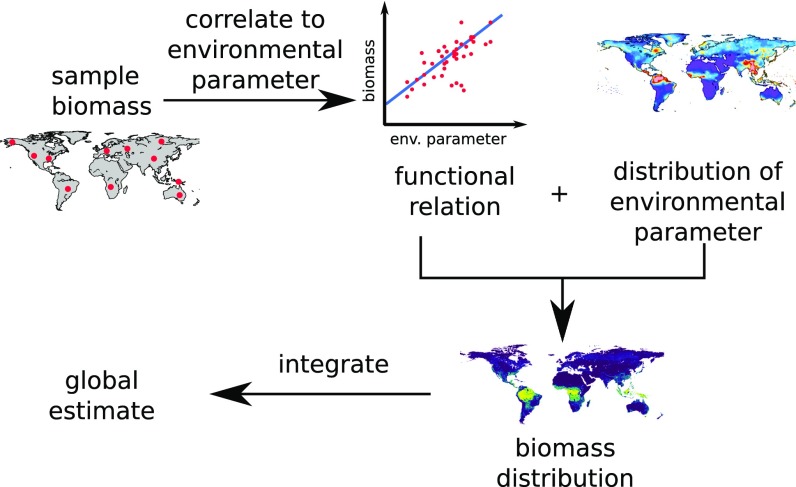
- For many taxa, local biomass samples are extrapolated globally by correlating biomass density with environmental parameters known at global scale; best estimates often use a geometric mean of independent estimates.
- Uncertainty is reported as multiplicative fold-change projections akin to 95% confidence intervals, incorporating intrastudy, interstudy, and intermethod variation; data and code are open-sourced.
Limitations
- The paper states that most datasets rely on fragmentary sampling, causing large uncertainties; sampling is scarce in the deep ocean (usually deeper than 200 m) and deep soil (usually deeper than 1 m), and some estimates may be biased by sampling toward high-abundance areas.
- The paper states that deep subsurface environments have particularly high uncertainty and unknown systematic biases, including unresolved distribution of biomass between aquifer fluids and rocks and among microbial taxa.
- The paper states that current and prehuman vertebrate biomass estimates are only a crude first step, amphibians remain poorly characterized, and parasite biomass is not resolved from hosts; evident from the text, kingdom-level grouping was chosen because much data lack finer taxonomic detail, and some uncertainty projections rely on analogous taxa or expert consultation.
Model-written summary. Check it against the paper before relying on it.
Integrity signals
Registry
Cites
Statistics
Figures
Verification
Claims the paper makes
9 Valid · 7 Not valid · 16 Not checked · 53 Own results and interpretations
Every source the paper cites for this claim was checked and supports it.
In the paper
“The biomass of amphibians, which are experiencing a dramatic population decline (42), remains poorly characterized.”
§ The biomass distribution on Earth > Discussion
What the sources say
- Supportedcites [42] Wake DB Vredenburg VT 2008 Colloquium paper: Are we in the midst of the sixth mass extinction? A view from the world of amphibians Proc Natl Acad Sci USA 105 11466 11473 18695221 PMC2556420 source
The citation is attached to the clause about amphibian population decline, not the separate statement that their biomass is poorly characterized. The passage reporting the Global Amphibian Assessment (labeled Abstract in our copy) says that 43% of amphibian species have declining populations. (LLM, conf=0.92)
plain- Asserted: passes — The authors put it forward as true.
- Checkable: passes — It can be checked against evidence.
- Load-bearing: unclear — It is unclear whether the paper’s conclusions depend on it.
- Based: passes — The paper gives a reason why it holds.
- Supported
Every source the paper cites for this claim was checked and supports it.
In the paper
“In the case of prokaryotes, some major improvements were recently realized, with global estimates of marine deep subsurface prokaryote biomass reduced by about two orders of magnitude due to an increased diversity of sampling locations (7).”
§ The biomass distribution on Earth > Discussion
What the sources say
- Supportedcites [7] Kallmeyer J Pockalny R Adhikari RR Smith DC D’Hondt S 2012 Global distribution of microbial abundance and biomass in subseafloor sediment Proc Natl Acad Sci USA 109 16213 16216 22927371 PMC3479597 source
The Discussion reports a revised subseafloor microbial biomass estimate of 4.1 Pg C versus a previous estimate of 303 Pg C—about a 74-fold reduction. It also identifies a more geographically diverse sampling database, including low-abundance ocean gyres, as a reason the new estimate is lower. The paper identifies other contributing factors as well. (LLM, conf=0.88)
plainstates a cause- Asserted: passes — The authors put it forward as true.
- Checkable: passes — It can be checked against evidence.
- Load-bearing: unclear — It is unclear whether the paper’s conclusions depend on it.
- Based: passes — The paper gives a reason why it holds.
- Supported
The sources with a verdict support this claim; the rest weren’t checked yet, have no full text we could read, or their verdicts aren’t rated yet.
In the paper
“Such inverted biomass distributions can occur when primary producers have a rapid turnover of biomass [on the order of days (34)], while consumer biomass turns over much more slowly [a few years in the case of mesopelagic fish (35)].”
§ The biomass distribution on Earth > Results > The Distribution of Biomass Across Environments and Trophic Modes.
What the sources say
- Supportedcites [34] Zubkov MV 2014 Faster growth of the major prokaryotic versus eukaryotic CO2 fixers in the oligotrophic ocean Nat Commun 5 3776 24777140 PMC4015317 source
The Results (Comparison of the growth rates of the CO2 fixers; page unavailable) report growth rates of 0.1–0.6 per day for the studied oceanic primary producers, consistent with biomass turnover on the order of days. The few-years estimate for mesopelagic fish is assigned to a different citation, not this source. (LLM, conf=0.91)
- Not checked — no full text of the sourcecites [35] Catul V Gauns M Karuppasamy PK 2011 A review on mesopelagic fishes belonging to family Myctophidae Rev Fish Biol Fish 21 339 354 source
plainstates a possible cause- Asserted: passes — The authors put it forward as true.
- Checkable: passes — It can be checked against evidence.
- Load-bearing: passes — The paper’s conclusions depend on it.
- Based: passes — The paper gives a reason why it holds.
- Supported
The cited sources support only part of this claim — read each source’s verdict below.
In the paper
“Combining data from independent sources such as these enables a robust assessment of the total plant biomass (17).”
§ The biomass distribution on Earth > Results > The Uncertainty Associated with Global Biomass Estimates.
What the sources say
- Partly supportedcites [17] Erb K-H 2017 Unexpectedly large impact of forest management and grazing on global vegetation biomass Nature 553 73 76 29258288 PMC5756473 sourceExperimental — accuracy not yet measured
The Methods describe combining multiple datasets and types of evidence to estimate global vegetation biomass stocks. But the paper also says global stocks remain uncertain, reports uncertainty ranges around 35% of the median estimate, and describes more robust estimates as a future prospect. It therefore supports the use of independent sources for an assessment, but not the unqualified characterization of that assessment as robust. (LLM, conf=0.84)
plainstates a cause- Asserted: passes — The authors put it forward as true.
- Checkable: passes — It can be checked against evidence.
- Load-bearing: passes — The paper’s conclusions depend on it.
- Based: passes — The paper gives a reason why it holds.
- Partly supported
A result the paper states — it cites no source for it, so there is none to check. The quote shows it is in the paper.
In the paper
“Plant biomass includes ≈70% stems and tree trunks, which are mostly woody, and thus relatively metabolically inert.”
§ The biomass distribution on Earth > Results > The Biomass Distribution of the Biosphere by Kingdom.
plain- Asserted: passes — The authors put it forward as true.
- Checkable: passes — It can be checked against evidence.
- Load-bearing: unclear — It is unclear whether the paper’s conclusions depend on it.
- Based: passes — The paper gives a reason why it holds.
27 more claims
Create a free account to see all 85 claims and to verify the 2 references still open.
- It may state two separate claims as one. 32
- Probably not a substantial claim. 28
Claims other papers make about this one
Each is checked against this paper’s own text: does it say what the citing paper says it does?
The cited source doesn’t support the claim as written.
In the citing paper
“and less than 10% that of the world ' s current human population ( 52 ).”
From Pervasive human-driven decline of life on Earth points to the need for transformative change (2019) · cites this paper as [52]
Checked by a reasoning model — may be wrong.
Experimental — accuracy not yet measuredThe cited source says what the claim attributes to it.
In the citing paper
“Approximately 450 Gt of C is bound up in terrestrial biota, primarily in plants (86), while only ~6 Gt of C is found in ocean biota (87).”
From Earth beyond six of nine planetary boundaries (2023) · cites this paper as [87]
The cited source says what the claim attributes to it.
In the citing paper
“The amount of metabolic energy available to a biosphere powered by O 2 is vast, such that the O 2 -rich ocean-atmosphere system of the modern Earth supports staggering levels of standing biomass (Bar-On et al. 2018), energy flow (Falkowski et al. 2008), and ecological complexity (Steele 1974).”
From The History of Ocean Oxygenation (2022) · cites this paper as Bar-On et al. 2018
In the citing paper
“Global populations of domestic ruminants (cattle, sheep, and goats) (Ripple et al. 2013) poultry, and pigs (Bennett et al. 2018) used to feed the growing human population now exceed 100 million tons of carbon (Bar-On et al. 2018), and livestock populations are growing rapidly.”
From Scientists’ warning to humanity on the freshwater biodiversity crisis (2021) · cites this paper as Bar-On et al. 2018
Citations
Cites
The worldwide leaf economics spectrum
Wright, I. J., Reich, P. B., Westoby, M., Ackerly, D. D., Baruch, Z., Bongers, F., Cavender-Bares, J., Chapin, T., Cornelissen, J. H. C., Diemer, M., et al. (2004) · Nature · doi:10.1038/nature02403 · Cited by 9,021 · cited 1×
“We then convert the total area of leaves to an estimate of the total dry mass of leaves by using the Glopnet database (24), which measured leaf mass per area (LMA) for ≈2500 plant species.”
MethodA large and persistent carbon sink in the world’s forests
Pan, Y., Birdsey, R. A., Fang, J., Houghton, R., Kauppi, P. E., Kurz, W. A., Phillips, O. L., Shvidenko, A., Lewis, S. L., Canadell, J. G., et al. (2011) · Science · doi:10.1126/science.1201609 · Cited by 8,458
Soil Sampling and Methods of Analysis
(2007) · CRC Press eBooks · doi:10.1201/9781420005271 · Cited by 6,469
Primary production of the biosphere: Integrating terrestrial and oceanic components
Field, C. B., Behrenfeld, M. J., Randerson, J. T., & Falkowski, P. (1998) · Science · doi:10.1126/science.281.5374.237 · Cited by 6,371
Prokaryotes: The unseen majority
Whitman, W. B., Coleman, D. C., & Wiebe, W. J. (1998) · Proceedings of the National Academy of Sciences · doi:10.1073/pnas.95.12.6578 · Cited by 4,871
Global effects of land use on local terrestrial biodiversity
Newbold, T., Hudson, L. N., Hill, S. L. L., Contu, S., Lysenko, I., Senior, R. A., Börger, L., Bennett, D. J., Choimes, A., Collen, B., et al. (2015) · Nature · doi:10.1038/nature14324 · Cited by 4,352
Belowground biodiversity and ecosystem functioning
Bardgett, R. D., & van der Putten, W. H. (2014) · Nature · doi:10.1038/nature13855 · Cited by 3,990 · cited 4×
“This was recommended by experts in the field for estimation of arbuscular mycorrhizal fungi abundance (117).”
BackgroundInfluentialMangroves among the most carbon-rich forests in the tropics
Donato, D. C., Kauffman, J. B., Murdiyarso, D., Kurnianto, S., Stidham, M., & Kanninen, M. (2011) · Nature Geoscience · doi:10.1038/ngeo1123 · Cited by 3,374
Poorter, H., Niklas, K. J., Reich, P. B., Oleksyn, J., Poot, P., & Mommer, L. (2012) · New Phytologist · doi:10.1111/j.1469-8137.2011.03952.x · Cited by 3,163 · cited 1×
“The first relies on a meta-analysis of the biomass allocation to different plant compartments across biomes (19).”
BackgroundA global analysis of root distributions for terrestrial biomes
Jackson, R. B., Canadell, J., Ehleringer, J. R., Mooney, H. A., Sala, O. E., & Schulze, E. D. (1996) · Oecologia · doi:10.1007/bf00333714 · Cited by 3,071 · cited 4×
“assumed the distribution of microbial biomass with depth follows the biomass density versus depth profile of root biomass (21).”
BackgroundMethodInfluential
Research works printed but not linked: 1
- Chapman AD 2009 Numbers of Living Species in Australia and the World Australian Biological Resources Study Canberra, Australia
Cited by
Items 3,501–3,600 of 3,743
Imported, not invented, genes prevail among Escherichia coli ORFans
uz‐Zaman, M. H., & Ochman, H. (2026) · Proceedings of the National Academy of Sciences · doi:10.1073/pnas.2523357123 · Cited by 2
Shao, H., Cheng, Z., Wang, D., et al. (2026) · Agriculture Ecosystems & Environment · doi:10.1016/j.agee.2026.110377
Microbial ecology for all: A vision of accessibility, unity, and responsibility
Sorouri, B., Bernardin, J. R., Favier, A. I., Garces, K. R., McMullen, J. G., & McGuire, R. M. (2026) · Ecology · doi:10.1002/ecy.70342
“Conservative estimates report 0.8 – 1.6 million distinct bacterial and archaeal taxa (Louca et al., 2019), accounting for approximately 15% of Earth ’ s total biomass, with fungi contributing another 2% (Bar-On et al., 2018).”
InfluentialToward the scalable cultivation of edible tunicates: Optimized protocol for Styela plicata
Platin, R., Uziahu, L., & Shenkar, N. (2026) · Aquaculture · doi:10.1016/j.aquaculture.2026.743908
Upcycling lignocellulosic biomass using a radial-axial fixed-bed ex-situ catalytic pyrolysis reactorPreprint
Li, F., Guo, J., Shi, X., Piao, W., Franch, C., Chen, Y., Seshan, K., & He, S. (2026) · SSRN Electronic Journal · doi:10.2139/ssrn.6460026
Makombore, L., Farley, J., Danielsen, J., & Marchessault, A. (2026) · Conservation · doi:10.3390/conservation6010037 · Cited by 1
Yang, C., Zhang, G., & Dong, J. (2026) · Land Degradation and Development · doi:10.1002/ldr.70574
“And with more species distribution data becoming available, such as plants, invertebrates, and freshwater species (Basset et al. 2012; Bar-On et al. 2018), future analyses may expand and refine these priority areas.”
Decline of human modern biodiversity
Kanwal, R., & Raza, M. (2026) · Practices in Science and Technology · doi:10.56770/pst2026211
Microbial Biotechnology in Medicine
Addington, E., Gannon, A. D., Larcombe, D. E., Lawaetz, A. C., McHugh, R. E., Vahtokari, S., & Munnoch, J. (2026) · Progress in molecular and subcellular biology · doi:10.1007/978-3-032-11438-9_7
Potassium isotopes trace silicate weathering: Challenges and prospects
Gou, L., Li-hui, W. A. N. G., & Zhang-dong, J. I. N. (2026) · Bulletin of Mineralogy Petrology and Geochemistry · doi:10.3724/j.issn.1007-2802.20260055
One Plant Health concept: Addressing emerging plant viruses and food security in Africa
Chofong, G. N., Mulabisana, J., & Richert-Pöggeler, K. R. (2026) · CABI Agriculture and Bioscience · doi:10.1079/ab.2026.0025
Maillard, F. (2018) · theses.fr (ABES) · doi:10.70675/ca2442b9z7d4az4f87za21az08a75bad2e98 · Cited by 1
Gaget, É. (2018) · theses.fr (ABES) · doi:10.70675/260cc117zb7fcz48d3z84a0z0426c8daa885 · Cited by 1
“L’agriculture s’étend sur plus de 20% des terres (Ellis 2015) avec comme fonction principale de nourrir les hommes et leurs animaux domestiques qui représentent aujourd’hui 95% de la biomasse des vertébrés terrestres (Bar-On et al. 2018).”
BackgroundLorel, C. (2018) · theses.fr (ABES) · doi:10.70675/7328e644z6bb7z4151z8cf1z912d8180d166
“HUMANITE, CHANGEMENTS GLOBAUX ET DECLIN DE BIODIVERSITE La Terre est exceptionnelle par bien des aspects, elle regorge d’une multitude de formes de vie, estimée à plus de 11 millions d’espèces (Bar-On et al., 2018).”
InfluentialAlbassatneh, M. C. (2019) · theses.fr (ABES) · doi:10.70675/bc6329d6z52d4z4863z8ab7zdc01ed926ae3
Bonamour, S. (2019) · theses.fr (ABES) · doi:10.70675/b2deac21zf716z49b7za2b6z9e9e555c3d8f · Cited by 1
Phénomènes dynamiques d’auto-assemblage et de désassemblage dans des virus icosaédriques.
Chevreuil, M. (2020) · theses.fr (ABES) · doi:10.70675/d2a45646zcc45z4f01z8466z7930d9855766
Doublet, V. (2020) · theses.fr (ABES) · doi:10.70675/4f4c025czd0d1z4423z9b84zfeccff6171ba · Cited by 1
Management territorial et conflits environnementaux industriels : à la recherche de la biodiversité
Boutin, N. (2018) · theses.fr (ABES) · doi:10.70675/9f9bb05dz25ecz41b7za93czd7fa96279cf7 · Cited by 2
Journé, V. (2020) · theses.fr (ABES) · doi:10.70675/ff282854z70b8z4ef2za869zf006a96c5253 · Cited by 1
Influence of flow on the growth dynamics of microorganisms : microfluidic imaging and modeling
Hubert, A. (2020) · theses.fr (ABES) · doi:10.70675/9c793bf4zd273z43dfza749z750ac4db399c
Kletty, F. (2020) · theses.fr (ABES) · doi:10.70675/22856151zb387z470dzb37aza5b14f1af4f7 · Cited by 4
Spatio-temporal structuring of microbial communities in freshwater ecosystems
David, G. M. (2020) · theses.fr (ABES) · doi:10.70675/08578691z4209z4725zab29zf1e85cf898b2
Wallner, A. (2020) · theses.fr (ABES) · doi:10.70675/b5726a9bz526bz444ez96bazca9325ebd1c0
Understanding virulence heterogeneity in Listeria monocytogenes
Hafner, L. (2021) · theses.fr (ABES) · doi:10.70675/46e92af9zd298z42dczbff5zf90528eb75f2
Petitjean, O. (2020) · theses.fr (ABES) · doi:10.70675/ab606fa5zc1d1z42cbza1adzb5446cba7cf3
Hervé, M. E. T. (2021) · theses.fr (ABES) · doi:10.70675/5d9672dbzf8d0z4098z9dd9zc9026183fb1a · Cited by 1
Houngnandan, F. (2020) · theses.fr (ABES) · doi:10.70675/d0206880z7bc0z427eza529z5f24946c37a8
Marques, V. (2020) · theses.fr (ABES) · doi:10.70675/eeb2f294ze6ccz48cbzb6f8z1715dc74c83a · Cited by 1
Martinetto, Y. (2020) · theses.fr (ABES) · doi:10.70675/a562dde8z5c5fz42cez8254zf40ff62a7ed8 · Cited by 1
Études de motifs de signalisation amyloïde des bactéries aux champignons filamenteux
Bardin, T. (2020) · theses.fr (ABES) · doi:10.70675/8e783c71za151z4301z95d0zd7ed22d1a81f
Belilla, J. (2020) · theses.fr (ABES) · doi:10.70675/fe6e9a06z6a16z40f2za324z34ebf8a5060b · Cited by 2
Study of terminal bacteroid differentiation features during the legume-rhizobium symbiosis
Nicoud, Q. (2021) · theses.fr (ABES) · doi:10.70675/98b9d605z8e6az4fd5zb20dzc35eb261c42a · Cited by 1
Vers un design de l'être : La bricologie comme savoir-faire et savoir-être de l’artisan Hermès
Ducourneau, E. (2020) · theses.fr (ABES) · doi:10.70675/416c7fefze5c9z4459z9312z57b72aa4f448 · Cited by 1
Domínguez, M. T., Martínez, M. G., Gutiérrez, E., Emeterio, L. M. S., González-Pérez, J. A., Serrano, M. S., Gaytán, Á., & Pérez-Ramos, I. M. (2026) · Applied Soil Ecology · doi:10.1016/j.apsoil.2026.107010
Coupling biological, interior and atmosphere models to infer habitability and biosignatures
Affholder, A. (2022) · theses.fr (ABES) · doi:10.70675/2097bf4bz3cebz45f9zb3cdz470fc5ddac4d · Cited by 2
Light sensing in the Ocean : studying diatom phytochrome photoreceptors
Duchêne, C. (2022) · theses.fr (ABES) · doi:10.70675/1a0d43adz02ecz44e7z8d03zeb6fa0027308
Labourel, F. (2021) · theses.fr (ABES) · doi:10.70675/262719dbz1132z4de5z9e4bzae9ea9ab6b0c · Cited by 1
Approche multi-échelle du suivi dynamique de la déconstruction de la biomasse lignocellulosique
Leroy, A. (2022) · theses.fr (ABES) · doi:10.70675/fc38bac6ze085z43aaz8f71z7463d58cca61
Effects of organic UV filters on heterotrophic marine bacteria
Lozano, C. (2021) · theses.fr (ABES) · doi:10.70675/92f93f34ze704z4990z9295zed071f186a36
Contribution of phototrophic microbes to peatland carbon uptake in a changing climate
Hamard, S. (2022) · theses.fr (ABES) · doi:10.70675/991b1cd3ze91ez432fza67fz14ace1dd2b61
Biorefinery : lignin liquefaction to produce green aromatic chemicals
Bartolomei, E. (2021) · theses.fr (ABES) · doi:10.70675/765a332fzf1c2z400dzbe05ze0998b2691c4 · Cited by 1
En dehors de la norme : déviation de l'optimalité écologique et originalité fonctionnelle
Grenié, M. (2020) · theses.fr (ABES) · doi:10.70675/f05ff132zfc27z4c70zbb53z73e833ab6182
Bacteria swimming in complex fluids
Urra, H. (2021) · theses.fr (ABES) · doi:10.70675/bceb6f5bz59dez44dfzab32z83ac633e95cb · Cited by 2
Marcellin-Gros, R. (2020) · theses.fr (ABES) · doi:10.70675/9eaf9c88z3bd4z4084zb8ffz1d5163213feb
Production of y-valerolactone, a green platform molecule
Liriano, J. D. (2023) · theses.fr (ABES) · doi:10.70675/bb6c3436z0890z4fd6za589z893d1d6a8f0c
Bioaccumulation and effects of mercury in cuttlefish in the context of ocean acidification
Minet, A. (2022) · theses.fr (ABES) · doi:10.70675/8fe3352bz01c0z4c6az9bb6zd30020ae723a · Cited by 2
Aruçi, E. (2023) · theses.fr (ABES) · doi:10.70675/87239574zb878z46fazb9c4z46257efd2a21 · Cited by 1
Le Tournant animal dans l'art contemporain (de 1960 à nos jours), approche écoféministe
Lointier, M. F. (2022) · theses.fr (ABES) · doi:10.70675/367b3a6ez011az4e93z8a63z4f5c649ead8d · Cited by 1
Knosp, S. (2022) · theses.fr (ABES) · doi:10.70675/e5a9585cz652fz4af4zb8d4zc2fa588df314 · Cited by 1
Automatic learning of interaction networks from next-generation sequence data
Barroso‐Bergadà, D. (2022) · theses.fr (ABES) · doi:10.70675/f05c8901z8d71z4975z85bczbd78bc8097ae
Deciphering Biotic Interactions and Their Role in Soil Microbial Community Assembly and Functions
Huet, S. (2022) · theses.fr (ABES) · doi:10.70675/c6538dc2z0818z4f4bza0f7z517316e633f7
Dendene, S. (2023) · theses.fr (ABES) · doi:10.70675/fa2cce89z6211z45d0zbeccze178b9e4123d · Cited by 1
Phylogéographie du termite néotropical humivore Embiratermes neotenicus
Gergonne, D. (2023) · theses.fr (ABES) · doi:10.70675/fef3d8bfz2863z4c0az99d4z1b9eea537713
Diversity, dynamics and functions of planktonic Fungi in coastal areas
Laymand, E. (2024) · theses.fr (ABES) · doi:10.70675/52e51f47z002ez4ffaz9f4dz8b8d474a9c75 · Cited by 1
Bridging scales in the Arbsucular Mycorhizal Symbiosis
Bisot, C. (2024) · theses.fr (ABES) · doi:10.70675/4e4eb1bbzdf6cz476az8856z4e477973aa7b · Cited by 2
Ecosystem Causal Analysis Using Petri Net Unfoldings
Aguirre-Samboní, G. K. (2023) · theses.fr (ABES) · doi:10.70675/79141c22z1e70z40d2zb072z129035bcd834 · Cited by 2
Pédarros, É. (2023) · theses.fr (ABES) · doi:10.70675/4fd8c71bza107z4df3z8f05z4d8cd6b94c11 · Cited by 1
Gaillard, J. (2023) · theses.fr (ABES) · doi:10.70675/8c3e1078zf49ez4662z893ezbf256ef32bc5
Divonne, S. D. L. F. (2024) · theses.fr (ABES) · doi:10.70675/177ad823zd08bz470bz8703za9c795a01832
'Modélisation multi-échelle du prétraitement par acide dilué de la biomasse lignocellulosique'
du Pasquier, J. (2024) · theses.fr (ABES) · doi:10.70675/1ca105abzfa0ez4ebdzb310zc47cd1dada8b
Samba, P. F. (2024) · theses.fr (ABES) · doi:10.70675/90eb2a50z3302z4044zab77zcdb74df08870 · Cited by 1
Impact de la modification epitranscriptomique m6A sur la structure de l'ARN du VIH-1
Martynov, V. (2024) · theses.fr (ABES) · doi:10.70675/3e95897azed88z44d2z8b99zb09c7d65e782
Charberet, S. (2023) · theses.fr (ABES) · doi:10.70675/f2033a54zc353z416ez85aaz0b9fed0654f9
Leclerc, M. A. J. (2023) · theses.fr (ABES) · doi:10.70675/422fdc68z732bz47e8z8ad5zf4476b4f4ea5 · Cited by 1
Keating, K. A., & Sheldon, N. D. (2026) · Paleoceanography and Paleoclimatology · doi:10.1029/2025pa005329
“Terrestrial δ 13 C org reflects the composition of aggregated plant matter (δ 13 C plant ), with some influence of secondary (e.g., microbial) metabolisms (Bar‐”
Scott, K. M., Walsh, D. P., Napier, L., Bohdanovska, M., Conde, Q., Machado-Olavarria, A., Madala, S., Meade, S. M., Nguyen, K. T., Nguyen, T., et al. (2026) · FEMS Microbes · doi:10.1093/femsmc/xtag016
“…Cyanobacteria and certain other au-totrophic Bacteria, phytoplankton, and plants, thrive in a huge variety of habitats, from deep-sea hydrothermal vents (Muyzer 1995) to the ocean surface (Goericke and Welschmeyer 1993 ) and land-masses, where they are the predominant biomass (Bar-On et al. 2018 ).”
Self-citationCheng, Z., Zhang, M., Yuan, H., et al. (2026) · Chemosensors · doi:10.3390/chemosensors14040094
Welfare implications of injuries and deformities in wild fish
Eckerström‐Liedholm, S. (2026) · Animal Welfare · doi:10.1017/awf.2026.10083
Liu, M. H., Han, Z., Yuan, Y., DeWitt, K., Wieczynski, D. J., Yammine, K. M., Yammine, A., Zufall, R. A., Siepielski, A. M., Chalker, D. L., et al. (2026) · Communications Biology · doi:10.1038/s42003-026-09980-6 · Cited by 3
Hertlein, M. L., Barton, P. S., Ammer, C., Loretto, M., Schall, P., Thorn, S., & Seibold, S. (2026) · Forest Ecosystems · doi:10.1016/j.fecs.2026.100468 · Cited by 1
McNamara, K. (2026) · Natural resource management and policy · doi:10.1007/978-3-032-17580-9_6
Developmental potential and adaptation
Olson, M. E. (2026) · Oxford University Press eBooks · doi:10.1093/9780197831533.003.0003
Olson, M. E. (2026) · Oxford University Press eBooks · doi:10.1093/9780197831533.003.0002
Building adaptationist evo-devo explanations of organismal form
Olson, M. E. (2026) · Oxford University Press eBooks · doi:10.1093/9780197831533.003.0006
Olson, M. E. (2026) · doi:10.1093/9780197831533.001.0001
Introduction: Why you want to be an evo-devo adaptationist
Olson, M. E. (2026) · Oxford University Press eBooks · doi:10.1093/9780197831533.003.0001
Olson, M. E. (2026) · Oxford University Press eBooks · doi:10.1093/9780197831533.002.0004
Metadata
- Authors
- Bar-On, Y. M., Phillips, R., & Milo, R.
- Affiliations
- Department of Plant and Environmental Sciences, Weizmann Institute of Science, 76100 Rehovot, Israel;
- California Institute of Technology (US)
- Weizmann Institute of Science (IL)
- Corresponding author
- Milo, Ron
- Venue
- Proceedings of the National Academy of Sciences
- Publisher
- National Academy of Sciences
- Published
- 2018-05-21
- Volume
- 115
- Issue
- 25
- Pages
- 6506-6511
- ISSN
- 0027-8424 (ISSN-L)
- 1091-6490
- PMC
- PMC6016768
- OpenAlex
- W2804910112
- Cited by
- 3,723
- References
- 263
- Citations by year
- 2026: 349 · 2025: 450 · 2024: 589 · 2023: 617 · 2022: 498 · 2021: 498 · 2020: 419 · 2019: 246 · 2018: 49
- FWCI
- 239.98
- Type
- journal article
- Language
- en
- Open access
- hybrid
- doi.org
- Licence
- Locations
- Proceedings of the National Academy of Sciences (publishedVersion, cc-by-nc-nd)
- Europe PMC (PubMed Central) (publishedVersion, cc-by-nc-nd)
- PubMed Central (publishedVersion, cc-by-nc-nd)
- PubMed (publishedVersion)
- CaltechAUTHORS (California Institute of Technology) (submittedVersion, cc-by-nc-nd)
- Funders
- National Institutes of Health (5r35gm118043-07)
- National Institute of General Medical Sciences (R35 GM118043)
- Topics
- Physical Sciences › Environmental Science › Nature and Landscape Conservation › Ecology and Vegetation Dynamics Studies
- Physical Sciences › Environmental Science › Global and Planetary Change › Earth Systems and Cosmic Evolution
- Life Sciences › Agricultural and Biological Sciences › Soil Science › Soil Carbon and Nitrogen Dynamics
- Keywords
- biomass allocation, biomass carbon, terrestrial biomass, marine biomass, bacteria, archaea, food pyramid, wild mammals, fish biomass, plant biomass
- MeSH terms
- Animals, Archaea, Bacteria, Carbon, Humans, Plants, Ecosystem, Biomass, Earth, Planet, Biota
About these checks
Registry, retraction, Cites and statistics results are computed, not judged, with one exception: a printed reference that no index lists is read once by a model before it counts as a citation error. Claims are extracted by a model and kept only when their quote appears verbatim in the text; each cited source is then checked, with a model’s help, for whether it says what the claim relies on. Those verdicts can be wrong — read the claim’s quote and the cited source before relying on one.
The claim verdicts this report counts are experimental: their accuracy is not yet measured.
A language model drew the claims from the paper on 2026-10-10, under version 3 of the claim definition (model deepseek-v4.1-flash, prompt extract-v3).
A second model labelled each claim on 2026-10-10 (model jev-1.13-20260917, definition revision gold-guideline-v0.2).
Cited sources are checked with a language model’s help (gpt-6-sol).
Statistics and arithmetic are recomputed, not judged.
Confidence bands are shown only for fields calibrated on our annotated test set. None is calibrated yet, so no band is shown.
What counts as a claim ›How we measure confidence ›How we check this ›
Are you an author, or do you see a problem with this page? Request a review
Data sources
Bibliographic data: Semantic Scholar, OpenAlex, Crossref.
Contains information from the Semantic Scholar Academic Graph Datasets, made available under the ODC Attribution License (ODC-BY 1.0).
Semantic Scholar’s data is described in: Kinney, R., et al. (2023). The Semantic Scholar Open Data Platform. arXiv:2301.10140.
