

The biomass distribution on Earth
Open accessThe DOI matches its Crossref record; 263 of the 263 references it cites were found in a registry or an index; 11 of the 41 sources its claims cite were checked for support.
Abstract
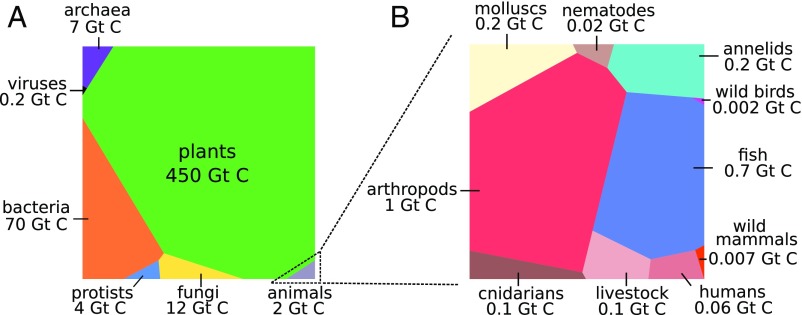
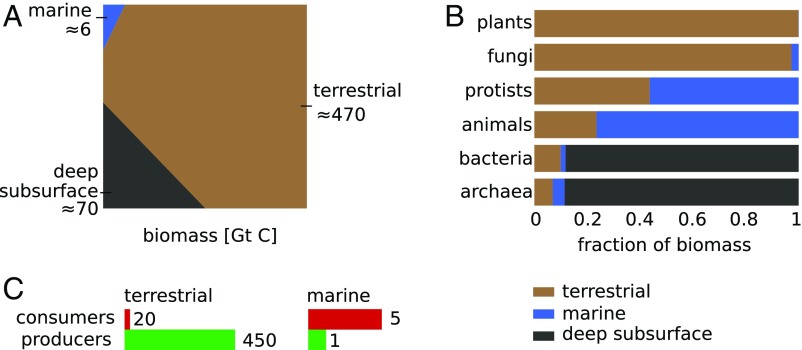
A census of the biomass on Earth is key for understanding the structure and dynamics of the biosphere. However, a global, quantitative view of how the biomass of different taxa compare with one another is still lacking. Here, we assemble the overall biomass composition of the biosphere, establishing a census of the ≈550 gigatons of carbon (Gt C) of biomass distributed among all of the kingdoms of life. We find that the kingdoms of life concentrate at different locations on the planet; plants (≈450 Gt C, the dominant kingdom) are primarily terrestrial, whereas animals (≈2 Gt C) are mainly marine, and bacteria (≈70 Gt C) and archaea (≈7 Gt C) are predominantly located in deep subsurface environments. We show that terrestrial biomass is about two orders of magnitude higher than marine biomass and estimate a total of ≈6 Gt C of marine biota, doubling the previous estimated quantity. Our analysis reveals that the global marine biomass pyramid contains more consumers than producers, thus increasing the scope of previous observations on inverse food pyramids. Finally, we highlight that the mass of humans is an order of magnitude higher than that of all wild mammals combined and report the historical impact of humanity on the global biomass of prominent taxa, including mammals, fish, and plants.
Overview
CoChat Summary
TL;DR
The paper assembles a global census of biomass across all kingdoms of life, estimating Earth’s total biomass at ≈550 Gt C, dominated by plants. It also compares biomass across environments and trophic modes, highlighting large uncertainties and human impacts on the biosphere.
Key findings
- Total global biomass is ≈550 Gt C, with plants ≈450 Gt C (≈80%), bacteria ≈70 Gt C (≈15%), fungi ≈12 Gt C, archaea ≈7 Gt C, protists ≈4 Gt C, animals ≈2 Gt C, and viruses ≈0.2 Gt C.
- Land biomass (≈470 Gt C) is about two orders of magnitude higher than marine biomass (≈6 Gt C); the deep subsurface holds ≈15% of total biomass, chiefly bacteria and archaea.
- In the ocean, ≈1 Gt C of primary producers supports ≈5 Gt C of consumer biomass, an inverted standing biomass distribution; marine biomass is ≈70% microbes, mainly bacteria and protists.
- Human-associated biomass is large relative to wild vertebrates: humans ≈0.06 Gt C, livestock ≈0.1 Gt C, wild mammals ≈0.007 Gt C, domesticated poultry ≈0.005 Gt C versus wild birds ≈0.002 Gt C; total plant biomass has declined approximately twofold relative to pre-human civilization.
Methods
- The authors synthesize hundreds of studies and generate estimates for major taxonomic groups, reporting biomass as gigatons of carbon (Gt C) and using a kingdom-level framework plus viruses.
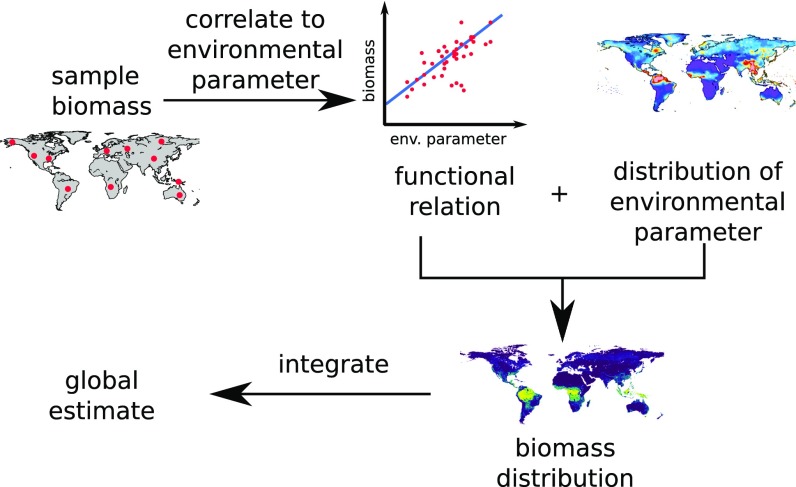
- For many taxa, local biomass samples are extrapolated globally by correlating biomass density with environmental parameters known at global scale; best estimates often use a geometric mean of independent estimates.
- Uncertainty is reported as multiplicative fold-change projections akin to 95% confidence intervals, incorporating intrastudy, interstudy, and intermethod variation; data and code are open-sourced.
Limitations
- The paper states that most datasets rely on fragmentary sampling, causing large uncertainties; sampling is scarce in the deep ocean (usually deeper than 200 m) and deep soil (usually deeper than 1 m), and some estimates may be biased by sampling toward high-abundance areas.
- The paper states that deep subsurface environments have particularly high uncertainty and unknown systematic biases, including unresolved distribution of biomass between aquifer fluids and rocks and among microbial taxa.
- The paper states that current and prehuman vertebrate biomass estimates are only a crude first step, amphibians remain poorly characterized, and parasite biomass is not resolved from hosts; evident from the text, kingdom-level grouping was chosen because much data lack finer taxonomic detail, and some uncertainty projections rely on analogous taxa or expert consultation.
Model-written summary. Check it against the paper before relying on it.
Integrity signals
Registry
Cites
Statistics
Figures
Verification
Claims the paper makes
9 Valid · 7 Not valid · 16 Not checked · 53 Own results and interpretations
Every source the paper cites for this claim was checked and supports it.
In the paper
“The biomass of amphibians, which are experiencing a dramatic population decline (42), remains poorly characterized.”
§ The biomass distribution on Earth > Discussion
What the sources say
- Supportedcites [42] Wake DB Vredenburg VT 2008 Colloquium paper: Are we in the midst of the sixth mass extinction? A view from the world of amphibians Proc Natl Acad Sci USA 105 11466 11473 18695221 PMC2556420 source
The citation is attached to the clause about amphibian population decline, not the separate statement that their biomass is poorly characterized. The passage reporting the Global Amphibian Assessment (labeled Abstract in our copy) says that 43% of amphibian species have declining populations. (LLM, conf=0.92)
plain- Asserted: passes — The authors put it forward as true.
- Checkable: passes — It can be checked against evidence.
- Load-bearing: unclear — It is unclear whether the paper’s conclusions depend on it.
- Based: passes — The paper gives a reason why it holds.
- Supported
Every source the paper cites for this claim was checked and supports it.
In the paper
“In the case of prokaryotes, some major improvements were recently realized, with global estimates of marine deep subsurface prokaryote biomass reduced by about two orders of magnitude due to an increased diversity of sampling locations (7).”
§ The biomass distribution on Earth > Discussion
What the sources say
- Supportedcites [7] Kallmeyer J Pockalny R Adhikari RR Smith DC D’Hondt S 2012 Global distribution of microbial abundance and biomass in subseafloor sediment Proc Natl Acad Sci USA 109 16213 16216 22927371 PMC3479597 source
The Discussion reports a revised subseafloor microbial biomass estimate of 4.1 Pg C versus a previous estimate of 303 Pg C—about a 74-fold reduction. It also identifies a more geographically diverse sampling database, including low-abundance ocean gyres, as a reason the new estimate is lower. The paper identifies other contributing factors as well. (LLM, conf=0.88)
plainstates a cause- Asserted: passes — The authors put it forward as true.
- Checkable: passes — It can be checked against evidence.
- Load-bearing: unclear — It is unclear whether the paper’s conclusions depend on it.
- Based: passes — The paper gives a reason why it holds.
- Supported
The sources with a verdict support this claim; the rest weren’t checked yet, have no full text we could read, or their verdicts aren’t rated yet.
In the paper
“Such inverted biomass distributions can occur when primary producers have a rapid turnover of biomass [on the order of days (34)], while consumer biomass turns over much more slowly [a few years in the case of mesopelagic fish (35)].”
§ The biomass distribution on Earth > Results > The Distribution of Biomass Across Environments and Trophic Modes.
What the sources say
- Supportedcites [34] Zubkov MV 2014 Faster growth of the major prokaryotic versus eukaryotic CO2 fixers in the oligotrophic ocean Nat Commun 5 3776 24777140 PMC4015317 source
The Results (Comparison of the growth rates of the CO2 fixers; page unavailable) report growth rates of 0.1–0.6 per day for the studied oceanic primary producers, consistent with biomass turnover on the order of days. The few-years estimate for mesopelagic fish is assigned to a different citation, not this source. (LLM, conf=0.91)
- Not checked — no full text of the sourcecites [35] Catul V Gauns M Karuppasamy PK 2011 A review on mesopelagic fishes belonging to family Myctophidae Rev Fish Biol Fish 21 339 354 source
plainstates a possible cause- Asserted: passes — The authors put it forward as true.
- Checkable: passes — It can be checked against evidence.
- Load-bearing: passes — The paper’s conclusions depend on it.
- Based: passes — The paper gives a reason why it holds.
- Supported
The cited sources support only part of this claim — read each source’s verdict below.
In the paper
“Combining data from independent sources such as these enables a robust assessment of the total plant biomass (17).”
§ The biomass distribution on Earth > Results > The Uncertainty Associated with Global Biomass Estimates.
What the sources say
- Partly supportedcites [17] Erb K-H 2017 Unexpectedly large impact of forest management and grazing on global vegetation biomass Nature 553 73 76 29258288 PMC5756473 sourceExperimental — accuracy not yet measured
The Methods describe combining multiple datasets and types of evidence to estimate global vegetation biomass stocks. But the paper also says global stocks remain uncertain, reports uncertainty ranges around 35% of the median estimate, and describes more robust estimates as a future prospect. It therefore supports the use of independent sources for an assessment, but not the unqualified characterization of that assessment as robust. (LLM, conf=0.84)
plainstates a cause- Asserted: passes — The authors put it forward as true.
- Checkable: passes — It can be checked against evidence.
- Load-bearing: passes — The paper’s conclusions depend on it.
- Based: passes — The paper gives a reason why it holds.
- Partly supported
A result the paper states — it cites no source for it, so there is none to check. The quote shows it is in the paper.
In the paper
“Plant biomass includes ≈70% stems and tree trunks, which are mostly woody, and thus relatively metabolically inert.”
§ The biomass distribution on Earth > Results > The Biomass Distribution of the Biosphere by Kingdom.
plain- Asserted: passes — The authors put it forward as true.
- Checkable: passes — It can be checked against evidence.
- Load-bearing: unclear — It is unclear whether the paper’s conclusions depend on it.
- Based: passes — The paper gives a reason why it holds.
27 more claims
Create a free account to see all 85 claims and to verify the 2 references still open.
- It may state two separate claims as one. 32
- Probably not a substantial claim. 28
Claims other papers make about this one
Each is checked against this paper’s own text: does it say what the citing paper says it does?
The cited source doesn’t support the claim as written.
In the citing paper
“and less than 10% that of the world ' s current human population ( 52 ).”
From Pervasive human-driven decline of life on Earth points to the need for transformative change (2019) · cites this paper as [52]
Checked by a reasoning model — may be wrong.
Experimental — accuracy not yet measuredThe cited source says what the claim attributes to it.
In the citing paper
“Approximately 450 Gt of C is bound up in terrestrial biota, primarily in plants (86), while only ~6 Gt of C is found in ocean biota (87).”
From Earth beyond six of nine planetary boundaries (2023) · cites this paper as [87]
The cited source says what the claim attributes to it.
In the citing paper
“The amount of metabolic energy available to a biosphere powered by O 2 is vast, such that the O 2 -rich ocean-atmosphere system of the modern Earth supports staggering levels of standing biomass (Bar-On et al. 2018), energy flow (Falkowski et al. 2008), and ecological complexity (Steele 1974).”
From The History of Ocean Oxygenation (2022) · cites this paper as Bar-On et al. 2018
In the citing paper
“Global populations of domestic ruminants (cattle, sheep, and goats) (Ripple et al. 2013) poultry, and pigs (Bennett et al. 2018) used to feed the growing human population now exceed 100 million tons of carbon (Bar-On et al. 2018), and livestock populations are growing rapidly.”
From Scientists’ warning to humanity on the freshwater biodiversity crisis (2021) · cites this paper as Bar-On et al. 2018
Citations
Cites
The worldwide leaf economics spectrum
Wright, I. J., Reich, P. B., Westoby, M., Ackerly, D. D., Baruch, Z., Bongers, F., Cavender-Bares, J., Chapin, T., Cornelissen, J. H. C., Diemer, M., et al. (2004) · Nature · doi:10.1038/nature02403 · Cited by 9,021 · cited 1×
“We then convert the total area of leaves to an estimate of the total dry mass of leaves by using the Glopnet database (24), which measured leaf mass per area (LMA) for ≈2500 plant species.”
MethodA large and persistent carbon sink in the world’s forests
Pan, Y., Birdsey, R. A., Fang, J., Houghton, R., Kauppi, P. E., Kurz, W. A., Phillips, O. L., Shvidenko, A., Lewis, S. L., Canadell, J. G., et al. (2011) · Science · doi:10.1126/science.1201609 · Cited by 8,458
Soil Sampling and Methods of Analysis
(2007) · CRC Press eBooks · doi:10.1201/9781420005271 · Cited by 6,469
Primary production of the biosphere: Integrating terrestrial and oceanic components
Field, C. B., Behrenfeld, M. J., Randerson, J. T., & Falkowski, P. (1998) · Science · doi:10.1126/science.281.5374.237 · Cited by 6,371
Prokaryotes: The unseen majority
Whitman, W. B., Coleman, D. C., & Wiebe, W. J. (1998) · Proceedings of the National Academy of Sciences · doi:10.1073/pnas.95.12.6578 · Cited by 4,871
Global effects of land use on local terrestrial biodiversity
Newbold, T., Hudson, L. N., Hill, S. L. L., Contu, S., Lysenko, I., Senior, R. A., Börger, L., Bennett, D. J., Choimes, A., Collen, B., et al. (2015) · Nature · doi:10.1038/nature14324 · Cited by 4,352
Belowground biodiversity and ecosystem functioning
Bardgett, R. D., & van der Putten, W. H. (2014) · Nature · doi:10.1038/nature13855 · Cited by 3,990 · cited 4×
“This was recommended by experts in the field for estimation of arbuscular mycorrhizal fungi abundance (117).”
BackgroundInfluentialMangroves among the most carbon-rich forests in the tropics
Donato, D. C., Kauffman, J. B., Murdiyarso, D., Kurnianto, S., Stidham, M., & Kanninen, M. (2011) · Nature Geoscience · doi:10.1038/ngeo1123 · Cited by 3,374
Poorter, H., Niklas, K. J., Reich, P. B., Oleksyn, J., Poot, P., & Mommer, L. (2012) · New Phytologist · doi:10.1111/j.1469-8137.2011.03952.x · Cited by 3,163 · cited 1×
“The first relies on a meta-analysis of the biomass allocation to different plant compartments across biomes (19).”
BackgroundA global analysis of root distributions for terrestrial biomes
Jackson, R. B., Canadell, J., Ehleringer, J. R., Mooney, H. A., Sala, O. E., & Schulze, E. D. (1996) · Oecologia · doi:10.1007/bf00333714 · Cited by 3,071 · cited 4×
“assumed the distribution of microbial biomass with depth follows the biomass density versus depth profile of root biomass (21).”
BackgroundMethodInfluential
Research works printed but not linked: 1
- Chapman AD 2009 Numbers of Living Species in Australia and the World Australian Biological Resources Study Canberra, Australia
Cited by
Items 3,601–3,700 of 3,743
Olson, M. E. (2026) · Oxford University Press eBooks · doi:10.1093/9780197831533.003.0008
Conclusion: Working together to build better explanations of organismal form
Olson, M. E. (2026) · Oxford University Press eBooks · doi:10.1093/9780197831533.003.0007
Evolution and developmental systems
Olson, M. E. (2026) · Oxford University Press eBooks · doi:10.1093/9780197831533.003.0004
Understanding phenotypic plasticity and its role in evolution
Olson, M. E. (2026) · Oxford University Press eBooks · doi:10.1093/9780197831533.003.0005
Liu, X., Ma, S.-D., Li, J.-M., Liu, H., Zhong, Z.-X., Zhang, G.-R., Hu, W., Li, H., & Lan, W. (2026) · Microbiology Spectrum · doi:10.1128/spectrum.03557-25
Soil fauna and ecosystem functions: Current knowledge and future perspectives in Latin America
Laura, M. M., Pérez-Roig, C., Fernanda, C. M., et al. (2026) · Pedobiologia · doi:10.1016/j.pedobi.2026.151139
Conservation of Terrestrial Ecosystem Through Carbon Cycle Monitoring and Management
Park, H. (2026) · Springer eBooks · doi:10.1007/978-3-032-02738-2_11
Deep Dark Futures: Foresighting Human Impacts on Mesopelagic Ecosystem Services
Scoulding, B., Hobday, A. J., Trebilco, R., Pethybridge, H., van Putten, I. E., Baker, K. B., Evans, K., Green, D. S., Hoshino, E., Haris, K., et al. (2026) · Fish and Fisheries · doi:10.1111/faf.70088
Bruskotter, J. T., Vucetich, J. A., Sullivan, L., Peterson, M. N., Serfass, T. L., Peterson, T. R., & Nelson, M. P. (2026) · Human Dimensions of Wildlife · doi:10.1080/10871209.2026.2655219
Insects shape the cadaver decomposition microbiome and postmortem interval estimation accuracy
Nieciecki, V., Seitz, V. A., Burcham, Z. M., Otto, K., Cantrell, K., Kirkland, J., Ackermann, G. L., Knight, R. D., Lynne, A. M., Metcalf, J. L., et al. (2026) · mSystems · doi:10.1128/msystems.00681-25 · Cited by 2
Houghton, R., Moreira, A., & Martins, I. (2026) · Elsevier eBooks · doi:10.1016/b978-0-443-21964-1.00122-1
Zlobin, I. E. (2026) · Biological reviews/Biological reviews of the Cambridge Philosophical Society · doi:10.1002/brv.70175
Wakil, S., Haruna, I. Y., Ibrahim, A., et al. (2026) · UMYU Scientifica · doi:10.56919/usci.2651.030
Tan, L.-R., Kim, S. M., Cho, Y. B., et al. (2026) · Bioresource Technology · doi:10.1016/j.biortech.2026.134783
Hacisalihoglu, G. (2026) · Springer eBooks · doi:10.1007/978-3-032-17047-7_1
Future Plants Now: Feeding the Twenty-First Century
Hacisalihoglu, G. (2026) · Springer eBooks · doi:10.1007/978-3-032-17047-7_12
Insect Biology, Ecology, and Behavior
Malinga, G. M., Davis, R. B., Gielen, R., Holm, S., & Valtonen, A. (2026) · Springer eBooks · doi:10.1007/978-981-95-7390-5_2
Research and conservation priorities for domesticated birds’ wild counterparts
Smith, W. J. B., Lavretsky, P., Gering, E., & Ottenburghs, J. (2026) · Ornithological Applications · doi:10.1093/ornithapp/duag045
Yao, X., Zhang, Z., Yuan, F., & Song, C. (2026) · Global and Planetary Change · doi:10.1016/j.gloplacha.2026.105514
Introduction. Some Necessary Clarifications
Flipo, F. (2026) · Environmental Politics and Theory · doi:10.1007/978-3-032-11371-9_1
Wang, S., Xi, X., Tu, X., Su, G., Wang, Z., Zhou, R., Zhao, Z., & Liu, X. (2026) · Acta Geochimica · doi:10.1007/s11631-026-00876-0 · Cited by 2
Importance of Biomass: Overview
Woiciechowski, A. L., de Carvalho, J. C., Filho, A. Z., Letti, L. A. J., Duda, L. J., & Soccol, C. R. (2026) · Biofuel and biorefinery technologies · doi:10.1007/978-3-032-19898-3_1
Mathias, Á. L. (2026) · Biofuel and biorefinery technologies · doi:10.1007/978-3-032-19898-3_9
Ruprecht, J., Forrester, T. D., Brown, C. L., Mengak, L. F., Wisdom, M. J., Clark, D. A., & Levi, T. (2026) · Journal of Animal Ecology · doi:10.1111/1365-2656.70273
“Domestic herbivores represent the largest biomass of mammals on Earth (Bar-On et al., 2018 ) and occur over a quarter of the planet's land where they co-occur with native species (Schieltz & Rubenstein, 2016 ).”
Mori, F., Dunlea, A. G., Hoshino, T., Tanaka, E., Yasukawa, K., Terada, T., & Morono, Y. (2026) · FEMS Microbiology Letters · doi:10.1093/femsle/fnag058
“This estimate has been refined over time by improving modeling approaches based on detailed data sets of horizontal and vertical cells distributions (Kallmeyer et al. 2012 , Parkes et al. 2014 , Bar-On et al. 2018 ).”
InfluentialLuby, S. P., & Rashid, S. F. (2026) · Oxford University Press eBooks · doi:10.1093/9780197651933.003.0009
At the roots of Plant Awareness Disparity (PAD): Semantic processing and numerosity perception
Guerra, S., Roccato, M., Oletto, C. M., Ghiani, A., Bertamini, M., & Battaglini, L. (2026) · PLoS ONE · doi:10.1371/journal.pone.0343890
“Plants represent more than 80% of the global biomass distribution of taxa on Earth [1].”
Xu, L., Zeng, M., Ya-yu, G., Yun-jun, Z., Ma, C., Zhang, C. L., Wen, J., Zhao, Y.-Y., & Yuan, T. (2026) · Journal of Agricultural and Food Chemistry · doi:10.1021/acs.jafc.5c14641
Pinheiro, Â., Martins, T. M., Varela, A., Domingos, P., Escórcio, R., Bento, A., Martins, I., Afonso, C. A. M., & Pereira, C. S. (2026) · BMC Microbiology · doi:10.1186/s12866-026-05128-y
“High-throughput DNA-based surveys have revolutionized our understanding of fungal biogeography and ecological roles, establishing soils as among the most diverse biological habitats on Earth, though their spatial and temporal distributions remain insufficiently understood [1, 6, 7].”
The Termite Biological Control Continued Optimism Must Face its Ongoing Absence of Potential
Chouvenc, T. (2026) · Sociobiology · doi:10.13102/sociobiology.v73i2.12626 · Cited by 1
Biocalorimetry for the biotechnological use of natural and synthetic macromolecules
Maskow, T., Duong, H. L., Merayo, N. F., & Schlosser, D. (2026) · Applied Microbiology and Biotechnology · doi:10.1007/s00253-026-13871-5
“Terrestrial plants alone contribute approximately 450 gigatons of carbon, predominantly in the form of polymers such as cellulose and lignin (Bar-On et al. 2018).”
Biological Senomic Thermodynamics in the Evolution of Life on Earth
Baluška, F., Miller, W. B., Reber, A. S., & Slijepčević, P. (2026) · Springer eBooks · doi:10.1007/978-3-032-24295-2_28 · Cited by 2
Non-mendelian Inheritance and Evolution in Ciliates with a Focus on Transposons
Allen, S. E., & Nowacki, M. (2026) · Springer eBooks · doi:10.1007/978-3-032-24295-2_11
Fiakpornu, G., & Kamata, N. (2026) · Insects · doi:10.3390/insects17060536
Nyambiya, I. (2026) · Springer eBooks · doi:10.1007/978-981-96-7995-9_6
A Look at History: How Did It Come to This? Drivers of Unsustainable Change
Müller, M. H.-P., & Meyer, A. K. (2026) · Springer eBooks · doi:10.1007/978-3-658-51394-8_1
Contemporary U.S. Anthromes as Defined by HANPP Regimes
Chandrasekaran, A., Fowler, K., & Lant, C. L. (2026) · Land · doi:10.3390/land15050855
Climate Change, Animal Agriculture, and Ethics
Donoso, A., & Mittiga, R. A. (2026) · Wiley Interdisciplinary Reviews Climate Change · doi:10.1002/wcc.70047 · Cited by 1
“Perhaps most important are those about the ethics of effectively winding down the majority of mammalian life on the planet (i.e., cows and pigs) (see Bar-On et al. 2018).”
Occupancy as a key attribute linking saprotrophic fungi to soil carbon decomposition
Peng, Z., Fu, Y., Schmid, B., Wang, Z., Qi, J., Luo, Y., Wei, G., & Jiao, S. (2026) · National Science Review · doi:10.1093/nsr/nwag319
“Soil saprotrophic fungi are among the most diverse and functionally important organisms on Earth [8 ], playing a central role in decomposition and carbon cycling [9 –11 ].”
Precision Lignocellulosic Biorefinery: Process Regulation From Corn Stover to Products
Lin, X., Wang, L., Pang, T., Yin, M., & Chen, H. (2026) · Advanced Science · doi:10.1002/advs.75391
Community structure and methylation of microbes in an artificially forced sediment core
Zhao, R., & Biddle, J. F. (2026) · Microbiology Spectrum · doi:10.1128/spectrum.03533-25
Kotrschal, K. M. (2026) · Frontiers in Psychology · doi:10.3389/fpsyg.2026.1800617
Osburn, M. R., Casar, C. P., Stevenson, B. S., Selensky, M. J., Kruger, B. R., Momper, L., Flynn, T. M., & Amend, J. P. (2026) · Journal of Geophysical Research Biogeosciences · doi:10.1029/2025jg009515
“Estimates of biomass within this realm are under continual refinement, but current estimates suggest that it is one of the largest ecosystems on the planet, constituting as much as 15–23 Pg of carbon, or ∼ 20% of the living biomass on Earth (Bar‐”
Islam, M. M., Kumar, K., Cheng, M., McDonald, A. G., Ding, L., Lin, Y., & Tu, M. (2026) · Bioresources and Bioproducts · doi:10.3390/bioresourbioprod2020009 · Cited by 1
Oxygen as a constraint and opportunity in carbon fixation: Rubisco, spin chemistry, and crop yield
Сахно, Т. В., Minaev, B. F., Marenych, M., et al. (2026) · Next research. · doi:10.1016/j.nexres.2026.101984
Mathes, F., Roussel, E. G., Cragg, B. A., Weightman, A. J., Sass, H., Parkes, R. J., & Webster, G. (2026) · Frontiers in Microbiology · doi:10.3389/fmicb.2026.1840877
Peugnet, G., Pisapia, C., Ménèz, B., Watkinson, M., Lecourt, L., Peugnet, N., Bouchez, J., Bruxelles, L., & Gérard, E. (2026) · FEMS Microbiology Ecology · doi:10.1093/femsec/fiag047
“Subsurface ecosystems host most of Earth’s micro-organisms (Bar-On et al. 2018 ), whose activity can significantly influence critical zone (CZ) processes, including rock weathering (Akob and Küsel 2011 , Wild et al. 2022 ).”
Syngas Production from Methane Reforming by Integrating Aqueous Microdroplets with Heterogeneous ZnO
孙璐璐, Wang, C., Yang, Y., Mu, J., Jia, X., Luo, N., & Wang, F. (2026) · Journal of the American Chemical Society · doi:10.1021/jacs.6c07879 · Cited by 1
The neuronal clock network in the polar key species Antarctic krill (Euphausia superba)Preprint
Hüppe, L., Reinhard, N., Karl, A., Kirsch, V., Wollny, L., Palmer, A., Rieger, D., Senthilan, P. R., & Helfrich-Förster, C. (2026) · eLife · doi:10.7554/elife.110990
The neuronal clock network in the polar key species Antarctic krill (Euphausia superba)Preprint
Hüppe, L., Reinhard, N., Karl, A., Kirsch, V., Wollny, L., Palmer, A., Rieger, D., Senthilan, P. R., & Helfrich-Förster, C. (2026) · eLife · doi:10.7554/elife.110990.1
Wenk, E. H., Falster, D. S., Wright, I. J., et al. (2026) · bioRxiv (Cold Spring Harbor Laboratory) · doi:10.64898/2026.06.10.731282
He, Y., Wang, X., Li, S. Y., Zhang, C. L., Xu, M., Zhou, Y., Sanford, R. A., Liang, R., Zhu, Y., Yang, D., et al. (2026) · Microbiology Spectrum · doi:10.1128/spectrum.01381-26
Kumar, A., Hira, P., Sood, U., Lata, P., Anand, S., Saxena, A., Singh, A. K., Verma, H., Negi, V., Singhvi, N., et al. (2026) · Microbial Biotechnology · doi:10.1111/1751-7915.70400
Ståhle, M., Johnson, A., Turner, S., Mårtensson, P., Kalinowski, B., & Dopson, M. (2026) · Microbial Ecology · doi:10.1007/s00248-026-02812-4
Intracrystalline-penetrating DNA-mineral hybrid structure for bulk bio-geological materials
Han, J., Han, X., Fang, W., Zhao, S., Lu, Z., Wang, Y., Liu, P., Tang, R., Liu, Z. H., & Gu, Z. (2026) · Matter · doi:10.1016/j.matt.2026.102880
Risk Effects Impact Carnivore Population Persistence
Pauli, J. N., Shiratsuru, S., Smith, M. M., & Curras, M. R. (2026) · Oxford University Press eBooks · doi:10.1093/9780191996665.003.0009
Wang, C., Qiu, M., Liu, Y., & Wang, S. (2026) · Progress in Physical Geography Earth and Environment · doi:10.1177/03091333261461202
Gjoni, V., Pomeranz, J. P. F., Junker, J. R., & Wesner, J. S. (2026) · Ecology Letters · doi:10.1111/ele.70437 · Cited by 4
“Earth supports ~550 gigatons of living carbon biomass (Bar-On et al. 2018; Elhacham et al. 2020) and a fundamental challenge for ecologists is to understand how that biomass is distributed across scales from individuals to ecosystems (Cyr and Pace 1993).”
The structural chemistry and biosynthesis of chlorophylls
Hunter, C. N., & Morey-Burrows, F. S. (2026) · RSC Chemical Biology · doi:10.1039/d6cb00082g · Cited by 4
Ma, X., Csarman, F., 关韵佳, Wang, L., Ludwig, R., & Ma, S. (2026) · Journal of Agricultural and Food Chemistry · doi:10.1021/acs.jafc.5c16214
Study on fungi, viruses and protozoa
Preeti, Kajal, A., Malik, R., Sehrawat, R., & Gahlot, V. (2026) · Elsevier eBooks · doi:10.1016/b978-0-12-817534-7.00003-3
Single cell genomics and fluorescence microscopy suggest a permanent plastid in a marine centrohelidPreprint
Walraven, A., Zlatogursky, V. V., Keeling, P. J., Foster, R. A., & Burki, F. (2026) · bioRxiv (Cold Spring Harbor Laboratory) · doi:10.64898/2026.06.22.732937
Voronkov, A., & Ivanova, T. (2026) · Russian Journal of Plant Physiology · doi:10.1134/s1021443726602326
“Since sporophyte generation currently accounts for the overwhelming majority of its biomass [31], it is this generation that occupies the widest variety of ecological niches and, as a result, is forced to adapt the composition of its membranes more extensively to a wide range of conditions.”
The chemistry of habitable oceans in the Solar system
Hao, J., Zhu, Y., Knoll, A. H., Tosca, N. J., He, C., Lau, M. C. Y., Liao, L., Crockford, P. W., Stüeken, E. E., Huo, A., et al. (2026) · Nature Communications · doi:10.1038/s41467-026-74955-4
“In addition, despite having extremely slow cellular turnover times 62,63 , marine sediments and terrestrialgroundwater canalsohost signi fi cant cell populations (> 10 29 cells) 61 .”
Forest biomass mapping associated with airborne lidar and multiple satellite data in Taiwan
Nguyen, L. D., Kato, T., Hayashi, M., Chen, Y., & Chu, H. (2026) · Journal of Forest Research · doi:10.1080/13416979.2026.2696165
“Approximately 80% of the Earth’s biomass carbon is stored by land plants (embryo-phytes) worldwide (Bar-On et al. 2018).”
Miller, W. B., Baluška, F., Slijepčević, P., & Reber, A. S. (2026) · Springer eBooks · doi:10.1007/978-3-032-23779-8_19
Boursat, T., Alméras, T., Barés, J., Molaro-Maqua, L., Kozlova, L. V., Boursiac, Y., & Clair, B. (2026) · Trees · doi:10.1007/s00468-026-02797-0
“Wood is by far the most abundant biomass in the world (Bar-On et al. 2018 ).”
Wang, L., Jiang, F., Pei, W., Dang, J., Zhang, Y., Liu, X., He, G., Tai, Q., Liu, X., He, Q., et al. (2026) · Chinese Chemical Letters · doi:10.1016/j.cclet.2026.113153
Moustafa, N., Nishikawa, E., van Dam, K. H., Morris, J., Paltsev, S., Bui, M., McCoy, S., & Dowell, N. M. (2026) · SSRN Electronic Journal · doi:10.2139/ssrn.7076303
Lu, S., Lin, F., Garedew, M., et al. (2026) · Green Chemistry · doi:10.1039/d6gc01450j
Exploring life’s hidden majority: microbial dark matter symposium highlights
Flamholz, Z., Mulay, S. A., Leshyk, V. O., Caporaso, J. G., Eisen, J. A., Kelly, L., Lloyd, K. G., Osburn, M. R., Podar, M., Roux, S., et al. (2026) · mSphere · doi:10.1128/msphere.00587-25
A generalized microbial cell model for methane biosignature predictions
Nicholson, A., & Mayne, N. J. (2026) · Monthly Notices of the Royal Astronomical Society · doi:10.1093/mnras/stag1300
Macroecology of Microbial Performance Across Earth's Biomes
Rain‐Franco, A., Andrei, A., & Pernthaler, J. (2026) · Global Ecology and Biogeography · doi:10.1111/geb.70279
Widrig, K. E., Starry, A., & James, H. F. (2026) · Integrative Organismal Biology · doi:10.1093/iob/obag038
Geographic Template for the Diversification of Amazonian Fishes
Albert, J. S., & REIS, R. E. (2026) · Fascinating life sciences · doi:10.1007/978-3-032-09328-8_1
Integrating large mammalian herbivores into Dynamic Global Vegetation Models: Status and next steps
Cheng, Y., O'Keeffe, J. A., Abraham, A. J., Christiansen, J. R., Philipsen, F. N., Larsen, K. S., Berzaghi, F., Mueller, C. W., Vesterdal, L., Kristensen, J. A., et al. (2026) · Functional Ecology · doi:10.1111/1365-2435.70409 · Cited by 2
Nganso, B. T., & Subramanian, S. (2026) · Current Opinion in Insect Science · doi:10.1016/j.cois.2026.101579
Siva, N., Mather, T., & Anderson, C. T. (2026) · Current Research in Food Science · doi:10.1016/j.crfs.2026.101505
167Chapter 9 Flattening the Curve: A Metaphor for the End of the World (As We Know It)
Pałasz, M. (2026) · De Gruyter eBooks · doi:10.1515/9783112234983-011
Gain, G., Chabi, M., Berne, N., Degand, H., Córdoba, J., Morsomme, P., Bray, F., Remacle, C., Cenci, U., & Cardol, P. (2026) · bioRxiv (Cold Spring Harbor Laboratory) · doi:10.64898/2026.07.20.739533
Groundwater microbial communities across the terrestrial subsurface
Küsel, K., & Dopson, M. (2026) · Nature Microbiology · doi:10.1038/s41564-026-02427-y · Cited by 3
Climate-modulated shifts in microbe-mediated home field advantage in litter decomposition
Deng, Y., Zheng, T., Yuan, H., Min, K., Fusheng, 陈. C., Lynch, L., & Liang, C. C. (2026) · Soil Biology and Biochemistry · doi:10.1016/j.soilbio.2026.110258
Saidu, A., Madawaki, M. S., Garba, Y. I., et al. (2026) · AGE Journal of Science · doi:10.65997/vwft2603
Ein dichotomer Ansatz zur extensiven und intensiven Tierhaltung
Frölich, K. (2026) · SDG - Forschung, Konzepte, Lösungsansätze zur Nachhaltigkeit · doi:10.1007/978-3-662-73184-0_18
Vinola, J., Sathish, S., Selvaraj, S., et al. (2026) · Next Materials · doi:10.1016/j.nxmate.2026.102896
Carbon Cycle II: Aerobic Heterotrophy
Kirchman, D. L., & Shade, A. L. (2026) · Oxford University Press eBooks · doi:10.1093/9780197831632.003.0010
Carbon Cycle I: Primary Production and Phototrophy
Kirchman, D. L., & Shade, A. L. (2026) · Oxford University Press eBooks · doi:10.1093/9780197831632.003.0009
Elements, Biochemicals, and Cellular Structures
Kirchman, D. L., & Shade, A. L. (2026) · Oxford University Press eBooks · doi:10.1093/9780197831632.003.0002
Kirchman, D. L., & Shade, A. L. (2026) · Oxford University Press eBooks · doi:10.1093/9780197831632.003.0004
The Physical-Chemical Environment
Kirchman, D. L., & Shade, A. L. (2026) · Oxford University Press eBooks · doi:10.1093/9780197831632.003.0003
Kirchman, D. L., & Shade, A. L. (2026) · Oxford University Press eBooks · doi:10.1093/9780197831632.002.0004
Kirchman, D. L., & Shade, A. L. (2026) · Oxford University Press eBooks · doi:10.1093/9780197831632.003.0005
Kirchman, D. L., & Shade, A. L. (2026) · Oxford University Press eBooks · doi:10.1093/9780197831632.003.0001
Kirchman, D. L., & Shade, A. L. (2026) · Oxford University Press eBooks · doi:10.1093/9780197831632.003.0006
Kirchman, D. L., & Shade, A. L. (2026) · Oxford University Press eBooks · doi:10.1093/9780197831632.003.0013
Deep subsurface organic-rich shale supports abundant, diverse, and novel fungi
Moon, Q., Barnhart, E. P., Varonka, M. S., Tomaszewski, E. J., Orozco-Quime, M., DesRosiers, T., Paciorka, I., Carley, M., Schramski, J., Stevenson, B. S., et al. (2026) · The ISME Journal · doi:10.1093/ismejo/wrag184 · Cited by 2
“Our protocol relied on sampling free-living cells by filtering formation water, which could underestimate the overall microbial abundance as 20%– 80% of microbial biomass in similar environments is attached to biofilms rather than suspended in the water column [ 1, 89, 90].”
Kirchman, D. L., & Shade, A. L. (2026) · Oxford University Press eBooks · doi:10.1093/9780197831632.003.0015
Kirchman, D. L., & Shade, A. L. (2026) · Oxford University Press eBooks · doi:10.1093/9780197831632.003.0012
Lavariega, M. C., Luna, B., Ramírez-Ibáñez, M., Martín‐Regalado, C. N., Galindo-Aguilar, R. E., García-Casimiro, E., Sánchez-Soto, E., Hidalgo‐Mihart, M. G., Caballero, A. S., Rosas-Rosas, O. C., et al. (2026) · Springer eBooks · doi:10.1007/978-3-032-21559-8_13
Metadata
- Authors
- Bar-On, Y. M., Phillips, R., & Milo, R.
- Affiliations
- Department of Plant and Environmental Sciences, Weizmann Institute of Science, 76100 Rehovot, Israel;
- California Institute of Technology (US)
- Weizmann Institute of Science (IL)
- Corresponding author
- Milo, Ron
- Venue
- Proceedings of the National Academy of Sciences
- Publisher
- National Academy of Sciences
- Published
- 2018-05-21
- Volume
- 115
- Issue
- 25
- Pages
- 6506-6511
- ISSN
- 0027-8424 (ISSN-L)
- 1091-6490
- PMC
- PMC6016768
- OpenAlex
- W2804910112
- Cited by
- 3,723
- References
- 263
- Citations by year
- 2026: 349 · 2025: 450 · 2024: 589 · 2023: 617 · 2022: 498 · 2021: 498 · 2020: 419 · 2019: 246 · 2018: 49
- FWCI
- 239.98
- Type
- journal article
- Language
- en
- Open access
- hybrid
- doi.org
- Licence
- Locations
- Proceedings of the National Academy of Sciences (publishedVersion, cc-by-nc-nd)
- Europe PMC (PubMed Central) (publishedVersion, cc-by-nc-nd)
- PubMed Central (publishedVersion, cc-by-nc-nd)
- PubMed (publishedVersion)
- CaltechAUTHORS (California Institute of Technology) (submittedVersion, cc-by-nc-nd)
- Funders
- National Institutes of Health (5r35gm118043-07)
- National Institute of General Medical Sciences (R35 GM118043)
- Topics
- Physical Sciences › Environmental Science › Nature and Landscape Conservation › Ecology and Vegetation Dynamics Studies
- Physical Sciences › Environmental Science › Global and Planetary Change › Earth Systems and Cosmic Evolution
- Life Sciences › Agricultural and Biological Sciences › Soil Science › Soil Carbon and Nitrogen Dynamics
- Keywords
- biomass allocation, biomass carbon, terrestrial biomass, marine biomass, bacteria, archaea, food pyramid, wild mammals, fish biomass, plant biomass
- MeSH terms
- Animals, Archaea, Bacteria, Carbon, Humans, Plants, Ecosystem, Biomass, Earth, Planet, Biota
About these checks
Registry, retraction, Cites and statistics results are computed, not judged, with one exception: a printed reference that no index lists is read once by a model before it counts as a citation error. Claims are extracted by a model and kept only when their quote appears verbatim in the text; each cited source is then checked, with a model’s help, for whether it says what the claim relies on. Those verdicts can be wrong — read the claim’s quote and the cited source before relying on one.
The claim verdicts this report counts are experimental: their accuracy is not yet measured.
A language model drew the claims from the paper on 2026-10-10, under version 3 of the claim definition (model deepseek-v4.1-flash, prompt extract-v3).
A second model labelled each claim on 2026-10-10 (model jev-1.13-20260917, definition revision gold-guideline-v0.2).
Cited sources are checked with a language model’s help (gpt-6-sol).
Statistics and arithmetic are recomputed, not judged.
Confidence bands are shown only for fields calibrated on our annotated test set. None is calibrated yet, so no band is shown.
What counts as a claim ›How we measure confidence ›How we check this ›
Are you an author, or do you see a problem with this page? Request a review
Data sources
Bibliographic data: Semantic Scholar, OpenAlex, Crossref.
Contains information from the Semantic Scholar Academic Graph Datasets, made available under the ODC Attribution License (ODC-BY 1.0).
Semantic Scholar’s data is described in: Kinney, R., et al. (2023). The Semantic Scholar Open Data Platform. arXiv:2301.10140.
