

Glycosylphosphatidylinositol-anchored Proteases of Candida albicans Target Proteins Necessary for Both Cellular Processes and Host-Pathogen Interactions
Open accessThe DOI matches its Crossref record; 51 of the 52 references it cites were found in a registry or an index.
Abstract
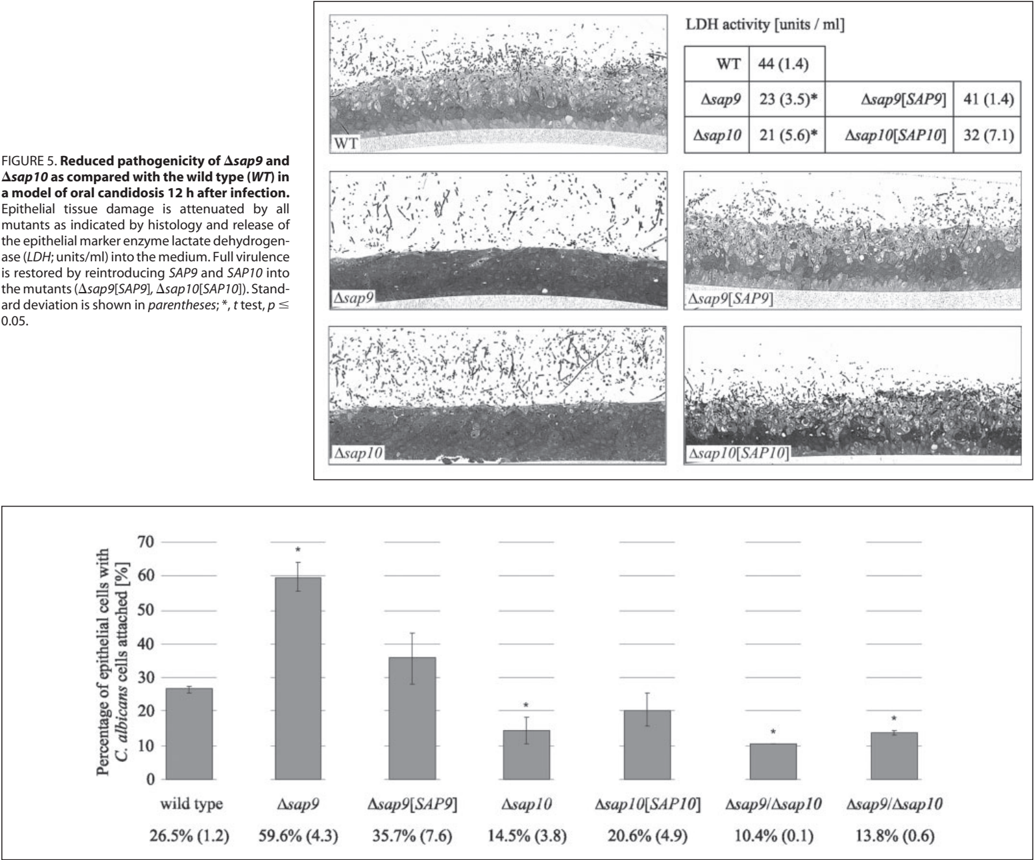
Intracellular and secreted proteases fulfill multiple functions in microorganisms. In pathogenic microorganisms extracellular proteases may be adapted to interactions with host cells. Here we describe two cell surface-associated aspartic proteases, Sap9 and Sap10, which have structural similarities to yapsins of Saccharomyces cerevisiae and are produced by the human pathogenic yeast Candida albicans. Sap9 and Sap10 are glycosylphosphatidylinositol-anchored and located in the cell membrane or the cell wall. Both proteases are glycosylated, cleave at dibasic or basic processing sites similar to yapsins and Kex2-like proteases, and have functions in cell surface integrity and cell separation during budding. Overexpression of SAP9 in mutants lacking KEX2 or SAP10, or of SAP10 in mutants lacking KEX2 or SAP9, only partially restored these phenotypes, suggesting distinct target proteins of fungal origin for each of the three proteases. In addition, deletion of SAP9 and SAP10 modified the adhesion properties of C. albicans to epithelial cells and caused attenuated epithelial cell damage during experimental oral infection suggesting a unique role for these proteases in both cellular processes and host-pathogen interactions.
Overview
The claims and statistics of this paper haven’t been checked yet.
Free: it reads the open-access text and checks the first 5 claims that cite a source we can check. Create a free account to check every claim.
Integrity signals
Registry
Cites
Statistics
Figures
Verification
Claims the paper makes
The claims and statistics of this paper haven’t been checked yet.
Free: it reads the open-access text and checks the first 5 claims that cite a source we can check. Create a free account to check every claim.
Claims other papers make about this one
Each is checked against this paper’s own text: does it say what the citing paper says it does?
The source backs part of the claim, not all of it — or backs it for a different population, condition or comparison.
In the citing paper
“Sap9 is a GPI-anchored member of the secreted aspartyl protease family involved in the proteolytic cleavage and maturation of cell wall and secreted proteins in C. albicans [62–64].”
From Carbon source‐induced reprogramming of the cell wall proteome and secretome modulates the adherence and drug resistance of the fungal pathogen C andida albicans (2012) · cites this paper as [62]
Experimental — accuracy not yet measuredThe cited source says what the claim attributes to it.
In the citing paper
“Increased Sap9 expression has been associated with adhesion to epithelial cells and epithelial damage during oral infection [62], making it an important mediator of host-pathogen interactions [65].”
The cited source says what the claim attributes to it.
In the citing paper
“Both Phr1 and Sap9 are known to contribute to adherence: phr1 null mutants display a reduction in adhesion to abiotic surfaces [66], while Sap9 modulates the adhesion to epithelial cells [62].”
Self-check
Percentages, sums and reported differences re-computed from the paper’s own numbers.
The self-check needs the paper’s full text.
Citations
Cites
Isogenic strain construction and gene mapping in Candida albicans.
Fonzi, W. A., & Irwin, M. Y. (1993) · Genetics · doi:10.1093/genetics/134.3.717 · Cited by 1,687
Virulence factors of Candida albicans
Calderone, R. A., & Fonzi, W. A. (2001) · Trends in Microbiology · doi:10.1016/s0966-842x(01)02094-7 · Cited by 1,331
Gillum, A. M., Tsay, E. Y. H., & Kirsch, D. R. (1984) · Molecular and General Genetics MGG · doi:10.1007/bf00328721 · Cited by 1,251
Candida albicans Secreted Aspartyl Proteinases in Virulence and Pathogenesis
Naglik, J. R., Challacombe, S. J., & Hube, B. (2003) · Microbiology and Molecular Biology Reviews · doi:10.1128/mmbr.67.3.400-428.2003 · Cited by 1,179
Self-citationJulius, D., Brake, A., Blair, L., Kunisawa, R., & Thorner, J. (1984) · Cell · doi:10.1016/0092-8674(84)90442-2 · Cited by 699
Fradin, C., De Groot, P., MacCallum, D., Schaller, M., Klis, F., Odds, F. C., & Hube, B. (2005) · Molecular Microbiology · doi:10.1111/j.1365-2958.2005.04557.x · Cited by 455
Self-citationMayor, S., & Riezman, H. (2004) · Nature Reviews Molecular Cell Biology · doi:10.1038/nrm1309 · Cited by 428
Intracellular Targeting and Structural Conservation of a Prohormone-Processing Endoprotease
Fuller, R. S., Brake, A. J., & Thorner, J. (1989) · Science · doi:10.1126/science.2683070 · Cited by 395
Yeast prohormone processing enzyme (KEX2 gene product) is a Ca2+-dependent serine protease.
Fuller, R. S., Brake, A., & Thorner, J. (1989) · Proceedings of the National Academy of Sciences · doi:10.1073/pnas.86.5.1434 · Cited by 392
Hube, B., Monod, M., Schofield, D. A., Brown, A. J. P., & Gow, N. A. R. (1994) · Molecular Microbiology · doi:10.1111/j.1365-2958.1994.tb01269.x · Cited by 372
Self-citation
Research works printed but not linked: 2
- Kinal, H., Park, C. M., Berry, J. O., Koltin, Y., and Bruenn, J. A. (1995) Plant Cell 7, 677-688
- Olsen, V., Cawley, N. X., Brandt, J., Egel-Mitani, M., and Loh, Y. P. (1999) Biochem. J. 339, 407-411 · doi:10.1042/bj3390407 · Paper page
Cited by
Items 101–200 of 274
Décanis, N., Tazi, N., Correia, A., Vilanova, M., & Rouabhia, M. (2011) · The Open Microbiology Journal · doi:10.2174/1874285801105010119 · Cited by 49
Joo, M. Y., Shin, J. H., Jang, H., Song, E. S., Kee, S., Shin, M., Suh, S., & Ryang, D. W. (2013) · Medical Mycology · doi:10.3109/13693786.2013.824623 · Cited by 48
Staib, P., Lermann, U., Blaß-Warmuth, J., Degel, B., Würzner, R., Monod, M., Schirmeister, T., & Morschhäuser, J. (2007) · Antimicrobial Agents and Chemotherapy · doi:10.1128/aac.01072-07 · Cited by 49
“Because different putative GPI anchorage sites have been proposed for Sap9p and Sap10p (1, 14, 17, 30), two different C-terminally truncated alleles were generated for each of these two SAP genes (see Materials and Methods and Table 1).”
BackgroundSelf-citationThe assimilation of different carbon sources in Candida albicans: Fitness and pathogenicity
Lok, B., Adam, M. A. A., Kamal, L. Z. M., Chukwudi, N. A., Sandai, R., & Sandai, D. (2021) · Medical Mycology · doi:10.1093/mmy/myaa080 · Cited by 39
Delattin, N., Brucker, K. D., Craik, D. J., Cheneval, O., Fröhlich, M., Veber, M., Girandon, L., Davis, T. R., Weeks, A. E., Kumamoto, C. A., et al. (2014) · Antimicrobial Agents and Chemotherapy · doi:10.1128/aac.01274-13 · Cited by 43
Candida albicans Possesses Sap7 as a Pepstatin A-Insensitive Secreted Aspartic Protease
Aoki, W., Kitahara, N., Miura, N., Morisaka, H., Yamamoto, Y., Kuroda, K., & Ueda, M. (2012) · PLoS ONE · doi:10.1371/journal.pone.0032513 · Cited by 41
Game theoretical modelling of survival strategies of Candida albicans inside macrophages
Hummert, S., Hummert, C., Schroeter, A., Hube, B., & Schuster, S. (2010) · Journal of Theoretical Biology · doi:10.1016/j.jtbi.2010.01.022 · Cited by 41
Self-citationKitamura, A., Higuchi, S., Hata, M., Kawakami, K., Yoshida, K., Namba, K., & Nakajima, R. (2009) · Antimicrobial Agents and Chemotherapy · doi:10.1128/aac.00435-09 · Cited by 41
“(1,6)- -glucan fraction] and were dialyzed overnight.”
BackgroundMethodInfluentialCandida glabrata tryptophan‐based pigment production via the Ehrlich pathway
Brunke, S., Seider, K., Almeida, R. S., Heyken, A., Fleck, C. B., Brock, M., Barz, D., Rupp, S., & Hube, B. (2010) · Molecular Microbiology · doi:10.1111/j.1365-2958.2010.07052.x · Cited by 37
“8D): LDH release induced by yeasts grown on ammonium sulphate or arginine medium was indistinguishable from the uninfected control, similar to the results obtained by Li and DongariBagtzoglou (2007).”
MethodSelf-citationBuu, L.-M., & Chen, Y. (2014) · Journal of Biomedical Science · doi:10.1186/1423-0127-21-22 · Cited by 43
“albicans [9-13].”
The Fusarium oxysporum cell wall proteome under adhesion‐inducing conditions
Prados‐Rosales, R., Luque-Garcia, J. L., Martínez‐López, R., Gil, C., & Pietro, A. D. (2009) · PROTEOMICS · doi:10.1002/pmic.200800950 · Cited by 39
“albicans, an aspartyl protease (Sap10) was also identified by MS/ MS analysis of isolated walls [44].”
BackgroundBowen, J. K., Mesarich, C. H., Rees‐George, J., Cui, W., Fitzgerald, A. M., Win, J., Plummer, K. M., & Templeton, M. D. (2009) · Molecular Plant Pathology · doi:10.1111/j.1364-3703.2009.00543.x · Cited by 45
“However, some GPI-anchored proteins are involved in host–pathogen interactions (Albrecht et al., 2006; Jiang et al., 2006; Richard and Plaine, 2007).”
BackgroundDabhade, A. R., Mokashe, N. U., & Patil, U. K. (2016) · Process Biochemistry · doi:10.1016/j.procbio.2016.02.015 · Cited by 39
Bairwa, G., Rasheed, M., Taigwal, R., Sahoo, R., & Kaur, R. (2014) · Biochemical Journal · doi:10.1042/bj20130757 · Cited by 36
dos Santos, A. L. S. (2010) · World Journal of Biological Chemistry · doi:10.4331/wjbc.v1.i2.21 · Cited by 38
Borelli, C., Ruge, E., Schaller, M., Monod, M., Körting, H. C., Huber, R., & Maskos, K. (2007) · Proteins Structure Function and Bioinformatics · doi:10.1002/prot.21425 · Cited by 36
Self-citationGarcia-Rubio, R., Hernandez, R. Y., Clear, A., Healey, K. R., Shor, E., & Perlin, D. S. (2021) · Frontiers in Microbiology · doi:10.3389/fmicb.2021.702779 · Cited by 35
Lapaquette, P., Ducreux, A., Basmaciyan, L., Paradis, T., Bon, F., Bataille, A., Winckler, P., Hube, B., d’Enfert, C., Esclatine, A., et al. (2022) · Gut Microbes · doi:10.1080/19490976.2021.2004798 · Cited by 36
Self-citationPeters, B. M., Zhu, J., Fidel, P. L., Scheper, M. A., Hackett, W., Shaye, S. E., & Jabra‐Rizk, M. A. (2010) · FEMS Yeast Research · doi:10.1111/j.1567-1364.2010.00632.x · Cited by 38
“albicans proteases (Sap9 and Sap2) were produced in Pichia pastoris and purified as described previously (Albrecht et al., 2006).”
Tacco, B. A. C. D. A., Parente, J. A., Barbosa, M. S., Báo, S. N., Gsóes, T. D. S., Pereira, M., & Soares, C. M. D. A. (2009) · Medical Mycology · doi:10.3109/13693780802695512 · Cited by 35
Molecular association of Candida albicans and vulvovaginal candidiasis: focusing on a solution
David, H., & Solomon, A. P. (2023) · Frontiers in Cellular and Infection Microbiology · doi:10.3389/fcimb.2023.1245808 · Cited by 38
Protease expression by microorganisms and its relevance to crucial physiological/pathological events
dos Santos, A. L. S. (2011) · World Journal of Biological Chemistry · doi:10.4331/wjbc.v2.i3.48 · Cited by 36
The first chordate big defensin: Identification, expression and bioactivity
Teng, L., Gao, B., & Zhang, S. (2012) · Fish & Shellfish Immunology · doi:10.1016/j.fsi.2012.01.007 · Cited by 35
Secretory Proteases of the Human Skin Microbiome
Chua, W., Poh, S. E., & Li, H. (2021) · Infection and Immunity · doi:10.1128/iai.00397-21 · Cited by 35
Signalling mucin Msb2 Regulates adaptation to thermal stress in C andida albicans
Saraswat, D., Kumar, R., Pande, T., Edgerton, M., & Cullen, P. J. (2016) · Molecular Microbiology · doi:10.1111/mmi.13326 · Cited by 36
“…(Kumar et al., 2015) sap8D Dsap8::hisG/Dsap8::hisG-URA3-hisG (Puri et al., 2012) sap9/10D Dsap8::hisG/Dsap8::hisG-URA3-hisG/SAP8 (Albrecht et al., 2006) ssk1D Dura3::imm434/Dura3::imm434 Dssk1::hisG/Dssk1::hisG-URA3-hisG (Chauhan et al., 2003) ssk2D…”
Genetically Engineered Virus Nanofibers as an Efficient Vaccine for Preventing Fungal Infection
Huai, Y., Dong, S., Zhu, Y., Li, X., Cao, B., Gao, X., Yang, M., Wang, L., & Mao, C. (2016) · Advanced Healthcare Materials · doi:10.1002/adhm.201500930 · Cited by 33
The Transcriptome of Exophiala dermatitidis during Ex-vivo Skin Model Infection
Poyntner, C., Blasi, B., Arcalís, E., Mirastschijski, U., Sterflinger, K., & Tafer, H. (2016) · Frontiers in Cellular and Infection Microbiology · doi:10.3389/fcimb.2016.00136 · Cited by 37
Ikonomova, S. P., Moghaddam‐Taaheri, P., Jabra‐Rizk, M. A., Wang, Y., & Karlsson, A. J. (2017) · FEBS Journal · doi:10.1111/febs.14327 · Cited by 36
“The Saps play a role in a number of cellular processes and attributes, including cell adhesion, cell integrity, and virulence [9].”
Childers, D. S., Avelar, G. M., Bain, J. M., Larcombe, D. E., Pradhan, A., Budge, S., Heaney, H., & Brown, A. J. P. (2019) · Current topics in microbiology and immunology · doi:10.1007/82_2019_182 · Cited by 36
Bocheńska, O., Rąpała‐Kozik, M., Wolak, N., Aoki, W., Ueda, M., & Kozik, A. (2016) · Acta Biochimica Polonica · doi:10.18388/abp.2016_1318 · Cited by 37
Effects of histatin 5 modifications on antifungal activity and kinetics of proteolysis
Ikonomova, S. P., Moghaddam‐Taaheri, P., Wang, Y., Doolin, M. T., Stroka, K. M., Hube, B., & Karlsson, A. J. (2019) · Protein Science · doi:10.1002/pro.3767 · Cited by 31
Self-citationTobouti, P. L., Casaroto, A. R., Almeida, R. S., Ramos, S. D. P., Dionísio, T. J., Porto, V. C., Santos, C. F., & Lara, V. S. (2015) · Journal of Prosthodontics · doi:10.1111/jopr.12285 · Cited by 33
Extended bottom-up proteomics with secreted aspartic protease Sap9
Laskay, Ü. A., Srzentić, K., Monod, M., & Tsybin, Y. O. (2014) · Journal of Proteomics · doi:10.1016/j.jprot.2014.07.035 · Cited by 33
Self-citationTipranavir exhibits different effects on opportunistic pathogenic fungi
Cenci, E., Francisci, D., Belfiori, B., Pierucci, S., Baldelli, F., Bistoni, F., & Vecchiarelli, A. (2007) · Journal of Infection · doi:10.1016/j.jinf.2007.08.004 · Cited by 30
Satała, D., Braś, G., Kozik, A., Rąpała‐Kozik, M., & Karkowska‐Kuleta, J. (2023) · Journal of Fungi · doi:10.3390/jof9010121 · Cited by 33
“cells showed increased adhesion, SAP10-deficient cells presented a lower level of adhesion compared to the wild-type strain, while the mutant lacking both proteases also had reduced adhesion; however, both single mutants presented a reduced capacity to invade and to damage reconstituted human epithelium in the model o…”
BackgroundResultInfluentialPutcharoen, O., Lee, S. H., Henrich, T. J., Hu, Z., Vanichanan, J., Coakley, E. P. G., Greaves, W. L., Gulick, R. M., Kuritzkes, D. R., & Tsibris, A. M. N. (2011) · Journal of Virology · doi:10.1128/jvi.06421-11 · Cited by 29
Mao, Y., Zhang, Z., Gast, C. E., & Wong, B. (2008) · Eukaryotic Cell · doi:10.1128/ec.00148-08 · Cited by 33
“albicans, GPI-anchored proteins play key roles in several virulence-associated processes, including adhesion to mammalian cells (5, 20, 34), switching between yeast and hyphal morphologies (3, 15), biofilm formation (17), CW biosynthesis (11), stress tolerance (31, 33), degradation of host tissues (1, 16), interaction…”
BackgroundHuman oral keratinocyte E-cadherin degradation by Candida albicans and Candida glabrata
Pärnänen, P., Meurman, J. H., Samaranayake, L., & Virtanen, I. (2010) · Journal of Oral Pathology & Medicine · doi:10.1111/j.1600-0714.2009.00866.x · Cited by 28
Promising immunotherapeutic targets for treating candidiasis
Feng, Z., Lu, H., & Jiang, Y. (2024) · Frontiers in Cellular and Infection Microbiology · doi:10.3389/fcimb.2024.1339501 · Cited by 33
Cadicamo, C. D., Mortier, J., Wolber, G., Hell, M., Heinrich, I. E., Michel, D., Semlin, L., Berger, U., Körting, H. C., Höltje, H., et al. (2012) · Biochemical Pharmacology · doi:10.1016/j.bcp.2012.12.008 · Cited by 30
Miller, K. A., DiDone, L., & Krysan, D. J. (2010) · Eukaryotic Cell · doi:10.1128/ec.00191-10 · Cited by 28
“pathogenic yeasts such as Candida albicans (1) and Candida”
BackgroundKlis, F. M., & Brul, S. (2015) · Eukaryotic Cell · doi:10.1128/ec.00142-15 · Cited by 27
Self-citationBuu, L.-M., & Chen, Y.-C. (2013) · Journal of Biomedical Science · doi:10.1186/1423-0127-20-101 · Cited by 27
Identification of Membrane Proteome of Paracoccidioides Lutzii and its Regulation by Zinc
de Curcio, J. S., Silva, M. G., Bailão, M. G. S., Báo, S. N., Casaletti, L., Bailão, A. M., & Soares, C. M. D. A. (2017) · Future Science OA · doi:10.4155/fsoa-2017-0044 · Cited by 28
Kozik, A., Gogól, M., Bocheńska, O., Karkowska‐Kuleta, J., Wolak, N., Kamysz, W., Aoki, W., Ueda, M., Faußner, A., & Rąpała‐Kozik, M. (2015) · BMC Microbiology · doi:10.1186/s12866-015-0394-8 · Cited by 25
“[53], the high, constitutive expression of the SAP9 gene was consistently detected in both reconstituted human epithelium (RHE) models and human patient samples.”
BackgroundGenomics and the development of new diagnostics and anti-Candida drugs
Weig, M., & Brown, A. J. P. (2007) · Trends in Microbiology · doi:10.1016/j.tim.2007.05.007 · Cited by 30
Candida spp. and phagocytosis: multiple evasion mechanisms
Oliver, J. C., Ferreira, C. B. R. J., Silva, N. C., & Dias, A. L. T. (2019) · Antonie van Leeuwenhoek · doi:10.1007/s10482-019-01271-x · Cited by 29
Arita, G. S., Faria, D. R., Capoci, I. R. G., Kioshima, É. S., Mendonca, P., & Svidzinski, T. I. E. (2022) · Microbiological Research · doi:10.1016/j.micres.2022.126996 · Cited by 25
Karkowska‐Kuleta, J., Kulig, K., Braś, G., Stelmaszczyk, K., Surowiec, M., Kozik, A., Karnas, E., Woźnicka, O., Zuba‐Surma, E. K., Pyza, E., et al. (2023) · Journal of Fungi · doi:10.3390/jof9111078 · Cited by 24
“N [58].”
BackgroundNews from the Fungal Front: Wall Proteome Dynamics and Host–Pathogen Interplay
Heilmann, C. J., Sorgo, A. G., & Klis, F. M. (2012) · PLoS Pathogens · doi:10.1371/journal.ppat.1003050 · Cited by 24
“The secretory aspartyl proteases Sap9 and 10, and Pir1, a predicted bglucan cross-linking protein, also seem to be involved [3,23].”
BackgroundSelf-citationHernández, R., & Rupp, S. (2008) · Methods in molecular biology · doi:10.1007/978-1-59745-204-5_10 · Cited by 28
Global Secretome Characterization of the Pathogenic Yeast Candida glabrata
Rasheed, M., Kumar, N., & Kaur, R. (2019) · Journal of Proteome Research · doi:10.1021/acs.jproteome.9b00299 · Cited by 23
“Further, of 119 proteins representing the C. glabrata secretome, 59 were predicted to have the canonical ER secretory signal by these two widely used web servers, Signal P and TargetP1.”
Teixeira, P. A. C., Castro, R. A., Ferreira, F. R. L., da Cunha, M. M. L., Torres, A. P., y Penha, C. V. L., Rozental, S., & Lopes-Bezerra, L. M. (2010) · Medical Mycology · doi:10.3109/13693780903453287 · Cited by 33
Loaiza-Loeza, S., Parra-Ortega, B., Cancino‐Díaz, J. C., Illades‐Aguiar, B., Hernández-Rodríguez, C. H., & Villa‐Tanaca, L. (2009) · FEMS Immunology & Medical Microbiology · doi:10.1111/j.1574-695x.2009.00570.x · Cited by 25
Ao, J., Chinnici, J. L., Maddi, A., & Free, S. J. (2015) · Eukaryotic Cell · doi:10.1128/ec.00032-15 · Cited by 22
Candida nivariensis in comparison to different phenotypes of Candida glabrata
Swoboda‐Kopeć, E., Sikora, M., Gołaś, M., Piskorska, K., Gozdowskı, D., & Netsvyetayeva, I. (2014) · Mycoses · doi:10.1111/myc.12264 · Cited by 24
Schaller, M., & Weindl, G. (2008) · Methods in molecular biology · doi:10.1007/978-1-59745-204-5_23 · Cited by 20
Self-citationBarelle, C. J., Duncan, V. M. S., Brown, A. J. P., Gow, N. A. R., & Odds, F. C. (2007) · Journal of Antimicrobial Chemotherapy · doi:10.1093/jac/dkm456 · Cited by 25
Self-citationGrbavac, A., Čanak, I., Stuparević, I., Teparić, R., & Mrša, V. (2016) · Biochimica et Biophysica Acta (BBA) - Molecular Cell Research · doi:10.1016/j.bbamcr.2016.12.009 · Cited by 20
The yapsin family of aspartyl proteases regulate glucose homeostasis in Candida glabrata
Askari, F., Rasheed, M., & Kaur, R. (2022) · Journal of Biological Chemistry · doi:10.1016/j.jbc.2022.101593 · Cited by 20
“albicans (Sap9 and 10) have not been implicated in glucose homeostasis (4, 52).”
BackgroundGlobal Protein–Protein Interaction Network of Rice Sheath Blight Pathogen
Lei, D., Lin, R., Yin, C., Li, P., & Zheng, A. (2014) · Journal of Proteome Research · doi:10.1021/pr500069r · Cited by 19
Dignani, M. C., Solomkin, J. S., & Anaissie, E. J. (2009) · Elsevier eBooks · doi:10.1016/b978-1-4160-5680-5.00008-6 · Cited by 35
Cheng, S., Chai, L. Y. A., Joosten, L. A. B., Vecchiarelli, A., Hube, B., van der Meer, J. W., Kullberg, B. J., & Netea, M. G. (2009) · Infection and Immunity · doi:10.1128/iai.01041-09 · Cited by 19
Self-citationRevuelta, M. V., van Kan, J. A. L., Kay, J., & ten Have, A. (2014) · Genome Biology and Evolution · doi:10.1093/gbe/evu110 · Cited by 19
Yang, H., Tsang, P. C. S., Pow, E., Lam, O., & Tsang, P. W.-K. (2019) · Microbial Pathogenesis · doi:10.1016/j.micpath.2019.103896 · Cited by 18
Martin, H., Govern, M. M., Abbey, L., Gilroy, A., Mullins, S., Howell, S., Kavanagh, K. A., & Velasco‐Torrijos, T. (2018) · European Journal of Medicinal Chemistry · doi:10.1016/j.ejmech.2018.10.011 · Cited by 18
Gasilova, N., Srzentić, K., Qiao, L., Liu, B., Beck, A., Tsybin, Y. O., & Girault, H. H. (2015) · Analytical Chemistry · doi:10.1021/acs.analchem.5b04045 · Cited by 17
Cao, W., Maruyama, J., Kitamoto, K., Sumikoshi, K., Terada, T., Nakamura, S., & Shimizu, K. (2009) · The Journal of General and Applied Microbiology · doi:10.2323/jgam.55.381 · Cited by 17
Gizińska, M., Staniszewska, M., & Ochal, Z. (2018) · Mini-Reviews in Medicinal Chemistry · doi:10.2174/1389557518666180924121209 · Cited by 15
Vandermeulen, M. D., Lorenz, M. C., & Cullen, P. J. (2024) · Genetics · doi:10.1093/genetics/iyae122 · Cited by 15
Exploiting new knowledge of Candidal infection for future antifungal combat
Kragelund, C. (2016) · Oral Diseases · doi:10.1111/odi.12546 · Cited by 15
Calugi, C., Guarna, A., & Trabocchi, A. (2012) · Journal of Enzyme Inhibition and Medicinal Chemistry · doi:10.3109/14756366.2012.696245 · Cited by 17
Kounatidis, I., Ames, L., Mistry, R., Ho, H.-L., Haynes, K., & Ligoxygakis, P. (2018) · G3 Genes Genomes Genetics · doi:10.1534/g3.118.200182 · Cited by 13
Physiology and Metabolic Requirements of Pathogenic Fungi
Brock, M. (2008) · Springer eBooks · doi:10.1007/978-3-540-79307-6_4 · Cited by 13
Alvarado, M., Navajas, J. A. G., Muñoz, M. T. B., Gómez-Molero, E., Berbegal, C., Eraso, E., Kramer, G., & de Groot, P. W. J. (2023) · PLoS Pathogens · doi:10.1371/journal.ppat.1011158 · Cited by 13
Factors associated with the presence of atrophic tongue in patients with dry mouth
Kimori, H., Yamamoto, K., Yamachika, S., Tsurumoto, A., Kamikawa, Y., Sasao, M., Morito, M., Saito, I., Ohshima, T., Maeda, N., et al. (2013) · Gerodontology · doi:10.1111/ger.12045 · Cited by 13
The Cell Wall: Glycoproteins, Remodeling, and Regulation
Munro, C. A., & Richard, M. L. (2014) · ASM Press eBooks · doi:10.1128/9781555817176.ch14 · Cited by 14
A systems biology approach to the mutual interaction between yeast and the immune system
Rizzetto, L., & Cavalieri, D. (2010) · Immunobiology · doi:10.1016/j.imbio.2010.05.009 · Cited by 16
“The ability of yeast cells to switch to hyphae has been described as a way to resist and survive phagocytic action (Clemons et al., 2000; Albrecht et al., 2006; Richard et al., 2002; Ibrahim et al., 1998).”
BackgroundDong, S., Shi, H., Cao, D., Wang, Y., Zhang, X., Li, Y., Gao, X., & Wang, L. (2016) · Scientific Reports · doi:10.1038/srep32256 · Cited by 13
“Among the Sap family, Sap2 is up to 67% identical to Sap1 and Sap3, and it is the most highly expressed and the major cause of damage and virulence when infected the host 21–23 .”
Jones, S. K., Clarke, S., Craik, C. S., & Bennett, R. J. (2015) · mBio · doi:10.1128/mbio.01604-15 · Cited by 14
Lipid Transport by Candida albicans Dnf2 Is Required for Hyphal Growth and Virulence
Jain, B. K., Wagner, A. S., Reynolds, T. B., & Graham, T. R. (2022) · Infection and Immunity · doi:10.1128/iai.00416-22 · Cited by 11
Discovery and characterization of ß-1,6-glucan inhibitors
Kitamura, A. (2010) · Expert Opinion on Drug Discovery · doi:10.1517/17460441.2010.498472 · Cited by 13
“The SAP (Secretory Aspartic Proteinase) and the PLD (Phospholipases) family have critical roles for the invasion in tissue [58,59].”
BackgroundA novel Candida glabrata cell wall associated serine protease
Pärnänen, P., Meurman, J. H., & Nikula-Ijäs, P. (2015) · Biochemical and Biophysical Research Communications · doi:10.1016/j.bbrc.2015.01.047 · Cited by 12
Ibe, C., Walker, L. A., Gow, N. A. R., & Munro, C. A. (2017) · Springer eBooks · doi:10.1007/978-3-319-50409-4_16 · Cited by 12
Staniszewska, M., Bondaryk, M., Żukowski, K., & Chudy, M. (2015) · Polish Journal of Microbiology · doi:10.5604/01.3001.0009.2115 · Cited by 14
“As far it is known (Cadicamo et al., 2013; Correia et al., 2010; Dalle et al., 2010; Jackson et al., 2007; Martin et al., 2011; Naglik et al., 2003; 2008; Taylor et al., 2005), the increased expression of specific Saps at various stages of the infection plays a special role in tissue invasion.”
BackgroundInfluentialChen, Y., Bernardis, F. D., Yu, S.-J., Sandini, S., Kauffman, S., Tams, R. N., Bethea, E. K., & Reynolds, T. B. (2015) · PLoS ONE · doi:10.1371/journal.pone.0116974 · Cited by 12
Silva, R. S., Segura, W. D., Oliveira, R. S., Xander, P. B., & Batista, W. L. (2023) · Journal of Fungi · doi:10.3390/jof9030375 · Cited by 10
“albicans confirmed their importance for cell wall integrity [24,55,56].”
BackgroundSohn, M. J., Oh, D., Kim, E. J., Cheon, S. A., Kwon, O., Kim, J., Lee, S. Y., & Kang, H. A. (2011) · Yeast · doi:10.1002/yea.1912 · Cited by 11
“Similarly, the C. albicansmutant strains with deletion of Sap9 and Sap10 were more sensitive to Calcofluor white and Congo red (Albrecht et al., 2006), and the expression of SAP9 gene was induced by the treatment of caspofungin (Copping et al., 2005).”
BackgroundStaniszewska, M., Bondaryk, M., Siennicka, K., Piłat, J., Schaller, M., & KURZĄTKOWSKI, W. (2012) · Postępy Mikrobiologii - Advancements of Microbiology · Cited by 11
Self-citationChapter 15 GPI Proteins in Biogenesis and Structure of Yeast Cell Walls
Gonzalez, M., Lipke, P. N., & Ovalle, R. (2009) · The Enzymes · doi:10.1016/s1874-6047(09)26015-x · Cited by 13
Vinterová, Z., Šanda, M., Dostál, J., Hrušková‐Heidingsfeldová, O., & Pichová, I. (2011) · Protein Science · doi:10.1002/pro.744 · Cited by 11
Sulfone derivatives reduce growth, adhesion and aspartic protease SAP2 gene expression
Bondaryk, M., Ochal, Z., & Staniszewska, M. (2014) · World Journal of Microbiology and Biotechnology · doi:10.1007/s11274-014-1676-2 · Cited by 11
Léger, T., Garcia, C., & Camadro, J. (2016) · Molecular & Cellular Proteomics · doi:10.1074/mcp.m116.059378 · Cited by 10
“In pathogenic yeasts, glycosylation has been implicated in host/ pathogen interactions (3, 4) and particularly in virulence and immune recognition (5).”
BackgroundSpontaneous and protein‐induced secretion of proteinases from Saccharomyces cerevisiae
Kurucová, A., Farkašová, E., Varečka, Ĺ., & Šimkovič, M. (2009) · Journal of Basic Microbiology · doi:10.1002/jobm.200900068 · Cited by 9
dos Santos, A. L. S. (2010) · Springer eBooks · doi:10.1007/978-3-642-12173-9_13 · Cited by 10
Battu, A., Purushotham, R., Dey, P., Vamshi, S. S., & Kaur, R. (2021) · PLoS Pathogens · doi:10.1371/journal.ppat.1009355 · Cited by 9
Martínez‐López, R., Hernáez, M. L., Redondo, E., Calvo, G., Radau, S., Gil, C., & Monteoliva, L. (2020) · bioRxiv (Cold Spring Harbor Laboratory) · doi:10.1101/2020.10.02.323774 · Cited by 8
Praetorius, J., Hitzler, S. U. J., Gresnigt, M. S., & Figge, M. T. (2025) · FEMS Yeast Research · doi:10.1093/femsyr/foaf011 · Cited by 8
Lohse, M. B., Brenes, L. R., Ziv, N., Winter, M. B., Craik, C. S., & Johnson, A. D. (2020) · Genetics · doi:10.1534/genetics.120.303613 · Cited by 8
Cortés-Acosta, E., Ibarra, J. A., Ramírez-Saad, H. C., Vargas-Mendoza, C. F., Villa‐Tanaca, L., & Hernández, G. (2017) · FEMS Yeast Research · doi:10.1093/femsyr/fox077 · Cited by 7
Metadata
- Authors
- Albrecht, A., Felk, A., Pichova, I., Naglik, J. R., Schaller, M., de Groot, P., MacCallum, D., Odds, F. C., Schäfer, W., Klis, F., Monod, M., & Hube, B.
- Affiliations
- Robert Koch Institute (DE)
- Universität Hamburg (DE)
- King's College London (GB)
- University of Tübingen (DE)
- University of Aberdeen (GB)
- University of Amsterdam (NL)
- Centre Hospitalier Universitaire Vaudois (CH)
- Corresponding author
- Hube, Bernhard
- Venue
- Journal of Biological Chemistry
- Publisher
- Elsevier BV
- Published
- 2006-01
- Volume
- 281
- Issue
- 2
- Pages
- 688-694
- ISSN
- 0021-9258 (ISSN-L)
- OpenAlex
- W2106860332
- Cited by
- 270
- References
- 52
- Citations by year
- 2026: 7 · 2025: 6 · 2024: 10 · 2023: 11 · 2022: 6 · 2021: 8 · 2020: 11 · 2019: 11 · 2018: 9 · 2017: 11 · 2016: 14 · 2015: 13 · 2014: 18 · 2013: 18 · 2012: 21
- FWCI
- 4.77
- Type
- journal article
- Language
- en
- Open access
- hybrid
- doi.org
- Licence
- cc-by
- www.elsevier.com/tdm/userlicense/1.0/ (tdm)
- creativecommons.org/licenses/by/4.0/ (vor, 5388 d)
- Locations
- Journal of Biological Chemistry (publishedVersion, cc-by)
- PubMed (publishedVersion)
- UvA-DARE (University of Amsterdam) (publishedVersion)
- IRIS (submittedVersion)
- Research Portal (King's College London) (submittedVersion)
- SERVAL (Université de Lausanne) (submittedVersion)
- Data Archiving and Networked Services (DANS) (submittedVersion)
- Funders
- European Commission
- Deutsche Forschungsgemeinschaft
- Grantová Agentura České Republiky
- Centre Hospitalier Universitaire Vaudois
- Robert Koch Institut
- University of California, San Francisco
- Topics
- Life Sciences › Biochemistry, Genetics and Molecular Biology › Molecular Biology › Fungal and yeast genetics research
- Health Sciences › Medicine › Infectious Diseases › Antifungal resistance and susceptibility
- Health Sciences › Medicine › Infectious Diseases › Fungal Infections and Studies
- Keywords
- Candida albicans, aspartic protease, Kex2, epithelial cell adhesion, host-pathogen interaction, oral infection, extracellular protease
- MeSH terms
- Animals, Candida albicans, Candidiasis, Cell Adhesion, Cell Membrane, Cell Wall, Chitin, Epithelial Cells, Fungal Proteins, Glycosylation, Humans, Mutation, Peptides, Phenotype, Phylogeny, Plasmids, Protein Binding, Protein Processing, Post-Translational, Recombinant Proteins, Saccharomyces cerevisiae, Saliva, Substrate Specificity, Gene Expression Regulation, Fungal, Microscopy, Immunoelectron, Aspartic Acid Endopeptidases, Glycosylphosphatidylinositols, Protein Structure, Tertiary, Reverse Transcriptase Polymerase Chain Reaction, Peptide-N4-(N-acetyl-beta-glucosaminyl) Asparagine Amidase, Green Fluorescent Proteins, Mice
About these checks
Registry, retraction, Cites and statistics results are computed, not judged, with one exception: a printed reference that no index lists is read once by a model before it counts as a citation error. Claims are extracted by a model and kept only when their quote appears verbatim in the text; each cited source is then checked, with a model’s help, for whether it says what the claim relies on. Those verdicts can be wrong — read the claim’s quote and the cited source before relying on one.
Statistics and arithmetic are recomputed, not judged.
Confidence bands are shown only for fields calibrated on our annotated test set. None is calibrated yet, so no band is shown.
What counts as a claim ›How we measure confidence ›How we check this ›
Are you an author, or do you see a problem with this page? Request a review
Data sources
Bibliographic data: Semantic Scholar, OpenAlex, Crossref.
Contains information from the Semantic Scholar Academic Graph Datasets, made available under the ODC Attribution License (ODC-BY 1.0).
Semantic Scholar’s data is described in: Kinney, R., et al. (2023). The Semantic Scholar Open Data Platform. arXiv:2301.10140.
