

Fathers’ experiences of perinatal death following miscarriage, stillbirth, and neonatal death: A meta-ethnography
Open accessThe DOI matches its Crossref record; 68 of the 70 references it cites were found in a registry or an index; 14 of the 46 sources its claims cite were checked for support.
Abstract
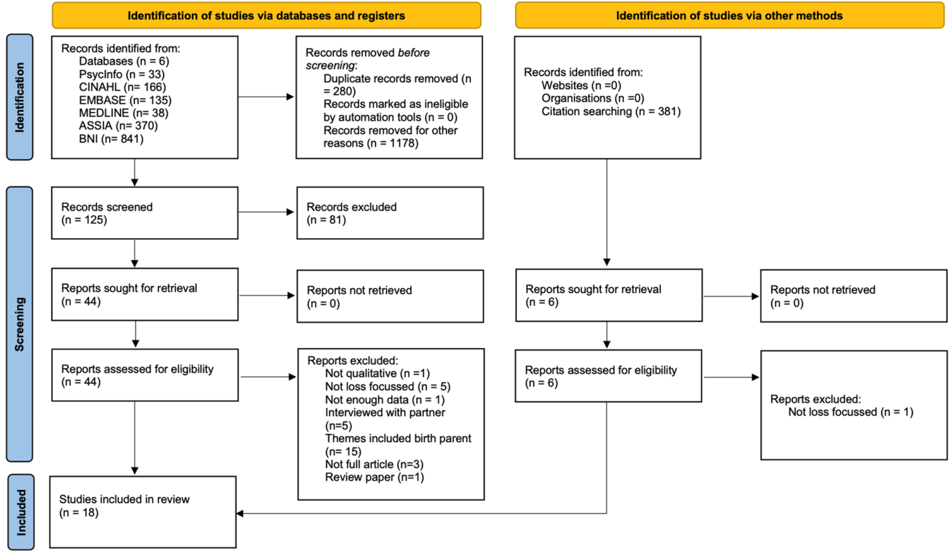
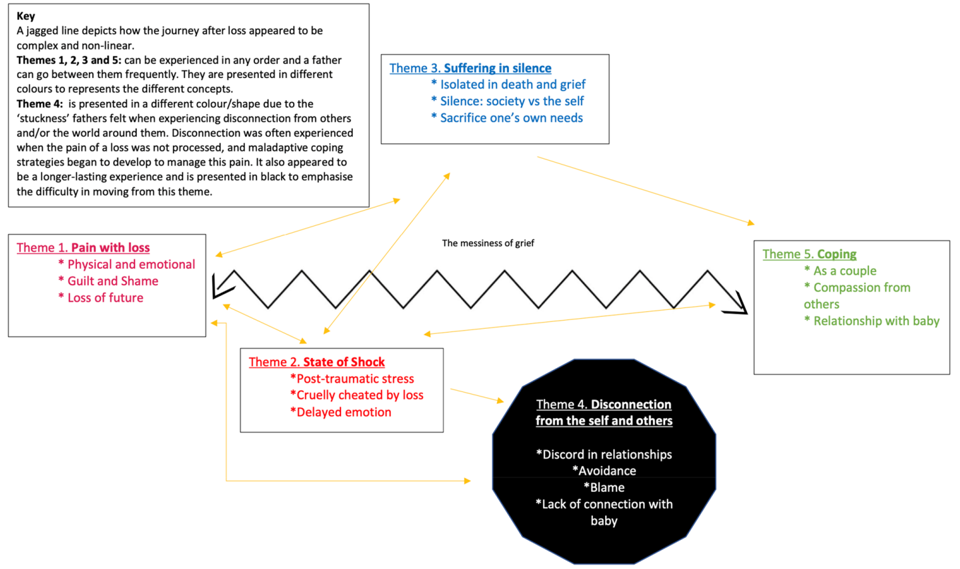
Following a perinatal death, parents can experience mental health difficulties and social stigma around the loss that can lead to increased feelings of isolation. This meta-synthesis aimed to explore partners' experiences of perinatal death following miscarriage, stillbirth and neonatal death. A search of six electronic databases resulted in the inclusion of 18 studies involving over 300 fathers. Using meta-ethnography five themes: were developed 1) The pain with loss, 2) state of shock, 3) suffering in silence, 4) disconnection from the self and others' and 5) coping. A lack of support available from services or familial support networks led to isolation. Coping strategies fostering open communication often allowed fathers to process the death of their baby, and many spoke positively of their ongoing connection with their baby that died. However, consequences of unhealthy coping mechanisms, including avoidance or blame, resulted in the father's disconnection from the self, others or the world.
Overview
CoChat Summary
## TL;DR
This meta-ethnography synthesized 18 qualitative studies involving over 300 fathers to understand experiences of miscarriage, stillbirth, and neonatal death. It found fathers’ grief was complex and non-linear, shaped by pain, shock, isolation, disconnection, and coping.
## Key findings
- The synthesis identified five themes: pain with loss, state of shock, suffering in silence, disconnection from the self and others, and coping.
- The review included 18 studies with over 300 fathers; all participants identified as male and cisgender.
- Miscarriage was represented in 13/18 studies, stillbirth in 8/18, and neonatal death in 4/18.
- The authors state that lack of support from services or familial networks led to isolation, while open communication and ongoing connection with the baby could help fathers process the loss.
## Methods
- Design: PRISMA-guided meta-ethnography/meta-synthesis of qualitative studies; protocol registered in PROSPERO (CRD42023416645).
- Data/sample: Searches of six electronic databases plus hand-searching identified 1,964 papers before deduplication; 18 studies were included after screening and full-text review.
- Analysis: Studies were appraised with the CASP qualitative checklist and synthesized using the seven-step meta-ethnography process of Noblit and Hare, with two researchers independently reading, extracting themes, and translating findings.
## Limitations
- The authors state that, because they excluded joint couple interviews and studies where themes were co-constructed with both parents’ data, the review is “not wholly representative” of current qualitative data on partner experience.
- They note that CERQual could have been used as an alternative quality appraisal/confidence approach; the paper says this as a methodological consideration.
- Evident from the text: the synthesis is limited to published peer-reviewed qualitative or mixed-methods studies and excluded grey literature, which may narrow the evidence base.
Model-written summary. Check it against the paper before relying on it.
Integrity signals
Registry
Cites
Statistics
Figures


Verification
Claims the paper makes
13 Valid · 2 Not valid · 59 Not checked · 67 Own results and interpretations
The sources with a verdict support this claim; the rest weren’t checked yet, have no full text we could read, or their verdicts aren’t rated yet.
In the paper
“There were a number of experiences identified in this review that have been previously identified in studies exploring mothers' experiences of perinatal death such as common emotions including guilt and blame, a sense of isolation, and increased fractured relationships as a result of loss (Gold et al., 2018;Kersting & Wagner, 2012;Turton et al., 2009).”
§ Fathers' experiences of perinatal death following miscarriage, stillbirth, and neonatal death: A meta-ethnography > Discussion
What the sources say
- Not checked — no full text of the sourcecites Gold et al., 2018 matched to “Whose Fault Is It Anyway? Guilt, Blame, and Death Attribution by Mothers After Stillbirth or Infant Death” (2018) source
- Supportedcites Kersting & Wagner, 2012 matched to “Complicated grief after perinatal loss” (2012) source
The review’s “Grief reactions after pregnancy loss” section describes guilt, self-blame, and isolation among mothers. Its “Risk factors of grief reactions” and Conclusion sections describe blame and strain between partners, including a decline in relationship quality after loss. (LLM, conf=0.92)
- Not checked — no full text of the sourcecites Turton et al., 2009 matched to “Long-term psychosocial sequelae of stillbirth: phase II of a nested case-control cohort study” (2009) source
plain- Asserted: passes — The authors put it forward as true.
- Checkable: passes — It can be checked against evidence.
- Load-bearing: unclear — It is unclear whether the paper’s conclusions depend on it.
- Based: passes — The paper gives a reason why it holds.
The sources with a verdict support this claim; the rest weren’t checked yet, have no full text we could read, or their verdicts aren’t rated yet.
In the paper
“Despite the papers involved in this synthesis spanning over five decades, nearly all studies spoke of the societal stigma attached to miscarriage, stillbirth and neonatal death (Miller et al., 2019;Miron & Chapman, 1994;Pabon et al., 2019).”
§ Fathers' experiences of perinatal death following miscarriage, stillbirth, and neonatal death: A meta-ethnography > Discussion
What the sources say
- Supportedcites Miller et al., 2019 matched to “‘There was just no-one there to acknowledge that it happened to me as well’: A qualitative study of male partner’s experience of miscarriage” (2019) source
The Results section reports that men regarded discussion of miscarriage as generally taboo. The Discussion’s ‘Future implications’ section explicitly calls for ending the silence and stigma around miscarriage, supporting this paper’s use as an example of a study addressing the synthesis’s stigma theme. (LLM, conf=0.88)
- Not checked — no full text of the sourcecites Miron & Chapman, 1994
- Not matchedcites Pabon et al., 2019
An author–year citation the paper’s reference list doesn’t settle. We don’t search these by name.
plain- Asserted: passes — The authors put it forward as true.
- Checkable: passes — It can be checked against evidence.
- Load-bearing: passes — The paper’s conclusions depend on it.
- Based: passes — The paper gives a reason why it holds.
- Supported
The cited sources that could be checked couldn’t confirm or dispute this claim.
In the paper
“The dual process model supports the review's findings (Stroebe et al., 2017).”
§ Fathers' experiences of perinatal death following miscarriage, stillbirth, and neonatal death: A meta-ethnography > Discussion
What the sources say
- Could not verifycites Stroebe et al., 2017 matched to “Cautioning Health-Care Professionals: Bereaved Persons Are Misguided Through the Stages of Grief” (2017) sourceExperimental — accuracy not yet measured
The Conclusions (page unavailable) describe the dual process model as a perspective on coping with bereavement, and Table 3 lists it among alternatives to stage theory. Neither passage identifies the citing review’s findings, so our copy cannot establish whether the model supports them. (LLM, conf=0.70)
plainstates an association- Asserted: passes — The authors put it forward as true.
- Checkable: passes — It can be checked against evidence.
- Load-bearing: unclear — It is unclear whether the paper’s conclusions depend on it.
- Based: passes — The paper gives a reason why it holds.
- Could not verify
A result the paper states — it cites no source for it, so there is none to check. The quote shows it is in the paper.
In the paper
“Intense and enduring pain was experienced by some fathers as a result of experiencing perinatal death.”
§ Fathers' experiences of perinatal death following miscarriage, stillbirth, and neonatal death: A meta-ethnography > Theme 1: Pain with loss
plainstates a cause- Asserted: passes — The authors put it forward as true.
- Checkable: passes — It can be checked against evidence.
- Load-bearing: passes — The paper’s conclusions depend on it.
- Based: passes — The paper gives a reason why it holds.
None of the sources cited for this claim have been checked yet.
In the paper
“Medical professionals emphasized the isolation fathers experienced by lack of meaningful or supportive communication with the father:”
§ Fathers' experiences of perinatal death following miscarriage, stillbirth, and neonatal death: A meta-ethnography > Subtheme 3.1: Isolated in death and grief
plainstates a cause- Asserted: passes — The authors put it forward as true.
- Checkable: passes — It can be checked against evidence.
- Load-bearing: passes — The paper’s conclusions depend on it.
- Based: passes — The paper gives a reason why it holds.
64 more claims
Create a free account to see all 141 claims and to verify the 4 references still open.
- Probably not a substantial claim. 27
- It may state two separate claims as one. 56
Citations
Cites
Using thematic analysis in psychology
Braun, V., & Clarke, V. (2006) · Qualitative Research in Psychology · doi:10.1191/1478088706qp063oa · Cited by 194,414
Content Analysis: An Introduction to its Methodology.
Shelley, M., & Krippendorff, K. (1984) · Journal of the American Statistical Association · doi:10.2307/2288384 · Cited by 24,312
Interrater reliability: The kappa statistic
McHugh, M. L. (2012) · Biochemia Medica · doi:10.11613/bm.2012.031 · Cited by 19,877 · cited 2×
“L i e b e r m a n , J ( 1 ) ( 1 ) ( 1 ) ( 1 ) ( 1 ) M o d e r a t e ( 7 ) 3 B o nn e tt e a n d B r oo m ( 2012 ) ( 1 ) ( 1 ) ( 1 ) ( 1 ) ( 1 ) ( 1 ) h i g h ( 8 .”
(2014) · Cited by 15,747
Content Analysis: An Introduction to Its Methodology
Krippendorff, K. (2019) · doi:10.4135/9781071878781 · Cited by 15,448
Page, M. J., Moher, D., Bossuyt, P. M., Boutron, I., Hoffmann, T. C., Mulrow, C. D., Shamseer, L., Tetzlaff, J. M., Akl, E. A., Brennan, S. E., et al. (2021) · BMJ · doi:10.1136/bmj.n160 · Cited by 13,262 · cited 1×
“This review was conducted in line with Preferred Reporting Items for Systematic Reviews and Meta-Analysis (PRISMA) guidelines (Page et al., 2021).”
Qualitative Analysis for Social Scientists
Strauss, A. L. (1987) · doi:10.1017/cbo9780511557842 · Cited by 12,277
A General Inductive Approach for Analyzing Qualitative Evaluation Data
Thomas, D. R. (2006) · American Journal of Evaluation · doi:10.1177/1098214005283748 · Cited by 10,858
(2004) · Cited by 5,198
(1978) · Medical Entomology and Zoology · Cited by 3,025
Critical analysis of strategies for determining rigor in qualitative inquiry
Morse, J. M. (2015) · Qualitative Health Research · doi:10.1177/1049732315588501 · Cited by 2,809 · cited 1×
“Once studies that met inclusion criteria had been finalized, two researchers read each paper and noted key themes independently in order to prevent bias and improve conceptual development (Morse, 2015).”
Noblit, G., & Hare, R. (1988) · doi:10.4135/9781412985000 · Cited by 2,723 · cited 3×
“Through the process of reading, determining how they were related and translating studies into one another, consistent with the process meta-ethnography (Noblit & Hare, 1988), we identified five themes.”
InfluentialBeyond PICO: The SPIDER Tool for Qualitative Evidence Synthesis
Cooke, A., Smith, D., & Booth, A. (2012) · Qualitative Health Research · doi:10.1177/1049732312452938 · Cited by 2,608 · cited 1×
“The search terms for this systematic review were defined using the SPIDER tool (Cooke et al., 2012).”
Self-citationThe Handbook of Discourse Analysis
(2003) · The Handbook of Discourse Analysis · doi:10.1111/b.9780631205968.2003.00004.x · Cited by 2,262
Discourse and Social Psychology
Potter, J. (2020) · Medical Entomology and Zoology · Cited by 1,657
The origins and nature of compassion focused therapy
Gilbert, P. (2014) · British Journal of Clinical Psychology · doi:10.1111/bjc.12043 · Cited by 1,593 · cited 1×
“The current findings thus support the use of a trauma-informed, compassionate care approach when working psychologically with fathers following perinatal death with additional considerations for themes such as isolation (Evans et al., 2021; Gilbert, 2014).”
Long, H. A., French, D. P., & Brooks, J. M. (2020) · Research Methods in Medicine & Health Sciences · doi:10.1177/2632084320947559 · Cited by 1,112 · cited 2×
“As the 10-item CASP does not offer a summary scoring system (Long et al., 2020), a numerical scoring system was adopted (No = 0, Partially Agree = 0.5, Yes =1) to aid comparison.”
InfluentialHusserl, E. (1960) · Springer eBooks · doi:10.1007/978-94-017-4952-7 · Cited by 1,046
(2014) · Taylor & Francis eBooks · doi:10.4324/9781315800790 · Cited by 995 · cited 1×
“Another theory linked closely with the findings of this review as well as with the dual process model is the continuing bonds theory (Klass et al., 1996), which centers on the ongoing relationship with the deceased and this being a source of comfort for most individuals (Hewson et al., 2024).”
The Dual Process Model of Coping with Bereavement: A Decade on
Stroebe, M., & Schut, H. (2010) · OMEGA - Journal of Death and Dying · doi:10.2190/om.61.4.b · Cited by 981 · cited 1×
“When someone is in restoration-orientation, they are adjusting to a changed world, and may focus on replanning or reconstructing their world without the deceased (Stroebe & Schut, 2010).”
Lewin, S., Glenton, C., Munthe-Kaas, H., Carlsen, B., Colvin, C. J., Gülmezoglu, M., Noyes, J., Booth, A., Garside, R., & Rashidian, A. (2015) · PLOS Medicine · doi:10.1371/journal.pmed.1001895 · Cited by 866 · cited 1×
“Alternative quality assessment tools could have been considered such as CERQual, which would have been helpful in assessing how much confidence to place in findings (Lewin et al., 2015).”
How can systematic reviews incorporate qualitative research? A critical perspective
Dixon-Woods, M., Bonas, S., Booth, A., Jones, D. R., Miller, T., Sutton, A. J., Shaw, R. L., Smith, J. A., & Young, B. (2006) · Qualitative Research · doi:10.1177/1468794106058867 · Cited by 860 · cited 1×
“There is no accepted approach toward excluding studies based on methodological quality (Dixon-Woods et al., 2006), and therefore no studies were excluded from this review.”
Handbook of discourse analysis
van Dijk, T. V. (1985) · doi:10.1111/b.9780631205968.2003.00022.x · Cited by 598
Interpretative phenomenological analysis.
Smith, J. A., & Fieldsend, M. (2021) · Qualitative research in psychology: Expanding perspectives in methodology and design (2nd ed.). · doi:10.1037/0000252-008 · Cited by 508
Adams, J., Hillier-Brown, F. C., Moore, H. J., Lake, A. A., Araujo-Soares, V., White, M., & Summerbell, C. (2016) · Systematic Reviews · doi:10.1186/s13643-016-0337-y · Cited by 486 · cited 1×
“Grey literature was also excluded due to lack of peer review and risk of bias or weak methodology (Adams et al., 2016).”
Colaizzi's descriptive phenomenological method
Morrow, R., Rodriguez, A., & King, N. (2015) · Zenodo · doi:10.5281/zenodo.14728857 · Cited by 445
Complicated grief after perinatal loss
Kersting, A., & Wagner, B. (2012) · Dialogues in Clinical Neuroscience · doi:10.31887/dcns.2012.14.2/akersting · Cited by 419 · cited 3×
“…that have been previously identified in studies exploring mothers’ experiences of perinatal death such as common emotions including guilt and blame, a sense of isolation, and increased fractured relationships as a result of loss (Gold et al., 2018; Kersting & Wagner, 2012; Turton et al., 2009).”
Ellis, A., Chebsey, C., Storey, C., Bradley, S., Jackson, S., Flenady, V., Heazell, A., & Siassakos, D. (2016) · BMC Pregnancy and Childbirth · doi:10.1186/s12884-016-0806-2 · Cited by 322 · cited 1×
“To date, the majority of research has focused on mothers’ experiences of perinatal death (Ellis et al., 2016).”
Self-citationSattar, R., Lawton, R., Panagioti, M., & Johnson, J. (2021) · BMC Health Services Research · doi:10.1186/s12913-020-06049-w · Cited by 321 · cited 1×
“…inductive and interpretative as an approach and allows the researcher to re-interpret themes, concepts and metaphors created by primary studies, using a translation synthesis method, in order to create higher level themes, develop new knowledge and produce a line of argument (Sattar et al., 2021).”
Cautioning Health-Care Professionals: Bereaved Persons Are Misguided Through the Stages of Grief
Stroebe, M., Schut, H., & Boerner, K. (2017) · OMEGA - Journal of Death and Dying · doi:10.1177/0030222817691870 · Cited by 252 · cited 1×
“The dual process model supports the review’s findings (Stroebe et al., 2017).”
A grief ignored: narratives of pregnancy loss from a male perspective
McCreight, B. S. (2004) · Sociology of Health & Illness · doi:10.1111/j.1467-9566.2004.00393.x · Cited by 237 · cited 1×
“I feel I have lost my future, no Fathers’ Day celebra-tions, no Christmas presents, no birthday cards (McCreight, 2004, p. 336).”
Charmaz, K., & Henwood, K. (2008) · The SAGE Handbook of Qualitative Research in Psychology · doi:10.4135/9781848607927.n14 · Cited by 235
Obst, K. L., Due, C., Oxlad, M., & Middleton, P. (2020) · BMC Pregnancy and Childbirth · doi:10.1186/s12884-019-2677-9 · Cited by 222 · cited 3×
“A lack of social recognition is echoed in a review by Obst et al. (2020), who highlighted how fathers face double-disenfranchised grief, meaning their loss is made more complex by a lack of social recognition for men’s grief and an absence of cultural norms on how to grieve the death of a baby.”
Inter-Rater Reliability Methods in Qualitative Case Study Research
Cole, R. (2024) · Sociological Methods & Research · doi:10.1177/00491241231156971 · Cited by 213 · cited 1×
“The use of the kappa statistic is supported in qualitative health research with previous literature highlighting how using inter-rater reliability methods to assess analysis increases methodological transparency (Cole, 2024; McHugh, 2012).”
A Waste of Life: Fathers' Experience of Losing a Child Before Birth
Samuelsson, M., Rådestad, I., & Segesten, K. (2001) · Birth · doi:10.1046/j.1523-536x.2001.00124.x · Cited by 138 · cited 3×
“It’s good that somebody thinks of taking pictures; you are very thankful afterwards (Samuelsson et al., 2001, p. 127)”
InfluentialButler, J., Gregg, L., Calam, R., & Wittkowski, A. (2020) · Clinical Child and Family Psychology Review · doi:10.1007/s10567-019-00307-y · Cited by 126 · cited 2×
“Quality was categorized as high (> 8–10), moderate (6–8) or low (≤ 5) (see Butler et al. 2020).”
Self-citationCharmaz, K., & Bryant, A. (2010) · International Encyclopedia of Education · doi:10.1016/b978-0-08-044894-7.01581-5 · Cited by 113
Long-term psychosocial sequelae of stillbirth: phase II of a nested case-control cohort study
Turton, P., Evans, C., & Hughes, P. (2009) · Archives of Women's Mental Health · doi:10.1007/s00737-008-0040-7 · Cited by 105 · cited 1×
“…that have been previously identified in studies exploring mothers’ experiences of perinatal death such as common emotions including guilt and blame, a sense of isolation, and increased fractured relationships as a result of loss (Gold et al., 2018; Kersting & Wagner, 2012; Turton et al., 2009).”
Jones, K., Robb, M., Murphy, S., & Davies, A. (2019) · Midwifery · doi:10.1016/j.midw.2019.102531 · Cited by 105 · cited 3×
“When discussing their role following perinatal death, fathers reported being the supportive partner and due to this role, they often felt overlooked by health professionals (Jones et al., 2019).”
InfluentialKing, S. B. (2015) · JACC: Cardiovascular Interventions · doi:10.1016/j.jcin.2015.03.004 · Cited by 105
The impact of continuing bonds following bereavement: A systematic review
Hewson, H., Galbraith, N., Jones, C., & Heath, G. (2024) · Death Studies · doi:10.1080/07481187.2023.2223593 · Cited by 101 · cited 1×
“Another theory linked closely with the findings of this review as well as with the dual process model is the continuing bonds theory (Klass et al., 1996), which centers on the ongoing relationship with the deceased and this being a source of comfort for most individuals (Hewson et al., 2024).”
The legitimacy of grieving: The partner's experience at miscarriage
Puddifoot, J. E., & Johnson, M. P. (1997) · Social Science & Medicine · doi:10.1016/s0277-9536(96)00424-8 · Cited by 90 · cited 7×
“Fathers appeared to search for meaning in loss, with some concluding that their partner was at fault: Yes, this is a punishment… I have looked into my soul and know that I have nothing to be punished for, so it must be for her sin… (Puddifoot & Johnson, 1997, p. 842).”
InfluentialThe grief response in the partners of women who miscarry
Johnson, M. P., & Puddifoot, J. E. (1996) · British Journal of Medical Psychology · doi:10.1111/j.2044-8341.1996.tb01875.x · Cited by 89 · cited 1×
“I have deliberately tried not to think about it (Johnson & Puddifoot, 1996, p. 322).”
Understanding stillbirth stigma: A scoping literature review
Pollock, D., Ziaian, T., Pearson, E., Cooper, M., & Warland, J. (2020) · Women and Birth · doi:10.1016/j.wombi.2019.05.004 · Cited by 82 · cited 1×
“Qualitative studies have the ability to give voice to those often silenced by societal stigma, which is particularly prevalent in parents who have previously experienced perinatal death (Pollock et al., 2020).”
The experience of early miscarriage from a male perspective
Murphy, F. A. (1998) · Journal of Clinical Nursing · doi:10.1046/j.1365-2702.1998.00153.x · Cited by 80
Men and Miscarriage: A Systematic Review and Thematic Synthesis
Williams, H. M., Topping, A., Coomarasamy, A., & Jones, L. L. (2020) · Qualitative Health Research · doi:10.1177/1049732319870270 · Cited by 74 · cited 1×
“In their systematic review, Williams et al. (2020) explored the experiences of 231 male participants following mis-carriage and highlighted gendered coping responses and female precedence.”
On grief, fathering and the male role in men’s accounts of stillbirth
Bonnette, S., & Broom, A. (2012) · Journal of Sociology · doi:10.1177/1440783311413485 · Cited by 73
Australian men's experiences of support following pregnancy loss: A qualitative study
Obst, K. L., & Due, C. (2019) · Midwifery · doi:10.1016/j.midw.2018.11.013 · Cited by 71
Miller, E. J., Temple-Smith, M. J., & Bilardi, J. E. (2019) · PLOS ONE · doi:10.1371/journal.pone.0217395 · Cited by 71 · cited 5×
“…or space to reflect on the loss individually appeared to allow both members of the couple to process the event as well as build and understanding or acceptance of the loss: …we had a bit of distance and a bit of space…to understand and come to terms with what had gone on (Miller et al. 2019, p. 9).”
InfluentialA review of stillbirth definitions: A rationale for change
Kelly, K. A., Meaney, S., Leitão, S., & O’Donoghue, K. (2020) · European Journal of Obstetrics & Gynecology and Reproductive Biology · doi:10.1016/j.ejogrb.2020.11.015 · Cited by 65 · cited 1×
“Definitions of the aforementioned categories of loss vary between countries around the world (Kelly et al., 2021).”
Gold, K. J., Sen, A., & Leon, I. (2018) · Illness, Crisis & Loss · doi:10.1177/1054137317740800 · Cited by 52 · cited 1×
“…that have been previously identified in studies exploring mothers’ experiences of perinatal death such as common emotions including guilt and blame, a sense of isolation, and increased fractured relationships as a result of loss (Gold et al., 2018; Kersting & Wagner, 2012; Turton et al., 2009).”
Pathak, E. B., Wieten, S. E., & Wheldon, C. W. (2017) · BMJ Open · doi:10.1136/bmjopen-2016-015137 · Cited by 50 · cited 1×
“Silence can be particularly conse-quential, with Pathak et al. (2017) highlighting that stoicism ideology may lead to help-seeking delays, caregiver strain, and suicide.”
Becoming a Father to a Stillborn Child
Worth, N. J. (1997) · Clinical Nursing Research · doi:10.1177/105477389700600107 · Cited by 49 · cited 2×
“5 ) ( 1 ) ( 1 ) ( 1 ) M o d e r a t e ( 7 ) O b s t a n d D u e ( 2019 ) ( 1 ) ( 1 ) ( 1 ) ( 1 ) ( 1 ) ( 1 ) ( 1 ) ( 1 ) ( 1 ) ( 1 ) h i g h ( 10 ) 1 5 P u dd i f oo t a n d J o hn s o n ( 1997 ) ( 0 .”
Paternal Experiences of Perinatal Loss—A Scoping Review
Mota, C., Sánchez, C., Carreño, J., & López, M. E. G. (2023) · International Journal of Environmental Research and Public Health · doi:10.3390/ijerph20064886 · Cited by 47 · cited 2×
“These findings concur with reviews aforementioned (Jones et al., 2019; Mota et al., 2023).”
Fathers experiencing a perinatal loss
Hughes, C. B., & Page-lieberman, J. (1989) · Death Studies · doi:10.1080/07481188908252331 · Cited by 46 · cited 3×
“She realized how we could think of it and be sad at different times (Bach Hughes & Page-Lieberman, 1989, p. 549).”
Communicated narrative sense-making theory: Linking storytelling and well-being
Kellas, J. K. (2017) · Cited by 43
Stillbirth and the Couple: A Gender-Based Exploration
Cacciatore, J., DeFrain, J., Jones, K. L. C., & Jones, H. (2008) · Journal of Family Social Work · doi:10.1080/10522150802451667 · Cited by 41 · cited 2×
“Whilst mothers and fathers may grieve in contrasting ways, a respect for one another’s grieving style has been shown to be of importance (Cacciatore et al., 2008).”
Horstman, H. K., Morrison, S., McBride, M. C., & Holman, A. (2021) · Health Communication · doi:10.1080/10410236.2021.1973718 · Cited by 34
Experience of Perinatal Death From the Father’s Perspective
Lizcano Pabón, L. D. M., Moreno Fergusson, M. E., & Palacios, A. M. (2019) · Nursing Research · doi:10.1097/nnr.0000000000000369 · Cited by 29 · cited 4×
“It all happened so sudden, the truth is that this is the fastest tragedy that has happened in my life (Pabon et al., 2019, p. 4).”
InfluentialMen’s Experiences of Miscarriage: A Passive Phenomenological Analysis of Online Data
Story Chavez, M., Handley, V., Lucero Jones, R., Eddy, B., & Poll, V. (2019) · Journal of Loss and Trauma · doi:10.1080/23802359.2019.1611230 · Cited by 29 · cited 3×
“Without time to process the loss individually, some fathers spoke of a space or distance between themselves and their partner: It’s gotten to the point that I don’t talk to Sally as much (Story Chavez et al., 2019, p. 670).”
(1994) · PubMed · Cited by 27
Theory-Building with Nud.Ist: Using Computer Assisted Qualitative Analysis in a Media Case Study
MacMillan, K., & McLachlan, S. (1999) · Sociological Research Online · doi:10.5153/sro.229 · Cited by 27
Communicated Narrative Sense-Making Theory
Kellas, J. K. (2017) · Routledge eBooks · doi:10.4324/9781315204321-6 · Cited by 27
Harty, T., Trench, M., Keegan, O., O'Donoghue, K., & Nuzum, D. (2022) · Health Expectations · doi:10.1111/hex.13452 · Cited by 24 · cited 2×
“…findings also highlight unique experiences for fathers including feelings of helplessness and unimportance, exacerbated by medical professionals (Harty et al., 2022), a lack of social recognition for a father’s grief leading to double-disenfranchised grief (Obst et al., 2020), and a lack of…”
Azeez, S., Obst, K. L., Due, C., Oxlad, M., & Middleton, P. (2022) · Death Studies · doi:10.1080/07481187.2022.2030431 · Cited by 21 · cited 5×
“I still have guilt that I didn’t do more to try and get them out earlier (Azeez et al., 2022, p. 1449).”
InfluentialGaining Control Over Traumatic Experiences: The Role of Guilt in Posttraumatic Stress Disorder
Raz, A. E., Shadach, E., & Levy, S. (2017) · Journal of Aggression Maltreatment & Trauma · doi:10.1080/10926771.2017.1389792 · Cited by 14 · cited 1×
“When exploring the function of grief in mothers and fathers, Aviad et al. (2018) supported the notion that guilt could be a mechanism for gaining control from a previous traumatic event.”
Fernández‐Basanta, S., Coronado, C., & Movilla‐Fernández, M. (2022) · Journal of Midwifery & Women's Health · doi:10.1111/jmwh.13353 · Cited by 9
La fausse couche : du côté des hommes
Lacroix, P., Got, F., Callahan, S., & Séjourné, N. (2016) · Psychologie Française · doi:10.1016/j.psfr.2015.06.003 · Cited by 7 · cited 8×
“…qu’elle m’en voulait… je ne comprenais plus sa tristesse et on s’est éloignés petit à petit (she shut down […] she was aggressive or distant, I had the impression that she was angry with me […] I didn’t understand her sadness anymore and we gradually drifted apart) (Lacroix et al., 2016, p. 211).”
InfluentialBarbero (2014) · doi:10.1016/j · Cited by 1
(2018) · Digital Commons@Becker (Washington University School of Medicine) · doi:10.1371/journal
Research works printed but not linked: 3
- 13. Crabtree, B. F., & Miller, W. L. (1992). Doing qualitative research: Multiple strategies. Sage Publications.
- 17. Evans, D., Butterworth, R., Atkins, E., Chilvers, R., Marsh, A., Barr, K., Cole, S., Cordwell, J., D'Urso, A., & Higgins, S. (2021). The anatomy of compassion: courage, connection and safeness in perinatal practice. Infant, 19(3), 88-92.
- 54. Potter, J., & Wetherelt, M. (1987). Discourse and social psy- chology. Sage. *
Cited by
Smith, D. M., Beaumont, J., Bailey, E., Barron, R., Murphy, M., Tomlinson, E., & Heazell, A. E. P. (2025) · Health Expectations · doi:10.1111/hex.70464 · Cited by 9
“A recent meta ‐ synthesis sum-marising partners experiences after loss showed a lack of support from friends, family and services leading to feelings of isolation, and a reliance on personal coping mechanisms [10].”
Self-citationParent-to-parent advice before the birth of a stillborn baby
Kremkow, J. M. D., & Lamberson, J. (2025) · Frontiers in Psychiatry · doi:10.3389/fpsyt.2025.1736265
Hénault, S., Bédard-Lévesque, M., de Montigny, F., Noël, R., Zeghiche, S., Verdon, C., Coulombe, S., & Meunier, S. (2026) · Etudes sur la mort/Études sur la mort · doi:10.3917/eslm.163.0207 · Cited by 1
Boakye, P. N., Prendergast, N., Desta, F., Obewu, O. A. T., & Mugambi, D. (2026) · Canadian Journal of Nursing Research · doi:10.1177/08445621251409460
“Previous studies have indicated that men commonly use distraction to gain temporary relief as they attempt to assert control over the situation and restore a sense of normalcy (Aydin & Kabukcuog ̆ lu, 2021; Blocksidge et al., 2025; Miller et al., 2019; Obst et al., 2020, Obst et al., 2020).”
Bereaved parents’ experiences of baby loss stigma: A meta-ethnography
Corcoran, R. L., Shirley, L. J., Clancy, A., & Smith, D. M. (2026) · Death Studies · doi:10.1080/07481187.2026.2659895 · Cited by 2
Self-citation
Metadata
- Authors
- Blocksidge, H., Wittkowski, A., Heazell, A. E. P., & Smith, D. M.
- Affiliations
- Greater Manchester Mental Health NHS Foundation Trust (GB)
- University of Manchester (GB)
- Corresponding author
- Blocksidge, Hope
- Smith, Debbie M.
- Venue
- Death Studies
- Publisher
- Informa UK Limited
- Published
- 2025-01-25
- Volume
- 50
- Issue
- 5
- Pages
- 671-687
- ISSN
- 0748-1187 (ISSN-L)
- 1091-7683
- OpenAlex
- W4406824449
- Semantic Scholar
- e0b61f18c3a16015f362d4fd5dd8380fa488c450
- Cited by
- 6
- References
- 66
- Citations by year
- 2026: 4 · 2025: 2
- FWCI
- 7.13
- Type
- journal article
- Language
- en
- Open access
- hybrid
- doi.org
- Licence
- Locations
- Death Studies (publishedVersion, cc-by)
- PubMed (publishedVersion)
- Research Explorer (The University of Manchester) (publishedVersion, cc-by)
- Topics
- Social Sciences › Psychology › Clinical Psychology › Grief, Bereavement, and Mental Health
- Health Sciences › Medicine › Pediatrics, Perinatology and Child Health › Global Maternal and Child Health
- Social Sciences › Anthropology › Death, Funerary Practices, and Mourning
- Keywords
- perinatal death, fathers, miscarriage, stillbirth, neonatal death, grief, coping, social isolation, stigma, coping strategies, parental bereavement
- MeSH terms
- Abortion, Spontaneous, Adaptation, Psychological, Adult, Anthropology, Cultural, Fathers, Female, Humans, Infant, Newborn, Male, Pregnancy, Stillbirth, Perinatal Death
About these checks
Registry, retraction, Cites and statistics results are computed, not judged, with one exception: a printed reference that no index lists is read once by a model before it counts as a citation error. Claims are extracted by a model and kept only when their quote appears verbatim in the text; each cited source is then checked, with a model’s help, for whether it says what the claim relies on. Those verdicts can be wrong — read the claim’s quote and the cited source before relying on one.
The claim verdicts this report counts are experimental: their accuracy is not yet measured.
A language model drew the claims from the paper on 2026-10-09, under version 3 of the claim definition (model deepseek-v4.1-flash, prompt extract-v3).
A second model labelled each claim on 2026-10-09 (model jev-1.13-20260917, definition revision gold-guideline-v0.2).
Cited sources are checked with a language model’s help (gpt-6-sol).
Statistics and arithmetic are recomputed, not judged.
Confidence bands are shown only for fields calibrated on our annotated test set. None is calibrated yet, so no band is shown.
What counts as a claim ›How we measure confidence ›How we check this ›
Are you an author, or do you see a problem with this page? Request a review
Data sources
Bibliographic data: Semantic Scholar, OpenAlex, Crossref.
Contains information from the Semantic Scholar Academic Graph Datasets, made available under the ODC Attribution License (ODC-BY 1.0).
Semantic Scholar’s data is described in: Kinney, R., et al. (2023). The Semantic Scholar Open Data Platform. arXiv:2301.10140.
