

Diversity, Equity, and Inclusion in Artificial Intelligence: An Evaluation of Guidelines
Open accessThe DOI matches its Crossref record; 59 of the 59 references it cites were found in a registry or an index; none of the 81 sources its claims cite is checked for support yet.
Abstract
Artificial intelligence (AI) is present everywhere in the lives of individuals. Unfortunately, several cases of discrimination by AI systems have already been reported. Scholars have warned on risks of AI reproducing existing inequalities or even amplifying them. To tackle these risks and promote responsible AI, many ethics guidelines for AI have emerged recently, including diversity, equity, and inclusion (DEI) principles and practices. However, little is known about the DEI content of these guidelines, and to what extent they meet the most relevant accumulated knowledge from DEI literature. We performed a semi-systematic literature review of the AI guidelines regarding DEI stakes and analyzed 46 guidelines published from 2015 to today. We fleshed out the 14 DEI principles and the 18 DEI practices recommended underlying these 46 guidelines. We found that the guidelines mostly encourage one of the DEI management paradigms, namely fairness, justice, and nondiscrimination, in a limited compliance approach. We found that narrow technical practices are favored over holistic ones. Finally, we conclude that recommended practices for implementing DEI principles in AI should include actions aimed at directly influencing AI actors’ behaviors and awareness of DEI risks, rather than just stating intentions and programs.
Overview
CoChat Summary
TL;DR
This semi-systematic review analyzes 46 AI ethics guidelines published from 2015 onward and finds that their DEI content is dominated by fairness, justice, and nondiscrimination in a limited compliance approach. It concludes that guidelines favor narrow technical practices over holistic organizational ones and rarely target AI actors’ day-to-day behaviors or awareness of DEI risks.
Key findings
- The review identified 14 DEI principles and 18 DEI practices across 46 guidelines. Of the 14 principles, 12 (86%) map to the “fair representation and treatment and nondiscrimination” paradigm, while only 2 (14%) reflect a “valuing diversity” or synergy perspective.
- The most cited DEI principles were Equity/Fairness (76%, 35 sources), Nondiscrimination (57%, 26), and Diversity in learning datasets/Representativeness (50%, 23). The most targeted groups were female (N = 34), disabled or health vulnerable people (N = 34), and racial or ethnic minorities (N = 32).
- In the AIS development process, the most recommended practices were verification and validation of AIS results (63%, 29), AIS learning sources and dataset (57%, 26), transparency of AIS decisions (54%, 25), and explicability of AIS decisions (52%, 24).
- For AIS design organizations, accountability/responsibility for AIS was recommended by 57% (26), team diversity in AIS companies by 50% (23), and DEI training/awareness by 43% in Table 5 (20; described as 50% in the text). Only one of eight organizational practices directly addressed the praxis dimension—objectives/incentives for compliance with DEI principles (13%, 6)—and no guideline included penalties for noncompliance.
Methods
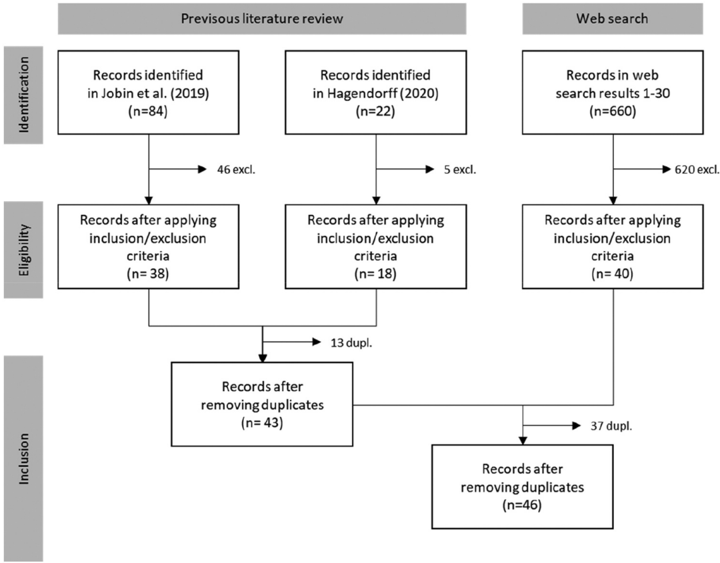
- Semi-systematic literature review adapted from PRISMA, using a two-step search: prior comprehensive AI ethics reviews plus keyword-based web search. Inclusion criteria were documents published in 2015 or later, written in English, and from reliable influential sources such as governmental/intergovernmental reports, professional AI associations, and influential private AI companies; the final sample was 46 documents.
- Content extraction and categorization used deductive categories based on DEI expertise, followed by inductive identification of additional categories. This yielded 14 DEI principles and 18 DEI practices, with 361 extracted entries for principles and 588 for practical recommendations.
- Two research graduate students coded independently; agreement was almost perfect for principles (k = 0.85, p < .05) and AIS development process (k = 0.84, p < .05), and substantial for AIS design organizations (k = 0.80, p < .05). A third researcher specializing in DEI management in AI inspected the results.
Limitations
- Paper-stated: the review selected only English-language sources, which may explain the strong Western domination in the results; the authors also note that no document, code, or charter dedicated specifically to DEI in AI was found within their criteria.
- Paper-stated: the authors call for further research on whether intentions and pro-DEI programs alone can influence AI actors’ DEI behaviors, or whether binding regulation is needed; they also note the lack of diversity among guideline authors (60.8% male, 74.2% white, 78.3% nationals of Western countries) and within the AI community.
- Evident from the text: the analysis is based on manual coding by two graduate students with a third researcher inspecting results, and the sample is limited to 46 English-language guidelines, so the categorization and geographic coverage may be shaped by those constraints.
Model-written summary. Check it against the paper before relying on it.
Integrity signals
Registry
Cites
Statistics
Figures


Verification
Claims the paper makes
0 Valid · 1 Not valid · 71 Not checked · 119 Own results and interpretations
A result the paper reports from its own data — it cites no other source for it, so there is none to check. The quote shows it is in the paper.
In the paper
“DEI principles in AI always target certain groups to benefit from the erected principles, such as social justice or fairness.”
§ Inclusion in Artificial Intelligence: An Evaluation of Guidelines > Targeted Groups in DEI Principles in AI
plainstates a cause- Asserted: passes — The authors put it forward as true.
- Checkable: passes — It can be checked against evidence.
- Load-bearing: unclear — It is unclear whether the paper’s conclusions depend on it.
- Based: passes — The paper gives a reason why it holds.
In the paper
“Results show an almost perfect agreement for the principles (k = 0.85; p < .05)and the AIS development process (k = 0.84; p < .05),and a substantial agreement for the regarding AIS design organizations (k = 0.80; p < .05)(Landis and Koch 1977).”
§ Inclusion in Artificial Intelligence: An Evaluation of Guidelines > Content Extraction and Categorization
What the sources say
- Not checked yetcites Landis and Koch 1977
plainstates an association- Asserted: passes — The authors put it forward as true.
- Checkable: passes — It can be checked against evidence.
- Load-bearing: unclear — It is unclear whether the paper’s conclusions depend on it.
- Based: passes — The paper gives a reason why it holds.
A result the paper reports from its own data — it cites no other source for it, so there is none to check. The quote shows it is in the paper.
In the paper
“Practices for ensuring more diverse and representative”
§ Inclusion in Artificial Intelligence: An Evaluation of Guidelines > The AIS Development Process
plain- Asserted: passes — The authors put it forward as true.
- Checkable: passes — It can be checked against evidence.
- Load-bearing: passes — The paper’s conclusions depend on it.
- Based: passes — The paper gives a reason why it holds.
A result the paper reports from its own data — it cites no other source for it, so there is none to check. The quote shows it is in the paper.
In the paper
“The respect of human dignity and social justice (referred, respectively, to by 35% and 33% of guidelines) are also pointed out, referring to a consideration of all individuals without distinction.”
§ Inclusion in Artificial Intelligence: An Evaluation of Guidelines > DEI Principles in AI Ethical Guidelines
plain- Asserted: passes — The authors put it forward as true.
- Checkable: passes — It can be checked against evidence.
- Load-bearing: unclear — It is unclear whether the paper’s conclusions depend on it.
- Based: passes — The paper gives a reason why it holds.
A result the paper reports from its own data — it cites no other source for it, so there is none to check. The quote shows it is in the paper.
In the paper
“Also, 26% percent of guidelines consider the importance of addressing the digital divide, which entails that all have access to AISs developed, with adequate literacy and understanding, fighting against barriers to access and empowering beneficiaries.”
§ Inclusion in Artificial Intelligence: An Evaluation of Guidelines > DEI Principles in AI Ethical Guidelines
plain- Asserted: passes — The authors put it forward as true.
- Checkable: passes — It can be checked against evidence.
- Load-bearing: unclear — It is unclear whether the paper’s conclusions depend on it.
- Based: passes — The paper gives a reason why it holds.
79 more claims
Create a free account to see all 191 claims and to verify the 81 references still open.
- Probably not a substantial claim. 59
- The quote only partly states this claim. 13
- It may state two separate claims as one. 65
Claims other papers make about this one
Each is checked against this paper’s own text: does it say what the citing paper says it does?
The cited source says what the claim attributes to it.
In the citing paper
“Incorporating DEI principles must be perceived as an essential priority, particularly given a lack of representation in current regulatory guidelines for AI applications50,83.”
From Bias recognition and mitigation strategies in artificial intelligence healthcare applications (2025) · cites this paper as [50]
Self-check
Percentages, sums and reported differences re-computed from the paper’s own numbers.
Each contradiction between two passages listed here was confirmed by an independent check.
Rated minor: it would not touch a result — a value no result rests on, a p-value that stays on the same side of the significance level, or a conflict that is clerical, resolved elsewhere in the paper, or outside its own findings.
In the paper
§ Inclusion in Artificial Intelligence: An Evaluation of Guidelines > The Rather Technical Operationalization of DEI Principles in AI Practices (R2a)
“7 out of 10 practices devoted to the AIS development process are recommended by 40% and more of guidelines”
§ Inclusion in Artificial Intelligence: An Evaluation of Guidelines > Conclusion
“| Functional design of AIS | 22 | 48% | | Technical design of AIS | 18 | 39% | | Correction of biased AIS results | 18 | 39% | | Mechanisms of redress for users/beneficiaries | 16 | 35% |”
Citations
Cites
The Measurement of Observer Agreement for Categorical Data
Landis, J. R., & Koch, G. G. (1977) · Biometrics · doi:10.2307/2529310 · Cited by 81,148 · cited 1×
“Results show an almost perfect agreement for the principles (k = 0.85; p < .05) and the AIS development process (k = 0.84; p < .05), and a substantial agreement for the regarding AIS design organizations (k = 0.80; p < .05) (Landis and Koch 1977).”
ResultInfluentialPreferred Reporting Items for Systematic Reviews and Meta-Analyses: The PRISMA Statement
Moher, D., Liberati, A., Tetzlaff, J., Altman, D. G., & The PRISMA Group (2009) · PLoS Medicine · doi:10.1371/journal.pmed.1000097 · Cited by 64,042 · cited 1×
“We developed a protocol for selecting eligible sources, adapted from the Preferred Reporting Items for Systematic Reviews and Meta-Analyses (PRISMA) framework (Moher et al. 2009).”
Tranfield, D., Denyer, D., & Smart, P. (2003) · British Journal of Management · doi:10.1111/1467-8551.00375 · Cited by 15,386 · cited 1×
“Following semi-systematic literature review guidelines, a rigorous source selection process was implemented (Tranfield, Denyer, and Smart 2003).”
MethodLiterature review as a research methodology: An overview and guidelines
Snyder, H. (2019) · Journal of Business Research · doi:10.1016/j.jbusres.2019.07.039 · Cited by 11,524 · cited 1×
“A semi-systematic review is relevant when covering a broad topic emerging from different diverse disciplines and different types of documents, and for detecting themes, perspectives, or common issues within a specific topic (Snyder 2019).”
BackgroundThe global landscape of AI ethics guidelines
Jobin, A., Ienca, M., & Vayena, E. (2019) · Nature Machine Intelligence · doi:10.1038/s42256-019-0088-2 · Cited by 6,220 · cited 8×
“First, we relied on the most comprehensive literature reviews available on ethics guidelines in AI including those regarding DEI (see Hagendorff 2020; Jobin, Ienca, and Vayena 2019).”
BackgroundMethodInfluentialMitchell, R. K., Agle, B. R., & Wood, D. J. (1997) · The Academy of Management Review · doi:10.2307/259247 · Cited by 5,039
Floridi, L., Cowls, J., Beltrametti, M., Chatila, R., Chazerand, P., Dignum, V., Luetge, C., Madelin, R., Pagallo, U., Rossi, F., et al. (2018) · Minds and Machines · doi:10.1007/s11023-018-9482-5 · Cited by 4,774
What is AI Literacy? Competencies and Design Considerations
Long, D., & Magerko, B. (2020) · Proceedings of the 2020 CHI Conference on Human Factors in Computing Systems · doi:10.1145/3313831.3376727 · Cited by 3,241 · cited 1×
“If AI literacy begins to be a subject of research and recommendations (Long and Magerko 2020; Ng et al. 2021), such research and recommendations should also explore the technological distance and literacy from diverse economic and cultural contexts.”
BackgroundUnderstanding HRM–Firm Performance Linkages: The Role of the “Strength” of the HRM System
Bowen, D. E., & Ostroff, C. (2004) · Academy of Management Review · doi:10.5465/amr.2004.12736076 · Cited by 2,996 · cited 1×
“When widely perceived and interpreted by organizational incumbents, these messages create a strong climate (Bowen and Ostroff 2004), that would lead them to adopt the desired behaviors toward DEI.”
Background(2019) · Cited by 2,637
Managing cultural diversity: implications for organizational competitiveness
Cox, T. H., & Blake, S. (1991) · Academy of Management Perspectives · doi:10.5465/ame.1991.4274465 · Cited by 2,527 · cited 1×
“…that a more diverse representation in the AI sector would be beneficial for developing AISs better equipped to face DEI challenges, drawing from DEI literature demonstrating increased performance and better decision-making in teams with more diversity (Cox and Blake 1991; Sacco and Schmitt 2005).”
BackgroundIn a Different Voice: Women's Conceptions of Self and of Morality
Gilligan, C. (1977) · Harvard Educational Review · doi:10.17763/haer.47.4.g6167429416hg5l0 · Cited by 2,405
(2016) · Cited by 2,334
The Ethics of AI Ethics: An Evaluation of Guidelines
Hagendorff, T. (2020) · Minds and Machines · doi:10.1007/s11023-020-09517-8 · Cited by 1,911 · cited 19×
“First, we relied on the most comprehensive literature reviews available on ethics guidelines in AI including those regarding DEI (see Hagendorff 2020; Jobin, Ienca, and Vayena 2019).”
BackgroundMethodInfluentialThe Ethics of AI Ethics -- An Evaluation of Guidelines
Hagendorff, T. (2019) · arXiv · doi:10.48550/arxiv.1903.03425 · Cited by 1,907 · cited 19×
“First, we relied on the most comprehensive literature reviews available on ethics guidelines in AI including those regarding DEI (see Hagendorff 2020; Jobin, Ienca, and Vayena 2019).”
BackgroundMethodInfluentialPrinciples alone cannot guarantee ethical AI
Mittelstadt, B. (2019) · Nature Machine Intelligence · doi:10.1038/s42256-019-0114-4 · Cited by 1,886 · cited 2×
“Mittelstadt (2019) also states that ethics in AI do not benefit from proven methods to translate principles into practice nor from common professional norms and robust legal accountability mechanisms for the AI sector, contrary to the medical sector.”
BackgroundFairness and Abstraction in Sociotechnical Systems
Selbst, A. D., Boyd, D., Friedler, S. A., Venkatasubramanian, S., & Vertesi, J. (2019) · Proceedings of the Conference on Fairness, Accountability, and Transparency · doi:10.1145/3287560.3287598 · Cited by 1,631 · cited 1×
“DEI is thus context-sensitive, and it is inappropriate to transpose DEI management principles and practices from one cultural context to another without prior consideration, what Selbst et al. (2019) call the portability gap of fairness in AI.”
BackgroundMan is to Computer Programmer as Woman is to Homemaker? Debiasing Word Embeddings
Bolukbasi, T., Chang, K.-W., Zou, J., Saligrama, V., & Kalai, A. (2016) · arXiv · doi:10.48550/arxiv.1607.06520 · Cited by 1,615 · cited 1×
“At the very least, they risk reproducing existing inequalities or even amplifying them (Bolukbasi et al. 2016; Zou and Schiebinger 2018).”
BackgroundAmazon Scraps Secret AI Recruiting Tool that Showed Bias against Women *
Dastin, J. (2022) · Ethics of Data and Analytics · doi:10.1201/9781003278290-44 · Cited by 1,165
Jain, A. (2017) · Business Economics · doi:10.1057/s11369-017-0027-3 · Cited by 1,058
Men Also Like Shopping: Reducing Gender Bias Amplification using Corpus-level Constraints
Zhao, J., Wang, T., Yatskar, M., Ordonez, V., & Chang, K.-W. (2017) · Proceedings of the 2017 Conference on Empirical Methods in Natural Language Processing · doi:10.18653/v1/d17-1323 · Cited by 829 · cited 1×
“On the one hand, biased AI learning databases (Eubanks 2018), given the use of shared and reusable datasets, tend to reproduce and maintain initially discriminatory algorithms (Zhao et al. 2017).”
BackgroundGiles, P. (2019) · Journal of Cultural Economy · doi:10.1080/17530350.2019.1639068 · Cited by 805
Improving Fairness in Machine Learning Systems: What Do Industry Practitioners Need?
Holstein, K., Wortman Vaughan, J., Daumé, H., Dudik, M., & Wallach, H. (2019) · Proceedings of the 2019 CHI Conference on Human Factors in Computing Systems · doi:10.1145/3290605.3300830 · Cited by 777 · cited 2×
“However, there is still a notable gap between the practices proposed in the literature and the challenges faced by AI designers in day-to-day operations (Holstein et al. 2019).”
BackgroundAI can be sexist and racist — it’s time to make it fair
Zou, J., & Schiebinger, L. (2018) · Nature · doi:10.1038/d41586-018-05707-8 · Cited by 765 · cited 2×
“But only recently has the issue of discrimination by AI been brought to light (O’neil 2016; Zou and Schiebinger 2018).”
BackgroundThe ethics of international business
(1990) · Choice Reviews Online · doi:10.5860/choice.27-5198 · Cited by 630
Filho, S. L., & Kane, B. T. (2016) · National Conference on Artificial Intelligence · Cited by 576
AI Literacy: Definition, Teaching, Evaluation and Ethical Issues
Ng, D. T. K., Leung, J. K. L., Chu, K. W. S., & Qiao, M. S. (2021) · Proceedings of the Association for Information Science and Technology · doi:10.1002/pra2.487 · Cited by 537 · cited 1×
“If AI literacy begins to be a subject of research and recommendations (Long and Magerko 2020; Ng et al. 2021), such research and recommendations should also explore the technological distance and literacy from diverse economic and cultural contexts.”
BackgroundCritical Turns in the Evolution of Diversity Management
Lorbiecki, A., & Jack, G. (2000) · British Journal of Management · doi:10.1111/1467-8551.11.s1.3 · Cited by 458 · cited 1×
“However, it may be criticized for weakening the moral case put forward by the fair representation and treatment perspective (Lorbiecki and Jack 2000).”
BackgroundTransparency in artificial intelligence
Larsson, S., & Heintz, F. (2020) · Internet Policy Review · doi:10.14763/2020.2.1469 · Cited by 458 · cited 1×
“AI , particularly when it involves deep learning, may become opaque in the absence of deliberate efforts to monitor its functioning (Larsson and Heintz 2020).”
BackgroundGreene, D., Hoffmann, A. L., & Stark, L. (2019) · Proceedings of the Annual Hawaii International Conference on System Sciences · doi:10.24251/hicss.2019.258 · Cited by 386 · cited 1×
“Many AI guidelines indeed suggest that ethical challenges are best addressed through technical and design expertise (Greene, Hoffmann, and Stark 2019).”
BackgroundA relational framework for international transfer of diversity management practices
Syed, J., & Özbilgin, M. (2009) · The International Journal of Human Resource Management · doi:10.1080/09585190903363755 · Cited by 381 · cited 2×
“Moreover, the DEI literature highlighted that diversity, inclusion, and equity are social constructs for perceiving and judging differences between individuals (Syed and Özbilgin 2009).”
BackgroundThe Ugly Truth About Ourselves and Our Robot Creations: The Problem of Bias and Social Inequity
Howard, A., & Borenstein, J. (2018) · Science and Engineering Ethics · doi:10.1007/s11948-017-9975-2 · Cited by 337 · cited 2×
“This matters because all the more research suggests that discriminatory AISs could not easily be fixed post deployment: once a bias enters the algorithm, it becomes challenging to identify and eradicate it (Howard and Borenstein 2018).”
BackgroundThe Ethics of Accident-Algorithms for Self-Driving Cars: an Applied Trolley Problem?
Nyholm, S., & Smids, J. (2016) · Ethical Theory and Moral Practice · doi:10.1007/s10677-016-9745-2 · Cited by 331 · cited 2×
“(Nyholm and Smids 2016).”
Towards a critical race methodology in algorithmic fairness
Hanna, A., Denton, R., Smart, A., & Smith-Loud, J. (2020) · Proceedings of the 2020 Conference on Fairness, Accountability, and Transparency · doi:10.1145/3351095.3372826 · Cited by 295 · cited 1×
“Hanna et al. (2020, 2) also argue that AI fairness research does not sufficiently consider how the social group categories, operationalized in AI guidelines, are socially constructed, resulting in the “widespread use of racial categories as if they represent natural and objective differences…”
BackgroundLost in Translation: The Making of Danish Diversity Management
Boxenbaum, E. (2006) · American Behavioral Scientist · doi:10.1177/0002764205285173 · Cited by 284 · cited 1×
“For example, Boxenbaum (2006) explains how diversity management has been adapted to the Danish context, which is characterized by strong egalitarianism, meeting both financial and human development expectations.”
BackgroundSingh, B., Winkel, D. E., & Selvarajan, T. T. (2013) · Journal of Occupational and Organizational Psychology · doi:10.1111/joop.12015 · Cited by 272 · cited 1×
“DEI climate has been shown to predict the adoption of pro-DEI behaviors by members of an organization (Chung et al. 2015; Singh, Winkel, and Selvarajan 2013).”
BackgroundDiscourses of Diversity, Equality and Inclusion: Trenchant Formulations or Transient Fashions?
Oswick, C., & Noon, M. (2014) · British Journal of Management · doi:10.1111/j.1467-8551.2012.00830.x · Cited by 272 · cited 1×
“While often opposed by their originators, these approaches have been convincingly argued as being mainly compatible and complementary (Oswick and Noon 2014).”
BackgroundDwertmann, D. J. G., Nishii, L. H., & van Knippenberg, D. (2016) · Journal of Management · doi:10.1177/0149206316630380 · Cited by 249 · cited 3×
“Our results show that 86% of AI guidelines meet the “fair representation and treatment and nondiscrimination” paradigm for managing DEI (Dwertmann, Nishii, and van Knippenberg 2016; Thomas and Ely 1996).”
BackgroundResultDoes ACM’s code of ethics change ethical decision making in software development?
McNamara, A., Smith, J., & Murphy-Hill, E. (2018) · Proceedings of the 2018 26th ACM Joint Meeting on European Software Engineering Conference and Symposium on the Foundations of Software Engineering · doi:10.1145/3236024.3264833 · Cited by 244 · cited 2×
“Furthermore, literature finds that codes of conduct do not impact behaviors or decision-making in technologies (McNamara, Smith, and Murphy-Hill 2018).”
BackgroundA Dynamic Multilevel Model of Demographic Diversity and Misfit Effects.
Sacco, J. M., & Schmitt, N. (2005) · Journal of Applied Psychology · doi:10.1037/0021-9010.90.2.203 · Cited by 206 · cited 1×
“…that a more diverse representation in the AI sector would be beneficial for developing AISs better equipped to face DEI challenges, drawing from DEI literature demonstrating increased performance and better decision-making in teams with more diversity (Cox and Blake 1991; Sacco and Schmitt 2005).”
BackgroundWhat's Next for AI Ethics, Policy, and Governance? A Global Overview
Schiff, D., Biddle, J., Borenstein, J., & Laas, K. (2020) · Proceedings of the AAAI/ACM Conference on AI, Ethics, and Society · doi:10.1145/3375627.3375804 · Cited by 199 · cited 1×
“Whereas Schiff et al. (2020) highlighted that it is not only technical practices that must adapt for ethics in AI but also organizational practices and integrated teams with technical and non-technical profiles.”
BackgroundOrganizational Ethics, Individual Ethics, and Ethical Intentions in International Decision-Making
Elango, B., Paul, K., Kundu, S. K., & Paudel, S. K. (2010) · Journal of Business Ethics · doi:10.1007/s10551-010-0524-z · Cited by 185
Chung, Y., Liao, H., Jackson, S. E., Subramony, M. V., Colakoglu, S. S., & Jiang, Y. (2015) · Academy of Management Journal · doi:10.5465/amj.2011.0829 · Cited by 175 · cited 1×
“DEI climate has been shown to predict the adoption of pro-DEI behaviors by members of an organization (Chung et al. 2015; Singh, Winkel, and Selvarajan 2013).”
BackgroundWorking below and above the line: the research–practice gap in diversity management
Kulik, C. T. (2014) · Human Resource Management Journal · doi:10.1111/1748-8583.12038 · Cited by 142 · cited 2×
“DEI paradigms are values, beliefs, and norms regarding the reasons and the means to go about diversity management (Kulik 2014).”
BackgroundRethinking Fairness: An Interdisciplinary Survey of Critiques of Hegemonic ML Fairness Approaches
Weinberg, L. (2022) · Journal of Artificial Intelligence Research · doi:10.1613/jair.1.13196 · Cited by 127 · cited 1×
“Some scholars even revealed that the fairness discourse in AI is largely co-produced by tech companies and associations to avoid further fair regulation and to preserve their interests (Ochigame 2019; Weinberg 2022).”
BackgroundMen Also Like Shopping: Reducing Gender Bias Amplification using Corpus-level ConstraintsPreprint
Zhao, J., Wang, T., Yatskar, M., et al. (2017) · arXiv (Cornell University) · doi:10.48550/arxiv.1707.09457 · Cited by 122 · cited 1×
“On the one hand, biased AI learning databases (Eubanks 2018), given the use of shared and reusable datasets, tend to reproduce and maintain initially discriminatory algorithms (Zhao et al. 2017).”
BackgroundTowards an ethics of AI in Africa: rule of education
Kiemde, S. M. A., & Kora, A. D. (2021) · AI and Ethics · doi:10.1007/s43681-021-00106-8 · Cited by 121
Hagendorff, T. (2022) · AI and Ethics · doi:10.1007/s43681-021-00122-8 · Cited by 103 · cited 2×
“Critical research and alternative perspectives are largely neglected (Hagendorff 2021).”
BackgroundAustralian public understandings of artificial intelligence
Selwyn, N., & Cordoba, B. G. (2021) · AI & Society · doi:10.1007/s00146-021-01268-z · Cited by 91 · cited 1×
“But the power of influence of stakeholders is questionable, as public understanding of AI technologies is often limited (Curtis, Gillespie, and Lockey 2022; Selwyn and Gallo Cordoba 2021).”
BackgroundEmployment equity and affirmative action: an international comparison
(2003) · Choice Reviews Online · doi:10.5860/choice.41-1648 · Cited by 75
Cachat‐Rosset, G., Carillo, K., & Klarsfeld, A. (2017) · European Management Review · doi:10.1111/emre.12133 · Cited by 53
Self-citationAI-deploying organizations are key to addressing ‘perfect storm’ of AI risks
Curtis, C., Gillespie, N., & Lockey, S. (2023) · AI and Ethics · doi:10.1007/s43681-022-00163-7 · Cited by 43 · cited 1×
“But the power of influence of stakeholders is questionable, as public understanding of AI technologies is often limited (Curtis, Gillespie, and Lockey 2022; Selwyn and Gallo Cordoba 2021).”
BackgroundDiversity in under-researched countries: new empirical fields challenging old theories?
Klarsfeld, A., Knappert, L., Kornau, A., Ngunjiri, F. W., & Sieben, B. (2019) · Equality Diversity and Inclusion An International Journal · doi:10.1108/edi-03-2019-0110 · Cited by 42 · cited 1×
“More broadly, comparative studies across countries present the different approaches and perspectives of diversity management at work, showing the cultural and historical nature of the concept (Klarsfeld et al. 2014, 2019).”
BackgroundSelf-citationAssessing and Addressing Algorithmic Bias - But Before We Get There
Garcia-Gathright, J. I., Springer, A., & Cramer, H. S. M. (2018) · arXiv (Cornell University) · doi:10.48550/arxiv.1809.03332 · Cited by 26 · cited 1×
“Principles of conduct in the technology sector do not automatically translate into practice (Van den Bergh and Deschoolmeester 2010) and these principles and guidelines are still not widely available to designers (Garcia-Gathright and Springer 2018).”
BackgroundEthical Decision Making in ICT: Discussing the Impact of an Ethical Code of Conduct
Vlerick Leuven Gent Management School, G., den Bergh, J., Deschoolmeester, D., & Vlerick Leuven Gent Management School, G. (2010) · Communications of the IBIMA · doi:10.5171/2010.127497 · Cited by 22 · cited 3×
“Principles of conduct in the technology sector do not automatically translate into practice (Van den Bergh and Deschoolmeester 2010) and these principles and guidelines are still not widely available to designers (Garcia-Gathright and Springer 2018).”
BackgroundExploring the impact of diversity climate on individual work role performance: A novel approach
Cachat‐Rosset, G., Klarsfeld, A., & Carillo, K. (2021) · European Management Review · doi:10.1111/emre.12483 · Cited by 15
Self-citationThe Shaping of Diversity Management in France: An Institutional Change Analysis
Djabi, A., & Pérugien, S. (2019) · European Management Review · doi:10.1111/emre.12343 · Cited by 11
Comparative and multi-country research in equality, diversity and inclusion
Ng, E. S., & Klarsfeld, A. (2018) · Edward Elgar Publishing eBooks · doi:10.4337/9781783476084.00014 · Cited by 10 · cited 1×
“…on the one hand, by national and social cultures, discourses, history, toleration of discrimination, groups’ domination and representations (Ng and Klarsfeld 2018), and on the other hand, by industries, organizational structures, DEI maturity or resources invested in DEI management…”
BackgroundSelf-citationAI Act: The European Union's Proposed Framework Regulation for Artificial Intelligence Governance
Voss, W. G. (2021) · HAL · Cited by 7
Research works printed but not linked: 45
- Accenture. 2019. Responsible AI and robotics: An ethical framework. Accenture, UK. ACM. 2017. Statement on algorithmic transparency and accountability. Washington, DC: Association for Computing Machinery US Public Policy Council.
- ACM. 2017. Statement on algorithmic transparency and accountability. Washington, DC: Association for Computing Machinery US Public Policy Council.
- Avila, R., A. Brandusescu, J. O. Freuler, and D. Takur. 2018. Artifcial intelligence: Open questions about gender inclusion. Argentina: World Wide Web Foundation. Beijing Academy of Artificial Intelligence. 2019. Beijing AI Principles. Beijing Academy of Artificial Intelligence (BAAI), Beijing: Beijing Academy of Artifcial Intelligence.
- Beijing Academy of Artificial Intelligence. 2019. Beijing AI Principles. Beijing Academy of Artificial Intelligence (BAAI), Beijing: Beijing Academy of Artifcial Intelligence.
- Benessaieh, K. 2022. Le Québec se classe 7e au monde. La Presse, 29(2): March 9th.
- Dawson, D., E. Schleiger, J. Horton, J. McLaughlin, C. Robinson, G. Quezada, J. Scowcroft, and S. Hajkowicz. 2019. Artificial intelligence: Australia's ethics framework. Data61 CSIRO, Australia.
- DeepMind. 2019. Ethics and society principles. London: DeepMind.
- DeepMind. 2019. Ethics and society principles. London: DeepMind. Deloitte. 2020. Trustworthy AI. USA: The Deloitte AI Institute.
- Diakopoulos, N., Friedler S, Arenas M, Barocas S, Hay M, Howe B, Jagadish HV, Unsworth K, Sahuguet A, Venkatasubramanian S,et al. 2019. Principles for accountable algorithms and a social impact statement for algorithms. Fairness, Accountability, and Transparency in Machine Learning (FAT/ML). https://www.fatml.org/resources/principles-for-accountable-algorithms
- Donaldson, T. 1989. The Ethics of International Business. OxfordNew York.
- Eubanks, V. 2018. Automating inequality: How high-tech tools profle, police, and punish the poor. New York: St. Marting's Press. e2176618-740
- G. CACHAT-ROSSET AND A. KLARSFELD European Commission. 2020. The Assessment List for Trustworthy Artificial Intelligence for self assessment. In Directorate-General for Communications Networks. Content and Technology, Publications Office.
- Freeman, R. E. 1984. Strategic management: A stakeholder theory. Journal of Management Studies 39 (1):1-21.
- Future of Life Institute. 2017. Asilomar AI principles. California: Future of Life Institute.
- Future of Life Institute. 2017. Asilomar AI principles. California: Future of Life Institute. The Future Society. 2018. The future society, law & society initiative, principles for the govern- ance of AI. Policy Research, The Law & Society Initiative.
- Gilligan, C. 1982. In a different voice: Psychological theory and women's development. Cambridge: Harvard University Press.
- Google. 2018. Artificial intelligence at google: Our principles. Google AI.
- Google. 2018. Artificial intelligence at google: Our principles. Google AI. Government of the Republic of Korea. 2017. Mid-to long-term master plan in preparation for the intelligent information society: Managing the fourth industrial revolution. Korea: Government of the Republic of Korea Interdepartmental Exercise.
- GOV.UK. 2019. Initial code of conduct for data-driven health and care technology. United Kingdom: GOV.UK.
- Green Digital Working Group. 2016. Position on robotics and artificial intelligence. The Green Digital Working Group, Europe.
- IBM. 2018. Everyday ethics for artificial intelligence, IBM design for AI. USA.
- IEEE. 2016. Ethically aligned design: a vision for prioritizing human well-being with autonomous and intelligent systems, version 1. IEEE Advancing Technology for Humanity. https://standards.ieee.org/wp-content/uploads/import/documents/other/ead_v1.pdf
- IEEE. 2019. Ethically aligned design: A vision for prioritizing human well-being with autonomous and intelligent systems, First Edition ed, IEEE Advancing Technology for Humanity. https://ieeexplore.ieee.org/stamp/stamp.jsp?tp=&arnumber=9398613
- IBM. 2018. Everyday ethics for artificial intelligence, IBM design for AI. USA. IEEE. 2016. Ethically aligned design: a vision for prioritizing human well-being with autonomous and intelligent systems, version 1. IEEE Advancing Technology for Humanity. https:// standards.ieee.org/wp-content/uploads/import/documents/other/ead_v1.pdf IEEE. 2019. Ethically aligned design: A vision for prioritizing human well-being with autono- mous and intelligent systems, First Edition ed, IEEE Advancing Technology for Humanity. https://ieeexplore.ieee.org/stamp/stamp.jsp?tp=&arnumber=9398613 Information Accountability Foundation. 2015. Unified ethical frame for big data analysis: IAF big data ethics initiative. Part A. Institute of Business Ethics. 2018. Business ethics and artificial intelligence. London: Institute of Business Ethics.
- Institute of Business Ethics. 2018. Business ethics and artificial intelligence. London: Institute of Business Ethics.
- ITI. 2017. AI policy principles. Information Technology Industry Council. https://www.itic.org/ public-policy/ITIAIPolicyPrinciplesFINAL.pdf
- Crawford, K., and M. Whittaker 2016. The AI now report: The social and economic implica- tions of artificial intelligence technologies. AI Now Institute, New York.
- Klarsfeld, A., L. A. E. Booysen, E. Ng, I. Roper, and A. Tatli. 2014. Perspectives from 16 countries on diversity and equal treatment at work: An overview and transverse questions country perspectives on diversity and equal treatment. Cheltenham: Edward Elgar Publishing.
- Leaders of the G7. 2018. Common vision for the future of artificial intelligence, G7. Charlevoix.
- Microsoft Corporation. 2019. Microsoft AI principles. USA: Microsoft Corporation. Ministry of State for Science and Technology Policy. 2017. Report on Artificial Intelligence and Human Society: Unofficial Translation. In Advisory Board on Artificial Intelligence and Human Society, Japan.
- Executive Office of the President National Science and Technology Council Committee on Technology. 2016. Report on the future of artificial intelligence, USA.
- Montréal Declaration. 2018. Montréal declaration for a responsible development of artificial intelligence. Montreal. https://www.montrealdeclaration-responsibleai.com/
- Partnership on AI. 2018. Advancing positive outcomes for people and society.
- PwC. 2019. The responsible AI framework. PwC. Royal Society. 2017. Machine learning: The power and promise of computers that learn by example. London: The Royal Society.
- Royal Society. 2017. Machine learning: The power and promise of computers that learn by example. London: The Royal Society.
- Thomas, D. A., and R. J. Ely. 1996. Making differences matter: A new paradigm for diversity management. Harvard Business Review 74 (5):79-90.
- Toronto declaration. 2018. The toronto declaration, protecting the right to equality and non- discrimination in machine learning systems. Toronto: Human Rights Watch.
- UNESCO. 2021. Recommendation on the ethics of artificial intelligence. Paris: SHS/BIO/REC- AIETHICS/2021.
- UNI Global Union. 2017. Top 10 Principles for Ethical AI. Switzerland: UNI Global Union.
- van Est, R., and J. Gerritsen. 2017. Human rights in the robot age: Challenges arising from the use of robotics, AI, and virtual and augmented reality. The Netherlands: Rathenau Instituut.
- Villani, C. 2018. For a meaningful artificial intelligence: Towards a French and European strategy. France: AI for Humanity.
- Wallach, W., and G. E. Marchant 2018. An agile ethical/legal model for the international and national governance of AI and robotics. Aies Conference on Artificial Intelligence, Ethics and Society, New Orleans, USA.
- West, S. M., M. Whittaker, and K. Crawford. 2019. Discriminating systems: Gender, race and power in AI. AI Now Institute.
- Whittaker, M., Crawford K, Dobbe R, Fried G, Kaziunas E, Mathur V, West SM, Richardson R, Schultz J, Schwartz O et al. 2018. AI now report 2018. New York: AI Now Institute.
- World Economic Forum. 2018. How to Prevent Discriminatory Outcomes in Machine Learning. In World Economic Forum Global Future Council on Human Rights 2016-18, REF, 120318-case 00040065 . Switzerland.
Cited by
Bias recognition and mitigation strategies in artificial intelligence healthcare applications
Hasanzadeh, F., Josephson, C. B., Waters, G., Adedinsewo, D., Azizi, Z., & White, J. A. (2025) · npj Digital Medicine · doi:10.1038/s41746-025-01503-7 · Cited by 320
AI and the quest for diversity and inclusion: a systematic literature review
Shams, R. A., Zowghi, D., & Bano, M. (2025) · AI and Ethics · doi:10.1007/s43681-023-00362-w · Cited by 192
“Even with these insights, many existing AI ethics guidelines remain narrowly focused on fairness, justice, and non-discrimination, with a heavy lean toward compliance-based procedures [28].”
Onciul, R., Tataru, C.-I., Dumitru, A. V., Crivoi, C., Serban, M., Covache-Busuioc, R.-A., Radoi, M. P., & Toader, C. (2025) · Journal of Clinical Medicine · doi:10.3390/jcm14020550 · Cited by 113
“Ensuring that future AI systems are inclusive and equi-table will require concerted efforts to collect diverse, representative data [299].”
Marko, J. G. O., Neagu, D. C., & Anand, P. B. (2025) · BMC Medical Informatics and Decision Making · doi:10.1186/s12911-025-02884-1 · Cited by 156
“Promoting fairness and equality in AI applications has a positive impact on public trust, especially among diverse populations [140, 141].”
Viberg, O., Kizilcec, R. F., Wise, A. F., Jivet, I., & Nixon, N. (2024) · British Journal of Educational Technology · doi:10.1111/bjet.13507 · Cited by 99
Metadata
- Authors
- Cachat-Rosset, G., & Klarsfeld, A.
- Affiliations
- Department of Management, Faculty of Business Administration, Université Laval, Québec, QC, Canada
- Head of Laboratory Work, employment and Health, Toulouse Business School Toulouse, Toulouse, France
- Venue
- Applied Artificial Intelligence
- Publisher
- Informa UK Limited
- Published
- 2023-02-22
- Volume
- 37
- Issue
- 1
- ISSN
- 0883-9514 (ISSN-L)
- 1087-6545
- OpenAlex
- W4321494006
- Semantic Scholar
- b690c7900b0e9c0295cdcee7491824dfca128c50
- Cited by
- 138
- References
- 58
- Citations by year
- 2026: 32 · 2025: 64 · 2024: 33 · 2023: 9
- FWCI
- 34.61
- Type
- journal article
- Language
- en
- Open access
- gold
- doi.org
- Licence
- Locations
- Applied Artificial Intelligence (publishedVersion, cc-by-nc)
- DOAJ (DOAJ: Directory of Open Access Journals) (submittedVersion, cc-by-sa)
- Topics
- Physical Sciences › Computer Science › Artificial Intelligence › Ethics and Social Impacts of AI
- Physical Sciences › Computer Science › Artificial Intelligence › Explainable Artificial Intelligence (XAI)
- Social Sciences › Business, Management and Accounting › Organizational Behavior and Human Resource Management › AI and HR Technologies
- Keywords
- diversity, equity, and inclusion, algorithmic discrimination, responsible AI, compliance approach
About these checks
Registry, retraction, Cites and statistics results are computed, not judged, with one exception: a printed reference that no index lists is read once by a model before it counts as a citation error. Claims are extracted by a model and kept only when their quote appears verbatim in the text; each cited source is then checked, with a model’s help, for whether it says what the claim relies on. Those verdicts can be wrong — read the claim’s quote and the cited source before relying on one.
A language model drew the claims from the paper on 2026-10-05, under version 3 of the claim definition (model deepseek-v4.1-flash, prompt extract-v3).
A second model labelled each claim on 2026-10-05 (model jev-1.13-20260917, definition revision gold-guideline-v0.2).
Statistics and arithmetic are recomputed, not judged.
Confidence bands are shown only for fields calibrated on our annotated test set. None is calibrated yet, so no band is shown.
What counts as a claim ›How we measure confidence ›How we check this ›
Are you an author, or do you see a problem with this page? Request a review
Data sources
Bibliographic data: Semantic Scholar, OpenAlex, Crossref.
Contains information from the Semantic Scholar Academic Graph Datasets, made available under the ODC Attribution License (ODC-BY 1.0).
Semantic Scholar’s data is described in: Kinney, R., et al. (2023). The Semantic Scholar Open Data Platform. arXiv:2301.10140.
