

Food groups and risk of coronary heart disease, stroke and heart failure: A systematic review and dose-response meta-analysis of prospective studies
Open accessThe DOI matches its Crossref record, with a small difference in title or year; 228 of the 228 references it cites were found in a registry or an index; none of the 57 sources its claims cite is checked for support yet.
Abstract
Background: Despite growing evidence for food-based dietary patterns' potential to reduce cardiovascular disease risk, knowledge about the amounts of food associated with the greatest change in risk of specific cardiovascular outcomes and about the quality of meta-evidence is limited. Therefore, the aim of this meta-analysis was to synthesize the knowledge about the relation between intake of 12 major food groups (whole grains, refined grains, vegetables, fruits, nuts, legumes, eggs, dairy, fish, red meat, processed meat, and sugar-sweetened beverages [SSB]) and the risk of coronary heart disease (CHD), stroke and heart failure (HF).Methods: We conducted a systematic search in PubMed and Embase up to March 2017 for prospective studies. Summary risk ratios (RRs) and 95% confidence intervals (95% CI) were estimated using a random effects model for highest versus lowest intake categories, as well as for linear and non-linear relationships.Results: Overall, 123 reports were included in the meta-analyses. An inverse association was present for whole grains (RRCHD: 0.95 (95% CI: 0.92–0.98), RRHF: 0.96 (0.95–0.97)), vegetables and fruits (RRCHD: 0.97 (0.96–0.99), and 0.94 (0.90–0.97); RRstroke: 0.92 (0.86–0.98), and 0.90 (0.84–0.97)), nuts (RRCHD: 0.67 (0.43–1.05)), and fish consumption (RRCHD: 0.88 (0.79–0.99), RRstroke: 0.86 (0.75–0.99), and RRHF: 0.80 (0.67–0.95)), while a positive association was present for egg (RRHF: 1.16 (1.03–1.31)), red meat (RRCHD: 1.15 (1.08–1.23), RRstroke: 1.12 (1.06–1.17), RRHF: 1.08 (1.02–1.14)), processed meat (RRCHD: 1.27 (1.09–1.49), RRstroke: 1.17 (1.02–1.34), RRHF: 1.12 (1.05–1.19)), and SSB consumption (RRCHD: 1.17 (1.11–1.23), RRstroke: 1.07 (1.02–1.12), RRHF: 1.08 (1.05–1.12)) in the linear dose-response meta-analysis. There were clear indications for non-linear dose-response relationships between whole grains, fruits, nuts, dairy, and red meat and CHD.Conclusion: An optimal intake of whole grains, vegetables, fruits, nuts, legumes, dairy, fish, red and processed meat, eggs and SSB showed an important lower risk of CHD, stroke, and HF.
Overview
CoChat Summary
TL;DR
This systematic review and dose-response meta-analysis of prospective studies found that higher intakes of whole grains, vegetables, fruits, nuts, legumes, and fish were generally associated with lower risk of coronary heart disease, stroke, or heart failure, while higher intakes of eggs, red meat, processed meat, and sugar-sweetened beverages were associated with higher risk for some outcomes. The authors conclude that optimal food-group intakes could substantially lower cardiovascular risk, though meta-evidence quality was mostly moderate or lower.
Key findings
- In linear dose-response analyses, inverse associations were reported for whole grains with CHD (RR 0.95, 95% CI 0.92–0.98) and HF (RR 0.96, 0.95–0.97); vegetables with CHD (RR 0.97, 0.96–0.99), stroke (RR 0.92, 0.86–0.98), and HF (RR 0.96, 0.94–0.98); fruits with CHD (RR 0.94, 0.90–0.97) and stroke (RR 0.90, 0.84–0.97); nuts with CHD (RR 0.67, 0.43–1.05); and fish with CHD (RR 0.88, 0.79–0.99), stroke (RR 0.86, 0.75–0.99), and HF (RR 0.80, 0.67–0.95).
- Positive linear dose-response associations were reported for eggs with HF (RR 1.16, 1.03–1.31); red meat with CHD (RR 1.15, 1.08–1.23), stroke (RR 1.12, 1.06–1.17), and HF (RR 1.08, 1.02–1.14); processed meat with CHD (RR 1.27, 1.09–1.49), stroke (RR 1.17, 1.02–1.34), and HF (RR 1.12, 1.05–1.19); and SSB with CHD (RR 1.17, 1.11–1.23), stroke (RR 1.07, 1.02–1.12), and HF (RR 1.08, 1.05–1.12).
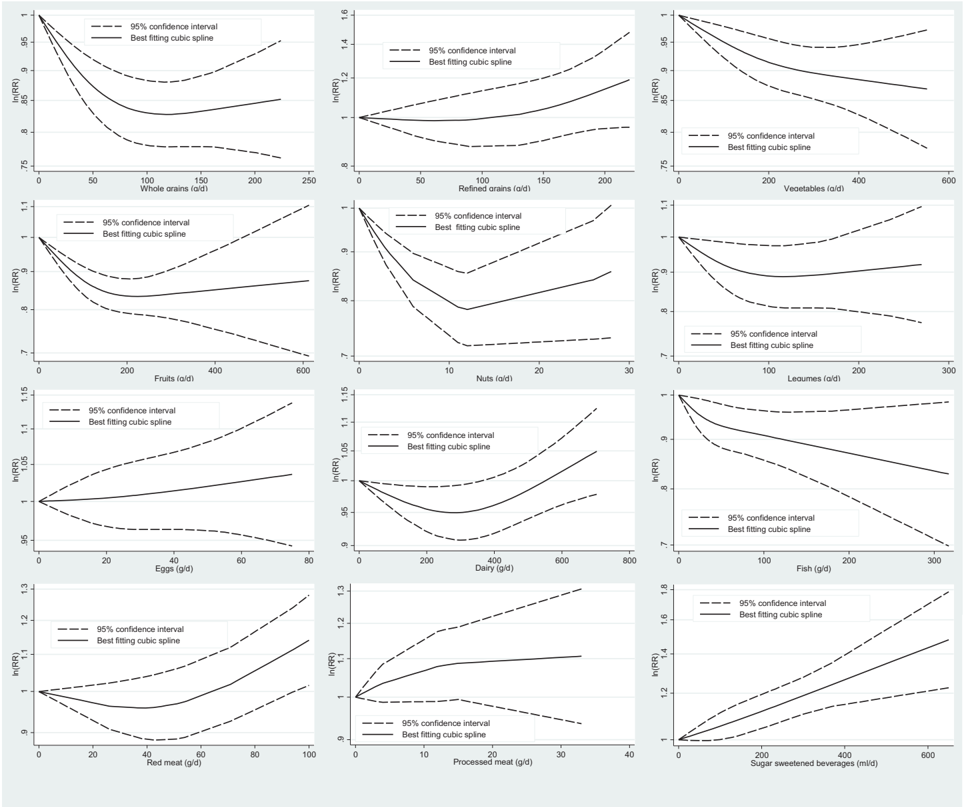
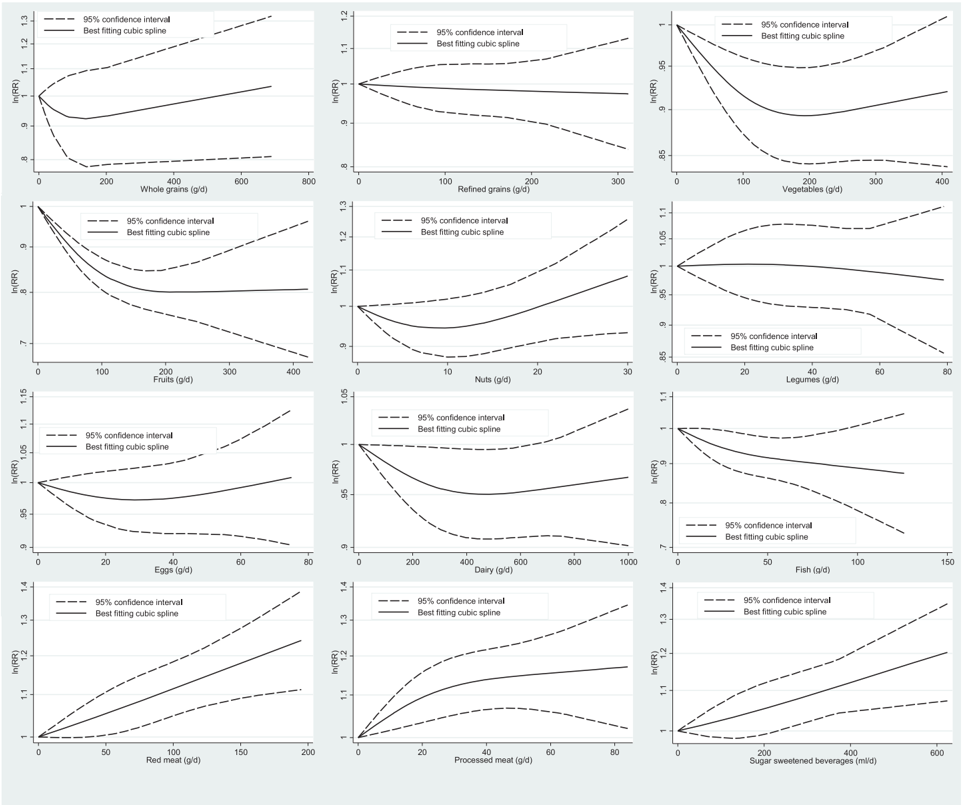
- Non-linear dose-response relationships were indicated for whole grains, fruits, nuts, dairy, and red meat with CHD, and for vegetables with stroke. Optimal consumption of risk-decreasing foods was calculated to reduce CHD risk by 65% and stroke risk by 40%; consuming 2 servings/day of red meat, processed meat, and SSB was associated with a 60% increased stroke risk, and not consuming these foods would reduce stroke risk by about 38%.
- NutriGrade meta-evidence was moderate for 10 food groups and low for refined grains and eggs regarding CHD; for stroke it was low for whole grains, refined grains, nuts, and legumes and moderate for the other eight; for HF it was very low for refined grains, low for whole grains, vegetables, fruits, nuts, dairy, and SSB, and moderate for eggs, fish, red meat, and processed meat.
Methods
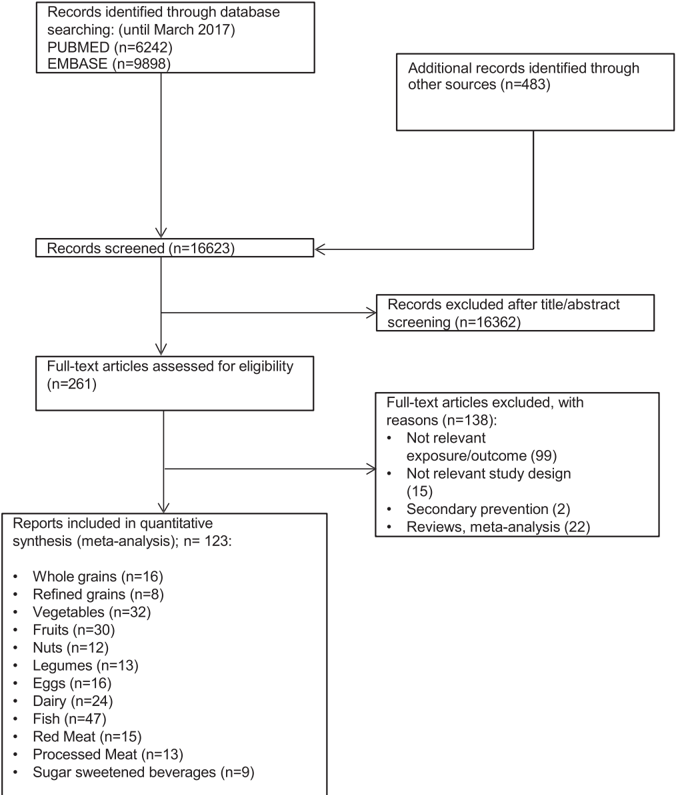
- Systematic search of PubMed and Embase up to March 2017 for prospective studies; 123 reports were included, covering 12 a priori defined food groups and CHD, stroke, and HF outcomes.
- Random-effects meta-analyses estimated summary RRs and 95% CIs for highest versus lowest intake categories and for linear and non-linear dose-response relationships; restricted cubic splines were used for non-linearity, and NutriGrade assessed meta-evidence quality.
- Subgroup and sensitivity analyses examined sex, follow-up length, geographic location, number of cases, dietary assessment, low risk of bias, nested case-control studies, and odds-ratio studies; the review was registered in PROSPERO (CRD42016037069).
Limitations
- Stated: some included studies used only baseline food intake, assuming stable consumption over time; substantial heterogeneity existed in population size, follow-up length, baseline age, and food consumption, and high statistical heterogeneity often persisted in subgroup analyses.
- Stated: residual confounding by lifestyle or socioeconomic status was possible, and for most food groups in relation to HF only a very limited number of studies was available, so some HF results should be interpreted with caution.
- Stated: the review excluded prospective studies on overall CVD and outcome-specific mortality, which may explain differences from other meta-analyses; evident from the text, many dose-response estimates relied on few studies (e.g., HF analyses with n = 1 for some foods), and NutriGrade confidence was mostly moderate or lower, limiting certainty.
Model-written summary. Check it against the paper before relying on it.
Integrity signals
Registry
Cites
Statistics
Figures


Verification
Claims the paper makes
0 Valid · 1 Not valid · 31 Not checked · 214 Own results and interpretations
A result the paper reports from its own data — it cites no other source for it, so there is none to check. The quote shows it is in the paper.
In the paper
“vegetables and fruits (RRCHD: 0.97 (0.96 -0.99)”
- Also stated in: § Vegetables · p. 7 · plain
“Each additional daily 100 g of vegetables were inversely associated with risk of CHD (RR: 0.97; 95% CI 0.96 to 0.99, I 2 D 12%, pheterogeneity D 0.32, n D 14)”
plainstates an association- Asserted: passes — The authors put it forward as true.
- Checkable: passes — It can be checked against evidence.
- Load-bearing: passes — The paper’s conclusions depend on it.
- Based: passes — The paper gives a reason why it holds.
- Rests on 3 assumptions not shown here.
- Also stated in: § Vegetables · p. 7 · plain
A result the paper reports from its own data — it cites no other source for it, so there is none to check. The quote shows it is in the paper.
In the paper
“stroke (RR: 0.91; 95% CI 0.82 to 1.02, I 2 D 53%, pheterogeneity D 0.05)”
plainstates an associationn = 11,114- Asserted: passes — The authors put it forward as true.
- Checkable: passes — It can be checked against evidence.
- Load-bearing: passes — The paper’s conclusions depend on it.
- Based: passes — The paper gives a reason why it holds.
- Rests on an assumption not shown here.
A result the paper reports from its own data — it cites no other source for it, so there is none to check. The quote shows it is in the paper.
In the paper
“There were clear indications for nonlinear dose-response relationships between whole grains, fruits, nuts, dairy, and red meat and CHD.”
boostedstates an association- Asserted: passes — The authors put it forward as true.
- Checkable: passes — It can be checked against evidence.
- Load-bearing: passes — The paper’s conclusions depend on it.
- Based: passes — The paper gives a reason why it holds.
- Rests on 3 assumptions not shown here.
A result the paper reports from its own data — it cites no other source for it, so there is none to check. The quote shows it is in the paper.
In the paper
“but not with risk of stroke (RR: 0.99; 95% CI 0.95 to 1.03, I 2 D 65%, pheterogeneity D 0.04, n D 4)”
plain- Asserted: passes — The authors put it forward as true.
- Checkable: passes — It can be checked against evidence.
- Load-bearing: passes — The paper’s conclusions depend on it.
- Based: passes — The paper gives a reason why it holds.
- Rests on 3 assumptions not shown here.
A result the paper reports from its own data — it cites no other source for it, so there is none to check. The quote shows it is in the paper.
In the paper
“RRHF: 0.96 (0.95 -0.97))”
- Also stated in: § Whole grains · p. 6 · plain
“and HF (RR: 0.96; 95% CI 0.95 to 0.97, I 2 D 0%, pheterogeneity D 0.36, n D 2)”
plainstates an associationn = 6,455- Asserted: passes — The authors put it forward as true.
- Checkable: passes — It can be checked against evidence.
- Load-bearing: passes — The paper’s conclusions depend on it.
- Based: passes — The paper gives a reason why it holds.
- Rests on 3 assumptions not shown here.
- Also stated in: § Whole grains · p. 6 · plain
181 more claims
Create a free account to see all 246 claims and to verify the 57 references still open.
- The quote only partly states this claim. 16
- It may state two separate claims as one. 24
- Probably not a substantial claim. 25
Claims other papers make about this one
Each is checked against this paper’s own text: does it say what the citing paper says it does?
The source backs part of the claim, not all of it — or backs it for a different population, condition or comparison.
In the citing paper
“each 250 mL/day increment of sugar sweetened beverage consumption was associated with a 17% and 4% higher risk of coronary heart disease (class II evidence) and all cause mortality (class III evidence), respectively.”
From Dietary sugar consumption and health: umbrella review (2023) · cites this paper as [10]
Experimental — accuracy not yet measuredThe source backs part of the claim, not all of it — or backs it for a different population, condition or comparison.
In the citing paper
“We observed no significant association between sugar sweetened beverage consumption and changes in diastolic blood pressure (children and adolescents)69 or heart failure.10”
From Dietary sugar consumption and health: umbrella review (2023) · cites this paper as [10]
Experimental — accuracy not yet measuredThe cited source says what the claim attributes to it.
In the citing paper
“A recent dose-response meta-analysis showed that each 250 mL/day increment of sugar sweetened beverage consumption was positively associated with a 7% (risk ratio 1.07, 1.02 to 1.12) higher risk of stroke.”
From Dietary sugar consumption and health: umbrella review (2023) · cites this paper as [10]
The cited source says what the claim attributes to it.
In the citing paper
“harmful associations between dietary sugar consumption and cardiovascular outcomes were also observed, including coronary heart disease,10 cardiovascular disease,8 cardiovascular disease mortality,68 71 hypertension in children and adolescents,69 hypertension in adults,70 myocardial infarction,66 change in systolic blood pressure in children and adolescents,69 and stroke.10”
From Dietary sugar consumption and health: umbrella review (2023) · cites this paper as [10]
Self-check
Percentages, sums and reported differences re-computed from the paper’s own numbers.
Each contradiction between two passages listed here was confirmed by an independent check.
Rated minor: it would not touch a result — a value no result rests on, a p-value that stays on the same side of the significance level, or a conflict that is clerical, resolved elsewhere in the paper, or outside its own findings.
In the paper
§ Discussion · p. 12
“The NutriGrade tool for evaluating the meta-evidence suggested a moderate con fi dence in the effect estimate for eggs, dairy, fi sh, red meat, and processed meat with respect to all three outcomes simultaneously;”
§ Quality of meta-evidence · p. 11
“The NutriGrade meta-evidence grading regarding CHD was rated ' low ' for re fi ned grains, and eggs and ' moderate ' for the 10 other food groups.”
Citations
Cites
Bias in meta-analysis detected by a simple, graphical test
Egger, M., Smith, G. D., Schneider, M., & Minder, C. (1997) · BMJ · doi:10.1136/bmj.315.7109.629 · Cited by 56,722 · cited 2×
“Potential small-study effects, such as publication bias, were explored using Egger (cid:2) s test and funnel plots (Egger et al. 1997), if at least 10 studies were available (Higgins and Green 2011).”
Meta-analysis in clinical trials
DerSimonian, R., & Laird, N. (1986) · Controlled Clinical Trials · doi:10.1016/0197-2456(86)90046-2 · Cited by 39,552 · cited 1×
“To evaluate the weighting of each study, the standard error for the log-transformed RR of each study was calculated and regarded as the estimated variance of the log-transformed RR, using an inverse variance method (DerSimonian and Laird 1986).”
Quantifying heterogeneity in a meta‐analysis
Higgins, J. P. T., & Thompson, S. G. (2002) · Statistics in Medicine · doi:10.1002/sim.1186 · Cited by 36,763 · cited 2×
“…Buckland et al. 2009; Dauchet et al. 2004; Del Gobbo et al. 2015; Dilis et al. 2012; Gillman et al. 1995; Hansen et al. 2017; Hansen et al. 2010; Hirvonen et al. 2001; Johnsen et al. 2003; Joshipura et al. 1999; Keli et al. 1996; Kobylecki et al. 2015; Larsson et al. 2009b; Larsson et al.…”
Meta-analysis of Observational Studies in Epidemiology<SUBTITLE>A Proposal for Reporting</SUBTITLE>
Stroup, D. F. (2000) · JAMA · doi:10.1001/jama.283.15.2008 · Cited by 20,623
European Guidelines on cardiovascular disease prevention in clinical practice (version 2012)
Authors/Task Force Members:, Perk, J., De Backer, G., Gohlke, H., Graham, I., Reiner, Ž., Verschuren, M., Albus, C., Benlian, P., Boysen, G., et al. (2012) · European Heart Journal · doi:10.1093/eurheartj/ehs092 · Cited by 8,490
(1980) · Neuropediatrics · doi:10.1055/s-2008-1071391 · Cited by 3,990 · cited 1×
“This systematic review was planned and conducted according to the standards of the Meta-analysis of Observational Studies in Epi-demiology (Stroup et al. 2000).”
Authors/Task Force Members, Graham, I., Atar, D., Borch-Johnsen, K., Boysen, G., Burell, G., Cifkova, R., Dallongeville, J., De Backer, G., Ebrahim, S., et al. (2007) · European Heart Journal · doi:10.1093/eurheartj/ehm316 · Cited by 3,753
Flexible regression models with cubic splines
Durrleman, S., & Simon, R. (1989) · Statistics in Medicine · doi:10.1002/sim.4780080504 · Cited by 2,689 · cited 1×
“…three fi xed knots at 10%, 50%, and 90% through the total distribution of the reported intake, and combined them using multivariable meta-analysis (Durrleman and Simon 1989) (if at least 2 studies with at least three quantitative exposure levels were known for one of the 12 food groups with the…”
Aune, D., Giovannucci, E., Boffetta, P., Fadnes, L. T., Keum, N., Norat, T., Greenwood, D. C., Riboli, E., Vatten, L. J., & Tonstad, S. (2017) · International Journal of Epidemiology · doi:10.1093/ije/dyw319 · Cited by 2,419 · cited 4×
“This difference could be explained by the greater number of studies (due to inclusion of studies on cause-speci fi c mortality and overall CVD) included by Aune et al. (Aune et al. 2017).”
InfluentialMethods for Trend Estimation from Summarized Dose-Response Data, with Applications to Meta-Analysis
Greenland, S., & Longnecker, M. P. (1992) · American Journal of Epidemiology · doi:10.1093/oxfordjournals.aje.a116237 · Cited by 2,353 · cited 1×
“The method described by Greenland and Longnecker (Greenland and Longnecker 1992) was applied for the dose-response analysis and computed study-speci fi c slopes (linear trends) and corresponding 95% CIs from the natural logs of the RRs and CIs across intake categories of the 12 food groups.”
Research works printed but not linked: 1
- Higgins, J., and S. Green. 2011. Cochrane handbook for systematic reviews of interventions Version 5.1.0 [updated March 2011]. The Cochrane Collaboration. Available from www.handbook.cochrane.org.
Cited by
Items 101–200 of 596
Schwingshackl, L., Knüppel, S., Michels, N., Schwedhelm, C., HOFFMANN, G. E., Iqbal, K., Henauw, S. D., Boeing, H., & Devleesschauwer, B. (2019) · European Journal of Epidemiology · doi:10.1007/s10654-019-00523-4 · Cited by 89
Self-citationLi, B., Yan, N., Jiang, H. F., Cui, M., Wu, M., Wang, L., Mi, B., Li, Z., Shi, J., Fan, Y., et al. (2023) · Frontiers in Nutrition · doi:10.3389/fnut.2023.1019534 · Cited by 94
Neelakantan, N., Park, S. H., Chen, G., & van Dam, R. M. (2021) · Nutrition Reviews · doi:10.1093/nutrit/nuab010 · Cited by 85
Adherence to the Mediterranean diet and risk of stroke and stroke subtypes
Chen, G., Neelakantan, N., Martín‐Calvo, N., Koh, W., Yuan, J., Bonaccio, M., Iacoviello, L., Martínez‐González, M. Á., Qin, L., & van Dam, R. M. (2019) · European Journal of Epidemiology · doi:10.1007/s10654-019-00504-7 · Cited by 126
“This consistency in results is plausible because both indices encompass key dietary components that may lower stroke risk, for example higher consumption of fruit, vegetables, nuts and fish, lower consumption of meat products (in particular red meat and processed meat), and avoidance of excessive drinking [51, 52].”
Potential Cardiometabolic Health Benefits of Full-Fat Dairy: The Evidence Base
Hirahatake, K. M., Astrup, A. V., Hill, J. O., Slavin, J. L., Allison, D. B., & Maki, K. C. (2019) · Advances in Nutrition · doi:10.1093/advances/nmz132 · Cited by 79
“, 2017 (48) Meta-analysis Full-fat dairy foods No difference in incident CHD risk for low- and full-fat”
BackgroundInfluentialZahrani, A. J. A., & Shori, A. B. (2023) · LWT · doi:10.1016/j.lwt.2023.114531 · Cited by 77
An, X., Liu, Z., Zhang, L., Zhao, J., Gu, Q., Han, W., Hu, Y., Fang, X., Zhang, F., Wang, S., et al. (2025) · The Lancet Global Health · doi:10.1016/s2214-109x(25)00013-0 · Cited by 77
Do patients benefit from omega-3 fatty acids?
Sherratt, S. C. R., Mason, R. P., Libby, P., Steg, P. G., & Bhatt, D. L. (2023) · Cardiovascular Research · doi:10.1093/cvr/cvad188 · Cited by 80
Egg consumption and cardiovascular risk: a dose–response meta-analysis of prospective cohort studies
Godos, J., Micek, A., Brzostek, T., Toledo, E., Iacoviello, L., Astrup, A. V., Franco, O. H., Galvano, F., Martínez‐González, M. Á., & Grosso, G. (2020) · European Journal of Nutrition · doi:10.1007/s00394-020-02345-7 · Cited by 84
EFSA Panel on Nutrition, N. F. A. F. A. (., Turck, D., Bohn, T., Castenmiller, J. J. M., Henauw, S. D., Hirsch‐Ernst, K. I., Knutsen, H. K., Maciuk, A., Mangelsdorf, I., McArdle, H. J., et al. (2022) · EFSA Journal · doi:10.2903/j.efsa.2022.7259 · Cited by 89
“…processed meat consumption and the development of chronic metabolic diseases (Aune et al., 2009; Micha et al., 2010; Abete et al., 2014; Wang et al., 2016; Schwingshackl et al., 2017; Tian et al., 2017; Bechthold et al., 2019; Fan et al., 2019; Neuenschwander et al., 2019; Zeraatkar et al., 2019).”
Fish Consumption and Stroke Risk: A Meta-Analysis of Prospective Cohort Studies
Zhao, W., Tang, H., Yang, X., Luo, X., Wang, X., Shao, C., & He, J. (2019) · Journal of Stroke and Cerebrovascular Diseases · doi:10.1016/j.jstrokecerebrovasdis.2018.10.036 · Cited by 72
Aging Fits the Disease Criteria of the International Classification of Diseases
Khaltourina, D. A., Matveyev, Y., Alekseev, A., Cortese, F., & Ioviţă, A. (2020) · Mechanisms of Ageing and Development · doi:10.1016/j.mad.2020.111230 · Cited by 86
Nuts and Cardio-Metabolic Disease: A Review of Meta-Analyses
Kim, Y., Keogh, J. B., & Clifton, P. M. (2018) · Nutrients · doi:10.3390/nu10121935 · Cited by 76
“Aune et al. 2016 [14] found that nut consumption decreased the risk of CHD by 24% (RR = 0.76; 95% CI 0.69, 0.84) comparing the highest with the lowest intakes.”
BackgroundResultInfluentialNuts and Cardiovascular Disease Prevention
Coates, A. M., Hill, A. M., & Tan, S. (2018) · Current Atherosclerosis Reports · doi:10.1007/s11883-018-0749-3 · Cited by 66
Springmann, M. (2024) · Proceedings of the National Academy of Sciences · doi:10.1073/pnas.2319010121 · Cited by 72
Kennedy, J., Alexander, P., Taillie, L. S., & Jaacks, L. M. (2024) · The Lancet Planetary Health · doi:10.1016/s2542-5196(24)00118-9 · Cited by 71
The EAT-Lancet Diet Index, Plasma Proteins, and Risk of Heart Failure in a Population-Based Cohort
Zhang, S., Marken, I., Stubbendorff, A., Ericson, U., Qi, L., Sonestedt, E., & Borné, Y. (2024) · JACC Heart Failure · doi:10.1016/j.jchf.2024.02.017 · Cited by 67
A Scoping Review of Current Guidelines on Dietary Fat and Fat Quality
Schwingshackl, L., Zähringer, J., Beyerbach, J., Werner, S. S., Nagavci, B., Heseker, H., Koletzko, B., Meerpohl, J. J., & on behalf of the International Union of Nutritional Sciences (IUNS) Task force on Dietary Fat Quality (2021) · Annals of Nutrition and Metabolism · doi:10.1159/000515671 · Cited by 53
Self-citationJiang, L., Wang, J., Xiong, K., Xu, L., Zhang, B., & Ma, A. (2021) · Nutrients · doi:10.3390/nu13072342 · Cited by 80
“’s study also suggested a negative association between fish consumption and the risk of CVD [41].”
BackgroundPerspective: Refined Grains and Health: Genuine Risk, or Guilt by Association?
Gaesser, G. A. (2018) · Advances in Nutrition · doi:10.1093/advances/nmy104 · Cited by 66
Lane, M. M., Travica, N., Gamage, E., Marshall, S., Trakman, G., Young, C., Teasdale, S. B., Dissanayaka, T. D., Dawson, S. L., Orr, R., et al. (2024) · Annual Review of Nutrition · doi:10.1146/annurev-nutr-062322-020650 · Cited by 68
The role of diet in secondary stroke prevention
English, C., MacDonald‐Wicks, L. K., Patterson, A. J., Attia, J. R., & Hankey, G. J. (2020) · The Lancet Neurology · doi:10.1016/s1474-4422(20)30433-6 · Cited by 69
Zhang, R., Zhang, B., Shen, C., Sahakian, B. J., Li, Z., Zhang, W., Zhao, Y., Li, Y., Feng, J., & Cheng, W. (2024) · Nature Mental Health · doi:10.1038/s44220-024-00226-0 · Cited by 72
Optimum nutritional strategies for cardiovascular disease prevention and rehabilitation (BACPR)
Butler, T., Kerley, C. P., Altieri, N., Alvarez, J., Green, J., Hinchliffe, J., Stanford, D., & Paterson, K. (2020) · Heart · doi:10.1136/heartjnl-2019-315499 · Cited by 92
Springmann, M., Kennard, H., Dalin, C., & Freund, F. (2022) · Nature Food · doi:10.1038/s43016-023-00852-4 · Cited by 72
“The certainty of evidence supporting the associations of dietary risks and disease outcomes used here was graded as moderate or high with NutriGrade 32–34 and/or assessed as probable or convincing by the Nutrition and Chronic Diseases Expert Group 23 and the World Cancer Research Fund 48 .”
MethodNatalucci, V., Marmondi, F., Biraghi, M., & Bonato, M. (2023) · Nutrients · doi:10.3390/nu15040913 · Cited by 62
Wesselman, L. M. P., van Lent, D. M., Schröder, A., van de Rest, O., Peters, O., Menne, F., Fuentes, M., Priller, J., Spruth, E. J., Altenstein, S., et al. (2020) · European Journal of Nutrition · doi:10.1007/s00394-020-02257-6 · Cited by 73
Chocolate and risk of chronic disease: a systematic review and dose-response meta-analysis
Morze, J., Schwedhelm, C., Bencic, A., Hoffmann, G., Boeing, H., Przybylowicz, K., & Schwingshackl, L. (2020) · European Journal of Nutrition · doi:10.1007/s00394-019-01914-9 · Cited by 57
Self-citationBhupathiraju, S. N., Sawicki, C. M., Goon, S., Gujral, U. P., Hu, F. B., Kandula, N. R., & Kanaya, A. M. (2022) · American Journal of Clinical Nutrition · doi:10.1093/ajcn/nqac174 · Cited by 58
“These food groups have all been previously associated with a higher cardiometabolic risk (6, 30).”
Guo, N., Zhu, Y., Tian, D., Zhao, Y., Zhang, C., Mu, C., Han, C., Zhu, R., & Liu, X. (2022) · BMC Medicine · doi:10.1186/s12916-022-02381-6 · Cited by 60
“98) [101] were associated with decreased incidence of stroke in meta-analyses comparing high versus low intake or Exposure total grains (Chen 2016) [14] whole grains (Bechthold 2019) [19] refined grains (Wu 2015) [20] whole grain bread (Aune 2016) [15] whole grain breakfast cereals (Aune 2016) [15] rice (Aune 2016) [1…”
Sawicki, C. M., Jacques, P. F., Lichtenstein, A. H., Rogers, G. T., Ma, J., Saltzman, E., & McKeown, N. M. (2021) · The Journal of Nutrition · doi:10.1093/jn/nxab177 · Cited by 53
Sustainability analysis of French dietary guidelines using multiple criteria
Kesse‐Guyot, E., Chaltiel, D., Wang, J., Pointereau, P., Langevin, B., Allès, B., Rebouillat, P., Lairon, D., Vidal, R., Mariotti, F., et al. (2020) · Nature Sustainability · doi:10.1038/s41893-020-0495-8 · Cited by 68
Steur, M., Johnson, L., Sharp, S. J., Imamura, F., Sluijs, I., Key, T. J., Wood, A., Chowdhury, R., Guevara, M., Jakobsen, M. U., et al. (2021) · Journal of the American Heart Association · doi:10.1161/jaha.120.019814 · Cited by 63
Self-citationMatsumoto, M., Suganuma, H., Shimizu, S., Hayashi, H., Sawada, K., Tokuda, I., Ihara, K., & Nakaji, S. (2020) · Nutrients · doi:10.3390/nu12061825 · Cited by 53
Usturoi, M. G., Rațu, R. N., Crivei, I. C., Veleşcu, I. D., Usturoi, A., Stoica, F., & Radu-Rusu, R. M. (2025) · Agriculture · doi:10.3390/agriculture15030242 · Cited by 64
Springmann, M., Dinivitzer, E., Freund, F., Jensen, J. D., & Bouyssou, C. G. (2025) · Nature Food · doi:10.1038/s43016-024-01097-5 · Cited by 66
“…majority of food-related GHG emissions within Europe 2,6,7 , and reductions in their intake have either been associated with lower disease risk (red and processed meat) or no health risk (white meat and dairy) 21–23 , Our analysis combines health, environmental and economic assessments (Methods).”
InfluentialKrittanawong, C., Narasimhan, B., Wang, Z., Virk, H. U. H., Farrell, A. M., Zhang, H., & Tang, W. H. W. (2020) · The American Journal of Medicine · doi:10.1016/j.amjmed.2020.05.046 · Cited by 66
Liu, K., Hui, S., Wang, B., Kaliannan, K., Guo, X., & Liang, L. (2019) · American Journal of Clinical Nutrition · doi:10.1093/ajcn/nqz280 · Cited by 56
Chaltiel, D., Adjibade, M., Deschamps, V., Touvier, M., Herçberg, S., Julia, C., & Kesse‐Guyot, E. (2019) · British Journal Of Nutrition · doi:10.1017/s0007114519001181 · Cited by 126
“Frequencies were assessed using eight possibilities of response: (1) most of the time; (2) occasionally; (3) never (too expensive); (4) never (product not available); (5) never (I’m not interested in organic products); (6) never (I avoid such products); (7) never (for no specific reason); and (8) I don’t know.”
MethodD’Alessandro, A., Lampignano, L., & De Pergola, G. (2019) · Nutrients · doi:10.3390/nu11061296 · Cited by 46
“However, in two dose-response meta-analyses there was evidence of nonlinearity between vegetable intake and stroke risk with a 28% reduction in RRs at 500 g/day [24] or with ~12% reduction in RRs up to intakes of ~200 g/day [17] without additional benefits above these amounts.”
BackgroundInfluentialCrosby, L., Rembert, E., Levin, S., Green, A., Ali, Z., Jardine, M., Nguyen, M., Elliott, P., Goldstein, D., Freeman, A., et al. (2022) · Journal of the Academy of Nutrition and Dietetics · doi:10.1016/j.jand.2022.04.008 · Cited by 41
Overview: the food matrix and its role in the diet
Weaver, C. M., & Givens, D. I. (2025) · Critical Reviews in Food Science and Nutrition · doi:10.1080/10408398.2025.2453074 · Cited by 53
“Bechthold et al. (2019) undertook a systematic review and meta-analysis of 123 prospective studies on the associations between food groups and the risk of CHD, stroke and heart failure They reported that dairy food consumption was not associated with risk of CHD (RR 0.99, 95% CI: 0.92-1.07), stroke…”
InfluentialHill, E. R., O’Connor, L. E., Wang, Y., Clark, C. M., McGowan, B. S., Forman, M. R., & Campbell, W. W. (2022) · Critical Reviews in Food Science and Nutrition · doi:10.1080/10408398.2022.2123778 · Cited by 59
“…Yang et al. 2016; Kim et al. 2017; Schwingshackl, Hoffmann, et al. 2017; Schwingshackl, Schwedhelm, et al. 2017; Tian et al. 2017; Kim and Je 2018; Bechthold et al. 2019; Fan et al. 2019; Schlesinger et al. 2019; Vernooij et al. 2019; Zeraatkar, Han, et al. 2019; Yang et al. 2020; Papier et al.…”
BackgroundInfluentialDrouin‐Chartier, J., Schwab, A. L., Chen, S., Li, Y., Sacks, F. M., ROSNER, B. A., Manson, J. E., Willett, W. C., Stampfer, M. J., Hu, F. B., et al. (2020) · American Journal of Clinical Nutrition · doi:10.1093/ajcn/nqaa115 · Cited by 48
“On the other hand, TMAO has been linked with CAD risk as strongly as with T2D risk (53), and egg consumption is not consistently associated with CAD risk (54, 55).”
BackgroundFatty acids from dairy and meat and their association with risk of coronary heart disease
Vissers, L. E. T., Rijksen, J., Boer, J. M. A., Verschuren, W. M. M., van der Schouw, Y. T., & Sluijs, I. (2018) · European Journal of Nutrition · doi:10.1007/s00394-018-1811-1 · Cited by 54
Torres‐Gonzalez, M., & Bradley, B. H. R. (2023) · Advances in Nutrition · doi:10.1016/j.advnut.2023.09.001 · Cited by 52
Arnesen, E., Þórisdóttir, B., Bärebring, L., Söderlund, F., Nwaru, B. I., Spielau, U., Dierkes, J., Ramel, A., Lamberg-Allardt, C. J. E., & Åkesson, A. (2023) · Food & Nutrition Research · doi:10.29219/fnr.v67.8961 · Cited by 54
“found no significant association with CHD nor stroke in a 2019 SR of cohort studies, but excluded all studies on CHD and stroke mortality (19).”
BackgroundLupoli, R., Vitale, M., Calabrese, I., Giosuè, A., Riccardi, G., & Vaccaro, O. (2021) · Nutrients · doi:10.3390/nu13020676 · Cited by 57
Kiesswetter, E., Stadelmaier, J., Πετροπούλου, Μ., Morze, J., Grummich, K., Roux, I., Lay, R., Himmelsbach, L., Kussmann, M., Roeger, C., et al. (2023) · Advances in Nutrition · doi:10.1016/j.advnut.2023.03.004 · Cited by 50
Self-citationTapsell, L. C., Neale, E. P., & Probst, Y. (2019) · Current Atherosclerosis Reports · doi:10.1007/s11883-019-0770-1 · Cited by 49
de Medeiros, G. C. B. S., Mesquita, G. X. B., Lima, S. C. V. C., Silva, D. F. O., de Azevedo, K. P. M., Pimenta, I. D. S. F., Gonçalves, A. K., Lyra, C. D. O., Martínez, D. G., & Piuvezam, G. (2022) · Critical Reviews in Food Science and Nutrition · doi:10.1080/10408398.2022.2058461 · Cited by 54
“…diseases (CVD) has been observed in meta-analysis studies, with an emphasis on coronary heart disease (CHD), stroke and/or heart failure (HF) (Bechthold et al. 2019; Micha, Michas, Mozaffarian, 2012) A meta-analysis that evaluated the consumption of food groups and the risk of all-cause…”
BackgroundFeng, Q., Kim, J. H., Omiyale, W., Bešević, J., Conroy, M. C., May, M., Yang, Z., Wong, S. Y. S., Tsoi, K. K., Allen, N. E., et al. (2022) · Frontiers in Nutrition · doi:10.3389/fnut.2022.831470 · Cited by 48
Figueroa, C., Echeverría, G., Villarreal, G. A., Martínez, X., Ferreccio, C., & Rigotti, A. (2021) · Frontiers in Nutrition · doi:10.3389/fnut.2021.680452 · Cited by 48
A systematic review of adaptations and effectiveness of scaled-up nutrition interventions
Sutherland, R., Jackson, J. K., Lane, C., McCrabb, S., Nathan, N., Yoong, S. L., Lum, M., Byaruhanga, J., McLaughlin, M. J., Brown, A., et al. (2021) · Nutrition Reviews · doi:10.1093/nutrit/nuab096 · Cited by 50
Schmidt, K. A., Cromer, G., Burhans, M. S., Kuzma, J. N., Hagman, D. K., Fernando, I., Murray, M., Utzschneider, K. M., Holte, S., Kraft, J., et al. (2021) · American Journal of Clinical Nutrition · doi:10.1093/ajcn/nqab131 · Cited by 53
Þórisdóttir, B., Arnesen, E., Bärebring, L., Dierkes, J., Lamberg-Allardt, C. J. E., Ramel, A., Nwaru, B. I., Söderlund, F., & Åkesson, A. (2023) · Food & Nutrition Research · doi:10.29219/fnr.v67.9541 · Cited by 51
“We are not aware of systematic reviews reporting evidence for an association between legume intake and stroke (28, 29, 82, 86, 87).”
BackgroundDietary behavior of video game players and esports players in Germany: a cross-sectional study
Soffner, M., Bickmann, P., Tholl, C., & Froböse, I. (2023) · Journal of Health Population and Nutrition · doi:10.1186/s41043-023-00373-7 · Cited by 63
“In addition, whole grain products are associated with a lower incidence of cardiovascular disease [18], cancer [59], and type 2 diabetes [60].”
BackgroundIntake of whole grain foods and risk of coronary heart disease in US men and women
Hu, Y., Willett, W. C., Manson, J. A. E., ROSNER, B. A., Hu, F. B., & Sun, Q. (2022) · BMC Medicine · doi:10.1186/s12916-022-02396-z · Cited by 46
Resting Heart Rate and the Risk of Atrial Fibrillation: A Dose-Response Analysis of Cohort Studies
Liu, X., Guo, N., Zhu, W., Zhou, Q., Liu, M., Chen, C., Yuan, P., Wan, R., & Hong, K. (2019) · International Heart Journal · doi:10.1536/ihj.18-470 · Cited by 41
Lifestyle changes to prevent cardio- and cerebrovascular disease at midlife: A systematic review
Zyriax, B., & Windler, E. E. T. (2022) · Maturitas · doi:10.1016/j.maturitas.2022.09.003 · Cited by 45
Association of Red Meat Consumption, Metabolic Markers, and Risk of Cardiovascular Diseases
Pan, L., Chen, L., Lv, J., Pang, Y., Guo, Y., Pei, P., Du, H., Yang, L., Millwood, I. Y., Walters, R. G., et al. (2022) · Frontiers in Nutrition · doi:10.3389/fnut.2022.833271 · Cited by 42
“Similar associations were reported in two other large metaanalyses (11, 12).”
ResultMota, J. D. O., Boué, G., Guillou, S., Pierre, F., & Membré, J. (2019) · Food and Chemical Toxicology · doi:10.1016/j.fct.2019.05.023 · Cited by 52
Bundled measures for China’s food system transformation reveal social and environmental co-benefits
Wang, X., Cai, H., Xuan, J., Du, R., Lin, B., Bodirsky, B. L., Stevanović, M., Collignon, Q., Yuan, C., Yu, L., et al. (2025) · Nature Food · doi:10.1038/s43016-024-01100-z · Cited by 40
“The relative risk estimates are adopted from a meta-analysis of prospective cohort studies 61–65 .”
Ye, Y., Chen, J.-X., Li, Y., Lai, Y.-W., Lu, Q., Xia, P., Franco, O. H., Liu, G., & Pan, A. (2024) · American Journal of Clinical Nutrition · doi:10.1016/j.ajcnut.2024.06.014 · Cited by 42
Pan, J., Liu, M., Huang, J., Chen, L., & Xu, Y. (2024) · Clinical Cardiology · doi:10.1002/clc.24228 · Cited by 47
Scoping review of the association of plant-based diet quality with health outcomes
Rosenfeld, R. M., Juszczak, H. M., & Wong, M. A. (2023) · Frontiers in Nutrition · doi:10.3389/fnut.2023.1211535 · Cited by 37
“, refined grains and sugarsweetened beverages) (3).”
The effect of information nudges on online purchases of meat alternatives
Segovia, M. S., Yu, N., & Loo, E. J. V. (2022) · Applied Economic Perspectives and Policy · doi:10.1002/aepp.13305 · Cited by 45
Sullivan, V. K., Na, M., Proctor, D. N., Kris‐Etherton, P. M., & Petersen, K. S. (2020) · Journal of the Academy of Nutrition and Dietetics · doi:10.1016/j.jand.2020.08.085 · Cited by 40
Senff, J. R., Tack, R. W. P., Mallick, A., Gutiérrez-Martínez, L., Duskin, J. A., Kimball, T. N., Tan, B. Y., Chemali, Z. N., Newhouse, A. L., Kourkoulis, C. E., et al. (2025) · Journal of Neurology Neurosurgery & Psychiatry · doi:10.1136/jnnp-2024-334925 · Cited by 43
Climate change, industrial animal agriculture, and the role of physicians – Time to act
Higuita, N. I. A., LaRocque, R. C., & McGushin, A. (2023) · The Journal of Climate Change and Health · doi:10.1016/j.joclim.2023.100260 · Cited by 44
Kim, Y., Keogh, J. B., & Clifton, P. M. (2019) · International Journal of Environmental Research and Public Health · doi:10.3390/ijerph16244957 · Cited by 34
Schwingshackl, L., Schwarzer, G., Rücker, G., & Meerpohl, J. J. (2019) · Advances in Nutrition · doi:10.1093/advances/nmz036 · Cited by 37
Self-citationWang, H., Chen, Q., Zhu, C., & Bao, J. (2022) · Foods · doi:10.3390/foods11162460 · Cited by 40
“Meanwhile, excessive (red and processed) meat consumption imposes threats on consumer health, potentially raising the risks of chronic illnesses such as type-2 diabetes mellitus, coronary heart disease, stroke, and colorectal cancer among food consumers [5,9].”
BackgroundFrank, S. M., Taillie, L. S., & Jaacks, L. M. (2022) · Public Health Nutrition · doi:10.1017/s1368980022000416 · Cited by 44
“Financial support: This work was funded through a grant from the Wellcome Trust, grant id # 216042/Z/19/Z. SMF is funded by the Carolina Population Center NICHD T32 Training Grant HD007168.”
BackgroundPractical Guidance for Food Consumption to Prevent Cardiovascular Disease
Nestel, P. J., Beilin, L. J., Clifton, P. M., Watts, G. F., & Mori, T. A. (2020) · Heart Lung and Circulation · doi:10.1016/j.hlc.2020.08.022 · Cited by 43
A Framework for Product Impact-Weighted AccountsPreprint
Serafeim, G., & Trinh, K. (2020) · SSRN Electronic Journal · doi:10.2139/ssrn.3532472 · Cited by 58
Castelló, J. V., & Casasnovas, G. L. I. (2019) · Economics & Human Biology · doi:10.1016/j.ehb.2019.100821 · Cited by 47
Carpentieri, S., Augimeri, G., Ceramella, J., Vivacqua, A., Sinicropi, M. S., Pataro, G., Bonofiglio, D., & Ferrari, G. (2022) · Foods · doi:10.3390/foods11152250 · Cited by 34
Schwingshackl, L., Schlesinger, S., Devleesschauwer, B., HOFFMANN, G. E., Bechthold, A., Schwedhelm, C., Iqbal, K., Knüppel, S., & Boeing, H. (2018) · Proceedings of The Nutrition Society · doi:10.1017/s0029665118000125 · Cited by 38
Self-citationEneroth, H., Wallin, S., Leander, K., Sommar, J. N., & Åkesson, A. (2017) · Nutrients · doi:10.3390/nu9121355 · Cited by 39
“Dose-response data indicate lower risk for coronary heart disease with increasing nut consumption up to about 10–15 g/day [3] and association with reductions in all-cause mortality up to 15–20 g/day [5].”
BackgroundGrummon, A. H., Goodman, D., Jaacks, L. M., Taillie, L. S., Chauvenet, C., Salvia, M. G., & Rimm, E. B. (2021) · Public Health Nutrition · doi:10.1017/s1368980021003098 · Cited by 43
“Health harms Type 2 diabetes • Meta-analyses have found that both unprocessed and processed red meat intake are associated with increased risk of type 2 diabetes(3,72) Weight gain • A systematic review(45) and a meta-analysis(44) found that red and processed meat intake is associated with weight gain and increased ris…”
BackgroundDrewnowski, A., McKeown, N. M., Kissock, K., Beck, E. J., Mejborn, H., Vieux, F., Smith, J. D., Masset, G., & Seal, C. J. (2020) · Advances in Nutrition · doi:10.1093/advances/nmaa172 · Cited by 32
“Meta-analyses of prospective cohort studies have consistently shown a protective association between diets high in whole grains and hypertension (32); type 2 diabetes (33); cardiovascular disease risk (34); colon (35), gastric, and esophageal cancers (36); and all-cause mortality (37).”
BackgroundKhan, T. A., Chiavaroli, L., Zurbau, A., & Sievenpiper, J. L. (2019) · European Journal of Clinical Nutrition · doi:10.1038/s41430-019-0514-x · Cited by 40
An Audit of Australian Bread with a Focus on Loaf Breads and Whole Grain
Grafenauer, S., & Curtain, F. (2018) · Nutrients · doi:10.3390/nu10081106 · Cited by 32
Córdova, R., Kim, J., Thompson, A. S., Noh, H., Shah, S., Dahm, C. C., Jensen, C. F., Mellemkjær, L., Tjønneland, A. M., Katzke, V. A., et al. (2025) · The Lancet Healthy Longevity · doi:10.1016/j.lanhl.2025.100742 · Cited by 35
Hejazi, K., Iraj, Z. A., Saeidi, A., Hackney, A. C., Laziri, F., Suzuki, K., Laher, I., & Zouhal, H. (2024) · Archives of Gerontology and Geriatrics · doi:10.1016/j.archger.2024.105737 · Cited by 36
Yan, D., Liu, K., Li, F., Shi, D., Li, W., Zhang, J., Su, X. B., & Wang, Z. (2023) · BMC Public Health · doi:10.1186/s12889-023-16954-4 · Cited by 39
“The importance of lifestyle, particularly dietary habits, in the development of CVD and its associated risk factors has been well-documented [7].”
BackgroundRicci, H., Gaeta, M., Franchi, C., Poli, A., Battino, M. A., Dolci, A., Schmid, D., & Ricci, C. (2023) · Nutrients · doi:10.3390/nu15214539 · Cited by 41
“Additionally, prospective studies have reported an association between fish consumption and CVD events [8–11].”
BackgroundMethodZhao, H., Wang, M., Peng, X., Zhong, L. X., Liu, X., Shi, Y., Li, Y., Chen, Y., & Tang, S. (2023) · Annals of Translational Medicine · doi:10.21037/atm-22-6515 · Cited by 42
“…the lowest categories, a small association was seen between fish intake and risk of CHD (RR: 0.94; 95% CI: 0.88, 1.02), atrial fibrillation (AF) (RR: 1.01; 95% CI: 0.94, 1.09) and venous thromboembolism (VTE) (RR: 1.02; 95% CI: 0.93, 1.11), but neither association reached significance (70,73,77).”
InfluentialPapp, R.-E., Hasenegger, V., Ekmekçioğlu, C., & Schwingshackl, L. (2021) · Critical Reviews in Food Science and Nutrition · doi:10.1080/10408398.2021.1975092 · Cited by 43
Self-citationIs Meat Too Cheap? Towards Optimal Meat TaxationPreprint
Funke, F., Mattauch, L., van den Bijgaart, I. M., Godfray, C., Hepburn, C., Klenert, D., Springmann, M., & Treich, N. (2021) · Social Science Research Network · doi:10.2139/ssrn.3801702 · Cited by 27
Waller, K., Furber, S. E., Bauman, A. E., Allman-Farinelli, M. A., van den Dolder, P., Hayes, A., Facci, F., Franco, L., Webb, A., Moses, R. G., et al. (2020) · Patient Education and Counseling · doi:10.1016/j.pec.2020.11.038 · Cited by 33
Trade-off between human health and environmental health in global diets
Zhang, J., & Chai, L. (2022) · Resources Conservation and Recycling · doi:10.1016/j.resconrec.2022.106336 · Cited by 31
Role of Biological Sex in the Cardiovascular-Gut Microbiome Axis
Li, S., & Kararigas, G. (2022) · Frontiers in Cardiovascular Medicine · doi:10.3389/fcvm.2021.759735 · Cited by 29
Alexy, U., Fischer, M., Weder, S., Längler, A., Michalsen, A., & Keller, M. (2021) · British Journal Of Nutrition · doi:10.1017/s0007114521003603 · Cited by 34
Melhaoui, R., Kodad, S., Houmy, N., Belhaj, K., Mansouri, F., Abid, M., Addi, M., Mihamou, A., Sindic, M., Serghini‐Caid, H., et al. (2021) · Scientifica · doi:10.1155/2021/9141695 · Cited by 32
Fleming, J. A., Kris-Etherton, P. M., Petersen, K. S., & Baer, D. J. (2021) · The American Journal of Clinical Nutrition · doi:10.1093/ajcn/nqaa375 · Cited by 25
“Exclusion criteria included: triglycerides >350 mg/dL; HDL cholesterol <15th percentile of US population (males <37 mg/dL, females <44 mg/dL) (11); fasting glucose >126 mg/dL; blood pressure >160/100 mmHg. Individuals prescribed blood pressure–lowering medications were eligible if they met the specified blood pressure…”
BackgroundInfluentialWang, D. D., Li, Y., Nguyen, X. T., Ho, Y.-L. A., Hu, F. B., Willett, W. C., Wilson, P. W. F., Cho, K., Gaziano, J. M., & Djoussé, L. (2023) · Journal of Nutrition · doi:10.1016/j.tjnut.2023.12.051 · Cited by 37
Zhu, Z., Li, F., Jia, Y., Li, Y., Guo, D., Chen, J., Tian, H., Yang, J., Yang, H., Chen, L., et al. (2022) · Circulation Heart Failure · doi:10.1161/circheartfailure.122.009592 · Cited by 37
“<4 h 116 497 (40) 35 604 (29) 10 349 (22)”
Nuts and legumes consumption and risk of colorectal cancer: a systematic review and meta-analysis
Jin, S., & Je, Y. (2022) · European Journal of Epidemiology · doi:10.1007/s10654-022-00881-6 · Cited by 35
“For studies that reported exposure units other than grams per day, we defined one serving as 28 g for nuts and 100 g for legumes according to the standard of the previous study converting these into grams per day [18, 41].”
Method
Metadata
- Authors
- Bechthold, A., Boeing, H., Schwedhelm, C., Hoffmann, G., Knüppel, S., Iqbal, K., De Henauw, S., Michels, N., Devleesschauwer, B., Schlesinger, S., & Schwingshackl, L.
- Affiliations
- German Nutrition Society, Bonn, Germany
- German Institute of Human Nutrition (DE)
- University of Vienna (AT)
- Department of Public Health, Ghent University, Gent, Belgium
- Ghent University (BE)
- Institut Scientifique de Santé Publique (BE)
- Deutsches Diabetes-Zentrum e.V. (DE)
- Corresponding author
- Bechthold, Angela
- Boeing, Heiner
- Schwedhelm, Carolina
- Hoffmann, Georg
- Knüppel, Sven
- Iqbal, Khalid
- Michels, Nathalie
- Devleesschauwer, Brecht
- Schlesinger, Sabrina
- Schwingshackl, Lukas
- ORCID
- Venue
- Critical Reviews in Food Science and Nutrition
- Publisher
- Informa UK Limited
- Published
- 2017-11-07
- Volume
- 59
- Issue
- 7
- Pages
- 1071-1090
- ISSN
- 1040-8398 (ISSN-L)
- 1549-7852
- OpenAlex
- W2765815272
- Cited by
- 693
- References
- 227
- Citations by year
- 2026: 37 · 2025: 81 · 2024: 92 · 2023: 95 · 2022: 127 · 2021: 95 · 2020: 73 · 2019: 56 · 2018: 32 · 2017: 2
- FWCI
- 7.24
- Type
- journal article
- Language
- en
- Open access
- hybrid
- doi.org
- Licence
- Locations
- Critical Reviews in Food Science and Nutrition (publishedVersion, cc-by-nc-nd)
- PubMed (publishedVersion)
- Ghent University Academic Bibliography (Ghent University) (submittedVersion, cc-by-nc-nd)
- Figshare (submittedVersion, cc-by)
- Informationszentrum Lebenswissenschaften (ZB MED) (submittedVersion, cc-by-nc-nd)
- Figshare (cc-by)
- Topics
- Health Sciences › Medicine › Public Health, Environmental and Occupational Health › Nutritional Studies and Diet
- Health Sciences › Medicine › Cardiology and Cardiovascular Medicine › Cardiovascular Health and Risk Factors
- Life Sciences › Agricultural and Biological Sciences › Food Science › Nutrition, Health, and Society Studies
- Keywords
- coronary artery disease, stroke, heart failure, food groups, whole grains, refined grains, vegetables, fruits, nuts, fish consumption, red meat, processed meat, egg consumption, dairy products, Fabaceae, sugar-sweetened beverages, dietary habits, cardiovascular risk, dose-response relationship, dietary fiber, dietary cholesterol, dietary sodium
- MeSH terms
- Whole Grains, Red Meat, Beverages, Coronary Disease, Diet, Eggs, Feeding Behavior, Fruit, Heart Failure, Humans, Nuts, Prospective Studies, Risk Factors, Vegetables, Databases, Factual, Seafood, Stroke, Risk Reduction Behavior
About these checks
Registry, retraction, Cites and statistics results are computed, not judged, with one exception: a printed reference that no index lists is read once by a model before it counts as a citation error. Claims are extracted by a model and kept only when their quote appears verbatim in the text; each cited source is then checked, with a model’s help, for whether it says what the claim relies on. Those verdicts can be wrong — read the claim’s quote and the cited source before relying on one.
A language model drew the claims from the paper on 2026-10-05, under version 3 of the claim definition (model deepseek-v4.1-flash, prompt extract-v3).
A second model labelled each claim on 2026-10-05 (model jev-1.13-20260917, definition revision gold-guideline-v0.2).
Statistics and arithmetic are recomputed, not judged.
Confidence bands are shown only for fields calibrated on our annotated test set. None is calibrated yet, so no band is shown.
What counts as a claim ›How we measure confidence ›How we check this ›
Are you an author, or do you see a problem with this page? Request a review
Data sources
Bibliographic data: Semantic Scholar, OpenAlex, Crossref.
Contains information from the Semantic Scholar Academic Graph Datasets, made available under the ODC Attribution License (ODC-BY 1.0).
Semantic Scholar’s data is described in: Kinney, R., et al. (2023). The Semantic Scholar Open Data Platform. arXiv:2301.10140.
