

Investigating appropriate reliance on AI-Based decision support systems: the role of expertise, trust, and self-confidence
Open accessThe DOI matches its Crossref record; 91 of the 92 references it cites were found in a registry or an index; 29 of the 53 sources its claims cite were checked for support.
Abstract
Achieving appropriate reliance on AI-based decision support systems (DSS) is a central challenge in human-AI decision-making. Both over-reliance and under-reliance can impair decision quality, underscoring the need to understand the psychological factors guiding reliance behaviour. This study examines how expertise, trust, and self-confidence relate to appropriate reliance within an AI-based DSS. Using structural equation modelling with data from 529 chess players with varying expertise-levels, we analysed direct, mediated, and moderated relationships among these factors. Results revealed no over-reliance, reflecting participants’ preference for self-reliance. Expertise was positively related to self-confidence and negatively related to trust, corresponding with a more critical stance toward AI advice. Trust was associated with reliance on accurate AI recommendations, whereas self-confidence was related to reliance on one’s own correct decisions. These findings support a relational framework linking user characteristics to behavioural reliance and inform the design of adaptive, explainable DSS that promote calibrated trust and effective decision-making.
Overview
CoChat Summary
TL;DR
This study models how expertise, trust, and self-confidence relate to appropriate reliance on an AI-based decision support system in chess. Using SEM with 529 chess players, it finds expertise is linked to lower trust and higher self-confidence, with trust mainly supporting reliance on correct AI advice and self-confidence supporting reliance on one’s own correct decisions.
Key findings
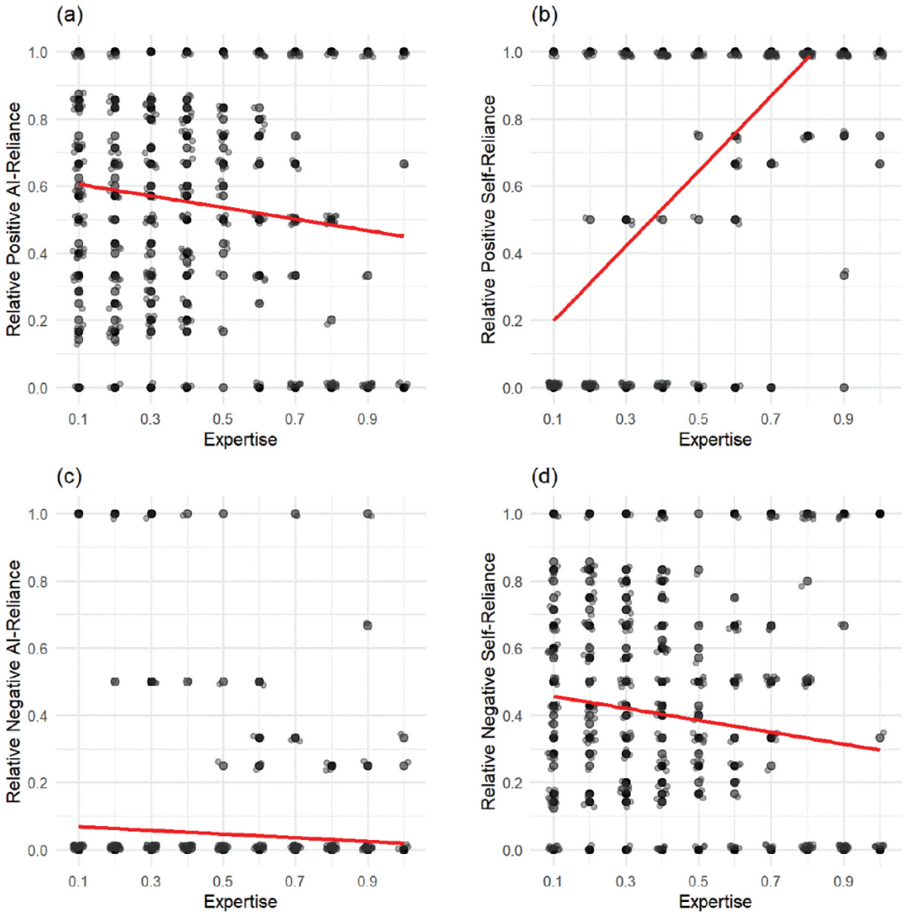
- No over-reliance was observed: negative AI-reliance was rare (0.77% of cases), while negative self-reliance occurred frequently (13.22%), reflecting a preference for self-reliance.
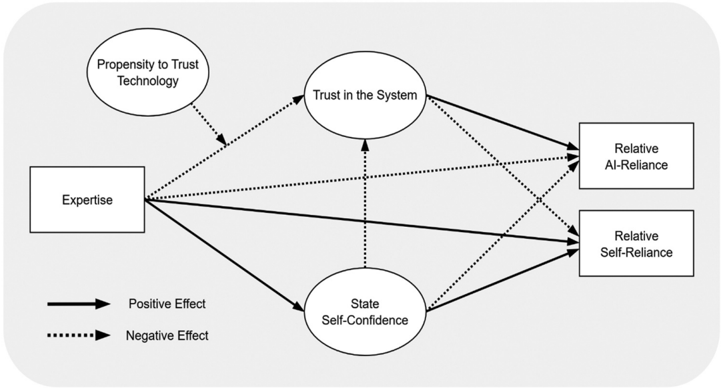
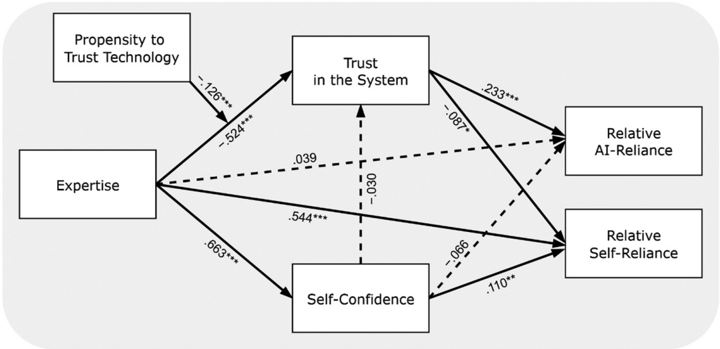
- Expertise positively predicted self-confidence (β = 0.663, p < .001) and negatively predicted trust (β = -0.524, p < .001); expertise also positively predicted RSR (β = 0.544, p < .001) but not RAIR (β = 0.039, p = .532).
- Trust positively predicted RAIR (β = 0.233, p < .001) and negatively predicted RSR (β = -0.087, p = .023); self-confidence positively predicted RSR (β = 0.110, p = .010) but did not significantly predict RAIR (β = -0.066, p = .245).
- Trust fully mediated the expertise–RAIR relationship (indirect β = -0.122, p < .001) and partially mediated expertise–RSR (indirect β = 0.046, p = .026); self-confidence partially mediated expertise–RSR (indirect β = 0.073, p = .011). The model explained 45.4% of RSR variance, 5.8% of RAIR variance, 31.2% of trust variance, and 44% of self-confidence variance.
Methods
- Online mixed within-between-subjects experiment conducted via SoSciSurvey between 26 September and 15 October 2024; final analytic sample N = 529 chess players after exclusions, recruited via Prolific and chess clubs/forums/newsletters.
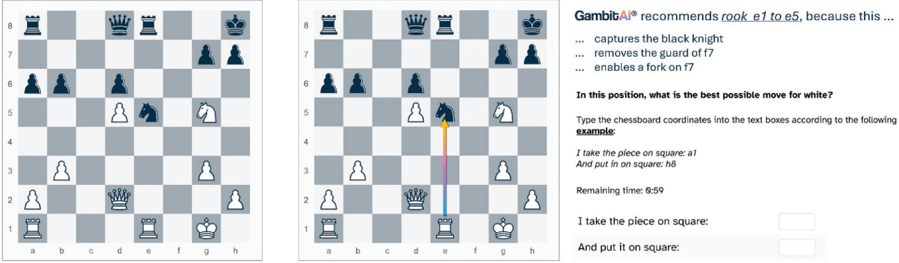
- Expertise was measured continuously via 10 chess puzzles; reliance behaviour was assessed across 12 additional puzzles with GambitAI advice, where 4 of 12 recommendations were deliberately incorrect, yielding 67% system accuracy.
- Structural equation modelling in R (lavaan) tested direct, mediated, and moderated relationships among expertise, trust, self-confidence, RAIR, and RSR, with z-standardised variables, bootstrapping (1,000 resamples), and five-fold cross-validation.
Limitations
- The paper states the online design limited control over participants’ environments, and participants saw the same puzzles twice, potentially introducing learning effects or delayed insights.
- The paper notes the one-minute puzzle time limit may have added unmeasured time pressure, and the AI’s low 67% accuracy likely encouraged cautious engagement and limits generalisability to higher-reliability settings.
- The paper states age and years of chess experience were not included in the model, SEM relationships are correlational, and the low-stakes chess paradigm may limit generalisability to high-stakes or collaborative domains.
Model-written summary. Check it against the paper before relying on it.
Integrity signals
Registry
Cites
Statistics
Figures




Verification
Claims the paper makes
24 Valid · 2 Not valid · 22 Not checked · 115 Own results and interpretations
The cited sources support only part of this claim — read each source’s verdict below.
In the paper
“Micocci et al. (2021) found that inexperienced general practitioners accepted incorrect AI advice more often than their experienced counterparts.”
§ Investigating appropriate reliance on AI-Based decision support systems: the role of expertise, trust, and self-confidence > Expertise
What the sources say
- Partly supportedcites Micocci et al., 2021 matched to “Attitudes towards Trusting Artificial Intelligence Insights and Factors to Prevent the Passive Adherence of GPs: A Pilot Study” (2021) sourceExperimental — accuracy not yet measured
In Results §3.3 (page unavailable), GPs who regularly used a dermatoscope or were more confident in dermatology were better at rejecting erroneous AI advice. The Discussion suggests that lack of task-specific experience or domain knowledge may contribute to adherence, but the paper does not establish that GPs with fewer years of general practice accepted incorrect advice more often than more experienced GPs. (LLM, conf=0.86)
plainstates an association- Asserted: passes — The authors put it forward as true.
- Checkable: passes — It can be checked against evidence.
- Load-bearing: unclear — It is unclear whether the paper’s conclusions depend on it.
- Based: passes — The paper gives a reason why it holds.
- Partly supported
Every source the paper cites for this claim was checked and supports it.
In the paper
“On the practitioner side (Harada et al., 2021), observed that clinicians erred more often due to under-reliance than over-reliance when utilising AI decision support.”
§ Investigating appropriate reliance on AI-Based decision support systems: the role of expertise, trust, and self-confidence > Appropriate reliance
What the sources say
- Supportedcites Harada et al., 2021 matched to “Efficacy of artificial-intelligence-driven differential-diagnosis list on the diagnostic accuracy of physicians: an open-label randomized controlled study” (2021) source
The Results (§3.3; page unavailable) define the relevant comparison as the prevalence of omission versus commission errors. Omission errors—rejecting a correct AI suggestion—had a slightly higher rate than commission errors—accepting an incorrect suggestion (15.9% versus 14.8%). These are rates with different denominators, not a comparison of raw error counts. (LLM, conf=0.84)
plainstates a cause- Asserted: passes — The authors put it forward as true.
- Checkable: passes — It can be checked against evidence.
- Load-bearing: unclear — It is unclear whether the paper’s conclusions depend on it.
- Based: passes — The paper gives a reason why it holds.
- Supported
Every source the paper cites for this claim was checked and supports it.
In the paper
“Nourani et al. (2020) showed that novices were prone to over-reliance due to limited error- detection skills.”
§ Investigating appropriate reliance on AI-Based decision support systems: the role of expertise, trust, and self-confidence > Expertise
What the sources say
- Supportedcites Nourani et al., 2020 matched to “The Role of Domain Expertise in User Trust and the Impact of First Impressions with Intelligent Systems” (2020) source
The Abstract states that novice users suffered from over-reliance because they lacked the knowledge to detect errors. Section 5.1 likewise reports that novices over-trusted the low-accuracy system and were prone to trusting it because they could not detect errors. (LLM, conf=0.94)
plainstates a cause- Asserted: passes — The authors put it forward as true.
- Checkable: passes — It can be checked against evidence.
- Load-bearing: unclear — It is unclear whether the paper’s conclusions depend on it.
- Based: passes — The paper gives a reason why it holds.
- Supported
The cited sources support only part of this claim — read each source’s verdict below.
In the paper
“Regarding reliance, Choung et al. (2023) demonstrated that trust significantly influences reliance intentions and Kahr et al. (2024) found that trust and reliance on AI advice were significantly higher when the AI model was highly accurate and that trust increased over repeated interactions.”
§ Investigating appropriate reliance on AI-Based decision support systems: the role of expertise, trust, and self-confidence > Trust
What the sources say
- Partly supportedcites Choung et al., 2023 matched to “Trust in AI and Its Role in the Acceptance of AI Technologies” (2023) sourceExperimental — accuracy not yet measured
The results near Table 4 report a statistically significant total effect of trust perception on intention to use AI technologies. The paper measures usage intention, not specifically intention to rely on AI advice, and its Limitations section says the correlational models cannot establish a causal effect. (LLM, conf=0.85)
boostedstates a cause- Asserted: passes — The authors put it forward as true.
- Checkable: passes — It can be checked against evidence.
- Load-bearing: passes — The paper’s conclusions depend on it.
- Based: passes — The paper gives a reason why it holds.
- Partly supported
The cited sources support only part of this claim — read each source’s verdict below.
In the paper
“Although no dedicated attention checks were included, inattentive responses were improbable given the precision required for entering valid chess moves and the targeted recruitment of chess-interested individuals (Ward & Meade, 2023).”
§ Investigating appropriate reliance on AI-Based decision support systems: the role of expertise, trust, and self-confidence > Procedure
What the sources say
- Partly supportedcites Ward & Meade, 2023 matched to “Dealing with Careless Responding in Survey Data: Prevention, Identification, and Recommended Best Practices” (2023) sourceExperimental — accuracy not yet measured
The sections “When Careless Responding Is Likely to Be a Problem” and “Context” identify lack of interest as a risk factor for careless responding, which lends some support to the rationale for recruiting chess-interested participants. They do not address chess moves or establish that inattentive responses were improbable in this study. “Minimal Screening” also recommends screening for careless responses; page numbers are unavailable in our copy. (LLM, conf=0.85)
hedged- Asserted: passes — The authors put it forward as true.
- Checkable: passes — It can be checked against evidence.
- Load-bearing: unclear — It is unclear whether the paper’s conclusions depend on it.
- Based: passes — The paper gives a reason why it holds.
- Partly supported
76 more claims · 3 with their cited sources checked
Create a free account to see all 163 claims and to verify the 3 references still open.
- It may state two separate claims as one. 59
- Probably not a substantial claim. 32
- The quote only partly states this claim. 1
Statistics recomputed
Every reported test result, recomputed from its test statistic and degrees of freedom. A result shows as not adding up only once an independent check has confirmed it.
- Consistentr(529) = 0.884reported p < .001 · recomputed p < .001
“r (529) = .884,p < .001”
- Consistentr(529) = 0.737reported p < .001 · recomputed p < .001
“r (529) = .737,p < .001”
Self-check
Percentages, sums and reported differences re-computed from the paper’s own numbers.
Each contradiction between two passages listed here was confirmed by an independent check.
Rated major: it would touch a result — a value a result rests on, reported and recomputed p-values on opposite sides of the significance level, two passages that conflict with no sign which is right, or a cited work retracted before this paper was published.
In the paper
§ Investigating appropriate reliance on AI-Based decision support systems: the role of expertise, trust, and self-confidence > Mediation and moderation effects
“The interaction between expertise and propensity to trust technology significantly moderated the effect of expertise on trust (β = -0.126,p < .001).”
§ Investigating appropriate reliance on AI-Based decision support systems: the role of expertise, trust, and self-confidence > Mediation and moderation effects
“This suggests that individuals with a higher propensity to trust technology exhibit a weaker negative relationship between expertise and trust.”
Rated minor: it would not touch a result — a value no result rests on, a p-value that stays on the same side of the significance level, or a conflict that is clerical, resolved elsewhere in the paper, or outside its own findings.
In the paper
§ Investigating appropriate reliance on AI-Based decision support systems: the role of expertise, trust, and self-confidence > Participants
“Participants were recruited via the online platform Prolific (n = 476) and through chess clubs, forums, and newsletters (n = 274).”
§ Investigating appropriate reliance on AI-Based decision support systems: the role of expertise, trust, and self-confidence > Participants
“After exclusions for incomplete responses (n = 16), zero performance on the expertise task (n = 180), or extreme completion times exceeding one standard deviation from the median (n = 24), the final analytic sample comprised N = 529 (300 from Prolific, 229 from other sources).”
Rated minor: it would not touch a result — a value no result rests on, a p-value that stays on the same side of the significance level, or a conflict that is clerical, resolved elsewhere in the paper, or outside its own findings.
In the paper
§ Investigating appropriate reliance on AI-Based decision support systems: the role of expertise, trust, and self-confidence > Self-confidence
“To obtain an overall self-confidence score, the mean was calculated across all responses (M = 4.40, SD = 2.80).”
§ Investigating appropriate reliance on AI-Based decision support systems: the role of expertise, trust, and self-confidence > Self-confidence
“These statements were rated on a 5-point Likert scale from strongly disagree (1) to strongly agree (5).”
Citations
Cites
An integrative model of organizational trust
Mayer, R. C., Davis, J. H., & Schoorman, F. D. (1995) · The Academy of Management Review · doi:10.2307/258792 · Cited by 10,736
Trust in Automation: Designing for Appropriate Reliance
Lee, J. D., & See, K. A. (2004) · Human Factors: The Journal of the Human Factors and Ergonomics Society · doi:10.1518/hfes.46.1.50_30392 · Cited by 6,605 · cited 7×
“When perceived system competence falls below a critical threshold, users generally adjust by relying more on their own judgement (Lee & See, 2004), which aligns with the present findings.”
InfluentialHumans and automation: Use, misuse, disuse, abuse
Parasuraman, R., & Riley, V. (1997) · Human Factors: The Journal of the Human Factors and Ergonomics Society · doi:10.1518/001872097778543886 · Cited by 4,554 · cited 12×
“Regarding individual differences, Parasuraman and Riley (1997) identified user expertise, self-confidence and trust in the system as critical determinants of reliance on automated decision support.”
InfluentialWolf, E. J., Harrington, K. M., Clark, S. L., & Miller, M. W. (2013) · Educational and Psychological Measurement · doi:10.1177/0013164413495237 · Cited by 3,931 · cited 1×
“As noted by Wolf et al. (2013), model complexity and indicator count influence SEM sample adequacy, and models with multiple indicators per construct, such as in this study, provide sufficient parameter estimation efficiency at slightly lower sample sizes.”
The trouble with overconfidence.
Moore, D. A., & Healy, P. J. (2008) · Psychological Review · doi:10.1037/0033-295x.115.2.502 · Cited by 2,358
Algorithm appreciation: People prefer algorithmic to human judgment
Logg, J. M., Minson, J. A., & Moore, D. A. (2019) · Organizational Behavior and Human Decision Processes · doi:10.1016/j.obhdp.2018.12.005 · Cited by 2,061 · cited 3×
“…research has identified expertise, trust, and self-confidence as key determinants of human interaction with automation (Chong et al., 2022; Choung et al., 2023; Logg et al., 2019), these factors have typically been examined in isolation rather than as part of an integrated decision-making process.”
Trust, control strategies and allocation of function in human-machine systems
LEE, J., & MORAY, N. (1992) · Ergonomics · doi:10.1080/00140139208967392 · Cited by 1,459 · cited 1×
“Conversely, reliable systems may be underutilised if deemed untrustworthy (Lee & Moray, 1992; Muir, 1987).”
The role of trust in automation reliance
Dzindolet, M. T., Peterson, S. A., Pomranky, R. A., Pierce, L. G., & Beck, H. P. (2003) · International Journal of Human-Computer Studies · doi:10.1016/s1071-5819(03)00038-7 · Cited by 1,276 · cited 2×
“…even when advice is incorrect, while under-reliance describes relying on automated advice too little, ignoring advice even when it’s correct, both of which can lead to diminished task performance (Bussone et al., 2015; Dzindolet et al., 2003; Parasuraman et al., 1993; Skitka et al., 2000).”
Automation bias: a systematic review of frequency, effect mediators, and mitigators
Goddard, K., Roudsari, A., & Wyatt, J. C. (2012) · Journal of the American Medical Informatics Association · doi:10.1136/amiajnl-2011-000089 · Cited by 1,162 · cited 17×
“In the conclusion of their systematic review, Goddard et al. (2012) propose that expertise may act on primary drivers to influence reliance on DSS, with those primary drivers being trust and confidence, again emphasising that expertise likely plays an indirect role on reliance behaviour.”
InfluentialBuçinca, Z., Malaya, M. B., & Gajos, K. Z. (2021) · arXiv · doi:10.48550/arxiv.2102.09692 · Cited by 1,124 · cited 3×
“…trust is central to understanding reliance on AI, it is prudent to also account for the propensity to trust technology, which can be crucial for trust-development (Lee & See, 2004; Schaefer et al., 2014) and is closely linked to trust-related behaviour (Buçinca et al., 2021; Küper & Krämer, 2024).”
Human-computer collaboration for skin cancer recognition
Tschandl, P., Rinner, C., Apalla, Z., Argenziano, G., Codella, N., Halpern, A., Janda, M., Lallas, A., Longo, C., Malvehy, J., et al. (2020) · Nature Medicine · doi:10.1038/s41591-020-0942-0 · Cited by 1,024 · cited 4×
“Tschandl et al. (2020) reported that less experienced clinicians were more likely to adjust initial diagnoses based on AI suggestions than experts, a pattern echoed by Fink et al. (2020) with dermatologists.”
InfluentialTrust in AI and Its Role in the Acceptance of AI Technologies
Choung, H., David, P., & Ross, A. (2023) · International Journal of Human–Computer Interaction · doi:10.1080/10447318.2022.2050543 · Cited by 963
Trust, self-confidence, and operators' adaptation to automation
Lee, J. D., & Moray, N. (1994) · International Journal of Human-Computer Studies · doi:10.1006/ijhc.1994.1007 · Cited by 932 · cited 2×
“Lee and Moray (1994) proposed that automation tends to be accepted when trust in the system exceeds self-confidence, and rejected when self-confidence dominates, indicating a potentially inverse relationship between the two constructs.”
Performance Consequences of Automation-Induced 'Complacency'
Parasuraman, R., Molloy, R., & Singh, I. L. (1993) · The International Journal of Aviation Psychology · doi:10.1207/s15327108ijap0301_1 · Cited by 875 · cited 2×
“…even when advice is incorrect, while under-reliance describes relying on automated advice too little, ignoring advice even when it’s correct, both of which can lead to diminished task performance (Bussone et al., 2015; Dzindolet et al., 2003; Parasuraman et al., 1993; Skitka et al., 2000).”
Trust between humans and machines, and the design of decision aids
Muir, B. M. (1987) · International Journal of Man-Machine Studies · doi:10.1016/s0020-7373(87)80013-5 · Cited by 762 · cited 1×
“Conversely, reliable systems may be underutilised if deemed untrustworthy (Lee & Moray, 1992; Muir, 1987).”
Does the Whole Exceed its Parts? The Effect of AI Explanations on Complementary Team Performance
Bansal, G., Wu, T., Zhou, J., Fok, R., Nushi, B., Kamar, E., Ribeiro, M. T., & Weld, D. S. (2020) · arXiv · doi:10.48550/arxiv.2006.14779 · Cited by 754
Proceedings of the 2023 CHI Conference on Human Factors in Computing Systems
(2023) · doi:10.1145/3544548 · Cited by 735
Manipulating and Measuring Model Interpretability
Poursabzi-Sangdeh, F., Goldstein, D. G., Hofman, J. M., Wortman Vaughan, J. W., & Wallach, H. (2021) · Proceedings of the 2021 CHI Conference on Human Factors in Computing Systems · doi:10.1145/3411764.3445315 · Cited by 728 · cited 2×
“…DSS and the system’s actual performance capabilities (Merritt et al., 2015), whereas appropriate reliance refers to a user’s ability to appropriately act on AI advice, specifically, to accept correct advice and reject incorrect advice (Poursabzi-Sangdeh et al., 2021; Schemmer et al., 2022).”
Manipulating and Measuring Model Interpretability
Poursabzi-Sangdeh, F., Goldstein, D. G., Hofman, J. M., Vaughan, J. W., & Wallach, H. (2018) · arXiv · doi:10.48550/arxiv.1802.07810 · Cited by 711
A Critical Analysis of Decision Support Systems Research
Arnott, D., & Pervan, G. (2005) · Journal of Information Technology · doi:10.1057/palgrave.jit.2000035 · Cited by 571 · cited 1×
“DSS are interactive, computer-based tools that support human judgement and improve decision quality in semi-structured domains (Arnott & Pervan, 2005; Power, 2008).”
Do as AI say: susceptibility in deployment of clinical decision-aids
Gaube, S., Suresh, H., Raue, M., Merritt, A., Berkowitz, S. J., Lermer, E., Coughlin, J. F., Guttag, J. V., Colak, E., & Ghassemi, M. (2021) · npj Digital Medicine · doi:10.1038/s41746-021-00385-9 · Cited by 543 · cited 3×
“Gaube et al. (2021) found that more experienced physicians rated AI-labelled advice as lower quality, reflecting a trust gap among experts.”
Merritt, S. M., & Ilgen, D. R. (2008) · Human Factors: The Journal of the Human Factors and Ergonomics Society · doi:10.1518/001872008x288574 · Cited by 527 · cited 1×
“Defined as a person’s general tendency to trust others (Merritt & Ilgen, 2008), this concept extends to include trust in technology, with applications in areas like AI and automation (Küper & Krämer, 2024; Montag et al., 2023).”
Ward, M. K., & Meade, A. W. (2023) · Annual Review of Psychology · doi:10.1146/annurev-psych-040422-045007 · Cited by 512 · cited 1×
“Although no dedicated attention checks were included, inattentive responses were improbable given the precision required for entering valid chess moves and the targeted recruitment of chess-interested individuals (Ward & Meade, 2023).”
Trust and reliance on AI — An experimental study on the extent and costs of overreliance on AI
Klingbeil, A., Grützner, C., & Schreck, P. (2024) · Computers in Human Behavior · doi:10.1016/j.chb.2024.108352 · Cited by 450 · cited 2×
“In a recent study, Klingbeil et al. (2024) showed how participants tended to over-rely on AI support, even in cases where the advice was inconsistent with available contextual information and the participant’s own judgement.”
The Role of Explanations on Trust and Reliance in Clinical Decision Support Systems
Bussone, A., Stumpf, S., & O'Sullivan, D. (2015) · 2015 International Conference on Healthcare Informatics · doi:10.1109/ichi.2015.26 · Cited by 441 · cited 1×
“…even when advice is incorrect, while under-reliance describes relying on automated advice too little, ignoring advice even when it’s correct, both of which can lead to diminished task performance (Bussone et al., 2015; Dzindolet et al., 2003; Parasuraman et al., 1993; Skitka et al., 2000).”
The benefits of imperfect diagnostic automation: a synthesis of the literature
Wickens, C. D., & Dixon, S. R. (2007) · Theoretical Issues in Ergonomics Science · doi:10.1080/14639220500370105 · Cited by 423 · cited 3×
“…falls below the critical reliability threshold of 70% identified in prior research as necessary for effective automation support (Onnasch, 2015; Wickens & Dixon, 2007), the reduced accuracy served a critical methodological purpose: it introduced sufficient disagreement between participants’…”
Explanations Can Reduce Overreliance on AI Systems During Decision-Making
Vasconcelos, H., Jörke, M., Grunde-McLaughlin, M., Gerstenberg, T., Bernstein, M., & Krishna, R. (2022) · arXiv · Cited by 403 · cited 2×
“Several researchers have found instances of over-reliance in the context of AI (Bansal et al., 2021; Buçinca et al., 2021; Logg et al., 2019; Vasconcelos et al., 2023).”
Explanations Can Reduce Overreliance on AI Systems During Decision-Making
Vasconcelos, H., Jörke, M., Grunde-McLaughlin, M., Gerstenberg, T., Bernstein, M. S., & Krishna, R. (2023) · Proceedings of the ACM on Human-Computer Interaction · doi:10.1145/3579605 · Cited by 402 · cited 2×
“Several researchers have found instances of over-reliance in the context of AI (Bansal et al., 2021; Buçinca et al., 2021; Logg et al., 2019; Vasconcelos et al., 2023).”
Kim, J., Giroux, M., & Lee, J. C. (2021) · Psychology & Marketing · doi:10.1002/mar.21498 · Cited by 353 · cited 3×
“Achieving appropriate reliance might require calibrated trust as a mediator between reliance and predictor variables (Kim et al., 2021; Schemmer et al., 2022).”
Merritt, S. M., Heimbaugh, H., LaChapell, J., & Lee, D. (2013) · Human Factors: The Journal of the Human Factors and Ergonomics Society · doi:10.1177/0018720812465081 · Cited by 329
Accountability and automation bias
SKITKA, L. J., MOSIER, K., & BURDICK, M. D. (2000) · International Journal of Human-Computer Studies · doi:10.1006/ijhc.1999.0349 · Cited by 324 · cited 1×
“…even when advice is incorrect, while under-reliance describes relying on automated advice too little, ignoring advice even when it’s correct, both of which can lead to diminished task performance (Bussone et al., 2015; Dzindolet et al., 2003; Parasuraman et al., 1993; Skitka et al., 2000).”
Automation and Human Performance: Theory and Applications
(2018) · Routledge eBooks · doi:10.1201/9781315137957 · Cited by 307
Trusting Automation: Designing for Responsivity and Resilience
Chiou, E. K., & Lee, J. D. (2023) · Human Factors: The Journal of the Human Factors and Ergonomics Society · doi:10.1177/00187208211009995 · Cited by 301
Power, competitiveness, and advice taking: Why the powerful don’t listen
Tost, L. P., Gino, F., & Larrick, R. P. (2012) · Organizational Behavior and Human Decision Processes · doi:10.1016/j.obhdp.2011.10.001 · Cited by 294 · cited 2×
“This finding supports H9, H11, and H13, supporting the assumption that expertise is associated with higher decision-making confidence, encouraging individuals to rely on their correct judgements even in the face of contradictory, incorrect AI input (Tost et al., 2012).”
Weber, P., Carl, K. V., & Hinz, O. (2024) · Management Review Quarterly · doi:10.1007/s11301-023-00320-0 · Cited by 292 · cited 1×
“Artificial Intelligence (AI) is becoming increasingly integrated into human decision-making processes across various domains, from everyday tasks to high-stakes fields like healthcare and finance (Mello-Thoms & Mello, 2023; Raciti et al., 2023; Weber et al., 2024).”
Chong, L., Zhang, G., Goucher-Lambert, K., Kotovsky, K., & Cagan, J. (2022) · Computers in Human Behavior · doi:10.1016/j.chb.2021.107018 · Cited by 262 · cited 6×
“While prior research has identified expertise, trust, and self-confidence as key determinants of human interaction with automation (Chong et al., 2022; Choung et al., 2023; Logg et al., 2019), these factors have typically been examined in isolation rather than as part of an integrated…”
InfluentialAppropriate Reliance on AI Advice: Conceptualization and the Effect of Explanations
Schemmer, M., Kuehl, N., Benz, C., Bartos, A., & Satzger, G. (2023) · Proceedings of the 28th International Conference on Intelligent User Interfaces · doi:10.1145/3581641.3584066 · Cited by 208 · cited 4×
“Appropriate Reliance was calculated according to Schemmer et al. (2023) using RAIR and RSR. RAIR describes the ratio of cases in which participants correctly adjusted their initially incorrect answers based on accurate AI advice to the total number of cases where they had the opportunity to adjust…”
InfluentialDecision Support Systems: A Historical Overview
Power, D. J. (2008) · International Handbooks on Information Systems · doi:10.1007/978-3-540-48713-5_7 · Cited by 202 · cited 1×
“DSS are interactive, computer-based tools that support human judgement and improve decision quality in semi-structured domains (Arnott & Pervan, 2005; Power, 2008).”
A Psychometric Analysis of Chess Expertise
Van Der Maas, H. L. J., & Wagenmakers, E.-J. (2005) · The American Journal of Psychology · doi:10.2307/30039042 · Cited by 186 · cited 1×
“Chess puzzles were sourced from the Amsterdam Chess Test (Van Der Maas & Wagenmakers, 2005).”
I do not need feedback! Or do I? Self-efficacy, perspective taking, and feedback seeking.
Sherf, E. N., & Morrison, E. W. (2020) · Journal of Applied Psychology · doi:10.1037/apl0000432 · Cited by 170 · cited 1×
“Zhang et al. (2022) suggest that reluctance to consider external input often stems from overconfidence and strong self-efficacy, which signals high performance and leads individuals to more readily dismiss feedback (Sherf & Morrison, 2020).”
Merkle, C., & Weber, M. (2011) · Organizational Behavior and Human Decision Processes · doi:10.1016/j.obhdp.2011.07.004 · Cited by 165 · cited 1×
“High self-confidence can lead to overestimating one’s performance (Merkle & Weber, 2011; Moore & Healy, 2008), negatively affecting willingness to take advice from others, including algorithms (Wiczorek & Meyer, 2019).”
In artificial intelligence (AI) we trust: A qualitative investigation of AI technology acceptance
Hasija, A., & Esper, T. L. (2022) · Journal of Business Logistics · doi:10.1111/jbl.12301 · Cited by 165 · cited 1×
“Empirical studies underscore the impact of trust on automation (Biros et al., 2004; Dzindolet et al., 2003) and AI decision support (Hasija & Esper, 2022; Kim et al., 2021).”
Clinical applications of artificial intelligence in radiology
Mello-Thoms, C. R., & Mello, C. A. B. (2023) · British Journal of Radiology · doi:10.1259/bjr.20221031 · Cited by 160 · cited 1×
“Artificial Intelligence (AI) is becoming increasingly integrated into human decision-making processes across various domains, from everyday tasks to high-stakes fields like healthcare and finance (Mello-Thoms & Mello, 2023; Raciti et al., 2023; Weber et al., 2024).”
Williamson, S. M., & Prybutok, V. (2024) · Information · doi:10.3390/info15060299 · Cited by 146 · cited 1×
“Regardless of the domain, the extent to which users rely on AI can be crucial, as both over-reliance and under-reliance on the system can lead to undesirable and potentially harmful outcomes, such as the spread of misinformation or errors in decision-making (Williamson & Prybutok, 2024).”
The Influence of Task Load and Automation Trust on Deception Detection
Biros, D. P., Daly, M., & Gunsch, G. H. (2004) · Group Decision and Negotiation · doi:10.1023/b:grup.0000021840.85686.57 · Cited by 145 · cited 1×
“Empirical studies underscore the impact of trust on automation (Biros et al., 2004; Dzindolet et al., 2003) and AI decision support (Hasija & Esper, 2022; Kim et al., 2021).”
Ma, S., Lei, Y., Wang, X., Zheng, C., Shi, C., Yin, M., & Ma, X. (2023) · Proceedings of the 2023 CHI Conference on Human Factors in Computing Systems · doi:10.1145/3544548.3581058 · Cited by 143 · cited 1×
“To address this, DSS could integrate calibrated feedback mechanisms that dynamically adjust trust based on the relative correctness likelihood of AI and human inputs, helping users recognise when AI advice provides valuable insights and when to rely on their own reasoning (Ma et al., 2023).”
Montag, C., Kraus, J., Baumann, M., & Rozgonjuk, D. (2023) · Computers in Human Behavior Reports · doi:10.1016/j.chbr.2023.100315 · Cited by 134 · cited 1×
“Defined as a person’s general tendency to trust others (Merritt & Ilgen, 2008), this concept extends to include trust in technology, with applications in areas like AI and automation (Küper & Krämer, 2024; Montag et al., 2023).”
Raciti, P., Sue, J., Retamero, J. A., Ceballos, R., Godrich, R., Kunz, J. D., Casson, A., Thiagarajan, D., Ebrahimzadeh, Z., Viret, J., et al. (2023) · Archives of Pathology & Laboratory Medicine · doi:10.5858/arpa.2022-0066-oa · Cited by 119 · cited 1×
“Artificial Intelligence (AI) is becoming increasingly integrated into human decision-making processes across various domains, from everyday tasks to high-stakes fields like healthcare and finance (Mello-Thoms & Mello, 2023; Raciti et al., 2023; Weber et al., 2024).”
Trust in artificial intelligence for medical diagnoses
(2020) · Progress in Brain Research · doi:10.1016/bs.pbr.2020.06.006 · Cited by 116 · cited 1×
“Juravle et al. (2020) found that users generally trust AI diagnoses less than those from human doctors, especially in high-risk cases.”
Nourani, M., King, J., & Ragan, E. (2020) · Proceedings of the AAAI Conference on Human Computation and Crowdsourcing · doi:10.1609/hcomp.v8i1.7469 · Cited by 116 · cited 1×
“Nourani et al. (2020) showed that novices were prone to over-reliance due to limited error-Figure detection skills.”
Dikmen, M., & Burns, C. (2022) · International Journal of Human-Computer Studies · doi:10.1016/j.ijhcs.2022.102792 · Cited by 116 · cited 1×
“Dikmen and Dikmen and Burns (2022) suggest that limited domain expertise can increase AI trust, leading to over-reliance.”
Online Trust: Definition and Principles
Aljazzaf, Z. M., Perry, M., & Capretz, M. A. M. (2010) · International Multi-Conference on Computing in the Global Information Technology (ICCGI) · doi:10.1109/iccgi.2010.17 · Cited by 114 · cited 1×
“Trust has always been a key concept in studies of algorithmic advice and AI decision support, encompassing factors such as ability, benevolence, integrity (Mayer et al., 1995), dependency, vulnerability, and risk attitude (Aljazzaf et al., 2010).”
Wang, L., Zhang, Z., Wang, D., Cao, W., Zhou, X., Zhang, P., Liu, J., Fan, X., & Tian, F. (2023) · Frontiers in Computer Science · doi:10.3389/fcomp.2023.1187299 · Cited by 104 · cited 8×
“This study investigated how expertise, trust, and self-confidence influence appropriate reliance on AI-based DSS. Direct, moderated, and mediated relationships between these factors were examined through structural equation modelling, providing insights into the relationships that underlie reliance behaviours.”
InfluentialThe role of domain expertise in trusting and following explainable AI decision support systems
Bayer, S., Gimpel, H., & Markgraf, M. (2022) · Journal of Decision Systems · doi:10.1080/12460125.2021.1958505 · Cited by 103
Knop, M., Weber, S., Mueller, M., & Niehaves, B. (2022) · JMIR Human Factors · doi:10.2196/28639 · Cited by 103 · cited 2×
“However, both trust calibration and reliance behaviour are inherently complex, varying considerably between individuals and being influenced by multiple factors, including contextual aspects such as the specific use case or user characteristics like personality traits (Knop et al., 2022).”
Age differences in trust and reliance of a medication management system
Ho, G., Wheatley, D., & Scialfa, C. T. (2005) · Interacting with Computers · doi:10.1016/j.intcom.2005.09.007 · Cited by 90 · cited 2×
“This distinction is critical, as age can independently influence attitudes towards and acceptance of AI and automation (Ho et al., 2005; Méndez-Suárez et al., 2023).”
The Measurement of the Propensity to Trust Automation
Jessup, S. A., Schneider, T. R., Alarcon, G. M., Ryan, T. J., & Capiola, A. (2019) · Lecture Notes in Computer Science · doi:10.1007/978-3-030-21565-1_32 · Cited by 90 · cited 1×
“Propensity to trust technology was measured using the Propensity to Trust Technology scale by Jessup et al. (2019), consisting of six items.”
Merritt, S. M., Lee, D., Unnerstall, J. L., & Huber, K. (2015) · Human Factors: The Journal of the Human Factors and Ergonomics Society · doi:10.1177/0018720814561675 · Cited by 83
Méndez-Suárez, M., Monfort, A., & Hervás-Oliver, J.-L. (2023) · European Research on Management and Business Economics · doi:10.1016/j.iedeen.2023.100223 · Cited by 83 · cited 2×
“This distinction is critical, as age can independently influence attitudes towards and acceptance of AI and automation (Ho et al., 2005; Méndez-Suárez et al., 2023).”
Explainable AI meets Healthcare: A Study on Heart Disease Dataset
Dave, D., Naik, H., Singhal, S., & Patel, P. (2020) · arXiv (Cornell University) · doi:10.48550/arxiv.2011.03195 · Cited by 72 · cited 1×
“Providing clear and interpretable explanations for AI recommendations, even in complex scenarios, can foster trust calibration and help users discern when to align with AI input and when to rely on their own expertise (Dave et al., 2020; Schemmer et al., 2023).”
Fink, C., Blum, A., Buhl, T., Mitteldorf, C., Hofmann‐Wellenhof, R., Deinlein, T., Stolz, W., Trennheuser, L., Cussigh, C., Deltgen, D., et al. (2020) · Journal of the European Academy of Dermatology and Venereology · doi:10.1111/jdv.16165 · Cited by 71 · cited 4×
“Tschandl et al. (2020) reported that less experienced clinicians were more likely to adjust initial diagnoses based on AI suggestions than experts, a pattern echoed by Fink et al. (2020) with dermatologists.”
InfluentialCognitive bias, decision styles, and risk attitudes in decision making and DSS
Phillips-Wren, G., Power, D. J., & Mora, M. (2019) · Journal of Decision Systems · doi:10.1080/12460125.2019.1646509 · Cited by 70 · cited 2×
“Traditional DSS relied on model-or knowl-edge-driven approaches, whereas modern AI-based DSS integrate machine learning and explainable algorithms to generate interpretable recommendations rather than replace human judgement (Haag, 2025; Lee & See, 2004; Phillips-Wren et al., 2019).”
User Characteristics in Explainable AI: The Rabbit Hole of Personalization?
Nimmo, R., Constantinides, M., Zhou, K., Quercia, D., & Stumpf, S. (2024) · CHI Conference on Human Factors in Computing Systems · doi:10.1145/3613904.3642352 · Cited by 60 · cited 1×
“Nimmo et al. (2024) emphasise that explanation design should consider these personal differences, as over-personalisation can reduce consistency while under-personalisation risks misunderstanding or mistrust.”
Crossing the boundaries of automation—Function allocation and reliability
Onnasch, L. (2014) · International Journal of Human-Computer Studies · doi:10.1016/j.ijhcs.2014.12.004 · Cited by 56 · cited 2×
“While this falls below the critical reliability threshold of 70% identified in prior research as necessary for effective automation support (Onnasch, 2015; Wickens & Dixon, 2007), the reduced accuracy served a critical methodological purpose: it introduced sufficient disagreement between…”
Ma, S., Wang, X., Lei, Y., Shi, C., Yin, M., & Ma, X. (2024) · arXiv · doi:10.48550/arxiv.2403.09552 · Cited by 56
Ma, S., Wang, X., Lei, Y., Shi, C., Yin, M., & Ma, X. (2024) · Proceedings of the CHI Conference on Human Factors in Computing Systems · doi:10.1145/3613904.3642671 · Cited by 54 · cited 1×
“…income prediction calibrating users’ self-confidence has been shown to be associated with reduced under-reliance on correct AI advice without increasing over-reliance on incorrect advice, suggesting a nuanced role of self-confidence in fostering appropriate reliance behaviours (Ma et al., 2024).”
Shekar, S., Pataranutaporn, P., Sarabu, C. R., Cecchi, G., & Maes, P. (2024) · arXiv (Cornell University) · doi:10.48550/arxiv.2408.15266 · Cited by 54 · cited 1×
“Conversely, Shekar et al. (2024) showed that non-experts rated high-accuracy AI responses as more trustworthy and satisfactory than doctor-generated responses.”
Cabitza, F., Campagner, A., Angius, R., Natali, C., & Reverberi, C. (2023) · Proceedings of the 2023 CHI Conference on Human Factors in Computing Systems · doi:10.1145/3544548.3581095 · Cited by 51 · cited 1×
“Recent advances in AI emphasise that effective human-AI interaction depends on achieving an appropriate level of reliance, particularly in decision-support contexts (Cabitza et al., 2023; Schemmer et al., 2022).”
Psychological Traits and Appropriate Reliance: Factors Shaping Trust in AI
Küper, A., & Krämer, N. (2024) · International Journal of Human–Computer Interaction · doi:10.1080/10447318.2024.2348216 · Cited by 49 · cited 4×
“However, more recent findings challenge this view, indicating that individuals with a high propensity to trust in technology may be particularly vulnerable to misleading AI advice, leading to over-trusting and impaired self-reliance (Küper & Krämer, 2024).”
InfluentialSelf-citationKahr, P. K., Rooks, G., Willemsen, M. C., & Snijders, C. C. P. (2024) · ACM Transactions on Interactive Intelligent Systems · doi:10.1145/3686164 · Cited by 49 · cited 1×
“Regarding reliance, Choung et al. (2023) demonstrated that trust significantly influences reliance intentions and Kahr et al. (2024) found that trust and reliance on AI advice were significantly higher when the AI model was highly accurate and that trust increased over repeated interactions.”
Effects of trust, self-confidence, and feedback on the use of decision automation
Wiczorek, R., & Meyer, J. (2019) · Frontiers in Psychology · doi:10.3389/fpsyg.2019.00519 · Cited by 46 · cited 2×
“For example, Wiczorek and Meyer (2019) found that while confidence and trust are often correlated, only trust significantly predicted reliance behaviour, whereas confidence had no measurable effect.”
Harada, Y., Katsukura, S., Kawamura, R., & Shimizu, T. (2021) · International Journal of Environmental Research and Public Health · doi:10.3390/ijerph18042086 · Cited by 44 · cited 2×
“This could be particularly relevant for high-stakes fields, where over-reliance and under-reliance carry the risk of diminishing task performance (Harada et al., 2021; Micocci et al., 2021).”
Schaefer, K. E., Billings, D. R., Szalma, J. L., Adams, J. K., Sanders, T. L., Chen, J. Y., & Hancock, P. A. (2014) · doi:10.21236/ada607926 · Cited by 43 · cited 1×
“…trust is central to understanding reliance on AI, it is prudent to also account for the propensity to trust technology, which can be crucial for trust-development (Lee & See, 2004; Schaefer et al., 2014) and is closely linked to trust-related behaviour (Buçinca et al., 2021; Küper & Krämer, 2024).”
The errors of experts: When expertise hinders effective provision and seeking of advice and feedback
Zhang, T., Harrington, K. B., & Sherf, E. N. (2021) · Current Opinion in Psychology · doi:10.1016/j.copsyc.2021.06.011 · Cited by 43 · cited 3×
“Expertise is expected to predict both self-confidence and reliance (Goddard et al., 2012), as it increases self-confidence and often reduces reliance on AI, even when judgement is flawed (Chong et al., 2022; Zhang et al., 2022).”
Micocci, M., Borsci, S., Thakerar, V., Walne, S., Manshadi, Y., Edridge, F., Mullarkey, D., Buckle, P., & Hanna, G. B. (2021) · Journal of Clinical Medicine · doi:10.3390/jcm10143101 · Cited by 39 · cited 4×
“This could be particularly relevant for high-stakes fields, where over-reliance and under-reliance carry the risk of diminishing task performance (Harada et al., 2021; Micocci et al., 2021).”
InfluentialShould I Follow AI-based Advice? Measuring Appropriate Reliance in Human-AI Decision-Making
Schemmer, M., Hemmer, P., Kühl, N., Benz, C., & Satzger, G. (2022) · arXiv · doi:10.48550/arxiv.2204.06916 · Cited by 33 · cited 9×
“…DSS and the system’s actual performance capabilities (Merritt et al., 2015), whereas appropriate reliance refers to a user’s ability to appropriately act on AI advice, specifically, to accept correct advice and reject incorrect advice (Poursabzi-Sangdeh et al., 2021; Schemmer et al., 2022).”
InfluentialKim, S., Choo, S., Park, D., Park, H., Nam, C. S., Jung, J., & Lee, S. (2023) · International Journal of Human-Computer Studies · doi:10.1016/j.ijhcs.2023.103009 · Cited by 33 · cited 1×
“Kim et al. (2023) demonstrated that contextualised, pragmatic explanation interfaces improve interpretability among domain experts by tailoring information depth and terminology to their existing knowledge.”
Acceptance of Medical Treatment Regimens Provided by AI vs. Human
Wu, J., Xu, L., Yu, F., & Peng, K. (2021) · Applied Sciences · doi:10.3390/app12010110 · Cited by 28
Personality of elite male and female chess players and its relation to chess skill
Vollstädt-Klein, S., Grimm, O., Kirsch, P., & Bilalić, M. (2010) · Learning and Individual Differences · doi:10.1016/j.lindif.2010.04.005 · Cited by 25 · cited 1×
“By focusing on chess, where expertise is not inherently age-dependent (Vollstädt-Klein et al., 2010), this approach isolates the effects of domain knowledge from broader demographic confounds and offers a more precise lens to investigate how true expertise shapes trust in and reliance on AI-driven…”
Faulhaber, A. K., Ni, I., & Schmidt, L. (2021) · Mensch und Computer (MuC) · doi:10.1145/3473856.3473886 · Cited by 23 · cited 1×
“Research shows a positive correlation between self-reported trust and propensity to trust, where individuals with a higher propensity to trust tend to exhibit a greater readiness to rely on automation, even discerning when automation is appropriate to use (Faulhaber et al., 2021; Lee & See, 2004).”
A Computational Model of Coupled Human Trust and Self-confidence Dynamics
Williams, K. J., Yuh, M. S., & Jain, N. (2023) · ACM Transactions on Human-Robot Interaction · doi:10.1145/3594715 · Cited by 18 · cited 1×
“Similarly, Williams et al. (2023) observed that individuals can simultaneously exhibit high self-confidence and high trust in automation, contradicting the assumption that confidence necessarily inhibits reliance.”
Jung, I.-C., Schuler, K., Zerlik, M., Grummt, S., Sedlmayr, M., & Sedlmayr, B. (2025) · Digital Health · doi:10.1177/20552076241308298 · Cited by 18 · cited 1×
“Similarly, Jung et al. (2025) summarised a comprehensive set of user-centred design recommendations, highlighting that effective DSS should combine context-aware explanations, explicit communication of reliability, and adaptability to user expertise.”
A reinforcement sensitivity theory view of seeking behaviors at work: A meta‐analysis
Sherf, E. N., Gilliam, N., & McElroy, T. (2024) · Personnel Psychology · doi:10.1111/peps.12579 · Cited by 15 · cited 3×
“Domain-specific self-efficacy – confidence in a specific area – negatively correlates with feedback and advice-seeking (Sherf et al., 2024).”
Papantonis, I., & Belle, V. (2025) · Frontiers in Computer Science · doi:10.3389/fcomp.2025.1560448 · Cited by 14 · cited 1×
“Finally, recent conceptual accounts, such as those by Papantonis and Belle (2025), emphasise that human-AI reliance arises from the joint influence of system-related factors (e.g. reliability, interpretability) and user-JOURNAL related factors (e.g. self-confidence self-confidence, domain…”
Mitigating cognitive bias with clinical decision support systems: an experimental study
Küper, A., Lodde, G. C., Livingstone, E., Schadendorf, D., & Krämer, N. C. (2023) · Journal of Decision System · doi:10.1080/12460125.2023.2245215 · Cited by 12
Self-citationFreel, A., Pias, S. B. H., Šabanović, S., & Kapadia, A. (2025) · Proceedings of the 2025 ACM Conference on Fairness, Accountability, and Transparency · doi:10.1145/3715275.3732187 · Cited by 11 · cited 1×
“Conversely, studies in lower-stakes laboratory tasks show that users calibrate trust more flexibly and recover from AI errors more readily (Freel et al., 2025).”
Trinh, T. K., Jia, G., Cheng, C., & Ni, C. (2025) · Applied and Computational Engineering · doi:10.54254/2755-2721/2025.21859 · Cited by 7 · cited 1×
“In the context of financial decision-making, calibrated trust improved appropriate reliance on AI recommendations (Trinh et al., 2025).”
AI and Decision-Making Process: A Meta-synthesis of the Literature
Javidan, A., & Za, S. (2024) · Lecture notes in information systems and organisation · doi:10.1007/978-3-031-76970-2_16 · Cited by 4
Johnson, D. S. (2026) · Proceedings of the 34th ACM Conference on User Modeling, Adaptation and Personalization · doi:10.1145/3774935.3806657 · Cited by 2 · cited 3×
“In high-stakes environments such as medicine or autonomous driving, users tend to display amplified trust responses – sometimes resulting in over-reliance or defensive under-reliance due to accountability concerns (Johnson, 2025).”
InfluentialJohnson, D. S. (2025) · arXiv · doi:10.48550/arxiv.2503.03529 · Cited by 2
Development of a new Trust in AI scale
Beisemann, M., Krämer, N., Wischnewski, M., & Doebler, P. (2023) · Open Science Framework · doi:10.17605/osf.io/bx32p · Cited by 2
Self-citationThe Effect of Explainable AI-based Decision Support on Human Task Performance: A Meta-Analysis
Haag, F. (2025) · arXiv · doi:10.48550/arxiv.2504.13858 · Cited by 1
Cited by
Luong, A., Kumar, N., & Lang, K. R. (2026) · Information & Management · doi:10.1016/j.im.2026.104384 · Cited by 7
Matschak, T., Nastjuk, I., Trang, S. T.-N., & Benitez, J. (2026) · Decision Support Systems · doi:10.1016/j.dss.2026.114721 · Cited by 2
“Instead, we contribute to the emerging body of literature that examines decision contexts with fallible AI and emphasizes calibrated reliance [2,19].”
Prompting strategies with generative AI during learning from multiple sources
Kim, S., & McCrudden, M. T. (2026) · Learning and Instruction · doi:10.1016/j.learninstruc.2026.102435 · Cited by 3
Trust Over Creepiness: AI Chatbot Perceptions in Balkan Countries
Galjak, M., & Budić, M. (2026) · International Journal of Human-Computer Interaction · doi:10.1080/10447318.2026.2638548
“The question of AI adoption is not only whether users trust the system, but whether that trust is resilient enough to withstand errors and whether it leads to appropriate reliance rather than blind dependence (Dogru & Krämer, 2025).”
Claude, A. (2026) · Lecture notes in business information processing · doi:10.1007/978-3-032-27997-2_25
Metadata
- Authors
- Dogru, E. Ö., & Krämer, N. C.
- Affiliations
- University of Duisburg-Essen (DE)
- Corresponding author
- Dogru, Enis Ömer
- Venue
- Journal of Decision Systems
- Publisher
- Informa UK Limited
- Published
- 2025-01-02
- Volume
- 34
- Issue
- 1
- ISSN
- 1246-0125 (ISSN-L)
- 2116-7052
- OpenAlex
- W4416774727
- Cited by
- 15
- References
- 87
- Citations by year
- 2026: 15
- FWCI
- 16.62
- Type
- journal article
- Language
- en
- Open access
- hybrid
- doi.org
- Licence
- Locations
- Journal of Decision System (publishedVersion, cc-by-nc-nd)
- Universitätsbibliographie, Universität Duisburg-Essen (submittedVersion)
- Funders
- DFG Research Training Group
- Topics
- Social Sciences › Human Factors and Ergonomics › Human-Automation Interaction and Safety
- Physical Sciences › Computer Science › Artificial Intelligence › Explainable Artificial Intelligence (XAI)
- Social Sciences › Decision Sciences › Information Systems and Management › Technology Adoption and User Behaviour
- Keywords
- AI-based decision support systems, AI reliance, expertise, trust in AI, self-confidence, human-AI decision-making, chess players, explainable AI, adaptive decision support, trust calibration
About these checks
Registry, retraction, Cites and statistics results are computed, not judged, with one exception: a printed reference that no index lists is read once by a model before it counts as a citation error. Claims are extracted by a model and kept only when their quote appears verbatim in the text; each cited source is then checked, with a model’s help, for whether it says what the claim relies on. Those verdicts can be wrong — read the claim’s quote and the cited source before relying on one.
The claim verdicts this report counts are experimental: their accuracy is not yet measured.
A language model drew the claims from the paper on 2026-10-02, under version 3 of the claim definition (model deepseek-v4.1-flash, prompt extract-v3).
A second model labelled each claim on 2026-10-02 (model jev-1.13-20260917, definition revision gold-guideline-v0.2).
Cited sources are checked with a language model’s help (gpt-6-sol).
Statistics and arithmetic are recomputed, not judged.
Confidence bands are shown only for fields calibrated on our annotated test set. None is calibrated yet, so no band is shown.
What counts as a claim ›How we measure confidence ›How we check this ›
Are you an author, or do you see a problem with this page? Request a review
Data sources
Bibliographic data: Semantic Scholar, OpenAlex, Crossref.
Contains information from the Semantic Scholar Academic Graph Datasets, made available under the ODC Attribution License (ODC-BY 1.0).
Semantic Scholar’s data is described in: Kinney, R., et al. (2023). The Semantic Scholar Open Data Platform. arXiv:2301.10140.
