

A systematic review and meta-analysis of self-guided online acceptance and commitment therapy as a transdiagnostic self-help intervention
Open accessThe DOI matches its Crossref record; 51 of the 51 references it cites were found in a registry or an index; 10 of the 39 sources its claims cite were checked for support.
Abstract
Online Acceptance and Commitment Therapy (ACT) interventions use websites and smartphone apps to deliver ACT exercises and skills. The present meta-analysis provides a comprehensive review of online ACT self-help interventions, characterizing the programs that have been studied (e.g. platform, length, content) and analyzing their efficacy. A transdiagnostic approach was taken, including studies that addressed a range of targeted problems and populations. Multi-level meta-analyses were used to nest multiple measures of a single construct within their respective studies. A total of 53 randomized controlled trials were included (n = 10,730). Online ACT produced significantly greater outcomes than waitlist controls at post-treatment for anxiety, depression, quality of life, psychological flexibility, and all assessed outcomes (i.e. omnibus effect), which were generally maintained at follow-up. However, only psychological flexibility and all assessed outcomes at post-treatment were found to be significantly greater for online ACT when compared to active controls, with no significant follow-up effects. Overall, these results further clarify that ACT can be effectively delivered in an online format to target a wide range of mental health concerns, although it is less clear if and when online ACT is more efficacious than other online interventions. © 2023 The Author(s). Published by Informa UK Limited, trading as Taylor & Francis Group.
Overview
CoChat Summary
TL;DR
This systematic review and multi-level meta-analysis of 53 RCTs (n = 10,730) found self-guided online ACT produced small significant improvements over waitlist controls at post-treatment across anxiety, depression, quality of life, psychological flexibility, and omnibus outcomes, generally maintained at follow-up. Against active controls, only psychological flexibility and omnibus outcomes were significant at post-treatment, with no significant follow-up effects.
Key findings
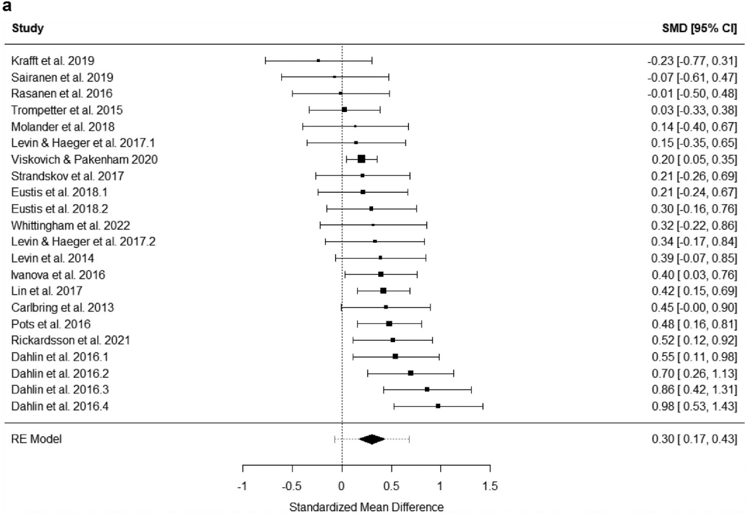
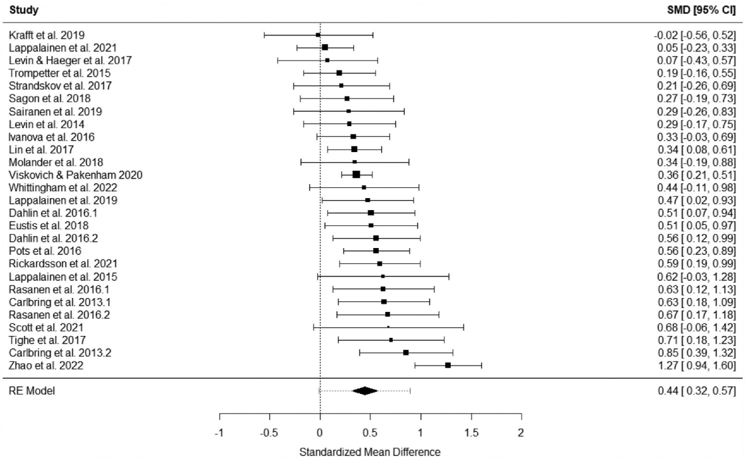
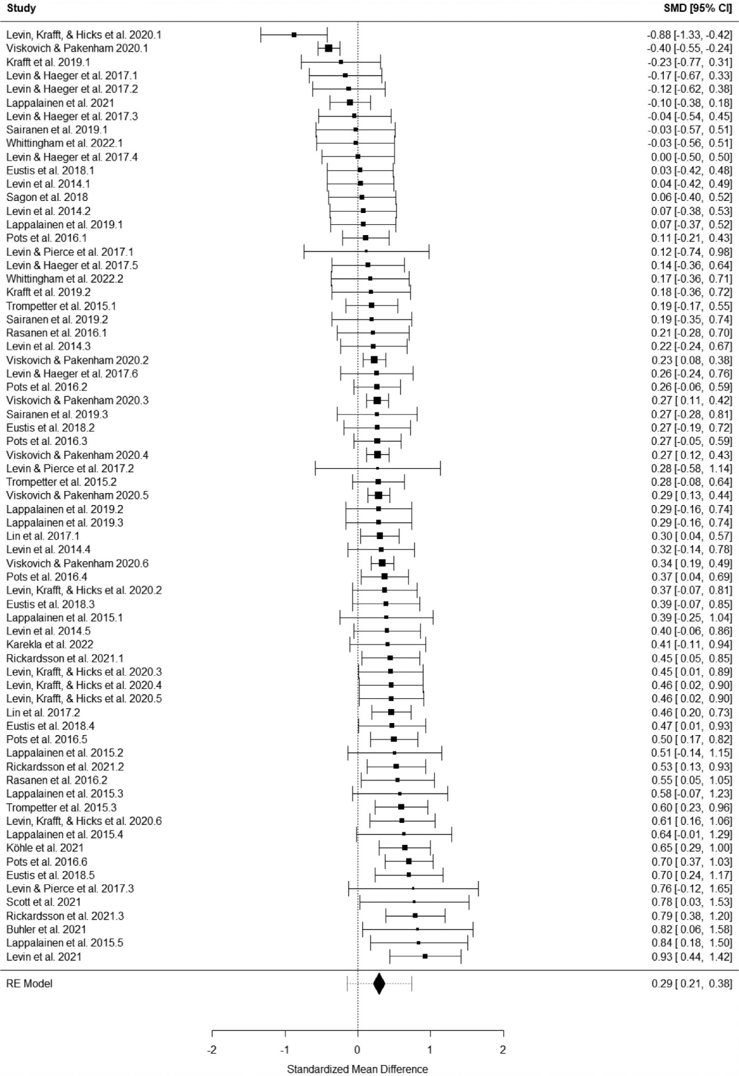
- Waitlist comparisons at post-treatment: anxiety g = 0.30 (95% CI [0.17, 0.43]), depression g = 0.44 (95% CI [0.32, 0.57]), quality of life g = 0.20 (95% CI [0.09, 0.30]), psychological flexibility g = 0.29 (95% CI [0.21, 0.38]), and omnibus g = 0.31 (95% CI [0.24, 0.39]). Follow-up effects were generally maintained: anxiety g = 0.32, depression g = 0.49, omnibus g = 0.30; quality of life follow-up was non-significant (g = 0.11, 95% CI [-0.14, 0.36]).
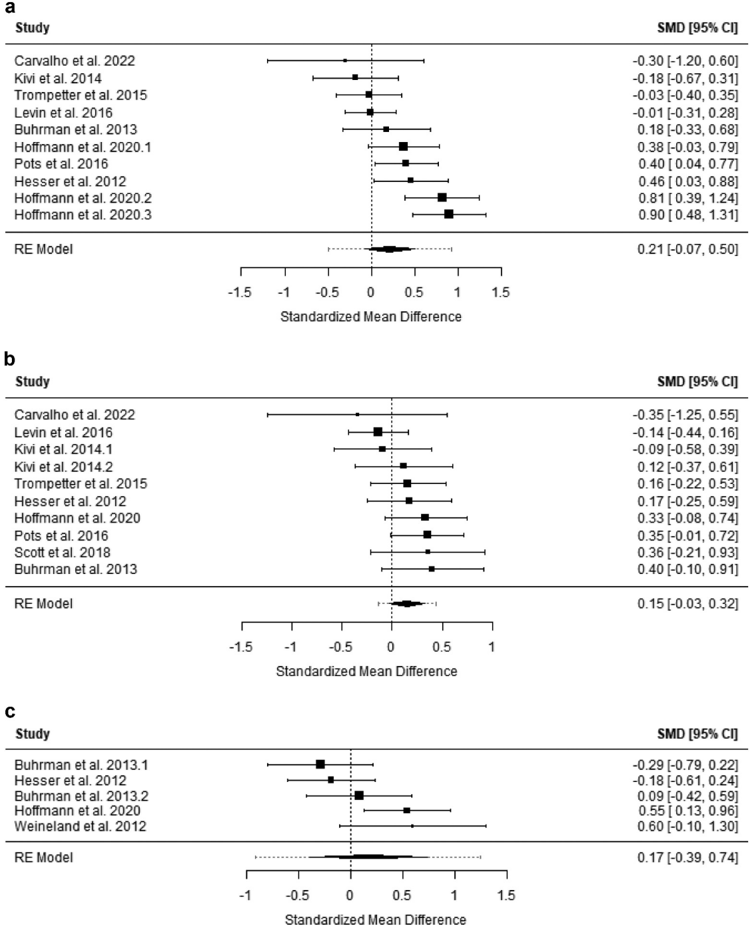
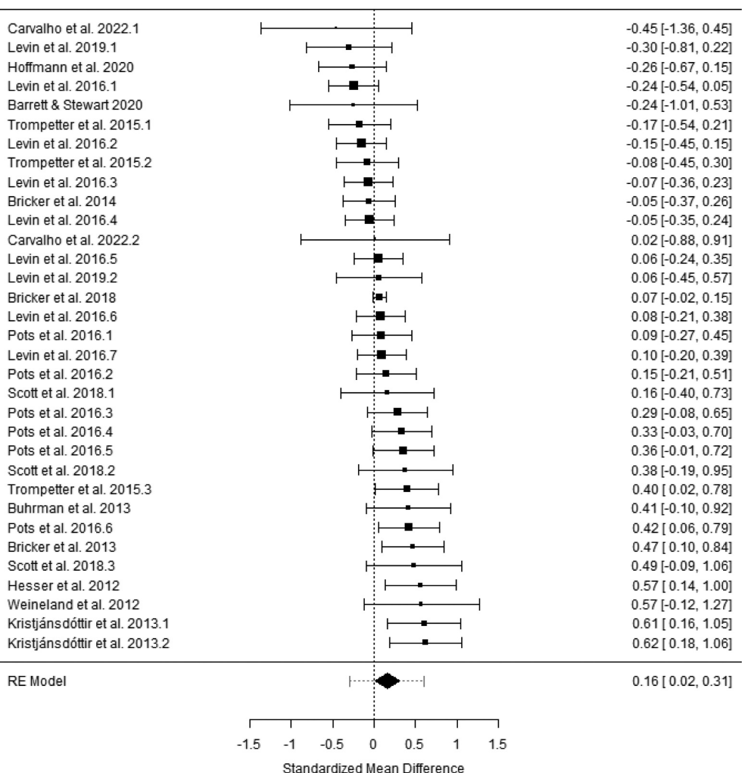
- Active control comparisons at post-treatment: omnibus g = 0.18 (95% CI [0.09, 0.28]) and psychological flexibility g = 0.16 (95% CI [0.02, 0.31]) were significant; anxiety (g = 0.21), depression (g = 0.15), and quality of life (g = 0.17) were not. No significant follow-up effects were found (omnibus g = 0.10; psychological flexibility g = 0.05).
- Adherence and satisfaction: average participants completing all modules was 57.63% (n = 23; SD = 18.45%; range 27.5%–94.7%); average modules completed was 74% (n = 13; SD = 11%; range 53.33%–94.5%); satisfaction averaged 7.27/10 (n = 14; between-study SD = 0.59); System Usability Score averaged 79.19/100 (n = 8; between-study SD = 5.46).
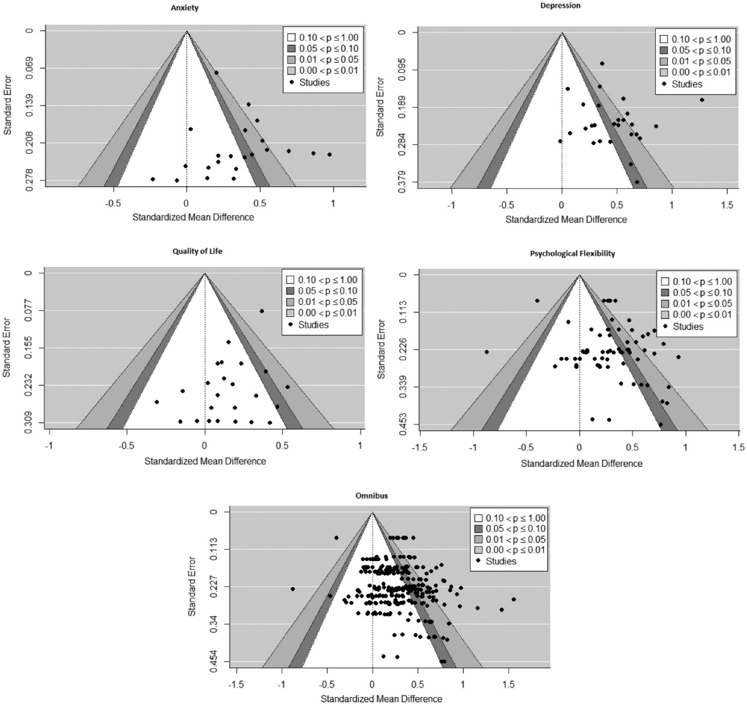
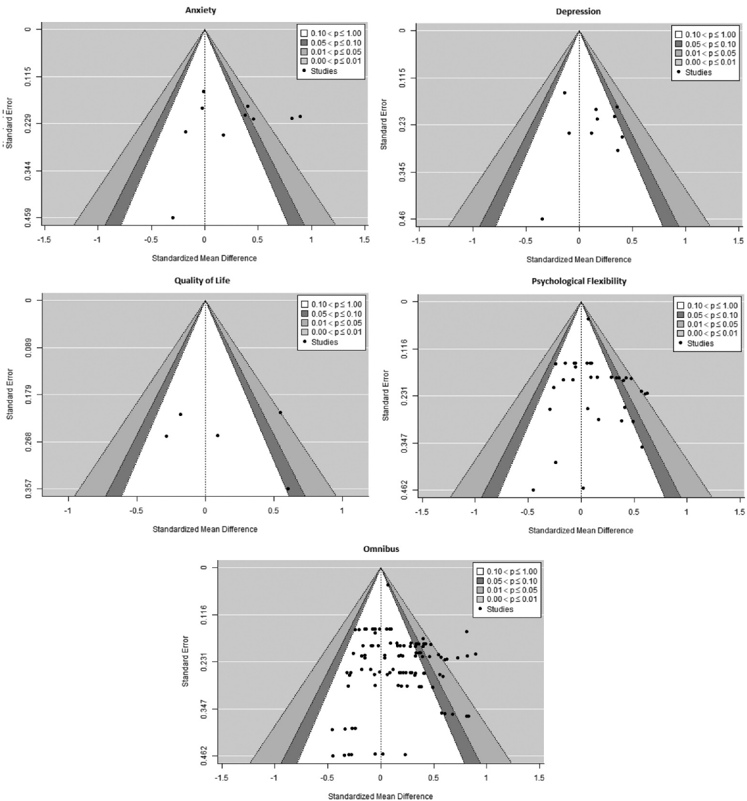
- Intervention features: 38 used a website, 10 used an app, and 5 used a combination; average duration was 9.27 weeks (SD = 9.05; median = 8), ranging from 2 weeks to 1 year; 42 were modular with an average of 6.38 modules (SD = 2.22; range 2–12); 49 included all three ACT pillars; 38 of 53 involved non-automated human support. Publication bias: Egger’s test showed significant asymmetry for waitlist omnibus (p = .017) and active-control omnibus (p = .003), and for waitlist anxiety (p = .012), depression (p = .005), quality of life (p < .001), and psychological flexibility (p = .005).
Methods
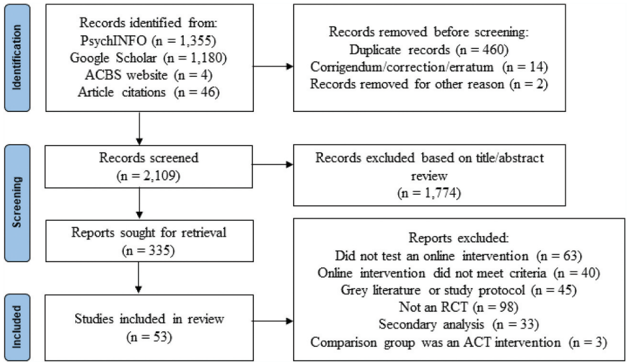
- Systematic review and multi-level meta-analysis; searched PsycINFO and Google Scholar in July 2022 plus prior reviews and the ACTing with Technology SIG list; included 53 RCTs (n = 10,730) of phone- or website-delivered self-guided ACT, requiring at least two of the three ACT pillars, peer-reviewed publication, English language, and pre/post outcomes.
- Data were extracted by three researchers with 84% agreement; intent-to-treat data were used; Hedges’ g random-effects models compared online ACT with waitlist and active controls separately; subgroup analyses covered anxiety, depression, quality of life, psychological flexibility, and an omnibus effect; 3-level and 4-level meta-analyses were run with the metafor package; publication bias was assessed with Egger’s tests and contour-enhanced funnel plots.
Limitations
- Stated: heterogeneity in delivery platform, human support, and treatment length; missing outcome data (21 post-treatment effects across 5 studies; 27 follow-up effects across 4 studies); missing adherence data (25 studies) and satisfaction data (11 studies); outcomes did not always map onto primary targets, potentially diluting effect sizes; RCT-only inclusion may inflate adherence and limit external validity; varying follow-up timepoints; significant publication bias risk; most studies from Europe and North America; exclusion of non-English studies.
- Evident from the text: the review was not formally registered.
Model-written summary. Check it against the paper before relying on it.
Integrity signals
Registry
Cites
Statistics
Figures



Verification
Claims the paper makes
8 Valid · 1 Not valid · 23 Not checked · 90 Own results and interpretations
Every source the paper cites for this claim was checked and supports it.
In the paper
“Given the high heterogeneity regarding how adherence, attrition, and engagement are reported in research on online interventions, comparison with other online programs based in other orientations is somewhat difficult (Beintner et al., 2019).”
What the sources say
- Supportedcites Beintner et al., 2019 matched to “Adherence Reporting in Randomized Controlled Trials Examining Manualized Multisession Online Interventions: Systematic Review of Practices and Proposal for Reporting Standards” (2019) source
The Introduction says that adherence is not consistently reported and that its operationalization varies across trials, limiting comparability. It also documents differing uses of terms including engagement and attrition. The Abstract’s Conclusions likewise state that varied reporting and usage metrics limit comparisons between studies; neither passage specifies therapeutic orientation, but the claim applies this general limitation to comparisons across orientations. Page numbers are not provided in our copy. (LLM, conf=0.91)
hedged- Asserted: passes — The authors put it forward as true.
- Checkable: passes — It can be checked against evidence.
- Load-bearing: unclear — It is unclear whether the paper’s conclusions depend on it.
- Based: passes — The paper gives a reason why it holds.
- Supported
A result the paper reports from its own data — it cites no other source for it, so there is none to check. The quote shows it is in the paper.
In the paper
“Participants typically completed a total of 74% ( n = 13; SD = 11%; median = 72.86%) of all modules, with a range of 53.33% to 94.5%.”
plainn = 13- Asserted: passes — The authors put it forward as true.
- Checkable: passes — It can be checked against evidence.
- Load-bearing: unclear — It is unclear whether the paper’s conclusions depend on it.
- Based: passes — The paper gives a reason why it holds.
A result the paper reports from its own data — it cites no other source for it, so there is none to check. The quote shows it is in the paper.
In the paper
“The pooled effect size for the studies comparing online ACT to waitlist control groups for depression measures during the post-treatment assessment ( k = 27 effects across 24 studies) was a small, significant effect of g = 0.44 (95% CI [0.32, 0.57]), with substantial between-studies heterogeneity ( I 2 = 53.4%) and no within-studies heterogeneity ( I 2 = 0%; see Figure 2(b)).”
plainstates a cause- Asserted: passes — The authors put it forward as true.
- Checkable: passes — It can be checked against evidence.
- Load-bearing: passes — The paper’s conclusions depend on it.
- Based: passes — The paper gives a reason why it holds.
A result the paper reports from its own data — it cites no other source for it, so there is none to check. The quote shows it is in the paper.
In the paper
“The studies that captured follow-up data on depression ( k = 7 effects across seven studies) had a small, significant pooled effect size of g = 0.49 (95% CI [0.30, 0.68]), with negligible between-studies heterogeneity ( I 2 = 3.8%) and within-studies heterogeneity ( I 2 = 3.8%) when comparing online ACT to waitlist control conditions.”
plainstates a cause- Asserted: passes — The authors put it forward as true.
- Checkable: passes — It can be checked against evidence.
- Load-bearing: passes — The paper’s conclusions depend on it.
- Based: passes — The paper gives a reason why it holds.
A result the paper reports from its own data — it cites no other source for it, so there is none to check. The quote shows it is in the paper.
In the paper
“However, no significant effect was found when comparing experiment and waitlist control conditions at follow-up ( k = 6 effects across three studies; g = 0.11; 95% CI [-0.14, 0.36]), with no between or within-studies heterogeneity being present ( I 2 = 0%).”
plain- Asserted: passes — The authors put it forward as true.
- Checkable: passes — It can be checked against evidence.
- Load-bearing: unclear — It is unclear whether the paper’s conclusions depend on it.
- Based: passes — The paper gives a reason why it holds.
53 more claims
Create a free account to see all 122 claims and every source verdict.
- Probably not a substantial claim. 32
- It may state two separate claims as one. 51
Claims other papers make about this one
Each is checked against this paper’s own text: does it say what the citing paper says it does?
The source backs part of the claim, not all of it — or backs it for a different population, condition or comparison.
In the citing paper
“the concept of the transdiagnostic approach (97, 100–109) reflects the observation that improvements in one dimension of psychological experiences are associated with improvements in further dimensions of psychological experiences.”
From Sleep disturbances and psychological well-being among military medical doctors of the Swiss Armed Forces: study protocol, rationale and development of a cross-sectional and longitudinal interventional study (2024) · cites this paper as [102]
Experimental — accuracy not yet measuredThe source backs part of the claim, not all of it — or backs it for a different population, condition or comparison.
In the citing paper
“The average attrition rate reported was 42.4 %, and the mean satisfaction rating out of 10 was 7.3.”
From An open trial of the feasibility of brief internet-delivered acceptance and commitment therapy (iACT) for chronic anxiety and depression (2023) · cites this paper as Klimczak et al., 2023
Experimental — accuracy not yet measuredThe source backs part of the claim, not all of it — or backs it for a different population, condition or comparison.
In the citing paper
“In contrast, no significant differences were found when iACT was compared to active control groups such as treatment-as-usual, placebo intervention, or online CBT.”
From An open trial of the feasibility of brief internet-delivered acceptance and commitment therapy (iACT) for chronic anxiety and depression (2023) · cites this paper as Klimczak et al., 2023
Experimental — accuracy not yet measuredThe cited source says what the claim attributes to it.
In the citing paper
“Furthermore, a systematic review and meta-analysis conducted by Klimczak et al also found that ACT could be effectively delivered as a self-guided online intervention.34”
The cited source says what the claim attributes to it.
In the citing paper
“The interventions had an average of 6.4 modules and took an average of 9.3 weeks to deliver.”
From An open trial of the feasibility of brief internet-delivered acceptance and commitment therapy (iACT) for chronic anxiety and depression (2023) · cites this paper as Klimczak et al., 2023
3 more claims about this paper
Create a free account to see every claim other papers make about this one.
Self-check
Percentages, sums and reported differences re-computed from the paper’s own numbers.
Each contradiction between two passages listed here was confirmed by an independent check.
Rated major: it would touch a result — a value a result rests on, reported and recomputed p-values on opposite sides of the significance level, two passages that conflict with no sign which is right, or a cited work retracted before this paper was published.
In the paper
§ Psychological flexibility
“Among the studies that investigated psychological flexibility at follow-up when comparing experiment and active control conditions ( k = 26 effects across seven studies), a small pooled effect size of g = 0.37 (95% CI [0.24, 0.49]) was found”
§ Anxiety
“| Follow-up ( k = 25) | 0.05 | [-0.15, 0.24] | .632 | .053 | 54.3% | 0% | [-0.43, 0.52] |”
Citations
Cites
R: A Language and Environment for Statistical Computing
R Core Team (2025) · doi:10.32614/r.manuals · Cited by 352,181
Quantifying heterogeneity in a meta‐analysis
Higgins, J. P. T., & Thompson, S. G. (2002) · Statistics in Medicine · doi:10.1002/sim.1186 · Cited by 36,763 · cited 1×
“…a full table of results, including effect size ( g ), 95% confidence intervals, effect size p-values, Cochran’s Q p-values (Cochran, 1954), Higgins and Thompson’s I 2 for both between-study and within-study (J. P. T. Higgins & Thompson, 2002), and 95% prediction intervals (IntHout et al., 2016).”
BackgroundConducting Meta-Analyses in R with the metafor Package
Viechtbauer, W. (2010) · Journal of Statistical Software · doi:10.18637/jss.v036.i03 · Cited by 20,464 · cited 1×
“…for multiple measures of a single construct being nested within a single study (3-level meta-analyses), and multiple constructs being nested within a single study in the case of the omnibus effect (4-level meta-analysis) using the rma. mv() function from the metafor package (Viechtbauer, 2010).”
MethodCochrane Handbook for Systematic Reviews of Interventions
(2019) · doi:10.1002/9781119536604 · Cited by 14,828
An Empirical Evaluation of the System Usability Scale
Bangor, A., Kortum, P. T., & Miller, J. T. (2008) · International Journal of Human–Computer Interaction · doi:10.1080/10447310802205776 · Cited by 5,181
Some Methods for Strengthening the Common χ 2 Tests
Cochran, W. G. (1954) · Biometrics · doi:10.2307/3001616 · Cited by 3,718 · cited 2×
“See Table 1 for a full table of results, including effect size ( g ), 95% confidence intervals, effect size p-values, Cochran’s Q p-values (Cochran, 1954), Higgins and Thompson’s I 2 for both between-study and within-study (J. P. T. Higgins & Thompson, 2002), and 95% prediction intervals (IntHout…”
BackgroundCzeisler, M. É., Lane, R. I., Petrosky, E., Wiley, J. F., Christensen, A., Njai, R., Weaver, M. D., Robbins, R., Facer-Childs, E. R., Barger, L. K., et al. (2020) · MMWR. Morbidity and Mortality Weekly Report · doi:10.15585/mmwr.mm6932a1 · Cited by 2,686
Plea for routinely presenting prediction intervals in meta-analysis.
IntHout, J., Ioannidis, J. P. A., Rovers, M. M., & Goeman, J. J. (2016) · BMJ Open · doi:10.1136/bmjopen-2015-010247 · Cited by 2,264 · cited 2×
“…a full table of results, including effect size ( g ), 95% confidence intervals, effect size p-values, Cochran’s Q p-values (Cochran, 1954), Higgins and Thompson’s I 2 for both between-study and within-study (J. P. T. Higgins & Thompson, 2002), and 95% prediction intervals (IntHout et al., 2016).”
BackgroundAcceptance and commitment therapy.
Hayes, S. C., & Lillis, J. (2012) · American Psychological Association eBooks · doi:10.1037/17335-000 · Cited by 1,543
Borghouts, J., Eikey, E., Mark, G., De Leon, C., Schueller, S. M., Schneider, M., Stadnick, N., Zheng, K., Mukamel, D., & Sorkin, D. H. (2021) · Journal of Medical Internet Research · doi:10.2196/24387 · Cited by 1,069 · cited 2×
“However, these ACT adherence rates appear to be generally similar to those found with other online CBTs (Borghouts et al., 2021; Linardon & FullerTyszkiewicz, 2020).”
ResultFleming, T., Bavin, L., Lucassen, M., Stasiak, K., Hopkins, S., & Merry, S. (2018) · Journal of Medical Internet Research · doi:10.2196/jmir.9275 · Cited by 670 · cited 1×
“Most online interventions are grounded in Cognitive Behavioral Therapy (CBT), with the majority of these using traditional CBT techniques (e.g. cognitive restructuring, progressive muscle relaxation, etc.; Ebert et al., 2018; Fleming et al., 2018).”
BackgroundThe empirical status of acceptance and commitment therapy: A review of meta-analyses
Gloster, A. T., Walder, N., Levin, M. E., Twohig, M. P., & Karekla, M. (2020) · Journal of Contextual Behavioral Science · doi:10.1016/j.jcbs.2020.09.009 · Cited by 622 · cited 2×
“…by a therapist for a wide range of mental health and related problems including anxiety disorders, obsessive compulsive related disorders, depression, substance use, eating disorders, serious mental illness, chronic pain, and coping with chronic health conditions (ACBS, 2022; Gloster et al., 2020).”
BackgroundSelf-citationLinardon, J., & Fuller-Tyszkiewicz, M. (2020) · Journal of Consulting and Clinical Psychology · doi:10.1037/ccp0000459 · Cited by 573 · cited 2×
“…meta-analyses and systematic reviews regarding online ACT interventions were also reviewed for inclusion (Han & Kim, 2022; Kelson et al., 2019; Linardon, 2020; O’Connor et al., 2018; Sierra et al., 2018; Thompson et al., 2021), as well as studies listed on the Association of Contextual…”
BackgroundResultCuijpers, P., Noma, H., Karyotaki, E., Cipriani, A., & Furukawa, T. A. (2019) · JAMA Psychiatry · doi:10.1001/jamapsychiatry.2019.0268 · Cited by 539 · cited 1×
“While synchronous treatment from a therapist is generally perceived as more acceptable than online self-help interventions (Cuijpers et al., 2019), these online interventions help reach a sub-population of individuals who are unwilling to see a therapist (e.g. Levin et al., 2018).”
BackgroundThe efficacy of Acceptance and Commitment Therapy: An updated systematic review and meta-analysis
Öst, L.-G. (2014) · Behaviour Research and Therapy · doi:10.1016/j.brat.2014.07.018 · Cited by 476 · cited 2×
“While significant effect sizes were small, and smaller than the medium effect sizes found for face-to-face therapy (Bai et al., 2020; Öst, 2014), these were comparable to prior effect sizes found by similar online ACT meta-analyses (O’Connor et al., 2018; Thompson et al., 2021).”
ResultInfluentialHarrer, M., Adam, S. H., Baumeister, H., Cuijpers, P., Karyotaki, E., Auerbach, R. P., Kessler, R. C., Bruffaerts, R., Berking, M., & Ebert, D. D. (2019) · International Journal of Methods in Psychiatric Research · doi:10.1002/mpr.1759 · Cited by 445 · cited 1×
“comp() function from the dmetar package (Harrer et al., 2019), representing the proportion of variance in observed effects that represent variance among true effects, as opposed to sampling error.”
BackgroundEbert, D. D., Van Daele, T., Nordgreen, T., Karekla, M., Compare, A., Zarbo, C., Brugnera, A., Øverland, S., Trebbi, G., Jensen, K. L., et al. (2018) · European Psychologist · doi:10.1027/1016-9040/a000318 · Cited by 437 · cited 2×
“Empirically-based online self-help interventions demonstrate significant effects on mental health outcomes as compared to waitlist controls, with several trials suggesting near equivalent effects as compared to face-to-face therapy (Ebert et al., 2018).”
BackgroundAcceptance and Commitment Therapy (ACT) to reduce depression: a systematic review and meta-analysis
Bai, Z., Luo, S., Zhang, L., Wu, S., & Chi, I. (2020) · Journal of Affective Disorders · doi:10.1016/j.jad.2019.09.040 · Cited by 321 · cited 4×
“While significant effect sizes were small, and smaller than the medium effect sizes found for face-to-face therapy (Bai et al., 2020; Öst, 2014), these were comparable to prior effect sizes found by similar online ACT meta-analyses (O’Connor et al., 2018; Thompson et al., 2021).”
MethodResultInfluentialClient preferences affect treatment satisfaction, completion, and clinical outcome: a meta-analysis
Lindhiem, O., Bennett, C. B., Trentacosta, C. J., & McLear, C. (2014) · Clinical Psychology Review · doi:10.1016/j.cpr.2014.06.002 · Cited by 315 · cited 2×
“This is high-lighted by the finding supported by one meta-analysis that clients are more likely to experience greater treatment satisfaction, completion rates, and clinical outcomes when provided with a choice in treatment (Lindhiem et al., 2014).”
ResultEfficacy of Smartphone Applications for Smoking Cessation: A Randomized Clinical Trial
Bricker, J. B., Watson, N. L., Mull, K. E., Sullivan, B. M., & Heffner, J. L. (2020) · JAMA Internal Medicine · doi:10.1001/jamainternmed.2020.4055 · Cited by 207 · cited 1×
“However, it is notable that the two interventions that took place over a full year were outliers (Bricker et al., 2018, 2020), with the second longest intervention taking place over 14 weeks.”
BackgroundBrown, M., Glendenning, A., Hoon, A. E., & John, A. (2016) · Journal of Medical Internet Research · doi:10.2196/jmir.6200 · Cited by 198 · cited 1×
“Previous studies, including meta-analyses and systematic reviews, have demonstrated the efficacy of ACT-based online interventions for depression and anxiety (Brown et al., 2016; Herbert et al., 2022; Kelson et al., 2019; O’Connor et al., 2018; Sierra et al., 2018; Thompson et al., 2021).”
ResultThompson, E. M., Destree, L., Albertella, L., & Fontenelle, L. F. (2021) · Behavior Therapy · doi:10.1016/j.beth.2020.07.002 · Cited by 177 · cited 11×
“While significant effect sizes were small, and smaller than the medium effect sizes found for face-to-face therapy (Bai et al., 2020; Öst, 2014), these were comparable to prior effect sizes found by similar online ACT meta-analyses (O’Connor et al., 2018; Thompson et al., 2021).”
BackgroundMethodResultInfluentialMusiat, P., Johnson, C., Atkinson, M., Wilksch, S., & Wade, T. (2022) · Psychological Medicine · doi:10.1017/s0033291721004621 · Cited by 166 · cited 1×
“Additionally, findings are mixed regarding the impact of these human-supports on adherence and treatment efficacy (Musiat et al., 2021; Shim et al., 2017).”
BackgroundThe use of smartphones for health research
Dorsey, E. R., “Yvonne” Chan, Y.-F., McConnell, M. V., Shaw, S. Y., Trister, A. D., & Friend, S. H. (2017) · Academic Medicine · doi:10.1097/acm.0000000000001205 · Cited by 154 · cited 1×
“Mobile health applications in particular are becoming increasingly popular around the world, with half a billion people downloading at least one of the over 100,000 mobile health apps available (Dorsey et al., 2017).”
BackgroundBaumel, A., Edan, S., & Kane, J. M. (2019) · Translational Behavioral Medicine · doi:10.1093/tbm/ibz147 · Cited by 143 · cited 1×
“It should also be taken into consideration that by way of including only RCTs, results may reflect online intervention use under more ideal conditions as compared to natural use (Baumel et al., 2019).”
BackgroundLinardon, J. (2020) · Behavior Therapy · doi:10.1016/j.beth.2019.10.002 · Cited by 133 · cited 2×
“…meta-analyses and systematic reviews regarding online ACT interventions were also reviewed for inclusion (Han & Kim, 2022; Kelson et al., 2019; Linardon, 2020; O’Connor et al., 2018; Sierra et al., 2018; Thompson et al., 2021), as well as studies listed on the Association of Contextual…”
BackgroundMethodInternet-Delivered Acceptance and Commitment Therapy for Anxiety Treatment: Systematic Review.
Kelson, J., Rollin, A., Ridout, B., & Campbell, A. (2019) · Journal of Medical Internet Research · doi:10.2196/12530 · Cited by 107 · cited 3×
“Studies included in previous meta-analyses and systematic reviews regarding online ACT interventions were also reviewed for inclusion (Han & Kim, 2022; Kelson et al., 2019; Linardon, 2020; O’Connor et al., 2018; Sierra et al., 2018; Thompson et al., 2021), as”
Stawarz, K., Preist, C., & Coyle, D. (2019) · JMIR Mental Health · doi:10.2196/12546 · Cited by 107 · cited 3×
“This is a key finding that reflects a discrepancy between the ACT literature and real-world practice, given that apps are a more commonly accessed method of self-help (Stawarz et al., 2019).”
BackgroundCollege student engagement with mental health apps: analysis of barriers to sustained use
Melcher, J., Camacho, E., Lagan, S., & Torous, J. (2022) · Journal of American College Health · doi:10.1080/07448481.2020.1825225 · Cited by 106 · cited 1×
“However, another study had found that 53% of college students have ever downloaded a self-help app (Melcher et al., 2020).”
BackgroundFeature-level analysis of a novel smartphone application for smoking cessation
Heffner, J. L., Vilardaga, R., Mercer, L. D., Kientz, J. A., & Bricker, J. B. (2015) · The American Journal of Drug and Alcohol Abuse · doi:10.3109/00952990.2014.977486 · Cited by 103 · cited 1×
“, 2019) or the ability to track skills practice (Heffner et al., 2015).”
BackgroundFrench, K., Golijani-Moghaddam, N., & Schröder, T. (2017) · Journal of Contextual Behavioral Science · doi:10.1016/j.jcbs.2017.08.002 · Cited by 100 · cited 2×
“online versus printed books), one study found that online self-help programs are equally effective as compared to print self-help such as books (French et al., 2017).”
BackgroundBricker, J. B., Mull, K. E., McClure, J. B., Watson, N. L., & Heffner, J. L. (2018) · Addiction · doi:10.1111/add.14127 · Cited by 91 · cited 1×
“However, it is notable that the two interventions that took place over a full year were outliers (Bricker et al., 2018, 2020), with the second longest intervention taking place over 14 weeks.”
BackgroundBeintner, I., Vollert, B., Zarski, A.-C., Bolinski, F., Musiat, P., Görlich, D., Ebert, D. D., & Jacobi, C. (2019) · Journal of Medical Internet Research · doi:10.2196/14181 · Cited by 89 · cited 1×
“Given the high heterogeneity regarding how adherence, attrition, and engagement are reported in research on online interventions, comparison with other online programs based in other orientations is somewhat difficult (Beintner et al., 2019).”
BackgroundBennett, C. B., Ruggero, C. J., Sever, A. C., & Yanouri, L. (2020) · Journal of Psychotherapy Integration · doi:10.1037/int0000217 · Cited by 87 · cited 1×
“Considering the number of difficulties individuals have connecting with a therapist face-to-face, online ACT could bridge the gap to make therapy more available, accessible, and affordable (Bennett et al., 2020).”
BackgroundTorous, J., Levin, M. E., Ahern, D. K., & Oser, M. L. (2017) · Cognitive and Behavioral Practice · doi:10.1016/j.cbpra.2016.05.007 · Cited by 73 · cited 6×
“While a previous study conducted in 2017 found only four publicly available ACT apps (Torous et al., 2017), this has since increased to 11 publicly available ACT apps, as compared to only 9 publicly available ACT website interventions (ACTing with Technology SIG, 2021).”
BackgroundMethodInfluentialSelf-citationShim, M., Mahaffey, B., Bleidistel, M., & Gonzalez, A. (2017) · Clinical Psychology Review · doi:10.1016/j.cpr.2017.09.003 · Cited by 72 · cited 1×
“Additionally, findings are mixed regarding the impact of these human-supports on adherence and treatment efficacy (Musiat et al., 2021; Shim et al., 2017).”
BackgroundChoi, I., Sharpe, L., Li, S., & Hunt, C. (2015) · Social Psychiatry and Psychiatric Epidemiology · doi:10.1007/s00127-014-0921-1 · Cited by 64 · cited 1×
“Attitudinal barriers such as treatment seeking stigma, or low perceived need, may be addressed by online programs as well (Choi et al., 2015; Wallin et al., 2018).”
BackgroundO’Connor, M., Munnelly, A., Whelan, R., & McHugh, L. (2018) · Behavior Therapy · doi:10.1016/j.beth.2017.07.007 · Cited by 62 · cited 8×
“…ACT interventions similarly found waitlist control comparisons produced a greater number of significant effects, however these were more promising than our found results given that significant effects were still found for depression and anxiety against active controls (O’Connor et al., 2018).”
BackgroundMethodResultInfluentialSelf‐stigma and the intention to seek psychological help online compared to face‐to‐face
Wallin, E., Maathz, P., Parling, T., & Hursti, T. (2018) · Journal of Clinical Psychology · doi:10.1002/jclp.22583 · Cited by 60 · cited 1×
“Attitudinal barriers such as treatment seeking stigma, or low perceived need, may be addressed by online programs as well (Choi et al., 2015; Wallin et al., 2018).”
BackgroundLevin, M. E., Haeger, J., & Cruz, R. A. (2019) · Mindfulness · doi:10.1007/s12671-018-1004-2 · Cited by 59 · cited 2×
“Online interventions may also offer unique features to facilitate delivery of ACT, such as ecological momentary assessment for tailoring skill coaching (Levin et al., 2019) or the ability to track skills practice (Heffner et al., 2015).”
BackgroundSelf-citationDo College Students Use Online Self-Help? A Survey of Intentions and Use of Mental Health Resources
Levin, M. E., Stocke, K., Pierce, B., & Levin, C. (2018) · Journal of College Student Psychotherapy · doi:10.1080/87568225.2017.1366283 · Cited by 57 · cited 1×
“One study found similar rates of uptake, with 17% of college students having ever used a self-help book, 15% having ever used a self-help website, and 8% having ever used a self-help app (Levin et al., 2017).”
ResultSelf-citationLevin, M. E., Krafft, J., & Levin, C. (2018) · Journal of American College Health · doi:10.1080/07448481.2018.1440580 · Cited by 56 · cited 1×
“While synchronous treatment from a therapist is generally perceived as more acceptable than online self-help interventions (Cuijpers et al., 2019), these online interventions help reach a sub-population of individuals who are unwilling to see a therapist (e.g. Levin et al., 2018).”
BackgroundSelf-citationCarl, J. R., Jones, D. J., Lindhiem, O. J., Doss, B. D., Weingardt, K. R., Timmons, A. C., & Comer, J. S. (2021) · British Journal of Clinical Psychology · doi:10.1111/bjc.12286 · Cited by 50 · cited 1×
“Given recent booms in digital healthcare (Carl et al., 2022), we can expect online interventions to continue increasing in popularity, with research on online self-help already eclipsing self-help book studies regarding rates of publications.”
BackgroundHerbert, M. S., Dochat, C., Wooldridge, J. S., Materna, K., Blanco, B. H., Tynan, M., Lee, M. W., Gasperi, M., Camodeca, A., Harris, D., et al. (2022) · Behaviour Research and Therapy · doi:10.1016/j.brat.2021.103995 · Cited by 44 · cited 1×
“Previous studies, including meta-analyses and systematic reviews, have demonstrated the efficacy of ACT-based online interventions for depression and anxiety (Brown et al., 2016; Herbert et al., 2022; Kelson et al., 2019; O’Connor et al., 2018; Sierra et al., 2018; Thompson et al., 2021).”
ResultCasey, L. M., Wright, M.-A., & Clough, B. A. (2014) · International Journal of Cyber Behavior, Psychology and Learning · doi:10.4018/ijcbpl.2014100102 · Cited by 33 · cited 1×
“Online self-help treatment programs, such as those delivered over websites and smartphone apps, are a step towards addressing these gaps in mental health services (Casey & Clough, 2015; Casey et al., 2014).”
Han, A., & Kim, T. H. (2022) · Journal of Medical Internet Research · doi:10.2196/39182 · Cited by 20 · cited 2×
“Studies included in previous meta-analyses and systematic reviews regarding online ACT interventions were also reviewed for inclusion (Han & Kim, 2022; Kelson et al., 2019; Linardon, 2020; O’Connor et al., 2018; Sierra et al., 2018; Thompson et al., 2021), as well as studies listed on the…”
MethodResultInfluentialSagon, A. L., Danitz, S. B., Suvak, M. K., & Orsillo, S. M. (2018) · Journal of Contextual Behavioral Science · doi:10.1016/j.jcbs.2018.06.004 · Cited by 16 · cited 1×
“One intervention was an exception to both of these categories, and was designed to be completed within two hours (either in a single session, or several shorter session) but was not divided into discreet modules (Sagon et al., 2018).”
BackgroundA Systematic Review and Meta-Analysis of Third-Wave Online Interventions for Depression
Sierra, M. A., Ruiz, F. J., & Flórez, C. L. (2018) · Revista Latinoamericana de Psicología · doi:10.14349/rlp.2018.v50.n2.6 · Cited by 15 · cited 3×
“Studies included in previous meta-analyses and systematic reviews regarding online ACT interventions were also reviewed for inclusion (Han & Kim, 2022; Kelson et al., 2019; Linardon, 2020; O’Connor et al., 2018; Sierra et al., 2018; Thompson et al., 2021), as”
Casey, L. M., & Clough, B. A. (2015) · doi:10.1515/9783110473780-010 · Cited by 14
The Psychology of Social Networking Vol.1: Personal Experience in Online Communities
Riva, G., Wiederhold, B. K., & Cipresso, P. (2015) · doi:10.1515/9783110473780 · Cited by 13
Barbero (2014) · doi:10.1016/j · Cited by 1
Cited by
An Overview of Research on Acceptance and Commitment Therapy
Levin, M. E., Krafft, J., & Twohig, M. P. (2024) · Psychiatric Clinics of North America · doi:10.1016/j.psc.2024.02.007 · Cited by 49
Self-citationPredictors of adherence to a publicly available self-guided digital mental health intervention
Woolley, M. G., Klimczak, K. S., Davis, C. H., & Levin, M. E. (2024) · Cognitive Behaviour Therapy · doi:10.1080/16506073.2024.2341807 · Cited by 27
“…such as cognitive behavioral therapy and acceptance and commitment therapy (ACT), have shown that program completion rates often fall below 50%, and the majority of trial participants typically do not reach full completion of these programs (Klimczak et al., 2023; Lipschitz et al., 2022).”
Self-citationRegli, J., Bahmani, D. S., Rigotti, V., Stanga, Z. G., Ülgür, I. I., Fichter, C., Lang, U. E., Brühl, A. B., & Brand, S. (2024) · Journal of Clinical Medicine · doi:10.3390/jcm13154372 · Cited by 21
Atefi, G. L., van Knippenberg, R. J. M., Bartels, S. L., Losada-Baltar, A., Márquez-González, M., Verhey, F. R. J., & de Vugt, M. E. (2024) · JMIR Aging · doi:10.2196/53489 · Cited by 15
“…revealed a high adherence rate of 83% (24/29) at the postintervention measurements, which exceeded the average adherence rate of 57% found in self-guided ACT interventions [48], 73% found in self-help interventions [24], and 69% found in internet-based treatments for the general population [49].”
BackgroundResultKäll, A., Biliūnaitė, I., & Andersson, G. (2024) · Digital Health · doi:10.1177/20552076241287643 · Cited by 22
Metadata
- Authors
- Klimczak, K. S., San Miguel, G. G., Mukasa, M. N., Twohig, M. P., & Levin, M. E.
- Affiliations
- Utah State University (US)
- Department of Psychology, Utah State University, 2810 Old Main Hill, Logan, UT 84322, USA
- Corresponding author
- Klimczak, Korena S.
- ORCID
- Venue
- Cognitive Behaviour Therapy
- Publisher
- Informa UK Limited
- Published
- 2023-02-27
- Volume
- 52
- Issue
- 3
- Pages
- 269-294
- ISSN
- 1650-6073 (ISSN-L)
- 1651-2316
- OpenAlex
- W4322495356
- Cited by
- 88
- References
- 49
- Citations by year
- 2026: 33 · 2025: 24 · 2024: 23 · 2023: 8
- FWCI
- 4.46
- Type
- journal article
- Language
- en
- Open access
- hybrid
- doi.org
- Licence
- Locations
- Cognitive Behaviour Therapy (publishedVersion, cc-by-nc-nd)
- PubMed (publishedVersion)
- Digital Commons - USU (Utah State University) (submittedVersion, cc-by-nc-nd)
- Topics
- Social Sciences › Psychology › Clinical Psychology › Mindfulness and Compassion Interventions
- Social Sciences › Psychology › Applied Psychology › Digital Mental Health Interventions
- Social Sciences › Psychology › Experimental and Cognitive Psychology › Anxiety, Depression, Psychometrics, Treatment, Cognitive Processes
- Keywords
- acceptance and commitment therapy, online self-help intervention, transdiagnostic treatment, psychological flexibility, anxiety, depression, quality of life, mobile application, waitlist control, follow-up outcomes, digital mental health
- MeSH terms
- Anxiety, Anxiety Disorders, Humans, Mental Health, Quality of Life, Acceptance and Commitment Therapy
About these checks
Registry, retraction, Cites and statistics results are computed, not judged, with one exception: a printed reference that no index lists is read once by a model before it counts as a citation error. Claims are extracted by a model and kept only when their quote appears verbatim in the text; each cited source is then checked, with a model’s help, for whether it says what the claim relies on. Those verdicts can be wrong — read the claim’s quote and the cited source before relying on one.
The claim verdicts this report counts are experimental: their accuracy is not yet measured.
A language model drew the claims from the paper on 2026-10-11, under version 3 of the claim definition (model deepseek-v4.1-flash, prompt extract-v3).
A second model labelled each claim on 2026-10-11 (model jev-1.13-20260917, definition revision gold-guideline-v0.2).
Cited sources are checked with a language model’s help (gpt-6-sol).
Statistics and arithmetic are recomputed, not judged.
Confidence bands are shown only for fields calibrated on our annotated test set. None is calibrated yet, so no band is shown.
What counts as a claim ›How we measure confidence ›How we check this ›
Are you an author, or do you see a problem with this page? Request a review
Data sources
Bibliographic data: Semantic Scholar, OpenAlex, Crossref.
Contains information from the Semantic Scholar Academic Graph Datasets, made available under the ODC Attribution License (ODC-BY 1.0).
Semantic Scholar’s data is described in: Kinney, R., et al. (2023). The Semantic Scholar Open Data Platform. arXiv:2301.10140.
