

Sex differences and hormonal effects on gut microbiota composition in mice
Open accessThe DOI matches its Crossref record; 35 of the 35 references it cites were found in a registry or an index.
Abstract
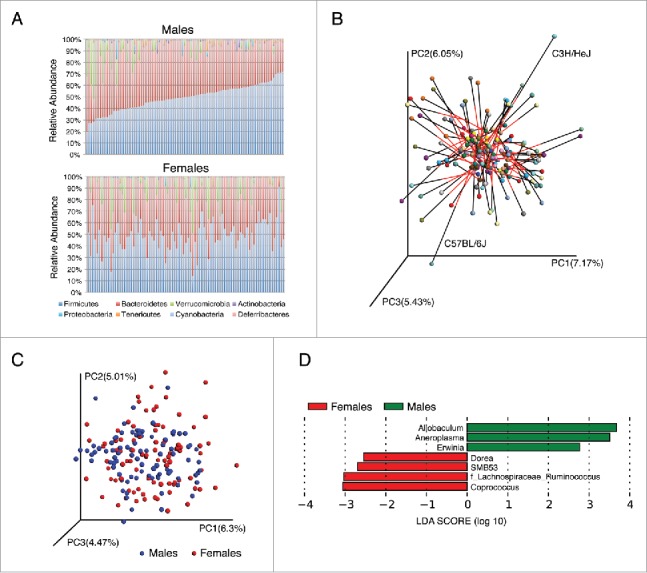
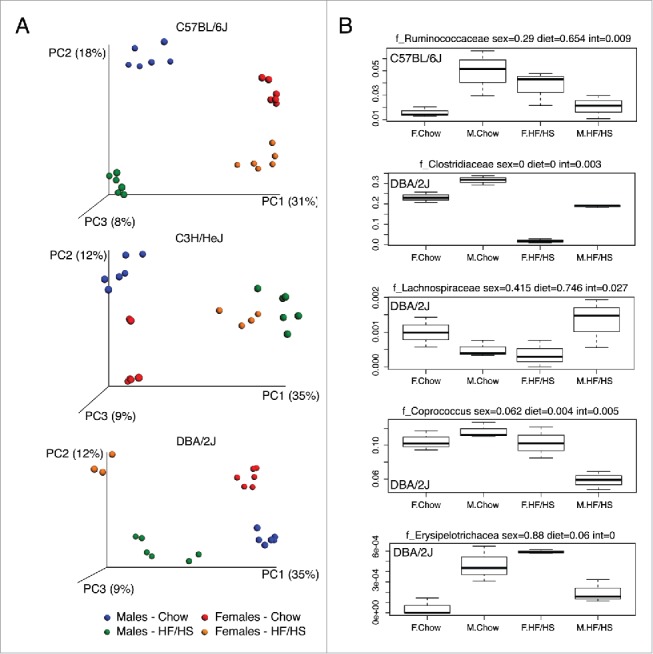
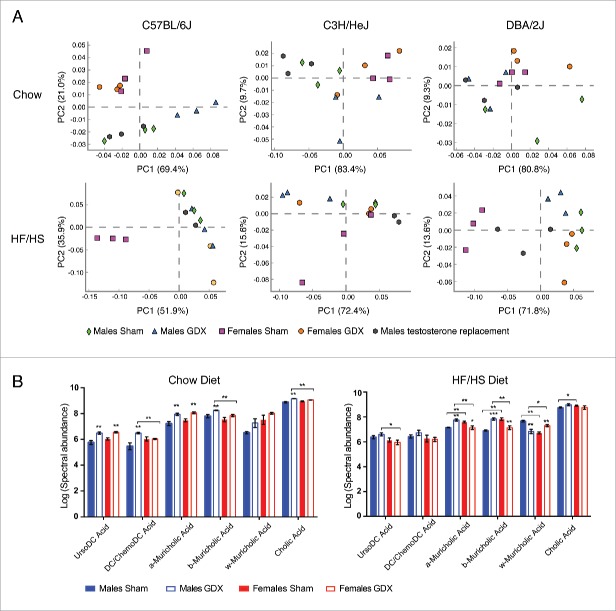
We previously reported quantitation of gut microbiota in a panel of 89 different inbred strains of mice, and we now examine the question of sex differences in microbiota composition. When the total population of 689 mice was examined together, several taxa exhibited significant differences in abundance between sexes but a larger number of differences were observed at the single strain level, suggesting that sex differences can be obscured by host genetics and environmental factors. We also examined a subset of mice on chow and high fat diets and observed sex-by-diet interactions. We further investigated the sex differences using gonadectomized and hormone treated mice from 3 different inbred strains. Principal coordinate analysis with unweighted UniFrac distances revealed very clear effects of gonadectomy and hormone replacement on microbiota composition in all 3 strains. Moreover, bile acid analyses showed gender-specific differences as well as effects of gonodectomy, providing one possible mechanism mediating sex differences in microbiota composition.
Overview
The claims and statistics of this paper haven’t been checked yet.
Free: it reads the open-access text and checks the first 5 claims that cite a source we can check. Create a free account to check every claim.
Integrity signals
Registry
Cites
Statistics
Figures
Verification
Claims the paper makes
The claims and statistics of this paper haven’t been checked yet.
Free: it reads the open-access text and checks the first 5 claims that cite a source we can check. Create a free account to check every claim.
Claims other papers make about this one
Each is checked against this paper’s own text: does it say what the citing paper says it does?
The cited source says what the claim attributes to it.
In the citing paper
“Significant differences in microbial diversity between males and females are first observed following puberty which can be reversed following male castration (6).”
From Association Between Sex Hormone Levels and Gut Microbiota Composition and Diversity—A Systematic Review (2022) · cites this paper as [6]
In the citing paper
“Another study observed a substantial effect of gonadectomy and hormone replacement on the composition of microbial species (6).”
From Association Between Sex Hormone Levels and Gut Microbiota Composition and Diversity—A Systematic Review (2022) · cites this paper as [6]
Self-check
Percentages, sums and reported differences re-computed from the paper’s own numbers.
The self-check needs the paper’s full text.
Citations
Cites
QIIME allows analysis of high-throughput community sequencing data
Caporaso, J. G., Kuczynski, J., Stombaugh, J., Bittinger, K., Bushman, F. D., Costello, E. K., Fierer, N., Peña, A. G., Goodrich, J. K., Gordon, J. I., et al. (2010) · Nature Methods · doi:10.1038/nmeth.f.303 · Cited by 34,887 · cited 1×
“0.(29,30) The total number of sequencing reads was 15,010,979 (an average of 19,571 reads per sample) with an average length of 153 base pair reads.”
BackgroundMetagenomic biomarker discovery and explanation
Segata, N., Izard, J., Waldron, L., Gevers, D., Miropolsky, L., Garrett, W. S., & Huttenhower, C. (2011) · Genome Biology · doi:10.1186/gb-2011-12-6-r60 · Cited by 16,192 · cited 1×
“LEfSe first performs the Kruskall-Wallis test (testing whether the values in different classes are differentially distributed), then a nonparametric Wilcoxon sum-rank test (testing whether all pairwise comparisons between subclasses within different classes significantly agreed with the class level trend) and then fol…”
MethodStructure, function and diversity of the healthy human microbiome
The Human Microbiome Project Consortium (2012) · Nature · doi:10.1038/nature11234 · Cited by 11,726
A human gut microbial gene catalogue established by metagenomic sequencing
MetaHIT Consortium, Qin, J., Li, R., Raes, J., Arumugam, M., Burgdorf, K. S., Manichanh, C., Nielsen, T., Pons, N., Levenez, F., et al. (2010) · Nature · doi:10.1038/nature08821 · Cited by 11,624
Diet rapidly and reproducibly alters the human gut microbiome
David, L. A., Maurice, C. F., Carmody, R. N., Gootenberg, D. B., Button, J. E., Wolfe, B. E., Ling, A. V., Devlin, A. S., Varma, Y., Fischbach, M. A., et al. (2014) · Nature · doi:10.1038/nature12820 · Cited by 10,100
Linking long-term dietary patterns with gut microbial enterotypes
Wu, G. D., Chen, J., Hoffmann, C., Bittinger, K., Chen, Y.-Y., Keilbaugh, S. A., Bewtra, M., Knights, D., Walters, W. A., Knight, R., et al. (2011) · Science · doi:10.1126/science.1208344 · Cited by 6,513
McDonald, D., Price, M. N., Goodrich, J., Nawrocki, E. P., DeSantis, T. Z., Probst, A., Andersen, G. L., Knight, R., & Hugenholtz, P. (2012) · The ISME Journal · doi:10.1038/ismej.2011.139 · Cited by 5,064 · cited 1×
“Sequences were binned into OTUs based on 97% identity using UCLUST(31) against the Greengenes reference database.(32) Each sample’s sequences were rarefied to 17826 reads per strain to reduce the effect of sequencing depth.”
MethodQuality-filtering vastly improves diversity estimates from Illumina amplicon sequencing
Bokulich, N. A., Subramanian, S., Faith, J. J., Gevers, D., Gordon, J. I., Knight, R., Mills, D. A., & Caporaso, J. G. (2013) · Nature Methods · doi:10.1038/nmeth.2276 · Cited by 4,401 · cited 1×
“0.(29,30) The total number of sequencing reads was 15,010,979 (an average of 19,571 reads per sample) with an average length of 153 base pair reads.”
BackgroundSTAMP: statistical analysis of taxonomic and functional profiles
Parks, D. H., Tyson, G. W., Hugenholtz, P., & Beiko, R. G. (2014) · Bioinformatics · doi:10.1093/bioinformatics/btu494 · Cited by 4,191
Bacterial Community Variation in Human Body Habitats Across Space and Time
Costello, E. K., Lauber, C. L., Hamady, M., Fierer, N., Gordon, J. I., & Knight, R. (2009) · Science · doi:10.1126/science.1177486 · Cited by 3,231
Cited by
Items 301–400 of 835
Hu, N., Zhang, X., Yu, Z., Du, Y., He, X., Wang, H., Pu, L., Pan, D., He, S., Liu, X., et al. (2022) · Journal of Hazardous Materials · doi:10.1016/j.jhazmat.2022.129605 · Cited by 29
Self-citationEffect of sex on vaccination outcomes: important but frequently overlooked
Harper, A., & Flanagan, K. L. (2018) · Current Opinion in Pharmacology · doi:10.1016/j.coph.2018.05.009 · Cited by 28
Effects of sex and chronic cigarette smoke exposure on the mouse cecal microbiome
Tam, A., Filho, F. S. L., Won, S., Yang, J., Leung, J. M., Churg, A., Wright, J. L., & Sin, D. D. (2020) · PLoS ONE · doi:10.1371/journal.pone.0230932 · Cited by 29
“performed 16S bacterial sequencing on the cecum of 689 mice from 89 different strains [20].”
BackgroundMethodGut Microbiome in Alzheimer’s Disease: from Mice to Humans
Liang, C., Pereira, R., Zhang, Y., & Rojas, O. L. (2024) · Current Neuropharmacology · doi:10.2174/1570159x22666240308090741 · Cited by 28
“Furthermore, the phenotypic expression of Alzheimer's disease pathology exhibits sexual dimorphism [27, 28].”
BackgroundSex-specific post-inflammatory dysbiosis mediates chronic visceral pain in colitis
Arzamendi, M. J., Habibyan, Y. B., Defaye, M., Shute, A., Baggio, C. H., Chan, R., Ohland, C., Bihan, D. G., Lewis, I. A., Sharkey, K. A., et al. (2024) · Gut Microbes · doi:10.1080/19490976.2024.2409207 · Cited by 27
“37 More recently, the sex-dependent interaction of pain and the microbiome has been studied, where visceral pain was seen to vary across the estrous cycle in specific pathogen-free (SPF) mice but not in germ-free mice.”
BackgroundLi, Y., Zhong, S. S., Yu, J., Sun, Y., Zhu, J., Ji, D.-F., & Wu, C. (2018) · Journal of Functional Foods · doi:10.1016/j.jff.2018.10.034 · Cited by 29
Role of gut microbe-derived metabolites in cardiometabolic diseases: Systems based approach
Cao, Y., Aquino-Martínez, R., Hutchison, E. R., Allayee, H., Lusis, A. J., & Rey, F. E. (2022) · Molecular Metabolism · doi:10.1016/j.molmet.2022.101557 · Cited by 29
“For example, gut microbiota in the HMDP discussed above were studied for sex differences in composition [48].”
BackgroundSelf-citationZhang, T., Ren, H., Du, Z., Zou, T., Guang, X., Zhang, Y., Tian, Y., Zhu, L., Yu, J., Xue, Y., et al. (2022) · Microbiology Spectrum · doi:10.1128/spectrum.02804-22 · Cited by 28
“Sex-specific differences in CAD development and gut microbiota composition are widely reported in animal (43) and human (44) studies.”
BackgroundExploring the Impact of the Microbiome on Neuroactive Steroid Levels in Germ-Free Animals
Diviccaro, S., Caputi, V., Cioffi, L., Giatti, S., Lyte, J. M., Caruso, D., O’Mahony, S. M., & Melcangi, R. C. (2021) · International Journal of Molecular Sciences · doi:10.3390/ijms222212551 · Cited by 29
Zhang, Z., Hyun, J. E., Thiesen, A., Park, H., Hotte, N., Watanabe, H., Higashiyama, T., & Madsen, K. L. (2020) · Nutrients · doi:10.3390/nu12072088 · Cited by 28
“In addition, while it is uncertain if biological sex differences have an impact on the composition of gut microbiota, animal studies have demonstrated that immune and hormonal variations based on the host’s sex can impact the composition and metabolism of gut bacterial communities [22,23].”
BackgroundLiu, W., Huo, G., & Chen, P. (2023) · BMC Cancer · doi:10.1186/s12885-023-10959-3 · Cited by 29
Yang, J.-L., Juhasz, A. L., Li, M., Ding, J., Xue, X.-M., Zhou, D., Ma, L. Q., & Li, H. (2023) · Environmental Science & Technology · doi:10.1021/acs.est.3c02388 · Cited by 27
Microbiota, a New Playground for the Omega-3 Polyunsaturated Fatty Acids in Cardiovascular Diseases
Rousseau, G. (2021) · Marine Drugs · doi:10.3390/md19020054 · Cited by 27
Relandscaping the Gut Microbiota with a Whole Food: Dose–Response Effects to Common Bean
Lutsiv, T., McGinley, J. N., Neil, E. S., Weir, T. L., Foster, M. T., & Thompson, H. J. (2022) · Foods · doi:10.3390/foods11081153 · Cited by 28
“In mice, sex-dependent as well as sex-by-diet-dependent changes in the gut microbiota composition have been reported and attributed predominantly to hormonal effects, especially that of testosterone [58,59].”
BackgroundVahidi, G., Moody, M., Welhaven, H. D., Davidson, L., Rezaee, T., Behzad, R., Karim, L., Roggenbeck, B. A., Walk, S. T., Martin, S. A., et al. (2023) · Journal of Bone and Mineral Research · doi:10.1002/jbmr.4835 · Cited by 29
“Moreover, the composition of microbiome taxa itself is sexually dimorphic.([2,5,7-10]) The reper-”
Liu, M., Zhang, J., Zhou, Y., Xiong, S., Zhou, M., Wu, L., Liu, Q., Chen, Z., Jiang, H., Yang, J., et al. (2023) · Journal of Animal Science and Biotechnology/Journal of animal science and biotechnology · doi:10.1186/s40104-023-00959-5 · Cited by 24
“Sex steroid hormones shape the gut microbiota by regulating the innate immune response [5, 6].”
BackgroundShen, W., Zhao, M., Xu, W., Shi, X., Ren, F., Tu, P., Gao, N., Shan, J., & Gao, B. (2024) · Metabolites · doi:10.3390/metabo14040189 · Cited by 26
“…a relationship between sex hormones and the gut microbiota [20]. in gut microbiota between sexes emerge at puberty onset, which confirms a relationship Gonadectomy and hormone replacement showed clear effects on the composition of the gut microbiota in three different inbred strains of mice [33] .”
BackgroundAndreu‐Sánchez, S., Ahmad, S., Kurilshikov, A., Beekman, M., Ghanbari, M., van Faassen, M. H. J. R., van den Munckhof, I., Steur, M., Harms, A. C., Hankemeier, T., et al. (2024) · iMeta · doi:10.1002/imt2.183 · Cited by 26
“This taxon has previously been linked to be sex ‐ linked in mice and pigs [36, 37].”
BackgroundDuan, X., Nie, Y., Xie, X., Zhang, Q., Zhu, C., Zhu, H., Chen, R., Xu, J. J., Zhang, J., Yang, C., et al. (2024) · Frontiers in Microbiology · doi:10.3389/fmicb.2024.1421608 · Cited by 26
Hawkins, B., Montgomery, M., Bokota, G., Santoyo, M., Giron, E., & Eltokhi, A. (2025) · Gut Microbes · doi:10.1080/19490976.2025.2574934 · Cited by 24
“For example, estrogen enhances microbial richness and shifts gut microbial profiles, 224 potentially contributing to sex-specific disease patterns or treatment responses.”
Nooromid, M. J., Chen, E. B., Xiong, L., Shapiro, K., Jiang, Q., Demsas, F., Eskandari, M., Priyadarshini, M., Chang, E. B., Layden, B. T., et al. (2020) · Journal of the American Heart Association · doi:10.1161/jaha.120.016235 · Cited by 24
How Can the Microbiome Induce Carcinogenesis and Modulate Drug Resistance in Cancer Therapy?
Mendes, I., & Vale, N. (2023) · International Journal of Molecular Sciences · doi:10.3390/ijms241411855 · Cited by 24
“Additionally, sex hormones may also influence the gut microbiome constitution [107].”
BackgroundGiatti, S., Diviccaro, S., Cioffi, L., & Melcangi, R. C. (2023) · Frontiers in Neuroendocrinology · doi:10.1016/j.yfrne.2023.101114 · Cited by 24
“In agreement, sex steroids also affect the gut bacterial communities (Org et al., 2016; Santos-Marcos et al., 2020), and gonadectomy influences the steroid environment in the brain as well as in the gut, differently depending on the sex (Caruso et al., 2010; Diviccaro et al., 2022a; Giatti et al.,…”
BackgroundManes, N. P., Shulzhenko, N., Nuccio, A. G., Azeem, S., Morgun, A., & Nita‐Lazar, A. (2017) · mSystems · doi:10.1128/msystems.00107-17 · Cited by 25
Samuelson, D. R., Gu, M., Shellito, J. E., Molina, P. E., Taylor, C. M., Luo, M., & Welsh, D. A. (2019) · Alcoholism Clinical and Experimental Research · doi:10.1111/acer.14176 · Cited by 30
Zhang, D., Liu, H., Wang, S., Zhang, W., Wang, S., Wang, Y., & Ji, H. (2021) · Applied Microbiology and Biotechnology · doi:10.1007/s00253-021-11310-1 · Cited by 26
“…Ridlon et al. (2013) had shown that Clostridium scindens could convert glucocorticoids to androgens, several types of bacteria could be implicated in steroid secretion or modification, and Org et al. (2016) reported that bacterial genera could correlate positively with testosterone levels.”
BackgroundSpot-light on microbiota in obesity and cancer
Marzullo, P., Bettini, S., Menafra, D., Aprano, S., Muscogiuri, G., Barrea, L., Savastano, S., Colao, A., Colao, A., Savastano, S., et al. (2021) · International Journal of Obesity · doi:10.1038/s41366-021-00866-7 · Cited by 25
“These gender differences are likely explained by actions of sex-related hormones on environment-microbiota interaction [40], as shown in experimental gonadectomy and subsequent sex steroid restoration [40, 41].”
BackgroundLopizzo, N., Marizzoni, M., Begni, V., Mazzelli, M., Provasi, S., Borruso, L., Riva, M. A., & Cattaneo, A. (2021) · Psychoneuroendocrinology · doi:10.1016/j.psyneuen.2021.105416 · Cited by 25
Xie, X., Zhang, L., Yuan, S., Li, H., Zheng, C., Xie, S., Sun, Y., Zhang, C., Wang, R., & Jin, Y. (2021) · Journal of Cellular and Molecular Medicine · doi:10.1111/jcmm.16229 · Cited by 24
Lai, L., Gu, W., Hu, M., Wang, W., Wang, S., Huai, Y., Mei, J., & Wang, C. (2021) · Aging · doi:10.18632/aging.203100 · Cited by 26
“These sex differences reflect the effects of hormones, genes and the environment on the immune system, which can change throughout a person’s life [1, 9].”
BackgroundMini-Review: Gut-Microbiota and the Sex-Bias in Autoimmunity – Lessons Learnt From Animal Models
Rosser, E. C., de Gruijter, N. M., & Matei, D. E. (2022) · Frontiers in Medicine · doi:10.3389/fmed.2022.910561 · Cited by 27
“(21) C57BL/6 Naïve Coprococcus, Bacteroides Increased in females N/A”
BackgroundMethodInfluentialSexual Dimorphism in Neurodegenerative Diseases and in Brain Ischemia
Zalewska, T., Pawelec, P., Ziąbska, K., & Ziemka‐Nałęcz, M. (2022) · Biomolecules · doi:10.3390/biom13010026 · Cited by 29
Oh, H., Min, U.-G., Jang, H.-J., Kim, N., Lim, J., Chalita, M., & Chun, J. (2022) · The Journal of Microbiology · doi:10.1007/s12275-022-1526-0 · Cited by 23
“For example, it is known that differences in the microbiome between the two sexes can be influenced by differences in hormones or dietary patterns (Bolnick et al., 2014; Woo et al., 2014; Org et al., 2016; Bennett et al., 2018; de la Cuesta-Zuluaga et al., 2019).”
BackgroundBubnov, R. V., & Spivak, M. Y. (2023) · Advances in predictive, preventive and personalised medicine · doi:10.1007/978-3-031-19564-8_6 · Cited by 24
Host–diet–microbiota interplay in intestinal nutrition and health
Ignatiou, A., & Pitsouli, C. (2024) · FEBS Letters · doi:10.1002/1873-3468.14966 · Cited by 23
Yak Gut Microbiota: A Systematic Review and Meta-Analysis
Su, Y., Su, J., Li, F., Tian, X., Liu, Z., Ding, G., Bai, J., Li, Z., Ma, Z., & Peppelenbosch, M. P. (2022) · Frontiers in Veterinary Science · doi:10.3389/fvets.2022.889594 · Cited by 23
Mo, Q., Deng, X., Zhou, Z., & Yin, L. (2025) · International Journal of Molecular Sciences · doi:10.3390/ijms26104777 · Cited by 23
“Baseline microbial differences underlie this divergence: males harbor lower α -diversity with Prevotella / Veillonella predominance, while females maintain richer communities enriched in SCFA producers [10,188–194].”
Fecal short‐chain fatty acids vary by sex and amyloid status
Kuehn, J. F., Zhang, Q., Heston, M. B., Kang, J. W., Harding, S. J., Davenport‐Sis, N. J., Peter, D. C., Kerby, R. L., Vemuganti, V., Schiffmann, E. C., et al. (2025) · Alzheimer s & Dementia · doi:10.1002/alz.70877 · Cited by 23
“Given prior evidence suggesting sex differences in both gut microbiome composition 20,21 and AD trajectories, 22,23 we also tested SCFA-by-sex and microbiome-by-sex interaction effects.”
Tao, X., Deng, B., Yuan, Q., Men, X., Wu, J., & Xu, Z. (2021) · Frontiers in Microbiology · doi:10.3389/fmicb.2021.717727 · Cited by 23
Hases, L., Archer, A., & Williams, C. (2022) · Advances in experimental medicine and biology · doi:10.1007/978-3-031-11836-4_12 · Cited by 22
Kouete, M. T., Bletz, M. C., LaBumbard, B. C., Woodhams, D. C., & Blackburn, D. C. (2023) · Animal Microbiome · doi:10.1186/s42523-023-00243-x · Cited by 21
“Studies of mice have also reported sex-related differences in the gut microbiome linked to hormonal differences between males and females [4, 5].”
BackgroundBucurica, S., Lupanciuc, M., Radu, F. I., Ștefan, I., Munteanu, A. E., Anghel, D. N., Jinga, M., & Gaman, L. E. (2023) · International Journal of Molecular Sciences · doi:10.3390/ijms242216034 · Cited by 21
“It is plausible to assume that the sex of the host (based on their reproductive system, chromosome type/hormones) plays an important role in the functionality of the gut microbiome [17,18].”
BackgroundYang, C. N., Dwan, C. A., Wimmer, B. C., Wilson, R., Johnson, L. R., & Caruso, V. (2024) · Marine Drugs · doi:10.3390/md22110485 · Cited by 21
Coordinated Induction of Antimicrobial Response Factors in Systemic Lupus Erythematosus
Ayyappan, P., Harms, R. Z., Buckner, J. H., & Sarvetnick, N. (2019) · Frontiers in Immunology · doi:10.3389/fimmu.2019.00658 · Cited by 23
Androgens augment pulmonary responses to ozone in mice
Osgood, R. S., Kasahara, D. I., Tashiro, H., Cho, Y., & Shore, S. A. (2019) · Physiological Reports · doi:10.14814/phy2.14214 · Cited by 21
“Furthermore, castration has been shown to alter the gut microbiome (Markle et al., 2013; Org et al., 2016).”
BackgroundDeBofsky, A., Xie, Y., Challis, J. K., Jain, N., Brinkmann, M., Jones, P. D., & Giesy, J. P. (2021) · Environmental Pollution · doi:10.1016/j.envpol.2021.116821 · Cited by 22
“This disparity could have resulted from maturation of these fish, since age or sexual differentiation are driving factors in bacterial community composition (Org et al., 2016; Stephens et al., 2015; Wong et al., 2015).”
BackgroundGut microbiome is more stable in males than in females during the development of colorectal cancer
Liao, H., Li, C., Ai, Y., & Kou, Y. (2020) · Journal of Applied Microbiology · doi:10.1111/jam.14943 · Cited by 23
“This may be because sexual maturation, hormones, and differences in the immune system and function profoundly affect microbe colonization in the gut (Markle et al. 2013; Elin et al. 2016; Fransen et al. 2017).”
BackgroundEkanayake, A., Madegedara, D., Chandrasekharan, V., & Magana-Arachchi, D. (2019) · Indian Journal of Microbiology · doi:10.1007/s12088-019-00850-w · Cited by 21
“Studies using mice have shown that differences in microbiota may cause in sexually dimorphic immunity [31].”
BackgroundDing, M., Li, B., Chen, H., Ross, R. P., Stanton, C., Zhao, J., Chen, W., & Yang, B. K. (2024) · Nutrients · doi:10.3390/nu16081148 · Cited by 21
“Furthermore, the effects of B. longum subsp. infantis on mice were intestinal niche-dependent.”
BackgroundSexual dimorphism, aging and immunity
Taneja, V. (2021) · Vitamins and hormones · doi:10.1016/bs.vh.2020.12.015 · Cited by 21
Li, H., Lü, L., Chen, R., Li, S., & Xu, D. (2022) · Frontiers in Microbiology · doi:10.3389/fmicb.2021.808285 · Cited by 23
Investigating Ramadan Like Fasting Effects on the Gut Microbiome in BALB/c Mice
Su, J., Li, F., Wang, Y., Su, Y., Verhaar, A. P., Ma, Z., & Peppelenbosch, M. P. (2022) · Frontiers in Nutrition · doi:10.3389/fnut.2022.832757 · Cited by 23
“In addition, the alterations observed within the bacterial communities might also be provoked by metabolic or immune modifications within host cells such as the production of hormones or ketone bodies, as these factors are known to shape the gut microbiota composition and its function (13, 14).”
BackgroundShi, Y. Q., Lin, W., Lin, X., Wu, S., Yue, F., Xia, K., & Zhang, D. (2022) · Current Microbiology · doi:10.1007/s00284-022-03025-x · Cited by 20
Diviccaro, S., Falvo, E., Piazza, R., Cioffi, L., Herian, M., Brivio, P., Calabrese, F., Giatti, S., Caruso, D., & Melcangi, R. C. (2022) · Neuropharmacology · doi:10.1016/j.neuropharm.2022.109405 · Cited by 22
Tanelian, A., Nankova, B. B., Miari, M., & Sabban, E. L. (2024) · Biology of Sex Differences · doi:10.1186/s13293-024-00590-7 · Cited by 21
“Sex differences in the overall ecological structure and composition of the gut microbiome are extensively reported, both in healthy individuals and in those with various diseases [28, 29, 71, 78, 79].”
BackgroundSeasonal and Sexual Differences in the Microbiota of the Hoopoe Uropygial Secretion
Rodríguez‐Ruano, S. M., Martín‐Vivaldi, M., Peralta‐Sánchez, J. M., García-Martín, A. B., Martínez-García, Á., Soler, J. J., Valdivia, E., & Martínez‐Bueno, M. (2018) · Genes · doi:10.3390/genes9080407 · Cited by 20
Early life microbiome perturbation alters pulmonary responses to ozone in male mice
Brown, T. A., Tashiro, H., Kasahara, D. I., Cho, Y., & Shore, S. A. (2020) · Physiological Reports · doi:10.14814/phy2.14290 · Cited by 20
“There are sex differences in the gut microbiome (Org et al., 2016), and it may be that the bacteria whose alterations contribute to effects of cohousing on responses to O3 in male mice are already similarly altered by female sex.”
BackgroundHarada, N., Hanada, K., Minami, Y., Kitakaze, T., Ogata, Y., Tokumoto, H., Sato, T., Kato, S., Inui, H., & Yamaji, R. (2020) · American Journal of Physiology-Endocrinology and Metabolism · doi:10.1152/ajpendo.00461.2019 · Cited by 22
Sex Differences in Intestinal Microbial Composition and Function of Hainan Special Wild Boar
Wang, X., Zhang, Y., Wen, Q., Wang, Y., Wang, Z., Tan, Z., & Wu, K. (2020) · Animals · doi:10.3390/ani10091553 · Cited by 23
“At the genus level, SMB53 from family Colstridiaceae and three members of family Lachnospiraceae (Dorea, Coprococcus, and Ruminococcus) were found to be more abundant in females than in males [8].”
BackgroundGeary, C. G., Wilk, V. C., Barton, K. L., Jefferson, P. O., Binder, T., Bhutani, V., Baker, C. L., Fernando‐Peiris, A. J., Mousley, A., Rozental, S. F. A., et al. (2021) · Journal of Neuroscience Research · doi:10.1002/jnr.24848 · Cited by 20
“Org et al., 2016).”
Intrinsic and extrinsic factors influence on an omnivore’s gut microbiome
Trujillo, S. M., McKenney, E. A., Hilderbrand, G. V., Mangipane, L. S., Rogers, M. C., Joly, K., Gustine, D. D., Erlenbach, J. A., Mangipane, B. A., & Lafferty, D. J. R. (2022) · PLoS ONE · doi:10.1371/journal.pone.0266698 · Cited by 20
“While this is contrary to other studies on other animal species [76], the link between sex and GMB composition is still unclear [77].”
ResultMa, W., Huang, C., Zhou, Y., Li, J., & Cui, Q. (2017) · Scientific Reports · doi:10.1038/srep40200 · Cited by 20
“We used the union set of associated microbes from different studies for each disease, because current microbiome data are too variable to obtain one consensus microbe set across different studies 19–21 .”
MethodNewton, R. U., Christophersen, C. T., Fairman, C. M., Hart, N. H., Taaffe, D. R., Broadhurst, D., Devine, A., Chee, R., Tang, C., Spry, N. A., et al. (2019) · BMJ Open · doi:10.1136/bmjopen-2018-024872 · Cited by 21
“17 The complex, dynamic interaction between sex hormones and gut microbiome is still poorly understood.(18) Nevertheless, Markle et al(19) demonstrated that elevated levels of testosterone in female mice results in favourable changes in microbiota, metabolomics and inflammation, lending potential support for the role…”
BackgroundToxic effects of DEHP and MEHP on gut-liver axis in rats via intestinal flora and metabolomics
Wang, J., Liu, H., Kou, X., Zhang, Y., Wang, Y., Chen, C.-L., Xiang, Z., Wang, X., Su, C., & Liu, Y.-C. (2024) · iScience · doi:10.1016/j.isci.2024.111135 · Cited by 20
“41 In male animals, fecal microbiota transplantation can penetrate the blood-testis barrier and alter the state of spermatogenesis.”
Habiballah, D. N., Li, F., & Jiang, L. (2025) · Frontiers in Immunology · doi:10.3389/fimmu.2025.1602235 · Cited by 20
“Women possess higher levels of some bene fi cial bacterial species, whereas microbial diversity is higher in men (42, 43).”
Impact of sex and age on the bacterial composition in rumen of Tibetan sheep in Qinghai China
Han, X., Liu, H., Hu, L., Ma, L., Xu, S., Xu, T., Zhao, N., Wang, X., & Chen, Y. (2020) · Livestock Science · doi:10.1016/j.livsci.2020.104030 · Cited by 21
Bao, W., Sun, Y., Lin, Y., Yang, X., & Chen, Z. (2022) · Brain Research · doi:10.1016/j.brainres.2022.148149 · Cited by 19
The Effect of Sex-Specific Differences on IL-10−/− Mouse Colitis Phenotype and Microbiota
Casado‐Bedmar, M., Roy, M., & Viennois, É. (2023) · International Journal of Molecular Sciences · doi:10.3390/ijms241210364 · Cited by 21
“Nevertheless, research has indicated that the influence of sex on gut microbiota composition [42] might be contingent upon the genotype of the host [13].”
BackgroundMartínez-Díaz, I. C., & Páez, L. C. (2023) · Healthcare · doi:10.3390/healthcare11131880 · Cited by 20
“In this sense, it is possible to find some publications in the literature identifying intense exercise, not only HIIT, as one of the causes of cognitive impairment and memory loss [33,34].”
BackgroundDSS treatment does not affect murine colonic microbiota in absence of the host
Krause, J. L., Engelmann, B., Schäpe, S. S., Rolle-Kampczyk, U. E., Jehmlich, N., Chang, H., Slanina, U., Hoffman, M., Lehmann, J., Zenclussen, A. C., et al. (2024) · Gut Microbes · doi:10.1080/19490976.2023.2297831 · Cited by 19
“48 Since male and female gut microbiota differ, 49 although mainly only on the strain level, repeating this experiment with male murine derived microbiota would be beneficial.”
Li, H., Zhuang, P., Zhang, Y., Shou, Q., Lu, Y., Wang, G., Qiu, J., Wang, J., He, L., Chen, J., et al. (2021) · The FASEB Journal · doi:10.1096/fj.202002161rr · Cited by 19
Harada, N., Minami, Y., Hanada, K., Hanaoka, R., Kobayashi, Y., Izawa, T., Sato, T., Kato, S., Inui, H., & Yamaji, R. (2020) · Gut Microbes · doi:10.1080/19490976.2020.1817719 · Cited by 19
Gut Microbiota and Osteoarthritis: From Pathogenesis to Novel Therapeutic Opportunities
Xi, Y., Wang, Z., Wei, Y., Xiao, N., Duan, L., Zhao, T., Zhang, X., Zhang, L., Wang, J., Li, Z., et al. (2025) · The American Journal of Chinese Medicine · doi:10.1142/s0192415x2550003x · Cited by 18
Lyte, J. M., Koester, L. R., Daniels, K. M., & Lyte, M. (2022) · Frontiers in Neuroscience · doi:10.3389/fnins.2022.827343 · Cited by 18
Genetic architecture of heart mitochondrial proteome influencing cardiac hypertrophy
Krishnan, K. C., Hachem, E.-J. E., Keller, M. P., Patel, S. G., Carroll, L., Díaz‐Vegas, A., Gyuricza, I. G., Light, C. M., Cao, Y., Pan, C., et al. (2023) · eLife · doi:10.7554/elife.82619 · Cited by 19
Self-citationGut bacteria and sex differences in colorectal cancer
Yang, X., Li, P., Qu, Z., Jing, Z., Wu, Y., Wu, W., & Wei, Q. (2023) · Journal of Medical Microbiology · doi:10.1099/jmm.0.001706 · Cited by 18
The gut‐microbiota‐brain axis: Focus on gut steroids
Diviccaro, S., Giatti, S., Cioffi, L., Chrostek, G., & Melcangi, R. C. (2024) · Journal of Neuroendocrinology · doi:10.1111/jne.13471 · Cited by 20
Organ-on-Chip Technology for Aerobic Intestinal Host – Anaerobic Microbiota Research
Bossink, E. G. B. M., Segerink, L. I., & Odijk, M. (2021) · Organs-on-a-Chip · doi:10.1016/j.ooc.2021.100013 · Cited by 18
Paroxetine effects in adult male rat colon: Focus on gut steroidogenesis and microbiota
Diviccaro, S., Giatti, S., Cioffi, L., Falvo, E., Piazza, R., Caruso, D., & Melcangi, R. C. (2022) · Psychoneuroendocrinology · doi:10.1016/j.psyneuen.2022.105828 · Cited by 19
KHAN, I. A., Bai, Y., Ullah, N., Liu, G., Rajoka, M. S. R., & Zhang, C. (2022) · Advanced Gut & Microbiome Research · doi:10.1155/2022/7813278 · Cited by 24
“In addition, multiple studies have also reported that animal sex has a profound impact on microbiome study outcomes and have clearly shown sex-specific differences in the composition of the gut microbiota [59, 79, 80].”
BackgroundAlterations in Fecal Microbiota Linked to Environment and Sex in Red Deer (Cervus elaphus)
Sun, Y., Yu, Y., Guo, J., Zhong, L., & Zhang, M. (2023) · Animals · doi:10.3390/ani13050929 · Cited by 18
“Reproductive hormones have also been associated with sex and gut microbial changes in wild animals [17,52,53].”
BackgroundDo high-protein diets have the potential to reduce gut barrier function in a sex-dependent manner?
James, D., Poveda, C. G., Walton, G., Elmore, J. S., Linden, B., Gibson, J., Griffin, B. A., Robertson, M. D., & Lewis, M. C. (2024) · European Journal of Nutrition · doi:10.1007/s00394-024-03407-w · Cited by 19
“Diet-dependent sex differences have pre - viously been reported in animals and humans [82, 84, 94– 96], with human males, in general, being more susceptible to dietary-driven changes in microbiota composition than females [82].”
BackgroundSegmental patterning of microbiota and immune cells in the murine intestinal tract
Anandakumar, H., Rauch, A., Wimmer, M. I., Yarritu, A., Koch, G., McParland, V. J., Bartolomaeus, H., & Wilck, N. (2024) · Gut Microbes · doi:10.1080/19490976.2024.2398126 · Cited by 18
“Emerging evidence 38,50,51 emphasize the need to explore age-and sex-dependent variations in immune-microbiome relationships, offering an important direction for future research in the field of host–microbe interactions.”
BackgroundZhang, L., Yang, F., Li, T., Dayananda, B., Lin, L., & Lin, C.-X. (2022) · Ecology and Evolution · doi:10.1002/ece3.8586 · Cited by 18
Pekkala, S., Lensu, S., Nokia, M., Vanhatalo, S., Koch, L. G., Britton, S. L., & Kainulainen, H. (2017) · Physiological Genomics · doi:10.1152/physiolgenomics.00081.2017 · Cited by 16
“In addition, a study in 89 inbred mice lines showed that several taxa exhibited significant sex-specific differences in the microbiota composition (32).”
BackgroundEstropausal gut microbiota transplant improves measures of ovarian function in adult mice
Kim, M., Wang, J., Pilley, S. E., Lu, R., Xu, A., Kim, Y., Liu, M., Fu, X., Booth, S. L., Mullen, P. J., et al. (2026) · Nature Aging · doi:10.1038/s43587-026-01069-3 · Cited by 18
“While the limited number of existing studies suggest a possible influence of sex hormones on the observed sex differences in the gut microbial profiles 101–103 , these findings do not negate potential effects of nonhor-monal factors, such as those related to sex chromosomes.”
Diviccaro, S., Giatti, S., Cioffi, L., Falvo, E., Herian, M., Caruso, D., & Melcangi, R. C. (2022) · Biomolecules · doi:10.3390/biom12111567 · Cited by 16
Targeting systemic and gut microbial metabolism in ER+ breast cancer
Heath, H., Mogol, A. N., Casiano, A. S., Zuo, Q., & Madak‐Erdogan, Z. (2024) · Trends in Endocrinology and Metabolism · doi:10.1016/j.tem.2023.12.008 · Cited by 18
Pirola, C. J., Landa, M. S., Schuman, M. L., García, S. I., Salatino, A., & Sookoian, S. C. (2024) · Clinical and Molecular Hepatology · doi:10.3350/cmh.2024.0359 · Cited by 17
Sex hormones–Gut microbiome axis: An update of what is known so far
Zommiti, M., & Feuilloley, M. G. J. (2025) · Current Opinion in Endocrine and Metabolic Research · doi:10.1016/j.coemr.2025.100571 · Cited by 17
Sharma, P., Wu, G. G., Kumaraswamy, D., Burchat, N., Ye, H., Gong, Y., Zhao, L., Lam, Y. Y., & Sampath, H. (2021) · Nutrients · doi:10.3390/nu13020637 · Cited by 19
“Importantly, the gut microbiota may be particularly relevant to sex-specific effects—sex is known to be a key determinant of gut microbiota composition [25,26], and there is emerging evidence on the role of gut microbiota in sexual dimorphism, e.”
BackgroundSong, C., Kim, N., Nam, R. H., Choi, S. I., Jang, J. Y., Choi, J., & Lee, H. (2023) · Cancer Research and Treatment · doi:10.4143/crt.2022.1427 · Cited by 16
Caremoli, F., Huynh, J., Lagishetty, V., Markovic, D., Braun, J. G., Dong, T. S., Jacobs, J. P., & Sternini, C. (2023) · Nutrients · doi:10.3390/nu15194145 · Cited by 19
Sex Hormone Androgen Elevates Blood Pressure Through Gut Microbiota-TMAO Pathway
Li, Y., Jiang, H., Chen, L., Yu, J.-Y., Aryal, S., Gao, Y., Zhu, Y., Lu, W.-F., Dai, Z.-M., Huang, L.-L., et al. (2025) · Hypertension · doi:10.1161/hypertensionaha.125.25052 · Cited by 15
Self-citationSex differences feed into nuclear receptor signaling along the digestive tract
Dean, A. E., Reichardt, F., & Anakk, S. (2021) · Biochimica et Biophysica Acta (BBA) - Molecular Basis of Disease · doi:10.1016/j.bbadis.2021.166211 · Cited by 17
Guo, Q., Wang, G., Zheng, L., Xue, H. F., Wang, R., Fang, Y., & Zhang, J. (2025) · Nature Communications · doi:10.1038/s41467-025-57581-4 · Cited by 15
Dedon, L. R., Yuan, H., Chi, J., Gu, H., Arias, A. J., Covault, J., & Zhou, Y. (2025) · Scientific Reports · doi:10.1038/s41598-025-92313-0 · Cited by 17
Habib, S. M., Zwicker, B. L., Wykes, L., & Agellon, L. B. (2021) · Physiological Reports · doi:10.14814/phy2.14733 · Cited by 16
“It has been determined that wild- type male and female mice possess distinct gut microbiomes (Org et al., 2016).”
BackgroundTransfer of Human Microbiome to Drosophila Gut Model
Ji, D., Sun, H., Yang, W., Gao, M., & Xu, H. (2022) · Microorganisms · doi:10.3390/microorganisms10030553 · Cited by 16
“Differences in gut microbiota composition between genders were clearly mediated at least in part by sex hormones [32].”
BackgroundEvariste, L., Lamas, B., Ellero‐Simatos, S., Khoury, L., Cartier, C., Gaultier, E., Chassaing, B., Feltin, N., Devoille, L., Favre, G., et al. (2023) · Particle and Fibre Toxicology · doi:10.1186/s12989-023-00539-5 · Cited by 15
Metadata
- Authors
- Org, E., Mehrabian, M., Parks, B. W., Shipkova, P., Liu, X., Drake, T. A., & Lusis, A. J.
- Affiliations
- University of California, Los Angeles (US)
- University of Wisconsin System (US)
- Bristol-Myers Squibb (United States) (US)
- Corresponding author
- Lusis, Aldons J.
- Venue
- Gut Microbes
- Publisher
- Informa UK Limited
- Published
- 2016-06-29
- Volume
- 7
- Issue
- 4
- Pages
- 313-322
- ISSN
- 1949-0976 (ISSN-L)
- 1949-0984
- PMC
- PMC4988450
- OpenAlex
- W2473762402
- Cited by
- 796
- References
- 35
- Citations by year
- 2026: 75 · 2025: 87 · 2024: 109 · 2023: 85 · 2022: 114 · 2021: 98 · 2020: 81 · 2019: 73 · 2018: 52 · 2017: 18 · 2016: 3
- FWCI
- 25.30
- Type
- journal article
- Language
- en
- Open access
- gold
- doi.org
- Licence
- Locations
- Gut Microbes (publishedVersion, cc-by-nc)
- PubMed Central (publishedVersion, cc-by-nc)
- PubMed (publishedVersion)
- Funders
- European Commission (330381)
- National Institutes of Health (HL‐28481, HL30568, T32-HD07228, HD07228)
- European Regional Development Fund (2014-2020’, 2014-2020.4.01.15-0012, (Project No. 2014-2020.4.01.15-0012), No. 2014-2020.4.01.15-0012)
- National Heart, Lung, and Blood Institute (P01HL030568, R00HL123021)
- National Institute of Diabetes and Digestive and Kidney Diseases (DP3DK094311)
- Eunice Kennedy Shriver National Institute of Child Health and Human Development (T32HD007228)
- Clinical and Translational Science Institute, University of California, Los Angeles
- Topics
- Life Sciences › Biochemistry, Genetics and Molecular Biology › Molecular Biology › Gut microbiota and health
- Health Sciences › Dentistry › Periodontics › Oral microbiology and periodontitis research
- Life Sciences › Agricultural and Biological Sciences › Animal Science and Zoology › Animal Nutrition and Physiology
- Keywords
- gut microbiota composition, sex differences, gonadectomy, hormone replacement therapy, inbred mouse strains, high-fat diet, bile acids, host genetics
- MeSH terms
- Gastrointestinal Microbiome, Animals, Bile Acids and Salts, Feeding Behavior, Female, Hormones, Male, Sex Factors, Gastrointestinal Tract, Mice
About these checks
Registry, retraction, Cites and statistics results are computed, not judged, with one exception: a printed reference that no index lists is read once by a model before it counts as a citation error. Claims are extracted by a model and kept only when their quote appears verbatim in the text; each cited source is then checked, with a model’s help, for whether it says what the claim relies on. Those verdicts can be wrong — read the claim’s quote and the cited source before relying on one.
Statistics and arithmetic are recomputed, not judged.
Confidence bands are shown only for fields calibrated on our annotated test set. None is calibrated yet, so no band is shown.
What counts as a claim ›How we measure confidence ›How we check this ›
Are you an author, or do you see a problem with this page? Request a review
Data sources
Bibliographic data: Semantic Scholar, OpenAlex, Crossref.
Contains information from the Semantic Scholar Academic Graph Datasets, made available under the ODC Attribution License (ODC-BY 1.0).
Semantic Scholar’s data is described in: Kinney, R., et al. (2023). The Semantic Scholar Open Data Platform. arXiv:2301.10140.
