

Sex differences and hormonal effects on gut microbiota composition in mice
Open accessThe DOI matches its Crossref record; 35 of the 35 references it cites were found in a registry or an index.
Abstract
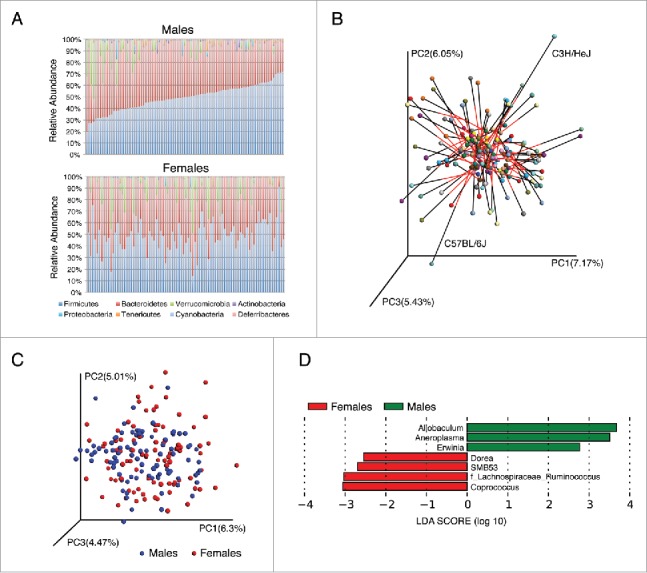
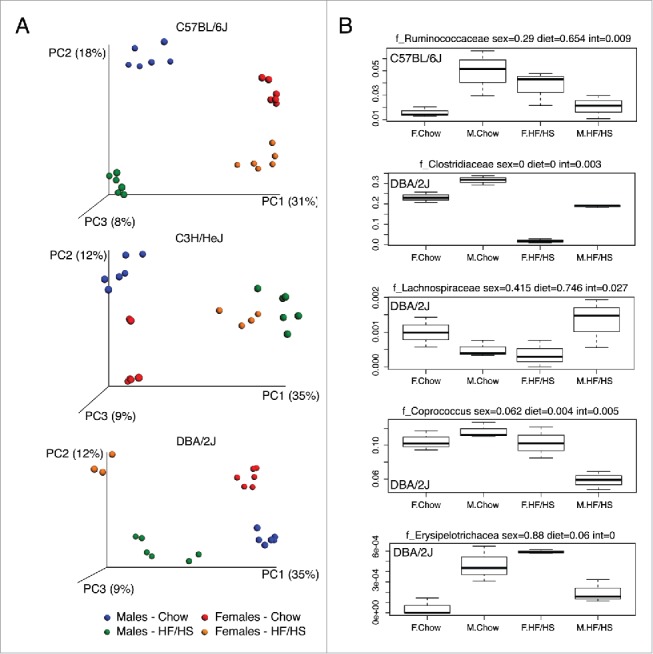
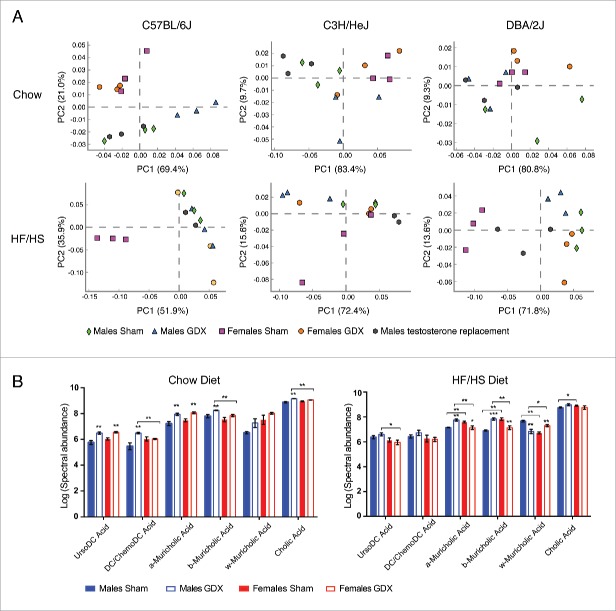
We previously reported quantitation of gut microbiota in a panel of 89 different inbred strains of mice, and we now examine the question of sex differences in microbiota composition. When the total population of 689 mice was examined together, several taxa exhibited significant differences in abundance between sexes but a larger number of differences were observed at the single strain level, suggesting that sex differences can be obscured by host genetics and environmental factors. We also examined a subset of mice on chow and high fat diets and observed sex-by-diet interactions. We further investigated the sex differences using gonadectomized and hormone treated mice from 3 different inbred strains. Principal coordinate analysis with unweighted UniFrac distances revealed very clear effects of gonadectomy and hormone replacement on microbiota composition in all 3 strains. Moreover, bile acid analyses showed gender-specific differences as well as effects of gonodectomy, providing one possible mechanism mediating sex differences in microbiota composition.
Overview
The claims and statistics of this paper haven’t been checked yet.
Free: it reads the open-access text and checks the first 5 claims that cite a source we can check. Create a free account to check every claim.
Integrity signals
Registry
Cites
Statistics
Figures
Verification
Claims the paper makes
The claims and statistics of this paper haven’t been checked yet.
Free: it reads the open-access text and checks the first 5 claims that cite a source we can check. Create a free account to check every claim.
Claims other papers make about this one
Each is checked against this paper’s own text: does it say what the citing paper says it does?
The cited source says what the claim attributes to it.
In the citing paper
“Significant differences in microbial diversity between males and females are first observed following puberty which can be reversed following male castration (6).”
From Association Between Sex Hormone Levels and Gut Microbiota Composition and Diversity—A Systematic Review (2022) · cites this paper as [6]
In the citing paper
“Another study observed a substantial effect of gonadectomy and hormone replacement on the composition of microbial species (6).”
From Association Between Sex Hormone Levels and Gut Microbiota Composition and Diversity—A Systematic Review (2022) · cites this paper as [6]
Self-check
Percentages, sums and reported differences re-computed from the paper’s own numbers.
The self-check needs the paper’s full text.
Citations
Cites
QIIME allows analysis of high-throughput community sequencing data
Caporaso, J. G., Kuczynski, J., Stombaugh, J., Bittinger, K., Bushman, F. D., Costello, E. K., Fierer, N., Peña, A. G., Goodrich, J. K., Gordon, J. I., et al. (2010) · Nature Methods · doi:10.1038/nmeth.f.303 · Cited by 34,887 · cited 1×
“0.(29,30) The total number of sequencing reads was 15,010,979 (an average of 19,571 reads per sample) with an average length of 153 base pair reads.”
BackgroundMetagenomic biomarker discovery and explanation
Segata, N., Izard, J., Waldron, L., Gevers, D., Miropolsky, L., Garrett, W. S., & Huttenhower, C. (2011) · Genome Biology · doi:10.1186/gb-2011-12-6-r60 · Cited by 16,192 · cited 1×
“LEfSe first performs the Kruskall-Wallis test (testing whether the values in different classes are differentially distributed), then a nonparametric Wilcoxon sum-rank test (testing whether all pairwise comparisons between subclasses within different classes significantly agreed with the class level trend) and then fol…”
MethodStructure, function and diversity of the healthy human microbiome
The Human Microbiome Project Consortium (2012) · Nature · doi:10.1038/nature11234 · Cited by 11,726
A human gut microbial gene catalogue established by metagenomic sequencing
MetaHIT Consortium, Qin, J., Li, R., Raes, J., Arumugam, M., Burgdorf, K. S., Manichanh, C., Nielsen, T., Pons, N., Levenez, F., et al. (2010) · Nature · doi:10.1038/nature08821 · Cited by 11,624
Diet rapidly and reproducibly alters the human gut microbiome
David, L. A., Maurice, C. F., Carmody, R. N., Gootenberg, D. B., Button, J. E., Wolfe, B. E., Ling, A. V., Devlin, A. S., Varma, Y., Fischbach, M. A., et al. (2014) · Nature · doi:10.1038/nature12820 · Cited by 10,100
Linking long-term dietary patterns with gut microbial enterotypes
Wu, G. D., Chen, J., Hoffmann, C., Bittinger, K., Chen, Y.-Y., Keilbaugh, S. A., Bewtra, M., Knights, D., Walters, W. A., Knight, R., et al. (2011) · Science · doi:10.1126/science.1208344 · Cited by 6,513
McDonald, D., Price, M. N., Goodrich, J., Nawrocki, E. P., DeSantis, T. Z., Probst, A., Andersen, G. L., Knight, R., & Hugenholtz, P. (2012) · The ISME Journal · doi:10.1038/ismej.2011.139 · Cited by 5,064 · cited 1×
“Sequences were binned into OTUs based on 97% identity using UCLUST(31) against the Greengenes reference database.(32) Each sample’s sequences were rarefied to 17826 reads per strain to reduce the effect of sequencing depth.”
MethodQuality-filtering vastly improves diversity estimates from Illumina amplicon sequencing
Bokulich, N. A., Subramanian, S., Faith, J. J., Gevers, D., Gordon, J. I., Knight, R., Mills, D. A., & Caporaso, J. G. (2013) · Nature Methods · doi:10.1038/nmeth.2276 · Cited by 4,401 · cited 1×
“0.(29,30) The total number of sequencing reads was 15,010,979 (an average of 19,571 reads per sample) with an average length of 153 base pair reads.”
BackgroundSTAMP: statistical analysis of taxonomic and functional profiles
Parks, D. H., Tyson, G. W., Hugenholtz, P., & Beiko, R. G. (2014) · Bioinformatics · doi:10.1093/bioinformatics/btu494 · Cited by 4,191
Bacterial Community Variation in Human Body Habitats Across Space and Time
Costello, E. K., Lauber, C. L., Hamady, M., Fierer, N., Gordon, J. I., & Knight, R. (2009) · Science · doi:10.1126/science.1177486 · Cited by 3,231
Cited by
Items 801–835 of 835
Hu, J., Liu, B., Hu, H., Wu, X., Matarrese, P., D’Archivio, M., Ruggieri, A., Ortona, E., Miao, L., Zhang, J., et al. (2026) · Frontiers in Global Women s Health · doi:10.3389/fgwh.2026.1833361
“Secondly, the sex-based dimorphism of gut microbiota plays an important role (47).”
Duodenal microbiome profiles exhibit sex-specific differences
Rashid, M. A., Leite, G., Barlow, G. M., Hosseini, A., Brimberry, D., Flor, D., Parodi, G., Sanchez, M., Rivera, I., Trujillo, A., et al. (2026) · iScience · doi:10.1016/j.isci.2026.116679
“14,47–49 There is also evidence from human studies: for example, polycystic ovary syndrome (PCOS, now polyendocrine metabolic ovarian syndrome [PMOS]), 50–52 which is a female-specific condition associated with hyperandrogenism, has been linked to gut microbiome alterations, 53–56 and…”
Zhou, T., He, R., Li, Y., Xie, Y., Deng, L., Meng, X., Lian, X., An, J., Gong, Y., & Chen, Q. (2026) · Biology · doi:10.3390/biology15141192
“While differences in sex hormones [45–47] and sex-related immune capacity [48,49] have been suggested in the literature as potential contributing factors, these parameters were not directly examined in the present study; therefore, this interpretation remains preliminary and awaits further…”
High‐Salt Diet Links Gut Microbiota, Intestinal Barrier Function, and Macrophage Responses
Abdulkadyrov, A., Diefenbach-Wilke, M.-L., Mass, E., & Viola, M. F. (2026) · European Journal of Immunology · doi:10.1002/eji.70234
“A growing body of evidence indicates that sex differences actively shape the composition of the gut microbiome and are likely mediated via hormonal factors [ 58–60 ].”
Gutiérrez-Ávila, J. L., Gutiérrez‐Rebolledo, G. A., Avila‐Bonilla, R. G., & Sánchez-Pardo, M. E. (2026) · Journal of Molecular Evolution · doi:10.1007/s00239-026-10338-z
“…dimorphism is well-documented in murine physiology, where it significantly influences immune responses and metabolic regulation (Markle et al. 2013; Org et al. 2016), it remains unclear whether sex-biased microbial functions represent evolutionarily conserved traits or species-specific phenomena…”
Bansal, N. (2026) · Lincoln (University of Nebraska)
Corion, M., Akram, M. Z., Sureda, E. A., Comer, L., Maertens, J., Smeets, N., & Everaert, N. (2026) · Journal of Animal Science and Biotechnology/Journal of animal science and biotechnology · doi:10.1186/s40104-026-01467-y
“Experimental evidence in mice demonstrates that gonadectomy or hormonal manipulation can shift microbial profiles, supporting a causal link between sex hormones and microbial community structure by influencing gut physiology, immune modulation, and nutrient metabolism [41–43].”
CVD Emerging Risk Factors: Gut Microbiota
Abais‐Battad, J. M. (2026) · Physiology in health and disease · doi:10.1007/978-3-032-26472-5_16
Epigenetics, bacterial metabolites and type 2 diabetes: a new view of gut-genome interactions
Taqi, A. F., Albuloushi, A., Saleh, A., Alqaderi, F., AlGharib, T., Al-Abdullah, L., Alzaïd, F., & Kandari, A. (2026) · Frontiers in Microbiology · doi:10.3389/fmicb.2026.1886562
“Sex hormones can shape gut microbiota composition and function, resulting in differences in microbial communities and their responses to environmental factors (Org et al., 2016; Jasarevic et al., 2016).”
Huang, Y., Shi, J., Li, Z., Ma, Y., He, P., Yang, R., & Lei, Z. (2026) · BMC Microbiology · doi:10.1186/s12866-026-05471-0
Early-life gut dysbiosis programs divergent metabolic trajectories in a sex-dependent manner
Su, J., Guo, Y., Shen, L., Wen, Y., Huang, B., & Li, F. (2026) · Gut Microbes · doi:10.1080/19490976.2026.2718681
“15 Our longitudinal analysis of C57BL/6 mice revealed sexually dimorphic gut microbiota configurations across developmental stages, from weaning (3 weeks) through young adulthood (8 weeks)-even during periods of low sex hormone influence.”
Xu, T., Chen, Y., Sheng, W., Li, L., & Wang, X. (2026) · Ecotoxicology and Environmental Safety · doi:10.1016/j.ecoenv.2026.120702
Seifishahpar, M., Kim, J. H., Abdelrahman, M., Kalupahana, N. S., Rohde, A., Kandasamy, A., Thevasagayampillai, S., Castillo, M., Gunaratne, P. H., & Moustaïd‐Moussa, N. (2026) · Journal of Nutrition · doi:10.1016/j.tjnut.2026.101802
Ossandón-Pino, N., Mardones, L., & Vidal, P. M. (2026) · Life Sciences · doi:10.1016/j.lfs.2026.124659
Kheloui, S. (2026) · uO Research (University of Ottawa) · doi:10.20381/ruor-32194
Wang, S., Wang, Y., Li, Z., Mo, T., Liufu, X., Xu, H., Ruan, Y., & Guo, H. (2026) · Biochimica et Biophysica Acta (BBA) - Molecular Basis of Disease · doi:10.1016/j.bbadis.2026.168449
Kusamoto, A., Osuga, Y., Hirota, Y., & Harada, M. (2026) · Reproductive Medicine and Biology · doi:10.1002/rmb2.70097
Gut Commensal Candida albicans Constrains Whole-Body Energy Storage in MicePreprint
Arrieta, M., Gutierrez, M. W., Nguyen, W., Ren, E., Mu, C., Bernardes, E. V. T., Glatthardt, T., Callejas, B. E., Hirota, S. A., & Shearer, J. (2026) · Research Square · doi:10.21203/rs.3.rs-10996465/v1
Fukuda, T., Takagaki, M., Nakamura, H., Ozaki, T., Kadono, Y., Kawabata, S., Terada, E., Nakagawa, R., Matsumura, T., Teranishi, K., et al. (2026) · Brain Research · doi:10.1016/j.brainres.2026.150559
COVID-19, immunity, and vaccination: unravelling the interplay of sex, gender, age, and the exposome
Calabrò, A., Accardi, G., Montomoli, E., Pawelec, G., Trombetta, C. M., & Caruso, C. (2026) · Exploration of Immunology · doi:10.37349/ei.2026.1003268 · Cited by 1
Silva, G. A. V., Tuplin, E. W. N., Kumar, V. M., Chow, M. R., Lowry, D. E., Patterson, R. A., Cho, N. A., Biddle, M. S., Sales, K. M., & Reimer, R. A. (2026) · Nutrition · doi:10.1016/j.nut.2026.113438
Zhao, L., Jia, S., Zhang, N., Li, C., Kang, K., Zhou, T., Wang, C., Wang, M., Li, D., & Tian, H. (2026) · International Dairy Journal · doi:10.1016/j.idairyj.2026.106843
Dean, A. E. (2024) · Illinois Digital Environment for Access to Learning and Scholarship (University of Illinois at Urbana-Champaign)
Niraula, S., Jang, J. W., Jung, J., Stirewalt, S. L., Alagna, M. E., Du, J., Staley, C. M., Seed, P. C., Green, S. J., & Ho, K. J. (2026) · bioRxiv (Cold Spring Harbor Laboratory) · doi:10.64898/2026.10.16.757428
The Childhood Estrobolome: A Missing Link in Early Puberty Onset
Zeyaullah, M., & Ahmad, M. F. (2026) · Endocrine Practice · doi:10.1016/j.eprac.2026.10.008
Byun, S., Sotzen, M. R., Bento, M. T., Knappenberger, M. A., Asker, M., Wright, J., Lamendella, R., Mu, C., & Skibicka, K. P. (2026) · Comprehensive physiology · doi:10.1002/cph4.70286
“Moreover, sex differences in gut microbiome composition and host–microbe interactions are well established, with both hormonal regulation and sex-specific physiological factors contributing to distinct microbial profiles (Org et al. 2016; Hases et al. 2023).”
Ulva lacinulata permeate improves age-related cognitive decline in male mice
Taoufik, A., Debenay, E., Lucas, C., Jarriault, D., Bridiau, N., Bodin, J., Bouvret, E., Fioramonti, X., Joffre, C., & Dinel, A. (2026) · Journal of Functional Foods · doi:10.1016/j.jff.2026.107559
Baqueiro, M. D. N., Costa, J. P., Simino, L. A. D. P., Menta, P. L. D. R., Costa, C. L., Silva, A. F. M., Chaves, W. F., da Silva, F. A., Milanski, M., Ignácio-Souza, L. M., et al. (2026) · Archives of Medical Research · doi:10.1016/j.arcmed.2026.103527
Wu, Q., Zhu, L., Chi, Y., & Dai, J. (2026) · bioRxiv (Cold Spring Harbor Laboratory) · doi:10.64898/2026.10.27.762144
“This gradient suggests that sex influences the microbial metabolome most strongly at its source in the gut, while peripheral filtering dampens sex effects downstream 10,11 .”
A Journal Review: Gut Microbiota Signatures of Vulnerability to Food Addiction in Mice and Humans
Akindemowo, J., Banman, P., Barrientos, K., Berthet, K., Findley, S., Kazmi, M., Khin, Y. M. M., Mehany, J., Nguyen, T. V. V., & Yiu, C. (2026) · doi:10.22186/jyi.29.10.1.1
Sex-specific alterations in gut microbiome composition in patients with Alzheimer's disease
Lin, X.-Q., Hua, H.-H., Zhang, X., Lv, D.-P., Cheng, Z.-S., Hong-yang, Q., & Xu, L. (2026) · Frontiers in Microbiology · doi:10.3389/fmicb.2026.1915847
Sahin, B., Eken, Y., Şahin, F., Karaman, T., Sezerman, O. U., Özer, S., Kaya, Z. Z., Karagozlu, M. Z., Serdar, M. A., Serteser, M., et al. (2026) · International Journal of Molecular Sciences · doi:10.3390/ijms27219879
Xu, Y., Jin, J., An, J., Wei, Q., Zafir, O. C., Bo, Z., Luan, M., Cao, L., & Li, H. (2026) · Frontiers in Microbiology · doi:10.3389/fmicb.2026.1970842
Yu, S., ZhanBao, G., Liu, D., Mu, Q., Wang, L., Zhou, W., 梁素云, Hu, J., Zhang, Y., Xie, M., et al. (2026) · Animal nutrition · doi:10.1016/j.aninu.2026.05.012
Hu, J., Ghoran, S. H., Taktaz, F., Zhang, S., Zhou, P., & Sang, S. (2026) · Journal of Agricultural and Food Chemistry · doi:10.1021/acs.jafc.6c14250
Metadata
- Authors
- Org, E., Mehrabian, M., Parks, B. W., Shipkova, P., Liu, X., Drake, T. A., & Lusis, A. J.
- Affiliations
- University of California, Los Angeles (US)
- University of Wisconsin System (US)
- Bristol-Myers Squibb (United States) (US)
- Corresponding author
- Lusis, Aldons J.
- Venue
- Gut Microbes
- Publisher
- Informa UK Limited
- Published
- 2016-06-29
- Volume
- 7
- Issue
- 4
- Pages
- 313-322
- ISSN
- 1949-0976 (ISSN-L)
- 1949-0984
- PMC
- PMC4988450
- OpenAlex
- W2473762402
- Cited by
- 796
- References
- 35
- Citations by year
- 2026: 75 · 2025: 87 · 2024: 109 · 2023: 85 · 2022: 114 · 2021: 98 · 2020: 81 · 2019: 73 · 2018: 52 · 2017: 18 · 2016: 3
- FWCI
- 25.30
- Type
- journal article
- Language
- en
- Open access
- gold
- doi.org
- Licence
- Locations
- Gut Microbes (publishedVersion, cc-by-nc)
- PubMed Central (publishedVersion, cc-by-nc)
- PubMed (publishedVersion)
- Funders
- European Commission (330381)
- National Institutes of Health (HL‐28481, HL30568, T32-HD07228, HD07228)
- European Regional Development Fund (2014-2020’, 2014-2020.4.01.15-0012, (Project No. 2014-2020.4.01.15-0012), No. 2014-2020.4.01.15-0012)
- National Heart, Lung, and Blood Institute (P01HL030568, R00HL123021)
- National Institute of Diabetes and Digestive and Kidney Diseases (DP3DK094311)
- Eunice Kennedy Shriver National Institute of Child Health and Human Development (T32HD007228)
- Clinical and Translational Science Institute, University of California, Los Angeles
- Topics
- Life Sciences › Biochemistry, Genetics and Molecular Biology › Molecular Biology › Gut microbiota and health
- Health Sciences › Dentistry › Periodontics › Oral microbiology and periodontitis research
- Life Sciences › Agricultural and Biological Sciences › Animal Science and Zoology › Animal Nutrition and Physiology
- Keywords
- gut microbiota composition, sex differences, gonadectomy, hormone replacement therapy, inbred mouse strains, high-fat diet, bile acids, host genetics
- MeSH terms
- Gastrointestinal Microbiome, Animals, Bile Acids and Salts, Feeding Behavior, Female, Hormones, Male, Sex Factors, Gastrointestinal Tract, Mice
About these checks
Registry, retraction, Cites and statistics results are computed, not judged, with one exception: a printed reference that no index lists is read once by a model before it counts as a citation error. Claims are extracted by a model and kept only when their quote appears verbatim in the text; each cited source is then checked, with a model’s help, for whether it says what the claim relies on. Those verdicts can be wrong — read the claim’s quote and the cited source before relying on one.
Statistics and arithmetic are recomputed, not judged.
Confidence bands are shown only for fields calibrated on our annotated test set. None is calibrated yet, so no band is shown.
What counts as a claim ›How we measure confidence ›How we check this ›
Are you an author, or do you see a problem with this page? Request a review
Data sources
Bibliographic data: Semantic Scholar, OpenAlex, Crossref.
Contains information from the Semantic Scholar Academic Graph Datasets, made available under the ODC Attribution License (ODC-BY 1.0).
Semantic Scholar’s data is described in: Kinney, R., et al. (2023). The Semantic Scholar Open Data Platform. arXiv:2301.10140.
