

Sex differences and hormonal effects on gut microbiota composition in mice
Open accessThe DOI matches its Crossref record; 35 of the 35 references it cites were found in a registry or an index.
Abstract
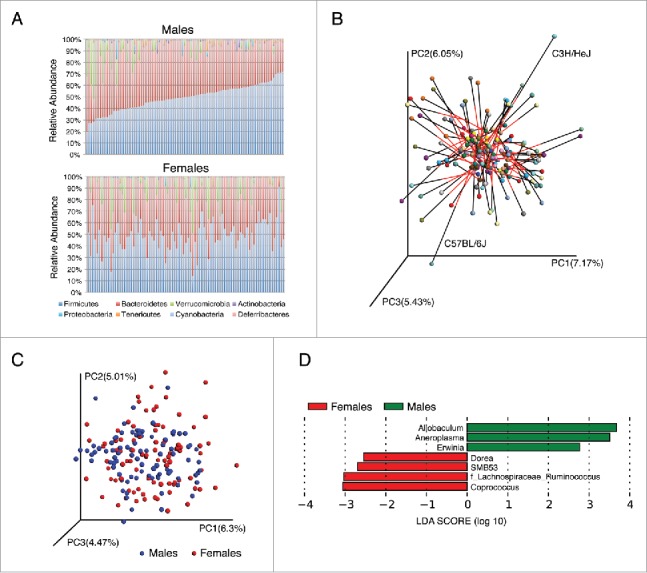
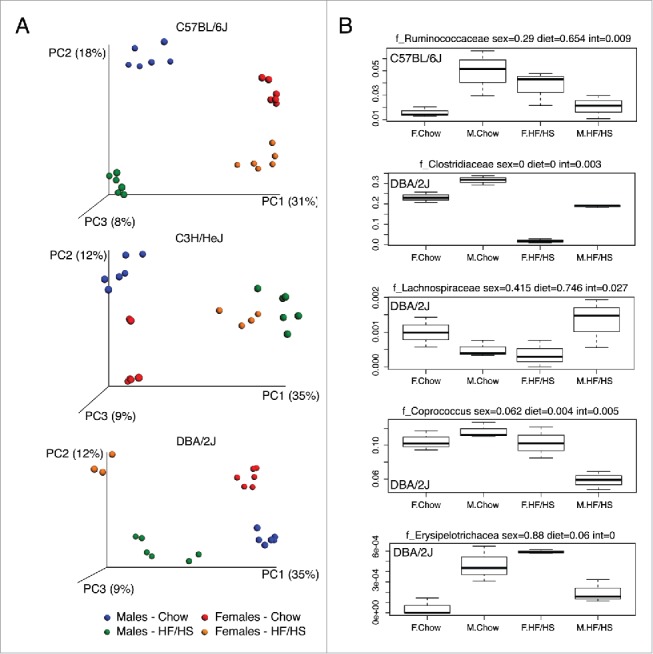
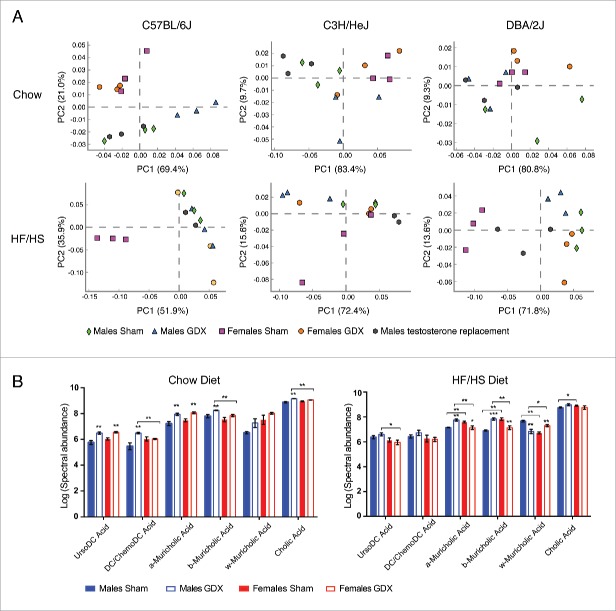
We previously reported quantitation of gut microbiota in a panel of 89 different inbred strains of mice, and we now examine the question of sex differences in microbiota composition. When the total population of 689 mice was examined together, several taxa exhibited significant differences in abundance between sexes but a larger number of differences were observed at the single strain level, suggesting that sex differences can be obscured by host genetics and environmental factors. We also examined a subset of mice on chow and high fat diets and observed sex-by-diet interactions. We further investigated the sex differences using gonadectomized and hormone treated mice from 3 different inbred strains. Principal coordinate analysis with unweighted UniFrac distances revealed very clear effects of gonadectomy and hormone replacement on microbiota composition in all 3 strains. Moreover, bile acid analyses showed gender-specific differences as well as effects of gonodectomy, providing one possible mechanism mediating sex differences in microbiota composition.
Overview
The claims and statistics of this paper haven’t been checked yet.
Free: it reads the open-access text and checks the first 5 claims that cite a source we can check. Create a free account to check every claim.
Integrity signals
Registry
Cites
Statistics
Figures
Verification
Claims the paper makes
The claims and statistics of this paper haven’t been checked yet.
Free: it reads the open-access text and checks the first 5 claims that cite a source we can check. Create a free account to check every claim.
Claims other papers make about this one
Each is checked against this paper’s own text: does it say what the citing paper says it does?
The cited source says what the claim attributes to it.
In the citing paper
“Significant differences in microbial diversity between males and females are first observed following puberty which can be reversed following male castration (6).”
From Association Between Sex Hormone Levels and Gut Microbiota Composition and Diversity—A Systematic Review (2022) · cites this paper as [6]
In the citing paper
“Another study observed a substantial effect of gonadectomy and hormone replacement on the composition of microbial species (6).”
From Association Between Sex Hormone Levels and Gut Microbiota Composition and Diversity—A Systematic Review (2022) · cites this paper as [6]
Self-check
Percentages, sums and reported differences re-computed from the paper’s own numbers.
The self-check needs the paper’s full text.
Citations
Cites
QIIME allows analysis of high-throughput community sequencing data
Caporaso, J. G., Kuczynski, J., Stombaugh, J., Bittinger, K., Bushman, F. D., Costello, E. K., Fierer, N., Peña, A. G., Goodrich, J. K., Gordon, J. I., et al. (2010) · Nature Methods · doi:10.1038/nmeth.f.303 · Cited by 34,887 · cited 1×
“0.(29,30) The total number of sequencing reads was 15,010,979 (an average of 19,571 reads per sample) with an average length of 153 base pair reads.”
BackgroundMetagenomic biomarker discovery and explanation
Segata, N., Izard, J., Waldron, L., Gevers, D., Miropolsky, L., Garrett, W. S., & Huttenhower, C. (2011) · Genome Biology · doi:10.1186/gb-2011-12-6-r60 · Cited by 16,192 · cited 1×
“LEfSe first performs the Kruskall-Wallis test (testing whether the values in different classes are differentially distributed), then a nonparametric Wilcoxon sum-rank test (testing whether all pairwise comparisons between subclasses within different classes significantly agreed with the class level trend) and then fol…”
MethodStructure, function and diversity of the healthy human microbiome
The Human Microbiome Project Consortium (2012) · Nature · doi:10.1038/nature11234 · Cited by 11,726
A human gut microbial gene catalogue established by metagenomic sequencing
MetaHIT Consortium, Qin, J., Li, R., Raes, J., Arumugam, M., Burgdorf, K. S., Manichanh, C., Nielsen, T., Pons, N., Levenez, F., et al. (2010) · Nature · doi:10.1038/nature08821 · Cited by 11,624
Diet rapidly and reproducibly alters the human gut microbiome
David, L. A., Maurice, C. F., Carmody, R. N., Gootenberg, D. B., Button, J. E., Wolfe, B. E., Ling, A. V., Devlin, A. S., Varma, Y., Fischbach, M. A., et al. (2014) · Nature · doi:10.1038/nature12820 · Cited by 10,100
Linking long-term dietary patterns with gut microbial enterotypes
Wu, G. D., Chen, J., Hoffmann, C., Bittinger, K., Chen, Y.-Y., Keilbaugh, S. A., Bewtra, M., Knights, D., Walters, W. A., Knight, R., et al. (2011) · Science · doi:10.1126/science.1208344 · Cited by 6,513
McDonald, D., Price, M. N., Goodrich, J., Nawrocki, E. P., DeSantis, T. Z., Probst, A., Andersen, G. L., Knight, R., & Hugenholtz, P. (2012) · The ISME Journal · doi:10.1038/ismej.2011.139 · Cited by 5,064 · cited 1×
“Sequences were binned into OTUs based on 97% identity using UCLUST(31) against the Greengenes reference database.(32) Each sample’s sequences were rarefied to 17826 reads per strain to reduce the effect of sequencing depth.”
MethodQuality-filtering vastly improves diversity estimates from Illumina amplicon sequencing
Bokulich, N. A., Subramanian, S., Faith, J. J., Gevers, D., Gordon, J. I., Knight, R., Mills, D. A., & Caporaso, J. G. (2013) · Nature Methods · doi:10.1038/nmeth.2276 · Cited by 4,401 · cited 1×
“0.(29,30) The total number of sequencing reads was 15,010,979 (an average of 19,571 reads per sample) with an average length of 153 base pair reads.”
BackgroundSTAMP: statistical analysis of taxonomic and functional profiles
Parks, D. H., Tyson, G. W., Hugenholtz, P., & Beiko, R. G. (2014) · Bioinformatics · doi:10.1093/bioinformatics/btu494 · Cited by 4,191
Bacterial Community Variation in Human Body Habitats Across Space and Time
Costello, E. K., Lauber, C. L., Hamady, M., Fierer, N., Gordon, J. I., & Knight, R. (2009) · Science · doi:10.1126/science.1177486 · Cited by 3,231
Cited by
Items 401–500 of 835
Ghasiyari, H., Rostami‐Nejad, M., Amani, D., Rostami, K., Pourhoseingholi, M. A., Asadzadeh‐Aghdaei, H., & Zali, M. R. (2018) · Journal of Immunology Research · doi:10.1155/2018/7587095 · Cited by 15
“A significant difference for TLR4 according to the gender might be due to significantly higher levels of immune activation and expression of genes associated with inflammatory response in the female’s gut microenvironment compared to men and different gut microbial communities between two sexes [28, 29].”
BackgroundThe emerging role of the gut microbiome in polycystic ovary syndrome
He, Y., Jin, X., Wang, H., Dai, H., Lu, X., Zhao, J., Zhang, H., Chen, W., & Wang, G. (2021) · F&S Reviews · doi:10.1016/j.xfnr.2021.03.003 · Cited by 16
Retention of Microbiota Diversity by Lactose-Free Milk in a Mouse Model of Elderly Gut Microbiota
Ntemiri, A., Ribière, C., Stanton, C., Ross, R. P., O’Connor, E. M., & O’Toole, P. W. (2019) · Journal of Agricultural and Food Chemistry · doi:10.1021/acs.jafc.8b06414 · Cited by 18
Biological determinants and outcomes of sex discrepancies in MASLD
Lonardo, A., Jamalinia, M., & Weiskirchen, R. (2026) · Metabolism and Target Organ Damage · doi:10.20517/mtod.2025.193 · Cited by 16
Zhao, H., Wang, Q., Hu, L., Xing, S., Gong, H., Liu, Z., Qin, P., Xu, J., Du, J., Ai, W., et al. (2022) · International Journal of Endocrinology · doi:10.1155/2022/6600158 · Cited by 19
“It is interesting to note that, in most autoimmune diseases, there is a gender bias and the impact of hormones factor, and research found that germ-free mice lost the gender bias for the incidence of T1D, indicating that sex hormones and microbes can work together to trigger the protective pathways…”
BackgroundFeješ, A., Belvončíková, P., Sanchis, D. P., Borbélyová, V., Celec, P., Džunková, M., & Gardlík, R. (2024) · International Journal of Molecular Sciences · doi:10.3390/ijms25010601 · Cited by 14
“Moreover, castrated adult male mice showed the same gut microbiota composition compared to the adult female mice [35].”
BackgroundKoleva, P. T., He, J., Dunsmore, G., Bozorgmehr, N., Lu, J., Huynh, M., Tollenaar, S. L., Huang, V., Walter, J., Way, S. S., et al. (2024) · Microbiome · doi:10.1186/s40168-024-01859-0 · Cited by 16
“The role of sex in shaping gut microbiome is well-documented in adult mice [48] but our results reveal such changes can be observed from a younger age.”
Lyu, S., Yang, J., Xin, X., Sun, Q., Cai, B., Wang, X., An, Z., Sun, J. G., Hu, Y., Shi, L., et al. (2025) · BMC Gastroenterology · doi:10.1186/s12876-025-03903-1 · Cited by 14
“Hormonal changes strongly affect BA profiles, and sex-specific differences in BA profiles are more prominent in high-fat and high-sugar diets [42].”
Coetzer, W. G., Coetzee, L., Cason, E. D., Grobler, J. P., Schneider, S.-R., & Boucher, C. E. (2020) · Indian Journal of Microbiology · doi:10.1007/s12088-020-00900-8 · Cited by 14
Ganci, M., Suleyman, E., Butt, H., & Ball, M. (2022) · BMC Psychiatry · doi:10.1186/s12888-022-03947-7 · Cited by 14
“Ruminoccocus has been found to be more abundant in females [33, 67], while R.”
BackgroundThe Role of Gut Microbiota in Inflammatory Bowel Disease-Current State of the Art
Safarpour, A. R., Askari, H., Shojaei‐Zarghani, S., Raeis-Abdollahi, E., Jahromi, H. K., Raise‐Abdullahi, P., Daliri, K., Tajbakhsh, A., & Rahmati, L. (2022) · Mini-Reviews in Medicinal Chemistry · doi:10.2174/1389557522666220914093331 · Cited by 15
Sisk-Hackworth, L., Brown, J., Sau, L., Levine, A. A., Tam, L. Y. I., Ramesh, A., Shah, R. S., Kelley-Thackray, E. T., Wang, S., Nguyen, A., et al. (2023) · Biology of Sex Differences · doi:10.1186/s13293-023-00564-1 · Cited by 14
“Additionally, while gonadectomy and sex steroid replacement studies indicate that sex steroid action in adult mice can regulate gut microbiota [30, 31, 105–108], the role of the reproductive axis in sex differentiation of the gut microbiome is unclear.”
BackgroundŠošić‐Jurjević, B., Lütjohann, D., Trifunović, S. L., Pavlović, S. Z., Borković-Mitić, S., Jovanović, L., Ristić, N., Marina, L., Ajdžanović, V. Z., & Filipović, B. R. (2023) · International Journal of Molecular Sciences · doi:10.3390/ijms241612624 · Cited by 14
“Several studies have confirmed the link between bile acids, sex hormones, and gut microbiota composition [49].”
BackgroundBehavior, hormone, and gut microbiota change by YYNS intervention in an OVX mouse model
Lei, H., Liu, J., Deng, J., Zou, P., Zou, Z., Li, Z., Li, H., Luo, L., & Tan, Z. (2024) · Frontiers in Cellular and Infection Microbiology · doi:10.3389/fcimb.2024.1445741 · Cited by 13
Park, H. A., Sung, J., Chang, Y., Ryu, S., Yoon, K. J., Kim, H., & Kim, H. (2024) · Journal of Cachexia Sarcopenia and Muscle · doi:10.1002/jcsm.13636 · Cited by 13
“Microbial composition differs by sex, likely influenced by sex hormones [12, 13], and these differences may contribute to variations in physiological traits, including muscle mass.”
Intervention Effect of Probiotics on the Early Onset of Puberty Induced by Daidzein in Female Mice
Yuan, X., Shangguan, H., Zhang, Y., Lin, X., & Chen, R. (2023) · Molecular Nutrition & Food Research · doi:10.1002/mnfr.202200501 · Cited by 13
Wu, W.-Q., Zhang, Y., Xu, J., Tang, Z., Li, S.-J., Wei, X.-Y., Li, L., Wu, H., Ma, X., Liu, J.-S., et al. (2023) · Infection and Drug Resistance · doi:10.2147/idr.s424048 · Cited by 13
“24,25 However, another study aimed to investigate the effects of gender and body mass index on the composition of the intestinal flora and revealed that although there were no significant differences in the diversity and overall composition of intestinal flora based on gender, the relative…”
BackgroundGe, Z., Feng, Y., Sheh, A., Muthupalani, S., Gong, G., Chawanthayatham, S., Essigmann, J. M., & Fox, J. G. (2019) · International Journal of Cancer · doi:10.1002/ijc.32332 · Cited by 14
“Furthermore, sexbiased MFs may result from distinct effects of male and female hormones capable of modulating the host immune responses and also the gastrointestinal microbiomes.(45) It has been documented that H.”
BackgroundHan, S., Yi, J., Kim, J., & Moon, H. (2020) · Microorganisms · doi:10.3390/microorganisms8060882 · Cited by 13
“Several studies recently showed data regarding differences in the gut microbiota between sexes [38,39].”
BackgroundLi, J., Cui, L., Jiang, X., Zhao, H., Zhao, S., Shi, Y., Wei, D., Li, Y., Ma, J., & Chen, Z. (2020) · Human Reproduction · doi:10.1093/humrep/deaa125 · Cited by 16
Effect of Gender Bias on Equine Fecal Microbiota
Hu, D., Chao, Y., Li, Y., Peng, X., Wang, C., Wang, Z., Zhang, D., & Li, K. (2020) · Journal of Equine Veterinary Science · doi:10.1016/j.jevs.2020.103355 · Cited by 14
PQQ and quinoprotein research--the first decade.
Duine, J. A. (1989) · PubMed · Cited by 14
Fecal microbial composition associated with testosterone in the development of Meishan male pigs
Jiang, X., Deng, S., Lu, N., Yao, W., Xia, D., Tu, W., Lei, H., Jia, P., & Gan, Y. (2023) · Frontiers in Microbiology · doi:10.3389/fmicb.2023.1257295 · Cited by 12
“Gonadectomy and hormone replacement significantly affected rodent intestinal microbiota composition (Org et al., 2016).”
BackgroundGender-affirming hormone therapy preserves skeletal maturation in young mice via the gut microbiome
Pal, S., Morgan, X. C., Dar, H. Y., Gacasan, C. A., Patil, S., Stoica, A., Hu, Y., Weitzmann, M. N., Jones, R. M., & Pacifici, R. (2024) · Journal of Clinical Investigation · doi:10.1172/jci175410 · Cited by 12
Gut microbiome in two high-altitude bird populations showed heterogeneity in sex and life stage
Sun, M., Halimubieke, N., Fang, B., Valdebenito, J. O., Xu, X., Sheppard, S. K., Székely, T., Zhang, T., He, S., Lu, R., et al. (2024) · FEMS Microbes · doi:10.1093/femsmc/xtae020 · Cited by 13
“…of intestinal bacterial communities, suggesting the influence of hormones on the micr obiome thr ough metabolic processes and the immune system (Org et al. 2016 , Wu et al. 2022 ) In wild male rufous-collared sparrows ( Zonotrichia capensis ), individuals with higher testosterone levels were…”
BackgroundPark, G., Johnson, K., Miller, K., Kadyan, S., Singar, S., Patoine, C., Hao, F., Lee, Y., Patterson, A. D., Arjmandi, B. H., et al. (2025) · npj Science of Food · doi:10.1038/s41538-025-00403-0 · Cited by 13
Jayasinghe, T. N., Jenkins, J., Medara, N., Choowong, P., Dharmarathne, G., Kong, F., Cho, H., Kim, S. H., Zhang, Y., Franco‐Duarte, R., et al. (2025) · Nutrients · doi:10.3390/nu17071146 · Cited by 13
“Sex differences in the metabolism, immune responses, and microbiome composition could lead to varied dietary effects [72–74].”
Pan, J., Lin, S. J., Qian, Q., Fu, S., & Liu, X. (2025) · Frontiers in Pharmacology · doi:10.3389/fphar.2025.1621678 · Cited by 13
“Gender is also one of the important host factors in fl uencing the human microbiota (Dominianni et al., 2015; Kim et al., 2020) and the animal microbiota (Elderman et al., 2018; Org et al., 2016).”
Self-citationMetformin Modifies the Gut Microbiota of Mice Infected with Helicobacter pylori
Jauvain, M., Courtois, S., Lehours, P., & Bessède, E. (2021) · Pharmaceuticals · doi:10.3390/ph14040329 · Cited by 12
“Consequently, results obtained are only valid in female and cannot completely be extrapolated to male as there are few differences in the composition of gut microbiota between genders and between female of different hormonal status [46,47].”
BackgroundTurroni, F., Rizzo, S. M., Ventura, M., & Bernasconi, S. (2022) · Microbiome Research Reports · doi:10.20517/mrr.2021.14 · Cited by 12
Meng, K., Lin, X., Liu, H., Chen, H., Liu, F., Xu, Z., Sun, Y., & Luo, D. (2022) · Frontiers in Immunology · doi:10.3389/fimmu.2022.938326 · Cited by 14
“Environmental and host genetic factors shape individual variations in host-associated microbiota community structures (33).”
BackgroundSignificant differences in intestinal fungal community of hooded cranes along the wintering periods
Wu, Y., Li, Z., Zhao, J., Chen, Z., & Xiang, X. (2022) · Frontiers in Microbiology · doi:10.3389/fmicb.2022.991998 · Cited by 12
“, 2015), sex (Org et al., 2016), life style (Vujkovic-Cvijin et al.”
BackgroundKawabata, S., Takagaki, M., Nakamura, H., Nishida, T., Terada, E., Kadono, Y., Izutsu, N., TAKENAKA, T., Yuichi, M., Yamada, S., et al. (2022) · Translational Stroke Research · doi:10.1007/s12975-022-01112-6 · Cited by 12
“Because of the possible effect of sex hormones on GM composition and on the outcomes of SAH, only male rats were included [20, 21].”
Ping, Y., Li, C., Wang, L., & Zhao, H. L. (2023) · Frontiers in Endocrinology · doi:10.3389/fendo.2022.1102605 · Cited by 14
Candel, S., Pérez-Sánz, F., Tyrkalska, S. D., Moreno‐Docón, A., Esteban, Á., Cayuela, M. L., & Mulero, V. (2023) · International Journal of Molecular Sciences · doi:10.3390/ijms24044127 · Cited by 14
“As previously mentioned for the alpha diversity results, multiple sex-associated differences in taxonomic composition have also been described for the human gut microbiome [30], and numerous studies have reported evidence to support the idea that levels of sex hormones, such as progesterone [32], androgen [33], and es…”
BackgroundPing, Y., Gao, Q., Li, C., Wang, Y., Wang, Y., Li, S., Qiu, M., Zhang, L., Tu, A., Tian, Y., et al. (2023) · Frontiers in Endocrinology · doi:10.3389/fendo.2023.1158318 · Cited by 12
“Estrogen imbalance, as an important sign of endocrine disorder, has also been proven to significantly affect the changes in intestinal microbiota (6).”
BackgroundKim, J. E., Tun, H. M., Bennett, D. C., Leung, F. C.-C., & Cheng, K. M. (2023) · Scientific Reports · doi:10.1038/s41598-023-31684-8 · Cited by 13
Neurological risks of COVID-19 in women: the complex immunology underpinning sex differences
Gu, J., Zhang, J., Liu, Q., & Xu, S. (2023) · Frontiers in Immunology · doi:10.3389/fimmu.2023.1281310 · Cited by 12
“The female microbiome exhibits a greater abundance of certain bacteria that shape immune function (67).”
BackgroundAmato-Menker, C. J., Hopen, Q., Pettit, A., Gandhi, J., Hu, G., Schafer, R., & Franko, J. (2024) · Biology of Sex Differences · doi:10.1186/s13293-024-00597-0 · Cited by 12
“Using a panel of over 100 diverse inbred strains of mice, Org et al. identified distinct gut microbial communities in male vs. female mice whose composition was influenced by the presence of male vs. female sex hormones [31].”
BackgroundEffects of sex on fat deposition through gut microbiota and short-chain fatty acids in weaned pigs
Yao, L., Wang, B., Wang, Y., Bai, J., Gao, Y., Ru, X., Bi, C., Li, J., & Shan, A. (2024) · Animal nutrition · doi:10.1016/j.aninu.2024.03.004 · Cited by 12
Analysis of the Intestinal Flora in Male Versus Female Swamp Eels (Monopterus albus)
Wang, Y., Zhang, J., Zhou, Q., Wang, Z., Gao, M., Yang, X., Liu, Y., Zhang, Z., Jiang, W., Hu, C., et al. (2020) · Frontiers in Microbiology · doi:10.3389/fmicb.2020.00699 · Cited by 14
“Also, the intestinal flora has been regarded as a large and complex ecosystem in the body, which is affected by diet, physiological status, environmental factors, genetic factors, and other factors (Filippo et al., 2010; O’Toole, 2012; Zijlmans et al., 2015; Karl et al., 2017).”
BackgroundDuggan, B. M., Tamrakar, A. K., Barra, N. G., Anhê, F. F., Paniccia, G., Wallace, J. G., Stacey, H. D., Surette, M. G., Miller, M. S., Sloboda, D. M., et al. (2021) · Molecular Metabolism · doi:10.1016/j.molmet.2021.101404 · Cited by 13
Intermittent antibiotic treatment accelerated the development of colitis in IL-10 knockout mice
Li, S., Jin, Y., Fu, W., Cox, A. D., Lee, D. Y., & Reddivari, L. (2021) · Biomedicine & Pharmacotherapy · doi:10.1016/j.biopha.2021.112486 · Cited by 12
Smith, K. S., Tissier, A., Bail, J. R., Novak, J. R., Morrow, C. D., Demark‐Wahnefried, W., & Frugé, A. D. (2022) · Supportive Care in Cancer · doi:10.1007/s00520-022-07496-3 · Cited by 17
“Cancer survivors often display gut dysbiosis from chemotherapy, hormone therapy, or radiation side effects [15, 20, 21] and/or poor dietary habits [22].”
BackgroundHu, M.-Y., Yu, Q.-Z., Lin, J., & Fang, S. (2022) · International Journal of Molecular Sciences · doi:10.3390/ijms232012140 · Cited by 11
“Independent analysis of 89 different inbred strains of mice showed significant differences in the gut microbiota between sexes of the same strain [17].”
BackgroundMolon, S., Brun, P., Scarpa, M., Bizzotto, D., Zuccolotto, G., Scarpa, M., Fassan, M., Angriman, I., Rosato, A., Braghetta, P., et al. (2023) · The Journal of Pathology · doi:10.1002/path.6092 · Cited by 11
Host-dependent alteration of the gut microbiota: the role of luminal microRNAs
Cuinat, C., Pan, J., & Comelli, E. M. (2025) · Microbiome Research Reports · doi:10.20517/mrr.2024.46 · Cited by 12
Vella, V. R., Ainsworth-Cruickshank, G., Luft, C., Wong, K. E., Parfrey, L. W., Vogl, A. W., Holman, P. J., Bodnar, T. S., & Raineki, C. (2025) · Neurochemistry International · doi:10.1016/j.neuint.2025.105952 · Cited by 11
“Additionally, a large body of work has demonstrated that there are sex differences in immune function (Klein and Flanagan, 2016; Markle and Fish, 2014; Osborne et al., 2018; Shepherd et al., 2021) as well as microbiota composition (Koliada et al., 2021; Org et al., 2016; Shobeiri et al., 2022).”
Lavrinienko, A., Greppi, A., Häcki, S., Paramonova, D., & Bokulich, N. A. (2025) · Trends in Food Science & Technology · doi:10.1016/j.tifs.2025.105370 · Cited by 12
Choi, Y., & Kim, N. (2022) · Springer eBooks · doi:10.1007/978-981-19-0120-1_19 · Cited by 12
Impact of alcohol-induced intestinal microbiota dysbiosis in a rodent model of Alzheimer’s disease
Frausto, D. M., Engen, P. A., Naqib, A. D., Jackson, A., Tran, L. B., Green, S. J., Shaikh, M. W., Forsyth, C. B., Keshavarzian, A., & Voigt, R. M. (2022) · Frontiers in Aging · doi:10.3389/fragi.2022.916336 · Cited by 11
Gual‐Grau, A., Guirro, M., Boqué, N., & Arola, L. (2023) · The Journal of Nutritional Biochemistry · doi:10.1016/j.jnutbio.2023.109338 · Cited by 12
Infant gut microbiota and negative and fear reactivity
Huovinen, V., Aatsinki, A., Kataja, E., Munukka, E., Keskitalo, A., Lamichhane, S., Raunioniemi, P., Bridgett, D. J., Lahti, L., O’Mahony, S. M., et al. (2023) · Development and Psychopathology · doi:10.1017/s0954579423001396 · Cited by 11
Lindheim, L., Manti, M., Fornes, R., Bashir, M., Czarnewski, P., Diaz, O. E., Seifert, M., Engstrand, L. G., Villablanca, E. J., Obermayer-Pietsch, B. M., et al. (2018) · Journal of the Endocrine Society · doi:10.1210/js.2018-00266 · Cited by 14
“Gonadectomy has been reported to cause changes in the microbiome profiles of both male and female mice and this effect was more prevalent in males on a CD and in females on a high-fat diet [36].”
BackgroundCho, N. A., Nicolucci, A. C., Klančič, T., Wang, W., Sharkey, K. A., Mychasiuk, R., & Reimer, R. A. (2020) · Microorganisms · doi:10.3390/microorganisms8071085 · Cited by 12
“While it is unclear why these sex-dependent differences were seen, they could be related to previously described sex differences in gut microbiota composition in mice and perhaps more importantly by sex-by-diet interactions where depending on the sex of the mice, microbial response to chow or high fat diet differed [7…”
BackgroundEndocrine Disruption and the Gut Microbiome
Acharya, K. D., Parakoyi, A. E. R., & Tetel, M. J. (2021) · Elsevier eBooks · doi:10.1016/b978-0-12-821985-0.00015-3 · Cited by 12
The microbiome and immune system development
Coker, M. O., & Madan, J. C. (2020) · Elsevier eBooks · doi:10.1016/b978-0-12-820602-7.00003-9 · Cited by 11
Astorga-Gaxiola, A. H., Reyes‐Moreno, C., Milán‐Carrillo, J., Jiménez‐Edeza, M., Cuevas-Rodríguez, E.-O., Ruelas, G. M. M. C., & Mora‐Rochín, S. (2023) · International Food Research Journal · doi:10.47836/ifrj.30.1.20 · Cited by 10
“While some authors suggested that gender has no direct effect on microbiota variations, other authors have reported inconclusive evidence to support how sex hormones may influence the commensal microbial community (Org et al., 2016).”
BackgroundRisk of bias assessment tool for systematic review and meta-analysis of the gut microbiome
Lampeter, T., Love, C., Tang, T. T., Marella, A. S., Lee, H. Y., Oganyan, A. K., Moffat, D., Kareem, A., Rusling, M., Massmann, A., et al. (2023) · Gut Microbiome · doi:10.1017/gmb.2023.12 · Cited by 13
“Substantial differences in the gut microbiota are attributable to sex differences in mammals (Org et al., 2016; Kim et al., 2020).”
BackgroundSun, H., Liu, Y., Zeng, T., Li, G., Tao, Z., Zhou, X., Jihui, W., Chen, X., Xu, W., Lu, L., et al. (2022) · Frontiers in Veterinary Science · doi:10.3389/fvets.2022.813800 · Cited by 14
“transport time, which may play important roles in shaping the intestinal microbiome (47, 48).”
BackgroundTayachew, B., Brink, H. V., Garcia‐Reyes, Y., Rahat, H., D’Alessandro, A., Frank, D. N., Robertson, C. E., Silveira, L. J., Kelsey, M. M., Pyle, L. L., et al. (2022) · Frontiers in Physiology · doi:10.3389/fphys.2022.887077 · Cited by 10
“(Org et al., 2016) It is plausible that the dose of exogenous hormones and duration of OCP exposure in human studies may not have been sufficient to drive detectable differences in α-diversity indices.”
BackgroundVedel, G., Triadó–Margarit, X., Linares, O., Moreno‐Rojas, J. M., de la Peña, E., García‐Bocanegra, I., Jiménez‐Martín, D., Carranza, J., & Casamayor, E. O. (2023) · Microbiological Research · doi:10.1016/j.micres.2023.127444 · Cited by 12
“In addition, many studies have shown sex-specific differences in the composition of the gut microbiota (Markle et al., 2013; Org et al., 2016; Elderman et al., 2018; Wang et al., 2020), suggesting that gender can regulate the microbiota composition through hormone-microbe interactions and immune…”
Dirr, E. W., Jiracek-Sapieha, L., Baekey, D. M., Martyniuk, C. J., Otto, K. J., & Zubcevic, J. A. (2023) · Physiological Genomics · doi:10.1152/physiolgenomics.00016.2023 · Cited by 10
Garrison, E. C., Brown, A. M. V., Salazar, M. M., Barr, B., Moustaïd‐Moussa, N., & Gollahon, L. (2024) · Nutrients · doi:10.3390/nu16111613 · Cited by 11
Wang, J., Su, C., Qian, M., Wang, X., Chen, C.-L., Liu, Y.-C., Liu, W., Xiang, Z., & Xu, B. (2024) · Frontiers in Endocrinology · doi:10.3389/fendo.2024.1415216 · Cited by 12
“Hormones also have an impact on the gut microbiota, with both gonadectomy and hormone replacement therapy causing signi fi cant changes in the species composition of the gut microbiota (20).”
BackgroundGut microbiota composition does not associate with toxoplasma infection in rats
Taggart, P. L., Liddicoat, C., Tong, W. H., Breed, M. F., Weinstein, P., Wheeler, D. A., & Vyas, A. (2022) · Molecular Ecology · doi:10.1111/mec.16552 · Cited by 10
Sex Differences in Fecal Microbiome Composition and Function of Dromedary Camels in Saudi Arabia
Elbir, H., & Alhumam, N. (2022) · Animals · doi:10.3390/ani12233430 · Cited by 10
“The cross-talk between microbiota and sex hormones likely acts by directly affecting the growth of specific taxa and by influencing the immune response to gut microbiota [40].”
BackgroundFecal microbiota transplants modulate the gut microbiome of a two‐toed sloth (Choloepus didactylus)
Thacher, P., Kendrick, E. L., Maslanka, M., Muletz‐Wolz, C. R., & Bornbusch, S. L. (2023) · Zoo Biology · doi:10.1002/zoo.21751 · Cited by 10
Han, J., Cui, C., Li, Y., Gao, H., Zhang, H., Zhang, C., Li, Y., Zhou, J., Lu, C., & Su, X. (2018) · Journal of Functional Foods · doi:10.1016/j.jff.2018.07.052 · Cited by 11
López-Martínez, J. M., Santana‐Gálvez, J., González, C. J. A., Santacruz, A., Guerra, C. A. A., & Jacobo‐Velázquez, D. A. (2020) · CyTA - Journal of Food · doi:10.1080/19476337.2020.1711813 · Cited by 11
“…system (Bridgewater et al., 2017; Bullock, Gemzik, Johnson, Thomast, & Parkinson, 1991; Czerniak, 2001; Fukuno, Nagai, Horii, Yamamoto, & Konishi, 2018; Fukushima et al., 2015; Jasarevic´, Morrison, & Bale, 2016; Org et al., 2016), suggesting that compounds may undergo gender-dependent metabolism.”
Yong-xian, Y., Zhang, F., Yu, X., Wang, L., & Wang, Z. (2024) · Frontiers in Microbiology · doi:10.3389/fmicb.2024.1403166 · Cited by 11
Associations Between Gut Microbiota Composition and Impulse Control Disorders in Parkinson’s Disease
Lin, S., Lin, R.-J., Chu, C.-L., Chen, Y., & Fu, S. (2025) · International Journal of Molecular Sciences · doi:10.3390/ijms26136146 · Cited by 9
The Gut Microbiota–Sex–Immunity Axis in Non-Communicable Diseases
Caldarelli, M., Rio, P., Franza, L., Cutrupi, S., Menegolo, M., Franceschi, F., Gasbarrini, A., Gambassi, G., & Cianci, R. (2025) · Life · doi:10.3390/life15101510 · Cited by 11
“The interaction between biological sex and the GM appears to be critically important especially in the case of cancer, autoimmune diseases, and metabolic and cardiovascular diseases [24,43].”
Blossom, S. J., Gokulan, K., Arnold, M., & Khare, S. (2020) · Frontiers in Pharmacology · doi:10.3389/fphar.2020.569008 · Cited by 9
“Another plausible explanation for the disparity in the male and female microbial population could be the intrinsic presence of sex-specific microbiota composition (Org et al., 2016).”
BackgroundYoungblut, N. D., de la Cuesta‐Zuluaga, J., & Ley, R. E. (2022) · Environmental Microbiology · doi:10.1111/1462-2920.15910 · Cited by 12
Martinez, B., Schwerdtfeger, L., Richardson, A., Tobet, S. A., & Henry, C. S. (2022) · Analytical Chemistry · doi:10.1021/acs.analchem.1c05146 · Cited by 11
Jiang, X., Dai, Y., Wang, Y., Guo, K., Du, Y., Gao, J.-F., Lin, L., Li, P., Li, H., Ji, X., et al. (2023) · Animals · doi:10.3390/ani13081365 · Cited by 9
“The structure and diversity of gut microbiota are susceptible to numerous external and internal factors, including the host’s taxonomic category [11,12], sex [13], healthy status [14], age [6], dietary habit [15], and living environment [16].”
BackgroundThe study on the impact of sex on the structure of gut microbiota of bamboo rats in China
Gan, Y., Wu, Y., Dong, Y., Li, Q., Shu-guang, W., Jin, Y.-Q., & Lu, T. (2023) · Frontiers in Microbiology · doi:10.3389/fmicb.2023.1276620 · Cited by 10
The gut microbiome as a modulator of arterial function and age-related arterial dysfunction
Longtine, A. G., Greenberg, N., de Quirós, Y. B., & Brunt, V. E. (2024) · American Journal of Physiology-Heart and Circulatory Physiology · doi:10.1152/ajpheart.00764.2023 · Cited by 13
Understanding Aging through the Lense of Gut Microbiome
Ira, R., Adwani, J., Krishnan, A. O., Subramanian, G., Yadav, S., Shukla, S., Rao, S., & Prakash, T. (2024) · Exploratory Research and Hypothesis in Medicine · doi:10.14218/erhm.2024.00008 · Cited by 12
Wu, T., Xu, G., Hong, X., Fan, H., Zeng, J., Liu, Y., Hu, J., Liang, F., Yang, J., & Chen, J. (2024) · Frontiers in Endocrinology · doi:10.3389/fendo.2024.1509152 · Cited by 10
“It is believed that changes in the composition of intestinal microorganisms lead to abnormal metabolites, causing in fl ammation in the intestines and ovaries, abnormal metabolism in the whole body, and obesity (16 – 18), which, in turn, affects the hormone levels (19, 20).”
d’Ettorre, G., Borrazzo, C., Pinacchio, C., Santinelli, L., Cavallari, E. N., Statzu, M., Fanello, G., Ceccarelli, G., Antonelli, G., Vullo, V., et al. (2019) · AIDS · doi:10.1097/qad.0000000000002122 · Cited by 11
Colonic bacterial composition is sex-specific in aged CD-1 mice fed diets varying in fat quality
Unger, A. L., Eckstrom, K. M., Jetton, T. L., & Kraft, J. (2019) · PLoS ONE · doi:10.1371/journal.pone.0226635 · Cited by 10
“Although the mechanisms are not fully understood, the relationship between sex and the gut bacterial community structure is thought to be driven by differences in circulating sex hormones [35].”
BackgroundMethodMills, M. C., Evans, M. V., Lee, S., Knobloch, T. J., Weghorst, C. M., & Lee, J. (2021) · Ecotoxicology and Environmental Safety · doi:10.1016/j.ecoenv.2021.112126 · Cited by 11
Exposure to chlorinated drinking water alters the murine fecal microbiota
Jandová, J., Schiro, G., Duca, F. A., Laubitz, D., & Wondrak, G. T. (2024) · The Science of The Total Environment · doi:10.1016/j.scitotenv.2024.169933 · Cited by 11
Gender Difference and Dietary Supplemental Vitamin B6: Impact on Colon Luminal Environment
Nirmagustina, D. E., Yang, Y., Kumrungsee, T., Yanaka, N., & Katô, N. (2018) · Journal of Nutritional Science and Vitaminology · doi:10.3177/jnsv.64.116 · Cited by 9
Microbial Metabolites in Cancer Promotion or Prevention
Cox‐York, K. A., Stoecker, E., Hamm, A. K., & Weir, T. L. (2019) · Current cancer research · doi:10.1007/978-3-030-04155-7_15 · Cited by 10
Sex Differences in Mouse Popliteal Lymph Nodes
Dill, R., Chen, K.-H. E., & Walker, A. M. (2019) · Scientific Reports · doi:10.1038/s41598-018-37175-5 · Cited by 9
Different gut microbiome composition in obese Guizhou minipigs between female and castrated male
Yao, G., Wu, S., Zeng, X., Zhao, H., Wang, G., Chen, M., & Ning, Q. (2019) · Folia Microbiologica · doi:10.1007/s12223-019-00704-4 · Cited by 9
Han, X., Liu, H., Hu, L., Zhao, N., Xu, S., Lin, Z., & Chen, Y. (2021) · Animals · doi:10.3390/ani11082243 · Cited by 10
“However, some studies provided evidence of the existence of a microbial difference between the sexes [40,41].”
BackgroundEffect of Geography and Captivity on Scat Bacterial Communities in the Imperiled Channel Island Fox
Adams, N., Becker, M. A., & Edmands, S. (2021) · Frontiers in Microbiology · doi:10.3389/fmicb.2021.748323 · Cited by 9
“sex hormones have been proposed as a mechanism for sex-specific microbiome differences [79].”
BackgroundEstrogen receptor α activation modulates the gut microbiome and type 2 diabetes risk factors
Shiffler, J., Goerger, K., & Gorres, B. K. (2022) · Physiological Reports · doi:10.14814/phy2.15344 · Cited by 10
“Male and female humans and rodents have differing native gut species (Jašarević et al., 2016; Org et al., 2016).”
Backgroundα-Glucosidase inhibitors boost gut immunity by inducing IgA responses in Peyer’s patches
Hattori-Muroi, K., Naganawa-Asaoka, H., Kabumoto, Y., Tsukamoto, K., Fujisaki, Y., Fujimura, Y., Komiyama, S., Kinashi, Y., Kato, M., Sato, S., et al. (2023) · Frontiers in Immunology · doi:10.3389/fimmu.2023.1277637 · Cited by 8
Zhang, M., Hu, F., Miao, L., Fan, L., & Min, R. (2025) · Frontiers in Immunology · doi:10.3389/fimmu.2025.1548444 · Cited by 183
“Estrogen also affects the gut microbiota and immune responses (40).”
Metabolic protection by the dietary flavonoid 7,8-dihydroxyflavone requires an intact gut microbiome
Sharma, P., Silva, C. S., Pfreundschuh, S., Ye, H., & Sampath, H. (2022) · Frontiers in Nutrition · doi:10.3389/fnut.2022.987956 · Cited by 8
Profiling of rhizosphere bacterial community associated with sugarcane and banana rotation system
Yao, Z., Khan, A., Xu, Y., Pan, K., & Zhang, M. (2024) · Chemical and Biological Technologies in Agriculture · doi:10.1186/s40538-024-00616-7 · Cited by 8
“Bray–Curtis distances were used to visualize principal coordinate analysis (PCoA) using an online database (https:// www. omics hare. com/ tools/ home/ report/reportpcoa2.html) [ 26].”
Intestinal deguelin drives resistance to acetaminophen-induced hepatotoxicity in female mice
Gong, S., Zeng, Y., Wang, Z., Li, Y., Wu, R., Li, L., Hu, H., Qin, P., Yu, Z., Huang, X., et al. (2024) · Gut Microbes · doi:10.1080/19490976.2024.2404138 · Cited by 8
“27 Female mice exhibited higher abundances of bacterial genera, including Dorea, Coprococcus and Ruminococcus , compared to their male counterparts.”
BackgroundZhang, X., Song, T., Liu, G., Wu, J., Zhaxi, Y., Mustafa, S. B., Shahzad, K., Chen, X., Zhao, W., & Jiang, X. (2024) · Animals · doi:10.3390/ani14202942 · Cited by 8
“Research has shown that male and female mice harbor distinct microbiota compositions, a disparity that can be modified following male castration [28].”
BackgroundDifferential Gut Microbiome Profiles in Long-Distance Endurance Cyclists and Runners
Shalmon, G., Ibrahim, R., Israel‐Elgali, I., Grad, M., Shlayem, R., Shapira, G., Shomron, N., Youngster, I., & Scheinowitz, M. (2024) · Life · doi:10.3390/life14121703 · Cited by 9
Shao, J., Li, X., Luo, Y. H., Fang, H., Lin, F., Zhang, G., Lu, F., Guo, L., & Sun, Y. (2021) · The Journal of Toxicological Sciences · doi:10.2131/jts.46.539 · Cited by 8
“…sensitivity of mice to arsenic is related to gender, which may be due to the higher expression of estrogen receptor gene in female mice than in male mice, or related to genderspecific differences in bile acid composition after arsenic exposure (Che et al., 2019; Chi et al., 2016; Org et al., 2016).”
Metadata
- Authors
- Org, E., Mehrabian, M., Parks, B. W., Shipkova, P., Liu, X., Drake, T. A., & Lusis, A. J.
- Affiliations
- University of California, Los Angeles (US)
- University of Wisconsin System (US)
- Bristol-Myers Squibb (United States) (US)
- Corresponding author
- Lusis, Aldons J.
- Venue
- Gut Microbes
- Publisher
- Informa UK Limited
- Published
- 2016-06-29
- Volume
- 7
- Issue
- 4
- Pages
- 313-322
- ISSN
- 1949-0976 (ISSN-L)
- 1949-0984
- PMC
- PMC4988450
- OpenAlex
- W2473762402
- Cited by
- 796
- References
- 35
- Citations by year
- 2026: 75 · 2025: 87 · 2024: 109 · 2023: 85 · 2022: 114 · 2021: 98 · 2020: 81 · 2019: 73 · 2018: 52 · 2017: 18 · 2016: 3
- FWCI
- 25.30
- Type
- journal article
- Language
- en
- Open access
- gold
- doi.org
- Licence
- Locations
- Gut Microbes (publishedVersion, cc-by-nc)
- PubMed Central (publishedVersion, cc-by-nc)
- PubMed (publishedVersion)
- Funders
- European Commission (330381)
- National Institutes of Health (HL‐28481, HL30568, T32-HD07228, HD07228)
- European Regional Development Fund (2014-2020’, 2014-2020.4.01.15-0012, (Project No. 2014-2020.4.01.15-0012), No. 2014-2020.4.01.15-0012)
- National Heart, Lung, and Blood Institute (P01HL030568, R00HL123021)
- National Institute of Diabetes and Digestive and Kidney Diseases (DP3DK094311)
- Eunice Kennedy Shriver National Institute of Child Health and Human Development (T32HD007228)
- Clinical and Translational Science Institute, University of California, Los Angeles
- Topics
- Life Sciences › Biochemistry, Genetics and Molecular Biology › Molecular Biology › Gut microbiota and health
- Health Sciences › Dentistry › Periodontics › Oral microbiology and periodontitis research
- Life Sciences › Agricultural and Biological Sciences › Animal Science and Zoology › Animal Nutrition and Physiology
- Keywords
- gut microbiota composition, sex differences, gonadectomy, hormone replacement therapy, inbred mouse strains, high-fat diet, bile acids, host genetics
- MeSH terms
- Gastrointestinal Microbiome, Animals, Bile Acids and Salts, Feeding Behavior, Female, Hormones, Male, Sex Factors, Gastrointestinal Tract, Mice
About these checks
Registry, retraction, Cites and statistics results are computed, not judged, with one exception: a printed reference that no index lists is read once by a model before it counts as a citation error. Claims are extracted by a model and kept only when their quote appears verbatim in the text; each cited source is then checked, with a model’s help, for whether it says what the claim relies on. Those verdicts can be wrong — read the claim’s quote and the cited source before relying on one.
Statistics and arithmetic are recomputed, not judged.
Confidence bands are shown only for fields calibrated on our annotated test set. None is calibrated yet, so no band is shown.
What counts as a claim ›How we measure confidence ›How we check this ›
Are you an author, or do you see a problem with this page? Request a review
Data sources
Bibliographic data: Semantic Scholar, OpenAlex, Crossref.
Contains information from the Semantic Scholar Academic Graph Datasets, made available under the ODC Attribution License (ODC-BY 1.0).
Semantic Scholar’s data is described in: Kinney, R., et al. (2023). The Semantic Scholar Open Data Platform. arXiv:2301.10140.
