

Sex differences and hormonal effects on gut microbiota composition in mice
Open accessThe DOI matches its Crossref record; 35 of the 35 references it cites were found in a registry or an index.
Abstract
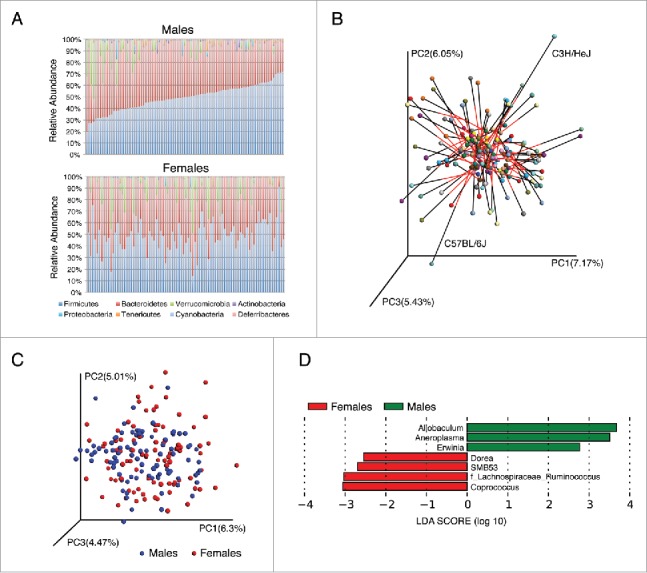
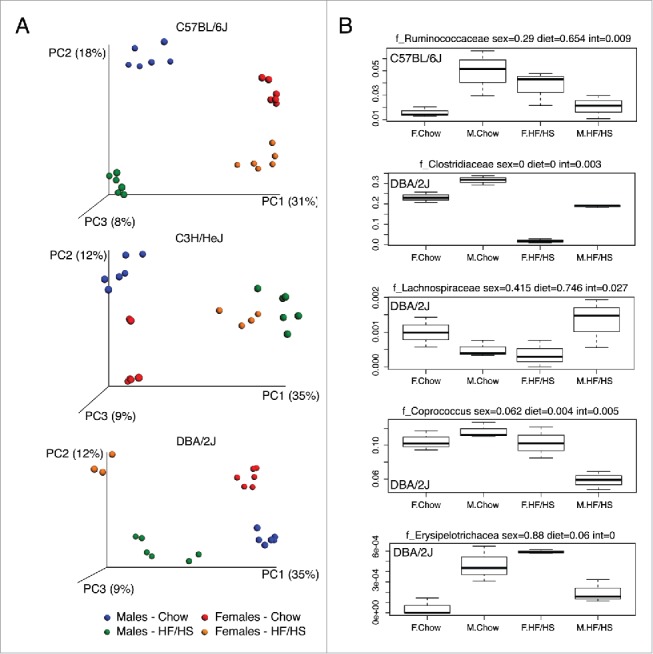
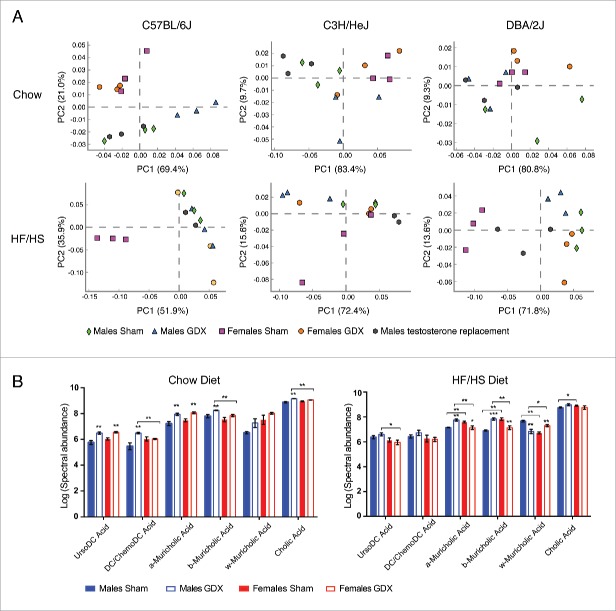
We previously reported quantitation of gut microbiota in a panel of 89 different inbred strains of mice, and we now examine the question of sex differences in microbiota composition. When the total population of 689 mice was examined together, several taxa exhibited significant differences in abundance between sexes but a larger number of differences were observed at the single strain level, suggesting that sex differences can be obscured by host genetics and environmental factors. We also examined a subset of mice on chow and high fat diets and observed sex-by-diet interactions. We further investigated the sex differences using gonadectomized and hormone treated mice from 3 different inbred strains. Principal coordinate analysis with unweighted UniFrac distances revealed very clear effects of gonadectomy and hormone replacement on microbiota composition in all 3 strains. Moreover, bile acid analyses showed gender-specific differences as well as effects of gonodectomy, providing one possible mechanism mediating sex differences in microbiota composition.
Overview
The claims and statistics of this paper haven’t been checked yet.
Free: it reads the open-access text and checks the first 5 claims that cite a source we can check. Create a free account to check every claim.
Integrity signals
Registry
Cites
Statistics
Figures
Verification
Claims the paper makes
The claims and statistics of this paper haven’t been checked yet.
Free: it reads the open-access text and checks the first 5 claims that cite a source we can check. Create a free account to check every claim.
Claims other papers make about this one
Each is checked against this paper’s own text: does it say what the citing paper says it does?
The cited source says what the claim attributes to it.
In the citing paper
“Significant differences in microbial diversity between males and females are first observed following puberty which can be reversed following male castration (6).”
From Association Between Sex Hormone Levels and Gut Microbiota Composition and Diversity—A Systematic Review (2022) · cites this paper as [6]
In the citing paper
“Another study observed a substantial effect of gonadectomy and hormone replacement on the composition of microbial species (6).”
From Association Between Sex Hormone Levels and Gut Microbiota Composition and Diversity—A Systematic Review (2022) · cites this paper as [6]
Self-check
Percentages, sums and reported differences re-computed from the paper’s own numbers.
The self-check needs the paper’s full text.
Citations
Cites
QIIME allows analysis of high-throughput community sequencing data
Caporaso, J. G., Kuczynski, J., Stombaugh, J., Bittinger, K., Bushman, F. D., Costello, E. K., Fierer, N., Peña, A. G., Goodrich, J. K., Gordon, J. I., et al. (2010) · Nature Methods · doi:10.1038/nmeth.f.303 · Cited by 34,887 · cited 1×
“0.(29,30) The total number of sequencing reads was 15,010,979 (an average of 19,571 reads per sample) with an average length of 153 base pair reads.”
BackgroundMetagenomic biomarker discovery and explanation
Segata, N., Izard, J., Waldron, L., Gevers, D., Miropolsky, L., Garrett, W. S., & Huttenhower, C. (2011) · Genome Biology · doi:10.1186/gb-2011-12-6-r60 · Cited by 16,192 · cited 1×
“LEfSe first performs the Kruskall-Wallis test (testing whether the values in different classes are differentially distributed), then a nonparametric Wilcoxon sum-rank test (testing whether all pairwise comparisons between subclasses within different classes significantly agreed with the class level trend) and then fol…”
MethodStructure, function and diversity of the healthy human microbiome
The Human Microbiome Project Consortium (2012) · Nature · doi:10.1038/nature11234 · Cited by 11,726
A human gut microbial gene catalogue established by metagenomic sequencing
MetaHIT Consortium, Qin, J., Li, R., Raes, J., Arumugam, M., Burgdorf, K. S., Manichanh, C., Nielsen, T., Pons, N., Levenez, F., et al. (2010) · Nature · doi:10.1038/nature08821 · Cited by 11,624
Diet rapidly and reproducibly alters the human gut microbiome
David, L. A., Maurice, C. F., Carmody, R. N., Gootenberg, D. B., Button, J. E., Wolfe, B. E., Ling, A. V., Devlin, A. S., Varma, Y., Fischbach, M. A., et al. (2014) · Nature · doi:10.1038/nature12820 · Cited by 10,100
Linking long-term dietary patterns with gut microbial enterotypes
Wu, G. D., Chen, J., Hoffmann, C., Bittinger, K., Chen, Y.-Y., Keilbaugh, S. A., Bewtra, M., Knights, D., Walters, W. A., Knight, R., et al. (2011) · Science · doi:10.1126/science.1208344 · Cited by 6,513
McDonald, D., Price, M. N., Goodrich, J., Nawrocki, E. P., DeSantis, T. Z., Probst, A., Andersen, G. L., Knight, R., & Hugenholtz, P. (2012) · The ISME Journal · doi:10.1038/ismej.2011.139 · Cited by 5,064 · cited 1×
“Sequences were binned into OTUs based on 97% identity using UCLUST(31) against the Greengenes reference database.(32) Each sample’s sequences were rarefied to 17826 reads per strain to reduce the effect of sequencing depth.”
MethodQuality-filtering vastly improves diversity estimates from Illumina amplicon sequencing
Bokulich, N. A., Subramanian, S., Faith, J. J., Gevers, D., Gordon, J. I., Knight, R., Mills, D. A., & Caporaso, J. G. (2013) · Nature Methods · doi:10.1038/nmeth.2276 · Cited by 4,401 · cited 1×
“0.(29,30) The total number of sequencing reads was 15,010,979 (an average of 19,571 reads per sample) with an average length of 153 base pair reads.”
BackgroundSTAMP: statistical analysis of taxonomic and functional profiles
Parks, D. H., Tyson, G. W., Hugenholtz, P., & Beiko, R. G. (2014) · Bioinformatics · doi:10.1093/bioinformatics/btu494 · Cited by 4,191
Bacterial Community Variation in Human Body Habitats Across Space and Time
Costello, E. K., Lauber, C. L., Hamady, M., Fierer, N., Gordon, J. I., & Knight, R. (2009) · Science · doi:10.1126/science.1177486 · Cited by 3,231
Cited by
Items 501–600 of 835
Ekpruke, C. D., Alford, R., Parker, E. S., & Silveyra, P. (2024) · Physiological Genomics · doi:10.1152/physiolgenomics.00003.2024 · Cited by 8
Tian, J., Du, J., Lü, Z., Li, Y., Li, D., Han, J., Wang, Z., & Guan, X. (2021) · Polar Biology · doi:10.1007/s00300-021-02812-9 · Cited by 8
Wydra, J., Szlendak-Sauer, K., Zgliczyńska, M., Żeber‐Lubecka, N., & Ciebiera, M. (2024) · Nutrients · doi:10.3390/nu16193382 · Cited by 8
“The shift in circulating androgen levels in PCOS after OC therapy is probably insufficient to impact the gut microbiota as observed in hypogonadal castrated mice [60] and as reported by Harada et al. [61].”
ResultHong, S., Roh, H. W., Nam, Y. J., Kim, T. W., Cho, Y. H., Son, S. J., & Hong, C. H. (2025) · Brain Sciences · doi:10.3390/brainsci15060611 · Cited by 7
The dynamic relationship of gut microbiota with sex hormones in systemic lupus erythematosus
Katrib, M., Haddad, R., Hamdan, Z., & Rida, M. A. (2023) · Reumatologia/Rheumatology · doi:10.5114/reum/163091 · Cited by 8
Ding, L., Liu, J. Y., Zhou, L., Zhang, Q., Yu, M., & Xiao, X. (2023) · Molecular Nutrition & Food Research · doi:10.1002/mnfr.202200753 · Cited by 7
Zhang, Z., Wang, D., Xiao, P., Liu, N., Dalmo, R. A., & Niu, C. (2025) · Aquaculture · doi:10.1016/j.aquaculture.2025.742504 · Cited by 7
Noroozzadeh, M., Mousavi, M. A., Naz, M. S. G., Farahmand, M., Azizi, F., & Tehrani, F. R. (2025) · Reproductive Biology and Endocrinology · doi:10.1186/s12958-025-01405-z · Cited by 8
“These sex differences may be influenced by genetic background, gene expression from the X and Y chromosomes, environmental factors, sex steroid hormones, and the gut microbiome [19, 22, 23].”
Esposito, P., Kearns, M. M., Smith, K. B., Chandrasegaram, R., Kadamani, A. K., Gandelman, M., Liang, J., Nikpoor, N., Tompkins, T. A., & Ismail, N. (2022) · Comprehensive Psychoneuroendocrinology · doi:10.1016/j.cpnec.2022.100147 · Cited by 7
“The onset of puberty in NOD/ShiLtJ males is associated with a reduction in microbial diversity, while pubertal females maintain higher microbial diversity into adulthood [33].”
BackgroundWu, N., Ning, K., Liu, Y., Wang, Q., Li, N., & Zhang, L. (2025) · Frontiers in Microbiology · doi:10.3389/fmicb.2025.1564902 · Cited by 7
Stapleton, T. E., Kohl, K. D., & Dearing, M. D. (2022) · FEMS Microbiology Ecology · doi:10.1093/femsec/fiac005 · Cited by 7
Sex Difference of Effect of Sophora flavescens on Gut Microbiota in Rats
Duan, X., Xie, X., Zhu, C., Duan, Z., Chen, R., Xu, J. J., Zhang, Q., Yu, Q., & Tian, W. (2022) · Evidence-based Complementary and Alternative Medicine · doi:10.1155/2022/4552904 · Cited by 8
“In recent years, some studies suggest that gender has no or very limited impact on the gut microbiota [34, 35], while others have shown that there are differences in the composition of gut microbiome between sexes, but the mechanism that causes the differences remains unclear [7, 8, 36, 37].”
BackgroundChen, E. B., Shapiro, K. E., Wun, K., Kuntz, T. M., Theriault, B. R., Nooromid, M. J., Leone, V., Harris, K. G., Jiang, Q., Spedale, M., et al. (2020) · Journal of the American Heart Association · doi:10.1161/jaha.119.013496 · Cited by 7
“While the larger study includes mice from both sexes, females will be analyzed and reported separately as there is known sexual dimorphism in both neointimal hyperplasia susceptibility(7) and the microbiome.(8) Microbial load at the time of carotid ligation was similar between CONV-R and GT-FT mice (16S rDNA gene copi…”
BackgroundGut Microbiome, Neuroinflammation, and Fetal Alcohol Spectrum Disorders: Insights from Rodent Models
Busayli, A. M., Xu, W., Raffah, G. A., & Chen, G. (2025) · Biology · doi:10.3390/biology14060593 · Cited by 7
“…knowledge gap, especially considering evidence from other conditions that showed that sex hormones significantly influence microbial communities [50], with males showing greater microbiome sensitivity to environmental challenges, as evidenced in models of inflammation and autoimmunity [51,52].”
Huang, L., Pu, Y.-T., Zhao, Y.-H., Sun, X.-Y., Zhu, Y., Lu, Y., Leng, H., Feng, J., Jin, L., & Sun, K. (2026) · npj Biofilms and Microbiomes · doi:10.1038/s41522-026-00930-y · Cited by 6
James, D., Batool, M., Poveda, C. G., Hayirli, Z., Callow, C., Abbas, M., Linden, B., Gibson, J., Griffin, B. A., Elmore, J. S., et al. (2026) · European Journal of Nutrition · doi:10.1007/s00394-025-03885-6 · Cited by 6
Changes in fecal microbiota during estrous cycle in healthy thoroughbred mares
Li, J., Toyama, H., Matsumoto, T., Qasimi, M. I., Inoüe, R., MURASE, H., Yamamoto, Y., & Nagaoka, K. (2024) · Journal of Equine Veterinary Science · doi:10.1016/j.jevs.2024.105034 · Cited by 7
Curtis-Joseph, N., Peterson, R., Brown, C. E., Beekman, C. N., & Belenky, P. A. (2024) · Frontiers in Microbiomes · doi:10.3389/frmbi.2024.1432202 · Cited by 6
“In mice, the gut microbiome differs substantially between males and females, beginning from an early age (Markle et al., 2013; Org et al., 2016).”
Glenny, E. M., Liu, J., Skinner, H. G., McFarlane, T. L., Reed, K. K., Weninger, A., Djukic, Z., Pellizzon, M., & Carroll, I. M. (2024) · Applied and Environmental Microbiology · doi:10.1128/aem.01552-24 · Cited by 8
Liufu, B., Su, Q., Hong, K., Wei, J., Wang, Y., Han, Z., & Yu, L. (2025) · Animals · doi:10.3390/ani15060870 · Cited by 6
“The diversity and structure of the intestinal microbiota in aquatic animals are influenced by factors such as species, diet, and the external environment [49,50].”
Tu, K., Ou, Q., Lin, F., Zhao, Y., Zhou, R., Zhou, R., Fang, Y., & Zhang, C. (2025) · Phytotherapy Research · doi:10.1002/ptr.8510 · Cited by 6
“Research indicates subtle differences in gut microbiota composition between sexes (Org et al. 2016), particularly influenced by sex-food interactions (Bolnick et al. 2014).”
Bravo‐Núñez, Á., Berthomé, A., Sabran, C., Vairo, D., Martin, J., Alvarado‐Ramos, K., Chassaing, B., Tomas, J., & Reboul, E. (2025) · Communications Biology · doi:10.1038/s42003-025-08293-4 · Cited by 7
“Thesigni fi cantsexual dimorphism observed supports the role of sex differences in shaping gut microbial communities in response to food intake 51 .”
Choi, S. I., Kim, N., Nam, R. H., Park, J. H., Nho, H., Yu, J. E., Song, C., Lee, S. M., & Lee, D. H. (2021) · Journal of Cancer Prevention · doi:10.15430/jcp.2021.26.4.277 · Cited by 6
“Another study also reported that sex and hormonal changes affect the gut microbiome diversity and composition in 89 different inbred strains of mice [16].”
BackgroundMurali, A., Zickgraf, F. M., Ternes, P., Giri, V., Cameron, H. J., Sperber, S., Haake, V., Driemert, P., Kamp, H., Funk-Weyer, D., et al. (2023) · Microorganisms · doi:10.3390/microorganisms11020533 · Cited by 7
“A few publications have highlighted potential reasons including the differences in hormone dynamics, host genetics, body mass index as some of the factors [33,34].”
BackgroundSalia, S., Martin, Y. H., Burke, F. F., Myles, L. A., Jackman, L. M., Halievski, K., Bambico, F. R., & Swift‐Gallant, A. (2023) · Brain Behavior & Immunity - Health · doi:10.1016/j.bbih.2023.100637 · Cited by 6
Floridia, V., Russo, N., D’Alessandro, E., Lopreiato, V., Pino, A., Amato, A., Liotta, L., Caggia, C., & Randazzo, C. L. (2023) · Microbiological Research · doi:10.1016/j.micres.2023.127510 · Cited by 6
Microbiota-associated mechanisms underlying sexual dimorphism in hypertension
Dasinger, J. H., Joe, B., & Abais‐Battad, J. M. (2023) · Microbiota and Host · doi:10.1530/mah-23-0016 · Cited by 6
Entamoeba muris mitigates metabolic consequences of high-fat diet in mice
Roy, M., Dumay, A., Adiba, S., Rozes, S., Kobayashi, S., Paradis, V., Postic, C., Rainteau, D. P., Ogier‐Denis, É., Gall, M. L., et al. (2024) · Gut Microbes · doi:10.1080/19490976.2024.2409210 · Cited by 6
“30 Preliminary data suggested that there are no major differences in term of amoeba colonization or microbiota composition between males and females, but our conclusions cannot be immediately extended to female mice.”
Nguyen, H. V. M., Cabello, E. V., Dyer, D. W., Fender, C. L., García‐Jaramillo, M., Hord, N. G., Austad, S. N., Richardson, A. G., & Unnikrishnan, A. (2025) · Aging · doi:10.18632/aging.206211 · Cited by 7
The gut microbiome in Huntington disease: A review
Patil, R. S., Vyas, S. G., Quazi, W. T., Tembhurnikar, H. J., Milmile, P. S., & Umekar, M. J. (2021) · GSC Biological and Pharmaceutical Sciences · doi:10.30574/gscbps.2021.15.3.0180 · Cited by 6
Small intestinal flora graft alters fecal flora, stool, cytokines and mood status in healthy mice
Xie, Y., Song, L., Yang, J., Tao, T., Yu, J., Shi, J., & Jin, X. (2021) · Life Science Alliance · doi:10.26508/lsa.202101039 · Cited by 6
“Most of the studies concerning gut microbiota (Org et al, 2016), immunity (Taneja,2018)andmoodstatus (Kokras&Dalla,2014)tookgender factors into account.”
Chen, Y., He, L.-X., Chen, J., Xu, X. S., Wang, J.-J., Zhan, X.-H., Jiao, J.-W., Dong, G., Li, E., & Xu, L. (2022) · iScience · doi:10.1016/j.isci.2022.104894 · Cited by 6
Symbiotic microbiota: A class of potent immunomodulators
Sharma, S., Kk, C., Singh, S. V., & Gupta, S. (2022) · ScienceAsia · doi:10.2306/scienceasia1513-1874.2022.139 · Cited by 9
Bull, K., Davies, G., Jenkins, T. P., & Peachey, L. (2023) · Equine Veterinary Journal · doi:10.1111/evj.13961 · Cited by 6
Neurobiology of Pathogen Avoidance and Mate Choice: Current and Future Directions
Cantini, D., Choleris, E., & Kavaliers, M. (2024) · Animals · doi:10.3390/ani14020296 · Cited by 6
Gender dimorphism in IgA subclasses in T2-high asthma
Varricchi, G., Poto, R., Covelli, B., Spigna, G. D., Galdiero, M. R., Marone, G., Postiglione, L., & Spadaro, G. (2022) · Clinical and Experimental Medicine · doi:10.1007/s10238-022-00828-x · Cited by 7
Bubnov, R. V., & NIa, S. (2018) · Preprints.org · doi:10.20944/preprints201809.0185.v1 · Cited by 6
Sex-specific effects of gut microbiome on shaping bile acid metabolismPreprint
Yang, Y., Chi, L., Hsiao, Y.-C., & Lü, K. (2024) · bioRxiv (Cold Spring Harbor Laboratory) · doi:10.1101/2024.06.27.601003 · Cited by 6
Martin, M. G., Llarena, J. F. C., Voy, B. H., McLean, K. J., & Myer, P. R. (2024) · Applied Microbiology · doi:10.3390/applmicrobiol4040098 · Cited by 5
Cannizzaro, R., Maiero, S., Pelizzo, P., Gulotta, M., Facchin, S., Tessarolo, G., Zucchetto, A., Matrone, F., Realdon, S., & Bortolus, R. (2025) · Journal of Clinical Medicine · doi:10.3390/jcm14134783 · Cited by 7
Dekkar, S., Mahloul, K., Falco, A., Konate, K., Pisteur, R., Maurel, S., Maïmoun, L., Chauvet, N., Boisguérin, P., Nocca, D., et al. (2025) · Journal of Biomedical Science · doi:10.1186/s12929-025-01163-5 · Cited by 5
“…differences in gastric smooth muscle response to HFD treatment, differences that may involve estrogen signaling pathways, including the sex-dependent expression of the G protein–coupled estrogen receptor (GPER) recently linked to gastrointestinal dysmotility in female diabetic mice [40–42].”
Comprehensive Analysis of Vaginal and Gut Microbiome Alterations in Endometriosis Patients
Zhao, Y., Hu, X., Li, C., Huang, J., Guo, K., Pan, Q., & Yu, Z. P. (2025) · International Journal of Women s Health · doi:10.2147/ijwh.s561386 · Cited by 5
“Similarly, the gut microbiome is integral to immune function, 14 hormone regulation, 15 and maintaining the integrity of the intestinal barrier.”
Soriano, S., Marshall, A., Holcomb, M., Flinn, H., Burke, M., Kara, G., Scalzo, P. L., & Villapol, S. (2026) · Frontiers in Microbiology · doi:10.3389/fmicb.2025.1703708 · Cited by 6
“…likely arise from intersecting effects of sex hormones on microglial activation, sex-biased immune signaling pathways, and underlying differences in microbiota composition and function (Markle et al., 2013; Jasarevic et al., 2016; Klein and Flanagan, 2016; Org et al., 2016; Villa et al., 2018).”
Sandeep, G., Pahari, S., Nayak, V., Gundamaraju, R., Mishra, P., & Misra, A. (2026) · Technology in Cancer Research & Treatment · doi:10.1177/15330338261424322 · Cited by 5
“90,91 These fi ndings together indicate a de fi ning role of hormonal regulation in controlling the growth of particular microbial populations.”
The complex of gut microbial metabolites and sex hormones in Alzheimer’s disease
Bahar, A., Khazaei, M., & Tahmasebi, H. (2026) · Seminars in Immunopathology · doi:10.1007/s00281-026-01076-x · Cited by 5
“CD34-/-Reserolfred mice produce less testoster - one than mice that are not germ-free and have a gut flora (microbiome) that is unbalanced or dysbiosis, which can sometimes disrupt the homeostasis of androgens [183].”
Mohssen, M., Zayed, A. A., Kigerl, K. A., Du, J., Smith, G. J., Schwab, J. M., Sullivan, M. B., & Popovich, P. G. (2026) · Communications Biology · doi:10.1038/s42003-026-10447-x · Cited by 5
Colony but not social phenotype or status structures the gut bacteria of a eusocial mammal
Fitzpatrick, C. R., Toor, I., & Holmes, M. M. (2022) · Behavioral Ecology and Sociobiology · doi:10.1007/s00265-022-03230-5 · Cited by 5
Üstündağ, H., Doğanay, S., Öztürk, B., Köse, F., Kurt, N., Celep, N. A., Huyut, M. T., & Özgeriş, F. B. (2023) · Journal of Food Biochemistry · doi:10.1155/2023/5562120 · Cited by 7
Solak, H. M., Kreisinger, J., Čížková, D., Sezgın, E., Schmiedová, L., Murtskhvaladze, M., Henning, Y., Çolak, F., Matur, F., & Yanchukov, A. (2024) · Frontiers in Microbiology · doi:10.3389/fmicb.2024.1476845 · Cited by 6
“Previous studies have discussed the relative strength of sex’s impact compared to other factors, such as host genetic background, age, and diet, with sex generally found to have lower influence on shaping the GM (Kovacs et al., 2011; Elderman et al., 2018; Org et al., 2016).”
Oliver, L., Malagón, M., Ramió‐Pujol, S., Sánchez-Vizcaino, M., Sánchez-Algans, R., Lacosta, E., Sáez, M., Serra‐Pagès, M., Aldeguer, X., Garcia-Gil, L. J., et al. (2025) · Frontiers in Microbiomes · doi:10.3389/frmbi.2025.1512257 · Cited by 5
“In addition to fat distribution and sex hormones, other mechanisms such as sex-speci fi c immune responses and host genetic factors have also been proposed to in fl uence A. muciniphila abundance and colonization dynamics (Org et al., 2016).”
Calalang, J., Cheung, H. Y. K., Lichimo, K., & So, B. (2021) · Open Collections · doi:10.14288/ujemi.v26.195406 · Cited by 8
Dwaib, H. S., AlZaim, I., Ajouz, G., Eid, A. H., & EL‐Yazbi, A. F. (2021) · Molecular Pharmacology · doi:10.1124/molpharm.121.000338 · Cited by 5
“HFD suggesting a sex-by-diet interactions (Org et al., 2016).”
BackgroundForging the microbiome to help us live long and prosper
Rock, R. R., & Turnbaugh, P. J. (2023) · PLoS Biology · doi:10.1371/journal.pbio.3002087 · Cited by 7
Buthgamuwa, I., Fenelon, J. C., Roser, A., Meer, H., Johnston, S. D., & Dungan, A. M. (2023) · MicrobiologyOpen · doi:10.1002/mbo3.1392 · Cited by 5
“This result was reversed once testosterone was once again provided to the male mice lacking the hormone source, with significant differences between male and female mice being established (Org et al., 2016).”
BackgroundSexual Dimorphism in the Gut Microbiome
Ren, C. C., & Sylvia, K. E. (2018) · IU Journal of Undergraduate Research · doi:10.14434/iujur.v4i1.24491 · Cited by 6
Gender difference in development of steatohepatitis in p62/Sqstm1 and Nrf2 double-knockout mice
Watahiki, T., Okada, K., Warabi, E., Nagaoka, T., Suzuki, H., Ishige, K., Yanagawa, T., Takahashi, S., Mizokami, Y., Tokushige, K., et al. (2020) · EXPERIMENTAL ANIMALS · doi:10.1538/expanim.20-0028 · Cited by 6
“recent studies have shown that gender or female hormones affect microbiota composition in both humans and mice [23, 30], and another study revealed that gonadectomy and hormone replacement changed gut microbiota composition dramatically [22].”
ResultSun, B. H., Vatanen, T., Jayasinghe, T. N., McKenzie, E. J., Murphy, R., & O'Sullivan, J. M. (2020) · Scientific Reports · doi:10.1038/s41598-020-75786-z · Cited by 5
Sex- and Gender-related Issues of Gut Microbiota in Gastrointestinal Tract Diseases
Kim, N. (2021) · Korean Journal of Gastroenterology · doi:10.4166/kjg.2021.409 · Cited by 5
Aatsinki, A., Lahti, L., Munukka, E., Keskitalo, A., Karlsson, H., & Karlsson, L. (2019) · Brain Behavior and Immunity · doi:10.1016/j.bbi.2019.07.006 · Cited by 5
Pfau, M., Degregori, S., Barber, P. H., Blumstein, D. T., & Philson, C. S. (2024) · Ecology and Evolution · doi:10.1002/ece3.70519 · Cited by 4
“For example, microbial composition based on diet is sex-specific in a wild stickleback population (Bolnick et al. 2014), and sex differences in endocrine systems have been shown to influence microbial composition (Org et al. 2016).”
Trieu, T., Vieujean, S., Delhougne, N., Seidel, L., Louis, E. J., & Loly, J. (2025) · United European Gastroenterology Journal · doi:10.1002/ueg2.12756 · Cited by 4
Nishinarita, Y., Miyoshi, J., Kuronuma, S., Wada, H., Oguri, N., Hibi, N., Takeuchi, O., Akimoto, Y., Lee, S. T. M., Matsuura, M., et al. (2025) · Scientific Reports · doi:10.1038/s41598-025-03661-w · Cited by 4
Winarsih, S., Hasanah, U., Nuraida, L., Andarwulan, N., & Kusuma, W. A. (2025) · Journal of Advanced Veterinary and Animal Research · doi:10.5455/javar.2025.l921 · Cited by 4
Exploring the Gut Microbiome in Combat Sports: A Systematic Scoping Review
Carlone, J., Rossi, C., Bianco, A., Drid, P., Parisi, A., & Fasano, A. (2026) · Sports · doi:10.3390/sports14010019 · Cited by 4
“Sex-specific physiological factors, including hormonal fluctuations across the menstrual cycle, differences in gut transit time, variations in immune responses, and distinct metabolic profiles, have been shown to potentially influence microbial diversity and taxonomic composition [67–69].”
Antibiotic-induced gut microbiome remodeling reduces neuroinflammation in traumatic brain injury
Flinn, H., Marshall, A., Holcomb, M., Burke, M., Kara, G., Cruz-Pineda, L., Soriano, S., Treangen, T. J., & Villapol, S. (2026) · Communications Biology · doi:10.1038/s42003-026-09737-1 · Cited by 5
Li, L., Zhao, X., & He, J. J. (2023) · Microorganisms · doi:10.3390/microorganisms11030799 · Cited by 5
“Consistent with our findings is another study in which gut microbiota shows significant differences between female and male [79].”
ResultAge and sex-related variations in murine laryngeal microbiota
An, R., Venkatraman, A., Binns, J., Saric, C., Rey, F. E., & Thibeault, S. L. (2024) · PLoS ONE · doi:10.1371/journal.pone.0300672 · Cited by 4
Jiang, S., Guo, X., Qian, X., Ning, X., Zhang, C., Yin, S., & Zhang, K. (2024) · Comparative Biochemistry and Physiology Part D Genomics and Proteomics · doi:10.1016/j.cbd.2024.101281 · Cited by 7
Smith, M. S., Soffa, D. R., McAnally, B. E., Hickman-Brown, K. J., Stockland, E. L., & Poole, R. K. (2024) · Frontiers in Animal Science · doi:10.3389/fanim.2024.1399337 · Cited by 5
Paz, H. A., Buddha, L., Zhong, Y., Sikes, J. D., & Wankhade, U. D. (2024) · Physiological Reports · doi:10.14814/phy2.70111 · Cited by 4
“Research in mice has demonstrated sex-dependent differences in the gut microbiota composition across strains, indicating a genetic influence on the microbiota profile (Org et al., 2016).”
BackgroundDeminami, M., Hashimoto, M., Takahashi, H., Harada, N., Minami, Y., Kitakaze, T., Masuda, W., Takenaka, S., Inui, H., & Yamaji, R. (2024) · Bioscience Biotechnology and Biochemistry · doi:10.1093/bbb/zbae175 · Cited by 4
Methodologies for bioactivity assay: animal study
Xu, F., & de Mejía, E. G. (2021) · Elsevier eBooks · doi:10.1016/b978-0-12-821389-6.00022-4 · Cited by 4
Pinteur, C., Julien, B., Véga, N., Vidal, H., Naville, D., & Magueresse‐Battistoni, B. L. (2021) · International Journal of Environmental Research and Public Health · doi:10.3390/ijerph18168685 · Cited by 5
“While ovariectomy induced obesity and triggered dysbiosis [66], we observed little changes in the mRNA expression levels of genes involved in epithelial cell differentiation and permeability throughout the gut segments with the exception of fatty acid transporters (Cd36 and Got2), Mmp7 in the jejunum, Muc2 in the ileu…”
BackgroundSex Difference of Colorectal Cancer
Kim, N. (2022) · Springer eBooks · doi:10.1007/978-981-19-0120-1_20 · Cited by 5
Wu, Q., Liu, H., Zhang, R., Zhang, X., & Xia, P. (2024) · Frontiers in Endocrinology · doi:10.3389/fendo.2024.1510917 · Cited by 4
Zapała, B., Pustelnik, J., Dudek, A., & Milewicz, T. (2023) · Diversity · doi:10.3390/d15101103 · Cited by 4
González, C. Y., Estrada, J. A., Oros‐Pantoja, R., Colín-Ferreyra, M. D. C., Benitez-Arciniega, A. D., Piña, A. E. S., & Garrido, J. F. A. (2024) · Microorganisms · doi:10.3390/microorganisms12122542 · Cited by 4
“Studies in rodents show that a relative deficiency of SCFA or SCFA-producing bacterial species observed after chronic feeding of high-fat diets can produce neuroinflammation [65,66].”
Liu, Y., Wang, S., Han, M., Luo, S., Chu, P., Tang, X., Zhao, C., Han, S., Yin, S., & Wang, T. (2025) · Marine Pollution Bulletin · doi:10.1016/j.marpolbul.2025.117533 · Cited by 3
Rosa, F. L., Guzzardi, M. A., Pardo-Tendero, M., Barone, M., Ruocco, C., Conti, G., Panetta, D., Riabitch, D., Bernardi, S., Giorgetti, A., et al. (2025) · Molecular Metabolism · doi:10.1016/j.molmet.2025.102157 · Cited by 3
“However, such designs may introduce hormonal and physiological mismatches, potentially confounding - or even opposing - the isolated effects of FMT [58,59].”
Zheng, B., Huang, Z., Wang, Z., Du, J., Jiang, J., Xiao, C., & Wang, Y. (2025) · Frontiers in Nutrition · doi:10.3389/fnut.2025.1586569 · Cited by 3
“However, testosterone treatment suppressed these changes, improving gut barrier integrity (28–30).”
Iftikhar, N., Konig, I. F. M., Brammer-Robbins, E., Kozuch, M., Bisesi, J. H., Hashmi, I., & Martyniuk, C. J. (2025) · Aquatic Toxicology · doi:10.1016/j.aquatox.2025.107546 · Cited by 4
Navarrete, F., Cabrera‐Rubio, R., Gasparyan, A., Aarnio, R., Lopez‐Picon, F. R., Helin, S., Rajander, J., Collado, M. C., & Manzanares, J. (2025) · Biomedicine & Pharmacotherapy · doi:10.1016/j.biopha.2025.118791 · Cited by 3
Gut Bacteria Improve Depressive Symptoms by Degrading Cortisol into Androgen
Wang, X., Wu, Q., Zeng, H., Shen, Y., Zhang, H., Gong, J., Zhang, Q., Xie, J., Ye, D.-W., Sun, Z., et al. (2026) · Advanced Science · doi:10.1002/advs.202508468 · Cited by 4
Wang, X., Lin, Y.-F., & Zhou, M. (2026) · Frontiers in Neuroendocrinology · doi:10.1016/j.yfrne.2026.101233 · Cited by 3
Chandra, Q. M., Clister, D., Halim, P., Dalimunthe, A., Ichwan, M., Sari, D. K., Umaya, C., Aktary, N., Rani, A., Park, M. N., et al. (2026) · Clinica Chimica Acta · doi:10.1016/j.cca.2026.120941 · Cited by 3
Park, J.-Y., Yoon, C. J., Lee, J.-J., Shin, Y. J., & Kim, B. S. (2026) · mSystems · doi:10.1128/msystems.00104-26 · Cited by 3
“Sex steroids can modulate microbiome and mucosal immune responses, and experimental studies have shown that hormonal perturbations can shift microbiota (52, 53).”
Gut microbiota from androgen‐altered donors alter pulmonary responses to ozone in female mice
Osgood, R. S., Tashiro, H., Kasahara, D. I., Yeliseyev, V., Bry, L., & Shore, S. A. (2020) · Physiological Reports · doi:10.14814/phy2.14584 · Cited by 3
“In both mice and humans, sex hormones can also shape the composition of the gut microbiome (Org et al., 2016; Yatsunenko et al., 2012).”
BackgroundResultInfluentialAburahma, A., Stewart, E. L., Rana, S., Larsen, R. A., Ward, C. S., & Sprague, J. E. (2022) · International Journal of Hyperthermia · doi:10.1080/02656736.2022.2159072 · Cited by 4
“On the other hand, despite the clear sex-based differences in gut microbiome richness and composition, other studies have demonstrated that higher differences were reported within the species and strain of the animals under investigation compared to the sex of the overall animals in general [20,46].”
BackgroundSex specificity in neonatal diseases
Bhat, V., & Bhandari, V. (2023) · Principles of Gender-Specific Medicine · doi:10.1016/b978-0-323-88534-8.00015-8 · Cited by 3
Enduring sex-dependent implications of pubertal stress on the gut-brain axis and mental health
Dworsky‐Fried, M., Tchida, J. A., Krnel, R., & Ismail, N. (2024) · Frontiers in Behavioral Neuroscience · doi:10.3389/fnbeh.2023.1285475 · Cited by 5
Sex differences in opioid response: a role for the gut microbiome?
Han, C., Manners, M. T., & Robinson, S. A. (2024) · Frontiers in Pharmacology · doi:10.3389/fphar.2024.1455416 · Cited by 3
“The analysis of 89 different inbred mice strains revealed that the commonly used C57BL/6J strain has one of the most prominent sexually dimorphic microbiomes, with females harboring a higher abundance of Coprococcus and Bacteroides compared to males (Org et al., 2016).”
BackgroundThe Effect of Gender on the Intestinal Flora of Colorectal Cancer Under Different Stages
He, F., Huang, X., Wang, Z., Qin, M., Chen, C., Huang, Z., Wu, Y., Huang, Y., Tang, B., Long, C., et al. (2024) · Molecular Carcinogenesis · doi:10.1002/mc.23863 · Cited by 3
“Animal experiments have shown that gonadectomy and hormone replacement have a significant impact on the composition of intestinal flora in mice [20].”
Yao, T., Libera, L., & Lindemann, S. R. (2025) · Food Research International · doi:10.1016/j.foodres.2025.116709 · Cited by 3
Huang, X., Wu, L., Zhang, Y., Lai, X., & Sun, D. (2025) · Endocrine Connections · doi:10.1530/ec-25-0162 · Cited by 3
“Compared with females, the abundance of Ruminococcus , Coprococcus , and Dorea in healthy male mice is much higher (50, 51).”
Neurosteroids, Microbiota, and Neuroinflammation: Mechanistic Insights and Therapeutic Perspectives
Tahri, A., Niccolai, E., & Amedei, A. (2025) · International Journal of Molecular Sciences · doi:10.3390/ijms26147023 · Cited by 3
“In contrast, NSs influence gut function by modulating immune responses and maintaining epithelial integrity [17–19].”
Tu, Y., Zhou, Z., Lu, Y., Wei, B., Ge, Y., Ding, G., Xi, D., Sheng, J., Zhang, Y., Li, J., et al. (2025) · Frontiers in Cellular and Infection Microbiology · doi:10.3389/fcimb.2025.1617187 · Cited by 3
Inflammatory bowel diseases: Sex differences and beyond
Soriano, A., Soriano, M., Beltrami, M., Sanguedolce, F., Palicelli, A., Zizzo, M., Ascani, S., Zanelli, M., & Pizarro, T. T. (2022) · Elsevier eBooks · doi:10.1016/b978-0-12-824466-1.00010-8 · Cited by 4
Cross-sex cecal microbiota transfer alters depressive-like behaviours in mice
Hinks, M., Martin, Y. H., Burke, F. F., Bambico, F. R., & Swift‐Gallant, A. (2023) · Behavioural Processes · doi:10.1016/j.beproc.2023.104960 · Cited by 3
Different gut microbial types were found in captive striped hamsters
Fan, C., Zheng, Y., Xue, H., Xu, J.-H., Wu, M., Chen, L., & Xu, L. (2023) · PeerJ · doi:10.7717/peerj.16365 · Cited by 3
“Sex bias of the composition of the gut microbiome in mice has been observed ( Org et al., 2016 ), and similar conclusions have also been presented in studies of humans and rats ( Jaggar et al., 2020 ; Gu et al., 2021 ).”
BackgroundResultdos Santos, L. A. C., Carvalho, R. D. D. O., Neto, J. P. R. C., Lemos, D. E. D. A., de Oliveira, K. Á. R., Sampaio, K. B., Freire, M. O. D. L., Aburjaile, F. F., Azevedo, V., de Souza, E. L., et al. (2024) · Microorganisms · doi:10.3390/microorganisms12040659 · Cited by 4
“In mice, the phyla Actinobacteria and Tenericutes were more abundant in males, while the family Lachnospiraceae was more abundant in females [4].”
Background
Metadata
- Authors
- Org, E., Mehrabian, M., Parks, B. W., Shipkova, P., Liu, X., Drake, T. A., & Lusis, A. J.
- Affiliations
- University of California, Los Angeles (US)
- University of Wisconsin System (US)
- Bristol-Myers Squibb (United States) (US)
- Corresponding author
- Lusis, Aldons J.
- Venue
- Gut Microbes
- Publisher
- Informa UK Limited
- Published
- 2016-06-29
- Volume
- 7
- Issue
- 4
- Pages
- 313-322
- ISSN
- 1949-0976 (ISSN-L)
- 1949-0984
- PMC
- PMC4988450
- OpenAlex
- W2473762402
- Cited by
- 796
- References
- 35
- Citations by year
- 2026: 75 · 2025: 87 · 2024: 109 · 2023: 85 · 2022: 114 · 2021: 98 · 2020: 81 · 2019: 73 · 2018: 52 · 2017: 18 · 2016: 3
- FWCI
- 25.30
- Type
- journal article
- Language
- en
- Open access
- gold
- doi.org
- Licence
- Locations
- Gut Microbes (publishedVersion, cc-by-nc)
- PubMed Central (publishedVersion, cc-by-nc)
- PubMed (publishedVersion)
- Funders
- European Commission (330381)
- National Institutes of Health (HL‐28481, HL30568, T32-HD07228, HD07228)
- European Regional Development Fund (2014-2020’, 2014-2020.4.01.15-0012, (Project No. 2014-2020.4.01.15-0012), No. 2014-2020.4.01.15-0012)
- National Heart, Lung, and Blood Institute (P01HL030568, R00HL123021)
- National Institute of Diabetes and Digestive and Kidney Diseases (DP3DK094311)
- Eunice Kennedy Shriver National Institute of Child Health and Human Development (T32HD007228)
- Clinical and Translational Science Institute, University of California, Los Angeles
- Topics
- Life Sciences › Biochemistry, Genetics and Molecular Biology › Molecular Biology › Gut microbiota and health
- Health Sciences › Dentistry › Periodontics › Oral microbiology and periodontitis research
- Life Sciences › Agricultural and Biological Sciences › Animal Science and Zoology › Animal Nutrition and Physiology
- Keywords
- gut microbiota composition, sex differences, gonadectomy, hormone replacement therapy, inbred mouse strains, high-fat diet, bile acids, host genetics
- MeSH terms
- Gastrointestinal Microbiome, Animals, Bile Acids and Salts, Feeding Behavior, Female, Hormones, Male, Sex Factors, Gastrointestinal Tract, Mice
About these checks
Registry, retraction, Cites and statistics results are computed, not judged, with one exception: a printed reference that no index lists is read once by a model before it counts as a citation error. Claims are extracted by a model and kept only when their quote appears verbatim in the text; each cited source is then checked, with a model’s help, for whether it says what the claim relies on. Those verdicts can be wrong — read the claim’s quote and the cited source before relying on one.
Statistics and arithmetic are recomputed, not judged.
Confidence bands are shown only for fields calibrated on our annotated test set. None is calibrated yet, so no band is shown.
What counts as a claim ›How we measure confidence ›How we check this ›
Are you an author, or do you see a problem with this page? Request a review
Data sources
Bibliographic data: Semantic Scholar, OpenAlex, Crossref.
Contains information from the Semantic Scholar Academic Graph Datasets, made available under the ODC Attribution License (ODC-BY 1.0).
Semantic Scholar’s data is described in: Kinney, R., et al. (2023). The Semantic Scholar Open Data Platform. arXiv:2301.10140.
