

Sex differences and hormonal effects on gut microbiota composition in mice
Open accessThe DOI matches its Crossref record; 35 of the 35 references it cites were found in a registry or an index.
Abstract
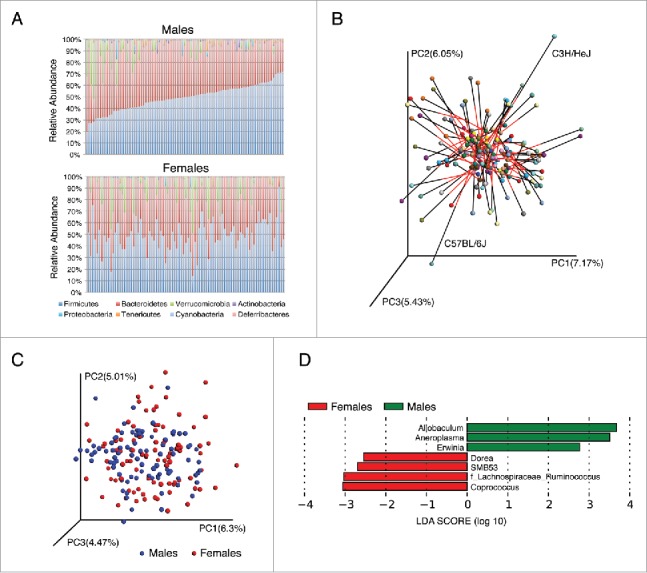
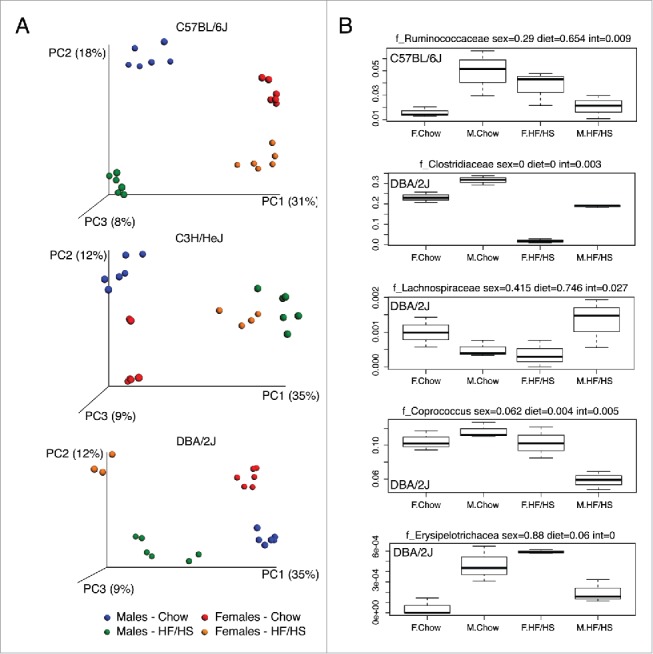
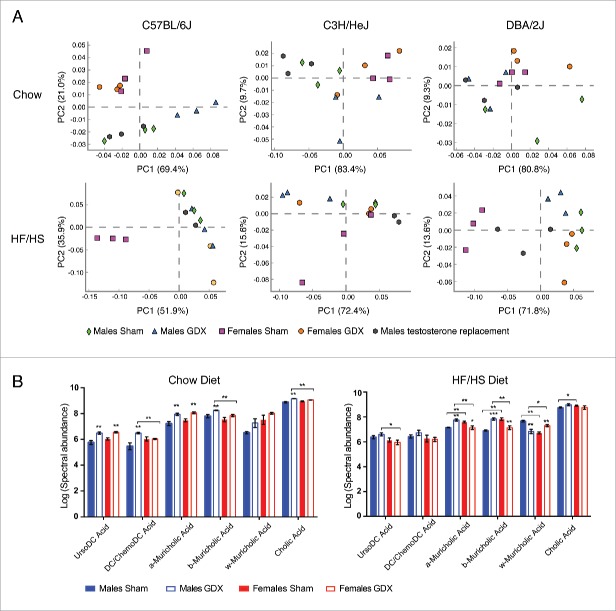
We previously reported quantitation of gut microbiota in a panel of 89 different inbred strains of mice, and we now examine the question of sex differences in microbiota composition. When the total population of 689 mice was examined together, several taxa exhibited significant differences in abundance between sexes but a larger number of differences were observed at the single strain level, suggesting that sex differences can be obscured by host genetics and environmental factors. We also examined a subset of mice on chow and high fat diets and observed sex-by-diet interactions. We further investigated the sex differences using gonadectomized and hormone treated mice from 3 different inbred strains. Principal coordinate analysis with unweighted UniFrac distances revealed very clear effects of gonadectomy and hormone replacement on microbiota composition in all 3 strains. Moreover, bile acid analyses showed gender-specific differences as well as effects of gonodectomy, providing one possible mechanism mediating sex differences in microbiota composition.
Overview
The claims and statistics of this paper haven’t been checked yet.
Free: it reads the open-access text and checks the first 5 claims that cite a source we can check. Create a free account to check every claim.
Integrity signals
Registry
Cites
Statistics
Figures
Verification
Claims the paper makes
The claims and statistics of this paper haven’t been checked yet.
Free: it reads the open-access text and checks the first 5 claims that cite a source we can check. Create a free account to check every claim.
Claims other papers make about this one
Each is checked against this paper’s own text: does it say what the citing paper says it does?
The cited source says what the claim attributes to it.
In the citing paper
“Significant differences in microbial diversity between males and females are first observed following puberty which can be reversed following male castration (6).”
From Association Between Sex Hormone Levels and Gut Microbiota Composition and Diversity—A Systematic Review (2022) · cites this paper as [6]
In the citing paper
“Another study observed a substantial effect of gonadectomy and hormone replacement on the composition of microbial species (6).”
From Association Between Sex Hormone Levels and Gut Microbiota Composition and Diversity—A Systematic Review (2022) · cites this paper as [6]
Self-check
Percentages, sums and reported differences re-computed from the paper’s own numbers.
The self-check needs the paper’s full text.
Citations
Cites
QIIME allows analysis of high-throughput community sequencing data
Caporaso, J. G., Kuczynski, J., Stombaugh, J., Bittinger, K., Bushman, F. D., Costello, E. K., Fierer, N., Peña, A. G., Goodrich, J. K., Gordon, J. I., et al. (2010) · Nature Methods · doi:10.1038/nmeth.f.303 · Cited by 34,887 · cited 1×
“0.(29,30) The total number of sequencing reads was 15,010,979 (an average of 19,571 reads per sample) with an average length of 153 base pair reads.”
BackgroundMetagenomic biomarker discovery and explanation
Segata, N., Izard, J., Waldron, L., Gevers, D., Miropolsky, L., Garrett, W. S., & Huttenhower, C. (2011) · Genome Biology · doi:10.1186/gb-2011-12-6-r60 · Cited by 16,192 · cited 1×
“LEfSe first performs the Kruskall-Wallis test (testing whether the values in different classes are differentially distributed), then a nonparametric Wilcoxon sum-rank test (testing whether all pairwise comparisons between subclasses within different classes significantly agreed with the class level trend) and then fol…”
MethodStructure, function and diversity of the healthy human microbiome
The Human Microbiome Project Consortium (2012) · Nature · doi:10.1038/nature11234 · Cited by 11,726
A human gut microbial gene catalogue established by metagenomic sequencing
MetaHIT Consortium, Qin, J., Li, R., Raes, J., Arumugam, M., Burgdorf, K. S., Manichanh, C., Nielsen, T., Pons, N., Levenez, F., et al. (2010) · Nature · doi:10.1038/nature08821 · Cited by 11,624
Diet rapidly and reproducibly alters the human gut microbiome
David, L. A., Maurice, C. F., Carmody, R. N., Gootenberg, D. B., Button, J. E., Wolfe, B. E., Ling, A. V., Devlin, A. S., Varma, Y., Fischbach, M. A., et al. (2014) · Nature · doi:10.1038/nature12820 · Cited by 10,100
Linking long-term dietary patterns with gut microbial enterotypes
Wu, G. D., Chen, J., Hoffmann, C., Bittinger, K., Chen, Y.-Y., Keilbaugh, S. A., Bewtra, M., Knights, D., Walters, W. A., Knight, R., et al. (2011) · Science · doi:10.1126/science.1208344 · Cited by 6,513
McDonald, D., Price, M. N., Goodrich, J., Nawrocki, E. P., DeSantis, T. Z., Probst, A., Andersen, G. L., Knight, R., & Hugenholtz, P. (2012) · The ISME Journal · doi:10.1038/ismej.2011.139 · Cited by 5,064 · cited 1×
“Sequences were binned into OTUs based on 97% identity using UCLUST(31) against the Greengenes reference database.(32) Each sample’s sequences were rarefied to 17826 reads per strain to reduce the effect of sequencing depth.”
MethodQuality-filtering vastly improves diversity estimates from Illumina amplicon sequencing
Bokulich, N. A., Subramanian, S., Faith, J. J., Gevers, D., Gordon, J. I., Knight, R., Mills, D. A., & Caporaso, J. G. (2013) · Nature Methods · doi:10.1038/nmeth.2276 · Cited by 4,401 · cited 1×
“0.(29,30) The total number of sequencing reads was 15,010,979 (an average of 19,571 reads per sample) with an average length of 153 base pair reads.”
BackgroundSTAMP: statistical analysis of taxonomic and functional profiles
Parks, D. H., Tyson, G. W., Hugenholtz, P., & Beiko, R. G. (2014) · Bioinformatics · doi:10.1093/bioinformatics/btu494 · Cited by 4,191
Bacterial Community Variation in Human Body Habitats Across Space and Time
Costello, E. K., Lauber, C. L., Hamady, M., Fierer, N., Gordon, J. I., & Knight, R. (2009) · Science · doi:10.1126/science.1177486 · Cited by 3,231
Cited by
Items 601–700 of 835
Balouei, F., Stefanon, B., Armone, R., Randazzo, A., & Chiofalo, B. (2025) · Microorganisms · doi:10.3390/microorganisms13010121 · Cited by 3
Roy, S., Sarkar, S., Paul, U. K., Biswas, A., Bera, A., & Choudhury, L. (2025) · Applied Biochemistry and Microbiology · doi:10.1134/s0003683824604608 · Cited by 3
Biological underpinnings of sex differences in neurological disorders
Winek, K., Tzur, Y., & Soreq, H. (2022) · International review of neurobiology · doi:10.1016/bs.irn.2022.06.009 · Cited by 4
Women health and microbiota: Different aspects of well-being
Nannini, G., & Amedei, A. (2024) · World Journal of Gastroenterology · doi:10.3748/wjg.v30.i10.1287 · Cited by 3
Sisk-Hackworth, L., Akhavan, S. R., Krutkin, D. D., Kelley, S. T., & Thackray, V. G. (2024) · bioRxiv (Cold Spring Harbor Laboratory) · doi:10.1101/2024.07.01.601610 · Cited by 3
“The cause of this sexual differentiation is not well understood, though it has been shown that gonadectomy and sex steroid replacement can shift gut microbiome composition in mice to resemble the microbiome of intact mice [24-27].”
Colorectal Diseases and Gut Microbiome
Kim, N. (2024) · Springer eBooks · doi:10.1007/978-981-97-0130-8_6 · Cited by 4
The influence of sex on the intestinal flora of Procypris mera
Chen, L., Lin, H., Ren, J., Wu, W., Li, Z., Lin, Y., Li, Y., & Su, S. (2025) · Comparative Biochemistry and Physiology Part D Genomics and Proteomics · doi:10.1016/j.cbd.2025.101464 · Cited by 3
Dong, Y., Zhang, Z., Zhu, Z., Hu, T., Chen, J., Teng, L., & Liu, Z. (2025) · Frontiers in Microbiology · doi:10.3389/fmicb.2025.1553622 · Cited by 2
“Among genetic factors, sex-related differences in hormone levels (Org et al., 2016), immune responses (Johnson et al., 2020), and metabolic patterns (Valeri and Endres, 2021) are particularly influential in microbial community construction.”
Dynamic shifts of intestinal microbiota during sex reversal in swamp eels (Monopterus albus)
Chen, H. Y. H., Zhang, Y., Hossain, M. S., Du, X., Wang, X., Yuan, S., Liu, Y., Dai, J., & Qiu, D. (2025) · Aquaculture and Fisheries · doi:10.1016/j.aaf.2025.08.003 · Cited by 3
Tokuno, M., Commey, K. L., Yamamoto, A., Tokushige, M., Tsukigawa, K., Nishi, K., Otagiri, M., Ekino, K., & Yamasaki, K. (2025) · Drug Metabolism and Disposition · doi:10.1016/j.dmd.2025.100149 · Cited by 2
Song, K., Luo, J., Zhang, Y., Wu, D., Chen, H., & Dai, M. (2025) · mSystems · doi:10.1128/msystems.00933-25 · Cited by 2
“These consistent sexual dysmorphism suggest distinct regulatory mechanism including sexual maturation and sex hormones (41, 42), while differences in immune function may also play a role (43).”
Ghosh, S., Li, Y., Yang, X., Wu, G. G., Zhang, C., & Zhao, L. (2025) · ISME Communications · doi:10.1093/ismeco/ycaf127 · Cited by 3
“There are limitations to the current study; first, the use of only male mice may overlook sex-specific differences in responses to TRF. Female mice may exhibit distinct metabolic and microbiome-related adaptations that are not represented in these findings [49, 50].”
Balasubramaniam, K. N., Müller‐Klein, N., Vink, T. J. F., Clutton-Brock, T. H., Manser, M. B., & Sommer, S. (2025) · Journal of Animal Ecology · doi:10.1111/1365-2656.70168 · Cited by 2
“…model (JSDM), meerkats ( Suricata suricatta ), microbial co-occurrence networks, social microbiome Pereira et al., 2020 ), sex (rodents: Org et al., 2016 ; passerine birds: Yan et al., 2022 ) and their infectious disease status (e.g. stages of tuberculosis infection among long-tailed…”
Sex-Specific Differences in Gut Microbial Composition and Metabolism of Jiangshan Black Pigs
Zhang, Y., Wu, X., Song, D., Wang, P., Wang, H., & Li, X. (2025) · Microorganisms · doi:10.3390/microorganisms13112551 · Cited by 2
“These discrepancies may reflect differences in age and the relatively small sample size used in our study [48], which also may have been influenced by diet composition and genetic background [49].”
Ericsson, A. C., McAdams, Z. L., Dorfmeyer, R. A., Hart, M. L., O’Neill-Blair, A., Amos-Landgraf, J. M., & Franklin, C. L. (2025) · mSystems · doi:10.1128/msystems.01112-25 · Cited by 2
Galgano, S., Conway, L., Fellows, A., & Houdijk, J. G. M. (2025) · animal · doi:10.1016/j.animal.2025.101724 · Cited by 2
Sun, L., & Liu, C.-Y. (2025) · Frontiers in Nutrition · doi:10.3389/fnut.2025.1723496 · Cited by 2
How Does Biological Sex Impact Mucosal Bacterial Infection? Mucosal Defenses and Bacterial Detection
Finn, L. R., & Ingersoll, M. A. (2026) · Immunological Reviews · doi:10.1111/imr.70112 · Cited by 2
“This phenotype is lost when male mice are castrated and can be restored with exogenous DHT [128].”
Brayan, M.-T., Kaur, A., Barr, B., Garrison, E. C., Brashears, M. M., Brown, A. M. V., & Gollahon, L. (2026) · Dietetics · doi:10.3390/dietetics5010013 · Cited by 3
Stoehr, M. C., Martin, E. M., Babalola, J. T., Xue, J., Kern, M., Li, N. Y., Winters, M. F., Bhagwagar, S., & Smith, C. J. (2026) · Journal of Neuroendocrinology · doi:10.1111/jne.70151 · Cited by 2
“100 Bacteroides is differentially expressed in individuals with ASD 101 and decreased in abundance in males exposed to DEP/MS. 38 One possibility is that differences in the abundance of bacterial genera such as Bacteroides between sexes, exposures (such as DEP/MS), and studies may contribute to sex…”
Wang, H., Dai, Y., Pan, W., Mao, K., Zhang, Z., Zhang, Y., Chen, Y., & Zhang, Y. (2026) · Medicine Advances · doi:10.1002/med4.70048 · Cited by 2
“Certain bacterial taxa, such as Clostridium and Bacteroides , can deconjugate estrogens into their active forms via β‐glucuronidase, thereby potentiating ER signaling and promoting tumorigenesis in ER‐positive BC [40–42].”
Testosterone administration partially modulates gut microbiota responses to severe energy deficit
Mohr, A. E., Berryman, C. E., Harris, M. N., Lawrence, A. B., Chakraborty, N., Campbell, R., Dimitrov, G. I., Gautam, A., Hammamieh, R., Lieberman, H. R., et al. (2026) · American Journal of Physiology-Endocrinology and Metabolism · doi:10.1152/ajpendo.00291.2025 · Cited by 3
Rao, P. P. (2026) · Obesity Medicine · doi:10.1016/j.obmed.2026.100694 · Cited by 3
Rao, X., Zou, L., Cai, X., Yao, Y., & Zhong, L. (2026) · Frontiers in Immunology · doi:10.3389/fimmu.2026.1761834 · Cited by 3
The impact of gut microbiome on intrahepatic cholestasis of pregnancy—systematic literature review
Donzé, F. J., Eli, N., Simone, N. D., Cavegn, B. B., & Mueller, M. (2026) · Frontiers in Medicine · doi:10.3389/fmed.2026.1859397 · Cited by 2
“For example, the pregnancy-specific elevation in sex hormones estrogen and progesterone might exert microbial selection pressure on certain gut bacteria, leading to dysbiosis in susceptible individuals (2, 53, 54).”
Matsuzaki, R., Valderrama, B., Tofani, G. S. S., Cagun, S. C., Fitzgerald, P., Clarke, G. A., Gunnigle, E., & Cryan, J. F. (2026) · Molecular Psychiatry · doi:10.1038/s41380-026-03693-2 · Cited by 2
“Such observations may be in fl uenced by intrinsic sex-related differences in gut microbiota composition, shaped by factors such as hormones and immunity, which are well documented [61].”
Guevara‐Ramírez, P., Paz‐Cruz, E., Ruiz‐Pozo, V. A., Cadena-Ullauri, S., Tamayo‐Trujillo, R., Paredes, A. S. C., Jaramillo, N. H., Melo, L. H., & Zambrano, A. K. (2026) · Microorganisms · doi:10.3390/microorganisms14071565 · Cited by 2
Azimzadeh, M., & Azimzadeh, M. (2026) · Behavioural Brain Research · doi:10.1016/j.bbr.2026.116404 · Cited by 2
Sex differences in the gut microbiome and related metabolites: role in cardiometabolic disease
Wang, Y., Cheng, E., & Peters, B. A. (2026) · Gut Microbes · doi:10.1080/19490976.2026.2721752 · Cited by 2
“3 Most mechanistic evidence originates from animal models, 122,126-129 in which a bidirectional relationship between gut microbiota and sex steroid hormones has been demonstrated: gut microbial enzymes (e.g., microbial β-glucuronidase) regulate hormone metabolism, and hormonal shifts, in turn,…”
Typical antibiotic exposure and dysglycemia risk in an elderly Chinese population
Yu, S., Kong, L., Gu, L., Zhu, Y., Liu, X., Sang, Y., Wang, Q., Wang, S., Zhang, D., Cao, H., et al. (2022) · Environmental Science and Pollution Research · doi:10.1007/s11356-022-20056-w · Cited by 2
Self-citationShigeno, Y., Liu, H., Sano, C., Inoüe, R., Niimi, K., & Nagaoka, K. (2022) · PLoS ONE · doi:10.1371/journal.pone.0273702 · Cited by 2
Golovach, I. Y., & Рекалов, Д. Г. (2022) · PAIN JOINTS SPINE · doi:10.22141/pjs.12.2.2022.332 · Cited by 2
Microbiota and its therapeutic implications in reproductive health and diseases
Singh, P., & Srivastava, R. K. (2023) · Elsevier eBooks · doi:10.1016/b978-0-323-99336-4.00003-3 · Cited by 5
Liu, D., Wang, X.-S., Zhong, X.-H., Cao, H., & Zhang, F. (2023) · The Journal of Steroid Biochemistry and Molecular Biology · doi:10.1016/j.jsbmb.2023.106451 · Cited by 2
Sex Differences in Cardiovascular Diseases: Exploring the Role of Microbiota and Immunity
Franza, L., Caldarelli, M., Villani, E. R., & Cianci, R. (2024) · Biomedicines · doi:10.3390/biomedicines12081645 · Cited by 2
“This association has been studied in murine models and has shown that there are differences in GM composition that appear to be influenced by hormones [59].”
BackgroundStamper, C. E., Cominski, T. P., Hoisington, A. J., Yoe, C. W., Agbolou, X. M., Stiritz, V. A., Interian, A., Goodman, M. S., Hazlett, E. A., Myers, C. E., et al. (2025) · Journal of Neurotrauma · doi:10.1177/08977151251372118 · Cited by 4
“22 In the other direction, female mice that receive a fecal micro-biome transplant from male donors start to produce more testosterone.”
Alwerdt, J., & Small, B. J. (2017) · Aging & Mental Health · doi:10.1080/13607863.2017.1399348 · Cited by 3
“Research indicates that sex hormones interact with the gut microbiome impacting many metabolic processes that influence muscle retention and signaling involved with the brain (Boirie, 2009; Grishina, Fenton, & Sankaran-Walters, 2014; Ja sarevi c, Morrison, & Bale, 2016; Org et al., 2016).”
BackgroundBlundon, M. A., Park, A., Keith, S. A., Oliver, S. L., Eutsey, R. A., Pyzel, A. M., Lau, T., Huang, J. H., Kolev, H. M., Hiller, N. L., et al. (2018) · bioRxiv (Cold Spring Harbor Laboratory) · doi:10.1101/444471 · Cited by 2
“In humans, mice, and flies, the 236 composition of the microbiota appears to be different in males and females [64]–[66], and in 237 mice this difference is mediated by sex hormones, and sex-specific differences in bile acids and 238 immunity [67]–[69].”
BackgroundZheng, Y., Xu, Y., Ma, H., Liang, C., & Yang, T. (2021) · Research Square · doi:10.21203/rs.3.rs-97809/v3 · Cited by 3
Improving feed efficiency in pigs : bridging genetics and nutrition
Verschuren, L. (2021) · doi:10.18174/549769 · Cited by 5
Sex differences in gut microbiome in high-fat-diet fed rats.Preprint
Shi, Y., Yue, F., Xing, L., Wu, S., Lin, W., Xiang, X., Lam, S. M., Shui, G., Russell, R., Xia, K., et al. (2020) · doi:10.21203/rs.3.rs-31327/v1 · Cited by 2
Liao, H., Li, C., Ai, Y., & Kou, Y. (2020) · Research Square · doi:10.21203/rs.2.21627/v1 · Cited by 3
Tryptophan catabolism by gut microbiota : A bridge connecting food science and human nutrition
Huang, Z. (2023) · doi:10.18174/583090 · Cited by 2
The Controversial Interplay of Gut Microbiome and Reproductive Function in Humans
CHRISTOPOULOS, P. F., Tsarna, E., & Domali, E. (2021) · The microbiomes of humans, animals, plants, and the environment · doi:10.1007/978-3-030-59642-2_9 · Cited by 1
Никитина, Е. А., Орлова, С. В., Podoprigora, I. V., Грибакин, С. Г., Volkova, L. Y., Pigareva, Y. A., & Sergueïevna, D. M. (2022) · Medical alphabet · doi:10.33667/2078-5631-2022-16-29-39 · Cited by 1
Glynn, T. R., Broedlow, C. A., Rodriguez, V. J., Nogueira, N. F., Londono, V., Brophy, T., Pallikkuth, S., Roach, M. E., Pahwa, S. G., Fein, L. A., et al. (2024) · Transgender Health · doi:10.1089/trgh.2024.0042 · Cited by 1
“32 Thus, it is plausible that GAHT in fl uences the microbiota of transgender women with HIV.”
Guers, J. J., Heffernan, K. S., & Campbell, S. C. (2025) · Reviews in Cardiovascular Medicine · doi:10.31083/rcm26430 · Cited by 1
“Another group of mice that had a gonadectomy that did not receive testosterone supplementation did exhibit microbial changes [52].”
InfluentialSangadji, I., Kunda, R. M., & Utami, P. (2025) · Biodiversitas Journal of Biological Diversity · doi:10.13057/biodiv/d260435 · Cited by 1
Nankova, B. B., Hu, F., & LaGamma, E. F. (2025) · Frontiers in Microbiology · doi:10.3389/fmicb.2025.1504513 · Cited by 2
Kuehnel, I. M., González‐Irarrázabal, C. E., Pardo, R., Julio‐Pieper, M., & Bravo, J. A. (2025) · Journal of Neurochemistry · doi:10.1111/jnc.70224 · Cited by 1
“The removal of gonadal hormones, such as oestrogen and testosterone, leads to significant changes in the gut environment, impacting microbial enzyme activity (Diviccaro et al. 2022; Liu et al. 2017; Humblot et al. 2007; Org et al. 2016).”
Ma, W. J., Safari, K., Cai, B., Thorsen, C. B., Pang, Y., Menzies, S. C., Ehling, S., & Sly, L. M. (2025) · Journal of Visualized Experiments · doi:10.3791/68928 · Cited by 1
Wang, Y., He, Z., Chen, J., Yang, M., & Zhang, L. (2025) · Global Ecology and Conservation · doi:10.1016/j.gecco.2025.e03969 · Cited by 1
Impact of Sex, Gonadectomy, and Repeated Restraint Stress on Gut Microbiome in Mice
Mekadim, C., Mrázek, J., Vodička, M., Ergang, P., Fliegerova, K. O., Mahayri, T. M., Chawengsaksophak, K., & Pácha, J. (2025) · Molecular Neurobiology · doi:10.1007/s12035-025-05305-6 · Cited by 1
Sex differences of oral-gut microbiota in acutely ill patients
Mano, R., Kita, R., Yoshino, A., Aoyagi, N., Morimoto, S., Nakamura, Y., Takata, T., & Kondo, S. (2025) · Journal of Oral and Maxillofacial Surgery Medicine and Pathology · doi:10.1016/j.ajoms.2025.11.011 · Cited by 1
Si, L., Zhang, R., Guo, J., Wang, H., Yan, J., & Liu, D. (2026) · PeerJ · doi:10.7717/peerj.20646 · Cited by 1
“Org et al. (2016) reported significant sex-specific differences in the gut microbiota of mice, with Actinobacteria and Tenericutes being more enriched in males.”
Liang, J., Fu, X., Wu, Y., Chen, T., Su, Y., Li, Y., Gu, M., Wen, L., Zhao, Y., Li, K., et al. (2026) · Nutrients · doi:10.3390/nu18050738 · Cited by 1
“Additionally, sex differences in gut microbiome composition and immune regulation may differentially mediate the diet–inflammation–diabetes pathway [19].”
Zaatar, M. T., Othman, R., Abushawish, M., Akl, M., Alachkar, M. T., Almatboona, G., Alriyami, F., Alshaibani, A., Ashkanani, D., Basharova, M., et al. (2026) · International Journal of Molecular Sciences · doi:10.3390/ijms27062521 · Cited by 1
“Excessive β -glucuronidase activity may contribute to estrogen dominance, progesterone resistance, and impaired endometrial receptivity; features commonly observed in both PCOS and endometriosis [60].”
Associations of the gut microbiome and cardiometabolic risk in adolescence: the HOME study
Arzu, J. L., Fleury, E. S., Cecil, K. M., Chen, A., Lanphear, B. P., Yolton, K. A., Buckley, J. P., Braun, J. M., & Laue, H. E. (2026) · BMC Medical Genomics · doi:10.1186/s12920-026-02359-w · Cited by 1
“…signaling, as gonadectomy in mice have altered gut microbiome composition and resulted in distinct bile acid profiles between females and males [25, 78], Although female adolescents in this study were more likely in advanced stages of pubertal development than males, we observed consistent…”
InfluentialIndustrialization increases the estrogen-recycling capacity of the gut microbiome
Brittain, R. S. A., Bribiescas, R. G., & Jasieńska, G. (2026) · Proceedings of the National Academy of Sciences · doi:10.1073/pnas.2523589123 · Cited by 1
“Some evidence suggests that female laboratory mice have higher abundances of Lachnospiraceae family members than males (63), which is con sistent with our result.”
Mi, X., Zhang, Y.-C., Xu-jun, Z., He, H., Chen, X.-C., & Dai, X. (2026) · Biology of Sex Differences · doi:10.1186/s13293-026-00905-w · Cited by 1
“Simultaneously, age-related metabolic reprogramming may further impact the over-all state of microbiota metabolic function [27], while the sex hormone-dependent regulation may also lead to differences between sexes in microbial metabolism and its effects on the gut-brain axis [80].”
Kumar, M. K. P., Iyer, K. S., Shahi, S. K., Garay, J. A. R., Mangalam, A. K., & Dayal, S. (2026) · GeroScience · doi:10.1007/s11357-026-02336-2 · Cited by 1
PFAS exposure alters gut microbiota metabolites associated with hepatic metabolism: a pilot study
Alijagić, A., Castro‐Alves, V., Orešič, T. O., Martín-Grau, M., Vidal‐Puig, A., do Prado, S. B. R., Duberg, D., Salihović, S., Carobbio, S., Orešič, M., et al. (2026) · Environment International · doi:10.1016/j.envint.2026.110463 · Cited by 1
Theodoropoulos, G. E. (2021) · The microbiomes of humans, animals, plants, and the environment · doi:10.1007/978-3-030-59642-2_4 · Cited by 1
Clinical Connections Between the Microbiota and Breast Cancer (Onset, Progression and Management)
Filippone, A., & Magno, S. (2021) · Elsevier eBooks · doi:10.1016/b978-0-12-819265-8.00099-1 · Cited by 1
Estrogen-gut microbiota interactions and irritable bowel syndrome
Jiang, F.-R., Hang, L., Zhou, Y., Feng, Y., & Yuan, J. (2022) · World Chinese Journal of Digestology · doi:10.11569/wcjd.v30.i12.511 · Cited by 1
Sex-specific genetic regulation of adipose mitochondria and metabolic syndrome by Ndufv2
Krishnan, K. C., Vergnes, L., Acín‐Pérez, R., Stiles, L., Shum, M., Ma, L., Mouisel, É., Pan, C., Moore, T. M., Péterfy, M., et al. (2022) · Yearbook of pediatric endocrinology · doi:10.1530/ey.19.15.17 · Cited by 1
Self-citationPark, M. Y., Park, S.-Y., Hartog, A., van Hoffen, E., Kardinaal, A. F. M., Kim, J., Choi, H. J., Kwon, O., & Kim, J. Y. (2023) · PLoS ONE · doi:10.1371/journal.pone.0281817 · Cited by 1
Strain- and sex-specific differences in intestinal microhemodynamics and gut microbiota composition.
Fu, S., Xu, M., Wang, B., Li, B., Li, Y., Wang, Y., Liu, X., Ling, H., Wang, Q., Zhang, X., et al. (2024) · PubMed Central · doi:10.1093/gastro/goae087 · Cited by 1
“Our findings align with previous research indicating Variance in gut microhemodynamics and microbiota | 11 that host genetics and sex hormones can shape the composition of the gut microbiota [40].”
ResultSelf-citationSex Differences in Gut Microbiome in High-Fat-Diet Fed RatsPreprint
Shi, Y., Yue, F., Xing, L., Wu, S., Wei, L., Xiang, X., Russell, R., Xia, K., & Zhang, D. (2020) · Research Square · doi:10.21203/rs.3.rs-98831/v1 · Cited by 1
Couto, J. I. (2021) · MOspace Institutional Repository (University of Missouri) · doi:10.32469/10355/88084 · Cited by 2
Zheng, Y., Xu, Y., Ma, H., Liang, C., & Yang, T. (2020) · Research Square · doi:10.21203/rs.3.rs-97809/v2 · Cited by 1
Heterozygous Hnf1a Mutation in Mice Reveals Multiple Pathogenic Mechanisms of HNF1A-MODYPreprint
Bonner, C., Acosta-Montalvo, A., Louvet, I., Saponaro, C., Moreno-Lopez, M., Thévenet, J., Delalleau, N., Gmyr, V., Giacobini, P., Espiard, S., et al. (2025) · Research Square · doi:10.21203/rs.3.rs-6369014/v1 · Cited by 1
Zwinsova, B., Hofman, J., Tomik, O., Brenerová, P., Holochová, P., Mekiňová, L., Ješeta, M., Růžička, F., & Linhartová, P. B. (2026) · Research Square · doi:10.21203/rs.3.rs-9050950/v1 · Cited by 1
Sciellour, M. L. (2019) · theses.fr (ABES) · doi:10.70675/9856b9fbz4b6fz4178zb870z35e3676a87e0 · Cited by 3
Mohamed, M. M. M. (2026) · Zenodo (CERN European Organization for Nuclear Research) · doi:10.5281/zenodo.13871703 · Cited by 1
Using Gel Based Proteomics to Study Signaling, Phsyiology, and Behavior in Drosophilia Melanogaster
Blundon, M. A. (2017) · KiltHub Repository · doi:10.1184/r1/6724187
Vigliotti, C. (2017) · theses.fr (ABES) · doi:10.70675/8d7a6cb1zccf0z4811z99c3z29cf6fae9433 · Cited by 1
Defining Microbial Signatures of Gut Dysbiosis in Models of Anxiety-related Disorders
Fields, C. T. (2019) · Digital Archive @ GSU · doi:10.57709/14866301
Hormon-Mikrobiota-Wechselwirkungen in der Menopause
Verhasselt, H. L. (2019) · gynäkologie + geburtshilfe · doi:10.1007/s15013-019-1846-2
“Experimente an Nagetieren zeigten, dass vorhandene Geschlechterdi£erenzen des Darm-Mikrobioms sich nach Kastration anglichen und dass bei männlichen kastrierten Nagern die Gabe von Testosteron diese Entwicklung verhinderte [15, 16].”
BackgroundJia, M., & Chi, T. (2019) · bioRxiv (Cold Spring Harbor Laboratory) · doi:10.1101/868950
“These sex-based differences of tumorigenesis in melanoma probably 5 reflect genetic, hormonal, environmental, and microbial effects on the immune system 6 throughout life in humans (1, 4-6).”
BackgroundAvaliação da microbiota intestinal na doença hepática gordurosa não alcoólica (DHGNA)
Duarte, S. M. B. (2020) · Digital Library of Theses and Dissertations (Universidade de São Paulo) · doi:10.11606/t.5.2020.tde-11022020-154452
Kearns, M. M. (2020) · uO Research (University of Ottawa) · doi:10.20381/ruor-25040
Sex as a modulator of lipid metabolism and metabolic disease
Vergnes, L., Riestenberg, C. K., & Reue, K. (2020) · Elsevier eBooks · doi:10.1016/b978-0-12-819404-1.00003-8
Goertz, S. (2020) · Nottingham ePrints (University of Nottingham)
Comparative Evaluation of Lactobacilli and Bifidobacteria in Healthy Individuals
Fadare, O. S., & Sabri, S. H. (2020) · Journal of Probiotics & Health · doi:10.35248/2329-8901.20.8:224
Intestinal microbiota and broiler health: hype or hope?
Kers, A. (2020) · Utrecht University Repository (Utrecht University) · doi:10.33540/295 · Cited by 1
The Key Role of Human Microbiota in Breast CancerPreprint
Filippone, A., Rossi, C., Rossi, M. M., Guarino, D., Maggiore, C., Micco, A. D., Ticca, L., Palma, S. D., Bolognino, R., Sánchez, A. M., et al. (2021) · Preprints.org · doi:10.20944/preprints202102.0393.v1
Shared microbial community changes in female rats and humans with Rett syndromePreprint
Gallucci, A., Patterson, K. C., Weit, A. R., Pol, W. V. D., Dubois, L. G., Percy, A. K., Morrow, C. D., Campbell, S. L., & Olsen, M. L. (2019) · Research Square · doi:10.21203/rs.2.19018/v1
“Additionally, the current study did not assess male MeCP2-deficient rats, although the abundance of past RTT studies have focused on behavioral traits of male models of MeCP2 deficiency, and previous studies have indicated vast differences in the male and female rodent microbiome (49,50).”
BackgroundYao, G., Fan, M., Zhang, J., Wu, Y., Zhao, H., Zhang, H., Li, L., & Wu, S. (2021) · Folia Microbiologica · doi:10.1007/s12223-021-00903-y
Gut Microbiota and the Liver: Interaction Shaping Interactome
Devi, P., Khan, A., Chattopadhyay, P., Garg, A., & Pandey, R. (2021) · Elsevier eBooks · doi:10.1016/b978-0-12-819265-8.00080-2
Harder, J. W. (2021) · ThinkIR: The University of Louisville's Institutional Repository (University of Louisville) · doi:10.18297/etd/3585 · Cited by 1
Social relationships: key to gut microbiome composition in wild redfronted lemurs?
Corrales, S. T. M. (2022) · eDiss (Georg-August-Universität Göttingen) · doi:10.53846/goediss-7766
Genetic and epigenetic processes linked to cancer
Anisman, H., & Kusnecov, A. W. (2022) · Elsevier eBooks · doi:10.1016/b978-0-323-91904-3.00013-6
Zheng, Y., Ma, H., Xu, Y., Liang, C., & Yang, T. (2020) · Research Square · doi:10.21203/rs.3.rs-97809/v1
“Sex hormones play an important role on the gut microbiome of the host [31,32].”
Background(2018) · PeerJ · doi:10.7287/peerj.5166v0.1/reviews/1
“…and 60 rooms) (Ericsson et al. 2015; Hufeldt et al. 2010; Rogers et al. 2014), genetic backgrounds (strains) 61 (Org et al. 2016; Org et al. 2015), diet (Liu et al. 2012; Turnbaugh et al. 2009b), sex (Markle et al. 62 2013; Org et al. 2016) and age (Langille et al. 2014; Schloss et al. 2012).”
BackgroundThe driving forces of metabolic programming: a fundamental study in mice
van Heijningen, S. (2022) · University of Groningen research database (University of Groningen / Centre for Information Technology) · doi:10.33612/diss.218473111
The Connection between Breast Cancer and Microbiome CompositionPreprint
Nezhad, A. F. (2022) · doi:10.22541/au.166066194.45035641/v1
Intestinal microbial diversity in female rhesus (Macaca mulatta) at different physiological periods
Li, Y., Yang, F., Chen, L., Duan, S., Jin, W., Liu, Q., Xu, H., Zhang, W., Li, Y., Wang, J., et al. (2022) · Frontiers in Microbiology · doi:10.3389/fmicb.2022.959315
Metadata
- Authors
- Org, E., Mehrabian, M., Parks, B. W., Shipkova, P., Liu, X., Drake, T. A., & Lusis, A. J.
- Affiliations
- University of California, Los Angeles (US)
- University of Wisconsin System (US)
- Bristol-Myers Squibb (United States) (US)
- Corresponding author
- Lusis, Aldons J.
- Venue
- Gut Microbes
- Publisher
- Informa UK Limited
- Published
- 2016-06-29
- Volume
- 7
- Issue
- 4
- Pages
- 313-322
- ISSN
- 1949-0976 (ISSN-L)
- 1949-0984
- PMC
- PMC4988450
- OpenAlex
- W2473762402
- Cited by
- 796
- References
- 35
- Citations by year
- 2026: 75 · 2025: 87 · 2024: 109 · 2023: 85 · 2022: 114 · 2021: 98 · 2020: 81 · 2019: 73 · 2018: 52 · 2017: 18 · 2016: 3
- FWCI
- 25.30
- Type
- journal article
- Language
- en
- Open access
- gold
- doi.org
- Licence
- Locations
- Gut Microbes (publishedVersion, cc-by-nc)
- PubMed Central (publishedVersion, cc-by-nc)
- PubMed (publishedVersion)
- Funders
- European Commission (330381)
- National Institutes of Health (HL‐28481, HL30568, T32-HD07228, HD07228)
- European Regional Development Fund (2014-2020’, 2014-2020.4.01.15-0012, (Project No. 2014-2020.4.01.15-0012), No. 2014-2020.4.01.15-0012)
- National Heart, Lung, and Blood Institute (P01HL030568, R00HL123021)
- National Institute of Diabetes and Digestive and Kidney Diseases (DP3DK094311)
- Eunice Kennedy Shriver National Institute of Child Health and Human Development (T32HD007228)
- Clinical and Translational Science Institute, University of California, Los Angeles
- Topics
- Life Sciences › Biochemistry, Genetics and Molecular Biology › Molecular Biology › Gut microbiota and health
- Health Sciences › Dentistry › Periodontics › Oral microbiology and periodontitis research
- Life Sciences › Agricultural and Biological Sciences › Animal Science and Zoology › Animal Nutrition and Physiology
- Keywords
- gut microbiota composition, sex differences, gonadectomy, hormone replacement therapy, inbred mouse strains, high-fat diet, bile acids, host genetics
- MeSH terms
- Gastrointestinal Microbiome, Animals, Bile Acids and Salts, Feeding Behavior, Female, Hormones, Male, Sex Factors, Gastrointestinal Tract, Mice
About these checks
Registry, retraction, Cites and statistics results are computed, not judged, with one exception: a printed reference that no index lists is read once by a model before it counts as a citation error. Claims are extracted by a model and kept only when their quote appears verbatim in the text; each cited source is then checked, with a model’s help, for whether it says what the claim relies on. Those verdicts can be wrong — read the claim’s quote and the cited source before relying on one.
Statistics and arithmetic are recomputed, not judged.
Confidence bands are shown only for fields calibrated on our annotated test set. None is calibrated yet, so no band is shown.
What counts as a claim ›How we measure confidence ›How we check this ›
Are you an author, or do you see a problem with this page? Request a review
Data sources
Bibliographic data: Semantic Scholar, OpenAlex, Crossref.
Contains information from the Semantic Scholar Academic Graph Datasets, made available under the ODC Attribution License (ODC-BY 1.0).
Semantic Scholar’s data is described in: Kinney, R., et al. (2023). The Semantic Scholar Open Data Platform. arXiv:2301.10140.
